Chapter V · LEADING VARIETIES OF PEACHES
Reading edition
ADMIRAL DEWEY
1. Ga. Sta. Bul. 42:232. 1898. 2. Mich. Sta. Sp. Bul. 30:14. 1905. 3. Albertson-Hobbs Cat. 29. 1906.
Admiral. 4. Budd-Hansen Am. Hort. Man. 2:335. 1903.
Dewey. 5. Am. Pom. Soc. Cat. 36. 1909. 6. Waugh Am. Peach Orch. 201. 1913.
Perhaps the peach most of all desired nowadays by peach-growers is a very early, yellow-fleshed freestone. For years Admiral Dewey and Triumph, both seedlings of Alexander, have been grown to fill this place and both, in the main, fail. Admiral Dewey, while early, yellow in flesh and good in quality, is not always a freestone and has several other defects which make it nearly worthless as a commercial fruit. Thus, though the trees are very productive, the peaches run small, are so heavily pubescent as to be unattractive, are very susceptible to brown-rot and are often disfigured with the peach-scab. The trees, too, suffer much from leaf-curl. With Alexander as the parent, the trees should be hardy, and from behavior elsewhere, must be so rated; but they have not proved exceptionally so on our grounds. While nowhere largely planted, Admiral Dewey is often set, as no doubt it should be, for an early peach in the home orchard. Of the two early sorts, this variety stands shipment rather better than Triumph. The varieties are of about the same season, both coming a week or thereabouts later than the well-known Alexander.
Admiral Dewey was grown from a seed of Alexander by J. D. Husted, Vineyard, Georgia, in the latter part of the Nineteenth Century. It was introduced in 1899 by Mr. Husted and has since been grown commercially east and west, north and south. The American Pomological Society placed the variety on its fruit-list in 1909 as Dewey but the full name bestowed to commemorate the great Admiral should, we think, be retained.
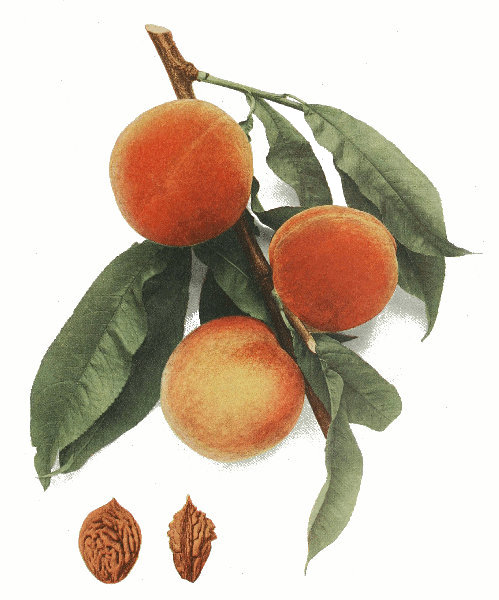
ADMIRAL DEWEY
Tree large, vigorous, upright-spreading, hardy, very productive; trunk thick, smooth; branches stocky, reddish-brown mingled with light ash-gray; branchlets slender, long, olive-green overspread with dark red, glossy, smooth, glabrous, with numerous lenticels, raised near the base.
Leaves six inches long, one and one-half inches wide, folded upward, oval to obovate-lanceolate, thin; upper surface olive-green, smooth except near the midrib; lower surface light grayish-green; margin finely serrate, tipped with reddish-brown glands; petiole one-fourth inch long, with one to seven large, reniform, greenish-yellow glands variable in position.
Flower-buds small, short, conical, pubescent, plump, free; blossoms appear in mid-season; flowers pink, one and one-half inches across, well distributed, usually in twos; pedicels short, thick, glabrous, green; calyx-tube dull reddish-green, orange-colored within, campanulate, glabrous; calyx-lobes short, broad, obtuse, glabrous within, slightly pubescent without; petals round-ovate, tapering to short, broad claws red at the base; filaments one-half inch long, shorter than the petals; pistil pubescent at the ovary, equal to the stamens in length.
Fruit matures early; two and one-fourth inches long, two and one-half inches wide, round-oblate, slightly compressed; cavity deep, wide, abrupt, with tender skin; suture shallow, becoming deeper at the extremities; apex roundish or flattened, with mucronate tip variable in size; color deep orange-yellow, blushed with dark red, indistinctly splashed and mottled; pubescence heavy; skin thin, tender, adherent to the pulp; flesh yellow, tinged with red near the pit, juicy, stringy, tender, melting, sweet but sprightly; good in quality; stone semi-free to free, one and one-fourth inches long, seven-eighths inch wide, oval to obovate, flattened at the base, tapering to a short point, with grooved surfaces; ventral suture deeply grooved along the sides, wide; dorsal suture a deep, wide groove.
ALEXANDER
1. Cult. & Count. Gent. 38:598. 1873. 2. Mich. Hort. Soc. Rpt. 263, 264. 1874. 3. Gard. Mon. 17:367, 368. 1875. 4. Am. Pom. Soc. Cat. 28. 1877. 5. Gard. Mon. 19:147, 303. 1877. 6. Hogg Fruit Man. 436. 1884. 7. Mich. Hort. Soc. Rpt. 424. 1886. 8. Tex. Sta. Bul. 39:809, figs. 5 & 9. 1896. 9. Ont. Fr. Exp. Sta. Rpt. 6:21 fig. 1899. 10. Fulton Peach Cult. 173. 1908. 11. Waugh Am. Peach Orch. 198. 1913. 12. U. S. D. A. Plant Immigrants 117:958. 1916.
Alexander's Early. 13. Am. Pom. Soc. Rpt. 75, 76. 1873. 14. Horticulturist 28:224. 1873.
For nearly a half-century Alexander has been one of the notable early peaches on this continent, hardiness and vigor of tree contributing with earliness to make the variety popular. Unfortunately, there are few fruit-characters to commend Alexander; the peaches run small, the flesh clings to the stone and is so tender that the two can be separated only with difficulty, and the quality is poor. Added to the defects of the fruit the trees have the grave fault of being unproductive. The fruits, too, are very susceptible to brown-rot but to offset this weakness, the trees are more resistant to leaf-curl than those of the average variety. Alexander has been more or less grown in every peach-region on this continent, sometimes attaining considerable commercial importance, but is now widely cultivated only on the Pacific Slope, and even here it is evidently destined to pass out before many years in the competition with newer and better sorts. It is often confused with Amsden though the two are quite distinct.
Alexander originated soon after the Civil War on the farm of O. A. Alexander, Mount Pulaski, Illinois. Since 1877 it has been on the fruit-list of the American Pomological Society. It has been the parent of a score or more of meritorious extra-early peaches.
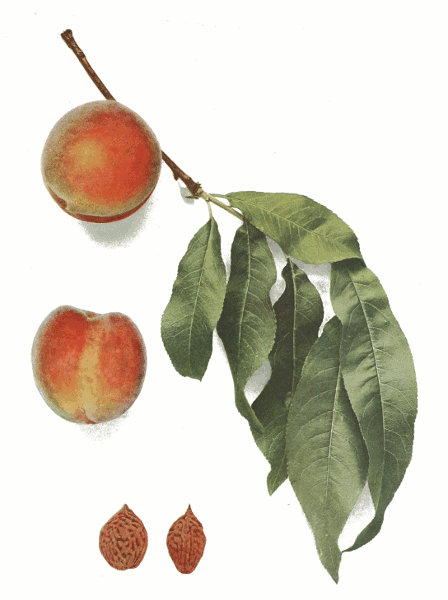
ALEXANDER
Tree large, vigorous, upright-spreading, hardy, unproductive; trunk stocky, smooth; branches reddish-brown overlaid with light ash-gray; branchlets medium to long, olive-green overlaid on the sunny side with dark red, smooth, glabrous, with conspicuous, large, raised lenticels.
Leaves six inches long, one and one-half inches wide, folded upward, oval-lanceolate, thin, leathery; upper surface dark green, smooth; lower surface light grayish-green; margin finely serrate, tipped with dark red glands; petiole three-eighths inch long, glandless or with one to four small, usually globose, greenish-yellow glands tipped with red, variable in position.
Flower-buds oblong-conic, pubescent, usually free; blooming season early; flowers pale pink, one and seven-sixteenths inches across, in well-distributed clusters; pedicels very short, thick, glabrous, greenish; calyx-tube dull green, light yellowish within, campanulate, glabrous; calyx-lobes short, broad, acute, glabrous within, slightly pubescent without; petals roundish, often broadly notched near the base, tapering to short, broad claws marked with red; filaments nearly one-half inch long; pistil pubescent at the ovary, equal to the stamens in length.
Fruit matures very early; two and one-eighth inches long, two and one-fourth inches wide, round, slightly compressed, with sides nearly equal; cavity deep, abrupt or slightly flaring; suture shallow; apex depressed, ending in a mucronate or small, mamelon, recurved tip; color greenish-white becoming creamy-white, blushed and blotched with dark red, mottled; pubescence short; skin separates readily from the pulp; flesh greenish-white, juicy, stringy, sweet, very mild; fair to good in quality; stone clinging, one and one-fourth inches long, five-eighths inch thick, oval, plump, faintly winged, abruptly pointed at the apex, with slightly pitted surfaces and with a few grooves; ventral suture deeply grooved along the sides, bulged; dorsal suture deeply furrowed, faintly winged.
ALTON
1. Ill. Hort Soc. Rpt. 181. 1898. 2. Rural N. Y. 60:726, 774. 1901. 3. Am. Pom. Soc. Cat. 35. 1909. 4. N. Y. State Fr. Gr. Assoc. Rpt. 21. 1912.
Minnie. 5. Mich. Sta. Bul. 118:30. 1895. 6. Tex. Sta. Bul. 39:813. 1896. 7. Ill. Hort. Soc. Rpt. 53. 1896. 8. Mich. Sta. Bul. 169:220. 1899. 9. Budd-Hansen Am. Hort. Man. 2:351, 352. 1903.
Alton is everywhere held in high esteem as an early mid-season, white-fleshed, semi-free peach. It merits the esteem bestowed upon it by virtue of large size, handsome appearance and high quality of the peaches and hardiness and productiveness in the trees. It ripens a little earlier than Champion, long the favorite white-fleshed peach of its season, does not rot so readily when brown-rot is rife and hangs longer on the tree in good condition. It is not, however, quite so choicely good in quality as Champion, nor, on the Station grounds at least, are the trees quite as productive. Other faults of Alton are that leaf-curl takes heavy toll on unsprayed trees, the blossoms open so early as often to be caught by spring frosts, and the peaches show great variation in size and shape and even in texture and flavor. The accompanying cut shows the beauty of the outside but unfortunately on the grounds of this Station the variety is almost a clingstone so that the stone could not be separated to permit photographing the creamy-white flesh, red at pit, and, all in all, most tempting to the eye. Alton seems to be most at home in the Middle West and South and is not a familiar inhabitant of eastern orchards as a commercial product.
This variety originated with T. V. Munson, Denison, Texas, a quarter-century ago and was introduced by him under the name Minnie. By some it is supposed to have come from Alton, Illinois, and to have been introduced as Emma but this is an error. Munson's Minnie was tested at the Illinois Experiment Station from which place Stark Brothers Nursery Company, Louisiana, Missouri, received it and propagated it under the name Alton. In 1909 the American Pomological Society placed the variety upon its list of fruits as Alton, a name which usage makes preferable to the first one, Minnie.
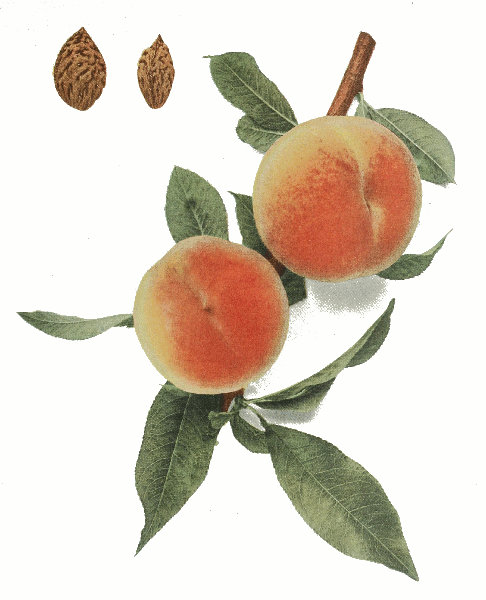
ALTON
Tree large, vigorous, spreading, hardy, medium in productiveness; trunk very stocky; branches thick, reddish-bronze overlaid with light ash-gray; branchlets slender, long, olive-green mingled with dull red, smooth, glabrous, with many small, inconspicuous lenticels.
Leaves six and one-fourth inches long, one and three-fourths inches wide, folded upward, oval-lanceolate, broad; upper surface dark green, rugose at the base; lower surface light grayish-green; margin finely serrate, tipped with dark glands; petiole three-eighths inch long, with two to four reniform glands, greenish-yellow, tipped with dull red, variable in position.
Flower-buds small, short, conical, usually appressed, heavily pubescent; season of bloom early; flowers pale pink, nearly two inches across; borne usually singly; pedicels very short, glabrous, green; calyx-tube dull reddish-green, tinged with greenish-yellow within, campanulate, glabrous; calyx-lobes acute to slightly obtuse, glabrous within, heavily pubescent without; petals roundish-oval, with blunt apex, frequently notched near the base, tapering to narrow claws; filaments one-half inch long; pistil pubescent at the ovary, as long as the stamens.
Fruit matures in early mid-season; two and five-sixteenths inches long, two and five-eighths inches thick, round-oblate, slightly compressed, with unequal halves; cavity abrupt or slightly flaring; suture of medium depth; apex roundish, mucronate; color creamy-white overspread with dull red, dotted and splashed with carmine; pubescence thin, short; skin tough, adhering slightly to the pulp; flesh white, juicy, stringy, tender, pleasantly subacid; fair in quality; stone semi-cling, one and three-eighths inches long, seven-eighths inch wide, obovate, plump at the apex, winged near the base, with pitted surfaces; ventral suture deeply grooved along the sides, narrow; dorsal suture deeply grooved.
ARP
1. N. Y. State Fr. Gr. Assoc. Rpt. 24. 1913.
Arp Beauty. 2. N. J. Hort. Soc. Rpt. 100. 1911. 3. N. Y. State Fr. Gr. Assoc. Rpt. 213. 1913. 4. N. Y. Sta. Bul. 364:183. 1913.
Arp is the earliest good yellow peach. This is the chief reason for its cultivation though it has other good characters beside earliness to give it a place among yellow peaches. At this Station the trees are healthy, vigorous, productive and hardier in bud than the average, the buds having withstood the cold of two test winters. The round-oval shape and shallow suture give it a pleasing appearance of rotundity. To its shapeliness, add a skin creamy-yellow, heavily blushed with red and covered with short, thick pubescence with the sheen of velvet, and you have a beautiful peach—well shown in the color-plate. The flesh is light yellow, firm, juicy, sweet, rich, and of excellent quality, but unfortunately clings rather tenaciously to the stone. The season of Arp is from a month to five weeks earlier than Elberta and for so early a peach is remarkably long. It is somewhat susceptible to brown-rot. We do not know from experience how the fruit will ship but believe it will stand the wear and tear of transportation and markets as well as any of the standard peaches. Arp ought to be in every home orchard. Attention is called to the fact that the June Elberta in the hands of some growers is Arp.
Arp originated with C. P. Orr, Arp, Texas, about 1897. Elberta is supposed to have been one of the parents while the other may have been a peach of the Indian type. The variety was introduced by the originator about 1902.
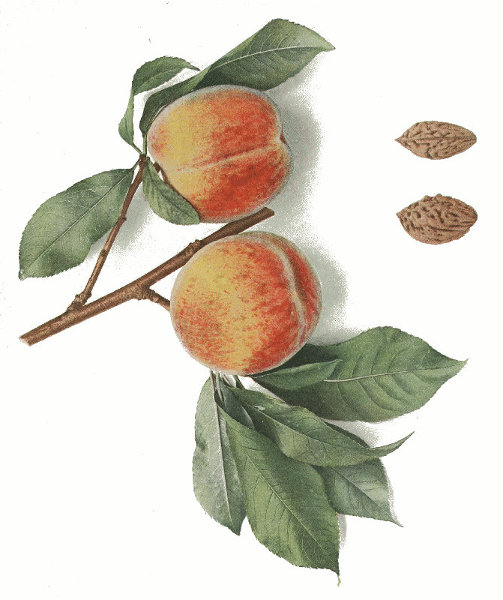
ARP
Tree rather large, vigorous, spreading, hardy, productive; trunk stocky, intermediate in smoothness; branches thick, smooth, reddish-bronze overlaid with light ash-gray; branchlets with internodes intermediate in length, pinkish-red mingled with green, smooth, glabrous, with many smallish lenticels.
Leaves six and one-fourth inches long, one and one-half inches wide, folded upward, oval-lanceolate, sometimes inclined to obovate, thin, somewhat leathery; upper surface dark green; lower surface grayish-green; margin finely serrate, tipped with reddish-brown glands; petiole three-eighths inch long, with one to three large, reniform, greenish-yellow or reddish-brown glands usually at the base of the leaf.
Flower-buds intermediate in size and length, plump, oblong-conic, pubescent, appressed; blossoms opening in mid-season; flowers light pink, one and three-fourths inches across; borne seldom in twos; pedicels short, glabrous, green; calyx-tube dark reddish-green, dull orange within, campanulate, glabrous; calyx-lobes long, medium in width, obtuse to acute, glabrous within, heavily pubescent without; petals round-obovate, usually broadly notched on each side of the base, tapering to short, narrow claws; filaments one-half inch long; pistil glabrous, pubescent at the ovary, equal to the stamens in length.
Fruit matures early; two and one-sixteenth inches long, two and one-eighth inches wide, oval to round, compressed, the halves unequal; cavity medium to deep, wide, abrupt; suture shallow, deeper at the base; apex roundish or depressed, with a mucronate tip; color greenish-yellow changing to deep yellow, heavily blushed with red, indistinctly striped, with conspicuous, large dots; pubescence short, stiff, thick; skin thick, tough, adhering to the pulp; flesh light yellow mingled with faint stripes of red radiating from the pit, juicy, stringy, tender, sweet, highly flavored; very good in quality; stone clinging, one and three-sixteenths inches long, three-fourths inch wide, narrow-oval, plump, with short, acute apex, the surfaces pitted and with few short grooves; ventral suture slightly winged, rather widely furrowed; dorsal suture a deep, narrow groove.
BELLE
1. Ga. Sta. Bul. 42:233. 1898. 2. Am. Gard. 21:852. 1900. 3. Ga. Sta. Rpt. 13:308. 1900. 4. Am. Pom. Soc. Cat. 35. 1909.
Belle of Georgia. 5. Am. Gard. 17:67. 1896. 6. Ohio Sta. Bul. 170:172, 173 fig. 1906.
Georgia. 7. Am. Pom. Soc. Cat. 33. 1899. 8. Del. Sta. Rpt. 13:99, 100 fig. 5. 1901.
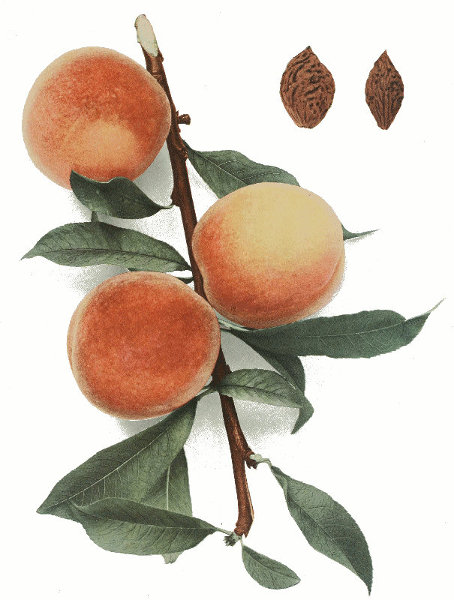
Belle elicits praise from all who know it because of the great beauty of its fruits. At its best it is one of the glories of the peach-orchard, the fruits being large, trim in contour, creamy-white, with a beautiful crimson cheek—truly voluptuous in form and color. The color-plate—made in a poor season—falls far short of doing the fruits justice in size and art cannot depict the soft tints of red and cream which make Belle so beautiful. The fruits are as enticing to the eye inwardly as outwardly, the white flesh being delicately marbled, tinted with red at the pit and the flesh and pit usually part cleanly. Unfortunately, appearance misrepresents quality; for the variety, while good, falls short in flavor, and the flesh is stringy so that it must be rated as not above the average for its type. The trees are large, open-headed, a little straggling, fast-growing and hardy, though, like most of its type, easy prey to leaf-curl. Belle prefers a southern climate and in the South is often a good commercial sort but in New York is grown only for local markets and home use, hardly equalling Champion as a white-fleshed peach for distant markets.
Belle came from a seed of Chinese Cling planted in 1870 by L. A. Rumph, Marshallville, Georgia. The other parent is unknown but it is supposed to have been Oldmixon Free, a tree of which stood near the Chinese Cling tree. The variety came to notice about the same time as Elberta and has been thought by some to be a seedling of Elberta. The American Pomological Society listed Belle in its catalog in 1899 as Georgia but in 1909 changed the name to Belle and it is so designated in horticultural treatises but popularly it is "Belle of Georgia."
BELLE
Tree large, vigorous, spreading, open-topped, hardy, very productive; trunk thick; branches stocky, smooth, reddish-brown covered with light ash-gray; branchlets thick, medium to long, olive-green overlaid with dark red, smooth, glabrous, with numerous conspicuous, rather small lenticels.
Leaves five and one-half inches long, one and one-half inches wide, folded upward, oblong-lanceolate, somewhat leathery; upper surface dark green, smooth; lower surface light grayish-green; margin coarsely serrate, tipped with dark red glands; petiole three-eighths inch long, with two to six large, reniform or globose, greenish-yellow glands variable in position.
Flower-buds large, long, oval, very plump, strongly pubescent, usually appressed; blooming season early; flowers pale pink but deeper in color along the edges, one and three-eighths inches across, often in twos; pedicels long, thick; calyx-tube dull reddish-green, yellowish within, campanulate, glabrous; calyx-lobes medium in length and width, acute to obtuse, glabrous within, heavily pubescent without; petals roundish-oval, tapering to short, broad claws red at the base; filaments nearly one-half inch long; pistil pubescent at the ovary, longer than the stamens.
Fruit matures in mid-season; two and one-sixteenth inches long, two and one-eighth inches wide, roundish-oval, often bulged near the apex, somewhat compressed, with halves nearly equal; cavity abrupt or somewhat flaring, red, with tender skin; suture shallow, deepening toward the apex; apex roundish to slightly pointed, with a mucronate tip; color greenish-white changing to creamy-white, blushed with red, with faint stripes and splashes of darker red, mottled; pubescence short, fine, rather thick; skin thin, tender, adherent to the pulp; flesh white, tinged with red at the pit and with radiating rays of red, juicy, stringy, tender, sweet, mild; good in quality; stone semi-free to free, one and one-eighth inches long, thirteen-sixteenths inch wide, oval, bulged near the apex, blunt at the base, with short, sharp point at the apex, with deeply-pitted surfaces; ventral suture deeply furrowed along the sides, wide; dorsal suture a narrow groove.
BEQUETTE FREE
1. Mich. Sta. Bul. 118:32. 1895. 2. Am. Pom. Soc. Cat. 35. 1909.
Bequett Free. 3. U. S. D. A. Pom. Rpt. 41. 1895. 4. Am. Pom. Soc. Cat. 32. 1899. 5. Budd-Hansen Am. Hort. Man. 2:337. 1903.
Becquette Free. 6. Tex. Sta. Bul. 39:806. 1896. 7. Del. Sta. Rpt. 13:91. 1901.
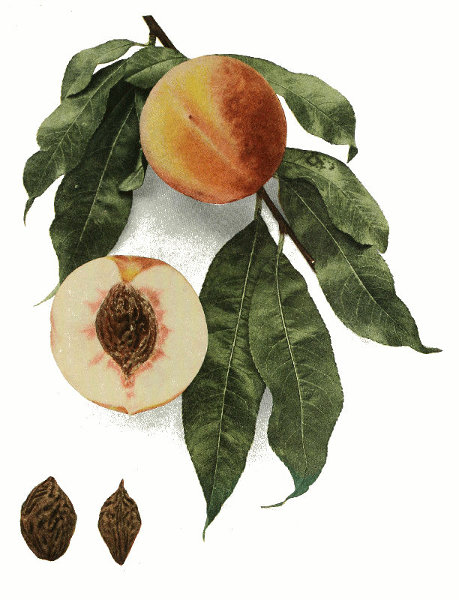
As it grows at this Station, Bequette Free makes a favorable impression because of the flavor and attractive appearance of the fruit. It is not a new variety, however, and the fact that it seems to have been rather widely and well tested without receiving general commendation except on the Pacific Slope is against its having a place in the list of desirable peaches for the Eastern States. The trees are fast-growing, very vigorous, hardy and densely clothed with foliage but cannot be called fruitful and are, possibly, a little too susceptible to leaf-curl. The color-plate shows the fruit to be a little more irregular than it is in nature.
This variety originated about 1860 in a seedling orchard of Benjamin Bequette, Visalia, California. J. H. Thomas of the same place named the sort and first propagated it about 1877. In 1899 the American Pomological Society added the variety to its list of fruits under the name Bequett Free but in 1909 corrected the spelling to Bequette Free.
BEQUETTE FREE
Tree large, vigorous, spreading, open-topped, hardy, rather unproductive; trunk thick, smooth; branches stocky, smooth, reddish-brown mingled with light ash-gray; branchlets slender, long, olive-green mingled with dark red, smooth, glabrous, with numerous large and small, inconspicuous, raised lenticels.
Leaves very numerous, six and three-fourths inches long, one and three-fourths inches wide, folded upward, oval-lanceolate inclined to broad-obovate, leathery; upper surface very dark green, smooth or slightly rugose; lower surface light grayish-green; margin coarsely serrate, tipped with dark glands; petiole three-eighths inch long, with two to five large, reniform, greenish-yellow glands variable in position.
Flower-buds large, long, oblong-conic, plump, pointed, heavily pubescent, usually appressed; blossoms appear in mid-season; flowers light to dark pink, nearly one and one-fourth inches across, borne in ones and twos; pedicels short, thick, glabrous, green; calyx-tube reddish-green, light yellow within, campanulate, glabrous; calyx-lobes rather short, medium to narrow, nearly acute, pubescent within, heavily pubescent without; petals roundish-oval, slightly notched near the base, tapering to short, narrow claws tinged with red at the base; filaments nearly one-half inch long, shorter than the petals; pistil heavily pubescent at the ovary, longer than the stamens.
Fruit matures in mid-season; two and one-half inches long, two and three-eighths inches wide, round-oval, compressed, often with unequal sides; cavity small, deep, abrupt or flaring, often tinged with red; suture shallow, deepening toward the apex; apex roundish, depressed at the center, with a small, recurved, mamelon tip; color greenish-white mingled with yellow, blushed, splashed and blotched with dark red; pubescence thick, long, coarse; skin thin, tough, separates readily from the pulp; flesh white, slightly tinged with red near the pit, juicy, stringy, tender and melting, pleasantly flavored, sprightly; good to very good in quality; stone nearly free, one and three-eighths inches long, seven-eighths inch wide, oval, with a short-pointed apex, medium in plumpness, with deeply pitted and slightly grooved surfaces; ventral suture slightly bulged near the apex, deeply furrowed along the edges, narrow; dorsal suture grooved.
BERENICE
1. La. Sta. Bul. 3:44. 1890. 2. Ibid. 27:941. 1894. 3. Tex. Sta. Bul. 39:806. 1896. 4. Ga. Sta. Bul. 42:233. 1898. 5. Del. Sta. Rpt. 13:92. 1901. 6. Mich. Sta. Bul. 194:45. 1901. 7. Berckmans Cat. 10. 1912-13.
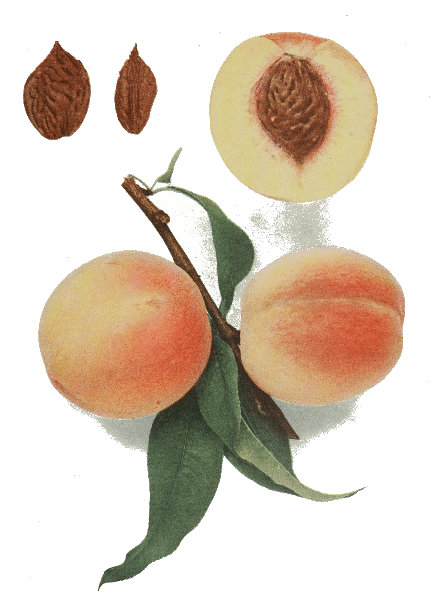
When at its best Berenice is hardly surpassed in quality by any other peach but it seems capricious, in the North at least, and this, with the fact that it is none too attractive in coloring, is probably the reason why the variety is not more grown. The trees are about all that could be desired, falling short chiefly in not being as productive as several other peaches of its season and in being a little susceptible to leaf-curl. The variety has been offered to fruit-growers a sufficient length of time to have had its merits well tried as a commercial peach and the fact that it is not now largely grown is presumptive evidence that it has little commercial value. Its high quality makes the variety a good sort for the home collection at least.
Berenice originated some thirty or more years ago with the late Dr. L. E. Berckmans of Augusta, Georgia. It is supposed to have sprung from the pit of a General Lee tree which grew in one of Mr. Berckmans' test orchards. In the Berckmans nursery catalog it is stated of Berenice that after thirty years' trial "there is nothing equal to it in the same season."
BERENICE
Tree large, vigorous, spreading, open-topped, hardy, medium to productive; trunk stocky; branches thick, smooth, reddish-brown mingled with light ash-gray; branchlets with short internodes, dark red overlaid with olive-green, smooth, glabrous, with numerous large and small lenticels raised at the base.
Leaves six inches long, one and five-eighths inches wide, folded upward, oval to obovate-lanceolate, leathery; upper surface dark green, smooth; lower surface light grayish-green; margin coarsely serrate, tipped with dark glands; petiole one-fourth inch long, with two to ten large, reniform, yellowish-green glands variable in position.
Flower-buds large, oblong, slightly pointed, heavily pubescent, usually appressed; blossoms appear in mid-season; flowers one and three-sixteenths inches across, pale pink, tinged darker along the edges, well distributed; pedicels short, glabrous, green; calyx-tube red mingled with dull, dark green, orange-colored within, campanulate, glabrous; calyx-lobes often broad, acute to obtuse, glabrous within, slightly pubescent or heavily pubescent without; petals round-ovate, broadly notched, tapering to short claws red at base; filaments three-eighths inch long, shorter than the petals; pistil pubescent at the ovary, longer than the stamens.
Fruit matures in mid-season; two and five-eighths inches long, two and one-half inches wide, round-oval, with halves often unequal; cavity deep, medium to wide, contracted around the sides, with tender skin, often blushed with red; suture shallow, deepening toward the apex; apex roundish or depressed, with a mucronate or mamelon tip; color greenish-yellow, blushed and splashed with red; pubescence short, medium fine; skin tough, separates from the pulp; flesh yellow, faintly tinted with red near the pit, stringy, tender and melting, sweet, mild, pleasant flavored; good in quality; stone nearly free, one and three-eighths inches long, fifteen-sixteenths inch wide, oval, plump, drawn out at the ends, usually with pitted surfaces; ventral suture deeply furrowed along the edges; dorsal suture deeply grooved, with sides slightly wing-like.
BLOOD CLING
1. Bridgeman Gard. Ass't Pt. 3:109. 1857. 2. Am. Pom. Soc. Cat. 21. 1897. 3. Waugh Am. Peach Orch. 199. 1913.
Blood Clingstone. 4. Prince Treat. Fr. Trees 17. 1820. 5. Floy Am. Fruits 411. 1825. 6. Downing Fr. Trees Am. 493, 494. 1845. 7. Ibid. 601. 1869. 8. Fulton Peach Cult. 201. 1908.
Blood Peach. 9. Kenrick Am. Orch. 197. 1841.
Indian Blood Cling. 10. Am. Pom. Soc. Cat. 18. 1871.
Indian Blood. 11. Ga. Sta. Bul. 42:237. 1898.
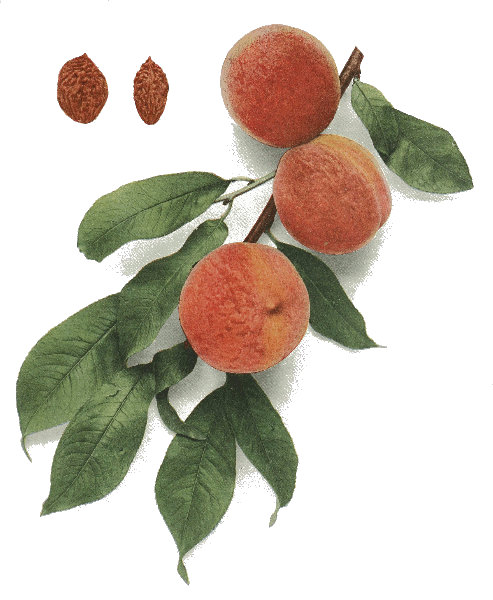
Blood Cling is the favorite curiosity of the peach-orchard and as such we accord it a color-plate and a full description in The Peaches of New York. Unfortunately, the beet-red color of the flesh could not be reproduced with sufficient accuracy to make the attempt satisfactory. It is a pleasant peach to eat out of hand and is much used for pickling and preserving, for which purposes it has real merit. The round-headed, compact tree might make the variety a desirable parent in breeding new peaches.
This peach is an American seedling raised many years ago from the Blood Clingstone of the French. The fruit is much larger than that of the parent sort but otherwise is much the same. The Blood Free raised by John M. Ives of Salem, Massachusetts, while somewhat of the nature of Blood Cling, is, nevertheless, a different sort. The American Pomological Society listed Blood Cling in its catalog in 1871 under the name Indian Blood Cling. In 1897 this name was changed to Blood Cling.
BLOOD CLING
Tree large, vigorous, round, compact, hardy, unproductive; trunk thick; branches stocky, reddish-bronze, with a light ash-gray tinge; branchlets slender, long, with short internodes, olive-green overlaid with dark red, smooth, glabrous, with numerous usually small, inconspicuous lenticels.
Leaves five and three-fourths inches long, one and one-half inches wide, folded upward, oval-lanceolate; leaves thin, somewhat leathery; upper surface dark green, varying from smooth to rugose; lower surface light grayish-green; margin finely serrate, with dark brown glands; petiole three-eighths inch long, with two to five reniform, light or dark green glands variable in position.
Flower-buds large, long, plump, oblong-conic, pubescent, free; flowers open in mid-season; blossoms pink, one and three-eighths inches across; pedicels short, glabrous, pale green; calyx-tube dull, speckled, greenish-red, light greenish-yellow within, campanulate, glabrous; calyx-lobes long, narrow, acute, glabrous within, heavily pubescent without; petals oval to ovate, crenate near the base, tapering to short, narrow claws white at the base; filaments three-eighths inch long, shorter than the petals; pistil pubescent, seven-sixteenths inch long, equal to or shorter than the stamens.
Fruit matures very late; one and three-fourths inches long, one and seven-eighths inches thick, compressed, with unequal halves often giving a lopsided appearance; cavity narrow, abrupt, usually white; suture shallow; apex round, with a mucronate tip; color dull greenish-white, entirely overspread with dingy pink mingled with splashes and stripes of darker, clouded red, mottled; pubescence long, coarse; skin tough, adherent to the pulp; flesh red, becoming lighter colored next the stone, juicy, coarse, stringy, tough and meaty, brisk, pleasantly flavored; fair in quality; stone clinging, one and one-fourth inches long, seven-eighths inch wide, oval to slightly obovate, short-pointed, strongly bulged near the apex, with grooved and pitted surfaces; ventral suture deeply furrowed at the sides, narrow; dorsal suture deep, medium in width.
BLOOD LEAF
1. Mich. Sta. Bul. 118:33. 1895.
Blood-leaved Peach. 2. Gard. Mon. 13:206. 1871. 3. Ibid. 14:316, Pl. 1872. 4. Ibid. 15:142, 183. 1873. 5. Horticulturist 28:155. 1873. 6. Gard. Mon. 17:58, 59. 1875.
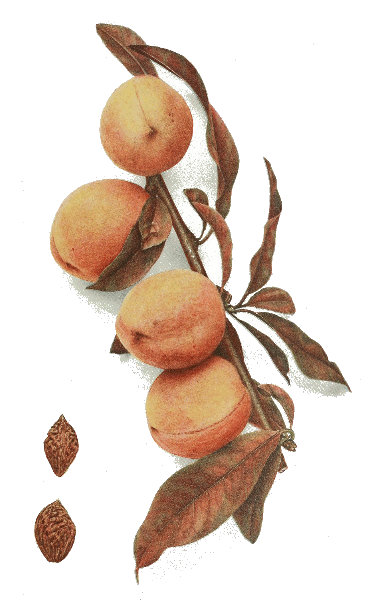
Blood Leaf is a handsome ornamental. Its beet-red leaves in early spring and its pink blossoms, borne in great profusion, entitle it to esteem for both foliage and flowers. It is worth growing as well for its fruits. The color-plate opposite page 78 shows the flowers and the accompanying illustration depicts the fruit-characters. The peaches are in no way remarkable and yet they please some as a dessert fruit. Seedlings springing up under two trees of this variety in the Station orchard in 1913, furnished interesting data on the inheritance of the blood-red color in the leaves of this peach. Out of 252 young trees, 189 were red-leaved and 63 green-leaved—an exact three-to-one ratio to show that the green color is carried as a recessive.
Several stories are told of the origin of this peach. One is that on the battlefield of Fort Donelson, Kentucky, a southern general, fatally wounded, sucked the juice of a peach and threw the stone into the little pool of blood which flowed from his side. From this pit in its bloody seed-bed sprang the tree with its blood-red leaves. John L. Hebron, in a letter published in Gardener's Monthly, 1873, tells a different tale. According to Hebron the variety was found by P. I. Connor in 1866 at Champion Hills, Mississippi, on the battlefield where General Tilghman was killed, a tree having sprung up close to the spot where the General died. The variety is sometimes called the General Tilghman peach. Leaving fable and coming to facts, we find that the variety originated in Mississippi in the sixties and was introduced to the trade in 1871.
BLOOD LEAF
Tree large, vigorous, upright-spreading, willowy in growth, open-topped, hardy, unproductive; trunk thick, rough; branches smooth, reddish-bronze overspread with light ash-gray; branchlets slender, long, with short internodes, dull green overlaid with dark red, smooth, glabrous, with numerous small, inconspicuous lenticels.
Leaves four and three-fourths inches long, one and one-fourth inches wide, folded upward, oval-lanceolate with tendency to obovate, thin; upper surface when young purplish-red but changing to green, smooth or rugose; lower surface purplish-olive; margin finely serrate, tipped with small, dark glands; petiole three-eighths inch long, with two to five small, reniform, greenish-yellow, red-tipped glands variable in position.
Flower-buds large, oblong-conic, plump, pubescent, appressed; blossoms appear in mid-season; flowers one and one-half inches across, pale pink, occasionally in twos; pedicels nearly sessile, glabrous, greenish; calyx-tube dark, dull red mingled with green, yellowish within, campanulate, glabrous; calyx-lobes long, narrow, acute, glabrous within, slightly pubescent to heavily pubescent without; petals oval, slightly contracted toward the apex, tapering to short claws; filaments three-eighths inch long, shorter than the petals; pistil equal to the stamens in length.
Fruit matures very late; one and five-eighths inches long, nearly one and five-eighths inches wide, roundish-oval, slightly compressed, with unequal sides, with prominent bulge near the apex; cavity deep, narrow, abrupt, contracted about the sides, marked with narrow, radiating stripes of pale red; suture very shallow, becoming deeper toward the apex; apex roundish or slightly depressed, with a small, mucronate or recurved, mamelon tip; color greenish-white and pale yellow, lightly washed with dull pink which changes to dull brown, in some cases deepening to a reddish blush; pubescence thick, short, fine; skin thin, tender, adherent to the pulp; flesh white to the pit, juicy, coarse, meaty but tender, sweetish, with some astringency; poor in quality; stone clinging, over one inch long, three-fourths inch wide, oval, very plump, tapering to a short, blunt point at the apex, with grooved surfaces; ventral suture lightly furrowed along the sides, rather wide; dorsal suture with narrow groove, slightly winged.
BRIGDON
1. Am. Gard. 11:244, 378. 1890. 2. Am. Pom. Soc. Cat. 32. 1899. 3. Budd-Hansen Am. Hort. Man. 2:340. 1903. 4. Waugh Am. Peach Orch. 199. 1913.
Garfield. 5. Can. Hort. 26:441, fig. 2665. 1903.
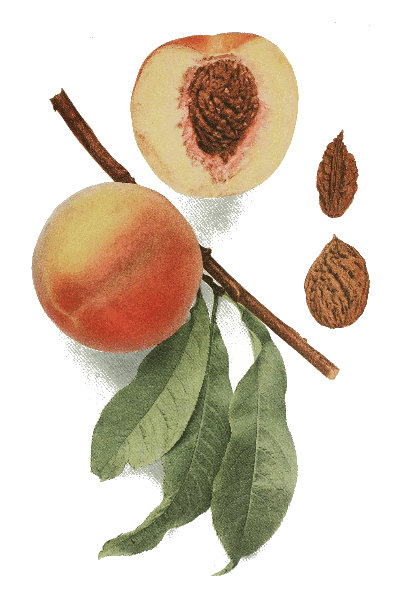
Brigdon is a local variety which possibly local pride puts too much in evidence in assigning it a place among the major varieties in The Peaches of New York. Still, it belongs with the Crawfords, aristocrats among peaches, and this is enough to give it standing in a home collection at least. In tree and fruit it is similar to and a worthy rival of Early Crawford and has the same two fatal faults to bar it from commercial plantations—the trees are capricious as to soils and are often unproductive. On the other hand, a character of the tree to commend it to the amateur is that it is one of the least susceptible of all peach-trees to leaf-curl. The variety is well known only in western New York and is going out in this region.
Brigdon originated more than a quarter-century ago in Cayuga County, New York, and has been grown since more or less extensively on the shores of Seneca Lake. The name Garfield was given to this peach by some one but why or when does not appear. The variety was added to the American Pomological Society's recommended list of fruits in 1899, a distinction it has since held.
BRIGDON
Tree large, vigorous, upright-spreading, open-topped, hardy, unproductive; trunk thick; branches stocky, rather smooth, reddish-brown overlaid with light ash-gray; branchlets slender, with tendency to branch, long, olive-green overlaid with dark red, smooth, glabrous, with numerous large and small, inconspicuous, irregularly shaped and often raised lenticels, the expansion of which causes a cracking of the bark.
Leaves five and seven-eighths inches long, one and five-eighths inches wide, folded upward, oval to obovate-lanceolate, thin; upper surface dark green, rugose; lower surface light grayish-green; margin finely serrate, tipped with dark glands; petiole nearly one-half inch long, glandless or with one to four small, globose, greenish-yellow glands variable in position.
Flower-buds oblong-conic, pubescent, somewhat shrunken, usually free; blossoms open in mid-season.
Fruit matures in mid-season; two and one-half inches long, two and three-fourths inches wide, round-oval to cordate, compressed, bulged beak-like near the apex; cavity deep, medium to wide, abrupt or flaring, often colored with red; suture shallow, becoming deep near the apex; apex roundish, with a pointed or recurved, mamelon tip; color greenish-yellow changing to pale orange-yellow, speckled and splashed with dull red which often extends over nearly the whole surface; pubescence long, thick, woolly; skin thin, somewhat tough, separates from the pulp only when fully ripe; flesh yellow, juicy, coarse, firm, tender, sweet, mild, pleasant flavored; very good in quality; stone semi-free to free, one and one-fourth inches long, seven-eighths inch wide, oval, decidedly bulged on one side, with a rather long and slightly curved point, with pitted and grooved surfaces; ventral suture deeply furrowed along the edges, medium in width; dorsal suture grooved, slightly winged.
CANADA
1. Mich. Sta. Bul. 118:33. 1895.
Early Canada. 2. Gard. Mon. 20:237. 1878. 3. Ibid. 27:144, 145. 1885. 4. Mich. Hort. Soc. Rpt. 80. 1897. 5. Bogue Cat. 25. 1905.
Canadische Frühpfirsich. 6. Mathieu Nom. Pom. 391. 1889.
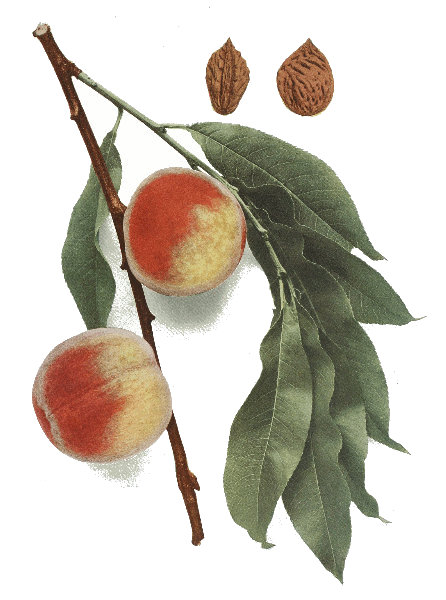
Since its introduction some twenty-five years ago, Canada has been a standard early peach in the northern states and more particularly in the peach-growing region along Lake Ontario in Canada where it originated. The variety has few characters to commend it excepting earliness and hardiness though the trees often load themselves with fruit. The peaches, though small, are attractive in color which is bright red on a light background. The red is well shown in the color-plate though the fruits illustrated are rather smaller than usual. Canada is about the poorest of all peaches in flavor. The fruits are firm and ship well for a white-fleshed peach making, so many maintain, a better commercial variety than its rival, Alexander. On our grounds Canada is freer from rot than Alexander and the flesh does not cling as tightly. All agree that the tree is very hardy. However, there ought to be but small place in the peach-lists of nowadays for a variety so poor in quality and with fruits of such inferior size as those of Canada.
The variety originated as a chance seedling more than a quarter-century ago with A. H. High, Jordan, Ontario, Canada. It is often known as Early Canada and is not infrequently confounded with Amsden and Alexander, varieties of the same season.
CANADA
Tree large, upright-spreading, open-topped, hardy, productive; trunk thick; branches stocky, smooth, reddish-brown overspread with light ash-gray; branchlets with internodes medium in length, dark red, with a slight tinge of green, glossy, smooth, glabrous, slightly curving, with numerous conspicuous, large, raised lenticels.
Leaves folded upward, six inches long, one and one-fourth inches wide, oval to obovate-lanceolate, medium in thickness; upper surface pale olive-green, smooth or rugose; lower surface grayish-green; margin finely serrate, tipped with reddish-brown glands; petiole one-fourth inch long, with one to four small, globose, greenish-yellow glands variable in position.
Flower-buds small, short, narrow, pointed, not very plump, dark colored, appressed; blossoms appear in mid-season; flowers dark pink at the center, bordered with lighter pink, one and one-half inches across; pedicels very short, glabrous, green; calyx-tube reddish-green, lemon-yellow within, obconic, glabrous; calyx-lobes short, obtuse, glabrous within, slightly or heavily pubescent without; petals roundish-ovate, widely notched at the base, tapering to long, broad claws red at the base; filaments one-half inch long, shorter than the petals; pistil equal to the stamens in length.
Fruit matures very early; two inches long, two and one-fourth inches wide, round-oblate, slightly compressed, with unequal sides; cavity wide, flaring; suture shallow to deep; apex ending in a mucronate, recurved tip; color creamy white, blushed with red and mottled and splashed with darker red; pubescence short, thick; skin thin, tender, separates from the pulp; flesh white, juicy, fine-grained, meaty but tender, sweet yet sprightly; fair in quality; stone semi-clinging, one and one-eighth inches long, seven-eighths inch wide, round-oval to elliptical, plump, abruptly pointed, with small grooves in the surfaces; ventral suture very deeply grooved along the sides, narrow; dorsal suture deeply grooved.
CAPTAIN EDE
1. Lovett Cat. 29. 1897. 2. W. N. Y. Hort. Soc. Rpt. 12. 1907.
Ede. 3. Ohio Hort. Soc. Rpt. 183. 1888-89. 4. Mich. Sta. Bul. 169:212. 1899. 5. Del. Sta. Rpt. 13:96. 1900. 6. Am. Pom. Soc. Cat. 37. 1909.
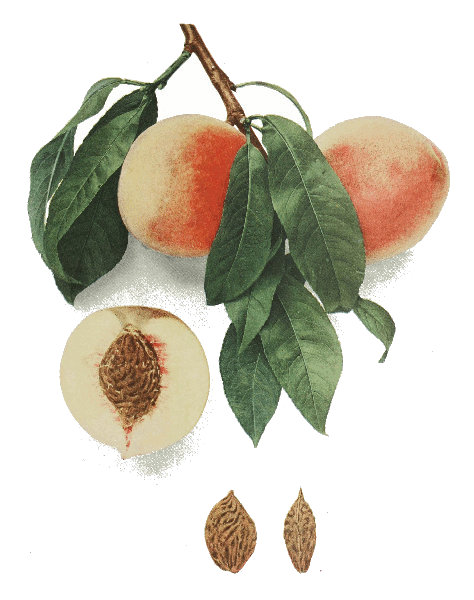
Though Captain Ede has been under cultivation forty-six years it has but recently come into prominence and seems now to find favor quite generally as a money-making peach. Those who recommend it say that the trees are vigorous, heavy bearers and that the crop is uniform and always fair, smooth and without culls. The crop matures in a short time, ships well and is in demand in the markets either as a dessert peach or for culinary purposes. On the Station grounds, Captain Ede comes up to the reputation given it in all respects excepting productiveness—here it is a shy bearer. The peaches, as the color-plate shows, are beautiful, the flavor is subacid but rich, with a distinct smack of the almond. Captain Ede ripens with Early Crawford, a week or ten days before Elberta. The tree, as it grows here, can hardly be distinguished from that of Elberta. We should unhesitatingly recommend Captain Ede to New York peach-growers, were it not for the fear that it does not accommodate itself to a diversity of soils and climates. It does rather better farther south.
Captain Ede originated in 1870 as a seedling in the door-yard of Captain Henry Ede, Cobden, Illinois. Later, it was introduced by George Gould and Son, Villa Ridge, Illinois. The parentage of the variety is unknown. By some, Chinese Cling is supposed to have been one of the parents and others give the same credit to Honest John. The American Pomological Society added Captain Ede to its fruit-list in 1909.
CAPTAIN EDE
Tree large, vigorous, upright-spreading, hardy, not always productive; trunk thick; branches stocky, smooth, reddish-brown overspread with very light ash-gray; branchlets slender, olive-green more or less overspread with dark red, smooth, glabrous, with numerous large or very small, inconspicuous lenticels.
Leaves five and three-fourths inches long, one and one-half inches wide, folded upward, oval to obovate-lanceolate; upper surface dark green, smooth; lower surface light grayish-green; margin finely serrate, tipped with dark red glands; petiole one-fourth inch long, with two to six, reniform, greenish-yellow glands medium in size and variable in position.
Flower-buds large, long, oblong-conic, plump, usually appressed; blossoms open very late; flowers three-fourths inch across, dark pink; pedicels short, glabrous, pale green; calyx-tube dull, dotted reddish-green, orange-red within, campanulate, glabrous; calyx-lobes short, broad, obtuse, glabrous within, heavily pubescent without; petals roundish-ovate, notched near the base, tapering to short, narrow, white claws; filaments one-fourth inch long, equal to the petals in length; pistil pubescent toward the base, equal to the stamens in length.
Fruit matures in mid-season; about two and one-fourth inches in diameter, roundish-cordate to somewhat oval, very slightly compressed, with nearly equal halves, bulged near the apex; cavity wide, abrupt or flaring, often tinged with red and with tender skin; suture variable in depth, extending more than half-way around; apex roundish, with a prolonged, recurved, mamelon tip; color orange-yellow, with specks and splashes of red, blushed with darker red; pubescence thick, short, variable in coarseness; skin tough, adherent to the pulp; flesh yellow, stained red at the pit, dry, stringy, tender, somewhat meaty, strongly aromatic, pleasantly flavored; good in quality; stone free, one and one-fourth inches long, seven-eighths inch wide, oval, bulged along the ventral suture, with pitted surfaces; ventral suture deeply furrowed along the edges, narrow; dorsal suture grooved, somewhat flattened.
CARMAN
1. U. S. D. A. Pom. Rpt. 25. 1894. 2. Rural N. Y. 54:235, 619. 1895. 3. Ga. Sta. Rpt. 13:308. 1900. 4. Del. Sta. Rpt. 13:92, 93 fig. 3. 1901. 5. U. S. D. A. Yearbook 385, 386, Pl. XLVIII. 1901. 6. W. N. Y. Hort. Soc. Rpt. 11. 1907. 7. Am. Pom. Soc. Cat. 36. 1909.
Among the many white-fleshed peaches of recent introduction, few hold a more conspicuous place than Carman. Possibly its chief asset is a constitution which enables it to withstand trying climates, both north and south, and to accommodate itself to a great variety of soils. Thus, we find Carman a very general favorite in nearly every peach-region on this continent. Besides its cosmopolitan constitution, there is much merit in the fruits especially for a peach ripening so early. While of but medium size (the color-plate does not do justice in showing the size of Carman) the peaches are most pleasing in appearance. The color is a brilliant red splashed with darker red on a creamy-white background. The shape is nearly round and the trimness and symmetry of the contour make the variety, especially when packed in box or basket, one scarcely surpassed in attractiveness of form. Carman is rated as very good in quality for a peach of its season though a smack of bitterness in its mild, sweet flavor condemns it for some. The habit of growth is excellent, peaches are borne abundantly, brown-rot takes comparatively little toll and in tree or bud the variety is remarkably hardy. All in all, Carman is one of the most useful peaches of its class and season for either home or commercial planting.
Carman grew from a seed planted in 1889 by J. W. Stubenrauch, Mexia, Texas. The tree fruited in 1892 and its earliness and freedom from rot so pleased Mr. Stubenrauch that he at once began propagating the new variety, naming it Pride of Texas. Later, in 1894, the name was changed to Carman in honor of the late E. S. Carman, long editor of the Rural New Yorker. In 1909 the American Pomological Society added Carman to its list of fruits as one of its recommended varieties.
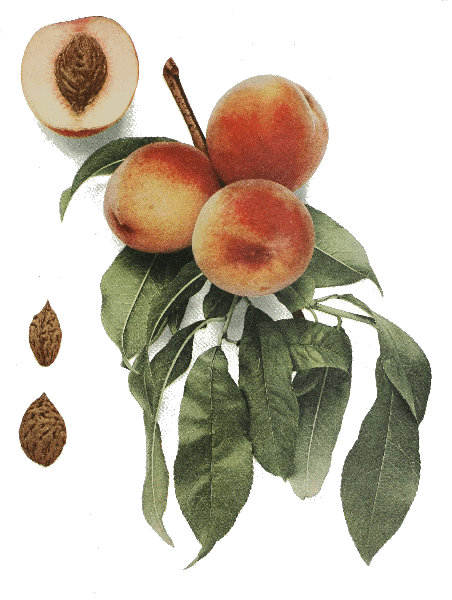
CARMAN
Tree large, vigorous, spreading or somewhat upright, open-topped, hardy, very productive; trunk thick; branches stocky, smooth, bright red overspread with ash-gray; branchlets long, olive-green overspread with dark red, glabrous, smooth, glossy, with numerous small, inconspicuous lenticels.
Leaves five and seven-eighths inches long, one and three-fourths inches wide, folded upward, oval to obovate-lanceolate; upper surface dark green, smooth; lower surface light grayish-green; margin finely serrate, tipped with dark red glands; petiole one-fourth inch long, with three to five reniform glands medium in size and variable in position and color.
Flower-buds oval, pointed, plump, heavily pubescent, appressed; blossoms open in mid-season; flowers one and one-fourth inches across, pink; pedicels short, glabrous, pale green; calyx-tube dull reddish-green, speckled, yellowish-green within, campanulate, glabrous; calyx-lobes short, acute to obtuse, glabrous within, heavily pubescent without; petals oval to ovate, with distinct notches near the base, tapering to narrow, white claws of medium length; filaments three-eighths inch long, shorter than the petals; pistil pubescent near the base, shorter than the stamens.
Fruit matures early; about two and one-fourth inches in diameter, round-oval, compressed, with unequal sides, bulged near the apex; cavity abrupt or flaring, tinged with pink and with tender skin; suture shallow, becoming deeper at the cavity; apex roundish or depressed, with a somewhat pointed or mucronate tip; color creamy-white more or less overspread with light red, with splashes of darker red; pubescence very thick, short; skin thin, tough, adherent to the pulp; flesh white, red at the pit, juicy, tender, sweet, mild, pleasant flavored; very good in quality; stone nearly free, about one and one-half inches long, one inch wide, oval, plump, with thickly-pitted surfaces; ventral suture deeply grooved along the edges, thick, furrowed and winged; dorsal suture deeply grooved.
CHAIRS
1. Mich. Sta. Bul. 169:209. 1899. 2. Rural N. Y. 59:642 fig. 236. 1900. 3. Budd-Hansen Am. Hort. Man. 2:340. 1903.
Chairs' Choice. 4. N. C. Sta. Rpt. 11:108. 1889. 5. Waugh Am. Peach Orch. 200. 1913.
Chair's Choice. 6. Col. O. Hort. Soc. Rpt. 151. 1893. 7. Ill. Hort. Soc. Rpt. 166. 1895. 8. Ibid. 26. 1899.
Chair Choice. 9. Am. Pom. Soc. Cat. 44. 1891.
Chairs is a select fruit in the Crawford group, in its turn the most select of the several groups of peaches. In quality Chairs is unapproachable by varieties outside of its own family and is not surpassed by any within its group. The variety was at one time a standard late, yellow-fleshed, freestone, market peach competing in popularity with Late Crawford over which it often held ascendency because less subject to brown-rot. The coming of the showier and more productive but less well-flavored varieties of the Elberta type has driven the Crawford group from the markets and Chairs is now known only in collections where it will long be treasured for its delectable quality. Unproductiveness and capriciousness in soil and climate, faults of all Crawford-like peaches, are marked in Chairs. The fruits are usually larger than the specimens shown in the accompanying illustration.
Chairs originated about 1880 in the orchard of Franklin Chairs, Anne Arundel County, Maryland. First called Chairs' Choice, the apostrophe was dropped in 1891 by the American Pomological Society and still later the same organization shortened the name to Chairs. Its horticultural value was early appreciated by all pomologists and it has long been a prime favorite.
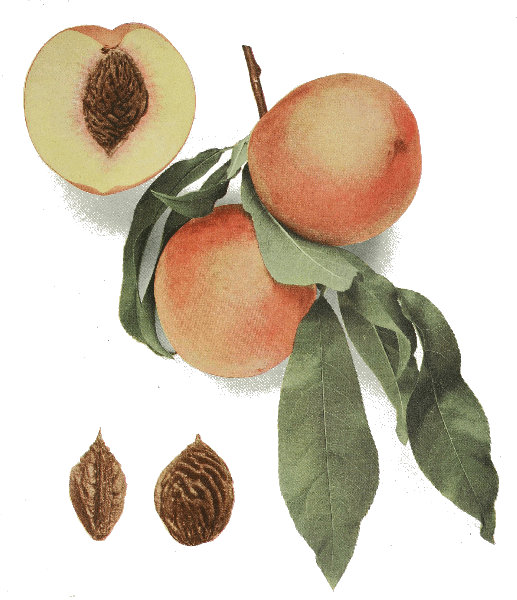
CHAIRS
Tree large, vigorous, upright-spreading, hardy, unproductive; trunk stocky; branches thick, smooth, reddish-brown covered with light ash-gray; branchlets inclined to rebranch, short, with long internodes, olive-green overlaid with dark red, smooth, glabrous, with numerous large and small, raised lenticels.
Leaves five and three-fourths inches long, one and one-half inches wide, folded upward, oval to obovate-lanceolate, thin; upper surface dark green, smooth or somewhat rugose; lower surface light grayish-green; margin coarsely serrate, often in two series, tipped with reddish-brown glands; petiole one-fourth inch long, with two to six small, globose, greenish-yellow glands variable in position.
Flower-buds large, oblong-obtuse, very plump, usually free; season of bloom late; flowers dark pink fading toward the whitish centers, three-fourths inch across; pedicels short, glabrous, pale green; calyx-tube dull, dotted reddish-green, orange-red within, campanulate, glabrous; calyx-lobes obtuse, glabrous within, heavily pubescent without; petals oval or ovate, nearly entire, often notched near the base, tapering to claws of medium width, white at the base; filaments one-fourth inch long, equal to the petals in length; pistil pubescent near the ovary, usually longer than the stamens.
Fruit matures in late mid-season; two and three-fourths inches long, two and seven-eighths inches thick, roundish-oval, irregular, bulged beak-like along one side toward the apex, compressed, with unequal halves; cavity deep, wide, abrupt or flaring; suture shallow, deepening toward the apex and extending slightly beyond; apex roundish, with a mucronate or small, recurved, mamelon tip; color golden-yellow, blushed and splashed with dull red; pubescence short, fine; skin thin, tough, free; flesh yellow, faintly stained with red near the pit, juicy, stringy, tender, subacid or sprightly, pleasantly flavored; very good in quality; stone free, one and three-fourths inches long, one and three-eighths inches wide, large, broadly oval, bulged along one side, plump, with surfaces deeply pitted and with short grooves; ventral suture wide, deeply furrowed along the sides, winged; dorsal suture a deep, wide groove inclined to wing.
CHAMPION
1. U. S. D. A. Rpt. 392. 1891. 2. Mich. Sta. Bul. 118:33. 1895. 3. Ont. Fr. Exp. Sta. Rpt. 2:57. 1895. 4. Am. Pom. Soc. Cat. 21. 1897. 5. Ga. Sta. Bul. 42:233. 1898. 6. Mich. Sta. Bul. 169:209, 210. 1899. 7. Kan. Hort. Soc. Rpt. 48. 1901. 8. Mich. Hort. Soc. Rpt. 112. 1903. 9. Can. Hort. 27:97, 98, fig. 2746. 1904. 10. U. S. D. A. Yearbook 478, 479, Pl. XLV. 1908. 11. Waugh Am. Peach Orch. 200. 1913.
Champion is the white-fleshed peach par excellence in quality—rightly used as the standard to gauge the quality of all other white-fleshed peaches. The fruits are nearly as attractive to the eye as to the palate but unfortunately run small and off color in all but choicely good peach-soils. The peaches are not only very good in the characters that make up quality—tender flesh, juiciness, pleasant flavor—but there is a peculiar honeyed sweetness possessed by few other peaches which gives the Champion individuality. The color, barring a slight excess in yellow, is well shown in the color-plate but the size as shown is small. The tree of Champion is almost perfect from the ground up, few other varieties surpassing it in height and girt and none, on the Station grounds at least, equalling it in the quantity and the luxuriant green of its foliage. A Champion tree is known by its foliage as far as the eye can distinguish color. As would be expected from the tree-characters given, in soils to which it is suited, Champion rejoices in vigor and health as do few other varieties. The variety surpasses most of its orchard-associates in productiveness but the peaches are inviting prey to brown-rot and the trees are sometimes defoliated with leaf-curl so that, with its capriciousness as to soils, it has grave faults as a commercial variety. Because of high quality of the fruit and the beauty of the tree, Champion should have a conspicuous place in the orchard of the amateur.
Champion is a seedling of Oldmixon Free supposedly fertilized by Early York. The original seed was planted about 1880 by I. G. Hubbard, Nokomis, Illinois, and the variety was introduced by him and by the Dayton Star Nurseries in 1890. In the early years of its dissemination Champion was confused with an early, semi-cling variety which originated in western Michigan and which was locally sold for a time under the same name. The American Pomological Society added Champion to its fruit-list in 1897.
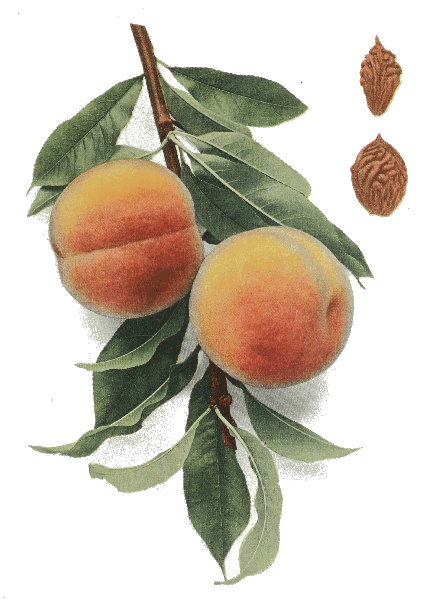
CHAMPION
Tree large, vigorous, spreading, open-topped, very productive; trunk thick; branches stocky, smooth, reddish-brown covered with ash-gray; branchlets thick, very long, with short internodes, olive-green overspread with dull red, smooth, glabrous, with numerous large lenticels, inconspicuous except toward the base.
Leaves five and one-fourth inches long, one and one-half inches wide, folded upward, oval to obovate-lanceolate; upper surface dark green, rugose along the midrib; lower surface grayish-green; margin finely serrate, tipped with dark red glands; petiole three-eighths inch long, with two to five small, globose, greenish-yellow glands variable in position.
Flower-buds large, medium in length, plump, conical, pubescent, free; blossoms appear in mid-season; flowers pink, less than one inch across, well distributed; pedicels short, glabrous, pale green; calyx-tube dark, mottled reddish-green, greenish-yellow within, obconic, glabrous; calyx-lobes short, broad, obtuse, glabrous within, pubescent without, slightly reflexed; petals round-oval to ovate, tapering to narrow, short, white claws; filaments three-eighths inch long, equal to the petals in length; pistil pubescent about the ovary, equal to the stamens in length.
Fruit matures in early mid-season; two and one-fourth inches long, two and three-eighths inches wide, round or round-oval, somewhat truncate, with halves usually equal; cavity shallow, narrow, abrupt or flaring, contracted; suture shallow; apex roundish, usually with a slightly recurved, mucronate tip; color pale green changing to creamy-white, with splashes of carmine mingled with a blush of darker red; pubescence short, thick; skin tough, adherent to the pulp; flesh white, tinged red at the pit, very juicy, markedly tender, sweet, pleasant flavored; very good; stone semi-free to free, one and one-half inches long, about one inch wide, oval, long-pointed, with deeply grooved surfaces; ventral suture furrowed deeply along the sides, wide; dorsal suture deeply furrowed, rather wide, with sides slightly wing-like.
CHILI
1. Am. Pom. Soc. Cat. 21. 1897. 2. Budd-Hansen Am. Hort. Man. 2:340. 1903.
Hill's Chili 3. Am. Pom. Soc. Rpt. 184, 211. 1856. 4. Elliott Fr. Book 298. 1859. 5. Downing Fr. Trees Am. 2nd App. 142, 143. 1872. 6. Am. Pom. Soc. Cat. 28. 1873. 7. Mich. Hort. Soc. Rpt. 483, 484. 1873.
Sugar. 8. Gard. Mon. 11:148. 1869.
Stanley Late. 9. Ibid. 14:347. 1872. 10. Mich. Sta. Sp. Bul. 44:62. 1910.
Jenny Lind. 11. Mich. Hort. Soc. Rpt. 116. 1872.
Cass. 12. Mich. Hort. Soc. Rpt. 14, 15. 1899.
Chili, long familiar to the older generation of peach-growers as Hill's Chili, is now waning in popularity though for nearly a century it was one of the mainstays of peach-growing, having been widely and commonly planted in commercial orchards the country over. Chili, in its day, was one of the notable culinary peaches, being especially desirable for canning and curing because of its firm, dry, but well-flavored flesh, and, besides, it ripened late in the season when cool weather gave storage conditions and made culinary work more agreeable to housewives. The peaches are not at all attractive in size, color or shape, are quite too dry of flesh to eat with pleasure out of hand and are made even less agreeable to sight and taste by pubescence so heavy as to be woolly. The trees of Chili are about all that could be desired, for, while of but medium size, they are vigorous, very hardy, long-lived and, barring injury from cold or frost, are annually fruitful, though the variety has the fault of ripening its crop unevenly—an asset in home orchards, a liability in commercial plantings.
Chili came into cultivation early in the Nineteenth Century, the first tree probably having appeared in the orchard of Deacon Pitman Wilcox, Chili, Monroe County, New York. It comes almost true to seed and several seedlings have sprung up which are almost indistinguishable from it. Among these are Sugar, Stanley Late, Jenny Lind and Cass. Chili was mentioned by the American Pomological Society in 1856 as a worthy sort under the name "Hill's Chili"; placed under this name on the fruit list in 1873; and changed to Chili in 1897.
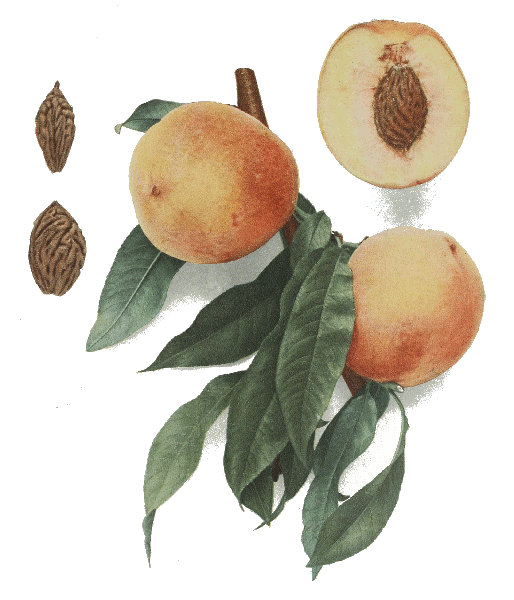
CHILI
Tree medium in size, compact, vigorous, upright-spreading, hardy, productive; trunk thick, shaggy; branches stocky, smooth, reddish-brown covered with light ash-gray; branchlets unusually long, with spur-like branches near the tips, dark reddish-green, glossy, smooth, glabrous, with conspicuous, raised lenticels.
Leaves folded upward and recurved, six inches long, one and one-half inches wide, long-oval to obovate-lanceolate, thin; upper surface dark, dull olive-green, smooth; lower surface grayish-green; margin finely serrate, tipped with reddish-brown glands; petiole three-eighths inch long, with two to seven small, usually reniform, reddish-brown glands mostly on the petiole.
Flower-buds small, short, obtuse, plump, pubescent, nearly free; blossoms appear in mid-season; flowers pink, one and one-half inches across, well distributed; pedicels short, glabrous, green; calyx-tube red at the base, orange-colored within, campanulate, glabrous; calyx-lobes short, medium to broad, obtuse, glabrous within, pubescent without; petals oval, faintly notched near the base, tapering to short claws of medium width, tinged with red at the base; filaments one-half inch long, shorter than the petals; pistil pubescent near the base, longer than the stamens.
Fruit late; two and one-half inches long, two and one-fourth inches wide, oblong-conic, somewhat angular, compressed, with unequal halves; cavity uneven, shallow, medium to wide, contracted, abrupt or flaring, the skin tender and tearing easily; suture shallow, sometimes extending beyond the apex; apex slightly pointed; color greenish-yellow changing to orange-yellow, with a dark red blush, splashed and mottled with red; pubescence long, thick, coarse; skin thin, tough, separates from the pulp; flesh stained red at the pit, yellowish, dry, stringy, firm but tender, mild but sprightly; good in quality; stone free, one and one-half inches long, fifteen-sixteenths inch wide, flattened wedge-like at the base, oval to obovate, winged, usually without bulge, long-pointed at the apex, with pitted surfaces; ventral suture deeply furrowed, wide; dorsal suture deeply grooved.
CHINESE CLING
1. Downing Fr. Trees Am. 636. 1857. 2. Horticulturist 14:107. 1859. 3. Am. Pom. Soc. Cat. 18. 1871. 4. Del. Sta. Rpt. 13:85, 86, 95, 107, fig. 4. 1901.
Shanghae. 5. Mag. Hort. 17:464. 1851. 6. Gard. Chron. 693. 1852. 7. Downing Fr. Trees Am. 641. 1857.
Chinese Peach. 8. Horticulturist N. S. 3:286, 472. 1853.
Shanghai. 9. Hogg Fruit Man. 231. 1866.
De Chang-Hai. 10. Mas Le Verger 7:211, 212, fig. 104. 1866-73.
Chinese Cling holds a high place in the esteem of American pomologists for its intrinsic value, because it was the first peach in one of the main stems of the peach-family to come to America, and because it is the parent, or one of the parents, of a great number of the best white-fleshed peaches grown in this country. The variety is not now remarkable for either fruit- or tree-characters, being surpassed in both by many of its offspring, except, possibly, in quality. The flavor is delicious, being finely balanced between sweetness and sourness, with sweet predominating, and with a most distinct, curious and pleasant taste of the almond. The fruits are too tender for shipment and very subject to brown-rot. The trees are weak-growers, shy-bearers, tender to cold and susceptible to leaf-curl. Chinese Cling created a sensation in pomology when it was brought to America because it was very different from any other peach then here and was superior to any other in several characters. Its seedlings quickly came into prominence with the result that possibly a hundred or more of the varieties named in The Peaches of New York have descended from it. The attempt to hold it and its seedlings in a distinct group fails, as we have tried to show in discussing groups of peaches, because through hybridization they are hopelessly confused with other stocks. The color-plate is an excellent illustration of Chinese Cling.
Chinese Cling was found growing in the orchards south of the city of Shanghai, China, by Robert Fortune, the indefatigable English botanist, who was sent to China by the London Horticultural Society to collect useful and ornamental plants. Fortune sent the peach to England in 1844 under the name Shanghai, a name which it retains, with variable spellings, in Europe. Chinese Cling was imported as potted plants to America in 1850 by Charles Downing through a Mr. Winchester, British consul at Shanghai, China. Downing forwarded one of the trees to Henry Lyons, Laurel Park, Columbia, South Carolina, with whom the variety first fruited in America. Lyons called the new fruit "Chinese Peach." In 1871 the American Pomological Society placed Chinese Cling on its recommended list of varieties, a place it still holds.
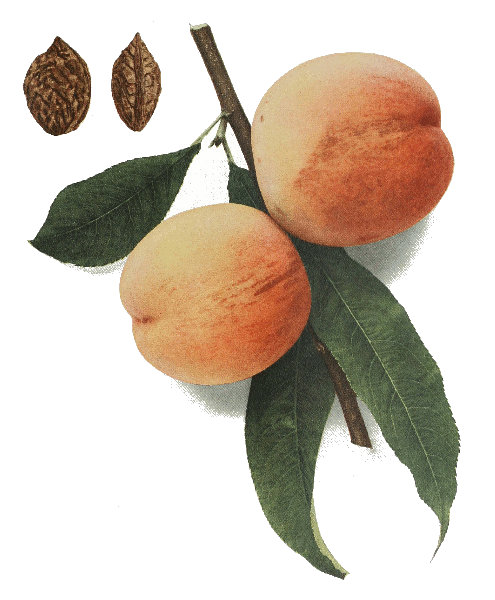
CHINESE CLING
Tree rather weak in growth, upright-spreading, round-topped, not very hardy, medium in productiveness; trunk thick; branches stocky, reddish-brown mingled with light ash-gray; branchlets with short internodes, olive-green more or less overlaid with dark red, smooth, glabrous, with numerous large and very small, inconspicuous lenticels.
Leaves seven and one-half inches long, two inches wide, folded upward, broad oval-lanceolate, thick, leathery; upper surface dark green, smooth, becoming slightly rugose along the midrib; lower surface light grayish-green; margin coarsely crenate to finely serrate, tipped with dark red glands; petiole one-half inch long, with two to five reniform, greenish-yellow, dark-tipped glands variable in position.
Flower-buds large, long, obtuse, plump, very pubescent, somewhat appressed; blossoms appear in mid-season; flowers pink, one and one-half inches across, well distributed; pedicels short, glabrous, green; calyx-tube reddish-green; calyx-lobes medium to broad, obtuse, glabrous within, heavily pubescent near the outer edges; petals ovate, irregularly notched near the base, tapering to short, white claws; filaments one-fourth inch long, shorter than the petals; pistil pubescent at the base, longer than the stamens.
Fruit matures late; two and five-eighths inches long, two and nine-sixteenths inches wide, round-oval, compressed; cavity deep, contracted, narrow, abrupt, faintly tinged with red; suture deep, extending beyond the apex; apex roundish or flattened, with a mucronate tip; color greenish-white changing to creamy-white, blushed on one side with lively red, splashed and marbled with duller red; pubescence thick; skin tough, adhering to the pulp; flesh white, tinged with red near the pit, juicy, meaty, tender, sweet but sprightly, aromatic; good in quality; stone clinging, one and three-eighths inches long, one inch wide, oval, conspicuously winged, bulged on one side, with pitted surfaces; ventral suture deeply furrowed along the sides, rather narrow; dorsal suture large, deep, wide, winged.
CHINESE FREE
1. Ala. Sta. Bul. 11:7, 11. 1890. 2. Am. Pom. Soc. Cat. 44. 1891. 3. Ga. Sta. Bul. 42:234. 1898. 4. Del. Sta. Rpt. 13:95. 1901. 5.Am. Pom. Soc. Cat. 36. 1909. 6. Waugh Am. Peach Orch. 200. 1913.
Perhaps it is enough to say that Chinese Free is Chinese Cling with a free stone—at least it has been so heralded. On our grounds, however, leaves, flowers and fruits are all smaller and the quality of the fruit is not nearly as good while the tree runs a little better in most characters. This, perhaps, is a good example of many of the seedlings of Chinese Cling—the influence of another parent and the stimulus of hybridization are apparent. Chinese Free is surpassed by many other white-fleshed peaches of its season for both home and market. Doubt has arisen as to whether the tree on the Station grounds is the true Chinese Free, yet we think it is the variety now commonly going under this name.
This variety grew from a seed of Chinese Cling in the orchard of W. P. Robinson, Atlanta, Georgia, nearly forty years ago. Mr. Robinson first exhibited it before the Georgia Horticultural Society in 1881 as an unnamed seedling. Thereafter it was sometimes known locally as Robinson but commercially it has always been called Chinese Free. In 1891 the Georgia Horticultural Society formally adopted the latter name. The American Pomological Society listed Chinese Free on its fruit-list in 1891 but dropped it in 1897. In 1909, however, another change in heart caused the Society's officials again to list it in the catalog where it still remains.
Tree above medium in size, vigorous, spreading, the lower branches slightly drooping, open-topped, neither very hardy nor very productive; trunk thick; branches stocky, smooth, reddish-brown tinged with light ash-gray; branchlets slender, inclined to rebranch, long, dark red intermingled with olive-green, glossy, smooth, glabrous, with numerous large, conspicuous lenticels raised toward the base.
Leaves five and three-fourths inches long, one and five-eighths inches wide, folded upward, oval-lanceolate, medium in thickness and toughness; upper surface dark green, rugose along the midrib; lower surface dull grayish-green; margin finely serrate, tipped with dark red glands; petiole three-eighths inch long, with two to six rather large, reniform, greenish-yellow, dark-tipped glands variable in position.
Flower-buds usually obtuse, plump, very pubescent, somewhat appressed; blooming season early; flowers pale pink, darker along the edges, one and one-fourth inches across, often in twos; pedicels short, glabrous, green; calyx-tube dull, dark reddish-green, light yellow within, obconic, glabrous; calyx-lobes acute, glabrous within, pubescent without; petals oval or ovate, tapering to small, narrow claws tinged with red at the base; filaments one-half inch long, usually shorter than the petals; pistil pubescent at the ovary, often longer than the stamens.
Fruit matures in mid-season; two and one-half inches long, two and three-fourths inches wide, roundish-oval, bulged at one side, compressed, with unequal halves; cavity narrow, abrupt, tinged with red, with tender skin; suture shallow but deepening at the apex; apex roundish or pointed, with a mucronate tip; color greenish-white changing to creamy-white, blushed with red, mottled and striped with darker red; pubescence very short, thin; skin thin, tough, separates from the pulp; flesh greenish-white or whitish, stained with red at the pit, juicy, tender, melting, subacid, sprightly; fair to possibly good in quality; stone free, one and one-fourth inches long, fifteen-sixteenths inch wide, oval, plump, abruptly pointed, with purplish-brown, pitted surfaces; ventral suture deeply furrowed along the sides, winged near the base, rather wide; dorsal suture deeply grooved, wing-like.
CLIMAX
1. Am. Pom. Soc. Cat. 44. 1891. 2. Tex. Sta. Bul. 39:804. 1896. 3. Glen St. Mary Cat. 11. 1900. 4. Fla. Sta. Bul. 73:143. 1904. 5. Am. Pom. Soc. Cat. 36. 1909.
Climax is a honey-sweet, freestone peach supposedly adapted only to the far south. The trees on the grounds of this Station seem as hardy as the average and are as productive. Whether or not the peaches are as large and as attractive here as in Florida, where the variety is a commercial sort, we cannot say but certain it is, Climax has no commercial value in New York. The peaches are small, unattractive in color, drop badly, are disfigured by peach-scab and have only honeyed sweetness to recommend them. We figure and describe the variety in full only to show that honey-fleshed peaches can be grown this far north and to call attention to the possibility and desirability of using peaches of this stock in breeding to improve the quality or give new flavors to northern peaches. It would, too, give pleasant variety and add quality to the home orchard.
Climax is a seedling of Honey but neither the date of origin nor the name of the originator is known. The variety was introduced by G. L. Taber, Glen Saint Mary, Florida, in 1886. The American Pomological Society added Climax to its fruit-list in 1891 but dropped it in 1899. In 1909, however, the variety was replaced in the Society's catalog as a peach of merit for the South.
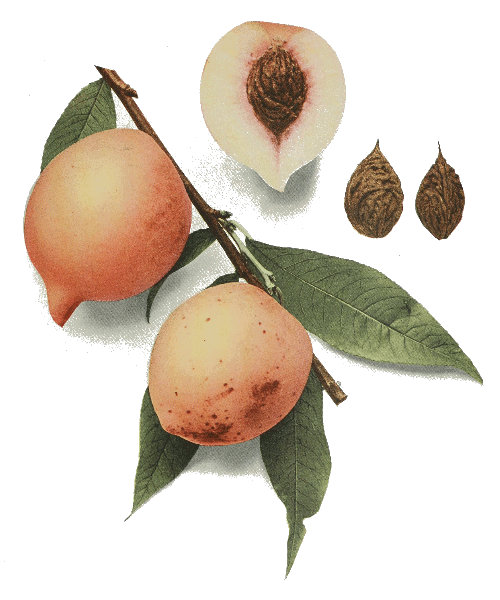
CLIMAX
Tree small, vigorous, upright-spreading, round-topped, dense, productive; trunk roughish; branches roughened by the lenticels, reddish-brown covered with gray; branchlets very slender, long, with short internodes, olive-green overspread with darker red, smooth, glabrous, with very few small, inconspicuous, raised lenticels.
Leaves six inches long, one and three-eighths inches wide, flattened, lanceolate, thin, leathery; upper surface dull, medium green, smooth; lower surface olive-green; margin bluntly serrate, glandular; petiole three-eighths inch long, slender, glandless or with one to four small, reniform glands usually at the base of the leaf.
Flower-buds small and short, conical, plump, pubescent, appressed; blooming season late; flowers pale pink, one inch across; pedicels slender, glabrous, green; calyx-tube dotted reddish-green, greenish-yellow within, obconic, glabrous; calyx-lobes acute or obtuse, glabrous within, pubescent without, partly erect; petals ovate or oval, tapering to narrow claws whitish at the base; filaments shorter than the petals; pistil shorter than the stamens.
Fruit matures in mid-season; two and three-eighths inches long, two and one-eighth inches thick, oval, but slightly compressed, with unequal sides; cavity usually shallow flaring, splashed with red; suture shallow, deepening toward the apex; apex conic, with a long, swollen, often recurved tip; color greenish-white or creamy-white, occasionally with a blush or faint mottlings of red toward the base; pubescence short, thick; skin thin, adherent to the pulp; flesh white, stained with red near the pit, juicy, stringy, melting, very sweet, mild; very good in quality; stone semi-free to free, one and one-fourth inches long, thirteen-sixteenths inch wide, oval, plump, bulged on one side, long-pointed at the apex, with pitted and grooved, reddish-brown surfaces; ventral suture deeply furrowed along the sides, narrow; dorsal suture grooved.
CROSBY
1. U. S. D. A. Rpt. 391, Pl. VIII. 1891. 2. Ont. Fr. Exp. Sta. Rpt. 2:58. 1895. 3. Minn. Hort. Soc. Rpt. 224 fig. 1896. 4. Ohio Hort. Soc. Rpt. 58, 59. 1896-97. 5. Am. Pom. Soc. Cat. 21. 1897. 6. Mich. Sta. Bul. 169:211. 1899. 7. Can. Hort. 23:379. 1900.
Excelsior. 8. Am. Gard. 12:699. 1891. 9. Rural N. Y. 50:736. 1891. 10. Am. Gard. 13:47. 1892.
Of the several virtues which entitle Crosby to the esteem of fruit-growers, possibly the most notable is hardiness in tree and bud so marked that it is often called the "frost-proof" peach. It is doubtful, however, whether it is hardier than other peaches of its kind as Chili, Smock and Heath Cling. Besides hardiness, the trees have to recommend them vigor, health and productiveness, the latter character offset somewhat by small size. The quality of the fruit is excellent. The rich, yellow, freestone flesh is delicious to the taste either as a dessert or as a culinary fruit. In these days of showy fruits, however, Crosby falls far short in appearance, the peaches running small, being somewhat irregular and covered with dense tomentum. Still, at its best, in soils to which it is perfectly suited, the peaches are often handsome. But there lies another fault, the variety accommodates itself but poorly to trying soils and climates, failing especially in hungry soils and dark climates. The variety is noted for its willowy growth, small leaves, small flowers, small pits and, as has been said, hardiness. It is an ideal home sort.
Crosby was sent out about 1876 by a Mr. Crosby, a nurseryman of Billerica, Massachusetts. Later the Massachusetts Agricultural College propagated and distributed it in a small way in northern Massachusetts where it was known as Excelsior. The fact that there was another variety called Excelsior made a change necessary and the peach was renamed in honor of Mr. Crosby. The American Pomological Society placed Crosby on its list of recommended varieties in 1897.
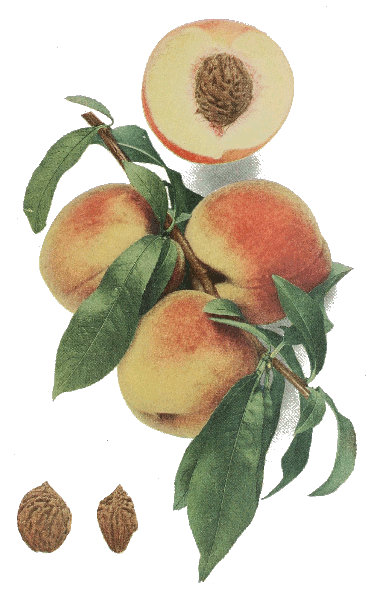
CROSBY
Tree small, vigorous, spreading, open-topped, with lower branches slightly drooping, unusually hardy, very productive; trunk thick; branches of medium size, smooth, reddish-brown overspread with light ash-gray; branchlets slender, inclined to rebranch, long, olive-green almost overspread with dark red, glossy, smooth, glabrous, with numerous large and small, conspicuous lenticels.
Leaves rather small and narrow, five and three-fourths inches long, one and one-fourth inches wide, folded upward, oval to obovate-lanceolate, thin; upper surface dark green, smooth; lower surface light grayish-green; margin finely serrate or crenate, tipped with dark brownish-red glands; petiole three-eighths inch long, with two to seven rather small, reniform, greenish-yellow glands variable in position.
Flower-buds small, short, conical, pubescent, appressed; flowers appear in mid-season; blossoms pale pink, darker near the edges, nearly one inch across, well distributed; pedicels very short, thick; calyx-tube dull reddish-green, orange-colored within, campanulate, glabrous; calyx-lobes short, narrow, acute, glabrous within, pubescent without; petals oval, tapering to long, narrow claws often red at the base; filaments three-eighths inch long, equal to the petals in length; pistil pubescent at the ovary, equal to or sometimes longer than the stamens.
Fruit matures late; two and three-fourths inches long, two and three-eighths inches thick, roundish or roundish-oblate, slightly compressed, bulged near the apex, with unequal sides; cavity deep, abrupt or flaring, sometimes splashed with red; suture shallow, becoming deeper near the apex and extending beyond; apex roundish, with a sunken, mucronate tip; color orange-yellow, often blushed over much of the surface with dull red, splashed and striped with darker red; pubescence long, thick, coarse; skin thick, tough, adherent to the pulp; flesh deep yellow, stained with red near the pit, juicy, stringy, firm but tender, sweet, mild, pleasant flavored; very good in quality; stone free, one and five-sixteenths inches long, one inch wide, oval, plump, bulged near the apex, with pitted and grooved surfaces; ventral suture with shallow furrows along the sides; dorsal suture deeply grooved, winged.
DAVIDSON
1. Harrison & Sons Cat. 16. 1905. 2. Mo. State Fr. Sta. Rpt. 12. 1905-06. 3. Mich. Sta. Sp. Bul. 44:35 fig., 36. 1910.
Davidson is on probation as an early peach for northern climates with the chances greatly against its ever proving worthy the attention of New York peach-growers. Still, it comes so highly recommended that we give it a place among the major varieties in The Peaches of New York hoping that the growers of the State will at least try it out. It is a white-fleshed peach similar to the well-known Rivers, larger in size, but not quite as early. The trees are very hardy, come into bearing early and bear heavily but ripen their crop unevenly. The peaches, as the color-plate shows, are handsome, and for a variety of early season they are particularly good in quality but are very susceptible to brown-rot, peach-scab, leaf-curl and seemingly all the other ills peach-flesh is heir to.
Davidson originated with G. W. Davidson, Shelby, Michigan, and is supposed to be a sport of Early Michigan, being very similar to that sort in all respects except season, Davidson being two weeks earlier. It is often confused with Eureka.
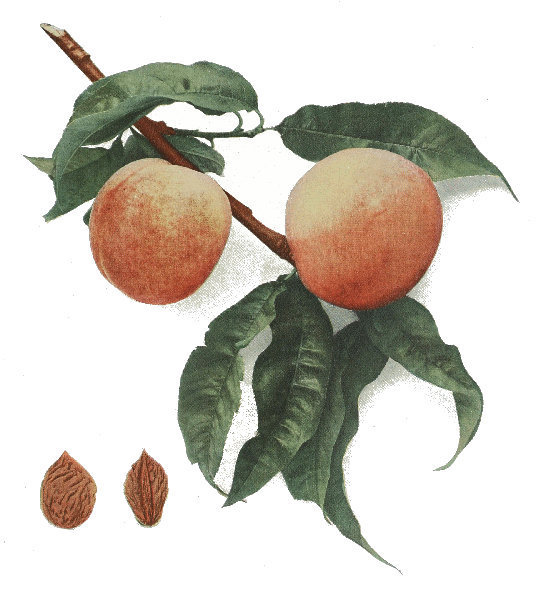
DAVIDSON
Tree large, upright-spreading, hardy, productive; trunk thick; branches stocky, smooth, reddish-brown covered with ash-gray; branchlets dull red strongly colored with olive-green, smooth, glabrous, with numerous small, conspicuous lenticels raised toward the base.
Leaves five and three-fourths inches long, one and five-eighths inches wide, folded upward, oval to obovate-lanceolate; upper surface dark green, smooth or slightly rugose; lower surface light grayish-green; margin broadly crenate or coarsely serrate, tipped with dark red glands; petiole one-half inch long, glandless or with one to five small, reniform, greenish-yellow glands variable in position.
Flower-buds conical, pubescent, plump, appressed; blooming season early; flowers pink, one and three-fourths inches across, well distributed; pedicels nearly sessile, glabrous, green; calyx-tube dull reddish-green, yellowish-green within, campanulate, glabrous; calyx-lobes medium in length, narrow, acute, glabrous within, pubescent without; petals roundish-ovate, often broadly notched near the base, tapering to short, broad claws occasionally with a red base; filaments one-half inch long, shorter than the petals; pistil pubescent at the ovary, equal to the stamens in length.
Fruit matures early; two and one-half inches long, two and three-eighths inches wide, roundish, bulged near the apex, compressed, with unequal halves; cavity contracted, deep, narrow, abrupt; suture shallow, becoming deep at the extremities; apex roundish, with a small, mucronate tip; color creamy-white blushed with dull red, indistinctly striped with darker red; pubescence short, thick; skin tough, separates from the pulp; flesh white, juicy, stringy, tender, melting, sweet or with some sprightliness; fair to good in quality; stone semi-free to free, one and three-eighths inches long, one inch wide, oval, plump, tapering to a short, abrupt point, bulged near the apex, contracted toward the base, with grooved, light-colored surfaces; ventral suture deeply furrowed along the sides, narrow, winged; dorsal suture winged, grooved.
EARLY CRAWFORD
1. Kenrick Am. Orch. 184. 1841. 2. Hovey Fr. Am. 1:29, 30, Pl. 1851. 3. Waugh Am. Peach Orch. 201. 1913.
Crawford's Early Melocoton. 4. Downing Fr. Trees Am. 490. 1845. 5. Mas Le Verger 7:45, 46, fig. 21. 1866-73.
Crawford's Early. 6. Elliott Fr. Book 272, 273. 1854. 7. Am. Pom. Soc. Cat. 211. 1856. 8. Am. Pom. Soc. Rpt. 42, 43. 1856. 9. Leroy Dict. Pom. 6:104 fig. 105. 1879. 10. Fulton Peach Cult. 192, 193. 1908.
Willermoz. 11. Carrière Var. Pêchers 76, 77. 1867. 12. Pom. France 6: No. 10, Pl. 10. 1869. 13. Lauche Deut. Pom. VI: No. 22, Pl. 1882. 14. Mathieu Nom. Pom. 418. 1889.
Unproductiveness and uncertainty in bearing keep Early Crawford from being the most commonly grown early, yellow-fleshed peach in America. In its season, when well grown, it is unapproachable in quality by any other peach and is scarcely equalled by any other of any season. The peach has all of the characters that gratify the taste—richness of flavor, pleasant aroma, tender flesh and abundant juice. Besides being one of the very best in quality it is one of the handsomest peaches. Unfortunately, this Station is one of the many places in which Early Crawford is not at home and the accompanying illustration is far from doing the variety justice in size, shape or color. At their best, the fruits are larger, more rotund and more richly colored than shown in The Peaches of New York. In soils to which it is well adapted the peach is large, often very large, roundish-oblong, slightly compressed, distinguished by its broad, deep cavity, rich red in the sun, splashed and mottled with darker red, and golden yellow in the shade. The flesh is a beautiful, marbled yellow, rayed with red at the pit and perfectly free from the stone. The trees are all that could be desired in health, vigor, size and shape but are unproductive and uncertain and tardy in bearing. Yet with these faults Early Crawford, for at least a half-century, was the leading market peach of its season giving way finally to white-fleshed sorts of the Belle, Carman and Greensboro type. Fast passing from commercial importance, Early Crawford ought long to be grown in home plantations because of the beauty and unexcelled quality of the fruit.
Early Crawford came into existence in the orchard of William Crawford, Middletown, New Jersey, early in the Nineteenth Century. Its merits were first set forth by William Kenrick in the American Orchardist in 1832. The variety in some manner found its way to Europe and came into the hands of Ferdinand Gaillard, a nurseryman at Brignais, Rhone, France, but without a name. Gaillard, believing it to be a new sort, gave it the name Willermoz in honor of M. Willermoz, Secretary of the Pomological Congress of France. Later, French pomologists decided that Gaillard's peach and Early Crawford were identical. The American Pomological Society put this peach on its fruit-list in 1856 under the name Crawford's Early. The name has several times been varied but today the variety is listed as Early Crawford.
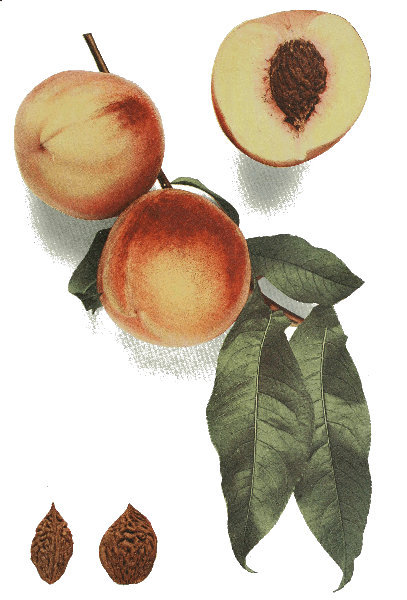
EARLY CRAWFORD
Tree large, vigorous, upright-spreading, round-topped, often unproductive; trunk thick; branches stocky, smooth, reddish-brown very lightly tinged with ash-gray; branchlets with internodes of medium length, pinkish-red intermingled with darker red, glossy, smooth, glabrous, with numerous large and small, conspicuous, raised lenticels.
Leaves six and three-fourths inches long, one and one-half inches wide, folded upward and recurved, oval to obovate-lanceolate, medium in thickness, leathery; upper surface dark green, usually smooth except along the prominent midrib; lower surface light grayish-green; margin finely serrate, often in two series, tipped with very fine, reddish-brown glands; petiole three-eighths inch long, glandless or with one to five small, globose, greenish-yellow glands variable in position.
Flower-buds conical, heavily pubescent, free; blossoms appear in mid-season; flowers pale pink, less than one inch across, well distributed; pedicels very short, thick, glabrous, green; calyx-tube reddish-green, orange-colored within, obconic; calyx-lobes short, medium to narrow, acute, glabrous within, pubescent without; petals oval, broadly notched near the base, tapering to broad claws red at the base; filaments one-fourth inch long, equal to the petals in length; pistil often longer than the stamens.
Fruit matures in early mid-season; two and one-half inches long, two and nine-sixteenths inches wide, round-oval or cordate, bulged near the apex, compressed, with unequal halves; cavity deep, wide, abrupt; suture shallow, becoming deeper near the apex; apex variable in shape, often with a swollen, elongated tip; color golden-yellow, blushed with dark red, splashed and mottled with deeper red; pubescence thick; skin separates from the pulp; flesh deep yellow, rayed with red near the pit, juicy, tender, pleasantly sprightly, highly flavored; very good in quality; stone free, one and one-half inches long, one inch wide, oval or ovate, bulged along one side, medium plump, with small, shallow pits in the surfaces; ventral suture deeply furrowed along the sides, medium in width, winged; dorsal suture grooved, slightly winged.
EARLY YORK
1. Kenrick Am. Orch. 220. 1832. 2. Downing Fr. Trees Am. 475, 476. 1845. 3. Horticulturist 2:399. 1847-48. 4. Proc. Nat. Con. Fr. Gr. 37, 38, 51. 1848. 5. Hovey Fr. Am. 1:45, Pl. 1851. 6. Elliott Fr. Book 273. 1854. 7. Hooper W. Fr. Book 221. 1857. 8. Mag. Hort. 23:518. 1857. 9. Flor. & Pom. 24, Pl. 1862. 10. Hogg Fruit Man. 446. 1884. 11. Fulton Peach Cult. 184. 1908.
Serrate Early York. 12. Thomas Am. Fruit Cult. 290 fig. 1849. 13. U. S. Pat. Off. Rpt. 334. 1856.
York Précoce. 14. Mas Le Verger 7:115, 116, fig. 56. 1866-73. 15. Leroy Dict. Pom. 6:308, 309 fig., 310. 1879.
Early York is entitled to a place among the leading varieties of peaches only because of the part it played in the beginning of the peach-industry in America. As the history which follows shows, it was one of the first named varieties to be grown in this country. It is of more than passing interest, too, because it is one of the few sorts with glandless leaves. The fruits of Early York are insignificant, though the color-plate hardly does the variety justice, but the vigorous, healthy, compact trees have much to recommend them so that the variety might be used as a stepping-stone in improving tree-characters of peaches.
No doubt several distinct varieties have been grown as Early York. Large York, for example, which originated with Prince at Flushing, New York, has probably been more often sold for Early York than any other sort. Early Purple, a very old peach of European origin, was introduced to America about the time Early York came to notice. In some manner this variety has been confused with Early York, the name often being given as a synonym of that variety. The two sorts, however, are distinct and the error of connecting the name has led to much misunderstanding. Early Purple disappeared from American cultivation soon after its introduction and peaches sold under this name today are probably Early York. A controversy has arisen as to the origin of Early York, both America and England having been given as its home. That Early York is of American origin, however, there can be little doubt. Its parentage, the time and place of origin, however, are unknown. It may have come in existence in New York, or possibly New Jersey or, as some have thought, near York, Pennsylvania. The variety was sent to Europe about the middle of the Nineteenth Century where Thomas Rivers grew it at Sawbridgeworth and from it raised several promising seedlings. The leaves of the variety are distinctly serrated, giving rise to the name Serrate Early York. Red Rareripe, another variety having serrated, glandless leaves, has often been confused with Early York. The two are very similar but the fruit of Red Rareripe is larger, broader and ripens about a week later. Early York was placed on the list of recommended fruits at the National Convention of Fruit-Growers in 1848 and since that time has had a place on the fruit-list of the American Pomological Society.
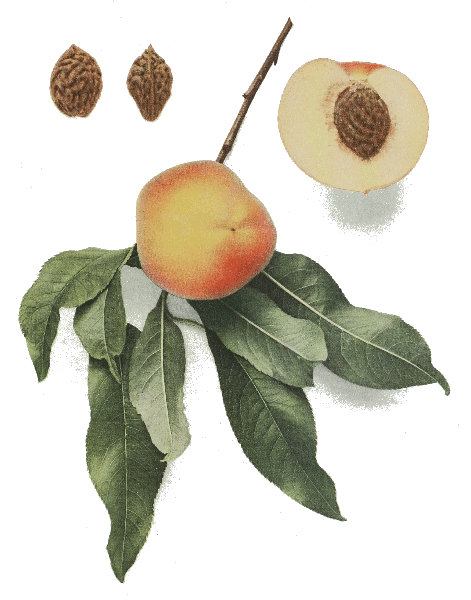
EARLY YORK
Tree large, compact, upright-spreading, unproductive; trunk stocky; branches thick, smooth, reddish-brown tinged with light ash-gray; branchlets very long, dark pinkish-red with some green, glossy, smooth, glabrous, with conspicuous, raised lenticels variable in size, numerous at the base and well scattered along the branches.
Leaves six inches long, one and one-half inches wide, folded upward, oval to obovate-lanceolate; upper surface dark green, smooth becoming slightly rugose along the midrib; lower surface light grayish-green; margin sharply serrate, tipped with reddish-brown glands; petiole seven-sixteenths inch long, glandless.
Flower-buds conical or pointed, heavily pubescent, free; blossoms open very late; flowers seven-eighths inch across, pale pink, the edges darker; pedicels short, glabrous, green; calyx-tube reddish-green, yellow within, campanulate; calyx-lobes short, narrow, acute or obtuse, glabrous within, pubescent without; petals roundish-oval, broadly notched, tapering to short claws of medium width, sometimes stained with red at the base; filaments three-eighths inch long, shorter than the petals; pistil pubescent at the ovary, longer than the stamens.
Fruit matures in early mid-season; two inches long, two and one-fourth inches wide, roundish to nearly oblate, somewhat oblique, with unequal halves; cavity shallow, flaring, with tender skin, often tinged with red; suture shallow, extending beyond the tip; apex variable in shape, with mucronate or sometimes mamelon tip; color pale white or creamy-white, blushed and mottled with carmine; pubescence thin, short; skin tough, adherent to the pulp until fully ripe; flesh white, rayed with red near the pit, juicy, stringy, tender and melting, mild subacid; good in quality; stone nearly free, over one inch long, three-fourths inch wide, oval, plump, flattened at the base, short-pointed at the apex, with pitted surfaces marked by few grooves; ventral suture narrow, with furrows of medium depth along the sides; dorsal suture deeply grooved.
EDGEMONT
1. Harrison & Sons Cat. 18. 1901.
Edgemont Beauty. 2. Barnes Bros. Cat. 7. 1910. 3. Md. Sta. Bul. 159:159. 1911. 4. Stark Bros. Cat. 35. 1913.
In fruit Edgemont is not easily distinguished from Late Crawford, the essential differences being that the fruits of Edgemont are more rotund than those of Late Crawford and the flavor is a little more acid. The trees differ, chiefly, in the greater productiveness of Edgemont and in a little later maturity of the crop. Of the score or more peaches of the Crawford type, in many respects the best of the several types of peaches, Edgemont is distinctly superior to all on our grounds. Compared with Elberta, with which it must compete in the markets, it is several days later, is juicier, less fibrous, much excels that variety in quality and, though the individual peaches are not quite as large, at Geneva the yield of fruit is even greater. If Edgemont proves adapted to as wide a range of climates and soils as Elberta, we shall have a new commercial peach of very great value. Whether it succeeds in commerce or not, Edgemont is well worth planting in home orchards by virtue of the exceptionally high quality and attractive appearance of the fruit.
Edgemont, shortened from Edgemont Beauty, in accordance with the rules of the American Pomological Society, is of rather recent origin, having been introduced by the Miller Orchard Company, Edgemont, Maryland, in 1902.
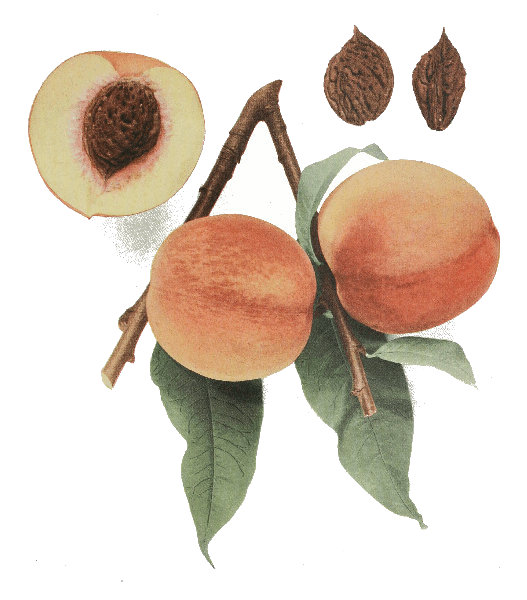
EDGEMONT
Tree large, vigorous, upright-spreading, productive; trunk stocky, smooth; branches thick, smooth; branchlets medium in thickness, purplish-red mingled with brown.
Leaves large, obovate, medium in thickness; upper surface yellowish-green, somewhat wrinkled; margin crenate; glands globose.
Flower-buds half-hardy, medium in size; flowers appear in mid-season, small, dark pink, well distributed, single; pedicels short, somewhat slender; petals ovate, entire; filaments long, sometimes longer than the petals.
Fruit matures in late mid-season; large, irregular, roundish-ovate, truncate at the base, with unequal halves; cavity rather deep, medium to narrow, regular, abrupt; suture shallow; apex mucronate; color light yellow or orange-yellow, with a bronze blush often deepening to an attractive carmine blush; pubescence short, medium in thickness; skin thick, somewhat tough, separates from the pulp; flesh yellow, stained red at the pit, very juicy, slightly coarse and stringy, meaty, mild subacid or sprightly; very good in quality; stone free, large, oval, plump, pointed, with corrugated surfaces.
ELBERTA
1. Am. Pom. Soc. Rpt. 66. 1881. 2. Am. Gard. 9:391 fig. 1888. 3. Can. Hort. 11:281, 282. 1888. 4. Am. Pom. Soc. Cat. 30. 1889. 5. U. S. D. A. Rpt. 382, Pl. 1. 1891. 6. Can. Hort. 17:305, Pl. 1894. 7. Mo. Hort. Soc. Rpt. 272, 273. 1896. 8. Tex. Sta. Bul. 39:807 fig. 1896. 9. Can. Hort. 23:131, 132, fig. 1769. 1900. 10. Del. Sta. Rpt. 13:97 fig. 98. 1900. 11. Rural N. Y. 60:54, 1901. 12. Budd-Hansen Am. Hort. Man. 2:343, 344 fig. 1903.
Elberta leads all other peaches in number of trees in New York and in America. It is, too, the most popular of all peaches in the markets. A study of the variety, though it reveals some shortcomings, justifies its popularity with orchardists and marketmen. The preeminently meritorious character of Elberta is its freedom from local prejudices of either soil or climate—it is the cosmopolite of cultivated peaches. Thus, Elberta is grown with profit in every peach-growing state in the Union and in nearly all, if not all, is grown in greater quantities than any other market peach. The second character which commends Elberta to those in the business of peach-growing is fruitfulness—barring frosts or freezes the trees load themselves with fruit year in and year out. Added to these two great points of superiority are ability to withstand, in fair measure at least, the ravages of both insects and fungi, large size, vigor, early bearing and longevity in tree, and large, handsome, well-flavored fruits which ship and keep remarkably well.
Elberta, however, is not without faults and serious ones. The trees are not as hardy in either wood or blossom as might be wished. In northern regions peaches of the Crosby, Chili, Smock and Wager type stand winter freezes and spring frosts much better. The blossoms open rather too early in New York. The peaches also fall short in quality. They lack the richness of the Crawfords and the sweetness of the white-fleshed Champion type. Moreover, the pronounced bitter tang, even when the peaches are fully ripe, is disagreeable to some. Picked green and allowed to ripen in the markets, Elberta is scarcely edible by those who know good peaches. The stone is large but is usually wholly free from the flesh. With these faults, the dominance of Elberta is not wholly desirable as growers have a feeling of sufficiency with the one variety and consumers are forced to put up with a peach none too high in quality. Still, since no other variety is so reliable for the trade, this, by the way, being about the only variety suitable for export by reason of shipping qualities, Elberta promises long to continue its commercial supremacy.
Elberta was grown by Samuel H. Rumph, Marshallville, Georgia, from a seed of Chinese Cling planted in the fall of 1870. The Chinese Cling tree stood near Early and Late Crawford trees and trees of Oldmixon Free and Oldmixon Cling. Mr. Rumph believed that the Chinese Cling blossom which produced Elberta was fertilized by pollen from Early Crawford. The seedling was named Elberta in honor of Mr. Rumph's wife, Clara Elberta Rumph. An interesting coincidence connected with the origin of Elberta is that another stone from the same Chinese Cling tree was given to L. A. Rumph and from this grew Belle, the splendid white-fleshed, freestone peach. Nurserymen and growers frequently produce strains of Elberta which they think superior to the older sort but the several strains which have been tested on the grounds of this Station have not proved to differ a whit from the old variety. From the number of so-called "Early Elbertas" and "Late Elbertas" it may be suspected that occasionally Elberta, because of some local condition, ripens its fruit prematurely, or that ripening may be delayed; when removed from the particular local environment, ripening time seems to occur normally. Elberta was placed on the American Pomological Society's fruit-list in 1889.
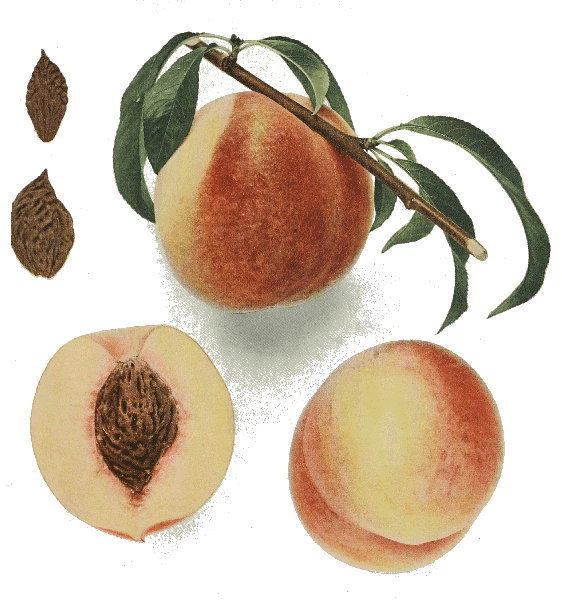
ELBERTA
Tree large, vigorous, upright-spreading, dense-topped, hardy, very productive; trunk thick; branches stocky, smooth, reddish-brown intermingled with light ash-gray; branchlets with tendency to rebranch, with long internodes, olive-green lightly overspread with dark red, glossy, smooth, glabrous, with numerous conspicuous lenticels variable in size.
Leaves six and three-fourths inches long, one and three-fourths inches wide, oval to obovate-lanceolate; upper surface dull, dark olive-green, mottled and somewhat rugose; lower surface grayish-green; margin finely to coarsely serrate, often in two series, tipped with reddish-brown glands; petiole three-eighths inch long, with one to six reniform, greenish-yellow glands medium in size and variable in position.
Flower-buds large, pubescent, conical or obtuse, plump, appressed; flowers appear in mid-season; blossoms light pink near the center, darker pink toward the edges, one and one-fourth inches across; pedicels short, glabrous, green; calyx-tube reddish-green, orange-colored within, obconic, glabrous; calyx-lobes acute, glabrous within, pubescent without; petals oval to ovate, bluntly notched near the base, tapering to broad, short claws red at the base; filaments one-half inch long, shorter than the petals; pistil pubescent at the ovary, longer than the stamens.
Fruit matures in mid-season; two and three-fourths inches long, two and one-half inches wide, roundish-oblong or cordate, compressed, usually with a slight bulge at one side; cavity deep, abrupt to flaring, often mottled with red; suture shallow, deepening toward the apex; apex roundish, with a mamelon or pointed tip; color greenish-yellow changing to orange-yellow, from one-fourth to three-fourths overspread with red and with much mottling extending sometimes over nearly the entire surface; pubescence thick and coarse; skin thick, tough, separates from the pulp; flesh yellow, stained with red near the pit, juicy, stringy, firm but tender, sweet or subacid, mild; good in quality; stone free, one and eleven-sixteenths inches long, one and one-sixteenth inches wide, broadly ovate, varying from flat to plump, sharp-pointed, decidedly bulged on one side, with pitted surfaces; ventral suture deeply furrowed along the sides, narrow, winged; dorsal suture deeply grooved, strongly winged.
ENGLE
1. Mich. Hort. Soc. Rpt. 192, 296, 299. 1893. 2. Mich. Sta. Bul. 169:213. 1899. 3. Am. Pom. Soc. Cat. 37. 1909. 4. Mich. Sta. Sp. Bul. 44:39, 40. 1910.
Engol's Mammoth. 5. Ont. Fr. Exp. Sta. Rpt. 2:58. 1895. 6. Ibid. 6:43. 1899.
Engle is almost a counterpart of the well-known Late Crawford from which it differs essentially in earlier ripening fruit and more productive trees. Before Elberta became the vogue, Engle stood high in the esteem of commercial planters in Michigan and its culture was rapidly spreading into other states but the coming of Elberta stopped its career. There seems little doubt but that Engle is more productive than either of the two Crawfords, splendid peaches which fail because of unproductiveness, and for those who want the best it is as good as any of this group—quite too good to be lost. One of the faults of the two Crawfords is that the trees are tardy in coming in bearing. Engle is said to bear younger. On the Station grounds the fruit drops rather too readily but we do not find this fault mentioned by others.
Engle was grown some forty years ago by C. C. Engle, Paw Paw, Michigan, with a number of seedlings, several others of which proved valuable. Late Crawford may have been the seed parent but of this there can be no certainty. The American Pomological Society added Engle to its list of recommended fruits in 1909.
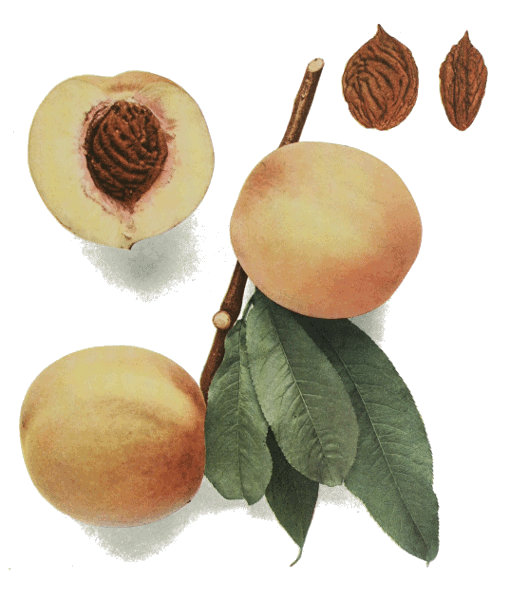
ENGLE
Tree very large, upright becoming spreading, tall, hardy, medium in productiveness; trunk thick, variable in smoothness; branches stocky, smooth, reddish-brown covered with light ash-gray; branchlets long, heavily tinged with olive-green, glossy, smooth, somewhat tortuous, inclined to rebranch, glabrous, with numerous small, conspicuous, raised lenticels.
Leaves six and one-fourth inches long, one and three-eighths inches wide, irregularly curled, oval to obovate-lanceolate, thin; upper surface rather dark, dull olive-green, rugose along the midrib; lower surface light grayish-green; apex narrow-acuminate; petiole three-eighths inch long, with one to four small, globose, greenish-yellow glands at the base of the leaf.
Flower-buds large and long, conical, plump, pubescent, free; blossoms appear in mid-season; flowers light pink at the center, darker red near the edges, one and one-eighth inches across; pedicels very short, glabrous, green; calyx-tube dull reddish-green, orange-colored within, obconic, glabrous; calyx-lobes narrow, acute, glabrous within, heavily pubescent without; petals oval to slightly ovate, faintly and broadly crenate, tapering to claws with red base; filaments three-eighths inch long, shorter than the petals; pistil pubescent at the ovary, equal to the stamens in length.
Fruit matures in mid-season; two inches long, two and seven-sixteenths inches wide, round-oval to cordate, becoming almost oblate in some specimens, bulged near the apex, compressed, with unequal sides; cavity abrupt to flaring; suture shallow, deepening toward the apex; apex variable in shape; color greenish-yellow changing to orange-yellow, in parts overspread with a bright red blush, splashed with darker red; pubescence short, thick, fine; skin thin, tough, separates readily from the pulp; flesh pale yellow, stained with red near the pit, juicy, tender and melting, sweet or pleasantly subacid, mild; good in quality; stone free, one and five-sixteenths inches long, fifteen-sixteenths inch wide ovate, bulged on one side, plump, with pitted surfaces; ventral suture very deeply grooved along the edges; dorsal suture grooved, often winged.