Chapter V · LEADING VARIETIES OF PEACHES (continued 3)
Reading edition
Mamie Ross is probably a seedling of Chinese Cling. It originated about 1881 with Captain A. J. Ross, Dallas, Texas. The variety soon attracted attention and neighbors began propagating it. Later, Mr. Ross' brother named the peach after the originator's youngest daughter. In 1899, the American Pomological Society added the variety to its fruit-list.
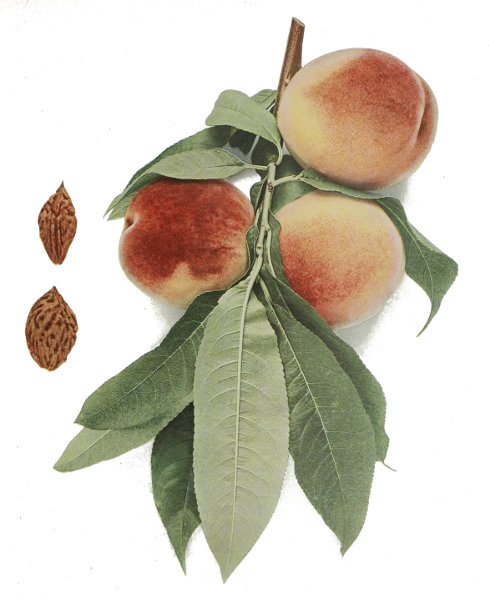
MAMIE ROSS
Tree large, vigorous, upright-spreading to somewhat drooping, open-topped, hardy, productive; trunk thick, smooth; branches stocky, smooth, reddish-brown with light ash-gray; branchlets very long, with long internodes, dark red with considerable olive-green, glossy, smooth, glabrous, with numerous conspicuous, raised lenticels variable in size.
Leaves six and three-fourths inches long, one and three-fourths inches wide, variable in position, oval to obovate-lanceolate, thick, leathery; upper surface dark green, smooth becoming rugose along the midrib; lower surface grayish-green; margin finely serrate, tipped with reddish-brown glands; petiole three-eighths inch long, with none to five small, globose and reniform, reddish-brown glands variable in position.
Flower-buds semi-hardy, obtuse to pointed, plump, heavily pubescent, free or appressed; blossoms open early; flowers one and three-fourths inches across, pink, single; pedicels very short, medium to thick, glabrous, green; calyx-tube reddish-green at the base, greenish-yellow within, obconic, glabrous; calyx-lobes acute or obtuse, glabrous within, heavily pubescent without; petals oval to obovate, entire except near the base, tapering to narrow claws often red at the base; filaments one-half inch long, shorter than the petals; pistil pubescent at the base, equal to the stamens in length.
Fruit matures in early mid-season; two and one-half inches long, two and seven-eighths inches wide, roundish-oval to oblong, often bulged on one side, compressed, usually with sides equal; cavity deep, abrupt, often marked with streaks of red; suture variable in depth; apex small, mucronate, set in a slight depression; color pale yellowish-cream, with more or less dull or bright red in which are splashes of darker red; pubescence short, fine, thick; skin thin, tough, separates from the pulp; flesh white, streaked with red near the pit, very juicy, stringy, tender, melting, sweet or somewhat sprightly, pleasantly flavored; good in quality; stone semi-cling or cling, one and five-eighths inches long, one inch wide, ovate to long-elliptical, plump, long-pointed, bulged on one side, with pitted and grooved surfaces; ventral suture deeply grooved along the edges, narrow, winged; dorsal suture grooved.
MAY LEE
1. Del. Sta. Rpt. 13:105. 1901. 2. Stark Bros. Cat. fig. 1904. 3. Ibid. 62 fig. 4, 63. 1910.
May Lee is a very early white-fleshed, clingstone, pink-cheeked peach introduced to rival Alexander, Triumph and other extra early sorts. It fails, on the Station grounds at least, because the peaches run small, the flesh clings too tenaciously and the stones crack. Neither is the fruit attractive in color nor high in quality. It may be as good in quality as Alexander or Triumph but is no better. The variety is but doubtfully worth planting in New York.
May Lee originated with E. W. Kirkpatrick, McKinney, Texas, from a seed of Mamie Ross planted in 1896.
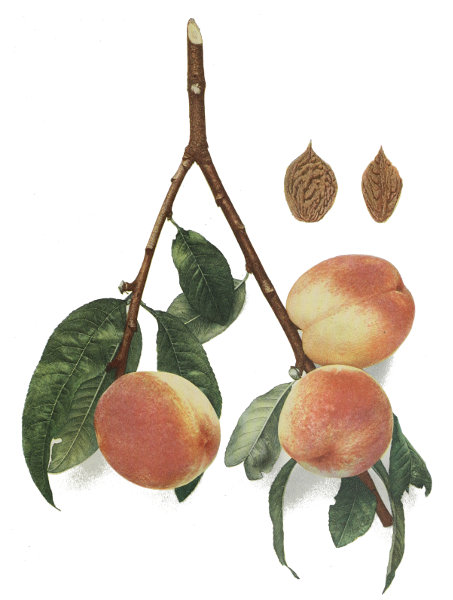
MAY LEE
Tree large, spreading, low-growing, very productive; trunk thick, smooth; branches stocky, smooth, reddish-brown with light ash-gray; branchlets slender, often inclined to rebranch, medium to long, with internodes dark pinkish-red intermingled with olive-green, glossy, smooth, glabrous, with numerous conspicuous, raised lenticels medium in size.
Leaves six and one-half inches long, one and three-fourths inches wide, flattened or curled downward, oval to obovate-lanceolate, rather thick, leathery; upper surface dark green, smooth becoming rugose along the midrib; margin crenate, tipped with small, reddish glands; petiole three-eighths inch long, glandless or with one to five large, reniform glands variable in color and position.
Flower-buds hardy, small, short, conical, plump, very pubescent, appressed or free; blossoms open in mid-season; flowers nearly two inches across, light pink; pedicels very short, of medium thickness, glabrous; calyx-tube greenish-red, campanulate; calyx-lobes obtuse, glabrous within, pubescent without; petals round or broadly ovate, notched near the base, tapering to claws red at the base; filaments one-half inch long, shorter than the petals; pistil pubescent at the ovary, longer than the stamens.
Fruit matures early; about two and three-fourths inches in diameter, round, compressed, bulged along one size, with unequal halves; cavity deep, narrow, abrupt; suture variable in depth, extending beyond the tip; apex small, mucronate, depressed; color creamy-white, usually with a blush toward the apex; tomentose; skin thick, tough, semi-free to free; flesh white, very juicy, tender and melting, sweet, mild, pleasantly flavored; good in quality; stone semi-clinging to clinging, one and nine-sixteenths inches long, one and one-eighth inches wide, oval, conspicuously winged, flattened near the base, with deeply grooved surfaces; ventral suture thin, winged, very deeply grooved along the edges; dorsal suture grooved.
MORRIS WHITE
1. Proc. Nat. Con. Fr. Gr. 39, 51. 1848. 2. Elliott Fr. Book 276. 1854. 3. Am. Pom. Soc. Cat. 22. 1897. 4. Mich. Sta. Bul. 169:220. 1899. 5. Fulton Peach Cult. 190, 191. 1908.
White Rareripe. 6. Coxe Cult. Fr. Trees 222. 1817. 7. Prince Pom. Man. 2:26. 1832.
Morris White Freestone. 8. Lond. Hort. Soc. Rpt. 6:410. 1826. 9. Floy-Lindley Guide Orch. Gard. 189. 1846.
Morris White Rareripe. 10. Downing Fr. Trees Am. 481. 1845.
Blanche de Morris. 11. Mas Le Verger 7:171, 172, fig. 84. 1866-73.
Morris Blanche. 12. Leroy Dict. Pom. 6:171 fig., 172. 1879.
Morris White is one of the ancients of American peach-orchards worth noticing now only because of its worthy past. It is distinguished among peach varieties by its white flesh—white clear to the pit with no trace of red even on the surface or next to the stone. It is further distinguished by its sweet, rich flavor—giving it high rank among the best of peaches—and by the great productiveness of the trees. Though undoubtedly the day of Morris White is passed for either commercial or home orchards, it might still be used advantageously in breeding late, white-fleshed, freestone peaches.
William Robert Prince,263 in his Pomological Manual, describes a White Rareripe which he claims originated in the nursery of his grandfather and which can be no other than the Morris White under discussion. The origin of the variety will always be in doubt but probably the elder Prince originated it in the latter part of the Eighteenth Century. Leroy has confused the history of Morris White with that of Red Rareripe, commonly called Morris Red Rareripe, which probably originated with Robert Morris, Philadelphia, Pennsylvania. Leroy questions the identity of the White Rareripe mentioned by Coxe but, although the season of Coxe's sort is a trifle earlier than Leroy's, the two are probably the same. There was a White Rareripe grown for a short time in America many years ago which proved to be the old French Nivette renamed. Nivette was not widely disseminated and probably has long since passed from cultivation in America. Morris White was reported upon at the National Convention of Fruit-Growers in 1848 and received a place in the list of recommended fruits. It continued to be listed in the American Pomological Society's fruit-catalog until 1891 when it was dropped but was replaced in 1897 and still remains there.
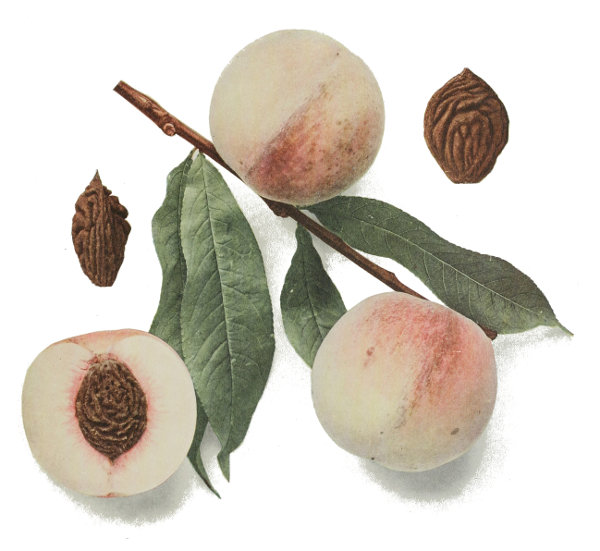
MORRIS WHITE
Tree large, vigorous, upright-spreading to drooping, dense-topped, productive; trunk intermediate in thickness and smoothness; branches stocky, smooth, reddish-brown with very light tinge of ash-gray; branchlets long, with long internodes, dark red mingled with green, glossy, smooth, glabrous, with many conspicuous, small, raised lenticels at the base.
Leaves six and three-fourths inches long, one and three-fourths inches wide, flat or curled downward, oval to obovate-lanceolate, leathery; upper surface dull, dark green, smooth; lower surface grayish-green; apex long, acuminate; margin finely serrate, tipped with reddish-brown glands; petiole three-eighths inch long, with one to five small, globose and reniform glands variable in color and position.
Flower-buds tender, obtuse to conical, plump, very pubescent, usually free; blossoms appear in mid-season; flowers less than an inch across, pale pink, deepening in color along the edges; pedicels short, thick, glabrous, green; calyx-tube greenish-red, greenish-yellow within, campanulate, glabrous; calyx-lobes narrow, glabrous within, pubescent without; petals oval, narrow; filaments three-eighths inch long, equal to the petals in length; pistil longer than the stamens.
Fruit matures late; two and one-sixteenth inches long, two and one-eighth inches wide, cordate-oval or oblate, compressed, with halves nearly equal; cavity abrupt or flaring; suture a line, becoming deeper toward the tip; apex roundish, depressed in the suture, with mucronate tip; color pale white, usually without blush or with a faint bronze blush; pubescence heavy, long and coarse; skin thin, tough, somewhat adherent; flesh white, juicy, tender and melting, sweet, pleasantly flavored; good in quality; stone semi-free to nearly free, one and one-fourth inches long, seven-eighths inch wide, oval to slightly obovate, flattened near the base, with deeply grooved surfaces; ventral suture with deep grooves along the edges, furrowed; dorsal suture grooved.
MOUNTAIN ROSE
1. Tilton Jour. Hort. 7:339 fig. 1870. 2. Am. Pom. Soc. Cat. 18. 1871. 3. Downing Fr. Trees Am. 1st App. 121. 1872. 4. Mich. Hort. Soc. Rpt. 33, 261. 1874. 5. N. J. Hort. Soc. Rpt. 41. 1878. 6. Ga. Sta. Bul. 42:239. 1898. 7. Mich. Sta. Bul. 169:220. 1899. 8. Budd-Hansen Am. Hort. Man. 2:352. 1903. 9. Fulton Peach Cult. 174. 1908.
For many years Mountain Rose was preeminent among white-fleshed, freestone peaches by virtue of high quality and handsome appearance. It has a distinct and curious but delicious flavor—a sort of scented sweetness that appeals to all who appreciate choicely good fruit. Unfortunately, it fails in the chief requirement for popularity in these days of commercial fruit-growing—the trees are unproductive, a fault so marked that the variety is rapidly passing from cultivation. Mountain Rose sells well in all markets where it is known, usually bringing a fancy price because of its extra good quality and because it follows closely after the dozen or more white-fleshed, clingstones of poorer quality.
The variety originated about 1851 on the farm of a Dr. Marvin, Morristown, New Jersey. Of its parentage nothing is known. Mountain Rose has always been considered a good market variety and has been widely disseminated. The American Pomological Society added this peach to its fruit-list in 1871, a place it has since held.
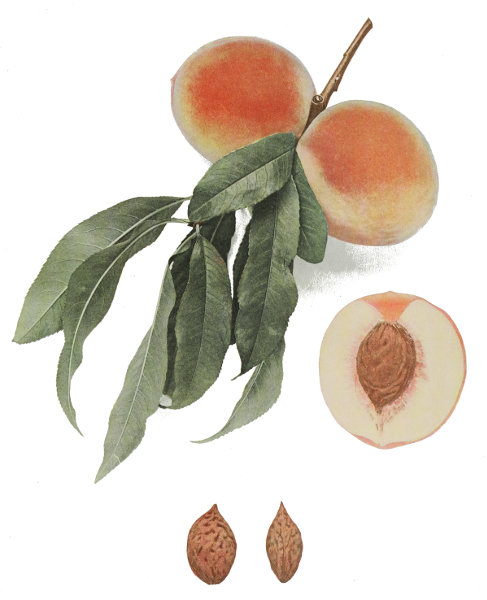
MOUNTAIN ROSE
Tree large, vigorous, upright-spreading, low-growing and dense-topped, rather unproductive; trunk thick, medium in smoothness; branches stocky, smooth, reddish-brown covered with light ash-gray; branchlets thick, long, with internodes of medium length, dark red intermingled with olive-green, glossy, smooth, glabrous, with numerous conspicuous, large and small lenticels raised near the base.
Leaves six and three-fourths inches long, one and five-eighths inches wide, flattened or curled downward, oval to obovate-lanceolate, thick, leathery; upper surface dull, dark green; lower surface grayish-green; apex long-acuminate; margin finely serrate, tipped with reddish-brown glands; petiole seven-sixteenths inch long, with two to four small, globose, reddish-brown glands variable in position; flower-buds conical to pointed, plump, very pubescent, usually appressed; blossoms appear in mid-season; flowers small.
Fruit matures in early mid-season; two and one-eighth inches long, two and one-fourth inches wide, roundish-oblate to slightly cordate; cavity intermediate in depth and width, flaring to abrupt, often twig-marked; suture shallow, becoming deeper toward the tip; apex roundish, depressed in the suture, with mucronate or sometimes mamelon tip; color creamy-white blushed with deep red, with a few splashes of darker red; pubescence long, thick; skin thin, tough, variable in adhesion; flesh white, stained red near the pit, juicy, tender and melting, sweet, mild, pleasantly flavored; good to very good in quality; stone free, one and one-fourth inches long, seven-eighths inch wide, oval to ovate, plump, bulged on one side, contracted toward the base, tapering to a short point, usually with small pits in the surfaces; ventral suture deeply grooved along the sides, furrowed; dorsal suture grooved, faintly winged.
Muir
1. Mich. Hort. Soc. Rpt. 314. 1889. 2. Wickson Cal. Fruits 312, fig. 1889. 3. Ga. Sta. Bul. 42:239. 1898. 4. Am. Pom. Soc. Cat. 34. 1899. 5. Mich. Sta. Bul. 169:221. 1899. 6. Budd-Hansen Am. Hort. Man. 2:352. 1903.
As a rule, peaches originating in California find small favor in New York. California peaches are selected for canning, evaporating and shipping, whereas New York varieties are dessert fruits. Muir is a California sort suitable only for culinary purposes—attractive enough inside but so unattractive externally that it could tempt no one who did not know the fruit to be sweet and delicious in flavor. It is a late mid-season, yellow-fleshed, freestone peach much used by canners on the Pacific slope. It ought to be more generally grown for the same purpose in the East; for, as a canned product, it is hardly surpassed in appearance or quality. The trees are vigorous, productive and little subject to leaf-curl but the fruits in New York are often marred by peach-scab. The variety seems perfectly at home in this State as, seemingly, it is in most peach-regions. In fruit-characters, Muir is very similar to Wager.
The variety was found more than twenty-five years ago on the farm of John Muir, near Silveyville, California. G. W. Thissell, Winters, California, named and introduced Muir. The American Pomological Society added this peach to its fruit-list in 1899.
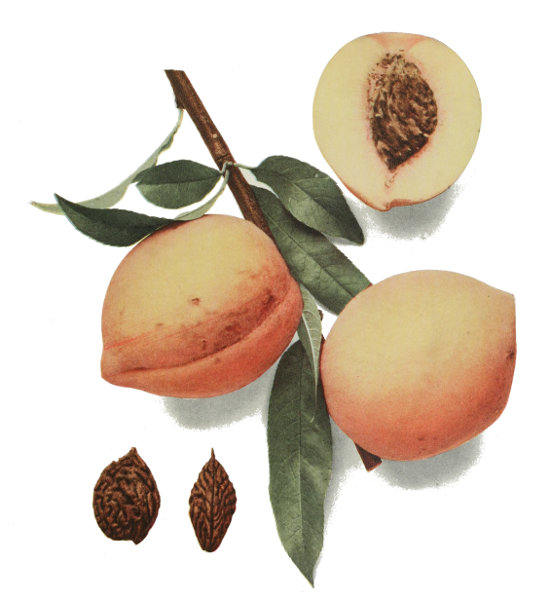
MUIR
Tree vigorous, upright or somewhat spreading, hardy, productive; trunk rough; branches smooth, ash-gray over reddish-brown; branchlets slender, long, with short internodes, dark pinkish-red with but a trace of green, smooth, glabrous, with inconspicuous, small, raised lenticels.
Leaves fall early in the season, six and three-fourths inches long, one and three-eighths inches wide, flat or somewhat curled downward, oval-lanceolate, leathery; upper surface dull, dark green, nearly smooth; lower surface olive-green; apex acuminate; margin bluntly serrate, tipped with reddish-brown glands; petiole seven-sixteenths inch long, with one to five large, reniform glands variable in position.
Flower-buds small, short, obtuse, very plump, heavily pubescent, appressed; blossoms open late; flowers seven-eighths inch across; pale pink, darker about the edges, usually singly; pedicels short, green; calyx-tube reddish-green, orange-red within, campanulate, glabrous; calyx-lobes short, obtuse, glabrous within, pubescent without; petals narrow-oval or ovate, tapering to claws of medium width; filaments three-eighths inch long, equal to the petals in length; pistil as long as the stamens.
Fruit matures in mid-season; two and three-fourths inches long, two and three-eighths inches wide, roundish-cordate or oval, slightly angular, compressed, with unequal halves; cavity shallow, contracted about the sides, abrupt or flaring; suture medium in depth; apex pointed, with a large, recurved, mamelon tip; color greenish or lemon-yellow, with little if any blush; pubescence heavy, long; skin thin, tough, separates from the pulp when fully ripe; flesh yellow, faintly tinged with red near the pit, dry, coarse, tender, sweet, mild; good in quality; stone free, one and seven-sixteenths inches long, fifteen-sixteenths inch wide, ovate, flattened, wedge-shape toward the base, tapering to a long apex, with large pits and a few small grooves in the surfaces; ventral suture deeply grooved along the sides, very wide, deeply furrowed; dorsal suture widely and deeply grooved.
NIAGARA
1. W. N. Y. Hort. Soc. Rpt. 115. 1900. 2. Budd-Hansen Am. Hort. Man. 2:352, 353. 1903. 3. W. N. Y. Hort. Soc. Rpt. 24. 1904. 4. Am. Pom. Soc. Cat. 38. 1909. 5. N. Y. Sta. Bul. 403:213, 214, Pl. 1915.
Newark Seedling. 6. Del. Sta. Rpt. 5:99. 1892.
Niagara is a variant of a peach which all growers lament as being less and less grown, the Crawford. The Crawford group, though a dominant type, is, as we have several times pointed out, a little too capricious as to soil and climate to suit the needs of commercial peach-growers, failing to bear regularly or abundantly in most soils. For this reason the once very popular Early and Late Crawfords are now seldom grown. All who know these varieties regret that a sort of their type, without their faults, has not yet come to light. In New York the best of the comparatively new Crawford-like peaches is Niagara, said to be a seedling of one of the Crawfords. The fruit ripens later than Early Crawford, averages larger, is borne more abundantly and holds its size better to the end of the season. But Niagara's great point of merit, as compared with Crawford, is that it is more dependable in all tree-characters, being, especially, less capricious as to soil and climate. Niagara, as the color-plate shows it, is a beautiful fruit, yellow, with a handsome over-color of red. The flesh, too, is attractive and delectable—yellow, thick and firm, with a rich, sweet flavor which makes it one of the most palatable peaches of its season. It is, as are most of its type, a freestone. Niagara fails in productiveness in some localities, having in this respect the fault of all its tribe; but it should have a welcome place in any home collection and, where it proves productive, is one of the best for general market.
Niagara probably came originally from Maryland to Julius Harris, Ridgeway, New York. Later it was sold to a grower near Lockport, New York, who disposed of it to a Mr. Corwin, Newfane, Niagara County, New York, who called it Corwin's Crawford. It then came into possession of the Rogers Nurseries, Dansville, New York, from whom this Station received its trees under the name Niagara. It is probably a seedling of Early Crawford. Niagara was added to the fruit-list of the American Pomological Society in 1909.
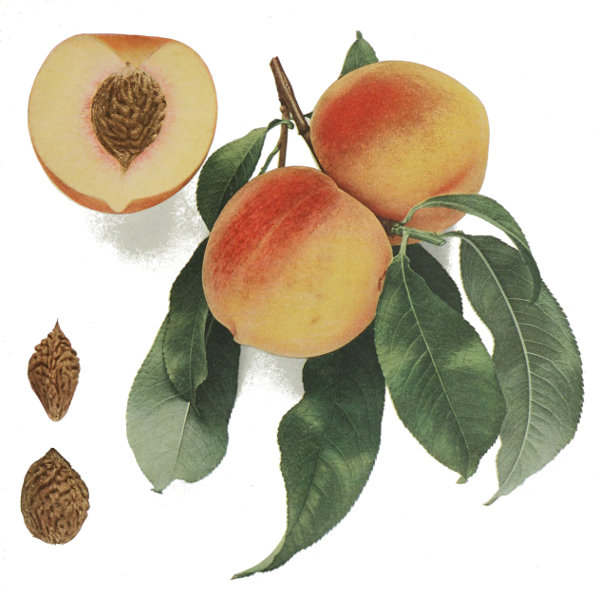
NIAGRA
Tree large, upright-spreading, hardy, medium in productiveness; trunk thick and smooth; branches stocky, smooth, reddish-brown mingled with light ash-gray; branchlets thick, red intermingled with olive-green, glossy, smooth, glabrous, with conspicuous, large, raised lenticels.
Leaves six and three-fourths inches long, one and three-fourths inches wide, flattened or curled downward, oval to obovate-lanceolate, leathery; upper surface dull, dark green, rugose along the midrib; lower surface grayish-green; apex acuminate; margin finely serrate, tipped with reddish-brown glands; petiole three-eighths inch long, glandless or with one to five small, globose, raised, reddish-brown glands variable in position.
Flower-buds large, long, conical or pointed, very plump, pubescent, usually free; blossoms open in mid-season; flowers one inch across, white near the center of the petals changing to dark pink near the edges; pedicels very short, thick, glabrous, green; calyx-tube reddish-green, orange-colored within, campanulate, glabrous; calyx-lobes narrow, acute, glabrous within, pubescent without; petals round-oval, tapering toward the apex, broadly notched near the base, contracting to claws red at the base; filaments three-eighths inch long, equal to or shorter than the petals; pistil pubescent at the ovary, longer than the stamens.
Fruit matures in mid-season; two and one-half inches long, two and three-eighths inches wide, round-cordate to oval, compressed, with equal halves; cavity medium to deep, flaring to abrupt, with very tender skin, often splashed with red; suture shallow, deepening toward the apex and often extending beyond; apex rounded or pointed, with a mamelon and sometimes recurved tip; color orange-yellow, blushed with deep, dull red, with stripes and splashes of darker red; pubescence short, thick, fine; skin thick, tough, adherent to the pulp; flesh yellow, deeply tinged with red near the pit, juicy, coarse but tender, sprightly; very good in quality; stone free, one and five-eighths inches long, one and one-eighth inches wide, broadly ovate, plump, with long point at the apex, usually with grooved surfaces and with few pits, tinged with red; ventral suture very deeply grooved along the sides, winged, rather wide; dorsal suture deeply grooved, wing-like.
OLDMIXON CLING
1. Coxe Cult. Fr. Trees 218. 1817. 2. Kenrick Am. Orch. 231. 1832. 3. Prince Pom. Man. 2:23. 1832. 4. Downing Fr. Trees Am. 497. 1845. 5. Am. Pom. Soc. Rpt. 211. 1856. 6. Fulton Peach Cult. 198. 1908. 7. Waugh Am. Peach Orch. 205. 1913.
Oldmixon. 8. Hoffy Orch. Com. 1:1841-42. 9. Elliott Fr. Book 278. 1854.
Without question one of the oldest American peaches, going back at least 150 years, Oldmixon Cling is still well worthy a place in every orchard where high quality is a prime requisite. It is a rich, luscious, white-fleshed peach, ripening late, which, besides being excellent in quality for dessert and culinary purposes, is uncommonly handsome—a combination of characters possessed by few other peaches. The color-plate is almost a perfect picture of the variety and could the flavor be as well conveyed to readers, Oldmixon Cling might again take on some of its one time popularity. We can discover but one fault in the fruits as they grow on the Station grounds—the pits crack badly. The variety, however, seems to be passing out because the trees are not, as a rule, fruitful though in all other respects they are seemingly near perfection.
There is no trace of when, where or how Oldmixon Cling originated. Coxe264 first set forth its merits in 1817. It is reported to have been introduced from Europe by Sir John Oldmixon but Downing believes that it was the pit and not the tree which Oldmixon brought to America. At any rate the variety takes its name from its supposed introducer. If the pit were planted by Sir John Oldmixon, this must be the oldest of our peaches for Oldmixon came to America nearly 200 years ago. He was, by the way, the author of one of the early and notable books on America, The British Empire in America, published in London in 1741. Pomologists from time to time have made two words of the name making it appear that old and new Mixon peaches existed. Oldmixon Cling was placed in the fruit-list of the American Pomological Society in 1856 and ever since has retained a place there. In 1881 the Society changed the name from Old Mixon Cling to Oldmixon Cling.
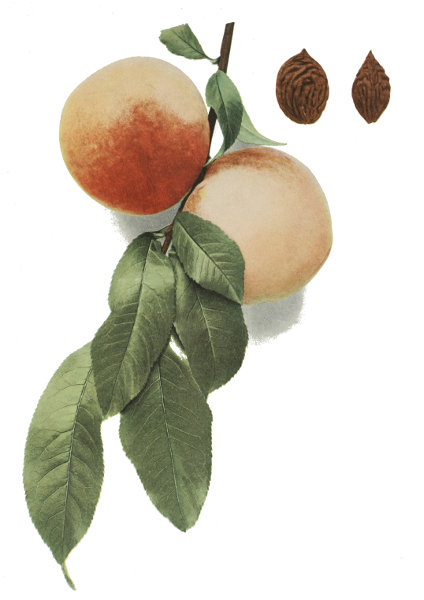
OLDMIXON CLING
Tree large, vigorous, upright-spreading, hardy, rather unproductive; trunk medium to thick, smooth; branches stocky, smooth, reddish-brown tinged with light ash-gray; branchlets of medium thickness and length, with tendency to rebranch, red intermingled with dull green, glossy, smooth, glabrous, with numerous conspicuous, large, raised lenticels.
Leaves six and three-fourths inches long, one and one-half inches wide, flattened or curled downward, oval to obovate-lanceolate, leathery; upper surface dark green, smooth becoming rugose along the midrib; margin finely serrate, tipped with reddish-brown glands; petiole three-eighths inch long, with one to four small, globose glands variable in color and position.
Flower-buds large, conical or pointed, plump, pubescent, appressed or somewhat free; blossoms appear in mid-season; flowers three-fourths inch across, light pink at the center deepening to darker pink at the margins, often in twos, sometimes in threes; pedicels short, green; calyx-tube reddish-green at the base, greenish-yellow within, obconic, glabrous; calyx-lobes short, narrow, acute, glabrous within, pubescent without; petals round-oval, nearly entire, tapering to claws tinged with red at the base; filaments three-eighths inch long, equal to or longer than the petals; pistil pubescent near the base, usually equal to the stamens in length.
Fruit matures late; about two and one-half inches in diameter, round or roundish-oval, bulged along one side, compressed, with unequal halves; cavity medium to deep, wide, variable in shape; suture shallow, becoming deeper toward the apex and extending beyond; apex round, with a recurved, mucronate or prominent and prolonged mamelon tip; color creamy-white, with a blush of lively red and faint splashes of darker red; pubescence fine, short, thick; skin thin, tough, separates from the pulp; flesh white, faintly stained with red near the pit, juicy, stringy, tender, melting, sweet but sprightly, pleasantly flavored; very good in quality; stone clinging, one and seven-sixteenths inches long, one and one-eighth inches wide, ovate to oval, bulged on one side, flattened near the base, plump, long-pointed, with grooved surfaces; ventral suture deeply grooved along the edges, furrowed; dorsal suture grooved, with tendency to wing.
OLDMIXON FREE
1. Kenrick Am. Orch. 221. 1832. 2. Prince Pom. Man. 2:23. 1832. 3. Downing Fr. Trees Am. 484. 1845. 4. Proc. Nat. Con. Fr. Gr. 51. 1848. 5. Elliott Fr. Book 278. 1854. 6. Am. Pom. Soc. Rpt. 45, 183, 211. 1856. 7. Fulton Peach Cult. 187, 188. 1908. 8. Waugh Am. Peach Orch. 205. 1913.
Oldmixon Clearstone. 9. Coxe Cult. Fr. Trees 222. 1817.
Oldmixon Free is a variant of Oldmixon Cling, differing, essentially, as the name implies, in having a free stone; it is, also, more sprightly in flavor and not quite as well endowed with the characters that constitute high quality. Side by side, outwardly, the two peaches can hardly be told apart. Since Oldmixon Cling is sometimes semi-free and Oldmixon Free often clings more or less, the two are often confused in orchards and markets. Both of these Oldmixons, as those who live in regions where cold and frost do frequent damage should know, are as hardy in wood and bud as any of the white-fleshed varieties. The blossoms of both, too, appear in late mid-season, thereby often escaping frosts. The trees of Oldmixon Free, like those of Oldmixon Cling, have the fault of being unproductive.
Oldmixon Free is supposed to be an American seedling of Oldmixon Cling, a fruit for the introduction of which we are indebted to Sir John Oldmixon of early colonial fame. At the Convention of Fruit-Growers held in 1848, Oldmixon Free was placed on the list of recommended peaches. In 1856 it appeared in the fruit-list of the American Pomological Society where it still remains.
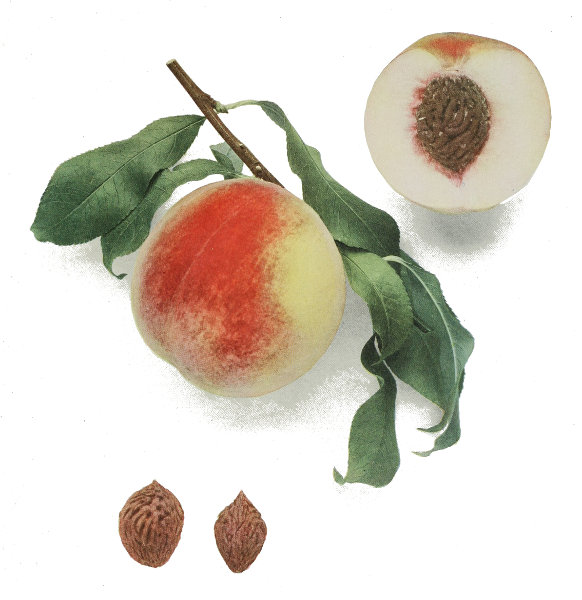
OLDMIXON FREE
Tree very large, vigorous, upright to spreading, hardy, rather unproductive; trunk thick, smooth; branches stocky, smooth, reddish-brown tinged with light ash-gray; branchlets of medium thickness and length, with tendency to rebranch, dark, deep red intermingled with olive-green, glossy, smooth, glabrous, with conspicuous, numerous, raised lenticels.
Leaves six and seven-eighths inches long, one and three-fourths inches wide, curled downward or flattened, oval to obovate-lanceolate, leathery, dull, dark green, smooth; lower surface grayish-green; apex acuminate; margins finely serrate, tipped with reddish-brown glands; petiole three-eighths inch long, glandless or with one to four small, globose glands variable in color and position.
Flower-buds half-hardy, conical to pointed, plump, pubescent, free; blossoms appear in mid-season; flowers three-fourths inch across, pale pink near the center becoming darker pink at the outside, often in twos; pedicels very short, glabrous, green; calyx-tube reddish-green at the base, greenish-yellow within, obconic; calyx-lobes short, obtuse, glabrous within, pubescent without; petals oval, faintly notched near the base, tapering to narrow, long claws tinged with red at the base; filaments three-eighths inch long, equal to the petals in length; pistil pubescent near the base, equal to or longer than the stamens.
Fruit matures late; two and one-half inches long, two and three-fourths inches wide, round-cordate, usually bulged on one side, often compressed, with unequal sides; cavity medium to deep, abrupt or flaring, tinged with red; suture shallow, becoming deeper toward the apex and extending beyond; apex roundish, with a mucronate or recurved, mamelon tip; color creamy-white more or less overspread with a lively red blush in which are faint splashes and mottlings of darker red; pubescence coarse, thick; skin thin, tough, separates from the pulp; flesh white, deeply tinted with red near the pit, juicy, stringy, tender and melting, sweet, with more or less sprightliness; very good in quality; stone free or nearly free, one and three-eighths inches long, one and one-eighth inches wide, oval to ovate, bulged, flattened near the base, with grooved and purplish-brown surfaces; ventral suture deeply grooved near the edges, furrowed, faintly winged; dorsal suture grooved.
OPULENT
1. Ill. Hort. Soc. Rpt. 209. 1906. 2. Fancher Creek Nur. Cat. 31. 1907. 3. Burbank Cat. 5. 1911.
Opulent is a white-fleshed, freestone peach of very mediocre character as it grows on the Station grounds. The fruits are attractive in appearance but not uncommonly so and are often marred, as they grow in New York, by peach-scab. The quality is scarcely better than the average and is ruined for most peach-lovers by a bitter tang, though to others this almond-like bitterness in the flavor may be a commendation. The variety ripens in mid-season. The trees are scarcely more satisfactory on the Station grounds than the fruits, being unproductive and none too vigorous. The chief claim this peach has to public notice is that it is a cross between a peach and a nectarine. Though as yet not thoroughly tried in New York, it is safe to say that it is worthless for this region.
Opulent was sent out several years ago by Luther Burbank, Santa Rosa, California, as a hybrid between the Muir peach and New White Nectarine.
Tree large, vigorous, upright-spreading with a tendency to droop, medium in productiveness; trunk smooth; branches stocky, smooth, reddish-brown with a light ash-gray tinge; branchlets slender, long, with medium to long internodes, dull red intermingled with green, glossy, smooth, glabrous, with conspicuous, large, raised lenticels few in number.
Leaves six and one-half inches long, one and one-half inches wide, flattened or curled downward, oval to obovate-lanceolate, leathery, dark green, smooth becoming rugose along the midrib; lower surface grayish-green; margin finely serrate, tipped with reddish-brown glands; petiole one-half inch long, with one to six small, globose and reniform, reddish-brown glands variable in position.
Flower-buds tender, large, long, conical or obtuse, pubescent, plump, free; blossoms appear in mid-season; flowers one and one-eighth inches across, white at the center of the petals becoming dark pink near the margins; pedicels short, glabrous, green; calyx-tube reddish-green, orange-colored within, campanulate, glabrous; calyx-lobes short, narrow, acute, glabrous within, pubescent without; petals oval or roundish, broadly notched, tapering to long, narrow claws red at the base; filaments five-sixteenths inch long, equal to the petals in length; pistil pubescent at the ovary, longer than the stamens.
Fruit matures in early mid-season; two and one-half inches long, two and seven-sixteenths inches wide, round-oval, compressed, with unequal halves; cavity deep, abrupt, often marked with red; suture a mere line or very shallow, often a slight depression just beyond the point; apex roundish, with a mucronate and recurved tip; color creamy-white, with a faint blush, speckled and striped with darker red; pubescence short; skin tough, separates from the pulp; flesh white, juicy, stringy, tender, melting, sweet but sprightly; fair in quality; stone free, one and five-sixteenths inches long, seven-eighths inch wide, ovate to slightly oval, flattened at the base, plump, short-pointed, with pitted surfaces marked by few grooves; ventral suture deeply furrowed along the edges, medium in width, furrowed; dorsal suture deeply grooved.
PALLAS
1. Ga. Hort. Soc. Rpt. 55. 1885. 2. Am. Pom. Soc. Cat. 46. 1891. 3. La. Sta. Bul. 17:499. 1891. 4. Tex. Sta. Bul. 39:805. 1896. 5. Ga. Sta. Bul. 42:239, 240. 1898. 6. Mich. Sta. Bul. 169:222. 1899. 7. Budd-Hansen Am. Hort. Man. 2:353. 1903. 8. Fla. Sta. Bul. 73:150. 1904. 9. Ala. Sta. Bul. 156:134. 1911.
Pallas Honeydew. 10. Ohio Sta. Bul. 170:178. 1906.
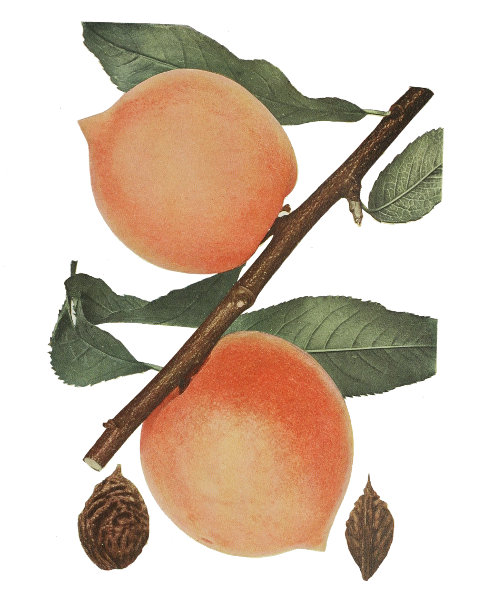
Pallas is about the best of the several honey-flavored, beaked peaches that have fruited on the Station grounds. This is one of the sorts supposed to thrive only in warm climates but here, in a location none too favorably situated as to climate, the trees are vigorous, appear to be hardy and differ from northern varieties, so far as life events are concerned, only in holding their leaves longer. The fruits run small and lack uniformity in size, faults that will not permit Pallas ever to become a commercial sort in New York. Moreover, the peaches are not attractive in appearance, suffer terribly from brown-rot and do not ship well—further disqualifications for competition in commerce. In quality, especially, to those who have a taste for sweets, Pallas is almost unapproachable—so rich, sweet, aromatic and delicious as well to justify the sobriquet, "Honeydew," frequently bestowed upon it. This variety might well be planted in every home orchard.
Pallas is one of the many seedlings of Honey and originated in 1878 with L. E. Berckmans, Augusta, Georgia. In 1891 the American Pomological Society added Pallas to its list of fruits as a noteworthy variety for southern fruit-districts.
PALLAS
Tree medium in vigor, upright-spreading, round-topped, productive; trunk rough; branches roughened by the lenticels, brownish intermingled with ash-gray and a little red; branchlets slender, with internodes of medium length, dark pinkish-red mingled with green, smooth, glabrous, with numerous conspicuous, small, raised, russet-colored lenticels.
Leaves fall late in the season, six inches long, one and one-half inches wide, variable in position, ovate-lanceolate, thin, leathery; upper surface dull, dark green, smooth; lower surface olive-green; margin sharply and often doubly serrate, glandular; petiole three-eighths inch long, stout, glandless or with one to three small, globose glands usually at the base of the leaf.
Flower-buds large, long, conical, plump, pubescent, conspicuous, usually free; flowers appear in mid-season, light pink changing to darker red; pedicels thick, glabrous, green; calyx-tube red, yellowish-green within, obconic, glabrous; calyx-lobes obtuse, glabrous within, heavily pubescent without; petals oval, entire, red at the base; filaments shorter than the petals; pistil pubescent, longer than the stamens.
Fruit matures in early mid-season; two and one-fourth inches long, two inches wide, pointed-oval, compressed, with halves equal; cavity shallow, flaring, with tender skin; suture shallow; apex a characteristically long, straight tip; color pale white or greenish-white occasionally with a bright red blush but mostly with dull mottlings; pubescence medium in amount; skin thick, tough; flesh white, scarcely stained at the pit, very juicy, sweet, tender and melting, high-flavored; very good in quality; stone free, one and five-sixteenths inches long, seven-eighths inch wide, oval to ovate, slightly wedge-shaped at the base, plump, conspicuously winged, long-pointed, with pitted and grooved surfaces; ventral suture narrow, furrowed; dorsal suture grooved.
PEARSON
1. Del. Sta. Rpt. 13:105. 1901. 2. N. Y. State Fr. Gr. Assoc. Rpt. 21. 1912.
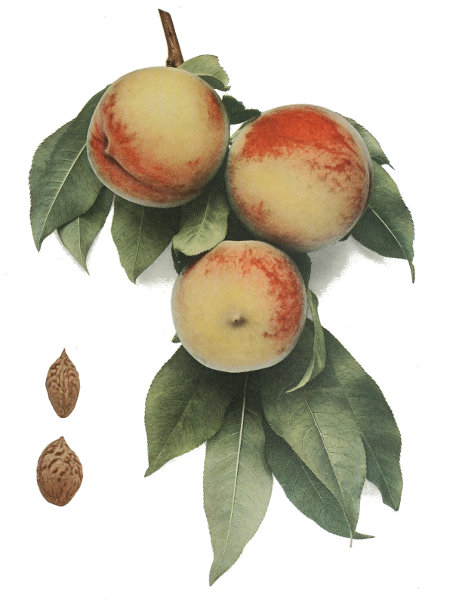
Pearson is a newcomer among peaches which will bear watching if it does as well in other parts of New York as on the Station grounds. It is a large, handsomely-colored, white-fleshed, freestone peach of good quality which ripens ten days before Champion. There are, it is true, a good many white-fleshed peaches at this season but Pearson is an exceptionally good one, much excelling Mamie Ross with which it might have to compete although the latter ripens a little later. The trees are very vigorous, productive and, so far, about as healthy as any on the Station grounds.
Pearson originated with J. M. Pearson, McKinney, Texas. Its parentage is unknown. The variety was introduced by E.W. Kirkpatrick of McKinney, who thinks it may be a seedling of Chinese Cling.
PEARSON
Tree large, vigorous, spreading, the lower branches drooping, very productive; trunk medium in thickness, smooth; branches stocky, smooth, reddish-brown mingled with light ash-gray; branchlets slender, short, with short internodes, dark red mingled with olive-green, glossy, smooth, glabrous, with few inconspicuous lenticels variable in size and raised toward the base.
Leaves seven inches long, one and three-fourths inches wide, variable in position, oval to obovate-lanceolate, leathery; upper surface dark, dull green, smooth becoming rugose along the midrib; lower surface grayish-green; apex long and narrow; margin finely serrate, tipped with reddish-brown glands; petiole three-eighths inch long, glandless or with one to four small, globose, reddish-brown glands usually at the base of the blade.
Flower-buds hardy, long, heavily pubescent, conical to obtuse, plump, appressed or partly free; blossoms appear very early; flowers nearly two inches across, pink, usually single; pedicels short, of medium thickness, glabrous, green; calyx-tube dark, dull reddish-green, greenish-yellow within, campanulate, glabrous; calyx-lobes broad, often emarginated, acute or obtuse, glabrous within, heavily pubescent without; petals oval to roundish-obovate, tapering to long, narrow claws; filaments about one-half inch long, shorter than the petals; pistil pubescent only at the base, equal to the stamens in length.
Fruit matures in early mid-season; two and one-fourth inches long, two and three-sixteenths inches wide, round-oval or somewhat cordate, compressed, with unequal halves, bulged near the apex; cavity medium to deep, abrupt or flaring, with tender skin; suture quite variable in depth; apex round or depressed, with a small, mucronate or recurved, mamelon tip; color greenish-white, with a blush covering much of the surface, more or less mottled; pubescence thin, fine, short; skin thin, tough, semi-free; flesh white, faintly tinged with red near the pit, juicy, stringy, tender and melting, pleasantly flavored; good in quality; stone semi-clinging or free, one and three-eighths inches long, one inch wide, oval, flattened at the base, winged, with pitted surfaces; ventral suture deeply grooved near the edges, narrow; dorsal suture grooved, winged.
PEENTO
1. Am. Pom. Soc. Rpt. 41. 1877. 2. Gard. Mon. 19:114, 301. 1877. 3. Gard. Mon. 26:61. 1884. 4. U. S. D. A. Rpt. 650. 1887. 5. Am. Pom. Soc. Cat. 32. 1889. 6. Am. Pom. Soc. Rpt. 114-116. 1889. 7. Fla. Sta. Bul. 62:506-509, Pl. 1. 1902. 8. Fulton Peach Cult. 202. 1908.
Chinese Flat. 9. Prince Treat. Hort. 16, 17. 1828. 10. Kenrick Am. Orch. 225, 226. 1832.
Flat Peach of China. 11. Lindley Guide Orch. 247, 248. 1831. 12. Horticulturist 1:383, 384, fig. 92. 1846-47. 13. Fla. Sta. Bul. 62:512, 513. 1902.
Platt Pfirsich. 14. Mathieu Nom. Pom. 410. 1889.
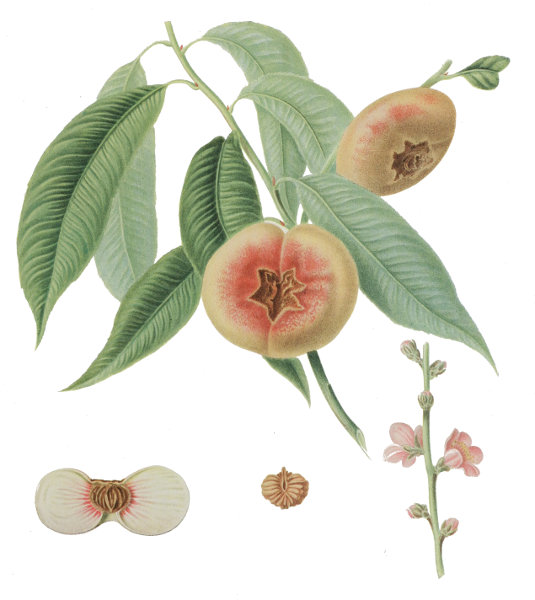
For the history and a discussion of the horticultural characters of Peento, the reader is referred to page 108. The variety is too tender to cold to be grown in New York; in fact it succeeds only in Florida and the warmest parts of the other Gulf States. The American Pomological Society listed Peento in its fruit-catalog in 1889. The following description, as it applies to the tree, has been compiled:
PEENTO
[Reproduced from Transactions of the Horticultural Society of London IV: 512. 1822.]
Tree vigorous, open-topped, too tender for the North, variable in productiveness; leaves mature late, four and one-half inches long, one and seven-sixteenths inches wide, oblong-oval, thin, leathery; upper surface light olive-green, smooth; lower surface grayish-green; margin coarsely serrate, tipped with dark glands; petiole with two or three reniform glands of medium size, gray or greenish-yellow, usually at the base.
Fruit matures early; one and three-eighths inches long, two and seven-sixteenths inches wide, strongly oblate; cavity shallow, very wide, flaring, twig-marked; suture deep, wide, extending two-thirds around the fruit; apex depressed, set in a large, wide, flaring basin; color creamy-yellow, mottled and delicately pencilled with red, often blushed toward the apex; pubescence short, thick; skin thick, tough, nearly free; flesh white, stained red at the stone, juicy, stringy, tender and melting, sweet, mild, with an almond-like flavor; very good in quality; stone clings, red, one-half inch long, fifteen-sixteenths inch wide, strongly oblate, with corrugated surfaces; ventral suture very deep at the edges, narrow at the base, becoming wide at the apex; dorsal suture a wide, deep groove, merging into a line at the apex.
PROLIFIC
1. Ga. Sta. Bul. 42:240. 1898.
New Prolific. 2. Col. O. Hort. Soc. Rpt. 32. 1892. 3. Mich. Hort. Soc. Rpt. 190. 1895. 4. Ohio Hort. Soc. Rpt. 59. 1896-97. 5. Mich. Sta. Bul. 169:221. 1899. 6. Budd-Hansen Am. Hort. Man. 2:352. 1903. 7. Am. Pom. Soc. Cat. 38. 1909.
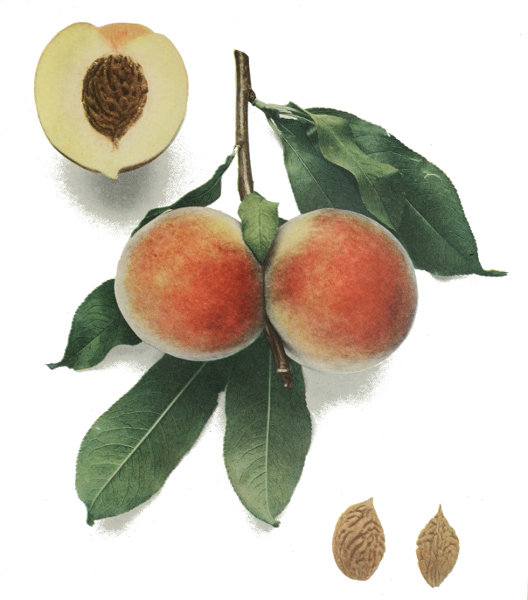
Prolific was heralded a quarter-century ago as one of the great acquisitions to the peach-flora of the country. Time has not dealt kindly with the variety and it is doubtful if it is as popular now as it was a few years after its introduction. The trees are very satisfactory, excelling most of their orchard-associates in vigor, size, health, hardiness and productiveness but the peaches fall below the mark in several characters. The fruits are of but medium size and not uncommonly attractive in color, though handsome enough, but too poor in quality to rate high among the peaches of its season which is a few days before Elberta. The flesh is yellow, firm, dry and little attacked by rot. With the qualities just named, the variety is, of course, a good shipper and might be in demand in the markets for culinary purposes. We doubt whether the peach should be largely planted in New York.
Further than that Prolific comes from Michigan, nothing is known of its parentage, the originator or the date of origin. It was introduced about 1890 by Greening Brothers, Monroe, Michigan, under the name New Prolific. In 1909 the American Pomological Society added this peach to its fruit-list as New Prolific.
PROLIFIC
Tree large, vigorous, spreading, becoming drooping, open-topped, very productive; trunk rough; branches stocky, smooth, reddish-brown with a very light tinge of ash-gray; branchlets deep, dull red intermingled with green, glossy, smooth, glabrous, with conspicuous, numerous lenticels raised near the base.
Leaves six and one-half inches long, one and one-half inches wide, variable in position, oval to obovate-lanceolate, leathery; upper surface dull, dark green, smooth, becoming rugose near the midrib; lower surface grayish-green; apex long-acuminate; margin finely serrate, tipped with reddish-brown glands; petiole three-eighths inch long, with from one to five small, globose glands variable in color and position.
Flower-buds hardy, conical to obtuse, plump, somewhat pubescent, appressed or free; blossoms open early; flowers one and five-sixteenths inches across, white near the center becoming pink along the edges; pedicels very short, glabrous, green; calyx-tube dull, dark reddish-green, orange-colored within, campanulate, glabrous; calyx-lobes narrow, acute, glabrous within, heavily pubescent without; petals roundish-ovate to oval, broadly notched near the base, tapering to narrow claws red at the base; filaments seven-sixteenths inch long, equal to the petals in length; pistil pubescent at the ovary, as long as the stamens.
Fruit matures in mid-season; two and one-fourth inches long, two and three-eighths inches wide, round-oval to cordate, bulged on one side, compressed, with unequal halves; cavity deep, usually abrupt, frequently mottled with red; suture a line, becoming deeper toward the tip; apex round or somewhat pointed, with a recurved, mamelon tip; color light orange, mottled and blushed with red; pubescence thick, fine; skin thin, tough, separates from the pulp; flesh light yellow, stained with red near the pit, medium juicy, coarse, stringy, tender, sweet, mild, pleasantly flavored; good in quality; stone free, one and three-eighths inches long, one inch wide, ovate, bulged on one side, plump, with long, pointed apex, with surfaces grooved and marked by small pits; ventral suture deeply grooved along the sides, slightly winged near the base; dorsal suture a deep groove, faintly winged.
RAY
1. Del. Sta. Rpt. 13:106. 1901. 2. Am. Pom. Soc. Cat. 38. 1909. 3. N. J. Hort. Soc. Rpt. 35. 1912. 4. Harrison Cat. 27. 1915.
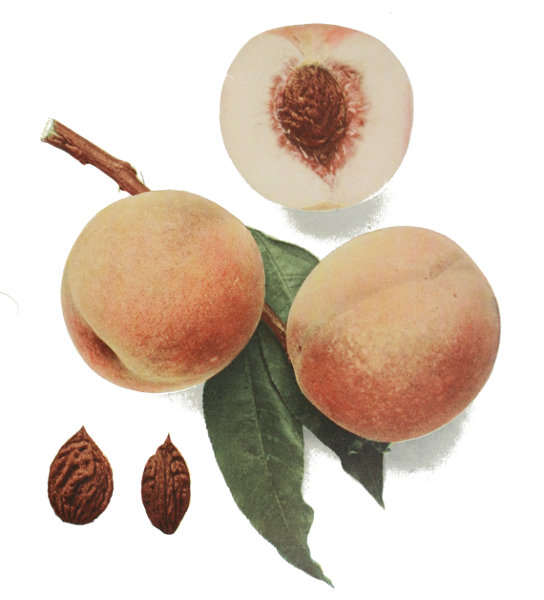
This is another of the many early, white-fleshed, freestone peaches which are competing for favor among peach-growers. We doubt if Ray, however, should find a place on the peach-list for New York. Several faults condemn it; worst of all, the trees are not productive. Add to unproductiveness, lack of uniformity in size, shape, color and flavor and the variety is out of the race as a commercial sort. This far north, too, the trees suffer from winter injury. The variety is remarkable for its foliage. Were it not for the fact that Ray is well spoken of in several other states, and the possibility that it might do better in other parts of New York than on the Station grounds, we should not place it among the major varieties in The Peaches of New York. It is said to be an excellent shipper.
This peach is occasionally confused with Raymond Cling, which originated in Mississippi many years ago and which has long since passed from cultivation. The present variety originated with D. Ray, Tyler, Texas. Its parentage is unknown. The American Pomological Society placed Ray on its fruit-list in 1909.
RAY
Tree large, vigorous, upright-spreading, the lower branches drooping, medium in productiveness; trunk thick, nearly smooth; branches stocky, smooth, reddish-brown with a light tinge of ash-gray; branchlets slender, dark red intermingled with olive-green, glossy, smooth, glabrous, with numerous raised lenticels variable in size.
Leaves six and one-half inches long, one and five-eighths inches wide, flattened or curled downward, oval to obovate lanceolate, leathery; upper surface dark green, smooth; lower surface medium green; margin finely serrate, tipped with reddish-brown glands; petiole three-eighths inch long, glandless or with one to three small, globose glands variable in position.
Flower-buds half-hardy, short, heavily pubescent, conical to pointed, plump, usually appressed; blossoms appear in mid-season; flowers one inch across, light pink becoming darker pink along the edges; pedicels short; calyx-tube reddish-green, greenish-yellow within, obconic; calyx-lobes long, narrow, obtuse, glabrous within, heavily pubescent without; petals ovate, with claws medium in length and width; filaments three-eighths inch long, equal to the petals in length; pistil pubescent at the base, longer than the stamens.
Fruit matures in mid-season; two and three-eighths inches long, two and one-half inches wide, roundish-conic to oblong-conic, slightly compressed, with nearly equal halves; cavity narrow, abrupt, with tender skin; suture shallow, deepening toward and often extending beyond the tip; apex round, with a mucronate tip; color greenish-white changing to white, scarcely blushed or with a bright pinkish-red blush varying from a small amount to about one-third of the surface, faintly mottled; pubescence coarse, thick, long; skin very thin, tough, separates from the pulp; flesh greenish-white, stained with red near the pit, juicy, stringy, firm but tender, aromatic, sprightly; good in quality; stone semi-free to free, one and seven-sixteenths inches long, slightly more than one inch wide, oval to ovate, plump, with short point at the apex, with grooved and pitted surfaces; ventral suture deeply grooved along the edges, narrow, furrowed; dorsal suture grooved.
RED CHEEK MELOCOTON.
1. Prince Pom. Man. 2:31, 32. 1832. 2. Downing Fr. Trees Am. 492. 1845. 3. Am. Pom. Soc. Cat. 32. 1867.
Red Cheek Malacotan. 4. Coxe Cult. Fr. Trees 225. 1817. 5. Floy-Lindley Guide Orch. Gard. 186. 1846.
Early Yellow Malacatune. 6. Kenrick Am. Orch. 220. 1832.
Yellow or Red Cheek Malacatune. 7. Ibid. 225. 1832.
Hogg's Malacatune. 8. Ibid. 190. 1841.
Red Cheek. 9. Elliott Fr. Book 288. 1854. 10. Mich. Sta. Bul. 169:223, 224. 1899. 11. Budd-Hansen Am. Hort. Man. 2:354. 1903. 12. Fulton Peach Cult. 195, 196. 1908. 13. Am. Pom. Soc. Cat. 39. 1909.
Malacatune. 14. Hooper W. Fr. Book 225. 1857.
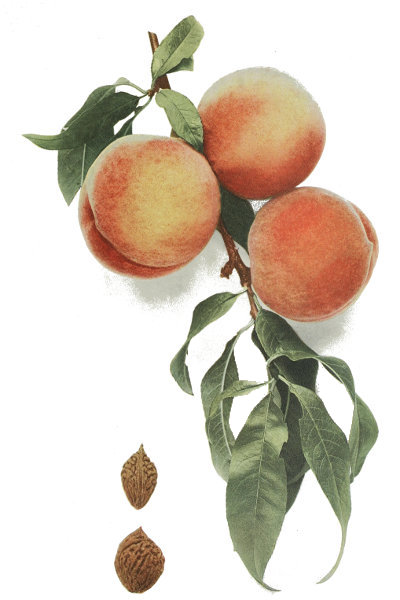
For nearly a century, beginning soon after the Revolutionary War, Red Cheek Melocoton had few rivals among yellow-fleshed, freestone peaches. Even yet it is surpassed in quality only by members of the Crawford family of which, by the way, it is supposed to be the immediate ancestor—certainly all Crawford-like peaches resemble it in both fruit and tree-characters. Lack of vigor and unproductiveness have driven Red Cheek Melocoton from common cultivation—indeed it is now almost impossible to obtain the trees. We give the variety attention in The Peaches of New York, not because of present worth, but because of the prominent part it has played in the peach-industry of the country in the past. The color-plate is an admirable reproduction of this old peach though possibly the fruits run a little larger than in the illustration. The derivation of "Melocoton," so often used in this text, is given on page 51.
Red Cheek Melocoton is an American seedling which, according to William Prince, sprang from a bud of a stock on which Lemon Cling had been grafted, at the Prince farm, Flushing, New York. The Princes were so impressed with the seedling that they propagated it, giving it the name Red Cheek Malacatune, the name Malacatune at that time being given to all yellow peaches having little red. The discovery of the variety in the Prince orchards dates back considerably over one hundred years. From Red Cheek Melocoton the Crawfords and several other notable peaches are said to have come. In 1867 the American Pomological Society placed this variety in its catalog as Red Cheek Melocoton but in 1909 shortened the name to Red Cheek. We prefer to preserve the old name.
RED CHEEK MELOCOTON
Tree medium in size, vigorous, upright-spreading, lacking in productiveness; trunk intermediate in thickness and smoothness; branches stocky, smooth, reddish-brown mingled with light ash-gray; branchlets thick, variable in length, with medium to long internodes, deep, dark red intermingled with green, glossy, roughened by the lenticels, glabrous, with a few smallish, inconspicuous lenticels which are raised toward the base.
Leaves seven and one-fourth inches long, nearly two inches wide, variable in position, oval to obovate-lanceolate, medium in thickness, leathery, dark olive-green, smooth, becoming rugose toward the midrib; margin sharply serrate; petiole three-eighths inch long, glandless or with one to three small, globose, alternate glands variable in color and in their position; flower-buds intermediate in size and length, conical or pointed, plump, free; blossoms appear in mid-season; flowers small.
Fruit matures in mid-season; two and one-fourth inches long, about two and one-half inches wide, roundish-cordate, compressed, with halves nearly equal; cavity wide, deep, flaring or abrupt; suture shallow; apex roundish, with a mucronate or mamelon tip; color deep golden-yellow, splashed, blushed and mottled with red; pubescence heavy; skin thick, tough, adherent to the pulp; flesh rayed with red near the pit, yellow, juicy, firm but tender, sweet, pleasantly flavored; good in quality; stone free, one and one-half inches long, one inch wide, ovate, more or less bulged at one side and drawn out near the base, plump, rather long-pointed, with short grooves and pits in the surfaces; ventral suture winged, medium in thickness, deeply grooved and furrowed along the edges; dorsal suture a narrow groove, winged.
REEVES
1. Tex. Sta. Bul. 39:814. 1896. 2. Mich. Sta. Bul. 169:224. 1899. 3. Budd-Hansen Am. Hort. Man. 2:354. 1903. 4. Am. Pom. Soc. Cat. 39. 1909.
Reeves' Favorite. 5. Elliott Fr. Book 288. 1854. 6. Downing Fr. Trees Am. 633. 1857. 7. Am. Pom. Soc. Cat. 30. 1875. 8. Fulton Peach Cult. 193. 1908.
Reeves' Late. 9. Mich. Hort. Soc. Rpt. 458. 1883.
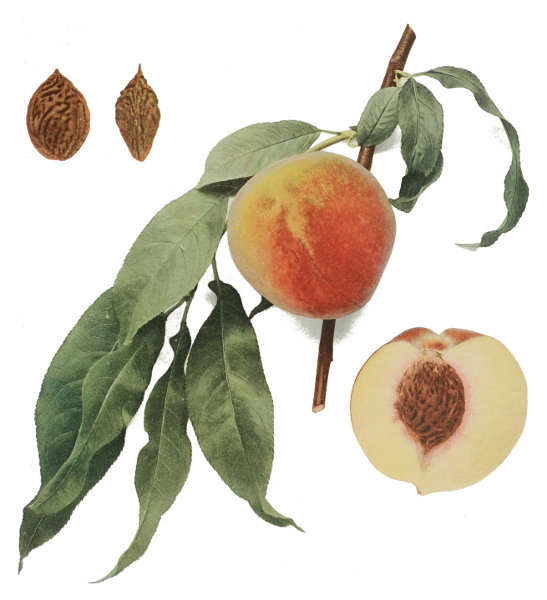
Reeves is another of the old favorites now rapidly passing out of cultivation. In its day it was justly celebrated for the high quality of its yellow-fleshed, freestone fruits which are as handsome as they are palatable. The peaches have but two minor defects to keep them from perfection—they are a little too irregular in shape and sometimes fall short in size. In texture of flesh, juiciness, taste and aroma they are scarcely surpassed. The fault that condemns the variety is unproductiveness in the trees. Under average conditions, Reeves is scarcely as productive as the Crawfords which are rated by all as about the poorest bearers. Making up in some degree for unfruitfulness, the trees are vigorous and more than usually hardy. It can hardly be expected that so poor a bearer will prove profitable in commercial plantations but Reeves is worthy of perpetuation for home orchards.
This attractive peach came from a chance seedling found about sixty years ago by Samuel Reeves, Salem, New Jersey. The variety has for many years gone under the name Reeves' Favorite and was so listed in the fruit-catalog of the American Pomological Society in 1875 but in 1909 the name was shortened by the Society to Reeves.
REEVES
Tree medium to large, vigorous, upright-spreading, hardy, rather unproductive; branches stocky, smooth, reddish-brown with light ash-gray; branchlets intermediate in thickness and length, with a tendency to rebranch, dark pinkish-red with some olive-green, glossy, smooth, glabrous, with moderately conspicuous lenticels raised and breaking the bark near the base.
Leaves six and three-fourths inches long, one and three-fourths inches wide, variable in position, oval to obovate-lanceolate; upper surface dark olive-green, smooth becoming rugose along the midrib; lower surface grayish-green; apex acuminate; margin finely serrate, with reddish-brown glands; petiole three-eighths inch long, glandless or with one to three small, globose glands variable in position.
Flower-buds tender, medium in size and length, pubescent, conical or pointed, plump, free; blossoms open late; flowers seven-eighths inch across, light and dark pink, well distributed; pedicels very short, glabrous, greenish; calyx-tube reddish-green at the base, orange-colored within, obconic, glabrous; calyx-lobes medium to narrow, acute, glabrous within, pubescent without; petals oval to ovate, tapering to claws red at the base; filaments three-eighths inch long, equal to the petals in length; pistil pubescent near the base, as long as the stamens.
Fruit matures in mid-season; two and three-eighths inches long, two and one-half inches wide, round-cordate, bulged at one side, compressed, with unequal halves; cavity often very deep, flaring or abrupt, the skin tender and often marked with red; suture shallow, sometimes extending beyond both cavity and tip; apex pointed or rounded, with a prominent, recurved, mamelon tip; color deep yellow, blushed with dull red, striped, splashed and mottled with brighter red; pubescence thick, long; skin thick, tough, separates from the pulp; flesh yellow, tinged with red near the pit, juicy, stringy, tender and melting, pleasantly flavored, mild, sweet; very good in quality; stone free, one and three-eighths inches long, fifteen-sixteenths inch wide, ovate to oval, more or less bulged near the apex, sometimes winged along the ventral suture, with pitted and grooved surfaces; ventral suture deeply furrowed along the sides, narrow, grooved; dorsal suture small, grooved.
RIVERS
1. Am. Pom. Soc. Cat. 34. 1883. 2. Ont. Fr. Exp. Sta. Rpt. 6:22 fig. 1899. 3. Del. Sta. Rpt. 13:106. 1901. 4. Can. Hort. 25:464. 1902. 5. Budd-Hansen Am. Hort. Man. 2:354. 1903.
Early Rivers. 6. Jour. Hort. N. S. 17:38, 58. 1869. 7. Downing Fr. Trees Am. 1st App. 120, 121. 1872. 8. Gard. Chron. 1262. 1872. 9. Am. Pom. Soc. Cat. 28. 1875. 10. Hogg Fruit Man. 445. 1884. 11. Rev. Hort. 388. 1890. 12. Cat. Cong. Pom. France 98 fig. 1906.
Rivers' Frühe. 13. Lauche Deut. Pom. VI: No. 9, Pl. 1882.
Précoce Rivers. 14. Baltet Cult. Fr. 239 fig. 138. 1908.
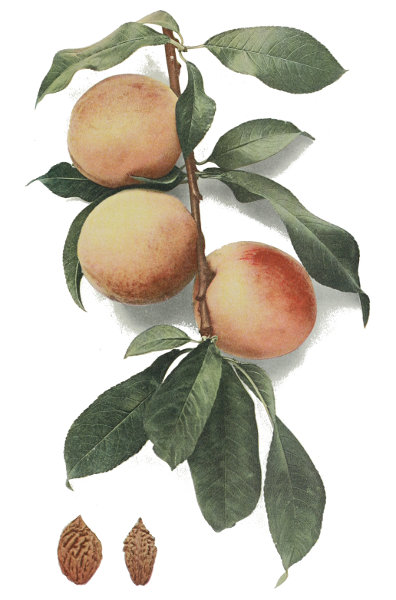
Rivers and one other, Salwey, are the only foreign peaches now commonly cultivated in America. The peach, of all tree-fruits, best proves the general rule that American varieties of fruits are best adapted to American conditions. Perhaps to Rivers may be added three or four more exotic peaches which are now and then planted in this country but all are passing out so rapidly that we shall soon be standing on a basis in peach-growing which is wholly American. Earliness and high quality of fruit keep Rivers alive in private places in America. No one would think of planting it in a commercial orchard because of its small fruit, tender skin and flesh which show every bruise, and its susceptibility to brown-rot. It is a white-fleshed freestone, tender, juicy and with an exceedingly rich, sugary flavor with a savoring smack of the nectarine. This variety stands almost alone in beauty of flesh which is white to the stone, translucent and more or less mottled and interspersed with white veins. At its best the fruits are rather large and quite handsome as they grow in America, but even so they are but a shadow of the peach described under this name in European fruit-books. The trees are fairly satisfactory in all essential characters.
Rivers originated with Thomas Rivers, Sawbridgeworth, England, about 1865 as a seedling of Early Silver. Soon after its introduction in England it was brought to America. The American Pomological Society listed the variety in its fruit-catalog in 1875 as Early Rivers but in 1883 changed the name to Rivers though it is still popularly known as Early Rivers.
RIVERS
Tree large, vigorous, upright-spreading, with inclination to droop, round-topped, hardy, productive; trunk thick; branches stocky, smooth, dark reddish-brown overspread with light ash-gray; branchlets long, with internodes olive-green overlaid with thin brownish-red, glossy, smooth, glabrous, with numerous conspicuous, large and small lenticels.
Leaves five and three-fourths inches long, one and five-eighths inches wide, folded upward and somewhat recurved, oval to obovate-lanceolate, thin, leathery, dark green, smooth or sometimes rugose; lower surface grayish-green, not pubescent, with a prominent midrib; apex acuminate; margin finely serrate, tipped with fine, reddish-brown glands; petiole one-fourth inch long, with one to six reniform, greenish-yellow glands variable in position.
Flower-buds large, long, conical, heavily pubescent, appressed; season of bloom early; flowers pink, one and one-half inches across, often in pairs; pedicels short, glabrous, green; calyx-tube dull reddish-green, light yellow within, campanulate, glabrous; calyx-lobes short, narrow, acute to obtuse, glabrous within, heavily pubescent without; petals round-ovate, bluntly notched near the base, tapering to long, narrow claws occasionally with a reddish base; filaments one-half inch long, shorter than the petals; pistil pubescent at the ovary, equal to the stamens in length.
Fruit matures early; two and three-eighths inches long, two and one-fourth inches wide, round-oval, compressed, with unequal halves; cavity shallow, contracted, irregular, abrupt; suture medium to shallow; apex roundish, somewhat mucronate; color creamy-white, blushed with red; pubescence short, heavy; skin thick but tender, adherent to the pulp; flesh white, translucent, veined, juicy, melting, sweet or mildly sprightly; good in quality; stone nearly free, one and five-sixteenths inches long, one inch wide, oval, plump, bulged on one side, light colored, short-pointed at the apex, with grooved surfaces; ventral suture very deeply grooved along the sides, narrow, winged; dorsal suture grooved, more or less winged.
ROCHESTER
1. Heberle Bros. Cat. 11, 23. 1915. 2. N. Y. Sta. Bul. 414:6, 7, Pl. 1916. 3. N. Y. State Fr. Gr. Assoc. Rpt. 18. 1916.
Fruit-growers have long desired an early, yellow, freestone peach with suitable tree-characters for a commercial plantation. There are several competitors for the place, the latest of which is Rochester, a member of the Crawford group and in several respects a marked improvement on the well-known Early Crawford. Rochester, in season, regarding the crop as a whole, certainly precedes Early Crawford several days, ripening soon after the middle of August. The introducers say that it is two weeks earlier, a statement made possible by the fact that its season is very long, a few specimens ripening extremely early. The great length of season of this variety under some circumstances may be an asset, under others a liability. As the color-plate shows, the peaches are large, yellow, with a handsome over-color of mottled red, more rotund than either of the two Crawfords or Elberta, making, all in all, a strikingly beautiful peach. The flesh, too, meets all the requirements of a good peach—thick and firm, marbled yellow, stained with red at the pit, juicy, rich, sweet and in all respects fully up to the high standard of palatability found in peaches of the Crawford group. While the variety must be classed as a freestone, yet there is a slight clinging which may disappear under some conditions and may be augmented under others. Rochester seems to be sufficiently productive for a good commercial fruit but it remains to be seen how generally it is adapted to soils and climates. Should its range of adaptability be great, Rochester, by virtue of earliness, good quality and handsome appearance, at once takes a high place in commercial peach-growing in New York.
Rochester came from a seed planted about 1900 on a farm owned by a Mr. Wallen, near Rochester, New York. It was introduced by the Heberle Brothers Nurseries, Brighton, New York, in 1912.
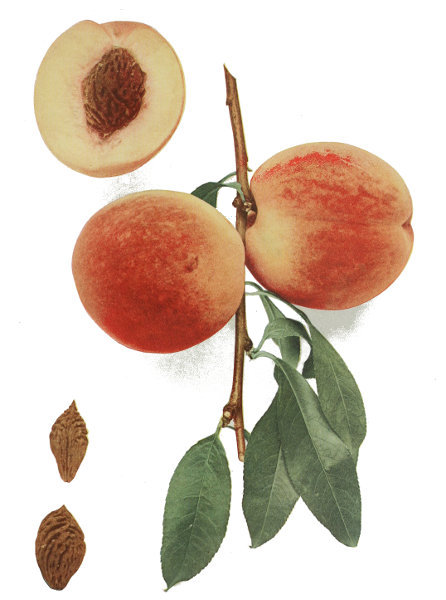
ROCHESTER
Trees large, vigorous, upright-spreading, more upright than Elberta, productive; trunk medium to thick, somewhat shaggy; branches stocky, smooth, ash-gray over red; branchlets slender, long, with long internodes, green mottled with brownish-red, smooth, glabrous, with numerous inconspicuous, small lenticels.
Leaves six inches long, one and five-eighths inches wide, folded upward and slightly recurled, oval to ovate-lanceolate, thin, leathery; upper surface dark green but often with a lighter tinge, smooth; lower surface grayish-green; apex acuminate; margin shallowly crenate; petiole one-half inch long, thick, with two to eight large, reniform glands variable in position.
Fruit matures in early mid-season; variable in size, the larger specimens varying from three to three and one-half inches in diameter, round-oblate, compressed, with unequal halves, often bulged near the apex; cavity wide, deep, flaring; suture shallow, becoming deeper near the tip; apex variable, often with a mucronate tip; color lemon-yellow changing to orange-yellow, blushed with deep, dark red, mottled; pubescence heavy; skin thick, tough, separates from the pulp; flesh yellow, stained with red near the pit, very juicy, tender and melting, sweet, highly flavored, sprightly; very good in quality; stone free, one and three-eighths inches long, more than one inch wide, oval, plump, flattened near the base, with roughened surface marked by large, deep pits and short grooves; ventral suture deeply furrowed along the edges, rather wide; dorsal suture grooved deeply, wide.
ST. JOHN
1. Mich. Hort. Soc. Rpt. 320. 1890. 2. Am. Pom. Soc. Cat. 46. 1891. 3. Mich. Hort. Soc. Rpt. 68. 1891. 4. Tex. Sta. Bul. 39:814. 1896. 5. Ont. Fr. Exp. Sta. Rpt. 9:8 fig. 1902. 6. Waugh Am. Peach Orch. 207. 1913.
Flater's St. John. 7. Downing Fr. Trees Am. 613. 1869.
Yellow St. John. 8. Am. Pom. Soc. Cat. 18. 1871. 9. Am. Pom. Soc. Rpt. 64. 1871. 10. Ohio Sta. Bul. 170:182. 1906.
Fleitas St. John. 11. Pa. Bd. Agr. Rpt. 586. 1878. 12. Ga. Sta. Bul. 42:235. 1898.
May Beauty. 13. Am. Pom. Soc. Rpt. 148. 1883.
Crane. 14. Mich. Sta. Sp. Bul. 44:34. 1910.
Unproductiveness and uncertainty in bearing keep this magnificent yellow-fleshed dessert fruit from being one of the most popular early peaches. Even with these handicaps, to which may be added small size in many situations, St. John has maintained great popularity for home orchards and in many peach-regions is grown for the markets. It is one of the earliest of the Crawford-like peaches, a perfect freestone, handsome in appearance, sweet, rich and delicious in flavor and pleasing in all of the flesh attributes of a good dessert peach. St. John resembles Early Crawford in size and shape but is a little more rotund, runs somewhat smaller, is not quite as high in quality and ripens several days earlier. The trees are all that could be asked for in size, vigor and hardiness, falling short only in the characters noted in the opening sentence. St. John should always be planted in the home orchard and it would seem that it is more often worth planting in commercial orchards. The color-plate does not do the variety justice in size, color or shape, the Station grounds being one of the many places in which the variety cannot be had at its best.
Where, by whom and when St. John originated and what its parentage, are unknown. It is more than half a century old, came from the South, and has been widely planted in southern peach-districts, especially along the southern coast of Alabama. The variety reproduces itself from seed and this fact has led to its being distributed under a number of different names as is shown by the synonyms listed in the references. In Michigan the variety was grown for some time as Crane, or Crane's Early Yellow, having come from the orchard of Charles G. Crane of Fennville. Mr. Crane, it appears, had lost the true name of the peach and after fruiting his supposed seedling for a time it was discovered by T. T. Lyon265 to be identical with St. John. In 1871 the American Pomological Society added this peach to its fruit-list as Yellow St. John but dropped "Yellow" from the name in 1891, the variety having appeared since that time in the Society's catalog as St. John.
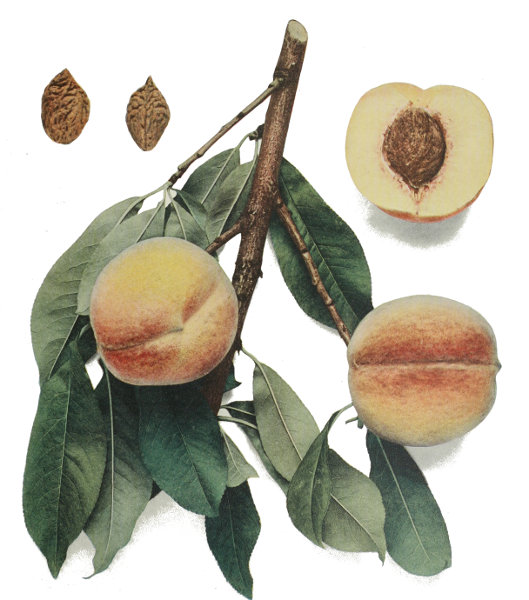
ST. JOHN
Tree medium to large, vigorous, upright-spreading, with the lower branches drooping, unproductive; trunk stocky, medium to smooth; branches thick, smooth, reddish-brown covered with light ash-gray; branchlets with internodes of medium length, dark pinkish-red with a trace of green, glossy, smooth, glabrous, with a few lenticels variable in size, raised at the base.
Leaves six and one-half inches long, one and three-fourths inches wide, flattened or slightly curled downward, oval to obovate-lanceolate, thick; upper surface dull, dark green, smooth; lower surface grayish-green; apex acuminate; margin finely serrate, often in two series, tipped with reddish-brown glands; petiole three-eighths inch long, glandless or with one to five small, globose glands variable in color and position.
Flower-buds obtuse, pubescent, plump, appressed or free; blossoms appear in mid-season; flowers seven-eighths inch across, white toward the base of the petals, becoming dark pink near the edges; pedicels short, glabrous, pale green; calyx-tube reddish-green, orange-colored within, obconic; calyx-lobes obtuse, glabrous within, pubescent without; petals small, ovate to oval, notched near the base, tapering to narrow claws; filaments seven-sixteenths inch long, equal to the petals in length; pistil pubescent near the base, as long as the stamens.
Fruit matures early; two and one-half inches long, two and three-fourths inches wide, round-oval, often bulged near the apex, usually compressed, with oblique sides; cavity medium to deep, wide, abrupt or flaring, often tinged with red; suture deep near the tip; apex round or depressed, with a mucronate or pointed tip; color deep yellow, blushed and splashed with carmine; pubescence thick and long; skin medium to thick, tough, variable in adherence to the pulp; flesh light yellow, tinged with red near the pit, juicy, tender, pleasantly sprightly, highly flavored; very good in quality; stone free, one and one-fourth inches long, fifteen-sixteenths inch wide, ovate, plump, tapering to a long point, with rough surfaces marked by large and small pits; ventral suture deeply grooved along the edges, furrowed; dorsal suture a large, deep groove.
SALWEY
1. Leroy Dict. Pom. 6:270, 271 fig. 1879. 2. Hogg Fruit Man. 460. 1884. 3. Bunyard Cat. 36. 1913-14.
Salway. 4. Horticulturist N. S. 8:168. 1858. 5. Gard. Chron. 944. 1861. 6. Mas Le Verger 7:51, 52, fig. 24. 1866-73. 7. Am. Hort. Ann. 80, 81 fig. 38. 1870. 8. Am. Pom. Soc. Rpt. 56. 1871. 9. Downing Fr. Trees Am. 1st App. 122. 1872. 10. Horticulturist 27:248. 1872. 11. Am. Pom. Soc. Cat. 30. 1875. 12. Mich. Sta. Bul. 169:225. 1899. 13. Kan. Hort. Soc. Rpt. 48, 49. 1901. 14. Budd-Hansen Am. Hort. Man. 2:355. 1903. 15. Cat. Cong. Pom. France 114 fig. 1906.
Salwey is one of the two European peaches cultivated on a commercial scale in America, Rivers being the other. Both find their greatest usefulness in extending the peach-season, this variety being one of the latest and Rivers one of the earliest sorts. It is a yellow-fleshed, freestone peach of attractive appearance and of good quality, neither handsome enough nor good enough in quality, however, to be considered a first-class dessert fruit. On the other hand it is one of the best sorts for canning, preserving and evaporating. The trees are vigorous, hardy, healthy and very productive but unfortunately ripen their crop so late in New York that the variety cannot be depended upon. Early freezes often destroy the fruit and cold, wet weather usually hinders maturity so much that the peaches are seldom at their best in this State. Possibly no other peach is more widely grown than Salwey. It is a standard sort in France, England and in peach-regions in America from the Atlantic to the Pacific and from Canada to the Gulf. This uncommon adaptability to diverse soils and climates ought to make it a valuable sort in peach-breeding. It has the reputation of coming true to seed but we do not find that many varieties have come from it.
The history of Salwey is not clear. Pomologists generally credit Thomas Rivers, Sawbridgeworth, England, with being the originator and introducer of the variety. It is known that Rivers grew it on his grounds but it is doubtful if he originated it. Other accounts say that it was raised in 1844 by Colonel Salwey, Egham Park, Surrey, England, from the seed of an Italian peach. Some say that a Charles Turner, Slough, England, brought the Italian peach seed from Florence, Italy, while others state that Turner introduced the new peach. The variety has long been known in America as Salway but Colonel Salwey, after whom the peach was named, spelled his name with an "e" and the correction is made in this text. In 1875 the American Pomological Society added this peach to its list of recommended fruits under the name Salway.
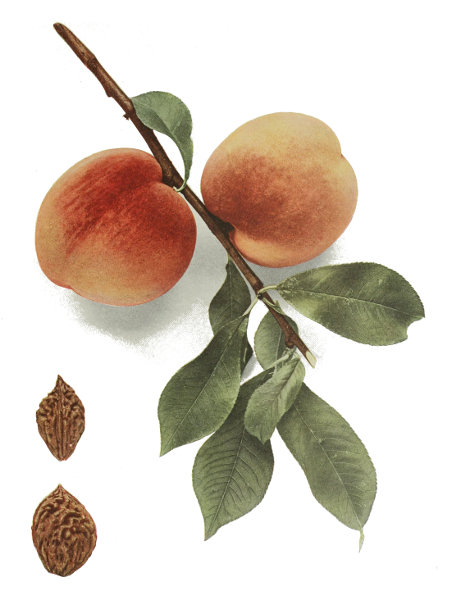
SALWEY
Tree of medium size, vigorous, upright-spreading, becoming drooping, dense-topped, hardy, very productive; trunk thick, smooth; branches stocky, smooth, reddish-brown mingled with very light ash-gray; branchlets slender, very long, with a tendency to rebranch near the tips; internodes dull pinkish-red with but little if any green, glossy, smooth, glabrous, with numerous raised lenticels.
Leaves seven inches long, one and three-fourths inches wide, folded upward and recurled, oval to ovate-lanceolate, leathery; apex acuminate; upper surface dark, dull green, smooth, becoming rugose near the midrib; margin finely serrate, tipped with reddish-brown glands; petiole three-eighths inch long, glandless or with one to six small, globose and reniform glands variable in color and position.
Flower-buds hardy, conical or pointed, pubescent, appressed or partly free; blossoms appear in mid-season; flowers seven-eighths inch across, white at the center of the petals, becoming pink near the margins; pedicels very short, nearly sessile, thick; calyx-tube reddish-green, orange-colored within, campanulate, glabrous; calyx-lobes short, narrow, acute, glabrous within, pubescent without; petals round, broadly oval, widely notched near the base, tapering to long, narrow claws red at the base; filaments five-sixteenths inch long, equal to the petals in length; pistil pubescent, longer than the stamens.
Fruit matures very late; two and nine-sixteenths inches long, two and one-half inches wide, round-cordate, bulged near the apex, compressed, with unequal halves; cavity deep, abrupt, often splashed with red; suture shallow, often extending beyond the tip; apex usually a small, elongated point; color greenish-yellow, usually with a brownish-red blush splashed dark red; pubescence short, thick, fine; skin thin, tough, adherent to the pulp; flesh golden-yellow, faintly tinged with red near the pit, juicy, stringy, tender, becomes dry with age, sweet, pleasantly flavored, aromatic; good to very good in quality; stone free, one and one-half inches long, one and one-sixteenth inches wide, oval to roundish-oval, very plump, pointed at the base, with large pits and short grooves in the surfaces; ventral suture narrow, deeply furrowed along the edges; dorsal suture winged, a narrow groove.
SCHUMAKER
1. Gard. Mon. 22:276. 1880. 2. W. N. Y. Hort. Soc. Rpt. 115. 1880. 3. Gard. Mon. 25:111 fig. 1883. 4. Mich. Hort. Soc. Rpt. 314, 315. 1889. 5. R. I. Sta. Bul. 7:41. 1890. 6. Budd-Hansen Am. Hort. Man. 2:356. 1903.
Shoemaker's Seedling. 7. Cult. & Count. Gent. 41:631. 1876.
Schumaker, now grown only in western New York and Pennsylvania, for a long time was described as the earliest of the white-fleshed, clingstone peaches. There are other peaches as early but, on the Station grounds, this is the best flavored of the early peaches. Moreover, when fully ripe it is almost a freestone. It is a handsome peach in color and shape but the fruits are too small though this can be remedied in part by thinning. The trees are large, hardy, vigorous and productive to a fault. With all of these good qualities, the wonder is that Schumaker is not more popular as a commercial variety to open the season but for some reason peach-growers are not pleased with it—probably because of the small size of the peaches. For a peach of its season, Schumaker is remarkably free from brown-rot. Nurserymen often substitute Alexander for this variety and vice versa.
This variety originated as a seedling with Michael Schumaker, Fairview, Erie County, Pennsylvania. Its parentage is unknown. It fruited for the first time in 1877 and was for a few years grown commercially but its popularity has long been on the wane.
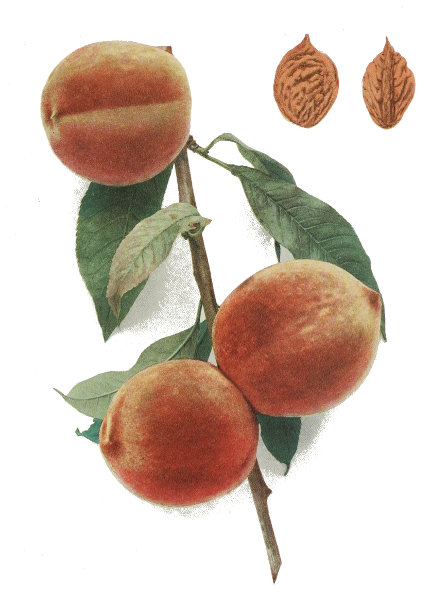
SCHUMAKER
Tree large, vigorous, upright-spreading, becoming drooping, open-topped, productive; trunk thick, smooth; branches stocky, smooth, reddish-brown tinged with light ash-gray; branchlets long, pinkish-red with but a trace of green, glossy, smooth, glabrous, with large, conspicuous, raised lenticels.
Leaves six and one-half inches long, one and five-eighths inches wide, variable in position, oval to obovate-lanceolate, leathery; upper surface dull, dark green, smooth; lower surface grayish-green; margin finely serrate, tipped with reddish-brown glands; petiole seven-sixteenths inch long, glandless or with one to four small, globose, reddish-brown glands variable in position.
Flower-buds hardy, pubescent, conical or pointed, plump, usually free; blossoms appear early; flowers one and one-half inches across, pink; pedicels very short, glabrous, green; calyx-tube reddish-green at the base, greenish-yellow within, obconic, glabrous; calyx-lobes short, acute, glabrous within, pubescent without; petals oval to ovate, tapering to claws sometimes red at the base; filaments one-half inch long, shorter than the petals; pistil pubescent at the base, as long as the stamens.
Fruit matures very early; about two and one-eighth inches in diameter, round, compressed, with unequal halves; cavity deep, flaring; suture shallow; apex ending in a recurved, mucronate tip but variable; color creamy-white, heavily blushed and often mottled with dark red; pubescence short, thick; skin thin, tender, separates from the pulp when fully ripe; flesh white, very juicy, stringy, tender, sweet, aromatic, highly flavored; very good in quality; stone clinging, becoming semi-cling when fully mature, one and one-fourth inches long, three-fourths inch wide, oval, plump, inconspicuously winged, with corrugated surfaces.
SMOCK
1. U. S. D. A. Rpt. 193, 194. 1865. 2. Mas Le Verger 7:75, 76, fig. 36. 1866-73. 3. Am. Pom. Soc. Cat. 28. 1873. 4. Leroy Dict. Pom. 6:279 fig., 280. 1879. 5. Mich. Sta. Bul. 169:225, 226. 1899. 6. Fulton Peach Cult. 196, 197. 1908.
Saint George. 7. Kenrick Am. Orch. 193. 1841.
Smock Freestone. 8. Downing Fr. Trees Am. 492. 1845. 9. Bridgeman Gard. Ass't Pt. 3:108. 1857. 10. Am. Pom. Soc. Cat. 78. 1862.
Though little grown now, during the last half of the last century Smock was one of the leading commercial peaches of its season. The variety has so little to recommend it, however, that we cannot but believe that reputation more than merit kept up its popularity. The trees are about all that could be desired but the peaches are of but mediocre quality and not at all attractive in appearance, lacking in size and color, are ungainly in shape and have but little uniformity in size, color or shape. It is one of the latest yellow-fleshed peaches and is said to be excellent for all culinary purposes. With so many better varieties of late yellow-fleshed, freestone peaches, Smock is not worth planting for any purpose.
Smock originated three-quarters of a century or more ago with a Mr. Smock, Middletown, New Jersey. Variations under such names as Smock X and Smock (Hance) have arisen as distinct varieties but all have proved to be identical with the old sort. The name Smock Cling appears in peach-literature but whether the peach was distinct we cannot say. Years after the introduction of Smock a peach was put out under the name "Beers Smock." The differences claimed are that Beers Smock runs larger and is better in quality than Smock. All descriptions of the two sorts, however, are so nearly identical that we believe that the two names are given to the same peach. In 1862 the American Pomological Society listed Smock in its catalog as Smock Freestone. In 1873 the name was shortened to Smock and it so appears today.
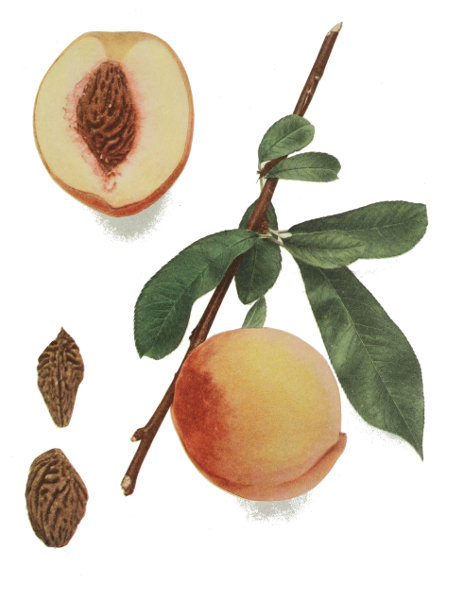
SMOCK
Tree large, vigorous, upright-spreading, somewhat drooping, dense-topped, tall, usually very productive; trunk medium to thick, rough; branches stocky, smooth, reddish-brown with very light ash-gray tinge; branchlets slender, medium to long, with short internodes, dark red intermingled with olive-green, glossy, smooth, glabrous, with large, raised lenticels.
Leaves six and one-fourth inches long, one and one-half inches wide, flattened or curved downward, oval to obovate-lanceolate, thick; upper surface dull, dark green; smooth; lower surface grayish-green; margin finely serrate, tipped with dark red glands; petiole three-eighths inch long, with none to five small, globose or reniform glands variable in color and position.
Flower-buds tender, conical or pointed, slightly pubescent, appressed or free; blossoms appear in mid-season; flowers less than one inch across, white at the center of the petals, light or dark pink near the edges, often in twos; pedicels short, glabrous, greenish; calyx-tube reddish-green at the base, orange-colored within, campanulate, glabrous; calyx-lobes broad, acute, serrate, glabrous within, pubescent without, partly reflexed; petals oval, irregular in outline near the base, tapering to long, narrow claws often reddish at the base; filaments three-eighths inch long, equal to the petals in length; pistil pubescent near the base, equal to or longer than the stamens.
Fruit matures very late; two and one-half inches long, two and three-eighths inches wide, oval, irregular, often bulged near the apex, compressed, with halves unequal and somewhat angular; cavity narrow, abrupt, contracted around the sides, twig-marked; suture a mere line, becoming deeper toward the apex; apex roundish, with a recurved, mucronate tip; color greenish-yellow or sometimes orange-yellow, specked and mottled with dull, dark red or sometimes faintly tinted with a bronze blush; pubescence very heavy, thick, fine; skin thin, tough, adherent to the pulp; flesh yellow, faintly tinged with red near the pit, variable in juiciness, tender, sprightly, pleasantly flavored; good in quality; stone free, one and five-eighths inches long, one and one-sixteenth inches wide, oval or obovate, bulged near the apex, flattened toward the base, with deeply grooved surfaces; ventral suture narrow, winged, deeply grooved along the sides; dorsal suture a wide and deep groove, winged.
STEVENS
1. Budd-Hansen Am. Hort. Man. 2:356, 357. 1903.
Stevens Rareripe. 2. N. J. Hort. Soc. Rpt. 42. 1878. 3. Am. Pom. Soc. Cat. 32. 1889. 4. Ont. Fr. Gr. Assoc. Rpt. 22:31, 32. 1890. 5. Mich. Sta. Bul. 169:227. 1899. 6. Ont. Fr. Exp. Sta. Rpt. 9:38. 1902. 7. Waugh Am. Peach Orch. 207. 1913.
Stevens is one of the fruits of the generation just past—a large, white and red, white-fleshed, freestone peach. The variety is best known as Stevens Rareripe but the last part of the name is inapt for the true rareripes are earlier ripening peaches while with Stevens lateness is one of its prime assets. In quality the fruits are extra good, the flesh-characters pleasing in every respect. The flavor is a pleasing mingling of sweet and sour not found in many other peaches so late in the season. The appearance of the peach is as alluring as the taste. The color-plate shows the variety almost perfectly in color and shape but the peaches as depicted are rather smaller than the average. These late, white-fleshed peaches now seldom sell well, usually reaching the markets in poor condition, but they are choice fruits for home use and for this purpose Stevens should be planted in every home orchard. The variety has the reputation of being hardy in both wood and buds.
Stevens originated about 1858 on the farm of B. Stevens, Morristown, New Jersey. Its parentage is unknown. It was listed in the American Pomological Society's catalog in 1889 as Stevens Rareripe. Later the name was shortened to Stevens in accordance with the Society's rules of nomenclature.
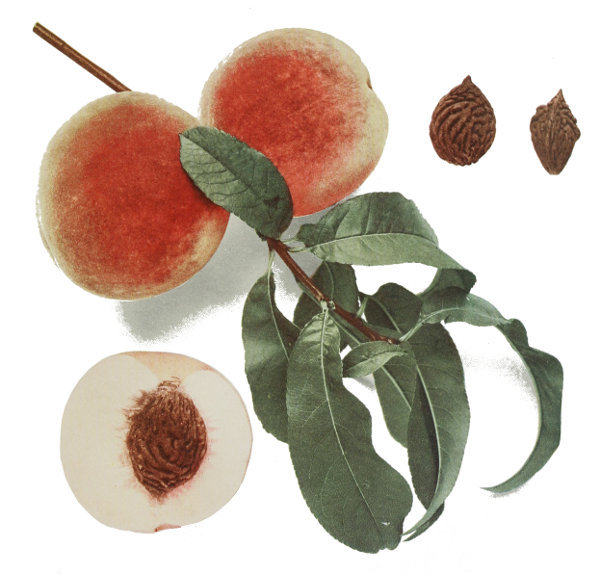
STEVENS
Tree vigorous, upright-spreading, with the lower branches inclined to droop, productive; trunk of medium thickness, rough; branches stocky, smooth, reddish-brown mingled with light ash-gray; branchlets thick, dark reddish-brown with but little green, glossy, smooth, with numerous large and small lenticels.
Leaves six inches long, one and five-eighths inches wide, folded upward and slightly recurled, oval to obovate-lanceolate, leathery; upper surface dark green, glossy, rugose along the midrib; lower surface light green; margin finely serrate, tipped with reddish-brown glands; petiole three-eighths inch long, glandless or with one to six small, reniform glands usually at the base of the leaf; flower-buds intermediate in size and length, conical to pointed, somewhat appressed, pubescent; flowers small.
Fruit matures late; about two and eleven-sixteenths inches in diameter, round to round-oval, with nearly equal sides; cavity deep, wide, flaring to abrupt; suture medium to deep, often extending beyond the tip; apex roundish, with a strongly mucronate and recurved tip; color greenish-white overlaid with attractive purplish-red, often mottled or splashed with darker red; pubescence short, fine; skin thick, tough, adherent to the pulp; flesh white, tinted with red near the pit and reddish underneath the deepest surface blush, juicy, coarse, sweet, sprightly; good in quality; stone nearly free, one and five-eighths inches long, one and one-eighth inches wide, obovate, flattened at the base, plump, with grooved surfaces; ventral suture medium to deeply grooved along the edges, intermediate in width, furrowed; dorsal suture deeply grooved, winged.
STUMP
1. Tex. Sta. Bul. 39:817. 1896. 2. Am. Pom. Soc. Cat. 22. 1897. 3. Mich. Sta. Bul. 169:227. 1899. 4. Budd-Hansen Am. Hort. Man. 2:357. 1903.
Stump the World. 5. U. S. Pat. Off. Rpt. 299. 1854. 6. Elliott Fr. Book 304. 1859. 7. Horticulturist 14:106, 107, Pl. 1859. 8. Am. Pom. Soc. Cat. 80. 1862. 9. U. S. D. A. Rpt. 193. 1865. 10. Hogg Fruit Man. 232. 1866. 11. Downing Fr. Trees Am. 633. 1869. 12. Ga. Sta. Bul. 42:242. 1898. 13. Fulton Peach Cult. 189, 190. 1908.
Stump-of-the-World. 14. N. J. Hort. Soc. Rpt. 41, 42. 1878.
Pêche du New-Jersey. 15. Leroy Dict. Pom. 6:195, 196 fig. 1879.
Late Stump. 16. Ark. Sta. Bul. 43:102. 1896.
Stump has long been a favorite white-fleshed, freestone, late peach of the Oldmixon type. It is not a handsome fruit, the color-plate flattering rather than detracting from its appearance, but makes up in quality what it lacks in looks. The flesh is melting, juicy, sparkling, rich and good though dry and very mediocre if permitted to overripen. The peaches are too tender for distant shipment and the variety is of value only for local markets and home use. The trees are large, vigorous, hardy, healthy and productive, with a shapely, upright-spreading, dense-topped head—about all that could be desired in a peach-tree. In spite of the high quality of the peaches and the splendid tree-characters, Stump is steadily waning in popularity and will, no doubt, soon pass from cultivation.
We can say little of the history of Stump other than that it originated in New Jersey at least three-quarters of a century ago. A Mr. Brant, Madison, New Jersey, in a report on peaches at the meeting of the New Jersey Horticultural Society in 1878 mentions a variety as Stump-of-the-World which originated on the farm of Samuel Whitehead in Middlesex County, New Jersey, about 1825. Mr. Brant, however, considered this sort distinct from Stump although very similar to it. From the description he gives it seems certain that he was describing the true Stump. In 1862 the American Pomological Society listed this sort in its catalog as Stump the World. The name was shortened to Stump in 1897 by the committee on nomenclature in accordance with pomological rules.
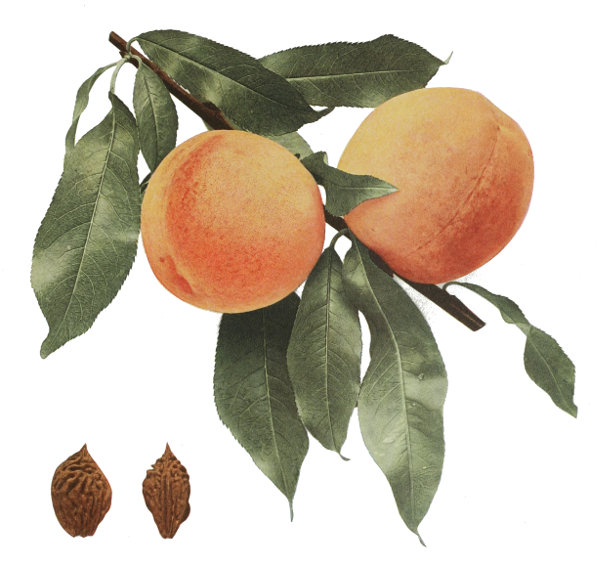
STUMP
Tree of medium size, vigorous, upright-spreading, dense-topped, productive; trunk medium in diameter, smooth; branches stocky, smooth, reddish-brown tinged with light ash-gray; branchlets thick, inclined to rebranch, long, with internodes dark red mingled with olive-green, glossy, smooth, glabrous, with many conspicuous, small, raised lenticels.
Leaves six and three-fourths inches long, one and three-fourths inches wide, folded downward, broad-oval to obovate-lanceolate, leathery; upper surface dull, dark green, rugose along the midrib; lower surface grayish-green; margin finely serrate, often in two series, tipped with reddish-brown glands; petiole seven-sixteenths inch long, with one to four globose glands variable in color and position.
Flower-buds semi-hardy, pubescent, conical to pointed, plump, usually more or less free; blossoms appear in mid-season; flowers thirteen-sixteenths inch across, white at the center, becoming pink near the margin; pedicels long, slender; calyx-tube dull reddish-green, yellow within, campanulate, glabrous; calyx-lobes acute, obtuse, glabrous within, pubescent without; petals oval, faintly notched near the base, tapering to very short claws tinged with red near the base; filaments five-sixteenths inch long, equal to the petals in length; pistil pubescent at the ovary, longer than the stamens.
Fruit matures late; about two and one-half inches in diameter, round-oval to cordate bulged near the apex, compressed, with markedly unequal halves; cavity shallow, wide, uneven in outline, flaring or abrupt, with tender skin; suture shallow, often extending beyond the tip; apex round or pointed, with a recurved, mucronate tip; color creamy-white, blushed, mottled and splashed with red; pubescence long, thick, coarse; skin thin, tough, separates from the pulp; flesh white, strongly stained with red near the pit, juicy, tender and melting, sweet, rich, pleasantly flavored, aromatic; very good in quality; stone nearly free, one and one-half inches long, one and one-sixteenth inches wide, ovate to oval, plump, flattened toward the base, tapering to a long point, with grooved surfaces; ventral suture deeply marked along the edges, narrow, sometimes winged; dorsal suture grooved.
SUMMER SNOW
1. Okla. Sta. Bul. 2:15. 1892. 2. Mich. Sta. Bul. 118:31. 1895. 3. Thomas Am. Fruit Cult. 691. 1897. 4. Mich. Sta. Bul. 169:227. 1899. 5. Ont. Fr. Exp. Sta. Rpt. 7:55. 1900.
Summer Snow is a curiosity with some value for culinary purposes Its distinctive peculiarities are a skin almost pure white and flesh white as snow from skin to pit. The quality is poor and the flesh clings to the pit so tenaciously that the variety has no value, whatsoever, for dessert but is said to be excellent for pickling and to make a very good and a very distinctive canned product.
There are no records of the origin of this peach but it is doubtful if it dates back more than a quarter of a century. The variety is very similar to the old Snow, which was probably its prototype, differing essentially in having a clinging stone while the stone of Snow is free. In New York the name is a misnomer as the fruit does not ripen until the last of September or early in October. Albino peaches date back to the early records of this fruit and seem to be known wherever peaches are grown. Whenever seedling peaches are grown in large numbers, an occasional albino appears.
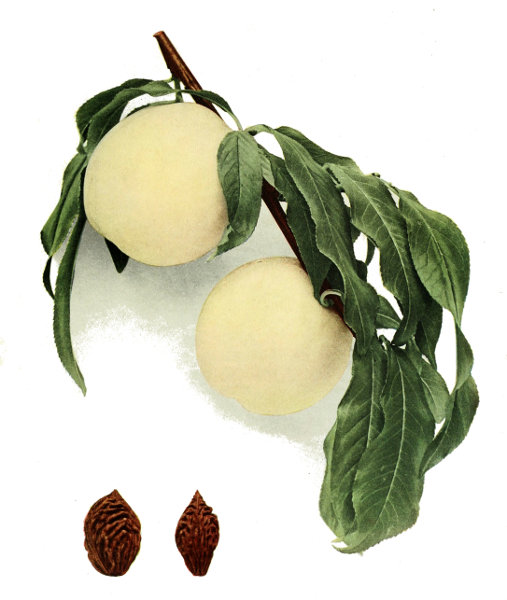
SUMMER SNOW
Tree large, vigorous, upright-spreading, slightly drooping, productive; trunk thick and, smooth; branches stocky, smooth, reddish-brown mingled with very light ash-gray; branchlets very long, inclined to rebranch, with internodes of medium length, olive-green intermingled with light brown, smooth, glabrous, with conspicuous, russet-colored lenticels.
Leaves six and one-fourth inches long, one and five-eighths inches wide, flattened or curved downward, oval to obovate-lanceolate, thin; upper surface dull green, smooth; lower surface grayish-green; margin finely serrate, tipped with reddish-brown glands; petiole three-eighths inch long, glandless or with one to six small, globose and reniform glands variable in color and position.
Leaf-buds semi-hardy, small, short, variable in shape, plump, appressed or slightly free; blossoms appear in mid-season; flowers one and five-eighths inches across, white, sometimes in twos; pedicels short, thick, glabrous, green; calyx-tube tinged with green, yellow within, campanulate, glabrous; calyx-lobes variable in length, medium to narrow, acute, glabrous within, pubescent without; petals often pointed at the apex, round-ovate, broadly notched at the base, tapering to broad, short claws; filaments seven-sixteenths inch long, shorter than the petals; pistil pubescent near the base, as long as the stamens.
Fruit matures late; two and three-eighths inches long, two and five-sixteenths inches wide, round-cordate, somewhat angular, bulged at one side, compressed, with unequal sides; cavity deep, narrow, abrupt, contracted about the sides, twig-marked; suture shallow, becoming deeper toward the tip; apex roundish or depressed, with a mucronate or sometimes a small, mamelon tip; color greenish-white changing to creamy-white, without blush; pubescence long, thick, coarse; skin thin, tender, adherent to the pulp; flesh white to the pit, juicy, meaty, mildly sweet to sprightly; fair in quality; stone firmly clinging, one and nine-sixteenths inches long, one and one-eighth inches wide, broad-oval, often bulged near the apex, winged, with pitted surfaces marked with short grooves; ventral suture rather narrow, winged, with furrows of medium depth along the sides; dorsal suture grooved, with winged sides.
SURPASSE
1. Mich. Sta. Bul. 169:227. 1899. 2. Budd-Hansen Am. Hort. Man. 2:357. 1903.
Surpasse Melocoton. 3. Mich. Hort. Soc. Rpt. 33. 1874. 4. Barry Fr. Garden 407. 1883. 5. R. I. Sta. Bul. 7:41. 1890.
As Surpasse grows on the Station grounds, it has most of the qualities of a first-class yellow-fleshed, freestone peach. The fruits are large, handsome and of excellent quality, while the trees are satisfactory in every respect except, possibly, in productiveness. The variety has been grown sufficiently long in New York to have been well tested and has not found favor, so that we must conclude that it does not do as well elsewhere as here and that it is doomed to go into the discard.
Surpasse originated more than forty years ago on the grounds of Ellwanger & Barry, Rochester, New York, and has long been sold by this nursery firm. It has never been widely nor largely grown commercially but is not uncommon in western New York.
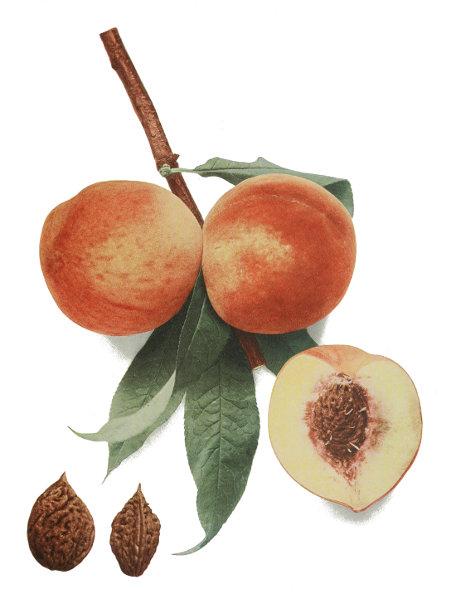
SURPASSE
Tree above medium size, vigorous, upright-spreading, with a tendency to droop, rather unproductive; trunk thick and smooth; branches stocky, smooth, reddish-brown mingled with light ash-gray; branchlets thick, inclined to rebranch, long, dark pinkish-red with some green, smooth except for the lenticels, glabrous, with very conspicuous, numerous, large and small, raised lenticels.
Leaves six inches long, one and five-eighths inches wide, variable in position, oval to obovate-lanceolate, leathery; upper surface dark olive-green, rugose along the midrib; apex acuminate; margin finely serrate, tipped with reddish-brown glands; petiole seven-sixteenths inch long, glandless or with one to four small, globose glands variable in color and position.
Flower-buds tender, pubescent, conical to pointed, plump, usually free; blossoms open in mid-season; flowers seven-eighths inch across, light pink but darker along the edges, usually single; pedicels short, glabrous, green; calyx-tube reddish-green, orange-colored within, campanulate, glabrous; calyx-lobes long, narrow, acute, glabrous within, pubescent without; petals ovate, with short, indistinct claws; filaments three-eighths inch long, equal to the petals in length; pistil as long as the stamens.
Fruit matures in mid-season; two and one-half inches long, two and three-eighths inches wide, round-cordate, irregular, compressed, much bulged near the apex, with unequal halves; cavity deep, wide, flaring to abrupt, with tender, reddish skin; suture a line becoming deeper toward the tip; apex pointed, usually with an erect, mamelon tip; color pale yellow or orange-yellow, mottled and splashed more or less with red and overspread with a lively, dark red blush; pubescence medium in length, thick, fine; skin thin, separates from the pulp; flesh light yellow, red near the pit, very juicy, rather coarse, stringy, tender and melting, sprightly, highly flavored; good to very good in quality; stone free, one and three-eighths inches long, fifteen-sixteenths inch wide, ovate, rather plump, tapering to a long point, sometimes slightly winged along the ventral suture, with pitted surfaces; ventral suture deeply grooved along the edges, below medium in width, furrowed; dorsal suture grooved, winged.
THURBER
1. Am. Pom. Soc. Rpt. 75. 1873. 2. Gard. Mon. 17:175. 1875. 3. Downing Fr. Trees Am. 2nd App. 144. 1876. 4. Am. Pom. Soc. Cat. 32. 1881. 5. Del. Sta. Rpt. 13:109 fig. 8, 110. 1901. 6. Budd-Hansen Am. Hort. Man. 2:357. 1903.
Thurber is mediocre in all of its characters in New York, though perhaps it is a little better in quality than the average white-fleshed, mid-season freestone. In the South, however, it seems to be considered one of the best of its class not only in quality but in size and appearance. The fruits are small in New York, as the color-plate shows, while all descriptions of them in the South say they are large. The variety is possibly worth planting, because of good quality, in home orchards in this State.
Thurber is a seedling of Chinese Cling grown by L. E. Berckmans, Rome, Georgia, more than forty years ago. The variety was named in honor of Dr. George Thurber, American botanist, naturalist and editor. It is similar to its parent but is a freestone and the trees are more compact and thrifty than those of Chinese Cling. The American Pomological Society added Thurber to its fruit-list in 1881, a place it still holds
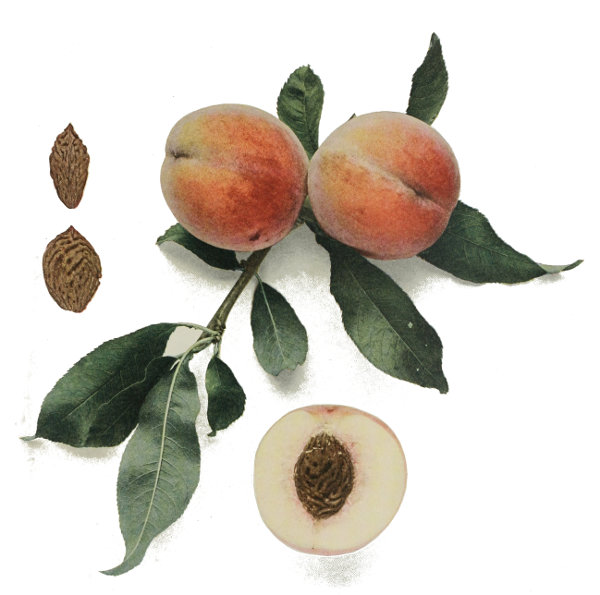
THURBER
Tree above medium size, vigorous, upright-spreading, productive; trunk thick and smooth; branches stocky, smooth, reddish-brown mingled with light ash-gray; branchlets slender, often very long, olive-green with some red, glossy, smooth, glabrous, with numerous conspicuous, raised lenticels variable in size, usually russetted toward the base.
Leaves six inches long, over one and one-half inches wide, flattened or curled downward, oval to obovate-lanceolate, leathery; upper surface dull, dark green, smooth becoming rugose along the midrib; lower surface grayish-green; margin finely serrate, tipped with reddish-brown glands; petiole three-eighths inch long, glandless or with one to four small, globose glands variable in color and position.
Flower-buds tender, large, medium to short, heavily pubescent, obtuse, very plump, usually free; blossoms open in mid-season; flowers one and one-eighth inches across, light pink, darker along the edges, usually single; pedicels long, slender, glabrous, greenish; calyx-tube reddish-green, greenish-yellow within, campanulate, glabrous; calyx-lobes acute, glabrous within, heavily pubescent without, flattened; petals ovate, tapering to short, narrow claws; filaments seven-sixteenths inch long, equal to the petals in length; pistil longer than the stamens.
Fruit matures in mid-season; two and three-eighths inches long, two and one-eighth inches wide, round-oval, somewhat compressed, with unequal halves; cavity shallow, narrow, flaring or abrupt, often tinted with red, compressed about the sides; suture a line or very shallow, often extending beyond the tip; apex round, with a recurved, mucronate or mamelon tip; color green or creamy-white, with few splashes of dull red over a lively red blush; pubescence long, coarse, thick; skin thin, tough, variable in adherence to the pulp; flesh white, deeply stained with red near the pit, juicy, tender and melting, pleasantly sprightly, aromatic; good in quality; stone free, one and one-half inches long, more than an inch wide, red, obovate to oval, flattened toward the base, plump, tapering to a short point, often winged on the ventral suture, with surfaces pitted and marked by short grooves; ventral suture deeply grooved along the edges, narrow; dorsal suture grooved, slightly winged.
TRIANA
1. Tex. Sta. Bul. 39:819. 1896. 2. Fla. Sta. Bul. 73:152. 1904. 3. Glen St. Mary Nur. Cat. 23. 1906. 4. Am. Pom. Soc. Cat. 39. 1909.
Triana is another of the honey-fleshed, beaked peaches supposed to thrive only in the far South. It can be grown, however, with about as much certainty in New York as many of the standard varieties of the North. Its small size and poor shipping qualities debar it from competing with commercial peaches in this region but it is well worth planting in home orchards for the sake of variety and because of its delicious flavor—a sort of scented sweetness wholly unknown in northern varieties. The good health, vigor, size and hardiness of these honey-peaches on the Station grounds is a constant surprise to those who have believed that they could be grown only in the Gulf States.
Triana originated a quarter of a century or more ago at the Glen Saint Mary Nurseries, Glen Saint Mary, Florida. It was introduced in 1892 by the originators. The American Pomological Society added Triana to its fruit-list in 1909.
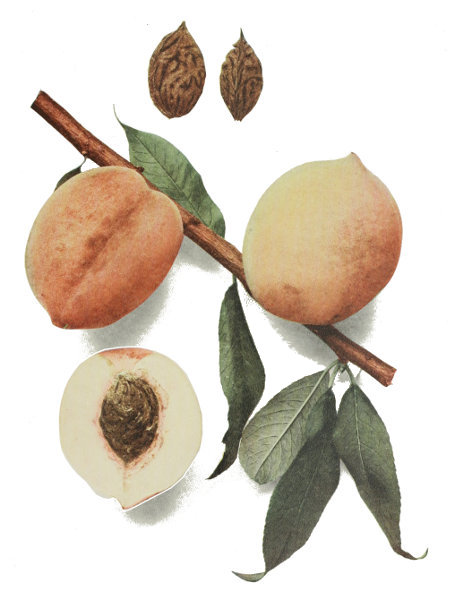
TRIANA
Tree of medium size, upright-spreading, open-topped, productive; branches greenish-red; branchlets slender, long, with a tendency to rebranch, dark red with some olive-green, rough, glabrous, with numerous conspicuous, large, raised lenticels.
Leaves five and one-half inches long, one and five-eighths inches wide, folded upward and recurled, slightly lanceolate, thin, leathery; upper surface dark green, smooth; lower surface grayish-green, with prominent mid-rib; margin finely serrate; petiole three-eighths inch long, with one to five small, reniform glands variable in position.
Flower-buds half-hardy, short, pubescent, conical, plump, usually appressed; blossoms one and one-half inches across, pale red, in dense clusters, usually single; pedicels long, slender, glabrous, greenish; calyx-tube reddish-green, dark greenish-yellow within, campanulate, glabrous; calyx-lobes acute, glabrous within, pubescent without; petals oval to long-ovate, tapering to short claws; filaments seven-sixteenths inch long, shorter than the petals; pistil pubescent at the ovary, often longer than the stamens.
Fruit matures in late mid-season; two and one-eighth inches long, one and thirteen-sixteenths inches wide, oval, compressed, with unequal halves; cavity shallow, flaring; suture of medium depth; apex a long, mucronate tip; color creamy-white, blushed, splashed and mottled with bright red; pubescence short, fine; skin thin, tender, adhering to the pulp; flesh white, faintly stained with red near the pit, tender, sweet, mild; good in quality; stone nearly free, one and one-fourth inches long, one and three-fourths inches wide, oval or elliptical, usually with pitted surfaces; ventral suture deeply grooved along the edges; dorsal suture grooved.
TRIUMPH
1. Gard. & For. 8:20. 1895. 2. U. S. D. A. Pom. Rpt. 44. 1895. 3. Kan. Hort. Soc. Peach, The 49. 1899. 4. Am. Pom. Soc. Cat. 34. 1899. 5. Can. Hort. 24:401, fig. 2158. 1901. 6. Ont. Fr. Exp. Sta. Rpt. 9:38. 1902. 7. Budd-Hansen Am. Hort. Man. 2:358. 1903. 8. Ohio Sta. Bul. 170:182. 1906. 9. Waugh Am. Peach Orch. 196, 208. 1913.
Triomphe. 10. Rev. Hort. 79. 1895.
Triumph is an extra early, yellow-fleshed peach so inferior in appearance and quality of fruit and so subject to brown-rot that it is not worth growing in any but the most northern peach-regions where, because of great hardiness in wood and bud, it becomes a valuable variety. It is grown more or less, however, both north and south because it is one of the earliest yellow-fleshed sorts and because the trees bear regularly and abundantly. The dark color and the great amount of fuzzy pubescence detract materially from the appearance of the peach. The specimens shown in the color-plate are from unthinned trees; the size can be increased by thinning. Small pits somewhat offset the small size of the fruits. The peaches, if not attacked by brown-rot, stand shipment splendidly, a character which adds to its value for early markets. Though often put down as a clingstone it is, when well grown, a semi-cling and sometimes the stone is free.