Chapter V · LEADING VARIETIES OF PEACHES (continued 4)
Reading edition
Triumph is one of several seedlings grown by J. D. Husted, Vineyard, Georgia. It is supposed to be an offspring of Alexander. The date of origin is unknown but references go back to 1895. Triumph was placed on the fruit-list of the American Pomological Society in 1899.
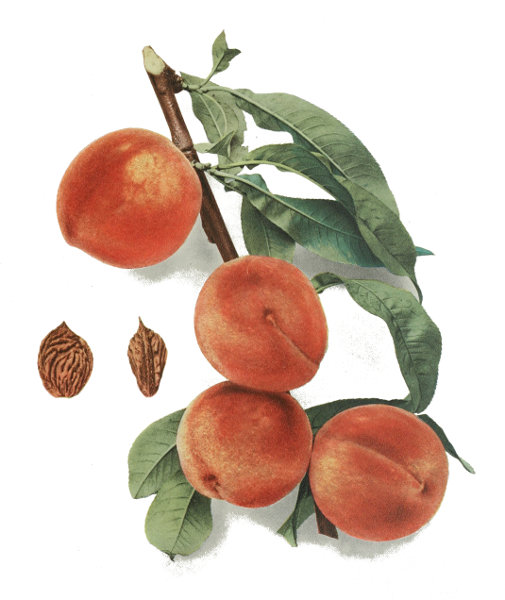
TRIUMPH
Tree of medium size, vigorous, upright-spreading, with lower branches drooping, hardy, very productive; trunk intermediate in thickness and smoothness; branches stocky, smooth, reddish-brown intermingled with very light ash-gray; branchlets slender, long, with internodes of medium length, dark pinkish-red with some green, glossy, very smooth, glabrous, with many conspicuous, small, raised lenticels.
Leaves six inches long, one and five-eighths inches wide, flattened or curled downward, oval to obovate-lanceolate, thin, leathery; upper surface dull, dark olive-green, rugose near the midrib; lower surface grayish-green; margin finely and shallowly serrate, tipped with reddish-brown glands; petiole three-eighths inch long, glandless or with one to four very small, globose glands variable in position.
Flower-buds hardy, small, short, pubescent, obtuse or pointed, plump, appressed or free; blossoms unfold early; flowers one and five-eighths inches across, dark pink, sometimes in twos; pedicels short, slender, glabrous, green; calyx-tube reddish-green at the base, orange-colored within, campanulate, glabrous; calyx-lobes broad, obtuse, glabrous within, pubescent without; petals broadly oval to ovate, widely notched near the base, tapering to claws with reddish base; filaments seven-sixteenths inch long, shorter than the petals; pistil pubescent near the base, equal in length to the stamens.
Fruit matures early; two inches long, two and one-eighth inches wide, roundish-oval, compressed, with unequal sides; cavity deep, abrupt, with tender skin; suture shallow; apex roundish, with a mamelon and recurved tip; color pale yellow overlaid with dark red; pubescence thick and long; skin thin, adherent to the pulp; flesh yellow, stained with red near the pit, juicy, firm until fully ripe, sprightly; fair in quality; stone semi-free to free when fully ripe, one and one-fourth inches long, seven-eighths inch wide, obovate, flattened wedge-like at the base, bulged at one side near the apex, plump, with deeply grooved surfaces; ventral suture deeply grooved along the edges, furrowed; dorsal suture winged, deeply grooved, rather wide.
TROTH
1. Am. Pom. Soc. Cat. 35. 1899. 2. Mich. Sta. Bul. 169:228. 1899. 3. Am. Gard. 24:413. 1903.
Troth's Early Rareripe. 4. Kenrick Am. Orch. 183. 1841.
Troth's Early Red. 5. Elliott Fr. Book 304. 1859. 6. Downing Fr. Trees Am. 634. 1869.
Troth's Early. 7. Am. Pom. Soc. Cat. 80. 1862. 8. Am. Jour. Hort. 3:341. 1868. 9. Fulton
Peach Cult. 183, 184. 1908.
Troth, the standard early peach in the middle of the last century, is now all but out of cultivation. It is still listed in a few nursery catalogs and is still on the fruit-list of the American Pomological Society. Among the multitude of early peaches now grown, Troth cuts but a sorry figure in either tree- or fruit-characters. It is worth discussing here only because it is a milestone in the evolution of cultivated peaches.
Troth, first known as Troth's Early Red, originated in the first years of the Nineteenth Century, probably in New Jersey. Nothing is known of its parentage or of the originator. It ripens with Early York and some pomologists have confused it with this variety and also with Haines but, while similar to both, Troth is distinct. The American Pomological Society placed the variety upon its fruit-list in 1862 under the name Troth's Early Red but dropped it in 1891. In 1899 it was once more recommended by the Pomological Society, being listed as Troth.
Tree above medium in size, vigorous, upright-spreading, the lower branches drooping, very productive; trunk somewhat stocky; branches thick, smooth, reddish-brown covered with light ash-gray; branchlets slender, long, with short internodes, dark pinkish-red intermingled with green, with conspicuous, very numerous, large and small lenticels; leaves six and one-fourth inches long, one and three-fourths inches wide, flattened and slightly curled downward, oval to obovate-lanceolate, leathery, dark, dull green, smooth becoming rugose near the midrib; margin finely and shallowly serrate, tipped with reddish-brown glands; petiole seven-sixteenths inch long, with one to five very small, globose, reddish-brown glands; flower-buds half-hardy, of medium size and length, more or less pubescent, obtuse or conical, plump, usually appressed; blossoms small, appear in mid-season.
Fruit matures in early mid-season; two inches long, two and one-eighth inches wide, roundish-oblate, slightly bulged at one side, somewhat compressed, with halves decidedly unequal; cavity of medium depth and width, abrupt, somewhat irregular, contracted about the sides, often dotted and striped with red; suture rather shallow, extending considerably beyond the point; apex roundish or depressed, with a mucronate or slightly pointed tip; color greenish-white or creamy-white, blushed with dark, dull red and with more or less heavy mottlings extending over more than half of the surface; pubescence thick, short; skin thin, tender, adheres somewhat to the pulp; flesh whitish, tinged with red near the pit, variable in juiciness, tender, nearly melting, pleasant flavored; fair to good in quality; stone free, one and one-eighths inches long, seven-eighths inch wide, oval, flattened toward the base, acute at the apex, with grooved surfaces; ventral suture medium in width; dorsal suture grooved.
WADDELL
1. Ga. Sta. Bul. 42:242. 1898. 2. Del. Sta. Rpt. 13:111 fig. 9. 1901. 3. Am. Pom. Soc. Rpt. 249. 1903. 4. Budd-Hansen Am. Hort. Man. 2:358. 1903. 5. Ohio Sta. Bul. 170:182. 1906. 6. Am. Pom. Soc. Cat. 39. 1909. 7. Waugh Am. Peach Orch. 208. 1913.
Waddell is an early mid-season, white-fleshed, semi-cling peach from Georgia, a very evident descendant of Chinese Cling. The variety is now widely grown and is everywhere esteemed as a commercial sort. Its chief competitor is Carman, compared with which the fruit differs in ripening a few days early; is handsomer, in color at least, the two, as the color-plates show, being very similar in size and shape; is of rather finer texture of flesh and is better flavored; and, lastly, according to most reports, Waddell is a better shipper than Carman. The variety has not been nearly as widely nor as generally planted as the better-known Carman but we are of the opinion that it has been a greater factor in the success of a score or more of the big commercial peach-orchards, North and South, of the last few years. It is a particularly pleasing peach in New York and ought to be considered for every commercial plantation where a variety of its season is wanted to precede or to compete with Carman.
Waddell is a chance seedling found by William Waddell, Griffin, Georgia. The variety was introduced by J. H. Hale, South Glastonbury, Connecticut. The American Pomological Society added Waddell to its fruit-list in 1909.
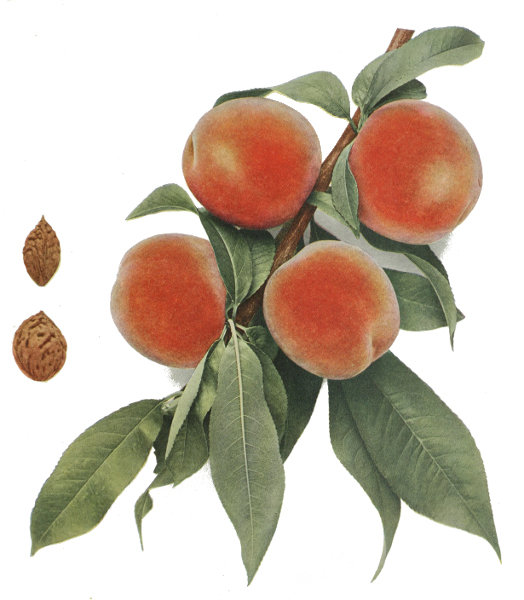
WADDELL
Tree medium in size, vigorous, upright becoming spreading and with the lower branches inclined to droop, hardy, productive; trunk thick, smooth; branches stocky, smooth, reddish-brown tinged with light ash-gray; branchlets long, inclined to rebranch, dark pinkish-red overspread with green, glossy, smooth, glabrous, with numerous conspicuous, raised lenticels variable in size.
Leaves six inches long, one and three-fourths inches wide, folded upward and curled downward, oval to obovate-lanceolate, leathery; upper surface dull, dark green, smooth; lower surface grayish-green; apex acuminate; margin finely serrate, tipped with reddish-brown glands; petiole three-eighths inch long, with one to four small, globose, reddish-brown glands variable in position.
Flower-buds hardy, conical or pointed, pubescent, usually appressed; blossoms appear in mid-season; flowers one and three-fourths inches across, red becoming pale pink, in clusters of twos; pedicels short, slender, glabrous, green; calyx-tube reddish-green at the base, greenish-yellow within, campanulate, glabrous; calyx-lobes broad, obtuse, glabrous within, pubescent without; petals oval, crenate, irregular in outline near the base, tapering to claws with reddish base; filaments seven-sixteenths inch long, shorter than the petals; pistil pubescent near the base, equal to the stamens in length.
Fruit matures in early mid-season; two and one-fourth inches long, about two inches wide, oval to roundish-oval, compressed, bulged on one side, with unequal halves; cavity deep, abrupt, with tender skin, tinged with pink; suture shallow, deepening toward the apex and extending beyond; apex roundish, with a small, mucronate tip; color creamy-white, blushed with red and with a few dull splashes of darker red; pubescence thick; skin tough, separates from the pulp; flesh white, stained with pink near the pit, juicy, stringy firm but tender, sweet but sprightly, aromatic; very good in quality; stone semi-free to free, one and three-eighths inches long, one inch wide, ovate; ventral suture deeply grooved along the sides, faintly winged; dorsal suture grooved, not winged.
WAGER
1. Cult. & Count. Gent. 43:584. 1878. 2. W. N. Y. Hort. Soc. Rpt. 113, 114. 1880. 3. Cult. & Count. Gent. 48:823. 1883. 4. Black Cult. Peach & Pear 111. 1886. 5. Am. Pom. Soc. Cat. 22. 1897. 6. Kan. Hort. Soc. Peach, The 148. 1899. 7. Budd-Hansen Am. Hort. Man. 2:358, 359. 1903.
Hardiness, productiveness and early bearing are the outstanding characters of Wager that give it a high place in the peach-list for New York. It is a yellow-fleshed, freestone peach none too attractive in coloring, always rather small and of only fair quality as a dessert fruit but excellent for canning, drying and all culinary purposes. The variety comes true to seed, or nearly so. The fruits of Wager are not attractive enough and the trees are too small to make the variety of much value in commercial plantations but it is a very good peach for home orchards and one of the best of all where hardiness is a prime requisite. Several quite distinct peaches are sold by nurserymen as Wager.
Wager originated some time previous to 1870 with Benjamin Wager, West Bloomfield, Ontario County, New York. The variety was added to the fruit-list of the American Pomological Society in 1897.
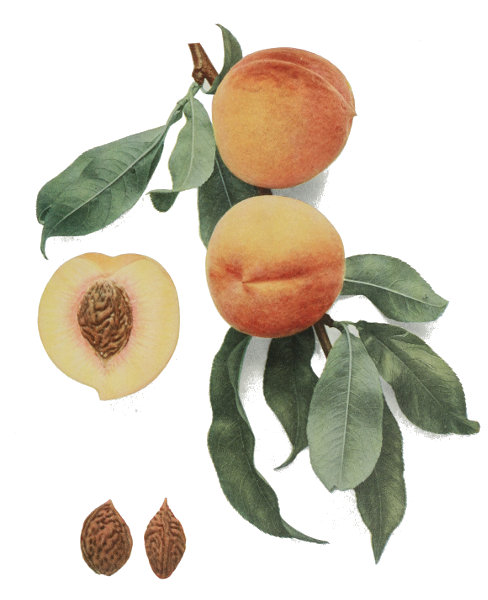
WAGER
Tree medium in size or small, upright-spreading, hardy, productive; trunk intermediate in thickness and smoothness; branches stocky, smooth, reddish-brown overlaid with light ash-gray; branchlets rebranching near the tips, dark red with some green, roughened by the lenticels, which are medium in size and number.
Leaves five and one-half inches long, one and one-fourth inches wide, flattened or curled downward, oval to obovate-lanceolate, thin, leathery; upper surface dull, dark green, rugose along the midrib; lower surface grayish-green; apex acuminate; margin finely serrate, tipped with reddish-brown glands; petiole five-sixteenths inch long, with two to four small, globose or reniform glands variable in color and position.
Flower-buds medium in size and length, heavily pubescent, conical, plump, usually free; blossoms appear in mid-season; flowers one and one-eighth inches across; pedicels very short, thick, glabrous, green; calyx-tube reddish-green, orange-colored within, campanulate, glabrous; calyx-lobes narrow, acute, glabrous within, pubescent without; petals oval, broadly notched, tapering to claws red at the base; filaments three-eighths inch long, shorter than the petals; pistil pubescent at the ovary, longer than the stamens.
Fruit matures in mid-season; two and one-half inches long, two and one-fourth inches wide, oval, bulged near the apex, sometimes conical, compressed, with unequal halves; cavity flaring or abrupt, often mottled with red and with tender skin; suture a line, becoming deeper toward the tip; apex roundish or pointed, usually with a mamelon, recurved tip; color orange-yellow, blushed and mottled with dark red; pubescence thick, long and fine; skin thin, tough, separates from the pulp; flesh yellow, faintly stained with red near the pit, meaty but tender, sweet, mild; good in quality; stone free, one and three-eighths inches long, one inch wide, ovate, flattened near the base, with pitted surfaces, marked with few short grooves; ventral suture deeply grooved along the sides, wide, furrowed; dorsal suture a wide, deep groove.
WATERLOO
1. Cult. & Count. Gent. 43:489. 1878. 2. W. N. Y. Hort. Soc. Rpt. 51. 1879. 3. Hogg Fruit Man. 463. 1884. 4. Am. Pom. Soc. Cat. 34. 1885. 5. Ibid. 22. 1897. 6. Garden 66:112. 1904. 7. Budd-Hansen Am. Hort. Man. 2:359. 1903. 8. Fulton Peach Cult. 173. 1908. 9. Waugh Am. Peach Orch. 209. 1913.
Waterloo is without honor in its own country but is a standard peach in England. In spite of the fact that the variety originated within ten miles of the Station grounds it is all but worthless here as it is in most parts of New York. Waterloo is an extra-early, white-fleshed, semi-cling peach very similar to the better-known Canada. The faults that condemn it are small size, poor quality, susceptibility to brown-rot and a long period of ripening for the fruit and small size and unproductiveness in the tree. It is given prominence in The Peaches of New York only because it is so often noted in the horticultural press as a standard variety, an opinion, no doubt, reflected in America from European publications.
Waterloo was first grown by Henry Lisk, Waterloo, Seneca County, New York, who brought it to notice in 1877. Thomas Rivers introduced it into England where it has long been grown and esteemed for its earliness and good quality. The American Pomological Society placed Waterloo in its fruit-catalog in 1885, where it remained until 1891 when it was dropped, but was replaced in 1897.
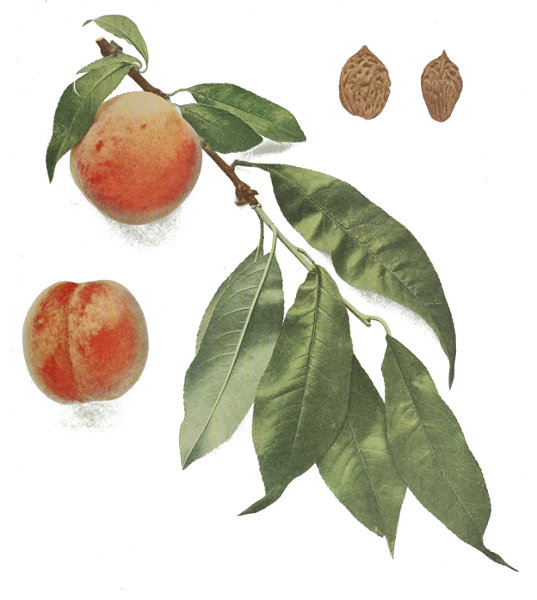
WATERLOO
Tree small, upright-spreading, sometimes productive; trunk smooth; branches stocky, smooth, reddish-brown covered with light ash-gray; branchlets very long, rebranching, with internodes of medium length, dark pinkish-red mingled with green, glossy, smooth, glabrous, with few large lenticels.
Leaves six and one-fourth inches long, one and three-fourths inches wide, flattened, oval to obovate-lanceolate, leathery; upper surface dull, dark olive-green, smooth; lower surface grayish-green; margin finely serrate, tipped with reddish-brown glands; petiole seven-sixteenths inch long, glandless or with one to four small, globose and reniform, reddish-brown glands variable in position.
Flower-buds half-hardy, obtuse or conical, plump, usually free, pubescent; flowers appear in mid-season; blossoms one and one-half inches across, light pink, usually single; pedicels very short, thick, green; calyx-tube lemon-yellow within, campanulate, glabrous; calyx-lobes short, obtuse, glabrous within, pubescent without; petals ovate, tapering to claws with reddish base; filaments one-half inch long, shorter than the petals; pistil equal to the stamens in length.
Fruit matures very early; nearly two inches in diameter, roundish, with equal halves; cavity deep, wide flaring; suture shallow; apex depressed, with a recurved, mamelon tip; color creamy-white, blushed and mottled with red; pubescence short, thick; skin thin, adherent to the pulp; flesh greenish-white, juicy, stringy, tender and melting, sweet, mild, fair to good in quality; stone semi-clinging, one and one-sixteenth inches long, three-fourths inch wide, oval, plump, acutely pointed at the apex, with pitted surfaces; dorsal suture slightly winging.
WHEATLAND
1. Thomas Am. Fruit Cult. 550. 1875-85. 2. W. N. Y. Hort. Soc. Rpt. 113. 1880. 3. Downing Fr. Trees Am. 3rd App. 173. 1881. 4. Am. Pom. Soc. Cat. 34. 1883. 5. Tex. Sta. Bul. 39:815. 1896. 6. Budd-Hansen Am. Hort. Man. 2:359. 1903. 7. Waugh Am. Peach Orch. 209. 1913.
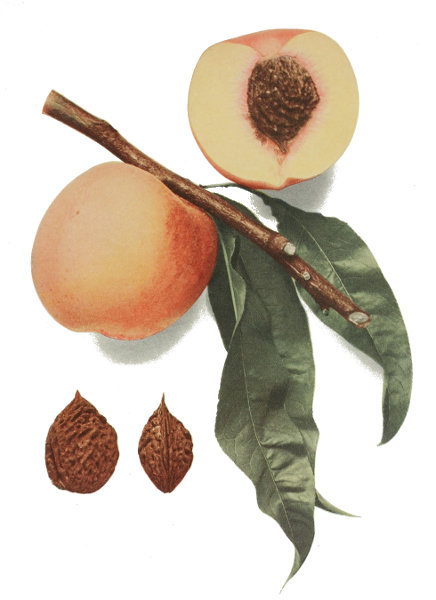
Wheatland is a large, yellow-fleshed, freestone peach of excellent quality which ripens just before Late Crawford. Although the variety originated in this State it is little grown here now, being somewhat more popular westward in Michigan and very much grown in Colorado and Utah. The fruit is about all that could be desired in New York but the trees are so unproductive that the variety is nowhere grown in this region with profit. The beauty and high quality of the fruit might make it desirable for home orchards.
Wheatland is a chance seedling found about 1870 on the grounds of Daniel E. Rogers, Scottsville, New York. The variety was placed on the fruit-list of the American Pomological Society in 1883.
WHEATLAND
Tree medium to large, vigorous, upright-spreading, with the lower branches drooping, hardy, rather unproductive; trunk thick and smooth; branches stocky, smooth, reddish-brown tinged with light ash-gray; branchlets long, with long internodes, inclined to rebranch, dark pinkish-red with but little green, smooth, glabrous, with conspicuous, large and small, raised lenticels intermediate in number.
Leaves six and one-half inches long, one and three-fourths inches wide, folded upward and recurved downward, oval to obovate-lanceolate, leathery; upper surface dark green, rugose; lower surface grayish-green; margin finely serrate, tipped with reddish-brown glands; petiole five-sixteenths inch long, with one to five small, globose and reniform, reddish-brown glands variable in position.
Flower-buds tender, medium to small, pubescent, conical or pointed, plump, usually free; blossoms open late; flowers seven-eighths inch across, light pink becoming darker along the edges; pedicels very short, glabrous, green; calyx-tube reddish-green, orange-colored within, campanulate; calyx-lobes narrow, acuminate, glabrous within, pubescent without; petals ovate; filaments five-sixteenths inch long, equal to the petals in length; pistil as long as the stamens, sometimes defective.
Fruit matures in mid-season; large, round; suture shallow; apex a small, acute point; color yellow, blushed and mottled with red; skin separates from the pulp; flesh yellow, stained red around the pit, juicy, firm but tender, sweet, pleasantly flavored; good in quality; stone free, one and seven-sixteenths inches long, more than an inch wide, ovate, broad at the base, with pitted surfaces; ventral suture very deeply grooved at the edges; dorsal suture deeply grooved.
YELLOW RARERIPE
1. Lond. Hort. Soc. Cat. 102. 1831. 2. Kenrick Am. Orch. 229. 1832. 3. Prince Pom. Man. 2:14, 15. 1832. 4. Downing Fr. Trees Am. 493. 1845. 5. Elliott Fr. Book 280. 1854. 6. Am. Pom. Soc. Cat. 80. 1862. 7. Mich. Sta. Bul. 169:229. 1899. 8. Fulton Peach Cult. 193, 194. 1908.
Marie Antoinette. 9. Kenrick Am. Orch. 187. 1846.
Early Orange Peach. 10. Floy-Lindley Guide Orch. Gard. 187. 1846.
Cutter's Yellow. 11. Hovey Fr. Am. 2:59, 60, Pl. 1851.
Rareripe Jaune. 12. Mas Le Verger 7:215, 216, fig. 106. 1866-73.
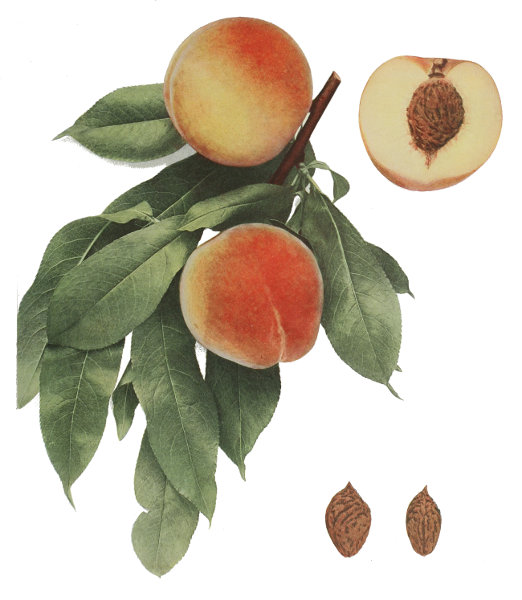
A century ago Yellow Rareripe was at the head of the list of yellow-fleshed, freestone peaches—largest, handsomest, hardiest and best-flavored of all. Even now in fruit- and tree-characters, with the single exception of productiveness, Yellow Rareripe holds its own very well with the peaches of its type and season. A glance at the color-plate shows the peach to be as attractive as any in color and shape; the size is above the average and in texture and flavor it is not often surpassed. Its fault is unproductiveness, to make up for which the trees usually bear regularly and come in bearing early. The variety is now hardly worth planting commercially in New York, being equalled by several yellow-fleshed peaches in all characters and surpassed in productiveness by many, but, if the trees can be obtained, it might find a welcome place in home orchards. Yellow Rareripe seems still to have all of the vigor and vitality of the first trees, helping thereby to furnish evidence that varieties do not run out.
This is another American peach the origin of which is involved in so much uncertainty that it is impossible to state where, when and by whom produced. Prince claims to have discovered the original Yellow Rareripe tree near Flushing, New York, over a hundred years ago. It was being grown in the vicinity of Boston early in the Nineteenth Century where it seems to have been first introduced by William Kenrick, Newton, Massachusetts, under the name Yellow Red Rareripe. Occasionally another and inferior peach, Yellow Melocoton, was substituted for Yellow Rareripe. Hovey received peach-trees from Kenrick under the name Cutter's Yellow which later proved to be Yellow Rareripe. Hovey retained the name Cutter's Yellow, because it was briefer. The Marie Antoinette, mentioned by Kenrick in 1841, is without question Yellow Rareripe and has been listed as synonymous by several authors. Yellow Rareripe was placed in the American Pomological Society's fruit-catalog in 1862 where it has since remained as a recommended variety.
YELLOW RARERIPE
Tree large, vigorous, upright-spreading, rather unproductive; trunk stocky; branches thick, smooth, reddish-brown mingled with light ash-gray; branchlets with internodes of medium length, dark pinkish-red tinged with pale green, glossy, smooth, glabrous, with conspicuous, numerous, large, raised lenticels.
Leaves six and three-fourths inches long, one and three-fourths inches wide, folded upward and curled downward, oval to obovate-lanceolate, leathery; upper surface dull, dark olive-green, smooth becoming rugose near the midrib; lower surface grayish-green; margin finely serrate and sometimes in two series, tipped with reddish-brown glands; petiole three-eighths inch long, glandless or with one to four small, globose glands variable in color and position.
Flower-buds conical or pointed, pubescent, plump, usually appressed; blossoms open in mid-season; flowers seven-eighths inch across, light pink but darker along the edges, usually single; pedicels short, green; calyx-tube reddish-green, orange-colored within, campanulate; calyx-lobes narrow, acute, glabrous within, pubescent without; petals oval to ovate, shallowly and widely notched towards the base, tapering to claws red at the base; filaments three-eighths inch long, equal to the petals in length; pistil as long as the stamens.
Fruit matures in mid-season; two and one-fourth inches long, two and three-sixteenths inches wide, round-conic to round-cordate, compressed, with unequal halves; cavity contracted and wrinkled about the sides, abrupt or flaring; suture shallow; apex round or somewhat pointed, with a mucronate or mamelon tip; color orange-yellow, with a deep red blush, splashed and mottled with red; pubescence thick, long, coarse; skin thin, tender, variable in adherence to the pulp; flesh yellow, tinged with red near the pit, juicy, fine-grained, tender and melting, sweet, pleasantly flavored; good to very good in quality; stone free, one and one-fourth inches long, seven-eighths inch wide, oval to ovate, bulged near the apex, plump, tapering to a short point, with grooved and pitted surfaces; ventral suture deeply grooved along the edges, furrowed; dorsal suture grooved, winging.