Chapter V · LEADING VARIETIES OF PEACHES (continued 2)
Reading edition
EUREKA
1. W. N. Y. Hort. Soc. Rpt. 115. 1880. 2. Gard. Mon. 24:211, 212. 1882. 3. U. S. D. A. Pom. Rpt. 42. 1895. 4. Mich Sta. Bul. 205:31. 1903.
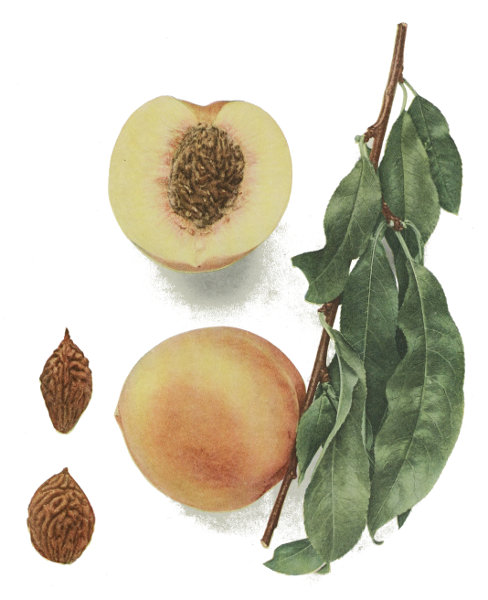
In the South where Eureka originated, the variety seems to have a very good reputation as an early, white-fleshed, semi-free peach. In New York the variety ripens early, when there are many other good peaches of its type, and it is therefore doubtful if it will ever have a prominent place in peach-growing in this State. As the variety grows on the Station grounds, one quality, in particular, marks Eureka as worthy more attention than it now receives—the peaches are exceptionally uniform in size. The color-plate, by the way, shows shape and color very well but does not give a fair idea of the size, as the peaches grow larger in average years. Though long grown, Eureka is worthy further trial in New York.
Eureka is a seedling of Chinese Cling found nearly half a century ago in Bossier Parish, Louisiana. It was introduced by L. T. Sanders and Son, Plain Dealing, Louisiana.
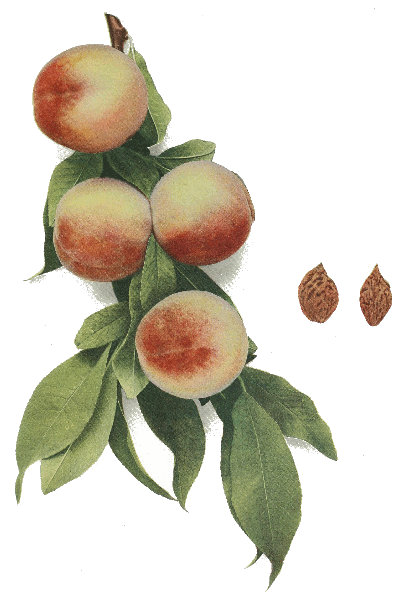
EUREKA
Tree above medium in size, upright-spreading, round-topped, semi-hardy to hardy, very productive; trunk thick; branches stocky, smooth, reddish-brown overspread with very light ash-gray; branchlets with long internodes, reddish lightly intermingled with olive-green, glossy, smooth, glabrous, with numerous conspicuous, large lenticels.
Leaves five inches long, one and seven-sixteenths inches wide, folded upward, variable in shape, leathery; upper surface dark green intermingled with olive-green, smooth becoming rugose near the midrib; lower surface grayish-green, with a prominent midrib; margin finely or coarsely serrate, glandular; petiole five-sixteenths inch long, with two to six large, reniform glands variable in color and position.
Flower-buds somewhat tender, small, short, heavily pubescent, obtuse or conical, plump, usually appressed; blossoms open early; flowers one and thirteen-sixteenths inches across, pink, well distributed; pedicels very short, medium to thick, glabrous, green; calyx-tube reddish-green, greenish-yellow within, obconic; calyx-lobes usually broad, obtuse, glabrous within, pubescent without; petals oval or ovate, entire, broadly and shallowly crenate, tapering to long claws reddish at the base; filaments one-half inch long, shorter than the petals; pistil pubescent at the ovary, as long as the stamens.
Fruit matures early; about two and seven-sixteenths inches in diameter, round or round-oval, bulged on one side, compressed, with unequal halves; cavity shallow, abrupt; suture shallow, deepening at the apex; apex flattened or more or less rounded, with mucronate tip; color greenish-white or creamy-white, often with a distinct, bright red blush overspreading one-third of the surface, with faint mottlings; pubescence fine, thick, short; skin thin, tender, separates from the pulp; flesh white, tender and melting, very juicy, pleasant flavored, good; stone free, one and one-half inches long, one inch wide, ovate to oval, tapering to a long point, with corrugated and deeply pitted surfaces; ventral suture winged, deeply grooved along the edges, narrow; dorsal suture a narrow groove.
FAMILY FAVORITE
1. Gard. Mon. 22:304. 1880. 2. W. N. Y. Hort. Soc. Rpt. 114. 1880. 3. Tex. Sta. Bul. 39:807 fig. 7. 1896. 4. Del. Sta. Rpt. 13:99. 1901. 5. Budd-Hansen Am. Hort. Man. 2:344. 1903. 6. Am. Pom. Soc. Cat. 33. 1909.
Family Favorite is one of the well-known peaches in the South-Central States but in most respects falls far short of Champion, with which it must compete, in New York. The tree is doubtfully hardy and the fruit scabs badly. The variety has two characters to commend it and to give it standing among commercial peaches in New York: Compared with that of Champion, the fruit stands shipment much better and when brown-rot is rife, does not suffer nearly as much. In selected locations, then, when a mid-season, white-fleshed peach is wanted, this variety is worth trying.
Family Favorite is a seedling of Chinese Cling, possibly crossed with Oldmixon Free. It was raised by the late William H. Locke, Bonham, Fannin County, Texas. The exact date of its origin is unknown. The variety was named and introduced by T. V. Munson, Denison, Texas. The American Pomological Society added Family Favorite to its list of fruits in 1909.
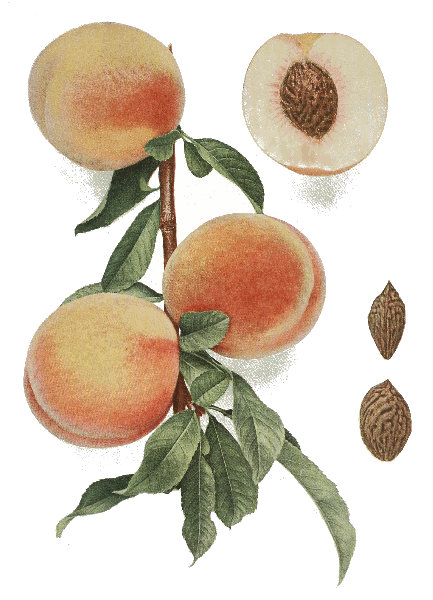
FAMILY FAVORITE
Tree of medium size, spreading, inclined to droop, open-topped, productive; trunk and branches intermediate in thickness; branches reddish-brown with a tinge of very light ash-gray; branchlets rather short, with internodes dark red intermingled with olive-green, glossy, smooth, curving, with numerous medium to small, conspicuous, raised lenticels.
Leaves folded upward, six inches long, one and one-half inches wide, ovate-lanceolate; upper surface a dull, mottled, dark green mingled with olive-green, rugose along the midrib; lower surface light grayish-green; margin finely serrate, often in two series, tipped with reddish-brown glands; petiole three-eighths inch long, with one to four small, globose, greenish-yellow glands variable in position.
Flower-buds small, obtuse to pointed, very plump, heavily pubescent, appressed; season of bloom early; flowers light pink at the center, darker pink along the edges, one and one-eighth inches across; pedicels short, glabrous; calyx-tube reddish-green, campanulate, glabrous; calyx-lobes broad, obtuse, pubescent within, heavily pubescent toward the edges; petals oval to ovate, usually entire, tapering to narrow claws; filaments one-half inch long, equal to the petals in length; pistil pubescent at the base, longer than the stamens.
Fruit matures in mid-season; two and one-half inches long, two and three-eighths inches wide, roundish-oval to strongly oval, bulged near the apex, compressed, with unequal sides; cavity contracted, narrow, abrupt; suture a line, deepening toward the apex; apex roundish, with a small, mucronate tip set in a depression; color creamy-white, with a few splashes of red showing through a dull and mottled blush; pubescence short, thin; skin thin, tough; flesh greenish-white, strongly stained with red at the pit, very juicy, tender and melting, sweet or subacid, aromatic; good in quality; stone semi-free to free, tinged with red, one and one-half inches long, one inch wide, flattened near the base, elliptical, plump, winged on one side, with roughish and usually pitted surfaces; ventral suture deeply furrowed along the sides, narrow; dorsal suture grooved, irregular.
FITZGERALD
1. Can. Hort. 18:417. 1895. 2. Ont. Fr. Exp. Sta. Rpt. 2:57. 1895. 3. Mich. Hort. Soc. Rpt. 235, 236. 1896. 4. Am. Pom. Soc. Cat. 33. 1899. 5. Budd-Hansen Am. Hort. Man. 2:344. 1903. 6. Can. Hort. 27:195 fig. 1904. 7. Waugh Am. Peach Orch. 196, 202. 1913.
Compare the color-plates of Fitzgerald and Early Crawford and it is seen at once that the two peaches are almost identical in fruit and foliage. There could be no use in growing Fitzgerald in this State, so similar is it to the better-known Early Crawford, were it not for the fact that the two differ in season a few days and that possibly Fitzgerald is the more productive of the two. Fitzgerald ripens a few days earlier than Early Crawford though in some of the references given it is said to ripen a few days later. Canadian peach-growers claim that Fitzgerald, besides being more productive and extending the season of Early Crawford, is hardier. In the effort to maintain peaches of the Crawford family in commercial plantations it may be worth while to try Fitzgerald.
Fitzgerald originated a quarter of a century or more ago at Oakville, Ontario, but who the originator or what the parentage is not known. The American Pomological Society placed Fitzgerald on its list of recommended fruits in 1899, a place it still holds.
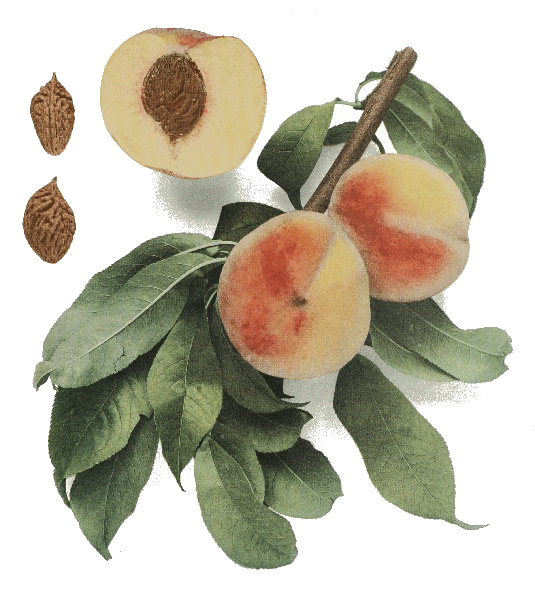
FITZGERALD
Tree of medium size, upright-spreading, round-topped, hardy, not very productive; trunk smooth; branches smooth, reddish-brown covered with light ash-gray; branchlets long, with inclination to develop short, spur-like branchlets, pinkish-red or dark red intermingled with green, smooth, glabrous, with numerous conspicuous, rather small lenticels.
Leaves six inches long, one and one-half inches wide, folded upward but recurved, oval to obovate-lanceolate; upper surface dark green tinged with olive-green, rugose; lower surface light grayish-green; margin finely serrate, tipped with reddish-brown glands; petiole one-half inch long, glandless or with one to five small, globose, greenish-yellow glands variable in position.
Flower-buds hardy, conical, pubescent, plump, free; blossoms appear in mid-season; flowers pale pink varying to a deeper red along the edges, seven-eighths inch across; pedicels very short, slender, glabrous, green; calyx-tube reddish-green, orange-colored within, obconic, glabrous; calyx-lobes narrow, acute, glabrous within, heavily pubescent without; petals roundish-oval to ovate, white at the center, tapering to narrow claws often red at the base; filaments one-fourth inch long, equal to the petals in length; pistil pubescent at the ovary, equal to the stamens in length.
Fruit matures in mid-season; two and one-half inches long, more than two and one-half inches wide, roundish-oval to cordate, somewhat compressed, with unequal halves, bulged at one side; cavity medium to deep, wide, abrupt or often flaring, marked with radiating streaks; suture shallow, deepening toward the apex; apex roundish, ending in a recurved, mamelon point; color golden-yellow more or less overspread with a dull red blush, with splashes and mottlings of deeper red; pubescence long, thick; skin thin, tough; flesh yellow, rayed with red at the pit, juicy, rather firm, tender, sweet or mildly subacid, pleasant flavored; very good in quality; stone free, one and one-half inches long, one inch wide, ovate, plump, flattened near the base, with pitted surfaces; ventral suture very deeply furrowed along the sides; dorsal suture slightly winged.
FOSTER
1. Am. Pom. Soc. Cat. 32. 1869. 2. Am. Hort. Ann. 82 fig. 39. 1870. 3. Gard. Mon. 12:371. 1870. 4. Downing Fr. Trees Am. 1st App. 121. 1872. 5. Mich. Hort. Soc. Rpt. 32, 260. 1874. 6. Cult. & Count. Gent. 44:678. 1879. 7. Budd-Hansen Am. Hort. Man. 2:345. 1903. 8. Waugh Am. Peach Orch. 202. 1913.
Foster's Seedling. 9. Am. Jour. Hort. 2:277 fig. 1867.
Foster is another very good peach of the Crawford type and at one time was widely grown in all northern peach-regions. It is so similar to Late Crawford that even experienced growers can hardly tell them apart. Those who grow the two in the same orchard find the essential differences to be: Foster is the larger peach, is more rotund, somewhat more flattened at the base, is a little earlier, possibly handsomer and is even of better quality than Late Crawford; the trees of Foster, however, are hardly as productive as those of either of the two unproductive Crawfords. This unproductiveness is the fault that keeps the variety in the background as a commercial peach. The variety is well worth planting in any home orchard.
Foster originated about 1857 with J. T. Foster, Medford, Massachusetts, from the stone of a peach purchased by him in a Boston market. It was awarded a place on the American Pomological Society's list of recommended fruits in 1869.
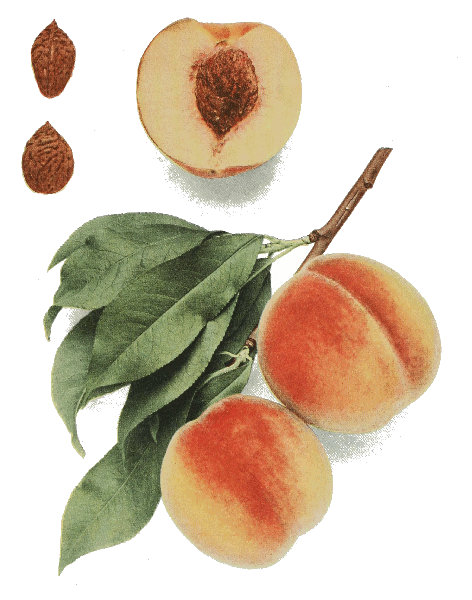
FOSTER
Tree very large, vigorous, upright-spreading, hardy, variable in productiveness; trunk thick; branches stocky, smooth, reddish-brown intermingled with light ash-gray; branchlets spur-like, long, dark pinkish-red mingled with olive-green, glossy, smooth, glabrous, with numerous large and small lenticels raised at the base.
Leaves six inches long, one and three-eighths inches wide, folded upward, oval to obovate-lanceolate, intermediate in thickness, leathery; upper surface dark green, smooth becoming rugose near the midrib; lower surface grayish-green; margin finely serrate, tipped with small glands; petiole seven-sixteenths inch long, with one to four small globose glands variable in color and position; flower-buds somewhat tender, conical or pointed, pubescent, free; blossoms appear in mid-season.
Fruit matures in mid-season; two and seven-sixteenths inches long, more than two and one-half inches wide, round-cordate, often bulged at one side, compressed, with unequal sides; cavity deep, wide, flaring or somewhat abrupt, often splashed with red; suture shallow, becoming deeper at both apex and cavity and extending slightly beyond the point; apex roundish or pointed, with a recurved, mamelon or occasionally mucronate tip; color deep yellow overspread with dark red, with a few splashes or stripes of red; pubescence long, thick; skin thick, tough, separates from the pulp when fully ripe; flesh deep yellow, faintly stained with red near the pit, juicy, coarse and stringy, firm but tender, sweet, mild, spicy; very good in quality; stone free.
GENERAL LEE
1. Gard. Mon. 29:271. 1887. 2. Am. Pom. Soc. Cat. 30. 1889. 3. Budd-Hansen Am. Hort. Man. 2:346. 1903.
R. E. Lee. 4. Ga. Hort. Soc. Rpt. 21. 1877. 5. Gard. Mon. 27:275. 1885. 6. Ga. Sta. Bul. 42:240. 1898.
Lee. 7. Am. Pom. Soc. Cat. 22. 1897. 8. Del. Sta. Rpt. 13:104. 1901. 9. Budd-Hansen Am. Hort. Man. 2:349. 1903.
General Lee is a white-fleshed clingstone, the fruit none too attractive and surpassed by that of other varieties of its season in quality. It is without value in the North. Southern growers say General Lee is an improved Chinese Cling and as such well worth growing under some conditions. It has the reputation of being quite susceptible to brown-rot. The variety is offered by a good many nurserymen and we discuss it only to condemn it for planting in New York. The variety, as its history shows, really belongs to eastern Asia and thus arouses interest.
General Lee originated with Judge Campbell, Pensacola, Florida, from pits brought from Japan in 1860. In 1864 P. J. Berckmans received buds from R. R. Hunley of Alabama and in 1867 introduced the sort under the name General Lee. The American Pomological Society listed this peach in 1889 as General Lee but in 1897 shortened the name to Lee and so it appears in the Society's catalog at the present time. We prefer the old name since when shortened it loses all significance as a commemorative appellation.
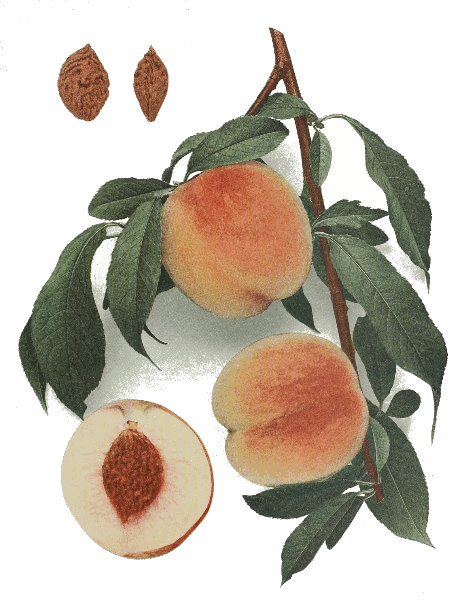
GENERAL LEE
Tree very large, vigorous, spreading, unproductive; trunk thick, rough; branches reddish-brown tinged with light ash-gray; branchlets slender, with internodes dark red mingled with considerable green, glossy, smooth, glabrous, with numerous inconspicuous, raised lenticels variable in size.
Leaves six and one-fourth inches long, one and one-half inches wide, flat or folded downward, oval to obovate-lanceolate, thick, leathery; upper surface dark, dull green, smooth; lower surface grayish-green; apex acuminate; margin coarsely serrate, tipped with reddish-brown glands; petiole nearly one-half inch long, with one to four large, reniform, reddish-brown glands variable in position.
Flower-buds somewhat tender, large, conspicuous, very plump, conical to obtuse, strongly pubescent, appressed or slightly free; blossoms appear in mid-season; flowers one and thirteen-sixteenths inches across, pink, well distributed; pedicels short, glabrous, green; calyx-tube reddish-green at the base, greenish-yellow within, obconic, glabrous; calyx-lobes narrow, obtuse, glabrous within, pubescent without; petals narrow-oval, tapering to short, broad claws occasionally with reddish base; filaments seven-sixteenths inch long, shorter than the petals; pistil pubescent near the base, longer than the stamens.
Fruit matures in mid-season; two and five-eighths inches long, two and one-half inches wide, round or roundish-oval, compressed, with halves equal; cavity deep, medium to wide, contracted around the sides, abrupt or flaring, often mottled with red; suture medium to deep, extending beyond the tip; apex mucronate, mamelon; color greenish-white changing to creamy-white, with a dull or lively red blush in which are intermingled a few splashes of duller red; pubescence coarse, long, thick; skin thick, tough, clings to the pulp; flesh white, stained with red near the pit, juicy, stringy, tender, sweet but sprightly, pleasantly flavored; good in quality; stone clinging, one and five-sixteenths inches long, one inch wide, bulged on one side, broadly oval to ovate, flattened, short-pointed at the apex, with pitted surfaces; ventral suture winged, narrow, deeply grooved along the edges; dorsal suture grooved.
GEORGE IV
1. Mas Le Verger 7:49, 50, fig. 23. 1866-73. 2. Leroy Dict. Pom. 6:129 fig. 1879. 3. Am. Pom. Soc. Cat. 37. 1909. 4. Waugh Am. Peach Orch. 202. 1913.
George the Fourth. 5. Lond. Hort. Soc. Rpt. 6:413. 1826. 6. Pom. Mag. 3:105. Pl. 1830. 7. Prince Pom. Man. 1:192, 193. 1831. 8. Downing Fr. Trees Am. 478. 1845. 9. Mag. Hort. 13:120, 121, 122. 1847. 10. Proc. Nat. Con. Fr. Gr. 38, 51. 1848. 11. Carrière Var. Pêchers 70. 1867. 12. Hogg Fruit Man. 447. 1884. 13. Budd-Hansen Am. Hort. Man. 2:346. 1903.
Once one of the mainstays of American peach-growing, George IV is now of but historical interest. This variety was one of the first named American peaches and had the honor of being placed on the recommended list of fruits at the first meeting of the National Convention of Fruit-Growers, an organization which became the American Pomological Society, in 1848. George IV is not worth planting now and is illustrated and described in The Peaches of New York only that fruit-growers may note progress in the development of peaches. It is interesting to note that this old American peach is still widely grown in Europe.
George IV has been confused with several other sorts, particularly Morris Red. Prince, in the Magazine of Horticulture, writes that Morris Red is an old Red Rareripe brought to America from Europe by Huguenot emigrants and that George IV came from buds of the original tree of this variety. The consensus of opinion, however, among those who early knew both peaches, is that Morris Red and George IV are distinct and that both are of American origin. George IV, the best authorities say, sprang up as a chance seedling, about 1821, in the garden of a Mr. Gill, Broad Street, New York City. After fruiting, the variety rapidly grew in favor and within a few years was everywhere grown in eastern America. Taken to Europe, it soon became one of the standard European peaches. From the first it was on the list in the American Pomological Society's fruit-catalog but was dropped in 1897 to be replaced in 1909. We doubt if it now deserves to be recommended on any list of fruits.
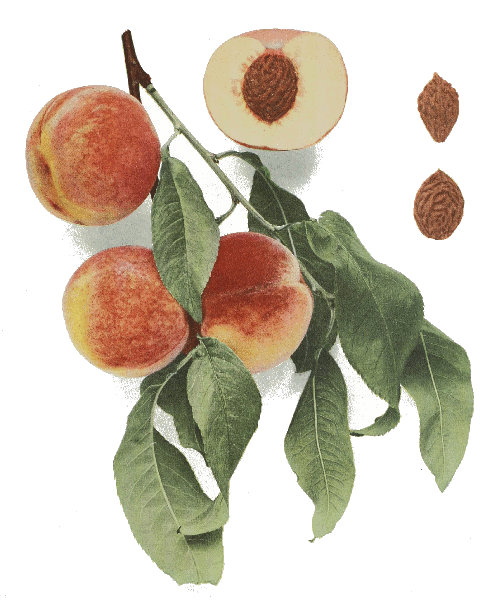
GEORGE IV
Tree large, vigorous, upright-spreading, hardy, unproductive; trunk thick; branches stocky, smooth, reddish-brown covered with light ash-gray; branchlets dark red, with faint traces of green, glossy, smooth, glabrous, with numerous conspicuous, small lenticels.
Leaves seven inches long, one and five-eighths inches wide, folded upward and recurved, oval to obovate-lanceolate, rather thick, leathery; upper surface dark green, smooth except near the midrib; lower surface grayish-green; margin sharply serrate, red; petiole three-eighths inch long, glandless or with one to three small, globose, reddish-brown glands usually at the base of the blade.
Flower-buds short, obtuse, plump, heavily pubescent, appressed; blossoms appear in mid-season; flowers pale pink, with white centers and edged with darker pink, nearly one inch across; pedicels nearly sessile; calyx-tube reddish-green, light yellow within, campanulate, glabrous; calyx-lobes medium in length and width, obtuse or acute, glabrous within, pubescent without; petals roundish-oval, tapering to claws red at the base; filaments one-fourth inch long, equal to the petals in length; pistil longer than the stamens.
Fruit matures in mid-season; two and five-sixteenths inches long, two and seven-sixteenths inches wide, roundish-oblate, bulged near the apex, oblique, with unequal sides; cavity slightly contracted, deep, wide, abrupt, with tender skin; suture shallow, becoming deeper at both apex and cavity and faintly showing beyond the tip; apex roundish, with a mucronate tip; color greenish-white changing to creamy-white, with a pink blush and sometimes with faint mottlings of red; pubescence short, thick, fine; skin thin, tough, variable in adherence to the pulp; flesh whitish, deeply tinged with red near the pit, juicy, stringy, tender, mild, pleasantly flavored; good in quality; stone semi-free to free, one and one-eighth inches long, three-fourths inch thick, roundish-oval, very plump, flattened at the base, tapering to a short, rounded point, with grooved surfaces; ventral suture winged, rather narrow; dorsal suture grooved.
GOLD DROP
1. Kan. Hort. Soc. Peach, The 142. 1899. 2. Mich. Sta. Bul. 169:214. 1899. 3. Budd-Hansen Am. Hort. Man. 2:347. 1903. 4. Am. Pom. Soc. Cat. 37. 1909.
Golden Drop. 5. U. S. Pat. Off. Rpt. 298. 1855. 6. Mich. Hort. Soc. Rpt. 243. 1886. 7. Ont. Fr. Exp. Sta. Rpt. 2:58 fig. 1895. 8. Mich. Sta. Sp. Bul. 44:42, 43 fig., 44, 45. 1910.
Gold Drop, long a familiar variety in Michigan peach-orchards, is not much grown elsewhere. It is doubtfully worth planting in New York as a peach of commerce but should find a place in every home orchard. The variety has several distinctive peculiarities which make it a pleasing variation in the peach-orchard and add to its merits as a home fruit. Thus, its transparent, golden skin and flesh make it one of the handsomest of all peaches; add to handsome appearance a somewhat distinctive flavor—vinous, rich, refreshing—and the peach becomes one that all agree is very good and one that, were the size larger, would sell in any market. Gold Drop is further characterized by great hardiness in tree and bud and by remarkable productiveness. Indeed, it loads itself so heavily that the peaches invariably run small unless the trees are heavily pruned and the crop thinned—small size of fruit is the greatest defect of the variety. Besides being one of the hardiest of all peaches it is also about the least susceptible to brown-rot and leaf-curl, the two worst scourges of the peach when yellows permits the trees to live. Earliness in coming in bearing is another admirable character. The trees are of but medium size, are dainty in habits with clean, fresh foliage so that the variety is an attractive ornamental. All in all, Gold Drop is ideal for the home garden and has many good characters which can be used as stepping-stones in breeding peaches.
The origin of Gold Drop is unknown. It is evidently an old sort and some horticulturists believe it to be an old variety renamed. The variety has been cultivated in Michigan orchards for many years under the name Golden Drop given it by George W. Griffin, Casco, Allegan County, Michigan, who introduced it. The variety was at one time supposed to be the peach which is grown in Michigan as Yellow Rareripe but it is not the Yellow Rareripe cultivated today. The American Pomological Society listed it in its fruit-catalog in 1909 under the name Gold Drop.
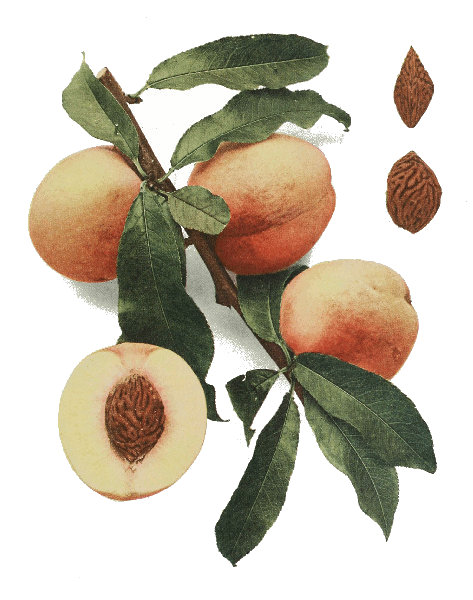
GOLD DROP
Tree of medium size and vigor, spreading, rather open-topped, hardy, very productive; trunk thick and smooth; branches stocky, smooth, reddish-brown with a covering of light ash-gray; branchlets slender, with internodes dull pinkish-red intermingled with green, smooth, glabrous, with conspicuous, raised lenticels.
Leaves five and one-half inches long, one and one-fourth inches wide, folded upward and recurved, oval to obovate-lanceolate, leathery; upper surface dark green, mottled; lower surface grayish-green; margin finely serrate, tipped with red along the edge; petiole three-eighths inch long, with two to nine large, reddish-brown or grayish, mixed glands usually on the leaf.
Flower-buds long, conical or obtuse, plump, somewhat appressed, pubescent; season of bloom early; flowers pale pink, one and three-fourths inches across, well distributed; pedicels short, medium to slender, glabrous, green; calyx-tube reddish-green, orange-colored within, obconic, glabrous; calyx-lobes broad, usually acute, glabrous within, pubescent without; petals ovate, notched near the base, tapering to long, narrow claws variable in color at the base; filaments one-half inch long, shorter than the petals; pistil pubescent at the ovary, equal to or longer than the stamens.
Fruit matures late; two and seven-sixteenths inches long, nearly two and one-half inches wide, roundish-oval, bulged at one side, with unequal halves; cavity deep, abrupt, twig-marked; suture very shallow, extending beyond the apex; apex roundish, with a slightly mamelon or mucronate tip; color greenish or golden-yellow, with a dull blush on one side; pubescence thick, coarse; skin adhering to the pulp; flesh pale yellow to the pit, variable in juiciness, pleasantly sprightly; good in quality; stone free, one and nine-sixteenths inches long, one and one-sixteenth inches wide, broadly ovate, bulged at one side, with a pointed apex and deeply grooved surfaces; ventral suture deeply grooved at the sides, rather narrow; dorsal suture with a deep groove, wing-like.
GOVERNOR HOGG
1. Brown Bros. Cat. 27. 1906. 2. Ga. Hort. Soc. Rpt. 65, 66. 1907. 3. Am. Pom. Soc. Cat. 37. 1909. 4. N. J. Hort. Soc. Rpt. 37. 1912. 5. Waugh Am. Peach Orch. 202. 1913.
Governor. 6. Del. Sta. Rpt. 13:101. 1901.
Were it not that Governor Hogg must compete with the well-established Greensboro and Carman, we should say at once that it was well worth trying in commercial planting in New York as an early, white-fleshed peach. In the Station orchard, Governor Hogg ripens a few days after Carman, is larger, handsomer and as good in quality. In both appearance and quality, Governor Hogg excels Greensboro, the size, shape and color of the two, as the illustrations show, being much the same though the color of this variety runs more to reds and soft tints of red. The flesh is firm, though tender and delicate, and the peaches ought to stand shipment well. As with all of these early, white-fleshed peaches, Governor Hogg is quite susceptible to both leaf-curl and brown-rot.
The parentage of this peach is unknown. It seems to have originated with a Mr. McClung, Tyler, Texas, about 1892, and was disseminated by Messrs. Sneed and Whitaker of the same place. The American Pomological Society placed Governor Hogg on its fruit-list in 1909.
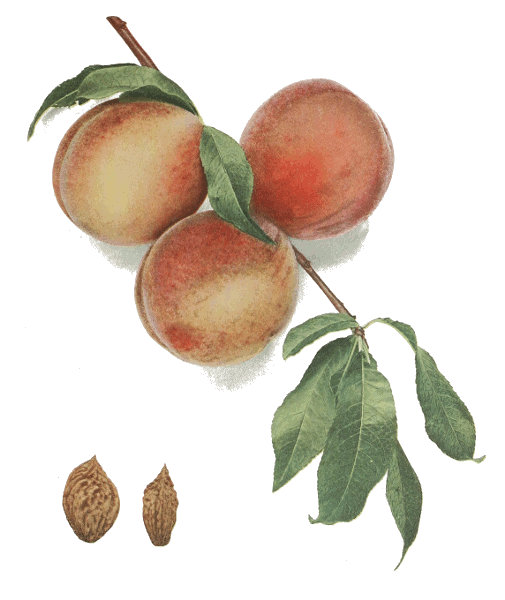
GOVERNOR HOGG
Tree large, upright-spreading, open-topped, hardy, variable in productiveness; trunk thick, reddish-brown intermingled with light ash-gray; branches slender, with short internodes, brownish mingled with red and ash-gray, glossy, smooth, glabrous, with many conspicuous, large and small lenticels.
Leaves five and one-half inches long, one and one-half inches wide, folded upward and slightly recurved, usually oval-lanceolate, medium in thickness, leathery; upper surface dark olive-green, smooth; lower surface grayish-green; margin finely serrate, tipped with reddish-brown glands; petiole three-eighths inch long, glandless or with one to five reniform, reddish-brown glands of medium size, variable in position; flower-buds conical, plump, pubescent, appressed; blossoms open in mid-season.
Fruit matures early; two and one-fourth inches long, more than two inches wide, oblong-oval, compressed, oblique; cavity deep, narrow, abrupt; suture shallow, becoming deeper at the cavity; apex depressed, with a mucronate tip; color creamy-white, blushed with red; pubescence short; skin thin, separates from the pulp; flesh white, juicy, stringy, meaty, rather tough; good in quality; stone clinging, one and three-eighths inches long, seven-eighths inch wide, obovate, plump, strongly bulged on one side, conspicuously winged, pointed at the base, with the surfaces grooved and pitted; ventral suture winged, narrow, with furrows of medium depth along the sides.
GREENSBORO
1. Mich. Hort. Soc. Rpt. 238. 1896. 2. Am. Pom. Soc. Cat. 33. 1899. 3. Kan. Hort. Soc. Peach, The 49, 143. 1899. 4. Del. Sta. Rpt. 13:101 fig. 6, 102. 1901. 5. Ont. Fr. Exp. Sta. Rpt. 9:37, 38. 1902. 6. W. N. Y. Hort. Soc. Rpt. 11. 1907. 7. Waugh Am. Peach Orch. 202. 1913. 8. N. Y. State Fr. Gr. Assoc. Rpt. 16. 1915.
Balsey. 9. U. S. D. A. Rpt. 289. 1893.
Greensboro is one of the leading early, white-fleshed peaches. It takes high place because of its showy fruits and its large, vigorous, healthy, early-bearing and prolific trees. In the last character, in particular, Greensboro is almost supreme—year in and year out, barring accidents, its trees are fruitful. Possibly, too, no other white-fleshed peach is adapted to a greater variety of soils than Greensboro which, with fair capacity to stand heat and cold, makes it suitable for wide variations in peach-regions. The peaches, while handsome, as the color-plate shows, are in no way remarkable, the quality, if anything, being rather inferior, so that it is the tree that gives Greensboro its standing. The variety is well thought of by fruit-dealers not only on account of the attractive product but because the fruits carry well and keep long. Possibly the peaches are less susceptible to brown-rot than most other varieties of Greensboro's season but to offset this advantage there are many cracked pits and accompanying mal-formed fruits. Picked green the stone clings; picked at maturity the variety may be called a freestone. All in all, Greensboro is one of the best early, market peaches for New York.
Greensboro is a seedling of Connett grown by W. G. Balsey, Greensboro, North Carolina, about 1891. It was introduced by John A. Young of Greensboro as Balsey, this name being changed to Greensboro in 1894. Greensboro was added to the list of fruits recommended by the American Pomological Society in 1899.
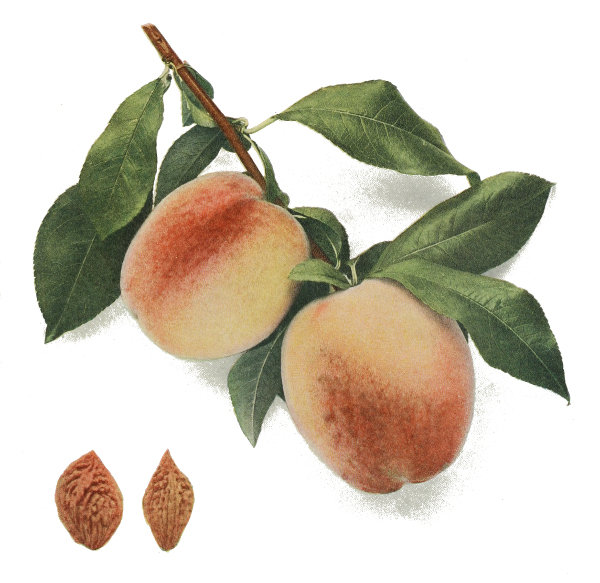
GREENSBORO
Tree very large, spreading, open-topped, hardy, very productive; trunk thick, shaggy; branches stocky, smooth, reddish-brown covered with light ash-gray; branchlets slender, long, with short internodes, dark red intermingled with olive-green, glossy, smooth, glabrous, with very small, conspicuous lenticels.
Leaves six and one-half inches long, one and one-half inches wide, folded upward, recurved, oval to obovate-lanceolate, thick, leathery; upper surface dark green, smooth, rugose along the midrib; lower surface grayish-green; margin finely serrate, tipped with reddish-brown glands; petiole one-half inch long, with one to five reniform, reddish-brown glands usually at the base of the blade.
Flower-buds hardy, large, medium to long, conical or obtuse, very plump, strongly pubescent, usually free; season of bloom early; flowers pale pink, one and three-fourths inches across, usually in twos; pedicels very short, glabrous; calyx-tube dull reddish-green, lemon-yellow within, campanulate, glabrous; calyx-lobes very broad, obtuse, glabrous within, pubescent without; petals round-ovate, tapering to short, narrow claws red at the base; filaments one-half inch long, shorter than the petals; pistil pubescent at the base, equal to the stamens in length.
Fruit matures early; two and one-half inches long, two and three-eighths inches wide, oblong-oval, often oblique, bulged at one side, compressed, with unequal sides; cavity deep, narrow, abrupt; suture shallow, deepening toward the cavity; apex roundish, with a small, mucronate tip; color creamy-white, blushed red, with a few stripes of darker red intermingling; pubescence heavy, nearly tomentose; skin rather tough, separates from the pulp; flesh white, very juicy, tender and melting, mild, sweet, sprightly; fair in quality; stone semi-clinging, one and seven-sixteenths inches long, one inch wide, winged on both sides, ovate, strongly bulged along one side, with short grooves on the surfaces; ventral suture narrow, deeply grooved along the sides; dorsal suture grooved, winged.
HALE EARLY
1. Mag. Hort. 27:65, 66. 1861. 2. Am. Pom. Soc. Cat. 78. 1862. 3. Gard. Mon. 5:68, 69, 198, 277, 278. 1863. 4. Horticulturist 18:63, 64, 197, 198, 242, 243 fig., 244. 1863. 5. Downing Fr. Trees Am. 615. 1869. 6. Horticulturist 27:23, 304. 1872. 7. Am. Pom. Soc. Cat. 37. 1909.
Précoce de Hale. 8. Mas Le Verger 7:193, 194, fig. 95. 1866-73.
Hale. 9. Am. Pom. Soc. Cat. 44. 1891. 10. Mich. Sta. Bul. 169:215. 1899.
In the middle of the last century, Hale Early was considered the best peach of its season for home and market. Even now it has several characters to recommend it; as, large, vigorous, hardy, healthy, productive trees, fruits handsome in color, uniform in size and shape, with flesh more than ordinarily free from the stone for an early peach, fair quality for the season and extreme earliness. The chief fault is that the peaches run small in size, scarcely exceeding large marbles, which they resemble in roundness. The variety must be grown in the best of peach-lands, heavily thinned, and the trees severely pruned. The peaches, besides being small, are very susceptible to brown-rot. Nowhere very commonly planted, the variety is still widely distributed, a fact, in view of the competition with many early peaches, which speaks well for a peach introduced more than fifty years ago. It is interesting to note that Hale Early was introduced into Europe many years ago and that European pomologists still speak highly of it.
Hale Early grew from a seed planted in 1850 by a German named Moas at Randolph, Portage County, Ohio. A few years later the attention of a Mr. Hale, Summit County, Ohio, was called to the seedling and he, impressed with its earliness, began to propagate it. About 1859 the variety was introduced by Hale and Jewett, nurserymen in Summit County, as Hale's Early German. In some localities it became known as Early German but finally the name Hale's Early was adopted. It was so listed in the American Pomological Society's fruit-catalog in 1862 but in 1891 the name was changed to Hale so to remain until 1909 when it appeared in the Society's catalog as Hale Early. The adoption of the last name is warranted, possibly, from the fact that another peach named Hale existed several years before the origin of the present sort.
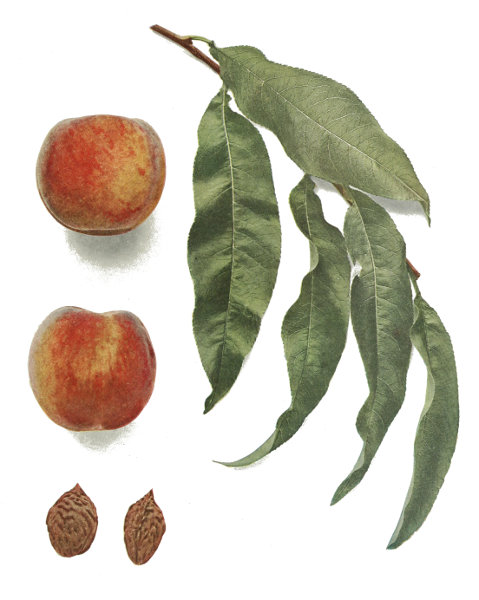
HALE EARLY
Tree large, vigorous, upright-spreading, hardy, variable in productiveness; trunk thick; branches stocky, smooth, reddish-brown mingled with ash-gray; branchlets long, dark pinkish-red with a trace of olive-green, glossy, smooth, glabrous, with rather few large, conspicuous lenticels.
Leaves flat or curled downward, six and one-fourth inches long, one and one-fourth inches wide, long-oval to obovate-lanceolate, thin, leathery; upper surface dark green, smooth; lower surface grayish-green; margin finely serrate, often in two series, tipped with reddish-brown glands; petiole three-eighths inch long, glandless or with one to four small, globose, reddish-brown glands usually at the base of the blade.
Flower-buds conical or pointed, plump, pubescent, usually free; blossoms appear in mid-season; flowers dark pink at the center, with lighter pink toward the margin and with streaks of light pink along the veins, one and one-half inches across, usually single; pedicels short, glabrous, green, with a few reddish dots; calyx-tube dull green mottled with red, with varying shades of orange within, campanulate, glabrous; calyx-lobes broad, usually obtuse, pubescent within and without, with longer hairs along the edges, erect; petals round or inclined to oval, entire, notched on both sides near the claws which are short, broad and tinged with red near the base; filaments one-half inch long, shorter than the petals; pistil finely pubescent at the ovary, longer than the stamens.
Fruit matures early; one and three-fourths inches long, one and seven-eighths inches wide, round, slightly compressed, with unequal halves; cavity regular, medium to deep, wide, flaring; suture shallow, with a slight bulge near the apex; apex roundish or flattened, ending abruptly in a short, sharp, recurved point; color creamy-white, with an attractive blush extending over one-half of the surface; pubescence short, thick; skin tough, free; flesh white, juicy, tender, sweet, with some astringency; good in quality; stone semi-free, one and five-sixteenths inches long, fifteen-sixteenths inch wide, ovate or oval, plump, with a short-pointed apex, surfaces marked by short grooves; ventral suture deep along the sides, narrow; dorsal suture deeply grooved, winged.
HEATH CLING
1. Prince Treat. Fr. Trees 17. 1820. 2. Kenrick Am. Orch. 234. 1832. 3. Proc. Nat. Con. Fr. Gr. 51. 1848. 4. Am. Pom. Soc. Cat. 78. 1862. 5. Fulton Peach Cult. 197, 198. 1908.
Heath. 6. Coxe Cult. Fr. Trees 228. 1817. 7. Lond. Hort. Soc. Rpt. 97. 1831. 8. Prince Pom. Man. 2:29, 30. 1832. 9. Downing Fr. Trees Am. 494, 495. 1845. 10. Floy-Lindley Guide Orch. Gard. 187, 188. 1846. 11. Elliott Fr. Book 274, 275. 1854. 12. Mas Le Verger 7:207, 208, fig. 102. 1866-73. 13. Am. Pom. Soc. Cat. 37. 1909.
White English. 14. Horticulturist N. S. 7:178, 179. 1857.
Heath Cling is unquestionably the oldest named American peach now under cultivation. Its antiquity constitutes about its only claim to recognition though for its tree-characters and for at least one fruit-character it ought to be retained for breeding. Few varieties have larger, healthier, hardier trees than Heath Cling, the fact that the oldest of our peaches has from the first retained these characters in pristine vigor confuting the notion that varieties degenerate. In the descriptions of Chinese peaches in Chapter 1, we read of winter peaches—sorts that could be kept for three or four months after picking. Of all American peaches, Heath Cling, possibly, most nearly approaches these Chinese winter peaches. It has been known to keep in good condition from October to December. Its quality, at best, is good but often it runs poor. Well grown, the peach has a sweet, rich, vinous taste but the flesh adheres so tightly to the stone that it is not pleasant eating out of hand though splendid cooked, preserved or pickled, the stone in culinary operations imparting a pleasant flavor of peach-pit bitterness. It is the best of all peaches to preserve or pickle whole. The color-plate shows the blushed sides of Heath Cling and therefore too much red for typical specimens of this variety.
Just how old Heath Cling is no one knows but it probably was grown in the colonies before the Revolution. Two accounts are given of its origin. According to one it originated with Daniel Heath of Maryland from a pit brought from the Mediterranean. Another is that the honor of originating this peach belongs in the Prince family and that the first William Prince discovered the variety growing wild on the farm of Judge Willet, Flushing, New York. The Princes, according to this account, gave it the name Heath because it was found on a barren heath. It seems fairly well established that the variety was in the Prince orchards before the Revolutionary War whether or not it was found and named by them.
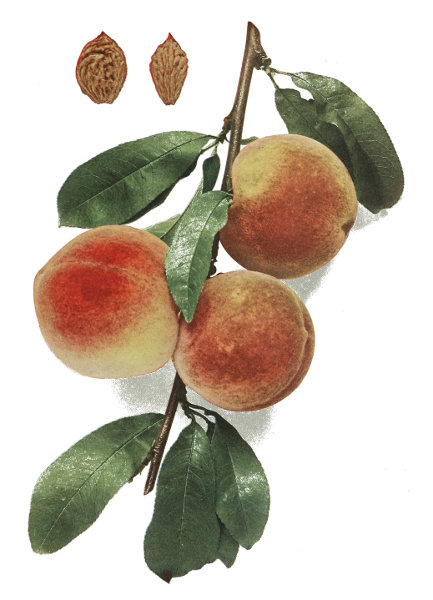
HEATH CLING
Tree large, vigorous, upright-spreading, hardy, unproductive; trunk shaggy; branches stocky, reddish-brown covered with light ash-gray; branchlets long, dark red intermingled with olive-green, glossy, smooth, glabrous, with numerous conspicuous, large, raised lenticels.
Leaves six and one-fourth inches long, one and one-half inches wide, folded upward, recurving, oval to obovate-lanceolate, leathery; upper surface dark green, rugose; lower surface grayish-green; margin finely serrate, tipped with reddish-brown glands; petiole one-half inch long, with two to seven small, mostly reniform, reddish-brown glands usually at the base of the leaf.
Flower-buds tender, medium to small, short, conical or pointed, plump, pubescent, free; blossoms appear in mid-season; flowers a faded pink, white at the center of the petals, about three-fourths inch across; pedicels short, medium to thick, glabrous, green; calyx-tube reddish-green; calyx-lobes short, broad, obtuse, glabrous within, pubescent without; petals roundish-oval, tapering to short, broad claws occasionally with a red base; filaments one-fourth inch long, shorter than the petals; pistil pubescent near the base, longer than the stamens.
Fruit matures very late; two and one-eighth inches long, two and one-fourth inches wide, round-oval, compressed and somewhat angular, with unequal sides; cavity variable in depth and width, abrupt or flaring; suture shallow, extending beyond the apex; apex ending in a swollen, pointed tip; color creamy-white, blushed with red, splashed and mottled with darker red; pubescence short, thick, fine; skin thin, adhering to the pulp; flesh white, juicy, firm and meaty but tender, sweet or somewhat sprightly; good in quality; stone clinging, one and one-fourth inches long, seven-eighths inch wide, oval, plump, flattened and pointed toward the base, tapering to a short point at the apex, with dark brown, grooved surfaces; ventral suture deep along the sides, thick, furrowed; dorsal suture grooved.
HEATH FREE
1. Am. Pom. Soc. Cat. 37. 1909. 2. Waugh Am. Peach Orch. 203. 1913.
Kenrick Heath. 3. Prince Treat. Hort. 17. 1828. 4. Prince Pom. Man. 2:30, 31. 1832. 5. Downing Fr. Trees Am. 479. 1845. 6. Am. Pom. Soc. Cat. 78. 1862. 7. Budd-Hansen Am. Hort. Man. 2:348. 1903.
Heath. 8. Kenrick Am. Orch. 226, 227. 1832.
Heath Free is now rarely planted, being replaced by better sorts—in fact it was out of date a quarter-century ago when the American Pomological Society dropped it from its fruit-list. We can see no justification of the Society's action in restoring the variety to its list ten years later. The tree-characters of Heath Free seem to be, in the main, very good but the peaches are not at all attractive in appearance and none too good in quality—at best it is but a culinary sort. Possibly it is worth growing under some conditions as a late, white-fleshed peach.
Heath Free is another old variety, a native of New England. Kenrick, one of the first American pomologists, received the variety from General Heath, Roxbury, Massachusetts, early in the Nineteenth Century. Later, Kenrick sent it to Prince at Flushing, New York, who is credited with having distributed it. The variety should not be confused with Heath Cling. Ripening at the latter end of the peach-season, the term "Late" is often attached to the name. In 1862 the American Pomological Society put this peach on its fruit-list under the name Kenrick Heath but dropped it from the list in 1899. Ten years later, 1909, the variety was replaced in the Society's catalog as Heath Free.
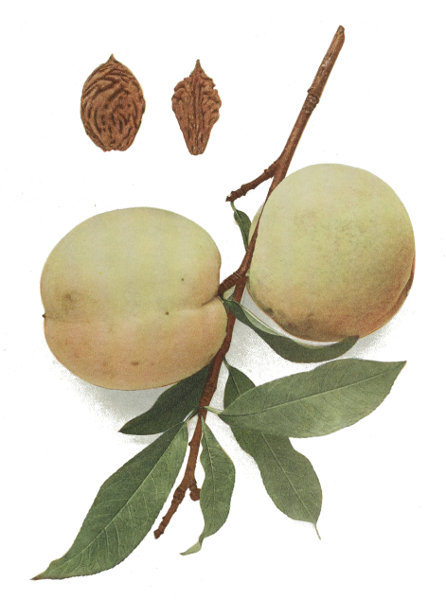
HEATH FREE
Tree very large, vigorous, upright-spreading, open-topped, unproductive; trunk thick, somewhat shaggy; branches stocky, smooth, reddish-brown covered with very light ash-gray; branchlets long, with many short, spur-like branches near the tips, with internodes dark red intermingled with olive-green, glossy, smooth, glabrous, with numerous conspicuous lenticels, raised near the base and tip.
Leaves seven and one-eighth inches long, one and three-fourths inches wide, folded upward, recurved slightly, long-oval to obovate-lanceolate, rather thin; upper surface dark green, smooth becoming rugose near the midrib; lower surface grayish-green; margin finely serrate, with reddish-brown glands; petiole one-half inch long, with two to five reniform, reddish-brown glands usually on the petiole.
Flower-buds half-hardy, conical or pointed, very pubescent, free; blossoms appear in mid-season; flowers dark pink along the margins of the petals changing to white toward their centers, well distributed; pedicels short, glabrous, green; calyx-tube reddish-green, yellow within, campanulate, glabrous; calyx-lobes short, narrow, acute to obtuse, glabrous within, pubescent without; petals small, narrow-oval, often broadly notched near the base, tapering to short, broad claws red at the base; filaments one-fourth inch long, equal to the petals in length; pistil pubescent at the base, longer than the stamens.
Fruit matures in late mid-season; two and one-eighth inches long, two and one-fourth inches thick, roundish-oval to oblong-oval, often strongly compressed, with halves nearly equal; cavity medium to shallow, wide, flaring, contracted along the sides, with tender skin; suture shallow; apex roundish, with a depressed, mucronate tip; color creamy-white, blushed or mottled with red, with splashes of deeper red; pubescence rather coarse, thick; skin thick, tough, adherent to the pulp; flesh white, bronzed at the pit, juicy, coarse, firm but tender, mild subacid with some astringency; good in quality; stone free, one and three-eighths inches long, one inch wide, flattened near the base, oval, with long grooves deeply sunken in the surfaces; ventral suture deeply furrowed along the edges, wide; dorsal suture grooved, faintly winged.
HILEY
1. Am. Pom. Soc. Rpt. 170. 1899. 2. Del. Sta. Rpt. 13:102 fig. 7, 103. 1901. 3. U. S. D. A. Yearbook 271, 272, Pl. 34. 1903. 4. Am. Pom. Soc. Cat. 37. 1909.
Early Belle. 5. Budd-Hansen Am. Hort. Man. 2:342. 1903. 6. W. N. Y. Hort. Soc. Rpt. 12. 1907.
In spite of keen competition with many other early, white-fleshed peaches, there seems to be a place for Hiley. Two characters make it notable in its class. It is the earliest commercial freestone, white-fleshed peach and it is rather better in quality than most of its competitors. Well grown, the peaches are large in size and handsomely colored but the fruits are not quite as uniform in either size or color as could be desired for a commercial variety. The trees, while productive, are neither large nor sufficiently hardy and vigorous to make an ideal commercial sort. Still, we must end as we began, with the statement that there is a place for Hiley because of earliness and high quality. The fruits, unfortunately, are easy prey to brown-rot.
Hiley originated with Eugene Hiley, Marshallville, Georgia, about 1886. Seeds of several varieties, including Belle and Elberta, were planted and from these sprang one tree which bore the fruit under discussion. R. A. Hiley, who seems to have first discovered its value, is of the opinion that this variety is a seedling of Belle crossed with Alexander. The new peach was first named Early Belle and the first crops were shipped under this name. Later the name was changed to Hiley. The American Pomological Society placed the variety on its fruit-list in 1909.
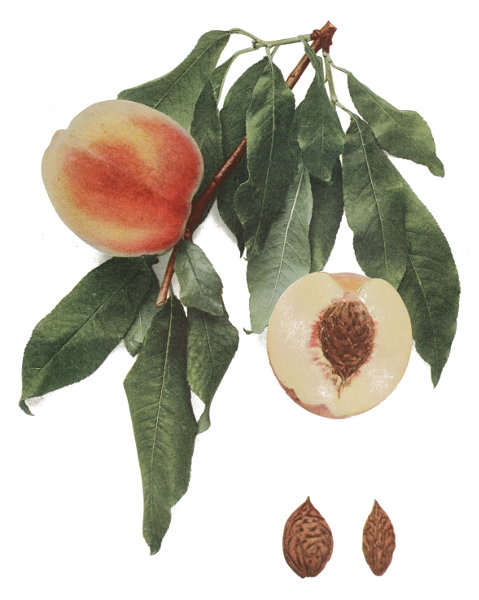
HILEY
Tree medium in size, lacking in vigor, upright-spreading, open-topped, very productive; trunk thick; branches stocky, smooth, reddish-brown covered with light ash-gray; branchlets with short internodes, brownish-red heavily overlaid with olive-green, smooth, glabrous, with conspicuous lenticels variable in number and size.
Leaves six and one-fourth inches long, one and one-half inches wide, folded upwards to nearly flattened, narrow-oval to obovate-lanceolate, leathery; upper surface dull, dark green, mottled, nearly smooth; lower surface grayish-green; margin finely serrate, tipped with reddish-brown glands; petiole three-eighths inch long, glandless or with one to eight small, globose and reniform, greenish-yellow glands variable in position.
Flower-buds tender, obtuse, plump, heavily pubescent, appressed or nearly so; blossoms appear in mid-season; flowers pink, one and seven-eighths inches across, often in twos; pedicels glabrous, greenish; calyx-tube dull, dark reddish-green, greenish-yellow within, obconic, glabrous; calyx-lobes broad, obtuse, glabrous within, heavily pubescent without; petals roundish-ovate, tapering to long, broad claws red at the base; filaments one-half inch long, shorter than the petals; pistil pubescent at the ovary, equal to or often longer than the stamens.
Fruit matures in mid-season; two and three-eighths inches long, two and one-fourth inches thick, roundish-conic to oblong-conic, bulged near the apex, with unequal halves; cavity abrupt, the skin tender and tearing easily; suture shallow, deepening toward the apex; apex pointed; color greenish-yellow with a dull blush often extending over one-half the surface, more or less mottled; pubescence thick, fine, short; skin thin, tough, separates from the pulp when fully ripe; flesh creamy-white, stained red at the pit, stringy, firm but tender, with a distinct, pleasant flavor, sprightly; good in quality; stone semi-free to free, one and three-eighths inches long, seven-eighths inch wide, elliptical to ovate, pointed at both ends, with nearly smooth surfaces; ventral suture rather wide and with deep furrows along the sides; dorsal suture a small groove.
HYNES
1. Tex. Sta. Bul. 39:812. 1896. 2. Am. Pom. Soc. Cat. 33. 1899. 3. Ont. Fr. Exp. Sta. Rpt. 8:14 fig. 1901. 4. Budd-Hansen Am. Hort. Man. 2:348. 1903.
Hynes Surprise. 5. W. N. Y. Hort. Soc. Rpt. 50. 1879. 6. Ibid. 111. 1880. 7. U. S. D. A. Pom. Rpt. 42. 1895.
Coming at a season when there are several very good, white-fleshed peaches, we doubt whether Hynes can establish itself in the peach-list for New York. The peaches are not quite large enough and the stone clings a little too tenaciously for a first-class early peach. The flavor is good for an early peach and when large enough the fruits are attractive, shape and coloring being particularly pleasing. Hynes was at one time highly recommended, widely advertised and largely sold in New York by nurserymen and fruit-growers in this State. We doubt if many are now planting it. The color-plate is an excellent reproduction of the variety.
Hynes was grown about 1877 by E. F. Hynes, West Plains, Missouri. Its parentage is unknown. The variety soon became disseminated as a valuable early, commercial peach. At first it was known as Hynes Surprise but gradually the name has been shortened to Hynes. The late S. D. Willard, Geneva, New York, grew and recommended this variety for a number of years and by some has been given the credit of having originated and introduced it. The American Pomological Society put Hynes on its fruit-list in 1899.
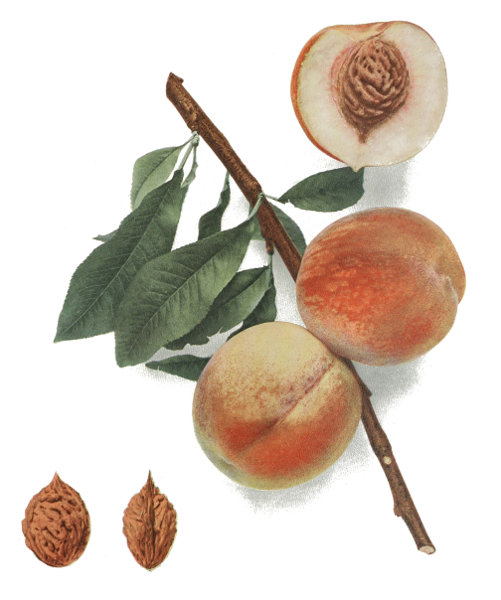
HYNES
Tree large, vigorous, upright-spreading, open-topped, hardy, medium in productiveness; trunk thick; branches stocky, smooth, reddish-brown with a small amount of ash-gray; branchlets long, with internodes of medium length, dark red intermingled with olive-green, glossy, smooth, glabrous, with conspicuous, large lenticels.
Leaves six and one-half inches long, about one and one-half inches wide, oval to obovate-lanceolate, leathery, dull, dark green, smooth; lower surface grayish-green; apex tapering to a long, narrow point; margin finely serrate, tipped with reddish-brown glands; petiole three-eighths inch long, with one to five small, globose, brownish-yellow glands variable in position.
Flower-buds hardy, small, short, obtuse, plump, slightly pubescent, usually appressed; blossoms appear in mid-season; flowers dark pink at the center, light pink near the edges, often in twos; pedicels short, medium to thick, glabrous, greenish; calyx-tube reddish-green, greenish-yellow within, campanulate, glabrous; calyx-lobes short, medium to broad, obtuse, glabrous within, pubescent without; petals broadly oval, irregular in outline, tapering to claws often red at the base; filaments one-half inch long, shorter than the petals; pistil pubescent near the base, equal to the stamens in length.
Fruit matures early; two and one-half inches long, two and one-fourth inches wide, round-oblate, with halves usually equal; cavity wide, flaring; suture shallow, becoming deeper near the tip; apex flattened or roundish, ending abruptly in a short, sharp point; color greenish or creamy-white, with a dull, dark red blush, splashed and mottled with carmine; pubescence thin, short, fine; skin thin, tender, variable in adherence to the pulp; flesh greenish-white, with a red stain under the skin and often rayed with red about the pit, juicy, stringy, tender and melting, sweet, mild; fair to good in quality; stone nearly free, one and one-fourth inches long, seven-eighths inch wide, bulged on one side, ovate, very plump, with surfaces pitted and with short, narrow grooves; ventral suture furrowed, very deeply grooved at the edges; dorsal suture wide, deeply grooved.
ILLINOIS
1. N. J. Hort. Soc. Rpt. 36. 1912. 2. Stark Bros. Cat. 37 fig. 1913. 3. Waugh Am. Peach Orch. 203. 1913. 4. Stark Bros. Cat. 43. 1914.
Illinois is a mid-season, white-fleshed, freestone peach, still on probation with what result as to commercial possibilities we should not like to predict. It has been little tried in New York and growers in other peach-regions are not in accord as to its value. In size, color and shape of fruit, as the color-plate shows, Illinois is one of the beauties of the orchard. Yet, all things considered, the new variety is not as good as Champion with which it would have to compete. Neither tree- nor fruit-characters are quite satisfactory as the variety grows on the Station grounds. It must be apparent, too, to all peach-growers that the industry is overloaded with white-fleshed peaches which at best must be sold in nearby markets or grown for home use.
Illinois originated about 1910 on the grounds of E. H. Riehl near North Alton, Illinois. It is supposed to be a cross between Stark Heath and Washington.
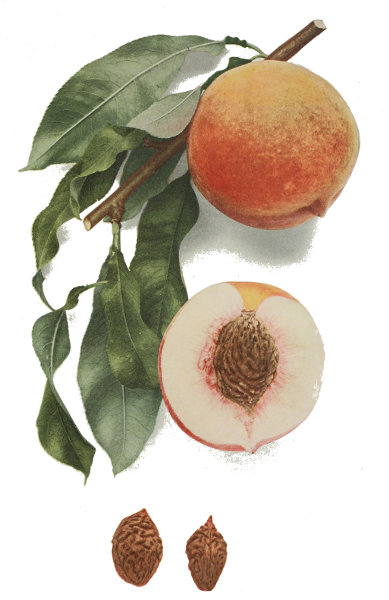
ILLINOIS
Tree medium in size and vigor, upright to spreading, hardy, very productive; trunk thick; branches stocky, smooth, dark reddish-brown overlaid by ash-gray; branchlets slender, short, with internodes dark red and olive-green, smooth, glabrous, with a few inconspicuous, raised lenticels variable in size.
Leaves five and one-half inches long, one and one-half inches wide, curled under at the tips, ovate-lanceolate, thin, leathery; upper surface dull, dark green, rugose along the midrib; lower surface olive-green; margin deeply and sharply serrate, the serrations often in two series, tipped with small glands; petiole three-eighths inch long, glandless.
Flower-buds medium to large, obtuse or conical, plump, pubescent, appressed; blossoms appear in mid-season; flowers variable in color, over one inch across, often in twos; pedicels short, greenish, glabrous; calyx-tube reddish-green, greenish-yellow within, campanulate, glabrous; calyx-lobes medium to broad, obtuse, glabrous within, pubescent without; petals oval, crenate, often broadly notched near the base, tapering to narrow claws with a tinge of red at the base; filaments one-half inch long, equal to the petals in length; pistil pubescent at the base, as long as the stamens.
Fruit matures in early mid-season; two and one-fourth inches long, two and one-half inches wide, round-oblate, compressed, the halves usually unequal; cavity deep, abrupt, often tinged with red; suture shallow, deepening toward the apex; apex roundish, with a mucronate tip; color creamy-white, blushed with dull, dark red and mottled with splashes of brighter red; pubescence heavy; skin tough; flesh white, stained red near the pit, juicy, tender and melting, sweet; good in quality; stone semi-free to free, one and one-fourth inches long, fifteen-sixteenths inch wide, oval or obovate, not bulged, slightly elongated toward the base, plump, short-pointed at the apex, with grooved and pitted surfaces; ventral suture winged, of medium width, deeply grooved along the edges; dorsal suture deeply grooved.
IMPERIAL
1. La. Sta. Bul. 27:943. 1894. 2. Tex. Sta. Bul. 39:819. 1896. 3. Am. Pom. Soc. Cat. 22. 1897. 4. Ala. Sta. Bul. 117:305. 1901. 5. Fla. Sta. Bul. 73:148, Pls. 3 & 4. 1904. 6. Am. Pom. Soc. Cat. 37. 1909. 7. Ala. Sta. Bul. 156:133. 1911.
Of the several honey-flavored peaches fruiting on the Station grounds, Imperial is probably the best. The fruit is not easily distinguished in appearance from that of Climax, at least by those unfamiliar with southern peaches, and is also rather closely allied to Honey in outward character but has a somewhat distinct flavor in which it surpasses Climax and Honey. It differs from both, too, in time of ripening. The peaches of this, as of other honey-flavored sorts, drop badly as they mature. It is doubtful if we shall ever grow pure-bred peaches of the Honey type in New York for the markets, but Imperial, at least, is worth a place in every home orchard where it does not have to brave too great a degree of cold; and peach-breeders should seize the opportunity to cross it with our less richly flavored northern varieties.
Imperial is a seedling of Honey grown in 1890 by G. L. Taber, Glen Saint Mary, Florida. This variety has been much confused with White Imperial, a sort grown in New York many years ago but long since out of cultivation. Pomologists frequently list White Imperial as a synonym of Imperial, giving the origin as New York, when the variety in mind is the true Imperial of southern origin. Imperial was listed in the American Pomological Society's catalog in 1897 but was dropped in 1899. It appears again, however, in the Society's catalog in 1909 under the name Imperial with White Imperial incorrectly given as a synonym.
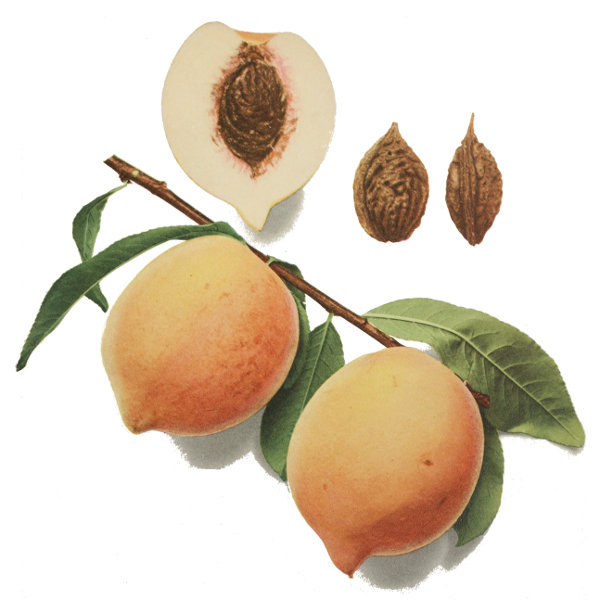
IMPERIAL
Tree medium in size or small, upright-spreading, round-topped, productive; trunk thick, rough; branches stocky, roughened, reddish-brown intermingled more or less with ash-gray; branchlets slender, often rebranching, long, with internodes dark pinkish-red mingled with varying shades of olive-green, and with conspicuous, numerous, raised lenticels.
Leaves six and one-fourth inches long, one and one-half inches wide, flattened, lanceolate, leathery; upper surface dull, dark green; lower surface olive-green; margin finely and shallowly serrate, tipped with glands; petiole three-eighths inch long, with one to four small, reniform glands usually at the base of the blade.
Flower-buds small, medium to short, conical or obtuse, pubescent, plump, usually appressed; blossoms appear in mid-season; flowers medium in size, showy, light pink, usually single; pedicels medium in length and thickness, green; calyx-tube reddish-green, orange-green within, obconic; calyx-lobes acute or obtuse, glabrous within, pubescent without; petals roundish, tapering to claws tinged with red at the base; filaments equal to or shorter than the petals; pistil pubescent.
Fruit matures late; two and one-half inches long, two and three-sixteenths inches wide, oval, with unequal halves; cavity shallow, medium in width, flaring; suture very shallow, often indistinct toward the cavity; apex distinctly elongated; color pale green becoming whitish, with faint mottlings and with a distinct or faint blush; pubescence short, thick; skin tough, adhering to the pulp; flesh white, stained with red near the pit, juicy, fine-grained, tender and melting, very sweet and of a delightful flavor; very good to best; stone free, one and three-eighths inches long, thirteen-sixteenths inch wide, oval or ovate, not very plump, bulged at one side, long and pointed at the apex, with roughish and pitted surfaces, dark brown mingled with purplish-red; ventral suture rather narrow, often winged, deeply grooved along the edges; dorsal suture grooved.
IRON MOUNTAIN
1. Mich. Sta. Bul. 152:197, 200. 1898. 2. Ibid. 169:217. 1899. 3. Rural N. Y. 58:738 fig. 271. 1899. 4. Am. Pom. Soc. Cat. 37. 1909. 5. Waugh Am. Peach Orch. 203. 1913.
Hardiness is the outstanding character which has brought Iron Mountain into prominence. The introducer and many growers claim extreme hardiness of wood and bud for the variety—others say that it is surpassed by Crosby, Wager and other varieties of their type. The trees on the Station grounds turned out not to be true to name so that we can offer no data as to hardiness. Iron Mountain is a very late, white-fleshed, freestone peach well adapted for extending the commercial limits for this fruit in regions where fall frosts hold off sufficiently long for the fruit to ripen. The tree-characters are reported by most growers as very satisfactory and the peaches serve very well for culinary purposes but are not sufficiently attractive for a dessert fruit though the quality is excellent. There seem to be two varieties, much alike in fruit, passing under this name; one is large-flowered, the other small-flowered. This variety might well be planted in New York for some markets; as, for example, near towns and cities where it is desirable to extend the local market as late as possible.
Iron Mountain seems to have originated in New Jersey about a quarter-century ago but nothing is known of its parentage or by whom grown. The variety was introduced by J. H. Lindley, Whitehouse, New Jersey. It was put on the fruit-list of the American Pomological Society in 1909.
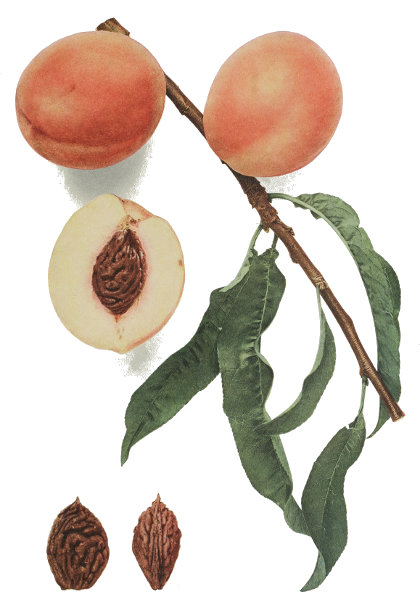
IRON MOUNTAIN
Tree large, vigorous, upright-spreading, open-topped, not always productive; trunk thick; branches smooth, dark ash-gray mingled with reddish-brown; branchlets medium to slender, with internodes of medium length, greenish-brown, smooth, glabrous, with numerous small, raised lenticels.
Leaves six inches long, one and one-half inches wide, folded upward and recurved, oval to obovate-lanceolate, medium in thickness, leathery; upper surface dark green, smooth; lower surface light green, with a prominent midrib; margin glandular, finely serrate; petiole three-eighths inch long, with one to six reniform glands of medium size, usually on the petiole; flower-buds medium to small, conical, free; season of bloom late; flowers small.
Fruit matures very late; two and three-fourths inches long, two and five-eighths inches thick, oblong-oval, often bulged on one side, compressed; cavity contracted, below medium in depth, flaring; suture shallow, extending only to the tip; apex distinctly mucronate or roundish, sometimes tapering; color pale greenish or creamy-white, occasionally with a light blush; pubescence heavy; skin medium to thin, tender, adherent to the pulp; flesh white, stained brown next to the pit, juicy, tender, sweet, mild; quality good; stone semi-free one and five-eighths inches long, more than one inch wide, somewhat wedge-like at the base, obovate, plump, long-pointed at the apex, winged, with large, wide and deep grooves in the surfaces; ventral suture with wide, deep furrows; dorsal suture grooved deeply, winged.
J. H. HALE
1. W. P. Stark Cat. 45-55. 1913. 2. Waugh Am. Peach Orch. 203. 1913.
Of many new peaches, J. H. Hale is now the leading aspirant for pomological honors. Indeed, it is one of the sensations of the pomological world, the variety having many merits to commend it and the name and fame of the originator and of the introducers, together with extensive advertising, helping much to bring the peach to the attention of fruit-growers. Elberta is now the standard commercial peach and, since J. H. Hale must make its way in competition with the variety in command of the markets, we can best set forth the characters of the new sort by comparing it with Elberta with which all are familiar. The comparison is easy to make, for the two peaches are of the same general type, Elberta, probably, being one of the parents of J. H. Hale.
In size of fruit, J. H. Hale averages larger—all things considered a trifle too large when the trees are at their best. The flesh of J. H. Hale is firmer and heavier and the peaches will ship and keep longer than those of Elberta. In shape, the fruit is almost a perfect sphere, its symmetry being scarcely marred by the suture so that it is more shapely than the oblong Elberta and can, of course, be packed to better advantage. The color-plates of the two peaches show the differences in shape very well. In color of fruit there is no choice—both peaches are voluptuously handsome. The skin of J. H. Hale is less pubescent and possibly a little firmer and tighter, characters adding to the appearance and shipping qualities of the fruit. It is but an invitation to argument to say which is the better in the characters that go to please the palate—flavor, aroma, texture and juiciness. Neither, in comparison with many other peaches, can be rated as extra good.
Unfortunately we cannot be as certain of the merits of the trees of the two varieties as we are of the fruits. This much we know, J. H. Hale is a few days earlier than Elberta and its trees and buds are hardier than those of Elberta. Which is the more productive is not certain and this can be ascertained only when data can be had from a large number of growers since productiveness in both is bound to vary with the soil. The greatest asset of Elberta is its ability to adapt itself to diverse soils; whether J. H. Hale is equally elastic in constitution remains to be seen. The variety is still on probation in New York with the chances growing stronger each year that it will take high place among commercial peaches. We do not expect it to drive Elberta from the markets but the markets will be shared between the two, J. H. Hale reaching the fruit-stands several days in advance of Elberta. Would that there were as good a commercial variety to follow Elberta.
This remarkable variety is a chance seedling found by J. H. Hale, South Glastonbury, Connecticut. From its characters, one sees at once that it is either an offspring or is very closely related to Elberta—at first many thought the two were identical. After having thoroughly tested the new variety in commercial orchards in both Connecticut and Georgia, Mr. Hale decided that it was worth introducing and sold the new peach to the William P. Stark Nurseries, Stark City, Missouri. The distribution of the variety was begun in 1912 and possibly no other tree-fruit has ever been so rapidly propagated and so widely distributed as has the J. H. Hale in the past four years.
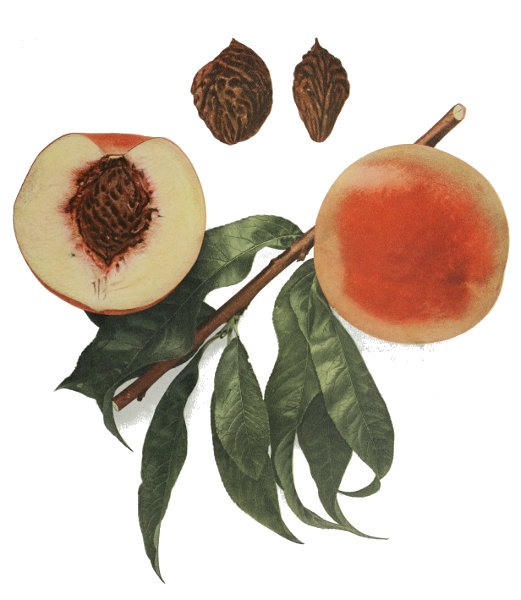
J. H. HALE
Tree vigorous, upright-spreading, open-topped, productive; trunk of medium thickness, smooth; branches smooth, ash-gray overspread with dark reddish-brown; branchlets medium in thickness and length, with long internodes, olive-green overspread with red, smooth, glabrous.
Leaves six and three-fourths inches long, one and three-fourths inches wide, folded upward, recurving at the tip, lanceolate, thin, leathery; upper surface dark green, smooth becoming rugose along the midrib; lower surface olive-green, with prominent midrib; margin singly or doubly serrate; petiole five-sixteenths inch long, thick, with one to five reniform, dark brown glands of medium size; flowers appear in mid-season.
Fruit matures in mid-season; three inches long, three and one-fourth inches wide, regular, round, with equal halves; cavity deep, wide, regular; suture a mere line, very shallow or with almost no depression; apex roundish, with a small tip set in a depression; color lemon-yellow overspread with attractive dark red and with mottlings and splashes of carmine; pubescence light; skin thick, tough, separates but poorly from the pulp; flesh yellow, red around the pit, juicy, fine-grained, sweet or somewhat sprightly; good in quality; stone free, one and three-fourths inches long, one and one-fourth inches wide, oval, plump, flattened at the base, pointed at the apex, with grooved and pitted surfaces; ventral suture furrowed, deeply grooved along the sides; dorsal suture winged, deeply grooved.
JENNIE WORTHEN
1. Mich. Sta. Bul. 31:58. 1887. 2. Munson Cat. 8. 1890-91. 3. Ill. Hort. Soc. Rpt. 183. 1898.
Worthen. 4. U. S. D. A. Pom. Rpt. 44. 1895. 5. Mich. Sta. Bul. 169:229. 1899.
Jennie. 6. Tex. Sta. Bul. 39:812. 1896.
Jennie Worthen is given a place among the major varieties in The Peaches of New York with the hope that New York growers may be induced to try it as a high-grade, yellow-fleshed, freestone variety to precede Elberta. It is enough to say that it is very similar to Early Crawford—best of all early peaches—and on the Station grounds is more productive, unproductiveness being the fault that keeps Early Crawford from being a money-making variety. Whether or not Jennie Worthen can be grown commercially, it is well worth planting in the home orchard.
But little is known of the history of this variety. According to a letter from the late T. V. Munson, Denison, Texas, it originated in Illinois with a Mr. Worthen and was named for his daughter. The Munson Nursery grew the variety for a few years after its introduction but has since discontinued its propagation.
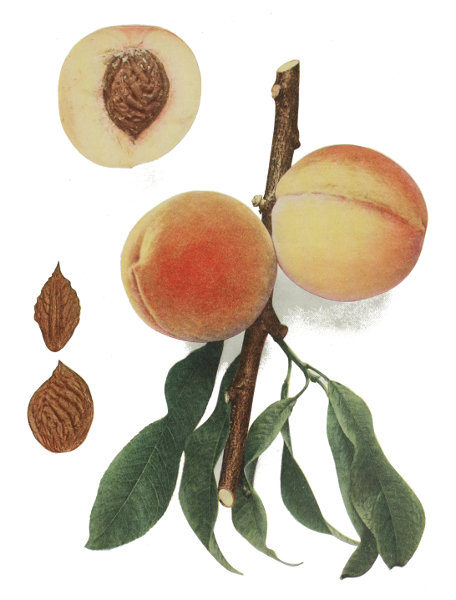
JENNIE WORTHEN
Tree large, vigorous, spreading, hardy, productive; trunk thick, smooth; branches thick, nearly smooth, reddish-brown mingled with light ash-gray; branchlets of medium thickness, tending to rebranch near the tips, with internodes of medium length, dark pinkish-red intermingled with green, glossy, smooth, glabrous, with numerous conspicuous, small, raised lenticels.
Leaves six and one-half inches long, one and three-eighths inches wide, curled both upward and downward, oval to obovate-lanceolate, thin, leathery; upper surface dark green, rugose near the base of the midrib; lower surface grayish-green; margin finely serrate, tipped with reddish-brown glands; petiole one-half inch long, glandless or with one to six reniform, reddish-brown glands of medium size, variable in position.
Flower-buds hardy, usually obtuse, sometimes conical, plump, very pubescent, free; blossoms appear in mid-season; flowers pale pinkish, darker pink near the margins, well distributed; pedicels short, medium to thick, glabrous, green; calyx-tube dull, dark reddish-green, orange-red within, campanulate, glabrous; calyx-lobes short, narrow, usually acute, glabrous within and without; petals oval, often broadly notched near the base, tapering to long, narrow claws occasionally tinged with red at the base; filaments three-eighths inch long, equal to the petals in length; pistil pubescent at the ovary, equal to or longer than the stamens.
Fruit matures in mid-season; two and seven-eighths inches long, two and five-sixteenths inches wide, irregular, roundish-oval, bulged at one side, considerably compressed, with unequal sides; cavity medium to deep, abrupt, with tender skin; suture shallow, deepening toward the tip; apex elongated; color greenish-yellow changing to orange-yellow, with stripes and splashes and mottlings of deeper red; pubescence thick, long; skin thin, tough, separates from the pulp; flesh deep yellow, stained with red near the pit, juicy, slightly stringy, tender, sweet, very pleasantly flavored, sprightly; good to very good in quality; stone free, one and three-eighths inches long, one inch wide, ovate, plump, bulged at one side, the surfaces grooved; ventral suture narrow, winged, deeply grooved near the edges; dorsal suture grooved.
KALAMAZOO
1. Mich. Hort. Soc. Rpt. 27, 28, 192. 1893. 2. Ibid. 143. 1894. 3. Am. Pom. Soc. Cat. 33. 1899. 4. Mich. Sta. Bul. 169:217. 1899. 5. Budd-Hansen Am. Hort. Man. 2:348. 1903. 6. Mich. Sta. Sp. Bul. 44:49 fig., 50. 1910. 7. Waugh Am. Peach Orch. 203. 1913.
Before peach-growers had Elberta, Kalamazoo was a promising yellow-fleshed, freestone variety. The fruit is better in quality than Elberta but not as showy in appearance and the trees are not quite as productive. Kalamazoo ripens with Late Crawford and could well compete with that variety for the trees are hardier in wood and bud and are much more productive. The variety falls short, however, in the size of the peaches, these running no larger than a medium Late Crawford, though possibly this defect could be remedied by thinning. The fruits are of highest quality either for dessert or culinary purposes. The trees are susceptible to leaf-curl and must be thoroughly sprayed for this fungus. The variety is grown rather extensively in Michigan and is well known in parts of New York.
Kalamazoo originated with J. N. Stearns, Kalamazoo, Michigan, about 1869, as a sprout from below the bud on a Yellow Alberge tree. It first fruited in 1871 and was exhibited that year at the Michigan State Fair where it received a premium as the best seedling peach. The American Pomological Society placed Kalamazoo in its fruit-list in 1899 where it still remains.
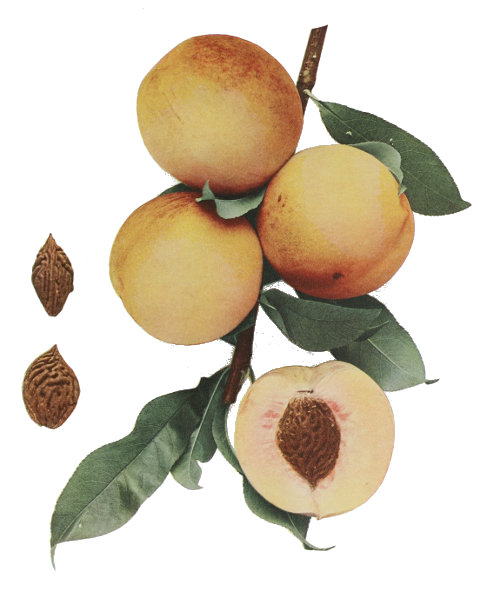
KALAMAZOO
Tree large, spreading, vigorous, open-topped, very productive; trunk medium in thickness and smoothness; branches stocky, nearly smooth, reddish-brown mingled with light ash-gray; branchlets long, with internodes of medium length, dark pinkish-red with a small amount of olive-green, smooth, glabrous, with lenticels of medium number and size.
Leaves six and one-half inches long, one and three-eighths inches wide, nearly flat or curled downward, oval to obovate-lanceolate, leathery; upper surface dark olive-green, smooth; lower surface grayish-green; apex narrow-acuminate; margin finely serrate, tipped with reddish-brown glands; petiole three-eighths inch long, with one to six small, reniform, reddish-brown glands variable in position.
Flower-buds hardy, conical, somewhat pointed, pubescent, partly appressed; blossoms appear in mid-season; flowers pale pink, white at the center of the petals, one and one-eighth inches across; pedicels short, medium to slender, glabrous, green; calyx-tube reddish-green, orange-colored within, campanulate, glabrous; calyx-lobes medium to narrow, acute, glabrous within, pubescent without; petals oval to somewhat ovate, irregular in outline near the base, tapering to narrow claws occasionally reddish at the base; filaments one-half inch long; pistil pubescent at the base, equal to or shorter than the stamens.
Fruit matures late; two and three-eighths inches long, two and seven-sixteenths inches wide, roundish-oval, often compressed, with unequal sides; cavity rather wide, flaring to abrupt; suture indistinct becoming more pronounced toward the tip; apex ending in a small, elongated point; color greenish-yellow becoming yellow, with a faint or distinct blush usually extending over one-fourth of the surface, mottled; pubescence thick, fine; skin thin, tough, separates from the pulp; flesh light yellow, stained with red near the pit, juicy, tender, sweet, mild; good in quality; stone free or nearly so, one and one-half inches long, one and one-sixteenths inches wide, oval to ovate, bulged on one side, winged near the base, the surfaces pitted and grooved near the apex; ventral suture very deeply grooved at the sides, medium in width; dorsal suture winged, grooved deeply.
LAMONT
1. Cornell Sta. Bul. 74:372. 1894. 2. N. Y. State Fr. Gr. Assoc. Rpt. 144. 1910. 3. Ibid. 21. 1912. 4. Van Dusen Nur. Cat. 21. 1913.
Though long grown in parts of western New York, Lamont has not been sufficiently well tested by the peach-growers of the State. It is a yellow-fleshed, freestone peach, much like Early Crawford in appearance and quality, which ripens from one to two weeks after Elberta. It is more productive than either of the Crawfords and if it does as well elsewhere as about Geneva, the place of its origin, it ought to take high place in the list of commercial peaches for this State. Several large growers in this region speak well of it as a market fruit. As a garden variety for its season, it can hardly be surpassed.
The original Lamont tree grew as a chance seedling on the grounds of Charles Lamont, Geneva, New York, first fruiting about 1884. It was introduced by E. Smith and Sons, Geneva, New York, soon after its discovery. The variety is offered by several Geneva nurserymen.
LAMONT
Tree large, vigorous, upright-spreading, productive; trunk thick, nearly smooth; branches stocky, smooth, reddish-brown with light ash-gray; branchlets with internodes of medium length, dark pinkish-red intermingled with green, glossy, smooth, glabrous, with inconspicuous, raised lenticels.
Leaves seven inches long, one and five-eighths inches wide, folded upward and curled downward slightly, oval to obovate-lanceolate, thick, leathery; upper surface dark olive-green, smooth; lower surface grayish-green; apex acuminate; margin finely and sharply serrate, tipped with reddish-brown glands; petiole one-half inch long, with one to six reniform, dark brown glands variable in position.
Flower-buds tender, large, long, conical or pointed, pubescent, free; blossoms appear in mid-season; flowers thirteen-sixteenths inch across, white at the center of the petals becoming dark pink near the edges; pedicels short, green; calyx-tube reddish-green at the base, obconic, glabrous; calyx-lobes short, medium to broad, obtuse, glabrous within, heavily pubescent without; petals roundish-oval, somewhat irregular in outline near the base, tapering to long, narrow claws occasionally with a red base; filaments three-eighths inch long, equal to the petals in length; pistil pubescent near the base, as long as the stamens.
Fruit matures late; about two and seven-eighths inches in diameter, roundish-cordate, compressed, with unequal sides; cavity deep, usually abrupt; suture indistinct, becoming deeper near the tip; apex roundish or pointed, usually with a noticeable mamelon or sometimes mucronate tip; color golden-yellow, blushed and faintly striped and splashed with carmine; pubescence heavy, long, coarse; skin thick, tough, adherent to the pulp; flesh light yellow, stained with red near the pit, juicy, coarse, tender, pleasantly sprightly; good in quality; stone free, one and five-eighths inches long, one and one-eighth inches wide, oval to obovate, flattened near the base, often bulged at the apex, winged, with grooved surfaces; ventral suture deeply marked along the edges, narrow, winged; dorsal suture grooved, the sides wing-like.
LARGE YORK
1. Am. Pom. Soc. Cat. 22. 1897. 2. Ill. Hort. Soc. Rpt. 26. 1899.
New York Rareripe. 3. Coxe Cult. Fr. Trees 220. 1817. 4. Elliott Fr. Book 277. 1854.
Large Early York. 5. Prince Treat. Fr. Trees 16. 1820. 6. Proc. Nat. Con. Fr. Gr. 39, 51. 1848. 7. Cole Am. Fr. Book 192. 1849. 8. Cultivator 6:308 fig. 1849. 9. Am. Pom. Soc. Rpt. 44. 1856. 10. Elliott Fr. Book 288. 1859. 11. Horticulturist 16:245. 1861. 12. Gard. Mon. 5:13. 1863. 13. Downing Fr. Trees Am. 619. 1869. 14. Fulton Peach Cult. 185, 186. 1908.
Large Early Rareripe. 15. Prince Pom. Man. 2:25. 1832.
Large York long ago lost all value for either home or commercial plantings but it is still listed in a few nursery catalogs and is still in the fruit-list of the American Pomological Society. It is one of the old American sorts and has been much confounded with several other peaches. We place it among the major varieties in The Peaches of New York chiefly to straighten out the nomenclatorial tangle involving it and the several varieties with which it is commonly confounded.
Large York has been more often confused with Early York than any other sort. George IV, Haines and Honest John have also been listed time and again as identical with Large York. While the sorts mentioned have many resemblances, there are distinguishing characters for all of them. Large York, known also as Large Early York and Large Early Rareripe, originated with William Prince,261 Flushing, New York, some time in the Eighteenth Century, probably from a pit of Red Rareripe. The variety was at first called Early York but to distinguish it from another Early York the term Large was added. Prince sent the variety to William Forsyth of England about 1790. Forsyth grew it in the Royal Kensington Gardens and later renamed it Royal Kensington under which name it is frequently sold in England. While Large York and Early York are closely related, the leaves of the latter are glandless while those of the former have globose glands. At the National Convention of Fruit-Growers held in 1848, Large York was put on the list of recommended varieties under the name Large Early York. The peach has remained on the American Pomological Society's fruit-catalog since the date given, the name being shortened in 1897 to Large York.
Tree large, vigorous, upright-spreading, open-topped, rather unproductive; trunk thick; branches thick, smooth, reddish-brown intermingled with light ash-gray; branchlets with long internodes, dark red with some green, somewhat russetted, glossy, smooth, glabrous, with conspicuous, numerous, large, raised lenticels; leaves six and one-half inches long, one and one-half inches wide, variable in position, oval to obovate-lanceolate, thick, leathery, dark green tinged with olive-green; margin finely serrate; petiole three-eighths inch long, glandless or with one to six small, globose, reddish-brown glands; flower-buds small, short, pointed, not very plump, pubescent, appressed; flowers small, appearing in mid-season.
Fruit ripens in mid-season; one and seven-eighths inches long, two and one-sixteenth inches wide, round-oblate, bulged at one side, compressed, with unequal halves; cavity narrow, abrupt, faintly splashed with red; suture shallow, becoming deeper toward the apex and extending considerably beyond; apex roundish or depressed, with a mucronate tip; color greenish-white or creamy-white, blushed and mottled with red; pubescence short, thick, fine; skin thin, tender, adheres to the pulp; flesh white, rayed with red near the pit, juicy, stringy, tender, sweet, mild, pleasant flavored, aromatic; good in quality; stone nearly free, one and one-eighth inches long, seven-eighths inch wide, oval, plump, short-pointed at the apex; ventral suture medium in width; dorsal suture grooved.
LATE CRAWFORD
1. Mas Le Verger 7:231, 232, fig. 114. 1866-73. 2. Waugh Am. Peach Orch. 204. 1913.
Crawford's Superb Malacatune. 3. Kenrick Am. Orch. 191, 192. 1841.
Crawford's Late Melocoton. 4. Horticulturist 1:12. 1846-47. 5. Downing Fr. Trees Am. 491. 1845. 6. Cole Am. Fr. Book 197. 1849.
Crawford's Late. 7. Proc. Nat. Con. Fr. Gr. 51. 1848. 8. Hovey Fr. Am. 2:9, 10, Pl. 1851. 9. Elliott Fr. Book 273. 1854. 10. Am. Pom. Soc. Rpt. 43. 1856. 11. Fulton Peach Cult. 194. 1908.
Late Crawford is at the head of the Crawford family, long dominant among the several groups of American peaches and not yet equalled by any other yellow-fleshed peaches in quality. Late Crawford, a quarter-century ago, began to give way to Elberta because of the greater productiveness of the Elberta tree and the showier Elberta fruits and now, though widely distributed, is nowhere largely planted and seems destined to pass out of cultivation as a peach of commerce. Unproductiveness and tardiness in coming in bearing are the faults on account of which Late Crawford is failing. Itself adapted to a wide range of soil and climatic condition, Late Crawford, through the recurring variations from seed, has made the Crawford family the most cosmopolitan of the several distinct races of American peaches. Of all the family it is most virile, more than a score of its offspring being described in The Peaches of New York.
Compared with other Crawford-like peaches, Late Crawford is possibly the best in fruit-characters, the peaches being unsurpassed in appearance and scarcely equalled in texture of flesh and richness of flavor. The peaches, too, are more shapely and more uniform in shape than fruits of other Crawford varieties, being rounder, trimmer in contour and having a suture that scarcely mars the symmetry of the peach. In color, Late Crawford runs the whole gamut of soft tints of red and yellow that make Melocotons and Crawfords the most beautiful of all peaches. The trees are as vigorous, hardy, healthy and as little susceptible to disease as any of the varieties near of kin, failing only, as has been said, in productiveness and in coming in bearing rather tardily. Evidently destined to pass from commercial cultivation, Late Crawford ought long to remain one of the treasures of the home orchard.
Late Crawford was raised by William Crawford, Middletown, New Jersey, at least a hundred years ago, the exact date of origin, as well as its parentage, being unknown. The variety was first brought to notice by William Kenrick, Newton, Massachusetts, who described it in the American Orchardist under the name Crawford's Superb Malacatune. No doubt it has a worthy line of ancestors in the old seedling orchards of the early colonists, the fact that it is the founder of a race indicating long-continued reproduction from seeds with little interposition of budding. At the National Convention of Fruit-Growers held in 1848, Late Crawford was placed in the list of recommended fruits and since that time has held a place on the fruit-list of the American Pomological Society. It was first listed as Crawford's Late; later as Crawford's Late Melocoton and now appears as Late Crawford in accordance with the Society's rules of nomenclature.
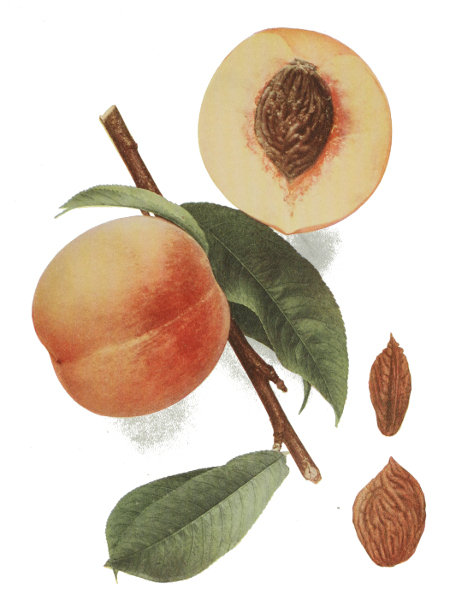
LATE CRAWFORD
Tree large, vigorous, upright-spreading, open-topped, not very productive; trunk stocky, smooth; branches thick, smooth, reddish-brown mingled with light ash-gray; branchlets long, somewhat twiggy, dark reddish-brown overlaid with olive-green, smooth, glabrous, with conspicuous, numerous, small, raised lenticels.
Leaves six and seven-eighths inches long, one and three-fourths inches wide, folded upward and curled downward, oval to obovate-lanceolate, thick, leathery; upper surface dark olive-green, smooth becoming rugose along the midrib; lower surface grayish-green; margin finely serrate, tipped with reddish-brown glands; petiole one-half inch long, with one to six small, globose, reddish-brown glands variable in position.
Flower-buds tender, large, above medium in length, obtuse or conical, plump, very pubescent, appressed or free; blossoms open in mid-season; flowers one and one-eighth inches across, pink, well distributed; pedicels short, medium to slender, glabrous, green; calyx-tube reddish-green, orange-colored within, obconic, glabrous; calyx-lobes medium to broad, obtuse, glabrous within, pubescent without, becoming heavily pubescent near the edges; petals oval to ovate, notched at the base, tapering to narrow claws which are reddish at the base; filaments seven-sixteenths inch long, shorter than the petals; pistil pubescent near the base, longer than the stamens.
Fruit matures late; two and three-fourths inches long, two and eleven-sixteenths inches wide, roundish-oval, compressed, with unequal halves; cavity deep, medium to narrow, abrupt or flaring; suture shallow, deepening toward the apex; apex roundish, with a slightly pointed and swollen beak-like tip; color deep yellow, dully or brightly blushed, with the red cheek splashed with darker red; pubescence short, fine; skin thick, tough, separates readily from the pulp; flesh yellow, strongly stained with red at the pit, juicy, firm but tender, sweet but sprightly, richly flavored; very good in quality; stone free, one and three-fourths inches long, one and one-eighth inches wide, ovate, flattened, bulged on one side, blunt-pointed, flattened near the base, with surfaces deeply pitted and grooved; ventral suture deeply grooved along the edges; dorsal suture a deep, wide groove, winged.
LATE RARERIPE
1. Am. Pom. Soc. Cat. 22. 1897. 2. Waugh Am. Peach Orch. 204. 1913. Prince Red Rareripe. 3. Prince Pom. Man. 2:16. 1832. 4. Elliott Fr. Book 278. 1854. Late Red Rareripe. 5. Downing Fr. Trees Am. 486. 1845. 6. Am. Pom. Soc. Cat. 78. 1862.
Rareripe Rouge Tardive. 7. Mas Le Verger 7:217, 218, fig. 107. 1866-73. 8. Leroy Dict. Pom. 6:255 fig., 256. 1879.
Prince. 9. Mich. Sta. Bul. 169:223. 1899.
Late Rareripe is a white-fleshed, late freestone. It is of value now only because of its historical interest though its high quality makes it well worth growing in gardens. Its position as a milestone in the progress of peaches is better marked if we quote A. J. Downing262 who wrote in 1845 when Late Rareripe was in its prime and one of the leading varieties: "Unquestionably one of the very finest of all peaches. Its large size, great excellence, late maturity, productiveness, vigor, all unite to recommend it to universal favor. We cannot praise it too highly."
This old variety is certainly of American origin but the originator, the time and place of origin are all unknown. It has been cultivated more than a hundred years. Prince believed it to be a seedling of Red Rareripe but there is nothing to be found now to verify this belief. Late Rareripe was sent to France in 1855 where it has since been grown as a satisfactory commercial sort. The American Pomological Society listed this variety in its catalog in 1862 under the name Late Red Rareripe. In 1897, the name was shortened to Late Rareripe as it now appears.
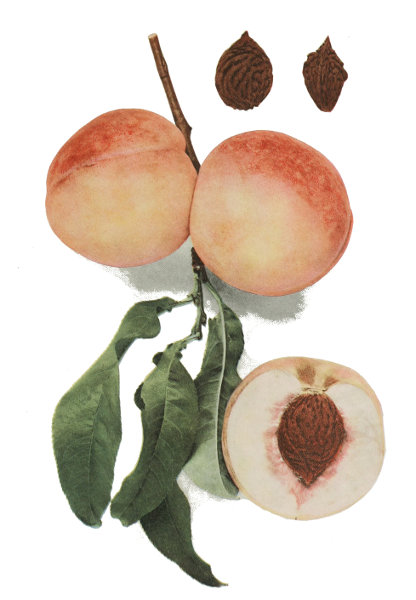
LATE RARERIPE
Tree often very large, vigorous, spreading, open-topped, of medium productiveness; trunk stocky, nearly smooth; branches thick, smooth, reddish-brown tinged with light ash-gray; branchlets long, with internodes of medium length, dark pinkish-red intermingled with dull green, glabrous, with numerous conspicuous, large lenticels raised at the base.
Leaves six and one-half inches long, one and one-half inches wide, folded upward and curled downward, oval to obovate-lanceolate, thick, leathery; upper surface smooth becoming rugose at the midrib; lower surface pale green; apex acuminate; margin finely and often doubly serrate, tipped with reddish-brown glands; petiole three-eighths inch long, glandless or with one to four small, globose, reddish-brown glands variable in position.
Flower-buds half-hardy, conical to pointed, plump, pubescent, free; blossoms appear in mid-season; flowers one and three-sixteenths inches across, white at the center of the petals changing to pink toward the margins, well distributed; pedicels short, glabrous, green; calyx-tube reddish-green at the base, greenish-yellow within, obconic, glabrous; calyx-lobes acute, glabrous within, pubescent without; petals oval, faintly notched near the base, tapering to narrow claws of medium length tinged with red at the base; filaments three-eighths inch long, equal to the petals in length; pistil pubescent near the base, usually as long as the stamens.
Fruit matures late; two and five-eighths inches long, two and eleven-sixteenths inches wide, roundish-cordate, with unequal surfaces; cavity variable in depth and width, abrupt or flaring, often with twig-mark across the cavity; suture variable in depth, extending beyond the tip; apex roundish, mamelon or mucronate, recurved; color greenish or creamy-white, sometimes with a lively red blush, mottled and splashed with darker and duller red; pubescence thick, coarse; skin tough, adherent to the pulp; flesh white, stained with red near the pit, juicy, stringy, tender, pleasantly flavored, sweet or somewhat sprightly; good to very good in quality; stone free or nearly so, one and one-half inches long, one and one-sixteenth inches wide, oval to ovate, plump, with deeply grooved surfaces; ventral suture deeply grooved along the edges, strongly furrowed; dorsal suture deeply grooved.
LEMON FREE
1. Wickson Cal. Fruits 313. 1889. 2. Am. Pom. Soc. Cat. 33. 1899. 3. Mich. Sta. Bul. 169:218. 1899. 4. Budd-Hansen Am. Hort. Man. 2:349. 1903. 5. Waugh Am. Peach Orch. 204. 1913.
Lemon. 6. Rural N. Y. 47:131. 1888. 7. Am. Pom. Soc. Cat. 32. 1889. 8. Ont. Fr. Exp. Sta. Rpt. 2:59. 1895.
Lemon Free is a yellow-fleshed, freestone, lemon-shaped, lemon-colored peach ripening in late mid-season. The fruit is not sufficiently attractive in appearance to sell well in the markets and, besides, is too thin-skinned to ship or keep well. The quality is very good, the flavor being sweet, rich and delicious, though possibly the flesh is a little too dry to permit the variety being ranked as "very good." It is an excellent peach for culinary purposes having the reputation of making a handsomer canned product than any other peach. Lemon Free is little grown in the eastern states but it is one of the leading sorts of its season in parts of California. The color-plate shows the shape very well but the color is not quite that of the real peach.
This variety seems to have originated in Ohio about 1885 but nothing is known of its parentage, originator or introducer. Wickson, in California Fruits, claims California as its birthplace but this, we think, is an error. In 1889 the American Pomological Society placed Lemon Free in its fruit-catalog as Lemon but in 1899 changed the name to Lemon Free.
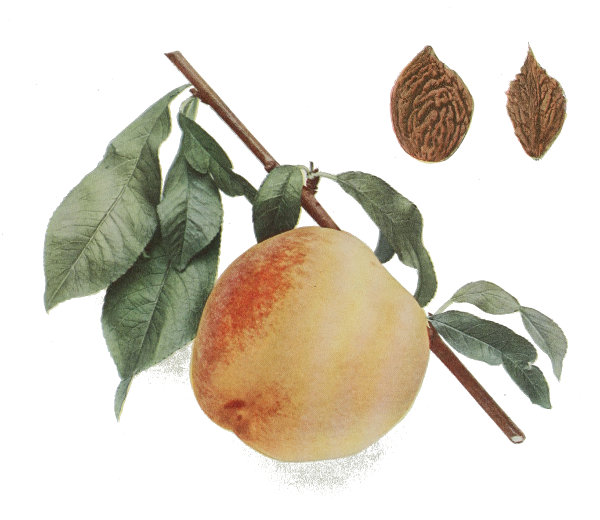
LEMON FREE
Tree very large, vigorous, upright-spreading, dense-topped, hardy, rather unproductive; trunk thick, smooth to medium; branches stocky, smooth, reddish-brown tinged with light ash-gray; branchlets often very long, with a tendency to rebranch, with medium to long internodes, pinkish-red with but a trace of green, glossy, smooth, glabrous, with large, raised, russetty lenticels medium in number.
Leaves seven inches long, one and three-fourths inches wide, folded upward and curled downward, oval to obovate-lanceolate, thick, leathery; upper surface dark olive-green, smooth becoming rugose along the midrib; lower surface grayish-green; margin finely serrate, tipped with reddish-brown glands; petiole three-eighths inch long, with two to six rather large, reniform, reddish-brown glands variable in position; flower-buds intermediate in size and length, conical to pointed, slightly pubescent, usually free; flowers appear in mid-season.
Fruit matures in late mid-season; two and one-half inches long, two and five-sixteenths inches wide, roundish-oval; cavity medium to deep, wide, flaring, often mottled with red; suture shallow, becoming deeper at the apex and extending beyond; apex mucronate to roundish-mamelon, recurved; color green or golden-yellow, with a faint blush and mottled with red; pubescence fine, long, thick; skin thin, tender, variable in adhesion to the pulp; flesh yellow, juicy, stringy, tender and melting, sweet to sprightly, pleasantly flavored; very good in quality; stone semi-free to free, one and one-fourth inches long, nearly one inch wide, oval, plump, flattened near the base, short-pointed, the surfaces usually grooved and with few pits; ventral suture winged, deeply marked along the edges, narrow; dorsal suture winged, grooved.
LEVY
1. Gard. Mon. 23:82. 1881. 2. Am. Pom. Soc. Cat. 37. 1909. 3. Waugh Am. Peach Orch. 204. 1913.
Henrietta. 4. U. S. Pat. Off. Rpt. 380. 1858. 5. Cult. & Count. Gent. 45:649. 1880. 6. Tex. Sta. Bul. 39:807. 1896. 7. Am. Pom. Soc. Cat. 33. 1899. 8. Waugh Am. Peach Orch. 203. 1913.
Levy Late. 9. Am. Pom. Soc. Rpt. 92, 93. 1881. 10. Downing Fr. Trees Am. 3rd App. 171. 1881. 11. Budd-Hansen Am. Hort. Man. 2:349. 1903.
This variety ripens quite too late for any but the most favorable peach-sections in New York. It is a round, yellow-fleshed clingstone of very good quality and might be planted in the parts of New York, where the season permits it to mature, for a very late culinary peach. It is one of the favorite peaches to close the season in Southern fruit-growing sections.
The history of Levy is badly confused. More than half a century ago a peach called Henrietta was cultivated. Where or when the variety originated no one can tell. In 1881, Downing mentioned a peach under the name Levy Late as being a new, late clingstone originating in the garden of W. W. Levy, Washington, District of Columbia. Downing gave Henrietta as a synonym of Levy Late, as have several pomologists since. From these facts, it seems safe to say that the variety is old, that it was first introduced as Henrietta and that the peach which Mr. Levy claimed to have originated was Henrietta. The American Pomological Society, in 1899, added this peach to its fruit-list as Henrietta but in 1909 changed the name to Levy, giving Henrietta as a synonym.
Tree large, vigorous, upright to quite spreading, hardy, productive; trunk thick, rough; branches stocky, smooth, reddish-brown intermingled with very light ash-gray; branchlets slender, with internodes dark red or purplish-red mingled with light green, smooth, glabrous, with small, numerous, conspicuous, raised lenticels.
Leaves six and one-half inches long, one and one-half inches wide, oval to obovate-lanceolate, of medium thickness, leathery; upper surface dark green, smooth becoming rugose along the midrib; lower surface grayish-green; apex acuminate; margin finely serrate, tipped with reddish-brown glands; petiole five-sixteenths inch long, with one to six small, globose, reddish-brown glands variable in position.
Flower-buds hardy, conical to pointed, plump, pubescent, free; blossoms appear in mid-season; flowers seven-eighths inch across, with varying shades of pink, sometimes in twos; pedicels short, medium to thick, glabrous, green; calyx-tube reddish-green at the base, orange-colored within, somewhat campanulate, glabrous; calyx-lobes short, medium to narrow, acute, glabrous within, pubescent without; petals oval, notched near the base, tapering to long, narrow claws often tinged with red at the base; filaments five-sixteenths inch long, equal to the petals in length; pistil pubescent near the base, as long as or longer than the stamens.
Fruit matures very late; about two and one-half inches in diameter, roundish-cordate, compressed, with very unequal halves; cavity medium to deep, wide, abrupt to slightly flaring, with tender skin and often twig-marked; suture deep, extending beyond the tip; apex mamelon, recurved, a few fruits with very large, mucronate tips; color greenish or golden-yellow, with splashes of dull red and a lively blush covering one cheek; pubescence short, thick, fine; skin thick, adherent to the pulp; flesh yellow, juicy, stringy, meaty, mild or somewhat astringent, pleasantly flavored; fair to good in quality; stone clinging, one and one-half inches long, one inch wide, bulged on one side, ovate to oval, plump, winged, with surfaces marked by short, red grooves; ventral suture deeply furrowed along the edges, wide; dorsal suture a deep groove.
LOLA
1. Del. Sta. Rpt. 13:104. 1901. 2. Am. Pom. Soc. Cat. 37. 1909.
Lolo. 3. Cornell Sta. Bul. 74:373. 1894. 4. Am. Pom. Soc. Cat. 33. 1899. 5. Budd-Hansen Am. Hort. Man. 2:349, 350. 1903.
Miss Lola. 6. U. S. D. A. Pom. Rpt. 43, Pl. IV. 1895. 7. Rural N. Y. 60:678. 1901. 8. N. Y. Sta. Bul. 364:184. 1913.
Miss Lolo. 9. Tex. Sta. Bul. 39:808. 1896.
Lola is a popular peach in parts of the South but is hardly known in New York. On the Station grounds it is the best of its season and one of the best of all white-fleshed peaches. Moreover, it fills a gap in the peach procession that ought to make it valuable in this State. It follows Mamie Ross and Greensboro, both of which it surpasses in appearance and quality. It precedes Champion and is even better than that handsome and delicious peach. Since it ripens with the well-known Carman, fruit-growers will want to know how it compares with that variety. It is hardier in bud than Carman, that sort not having a single fruit after the cold winter of 1911-12 while Lola bore a fair crop; the fruit is of better quality, larger, hardly as well colored and on the Station grounds the tree is more productive. Attention of New York peach-growers was called to Lola, in words almost identical with those here used, in Bulletin 364 from this Station, published in 1913, with the result that it is now being tried in several parts of the State and we shall soon know what its commercial value is this far north.
The parentage of Lola is unknown. The variety originated from seed planted in 1876 by J. W. Stubenrauch, Mexia, Texas, who named it Miss Lola in honor of his daughter. The American Pomological Society listed Lola in its catalog in 1899 as "Lolo." In 1909, however, the spelling was changed to Lola as it is correctly written.
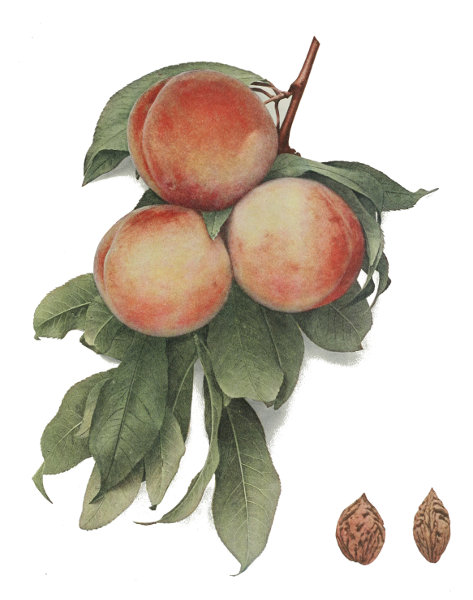
LOLA
Tree large, vigorous, upright-spreading, open-topped, hardy, productive; trunk thick, smooth; branches stocky, smooth, reddish-brown with a light tinge of ash-gray; branchlets very long, with internodes of medium length, dark pinkish-red intermingled with pale green, glossy, smooth, glabrous, with conspicuous, numerous, small, raised lenticels.
Leaves six inches long, one and one-half inches wide, variable in position, oval to obovate-lanceolate, thin; upper surface dull, dark green; lower surface silvery-green; apex acuminate; margin finely serrate to nearly crenate, glandular; petiole three-eighths inch long, with one to five reniform glands usually on the petiole.
Flower-buds hardy, obtuse, very plump, heavily pubescent, appressed or free; blossoms open early; flowers nearly two inches across, light to dark pink, usually in twos; pedicels short, slender, glabrous, green; calyx-tube reddish-green at the base, greenish-yellow within, somewhat campanulate, glabrous; calyx-lobes broad, obtuse, glabrous within, pubescent without; petals ovate, deeply indented near the base, faintly crenate, tapering to narrow claws; filaments one-half inch long, shorter than the petals; pistil, pubescent near the base, equal to the stamens in length.
Fruit matures in early mid-season; two and three-eighths inches long, two and one-half inches wide, round-oval, usually somewhat oblique, compressed, with nearly equal halves; cavity deep, wide, abrupt, with tender skin; suture shallow, deepening toward the tip; apex small, mucronate, roundish or somewhat depressed; color creamy-white blushed with carmine deepened by a few dark splashes; pubescence short, thin; skin thin, tough, separating from the pulp; flesh white, rayed with red near the pit, very juicy, tender and melting, sweet, with a pleasant sprightliness; good in quality; stone semi-free to free, one and three-eighths inches long, fifteen-sixteenths inch wide, obovate, plump, abruptly pointed, with corrugated and pitted surfaces; ventral suture wide, winged, deeply furrowed along the edges; dorsal suture a deep, narrow groove.
MAMIE ROSS
1. Can. Hort. 17:346. 1894. 2. Tex. Sta. Bul. 39:807, 808 fig. 8. 1896. 3. Ga. Sta. Bul. 42:238. 1898. 4. Am. Pom. Soc. Cat. 33. 1899. 5. Del. Sta. Rpt. 13:104, 105. 1901. 6. Budd-Hansen Am. Hort. Man. 2:351. 1903. 7. Waugh Am. Peach Orch. 205. 1913.
Mamie Ross seems to have a very good reputation as a table and market peach in Texas and other parts of the South but is hardly worth growing in New York. The fruit has two bad faults: The quality is not high—the flesh being coarse, juicy and insipid in flavor; and the peaches bruise with the least possible handling so that they cannot be shipped to advantage. On the Station grounds the pubescence, too, is so abundant as to be objectionable. Mamie Ross comes at a season when there are many other good mid-season, white-fleshed peaches and may, therefore, be thrown out of the list for this region. It is, as the color-plate shows, a very handsome peach.