DAVIES GILBERT, (continued 4)
Reading edition
The deanery of Exon was founded by William Briwere, Bishop of Exon 1225.[20]
TONKIN.
This parish of St. Breward is also called Simon Ward; and the popular legend has changed a pious and venerable bishop into one Simon Ward, a domestic brewer to King Arthur. I rather conjecture that on the division of parishes it was called Brewer from “bruiers,” which in the French tongue is “heath.”
THE EDITOR.
The principal villages in this parish are Lank Major, Lank Minor, without doubt Lank Vrauz, and Lank Vean; perhaps lank may be lan, varying with local pronunciation in the absence of all orthography, when the names will signify the great and small inclosure; also Swallock. Mr. Lysons states that the ancient manor of Hamethy, or Hametethy, is situated in this parish, five-sixths belonging to Mr. Mitchell of Hengar, in the adjacent parish of St. Tudy, and the other sixth to Mr. Kekewich.
But this parish is distinguished from all others in Cornwall by the locality of Roughtor and Brown Willy; these hills, pre-eminent from their elevation, and from the granite crags studded over the whole expanse of their surfaces, may be seen from an elevation crossed by the road near Ilfracombe in the north of Devon, and 132 from the high land in Zennor, about ten miles from the Land’s End.
This parish contains 8552 statute acres.
£. s. d.
Annual value of the Real Property as returned to Parliament in 1815 2561 0 0
Poor Rates in 1831 289 2 0
Population,—
in 1801, 513 in 1811, 506 in 1821, 554 in 1831, 627;
increase on a hundred in 30 years of 222⁄10 per cent.
Present Vicar, the Rev. T. J. Landon, presented in 1815 by the Dean and Chapter of Exeter.
GEOLOGY, BY DR. BOASE.
The greater part of this parish is situated on granite, including within its boundaries Roughtor and Brown Willy, the highest hills in Cornwall, the latter being 1368 feet above the level of the sea. The composition of this granite has been already noticed under the head of Advent: it affords few varieties, which may be owing to its offering few opportunities for examination.
The circumstance most attractive of attention is the great sterility of this extensive district; some few contracted spots are indeed brought into cultivation; some parts afford summer pasturage for cattle, and others turf for fuel; but by far the greater portion of the whole lies entirely unproductive. And this character belongs to the whole insulated patch of granite more than ten miles in diameter; and the church of St. Breward is the only one to be found on this extensive surface of perhaps from forty to fifty thousand acres; while nine churches are to be found on the granite district of the Land’s End, where this substratum, departing from its usual qualities, gives fertility to the soil.
The western extremity of this parish is fertile, resting on a peculiar kind of slate, which possesses geological interest. It may be seen at Combe, at Penrose, and at other places near the river Camel, and appears to be a 133 variety of mica slate, being composed of granular felspar, interlaminated with mica. It contains beds of dark purple felspar rock, very similar to that which abounds in the mining district in the western part of the county. This micaceous slate gradually passes into a thick lamellar rock, which extensively disintegrates and becomes argillaceous, exactly resembling the stone quarried for building at Bodmin.
BRIDGERULE.
HALS.
Bridgerule is situate in the hundred of Stratton, i. e. street or highway town. Now the part of the parish that is on the north side of the river Tamar, hath upon the north Launcells, west Marham Church, south Whitstone, east the Tamar river. The church stands on the Devonshire side, in the Halisworthy hundred, so that this rule or dominion of the Bridge extendeth itself into both counties, as to spirituals and temporals. In the Valor Beneficiarum, it is called Brige Rowell. Ecclesia de Bridge Rule, in Decanatu de Stratone, was taxed to the Pope’s annats, in 1294, at vl. iiis. 8d. Vicar ibidem nihil propter paupertatem. In Wolsey’s Inquisition it was taxed at 14l., and the parish was rated to the 4s. land-tax, in 1696, at 45l. 3s.
At the time of the Domesday Roll, 20 W. Conq. this district was taxed under the name of Tacabere, which place is now the dwelling place of Mr. Samuel Gilbert.
TONKIN.
Mr. Risdon, in his History of Devon, part ii. p. 298, gives the true etymology of this place, in those words, “Bridge Renold, of the vulgar Bridge Rule, anciently 134 Brige, by which name it is simply so called before the Norman Conqueror bestowed it upon Reginald[21] Adobed, and hence it took the adjunct of its owner.” The original of the primitive name is the bridge connecting the two parts across the Tamar.
The manor of Tackbere, in Domesday called Tacabere, was one of those which the Conqueror bestowed on his half-brother the Earl of Morton.
THE EDITOR.
This manor of Tacabre, or Takkebere, which appears to have been very extensive, is said by Mr. Lysons to have been bestowed by King Edward the Third on the Abbey of St. Mary of Graces, which appears in Tanner’s Notitia Monastica to have been founded by that king in the years 1349-50, in the new church-yard of the Holy Trinity, eastward of the Tower of London. The manor has since acquired the name of Merrifield, probably Maryfield, from the monastery. It was for many years the property of Gilberts, a branch from the Gilberts of Crompton Castle, near Torbay. The only daughter of the last Mr. Gilbert, of Tackbere, married Mr. Cotton Amy, of Botreaux Castle, who left two daughters; Anne, who survived her sister, but died unmarried after a long insanity; and Grace, married to Mr. Jonathan Phillipps, of Camelford, and of Newport, near Launceston, who was subsequently knighted in 1786, on the memorable occasion afforded by Margaret Nicholson. This lady had several children: two daughters were alive at the time of her decease in 1788, but they both died in twelve months after their mother, and Tackbere has ascended through the two female lines, and become vested in the right heirs-at-law of Mr. Samuel Gilbert, the father of Mrs. Amy.
The portion of this parish which is situated in Cornwall, 135 measures no more than 851 statute acres.
£. s. d.
Annual value of the Real Property, as returned to Parliament in 1815 719 0 0
Poor Rate in 1831 80 1 0
Population,—
in 1801, 191 in 1811, 176 in 1821, 238 in 1831, 250;
giving an increase of just 31 per cent. in 30 years.
Present Vicar, the Rev. Thos. Hockin Kingdon, B.D.
Doctor Boase has not noticed this small division of a parish. The geology will probably be stated with that of some parish adjoining.
BUDOCK.
HALS.
Budock is situate in the hundred of Kerrier, and hath upon the north Gluvias, east Falmouth, west Mawnan, south the British channel; and by the name of Bowidoc it was taxed in Domesday Roll, a corruption of Bud-oc, or Bud-ock, signifying a bay, cove, creek, haven, or inlet of waters, and oak; according to the ancient natural circumstances of the place.
In the inquisition of the Bishops of Lincoln and Winchester, 1294, into the value of benefices, in order to the Pope’s annats, ecclesia de Sancto Budoco, in decanatu de Kerrier, is rated at 6l. At that time, it seems, it was not consolidated into Gluvias; though afterwards, in Wolsey’s Inquisition, they were united, as will appear in that place. The patronage in the Bishop of Exeter, the incumbent Collyer; the rectory or sheaf in possession of Pendarves, and the parish rated to the 4s. per pound land-tax, 1696, 122l. 11s.
Against the south wall of this church stand some 136 funeral monuments, pertaining to the ancient and famous family of the Killigrews, particularly that of Sir John Killigrew, Knight, that married Wolverston, temp. Elizabeth, and some others. The barton of Arwinike, their chief seat in former ages, being within this parish, till Falmouth parish where it now stands was dismembered from it by Act of Parliament 1663, near which monument is a stone fastened to the wall of the said church, also containing the memorial of Sir Nicholas Parker, Knight, some time Governor of Pendennis Castle, who married the widow of Erisey, one of the coheirs of Militon of Pengerwick, and died 1608, who was succeeded in that dignity by Sir Nicholas Hals of Fentongollan, Knight.
The arms of Parker were, as I take it, Chequy, a fess.
Ros-meran in this parish, was of old the lands of Killigrew.
Trescobays, also Triscobays, Triscovays, in this parish, (synonymous words, signifying treble or threefold kisses,) was the dwelling of William Gross, gentleman, that married Erisey the widow of Charles Vyvyan, of Merthin, Esq. mother of Sir Richard Vyvyan, Baronet, who, upon some jealousy or discontent of his wife, drank a pint or quart of brandy, entered his chamber, took a pistol and charged it with a brace of bullets, and then forthwith shot himself dead, about the year 1693.
At Treon, Trone, (id est, Saxon, a tree,) for two or three descents, was the dwelling of the Thomases, transnominated to Carnsew, by living at Carnsew in Mabe; id est, the dry rock, where they married Tripcony, Seyntaubyn, and —— finally Thomas Carnsew, gentleman, attorney-at law, sold those land to Trewinard, and in testimony of the truth of the said transnomination, this family still give for their arms the same as Thomas, and not that of Carnsew; viz. in a field Argent, a chevron between three talbots Sable. Trewinard hath since sold it to Rundle.
137
TONKIN.
On the western side of this parish, behind Arwinnick, the seat of Sir Peter Killigrew, is a large pool, like a little harbour, between two hills, but that it hath a bar of sand and pebbles, which keepeth out the sea, like that of the Loe near Helston. It is commonly called the Swan Pool, for that Sir Peter Killigrew, to whom it belongs, kept abundance of swans here.
Trewoon, or Treoon, in this parish, the downy dwelling, or house —— in the downs, was the seat of the Carnsews, who had their name from their habitation at Carnsew in Mabe, where they formerly possessed a fine estate, which, being wasted by extravagant living, this barton was at first mortgaged, and a little after the late Revolution, sold by Mr. John Carnsew to Joseph Trewinnard, rector of Mawnan.
THE EDITOR.
The manor of Penwerris, become of great value by its proximity to Falmouth, is the property of Lord de Dunstanville, derived from his grandmother Mary Pendarves of Roscrow. The best part of Falmouth itself is now built on this property, and distinguished by the name of Green Bank.
Budock measures 3507 statute acres.
£. s. d.
The annual value of the Real Property, as returned to Parliament in 1815 8618 0 0
The Poor Rate in 1832 640 8 0
Population,—
in 1801, 779 in 1811, 1514 in 1821, 1634 in 1831, 1797;
being an increase on an hundred of 131 per cent.
The parish feast is celebrated on the Sunday before Advent.
GEOLOGY, BY DR. BOASE.
The extreme western part, adjoining Mabe, consists of granite of a very crystalline variety, and excellent for 138 building; it is exported in great quantities from Penryn. Nearly the whole western half of the parish is coarse; but the eastern part is well cultivated. The soil rests on a species of hornblend slate, which furnishes deep soil by its decomposition.
On the sea shore at Swanpool a most interesting phenomenon occurs in a bed of felspar porphyry, (elvan course,) which runs north-east and south-west for several hundred feet: near low water it exhibits that appearance called by the miners a heave. The course terminates abruptly, and begins again about twenty feet further to the south, from whence it goes on as before the heave.
This porphyry is decomposed at the surface and to some depth, into a fine white clay, from which bricks of a good quality are made on the spot.
BURIAN.
HALS.
Burian is situated at the western extremity of the county, having two adjoining parishes, Senner and St. Levan annexed; the former of which includes the Lands’ End. In Domesday tax this district was rated by the name of Beriand, for Berian or Bury-an; synonymous words, signifying a cemetery or burying place for human creatures; that is to say, that place which is now called the churchyard, which was an inclosure, as in most other places, converted to that use before and since the church was erected therein. This instance of a Domesday Roll, wherein this district is named Beri-an, overthrows the story of Camden’s conjecture, that the name thereof was derived from one St. Buryana, an 139 Irishwoman that was the tutelar guardian of this church, whereas the appellation of Saint, as I have elsewhere observed, at that time was not given to but one church in Cornwall. Besides, this Irish saint is not to be found in the Roman legend, or calendar, nor in Capgrave’s catalogue of English and Irish Saints.
This church was founded and endowed by King Athelstan, about the year 930, after such time as he had conquered the Scilly Islands, as also the county of Devon; and made Cornwall tributary to his sceptre. To which church he gave lands and tithes of a considerable value for ever, himself becoming the first patron thereof, as his successors the Kings of England have been ever since: for which reason it is still called the royal rectory, or regal rectory, and the royal or regal peculiar. Signifying thereby that this is the church or chapel pertaining to the king, or immediately under the jurisdiction of him as the supreme ordinary, from when there is no appeal; whereas other peculiars, though exempt from the visitation or jurisdiction of the diocesan bishop within whose see they stand, yet are always subject to the provincial archbishops of Canterbury and York, or other persons.
This church or college consisted of canons augustines, or regular priests, and three prebendaries, who enjoyed the revenues thereof in common, but might not marry; and the lord chancellors of England of old visited this peculiar, which extended only over the parishes of Burian, Sennen, and St. Levan, for the king.
One of the Popes of Rome, about the time of Edward III. obtruded upon this church, the canons and prebends thereof, a dean to be an inspector and overseer over them: whom he nominated to be the bishop of Exon for the time being, who for some time visited this church as its governor, as the lord chancellor did before; which encroachment of the Pope being observed by Edward III., as appears from the register of the writs, 140 folio 40 and 41; 8 Edward III. rot. 97. This usurpation of the Pope was taken away.
[Mr. Hals here enters into long dissertations respecting secular canons, regular canons, the state generally of the church and of the clergy, benefices held in commendam, &c. which, not having any particular relation to the parochial history of Cornwall, are omitted.]
Boscawen-ros in this parish, compounded of Boscawen-ros, is a name given and taken from the natural circumstances of the place, and signifies in Cornish-British “a valley, notable for skeawe or scawen” trees. And indeed this place, being naked and exposed to the sea on the cliffs of the British Channel, anciently, as it seems, produced no other trees than scawen, (i. e. elder,) proper to that part of the country; neither, I think, is there any other trees at present that grow there. From this place was transnominated an Irish gentleman that settled here either by marriage or purchase, in the latter end of the reign of Edward IV., who discontinued his paternal name, and styled himself John de Boscawen, which latter name hath been the hereditary name of his posterity ever since; who from hence transplanted their dwellings to Tregameer in St. Colomb Major; and Trevallock in Creed or St. Stephen’s; and from thence, by marriage with the daughter and heir of Tregothnan by Lawrence Boscawen, gentleman, attorney-at-law, temp. Henry VII., who died 1567, and lieth buried in the north aile of St. Michael Penkivell Church, as is testified by a brass inscription on his gravestone, there lately extant, upon which, on a lead escutcheon, was engraved his paternal coat armour, viz. in a field Vert, a bull passant Argent, armed Or; on a chief Ermine, a rose Gules; crest a boar Argent:—out of a supposed allusion to their present name, as if it had signified a white bull and a rose. In the reign of James I. his posterity discontinued this bearing, and gave only for their arms, Ermine, a rose; which, I take it, also is the hereditary 141 coat armour of Beverley. See St. Michael Penkivell. Since the writing hereof this place is become the hereditary honorary title of Hugh Lord Boscawen, Baron of Boscawen-rose, and Viscount of Falmouth.
Upon Boscawen downs, some of which was lately the lands of Mr. Christopher Davis, stands a monument called Dance Meyns, that is to say the dance stones; which are nineteen pyramidal stones, about six foot high above ground, set in a round circle, distant from each other about twelve feet, having in the centre one pitched far bigger than the rest; a little to the north of those are two admirable great stones in perpendicular manner, much bigger than the rest, those are vulgarly called the Pipers. But since it is not probable that those stones were either dancers or pipers, I take the common appellation dance meyns, only by the dialect to be a corruption of dans meyns, id est, men’s stones; that is to say stones set up in memory of once so many famous men that lived in those parts, or lie interred there, before the sixth century.[22] Mr. Davis aforesaid informed me, that, contiguous with those dans meynes, he caused not long since divers barrows of earth to be carried abroad in order to manure his lands, in several of which burrows he found two or three urns or earthern pots, sound and firm, having in them pieces of bones, and ashes.
142 About twenty years past, the sexton of this parish sinking a grave four feet deep in the ground, he met with a large flat marble or other stone, which he lifted up out of the earth, on which was cut or engraved a long plain cross, surmounted on four grieces or steps; on the border of this stone, round the said cross, was an inscription in Norman French, which soundeth thus in English:—“Clarice, the wife of Geffery de Bolleit, lies here; whosoever shall pray for her soul shall have ten days’ pardon. Amen.”[23] There is a place still extant in this parish called Bolait, or Bolaith, i. e. a place of slaying or killing cows, kine, or cattle; otherwise it may be interpreted cow’s milk, or a place notable for the same.
Trove, in this parish, is, in Cornish and Armorick, a dent, pit, a cavern, or valley: a name doubtless taken from the natural and artificial circumstances of the place, situate between two hills, on a cavern; also Trewoofe, that is to say the town or dwelling of ob-yarn, such as the sail-spinsters make, in order to be woof, or woven cross the warp in pieces of cloth, stuff, or serges, from whence was denominated a family of gentlemen named Trewoofe; who, out of a mistaken etymology of their name, (as many others in Cornwall,) gave for their arms, in a field —— three wolves’ heads; whereas, try-bleith, try-bleit, is three wolves in Cornish; the heiress of which family was married to Leveale, temp. Henry VIII. of the old Norman race, whose posterity flourished here in good fame for several descents, till, for want of issue male, Lewis Leveale’s daughter and heir, by Cooke of Tregussa, carried this place, together with herself in marriage, to Mr. Uspar or Vospar, temp. Charles I. who had issue Arthur Vosper, his son and heir, who married Eyans, of Eyanston in Oxfordshire, who had issue by her two daughters, married to Mr. 143 Marke of Woodhill and Mr. Dennis of Leskeard. This last gentleman, Mr. Vospur, bathing himself in the river Isis in Oxfordshire, with other young men, was there unfortunately drowned, about the year 1679. The name Vosper or Vospur, in British-Cornish, signifies a pure or immaculate maid or virgin. The arms of Leveale were three calves or veals.
In the middle of this barton of Trove, on the top of a hill, is still extant the downfalls of a castle or treble intrenchment called ——, in the midst of which is a hole leading to a vault under ground. How far it extends no man now living can tell, by reason of the damps or thick vapours that are in it; for as soon as you go an arrow flight in it or less, your candles will go out, or extinguish of themselves, for want of air. For what end or use this vault was made is uncertain, though it is probable it was an arsenal or store-house for laying up arms, ammunition, corn, and provision, for the soldiers of the castle wherein it stands, in the wars between Charles I. and his Parliament. Divers of the royal party, pursued in the West by the Parliament troops under Sir Thomas Fairfax, were privately conveyed into this vault as far as they could proceed with safety, where Mr. Leveale fed and secured them till they found opportunity to make their escapes to the king’s friends and party. See St. Evall.
Pentre, otherwise Pendrea, in this parish, id est, the head town, or town at the head of some other, denominated a family of gentlemen from thence called Pendre, who gave for their arms, Argent, on a bend Gules and Sable, three fleurs de lis of the Field. John Pendre, the last of this tribe, temp. Henry VI. leaving only two daughters that became his heirs, who were married to Bonython of Carclew, and Noy. To Noy’s share fell this tenement of Pendrea, which was the dwelling of him and his posterity for several descents; and here was 144 born, as I was informed, William Noy, the Attorney-general to Charles I., who designed to have built a notable house here but was prevented by death, having before brought great quantities of materials to this place in order thereto; his grandson, William Noy, Esq. sold this place and several others to my very kind friend Christopher Davis, Gent. now in possession thereof.
Burnewall, in this parish, id est, the walled well or well-pit of waters, so called from some such place on the lands thereof, was also formerly the lands of the said William Noy, who sold it to the said Mr. Davis, who conveyed it to his nephew Henry Davis on his marriage with Hester, daughter of Humphrey Noy, Gent. younger brother of the said William Noy, now in possession thereof, and hath issue. The arms of Davis are, Argent, a chevron Sable between three mullets Gules, which also is the coat armour of Davey of Creedy in Devon.
Leah, also Lahe, id est, lawe, or leh, a place or dwelling, is the seat of Oliver Ustick, or Usteck, Gent. (id est, Nightingale; otherwise, Eus-teck is fair nightingale,) that married Roscrow of Penryn.
From Als, now Alse, and Alsce, viz. lands towards or upon the sea-coast, as this whole parish and its members are situate, was denominated John de Als, or from Bar-Als-ton in Devon; temp. Henry I. and King Stephen, ancestor of the De Alses, formerly of Lelant, now Halses, see Lelant; which place was heretofore the voke lands of a considerable manor, now dismembered and in the possession of Trevanion and others. This family, in Edward III.’s days, wrote their surname De Als, now Halse. See Prince’s Worthies of Devon, upon Hals.
TONKIN.
This parish is of large extent, and the land generally good, and lying very warm on the South Sea, which, 145 with the desire of living quiet, has induced several gentlemen to settle themselves in this remote corner of the kingdom, where they may liberally entertain all such as out of curiosity come to visit the Land’s End.
Mr. Francis Paynter was brother to Doctor William Paynter, Rector of Exeter College, Oxford, (elected in 1690, died Feb. 19, 1715, aged eighty, was rector of Wootton in Northamptonshire, where he is buried,—Editor;) both younger brothers to Mr. Paynter of Trelisick’s father, who by his skill in husbandry, in which he has scarce his fellow, not his superior in the county, and some helps of the law, has purchased to himself a very fair younger brother’s inheritance. Though this place lies near the sea, and very much exposed, yet has this gentleman, by the means of furze ricks and other ingenious contrivances, raised several fair walks of trees about it, and made it a pleasant and profitable seat, which I mention here, that those who live under the same inconveniences may imitate his industry. At Leigha liveth Mr. Oliver Ustick, married to Julia the eldest of two daughters of —— Roscrow of Penryn, of the family of Roscrows of Roscrow. Leigha is part of the manor of Rosemadans, now the property of Mr. Grosse.
Boscawanrose, in this parish, gave name and habitation to the famous and honourable family of Boscawan, who, led away, as many other Cornish gentlemen have been, by the similarity of sound between words in the Kernawish tongue and others in French or in Latin, have mistaken rose a valley, for the flower a rose; and more anciently they are said to have borne in their arms, besides a rose, an ox, having mistaken the word bos, which signifies a house or dwelling, for the name of that animal.
THE EDITOR.
It seems very improbable that King Athelstan, after founding and splendidly endowing a church to commemorate 146 or to sanctify his conquest of Cornwall, should bestow on it a name so very indiscriminate as The burial-ground; more especially at a time when missionaries from Ireland had recently converted the inhabitants to Christianity, and had left to posterity a reputation for piety so elevated as to invest them at once with the appellation of saints, and to procure for them, in after times, the dedication of almost all the churches throughout the County.
St. Burian is mentioned by Leland, Camden, Tanner, and various other antiquaries, as a holy woman from Ireland, to whom King Athelstan dedicated this church, and in Doctor Alban Butler’s Lives of the Saints, &c. her festival is given on the 4th of June.
The establishment consisted of a dean and three prebendaries, who are said by Mr. Lysons to have held from the King by the service of saying a hundred masses and a hundred psalters for the souls of the King and of his ancestors. It is not stated how frequently those recitations were to take place.
Bishop Tanner, in the Notitia Monastica, states that this deanery was seised into the king’s hands in the time of Edward III. under the pretence that John de Mount, the third dean, was a Frenchman. In 18 Henry VI. this deanery was given to his college (King’s) in Cambridge; and afterwards, by Edward IV. probably in the true spirit of party, to the collegiate church of Windsor. It was, however, soon separated from Windsor, and continues, according to the foundation of Athelstan, exempt from all inferior jurisdiction, and consequently since Henry VIII.’s assumption of all temporal power exercised by the Pope, there is not any appeal from the local authorities but to the king himself; a constitution most inexpedient, and likely to produce the most serious inconvenience, if matters of much importance ever came for investigation and decision before a court wholly unfitted, from its very nature, from entertaining 147 them; and yet empowered to declare a judgment final to all intents and purposes, unless it is immediately revised by the highest and most expensive ecclesiastical tribunal.
This exemption from all episcopal authority has, in times not very remote, admitted of such abuses in the administration of divine service, and of the spiritual care of the three parishes, as would not otherwise have been endured. It would be worse, however, than useless to expatiate on a system which is fortunately passed by.
I believe that no dean has resided since the final dissolution of the college; the Royner’s hand having been there so forcibly applied as to wrest off the whole glebe, not leaving even an habitation, nor the smallest portion of land on which a house could be built. The nominal deanery of St. Burian, like that of Battle and two or three more, is not esteemed a dignity in the church: yet with cure of souls, and for no better reason than its not being mentioned eo nomine in the canons and acts of Parliament, this living is allowed to be tenable with all other preferments, and at all distances.
Pendrea, the birth place and property of Mr. William Noye the attorney-general, was sold by his eldest son, Edward Noye, to Mr. Davies of Burnuhall, and by his grandson to Mr. Tonkin, whose great grandson, the Rev. Uriah Tonkin, possesses it at this time. At Burnuhall there still remains a curious performance of shell-work, said to have been made by Mr. Davies’ daughters, strongly expressive of the political feelings then almost universal throughout Cornwall. King Charles II. is represented flying from his enemies, and one of them, in full pursuit, has a legend, “This is the heir! come, let us kill him, that the inheritance may be our own!” whilst an angel exclaims in the same manner from a cloud “Is it not written, Thou shalt 148 do no murder?” The material of this work is found in great variety and beauty round the coast, and particularly at Porth Kernow, near the Logging Rock.
The last Mr. Davies of Burnuhall married —— Kegwin of Newlyn; he wasted the remains of a property which had been gradually diminishing in the hands of his father and of his grandfather; so that about the year 1750, Burnuhall and some other farms were sold to Admiral Boscawen.
Boskenna is the property and residence of Mr. Francis Paynter, a very respectable gentleman and magistrate, the great-grandson, I believe, of the individual distinguished by Mr. Hals for his skill in husbandry. There is a tradition of his having purchased the place of one whose family had long possessed it, but who had ultimately become the huntsman of a pack of hounds kept originally as his own.
Mr. Francis Paynter, uncle of the gentleman now possessed of Boskenna, was greatly distinguished for his wit and humour. He was either the sole or joint author of a poem made in imitation of Prior’s Alma, and in ridicule of the then dean of Burian, called “The Consultation.” Mr. Paynter practised his profession of the law near St. Columb. He married Miss Pender of Penzance, and left several sons. The exercise of wit is not always, perhaps not frequently, associated with pecuniary gain. The Editor has heard Mr. Paynter declare that “The Consultation” prevented his obtaining a valuable stewardship from the family of which the dean was a member.
The Vyvyans of Trelovornow are said to have originated from Treviddror in this parish. And Lord Chief Justice Tresilian was from Burian, in whose descendants Pendor and Ristchurch, after the lapse of nearly five centuries, some of his property still remains.
From about fifty to seventy years ago Boskenna attracted much attention, and gave occasion to various 149 conjectures over the whole neighbourhood, in consequence of a gentleman and lady residing there under the assumed name of Browne, and withdrawing themselves entirely from public observation. They were conjectured to be members of some distinguished family on the continent implicated in political disputes; or at the least, some very eminent persons of our own country, till at last the mystery was explained by a disclosure of their real name and condition.
Mr. Berty Birge, having been involved in the pecuniary affairs of an individual who subsequently became insane, found himself obliged to retire, although it is understood that nothing discreditable to his character occurred in the transactions. On that individual’s decease Mr. Birge resumed his real name, and removed to Penzance, where he passed the remainder of his life.
The church of St. Burian is among those most distinguished for size and beauty in the west of Cornwall. It is situated on high ground, with a lofty tower, conspicuous therefore from a very great distance. It possessed, till within these few years, a curious rood-loft.
A station of the great trigonometrical survey was placed in 1796 very near Burian church, and in the Philosophical Transactions for 1800, the latitude of the tower is stated to be 50° 4′ 32.8″, and the longitude is 5° 36′ 10.5″, or in time 22′ 24.7″ west of Greenwich.
Burian measures 6274 statute acres.
£. s. d.
The annual value of Real Property, as returned to Parliament in 1815 7288 0 0
Poor Rate in 1831 350 0 0
The parish feast is kept on the nearest Sunday to old May day.
Population,—
in 1801, 1161 in 1811, 1188 in 1821, 1495 in 1831, 1707;
being an increase of 47 in a hundred in 30 years.
Present Rector, the Hon. F. Stanhope.
GEOLOGY, BY DR. BOASE.150
The whole of this parish, with the exception of a small patch of slate at Rosemodris, rests on granite. Judging from what occurs in the eastern part of Cornwall, one might be led to expect that the land of St. Burian must be sterile. In some elevated spots it undoubtedly is so, but in general the parish is well cultivated and highly productive.
This difference in the granitic soils of east and of west Cornwall, may be, in part, explained by the gradual diminution of height towards the west, accompanied by a corresponding improvement of the climate; but in this part of the county more of the debris, especially of diluvial clay, is retained on the surface, that of the more elevated eastern ridges having been in great measure swept away.
This circumstance must not, however, be omitted. The granite of Burian exhibits more varieties than have been yet found in the eastern district. The slate in the cliffs at Rosemodris is a felspar rock, and its contact with the granite is distinctly seen; where it may be observed at the eastern extremity traversed by numerous granite veins; and the granite near this junction abounds in shorl.
NOTE BY THE EDITOR.
Doctor Paris has remarked on the granite of this district, that it contains full twenty-five per cent. of felspar, which he says at once explains the rapidity of this stone’s decomposition, and the fertility which is so very unusual in granitic countries; and that this granite in a state of decomposition, when it is provincially called growan, has actually been applied to some lands as a manure, and with the best effect.
I had the pleasure of attending Doctor Withering (author of the Arrangement of British Plants, &c.) to 151 the Land’s End in 1793, when he expressed much surprise at the fertility of a granitic soil, and explained it as Doctor Paris has since done, by observing that in all the granite he had previously seen siliceous matter abounded, and that the very word was synonymous with sterile, but that here felspar and fertility appeared together.
Felspar is said to contain nearly a third part of its weight of alumine, about an eighth part of lime, and a twentieth of soda.
CALLINGTON.
THE EDITOR.
Neither Mr. Hals nor Mr. Tonkin notice this parish. It is appended to the parish of Southill. The name is pronounced Kelliton in the immediate neighbourhood.
Callington is situated in the hundred of East, having Southill and Stoke Climsland on the north; Calstock on the east; St. Mellior and St. Dominick to south; and St. Ive to the West.
The town is said to have sent members to Parliament so early as the reign of Henry III., when the privileges of markets and fairs were granted; but the first authentic return was in the reign of Queen Elizabeth.
In the time of Henry III. the manor and lordship of Callington were vested in the family of Ferrers, by a grant from the earls of Cornwall; the possession has passed by heiresses to several families; and finally, through Dennis, Rolle and Walpole, to Mr. George William Trefusis of Trefusis, in Milor; together with the barony in fee of Clinton, created by a writ directed John de Clinton, 17 Edward I. A.D. 1299. His grandson sold the property to Mr. Alexander Baring, at a period when some adventitious circumstances, no longer 152 in existence, added materially to its value. The church and town are handsome specimens of the gothic architecture which distinguishes the west of England; and there exist several ancient monuments of individuals formerly lords of the manor.
This parish contains 2387 statute acres.
£. s. d.
Annual value of the Real Property, as returned to Parliament in 1815 4142 0 0
The Poor Rate in 1831 950 17 0
Population,—
in 1801, 819 in 1811, 938 in 1821, 1321 in 1831, 1388;
giving an increase of 70 per cent. in 30 years.
GEOLOGY, BY DR. BOASE.
The north-eastern part of this parish extends to the east of Kitt Hill, the most elevated point of Hingston Downs, which is composed of granite. The slate adjoining thereto resembles that which occurs in similar situations in the parishes of St. Austell and St. Blazey; and this district has been the scene of considerable mining speculations. In former ages it abounded in stream tin to such an amount that the Cornishmen of those days expressed their opinion of its value by the distich
Hengsten Down, well yrought Is worth London town, dear ybought. Carew, Lord Dunstanville’s Edition, p. 272.
As the town of Callington is approached, the slate becomes of a darker blue, and passes into hornblend rock, which prevails in the other parts of the parish, and in several places so much abounds in quartz as to form barren downs. This rock, however, has not any marked character, and it is not often exposed to view; near St. Ive it appears to graduate into the calcareous series.
153
CALSTOCK.
HALS.
Calstock is situate in the hundred of East, and hath upon the north Stoke Clemsland, west Kellaton, south St. Dominick, east the Tamar river.
The rectory of Calstock church seems to be extant before Domesday Tax, since it passed then by that name, and hath never admitted of any change of name or alteration since, and was undoubtedly founded and endowed by the Earls of Cornwall, out of their manor of Calstock, wherein it is situate; and the Duke of Cornwall, or the King, in that right, are still patrons thereof. Ecclesia de Calstock, in Decanatu de Estwellshire, was valued to the Pope’s annats, 1294, cs.; in Wolsey’s Inquisition and Valor Beneficionum, 26l. 4s. 4d. The patronage as aforesaid, the Incumbent Blackburn, and the parish rated to the 4s. per pound Land Tax, 1696, temp. William III. 302l. 0s. 2d.
It appears from the ancient survey of the Duchy of Cornwall in the Exchequer, and Blount’s Tenures from thence, p. 122, that the tenants of this manor had granted them, by the Earls or Dukes thereof, its lords, the liberty of free fishing on the Tamar river, in his verbis: “Nativi tenentes de Calstock, in comitatu Cornubiæ, reddunt per annum de certo redditu, vocato Berbiagium, sine barbague, ad le Hoke-day, 19s. 6d.” Now barbague, barbagyu, is, in Cornish, a bearded or barbed spear, such as is commonly used for killing salmons in the Tamar and other rivers. [See Stoke-Clemsland.] The salmon wear, here built over the Tamar, is, by lease from the Duke of Cornwall, in possession of Sir John Carew, baronet, and hath formerly been set for 120l. per annum. [See Helston in Trigg for Barbiague. Tenants on the Alan river there.]
154 Cuthill, in this place, I take it was the most ancient seat of the knightly family of Edgecombes in Cornwall, and is still in their possession; and here lived Sir Richard Edgecombe, knight, that assisted Henry the Seventh against Richard the Third, who was bountifully rewarded for his services by that prince.
TONKIN
has merely transcribed from Hals.
THE EDITOR.
Calstock, or Calstoke, has of late become a mining parish on an extensive scale. The manor having been sold by the Duchy for the redemption of Land Tax, has ultimately become the property of Mr. John Williams, one of the most skilful and successful miners in Cornwall.
Cotehele is preserved by Lord Mount Edgecombe as a faithful representative of what were the residences of country gentlemen or barons in the ancient acceptation of that word.
“It came,” says Lysons, “into the possession of the Edgecombe family, by the marriage of Hilaria, daughter and heir of William de Cotehele, with William de Edgecombe, in the reign of Edward III. After this marriage, Cotehele became for a while the chief residence of the Edgecombe family.” Carew, speaking of this place, says, “the buildings are ancient, large, strong, and fayre, and appurtenanced with the necessaries of wood, water, fishing, park, and mills, with the devotion of (in times past) a rich-furnished chapel, and with the charity of almshouses, for certain poor people, whom the owners used to relieve.”
The beauty of its situation, the river and ancient ponds, united with the antiquities of the place, render Cotehele one of the most curious and worthy of attention in the West of England; and the following description, 155 taken in 1830 by an architectural correspondent of the Gentleman’s Magazine, is therefore extracted from that miscellany for 1833.
“There is a singularity about this Mansion, which requires to be accounted for. It cannot claim an origin in very remote antiquity, the earliest parts being not older than the reign of Henry the Seventh; yet the narrowness of the windows and other openings, and the tower above the gateway, would lead to the idea that it was built in an early insecure period. This, I think, may be accounted for from the fact that the builder, Sir Richard Edgecombe, had encountered personal danger in the wars of the Roses, and probably erected his mansion in the early part of the reign of Henry the Seventh, so soon after the conclusion of the conflict, that he might be impressed with the fear that the reign of the newly enthroned monarch might not be more peaceable than that of his predecessors, and he adopted under these impressions the style which the mansion now displays.
“The house is quadrangular, with a court-yard in the centre; and, like the generality of the mansions of antiquity, has the appendage of a hall and chapel. It is built of moor-stone in irregular courses, though some of the blocks are exceedingly large. The west front is not imposing, from the want of height, which detracts from its general appearance. The entrance is not in the centre, and is only wide enough for foot passengers; it consists of an obtuse pointed arch, slightly moulded with foliage on the spandrils, which is inclosed within another of larger dimensions with a weather cornice, and on the space between the two is a blank shield accompanied by two bold leaves. The windows are situated high in the wall; they are of small dimensions, being in fact little more than enlarged loopholes. The chimneys are square, having caps formed with coping stones. Above the entrance is a tower of a cubical form, with an embattled parapet. On entering the court through 156 the gateway, the Hall is seen in the front, and near it, on the west side of the quadrangle, the lantern window of the Chapel.
“The interior of the Hall is very interesting. The roof is timber, and arched; and on the walls hang various pieces of armour and weapons of considerable antiquity, with a complete suit of armour, which is probably not older than the Civil wars. In the end walls are apertures in the shape of a quatrefoil, which admit a view of the hall from adjacent apartments, and would allow the motions of persons assembled in it to be watched. There are some specimens of ancient furniture in the hall; in particular a chair having the date 1627. In the windows are several armorial shields in stained glass.
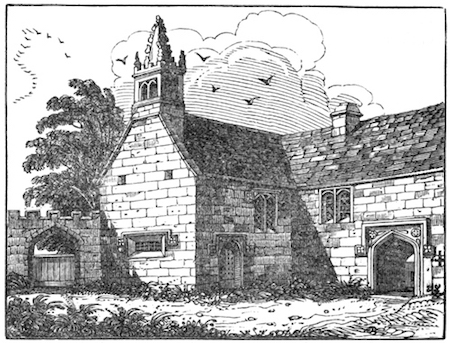
CHAPEL AT COTEHELE.
“The Chapel projects from the western side of the mansion. It is small and neat, and has a small bell-tower. The square window in the west end is unglazed; the aperture being secured by wide bars; but allowing 157 any person standing on the outside to see the altar. At the distance of a few feet from the door lies an ancient font, 19 inches square by 14 inches deep; it is formed of a block of moorstone, and panelled at the sides. The interior of this chapel is approached from the mansion by the hall, to which it communicates through a small room. The roof is timber, ribbed and panelled; and coved in the form of an obtuse arch. In the south window St. Anne and St. Katherine are represented in painted glass. The altar is oak, with upright panels, having quatrefoil heads. An ancient altar cloth is preserved in the house; it is formed of red velvet powdered with fleur-de-lis, and the part which was shown when it was laid on the altar, had a crucifix in the centre, accompanied by the twelve apostles in rich embroidery, and the arms of Edgecombe.
“The limit of a single visit would not allow me to particularize the various articles of furniture contained in the mansion. In the drawing-room the screen to the doorway appears to be of the date of the building; on the door itself are roses in lozenges. The bedroom, called King Charles’s, has a fine ancient state bed, with a profusion of carved work about it; and a steel mirror. The dog-inns, some of which are probably as old as the mansion, remain in the fire-places. Two chairs commemorate a visit from King George the Third and Queen Charlotte in 1789.
“In the grounds is another chapel, which derives its interest from the circumstance of its having been erected by Sir Richard Edgecombe in commemoration of his escape from his pursuers by concealment near the spot. It is much injured by modern alterations made in 1769, and externally retains little of its original features. In the interior are several ancient paintings, which probably formed the decorations of an ancient altar-piece; when entire, it represented the Annunciation. In the east window are St. George, and a female saint with a 158 sword, in painted glass, and several coats of arms. There is also an ancient painting of the monument of the founder of the chapel, who was buried in the conventual church of Morlaix in Bretagne, in September 1489; and a carving in wood of St. Thomas a Becket.”
It is a curious circumstance in the history of Cornwall, that several of the principal gentlemen from this remote county, took active parts on either side between King Richard the Third and his antagonist Henry the Seventh: many were present at the battle of Bosworth. Mr. Carew relates (p. 269, Lord Dunstanville’s edition) the almost miraculous escape of Sir Richard Edgecombe of Cotehele, when he was pursued (as I apprehend) by Bodrigar, who, in his turn, found himself obliged to fly after the defeat of King Richard; and his property was divided between Edgecumbe and Trevanion, with whom a large part of it still remains.
The river from Cotehele to New Bridge exhibits a magnificence of scenery very rarely to be found: the cliffs on the east and north-eastern bank affording here the steep and bold scarpment, as in all other similar situations throughout the country.
Harewood, in this parish, although in the different style of a modern seat, almost rivals Cotehele: this spacious and elegant house was built almost forty years ago by Mr. Foot; but the place was sold after his decease, and it is now the property and residence of Mr. William Salusbury Trelawney, heir of that ancient and distinguished family. Mr. Trelawney married Miss Carpenter, of Mount Toby, near Tavistock, and now (1833) represents the eastern division of Cornwall in Parliament.
Sandhill is another handsome seat in this parish, occupied by Mr. Williams, who, since his purchase of the manor, has improved the waste lands, planted such elevated or steep portions as were unfit for agriculture, and in every way contributed to the prosperity of the place and of its inhabitants.
This parish contains 5035 statute acres.159
£. s. d.
Annual value of the Real Property, as returned £. to Parliament in 1815 5801 0 0
Poor Rate in 1831 1426 0 0
Population,—
in 1801, 1105 in 1811, 2064 in 1821, 2388 in 1831, 2328;
being an increase of about 111 per cent. in 30 years.
Present Rector, the Rev. Edward Morshead, presented by the King in 1796.
GEOLOGY, BY DR. BOASE.
The Geological structure of this parish is precisely similar to that of Callington; but, as it is better developed, it will admit of a little more detail.
The northern part consists of the granite of Hingston Down, which is crystalline, and it is extensively quarried for economical purposes. The quarries near the summit of Kitt Hill afford excellent illustrations of the internal structure of the granitic mass. On this Down, beds of fine-grained granite project here and there above the surface, resembling that which occurs as Elvan courses in the adjacent slate. The latter rock consists of a basis of granular felspar, spotted and spangled with a shining mineral like mica. This slate, as well as the granite, have been long explored for tin and copper. Shorl and mica generally abound in the lodes; and the former mineral is often so intimately combined with the quartz, as to form a dark-coloured compact shorl rock. Southward the slate becomes more blue, and is fissile into extended slabs. Near the village of Calstock it is soft and lamellar, having evidently graduated into the calcareous series. At Cotehele, near the landing place, a beautiful oved-coloured calcareous schist is quarried, which is said to prove a good material for lining kilns and ovens: it has a shining talcose appearance, resembling that of Trenalt, near Pallephant, in Alternon.
160 Nearly opposite to the Rectory, built by Bishop Blackbourn, and pleasantly situated on the river, may be seen the debouch of a canal from Tavistock, with an inclined plane, descending into the Tamar. This canal, in one part of its line, passes through a hill at the depth of seventy fathoms.
CAMBORNE.
HALS.
Camborne is situate in the hundred of Penwith, and hath upon the east Redruth, north Illugan, west Gwynier, south Crowan. For its modern name, Camborne, which was not extant at the time of the Norman Conquest, signifies a crooked or arched burne, or well.
This parish is said to derive its name from a holy well situated within it, to which great numbers of persons resorte from a high opinion of its great medical virtues, in addition to its sanctity.
Ecclesia de Camborne, in Decanatu de Penwid, 1294, was rated to the Pope’s annats viiil. In Wolsey’s Inquisition, 1521, and Valor Beneficiorum, £39. 16s. 9d. The patronage in Basset, the incumbent Newcombe; the parish rated to the 4s. per £1. Tax, 1696, £203. 16s.
Pendarves in this parish, I am informed, transnominated a family of gentlemen from Tresona, i. e. the charm town, in St. Enoder, to Pendarves, temp. Eliz. William Pendarves, Esq. Sheriff of Cornwall 30th Cha. II. 1680, married Adiston, daughter of Edmund Prideaux, Esq. but died without issue; whereby his estate descended to his second brother’s son; and he dying without issue, it descended to his third brother’s son, viz. Sir William Pendarves, knight, now in possession thereof, who married Godolphin, the widow of Hoblyn of Nanswidon. 161 His father, Thomas Pendarves, clerk, rector of St. Colomb Major, and St. Mawgun in Pider, married Hoblyn of Nanswiddon; his grandfather, Arundell of Menadarva; his great-grandfather Humphrys; and giveth for his arms, in a field Sable, a falcon Argent displayed, between three mullets Or.
Menadarva, in this parish, is the dwelling of William Arundell, Esq. descended from the Arundells of Trerice, to whose ancestor, temp. Charles I. it was given by the last will and testament of John Arundell, of Trerice, Esq. (commonly called John of Tilbury, for that with Queen Elizabeth, at that place, he was an officer under her in the standing army posted in that place in expectation of and to oppose the Spanish Armada 1588), in those words amongst other—“Item, I give to my naturall son, John Arundell, my mannor and barton of Menadarva in Camburne, and to his heirs lawfully begotten for ever.”
The last gentleman of this family dying without issue male, his sisters for a time, married to Tresahar and others, became possessed of this lordship; but it happened that a brother of theirs also, who was a merchant factor in Spain, who married an innkeeper’s widow there, in Malaga or Seville, of English extraction, was said to be dead without issue, but it seems before his death had issue by her an infant son, which was bred up in Spain till he came of age, without knowledge of his relations aforesaid; who, being brought into England with his mother, temp. Will. III. delivered ejectments upon the barton and manor of Menadarva, and the occupants thereof, as heir-at-law to Arundell, and brought down a trial upon the same at Lanceston, in this county; where upon the issue it appeared, upon the oaths of Mr. Delliff and other Spanish merchants of London, that the said heir was the legitimate son of Mr. Arundell aforesaid in Spain, and born under coverture or marriage; he obtained a verdict and judgment thereon for the same, 162 and is now in possession thereof. He married Tremanheer of Penzance, and hath issue. The arms of this family are the same as those of the Arundells of Trerice, with due distinction.[24]
Roswarne, in this parish, gave to its owner the name of De Roswarne, one of which tribe sold those lands, temp. James I. to Ezekiel Grosse, gent. attorney-at-law, who made it his dwelling, and in this place got a great estate by the inferior practice of the law; but much more,[25] as tradition saith, by means of a spirit or apparition that haunted him in this place till he spake to it (for it is notable that sort of things called apparitions, are such proud gentry that they never speak first), whereupon it discovered to him where much treasure lay hid in this mansion, which, according to the (honest) ghost’s direction he found, to his great enriching; after which this phantasm or spectrum become so troublesome and direful to him day and night, that it forced him to forsake this place (as rich, it seems, as this devil could make him) and to quit his claim thereto by giving or selling it to his clerk John Call; whose son, John Call, gent. sold it again to Robert Hooker, gent. attorney-at-law, now in possession thereof. The arms of Call were, in a field three trumpets, in allusion to the name in English; but in Cornish British, call, cal, signifies any hard, flinty, or obdurate matter or thing, and hirgorne is a trumpet.
Crane, adjoining Roswarne, gave name to its possessor Cit-crane, who gave bustards or cranes for his arms; for as Crana, Krana, is as grus in Latin, so it is a crane in English; garan and cryhyr is in the Welsh. One of which gentlemen sold this tenement also to Gross, who conveyed it to Call, as Call hath to Hooker aforesaid.
Treswithan, or Trease-withan, in this parish, compounded of Tres-with-an, was of old the seat of the De 163 Brayes, gentlemen heretofore of great antiquity, good note, and considerable revenues in those parts; though in the time of Charles I. their estate was much impaired, so that the last gentleman of this family dying much indebted, and no heir appearing, occasioned a memorable lawsuit between Sir Francis Basset, knight, lord of the manor of Tyhiddy, of which those lands of Treswithan were held, and the creditors of Mr. Braye, then in possession of the premises: when in fine, upon the issue at law at Lanceston, the jury gave it in escheat, for want of issue, to Sir Francis Basset, in right of his manor aforesaid, the verdict passing against the creditors; whereby the posterity of Sir Francis are possessed of it to this day.
TONKIN
has merely copied from Mr. Hals.
THE EDITOR.
Camborne has risen more rapidly into wealth and importance than any other parish in Cornwall. The church tower is so large and well-built, and it possesses with a market so many appendages of a regular town, that the prefix church may well be omitted.
Pendarves was given by Mrs. Percevall, surviving sister of Sir William Pendarves, to Mr. John Stackhouse, second son of Doctor William Stackhouse, Rector of St. Anne, who married Miss Williams, heiress of that branch of the Williamses of Probus, which had settled at Trehane. Mr. John Stackhouse married Miss Acton, with whom he acquired a very large property in Shropshire: his son, Mr. Edward William Wynne Pendarves is now the proprietor. Pendarves has become a very handsome seat in consequence of the successive improvements made by the late Mr. Stackhouse and himself. He has adopted the name of Pendarves in the place of Stackhouse, and added Wynne in gratitude 164 of a large addition made to his fortunes by the late Reverend Luttrell Wynne, LL.D.
Mr. Pendarves has followed the examples of his two immediate predecessors, by marrying a considerable heiress, Miss Triste, from Devonshire. He has been twice elected member for the county, and now (1833) represents the western division of Cornwall.
Menadarva was purchased by the late Mr. Basset, and belongs to his son, Lord Dunstanville.
Rosewarne was the residence of Mr. William Harris, who greatly increased his fortune by skill and success in mining. He served the office of sheriff in 1773. His only daughter and heiress is married to Mr. Winchcombe Hartley, a gentleman of Berkshire.
Crane, with several adjoining farms, became the property of Mr. John Oliver Willyams, of Carnanton, in right of his mother, and the whole, on his demise, was purchased by Lord Dunstanville.
I cannot close my short additions to Camborne without noticing Mr. Richard Trevithick. No one, with the exception of Mr. Watt, has probably contributed in so great a degree to the improvement of steam-engines, the most important and the most philosophical of all mechanical inventions. His enterprise has also equalled the abstract powers of his mind, and for several years he laboured in South America to give the mines of that great continent the advantage of European machinery; but civil wars, and the instability of Governments, defeated his best endeavours, so as to render them, up to the present time, unavailing either to those mines or to himself.
Camborne contains 5933 statute acres.
£. s. d.
Annual value of the Real Property, as returned to Parliament in 1815 11,783 0 0
Poor Rates in 1831 2,649 16 0
Population,—
in 1801, 4811 in 1811, 4714 in 1821, 6219 in 1831, 7699;
giving an increase of 60 per cent. in 30 years.
GEOLOGY, BY DR. BOASE.165
The eastern and south-western sides of this parish are situate on granite, the greater part consisting of high and barren hills, including Carnbrea and Carnkie. This rock is large-grained, and not very prone to disintegrate; it is occasionally traversed by beds of felspar porphyry.
On the boundaries of this granite, and in the adjacent slate, are numerous tin and copper-mines, the most interesting of which are Delcoath and Cock’s Kitchen; the latter extends into the parish of Illogan, but is a continuation of the Camborne lodes. Delcoath has been for many years the deepest mine in Cornwall. It stands at the surface, about fifty fathoms (300 feet) above the level of the sea, and the deepest shaft is about a hundred and eighty fathoms (1080 feet) below the sea level, making on the whole a depth from the surface of nearly 1400 feet.
These mines exhibit the curious geological phenomena of alternating granite and slate; that is, in sinking a perpendicular shaft, the miner passes repeatedly out of one of these rocks into the other. Various theoretical opinions have been entertained on this subject: some geologists supposing that the layers are no more than irregular protuberances from the main mass of the rock; whilst others consider them as large veins dipping towards and communicating with the granite at a great depth. But it is ascertained that these granite layers are sometimes detached or insulated masses, whilst at other times they form large veins or courses, which have regular bearings to a considerable distance, and are then called elvans; to form, however, a correct idea of the features of these phenomena, we must become acquainted, not with the appearance only, but with the nature and composition of these two rocks.
Granite and slate are usually considered, from their exterior character, as very dissimilar, whereas in this situation their real composition is nearly alike.
166 The granite immediately in contact with the slate, consists of compact felspar, containing particles or crystals of felspar, quartz, and mica, in variable proportions, but the whole generally increasing towards the centre of the mass. So that the granite is changed into a felspar rock or porphyry rock, scarcely ever resembling a well characterised granite; while the slate in contact has received the various names of greywacke, greenstone, clayslate, and killas; but it appears to be a rock sui generis, consisting almost entirely of compact felspar, coloured purple or blue by its intimate union with a dark-coloured micaceous mineral, sometimes seen distinct on the surface of the slate, and from which it appears to derive its lamellar structure. The bases of these two rocks are therefore the same, and at the point of contact it is often difficult to draw a line between them; for the slate passes into white compact felspar by the gradual disappearance of its colouring mineral; and this granite rock, by the more and more additions of felspar, quartz, and mica, reassumes its usual character.
On this view of the subject, it is easy to comprehend why the granite and the slate alternate and mutually pass into each other; and an explanation may also be given of the complicated phenomena of granite veins in slate, when it is assumed that both rocks are not only of contemporaneous origin, but likewise similar in their mineral composition.
Between this mining district and a line drawn east and west across the parish, a little north of the church town, the land is in most places very good; but north of this line, at the extremity of the parish, where it abuts on the sea, the ground is almost entirely uncultivated, affording nothing more than a slight pasturage for sheep. At Godrevy Point there is laid open an interesting section of diluvial deposits: one of the beds, composed of shelly sand and pebbles, is consolidated with sandstone and conglomerate.
167
CARDINHAM.
HALS.
Cardinham is situate in the hundred of West, and hath upon the north Blisland, Temple, and part of Altarnun; south, Bradock and Warleggan; west, Bodmin. For the name, it is compounded of those particles, car-din-ham, id est, the rock-man’s-home or habitation; also car-dyn-an, i. e. the rock man, or a man that dwells upon, or has his residence amongst rocks, or in a rocky country, with which sort of inanimate creatures the north part of this parish aboundeth. It takes its denomination from the manor and barton of old Cardinham; as from thence did its lord and owner Robert de Cardinan, temp. Richard I., the same gentleman mentioned in Mr. Carew’s “Survey of Cornwall,” that by the tenure of knight-service held in those parts seventy-one knight’s fees; which undoubtedly then was the greatest estate pertaining to any private man in this province. He was not only the founder and endower of the Alien Priory of St. Andrew at Tywardreth, (of which more in that place,) but also of this rectory church. By the Inquisition of the Bishops of Lincoln and Winchester into the value of benefices in Cornwall, as aforesaid, 1294, Ecclesia de Cardinan in Decanatu de Westwellshire, was rated 6l. 8s. 4d. In Wolsey’s Inquisition, 1521, and Valor Beneficiorum, 24l. 17s. 6d., by the name of the Rectory of Cardenham, synonymous with Cardinham. The patronage in the Lord Dynham’s heir, Arundell, and others; the incumbent, Waddon; this parish was taxed to the 4s. per pound Land Tax, 1696, temp. William III., 161l. 8s.
And here it must be observed, that there was no such parish or church extant at the time of the Norman conquest as Cardinham; for in the Domesday Rate, 1087, 20 William I., this division passed then under the 168 districts of Cabulian, Dovenot, and Glin, (see the Domesday Catalogue); but after the building and endowing of this church, Glin was converted into Cardinham parish, and Cabulian into Warliggon; under which name and title they have hitherto passed, as members thereof. I find it much controverted amongst antiquaries and historians, whether the Dynhams, that afterwards became possessed of this manor and barton, were the descendants of this Robert de Cardinan, or not; some averring one thing and some another; but certain I am they were possessed thereof as his heirs and assigns; but whether denominated from thence, or the local places of Dynham in St. Menvor, or Dinham-bridge in St. Kew, I know not. Nevertheless, contrary to both those conjectures, Mr. Camden tells us that those Dinhams were a French tribe that came into England with William the Conqueror; particularly one Oliver de Dinant, one of whose sons, viz. Galfrid de Dinham, temp. Henry II. was a great augmenter of the Abbey of Hartland; and changed the secular priests founded there by Githa, wife of Earl Godwin, into Black Canons Augustine. See Monasticon Anglicanum, in Devon.
One Oliver de Dinant, or Dinham, was by writ of summons called to Parliament as a Baron, 24 Edward I. who had issue Josce, who had issue John, who had issue John, who had issue John, who had issue John; who were all knighted; which last John had issue, by Sir Richard Arche’s heir, John Dinham, of Old Cardenham, Esq., sheriff of Devon, 39 Henry VI., 1460, who then resided at his barton of Nutwell, in Woodberry parish, eight miles from Exeter, who at that time made use of his authority in promoting the safety of the Duke of York’s friends, viz. the Earls of March, Salisbury, and Warwick, and others, then attainted of treason by Act of Parliament, who, in order to the preservation of their lives, fled into Devonshire, 169 where they were concealed by the said John Dinham at Nutwell aforesaid, till he had opportunities from Exmouth to convey them to Guernsey, from whence they were transported to Calais, which place they secured for the Duke of York. But as soon as King Henry and the Parliament understood thereof, immediately the Duke of Somerset was dispatched with a commission to be governor of that place; who no sooner approached the harbour of Calais with his ships, but those fugitive lords ordered the train of artillery at Rysbank (there) immediately to be fired upon the Duke of Somerset and his companions, as they were coming on shore, which so obstructed their design that they were forced, with some damage and loss, to return to their ships, weigh anchor, spread sails, and bear off for the English coast, and dropped anchor safely at Sandwich in Kent; from whence King Henry and Queen Margaret had some notice from the Duke of Somerset of the affront offered his Majesty and him at Calais, whereupon the King ordered his navy royal, as soon as possible, to be in readiness to attend and assist him, in order to reduce Calais to his obedience.
But, alas! maugre those contrivance, the said John Dynham, before the King’s navy could be provided and got together, out of affection to the Duke of York, the Earl of March and his confederates, like a daring, valiant, courageous, and invincible hero, as he was, with a small company of armed men, boarded the Earl of Somerset’s ships in the harbour of Sandwich, and therein took the Lord Rivers, designed for his admiral against Calais, and by a strong hand carried him and all his ships thither; and then, with the same ships, conveyed the Earl of March and his friends from Calais to the Duke of York his father, then fled into Ireland.
After the restoration of the House of York to the crown, in the person of Edward IV. we find this John Dynham was knighted. In the 6th Edward IV. he was 170 by writ summoned to Parliament as a Baron thereof, by the name of John Dinham, Baron Dinham, of Cardinham. In the 9th Edward IV. he obtained a grant of the custody of the forest of Dartmoor, the manor and borough of Lidford, and the manor of South Teign in Devon, during his life, under the yearly rent of 100 marks, and 6s. 8d.; and soon after he got a grant of the office of steward of the honours, castles, manors, and boroughs of Plympton, Oakhampton, Tiverton, Sampford Courtney, and some others, and was made Knight of the Garter; and in the first year of Henry VII., 1485, he was by letters patent created Baron Dinham, of Cardinham; afterwards he was made Lord High Treasurer of England, which office he held fifteen years, and died 17 Henry VII. aged seventy-two years. He left issue Charles Dinham, Esq. his son and heir, sheriff of Devon, 16 Edward IV., 1476, that married Elizabeth, daughter and heir of Lord Fitzwalter, who died without issue; by reason whereof his four sisters became his heirs, and were married, Jane, to Baron Zouch, of Totness; Joan, to Lord Arundell, of Lanherne, knight; Margaret, to Nicholas Baron Carew, of Molesford, in Berkshire; and Elizabeth, to Foulk Bourchier, of Tavistock, Lord Fitzwarren. The arms of Dinham were, in a field Gules, three fusils in fess Argent, within a border Ermine; but Nicholas Upton, in his manuscript of heraldry, 1440, written before the invention of printing, tells us, Monsieur Oliver de Dinham port de Goules un fess engrelle de Ermine, un bordure endentee Argent.
The Lady Elizabeth Dinham, widow of the Lord Fitzwarren aforesaid, after his death, was married to Thomas Shapcott, of Elton, in Huntingdonshire, Esq., where, at her own proper cost and charge, she erected a private chapel to the honour of Almighty God, of that curious and costly workmanship, both in walls, roof, and window, that it is worthy the admiration of all beholders, and parallel to, if not superior, to any other 171 church or chapel of its bigness in England. See Camden in Huntingdonshire.
Nicholas Baron Carew aforesaid, together with his lady, were buried in Westminster Abbey, amongst the kings and queens of England, as appears from a grey marble tomb-stone, with a brass inscription round it, containing, as I remember, these words.
Orate pro animabus Nicolai Baronis quondam de Carew, et Dominæ Margaretæ uxoris ejus, filiae Johannis Domini Dinham, Militis; qui quidem Nicholaus obiit sexto die mensis Decembris, anno Dom. 1470; et predicta Domina Margareta obiit die mensis Decembris, anno 1471. Of this famous family Mr. Carew, in his “Survey of Cornwall,” hath only these words: “formerly at Cardinham lived the Lord Dinham.”
Glin, Glynn, in this parish, is a name taken and given from the ancient natural circumstances of the place, where lakes, pools, and rivers of water abound, and groves of trees, or copps, flourish and grow; derived from the Japhetical Greek λιμνη, [limnee] lacus; under which name, and devyock, or deynock district, part of the now parish of Cardinham, was taxed 20 William I., 1087. From which place was denominated an ancient family of gentlemen surnamed De Glynn, who for many generations flourished there in worshipful degree, till about the time of Henry VII., when the sole daughter and heir of this family was married to Carmynow of Resprin, or Polmaugan, whose heir being married to Courtney, brought this barton of Glynn into that family; by some of whose posterity it was sold to a younger branch of this family of Glynn, who thereby was restated therein, and so became possessed thereof; from whom was lineally descended Nicholas Glynn, Esq. Member of Parliament for Bodmin, temp. Charles II., who married one of the coheirs of Dennis, of Orleigh, in Devon, as did Sir Thomas Hamson, Knt., of Buckinghamshire, the other; who 172 had issue Denny Glynn, Esq. that married two wives, Foow of Tiverton, and Hoblyn of Bodman; who had issue William Glynn, Esq., that married Prideaux of Padstow, and giveth for his arms, in a field Argent, a chevron between three salmon-spears Sable; alluding to their custom, privilege, or right of hunting or fishing for salmons in the Fowey river, passing through this barton or lordship of Glynn towards the sea. Mr. Carew, in his Survey of Cornwall, tells us this place is called Glynford, by reason of a bridge or pass over the Fowey River there; for ford in British signifies a street, road, pass, or highway over waters; but the authority of Domesday Roll aforesaid, which calls it Glin, plainly shows that this latter appellation, ford, was added to this word Glynn after the bridge aforesaid was erected, and not otherwise to be applied. Nicholas Glynn, of Glyn-ford, Esq. was sheriff of Cornwall 18 James I.
Devynock, as aforesaid, was another district now in this parish, taxed in Domesday Roll, now in possession of —— Hann, Gent.
TONKIN.
Mr. Tonkin has not any thing of the least curiosity that differs from Hals. He ends indeed by saying, that “nothing can be more ridiculous than Mr. Hals’s derivation of the name of this parish.”
THE EDITOR.
It is much to be wished that some one learned in the Celtic language, perhaps a native of Britany, would investigate the derivations of all the names of places, of hills, and of rivers, after visiting their localities.
Car, in composition, is probably the same as cairn or kairn a rock, and din is a fortress; but these do not seem likely to take up the Saxon termination ham, an house or dwelling.
173 Glynn has not, in all probability, any connection with the Saxon words gline or glen. A word of very similar sound in one of the Celtic dialects denominates a spear, and this agrees with the family arms, which are Argent, the heads of three fishing-spears or tridents, with their points downwards, two and one, Sable. A new house was built at Glynn by Mr. Edmund John Glynn, son of Serjeant Glynn, distinguished in the political dissensions of Mr. Wilkes. The house was accidentally consumed by fire before the whole interior had been completed. The walls, however, were not much injured, and the building will probably be restored. It is now the property of the Right Hon. Gen. Sir Hussey Vivian.
Serjeant Glynn succeeded to his elder brother’s son, a young man said to be possessed of considerable abilities and even learning, but of such singular and eccentric habits, that he remained for years without speaking a single word, communicating his thoughts by writing. A verdict of lunacy was at last obtained against him at the Cornwall Assizes, but much to the general dissatisfaction of the country, as interested motives were readily imputable to the uncle; and his mother felt so strongly on the subject, that being heiress of an ancient family, Nicholls of Trewane in St. Kew, she devised nearly the whole of her possessions, in honour of her son’s name, to Mr. Glynn of Heliton; probably of the same stock, but very distantly related.
This parish measures 7750 statute acres.
£. s. d.
Annual value of the Real Property, as returned to Parliament in 1815 3029 0 0
Poor Rate in 1831 429 17 0
Population,—
in 1801, 552 in 1811, 662 in 1821, 775 in 1831, 728;
an increase of 32 per cent. or nearly one-third in 30 years.
174 GEOLOGY, BY DOCTOR BOASE.
A continuation of the granite of Blisland and St. Breward forms the north-eastern corner of this parish. A belt then succeeds, which appears to be of the same kind as the micaceous slate of St. Breward already described; it may be traced along the side of the Leskeard road in a disintegrated state. On leaving this road and proceeding towards the church, the rock becomes more argillaceous, as round Bodmin, and the land improves in quality. The western and southern parts of the parish consist of barren downs, reposing on rocks which abound in quartz.
ST. CLEER.
HALS.
St. Cleer is situate in the hundred of West, and hath upon the north, Altarnun; south, Liskeard; east, St. Tew; west, St. Neot. The modern name of this parish was not extant at the time of the Norman Conquest, but probably then passed in the Domesday tax under the titles of Trelven, Niveton, or Trethac. At the time of the Pope’s inquisition into the value of Cornish benefices, in order to his Annats, 1294, Ecclesia de Sancto Claro, in Decanatu de Westwellshire, was charged ten marks; Vicar ejusdem 40s. In Wolsey’s Inquisition, 1521, and Valor Beneficiorum, 19l. 16s. 8d. and the parish rated to the 4s. per pound Land Tax, 1696, 241l. 17s.
The name of this parish is taken from the church, and the church’s name from the titular guardianess thereof, to whom the same is dedicated, viz. St. Clare 175 or Cleer; whose name is derived from the Latin word claro, i. e. clear, bright, shining, transparent; and she herself was born of an honourable lineage at the city of Assisum in Italy.
[Mr. Hals here gives a long history of St. Clare, much more in detail than is suited to a parochial history.
It may be sufficient to add, she was the daughter of Phavorino Sciffo, a noble knight, and of Hortulana, his most virtuous wife, and born in the year 1193. St. Francis was then alive and at the height of his fame. St. Dominic and St. Francis, as is well known, instituted the two great orders of begging monks or friars. Those who entered into any of the previously existing monastic establishments, underwent what was termed a civil death, renounced all individual property, bestowing what was at their own disposal in any way most agreeable to themselves, and suffering what was inalienable to descend to their heirs. Hence has originated the expression natural life, as opposed to civil life, still used in legal proceedings. But St. Dominic and St. Francis, not content with this individual poverty, extended it to their orders; so that with the exception of a dwelling, some furniture, and necessary raiment, their friars were to live, as the cynics had done of old, upon the accidental charity of victuals given in kind and from day to day; for a broad and impassable boundary was drawn between receiving bread from the donor’s hand, and a piece of metal for which that bread might be procured; in the same manner as any portion of the increase arising from flocks or herds might lawfully be given; whilst anathemas were thundered against him who accepted the least return for valuable commodity, in exchange for which similar flocks or herds could easily and freely be procured.
As impassioned harangues were obviously the most efficient agents for eliciting or extorting these daily 176 alms, they were incessantly employed; so that the mendicants soon acquired the distinctive appellation of preaching friars; and the whole institution being suited to the genius, the spirit, and the prejudices of the rude age in which it arose, the Dominicans and Franciscans acquired and maintained, during some centuries, almost the temporal sovereignty of Europe; till their dissentions, the scandalous immorality growing out of their vagrant lives, and the diffusion of knowledge, dissolved the charm.
This contagion readily extended itself to females, so that, with some indispensible modifications, societies soon arose of women bound by the same rule of individual and collective poverty. St. Clare appears to have been the first female disciple of St. Francis, or at least the first raised by him to eminence and power, acquisitions far more captivating to the human mind, than wealth with all its passive luxuries and enjoyments.
St. Clare had the gratification of eloping from her parents to receive the veil and the tonsure from the hands of St. Francis, who placed her at first in a monastery of Benedictine Nuns; but the young saint soon found herself in the situation of an abbess, with her mother and two sisters members of the community, submitted to her sway. From this station she advanced to be the founder of an order, having numerous houses established under her supreme authority, exercised according to rules dictated by St. Francis; and the poor Clares constitute a principal branch of the female monastic establishments existing in all Catholic countries up to the present times.
Pope Innocent IV. made a journey on purpose to visit Clare, not long before her death in 1253, and again to assist at her funeral. His successor, Pope Alexander IV. two years afterwards, inscribed her name in the celestial canon. Mr. Hals then proceeds to particulars.]
177 In this parish is yet to be seen a famous chapel Well, dedicated to St. Clare, a work of great skill, labour, and cost, though now much decayed, which formerly pertained to some nunnery of those sort of religious women extant here or at Leskeard. (See Truro and Kenwyn, for Clares.) From this parish was denominated an ancient family of gentlemen, surnamed de St. Cleare, from whence are descended the St. Clears of Tudwell, in Devon, who, suitable to their name, give for their arms, in a field Azure the sun in its glory shining or transparent; of which tribe was that Robertus de Sancto Claro, qui tenet decem libratas terræ, in hundredo de Mertock, in comit. Somerset, de domine rege in capite, per servicium inveniendi unum servientem armatum cum uno equo in exercitu domini regis in Wallia per xl. dies sumptibus suis propriis. (Pleas of the Crown in Scaccario, 8 Edward I.)
In this parish is Tre-worg-y, the mansion of John Conock, Esq., that married Burgoigne; his father Heale and Courtney; and giveth for his arms, Argent, a fess dancette between three spread eagles Gules.
The name Conock or Connock signifies rich, prosperous, thriving, successful, of which name and family those in Cornwall are descended from the Conocks of Wiltshire, and the first propagator of this tribe in those parts was one Mr. Conock, who in the time of Queen Elizabeth came to Leskeard town a tanner, and in that occupation got much riches, and laid the foundation of his estate, as Mr. Thomas River, of Liskeard, informed me.
Tre-mabe, in this parish, id est, the son’s town, viz. a place in former ages by some father given as the dwelling to his son, was formerly the lands of Samuel Langford, Gent. that married Cary of Clovelly.
Tre-wor-oc, also Tre-wor-ock, the town on a lake, was formerly the lands of Trubody, who sold the same to 178 Jackman, now in possession thereof. In the church on seats or pews, pertaining to those Trubodys, I have seen this inscription, Nati honoris; in what sense to be construed is mystery to me, since I have not understood that any of this tribe was either a son nobly born, or inherited to any kind of honour, dignity, or promotion.
At Pennant in this parish, id est, the head of the valley, or the valley head, in the open downs by the high road or street-way, formerly stood a large flat moor-stone, about eight feet long, in perpendicular manner, described by Mr. Carew and Mr. Camden, wherein is still to be seen on the one side thereof this inscription, in Roman Saxon letters, then in use when it was set up, containing these words: doniert rogauit pro anima.
[Instead of the long and uninteresting account given by Mr. Hals of this monument, I will take the liberty of substituting an extract from Mr. Bond’s Topographical and Historical Sketches of the Boroughs of East and West Looe, printed by J. Nichols and Son, Parliament Street, in 1823, which will be found of a very different description.]
“Not far from Dosmery Pool may be seen a curious heap of rocks, called Wring Cheese or Cheese Wring; and, at a short distance therefrom, an artificial curiosity called the Hurlers, and another called the Other-half-stone.
“Camden, in his Britannia, speaking of St. Neot’s parish, says, ‘Near unto this, as I have heard, within the parish of St. Cleer, there are to be seen, in a place called Pennant, that is, the head of the vale, two monuments of stone; of which the one in the upper part is wrought hollow, in manner of a chair; the other, named Other-halfe-stone, hath an inscription of barbarous characters, now in a manner worn out,’ which he thinks should be read thus: DONIERT ROGAVIT PRO 179 ANIMA. As for this Doniert, Camden thinks he was that prince of Cornwall whom the chroniclers name Dungerth, and record that he was drowned in the year of our salvation 872. Camden also says, ‘Hard by there is a number of good big rockes heaped up together; and under them one stone of a lesser size, fashioned naturally in form of a cheese, so as it seemeth to be pressed like a cheese; whereupon it is named Wring Cheese. Many other stones besides, in some sort four-square, are to be seen upon the plain adjoining; of which seven or eight are pitched upright of equal distances asunder. The neighbouring inhabitants term them Hurlers, as being by a devout and godly error persuaded, they had been men sometime transformed into stones, for profaning the Lord’s day with hurling the ball. Others would have it to be a trophy (as it were) or a monument in memorial of some battle. And some think verily they were set as mere stones or landmarks; as having read in those authors that wrote on limits, that stones were gathered together of both parties, and the same erected for bounders. In this coast the river Loo maketh way and runneth into the sea, and in his very mouth giveth name to two little towns joined with a bridge together.’
“On the 6th August, 1802, I went with a party of friends to see these natural and artificial curiosities, mentioned by Camden. I first got the party to Red-gate,[26] in St. Cleer parish, about four miles from Liskeard, in order to find out Doniert or Dungerth’s monument, which I understood was somewhere near to it. I made inquiry at the house at Red-gate after this monument, but could get no account of it for some time, 180 though I questioned in a variety of ways; at last, however, we got information where it was situated. It is about a quarter of a mile off from Red-gate, eastward, in a field next the high road. We got into this field, and seeing an erect stone went towards it, and found it to be the monument we sought. One moorstone stands erect, and the other with the inscription on it, lies in a pit close by. The figures of these stones in Borlase’s History are most like them of any I have seen.[27] I made out and copied the inscription very perfectly, by rubbing a soft stone which left its mark in the letters.
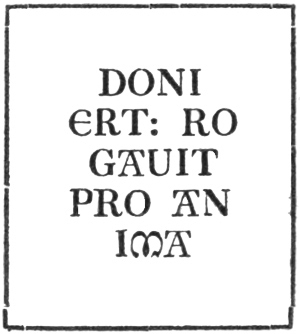
DONIERT: ROGAUIT PRO ANIMA
“This stone by recollection is about two feet wide at top, and about five or six feet in length. And the other stone, which still stands erect, and ornamented with cross lines, &c. is about the same in height.
181 “The west front is quite plain; the top has the remains of a kind of mortice, left hand corner broken off. The east front is dotted over, but has no letters.
“I find in Hals, that the pit in which the stone with the inscription lies, was formed in the latter end of the reign of Charles II. in consequence of his, Hals’s, going there at that period with some gentlemen, to view, as he says, the, at that time thought barbarous, inscription; for some tinners in the contiguous country, taking notice of these gentlemen visiting this place, apprehended they came there in quest of some hidden treasure; whereupon, as Hals says, some of them wiser than the rest, lay their heads together, and resolved in council to be before-hand, and accordingly went with pickaxes and shovels, and opened the earth round about the monument, to the depth of about six feet; when they discovered a spacious vault walled about, and arched over with stones, having on the sides thereof two stone seats, not unlike those in churches for auricular confession. The sight of all which struck them with consternation, or a kind of horror, that they incontinently gave over search, and with the utmost hurry and dread, throwing earth and turf to fill up the pit they made, they departed, having neither of them the courage to enter or even to inspect into the further circumstances of the place; which account Hals says, he had from the mouths of some of the very fellows themselves. Some short while after, the loose earth, by reason of some heavy rains which fell, sunk away into the vault, which occasioning also a sort of terræ-motus and concession of the earth adjoining, the said monument was at length so undermined thereby, that it fell to the ground, where it still remains. Would some gentlemen of ability and curiosity, says Hals, and so say I, be at the charge of again opening and cleansing this under-ground chapel, or whatever else it may be denominated, it might probably afford matter of pleasing amusement, if 182 not grand speculation to the learned searchers into matters of antiquity.
“This monument formerly went by the name of ‘the other half stone.’ Some translate the inscription, ‘Pray for the soul of Dungerth,’ others ‘Doniert asked for his soul;’ and there seems to be great controversy for what purpose this monument was erected. High stones might originally, in the early ages of Christianity, have been erected near roads in desolate situations, and at short distances from each other, to direct travellers in their journies; and crosses might have been placed on them as a memento for thanksgiving, when the traveller had effected this part of his journey in safety. Now if the inscription on the above monument is meant for ‘Pray for the soul of Dungerth,’ may we not suppose that it was meant as a request to those who should happen to be praying for themselves, to offer up a prayer also for Dungerth, who probably caused that monument to be erected, or who was buried near the same, perhaps in the chapel before mentioned to have been discovered by the tinners. Or if the inscription is to be read, ‘Doniert asked for his soul,’ which seems the proper translation; may we not suppose that Doniert (who by all accounts was a very pious prince) erected this stone, and prayed or asked for mercy thereat. Perhaps originally these stones might have been called Ave stones, from the Latin word ‘Ave,’ all hail! God speed you; God save you, &c. a very appropriate expression in a desolate situation to a wanderer or traveller. And the reference to another Ave stone might signify the one which is a little to the eastward of it, bearing a cross, and by its appearance formerly a legend underneath. This word Ave (pronounced in the same manner it is in Ave-Mary-Lane, London) might be corrupted into Half; so that Ave stone and Half stone might mean one and the same thing. And in Cornwall the F is very frequently pronounced as a V, and the V as an F, at this 183 present time.[28] If this does not meet approbation, I will add another conjecture. As the circle of stones called the Hurlers, are at a short distance from this monument and the cross before-mentioned, might not the monument and the cross be called the ‘one heave stone,’ and the other, ‘the other or outer heave stone,’ places from whence the ball during the game of hurling was thrown. The traditionary story of the stones called the hurlers, being once men turned into stone for profaning the Sabbath, will give some slight sanction to this conjecture; and in addition, even at this time the high-cross is vulgarly believed to have been the man who ran off with the ball.
“With respect to the stones called the Hurlers being once men, I will say with Hals, ‘Did but the ball which these Hurlers used when flesh and blood, appear directly over them immoveably pendant in the air, one might be apt to credit some little of the tale;’ but as this is not the case, I must add my belief of their being erected by the Druids for some purpose or other, probably a court of justice; long subsequent to which erection, however, they may have served as the goal for hurl players. And indeed a finer spot for such a game could not be fixed on perhaps any where. But I believe the Hurlers took their names from some other source than that of the game of hurling the ball being used there.
184
“After sufficiently viewing Dungerth’s monument, we directed our course towards Cheese-wring, and soon came to the Hurlers, but first we rode up to the High Cross before mentioned, which at a distance looked somewhat like a man. Under its cross it has an oblong square, as if the border of an inscription, but at present there is not the least vestige of a letter on it. Soon after we came to the Hurlers, which we found to be moorstones of about five or six feet high, forming two circles one without the other (not as represented in Hals’ Parochial History, but like that in Borlase), the circle nearest Cheese-wring less than that of the other. Some of the stones are fallen down, and remain where they fell, and others have probably been carried off for gate posts and other purposes. The areas of the circles are not level, there being many pits in them, as if the earth had sunk over large graves. I confess I was not much struck with the appearance of these famous stones, not having faith to believe they once were men. Near this place we fell in with a man going to Cheese-wring, and were glad to follow him as a guide. Among other questions, I asked him, as we passed along, whether he could tell me the name of the tenement on which Dungerth’s monument was; he answered Pennant. I also asked him whether he knew where the source of the Looe river was; he said in a field next below Dungerth’s monument. I was sorry to hear this, as we could not conveniently return to see it, but I learned from him it was a mere spring of water uninclosed.