Two Letters From the Trenches
Reading edition
[From The London Times, Oct. 25, 1914.]
A Canadian officer attached to the British forces writes as follows on Sept. 27:
IT has been very fortunate for me having a recommendation to Gen. C. He said that he would welcome all the French-speaking Canadians with military knowledge that crossed the Atlantic. I keep my rank of Lieutenant and am attached to the —— Guards, which does scouting, patrol, and reconnoissance duty in areas prescribed by the Brigadier. We have plenty of most interesting work, which suits me down to the ground. Nothing could exceed the kindness shown to Canadian officers by their English brethren. We are all one in aim, in spirit, and in that indefinable quality of loyal co-operation which holds together the British Army fighting against enormous odds in France, as it binds together the British Empire by bonds not less strong because they are invisible.
This afternoon we are taking a good sound rest at the house of a retired French farmer, who has three sons fighting in the country. He is as game as game, and says he is just holding things together until the war is over. He is 75 and remembers the horrors of the last war, in which he fought in the artillery.... Our "look-out" men are ever on the alert, for we never take a meal or rest altogether. Sentries and signalers are always posted before we dismount. The curé joined us at the farmer's house and we enjoyed an excellent repast, with the honor of two local gendarmes who had brought in a German spy caught red-handed robbing the house of a peasant the night before and attempting to murder her. The man was dressed as a French peasant. Upon him we found evidence that he was a spy. Summary procedure made it easy to decide that the sentence of drumhead court-martial was death. And here again is an instance of the extraordinary clemency of the French clergy. The curé pleaded that the spy should not be shot and the extreme penalty inflicted. So I consented (not being a man of blood) to the prisoner being sent to the nearest French military post, to be executed or not, as the General shall order.
I really believe that all of the evidence which crowds into me supports the charge that this is not a campaign which has proved attractive to the German rank and file. Prisoners we have taken say that they have no relish for the fighting. They have been well plied with drink, and seem to urge that drunkenness may be pleaded as an excuse for crime.
An officer whose letter from the trenches we published a few days ago has since written a letter, dated Oct. 8, from which we take extracts:
Last week I wrote that we had been in the trenches ten days. Now we have been in them nearly three weeks, and still the fight goes on. We don't mind it now. We hated it at first. The inaction made us ill. But we recovered and began to make jokes about it. And now we don't care. We eat and sleep, and eat again; and we dig, eternally dig, grubbing our way deeper and deeper into the earth, and making covered ways that lead hundreds of yards back from the firing line into safety.
And at the end of one of these I sit at this moment; away on the rear slope of the hill which is our fortress. The sun is sinking far away down the valley of the Aisne, and the river flickers in the distance between lines of trees, while the little villages at the foot of the slopes are gradually losing themselves in the evening mist. How lovely to sit here in time of peace! Could one bear it after this, I wonder? With all the beauty, there are sad things around me; signs of war every way I look. To the right, a few yards off, are new-cut graves, and they are putting up headstones, made by a reservist who is a mason in private life. One man was killed yesterday, and we buried him after dark. There was no service, because we had neither light nor book; but I said the Lord's Prayer before the earth was thrown in, thinking there could be no harm.
Then away across a bend of the valley are more of our trenches, with the German parapets 200 yards away beyond. And over these our shells are bursting, fired by guns on the slope of the hill beneath me; they whistle softly as they skim through the air over my head, and I hear the burst as they land. Further away to the west is one of the enemy's strongholds, and there bigger shells are bursting, throwing up clouds of black smoke and dust. These pass by with a louder purring whistle like the sound of surplus air escaping from the pipes of an organ in church. They come from our big guns up in the woods across the river, hidden from view. And always up in the sky the German aeroplanes circle round and round, seeking for the guns, their engines buzzing and the sun shining on their wings. Now and then they dash away, perhaps to carry news, perhaps because a British or French machine has come upon the scene. When they spot our positions they drop little silvery packets, which unfold and show their gunners where to shoot. Sometimes they drop bombs, but these do little harm. At times the weather is foggy, so that the aeroplanes can do nothing at all, and warfare becomes suddenly ten years out of date.
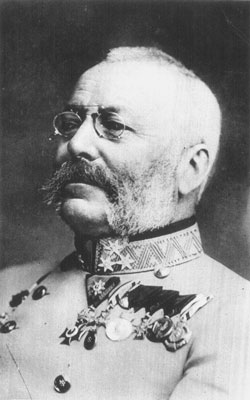
ARCHDUKE FREDERICK, Commander in Chief of Austrian Armies Operating Against the Russians.
(Photo from Paul Thompson.)
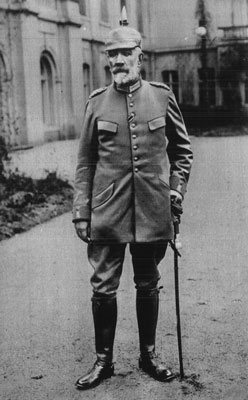
DR. VON BETHMANN-HOLLWEG, THE GERMAN CHANCELLOR, In His Field Uniform, Showing the Helmet in Its New Weatherproof Cover.
(Photo by Brown & Dawson, From Underwood & Underwood.)
Now the enemy are firing on the little village behind our lines, dropping shell among the houses, and always near the house where certain staff officers are at work. A curious point this—how close they get to the house when they can't possibly see the result of their fire. The explanation must be "spies." They are everywhere here; they wear British uniform and French uniform, and, most dangerous of all, civilian dress. It is our own fault; we allow the French population to return to the village right in our midst, and who in these times can question every one's rights? The other day three men in civilian dress were found near our lines sitting in trees; they were armed with wire-cutters, and said they were engaged in cutting vines. Now there are no vineyards near, but our wire entanglements were just beyond the wood. Again, one night we were to attack a small position at a given hour, but the order was afterward canceled. However, at the appointed time the enemy opened fire upon the ground we should have crossed and lighted the scene with rockets.
Nighttime is a period of continuous strain. The sentry peers into the darkness, imagining every bush to be an approaching enemy. Distant trees seem to change their position; bunches of grass, really quite close, seem to be men coming over the sky-line. One man questions another; the section commander is called upon. He in turn explains his fears to an officer. A single shot is ordered at the suspected object, and no sound is heard. So the night goes on. When we were new to the game a single shot was enough to alarm the whole line, and thousands of rounds were fired into the darkness. Now we know better. So also do the enemy. And it was satisfactory to find that our ammunition had not all been wasted, for a patrol recently discovered more than a hundred dead Germans in a wood in front of us. The ammunition had not been wasted that time. But, oh, what a wasteful war!