Letters and Diaries
Reading edition
A Group of Soldiers' Letters
A German cavalry division was pursuing a division of English infantry. The English ranks were suddenly reinforced; they turned and charged the Germans, who fled in disorder.
All the Germans fled—but one. Says an English soldier, Trooper S. Cargill:
When they saw us coming they turned and fled, at least all but one, who came rushing at us with his lance at the charge. I caught hold of his horse, which was half mad with terror, and my chum was going to run the rider through when he noticed the awful glaze in his eyes, and we saw that the poor devil was dead.
That ghastly vision of the mounted corpse can find no place in histories of this war. It has no historical significance even if it did receive a place in the cable dispatches from the front. Only from the lips of soldiers or from their pens when they snatch a few moments from the business of war to write to their people at home come such naïvely graphic accounts of trivial but illuminative incidents.
In many an American family is treasured a packet of yellow papers, on which are written, in ink fast fading away, brief and intimate impressions of the civil war by men who waged it. Every war has thus its unknown, unhonored chroniclers, who send to their little home circles narratives that for startling realism no highly paid special correspondent could surpass.
Trooper Cargill's letter is one of a number contained in an extraordinary volume just published by the George H. Doran Company of New York, with the title "In the Firing Line," (50 cents net.) Mr. A. St. John Adcock collected a large number of letters sent home during the last few weeks by English soldiers fighting in France and has arranged them to form what is perhaps the most essentially human account of the great war that has yet appeared.
Consider, for instance, the narrative of Private Whitaker of the Coldstream Guards. He fought through the terrific four-day battle near Mons, and his account of it follows. It must be remembered that the British troops who took part in that battle had sailed from Southampton only four days before:
You thought it was a big crowd that streamed out of the Crystal Palace when we went to see the Cup Final. Well, outside Compiègne it was just as if that crowd came at us. You couldn't miss them. Our bullets plowed into them, but still they came for us. I was well intrenched, and my rifle got so hot I could hardly hold it. I was wondering if I should have enough bullets when a pal shouted, "Up, Guards, and at 'em!" The next second he was rolled over with a nasty knock on the shoulder. He jumped up and hissed, "Let me get at them!" His language was a bit stronger than that.
When we really did get the order to get at them we made no mistake, I can tell you. They cringed at the bayonet, but those on our left wing tried to get around us, and after racing as hard as we could for quite five hundred yards we cut up nearly every man who did not run away.
You have read of the charge of the Light Brigade. It was new to our cavalry chaps. I saw two of our fellows who were unhorsed stand back to back and slash away with their swords, bringing down nine or ten of the panic-stricken devils. Then they got hold of the stirrup-straps of a horse without a rider and got out of the mêlée. This kind of thing was going on all day.
In the afternoon I thought we should all get bowled over, as they came for us again in their big numbers. Where they came from goodness knows; but as we could not stop them with bullets they had another taste of the bayonet. My Captain, a fine fellow, was near to me, and as he fetched them down he shouted, "Give them socks, my lads!" How many were killed and wounded I don't know; but the field was covered with them.
It is also of the four days' battle that Private J.R. Taft of the Second Essex Regiment wrote. How typical of real life, as distinct from romance, is his ready transition from his devout thanksgiving for his safety to his amused recollection of the popular song that rose above the crash of shot and shell:
We were near Mons when we had the order to intrench. It was just dawn when we were half way down our trenches, and we were on our knees when the Germans opened a murderous fire with their guns and machine guns.
We opened a rapid fire with our Maxims and rifles; we let them have it properly, but no sooner did we have one lot down than up came another lot, and they sent their cavalry to charge us, but we were there with our bayonets, and we emptied our magazines on them. Their men and horses were in a confused heap. There were a lot of wounded horses we had to shoot to end their misery.
We had several charges with their infantry, too. We find they don't like the bayonets. Their rifle shooting is rotten; I don't believe they could hit a haystack at 100 yards.
We find their field artillery very good; we don't like their shrapnel; but I noticed that some did not burst; if one shell that came over me had burst. I should have been blown to atoms. I thanked the Lord it did not. I also heard our men singing that famous song, "Get Out and Get Under." I know that for an hour in our trench it would make any one keep under, what with their shells and machine guns. Many poor fellows went to their death like heroes.
The writer of the following letter, too, was telling of Mons. To friends far away, at peaceful Barton-on-Humber, he wrote:
Just a line to tell you I have returned from the front, and I can tell you we have had a very trying time of it. I must also say I am very lucky to be here. We were fighting from Sunday, 23d, to Wednesday evening, on nothing to eat or drink—only the drop of water in our bottles which we carried.
No one knows—only those that have seen us could credit such a sight, and if I live for years may I never see such a sight again. I can tell you it is not very nice to see your chum next to you with half his head blown off. The horrible sights I shall never forget. There seemed nothing else only certain death staring us in the face all the time. I cannot tell you all on paper. We must, however, look on the bright side, for it is no good doing any other.
There are thousands of these Germans, and they simply throw themselves at us. It is no joke fighting seven or eight to one. I can tell you we have lessened them a little, but there are millions more yet to finish.
Of the battle that reddened the foam of the North Sea during the last days of August many a seaman recorded his impressions. And what curious things stuck in the memories of the weary, powder-stained survivors! "The funny thing which you should have seen," wrote Midshipman Hartley to his parents, "was all the stokers grubbing around after the action looking for bits of shell." And a seaman on H.M.S. Hearty wrote:
Two cooks were in the galley of the Arethusa, just having their rum, when a shell killed one and blew the other's arm off. A funny thing, they've got a clock hanging up; it smashed the glass and one hand, but the blooming thing's still going.
There is fine realism in Seaman Gunner Brown's letter to the parents who waited for tidings in their cottage on the Isle of Wight:
We and another ship in our squadron came across two German cruisers. We routed one and started on the second, but battle cruisers soon finished her off. Another then appeared, and after we had plunked two broadsides into her she slid off in flames.
Every man did his bit, and there was a continuous stream of jokes. We penciled on the projectiles, "Love from England," "One for the Kaiser," and other such messages. The sight of sinking German ships was gloriously terrible, funnels and masts lying about in all directions, and amidships a huge furnace, the burning steel looking like a big ball of sulphur. There was not the slightest sign of fear, from the youngest to the oldest man aboard.
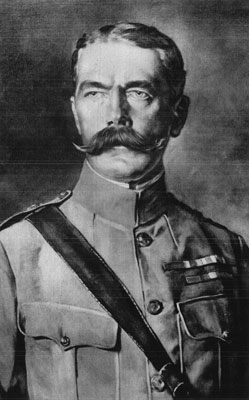
ENGLAND'S SECRETARY OF STATE FOR WAR, FIELD MARSHAL EARL KITCHENER.
(From the Painting by Angelo.)
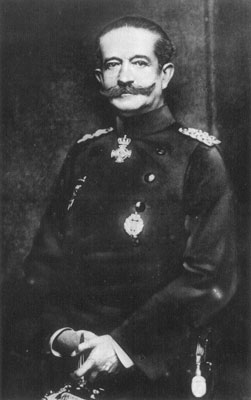
GEN. VON BISSING, Recently Made Military Governor of Belgium to Succeed Field Marshal von der Goltz.
(Photo from Ruschin.)
But it remained for a naval Lieutenant, whose name is not given, to describe, in a letter to a friend, one of the most remarkable incidents of the war, an incident which might have occurred in the imagination of Jules Verne or of H.G. Wells in his youth. He wrote:
The Defender having sunk an enemy, lowered a whaler to pick up her swimming survivors; before the whaler got back an enemy's cruiser came up and chased the Defender, and thus she abandoned her whaler. Imagine their feelings—alone in an open boat without food, twenty-five miles from the nearest land, and that land the enemy's fortress, with nothing but fog and foes around them. Suddenly a swirl alongside and up, if you please, pops his Britannic Majesty's submarine E-4, opens his conning tower, takes them all on board, shuts up again, dives, and brings them home, 250 miles!
In his introduction to the book St. John Adcock calls the private letters of the soldiers "the most potent of recruiting literature." Undoubtedly this is true of some of them. The casual, almost flippant, records of splendid heroism, the reflection of a spirit of gay courage, the description of the most picturesque and romantic aspects of battle—these tend, certainly, to fill the mind of the stay-at-home readers with a desire for participation in this great adventure.
But, on the other hand, such passages as "The dead were piled up in the trenches about ten deep, and there were trenches seven miles long," and "Our Maxim gun officer tried to fix his gun up during their murderous fire, but he got half his face blown away," are not likely to make fighting seem a pleasant occupation. It is true that the dead referred to in the first of these passages are the enemy's dead; still, there is a wholesale quality about those seven-mile trenches filled with dead ten deep that is not a recruiting allurement.
Nor is this letter, vivid in its realism, likely to make those not already warlike eager to enlist. It was sent to his parents at Ilfracombe by Private William Burgess of the Royal Field Artillery:
We left our landing place for the front on the Tuesday and got there on Saturday night. The Germans had just reached Liége then, and we got into action on the Sunday morning. The first thing we did was to blow up a bridge to stop the Germans from crossing. Then we came into action behind a lot of houses attached to the main street. We were there about ten minutes when the houses started to fall around us. The poor people were buried alive. I saw poor children getting knocked down by bursting shells.
The next move was to advance across where there was a Red Cross hospital. They dropped shells from airships and fired on it until the place was burned down to the ground. Then they got a big plan on to retire and let the French get behind them. We retired eight miles, but we had to fight until we were forced to move again. We got as far as Le Cateau on Tuesday night. We camped there until 2 o'clock next morning.
Then we all heard there was a big fight coming off, so we all got together and cleared the field for action. [The letter mentions the numbers of men engaged, and states that the Germans were in the proportion of three to one.] We cut them down like rats. We could see them coming on us in heaps and dropping like hail. The Colonel passed along the line and said, "Stick it, boys."
I tell you, mother, it was awful to see your own comrades dropping down—some getting their heads blown off and others their legs and arms. I was fighting with my shirt off. A piece of shell went right through my shirt at the back and never touched me. It stuck into a bag of earth which we put between the wheels to stop bullets.
We were there, all busy fighting, when an airship came right over the line and dropped a bomb, which caused a terrible lot of smoke. Of course, that gave the Germans our range. Then the shells were dropping on us thick. We looked across the line and saw the German guns coming toward us. We turned our two centre guns on them and sent them yards in the air. I reckon I saw one German go quite twenty yards in the air.
Just after that a shell burst right over our gun. That one got me out of action. I had to get off the field the best way I could. The bullets were going all around me on the way off; you see, they got completely around us. I went about two miles and met a Red Cross cart. I was taken to St. Quentin Hospital. We were shelled out of there about 2 in the morning, and then taken in a train and taken down to a plain near Rouen. Next morning we were put on a ship for dear old England.