How Prohibition Came to Russia
Reading edition
Interview with the Peasant-Born Millionaire Reformer, Tchelisheff.
[By the Associated Press.]
PETROGRAD, Nov. 18.—There is prohibition in Russia today, prohibition which means that not a drop of vodka, whisky, brandy, gin, or any other strong liquor is obtainable from one end to the other of a territory populated by 130,000,000 people and covering one-sixth of the habitable globe.
The story of how strong drink has been utterly banished from the Russian Empire was related by Michael Demitrovitch Tchelisheff, the man directly responsible for putting an end to Russia's great vice, the vodka habit.
It should be said in the beginning that the word prohibition in Russia must be taken literally. Its use does not imply a partially successful attempt to curtail the consumption of liquor resulting in drinking in secret places, the abuse of medical licenses and general evasion and subterfuge. It does mean that a vast population who consumed $1,000,000,000 worth of vodka a year; whose ordinary condition has been described by Russians themselves as ranging from a slight degree of stimulation upward, has been lifted almost in one day from a drunken inertia to sobriety.
On that day when the mobilization of the Russian Army began, special policemen visited every public place where vodka is sold, locked up the supply of the liquor, and placed on the shop the imperial seal. Since the manufacture and sale of vodka is a Government monopoly in Russia, it is not a difficult thing to enforce prohibition.
From the day this step was taken drunkenness vanished in Russia. The results are seen at once in the peasantry; already they are beginning to look like a different race. The marks of suffering, the pinched looks of illness and improper nourishment have gone from their faces. There has been also a remarkable change in the appearance of their clothes. Their clothes are cleaner, and both the men and women appear more neatly and better dressed. The destitute character of the homes of the poor has been replaced with something like order and thrift.
In Petrograd and Moscow the effect of these improved conditions is fairly startling. On holidays in these two cities inebriates always filled the police stations and often lay about on the sidewalks and even in the streets. Things are so different today that unattended women may now pass at night through portions of these cities where it was formerly dangerous even for men. Minor crimes and misdemeanors have almost vanished.
Tchelisheff, the man who virtually accomplished this miracle, was a peasant by birth, originally a house painter by profession, then Mayor of the city of Samara, and now a millionaire. Physically he is a giant, standing over 6 feet 4 inches in his stocking feet, and of powerful build. Although he is 55 years old, he looks much younger. His movements display the energy of youth, his eyes are animated, and his black hair is not tinged by gray.
In Petrograd Mr. Tchelisheff is generally found in a luxurious suite of rooms in one of the best hotels. He goes about clad in a blue blouse with a tasseled girdle, and baggy black breeches tucked into heavy boots. He offers his visitors tea from a samovar and fruit from the Crimea. Speaking of what he had accomplished for the cause of sobriety in Russia, Mr. Tchelisheff said:
"I was reared in a small Russian village. There were no schools or hospitals, or any of the improvements we are accustomed to in civilized communities. I picked up an education from old newspapers and stray books. One day I chanced upon a book in the hands of a moujik, which treated of the harmfulness of alcohol. It stated among other things that vodka was a poison.
"I was so impressed with this, knowing that everybody drank vodka, that I asked the first physician I met if the statement were true. He said yes. Men drank it, he explained, because momentarily it gave them a sensation of pleasant dizziness. From that time I decided to take every opportunity to discover more about the use of vodka.
"At the end of the eighties there came famine in Russia, followed by agrarian troubles. I saw a crowd of peasants demand from a local landlord all the grain and foodstuffs in his granary. This puzzled me; I could not understand how honest men were indulging in what seemed to be highway robbery. But I noted at the time that every man who was taking part in this incident was a drinking man, while their fellow villagers, who were abstemious, had sufficient provisions in their own homes. Thus it was that I observed the industrial effects of vodka drinking.
"At Samara I decided to do more than passively disapprove of vodka. At this time I was an Alderman, and many of the tenants living in my houses were workingmen. One night a drunken father in one of my houses killed his wife. This incident made such a terrible impression on me that I decided to fight vodka with all my strength.
"On the supposition that the Government was selling vodka for the revenue, I calculated the revenue received from its consumption in Samara. I then introduced a bill in the City Council providing that the city give this sum of money to the imperial treasury, requesting at the same time that the sale of vodka be prohibited. This bill passed, and the money was appropriated. It was offered to the Government, but the Government promptly refused it.
"It then dawned upon me that Russian bureaucracy did not want the people to become sober, for the reason that it was easier to rule autocratically a drunken mob than a sober people.
"This was seven years ago. Later I was elected Mayor of Samara, capital of the Volga district, a district with over a quarter of a million inhabitants. Subsequently I was elected to the Duma on an anti-vodka platform. In the Duma I proposed a bill permitting the inhabitants of any town to close the local vodka shops, and providing also that every bottle of vodka should bear a label with the word poison. At my request the wording of this label, in which the evils of vodka were set forth, was done by the late Count Leo Tolstoy. This bill passed the Duma and went to the Imperial Council, where it was amended and finally tabled.
"I then begged an audience of Emperor Nicholas. He received me with great kindness in his castle in the Crimea, not far from the scene of the recent Turkish bombardment. He listened to me patiently. He was impressed with my recital that most of the revolutionary and Socialist excesses were committed by drunkards, and that the Svesborg, Kronstadt, and Sebastopol navy revolts and the Petrograd and other mutinous military movements were all caused by inebriates. Having heard me out his Majesty promised at once to speak to his Minister of Finance concerning the prohibition of vodka.
"Disappointed at not having been able to get through a Government bill regulating this evil, I had abandoned my seat in the Duma. It was evident that the bureaucracy had been able to obstruct the measure. Minister of Finance Kokovsoff regarded it as a dangerous innovation, depriving the Government of 1,000,000,000 rubles ($500,000,000) yearly, without any method of replacing this revenue.
"While I lobbied in Petrograd the Emperor visited the country around Moscow and saw the havoc of vodka. He then dismissed Kokovsoff, and appointed the present Minister of Finance, M. Bark.
"Mobilization precipitated the anti-vodka measure. The Grand Duke, remembering the disorganization due to drunkenness during the mobilization of 1904, ordered the prohibition of all alcoholic drinks except in clubs and first-class restaurants. This order, enforced for one month, showed the Russian authorities the value of abstinence.
"In spite of the general depression caused by the war, the paralysis of business, the closing of factories, and the interruption of railroad traffic, the people felt no depression. Savings banks showed an increase in deposits over the preceding month, and over the corresponding month of the preceding year. At the same there was a boom in the sale of meats, groceries, clothing, dry goods, and housefurnishings. The 30,000,000 rubles a day that had been paid for vodka were now being spent for the necessities of life.
"The average working week increased from three and four days to six, the numerous holiday of the drinker having been eliminated. The working day also became longer, and the efficiency of the worker was perhaps doubled. Women and children, who seldom were without marks showing the physical violence of the husband and father, suddenly found themselves in an undreamed-of paradise. There were no blows, no insults, and no rough treatment. There was bread on the table, milk for the babies, and a fire in the kitchen.
"I decided to seize this occasion for a press campaign, so far as this is a possible thing in Russia. I organized delegations to present petitions to the proper authorities for the prolonging of this new sobriety for the duration of the war. This step found favor with his Imperial Majesty, and an order was issued to that effect. Another similar campaign to remove the licenses from privileged restaurants and clubs was successful, and strong liquor is no longer available anywhere in Russia.
"The second month of abstinence made the manifold advantages so clear to everybody that when we called upon his Majesty to thank him for his orders, he promised that the vodka business of the Government would be given up forever. This promise was promulgated in a telegram to the Grand Duke Constantine.
"There remains only now to find elsewhere the revenue which up to the present time has been contributed by vodka. There has been introduced in the Duma a bill offering a solution of this question. The aim of this bill is not the creation of new taxes or an increase in the present taxes, but an effort to render the Government domains and possessions more productive."
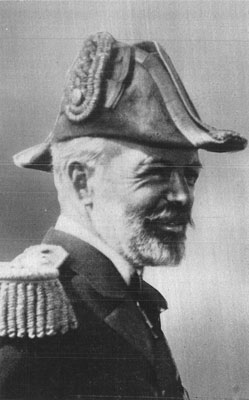
ADMIRAL SIR CHRISTOPHER CRADOCK, Who Went Down with His Flagship, the Good Hope, in the Naval Engagement Off the Coast of Chile.
(Photo from a Kodak Negative.)
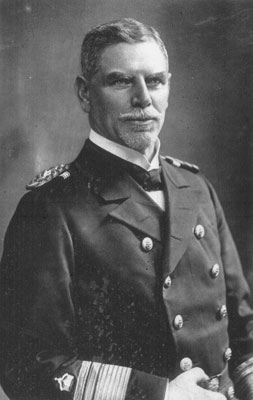
ADMIRAL COUNT VON SPEE, Who Went Down with His Flagship, the Scharnhorst, in the Battle with the British Squadron Off the South American Coast.
(Photo © by Brown Bros.)