Bass's Story
Reading edition
[Special Dispatch to The New York Times.]
CHICAGO, Jan. 7.—John F. Bass, the staff correspondent of The Chicago Daily News, who with Perceval Gibbon had a remarkable escape from being blown to pieces by German shells while returning from a visit to a Russian first-line trench in Poland, cables to his paper his version of their experiences, which duplicates largely that by Perceval Gibbon cabled to The New York Times.
Recounting their arrival at the trench held by the Bielojevski Regiment, in the centre of the battle line, he says:
"The officers, in small underground bomb-proofs, gave us a hospitable welcome. The men had cut small recesses in the front wall of the trench, where they were comfortably housed in straw with bagging in front to keep out the cold. The trenches were in good condition and clean for war time.
"In the loopholes rifles lay ready for firing. One man in every four watched while the other three slept. As we walked through the trench we stepped over dead bodies of men who had recently fallen. Two of the regiment's battalions are commanded by Staff Capt. Podjio, one of the finest specimens of a conscientious, hard-working line officer I have met. He passed the night traveling the trenches, keeping a vigilant watch and encouraging the men, who seemed to be in fine condition.
"It was bitterly cold, so we lay for a time on the straw of a bomb-proof, watching by candlelight a giant orderly sending and receiving messages on a buzzing telephone from different parts of the line. It is a habit of Germans to make night attacks that bring them within fifty yards of the Russian trenches before they are driven off.
"We saw indistinctly across the trenches the Russian videttes in front. It is reported that the Germans do not take the precaution of posting a line of sentinels before their trenches. Just before morning the videttes came running to report activity in the German trenches. Quickly the sleeping soldiers were roused to man the loopholes. The machine guns cracked and the rifles rolled out volleys in the cold morning light. The Germans answered and bullets kicked the top of our trench. Some of the bullets seemed to crack on striking and it was reported to us that the Germans were using explosive missiles. Under the Russian fire the Germans failed to leave their trench.
"When the light swelled into day the German artillery began shelling the houses, the tall chimney, and the trenches. Black clouds of smoke rose from the spots where the shells struck. On our trench they used shrapnel, which burst for the most part beyond us in white puffs. The German infantry continued a heavy fusillade, but our machine gun fire, which seemed to sweep the dust from the top of the German trench, caused their rifle fire to go high and the bullets hissed overhead.
"Two German aeroplanes swept down the line above the Russian trench, but retired when chased by a Russian biplane. In the distance a German observation balloon hung in the sky like a huge sausage."
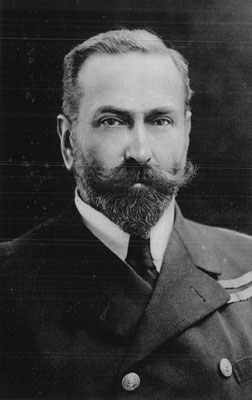
H.S.H. PRINCE LOUIS ALEXANDER OF BATTENBERG, Who Was Forced to Resign as First Sea Lord of the British Admiralty.
(Photo © by Pach Bros., N.Y.)
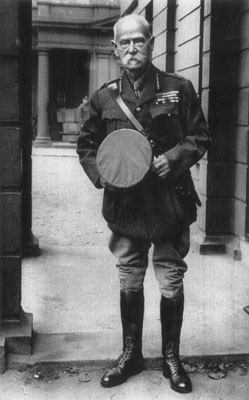
FIELD MARSHAL LORD ROBERTS, From a Photograph Taken on His Eighty-second Birthday.
(Photo by L.N.A.)