Volume 2 — CHAPTER XVII. THE AZTEC PICTURE-WRITING.
Reading edition
Hieroglyphic Records—The Native Books—Authorities—Destruction of the Native Archives by Zumárraga and his Confrères—Picture-writings used after the Conquest for Confession and Law-Suits—Value of the Records—Documents sent to Spain in the Sixteenth Century—European Collections—Lord Kingsborough's Work—Picture-writings retained in Mexico—Collections of Ixtlilxochitl, Siguënza, Gemelli Careri, Boturini, Veytia, Leon y Gama, Pichardo, Aubin, and the National Museum of Mexico—Process of Hieroglyphic Development—Representative, Symbolic, and Phonetic Picture-writing—Origin of Modern Alphabets—The Aztec System—Specimen from the Codex Mendoza—Specimen from Gemelli Careri—Specimen from the Boturini Collection—Probable future success of Interpreters—The Nepohualtzitzin.
The Nahua nations possessed an original hieroglyphic system by which they were able to record all that they deemed worthy of preservation. The art of picture-writing was one of those most highly prized and most zealously cultivated and protected, being entrusted to a class of men educated for the purpose and much honored. The written records included national, historic, and traditional annals, names and genealogical tables of kings and nobles, lists and tribute-rolls of provinces and cities, land-titles, law codes, court records, the calendar and succession of feasts, religious ceremonies of the temple service, names and attributes of the gods, the mysteries of augury and soothsaying, with some description of social customs, mechanical employments, and educational processes. The preparation and guardianship of records of the higher class, such as historical annals and ecclesiastical mysteries, were under the control of the highest ranks of the priesthood, and such records, comparatively few in number, were carefully guarded in the temple archives of a few of the larger cities. These writings were a sealed book to the masses, and even to the educated classes, who looked with superstitious reverence on the priestly writers and their magic scrolls. It is probable that the art as applied to names of persons and places or to ordinary records was understood by all educated persons, although by no means a popular art, and looked upon as a great mystery by the common people. The hieroglyphics were painted in bright colors on long strips of cotton cloth, prepared skins, or maguey-paper—generally the latter—rolled up or, preferably, folded fan-like into convenient books called amatl, and furnished often with thin wooden covers. The same characters were also carved on the stones of public buildings, and probably also in some cases on natural cliffs. The early authorities are unanimous in crediting these people with the possession of a hieroglyphic system sufficiently perfect to meet all their requirements.[642]
DESTRUCTION OF ABORIGINAL RECORDS.
Unfortunately the picture-writings, particularly those in the hands of priests—those most highly prized by the native scholar, those which would, if preserved, have been of priceless value to the students of later times—while in common with the products of other arts they excited the admiration of the foreign invaders, at the same time they aroused the pious fears of the European priesthood. The nature of the writings was little understood. Their contents were deemed to be for the most part religious mysteries, painted devices of the devil, the strongest band that held the people to their aboriginal faith, and the most formidable obstacle in the way of their conversion to the true faith. The destruction of the pagan scrolls was deemed essential to the progress of the Church, and was consequently ordered and most successfully carried out under the direction of the bishops and their subordinates, the most famous of these fanatical destroyers of a new world's literature being Juan de Zumárraga, who made a public bonfire of the native archives. The fact already noticed, that the national annals were preserved together in a few of the larger cities, made the task of Zumárraga and his confrères comparatively an easy one, and all the more important records, with very few probable exceptions, were blotted from existence. The priests, however, sent some specimens, either originals or copies, home to Europe, where they attracted momentary curiosity and were then lost and forgotten. Many of the tribute-rolls and other paintings of the more ordinary class, with perhaps a few of the historical writings, were hidden by the natives and thus saved from destruction. Of these I shall speak hereafter.[643]
After the zeal of the priests had somewhat abated, or rather when the harmless nature of the paintings was better understood, the natives were permitted to use their hieroglyphics again. Among other things they wrote down in this way their sins when the priests were too busy to hear their verbal confessions. The native writing was also extensively employed in the many lawsuits between Aztecs and Spaniards during the sixteenth century, as it had been employed in the courts before the conquest. Thus the early part of the century produced many hieroglyphic documents, not a few of which have been preserved, and several of which I have in my library. During the same period some fragments that had survived the general destruction were copied and supplied with explanations written with European letters in Aztec, or dictated to the priests who wrote in Spanish. The documents, copies, and explanations of this time are of course strongly tinctured with Catholic ideas wherever any question of religion is involved, but otherwise there is no reason to doubt their authenticity.[644]
VALUE OF THE NATIVE RECORDS.
To discuss the historical value of such Aztec writings as have been preserved, or even of those that were destroyed by the Spaniards, or the accuracy of the various interpretations that have been given to the former, forms no part of my purpose in this chapter. Here I shall give a brief account of the preserved documents, with plates representing a few of them as specimens, and as clear an idea as possible of the system according to which they were painted. Respecting the theory, supported by a few writers, that the Aztecs had no system of writing except the habit common to all savage tribes of drawing rude pictures on the rocks and trees, that the statements of the conquerors on the subject are unfounded fabrications, the specimens handed down to us mere inventions of the priests, and their interpretations consequently purely imaginary, it is well to remark that all this is a manifest absurdity. On the use of hieroglyphics the authorities, as we have seen, all agree; on their destruction by the bishops they are no less unanimous; even the destroyers themselves mention the act in their correspondence, glorying in it as a most meritorious deed. The burning was moreover perfectly consistent with the policy of the Church at that time, and its success does not seem extraordinary when we consider the success of the priests in destroying monuments of solid stone. The use of the aboriginal records in the Spanish courts for a long period is undeniable. The priests had neither the motive nor the ability to invent and teach such a system. Respecting the historical value of the destroyed documents, it is safe to believe that they contained all that the Aztecs knew of their past. Having once conceived the idea of recording their annals, and having a system of writing adequate to the purpose, it is inconceivable that they failed to record all they knew. The Aztecs derived their system traditionally from the Toltecs, whose written annals they also inherited; but none of the latter were ever seen by any European, and, according to tradition, they were destroyed by a warlike Aztec king, who wished the glory of his own kingdom to overshadow that of all others, past, present, or future. If the hieroglyphics of the Nahua nations beyond the limits of Anáhuac differed in any respect from those of the Aztecs, such differences have not been recorded.[645]
EUROPEAN COLLECTIONS.
I have said that many hieroglyphic manuscripts, saved from the fires kindled by Zumárraga's bigotry, or copied by ecclesiastical permission before serving as food for their purifying flames, were sent to Spain by the conquerors. After lying forgotten for a few centuries, attention was again directed to these relics of an extinct civilization, and their importance began to be appreciated; search was made throughout Europe, and such scattered remnants as survived their long neglect were gathered and deposited in public and private libraries. Eight or ten such collections were formed and their contents were for the most part published by Lord Kingsborough.
The Codex Mendoza was sent by the viceroy Mendoza to Charles V., and is now in the Bodleian Library at Oxford. It is a copy on European paper, coarsely done with a pen, and rolled instead of folded. Another manuscript in the Escurial Library is thought by Prescott to be the original of this codex, but Humboldt calls it also a copy. An explanation of the codex in Aztec and Spanish accompanies it, added by natives at the order of Mendoza. It has been several times published, and is divided in three parts, the first being historical, the second composed of tribute-rolls, and the third illustrative of domestic life and manners.[646]
The Codex Vaticanus (No. 3738) is preserved at Rome in the Vatican Library, and nothing is known of its origin further than that it was copied by Pedro de los Rios, who was in Mexico in 1566. It is divided into two parts, mythological and historical, and has a partial explanation in Italian. Another manuscript, (No. 3776) preserved in the same library, is written on skin, has been interpreted to some extent by Humboldt, and is supposed to pertain to religious rites. The Codex Telleriano-Remensis, formerly in the possession of M. Le Tellier, and now in the Royal Library at Paris, is nearly identical with the Codex Vaticanus (No. 3738), having only one figure not found in that codex, but itself lacking many. It has, however, an explanation in Aztec and Spanish.[647]
The Codex Borgian was deposited in the College of the Propaganda at Rome by Cardinal Borgia, who found it used as a plaything by the children in the Gustiniani family. It is written on skin, and appears to be a ritual and astrologic almanac very similar to the Vatican manuscript (No. 3776). It is accompanied by an interpretation or commentary by Fabrega. The Codex Bologna, preserved in the library of the Scientific Institute, was presented in 1665 to the Marquis de Caspi, by Count Valerio Zani. It is written on badly prepared skin, and appears to treat of astrology. A copy exists in the Museum of Cardinal Borgia at Veletri. Of the Codex Vienna nothing is known except that it was given in 1677 to the Emperor Leopold by the Duke of Saxe-Eisenach, and that its resemblance to the manuscripts at Rome and Veletri would indicate a common origin. Four additional manuscripts from the Bodleian Library at Oxford, and one belonging to M. de Fejérvary in Hungary, are published by Kingsborough. Nothing is known of the origin of these, nor has any interpretation been attempted, although the last-named seems to be historical or chronological in its nature.[648]
PICTURE-WRITINGS PRESERVED IN MEXICO.
I have said that many manuscripts, mostly copies, but probably some originals, were preserved from destruction, and retained in Mexico. Material is not accessible for a complete detailed history of these documents, nor does it seem desirable to attempt here to disentangle the numerous contradictory statements on the subject. The surviving remnants of the Tezcucan archives, with additions from various sources, were inherited by Ixtlilxochitl, the lineal descendant of Tezcuco's last king, who used them extensively if not always judiciously in his voluminous historical writings. The collection of which these documents formed a nucleus may be traced more or less clearly to the successive possession of Sigüenza, the College of San Pedro y San Pablo, Boturini Benaduci, the Vice-regal Palace, Veytia, Ortega, Leon y Gama, Pichardo, Sanchez, and at last to the National Museum of the University of Mexico, its present and appropriate resting-place. Frequent interventions of government and private law-suits interrupted this line of succession, and the collection by no means passed down the line intact. Under the care of several of the owners large portions of the accumulation were scattered; but on the other hand, several by personal research greatly enlarged their store of aboriginal literature. While in Sigüenza's possession the documents were examined by the Italian traveler Gemelli Careri, through whose published work one of the most important of the pictured records was made known to the world. This latter has been often republished and will be given as a specimen in this chapter.[649] Clavigero studied the manuscripts in the Jesuit College of San Pedro y San Pablo in 1759.[650] Boturini was a most indefatigable collector, his accumulation in eight years amounting to over five hundred specimens, some of them probably antedating the Spanish conquest. He published a catalogue of his treasures, which were for the most part confiscated by the government and deposited in the palace of the viceroy, where many of the documents are said to have been destroyed or damaged by dampness and want of care. Those retained by the collector were even more unfortunate, since the vessel on which they were sent to Europe was taken by an English pirate, and the papers have never since been heard of. Only a few fragments from the Boturini collection have ever been published, the most important of which, a history of the Aztec migration, has been often reproduced, and will be given in this chapter. The original was seen by Humboldt in the palace of the viceroy, and is now in the Mexican Museum.[651]
The confiscated documents passed by order of the Spanish government into the hands of Veytia, or at least he was permitted to use them in the preparation of his history,[652] and after his death and the completion of his work by Ortega, they passed, not without a lawsuit, into the possession of Leon y Gama, the astronomer.[653] On the death of Gama a part of his manuscripts were sold to Humboldt to form the Berlin collection published by Kingsborough;[654] the rest came into the hands of Pichardo, Gama's executor, who spent his private fortune in improving his collection, described by Humboldt as the richest in Mexico. Many of Pichardo's papers were scattered during the revolution, and the remainder descended through his executor Sanchez to the Museum.[655] It is not unlikely either that the French intervention in later years was also the means of sending some picture-writings to Europe. Of the documents removed from the Mexican collections on different occasions and under different pretexts, M. Aubin claims to have secured the larger part, which are now in his collection in Paris, with copies of such manuscripts as he has been unable to obtain in the original form.[656]
HIEROGLYPHIC DEVELOPMENT.
In order to form a clear idea of the Aztec system of picture-writing, it will be well to consider first the general principles of hieroglyphic development, which are remarkably uniform and simple, and which may best be illustrated by our own language, supposing it, for convenience, to be only a spoken tongue.
It is evident that the first attempt at expressing ideas with the brush, pencil, or knife, would be the representation of visible objects by pictures as accurately drawn as possible; a house, man, bird, or flower are drawn true to the life in all their details. But very soon, if a frequent repetition of the pictures were needed, a desire to save labor would prompt the artist to simplify his drawing, making only the lines necessary to show that a house, man, etc., were meant,—a retrograde movement artistically considered, but intellectually the first step towards an alphabet. The representation of actions and conditions, such as a house on fire, a dead man, a flying bird, or a red flower would naturally follow.
The three grades of development mentioned belong to what may be termed representative picture-writing. It is to be noted that this writing has no relation to language; that is, the signs represent only visible objects and actions without reference to the words by which the objects are named or the actions expressed in our language. The pictures would have the same meaning to a Frenchman or German as to the painter.
The next higher phase of the art is known as symbolic picture-writing. It springs from the need that would soon be experienced of some method by which to express abstract qualities or invisible objects. The symbolic system is closely analogous in its earlier stages to the representative, as when the act of swimming is symbolized by a fish, a journey by a succession of footprints, night by a black square, light by an eye, power by a hand, the connection between the picture and the idea to be expressed being more or less obvious. Such a connection, real or imaginary, must always be supposed to have existed originally, since it is not likely that purely arbitrary symbols would be adopted, but nearly all the symbols would be practically arbitrary and meaningless to a would-be interpreter ignorant of the circumstances which originated their signification.
We have seen that the symbolic and representative stages of development are in many respects very like one to the other, and there are many hieroglyphic methods between the two, which it is very difficult to assign altogether to either. For instance, when a large painted heart expresses the name of a chief 'Big Heart;' or when a peculiarly formed nose is painted to represent the man to whom it belongs; or when the outlines of the house, man, bird, or flower already mentioned are so very much simplified as to lose all their apparent resemblance to the objects represented. It is also to be noted that the symbolic writing, as well as the representative, is entirely independent of language.
REPRESENTATIVE AND SYMBOLIC WRITING.
Picture-writing of the two classes described has been practiced more or less, probably, by every savage tribe. By its aid records of events, such as tribal migrations, and the warlike achievements of noted chiefs, may be and doubtless have been made intelligible to those for whose perusal they were intended. But the key to such hieroglyphics is the actual acquaintance of the nation with each character and symbol, and it cannot long survive the practice of the art. In only two ways can the meaning of such records be preserved,—the study of the art while actually in use by a people of superior culture, or its development into a hieroglyphic system of a higher grade. Neither of these conditions were fulfilled in the case of our Wild Tribes, but both were so to some extent, as we shall see, in the case of the Civilized Nations. Throughout the Pacific States rock-carvings and painted devices will be noted in a subsequent volume of this work; most of them doubtless had a meaning to their authors, although many may be attributed to the characteristic common to savages and children of whiling away time by tracing unmeaning sketches from fancy. All are meaningless now and must ever remain so. Full of meaning to the generation whose work they were, they served to keep alive in the following generation the memory of some distinguished warrior, or some element of aboriginal worship, but to the third generation they became nothing but objects of superstitious wonder. Even after coming into contact with Europeans the savage often indicates by an arrow and other figures carved on a forest-tree the number of an enemy and the direction they have taken, or leaves some other equally simple representative record.
The next and most important step in hieroglyphic development is taken when a phonetic element is introduced; when the pictures come into a relation, not before attained, with sounds or spoken language; when a picture of the human form signifies man, not homme or hombre; a painted house, house, not casa or maison. Of this phonetic picture-writing in its simplest form, the illustrated rebuses—children's hieroglyphics—present a familiar example; as when charity is written by drawing in succession a chair, an eye, and a chest of tea, 'chair-eye-tea.' In pronouncing the whole word thus written, the sounds of the words represented by the pictures are used without the slightest reference to their meaning. To the Frenchman the same pictures 'chaise-œil-thé' would have no meaning.
In the example given the whole name of each word pictured is pronounced, but the number of words that could be produced by such combinations is limited, and the first improvement of the system would perhaps be to pronounce only the leading syllable or sound of the pictured word, and then charity might be painted 'cha (pel)-ri (ng)-tee (th).' By this system the same word might be written in a great many ways, and the next natural improvement would be the conventional adoption of certain easily pictured words to represent certain sounds, as 'hat,' 'hand,' or 'ham,' for the sound ha, or simply the aspirated h. The next development would be effected by simplifying the outlines of the numerous pictures employed, which have now become too complicated and bulky for rapid writing. For a time this process of simplification would still leave a rude resemblance to the original picture; but at last the resemblance would become very faint, or only imaginary, and perhaps some arbitrary signs would be added—in other words, a phonetic alphabet would be invented, the highest degree of perfection yet achieved in this direction.
To recapitulate briefly: picture-writing may be divided, according to the successive stages of its development, into three classes, representative, symbolic, and phonetic, no one of which except the last in its highest or alphabetic, and the first in its rudest, state, would be used alone by any people, but rather all would be employed together. In the representative stage a might express a human hand, or as the system is perfected, a large, small, closed, black, or red hand; and finally 'Big Hand,' an Indian chief; and all this would be equally intelligible to American or Asiatic, savage or civilized, without respect to language.

HIEROGLYPHIC WRITING.
Symbolic picture-writing indicates invisible or abstract objects, actions, or conditions, by the use of pictures supposed to be suggestive of them; the symbols are originally in a manner representative, and rarely, if ever, arbitrarily adopted. As a symbol the might express power, a blow, murder, the number one or five. These symbols are also independent of language.
Phonetic picture-writing represents not objects, but sounds by the picture of objects in whose names the sound occurs; first words, then syllables, then elementary sounds, and last—by modification of the pictures or the substitution of simpler ones—letters and an alphabet. According to this system the signifies successively the word 'hand,' the syllable 'hand' in handsome, the sound 'ha' in happy, the aspiration 'h' in head, and finally, by simplifying its form or writing it rapidly, the becomes , and then the 'h' of the alphabet.

The process of development which I have attempted to explain by imaginary examples and illustrations in our own language, is probably applicable to a greater or less extent to all hieroglyphic systems; yet such hieroglyphics as have been preserved are of a mixed class, uniting in one word, or sentence, or document, all the forms, representative, symbolic, and phonetic; the Egyptians first spelled a word phonetically and then, to make the meaning clear, represented the word by a picture or symbol; the Chinese characters were originally pictures of visible objects, though they would not now be recognized as such, if the originals were not in existence. What proportion of the letters in modern alphabets are simplified pictures, or representative characters, and what arbitrary, it is of course impossible to determine; many of them, however, are known to be of the former class.[657]
In the Aztec picture-writings all the grades or classes of pictures are found, except the last and highest—the alphabet. A very large part of the characters employed were representative; many conventional symbols are known; and the Aztecs undoubtedly employed phonetic paintings, though perhaps not very extensively in the higher grades of development.
SPECIMEN FROM CODEX MENDOZA.
The plate on the opposite page is a reproduction of a part of the Codex Mendoza from Kingsborough's work. Its four groups describe the education of the Aztec child under the care of its parents. In the first group the father (fig. 3) is punishing his son by holding him over the fumes of burning chile (fig. 5); while the mother threatens her daughter with the same punishment. Figures 2 and 8 represent, like 11, 16, 20, 24, 30 and 34 in the other groups, the child's allowance of tortillas at each meal. In the second group the son is punished by being stretched naked on the wet ground, having his hands tied, while the girl is forced to sweep, or, as she has no tear in her eye, perhaps is merely being taught to sweep instead of being punished. In the third group the father employs his boys in bringing wood (fig. 21) or reeds either on the back or in a canoe; and the mother teaches her daughter to make tortillas (fig. 27) and the use of the metate and other household utensils (figs. 23, 25, 26, 28). In the last group the son learns the art of fishing, and the daughter that of weaving.
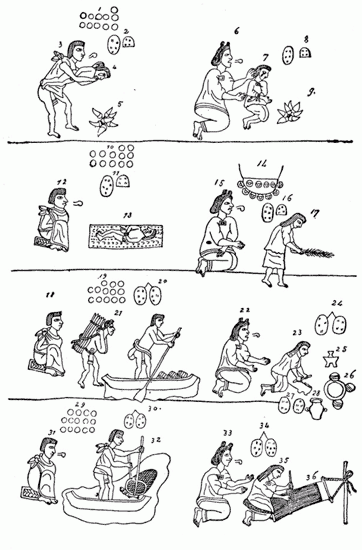
Education of Aztec Children. View larger image.
Thus far all the pictures are purely representative; the remainder are more or less symbolic. The small circles (fig. 1, 10, 19, 29) are numerals, as explained in a preceding chapter, and indicate the age of the children, eleven, twelve, thirteen, and fourteen years respectively; the character issuing from the mouth of the parents is the symbol of speech, and indicates that the person to whom it is attached is speaking; the tears in the children's eyes, are symbols of the weeping naturally caused by the punishment inflicted; and figure 14 is interpreted to be a symbol of night, indicating that the child was forced to sweep at night.[658]
Many of the Aztec symbols are of clearly representative origin, as foot-prints, symbols of traveling; tongues, of speech; a man sitting on the ground, of an earthquake; painted drops, of water; and other signs for day, night, air, movement, etc., which are more or less clear. But of others, as the serpent, symbol of time, the origin is not affirmed. To define the extent to which the symbolic writing prevailed is very difficult, because many of the characters which were, originally at least, representative, would appear to the uninitiated purely arbitrary; and it is not improbable that many signs may have had a double meaning according to the connection in which they were employed. The system is capable of indefinite expansion in the hands of the priesthood for purposes of religious mystification; and the fact that the religious and astrologic documents seem to contain but few of the representative and phonetic signs by which other paintings are interpreted, lends some probability to the theory that the priests had a partially distinct symbolic system of their own. The Abbé Brasseur goes so far as to say that all the historical documents had a double meaning, one for the initiated, another for the masses. The use of symbols doubtless accounts for the difficulty experienced in the interpretation of the picture-writings which have been preserved, and for the variety of extravagant theories that have been founded on them.
The intermediate method already mentioned as coming between the purely representative and the symbolic, was very extensively employed by the Aztecs in writing the names of places and persons, nearly all of which were derived from natural objects. Examples of this method are: Itzcoatl, 'stone (or obsidian) serpent;' Chapultepec, 'hill of the grasshopper;' Tzompanco, 'place of skulls;' Chimalpopoca, 'smoking shield;' Acamapitzin, 'hand holding reeds;' Macuilxochitl, 'five flowers;' Quauhtinchan, 'house of the eagle;' all written by the simple pictures of the objects named. The picture expressing a person's name was attached by a fine line to his head.
AZTEC PHONETIC WRITING.
The use of the phonetic element by the Aztecs was first noticed by the early missionaries in their efforts to teach Church forms. The natives, eager or obliged to learn the words so essential to their salvation but so new to their ear, aided their memory by writing phonetically in a rude way the strange words. Amen was expressed by the symbol of water, atl, joined to a maguey, metl, forming the sounds atl-metl or a-mĕ, sufficiently accurate for their purpose. Pater noster was likewise written with a flag, pantli, and a prickly pear, nochtli; or sometimes a stone, tetl, was introduced before and after the prickly pear, the whole reading pa(ntli)-te(tl)-noch(tli)-te(tl). Here it will be observed that the sound only of the objects employed is considered, with no reference to their meaning. The name Teocaltitlan is an excellent specimen of the syllabic-phonetic writing. It is written in one of the manuscripts of the Boturini collection by a pictured pair of lips, tentli, for the syllable te; footsteps, symbolic of a road, otli, for o; a house, calli, for cal; and teeth, tlantli, for tlan, ti being a common connective syllable. The termination coatl is a very frequent one in Aztec words, and is often written phonetically by a 'pot,' comitl, surmounted by the symbol of water, atl, co-atl; but coatl means 'serpent' and is also written representatively by a simple picture of that reptile. Matlatlan 'net-place,' is written by pictured teeth, tlantli, phonetic, and a net, matla, representative. Mixcoatl, 'cloudy serpent,' is expressed by the representative sign of a cloud, mixtli, and by the word coatl phonetically written as before explained. These examples suffice to illustrate the system. There is no evidence that the Aztecs ever reached the highest or alphabetic stage of hieroglyphics, and so far as is known they only used the syllabic method in writing names, and foreign words after the coming of the Spaniards. Still there is some reason to suspect that the phonetic element was much more in use than has been supposed, and that many characters which, hitherto considered by students as representative and symbolic signs, have yielded no meaning, may yet prove to be phonetic, and may throw much light on a complex and mysterious subject.[659]
RECORD OF AN AZTEC MIGRATION.
On the two following pages is a copy of the painting already referred to as having been published by Gemelli Careri, Humboldt, Kingsborough, Prescott, and others, and which I take from the work of Ramirez as being probably the most reliable source.[660] This painting, preserved in the National Museum, is about twenty by twenty-seven inches, on maguey paper of the finest quality, now mounted on linen. I do not propose to attempt in this chapter any interpretation of the painting, to discuss the interpretations of others, or to investigate its historical importance. I simply present the document as an illustration of the Aztec picture-writing, with interpretations of some of the figures as given by Señor Ramirez, leaving to another volume all consideration of the old absurd theory that a part of the painting (fig. 1-6) pictures the flood, the preservation of Coxcox, the Aztec Noah, and the confusion of tongues.
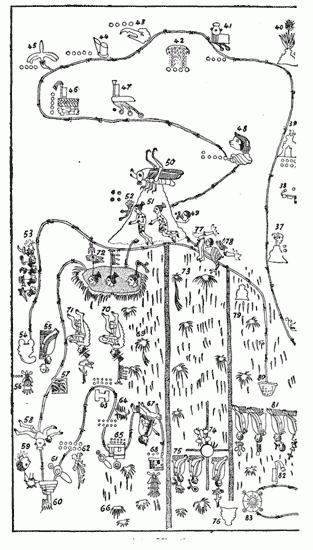
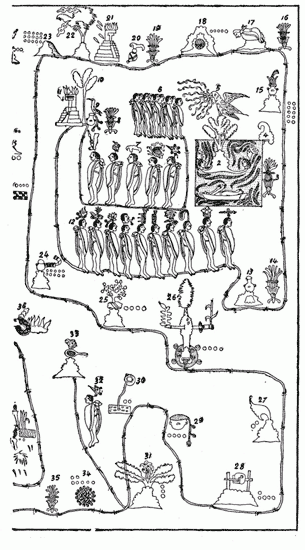
The Aztec Migration. View larger image (left). View larger image (right).
PICTURE-WRITING FROM GEMELLI CARERI.
The winding parallel lines, with frequent foot-prints, by which the different groups of figures are united, are symbols of a journey, and there is little doubt that the whole painting describes the migrations or wanderings of the Aztec people. The square at the right represents the place from which they started. Fig. 1, 2, perhaps express phonetically its name, but their interpretation is doubtful. It was evidently a watery region, probably a lake island in the valley of Mexico. Fig. 3 is a xiuhmolpilli, 'bundle of grass,' symbol of the Aztec cycle of fifty-two years; fig. 4 is a 'curved mountain,' or the city of Culhuacan, on the borders of the lake; fig. 5 is a bird speaking to the people (fig. 6), the tongues issuing from its mouth being, as I have said, the usual symbols of speech. It was a popular tradition among the Aztecs that the voice of a bird started them on their wanderings. The fifteen human forms (fig. 7, 12,) are the chiefs of the migrating tribes, whose names are hieroglyphically expressed by the figures connected with their heads. At their first stopping-place they completed another 'sheaf' of fifty-two years (fig. 8), and perhaps built a temple (fig. 11). The stay at Cincotlan (fig. 15) was ten years as indicated by the ten circles; fig. 17 is interpreted by Gemelli Careri Tocolco, 'humiliation,' and fig. 18, Oztotlan, 'place of caves.' At the next stopping-place fig. 20 represents a body wrapped in the Mexican manner for burial; his name as shown by the character over his head is that of the central figure in the group shown in fig. 7. As this name does not appear again, the meaning is perhaps that one of the tribes here became extinct. Fig. 25 is Tetzapotlan, 'place of the tree tetzapotl.' The generic name of the tree is tzapotl (modern zapote), but a particular species is tetzapotl, and the prefix te is phonetically expressed by the stone, tetl, at the base of the tree. Fig. 28 is Tzompanco, 'place of skulls,' representing supposably a skull impaled on a stick; fig. 29 is Apazco, 'earthen vase;' fig. 31, Quauhtitlan 'place of the eagle,' and here one of the chiefs of tribes, the right hand figure of group 7, separates from the rest to form a settlement at fig. 33. The time of stopping at each place and the completion of each fifty-two years are clearly indicated and need not be mentioned here. Fig. 34 is Azcapuzalco, 'the anthill;' fig. 83 is Chalco, 'the chalchiuite-stone;' fig. 36, Tlecohuatl, tletl-cohuatl, or 'fire-serpent;' fig. 39, Chicomoztoc, chicome-oztotl, 'seven caves;' the lower part of fig. 47 is the symbol of water; fig. 48, Teozomaco, 'the monkey of stone.' Fig. 50 is Chapultepec, 'hill of the locust or grasshopper.' After the arrival at Chapultepec a great variety of events, most of which can be identified with traditional occurrences in the early history of the Aztecs, are pictured. I shall not attempt to follow them. The route seems to continue towards fig. 80, Tlatelolco; but five tribes (fig. 53), all but one identical with those of the group in fig. 7, 12, return as fugitives or prisoners (fig. 51) to Culhuacan (fig. 54), the original starting-point. Fig. 61, and one of the characters of fig. 65, are the symbols of combat or war. Fig. 67 is Inixiuhcan, 'birth-place,' the picture representing a woman who has just given birth to a child. Fig. 74 is Tenochtitlan, 'place of tenochtli,' the tenochtli being a species of nopal represented in the figure, and being also the sign of the name of Tenoch, one of the original chiefs of the group in fig. 12, and also seen in the group in fig. 81. Six of the original tribes seem to have reached Tenochtitlan, afterwards Mexico, with the tribe that joined them at Chapultepec; nine having perished or been scattered on the way, which agrees with the historical tradition. The preceding brief sketch will give an idea of a document whose full description and interpretation, even if possible, would require much space and would not be appropriately included here.
CHRONOLOGIC RECORD.
The picture-writing shown on the following pages is the one already mentioned as having formed part of the Boturini collection, is equally important with the one already described, and is preserved like the former in the National Museum. This painting, like the other, describes a migration, indicated by the line of foot-prints. Starting from an island, a passage by boat is indicated to Culhuacan, 'the curved mountain,' on the mainland. In this painting we have not only the number of years spent in the migration, and at each stopping-place, but the years are named according to the system described in the last chapter, and the migration began in the year Ce Tecpatl. The character within that of Culhuacan is the name of Huitzilopochtli, the great Aztec god. Next we have in a vertical line the names of the eight tribes, hieroglyphically written, who started on the migration, the Chalcas, Matlaltzincas, Tepanecs, etc., agreeing with the tradition, except three which cannot be accurately interpreted. The first stopping-place after Culhuacan was Coatlicamac, the first figure in the lower column of the first page. Here they remained twenty-eight years from Ome Calli to Yey Tecpatl as indicated by the squares connected by a line. The last but one of these years completed the cycle and is represented by a picture showing the process of kindling fire by friction, instead of the bundle of grass as before. Between the groups of small squares are the hieroglyphic names of the stopping-places, which are in the following order, beginning with the second column of the first page, Coatlicamac, Tollan, Atlicalaquiam, Tlemaco, Atotonilco, Apazco, Tzompanco, Xaltocan, Acolhuacan, Ehecatepec, Tolpetlac, Coatitlan (where they first cultivated the maguey), Huixachtitlan (where they made pulque from the maguey), Tecpayocan, Pantitlan, 'place of the flag,' Amalinalpan, Azcapuzalco, Pantitlan, Acolnahuac, Popotla, ——, Atlacuihuayan (Tacubaya), Chapultepec, Acocolco, and Culhuacan (as prisoners). The migration is not brought down to the arrival in Tenochtitlan, but the chronology is perfectly recorded. Several of the names of places are indicated by the same hieroglyphic signs as in the other painting. It will be observed that there is nothing to locate the starting-place in the north-west. It was probably either on the lakes of Anáhuac, or in the south beyond what is now the isthmus of Tehuantepec. Both of these paintings will be noticed in the historical investigations to be given in volume V. of this work.
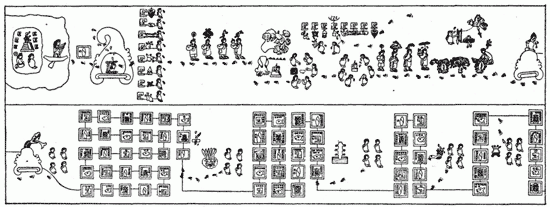
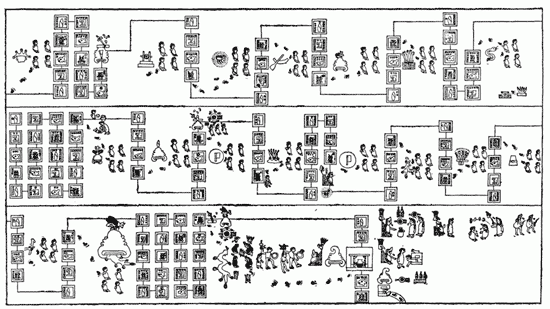
PICTURE-RECORD OF THE AZTEC MIGRATION. FROM THE BOTURINI COLLECTION.
The hieroglyphic paintings afford no test of the Aztec painter's skill; in an artistic point of view the picture-writing had probably been nearly stationary for a long time before the conquest. The pictures were in most cases conventionally distorted; indeed, to permit different painters to exercise their skill and fancy in depicting the various objects required would have destroyed the value of the paintings as records. The first progressional steps had taught the native scribes to paint only so much of representative and symbolic objects as was necessary to their being understood; convenience and custom would naturally tend to fix the forms at an early period. Bold outlines, and bright contrasted colors were the desiderata; elegance was not aimed at. Hence no argument respecting the Aztec civilization can be drawn from the rude mechanical execution of these painted characters.
The American hieroglyphics contain no element to prove their foreign origin, and there is no reason to look upon them as other than the result of original native development. Whether enough of the painted records have been preserved to throw much additional light on aboriginal history, may well be doubted; but it is certain that great progress will be made in the art of interpreting such as have been saved, when able men shall devote their lives to a faithful study of this indigenous American literature as they have to the study of old-world hieroglyphics.[661]
THE NEPOHUALTZITZIN.
I will in conclusion call attention to Boturini's statement that knotted cords, similar to the aboriginal Peruvian quipus, but called in Aztec nepohualtzitzin, were also employed to record events in early times, but had gone out of use probably before the Aztec supremacy. This author even claims to have found one of these knotted records in a very dilapidated condition in Tlascala. His statement is repeated by many writers; if any information on the subject is contained in the old authorities, it has escaped my notice.[662]