PART III.—THE HEROES.
Reading edition
I.—INTRODUCTORY.
On passing to heroic mythology, a world still more rich in marvels than that with which we have already become acquainted presents itself to our view. The greater extent of this department of mythic lore is easily comprehensible, if we take into consideration the multitude of separate existences into which Greek life was split up, even from the earliest times. Each of the numberless countries, islands, cities, and towns endeavoured to trace back its peculiar institutions to mythical founders and ancestors; and as these were always described either as the sons or as the favourites of the gods, there accordingly sprang up, in course of time, a vast number of local heroic legends. These fabulous founders of states, however, were not the only heroes of Greek mythology. The attempt to pierce the clouds of obscurity which enveloped the early history of mankind, and the desire of a more enlightened age to bridge over the intervening gulf, and fill it with beings who should form a connecting link between the sublime forms of the great inhabitants of Olympus and the puny race of mortals, naturally gave rise to a whole series of heroic legends. These were partly the property of entire nationalities, or even of the whole Hellenic 160race, and partly of a local or provincial character. Moreover, as the gods collectively were divided into gods proper and dæmones—that is to say, spirits resembling the gods, but inferior to them in wisdom and power, whose workings men saw in air and earth and sea—even so the race of mortals was divided into heroes and men, between whom a similar difference subsisted. The latter are, in their nature, not different from the former—both are alike mortal, and must at length fall a prey to inexorable death. But the heroes are endowed with a degree of physical strength and dexterity, courage and endurance under difficulties, such as never fall to the lot of ordinary men. It was not, however, by any means all who lived in this early mythical period who were accounted heroes; but, just as in Genesis vi. 2 a distinction is made between the “sons of God” and the “daughters of men,” so in the present instance the heroes were the mighty ones—the ruling spirits of the age—those whose marvellous exploits contributed to remove the obstacles to civilisation and culture, who delivered countries from cruel robbers and savage beasts, who drained marshes, made roads through untrodden forests, and regulated the course of rivers. By their actions they proved themselves men of no ordinary powers, endowed with divine strength, and, therefore, apparently of divine origin. It appeared, at least, that such beings must have had an origin different from that of ordinary men, who were made out of clay, or sprang from trees or stones. Some of these heroes may perhaps have had a real existence, having probably been the ancestors of the later dominant races, to whom a dim tradition reached. Others were undoubtedly a product of the imagination. To these may be added a third class, and this is by far the most numerous, including those who were originally personifications of various natural phenomena, and, as such, deified and venerated in local forms of worship, but who were later, in consequence of the birth of new political communities, expelled from their place in public worship, and only continued to exist in the popular faith in the inferior character 161of heroes. Many such heroes were afterwards again promoted to the rank of gods, though with an altered meaning (e.g., Heracles).
Any real veneration of heroes by prayers and sacrifices can scarcely be said to have existed before the migration of the Heraclidæ—at least there is no mention of it in Homer. Even later, except in the case of those heroes who were raised to the rank of gods for their great deeds, and who were, therefore, worshipped in temples of their own, the worship of heroes is scarcely to be distinguished from that of the dead. Homer makes no distinction between the fate of heroes after death and that of ordinary mortals, all being doomed alike to the gloomy realms of Hades. As we have already observed, it was only certain special favourites, or sons of Zeus, who were excepted from this gloomy lot, and were transported in their bodily shape to the Isles of the Blest. Hesiod, on the other hand, says that all heroes—whom he, in the first instance, terms demigods—were transported to the Isles of the Blest, where Cronus ruled over them. Here, for the first time, the idea of a just retribution in the other world takes a definite shape; for Hesiod obviously conceives a residence in Elysium to be the reward of meritorious actions performed in the upper world. This idea was subsequently more fully developed, especially in the mysteries, and men were gradually elevated to a belief in the immortality of the soul. The spirits of the dead were believed, even after they were in their graves, to exert continually a mysterious influence; on which account men strove to gain their favour by means of offerings, thereby removing every real distinction between the worship of heroes and that of the dead.
Amid the multitude of legends of this kind, we shall only dwell upon those which occupy a prominent position either in poetry or in art. We shall begin with those which relate to the creation and early civilisation of mankind, after which we shall pass to the most celebrated provincial legends, and conclude with those that refer to the more important of the common undertakings of the later heroic age.
162
II.—THE CREATION AND PRIMITIVE CONDITION OF MANKIND.
The legends concerning the origin of the human race differ very widely. The most ancient are undoubtedly those which describe men as springing from the trees or rocks. Another tradition asserts that the human race was of later growth, having been first called into existence by Zeus and the gods of Olympus. A third account makes the Titan Prometheus, the son of Iapetus, the creator of mankind, but leaves it uncertain whether this took place before or after the flood of Deucalion. Prometheus, according to this account, made men of clay and water, after which Athene breathed a soul into them. There were likewise various accounts concerning the primeval condition of mankind. According to one, the human race raised itself, with the assistance of the gods, from a state of helpless barbarism: this progress was the subject of numerous legends. Another account represents men as living originally in a holy and happy communion with the gods (the golden age), and asserts that they first became savage after having lost this good fortune by their presumption.
Of the myths that relate to the introduction of the first elements of civilisation among mankind by divine aid, there is none, except those already mentioned concerning Dionysus and Demeter, more celebrated than the story of Prometheus. The Titan Iapetus had, by Clymene, the daughter of Oceanus, four sons—the stout-hearted Atlas, the presumptuous Menœtius, the crafty Prometheus, and the foolish Epimetheus. With the name of Prometheus is linked the idea of the first commencement of civilisation among mankind by the introduction of fire. Prometheus is said to have stolen fire from heaven, and to have taught its use to man. By being employed for all the common purposes of daily life, however, this pure celestial element became polluted; whereupon Zeus visited the author of this sacrilege with a fearful punishment. He ordered Prometheus to be chained to a rock, where, during the day-time, an eagle 163devoured his liver (the seat of all evil desires), which always grew again during the night.
It is very difficult to see the origin of this series of legends, but the foundation seems to be the discovery of fire by man. At any rate, one word, closely resembling the name Prometheus, appears in India as the name of the stick used to produce fire by friction. If this be the case, we shall see in parts of the Greek legend instances of the ever-recurring principle, that when the real derivation of a word is lost, men try to give it an explanation by attaching it to the nearest word in the existing language (cf. the derivation of Pan mentioned p. 130). When the notion of “forethought” had once been attached to his name, it would be natural to invent a complementary legend about his brother Epimetheus (afterthought).
The legend of Prometheus appears in its grandest form in Æschylus’ play, “Prometheus Bound.”
The idea that, together with the introduction of civilisation, many evils which were before unknown to man came into existence, is expressed in the myth of Pandora. Zeus determined to leave mankind in possession of Prometheus’ gift; but he ordered Hephæstus to make an image of a beautiful woman, which the gods then endowed with life and adorned with all kinds of gifts, whence she was called Pandora. Aphrodite bestowed on her the seductive charms that kindle love, Athene instructed her in every art, Hermes endued her with a smooth tongue and a crafty disposition, whilst the Seasons and Graces adorned her with flowers and fine dresses. Zeus then sent her, under the guidance of Hermes, to the foolish Epimetheus, who, in spite of the warning of his brother not to accept any present from Zeus, received Pandora and made her his wife. There was in the house of Epimetheus a closed jar, which he had been forbidden to open, and which contained all kinds of diseases and ills. Pandora removed the cover and these escaped, and men who had before been free from disease and care have ever since been tormented. Pandora closed the jar in time to 164keep in Hope. Thus both Greek legend and Biblical tradition alike represent woman as the first cause of evil and death.
The legend of the five ages of mankind transports us to quite another region of tradition. According to this, the gods first created a golden race of men, who lived free from care and sorrow, while the earth, of its own accord, furnished them with all that was necessary to support life. Subject neither to the infirmities of age nor to the pangs of sickness and disease, men at last sank peacefully, as into a sweet sleep, to death. In what manner the golden age disappeared is not related; we are only told that this race, notwithstanding its disappearance, still continues to exist in the upper world, in the shape of good spirits, who guard and protect mortals. After this, the gods created a second (silver) race of men, who were, however, far inferior to their predecessors, both in mind and body. They passed their time in idle and effeminate pursuits, and refused to pay the gods due honours. Zeus, in his wrath, thereupon blotted them out from the face of the earth, and created the third (brazen) race of mankind out of ash wood. This race proved headstrong and violent. They were of giant stature and great strength, and took pleasure in nothing but battle and strife. Their weapons, houses, and utensils were of bronze, iron not yet being known. Zeus was not compelled to destroy this evil race, since they destroyed themselves in their bloodthirsty strife. According to another account, they were destroyed by the flood of Deucalion.
Deucalion appears to have been a son of Prometheus, while his wife Pyrrha was the daughter of Epimetheus and Pandora. Zeus having determined to destroy the corrupt race of the third or bronze age by a flood, Prometheus warned his son, who built himself an ark, into which he retired with his wife when the waters began to rise. Nine days and nights he was tossed on the waters; at length his vessel rested on Mount Parnassus in Bœotia. He disembarked, and immediately offered a sacrifice of thanksgiving to Zeus the preserver. Pleased at his gratitude, Zeus granted his prayer for the restoration of the human race; and Deucalion 165and Pyrrha were commanded by Hermes to cast stones behind them, from which sprang a new race of men. Such is the legend in its most ancient form; later writers engrafted on it still farther incidents of Biblical tradition, until at last the Greek Noah was represented as having taken living animals with him into the ark, and as having let loose a dove after his landing on Parnassus.
III.—PROVINCIAL HEROIC LEGENDS.
1. The Lapithæ and the Centaurs.—We shall commence with the Thessalian legend of the Lapithæ and Centaurs, on account of its great antiquity and its importance in sculpture. We read in the Homeric poems how the hoary Nestor on one occasion boasts of having, in his younger days, taken part with his friends Pirithoüs and Cæneus, and the other princes of the Lapithæ, in their contest with the savage Centaurs. In Homer’s account the Centaurs are merely depicted as an old Thessalian mountain tribe of giant strength and savage ferocity, utterly unable to control their rude, sensual nature. Nor do we find here any mention of their being half horses and half men; they are merely said to have inhabited the mountain districts of Œta and Pelion, in Thessaly, and to have been driven thence by the Lapithæ into the higher mountain-lands of Pindus.
Their contest with the Lapithæ is sometimes conceived as a symbol of the struggle of Greek civilisation with the still existing barbarism of the early Pelasgian period. This may be the reason why Greek art, when in its bloom, devoted itself so especially to this subject. The origin of this contest is referred to the marriage feast of Pirithoüs and Hippodamia, to which the principal Centaurs had been invited. On this occasion the Centaur Eurytion, heated with wine, attempted to carry off the bride; this gave rise to a contest which, after dreadful losses on both sides, ended in the complete defeat of the Centaurs. The Centaurs, however, since they were thus able to sit with the Lapithæ at meat, must have been endowed with purely human forms.
166Theseus and Nestor, the friends of Pirithoüs, both took part in the battle. Another prominent warrior was the gigantic Cæneus (Slayer), who had been rendered invulnerable by Poseidon, but whom the Centaurs slew on this occasion by burying him beneath a mass of trees and rocks.
There is, however, also a natural explanation of the tales of these strange beings. The father of the Centaurs is Ixion, who, as we have already seen, may be interpreted to be the sun. The crime said to have been the cause of his punishment was his love for Hera (the goddess of the atmosphere). If we take these points, together with the legend that Ixion begat the Centaurs of Nephele, the cloud, we may be prepared to see in the horse-formed Centaurs a parallel to the cows of the sun, the bright clouds which pass over the sky. There is the more ground for this, as similar beings appear in Indian mythology, and their name has, with much probability, been identified with that of the Centaurs.
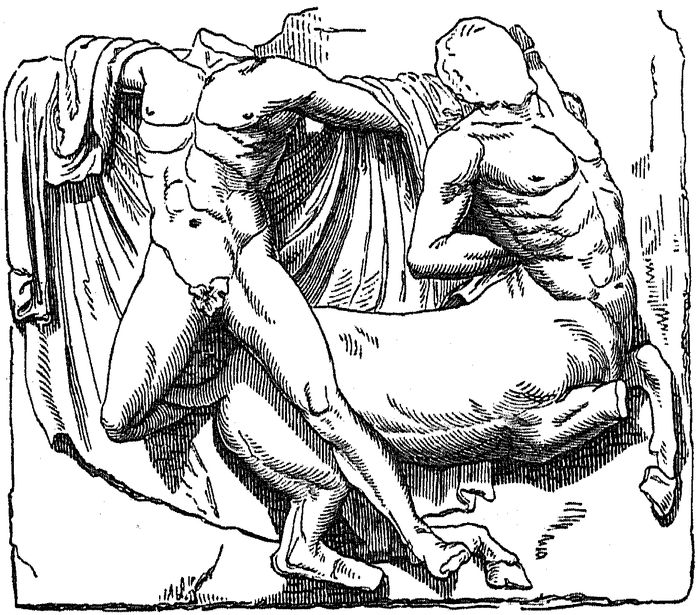
Fig. 48.—Metope of the Parthenon.
As we have already mentioned, the Centaurs play an important part in art. The custom of depicting them half horse and half man came into vogue after the time of Pindar, and was quickly adopted in sculpture. In the representations of earlier art the face of a man is joined to the body and hind legs of a horse. But in its higher stage of development, after the time of Phidias, this was replaced by a more elegant conception, and the body of a man from the navel upwards was joined to the complete body of a horse, so that the Centaurs of this period have the four feet of a horse and the hands and arms of a man. Such is their appearance on numerous extant art monuments, of which we shall mention the most important.
167In the first place, there are the reliefs from the frieze of the Theseum at Athens. This temple, which is still in a good state of preservation, was converted during the middle ages into a chapel of St. George. It is supposed to have been built at the instance of Cimon, after he had brought back the bones of the Attic hero from Scyros. Besides other important pieces, which we shall mention hereafter, the temple has, on its western or hinder frieze, a representation of the contests of the Centaurs and Lapithæ at the wedding of Pirithoüs, done in Parian marble. It is executed in such a manner that it is impossible to discover which party will get the upper hand; and this has enabled the artist, whose name has not come down to us, to introduce a lively variety into the different scenes of the combat.
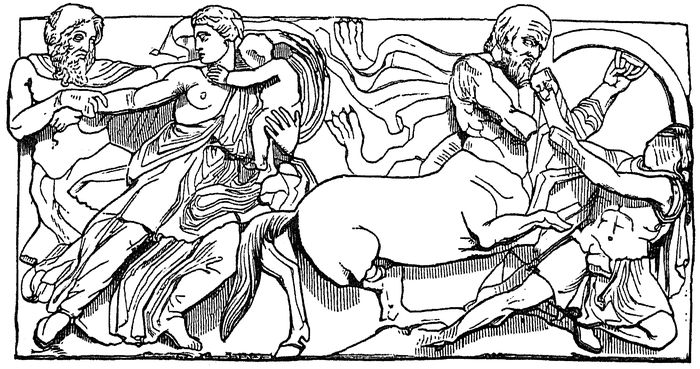
Fig. 49.—From the Frieze of the Temple at Bassæ.
We have another series of most splendid representations from the battle of the Centaurs, full of life and spirit, on some dilapidated metopes[6] of the Parthenon at Athens. This splendid specimen of Doric architecture is 227 feet in length and 101 feet in breadth. It was ruined in 1687, during the war between the Venetians and Turks, by a shell which broke through the midst of the marble roof. A large part of the ninety-two metopes of the outer frieze contain a number of the most beautiful and life-like scenes from the battle of the Giants and that of the Centaurs. Of these metopes, thirty-nine still remain on the temple, though they are all in a terribly mutilated condition; seventeen are in the British Museum, and one in the Louvre at Paris. Those from the south side are comparatively in the best state of preservation; these are seventeen in number, the 168whole number on the south side having been thirty-two. They represent, exclusively, scenes from the battle of the Centaurs. Here a bearded Centaur is carrying off a woman, whom he holds in his powerful grasp; there, another is galloping away over the body of his fallen enemy; another is engaged in a fierce contest with a human foe; whilst a fourth lies slain on the field. The engraving we append may give a faint idea of the beauty and bold design of this splendid creation (Fig. 48). To these grand monuments of Greek art we must add the frieze of the temple of Apollo Epicurius at Bassæ, near Phigalia in Arcadia, which was discovered in 1812, and is now in the British Museum. It represents, likewise, a series of the most vivid scenes from the battle of the Lapithæ and Centaurs. In the individual groups and scenes of the battle, which is here completed before our eyes, there is the same variety and animation, so that we must ascribe it to some great artist (Fig. 49).
Besides these sculptures in relief, some splendid single statues of Centaurs have come down to us from antiquity. Among these, the first place must be assigned to the two Centaurs in the Capitoline Museum. They are executed in black marble, and were found in the villa of Hadrian at Tivoli, where so many ancient art treasures have been brought to light.
Among the Centaurs, Chiron, who was famous alike for his wisdom and his knowledge of medicine, deserves mention as the preceptor of many of the heroes of antiquity. So far superior was he to his savage kindred, both in education and manners, that he was commonly reported to have had a different origin, and was therefore described as a son of Cronus and Philyra, or Phyllira, one of the Oceanids. Homer, who knew nothing of the equine shape of the Centaurs, represents him as the most upright of the Centaurs, and makes him the friend of Peleus and the preceptor of the youthful Achilles, whom he instructed in the art of healing and gymnastic exercises. He was, moreover, related to both these heroes, his daughter Endeïs having been the mother of Peleus. Subsequently, other mythical heroes were added to the number of his pupils, such as Castor and Polydeuces, Theseus, Nestor, Meleager, and Diomedes. Music, too, was now represented as a subject of his instruction, though this is perhaps due to a misinterpretation of the name of his 169mother. He inhabited a cave on Mount Pelion; later mythology, however, transferred his residence, after the Centaurs had been driven from Pelion by the Lapithæ, to the promontory of Malea. Here, by an unlucky accident, he was wounded with a poisoned arrow by his friend Heracles, and, the wound being incurable, he voluntarily chose to die in the place of Prometheus.
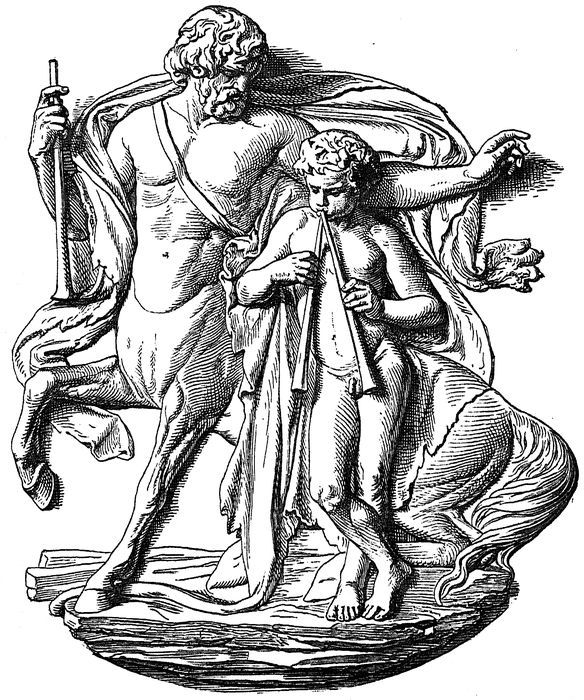
Fig. 50.—Centaur teaching a Boy to play upon the Pipe. Relief by Kundmann.
170The idea of the connection of the Centaurs with the arts and sciences originated in the story of Chiron and Achilles, and has since furnished modern art with the subjects for some of its most valuable works. Fig. 50 represents a Centaur teaching a boy to play on the flute, and is after an alto-relievo of the Viennese sculptor Kundmann.
2. Theban Legend.—1. Cadmus.—Among Theban legends, none is more celebrated than the founding of Thebes by Cadmus. Cadmus was a son of the Phœnician king Agenor. After Zeus carried off his sister Europa to Crete (vide the Cretan Legends), he was despatched by his father in search of her. Accompanied by his mother Telephassa, he came to Thrace and thence to Delphi, where he was commanded by the oracle to relinquish his quest. It further ordered him to follow a young heifer with the mark of a crescent on either side, and to build a town on the place where the heifer should lie down. Cadmus obeyed, and, finding the heifer in Phocis, he followed her. She led him into Bœotia, and at length lay down on a rising ground. On this spot Cadmus founded a town, which he called Cadmea, after himself, though he had first to experience a perilous adventure. Before sacrificing the heifer, he sent some of his companions to fetch water from a neighbouring spring, where they were slain by a dragon belonging to Ares which guarded the spring. Cadmus then went himself, and slew the dragon, the teeth of which he sowed in the ground by the advice of Pallas. Hereupon armed men sprang from the ground; they immediately turned their arms against each other, and were all slain except five. Cadmus built his new town with the assistance of these men, who thus became the ancestors of the noble families of Thebes. In expiation of the dragon’s death, Cadmus was obliged to do service to Ares for eight years. At the end 171of this period Ares pardoned Cadmus and gave him Harmonia—his daughter by Aphrodite—to wife. Harmonia became the mother of four daughters—Autonoë, Ino, Semele, and Agave. After reigning for a long time at Thebes, Cadmus was compelled in his old age to retire to the Enchelians in Illyria; but whether he was driven out by Amphion and Zethus (who appear in Homer as the founders of Thebes) or withdrew from some other cause is not manifest. He and his wife were afterwards changed into serpents, and transferred, by the command of Zeus, to the Elysian fields.
In this story we see another form of the combat of the hero with the monster, and can probably give it the same explanation. The dragon guards the waters, and the hero, by killing it, frees them. Do we not see in this the combat of the sun with the cloud; and in the armed men who turn their weapons against one another, the clouds that seem to fight with one another in the thunderstorm? Yet even admitting this interpretation, it may be that we have in the name of Cadmus an allusion to the civilisation and the arts received by the Greeks from the East. So, too, with the alphabet, the invention of which Hellenic tradition ascribed to him.
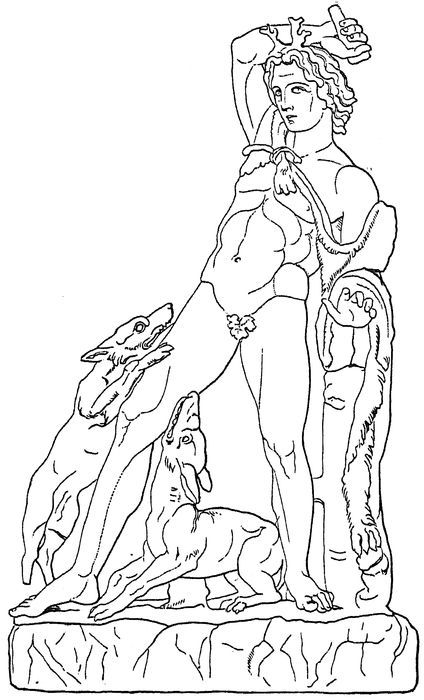
Fig. 51.—Actæon Group. British Museum.
2. Actæon.—We have already incidentally mentioned the fortunes of three of the daughters of Cadmus—Ino, Semele, and Agave. The eldest, Autonoë, married Aristæus, the son of Apollo, and became by him the mother of Actæon. Actæon was handed over to Chiron to be reared as a stout hunter and warrior; but he had scarcely reached the prime of youth when he was overtaken by a lamentable fate. Whilst hunting one day on Mount Cithæron, he was changed by Artemis into a stag, and was torn in pieces by his own dogs. The cause of her anger was either that Actæon had boasted that he was a more skilful hunter than Artemis, or that he had surprised the virgin goddess bathing. The latter tradition ultimately prevailed, and, 172in later times, even the rock whence he beheld Artemis was pointed out on the road between Megara and Platæa. He received heroic honours in Bœotia, and his protection was invoked against the deadly power of the sun in the dog-days. The story of Actæon is probably nothing but a representation of the decay of verdant nature beneath an oppressive summer heat.
The story of Actæon’s transformation and death was a favourite subject for sculpture. A small marble group, representing Actæon beating off two dogs which are attacking him, was found in 1774, and is now preserved in the British Museum (Fig. 51).
3. Amphion and Zethus.—Besides the royal family of Cadmus, which was continued in Thebes after his departure by his son Polydorus, we come across the scions of another ruling family of Thebes which came from Hyria, or Hysia, in Bœotia, in the persons of Amphion and Zethus. Nycteus, king of Thebes, had a wonderfully beautiful daughter called Antiope, whose favours Zeus enjoyed on approaching her in the form of a Satyr. On becoming pregnant, she fled from the resentment of 173her father to Sicyon, where the king, Epopeus, received her and made her his wife. This enraged Nycteus, who made war on Epopeus in order to compel him to deliver up his daughter Antiope. He was obliged to retire without accomplishing his purpose, but, on his death, he entrusted the execution of his vengeance to his brother Lycus, who succeeded him. Lycus defeated and slew Epopeus, destroyed Sicyon, and took Antiope back with him as prisoner. On the way, at Eleutheræ on Cithæron, she gave birth to the twins Amphion and Zethus. These were immediately exposed, but were subsequently discovered and brought up by a compassionate shepherd. Antiope was not only kept prisoner in the house of Lycus, but had also to submit to the most harsh and humiliating treatment at the hands of his wife Dirce. At length she managed to escape, and by a wonderful chance discovered her two sons, who had grown, on lonely Cithæron, into sturdy youths. The story of her wrongs so enraged them that they resolved to wreak a cruel vengeance on Dirce. After having taken Thebes and slain Lycus, they bound Dirce to the horns of a wild bull, which dragged her about till she perished. According to another story, Dirce came to Cithæron to celebrate the festival of Bacchus. Here she found her runaway slave, whom she was about to punish by having her bound to the horns of a bull. Happily, however, Amphion and Zethus recognised their mother, and inflicted on the cruel Dirce the punishment she had destined for another. Her mangled remains they cast into the spring near Thebes which bears her name.
174
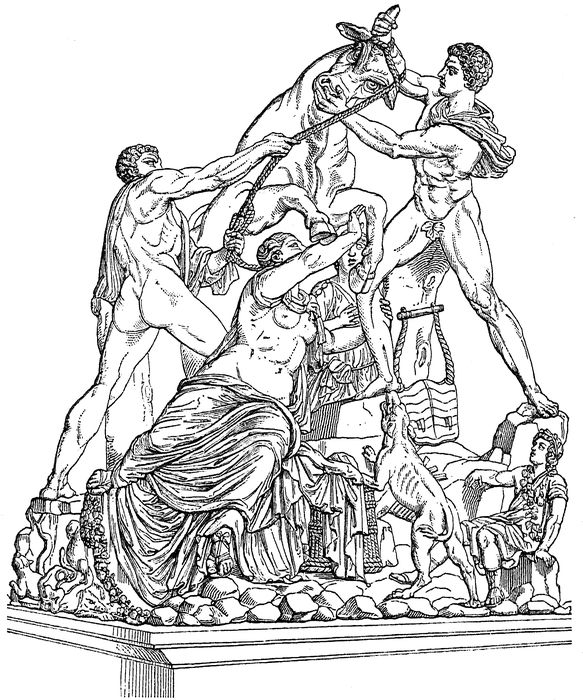
Fig. 52.—Farnese Bull. Naples.
The punishment of Dirce forms the subject of numerous pieces of sculpture. The most important among them is the Farnese Bull (Toro Farnese) in the museum at Naples (Fig. 52). This world-renowned marble group is supposed, with the exception of certain parts which have been restored in modern times, to have been the work of the brothers Apollonius and Tauriscus, of Tralles in Caria, Apollonius and Tauriscus belonged to the Rhodian school, which flourished in the third century B.C. This colossal group—undoubtedly the largest which has descended to us from antiquity—was first erected in Rhodes, but came, during the reign of Augustus, into the possession of Asinius Pollio, the great art-patron. It was discovered in 1547 in the Thermæ of Caracalla at Rome, and was set up in the Palazzo Farnese. It was thence transferred to Naples in 1786, as a portion of the Farnese inheritance. The following is a brief 175explanation of the group, though, of course, the most complete account could give but an imperfect idea of its beauty. The scene is laid on the rocky heights of Cithæron. The position of the handsome youths on a rocky crag is as picturesque as it is dangerous, and serves not only to lend the group a pyramidal aspect pleasing to the eye, but also to set before us their marvellous strength. There are several tokens that the occurrence took place during a Bacchic festival: the wicker cista mystica in use at the festivals of Dionysus—the fawn skin which Dirce wears—the ivy garland that has fallen at her feet—the broken thyrsus, and, lastly, the Bacchic insignia which distinguish the shepherd boy, who is sitting on the right watching the proceedings with painful interest—all point to this fact. The lyre which rests against the tree behind Amphion is a token of his well-known love of music. The female figure in the background is Antiope.
The story goes on to relate that the two brothers, after the expulsion and death of Lyons, acquired the sovereignty of Thebes, though Amphion always figures as the real king. The two brothers were widely different in disposition and character. Zethus appears to have been rude and harsh, and passionately fond of the chase. Amphion, on the other hand, is represented as a friend of the Muses, and devoted to music and poetry. He soon had an opportunity of proving his wondrous skill when they began to enclose Thebes, which had been before unprotected, with walls and towers; for whilst Zethus removed great blocks and piled them one on another by means of his vast strength, Amphion had but to touch the strings of his lyre and break forth into some sweet melody, and the mighty stones moved of their own accord and obediently fitted themselves together. This is why Amphion is always represented in sculpture with a lyre and Zethus with a club. We can scarcely doubt that these Theban Dioscuri, like the Castor and Polydeuces of Sparta, who are well known to be only symbols of the morning and evening star, were originally personifications of some natural phenomenon; though we are no longer in a position to say what it was.
176Amphion is further celebrated on account of the melancholy fate of his sons and daughters. He married Niobe, the daughter of the Phrygian king Tantalus, and sister of Pelops. Great was the happiness of this marriage; the gods seemed to shower down their blessings on the royal pair. Many blooming and lovely children grew up in their palace, the pride and delight of their happy parents. From this paradise of purest joy and happiness they were soon to pass into a night of the deepest mourning and most cruel affliction through the presumption of Niobe—the same presumption which had led her father Tantalus to trifle with the gods and consummate his own ruin. The heart of Niobe was lifted up with pride at the number of her children,[7] and she ventured to prefer herself to Latona, who had only two; nay, she even went so far as to forbid the Thebans to offer sacrifice to Latona and her children, and to claim these honours herself. The vengeance of the offended deities, however, now overtook her, and all her children were laid low in one day before the unerring arrows of Apollo and his sister. The parents did not survive this deep affliction. Amphion slew himself, and Niobe, already paralysed with grief, was turned into stone by the pity of the gods, and transferred to her old Phrygian home on Mount Sipylus, though even the stone has not ceased to weep.
Such is the substance of this beautiful legend, though its details vary considerably in the accounts of the poets and mythologists. The most circumstantial and richly-coloured account of it is contained in the Metamorphoses of Ovid. The poets 177have continually striven to impose a purely ethical interpretation on the story, by representing the destruction of the children of Niobe as the consequence of the great sin of their mother; but it is more probably a physical meaning which lies at the root of the legend. It is, in fact, a picture of the melting of the snow before the hot scorching rays of the sun. This incident the fertile imagination of the Greeks portrayed in the most beautiful metaphors. But just as a subject so purely tragic as the history of Niobe found its first true development in tragic poetry, so likewise it only attained its proper place in sculpture after art had laid aside its earlier and more simple epic character, and set itself to depict, in their full force, the inward passions of the soul. This tendency towards pathos and effect is characteristic of the age of Praxiteles and Scopas, and the later Attic school.
To this age (4th century B.C.) belonged the group of Niobe, which was so highly celebrated even among the ancients, and which was seen by Pliny in the temple of Apollo Sosianus at Rome, although people even then hesitated whether to ascribe it to Praxiteles or Scopas. None but one of these great masters could have been the author of this tragedy hewn in stone. Although the original figures of this magnificent group have disappeared, yet copies of most of them are still in existence. With regard to the celebrated Florentine Niobe group, the dissimilarity of its treatment and the various kinds of marble employed serve to show that it is not a Greek original, but a Roman imitation. It was found at Rome in 1583, near the Lateran Church, and was purchased by Cardinal Medici to adorn his villa on the Monte Pincio. In 1775 it was brought to Florence, where it has remained since 1794 in the gallery of the Uffizi.
There has never been but one opinion as to the beauty of this group. First among the figures—not only in size, but also in artistic perfection—is that of Niobe herself. The unhappy queen displays in her whole hearing so majestic and noble a demeanour, that, even if none of the other splendid results of Greek sculpture had come down to us, this alone would bear ample testimony to the high perfection and creative power of Greek art. The following description of the arrangement of the group is taken from Lübke’s History of Plastic Art:—
178
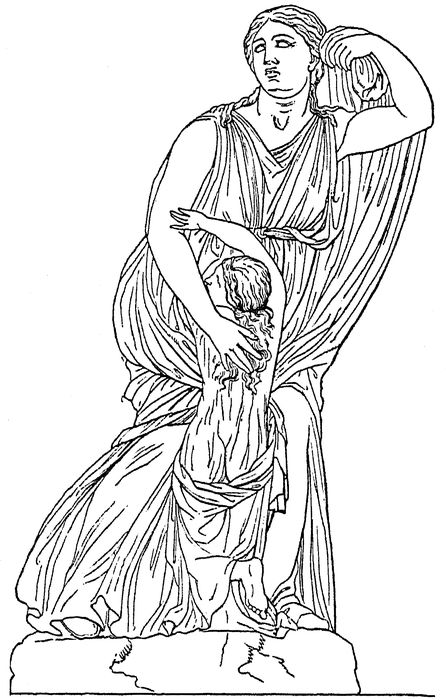
Fig. 54.—Niobe. Florence.
“Apollo and Artemis are to be supposed outside the group; they have accomplished their work of vengeance and destruction from an invisible position in the heavens. This is denoted by each movement of the flying figures, who either gaze upwards in affright towards the heavens, or seek to cover themselves with their garments. One of the sons is already stretched dead on the earth; another leans in mortal agony against a rock, fixing his eyes, already glazed in death, on the spot whence destruction has overtaken him. A third brother is striving in vain to protect with his robe his sister, who has fallen wounded at his feet, and to catch her in his arms; another has sunk on his knees, and clutches in agony at the wound in his back; whilst his preceptor is endeavouring to shield the youngest boy. All the others are fleeing instinctively to their mother, thinking, doubtless, that she who had so often afforded protection could save them also from the avenging arrows of the gods. Thus from either side the waves of this dreadful flight rush towards the centre, to break on the sublime figure of Niobe as upon a rock. She alone stands unshaken in all her sorrow, mother and queen to the last. Clasping her youngest daughter, whose tender years have not preserved her, in her arms, and bending over as though to shield the child, she turns her own proud head upwards, and, before her left hand can cover her sorrow-stricken face with her robe, she casts towards the avenging goddess a look in which bitter grief is blended with sublime dignity of soul (Fig. 54). In this look there is neither defiance 179nor prayer for mercy, but a sorrowful and yet withal lofty expression of heroic resignation to inexorable fate that is worthy of a Niobe. This admirable figure, then, is pre-eminently the central point of the composition, since it expresses an atonement which, in a scene of horror and annihilation, stirs the heart to the deepest sympathy.”
Zethus was not more fortunate than Amphion in his domestic affairs. He married Aëdon (nightingale), the daughter of Pandareos. Pandareos was the friend and companion of Tantalus, for whom he stole a living dog made of brass from the temple of Zeus in Crete, and was on that account turned into stone.
Aëdon was jealous of the good-fortune of Niobe in having so many beautiful children; she herself having only one son, Itylus. She resolved, one night, to slay the eldest son of Niobe, but she killed, in mistake, her own child instead. Zeus took compassion on her, and changed her into a nightingale. In this guise she still continues to bewail her loss in long-drawn mournful notes. Tradition says nothing as to the death of Zethus, although the common grave of the Theban Dioscuri was pointed out in Thebes. After his death, Laius, the son of Labdacus and grandson of Polydorus, restored in his person the race of Cadmus to the throne of Thebes. (See the legend of the Labdacidæ later on.)
3. Corinthian Legend.—1. Sisyphus.—Corinth, or Ephyra, as it was formerly called, was said to have been founded by Sisyphus, the son of Æolus. Its inhabitants, on account of the position of their city between two seas, were naturally inclined to deify that element, and it is not improbable that Sisyphus was merely an ancient symbol of the restless, ever-rolling waves of the sea. This interpretation, however, is by no means certain; and the idea of Sisyphus in the lower world ever rolling a huge stone to the top of a mountain might equally well refer to the sun, which, after attaining its highest point in the heavens at the time of the summer solstice, glides back again, only to begin 180its career anew on the shortest day. In any case, the rolling of the stone does not appear to have been originally a punishment. It was only later—after people had become familiar with the idea of retribution in the lower world—that it assumed this character. In order to account for it, a special crime had to be found for Sisyphus. According to some, he was punished at the instance of Zeus, because he had revealed to the river-god Asopus the hiding-place of his daughter Ægina, whom Zeus had secretly carried off from Phlius. According to another tradition, he used to attack travellers, and put them to death by crushing them with great stones. The Corinthians being crafty men of business, it was natural that they should accredit their mythical founder with a refined cunning. Of the numerous legends which existed concerning him, none was more celebrated than that of the cunning mode in which he succeeded in binding Death, whom Ares had to be despatched to release.
2. Glaucus.—Tradition describes Glaucus as a son of Sisyphus by Merope. He also appears to have had a symbolic meaning, and was once identical with Poseidon, though he was afterwards degraded from the rank of a god to that of a hero. He is remarkable for his unfortunate end. On the occasion of some funeral games, celebrated in Iolcus in honour of Pelias, he took part in the chariot race, and was torn in pieces by his own horses, which had taken fright.
3. Bellerophon and the Legend of the Amazons.—The third national hero of Corinth was Bellerophon, or Bellerophontes. Here the reference to the sun is so obvious, that the signification of the myth is unmistakeable. He was termed the son of Poseidon or Glaucus, and none could appreciate this genealogy better than the Corinthians, who daily saw the sun rise from the sea. We must first, however, narrate the substance of the story. Bellerophon was born and brought up at Corinth, but was obliged from some cause or other to leave his country. That he 181killed Bellerus, a noble of Corinth, is nothing but a fable arising from an unfortunate misinterpretation of his name. He was hospitably received by Prœtus, king of Tiryns, whose wife at once fell in love with the handsome, stately youth. Finding, however, that Bellerophon slighted her passion, she slandered him to her husband, and Prœtus forthwith sent him to his father-in-law, Iobates, king of Lycia, with a tablet, mysterious signs on which bade Iobates put the bearer to death. At this juncture the heroic career of Bellerophon begins. Iobates sought to fulfil the command of Prœtus by involving his guest in all kinds of desperate adventures. He first sent him to destroy the Chimæra, a dangerous monster that devastated the land. The fore part of its body was that of a lion, the centre that of a goat, and the hinder part that of a dragon. According to Hesiod, it had three heads—that of a lion, a goat, and a dragon. According to the same poet, the Chimæra was a fire-breathing monster of great swiftness and strength, the daughter of Typhon and Echidna. Bellerophon destroyed the monster by raising himself in the air on his winged horse Pegasus, and shooting it with his arrows. Pegasus was the offspring of Poseidon and Medusa, from whose trunk it sprung after Perseus had struck off her head. Bellerophon captured this wonderful animal as it descended at the Acro-Corinthus to drink of the spring of Pirene. In this he was assisted by the goddess Athene, who also taught him how to tame and use it. Here, then, he appears to have already possessed the horse at Corinth; though another tradition relates that Pegasus was first sent to him when he set out to conquer the Chimæra. The origin of the story is ascribed to a fiery mountain in Lycia; but, as all dragons and suchlike monsters of antiquity are represented as breathing forth fire and flames, we are perhaps scarcely justified in having recourse to a volcano. This characteristic is, in fact, merely a common symbol of the furious and dangerous character of these monsters. 182The contest of Bellerophon is far more likely to be a picture of the drying up, by means of the sun’s rays, of the furious mountain torrents which flood the corn-fields. Others, again, have thought that the Chimæra represents the storms of winter conquered by the sun.
The next adventure in which Iobates engaged Bellerophon was an expedition against the Solymi, a neighbouring but hostile mountain tribe. After he had been successful in subduing them, Iobates sent him against the warlike Amazons, hoping that among them he would be certain to meet his death. We here, for the first time, come across this remarkable nation of women, with whom other Greek heroes, such as Heracles and Theseus, are said to have fought; and it will not, therefore, be foreign to our object to dwell here on their most important features.
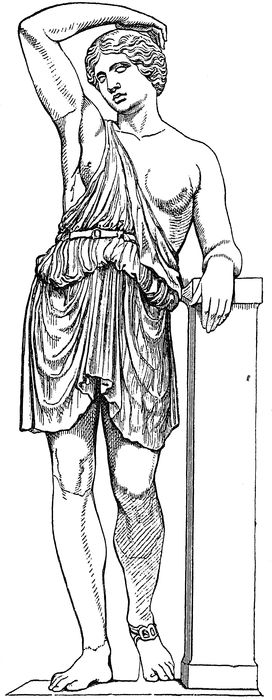
Fig. 55—Amazon. Berlin.
The Amazons appear in legend as early as Homer, though he only mentions them incidentally. They were said to be a nation of women, who suffered no men among them, except so far as it was necessary to keep up the race. The women, on the other hand, were trained from their earliest years in all warlike exercises; so that they were not only sufficiently powerful to defend their own land against foreign invaders, but also to make plundering incursions into other countries. Their dominions, the situation of which was at first indefinitely described as in the far north or far west, were afterwards reduced to more distinct limits, and placed in Cappadocia, on the river Thermodon, their capital being Themiscyra in Scythia, on the borders of Lake Mæotis, where their intercourse with the Scythians is said to have given rise to the Sarmatian tribes. Later writers also speak of the Amazons in Western Libya. Of the numerous stories rife concerning them, none is more tasteless than that of their cutting off or burning out the right breast, in order not to incommode themselves in the 183use of the bow. From the Thermodon they are said to have made great expeditions as far as the Ægean sea; they are even reported to have invaded Attica, and made war on Theseus. They also play a prominent part in the story of Heracles, by whom they were defeated; and in the Trojan war, when, under their queen Penthesilea, they came to the assistance of Priam against the Greeks.
The Amazons were frequently represented in Greek art. They are here depicted as fine, powerful women, resembling Artemis and her nymphs, though with stouter legs and arms. They generally appear armed, their weapons being a long double-edged battle-axe (bipennis) and a semicircular shield. An anecdote related by Pliny proves what a favourite subject the Amazons were with Greek artists. He says that the celebrated sculptors, Phidias, Polycletus, Phradmon, and Cresilas, made a wager as to who should create the most beautiful Amazon. Polycletus received the prize, so that we may conclude that he 184brought this statue—the ideal Amazon of the Greeks—to its highest perfection. Unfortunately, we know nothing of it, except that it was of bronze, and stood with the statues of the other artists in the temple of the Ephesian Artemis. The Amazon of Phidias, we are told, was represented as leaning on a spear; Cresilas, on the other hand, endeavoured to portray a wounded Amazon. Besides these statues, we hear a great deal of the Amazon of Strongylion, celebrated for the beauty of her legs, which was in the possession of Nero.
We still possess a considerable number of Amazon statues, some of which are supposed to be imitations in marble of the renowned statue at Ephesus. There are, moreover, several statues of wounded Amazons, some of which are believed to be copies of the work of Cresilas. There is also another marble statue, considerably larger than life, which takes a still higher rank. It was originally set up in the Villa Mattei, but since the time of Clement XIV. it has been in the Vatican collection. It is apparently a representation of an Amazon resting after battle; she is in the act of laying aside her bow, as she has already done her shield, battle-axe, and helmet. In doing so she raises herself slightly on her left foot, an attitude which is as charming as it is natural.
Lastly, we must not omit to mention a statue that has newly come into the possession of the Berlin Museum, which is supposed to be after a work of Polycletus (Fig. 55).
We must now return to the history of Bellerophon. After returning in triumph from his expedition against the Amazons, the life of the young hero was once more attempted by Iobates, who caused him to be surprised by an ambuscade. Bellerophon, however, again escaped, slaying all his assailants. Iobates now ceased from further persecution, and gave him his daughter in marriage, and a share in the kingdom of Lycia. Bellerophon, in full possession of power and riches, and surrounded by blooming children, seemed to have reached the summit of earthly prosperity, when he was overtaken by a grievous change of fortune. He was seized with madness, and wandered about alone, fleeing the society of men, until he at length perished miserably. Pindar says that he incurred the enmity of the gods by attempting to fly to heaven on his winged horse Pegasus; whereupon Zeus sent a gadfly to sting the horse. Pegasus cast 185off Bellerophon, and flew of his own accord to the stables of Zeus, whose thunder-chariot he has ever since drawn. The sad fate of Bellerophon was the subject of a touching tragedy of Euripides, some parts of which are still in existence. Heroic honours were paid to Bellerophon in Corinth, and he also had a shrine in the celebrated cypress-grove of Poseidon.
4. Argive Legend.—1. Io.—The first personage who meets us on the very threshold of the mythic age of Argos is Inachus, the god of the Argive river of that name. Inachus was venerated by the inhabitants as the first founder of Argive civilisation after the flood of Deucalion. By his union with Melia, the daughter of Oceanus, he became the father of Io, famed for her beauty, whose history, which is of great antiquity, has been so greatly embellished by the poets and legendary writers. The following is the substance of the story:—
Io was the priestess of Hera. Her great beauty attracted the notice of Zeus. On remarking this, Hera, in her jealousy, changed Io into a white heifer, and set the hundred-eyed Argus Panoptes (the all-seeing) to watch her. Zeus, however, sent Hermes to take away the heifer. Hermes first lulled the guardian to sleep with his wand and then slew him, whence he is called Argiphontes (slayer of Argus). Hera avenged herself by sending a gadfly to torment Io, who, in her madness, wandered through Europe and Asia, until she at length found rest in Egypt, where, touched by the hand of Zeus, she recovered her original form, and gave birth to a son. This son, who was called Epaphus, afterwards became king of Egypt, and built Memphis. The myth, as we have already remarked, has received many embellishments, for the wanderings of Io grew more and more extensive with the growth of geographical knowledge. The true interpretation of the myth is due to F. W. Welcker, whose meritorious researches in Greek mythology have 186proved of such great value. Io (the wanderer) is the moon, whose apparently irregular course and temporary disappearance was considered a most curious phenomenon by the ancients. The moon-goddess of antiquity was very frequently represented under the figure of a heifer; and Isis herself, the Egyptian goddess of the moon, was always depicted with horns. The guardian of the heifer, the hundred-eyed Argus, is a symbol of the starry heaven. Whether we see in Hermes the dawn or the morning breeze, in either case the slaying of Argus will simply mean that the stars become invisible at sunrise. There is nothing extraordinary in representing the apparent irregularity of the moon’s course, inexplicable as it was to the ancients, under the guise of mental disorder. Similar representations occur in the stories of the solar heroes, Bellerophon and Heracles. In the south-east—the direction in which Egypt lay from Greece—Io again appears as full moon, in her original shape.
2. Danaüs and the Danaïds.—According to the legend, Danaüs was a descendant of Io. Epaphus, the son of Io, had a daughter Libya, who bore to Poseidon two sons, Agenor and Belus. The former reigned over Phœnicia, the latter over Egypt. Belus, by his union with Anchinoë, or Achiroë, the daughter of the Nile, became the father of Ægyptus and Danaüs. Between these two brothers—the former of whom had fifty sons and the latter fifty daughters—a deadly enmity arose; this induced Danaüs to migrate from Egypt and seek the old home of his ancestress Io. He embarked with his fifty daughters in a ship—the first that was ever built—and thus came to Argos, where Gelanor, the reigning descendant of Inachus, resigned the crown in his favour. As king of Argos, Danaüs is said to have brought the land, which suffered from want of water, to a higher state of cultivation by watering it with wells and canals. He is also said to have introduced the worship of Apollo and Demeter. The story proceeds to relate that the fifty sons of Ægyptus followed their uncle to Argos, and compelled 187him to give them his fifty daughters in marriage. Danaüs, in revenge, gave each of his daughters on the wedding day a dagger, and commanded them to slay their husbands in the night. All obeyed his command except Hypermnestra, who spared her husband Lynceus, and afterwards even succeeded, with the assistance of Aphrodite, in effecting his reconciliation with her father. Lynceus succeeded Danaüs in the kingdom, and became, by his son Abas, the ancestor of both the great Argive heroes, Perseus and Heracles. At a later period, the fable sprang up that the Danaïds were punished for their crimes in the lower world by having continually to pour water into a cask full of holes. It has been frequently remarked that this punishment has no conceivable connection with the crime. Neither must we forget that the idea of retribution in the lower world was of a comparatively late date. Originally, too, the idea prevailed that the pursuits of the upper world were continued after death in the realms of Hades. And herein lies the key to the interpretation of the myth, which is evidently connected with the irrigation of Argos ascribed to Danaüs.
3. Prœtus and his Daughters.—Acrisius and Prœtus were twin sons of Abas, the son of Lynceus and Hypermnestra. Between these two brothers an implacable hostility existed, which was said by the poets to have commenced even in their mother’s womb. Prœtus received, as his share of the patrimony, the kingdom of Tiryns; but he was subsequently expelled by his brother, and took refuge at the court of Iobates, king of Lycia. Iobates gave him his daughter Antea, or Sthenebœa, in marriage, and afterwards restored him to his kingdom of Tiryns. Prœtus, with the aid of the Lycian workmen whom he had brought with him (Cyclopes), built a strong fortress, which enabled him not only to maintain peaceable possession of Tiryns, but also to extend his dominion as far as Corinth. The legend then passes to the history of his three 188daughters, the Prœtides, whose pride was so excited by their father’s greatness and their own beauty that they began to think themselves superior to the gods. Their arrogance, however, was soon punished, for they were visited with a foul disease and driven mad. They now fled the society of mankind, and wandered about among the mountains and woods of Argos and Arcadia. At length Prœtus succeeded in procuring the services of the celebrated soothsayer and purifier Melampus, who undertook the purification and cure of his daughters. It was reported of Melampus that serpents had licked his ears whilst asleep, and that he acquired, in consequence, a knowledge of the language of birds. He successfully accomplished the cure of the Prœtides, and received, as a reward, the hand of the princess Iphianassa, in addition to which both he and his brother Bias received a share in the sovereignty of Tiryns. Thus it was that the race of the Amythaonidæ, who all inherited the gift of seeing into futurity, and from whom the celebrated soothsayer Amphiaraüs himself was descended, came to Argos.
4. Perseus.—Acrisius, the brother of Prœtus, had a daughter called Danaë, whose fortune it was to gain the love of the great ruler of Olympus. Her father, Acrisius, was induced by an oracle, which foretold that he should be killed by his own grandson, to immure Danaë in a subterraneous chamber. Zeus, however, in his love for her, changed himself into a shower of golden rain, and thus introduced himself through the roof of her prison. Thus was the god-like hero Perseus born. There can be no doubt that this myth, too, is founded on the idea of the bridal union of heaven and earth; this is one of the pictures of nature which the mind most readily forms. Danaë represents the country of Argos; her prison is the heaven, enveloped, during the gloomy months of winter, with thick clouds. Her offspring by Zeus represents the light of the sun, which returns in the spring-time and begins, like a veritable hero, its contest 189with the powers of death and darkness. The Gorgon Medusa has the same significance in the history of Perseus that the hideous Python has in that of Apollo.
The legend then proceeds to relate that Acrisius, having heard of the birth of his grandson, to avert the fate threatened by the oracle, ordered mother and child to be confined in a chest and cast into the sea. But human wisdom avails nought against the inevitable decrees of heaven. The chest was cast by the waves on the rocky island of Seriphus, where it was found by the fisherman Dictys; and Danaë and her child were hospitably received and cared for by Dictys and his brother Polydectes, the ruler of the island. The latter, however, subsequently wished to marry Danaë, and on her rejecting his advances made her a slave. Fearing the vengeance of Perseus, he despatched him, as soon as he was grown up, on a most perilous adventure. This was no other than to bring him the head of the Gorgon Medusa—a terrible winged woman, who dwelt with her two sisters, the daughters of Phorcys and Ceto, on the farthest western shore of the earth, on the border of Oceanus. Perseus set out, though he was in the greatest perplexity how to accomplish so perilous a task. Hermes, however, at this juncture came to his aid; and Athene, the special patroness of heroes, inspired him with courage. These deities first showed him how to procure the necessary means for accomplishing his undertaking, which consisted of an invisible helmet, a magic wallet, and a pair of winged sandals. All these were in the hands of the Nymphs, by whom probably the water-nymphs are meant. The way to their abode he could only learn from the Grææ. These creatures, who were likewise the daughters of Phorcys and Ceto, were reported to have come into the world as old women; their very appearance was appalling, and they had but one eye and one tooth between them, of which they made use in turn. They, too, dwelt on the outskirts of the gloomy region inhabited by 190the Gorgons, whence they are called by Æschylus their sentinels. Under the guidance of Apollo and Athene, Perseus came to the Grææ. He then robbed them of their one eye and one tooth, and thus forced them to tell him the way to the habitations of the Nymphs. From the latter he at once obtained the objects he sought; and having donned his winged sandals, he hastened to the abode of the Gorgons, whom he fortunately discovered asleep. Athene then pointed out to him Medusa—the other two sisters, Stheno and Euryale, being immortal—and enjoined him to approach them carefully backwards, as the sight of their faces would infallibly turn any mortal into stone. With the help of her mirror-like shield and the sickle of Hermes, Perseus succeeded in cutting off the head of Medusa without looking round; and having placed the head in his wallet, he hastened away. His helmet, which rendered him invisible, enabled him to escape the pursuit of the other Gorgons, who had meanwhile awaked. From the trunk of Medusa sprang the winged horse Pegasus, and Chrysaor, the father of Geryones. On his return to Seriphus, Perseus turned the unrighteous Polydectes into stone by means of the Gorgon’s head, which he then presented to Athene; and after making his benefactor, Dictys, king of the island, he turned his steps towards his native place, Argos. Such are the essential features of the myth—concerning which, in spite of its antiquity, we have no earlier sources of information—such is the original framework on which was afterwards built up the history of the further adventures of the hero. The most celebrated of these was the rescue of Andromeda, which formed the subject of a drama of Euripides, and was also highly popular among artists and poets. The following is a brief account of this exploit:—Cassiopea, the wife of Cepheus, king of Æthiopia, ventured to extol her own beauty above that of the Nereids, who thereupon besought Poseidon to avenge them. He granted their request, and not only overwhelmed the land 191with disastrous floods, but sent also a terrible sea-monster, which devoured both man and beast. The oracle of Ammon declared that the land could only be saved by the sacrifice of the king’s daughter, Andromeda, to the monster. Cepheus, after some time, yielded to the entreaties of his people, and Andromeda was chained to a rock close to the sea. In this situation she was found by Perseus, on his return from his adventure with the Gorgons. He forthwith attacked and slew the sea-monster, and released the trembling maiden, who soon after married her preserver. Later writers, not satisfied with this adventure, added that Perseus was also obliged to vanquish a rival in Phineus, the king’s brother, to whom Andromeda had been already promised. Phineus, together with his warriors, was changed into stone by means of the Gorgon’s head.
The legend concludes with the return of the hero to Argos, where he was reconciled to his grandfather Acrisius, who had at first fled in terror to Larissa. On the occasion, however, of some games which the people of Larissa had instituted in his honour, Perseus was unfortunate enough to kill Acrisius with his discus, thus involuntarily fulfilling the prophecy of the oracle. In this feature of the story we recognise an unmistakeable reference to the symbolic meaning of Perseus; for the discus here represents, as in the story of the death of Hyacinthus, the face of the sun. Perseus, unwilling to enter on the inheritance of the grandfather he had slain, exchanged the kingdom of Argos for that of Tiryns, which was handed over to him by its king, Megapenthes, the son of Prœtus. He here founded the cities of Midea and Mycenæ, and became, through his children by Andromeda, the ancestor of many heroes, and, among others, of Heracles. His son Electryon became the father of Alcmene, whilst Amphitryon was descended from another of his sons. According to Pausanias, heroic honours were paid to Perseus, not only throughout Argos, but also in Athens and the island of Seriphus.
192Perseus occupies a prominent position in Greek art. His common attributes are the winged sandals, the sickle which he made use of to slay Medusa, and the helmet of Hades. In bodily form, as well as in costume, he appears very like Hermes.
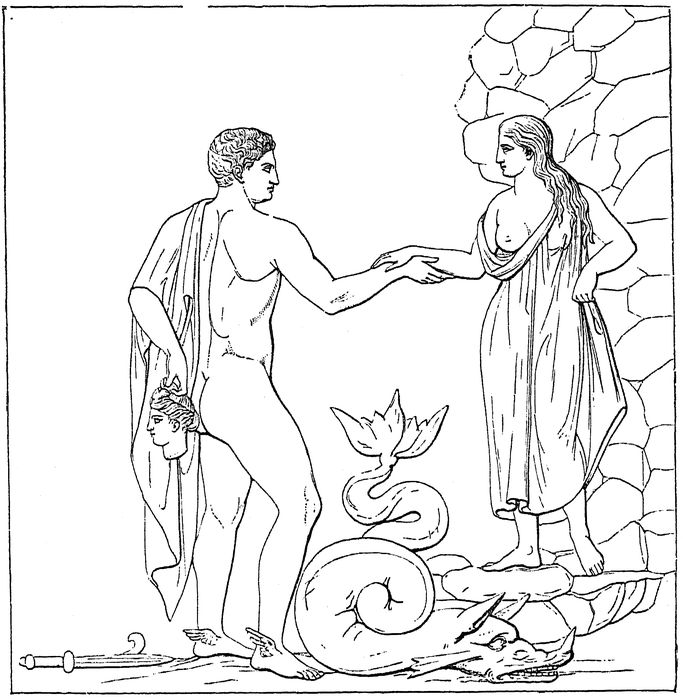
Fig. 56.—Perseus and Andromeda. Marble Relief in the Museum at Naples.
Among the art monuments which relate to his adventures is a marble relief from the Villa Pamfili, now in the Capitoline Museum at Rome, depicting the rescue of Andromeda. The sea-monster lies dead at the feet of Perseus, who is assisting the joyful Andromeda to descend from the rock. The attitude and expression of both figures are very striking: on the one side, maidenly modesty; on the other, proud self-reliance. It is worth remarking that Perseus, in addition to his winged shoes, has also wings on his head. The same conception 193is perceptible, with a few minor points of difference, in several Pompeian paintings, and on a marble relief of the Naples Museum (Fig. 56). Representations of Medusa are mostly confined to masks, which are often found on coats of mail, shields, leaves of folding doors, and instruments of all kinds. There are two types, representing an earlier and a later conception of Medusa. Earlier art set itself to depict the horrible only in the head of Medusa; and artists, therefore, strove to impart to the face as strong an expression of rage and ferocity as was possible, representing her with tongue lolling forth, and boar-like tusks. It is worthy of remark that, in the earlier examples of these masks—which are frequently met with on coins, gems, and pottery—the hair generally falls stiff and straight over the forehead, serving to render the horrible breadth of the face still more striking, while the snakes appear to be fastened round the neck like a necklace. Very different is the conception adopted by the later and more sensuous school. This laboured principally to give expression to the gradual ebbing away of life in the countenance of the dying Gorgon, an effect which was rendered still more striking by transforming the hideous Gorgon face of earlier times into an ideal of the most perfect beauty. The most splendid example of this later conception, which had been creeping in since the age of Praxiteles, is to be found in the Medusa Rondanini of the Munich collection—a marble mask of most beautiful workmanship, which was brought from the Rondanini Palace at Rome (Fig. 57). This Medusa, like many others of the later type, has wings on the head.
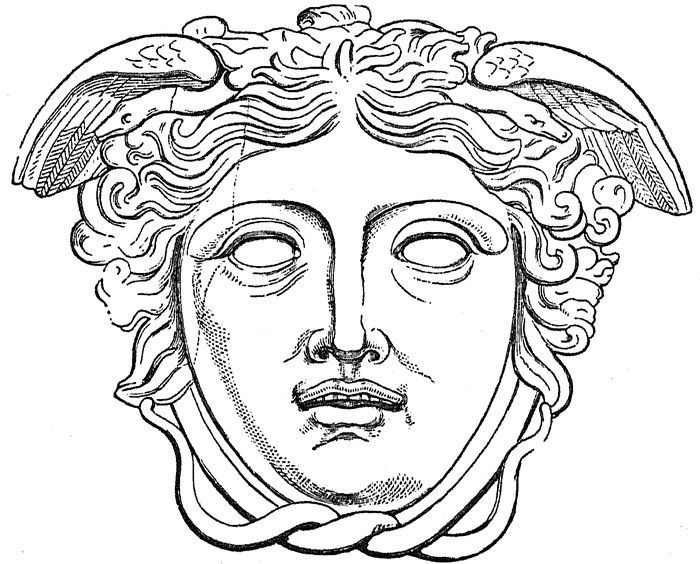
Fig. 57.—Rondanini Medusa. Munich.
1945. The Dioscuri.—On passing to Laconia and Messenia, the southern districts of the Peloponnesus, we come in contact with the legend of the Dioscuri. Tyndareüs and his brother Icarius were said to have founded the most ancient sovereignty in Lacedæmon. They were driven thence, however, by their half-brother Hippocoön, and were kindly received by Thestius, the ruler of the ancient city of Pleuron in Ætolia, who gave Tyndareüs his daughter Leda in marriage. Icarius received the hand of Polycaste, who bore him Penelope—afterwards the wife of Odysseus; while Leda was the mother of the Dioscuri, Castor and Polydeuces (Pollux). Tyndareüs was afterwards reinstated in his Lacedæmonian kingdom at Amyclæ by Heracles. Besides these two sons, Leda had also two daughters, Clytæmnestra and Helene (Helen), who are celebrated in connection with the Trojan war. An ancient legend also existed to the effect that Leda had been beloved by Zeus, who had approached her under the guise of a swan. The greatest incongruity prevails as to which of the children could claim a divine origin. In Homer, Helen alone is represented as the daughter of Zeus; while Clytæmnestra, together with Castor and Polydeuces, appear as the children of Tyndareüs. At a subsequent period, the name of “Dioscuri” (sons of Zeus) and a belief in their divine origin arose simultaneously. Later still, Castor was represented as a mortal, and the son of Tyndareüs; and Polydeuces as immortal, and the son of Zeus. After Castor, however, had fallen in the contest with the sons of Aphareus, his brother Polydeuces, unwilling to part from him, prevailed on Zeus to allow them to remain together, on condition of their spending one day in Olympus and the next in Hades. They thus led a life divided between mortality and immortality. The following is an account of their heroic deeds:—On attaining manhood, Castor distinguished 195himself by his skill in the management of horses; whilst Polydeuces became renowned as a skilful boxer, though he too had skill in riding. They first made war on Theseus, who had carried off their sister Helen, then ten years old, and set her free by the conquest of Aphidnæ. They next took part in the expedition of the Argonauts, in which Polydeuces gained still further renown by his victory with the cestus over the celebrated boxer Amycus. They were also present at the Calydonian boar hunt. Their last undertaking was the rape of the daughters of Leucippus, king of Messenia. This was the cause of their combat with their cousins Idas and Lynceus, the sons of Aphareus, to whom the damsels had been betrothed. According to others, however, it sprang from a quarrel as to the division of some booty that they had carried off together. Castor was slain by Idas, whereupon Polydeuces in his wrath slew Lynceus, while Idas himself was overwhelmed by a thunderbolt from Zeus.
The interpretation of this myth is by no means void of difficulty. It is commonly supposed that they were ancient Peloponnesian divinities of light, who, after the Dorian invasion, were degraded to the rank of heroes. They are often interpreted as personifications of the morning and evening star, or of the twilight (dawn and dusk). This view died out after the second deification that they underwent. They were venerated, not only in their native Sparta, but throughout the whole of Greece, as kindly, beneficent deities, whose aid might be invoked either in battle or in the dangers of shipwreck. In this latter character they are lauded by an Homeric hymn, in which they are represented as darting through the air on their golden wings, in order to calm the storm at the prayer of the terror-stricken mariner. It has often been remarked, and with a great appearance of truth, that these Dioscuri flitting about on their golden wings are probably nothing more than what is commonly called St. Elmo’s 196fire—an electric flame which, is often seen playing round the tops of the masts during a storm, and which is regarded by the sailors as a sign of its speedy abatement; indeed the name Elmo has been supposed a corruption of Helene. In Sparta, the Dioscuri were regarded as the tutelary deities of the state, as well as an example of warlike valour for the youth of the country. Their shrines here were very numerous. Their ancient symbol, which the Spartans always took with them on a campaign, consisted of two parallel beams joined by cross-bars. They had other festivals and temples besides those of Sparta; in Mantinea, for instance, where an eternal fire was kept burning in their honour; also in Athens, where they were venerated under the appellation of Anaces. Their festival was here celebrated with horse-racing. The Olympic games also stood under their special protection, and their images were set up in all the palæstra. They were, in fact, everywhere regarded as extremely benevolent and sociable deities, who foster all that is noble and beautiful among men.
The Dioscuri were believed to have assisted the Romans against the Latins at the Lake Regillus; and the dictator, A. Postumius, vowed a temple to them, which was erected in the Forum, opposite the temple of Vesta. In commemoration of this aid, the Equites made a solemn procession from the temple of Honos, past the temple of the Dioscuri, to the Capitol every year on the Ides of July.
In art the Dioscuri are represented as heroic youths of noble mien and slim but powerful forms. Their characteristic marks are conical caps, the points of which are adorned with a star. They generally appear nude, or clothed only with a light chlamys, and nearly always in connection with their horses, either riding, standing by and holding them, or leading them by the bridle. The most celebrated representation of the Dioscuri that has come down to us from antiquity consists of the marble statues called the Colossi of Monte Cavallo, in Rome. These are eighteen feet in height, and the proportions of the figures, together with those of the horses, are exquisite. 197They are set up on the Quirinal, which has received from them the name of Monte Cavallo. They are not, indeed, original works, but are probably imitations of bronzes of the most flourishing period of Greek art, executed in the time of Augustus.
6. Heracles (Hercules).—Of all the myths of the countries originally inhabited by the Æolians the myth of Heracles is the most glorious. This hero, though his fame was chiefly disseminated by means of the Dorians, was yet by birth the common property of the Æolian race—their national hero, in fact, just as he afterwards became the national hero of the whole of Greece. No other Greek myth has received so many subsequent additions—not only from native, but also from foreign sources—as this; which is, in consequence, the most extensive and complicated of all Greek myths. We shall, therefore, have to confine ourselves to the consideration of its most characteristic features, and those which are the most important in the history of art.
In Homer, who is here again our most ancient authority, the leading features of the myth are traced—the enmity of Hera towards the hero; his period of subjection to Eurystheus, and the labours by which he emancipated himself (though special mention is made only of his seizure of Cerberus); his expeditions against Pylus, Ephyra, Œchalia, and Troy. The verses in the Odyssey (xi. 602–4), which refer to his deification and subsequent marriage with Hebe, are probably a later insertion. In the Iliad, Heracles is spoken of as a great hero of olden time, “whom the Fates and the grievous wrath of Hera subdued.” In Homer, too, he appears as a purely Grecian hero, his warlike undertakings having never yet led him beyond Troy, and his armour differing in no respect from that of other heroes. The description of him in Hesiod’s Theogony and in the Shield of Heracles is somewhat more minute, but is otherwise essentially the same. From what source the deification of Heracles sprang—whether it was due to Phœnician influences 198or not—has hitherto remained an undetermined question; we only know that it appears as an accomplished fact about 700 B.C.
I. The Birth and Youth of Heracles.—This portion of the legend found its chief development in Bœotia. Amphitryon, a son of Alcæus and grandson of Perseus, was compelled to flee from Tiryns with his betrothed Alcmene—likewise a descendant of Perseus by her father Electryon—on account of a murder, and found an asylum at the court of Creon, king of Thebes. From this place he undertook an expedition against the robber tribes of the Teleboæ (Taphians), in consequence of a promise made to Alcmene, whose brother they had slain. After the successful termination of this expedition, the marriage was to have been celebrated at Thebes. But, in the meanwhile, the great ruler of Olympus himself had been smitten with the charms of Alcmene, and, taking the form of the absent Amphitryon, had left her pregnant with Heracles, to whom she afterwards gave birth at the same time with Iphicles, the son of Amphitryon. The sovereignty over all the descendants of Perseus, which Zeus had destined for Heracles, was snatched from him by the crafty jealousy of Hera, who prolonged the pains of Alcmene and hastened the delivery of the wife of Sthenelus, the uncle of Amphitryon, by two months. Not content with having subjected the hero to the will of the weak and cowardly Eurystheus, Hera, according to a subsequent account of the poets, sent two serpents to kill the child when he was about eight months old. Heracles, however, gave the first proof of his divine origin by strangling the serpents with his hands. An account of this scene has descended to us in a beautiful poem of Pindar. In Thebes, the boy grew up and was put under the care of the best preceptors. But, though he excelled in every feat of strength and valour, he made no progress in musical arts, and even slew his 199master Linus on account of a somewhat harsh reproof which his inaptitude entailed on him. As a punishment, Amphitryon sent him to Mount Cithæron to mind the flocks, a mode of life which Heracles continued until he had completed his eighteenth year. It was to this period that the sophist Prodicus, a contemporary of Socrates, referred his beautiful allegory of the Choice of Heracles. After attaining his full growth (according to Apollodorus he was four cubits in height) and strength, the young hero performed his first great feat by killing the lion of Cithæron. Whether it was this skin or that of the Nemean lion which he afterwards used as a garment is not certain. His next act was to free the Thebans from the ignominious tribute which they were compelled to pay to Erginus, king of Orchomenus, by a successful expedition, in which Amphitryon, however, lost his life. Creon, the king of Thebes, in gratitude gave the hero his daughter Megara in marriage, while Iphicles married her sister.
II. Heracles in the Service of Eurystheus—The Twelve Labours.—We now come to the second epoch in the life of the hero, in which he performed various labours at the bidding of Eurystheus, king of Mycenæ or Tiryns. The number of these was first fixed at twelve in the Alexandrian age, when Heracles was identified with the Phœnician sun-god, Baal; probably from the analogy afforded in the course of the sun through the twelve signs of the Zodiac. The subjection of Heracles to his unmanly cousin Eurystheus is generally represented as a consequence of the stratagem by which Hera obtained for the latter the sovereignty over all the descendants of Perseus. At a later period Heracles was said to have become insane, in consequence of the summons of Eurystheus to do his bidding. The following is an account of the labours of Heracles:—
1. The Fight with the Nemean Lion.—The district of Nemea 200and Cleonæ was inhabited by a monstrous lion, the offspring of Typhon and Echidna, whose skin bade defiance to every weapon. Heracles, after using his arrows and club against the animal in vain, at last drove it into a cave, and there strangled it with his hands. He afterwards used the head of the lion as a helmet, and the impenetrable skin as a defence.
2. The Lernæan Hydra.—This was a great water-serpent, likewise the offspring of Typhon and Echidna. The number of its heads varies in the accounts of poets, though ancient gems usually represent it with seven. It ravaged the country of Lerna in Argolis, destroying both men and beasts. In this adventure Heracles was accompanied by Iolaüs, the son of his brother Iphicles, who, on this as on other occasions, appears as his faithful companion. After driving the monster from its lair by means of his arrows, he advanced fearlessly, and, seizing it in his hands, began to strike off its heads with his sword. To his amazement, in the place of each head he struck off two sprang up. He then ordered Iolaüs to set on fire a neighbouring wood, and with the firebrands seared the throats of the serpent, until he at length succeeded in slaying it. He then dipped his arrows in its gall, thus rendering the wounds inflicted by them incurable.
3. The Erymanthian Boar.—This animal inhabited the mountain district of Erymanthus in Arcadia, from which place it wasted the corn-fields of Psophis. Heracles drove the boar up to the snow-covered summit of the mountain, and then caught it alive, as Eurystheus had commanded him. When he arrived at Mycenæ with the terrible beast on his back, Eurystheus was so terrified that he hid himself in a vessel. This comic scene is frequently depicted on vases. It was on this occasion that Heracles destroyed the Centaurs. On the road the hero, hungry and thirsty, was hospitably received by the friendly Centaur Pholus, who holds the same place among the Arcadian Centaurs 201as Chiron does among those of Thessaly. Pholus broached, in honour of his guest, a cask of wine lying in his cave, which was the common property of all the Centaurs. The fragrance of the wine attracted the other Centaurs living on Mount Pholoë, and they immediately attacked the tippling hero with pieces of rock and trunks of trees. Heracles, however, drove them back with arrows and firebrands, and completely vanquished them after a terrible fight. On returning to the cave of Pholus, he found his friend dead. He had drawn an arrow out of a dead body to examine it, but accidentally let it fall on his foot, from the wound of which he died.
4. The Hind of Cerynea.—This animal, which was sacred to the Arcadian Artemis, had golden horns and brazen hoofs, the latter being a symbol of its untiring fleetness. Heracles was commanded to bring it alive to Mycenæ, and for a whole year he continued to pursue it over hill and dale with untiring energy. At length it returned to Arcadia, where he succeeded in capturing it on the banks of the Ladon, and bore it in triumph to Mycenæ.
5. The Stymphalian Birds.—These voracious birds, which fed on human flesh, had brazen claws, wings, and beaks, and were able to shoot out their feathers like arrows. They inhabited the district round Lake Stymphalis in Arcadia. Heracles slew some, and so terrified the rest by means of his brazen rattle that they never returned. This latter circumstance is apparently an addition of later times, to explain their reappearance in the history of the Argonauts.
6. Cleansing of the Stables of Augeas.—The sixth task of Heracles was to cleanse in one day the stables of Augeas, king of Elis, whose wealth in cattle had become proverbial. Heracles repaired to Elis, where he offered to cleanse the stables, in which were three thousand oxen, if the king would consent to give him a tenth part of the cattle. Augeas agreed to do so; Heracles 202then turned the course of the Peneus or the Alpheus, or, according to some, of both rivers, through the stalls, and thus carried off the filth. Augeas, however, on learning that Heracles had undertaken the labour at the command of Eurystheus, refused to give him the stipulated reward, a breach of faith for which Heracles, later, took terrible vengeance on the king.
7. The Cretan Bull.—In the history of Minos, king of Crete, we find that Poseidon once sent up a bull out of the sea for Minos to sacrifice, but that Minos was induced by the beauty of the animal to place it among his own herds, and sacrificed another in its stead; whereupon Poseidon drove the bull mad. The seventh labour of Heracles consisted in capturing this bull and bringing it to Mycenæ. It was afterwards set free by Eurystheus, and appears later, in the story of Theseus, as the bull of Marathon.
8. The Mares of Diomedes.—Diomedes was king of the Bistones, a warlike tribe of Thrace. He inhumanly caused all strangers cast upon his coasts to be given to his wild mares, who fed on human flesh. To bind these horses and bring them alive to Mycenæ was the next task of Heracles. This, too, he successfully accomplished, after inflicting on Diomedes the same fate to which he had condemned so many others.
9. The Girdle of Hippolyte.—Admete, the daughter of Eurystheus, was anxious to obtain the girdle which the queen of the Amazons had received from Ares; and Heracles was accordingly despatched to fetch it. After various adventures he landed in Themiscyra, and was at first kindly received by Hippolyte, who was willing to give him the girdle. But Hera, in the guise of an Amazon, spread a report that Heracles was about to carry off the queen, upon which the Amazons attacked Heracles and his followers. In the battle which ensued Hippolyte was killed, and the hero, after securing the girdle, departed. On his journey homewards occurred his celebrated adventure 203with Hesione, the daughter of Laomedon, king of Troy. This king had refused Poseidon and Apollo the rewards he had promised them for their assistance in building the walls of Troy. In consequence of his perfidy, Apollo visited the country with a pestilence, and Poseidon sent a sea-monster, which devastated the land far and wide. By the advice of the oracle, Hesione, the king’s daughter, was exposed to be devoured by the animal. Heracles offered to destroy the monster, if Laomedon would give him the horses which his father Tros had received as a compensation for the loss of Ganymedes. Laomedon agreed, and Heracles then slew the monster. Laomedon, however, again proved false to his word, and Heracles, with a threat of future vengeance, departed.
10. The Oxen of Geryones.—The next task of Heracles was to fetch the cattle of the three-headed winged giant Geryones, or Geryoneus (Geryon). This monster was the offspring of Chrysaor (red slayer) and Callirrhoë (fair-flowing), an Oceanid, and inhabited the island of Erythia, in the far West, in the region of the setting sun, where he had a herd of the finest and fattest cattle. It was only natural that Heracles, in the course of his long journey to Erythia and back, should meet with numerous adventures; and this expedition has, accordingly, been more richly embellished than any other by the imagination of the poets. He is generally supposed to have passed through Libya, and to have sailed thence to Erythia in a golden boat, which he forced Helios (the sun) to lend him by shooting at him with his arrows. Having arrived in Erythia, he first slew the herdsman who was minding the oxen, together with his dog. He was then proceeding to drive off the cattle, when he was overtaken by Geryon. A violent contest ensued, in which the three-headed monster was at length vanquished by the arrows of the mighty hero. Heracles is then supposed to have recrossed the ocean in the boat of the sun, and, starting from Tartessus, to 204have journeyed on foot through Iberia, Gaul, and Italy. We pass over his contests with the Celts and Ligurians, and only notice briefly his victory over the giant Cacus, mentioned by Livy, which took place in the district where Rome was afterwards built, because Roman legend connected with this the introduction of the worship of Hercules into Italy. At length, after many adventures, he arrived at Mycenæ, where Eurystheus sacrificed the oxen to the Argive goddess Hera.
Heracles has now completed ten of his labours, but Eurystheus, as Apollodorus relates, refused to admit the destruction of the Lernæan Hydra, because on that occasion Heracles had availed himself of the help of Iolaüs, or the cleansing of the stables of Augeas, because of the reward for which he had stipulated; so that the hero was compelled to undertake two more. This account does not, however, harmonise with the tradition of the response of the oracle, in deference to which Heracles surrendered himself to servitude, and which offered the prospect of twelve labours from the first.
11. The Apples of the Hesperides.—This adventure has been even more embellished with later and foreign additions than the last. The golden apples, which were under the guardianship of the Hesperides, or nymphs of the west, constituted the marriage present which Hera had received from Gæa on the occasion of her marriage with Zeus. They were closely guarded by the terrible dragon Ladon, who, like all monsters, was the offspring of Typhon and Echidna. This, however, was far less embarrassing to the hero than his total ignorance of the site of the garden of the Hesperides, which led him to make several fruitless efforts before he succeeded in reaching the desired spot.
His first object was to gain information as to the situation of the garden, and for this purpose he journeyed through Illyria to the Eridanus (Po), in order to inquire the way of the nymphs who dwelt on this river. By them he was referred to the 205treacherous sage Nereus, whom he managed to seize whilst asleep, and refused to release until he had obtained the desired information. Heracles then proceeded by way of Tartessus to Libya, where he was challenged to a wrestling match by the giant Antæus, a powerful son of Earth, who was, according to Libyan tradition, of a monstrous height (some say sixty cubits). He was attacked by Heracles, but, as he received new strength from his mother Earth as often as he touched the ground, the hero lifted him up in the air and squeezed him to death in his arms.
From Libya Heracles passed into Egypt, where the cruel king Busiris was in the habit of seizing all strangers who entered the country and sacrificing them to Zeus. Heracles would have suffered a similar fate, had he not broken the chains laid upon him, and slain the king and his son. His indulgence at the richly-furnished table of the king was a feature in the story which afforded no small amusement to the comic writers, who were especially fond of jesting on the subject of the healthy and heroic appetite of Heracles. From Egypt the hero made his way into Æthiopia, where he slew Emathion, the son of Tithonus and Eos, for his cruelty to strangers. He next crossed the sea to India, and thence came to the Caucasus, where he set Prometheus free and destroyed the vulture that preyed on his liver. After Prometheus had described to him the long road to the Hesperides, he passed through Scythia, and came at length to the land of the Hyperboreans, where Atlas bore the pillars of heaven on his shoulders. This was the end of his journey, for Atlas, at his request, fetched the apples, whilst Heracles supported the heavens. Here again the comic poets introduced an amusing scene. Atlas, having once tasted the delights of freedom, betrayed no anxiety to relieve his substitute, but offered, instead, to bear the apples himself to Eurystheus. Heracles, however, proved even more cunning than he, for, 206apparently agreeing to the proposition, he asked Atlas just to relieve him until he had arranged more comfortably a cushion for his back. When Atlas good-humouredly consented, Heracles of course left him in his former position, and made off with the apples. Another account states that he descended himself into the garden and slew the hundred-headed dragon who kept guard over the trees.
12. Cerberus.—The most daring of all the feats of Heracles, and that which bears the palm from all the others, and is in consequence, always put at the end of his labours, was the bringing of Cerberus from the lower world. In this undertaking, which is mentioned even by Homer, he was accompanied by Hermes and Athene, though he had hitherto been able to dispense with divine aid. He is commonly reported to have made his descent into the lower world at Cape Tænarum in Laconia. Close to the gates of Hades he found the adventurous heroes Theseus and Pirithoüs, who had gone down to carry off Persephone, fastened to a rock. He succeeded in setting Theseus free, but Pirithoüs he was obliged to leave behind him, because of the violent earthquake which occurred when he attempted to touch him. After several further adventures, he entered the presence of the lord of the lower world. Hades consented to his taking Cerberus, on condition that he should master him without using any weapons. Heracles seized the furious beast, and, having chained him, he brought him to Eurystheus, and afterwards carried him back to his place in the lower world. The completion of this task released Heracles from his servitude to Eurystheus.
III. Deeds of Heracles after his Service.—1. The Murder of Iphitus and Contest with Apollo.—The hero, after his release from servitude, returned to Thebes, where he gave his wife Megara in marriage to Iolaüs. He then proceeded to the court of Eurytus, king of Œchalia, who had promised his beautiful daughter Iole in marriage to the man who should vanquish himself 207and his sons in shooting with the bow. The situation of Œchalia is variously given; sometimes it is placed in Thessaly, sometimes in the Peloponnesus, on the borders of Arcadia and Messenia, and sometimes in the island of Eubœa, close to Eretria. Heracles gained a most complete victory; but Eurytus, nevertheless, refused to give him his daughter, reproaching him with the murder of his children by Megara, and with his ignominious bondage to Eurystheus. Heracles, with many threats of future vengeance, withdrew, and when, not long afterwards, Iphitus, the son of Eurytus, fell into his hands, he cast him from the highest tower of his citadel in Tiryns. This somewhat treacherous action being at variance with the general character of the hero, the story subsequently arose that Iphitus was a friend of Heracles, and had advocated his cause with Eurytus, and that Heracles only treated him thus in a fit of insanity. The bloody deed was fraught with the gravest consequences. After seeking purification and absolution in vain among men, Heracles came to Delphi, in order to seek the aid and consolation of the oracle. But Apollo, with whom the royal family of Œchalia stood in high favour, rejected him; whereupon Heracles forced his way into the temple, and was already in the act of bearing away the holy tripod, in order to erect an oracle of his own, when he was confronted by the angry deity. A fearful combat would doubtless have ensued, if the father of gods and men himself had not interfered to prevent this unnatural strife between his favourite sons by separating the combatants with his lightning. Heracles was now commanded by the Pythian priestess to allow himself to be sold by Hermes into slavery for three years, to expiate the murder of Iphitus.
2. Heracles in the Service of Omphale.—This portion of the story is of Lydian origin, but was cleverly interwoven with the Greek legend. The Lydians, in fact, honoured a sun-hero called Sandon, who resembled Heracles in many respects, as the ancestor 208of their kings. The oriental character of the Lydian Heracles at once manifests itself in the fact that he here appears as entirely devoted to sensual pleasures, becoming effeminate in the society of women, and allowing himself to be clothed in female attire, whilst his mistress Omphale donned his lion-skin and club, and flaunted up and down before him. He did not always linger in such inactivity, however; sometimes the old desire for action urged him forth to gallant deeds. Thus he vanquished and chastised the Cercopes, a race of goblins who used to trick and waylay travellers. He also slew Syleus, who compelled all passing travellers to dig in his vineyard; which formed the subject of a satyric drama of Euripides.
3. His Expedition against Troy.—After performing several other feats in the service of Omphale, Heracles again became free. He now appears to have undertaken an expedition against the faithless Laomedon, king of Troy, in company with other Greek heroes, such as Peleus, Telamon, and Oïcles, whose number increased as time went on. The city was taken by storm: Oïcles, indeed, was slain, but, on the other hand, Laomedon and all his sons except Podarces fell before the arrows of Heracles. Hesione, the daughter of the king, was given by Heracles to his friend Telamon, and became by him the mother of Teucer. She received permission from Heracles to release one of the prisoners, and chose her brother Podarces, who afterwards bore the name of Priamus (the redeemed), and continued the race of Dardanus in Ilium.
4. The Peloponnesian Expeditions of Heracles.—The legend relates that the hero now undertook his long-deferred expedition against Augeas, which was the means of kindling a Messenian and Lacedæmonian war. After assembling an army in Arcadia, which was joined by many gallant Greek heroes, he advanced against Elis. Heracles, however, fell sick; and in his absence his army was attacked and driven back with great loss by the 209brave Actoridæ or Molionidæ, the nephews of Augeas. It was only after Heracles had slain these heroes in an ambuscade at Cleonæ, as they were on their way to the Isthmian games, that he succeeded in penetrating into Elis. He then slew Augeas, and gave the kingdom to his son Phyleus, with whom he was on friendly terms. It was on this occasion that he instituted the Olympic games. He then marched against Pylus, either because its king, Neleus, had given assistance to the Molionidæ, or else because Neleus had refused to purify him from the murder of Iphitus. This expedition against Pylus was subsequently greatly embellished by the poets, who made it into a great battle of the gods, one part of whom fought for Neleus, and the other part for Heracles. The chief feature was the combat between Heracles and Periclymenus, the bravest of the sons of Neleus, who had received from Poseidon, the tutelary deity of the Pylians, the power of transforming himself into any kind of animal. The result of the combat was of course a complete victory for Heracles. Neleus, with his eleven gallant sons, was slain, and only the youngest, Nestor, remained to perpetuate the celebrated race. The Lacedæmonian expedition of Heracles, which follows close on that against Pylus, was undertaken against Hippocoön, the half-brother of Tyndareüs, whom he had expelled. Hippocoön was defeated and slain by Heracles, who gave his kingdom to Tyndareüs. On this occasion Heracles was assisted by Cepheus, king of Tegea, with his twenty sons, a circumstance which is only mentioned on account of a remarkable legend connected with his stay in Tegea. Heracles is here said to have left Auge, the beautiful sister of Cepheus, and priestess of Athene, pregnant with Telephus, whose wondrous adventures have occupied artists and poets alike. Auge concealed her child in the grove of Athene, whereupon the angry goddess visited the land with a famine. Aleüs, the father of Auge, on discovering the fact, caused the child to be exposed, and sold the mother 210beyond the sea. Auge thus came into Mysia, where the king Teuthras made her his wife. Telephus was suckled by a hind. He grew up, and ultimately, after some wonderful adventures, succeeded in finding his mother. He succeeded Teuthras, and, later, became embroiled with the Greeks when they landed on their expedition against Troy, on which occasion he was wounded by Achilles. Telephus, among all the sons of Heracles, is said to have borne the greatest resemblance to his father.