PART III.—THE HEROES. (continued 2)
Reading edition
5. Acheloüs, Nessus, Cycnus.—The next episode in the history of the hero is his wooing of Deïanira, the daughter of Œneus, king of Ætolia. Œneus is celebrated as the first cultivator of the vine in that country, and as the father of the Ætolian heroes, Meleager and Tydeus. The river-god Acheloüs was also a suitor for the hand of Deïanira, and as neither he nor Heracles would relinquish their claim, it was decided by the combat between the rivals[8] so often described by the poets. The power of assuming various forms was of little use to Acheloüs, for, having finally transformed himself into a bull, he was deprived of a horn by Heracles, and compelled to declare himself vanquished. Heracles restored him his horn, and received in exchange that of the goat Amalthea. After his marriage with Deïanira, Heracles lived for some time happily at the court of his father-in-law, where his son Hyllus was born. In consequence of an accidental murder, he was obliged to leave Ætolia and retire to the court of his friend Ceÿx, king of Trachis, at the foot of Mount Œta. On the road occurred his celebrated adventure with the Centaur Nessus. On coming to the river Evenus, Heracles entrusted Deïanira to Nessus to carry across, whilst he himself waded through the swollen stream. The Centaur, induced by the beauty of his burden, attempted to carry off Deïanira, but 211was pierced by an arrow of Heracles, and expiated his attempt with his life. He avenged himself by giving Deïanira some of his blood to make a magic salve, with which he assured her she could always secure the love of her husband.
On reaching Trachis they were hospitably received by Ceÿx. Heracles first defeated the Dryopes, and assisted the Dorian king Ægimius in his contest with the Lapithæ. He next engaged in his celebrated combat with Cycnus, the son of Ares, which took place at Iton, in the neighbourhood of the Gulf of Pagasæ. Heracles not only slew his opponent, but even wounded the god of war himself, who had come to the assistance of his son. This contest is the subject of the celebrated poem called the Shield of Hercules, which goes under the name of Hesiod.
IV. Death and Apotheosis.—The death of Heracles, of which we learn most from the masterly description of Sophocles in the Trachiniæ, is generally supposed to have been connected with his expedition against Eurytus. The hero, who could not forget the ignominious treatment he had received at the hands of Eurytus, now marched with an army from Trachis against Œchalia. The town and citadel were taken by storm, and Eurytus and his sons slain; whilst the beautiful Iole, who was still unmarried, fell into the hands of the conqueror. Heracles now withdrew with great booty, but halted on the promontory of Cenæum, opposite the Locrian coast, to raise an altar and offer a solemn sacrifice of thanksgiving to his father Zeus. Deïanira, who was tormented with jealous misgivings concerning Iole, thought it was now high time to make use of the charm of Nessus. She accordingly sent her husband a white sacrificial garment, which she anointed with the ointment prepared from the blood of the Centaur. Heracles donned the garment without suspicion, but scarcely had the flames from the altar heated the poison than it penetrated the body of the unhappy hero. In the most fearful agony he strove to tear off 212the garment, but in vain, for it stuck like a plaster to his skin; and where he succeeded in rending it away by force, it tore out great pieces of his flesh at the same time. In his frenzy he seized the herald Lichas, the bearer of the unfortunate present, and violently dashed him in pieces against a rock of the sea. In this state Heracles was brought to Trachis, where he found that Deïanira, full of sorrow and despair on learning the consequences of her act, had put an end to her own life. Convinced that cure was hopeless, the dying hero proceeded from Trachis to Œta, and there erected a funeral pile on which to end his torments. None of those around him, however, would consent to set the pile on fire, until Pœas, the father of Philoctetes, happened to pass by, and rendered him the service, in return for which Heracles presented him with his bow and arrows. As the flames rose high, a cloud descended from heaven, and, amid furious peals of thunder, a chariot with four horses, driven by Athene, appeared and bore the illustrious hero to Olympus, where he was joyfully received by the gods. He here became reconciled to Hera, who gave him the hand of her beauteous daughter Hebe in marriage.
V. Heracles as God.—We have already laid before our readers the most characteristic features of the myth. To interpret it and trace it back in all its details to the original sources would be, amid the mass of provincial and foreign legends with which it is amalgamated, almost impossible. Thus much is certain, however, that, apart from the conceptions which were engrafted on the story from Tyrian and Egyptian sources, even in the case of the Greek Heracles, myths based on natural phenomena are mixed up with historical and allegorical myths. The historic element, for instance, is apparent in the wars of Heracles against the Dryopes—against Augeas, Neleus, and Hippocoön. Here the exploits of the whole Dorian race are personified in the actions of the hero. On the other hand, in most of his single 213combats a symbolic meaning, derived from natural phenomena, is unmistakeable. Heracles, in fact, appears to have been, originally, a symbol of the power of the sun triumphing over the dark powers in nature. Driven from Argos by the worship of the Argive Hera, he first sank to the level of a hero, but was, subsequently, again raised to the dignity of a god. This occurred at a time when the gods of Greece had altogether cast aside their physical meaning; so that he was now regarded principally from an ethical point of view. He appears as a symbol of that lofty force of character which triumphs over all difficulties and obstacles. Poets and philosophers alike vied with each other in presenting him to the youth of their country in this character, pointing to his career as a brilliant example of what a man might accomplish, in spite of a thousand obstacles, by mere determination and force of will. The well-known allegory of the sophist Prodicus,[9] called “The Choice of Hercules,” is an instance of the mode in which the history of the hero was used to inculcate moral precepts.
In the religious system of the Greeks, Heracles was specially honoured as the patron of the gymnasia; the gymnasium of Cynosarges in Athens being solely dedicated to him. After his deification, Heracles was also regarded in the character of a saviour and benefactor of his nation; as one who had not only merited the lasting gratitude of mankind by his deeds throughout an active and laborious life—in having rid the world of giants and noxious beasts, in having extinguished destructive forces of nature, and abolished human sacrifices and other barbarous institutions of antiquity—but also as a kindly and beneficent deity, ever ready to afford help and protection to 214mankind in the hour of need. In this character he was known by the names of Soter (Saviour) and Alexicacus (averter of evil). He had temples and festivals in various parts of Greece. In Marathon, which boasted of being the first seat of his worship, games were celebrated in his honour every four years, at which silver cups were given as prizes. The fourth day of every month was held sacred to him, this day being regarded as his birthday.
We have already mentioned the legendary introduction of his worship into Rome.[10] Hercules, as he was called in Italy, was identified with the Italian hero Recaranus. He had an altar in the Forum Boarium, established, according to tradition, by Evander. The Roman poets, of course, devoted especial attention to the stories of his journey through Italy, and his fight with Cacus.
In Heracles ancient art sought to portray the conception of gigantic bodily strength. He is, therefore, generally represented as a full-grown man—rarely as a child or youth. We may observe the manner in which the prominent idea of physical force is expressed by regarding the formation of the neck and throat in the statue of Heracles. Nothing can express better a bull-like strength than the short neck and the prominent muscles, especially if associated with a broad, deep chest. We shall be able to appreciate this distinctive character still more clearly if we compare the form of Heracles with that of the ideal god Apollo, whose neck is especially long and slender. The figure of Heracles is, moreover, characterised by a head small in comparison with the giant body; by curly hair, bushy eyebrows, and muscular arms and legs. This conception was principally developed by Myron and Lysippus. A statue of Heracles by the former artist played a part in connection with the art robberies of Verres in Sicily. Lysippus erected several celebrated statues of Heracles, the most remarkable of which was the bronze colossus in Tarentum, which the Romans, after the capture of that town, transferred to the Capitol. Thence it was brought, by order of Constantine, to his new capital of Constantinople, where it remained until the Latin crusade of 1202, when it was melted down. Lysippus portrayed in this statue a mourning Heracles, which no one had ever attempted before him. The hero appeared in a sitting posture, without his weapons, his left elbow resting on his left leg, while his head, full of thought and sorrow, rests on the open hand. The same artist, in a still greater work, depicted the twelve labours of Heracles. These formed a group which was originally executed for Alyzia, a seaport town of Acarnania, but which was, subsequently, likewise transferred to Rome.
215
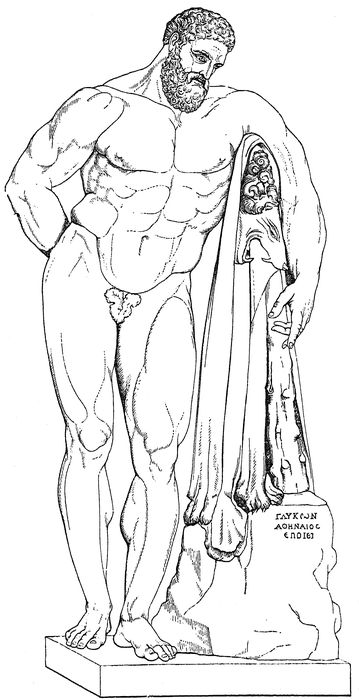
Fig. 58.—Farnese Hercules.
216First among existing statues is the Farnese Hercules (Fig. 58). This celebrated colossal statue, now in the Naples Museum, was discovered in 1540, on the site of the Thermæ of Caracalla. The hero is standing upright, resting his left shoulder on his club, from which hangs his lion’s skin. This attitude, as well as the head drooping towards the breast, and the gloomy gravity of his countenance, clearly show that the hero feels bowed down by the burden of his laborious life. Even the thought that he is soon to be released from his ignominious servitude (he holds behind him, in his right hand, the three apples of the Hesperides, the fruit of his last labour) is unable to cheer him, and his thoughts seem to revert only to the past. On account of the conception of the piece, and the existence of another copy bearing the name of Lysippus, the Farnese Hercules is supposed to be a copy of a work of Lysippus, of which nothing further is known.
Still more important as a work of art, though it has reached us in a terribly mutilated condition—minus head, arms, and legs—is the celebrated Torso of Hercules, in the Vatican. This was found in Rome during the reign of Pope Julius II., on a spot where the theatre of Pompey, of which it was probably an ornament, once stood.
Groups.—Heracles in action was a still more favourite subject with artists, who delighted to portray the different scenes of his versatile life. Numberless representations of such scenes occur, not only in the form of statues and works in relief, but more especially on ancient vases. We mention here, in the chronological order of the events, some of the most important.
1. Heracles and the Serpents.—This scene was early depicted by the celebrated painter Zeuxis, who represented Heracles as strangling the serpents, whilst Alcmene and Amphitryon stood by in amazement. There are also several statues representing this feat, among which that at Florence takes the first rank. There is also a painting from Herculaneum in the Naples Museum.
2. The Twelve Labours.—These have naturally been treated of times out of number. We have already mentioned the groups of Lysippus, which he executed for the town of Alyzia. A still existing bronze statue in the Capitoline Museum, representing Heracles battling with the Hydra, appears to belong to this series. Among interesting remains are the metope reliefs on the Theseum at Athens. Ten on the east side of the temple represent scenes from the life of Heracles. Nine of them belong to the twelve labours, viz., the 217Nemean lion, the Hydra, the Arcadian hind, the Erymanthian boar, the horses of Diomedes, Cerberus, the girdle of Hippolyte, Geryon, and the Hesperides; whilst the tenth tablet represents his contest with Cycnus. The remains of the splendid temple of Zeus at Olympia, which was completed about 435 B.C., are less important. The metopes of the front and back of the temple contained six of the labours of Heracles. Those representing the contest with the Cretan bull, the dying lion, a portion from the fight with Geryon, and some other fragments, were found in 1829, and conveyed to the museum of the Louvre at Paris. The only one which is perfect, however, is the spirited and life-like representation of the struggle with the Cretan bull.
3. Parerga (Subordinate Deeds).—First among these come the scenes from his contest with the Centaurs, which were frequently treated of in art. Groups of these exist in the museum at Florence; there are also various representations to be found on vases. His adventure with Nessus is represented separately on a Pompeian painting in the Naples Museum; Nessus crouches in a humble posture before Heracles, who has the little Hyllus in his arms, and he appears to be asking permission to carry Deïanira across the stream. There is also an interesting representation of the release of Prometheus on the Sarcophagus of the Capitol, from the Villa Pamfili, which is, in other respects, also worthy of mention. The seizure of the tripod at Delphi is also frequently portrayed in art.
4. Heracles and Omphale.—Of the monuments referring to Heracles’ connection with Omphale, the most important is the beautiful Farnese group in marble in the Naples Museum. Omphale has thrown the lion’s skin round her beautiful limbs, and holds in her right hand the hero’s club. Thus equipped, she smiles triumphantly at Heracles, who is clothed in female attire, with a distaff in his hand.
5. Heracles and Telephus.—The romantic history of Telephus was also frequently treated of in art. The Naples Museum possesses a fine painting, representing the discovery of the child after it has been suckled by the hind, on which occasion, strange to say, Heracles himself is present. In the Vatican Museum there is a fine marble group, representing Heracles with the child Telephus in his arms.
7. Attic Legend.—1. Cecrops.—Cecrops, the first founder of civilisation in Attica, plays a similar part here to that which Cadmus does in Thebes. Like Cadmus, he was afterwards called an immigrant; indeed he was said to have come from Sais in Lower Egypt. In his case, however, we are able to trace the rise of the erroneous tradition with far greater distinctness. 218Pure Attic tradition recognises him only as an autochthon—that is, an original inhabitant born of the earth; and further adds, that, like the giants, he was half man and half serpent. As the mythical founder of the state, he was also regarded as the builder of the citadel (Cecropia); and marriage, as well as other political and social institutions, were ascribed to him. Perhaps he is only a local personification of Hermes. The probability of this view is greatly enhanced by the fact that his three daughters, Herse, Aglaurus, and Pandrosus, received divine honours. It was under Cecrops that the celebrated contest occurred between Poseidon and Athene for the possession of Attica, and was by his means decided in favour of the goddess. We have already given an account of it, and need only here remark that the story is purely the result of the observation of natural phenomena. In Attica, in fact, there are only two seasons—a cold, wet, and rainy winter (Poseidon), and a warm, dry, genial summer (Pallas). These seem to be continually striving for the supremacy of the land. Cecrops was succeeded in the government by Cranaüs, who is represented by some as his son. The common mythological account places the flood of Deucalion in his reign. After the expulsion of Cranaüs, Amphictyon, one of the sons of Deucalion, succeeded to the sovereignty of Attica, of whom nothing more is known than that he was deprived of the government by Erechtheus.
2. Erechtheus, or Erichthonius.—Erechtheus, or Erichthonius, is really only a second Cecrops—the mythical founder of the state after the flood, as Cecrops was before it. Being also earthborn, he is, like Cecrops, endowed with a serpent’s form. There was another very sacred legend concerning him, which stated that Gæa (Ge), immediately after his birth, gave him to the goddess Pallas to nurse. The latter first entrusted him to the daughters of Cecrops, her attendants and priestesses, enclosed in 219a chest. The latter, however, prompted by curiosity, opened the chest, contrary to the commands of the goddess, and were punished in consequence with madness. Erichthonius was now reared by the goddess herself in her sanctuary on the citadel, and was subsequently made king of Athens. The same stories are then related of him as of Cecrops—that he regulated the state, introduced the worship of the gods, and settled the dispute between Poseidon and Athene.
The tomb of Erechtheus was shown in the Erechtheum, the ancient temple dedicated to Athene Polias, where the never-dying olive tree created by the goddess was also preserved.
Two among the daughters of Erechtheus are celebrated in legend. The first is Orithyia, who was carried off by Boreas, and became the mother of Calaïs and Zetes, whom we come across again in the story of the Argonauts; the other is Procris, the wife of the handsome hunter Cephalus, who was said to be a son of Hermes by Herse, the daughter of Cecrops. Cephalus was carried off by Eos, who was unable to shake his fidelity to his wife. It served, however, to excite the jealousy of the latter, which ultimately proved fatal to her. Procris had hidden herself among the bushes, in order to watch her husband, when Cephalus, taking her for a wild animal, unwittingly killed her. After the death of Erechtheus, the tragic poets relate that Ion, the mythical ancestor of the Ionians, ruled in Athens. This means nothing more than that the primitive Pelasgian age in Attica had now come to an end, and the dominion of the Ionians commenced.
3. Theseus.—Theseus is the national hero of the Ionians, just as Heracles is of the Æolians. He has not unjustly been called the second Heracles; and he has, indeed, many features in common with the Æolian hero, since the national jealousy of the Ionians led them to adopt every possible means of making their own hero rival that of their neighbours. They therefore strove 220to represent him, likewise, as a hero tried in numberless contests—generous, unselfish, and devoted to the interests of mankind—and of course ascribed to him a multitude of adventurous exploits. There is no great undertaking of antiquity in which Theseus is not supposed to have taken part, and he was even sent on an expedition to hell, in imitation of Heracles.
He was the son of the Athenian king Ægeus, whom mythological tradition made a great-grandson of Erechtheus. After his father Pandion had been driven out by his relations, the sons of Metion, Ægeus betook himself to Megara, where he was hospitably received by the ruler, Pylas. From Megara, Ægeus, Pallas, Nisus, and Lycus, the sons of Pandion, undertook an expedition against Athens, which ended in the expulsion of the Metionidæ, and the restoration of the former royal family in the person of Ægeus. Such, at least, is the tradition; although it is more probable that Athens never had a king of this name, and that Ægeus (wave-man) is only a surname of Poseidon, the chief deity of the seafaring Ionians. Ægeus, though twice married, had no heir, and now undertook a journey to Delphi to seek the advice of the oracle. On his way back he stopped at the court of Pittheus, king of Trœzen, and became, by his daughter Æthra, the father of Theseus. Before his departure, he placed his sword and sandals beneath a heavy stone, and commanded Æthra to send his son to Athens as soon as he was able to move the stone and take his father’s sword. Theseus was carefully trained in music and gymnastics by the sagacious Pittheus, and soon developed into a stately youth. He is also supposed to have been educated by the Centaur Chiron, whose instruction had now become a necessary item in the education of a real hero.
When Theseus was sixteen, his mother took him to the stone beneath which lay his father’s sword and sandals. With a slight effort he raised the stone, and thus entered on his heroic 221career. His earlier adventures consisted in overcoming a series of obstacles that beset him in his journey from Trœzen to Athens. They are generally supposed to have been six in number.
1. Between Trœzen and Epidaurus he slew Periphetes, the son of Hephæstus—who was lame, like his father—because he was in the habit of murdering travellers with his iron club; whence he is called Corynetes, or club-bearer.
2. He next delivered the Isthmus from another powerful robber called Sinis. He used to fasten travellers who fell into his hands to the top of a pine tree, which he bent to the earth, and then allowed to recoil; after which, on their reaching the ground, he would kill them outright; whence he is called Pityocamptes, or pine-bender. Theseus inflicted the same fate on him.
3. In the woody district of Crommyon he destroyed a dangerous wild sow that laid waste the country.
4. Not far from this, on the rock of Sciron, on the borders of Megara, dwelt another monster, called Sciron, who compelled travellers to wash his feet, and then kicked them into the sea. Theseus served him in a similar fashion.
5. In the neighbourhood of Eleusis he vanquished the giant Cercyon, who compelled all who fell into his hands to wrestle with him.
6. His last combat awaited him on the confines of Eleusis, where dwelt the inhuman Damastes. This monster used to lay his victims in a bed: if this was too short, he would hack off their projecting limbs; if too long, he would beat out and pull asunder their limbs, whence he is called Procrustes. He was also slain by Theseus.
On reaching Athens, he found his father Ægeus in the toils of the dangerous sorceress Medea, who had fled from Corinth to Athens. She was on the point of making away with the newcomer 222by poison, when Ægeus, fortunately, recognised him by the sword he bore, and preserved him from his impending fate.
Medea was compelled to flee; but a new danger awaited the hero from the fifty sons of Pallas, who had reckoned on succeeding their childless uncle Ægeus. Theseus, however, slew some in battle and expelled the rest.
He now undertook his greatest and most adventurous feat, in order to free his country from its shameful tribute to Minos, king of Crete, whose son, the youthful hero Androgeos, had been treacherously murdered by the Athenians and Megareans. Another account says that he was sent by Ægeus against the bull of Marathon, and thus slain. At any rate, Minos undertook a war of revenge. He first marched against Megara, of which Nisus, the brother of Ægeus, was king. Minos conquered him by means of his own daughter Scylla, who became enamoured of Minos, and cut off from her father’s head the purple lock on which his life depended. After having taken Megara and slain Nisus, Minos marched against Athens. Here he was equally successful, and compelled the vanquished Athenians to expiate the blood of his son by sending, every eight or (according to the Greek method of reckoning) every nine years, seven youths and seven maidens to be devoured by the Minotaur. This was a monster, half man and half bull. Twice already had the bloody tribute been sent, and the third fell just after Theseus’ arrival in Athens; he at once bravely offered to go among the allotted victims. He was resolved to do battle with the Minotaur, and to stake his life on the liberation of his country from the shameful tribute. Under the guidance of Aphrodite he passed over to Crete, and soon discovered the efficacy of her protection. The goddess kindled a passionate love for the hero in the breast of Ariadne, the daughter of Minos. Ariadne rendered him every possible assistance in his undertaking, and especially presented 223him with a clew of thread, by means of which Theseus, after having slain the Minotaur, was enabled to find his way out of the Labyrinth. We have already narrated how Ariadne was deserted by Theseus on the isle of Naxos, only to become the bride of Dionysus, the divine son of Semele. Theseus also landed at Delos, where he instituted the festival of the Delia in honour of the divine children of Leto. On reaching Athens, he showed his gratitude to his divine protectress by the institution of the worship of Aphrodite Pandemus. In honour of Dionysus and Ariadne, he instituted the Oschophoria, in which festival Athene also had a share. Lastly, in honour of Apollo, he instituted the Pyanepsia, a festival which was celebrated on the seventh day of the month Pyanepsion (end of October).
The happy return of Theseus from his Cretan expedition, however, proved the death of his aged father. Ægeus, as he stood on the coast looking for his son’s return, perceived that the ships had black sails instead of white, which were to have been hoisted in the event of his son’s success; and believing that all was lost, he cast himself headlong into the sea. This story was perhaps only invented to account for the name of the Ægean Sea.
With regard to the other exploits of Theseus, there exists the greatest variety of accounts as to the order in which they took place. As king, he is said to have been the first to unite the separate districts of Attica into one political community, with one state Prytaneum, and to have instituted the festival of the Panathenæa in commemoration of this event. The following, among his later exploits, are worthy of mention:—
1. He captured the bull of Marathon (said to have been the same which Heracles brought alive from Crete), and sacrificed it in Athens to Apollo Delphinius.
2. He assisted his friend Pirithoüs, the prince of the Lapithæ, in his contest with the Centaurs.
2243. He undertook with Pirithoüs an expedition to Lacedæmon, in which they carried off Helen, the sister of the Dioscuri.
4. At the request of Pirithoüs, he accompanied him to the lower world to carry off Persephone; but Hades, enraged at their audacity, caused them both to be bound in chains and fastened to a rock. Theseus was rescued from this plight by Heracles, but during his absence the Dioscuri had released their sister from Aphidnæ, where she was confined.
5. He next joined Heracles in his expedition against the Amazons, and received, as the reward of victory, their queen Antiope, or Hippolyte. Another tradition asserts that Antiope followed him of her own free will to Athens, where she was married to him, and became the mother of Hippolytus, famed for his unhappy fate. His great beauty caused his step-mother Phædra, a later wife of Theseus, and a sister of Ariadne, to fall in love with him. As he withdrew himself from her dishonourable proposals by flight, she accused him to his father of attempts on her virtue. Theseus, in his wrath, besought Poseidon to punish his faithless son; and the god, who had sworn to grant any request of Theseus, sent a wild bull (i.e., a breaker) out of the sea as Hippolytus was driving in his chariot along the sea-shore. This so terrified his horses that Hippolytus was thrown from his chariot, and dragged along the ground till he was dead. This story—the scene of which was afterwards transferred to Trœzen, whither Theseus was supposed to have fled on account of a murder—was dealt with in a touching manner by the tragic poets. The Hippolytus of Euripides is still extant.
6. As a result of the carrying off of Antiope, a second contest with the Amazons was subsequently invented, in which Theseus was engaged alone, and which took place in the immediate neighbourhood of Athens. The Amazons are supposed to have invaded Attica, in order to release their queen. Antiope, however, was so enamoured of Theseus that she refused to return, 225and fought at her husband’s side, against her kindred, until she was slain.
Lastly, Theseus is said to have taken part in the Calydonian boar hunt, and also in the expedition of the Argonauts, of which we shall have more to say hereafter.
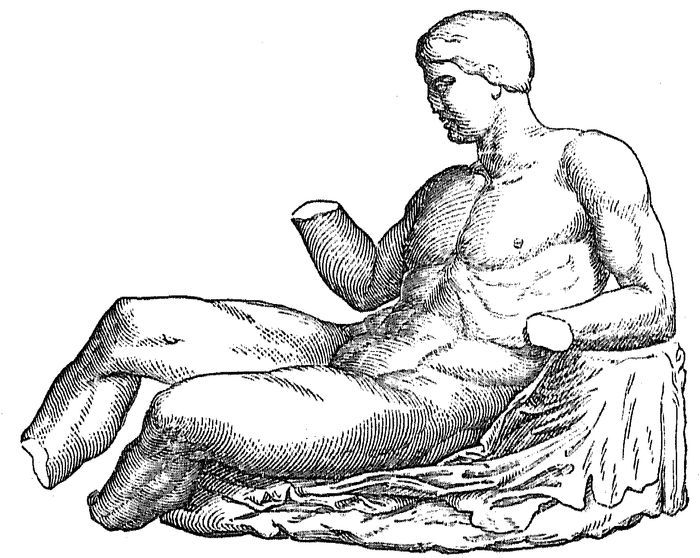
Fig. 59.—Elgin Theseus. British Museum.
The death of Theseus is commonly agreed to have taken place in the following manner:—He had been deprived of the sovereignty of Athens by Menestheus, who was aided by the Dioscuri; and then withdrew to the island of Scyros. Here he was at first hospitably received, but subsequently murdered in a treacherous manner by Lycomedes, the ruler of the island. Demophoön, the son of Theseus, is said to have afterwards recovered his father’s kingdom. At a still later period the bones of the hero were brought to Athens by Cimon, at the command of the Delphic oracle. Cimon is also supposed to have caused the erection of the temple of Theseus, which still exists in Athens, and serves as an art museum. The eighth day of every month was held sacred to Theseus, besides which he 226had a special festival, called the Thesea, on the eighth of Pyanepsion.
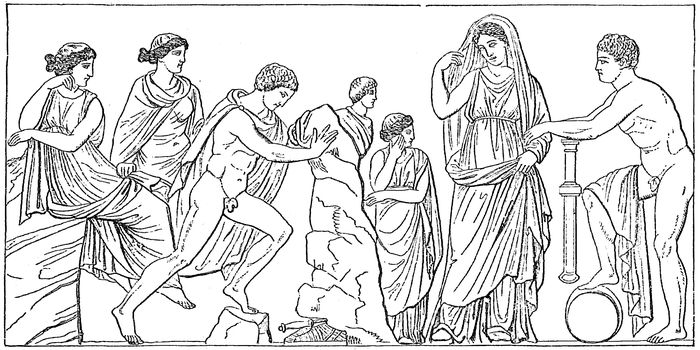
Fig. 60.—Theseus Lifting the Rock. Relief in the Villa Albani.
Art has followed the example of the poets and mythologists in depicting Theseus as a second Heracles. Here, however, the characteristic differences that existed between the Doric and Ionic races become apparent. Just as the latter race surpassed the former in elasticity, both of mind and body, so their national hero gives token not only of a higher intellectual being, but also of a body more lithe, and capable of greater swiftness and dexterity, than that of the Doric hero. The slighter and more elegant form of Theseus lacks, perhaps, the sheer brute strength of Heracles, but is compensated by the possession of a far greater degree of activity and adroitness. The expression of face is more amiable and the hair less bristling than that of Heracles, while there is generally no beard. Such is Theseus as depicted by Greek art at the epoch of its full development; later art strove 227to render the form of the body still more lithe and graceful. The costume of Theseus consists, like that of his prototype Heracles, of a lion’s skin and club; sometimes also of the chlamys and petasus of the Attic youth. Existing art monuments are far less numerous in his case than in that of Heracles. If the explanation is correct, the British Museum possesses a Theseus of priceless value. Among the statues of the Parthenon which have been preserved, there is one of a figure negligently reclining on a lion’s skin, which, with the exception of the nose, hands, and feet, is in a tolerably good state of preservation (Fig. 59). It belonged to the great group of the east gable, which represented the first appearance of the new-born Athene to the astonished gods. It is the figure of a youth in his prime, somewhat larger than life, and altogether a perfect ideal of manly beauty.
A representation of the conflict of Theseus with the invading army of the Amazons still exists on a large piece of frieze-work, which, together with the representations of the battle of the Lapithæ and Centaurs (which have been already mentioned), formerly decorated the walls of the shrine of Apollo’s temple in Phigalia, and is now the property of the British Museum. Among the Greek warriors Theseus may be easily recognised by his lion’s skin and the club, which he is in the act of swinging against a mounted Amazon, probably the leader of the hostile army. We give an engraving of the scene where Theseus obtained the sword and sandals of his father from beneath the rock, after a relief in the Villa Albani (Fig. 60).
8. Cretan Legend.—1. Minos and the Minotaur.—Cretan myths are both obscure and difficult of interpretation, because Phœnician and Phrygian influences made themselves felt at a very early period, and native sources fail us. Minos is commonly supposed to have been the first king of the country. He was the son of Zeus and Europa, who is called in Homer a daughter of Phœnix. This Phœnix was subsequently made into Agenor, a Phœnician, king of Sidon; and the story then arose that Zeus, in the form of a white bull, had carried off Europa, and arrived with his lovely prey in Crete. Europa is there said to have given birth to Minos, Rhadamanthys (Rhadamanthus), and some say Sarpedon. She afterwards married Asterion, who brought up the sons of Zeus as his own children, 228and, at his death, left the kingdom to Minos. He, after expelling his brothers Sarpedon and Rhadamanthus, became sole king of Crete. Of his brothers, Sarpedon went to Lycia, whilst the pious Rhadamanthus found a refuge in Bœotia. Minos next married Pasiphaë, a daughter of Helios and Perseïs, by whom he became the father of Catreus, who succeeded him, Deucalion, Glaucus, and Androgeos, besides several daughters, of whom the most celebrated are Ariadne and Phædra. Minos gave wise laws to his people, and became supreme at sea among the isles of the Ægean Sea, and even as far as Attica. In his name we find the same root (meaning “to think”) which we have seen in Minerva, and which appears in the name of the Indian lawgiver Manu.
In order to vindicate his right to the crown, Minos besought Poseidon to send him a bull out of the sea, which he was then to sacrifice to the god. Poseidon granted his prayer, but Minos was induced by the beauty of the animal to place it among his own herds. As a punishment of his perfidy, Poseidon kindled in the breast of Pasiphaë an unnatural love for the bull, and the fruit of their connection was the Minotaur. This was a monster, half man and half bull, which Minos shut up in the labyrinth that had been made by the skill of Dædalus. The food of the monster consisted of human beings, who were partly criminals and partly youths and maidens, sent as tribute from the subjugated countries. This lasted until Theseus came to Crete, and, with the aid of Ariadne and Dædalus, destroyed the Minotaur. Such is the substance of this perplexing mythical tradition, of which the simplest interpretation is that the Minotaur was originally an ancient idol of the Phœnician sun-god Baal, which had the form of a bull, and to which human sacrifices were offered. The destruction of the Minotaur by Theseus is a symbol of the triumph of the higher Greek civilisation over 229Phœnician barbarism, and the consequent abolition of human sacrifices.
Closely connected with the royal family of Crete we find Dædalus, the most celebrated artist of the legendary period. He is said to have been a son of Metion, and a descendant of Erechtheus, and to have fled from Athens to Crete after murdering his nephew Talus in a fit of professional jealousy. During his residence in Crete he constructed the Labyrinth, an underground building with an endless maze of passages, as a dwelling-place for the Minotaur; besides many other wonderful works of art. For having aided Theseus in his combat with the Minotaur, Dædalus and his son Icarus were both imprisoned in the Labyrinth of Minos. The story of his flight, which he accomplished by means of the artificial wings that he made for himself and his son, is well known from the Metamorphoses of Ovid. Icarus fell into the sea that is named after him, and was drowned, but Dædalus reached Cumæ in safety. From this place he passed over to Sicily, where he was hospitably received by Cocalus. When Minos, however, pursued the fugitive and demanded his surrender, not only was his request refused, but he was even put to death by the contrivance of the king’s daughters.
Of the other sons of Minos, Deucalion is celebrated as having taken part in the Calydonian boar hunt, and also as the father of the hero Idomeneus, who fought against Troy. Glaucus was killed, while yet a boy, by falling into a cask of honey as he was pursuing a mouse. He is reported, however, to have been restored to life by the Corinthian augur Polyidus, or, according to others, by Asclepius himself.
2. Talos.—The legend of Talos, the brazen man, betrays likewise a Phœnician origin, and refers to the cruel practice of offering human sacrifices. This Talos was made of brass, and was invulnerable. Hephæstus, or, as others say, Zeus gave him 230to Minos as guardian of the island of Crete, round which he travelled thrice a-day. If he perceived any strangers approach he would spring into the fire, and, after becoming red-hot, he would clasp them to his breast, until they expired beneath the sardonic chuckle of the demon. He attempted to drive off the Argonauts with stones, but was destroyed by the skill of Medea. Talos had a single vein, which ran from his head to his feet, and was closed at the top with a nail. This nail Medea cleverly succeeded in extracting, in consequence of which Talos bled to death.
IV.—COMBINED UNDERTAKINGS OF THE LATER HEROIC AGE.
1. The Calydonian Hunt.—The story of Meleager and the Calydonian boar hunt was undoubtedly, in its origin, nothing more than a provincial myth based on natural phenomena, like other myths that we have already explained. In this case the physical significance involved in the myth soon disappeared, owing to the treatment it received at the hands of the epic and dramatic poets. The poets, in fact, succeeded in introducing some striking ethical conceptions, which absorbed all higher interest.
Œneus, king of Calydon in Ætolia, on the occasion of a great festival which was celebrated after a successful vintage, had accidentally or purposely omitted to sacrifice to Artemis. To punish this neglect she sent a huge wild boar, which devastated the fields of Calydon, and seemed invincible by any ordinary means on account of its vast size. Meleager, the brave and heroic son of Œneus, therefore assembled men and hounds in great number to slay it. The boar was slain; but Artemis stirred up strife over the head and hide between the Ætolians 231and the Curetes of Pleuron. At first the former were victorious; but when Meleager withdrew in wrath from the battle because his mother had cursed him for the death of her brother, they were no longer able to keep the field, and soon saw their city closely invested by their enemies. In vain did the elders and priests of Calydon beseech Meleager; in vain did his father, sisters, and even mother beseech him to aid his hard-pressed countrymen. Like Achilles in the Trojan war, when he was wroth with Agamemnon on account of the loss of Briseis, Meleager long refused to stir. At last his wife—the beautiful Cleopatra—succeeded in moving him. He donned his armour, and put himself at the head of his countrymen for a sally against the besiegers. Brilliant, indeed, was the victory of the men of Calydon; but the hero Meleager did not return from the battle, for the cruel Erinyes, who had heard his mother’s curse, destroyed him with the arrows of Apollo.
Such is the earliest form of the legend, as it exists in the Iliad. In time, however, Meleager was said to have called together against the boar all the renowned heroes of Greece. Among others there came the Dioscuri, Castor and Pollux; Theseus and his friend Pirithoüs; Idas and Lynceus, the sons of Aphareus; Admetus of Pheræ; Jason, from Iolcus; Iphicles and Iolaüs, from Thebes; Peleus, the father of Achilles; Telamon, from Salamis; Ancæus and the beautiful huntress Atalante (Atalanta), from Arcadia; besides the soothsayer Amphiaraüs, from Argos. After Œneus had entertained his guests royally for nine days, the hunt began, and the huge beast, which was as large as an ox, was surrounded and driven from its lair. Atalante, the swift huntress, was the first to inflict a wound. Ancæus then advanced with his battle-axe, but the enraged beast, with one stroke of his dreadful tusks, tore open his body and killed him on the spot. At length the monster received a mortal wound from a spear hurled by the powerful arm of 232Meleager, and was soon despatched by the rest. Meleager received as his due the head and hide of the slaughtered animal, but resigned the prize to Atalante, of whom he was enamoured, on the ground that she was the first to wound the boar. This act excited the bitter jealousy of Plexippus and Toxeus, the sons of Thestius, king of Pleuron, and brothers of Althæa, the mother of Meleager. They accordingly lay in wait for Atalante, and robbed her of the present. Enraged at this, Meleager slew them both. But Meleager’s death, though caused by the wrath of his mother, was worked out differently in the time of the tragic poets. The Fates had appeared to Althæa, soon after the birth of Meleager, and informed her that her son would only live until a certain brand, which was then burning on the fire, was consumed. Althæa immediately snatched the brand from the flames and carefully treasured it up. After Meleager had slain her brothers, in the first outburst of grief and indignation against her son, she placed the brand again in the fire, and thus cut off the noble hero in the prime of his youth and beauty. Althæa, on learning the unhappy fate of her son, full of sorrow for her hasty deed, put an end to her own life.
2. The Argonauts.—The story of the Argonauts experienced a similar fate to that of the Calydonian hunt. It was originally nothing but a myth based on natural phenomena; but in the hands of the poets it swelled to a mass of legends common to all the tribes of Greece, the nucleus of which was the history of the golden fleece. Athamas, the son of Æolus, was king of the Minyæ. He put away his first wife, Nephele (cloud), in order to marry Ino, the daughter of Cadmus; though he still kept Phrixus (rain-shower) and Helle (ray of light), his children by Nephele, with him. By Ino he had two other children, Learchus and Melicertes, whom their mother naturally preferred to her stepchildren, and for whose sake she endeavoured to drive the latter 233from their father’s house. Soon afterwards, either at the command of Nephele, whom some represent as a goddess, or in consequence of her prayers for the punishment of Athamas, the land was visited with a long drought, and Ino persuaded her husband to sacrifice Phrixus as a sin-offering to Zeus, in order to put an end to the calamity. Whether Helle was to have shared her brother’s fate we cannot tell, for, before Ino could accomplish her purpose, Nephele came to the assistance of her children, and gave them a winged ram with a golden fleece, which Hermes had presented to her for that purpose. Seated on this ram they fled over the sea to Colchis. On the way Helle fell into that part of the sea which bears her name, and was drowned, but Phrixus arrived safely in Colchis (Æa), where he sacrificed the ram to Zeus, who had preserved him in his flight. The fleece he hung up in the grove of Ares as a sacred treasure, setting over it a terrible, ever-watchful dragon as its guardian. To fetch this treasure from a foreign land, and thereby to release the country and people of the Minyæ from the calamity with which they were oppressed, was the task of the heroes of the race of Æolus. Athamas was so grieved at the evil he had brought on his country that he became insane, and sought to slay Ino and her children. He did, indeed, kill Learchus by dashing him against a rock, but Ino succeeded in saving herself and her younger child Melicertes by leaping into the sea (cf. Ino Leucothea). Athamas then fled to Epirus, and the kingdom devolved on his brother Cretheus. Cretheus married Tyro, the daughter of his younger brother Salmoneus, king of Elis. Tyro bore him three sons, the eldest of whom, Æson, succeeded his father in the kingdom, but was soon after expelled by his step-brother Pelias, who is described as a son of Tyro and Poseidon. Æson with difficulty managed to rescue his little son Jason from the hands of Pelias, and brought him to the Centaur Chiron to be educated. In Chiron’s cave the young hero grew up, a 234favourite with gods and men. After completing his twentieth year, he betook himself to Iolcus to demand of his uncle his rightful inheritance. Pelias, not daring to use violence to the sturdy youth, endeavoured to get rid of his unwelcome guest by involving him in a most dangerous adventure. He declared that he would gladly resign the crown if Jason would recover the golden fleece from Colchis. Jason, like a true hero, at once accepted the perilous adventure. In the harbour of Iolcus he caused a large ship with fifty oars to be constructed, which he called the “Argo,” after its builder, Argus. He then called together the heroes, who had consented at his invitation to take part in the expedition. In the original version of the story, the expedition was stated to have been undertaken only by the heroes of the race of the Minyæ—such as Acastus, Admetus, and Periclymenus. At a later period, however—when the date of the expedition had been fixed at one generation before the Trojan war—no hero of any note was allowed to be absent from the undertaking. In this manner were added the Dioscuri, the sons of Boreas, Calaïs and Zetes, Telamon, Peleus, Meleager, Tydeus, Iphitus, Theseus, Orpheus, Amphiaraüs, and even Heracles. In the last case, the incongruity of allowing the hero to play only a subordinate part was soon felt, and his name was withdrawn. He was said to have been left behind in Mysia, where he had landed in order to search for his favourite Hylas, who had been carried off by the Naiads. The number of the Argonauts was finally computed at fifty, tallying with the number of oars.
The expedition proceeded from Iolcus to Lemnos, and thence through the Hellespont to Cyzicus, where they were kindly received by the Doliones. From Cyzicus they proceeded to Bithynia, where they were opposed by the Bebryces, whose king, Amycus, was slain by Pollux in a boxing match. Their greatest difficulty lay in the passage of the Bosporus, there 235being at the entrance of the Pontus (Black Sea) two terrible rocks, which were in constant motion—now retreating to the shore on either side, now hastily dashing together again; whence they were called the Symplegades. This occurred so rapidly that even the swiftest vessel had not time enough to get through. The Argonauts were in great perplexity. At length the blind seer Phineus, who dwelt in Thracian Salmydessus, and whose gratitude they won by delivering him from the Harpies who had tormented him, assisted them with his advice. By means of a stratagem he recommended they were enabled to bring the Argo through without any considerable damage, after which the Symplegades remained stationary. After this they stood along the south coast towards their destination, which, in the original legend, appears to have been the utterly fabulous Æa, subsequently converted into Colchis. This was the residence of the mighty king Æetes, a son of the sun-god. To rob him, either by craft or by violence, of the golden fleece was the task of Jason, the leader of the Argonauts.
The second prominent character in the story, Medea, the daughter of Æetes, now makes her appearance. It was, in fact, only through her love that Jason was enabled to surmount the vast obstacles which stood between him and the possession of the golden fleece. When the hero demanded the fleece of Æetes, the latter declared that he would deliver it up to him after he had accomplished two tasks. The first was to harness two brazen-footed, fire-breathing bulls, which Æetes had received from Hephæstus, to a plough, and with them to till an uncultivated field. The second was to sow in the furrows the dragon’s teeth that Æetes would give him, and to destroy the armed men which would then spring up. Jason’s heart failed him on hearing these conditions, but Medea, who was an enchantress and priestess of Hecate, was equal to the occasion. She gave the hero a magic salve to protect him against the fiery breath of 236the bulls and to endow him with invincible strength, which enabled him to accomplish his first task successfully. In the case of the armed men who sprang from the dragon’s teeth, by the advice of Medea he followed the example of Cadmus, and cast among them a heavy stone, whereupon in blind fury they turned their arms against each other, and were all destroyed.
The conditions imposed upon him by Æetes were thus accomplished; but the king, who perceived that Jason had only succeeded through the aid of his daughter, made this a pretext for refusing to surrender the fleece. Jason then removed it by night from the grove of Ares, after Medea had, by means of her enchantments, lulled the watchful dragon to sleep. That same night the Argonauts embarked on board their ship and put to sea, Medea accompanying them as the future wife of Jason. The wrathful Æetes attempted to overtake the fugitives, but Medea succeeded in staying the pursuit by slaying her younger brother Apsyrtus, whom she had brought with her, and scattering his limbs in the sea.
The most diverse accounts exist as to the road taken by the Argonauts on their homeward journey. Some say that they sailed up the Phasis to the Eastern Sea, and then, passing through the Red Sea and Libyan desert, over which they had to carry the Argo twelve days’ journey, came to Lake Tritonis, and thence to the Mediterranean. According to another account, they sought to pass through the Ister (Danube) and Eridanus (Po) to the Western Ocean; but the object of this account was manifestly to subject them to the same vicissitudes and adventures as Odysseus and his companions.
At length Jason landed happily in Iolcus, and delivered the golden fleece into the hands of his uncle. Pelias, however, still refused to surrender the kingdom to Jason, and Medea therefore determined to make away with him by craft. Having persuaded the daughters of Pelias that she possessed a means of making 237the old man young again, she directed them to slay their father, cut him in pieces, and boil the limbs in a cauldron filled with all manner of herbs; this they did in the vain expectation of seeing him restored to youth. Jason now took possession of his father’s kingdom, but was soon afterwards expelled by Acastus, the son of Pelias, and took refuge in Corinth. His subsequent misfortunes are well known. Thinking to better his condition, he was about to marry Creüsa, the daughter of the king of Corinth, when he was arrested by the fearful vengeance of his first wife. Medea sent the bride a poisoned garment, which caused her to die an agonising death, and then slew her own children by Jason; after which she fled in her chariot drawn by winged dragons to Athens, where she long found protection at the court of Ægeus. Jason either put an end to his own life, or was killed by the fall of a rotten beam of the Argo.
In the history of the golden fleece we have one of the most widely spread myths of all, namely, that of the loss and recovery of a treasure. In Teutonic tradition we have the treasure of the Nibelungs, in which the very name is almost identical; and if we include the stories of women carried off and rescued, the list becomes endless. And the treasure of all those stories has been interpreted to be the golden clouds. The Dragon which guards the treasure again appears in the story of the apples of the Hesperides, and is closely allied to the Sphinx.
3. The Theban Cycle.—The highly tragic history of the Theban house of the Labdacidæ, teeming as it does with important characters and events, has at all times furnished subjects for Greek art and poetry, and has given birth to a whole series of epic and dramatic works. The former, which would have conduced far more to an exact acquaintance with the legend, have, unfortunately, perished, with the exception of a few unimportant fragments; although many important works of the great tragic poets, Æschylus, Sophocles, and Euripides, relating to the subject, still remain. The common account runs thus:—Laius, a great-grandson of Cadmus, was warned by the oracle to 238beget no children, as he was doomed to perish by the hands of his son, who would then marry his mother. When his wife Iocaste gave birth to a son, Laius accordingly exposed the child, with its feet pierced, on Mount Cithæron. The child, called Œdipus from the swelling of its feet, did not die, but was found by some Corinthian shepherds, who brought it to Polybus, king of Corinth. Polybus, having no children of his own, adopted Œdipus, who grew up in the belief that Polybus and Merope were his real parents, until one day a taunt of his companions as to his mysterious origin raised doubts in his mind. In order to solve his misgivings, he went to consult the oracle of Delphi, but he here received only the obscure direction not to return to his country, since, if he did, he would kill his father and marry his mother. Fearing on this account to return to Corinth, he took the road to Thebes, and thus, by his presumptuous prudence, brought about the very consequences he was so anxious to avoid. On the road he was met by Laius, who was on his way to the oracle to ask its advice concerning the Sphinx. A quarrel arose, in a narrow defile, between Laius and Œdipus; and Œdipus slew his father without knowing who he was. On arriving at Thebes he succeeded in delivering the country from the Sphinx. This monster, which had the combined form of a woman and a lion, had been sent by Hera, whom Laius had in some way offended, from Ethiopia to devastate the land of Thebes. Seated on a rock close to the town, she put to every one that passed by a riddle, and whoever was unable to solve it, she cast from the rock into a deep abyss. This calamity induced Creon, on the death of his brother-in-law Laius, to proclaim that whoever solved the riddle should obtain the crown and the hand of Iocaste. Œdipus succeeded in solving it, and thus delivered the country from the monster, who cast herself into the abyss.
The Sphinx belongs to the same family as many of the monsters we have spoken of already; she is called by Hesiod the child of Orthros and Chimæra, whom we have seen to be 239the daughter of Typhon and Echidna. It would seem, therefore, probable that the contest between her and her opponent may be interpreted in the same way as that of Bellerophon and the Chimæra, or of Zeus and Typhon. In support of this, the following considerations may be adduced. Since we know that thunder was supposed to be a warning or encouragement to men, it is easy to see in it the mysterious voice of the cloud, only intelligible to the wisest of men. Hence the conqueror of the cloud was called the man who understood her language. (It would not a little help this idea, that Œdipus might seem derived from a word meaning “to know.”) Then the death of the Sphinx will be the cloud falling upon the earth in the shape of rain. Œdipus, on the other hand, will be the same antagonist as we have before seen victorious over the cloud dragons; the sun, born helpless, rising to take the kingdom after the slaughter of his enemies, yet at last sinking blinded into an unknown grave. This, however, does not cover the crimes laid to his charge. But they have been explained in this way: that when people lost consciousness of the real meaning of the misfortunes of Œdipus, they cast about for some adequate cause, and found one in the two great crimes of incest and parricide. We have seen something similar to this in the case of Ixion. Further, the names of the wives assigned by various writers to Œdipus are connected with the light, and the name Laius has been interpreted as “enemy” of the light. Sphinx itself signifies “throttler.”
In art, the Sphinx had the form of a lion, generally in a recumbent position, with the breast and upper part of a beautiful woman. When the Greeks saw similar figures in Egypt, they naturally gave them the name of Sphinx. But name, family, and meaning of the Sphinx are alike Greek, although the Egyptian statues have taken too firm possession of the name ever to lose it. Ancient Egyptian art revelled in the creation of colossal Sphinxes, which were carved out of granite. A notable example of this kind exists in the giant Sphinx near the Pyramids of Gizeh, which is eighty-nine feet long. From such monstrous figures as these, Greek art held aloof.
Œdipus was rewarded with the sovereignty of Thebes and the hand of Iocaste; and for several years he enjoyed uninterrupted 240happiness, surrounded by four blooming children, the fruit of his incestuous marriage. By the secret agency of the goddess, the dreadful truth was at length discovered. Iocaste hanged herself, and Œdipus, in despair, put out his own eyes. Not content with this voluntary penance, the hard-hearted Thebans compelled him besides to leave their city and country, while his sons Eteocles and Polynices, who were now grown up, refused to stir a foot in their father’s behalf. Œdipus, after invoking bitter curses on their heads, withdrew, and, guided by his faithful daughter Antigone, at last found an asylum in the grove of the Eumenides at Colonus, near Athens. His grave there was regarded, in consequence of an ancient response of the oracle, as a national treasure.
The curse of their father took effect on his unnatural sons. The elder, Eteocles, drove out his brother Polynices, who then sought the assistance of Adrastus, king of Argos. Adrastus was a grandson of Bias, of the race of the Amythaonidæ, and by his marriage with the daughter of the wealthy Polybus acquired the sovereignty of Sicyon. He not only hospitably received the fugitive Polynices, but gave him his daughter in marriage, and promised to assist him in recovering the crown of Thebes. In this expedition Adrastus sought to gain the aid of the other Argive heroes. They all declared their readiness to accompany him, with the exception of Amphiaraüs, his brother-in-law, who was equally renowned for his wisdom and courage. Amphiaraüs was a great-grandson of the celebrated seer Melampus, and inherited from him the gift of prophecy. He was thus enabled to perceive the disastrous termination of the war, and strove to hinder it. But Polynices and the fiery Tydeus—likewise a son-in-law of Adrastus—were so unceasing in their entreaties, that he at length sought to escape their importunity by flight. Polynices, however, bribed his wife Eriphyle, by the present of a magnificent necklace, which had formerly been given to Harmonia on the occasion of her marriage with Cadmus, to betray his place of concealment. Hereupon Amphiaraüs was obliged unwillingly to join the expedition, which ended as he had prophesied. The 241attack on Thebes was not only repulsed, but all the Argive leaders, with the exception of Adrastus, who was saved by the fleetness of his horse, were slain. Polynices and Eteocles fell in single combat with each other. The flight of Adrastus to Attica, where he procured the assistance of Theseus in compelling the Thebans to grant the fallen heroes a solemn burial, is a feature unknown to the original legend, and may be ascribed to the patriotic impulses of the Athenian dramatists. The celebrated tragedy of Sophocles, called Antigone, is based on the assumption that Creon, the new king of Thebes, allowed the burial of the other heroes, but left Polynices to lie unburied on the field like a dog, and condemned Antigone to death because she ventured to bury her brother in despite of his command. Creon was destined to meet with a dreadful retribution, for his own son, who was betrothed to Antigone, killed himself in grief at her fate.
Ten years later, the sons of the fallen heroes are said to have combined with Ægialeus, the son of Adrastus, to avenge their fathers’ defeat. This expedition has therefore been called the war of the Epigoni (descendants), and not being undertaken, like that of their fathers, in manifest opposition to the will of the gods, proved successful. Laodamas, the savage son of Eteocles, who was now king of Thebes, was defeated in a decisive battle near Thebes, and, after Ægialeus had fallen by his hands, was himself slain by Alcmæon, the son of Amphiaraüs. The Thebans were unable any longer to hold their city, and, following the advice of the blind seer Tiresias, they withdrew under the cover of darkness and mist. The aged Tiresias expired on the road, at the fountain of Tilphusa; of the rest, some took refuge in Thessalia, and some sought other lands. The victorious Argives, after plundering and partly destroying the city, dedicated a great portion of the booty—among which was Manto, the daughter of Tiresias—to the oracle of Delphi. They then made Thersander, the son of Polynices, king of Thebes; upon which many of the fugitive inhabitants returned. Thersander subsequently took part in the Trojan war, and there perished.
2424. The Trojan Cycle.—We now come to the Trojan war, the fourth and most celebrated of the common undertakings of the later heroic age. Here the sources of our information are far more plentiful than in any former period of mythic history, because both the grand national epics, the Iliad and the Odyssey, which are commonly ascribed to Homer, relate to the Trojan war. As the contents of these immortal poems are probably well known to our readers, we shall only dwell on the most essential features of the story.
I. The Heroic Races of the Trojan War.—1. The Dardanidæ, or race of Dardanus.—The royal family of Troy were descended from Dardanus, a son of Zeus by Electra, a daughter of Atlas. Dardanus is said to have emigrated from Samothrace, or, according to others, from Italy to Arcadia, to the north-west portion of Asia Minor, between the range of Ida and the Hellespont, where he received from king Teucer some land to form a settlement. By a daughter of the river-god Simoïs, or, as others say, of Scamander, Dardanus had a son called Tros, from whom the Trojans derived their name. Tros had three sons—Assaracus, Ilus, and Ganymedes. The last, who, like all the scions of the race of Dardanus, was possessed of wonderful beauty, was raised by Zeus to the dignity of cupbearer to the gods, and thus became immortal. Ilus and Assaracus became the founders of two different branches of the Dardanian race. The latter remained in his native settlement of Dardania, where he became the father of Capys and the grandfather of Anchises, the father of Æneas. Ilus, on the other hand, emigrated to the plains of the Scamander, where he founded the city of Ilium, or Troy. After completing the town, he begged Zeus to bestow on him a sign of his favour. The next morning he found in front of his tent the celebrated Palladium—an image of Pallas Athene, carved in wood. On the possession of this depended the fortune and welfare of the city. After the death of Ilus, his son Laomedon became king of Troy. At his request, Poseidon and Apollo built the citadel of Pergamum. We have already related how this king, by his 243faithless conduct provoked the wrath of Heracles, and the first capture of the city. Of his sons only Priam remained; in him the race of Dardanus flourished afresh, for by his wife Hecuba and by his concubines he had a great number of sons and daughters.
2. The Pelopidæ, or race of Pelops.—The Pelopidæ, who were chiefly instrumental in the destruction of Troy, were descended from the Phrygian king Tantalus, who was renowned alike for his unexampled good fortune and his subsequent unhappy fate. He was the son of Zeus and Pluto (rich plenty), and inhabited a citadel on Mount Sipylus, whence his rich pasture-lands and fruitful corn-fields extended twelve days’ journey, as far as Ida and the Propontis. The very gods honoured him with their friendship, and lived on such intimate terms that they invited him to eat at their table. This unheard-of good fortune, however, begot in the puny mortal such presumption, that he began to indulge in the grossest outrages on gods and men. At length he went so far as to cut his son Pelops in pieces to boil them, and set them before the gods in order to test their omniscience. The cup of his iniquity now seemed full, and the gods brought down a heavy retribution on the head of the criminal by his well-known punishment in the lower world, where, though surrounded by the most delicious fruits, and standing up to his neck in water, he was nevertheless condemned to suffer the pangs of continual hunger and thirst. Another tradition relates that he was kept in constant anxiety by a huge rock which was suspended over his head. (See pp. 149, 150.)
The children of Tantalus were Pelops and Niobe. The unhappy fate of the latter has already been described in the mythic history of Thebes. Pelops was restored to life by the art of Hermes; and a portion of his shoulder, which had been consumed by Demeter, was replaced by the gods with a piece of ivory. Pelops is said to have grown up in Olympus, amongst the blessed gods. On being restored to earth, he proceeded to Elis, where he became a suitor for the hand of Hippodamia, the beautiful daughter of the king Œnomaüs. The latter had promised his daughter to the man who should vanquish him in 244a chariot race: whoever failed was obliged to expiate his temerity with his life, as Œnomaüs transfixed him with his unerring lance as he passed. Thirteen noble youths had already suffered this fate, when Pelops appeared to undergo the dangerous ordeal. By means of the untiring winged horses which had been given him by Poseidon, and also by bribing Myrtilus, the King’s charioteer—who, before starting, withdrew the linch-pins from his master’s chariot or replaced them with wax—he came off victorious. Œnomaüs either was killed by the breaking down of his chariot, or put an end to his own life on seeing himself vanquished. Pelops now obtained both Hippodamia and the kingdom of Elis; but he ill rewarded Myrtilus, who had rendered him such valuable service, by casting him into the sea, in order to release himself from his obligations. Hermes, whose son he is reputed to have been, set him amongst the stars as charioteer.
The sons of Pelops by Hippodamia were Atreus and Thyestes, whose history, which is full of the most revolting crimes, formed a favourite subject with the tragic poets. First, Atreus and Thyestes murdered their step-brother Chrysippus, and were compelled to leave their country in company with their mother. They were hospitably received at Mycenæ by their brother-in-law Sthenelus, the son of Perseus, or by his son Eurystheus. On Eurystheus’ death, they inherited the sovereignty of the Persidæ in Argos, and Atreus now took up his residence in the proud capital of Mycenæ, whence, strange to say, the most ancient specimen of Greek sculpture has come down to us in the so-called Gate of Lions. Soon an implacable enmity arose between the two brothers, and Thyestes, in consequence, was banished from Argos. He took with him, in revenge, Pleisthenes, the young son of Atreus, brought him up as his own son, and despatched him, later, to Mycenæ to kill Atreus. His design was discovered, and he expiated his intended crime with his life. When Atreus learned that it was his own son whom he had condemned to death, he determined on a dreadful revenge. Pretending to be reconciled, he recalled Thyestes and his children to Mycenæ; and 245Thyestes, trusting to his brother’s word, returned. Atreus then privately seized the two young sons of Thyestes, slew them, and set this horrible food before their father. Horror-struck at this inhuman cruelty, the sun turned his chariot and went back in his course. Thyestes, uttering fearful curses against his brother and the whole race of the Pelopidæ, again escaped, and took refuge with Thesprotus, king of Epirus. Later, he succeeded, with the help of his only remaining son Ægisthus, in avenging himself on his brother. Atreus was slain by Ægisthus whilst offering up a sacrifice on the sea-shore, and Thyestes now acquired the sovereignty of Mycenæ. The sons of Atreus, Agamemnon and Menelaüs, fled from their barbarous uncle to Sparta, where Tyndareüs, the king, received them kindly, and gave them his daughters, Clytæmnestra and Helen, in marriage. With his aid Agamemnon recovered his father’s kingdom, slew Thyestes, and drove out Ægisthus. Menelaüs remained in Sparta—where he succeeded Tyndareüs—until the carrying off of his wife Helen by Paris gave rise to the Trojan war.
3. The Æacidæ, or race of Æacus.—After the sons of Atreus, the Æacidæ play the most important part in the Trojan war; in fact, we are almost justified in saying that the war was an exploit of these two races of heroes and their peoples, the Achæans of Argos and the Hellenes of Phthia. The ancestor of the Æacidæ was Æacus, who was renowned alike for his wisdom and justice, and on this account subsequently made a judge in the lower world. Æacus was a son of Zeus by Ægina, a daughter of the river-god Asopus. He ruled over the island of Ægina, and married Endeïs, the daughter of the wise Centaur Chiron. She bore him two sons, Peleus and Telamon. On reaching manhood they were compelled to leave their country, because, like the sons of Pelops, they had murdered, in a fit of jealousy, a step-brother who was a favourite with their father. Peleus betook himself to Phthia, where he was kindly received 246by Eurytion, who bestowed on him the hand of his daughter and a third part of his kingdom. Peleus afterwards took part in the boar hunt of Calydon, on which occasion he had the misfortune to kill his father-in-law. In consequence of this, he left Phthia and proceeded to Iolcus, where he took part in the funeral games which Acastus was celebrating in honour of his father Pelias, who had perished by the treachery of Medea. Here he experienced a similar fate to that of Bellerophon at the court of Prœtus. Astydameia, the wife of Acastus, finding herself unable to seduce him, slandered him to her husband, who thereupon sought to take his life. After hunting on Pelion one day, Peleus fell asleep, and was left thus unprotected by Acastus, who hoped by this means to get rid of him. He would, indeed, have been murdered by the Centaurs, if the gods had not taken pity on him, and sent him by Hermes a sword of wonderful power, with which he was enabled to repel the assaults of the wild inhabitants of the forest. Peleus, with the help of the Dioscuri, subsequently took Iolcus, and put the treacherous Acastus and his wife to death. As a reward for his chastity, the gods gave him the goddess Thetis—a beautiful daughter of Nereus—to wife. She bore him one son, Achilleus (Achilles), the greatest and bravest hero of the Trojan war. A later tradition asserts that Thetis left her husband soon after the birth of Achilles, because he had disturbed her when she was about to render her child immortal in the fire, just as Demeter intended to do to the child of Celeüs; but this story is unknown to Homer. According to a still later legend, she plunged her son into the Styx, and thereby rendered him invulnerable in every part except the heel by which she held him. Like all noble heroes, Achilles was instructed by Chiron, under whom he acquired such wonderful skill in all feats of strength and agility that he soon surpassed all his contemporaries. In addition to Chiron, Homer names Phœnix, the son of Amyntor, as the instructor of the youthful 247hero. Achilles proceeded to the Trojan war with cheerful determination, although he knew beforehand that he was not fated to return alive. The story that his mother Thetis, in order to avert his fate, sent him, disguised in women’s clothes, to the court of Lycomedes, king of Scyros, where he was discovered by the craft of Odysseus, is a post-Homeric invention.
From Telamon, the second son of Æacus, was descended Aias or Ajax, a hero of but little less importance. Telamon, after his flight from Ægina, found a new home in Salamis, where he married the daughter of the king Cychreus. On the decease of Cychreus, he succeeded to the crown. After the death of his first wife, he married Peribœa, a daughter of Alcathoüs, king of Megara, who bore him Ajax. Tradition tells us much of the intimate friendship of Heracles and Telamon, who took part in the Trojan expedition of his mighty friend. Heracles, in return, gave him Hesione, the daughter of Laomedon, by whom he became the father of a second son, Teucer. Like every celebrated hero of antiquity, he is said to have taken part in the Calydonian hunt and the expedition of the Argonauts. Nothing inferior to this brave and doughty father was his son Ajax, on whom the mighty hero Heracles had invoked the blessing of his father Zeus, when as a child he held him in his arms. He was of greater size and strength than any of the other heroes; though he appears somewhat uncouth and clumsy when contrasted with the swift and agile form of Achilles. His mighty shield was as characteristic of him as the ponderous deadly spear was of Achilles. Beside him, his brother Teucer ranks as the best archer among the Greeks.
4. Nestor, the Locrian Ajax, Diomedes, and Odysseus.—Associated with the heroes of the race of Pelops and Æacus were some other renowned chieftains. First among them was the aged Nestor, of Pylus, whose wise counsels were as indispensable to the Greeks before Troy as the dauntless courage of 248an Achilles or an Ajax. Nestor was the youngest of the twelve sons of Neleus, who was himself a son of Poseidon and Tyro, and twin-brother of Pelias. Neleus, having been driven out by Pelias, took refuge in Messenia, where he became the founder of a new kingdom. Later, however, both his sovereignty and the glory of his house were well-nigh extinguished by the hostility of Heracles, who slew all the sons of Neleus except Nestor. When quite young, Nestor defeated the neighbouring tribes of the Epei and Arcadians, and restored the dominions of his father to their former extent. He likewise took part in the contest between the Lapithæ and the Centaurs, in the Calydonian boar hunt, and in the expedition of the Argonauts. Though so far advanced in years—having ruled over three generations of men—he could not withstand the desire to take part in the Trojan war.
The Locrian Ajax—also called the Lesser Ajax, to distinguish him from his mighty namesake—was a son of the Locrian king Oïleus, of whom nothing more is known than that he took part in the expedition of the Argonauts. Ajax was renowned among the Greeks for his skill in hurling the spear and for his great fleetness, in which he was surpassed only by Achilles. He always appears in a linen corslet, and his followers, the Opuntian Locrians, are also light-armed troops.
Diomedes was a member of the oft-mentioned race of the Æolian Amythaonidæ. His father was the hot-headed Tydeus, who was killed in the war of the Seven against Thebes. Diomedes, who inherited no small portion of his father’s wild, untameable disposition, of course took part in the war of the Epigoni, and subsequently succeeded his grandfather Adrastus in his Argive sovereignty at Sicyon. He also restored his paternal grandfather, the aged Ætolian king Œneus, who had been dethroned by the sons of his brother Agrius, to his kingdom. In the Iliad he appears as a special favourite of Pallas 249Athene, and Homer makes him play an important part in the contests of the Greeks before the walls of Troy. In post-Homeric story he is represented as having carried off the Trojan Palladium.
Finally, Odysseus (Ulysses), the most popular of the Greek heroes of the Trojan war, was a son of Laërtes, king of Ithaca, by Anticlea, the daughter of Autolycus. Autolycus inhabited a district on Mount Parnassus, and was renowned for his cunning. His grandson seems to have inherited no small part of his grandfather’s disposition. Through his noble and virtuous wife Penelope, Odysseus was closely related to the Atridæ; Penelope being the daughter of Icarius, who was a brother of the Spartan king Tyndareüs. He was therefore obliged—though much against his will—to comply with the request of Menelaüs, and join the expedition against Troy. On account of his wisdom and eloquence, his dexterity in all feats of strength, and his dauntless valour in the midst of danger, he also was a special favourite of Pallas.
II. The War.—The Iliad of Homer, the most important source of our information with regard to the Trojan war, does not deal with the events of the first nine years; and of those of the tenth and last year it only gives such episodes as relate to the quarrel of Achilles and Agamemnon. Of the origin of the war, and the events of the first nine years, it speaks only incidentally, for the sake of explanation. The gap has to be filled up from the works of those writers who had access to other epic poems of the Trojan cycle, which are now no longer extant.
Eris, the goddess of discord, not having been invited to the marriage festivities of Peleus and Thetis, avenged herself by casting into the assembly a golden apple, with the inscription—“To the fairest.” The three rival goddesses—Hera, Athene, and Aphrodite—each claimed the apple for herself, but were referred by Zeus to the decision of Paris. Paris was a son of Priam, the 250Trojan king. Immediately after birth, he was exposed on Mount Ida, in consequence of an ill-omened dream which his mother Hecuba had during her pregnancy. He was found, however, and brought up by some shepherds. He decided in favour of Aphrodite, who had promised him the most beautiful woman on earth as his wife. Soon afterwards, at some games given by the king, the youth, who was equally distinguished for his handsome person and his bodily dexterity, after having wrested the prize from all his brethren, was recognised by the prophetess Cassandra, and received into his father’s favour. He next undertook a journey across the sea to Greece, and, among other places, visited the court of Menelaüs, king of Sparta, by whom he was hospitably received and entertained. Aphrodite kindled in the breast of the young wife of Menelaüs a fatal love for their handsome guest, who dazzled her as much by the beauty of his person as by the oriental splendour of his appearance. While Menelaüs was absent in Crete, and her brothers, the Dioscuri, were engaged in their strife with the sons of Aphareus, Helen fled with her seducer to Troy. On the refusal of the king of Troy to surrender Helen, Menelaüs succeeded in rousing the whole of Greece to a war of revenge. This task was the more easy, as most of the Grecian chieftains had been suitors of Helen, and had bound themselves by an oath to Tyndareüs to unite in support of the husband whom Helen should choose, in the event of his ever being injured or attacked. The well-manned ships of the Greeks assembled in the Bœotian port of Aulis. Their number amounted to eleven hundred and eighty-six, according to Homer; of which Agamemnon, who had been chosen leader of the expedition, alone furnished over one hundred. Agamemnon, however, having offended Artemis by killing a hind sacred to the goddess, the departure of the expedition was delayed by continuous calms, until at length, at the command of the priest Calchas, Agamemnon determined to appease the wrath 251of the goddess by sacrificing his daughter Iphigenia on her altar. At the fatal moment Artemis rescued the victim, and, after substituting a hind in her stead, conveyed Iphigenia to Tauris, where she became a priestess in the temple of the goddess. The fleet now sailed with a fair wind. The expedition first stopped at Tenedos, opposite the coast of Troy. Here, on the occasion of a banquet, Philoctetes, who possessed the bow and arrows of Heracles on which the conquest of Troy depended, was bitten in the foot by a serpent, and on account of his cries and the offensive smell of the wound was carried to Lemnos, and there left to his fate. The Greeks next effected a landing on the coast of Troy, in spite of the opposition of Hector and Æneas; for Protesilaüs devoted himself to death for the Greeks, and sprang first on the Trojan shore. Even Cycnus, the mighty son of Poseidon, who was king of Colonæ in Troas, and came to the assistance of the Trojans, was unable to stem the advance of the Greeks; and his body being invulnerable, he was strangled by Achilles by means of a thong twisted round his neck.
After the Greeks had made a station for their ships, the war began in earnest. Several of their attacks on the town having been successfully repelled by the Trojans, the Greeks now confined themselves to making inroads and plundering excursions into the surrounding country, in which Achilles was always the most prominent actor. The first nine years of the war were by no means fruitful in important events, and the wearisome monotony of the siege was broken only by the single combat between Achilles and Troïlus, the youngest son of Priam, in which Troïlus was slain, and by the fall of Palamedes of Eubœa, the head of the Greek peace-party, which was brought about by the treachery of Odysseus. At length, in the tenth year of the war, a quarrel broke out between Achilles and Agamemnon respecting a female slave who had been taken captive, and gave for the time quite another aspect to affairs. It is at this point 252that the Iliad commences. Achilles, in his wrath, retired to his tent, and refused to take any further part in the war; whilst the Trojans, who feared him more than all the other Greeks, became bolder, and no longer kept to the protection of their walls. Zeus, at the request of Thetis, gave them the victory in their first engagement with the Greeks. Hector drove the latter back to their ships, and was already about to set them on fire, when Achilles consented to allow his friend Patroclus to don his armour and lead his Myrmidons to the assistance of the Greeks. The Trojans were now driven back, but Patroclus, in the ardour of pursuit, was slain by Hector, and deprived of his armour, and Menelaüs, with the help of the greater Ajax and other heroes, only succeeded in rescuing his corpse after a bloody and obstinate struggle. The wrath of Achilles was now entirely diverted by the desire of avenging on Hector the death of his much-loved friend Patroclus. He was scarcely willing even to wait for the new armour which his goddess-mother procured him from the workshop of Hephæstus. No sooner was he in possession of it than he again appeared on the field, and Hector—the bulwark of Troy—soon succumbed to his furious onslaught. Achilles, however, was generous enough to surrender his corpse to the entreaties of Priam. The Iliad concludes with the solemn funeral of Hector.
The succeeding events, up to the death of Achilles and the contest for his arms, were narrated in the Æthiopis of Arctinus of Miletus, with the contents of which we have some slight acquaintance, although the work itself is lost. All kinds of brilliant exploits are reported to have been performed by Achilles before the walls of Troy, which were manifestly unknown to the earlier story. In the first place, immediately after Hector’s death, Penthesilea, the queen of the Amazons, came to the assistance of the Trojans, and fought so bravely at the head of her army that the Greeks were hard 253pressed. Achilles at length overcame the heroic daughter of Ares. After her fall, a new ally of the Trojans appeared in Memnon, king of Æthiopia, who is called a son of Eos, because the Æthiopians were supposed to dwell in the far East. Among those who fell by the hand of this handsome and courageous hero was Antilochus, the valiant son of Nestor. When Memnon, however, ventured to meet the invincible Achilles, he also was vanquished, after a brave struggle. The fresh morning dew, which springs from the tears of Eos, proves that she has never ceased to lament her heroic son. But death was soon to overtake him before whom so many heroes had bitten the dust. In an assault on the Scæan gate, Achilles was killed, at the head of his Myrmidons, by an arrow of Paris, which was directed by Apollo. According to later writers, whose accounts were followed by the tragic poets, he was treacherously murdered here on the occasion of his betrothal to Polyxena, the beautiful daughter of Priam. A furious contest, lasting the whole day, took place for the possession of his corpse and armour: at length Odysseus and Ajax succeeded in conveying it to a place of safety. Mourning and confusion reigned among the Greeks at his death. During seventeen days and nights Thetis, with the whole band of Nereids, bewailed his untimely fate in mourning melodies, so sad and touching that neither gods nor men could refrain from tears.
“See, tears are shed by every god and goddess, to survey
How soon the Beautiful is past, the Perfect dies away!”
The death of the bravest of the Greeks was followed by an unhappy quarrel between Ajax and Odysseus respecting his arms. Ajax, on account of his near relationship to the deceased hero, and the great services he had rendered to the cause of the Greeks, seemed to have the best claim; but Agamemnon, by the advice of Athene, adjudged them to Odysseus. Ajax was so 254mortified at this decision that he became insane, and put an end to his own life. An entire tragedy of Sophocles, treating of the mournful fate of the son of Telamon, has come down to us.
After Ajax had quitted the scene, Odysseus became decidedly the chief personage among the Greeks. It was he who captured the Trojan seer Helenus, and extorted from him the secret that Ilium could not be taken without the arrows of Heracles. Hereupon Philoctetes, who was still lying sick at Lemnos, was fetched, and his wound healed by Machaon. Paris soon afterwards fell by his hand. It was Odysseus, moreover, who, in company with Diomedes, undertook the perilous task of entering Troy in disguise and stealing the Palladium, on which the safety of the city depended. It was he who fetched Neoptolemus, the young son of Achilles, from Scyros to the Trojan camp, it having been decreed that his presence was necessary to the success of the Greeks. Lastly—and this was his greatest service—it was Odysseus who devised the celebrated wooden horse, and the stratagem which led to the final capture of the city. In the belly of the horse, which was built by Epeüs, one hundred chosen warriors of the Greeks concealed themselves. The rest of the Greeks set fire to their camp, and sailed away to Tenedos; whereupon the Trojans, deceived by the assurances of Sinon, dragged the fatal horse, amid cries of joy, into the city. In vain did the Trojan priest of Apollo, Laocoön, seek to divert them from their folly. None would give heed to his warnings; and when, soon afterwards, both he and his sons, whilst sacrificing to Poseidon on the sea-shore, were strangled by two serpents that came up out of the sea, the Trojans regarded this as a punishment sent by the gods for his evil counsel, and were the more confirmed in their purpose.
The death of Laocoön and his sons forms the subject of one of the most splendid of the creations of Greek art that have come down to 255us from antiquity. The group was found, in the year 1506, by a Roman citizen in his vineyard, close to the former Thermæ of Titus, and was made over by him, for a considerable annuity, to Pope Julius II., who then placed it in the Vatican collection. The right arm of Laocoön, which was wanting, has, unfortunately, been incorrectly restored. This is attested by a copy of the group which was subsequently discovered in Naples. We give an engraving of the group in its original form (Fig. 61).
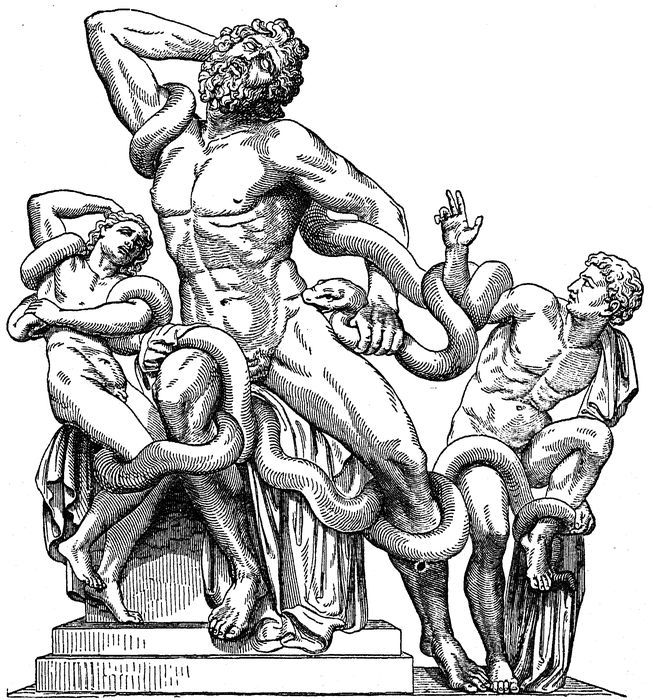
Fig. 61.—Laocoön. Group.
It treats really of three distinct incidents, which have been skilfully incorporated, by the artists to whom we owe the work (the 256Rhodians Agesander, Athenodorus, and Polydorus), into one harmonious group. The eldest son is as yet unhurt, and appears to be so loosely held by the coils of the serpent that he might easily escape his impending fate, if he were not more effectually restrained by his loving sympathy with his noble father, on whom he gazes with piteous looks. Laocoön himself, who naturally forms the centre of the group, is depicted at the moment in which, mortally wounded by the serpent, he sinks on the altar, to rise from which he vainly exerts his last remaining strength. With his left arm he still mechanically seeks to repel the serpents. His hitherto energetic resistance has begun to fail, and his noble head is raised in mournful resignation to heaven, as though to ask the gods why they had condemned him to so terrible a fate. The dignified and resolute aspect of his countenance forms a beautiful contrast to that of his body, which is manifestly quivering in the keenest agony. The younger son on his right is already in the last agonies of death, and though his left hand grasps instinctively the head of the snake, he is evidently incapable of further resistance. He is drooping like a plucked flower, and in one more moment will have breathed his last.
On the night succeeding Laocoön’s horrible end, and the rejoicings of the Trojans at the apparent departure of the Greeks, the Greek fleet returned in silence at a signal given by Sinon. The heroes who were hidden in the wooden horse then descended and opened the gates to the Greek host, who rushed into the doomed city. A terrible scene of plunder and carnage ensued, the Trojans, in their dismay and confusion, offering no resistance. The fate of the sacred city was fulfilled; Priam perished before the altar of Zeus by the hand of Neoptolemus, and with him the glory of Troy was laid in the dust. The men were put to death, the women and children, together with the rich booty, were carried off, the former being destined to the hard lot of slavery. Among them was the aged queen Hecuba, with all her daughters and daughters-in-law. Helen—the cause of all this misfortune—was found in the house of Deïphobus, whom she had married after the death of his brother Paris.
The city was burnt to the ground, and, long after, other cities rose on its site. Still the tradition of the siege remained among 257the inhabitants, though, even in Roman times, learned men had begun to declare that Old Troy must have had another site. And now when the last Ilium had been no more for many centuries, and the very existence of Homer’s Troy had been declared a fable, the palace and the traces of the conflagration have been found. Dr. Schliemann has excavated the legendary site, and we know now that Athene was worshipped in the city, and that it perished by fire. We can hardly tell at present the full importance of these discoveries, nor of those at Mycenæ, where the traditional tombs of the Grecian leaders have been examined, and their long-buried wealth brought to light.
Yet this, too, the greatest of all the Grecian legend series, dissolves into the phenomena of nature. That there was a Trojan war, and that we have some historical facts about it, we can hardly doubt; but so many myths have crystallised round it, that to us it must be merely legend. The very names of Achilles, and Paris, and Helen, upon whom the whole story turns, have been recognised in Indian legend. Point after point in their history is found in the legend history of every nation of the Aryan family. The only conclusion that we can draw is, that such stories must have come into being before the separation of the Aryan family, and cannot therefore contain the later history of any one branch.
III. The Return.—The Greeks, after sacrificing Polyxena on the grave of Achilles at Sigeum, prepared to return to their country. Few, however, were destined to reach their homes without some misfortune, or, even when arrived there, to experience a kindly welcome. Of the two sons of Atreus, Agamemnon, after escaping a storm on the coast of Eubœa, landed safely on his native shores, but was soon after murdered by his wife and Ægisthus, who had, during his absence, returned to Argos and married Clytæmnestra. Cassandra, the Trojan prophetess, who, in the division of the spoils, had fallen to Agamemnon, 258shared his fate. She had continually predicted the unfortunate end of the war and the ultimate fate of the city, but had always been laughed to scorn by her incredulous countrymen. The fate of the commander of the Greeks, with its eventful consequences, was a favourite subject with the tragic poets. His murder did not go unavenged. Orestes, the only son of Agamemnon and Clytæmnestra, had been hastily removed from the scene by his sister Electra, and sent to his uncle, Strophius, king of Phocis. Strophius had him carefully educated with his own son Pylades, who was about the same age. A most intimate friendship soon sprang up between the two youths, which, from its faithfulness and constancy, has become proverbial. On reaching manhood, the sole thought of Orestes was to avenge his noble father’s treacherous death at the hands of the crafty Ægisthus and his mother Clytæmnestra. Accompanied by his friend Pylades, he returned, in the eighth year of his exile, to Mycenæ, and there slew both Ægisthus and Clytæmnestra. Although in so doing he had only fulfilled a duty, he yet incurred the deepest guilt by the murder of her who gave him birth, and at once found himself pursued by the avenging Furies. They dogged his steps, and ceased not to pursue him through all the countries of the earth, until he was at length directed by the oracle at Delphi to convey the statue of Artemis from Tauris to Attica. After he had, with the help of his newly-found sister, successfully achieved this task, he was purified by Apollo (see page 152). Of the numerous dramas that were written on the subject of the fortunes of the Pelopidæ, which we have here briefly touched on, the Agamemnon, Choëphoræ, and Eumenides of Æschylus, the Electra of Sophocles, and the Electra and Iphigenia in Tauris of Euripides, are still extant.