PART II.—THE GODS. (continued 3)
Reading edition
“of old
Called the wild man from waste and wold,
And, in his hut thy presence stealing,
Roused each familiar household feeling;
And, best of all the happy ties,
The centre of the social band,—
The instinct of the Fatherland.”
Regarded in this light, she comes into contact with Dionysus, whose beneficial influence on human civilisation and manners we have already described. This accounts for the intimate connection of these two deities in the Eleusinian mysteries, where Dionysus-Iacchus even appears as the son of Demeter and the husband of Cora-Persephone. Owing to the important part she played in the institution of law and order among mankind, she was venerated as the goddess of marriage, marriage being the necessary foundation of civil society. She was also regarded as the tutelary goddess of national assemblies.
Of the numerous legends which are linked with the name of this goddess, none perhaps is more celebrated, or more pregnant with meaning in regard to her worship, than the rape of her daughter Persephone, or Cora. The latter was once playing with the daughters of Oceanus in a flowery meadow, where they were picking flowers and making garlands. Persephone happened to quit her companions for a moment to pluck a narcissus she had perceived, when suddenly the ground opened 139at her feet, and Pluto, or Hades, the god of the infernal regions, appeared in a chariot drawn by snorting horses. Swift as the wind he seized and carried off the terrified maiden in spite of her struggles, and vanished again into the regions of darkness before her companions were aware of the catastrophe. All this occurred, however, with the knowledge of Zeus, who had, unknown to Demeter, promised her daughter to Pluto. When Demeter missed her darling child, and none could tell her where she had gone, she kindled torches, and during many days and nights wandered in anxiety through all the countries of the earth, not even resting for food or sleep. At length Helios, who sees and hears everything, told Demeter what had happened, not disguising, however, that it had occurred with the consent of Zeus. Full of wrath and grief, the goddess now withdrew from the society of the other gods into the deepest solitude. Meanwhile all the fruits of the earth ceased, and a general famine threatened to extinguish the human race. In vain Zeus sent one messenger after another, beseeching the angry goddess to return to Olympus. Demeter swore that she would neither return nor allow the fruits of the earth to grow until her daughter was restored to her. At length Zeus was fain to consent, and despatched Hermes to the lower world to bring Persephone back. Persephone joyfully prepared to obey this command, but as she was about to depart Hades gave her a pomegranate-seed to eat, whereupon she found herself bound to him and unable to return. By means of Zeus, however, a compact was made by which Persephone was to spend two-thirds of the year in the upper world with her mother, and the remaining portion with her husband. And thus every year at springtide she ascends from her subterraneous kingdom to enjoy herself in her mother’s company, but returns again late in autumn to the regions of darkness and death.
It is not difficult to discover the meaning of this myth. It is 140simply an allegorical representation of the spectacle that is annually renewed before our eyes—the dying away and coming to life again of the vegetable world. Whilst Cora is dwelling during the winter months in the realms of Hades, Nature appears to wear a garb of mourning for her lost daughter. In the Eleusinian mysteries this inevitable decease and resurrection of the vegetable world was conceived as a symbol of higher meaning, setting forth the immortality of the soul. Every living being shares the fate of Cora; every life becomes the prey of cold, inexorable death, only to arise from the darkness of the grave more beautiful and glorious than before.
Closely connected with this beautiful and expressive myth is another which refers to the institution of the Eleusinian mysteries. When Demeter, after the loss of her daughter, was wandering over the earth in the guise of a poor old woman, she came to Eleusis. The daughters of Celeüs, the king of the city, found her sitting on a stone by the Maidens’ Well as they came thither to draw water, and offered the old woman service in their father’s house as nurse to their youngest brother Demophon. The goddess consented, and was kindly received in the house of Celeüs, where she was at once installed as nurse to the young prince. She became so fond of the child that she resolved to make him immortal by anointing him with ambrosia, and then laying him at night in the glow of the fire. She was discovered at her work, however, by the mother of the child, whose cries disturbed her, and thus prevented her from fulfilling her benevolent intention. She now revealed herself to Celeüs, and commanded him to build her a temple in Eleusis. When it had been hastily completed, with the help of the goddess, she initiated Celeüs and some other princes of Eleusis—Triptolemus, Eumolpus, and Diocles—in the solemn rites of her service. On Triptolemus, who is called the son of Celeüs, she imposed the 141task of disseminating a knowledge of agriculture and of her own worship throughout the earth, and for this purpose lent him her own chariot and dragons. On this he travelled through the countries of the earth, making known everywhere the blessings of agriculture, and uniting men in regular political communities. He was not well received in all places, and the goddess had sometimes to step in and punish those who contemned her benefits. Such was the case with the Scythian king Lynceus and the Thessalian prince Erysichthon; but at length her cause triumphed, and the worship of the bountiful goddess spread itself over the whole world.
The chief seat of her worship was the city of Eleusis, which was beautifully situated on the bay of Salamis. It retained this honour even after it had lost its independence and come into the possession of the Athenians. The Eleusinian mysteries were celebrated both here and at Athens, in honour of Demeter and the deities associated with her. They probably contained a symbolical history of Cora.
There was a distinction between the greater and lesser mysteries. The latter were celebrated at Athens in the month of Anthesterion (February), and were a kind of preparation for the greater mysteries, which took place in September, and were celebrated during nine days, partly at Athens and partly at Eleusis. In these secret rites only those could take part who had been initiated. The chief feature of the festival was a great and solemn procession on the sixth day from Athens to Eleusis, a distance of about twelve miles. All those who took part in it—often as many as 30,000—were crowned with myrtle, and bore torches in their hands, as the procession started from Athens at the earliest dawn.
The festival of the Thesmophoria, which was celebrated at the beginning of November, in honour of Demeter in her character of lawgiver and goddess of marriage, was less important than the Eleusinia. It lasted for five days, and only married women were allowed to take part in it.
142
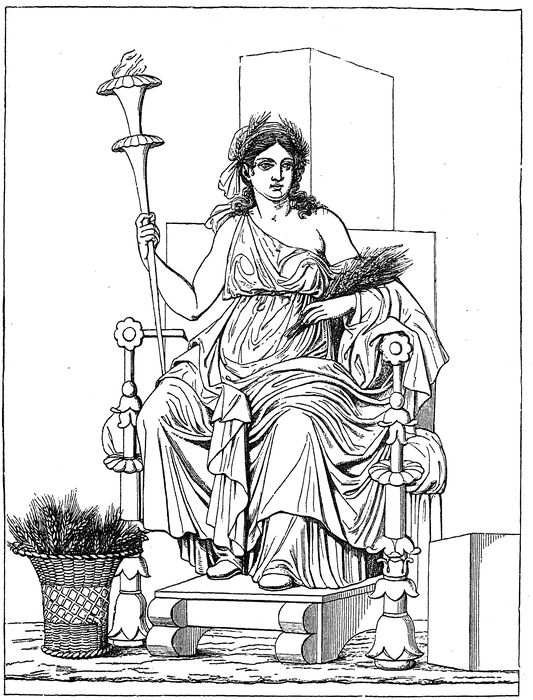
Fig. 44.—Demeter Enthroned. Painting from Pompeii. Naples.
143The Ceres of the Romans, though undoubtedly an ancient Italian goddess, was the very counterpart of the Greek Demeter, with whom, after the successful introduction of her worship during the first years of the Republic, she was entirely identified.
The chief festival of Ceres and her associate deities, Liber and Libera, fell on the 19th of April, which, as the proper spring month, was especially dedicated by the inhabitants of Italy to deities presiding over agriculture. The Cerealia were opened by a grand procession, in which every one was clothed in white. It was further celebrated with solemn sacrifices and games in the circus, the management of which lay with the plebeian ædiles.
The usual sacrifice, both among Greeks and Romans, was the sow (the symbol of fruitfulness), but, besides this, cows and the first fruits of the trees and hives were offered to her.
In the representations of the goddess an expression of lofty dignity is blended with condescending benevolence and gentleness. Her principal attributes are a torch, a sheaf of corn, a garland of ears of corn interwoven in her hair, and a basket filled with flowers at her side. Among the few antique statues, a large marble figure in the Capitoline Museum at Rome deserves especial mention. The engraving (Fig. 44), which is after a Pompeian painting, depicts Demeter as the bountiful goddess of agriculture. She is seated on a throne, and holds a torch consisting of two calices in her right hand, and a bunch of corn in her left.
15. Persephone (Proserpina).—In Persephone, the goddess of the lower world, whom the Athenians preferred to call by her mystic name of Cora, two distinct conceptions are embodied. On the one hand she appears as the wife of the dark god of the lower world—like him, a gloomy, awe-inspiring deity, who pitilessly drags down all that lives into the hidden depths of the earth; whence the grave is called the chamber of 144Persephone. Such is the view of her taken by Homer and later epic poets. These represent her as sitting enthroned at the side of her grim lord, the joyless queen of the infernal regions, to dwell in which were worse than to be a slave on earth. On the other hand she appears as Cora, the lovely daughter of the all-bountiful Mother Earth; a personification, in fact, of that never-dying force of nature which, year by year, causes the most luxuriant vegetation to spring up before our eyes, only, however, to die away again in the autumn. In a somewhat narrower sense Persephone may be regarded as a type of the grain, which long remains in the ground where it has been sown as though dead, but afterwards breaks forth into new life. It was only natural to associate with this last conception ideas of the immortality of the soul, of which, in the secret doctrines of the mysteries, Persephone was a symbol. Though we know but little concerning the details of the mysteries, we are yet aware that their chief object was to disseminate better and purer ideas of a future life than the popular faith of the Greeks afforded. It was commonly believed that the souls of men after death led a dull, miserable existence in the world of shadows. Those initiated in the mysteries, however, were taught that death was only a resurrection of the soul to a brighter and better life, on the condition, of course, that a man had fully pleased the gods and rendered himself worthy of such a happy lot.
Persephone, or Proserpina, as she is called in Latin, was a deity originally entirely strange to the Romans, who borrowed all their ideas of the lower world from the Greeks. Nevertheless, they identified her with Libera, an ancient rustic goddess of fertility, the feminine counterpart of Liber, under which name she signifies the same as the Greek Cora. Black, barren cows were sacrificed to Persephone as an infernal goddess, but she does not appear to have had any temples of her own.
145
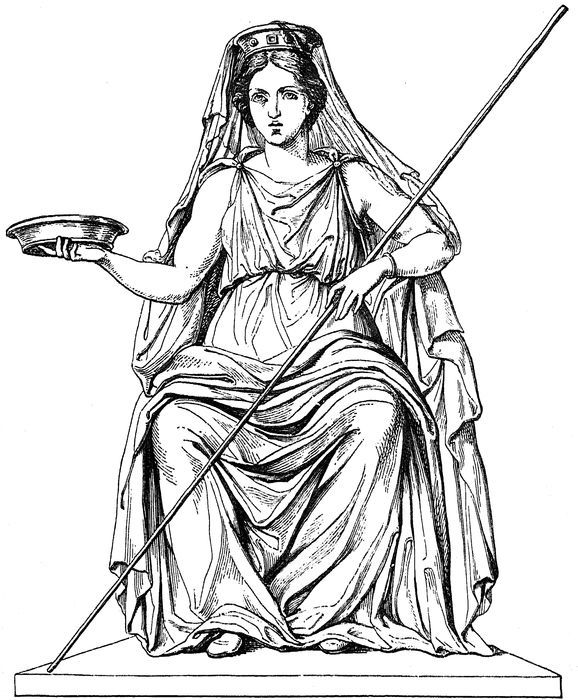
Fig. 45.—Persephone Enthroned. Painting from Pompeii. Naples.
Persephone is of no great importance in art, and statues of her are rare. She is represented either as the fair daughter of Demeter, or as the grave, severe queen of the world of shadows. In the latter character she may generally be recognised by her sceptre and diadem. Her other attributes are ears of corn, a poppy, and a torch, as a symbol of her connection with the Eleusinian mysteries, besides the 146pomegranate and narcissus. The engraving (Fig. 45), after a painting in the Naples Museum, represents her as the Stygian queen.
16. Hades (Pluto).—The same twofold nature which we meet with in Persephone may be observed also in her husband, Hades, or Aïdoneus (the invisible), as he is called by the epic poets, on account of the mysterious gloom in which his kingdom as well as his person was enveloped. He first appears as the unrelenting, inexorable foe of human life, on whom one cannot even think without fear and trembling. For this reason, says Homer, “he is of all the gods the most detested among mortals.” This conception, however, was subsequently supplanted by one of a less dismal nature, in which the other side of his character is brought into prominence. From this point of view he is represented not only as sending nourishment to plants from the deep bosom of the earth, but also as offering unbounded riches to mankind in the shape of the precious metals which lie in his subterraneous passages and chambers. In this sense he was also called Pluto, or Pluteus—that is, the god of riches.
Hades belonged to the earliest deities of Greece, being, like Poseidon, a brother of Zeus. When the three brothers partitioned the universe among themselves, Hades received the dark regions of the earth as his exclusive kingdom, the portals of which he was said to keep closed, in order that no soul might return to the upper world without his consent. He was also termed Polydectes (the receiver of many), from the fact of his seizing on all men, without distinction, at their appointed time, and conveying them to his dismal realms. The ideas which men first entertained, as to the mode in which Hades exercised his power over mortals, exactly corresponded with their grim conception of the god. He was looked on as a powerful and dreaded robber, who, as in the case of Persephone, seizes on his prey and carries it off with his swift horses. Later, a milder conception of the god was introduced. The task of carrying the souls of the dead 147to the lower world was delegated to Hermes, who thus became a servant of Pluto, the Zeus of the infernal regions, just as he was otherwise a servant of the Zeus of heaven. But though the original dismal conception of this deity as the inexorable god of death was much diminished in course of time, yet Hades, nevertheless, always conveyed an idea of something grim and mysterious to the Greek mind; which is perhaps the reason why so few myths, beyond that of the rape of Proserpina, were circulated concerning him. He can, in fact, scarcely be said to have had a place in the public worship of the Greeks.
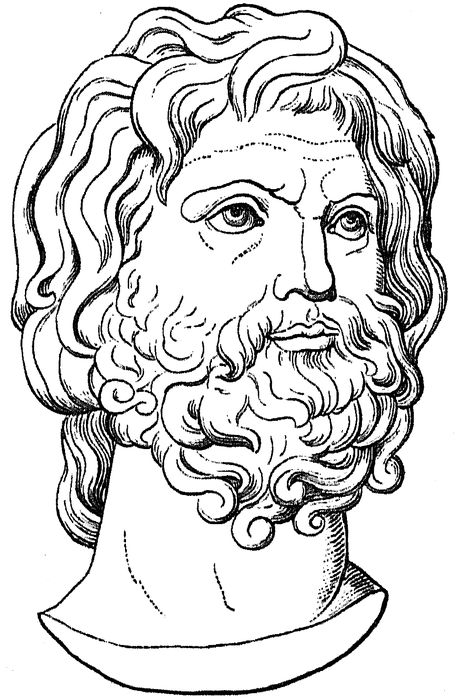
Fig. 46.—Head of Hades. Palazzo Chigi. Rome.
The Roman conception of this deity differed little from that of the Greeks, having been, in fact, borrowed entirely from a Greek source. By them he was called Pluto, or Pater Dis. He had no temple in Rome, but had, in common with Proserpina, a subterranean altar in the Campus Martius, which was uncovered and used once a-year. Only black animals were sacrificed to him.
Artists naturally hesitated to portray a being whose very name they feared to pronounce, and consequently antique statues of Hades are very rare. His characteristic features—a grim expression of countenance, tightly-closed lips, and long tangled hair—are embodied in a marble head, in the possession of Prince Chigi at Rome, of which we give an engraving (Fig. 46). His principal attributes are a sceptre, a votive bowl, and sometimes a two-pronged fork, or a key.
17. The Lower World.—To our consideration of Hades we must add some remarks on the ideas which the ancient 148Greeks and Romans had of the other life and of the abodes of the dead. It may be well to remark, at the outset, that the Romans do not originally appear to have believed in a kingdom of the dead in the interior of the earth, and that all their ideas on this subject were borrowed from the writings of the Greeks. Neither do their ideas on this subject, nor even those of the Greeks, appear to have been invariably the same at all times. Even in the poetry of Homer we come across two very different views as to the situation of the realms of the dead. According to that which we find in the Iliad, it was situated beneath the disc-shaped earth, only a thin layer separating it from the upper world. This is made evident on the occasion of the great battle of the gods in the 20th book, where we read—
“Pluto, the infernal monarch, heard alarmed,
And, springing from his throne, cried out in fear,
Lest Neptune, breaking through the solid earth,
To mortals and immortals should lay bare
His dark and drear abode of gods abhorred.”
According to another view which prevails in the Odyssey, the world of shadows was not situated beneath the earth, but lay far to the westward, on the other side of Oceanus, or on an island in the same; so indefinite and vague were men’s ideas as to the locality of the kingdom of death in the time of Homer, and so undeveloped were their conceptions as to the lives of departed souls. The lower world appears as a desolate, dismal region, where departed spirits lead a shadowy, dreamy existence, to reach which is no happiness. There is no difference in their lots; for we as yet hear nothing of the judgment of the dead. The Elysian fields, to which the special favourites of the gods were transferred, form no part of the lower world in Homer, but were supposed to lie in an entirely distinct region in the far West (the isles of the blest). Later on, the outlines of the lower 149world become more clearly defined. It was now supposed to be a region in the centre of the earth, with several passages to and from the upper world. Through it flowed several rivers—Cocytus, Pyriphlegethon, Acheron, and Styx. The last of these encompassed the lower world several times, and could only be crossed by the aid of Charon, the ferryman, who was depicted as a sullen old man with a bristling beard. The Greeks therefore used to place an obolus (small copper coin) in the mouths of their dead, in order that the soul might not be turned back by Charon for lack of money. On the farther side of the river the portals were watched by the dreadful hell-hound Cerberus, a three-headed monster, who refused no one entrance, but allowed none to leave the house of Pluto. All souls, on reaching the lower world, had to appear before the tribunal of Minos, Rhadamanthus, and Æacus. Those whose lives had been upright were then permitted to enter Elysium, where they led a life of uninterrupted bliss; whilst those who on earth had been criminal and wicked were consigned to Tartarus, where they were tormented by the Furies and other evil spirits. Those whose lives had not been distinctly good or bad remained in the asphodel meadow, where as dim shadows they passed a dull, joyless existence.
The punishments of great criminals in the infernal regions were a fruitful theme for the imagination of the poets. The most celebrated criminals were Tityus, Tantalus, Sisyphus, Ixion, and the Danaids. We have said that the idea of the judgment of the dead is not found in the earliest legends. Hence we must expect to find, in some cases, that the crimes supposed to have drawn down the wrath of the gods were either later inventions, or had very little connection with the punishment inflicted. Thus to take the case of Tantalus, the original idea appears to have been the burning sun looking upon sweet fruits and streams of water, and drying them up instead of being able to enjoy them. It is possible that another part of the legend, the offering of his children for the gods of heaven to eat, may have 150a similar origin. So the story of Sisyphus seems to point to the sun daily toiling up the steep hill of heaven, yet ever obliged to recommence his weary task. So the name Ixion seems to be derived from a word meaning wheel, and to be yet another allusion to the orb of day. As men began to forget the reality underlying these words, and to think that some real person suffered these woes, it was only natural that they should try to find a reason. Generally, perhaps always, some point in the story could be twisted into a crime deserving of punishment (compare the legend of Œdipus). The punishment of Tityus, who had offered violence to Leto, consisted in being chained to the earth, whilst two vultures continually gnawed at his ever-growing liver. Tantalus, the ancestor of the Atridæ, Agamemnon and Menelaus, had been deemed worthy to hold intercourse with the gods, until he thought fit to put their omniscience to the test by setting before them the flesh of his son Pelops. This crime he was condemned to expiate by the torments of continual hunger and thirst. Above his head were suspended the most beautiful fruits; but when he attempted to snatch them, a gust of wind blew them beyond his reach. At his feet flowed a stream of the purest water; but when he tried to quench his thirst, it suddenly vanished into the ground. Sisyphus, formerly king of Corinth, had provoked the wrath of the gods by his numerous crimes, and was condemned, in consequence, to roll a block of stone up a high mountain, which, on reaching the top, always rolled down again to the plain. Ixion, a not less insolent offender, was bound hand and foot to an ever-revolving wheel. Lastly, the Danaids, or daughters of Danaus, who, at their father’s command, had slain their husbands on the wedding night, were condemned to pour water continually into a cask full of holes, which could never be filled.
18. The Erinyes (Furiæ).—The Erinyes, or Furies, were denizens of the lower world, who executed the commands of Hades and Persephone. They were ultimately three in number, 151and their names were Tisiphone, Alecto, and Megæra; and this number, like that of the Graces, the Fates, and others, is due to the fact that the Greeks expressed any undefined number by the sacred numeral three. In their original signification they appear as the avengers of every violation, either on the part of gods or men, of the moral laws of the universe. When, at a later period, the idea of an avenging Nemesis had become more and more developed, the significance of the Erinyes diminished, and their avenging duties were confined to the family.
As the inexorable pursuers of every injury done to the sacred ties of blood—especially the murder of kindred—they received a much greater degree of attention at the hands of the Greek tragic poets, by whom they were frequently brought on the stage. The pictures thus drawn of the relentless activity of the Erinyes are both powerful and striking. Nothing can equal the keen scent with which they trace the crime, or the untiring speed with which they pursue the criminal. As a symbol of this latter quality, the poets have endowed them with brazen feet. Their appearance is wan and Gorgon-like; wild lust for blood is written in their features, and the serpents which twine round their heads in the place of hair deal out destruction and death on their unhappy victims. Flight avails them nought, for there is no region whither the avenging Furies cannot follow, no distance that they cannot compass. With torch swung on high they dog the steps of the unhappy wretch, like swift huntresses following in the track of their hard-pressed game, and never rest until they have driven him to madness and death.
What, then, was the origin of the belief in these dreadful beings? Two explanations have been given, and in each case we shall see in them the powers of nature. Whether we are to look upon them as the storm-clouds darting lightnings upon the criminal, or as the bright dawn rising over the earth and pointing out his hiding-place, we must recognise the idea of the punishment of sin, inflicted by the powers of heaven. If, as seems most probable (cf. the genealogy given them by Æschylus and 152Sophocles), we are to take the latter explanation, we shall have some reason for the names of “kindly” and “venerable,” applied to them by the Greeks, partly, no doubt, owing to the ancient custom of avoiding words of ill-omen. Yet poetical mythology treated this as a transformation of their nature, and associated it with a special event, namely, the institution of the Areopagus at Athens, and the purification of the matricide Orestes effected by this venerable court. The story relates that Orestes, after having slain his mother Clytæmnestra and her infamous paramour Ægisthus, in revenge for the murder of his father Agamemnon, wandered for a long time about the earth in a state bordering on madness, owing to the persecution of the Erinyes. At length, however, he was befriended by Apollo and Athene, the kindly deities of the luminous Æther. Apollo first purified him before his own altar at Delphi, and then defended him before the court of the Areopagus, which had been founded by Athene. Orestes was here acquitted, for Athene, when the votes for and against him were equal, declared that then and in all future time the criminal should have the benefit of the doubt. The Furies, indeed, were at first very wroth, and threatened the land with barrenness both of women and soil; but Athene succeeded in pacifying them, by promising that a shrine should be erected to them on the hill of the Areopagus. After they had taken possession of this sanctuary, they were thenceforth venerated by the Athenians, under the names of Semnæ (venerable), or Eumenides (benevolent), as propitious deities who, though they still continued to punish crimes, were ever ready to grant mercy to the repentant sinner, and to give succour to all good men.
There were different traditions concerning the origin of the Erinyes. According to Hesiod, they owed their existence to the first execrable crime committed since the beginning of the world, for they were the daughters of Earth, and sprang from the drops of blood that fell from the mangled body of Uranus. They here appear, therefore, as an embodiment of the curses 153which the angry father invoked on the head of his unnatural son. Sophocles, on the other hand, calls them the daughters of Gæa and Scotos (darkness of night). Æschylus simply terms them the daughters of the Night. Besides the shrine in Athens already mentioned, they had another near the city, a sacred grove in Colonus, which was celebrated as the last refuge of the unfortunate Œdipus. In Athens they had an annual festival, at which libations of milk and honey were made to them.
In art the Erinyes are represented as swift huntresses, armed with spear, bow, and quiver. Torches, scourges, or snakes were also put in their hands. They were, moreover, provided with wings on their shoulders or head as a token of their swiftness.
19. Hecate.—Among the mystic deities of the lower world we must not omit to mention Hecate. By the Romans, indeed, she was never publicly venerated, though she was not exactly unknown to them. Common tradition made her a daughter of the Titan Perseus and Asteria. She ruled principally over the secret forces of Nature, which perhaps explains the spectral and awe-inspiring form which this goddess assumed. She was supposed to preside over all nocturnal horrors, and not only to haunt the tombs and cross-roads herself in company with the spirits of the dead, but also to send nightly phantoms from the lower world, such as the man-eating spectre Empusa, and other fabulous goblins.
As her name seems to signify, Hecate (far-striking) was originally a moon-goddess, not like either Artemis or Selene, but representing the new moon in its invisible phase. The ancients not being able to account for the different phases of the moon, naturally came to the conclusion that, when invisible, it was tarrying in the lower world. The public worship of the goddess was not very extensive, but her importance in connection with the mysteries was all the greater. Men were wont to affix small pictures of her to houses and city gates, which were supposed to prevent any bad spells from affecting the town or house. On the last day of every month her image on the house doors was 154crowned with garlands, and viands were set before it in her honour, which were afterwards eaten by the poor, and termed the meals of Hecate. Wooden images of the goddess with three faces were generally set up where three roads met, and here dogs were sacrificed to her as sin-offerings for the dead. This usually took place on the thirtieth day after death. As in the case of other infernal deities, black lambs were sacrificed to her, besides libations of milk and honey.
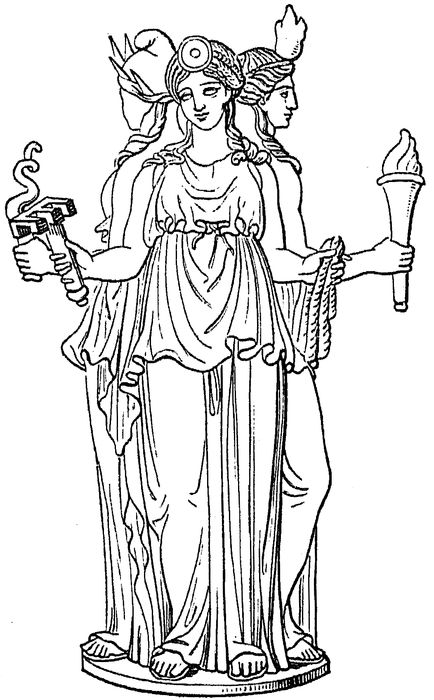
Fig. 47.—Three-formed Hecate. Capitoline Museum.
Hecate was generally represented as three-formed (triformis), which probably has some connection with the appearance of the full, half, and new moon. In order to explain more clearly the nature of such a representation, we give an engraving (Fig. 47) after a bronze statuette in the Capitoline Museum at Rome. The figure facing us holds in her hands a key and a rope, which point her out as the portress of the lower world; over her brow is a disc, representing, probably, the dark surface of the new moon. The figure on the right holds in either hand a torch, in virtue of her character as a mystic goddess, whilst on her brow is a half-moon and a lotus-flower. Lastly, the third figure bears, as a symbol of the full moon, a Phrygian cap with a radiant diadem fastened on it, which gives forth seven rays; in her right hand is a knife, in her left the tail of a serpent, of which no satisfactory interpretation has hitherto been discovered.
20. Sleep and Death.—Sleep and Death were conceived by the ancients as twin brothers. According to Hesiod, they were children of Night alone. They dwelt in the lower world, whence they visited the earth to steal over mortals; the former a kindly benevolent spirit, the latter grim and cruel. Apart from this 155conception, which was especially developed by later poets and artists, Death was sometimes depicted as quite distinct from Sleep, and in a still less amiable guise. The different forms of violent death were personified as female deities of formidable aspect, called the Ceres; or Apollo and Artemis among the inhabitants of heaven, and Pluto and Persephone among those of the lower world, were represented, as the deities of death. The Romans had a personal god of death, whom they called Orcus; he was represented as an armed warrior dealing out mortal wounds among mankind. But none of these special gods of death had any great importance, either in religion or art. Artists, indeed, laboured sedulously to diminish the dreadful appearance of Thanatus (death), and to render him more and more like his brother Hypnus (sleep).
Thanatus and Hypnus often appear in company, either sleeping or standing; the former usually bears a reversed torch, the latter a poppy-stalk or a horn, out of which he is pouring some liquid. They are both generally represented in the bloom of youth. In Fig. 34, which is after a drawing of Asmus Carstens, they appear as the children of Night, and are here brought into immediate connection with the other powers, Nemesis and the Parcæ, who control the destinies of man.
Besides Sleep and Death, Hesiod also mentions Dreams as the children of Night. Other writers, however, call them the sons of Sleep, who dwell in the far West, close to the realms of Hades. This house of dreams has, in Homer’s well-known description, two gates—one of ivory, through which pass flattering, deceptive dreams, and one of horn, whence the true dreams proceed. Morpheus was made the special god of dreams by the poets, and termed the son of Hypnus.
IV.—ROMAN DEITIES OF THE HOUSE AND FAMILY.
Before passing to the heroic legends, some remarks are necessary concerning the inferior deities, who played such an important part in the domestic worship of the Romans. We have already 156incidentally remarked that the people of Italy generally passed by the greater gods of the heaven and earth in anxious awe. Their invocation and adoration was left to public worship, whilst, in their less important domestic concerns, men had recourse to certain inferior deities, whom they thought nearer to them; just as in the present day, in Italy, the common people prefer to communicate their prayers and wishes to their patron saints rather than to the Almighty himself.
1. The Penates.—The Penates were the kindly domestic deities of the Romans—the guardians of the household, who especially provided for its daily wants. Of their name, number, and sex nothing is known—not because the facts have been lost to us, but because the Romans themselves were content with this indefinite conception. Similar good spirits, exerting an active influence in the household, were recognised by popular German superstition, without experiencing any necessity of having distinct names for them. The shrine of the Penates consisted of the hearth, the central point of the house, which not only served for the preparation of meals, but was also especially dedicated to religious purposes. It stood in the “atrium,” the only large room in the Roman house, where the family met for meals and received visitors. On the hearth, a fire was continually kept burning in honour of Vesta and the Penates. Around it, after the introduction of images of the gods, were placed the statues of the Penates. These were generally small and puppet-like, and, among the poorer classes, were only roughly cut out of wood. There was no domestic occurrence, either of joy or mourning, in which the Penates did not take part. Like the Lares, of whom we shall speak presently, they participated in the daily meal, portions being set on certain plates for that purpose before the images. There were also State Penates, the ancients regarding the state as nothing but an extended family. The temple of Vesta was to the state what the hearth was to the household. Here was the seat of their 157worship, and here it was that the Roman Pontifex Maximus brought those offerings which, in private households, were the part of the head of the family. In the innermost sanctuary of the temple of Vesta there were statues of these Penates, of great sanctity, since Æneas was reported to have brought them with him from Troy. We have no trustworthy information as to their number or appearance, for, with the exception of the Pontifex and the Vestal Virgins, none ever entered the holy place. It is scarcely necessary to add that they were believed to exercise an especial influence on the welfare and prosperity of the state and people of Rome.
2. The Lares.—The Lares, like the Penates, were the tutelary deities of the house and family, and on that account often confounded with them. They were commonly supposed to be the glorified spirits of ancestors, who, as guardian deities, strove to promote the welfare of the family. The seat of their worship was also the family hearth in the atrium, where their images of wood or wax were generally preserved in a separate shrine of their own (Lararium). The Lares received an especial degree of veneration on the first day of every month; but, like the Penates, they took part in all the domestic occurrences, whether of joy or sorrow. Like the Penates, they also received their share at every meal on particular dishes, and were crowned with garlands on the occasion of every family rejoicing. When a son assumed the toga virilis (came of age), he dedicated his bulla[5] to the Lares, amid prayers and libations and burning of incense. When the father of the house started on a journey or returned in safety, the Lares were again addressed, and their statues crowned with wreaths, flowers and garlands being their favourite offerings.
The same conception which pervades the domestic Lares may be perceived in a more extensive form in the Lares of the Gens, the 158city, and the state itself. The Lares do not appear, in fact, to have differed in many respects from the heroes worshipped by the Greeks. At all events, Romulus and Remus, the mythical founders of the city, were regarded as its Lares, and, in the time of Augustus, the genius of the emperor was associated with them.
3. Larvæ, Lemures, and Manes.—Just as the Lares were regarded as the good and happy spirits of ancestors, the souls of others were supposed to wander about in the guise of evil demons and spectres, giving rise to weird terrors, and casting bad spells on the senses of those whom they met. Such was especially believed to be the fate of those who had not received burial, or in whose case the prescribed ceremonies had been neglected, and who being, in consequence, unable to find rest, were doomed to flit about the earth. Such spirits were called Larvæ, or Lemures. The propitiatory festival of the Lemuria, or Lemuralia, which was said to have been instituted in memory of the murdered Remus, was celebrated annually in their honour on the 9th, 11th, and 13th of May. Every paterfamilias was supposed during these days to perform certain midnight ceremonies, and to repeat certain forms, which had the effect of banishing any evil spirits.
In contrast to the Lares and Larvæ, the souls of the dead were also commonly venerated as Manes, or good spirits. These were believed after burial to have been converted into beings of a higher order, who dwelt, indeed, in the interior of the earth, but exercised, notwithstanding, a considerable influence on the affairs of the upper world. It was possible to summon them from the lower world by means of sacrifices. A general festival of the dead took place in February, when the Manes were propitiated with offerings and libations. These offerings were placed on the tombs of the deceased, and, of course, varied extremely, according to the means of the donors.
159