PART III.—THE HEROES. (continued 3)
Reading edition
We must now turn to the fortunes of the other Greek leaders. Agamemnon’s brother Menelaus was overtaken, off Cape Malea, by a fearful storm, which carried him to Crete and Egypt, 259whence, after seven years of wandering, he returned to Sparta with Helen and his share of the spoils of Troy.
The Locrian Ajax experienced a still more unhappy fate. On the night of the destruction of Troy he had penetrated into the temple of Pallas, and had not only torn away the priestess Cassandra, who was clinging for safety to the altar and statue of the goddess, but had also overturned the statue of Pallas herself. As a punishment for this offence, his ship was wrecked on Cape Caphareus, He would still have been able to escape with his life—having succeeded in getting hold of a rock—if he had not given such offence to Poseidon by his impious boast that he needed not the help of the gods, that the god split the rock with his trident, whereupon Ajax fell into the sea and was drowned.
Diomedes, Philoctetes, and Idomeneus reached their homes in safety, but were all soon afterwards driven out, after which they all three emigrated to Italy. Here Diomedes founded many towns, and was long worshipped with heroic honours.
Teucer also succeeded in reaching Salamis in safety, but his father Telamon was so wroth because he had not better protected his brother Ajax, or at least avenged his death, that he refused to receive him. He was, therefore, likewise obliged to leave his country, and subsequently settled on the island of Cyprus.
But of all the Greek heroes Odysseus experienced the most reverses, while at home his faithful wife Penelope and his son Telemachus were hard pressed by the suitors. It was only in the tenth year after the fall of Troy, and after numerous wanderings and vicissitudes, that he was permitted to return to his native Ithaca and punish the shameless suitors who had wasted his substance and goods. The story of his adventures is so well known that we need not dwell on it here, further than to mention that, according to post-Homeric accounts, Odysseus was killed by the hand of Telegonus, his own son by Circe.
260The events of the Trojan cycle have supplied not only the poet, but also the artist and the sculptor, with a large number of their most acceptable subjects. Single scenes, such as the judgment of Paris, have been continually selected, ever since the time of Raphael, as favourite subjects of representation. Of modern masters, Carstens, Thorwaldsen the great Danish sculptor, Cornelius, Genelli, and Preller (Landscapes of the Odyssey) have illustrated the story of Troy in a series of splendid compositions. We give an engraving of a relief by Thorwaldsen, representing Priam before Achilles (Fig. 62).
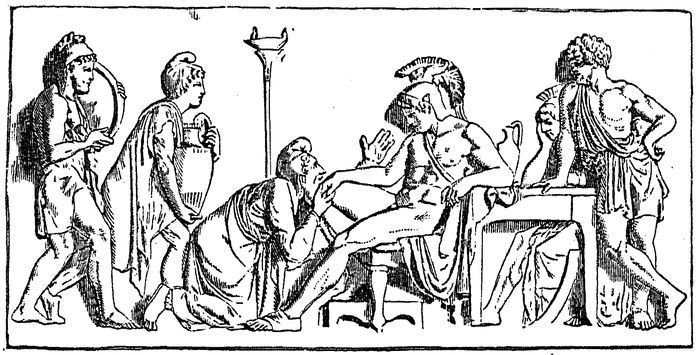
Fig. 62.—Priam before Achilles. Relief by Thorwaldsen.
Of the more important extant works of antiquity, we may mention the wedding of Peleus and Thetis, depicted on the Français vase in the Naples Museum; the abduction of Helen, depicted on a marble relief in the former Campana collection, now in the Louvre (Fig. 63); the marble group in Rome, known by the name of “Pasquino,” which represents Menelaüs raising the corpse of Patroclus; and, lastly, the celebrated Ægina marbles in Munich. These last are the remains of a marble group from the gable of a temple of Pallas at Ægina, representing a battle between the Greeks and Trojans. They were discovered at Ægina in the year 1811; King Ludwig I. of Bavaria, who was a great patron of art, bought the Ægina marbles, and, after having them restored by Thorwaldsen, placed them in the Munich collection. The Laocoön, the most important of all the works relating to the Trojan cycle, has already been discussed.
261
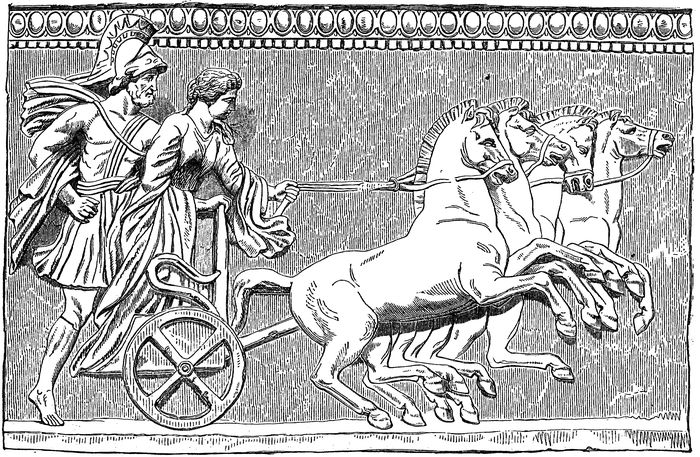
Fig. 63.—Rape of Helen. Campana Collection. Paris.
262
V.—MYTHIC SEERS AND BARDS.
We have already incidentally mentioned most of the seers of antiquity—Melampus, the son of Amythaon, who figures in Argive legend; likewise Amphiaraüs, Tiresias, and Calchas. Concerning Tiresias, we may remark that the ancients ascribed to him a fabulous age, extending over seven or even nine generations; so that he was thus a witness of all that happened to Thebes, from the foundation of the city to its destruction by the Epigoni. Like all celebrated soothsayers, he was acquainted with the language of birds, and could penetrate the most hidden secrets of nature; on which account he enjoyed up to his death an ever-increasing reputation among the Thebans. We have already related how, in extreme old age, when his native city could no longer withstand the assaults of the Epigoni, he experienced the bitter lot of having to take refuge in flight, and at length succumbed beneath the hardships of the journey. In the second century A.D. his grave was still shown in the neighbourhood of Haliartus.
Among the fugitive Thebans who fell into the hands of the Argives is said to have been Manto, the daughter of Tiresias, who was likewise renowned as a prophetess. She was dedicated, together with a large portion of the spoils, to the oracle at Delphi. By the command of the god she was sent into Asia Minor, where she founded the oracle of Claros, near Colophon. She here married the Cretan Rhacius, and became by him the mother of Mopsus, who afterwards founded the oracle of Mallos in Cilicia.
Among the names of the mythic bards that have been handed down to us are undoubtedly to be found some recollections of those who first cultivated the art of poetry; partly, however, they are nothing more than personifications of certain tendencies 263and modes of poetry. Such is probably the case with the mythic bard Linus, who was celebrated in Argos, Thebes, and Eubœa. Nothing is more common than for an unsophisticated people to burst forth in lamentation over the decay and final extinction of the blooming life of nature. This, as we see in the myth of Hyacinthus, was often portrayed under the metaphor of a beautiful boy slain by a quoit or by savage dogs—both symbols of the scorching heat of the sun. The dirges which from time immemorial were sung over the beautiful boy Linus, at the season of vintage, probably gave rise to the myth which makes Linus himself the singer.
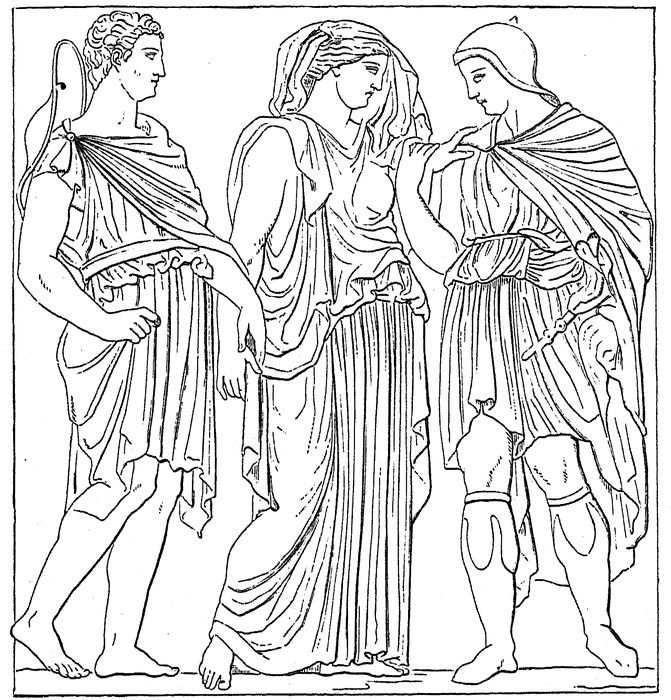
Fig. 64.—Orpheus and Eurydice. Marble Relief In the Villa Albani.
264Similar doleful memories are linked with the name of Orpheus, who is often termed a brother of Linus, though he was really not an Æolian, but a Thracian of Pieria. That which is best known of him is the story of his love for the beautiful nymph Eurydice. She was bitten in the foot by a snake, and thus snatched away from him by death. Orpheus then filled mountain and valley with songs of lamentation so piteous, that the wild beasts of the forest were enchanted at the sound, and followed him like lambs; and the very rocks and trees moved from their places. His yearning towards his beloved Eurydice induced him to descend to the lower world, to beg her release from the grim king of shadows. Here his piteous lay caused even the Erinyes to shed tears of compassion, and moved the hard heart of the Stygian king. He released Eurydice on condition that Orpheus should not look back on her till he reached the upper world. Orpheus, however, violated this condition, and Eurydice was once more lost to him. He himself, not long afterwards, whilst wandering in his despair over the Thracian mountains, was torn in pieces by some women in the mad excitement of their nightly Bacchanalian orgies.
A splendid representation of the second parting of the lovers by Hermes, the guide of souls, has come down to us on a marble relief, which is preserved in the Villa Albani (Fig. 64).

265