Chapter II · THE WHITE-SPORED AGARICS.
Reading edition
The species bearing the white spores seem to be higher in type than those producing colored spores. Most of the former are firmer, while the black spored specimens soon deliquesce. The white spores are usually oval, sometimes round, and in many cases quite spiny. All white-spored specimens will be found in clean places.
Amanita. Pers.
Amanita is supposed to be derived from Mount Amanus, an ancient name of a range separating Cilicia from Syria. It is supposed that Galen first brought specimens of this fungus from that region.
The genus Amanita has both a volva and veil. The spores are white and the stem is readily separable from the cap. The volva is universal at first, enveloping the young plant, yet distinct and free from the cuticle of the pileus.
This genus contains some of the most deadly poisonous mushrooms, although a few are known to be very good. There is a large number of species—about 75 being known, 42 of which have been found in this country—a few being quite common in this state. All the Amanita are terrestrial plants, mostly solitary in their habits, and chiefly found in the woods, or in well wooded grounds.
In the button stage it resembles a small egg or puff-ball, as will be seen in Figure 6, page 11, and great care should be taken to distinguish it from the latter, if one is hunting puff-balls to eat; yet the danger is not great, since the volva usually breaks before the plant comes through the ground.
Amanita phalloides. Fr.
The Deadly Amanita.
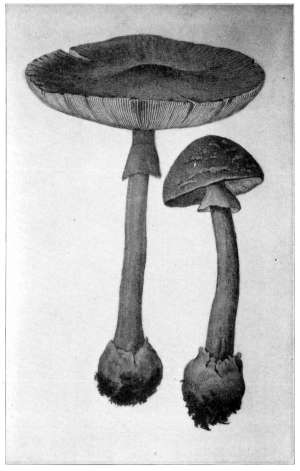
Figure 11.—Amanita phalloides. Fr. Showing volva at the base, cap dark.
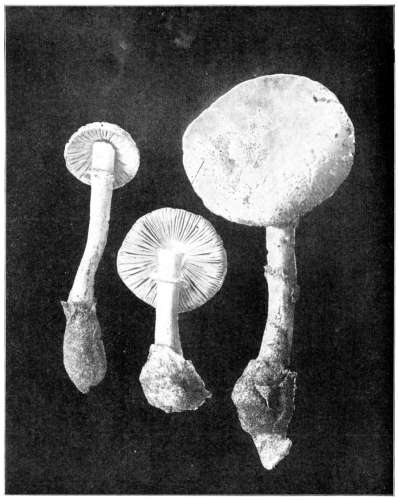
Figure 12.—Amanita phalloides. Fr. White form showing volva, scaly stem, ring.
Phalloides means phallus-like. This plant and its related species are deadly poisonous. For this reason the plant should be carefully studied and thoroughly known by every mushroom hunter. In different localities, and sometimes in the same locality, the plant will appear in very different shades of color. There are also variations in the way in which the volva is ruptured, as well as in the character of the stem.
The beginner will imagine he has a new species often, till he becomes thoroughly acquainted with all the idiosyncrasies of this plant.
The pileus is smooth, even, viscid when young and moist, frequently adorned with a few fragments of the volva, white, grayish white, sometimes smoky-brown; whether the pileus be white, oyster-color or smoky-brown, the center of the cap will be several shades darker than the margin. The plant changes from a knob or egg-shape when young, to almost flat when fully expanded. Many plants have a marked umbo on the top of the cap and the rim of the cap may be slightly turned up.
The gills are always white, wide, ventricose, rounded next to the stem, and free from it.
The stem is smooth, white unless in cases where the cap is dark, then the stem of those plants are apt to be of the same color, tapering upward as in the specimen (Fig. 11); stuffed, then hollow, inclined to discolor when handled.
The volva of this species is quite variable and more or less buried in the ground, where careful observation will reveal it.
One need never confound this species with the meadow mushroom, for the spores of that are always purple-brown, while a spore-print of this will always reveal white spores. I have seen a slight tint of pink in the gills of the A. phalloides but the spores were always white. Until one knows thoroughly both Lepiota naucina and A. phalloides before eating the former he should always hunt carefully for the remains of a volva and a bulbous base in the soil.
This plant is quite conspicuous and inviting in all of its various shades of color. It is found in woods, and along the margin of woods, and sometimes on lawns. It is from four to eight inches high and the pileus from three to five inches broad. There is a personality about the plant that renders it readily recognizable after it has once been learned. Found from August to October.
Amanita recutita. Fr.
The Fresh-skinned Amanita. Poisonous.
Recutita, having a fresh or new skin. Pileus convex, then expanded, dry, smooth, often covered with small scales, fragments of the volva; margin almost even, gray or brownish.
The gills forming lines down the stem.
The stem stuffed, then hollow, attenuated upward, silky, white, ring distant, edge of volva not free, frequently obliterated.
Rather common where there is much pine woods. August to October.
This species differs from A. porphyria in ring not being brown or brownish.
Amanita virosa. Fr.
The Poisonous Amanita.
Virosa, full of poison. The pileus is from four to five inches broad; the entire plant white, conical, then expanded; viscid when moist; margin often somewhat lobed, even.
The gills are free, crowded.
The stem is frequently six inches long, stuffed, round, with a bulbous base, attenuated upward, squamulose, ring near apex, volva large, lax.
The spores are subglobose, 8–10µ. This is probably simply a form of A. phalloides. It is found in damp woods. August to October.
Amanita muscaria. Linn.
The Fly Amanita. Poisonous.
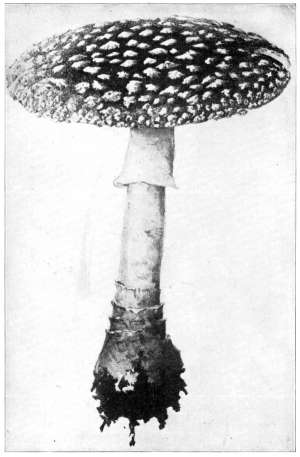
Figure 13.—Amanita muscaria.—Linn. Cap reddish or orange, showing scales on the cap and at base of stem.
Muscaria, from musca, a fly. The fly Amanita is a very conspicuous and handsome plant. It is so called because infusions of it are used to kill flies. I have frequently seen dead flies on the fully developed caps, where they had sipped of the dew upon the cap, and, like the Lotos-eaters of old, had forgotten to move away. It is a very abundant plant in the woods of Columbiana county, this state. It is also found frequently in many localities about Chillicothe. It is often a very handsome and attractive plant, because of the bright colors of the cap in contrast with the white stem and gills, as well as the white scales on the surface of the cap. These scales seem to behave somewhat differently from those of other species of Amanita. Instead of shrivelling, curling, and falling off they are inclined to adhere firmly to the smooth skin of the pileus, turning brownish, and in the maturely expanded plant appear like scattered drops of mud which have dried upon the pileus, as you will observe in Figure 13.
The pileus is three to five inches broad, globose at first, then dumb-bell in shape, convex, then expanded, nearly flat in age; margin in matured plants slightly striate; the surface of the cap is covered with white floccose scales, fragments of the volva, these scales being easily removed so that old plants are frequently comparatively smooth. The color of the young plant is normally red, then orange to pale yellow; late in the season, or in old plants, it fades to almost white. The flesh is white, sometimes stained yellow close to the cuticle.
The gills are pure white, very symmetrical, various in length, the shorter ones terminating under the cap very abruptly, crowded, free, but reaching the stem, decurrent in the form of lines somewhat broader in front, sometimes a slight tinge of yellow will be observed in the gills.
The stem is white, often yellowish with age, pithy and often hollow, becoming rough and shaggy, finally scaly, the scales below appearing to merge into the form of an obscure cup, the stem four to six inches long.
The veil covers the gills of the young plant and later is seen as a collar-like ring on the stem, soft, lax, deflexed, in old specimens it is often destroyed. The spores are white and broadly elliptical.
The history of this plant is as interesting as a novel. Its deadly properties were known to the Greeks and Romans. The pages of history record its undoing and its accessory to crime. Pliny says, alluding to this species, "very conveniently adapted for poisoning." This was undoubtedly the species that Agrippina, the mother of Nero, used to poison her husband, the Emperor Claudius; and the same that Nero used in that famous banquet when all his guests, his tribunes and centurions, and Agrippina herself, fell victims to its poisonous properties.
However, it is said this mushroom is habitually eaten by certain people as an intoxicant; indeed, it is used in Kamchatka and Asiatic Russia, generally, where the Amanita drunkard takes the place of the opium fiend and the alcohol bibber in other countries. By reading Colonel George Kennan in his "Tent-life in Siberia," and Cooke's "Seven Sisters of Sleep," you will find a full description of the toxic employment of this fungus which will far surpass any possible imagination.
It caused the death of the Czar Alexis of Russia; also Count de Vecchi, with a number of his friends, in Washington in 1896. He was in search of the Orange Amanita and found this, and the consequences were serious.
In size, shape, and color of the cap there is similarity, but in other respects the two are very different. They may be contrasted as follows:
Orange Amanita, edible.—Cap smooth, gills yellow, stem yellow, wrapper persistent, membranaceous, white.
Fly Amanita, poisonous.—Cap warty, gills white, stem white, or slightly yellowish, wrapper soon breaking into fragments or scales, white or sometimes yellowish brown.
Found along roadsides, wood margins, and in thin woods. It prefers poor soil, and is more abundant where poplar and hemlock grow. From June to frost.
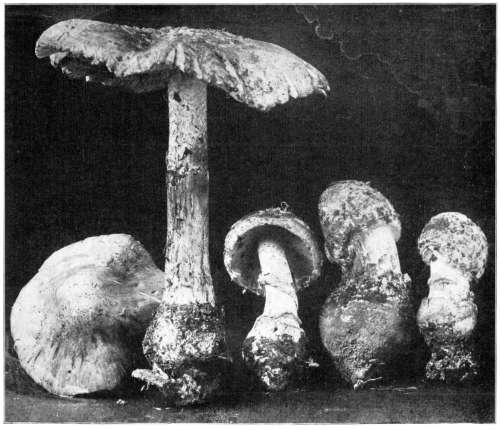
Figure 14.—Amanita muscaria.—Linn. One-half natural size, showing development of the plant.
Amanita Frostiana. Pk.
Frost's Amanita. Poisonous.
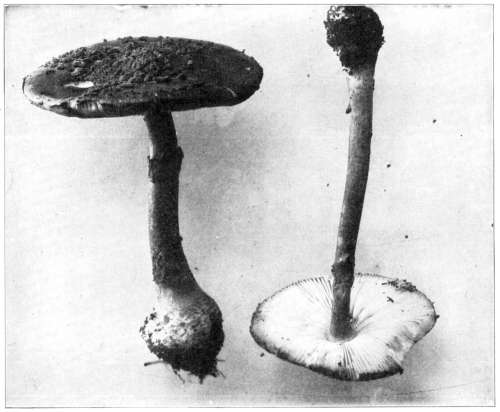
Figure 15.—Amanita Frostiana. Photo by C. G. Lloyd.
Frostiana, named in honor of Charles C. Frost.
The pileus is convex, expanded, bright orange or yellow, warty, sometimes smooth, striate on the margin, pileus one to three inches broad.
The gills are free, white, or slightly tinged with yellow.
The stem is white or yellow, stuffed, bearing a slight, sometimes evanescent, ring, bulbous, at the base, the bulb slightly margined by the volva. The spores globose, 8–10µ in diameter. Peck.
Great care should be taken to distinguish this species from A. cæsarea because of its often yellow stem and gills. I found some beautiful specimens on Cemetery Hill and on Ralston's Run. It is very poisonous and should be carefully avoided, or rather, it should be thoroughly known that it may be avoided. The striations on the margin of its yellow tinge might lead one to mistake it for the Orange Amanita. It is found in shady woods and sometimes in open places where there is underbrush. June to October.
Amanita verna. Bull.
The Spring Amanita. Poisonous.
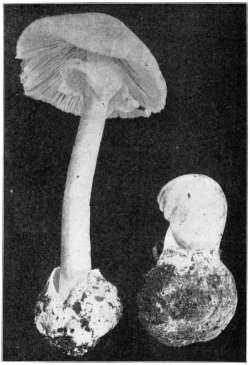
Figure 16.—Amanita verna. Two-thirds natural size, showing the volva cup and the ring.
Verna, pertaining to spring. This species is considered by some only a white variety of Amanita phalloides. The plant is always a pure white. It can only be distinguished from the white form of the A. phalloides by its closer sheathing volva and perhaps a more ovate pileus when young.
The pileus is at first ovate, then expanded, somewhat depressed, viscid when moist, even, margin naked, smooth. The gills are free.
The stem is stuffed, with advancing age hollow, equal, floccose, white, ringed, base bulbous, volva closely embracing the stem with its free margin, ring forming a broad collar, reflexed. The spores are globose, 8µ broad.
This species is very abundant on the wooded hills in this section of the state. Its pure white color makes it an attractive plant, and it should be carefully learned. I have found it before the middle of June.
Amanita magnivelaris. Pk.
The Large Veiled Amanita. Poisonous.
Magnivelaris is from magnus, large; velum, a veil.
The pileus is convex, often nearly plane, with even margin, smooth, slightly viscid when moist, white or yellowish-white.
The gills are free, close, white.
The stem is long, nearly equal, white, smooth, furnished with a large mebranaceous volva, the bulbous base tapering downward and rooting. The spores are broadly elliptical.
This species very closely resembles Amanita verna, from which it can be distinguished by its large, persistent annulus, the elongated downward-tapering bulb of its stem, and, especially, by its elliptical spores.
It is found solitary and in the woods. I found several on Ralston's Run under beech trees. Found from July to October.
Amanita pellucidula. Ban.
Pileus at first campanulate, then expanded, slightly viscid, fleshy in center, attenuated at the margin; color a smooth bright red, deeper at the top, shaded into clear transparent yellow at the margin; glossy, flesh white, unchanging.
The gills are ventricose, free, numerous, yellow.
The stem is stuffed, ring descending, fugacious. Peck's 44th Report.
This species differs from Amanita cæsarea in having an even margin and a white stem. It is only a form of the cæsarea. The white stem will attract the attention of the collector.
Amanita solitaria. Bull.
The Solitary Amanita.
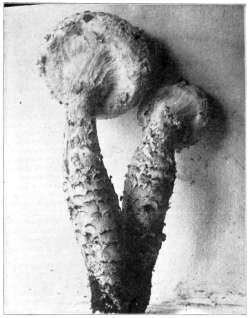
Figure 17.—Amanita solitaria. Two-thirds natural size, showing the peculiar veil.
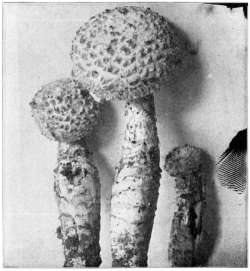
Figure 18.—Amanita solitaria. Two-thirds natural size, showing scaly cap and stem.
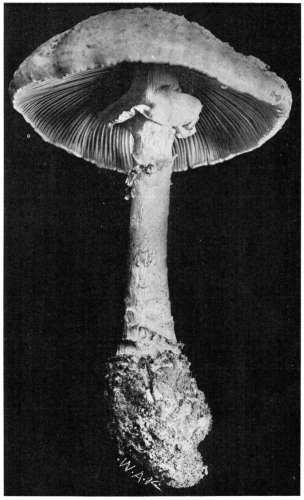
Plate II. Figure 19.—Amanita solitaria. Natural size, showing scaly cap and stem, plant white.
Solitary, growing alone. I have found this plant in various parts of the state and have always found them growing alone. In Poke Hollow, where I found the specimens in the illustrations, I found several on the hillside on different occasions, but I have never found them growing in groups. It is quite large in size, white or whitish, very woolly or floccose. Usually the cap, stem, and the gills are covered with a floccose substance which will serve to identify the species. This fluffy exterior adheres readily to your hands or clothing. The cap is sometimes tinged with brown, but the flesh is white and smells quite strong, not unlike chloride of lime. The annulus is frequently torn from the stem and is found adhering to the margin of the cap.
The pileus is from three to five inches broad, or more, when fully expanded, at first globose to hemispherical, as will be seen in Figures 17 and 18, convex, or plane, warty, white or whitish, the pointed scales being easily rubbed off, or washed off by heavy rains, these scales varying in size from small granules to quite large conical flakes, and differing in condition and color in different plants.
The gills are free, or are not attached by the upper part, the edges are frequently floccose where they are torn from the slight connection with the upper surface of the veil; white, or slightly tinged with cream-color, broad.
The stem is four to eight inches high, solid, becoming stuffed when old, bulbous, rooting deep in the soil, very scaly, ventricose sometimes in young plants, white, very mealy. Volva friable. Ring, large, lacerated, usually hanging to the margin of the cap, but in Figure 19 it adheres to the stem.
This is a large and beautiful plant in the woods, and easily identified because of its floccose nature and the large bulb at the base of the stem. It is not so warty and the odor is not nearly so strong as the Amanita strobiliformis. It is edible but very great caution should be used to be sure of your species. Found from July to October in woods and roadsides.
Amanita radicata. Pk.
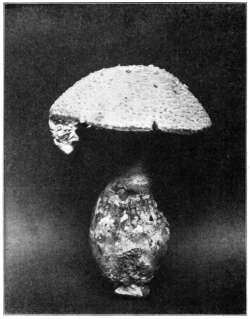
Figure 20.—Amanita radicata. Two-thirds natural size, showing scaly cap, bulbous stem and root broken off and peculiar veil.
Radicata means furnished with a root. The root of the specimen in Figure 20 was broken off in getting it out of the ground.
The pileus is subglobose, becoming convex, dry, verrucose, white, margin even, flesh firm, white, odor resembling that of chloride of lime.
The gills are close, free, white.
The stem is solid, deeply radicating, swollen at the base or bulbous, floccose or mealy at the top, white; veil thin, floccose, or mealy, white, soon lacerated and attached in fragments to the margin of the pileus or evanescent. The spores are broadly elliptic, 7.5–10µ long, 6–7µ broad. Peck.
This is quite a large and beautiful plant, very closely related to Amanita strobiliformis, but readily distinguished from it because of its white color, its clearly radiating stem, and small spores. The stem shows to be bulbous and the cap covered with warts. I found the plant frequently in Poke Hollow and on Ralston's Run. July and August.
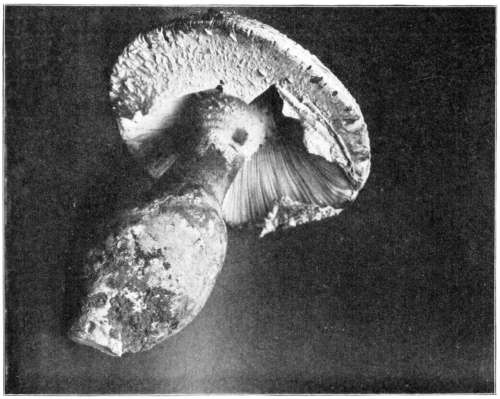
Figure 21.—Amanita radicata.
Amanita strobiliformis. Fr.
The Fir-cone Amanita.
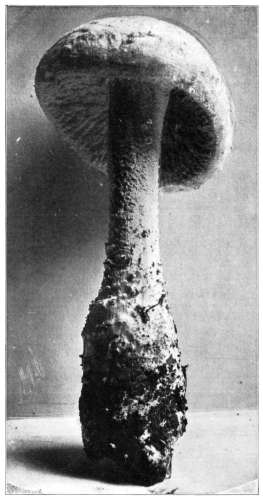
Plate III. Figure 22.—Amanita strobiliformis. Young plant showing veil covering the entire gill-surface of the plant. Cap covered with persistent warts, stem rough and rooting, odor strong of chloride of lime.
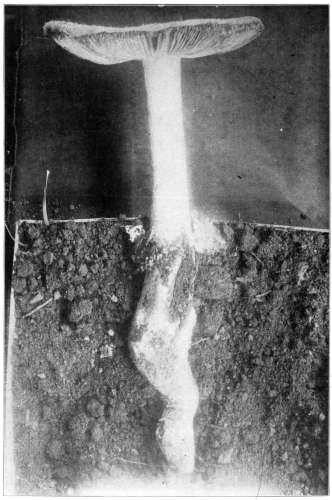
Plate IV. Figure 23.—Amanita strobiliformis. Showing long root.
Strobiliformis means fir-cone form; so called from the similarity of its undeveloped form to that of the strobile of the pine.
The pileus is six to eight inches broad, when young, subglobose, then convex, expanded, nearly plane, with persistent warts, white, ash-color, sometimes yellow on the cap, the margin even and extending beyond the gills; warts hard, angular, pointed, white; flesh white, compact.
The gills are free, crowded, rounded, white, becoming yellow.
The stem is five to eight inches long, frequently longer, tapering upward, floccosely scaly, bulbous, rooting beyond the bulb; ring large, torn; volva forming concentric rings. The spores are 13–14×8–9µ.
This is one of the most stately plants in the woods. It is said to be edible, but the strong pungent odor, like chloride of lime, has deterred me from eating it. This, however, is said to disappear in cooking. It grows to be very large. Dr. Kellerman and I found a specimen in Haynes's Hollow whose stem measured over eleven inches, and cap nine inches. It is found in open woods and wood margins. Great caution should be used before the plant is eaten to know it beyond doubt. Found July to October.
Amanita mappa. Fr.
The Delicate Amanita. Poisonous.
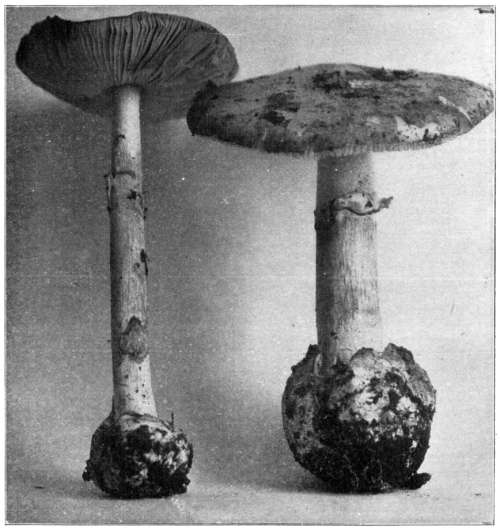
Figure 24.—Amanita mappa. Natural size, showing long smooth stem, cap yellowish-white and ring.
Mappa means a napkin, so called from the volva. The pileus is two to three inches broad, convex, then expanded, plane, obtuse or depressed, without separable cuticle; margin nearly even; white or yellowish, usually with patches of the volva dry.
The gills are adnexed, close, narrow, shining, white.
The stem is two to three inches long, stuffed, then hollow, cylindrical, nearly smooth, bulbous, nearly globose at the base, white, almost equal above the bulb.
The volva with its free margin is acute and narrow. The ring is membranaceous, superior, soft, lax, ragged.
Its color is quite as variable and its habits are much like A. phalloides, from which it can only be distinguished by its less developed volva, which, instead of being cup-shaped, is little more than a mere rim fringing the bulb. The odor at times is very strong. It is found in open woods and under brush. Label it poisonous.
Amanita crenulata. Pk.
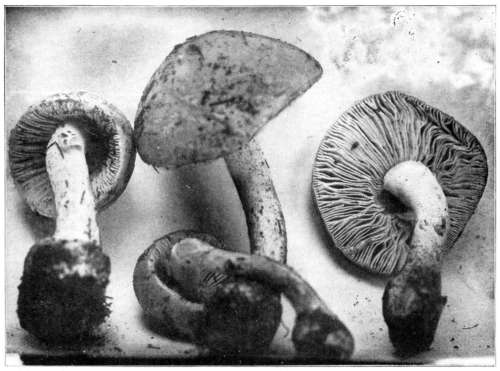
Figure 25.—Amanita crenulata.
Crenulata means bearing notches, referring to the crenulate form of the gills, which are very distinct.
The pileus is thin, two to two and a half inches broad, broadly ovate, becoming convex, or nearly plane, somewhat striate on the margin, adorned with a few thin whitish floccose warts or with whitish flocculent patches, whitish or grayish, sometimes tinged with yellow.
The gills are close, reaching the stem, and sometimes forming decurrent lines upon it, floccose crenulate on the edge, the short ones truncate at the inner extremity, white.
The stem is equal, bulbous, floccose mealy above, stuffed or hollow, white, the annulus slight, evanescent. Spores broadly elliptic or subglobose, 7.5–10 long, nearly as broad, usually containing a single large nucleus. Peck, Bull. Tor. Bot. Club.
The stem is bulbous at the base but the volva is rarely seen upon it although slight patches are frequently seen on the pileus. The ring is very evanescent and soon disappears. The specimens I have received from Mrs. Blackford look good enough to eat and she speaks highly of the edible qualities of this species. So far as I know this plant is confined to the New England states. Found from September to November. It grows in low damp ground under trees.
Amanita cothurnata. Atkinson.
The Booted Amanita.
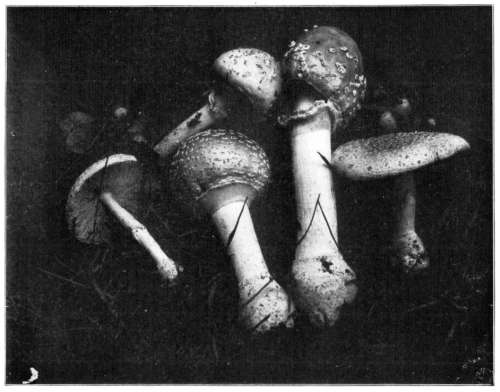
Figure 26.—Amanita cothurnata. Slightly reduced from natural size, showing different stages of development.
Cothurnata means buskined; from corthunus, a high shoe or buskin worn by actors. This species is easily separated from the other Amanitas. I shall give Prof. Atkinson's description of it in full: "The pileus is fleshy and passes from nearly globose to hemispherical, convex, expanded, and when specimens are very old sometimes the margin is elevated. It is usually white, though specimens are found with a tinge of citron yellow in the center or of tawny yellow in the center of other specimens. The pileus is viscid, strongly so when moist. It is finely striate on the margin, and covered with numerous, white, floccose scales from the upper half of the volva, forming more or less dense patches, which may wash off in heavy rains.
The gills are rounded next the stem, and quite remote from it. The edge of the gills is often eroded or frazzly from the torn-out threads with which they were loosely connected to the upper side of the veil in the young or button stage. The spores are globose or nearly so, with a large "nucleus" nearly filling the spore.
The stem is cylindrical, even, and expanded below into quite a large oval bulb, the stem just above the bulb being margined by a close-fitting roll of the volva, and the upper edge of this presenting the appearance of having been sewed at the top like the rolled edge of a garment or buskin. The surface of the stem is minutely floccose, scaly or strongly so, and decidedly hollow even from a very young stage or sometimes when young with loose threads in the cavity.
A. cothurnata resembles in many points A. frostiana and it will afford the collector a very interesting study to note the points of difference. I found the two species growing on Cemetery Hill. Figure 26 is from plants collected in Michigan and photographed by Dr. Fisher. Found in September and October.
Amanita rubescens. Fr.
The Reddish Amanita. Edible.
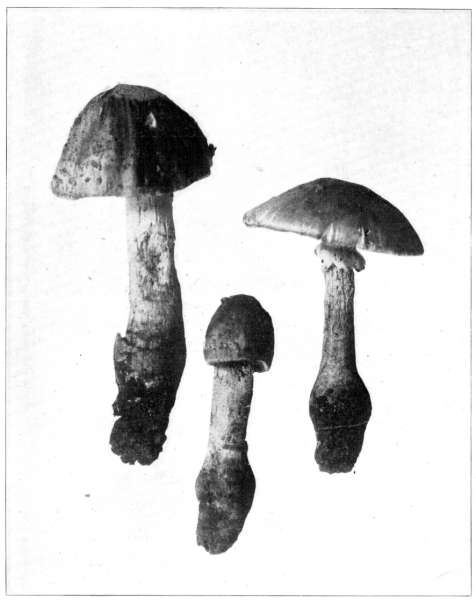
Figure 27.—Amanita rubescens. One-third natural size, caps a dingy reddish-brown, stains reddish when bruised.
Rubescens is from rubesco, to become red. It is so called because of the dingy reddish color of the entire plant, and also because when the plant is handled or bruised it quickly changes to a reddish color. It is often a large bulky plant and rather uninviting.
The pileus is four to six inches broad, dingy reddish, often becoming pale flesh color, fleshy, oval to convex, then expanded; sprinkled with small pale warts, unequal, mealy, scattered, white, easily separating; margin even, faintly striate, especially in wet weather; flesh soft, white, becoming red when broken.
The gills are white or whitish, free from the stem but reaching it and forming at times decurrent lines upon it, thin, crowded.
The stem is four or five inches long, nearly cylindrical, solid, though inclined to be soft within, tapering from the base up, with a bulbous base which often tapers abruptly below, containing reddish scales, color dull red. It has seldom any distinct evidence of a volva at the base but abundant evidence on the cap. Ring large, superior, white, and fragile.
The plant is quite variable in color, sometimes becoming almost white with a slight reddish or brownish tint. The strong distinguishing character of the species is the almost entire absence of any remains of the volva at the base of the stem. By this, and by the dull red hues and the bruised portions quickly changing to a reddish color, it is easily distinguished from any of the poisonous Amanitas.
According to Cordier it is largely used as an article of food in France. Stevenson and Cooke speak well of it. I noticed the small Bohemian boys gathered it about Salem, Ohio, not having been in this country more than a week and not being able to speak a word of English. It convinced me that it was an article of diet in Bohemia and that our species is similar to theirs. I have found the plants in woods about Bowling Green and Sidney, Ohio. The plants in Figure 27 were collected on Johnson's Island, Sandusky, Ohio, and photographed by Dr. Kellerman. It is found from June to September.
Amanita aspera. Fr.
Rough Amanita.
Aspera means rough. The pileus is convex, then plane; warts minute, somewhat crowded, nearly persistent; margin even, rather thin, increasing in thickness toward the stem; scarcely umbonate, reddish with various tints of livid and gray; flesh rather solid, white, with tints of reddish-brown immediately next to the epidermis.
The gills are free, with sometimes a little tooth behind, running down the stem, white, broad in front.
The stem is white, squamulose, bulb rugulose, ring superior and entire. The spores are 8×6µ.
When the flesh is bruised or eaten by insects it assumes a reddish-brown color, and in this respect it resembles A. rubescens. The odor is strong but the taste is not unpleasant. In woods from June till October. The collector should be sure he knows the plant before he eats it.
Amanita cæsarea. Scop.
The Orange Amanita. Edible.
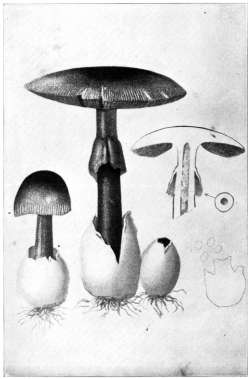
Figure 28.—Amanita cæsarea. From a drawing showing the different stages of the plant. Caps, gills, stem and collar yellow, volva white.
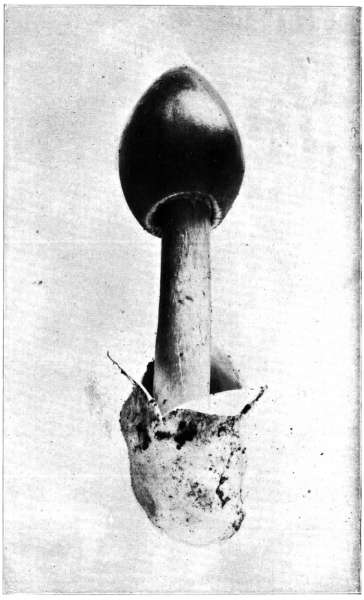
Photo by H. C. Beardslee.
Figure 29.—Amanita cæsarea.
The Orange Amanita is a large, attractive, and beautiful plant. I have marked it edible, but no one should eat it unless he is thoroughly acquainted with all the species of the genus Amanita, and then with great caution. It is said to have been Cæsar's favorite mushroom. The pileus is smooth, hemispherical, bell-shaped, convex, and when fully expanded nearly flat, the center somewhat elevated and the margin slightly curved downward; red or orange, fading to yellow on the margin; usually the larger and well-developed specimens have the deeper and richer color, the color being always more marked in the center of the pileus; margin distinctly striate; gills rounded at the stem end and not attached to the stem, yellow, free and straight. The color of the gills of matured plants usually is an index to the color of the spores but it is an exception in this case as the spores are white.
The stem and the flabby membranaceous collar that surrounds it toward the top are yellow like the gills, the depth of the color varying more with the size of the plant than is the case with color of the cap. Sometimes in small and inferior plants the color of both stem and gills is nearly white, and if the volva is not distinct it is difficult to distinguish it from the fly mushroom, which is very poisonous. The stem is hollow, with a soft cottony pith in the young plants.
In very young plants the edge of the collar is attached to the margin of the cap and conceals the gills, but with the upward growth of the stem and the expansion of the cap the collar separates from the margin and remains attached to the stem, where it hangs down upon it like a ruffle.
The expanded cap is usually from three to six inches broad, the stem from four to six inches long and tapering upward.
When in the button stage, the plant is ovate; and the white color of the volva, which now entirely surrounds the plant, presents an appearance much like a hen's egg in size, color, and shape. As the parts within develop, the volva ruptures in its upper part, the stem elongates and carries upward the cap, while the remains of the volva surrounds the base of the stem in the form of a cup.
When the volva first breaks at the apex, it reveals the point of the cap with its beautiful red color and in contrast with the white volva makes quite a pretty plant, but with advancing age the red or orange red fades to a yellow. In drying the specimens the red often entirely disappears. In young, as well as in old plants, the margin is often prominently marked with striations, as will be seen in Figures 28 and 29. The flesh of the plant is white but more or less stained with yellow next to the epidermis and the gills, which are of that color.
The plant grows in wet weather from July to October. It grows in thin woods and seems to prefer pine woods and sandy soil. I have found it from the south tier of counties to the north of our state. It is not, however, a common plant in Ohio.
From its several names—Cæsar's Agaric, Imperial Mushroom, Cibus Deorum, Kaiserling—one would infer that for ages it had been held in high esteem as an esculent.
Too great caution cannot be used in distinguishing it from the very poisonous fly mushroom.
Amanita spreta. Pk.
Hated Amanita. Poisonous.
Spreta, hated. The pileus at first is nearly ovate, slightly umbonate, then convex, smooth, sometimes fragments of the volva adhering, the margin striate, whitish or pale-brown toward and on the umbo, soft, dry, more or less furrowed on the margin.
The flesh is white, thin on the edges, and increasing in thickness toward the center. Gills close, white, reaching the stem.
The stem is equal, smooth, annulate, stuffed or hollow, whitish, finely striate at the top from the decurrent lines of the gills, not bulbous at the base, the volva rather large and inclined to yellowish color. The spores are elliptical.
The plant resembles the dark forms of the Amanitopsis in having the marked striations and the entire and closely fitting volva at the base, but can be easily distinguished by its ring. I found it on Cemetery Hill in company with the Amanitopsis. It does not seem to root as deep in the ground as the Amanitopsis. It is very poisonous and should be carefully studied so that it may be readily recognized and avoided.
It is found in open woods from July to September.
Amanitopsis. Roze.
Amanitopsis is from Aminita and opsis, resembling; so called because it resembles the Amanita. The principal feature wherein the genus differs from the Amanita is the absence of a collar on the stem. Its species are included among the Amanita by many authors. The spores are white. The gills are free from the stem, and it has a universal veil at first completely enveloping the young plant, which soon breaks it, carrying remnants of it on the pileus, where they appear as scattered warts. It differs from the Lepiota in having a volva.
Amanitopsis vaginata. Bull.
The Sheathed Amanitopsis. Edible.
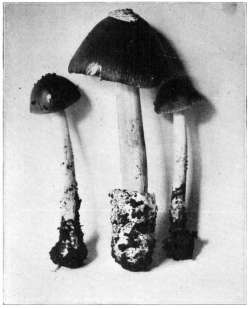
Figure 30.—Amanita vaginata. One-third natural size. Notice a portion of the volva adhering to the cap.
Vaginata—from vagina, a sheath. The plant is edible but should be used with very great caution. It is quite variable in color, ranging from white to mouse color, brownish or yellowish.
The pileus is ovate at first, bell-shaped, then convex and expanded, thin, quite fragile, smooth, when young with a few fragments of the volva adhering to its surface, deeply and distinctly striate.
The gills are free, white, then pallid, ventricose, broadest in front, irregular. The flesh is white, but in the darker forms stained under the easily separating skin. The spores are white and nearly round, 7–10µ.
The stem is cylindrical, even or slightly tapering upward, hollow or stuffed, smooth or sprinkled with downy scales, not bulbous at the base.
The volva is long, thin, fragile, forming a permanent sheath which is quite soft and readily adheres to the base of the stem.
The striations on the margin are deep and distinct, as in the Orange Amanita. The cup is quite regular but it is fragile, easily broken and usually deep in the ground. In some plants a slight umbo is developed at the center.
The mushroom-eater wants to distinguish very carefully between this species and Amanita spreta, which is very poisonous.
It is found in woods, in open places where there is much vegetable mould, sometimes found in stubble and pastures, especially in meadows under trees. Found from June to November.
The plant varies considerably in color, and there are several varieties, separable by means of their color:
A. vaginata, var. alba. The whole plant is white.
A. vaginata var. fulva. The cap tawny yellow or pale ochraceous.
A. vaginata var. livida. The cap leaden brown; gills and stem tinged with smoky brown.
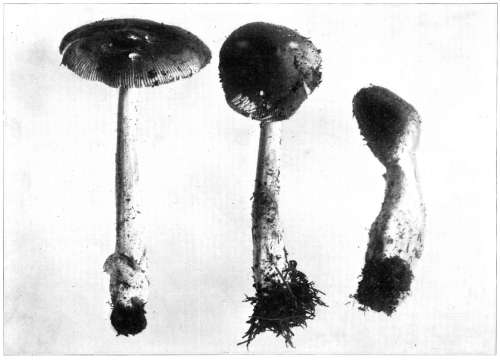
Photo by C. G. Lloyd.
Plate V. Figure 31.—Amanita vaginata
Amanitopsis strangulata. Fr.
The Gray Amanitopsis. Edible.
Strangulata means choked, from the stuffed stem. The pileus is two to four inches broad, soon plane, livid-bay or gray, with patches of the volva, margin striate or grooved.
The gills are free, white, close.
The stem is stuffed, silky above, scaly below, slightly tapering upwards. The volva soon breaking up, forming several ring-like ridges on the stem. The spores are globose, 10–13µ.
This is a synonym for A. ceciliae. B. and Br. and perhaps nothing more than a vigorous growth of Amanitopsis vaginata. It has almost no odor and a sweet taste and cooks deliciously.
Found in the woods and in open places from August to October.
Lepiota. Fr.
Lepiota means a scale. In the Lepiota the gills are typically free from the stem, as in Amanita and Amanitopsis, but they differ in having no superficial or removable warts on the cap, and no sheathing or scaly remains of a volva at the base of the stem. In some species the epidermis of the cap breaks into scales which persistently adhere to the cap, and this feature, indeed, suggests the name of the genus, which is derived from the Latin word lepis, a scale.
The stem is hollow or stuffed, its flesh being distinct from the pileus and easily separable from it. There are a number of edible species.
Lepiota procera. Scop.
The Parasol Mushroom. Edible.
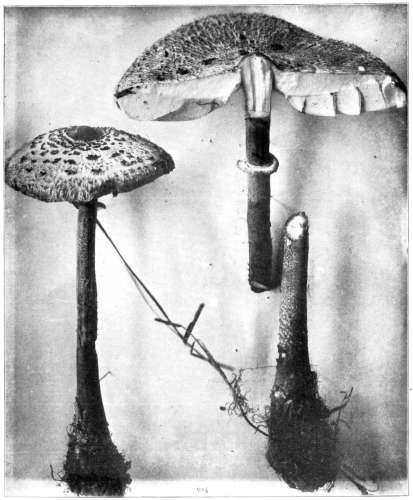
Photo by C. G. Lloyd.
Plate VI. Figure 32.—Lepiota procera.
Procera means tall.
The pileus is thin, strongly umbonate, adorned with brown spot-like scales.
The gills are white, sometimes yellowish-white, free, remote from the stem, broad and crowded, ventricose, edge sometimes brownish.
The stem is very long, cylindrical, hollow or stuffed, even, very long in proportion to its thickness and is, therefore, suggestive of the specific name, procera. The ring is rather thick and firm, though in mature plants it becomes loosened and movable on the stem. This and the form of the plant suggest the name, parasol. The cap is from three to five inches broad and the stem from five to nine inches high. I found one specimen among fallen timber that was eleven inches tall and whose cap was six inches broad.
It has a wide distribution. It is found in all parts of Ohio but is not abundant anywhere. It is a favorite with those who have eaten it, and, indeed, it is a delicious morsel when quickly broiled over coals, seasoned to taste with salt and pepper, butter melted in the gills and served on toast. This mushroom is especially free from grubs and it can be dried for winter use.
There is no poisonous species with which one is likely to confound it. The very tall, slender stem with a bulbous base, the very peculiar spotted cap with the prominent dark colored umbo and the movable ring on the stem, are ear-marks sufficient to identify this species.
Spores white and elliptical, 14×10µ. Lloyd. It is found in pastures, stubble, and among fallen timber. July to October.
I am indebted to C. G. Lloyd for the photograph given here.
Lepiota naucina. Fr.
Smooth Lepiota. Edible.
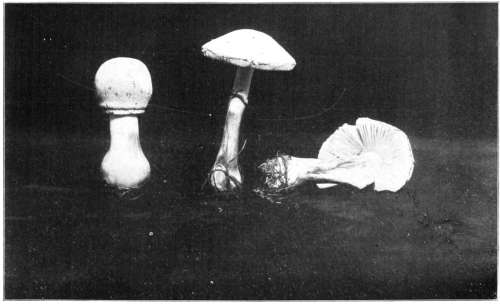
Figure 33.—Lepiota naucina. The entire plant white.
Pileus soft, smooth, white or smoky-white; gills free, white, slowly changing with age to a dirty pinkish-brown color; stem annulate, slightly thickened at the base, attenuated upward, clothed with fibres pure white. The Smooth Lepiota is generally very regular in shape and of a pure white color. The central part of the cap is sometimes tinged with yellow or a smoky white hue. Its surface is nearly always very smooth and even. The gills are somewhat narrower toward the stem than they are in the middle. They are rounded and not attached to the stem.
Cap two to four inches broad; stem two to three inches long. It grows in clean grassy places in lawn, pastures, and along roadsides. I have seen the roadside white with this species around Sidney, Ohio. The specimens represented in figure were found in Chillicothe, August to November.
This is one of the best mushrooms, not inferior to the meadow mushroom. It has this advantage over the former that the gills retain their white color and do not pass from a pink to a repulsive black. The halftone and the description ought to make the plant known to the most casual reader.
Lepiota americana. Pk.
The American Lepiota. Edible.
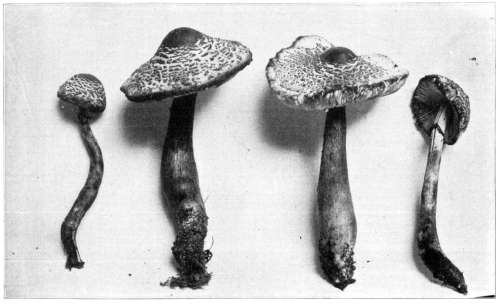
Figure 34.—Lepiota americana. Center of disk red or reddish-brown, stem frequently swollen. Plant turning red when drying.
This plant is quite common about Chillicothe, especially upon sawdust piles. It grows both singly and in clusters. The umbonate cap is adorned with reddish or reddish-brown scales except on the center where the color is uniformly reddish or reddish-brown because the surface is not broken up into scales; gills close, free, white, ventricose; stem smooth, enlarged at the base. In some plants the base of the stem is abnormally large; ring white, inclined to be delicate.
Wounds and bruises are apt to assume brownish-red hues. Dr. Herbst says: "This is truly an American plant, not being found in any other country. This is the pride of the family. There is nothing more beautiful than a cluster of this fungi. To look over the beautiful scaly pileus is a sight equally as fascinating as a covey of quail."
Found in grassy lawns and on old sawdust piles, in common with Pluteus cervinus. It is found almost all over the state. It is quite equal to the Parasol mushroom in flavor. It has a tendency to turn the milk or cream in which it is cooked to a reddish color. It is found from June to October. Mr. Lloyd suggests the name Lepiota Bodhami. It is the same as the European plant L. hæmatosperma. Bull.
Lepiota Morgani. Pk.
In Honor of Prof. Morgan.
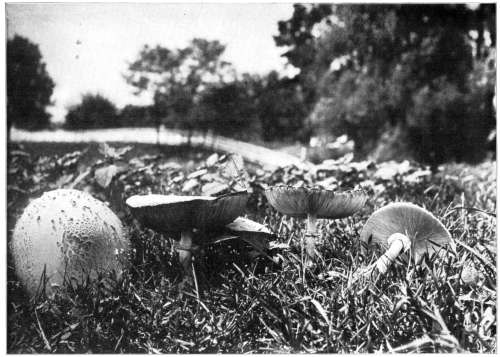
Photo by C. G. Lloyd.
Plate VII. Figure 35.—Lepiota morgani. Entire plant white or brownish-white. Gills white at first then greenish.
Pileus fleshy, soft, at first subglobose, then expanded or even depressed, white, the brownish or yellowish cuticule breaking up into scales on the disk; gills close, lanceolate, remote, white, then green; stem firm, equal or tapering upward, subbulbous, smooth, webby-stuffed, whitish tinged with brown; ring rather large, movable as you will observe in Figure 35. Flesh of both pileus and stem white, changing to a reddish, then to yellowish hue when cut or bruised. Spores ovate or subelliptical, mostly uninucleate, sordid green. 10–13×7–8. Peck.
This plant is very abundant about Chillicothe and I found it equally so at Sidney. I have known several families to eat of it, making about half of the children in each family sick. I regard it as a dangerous plant to eat. It grows very large and I have seen it growing in well marked rings a rod in diameter. If you are in doubt whether the plant you have is Morgani or not, let it remain in the basket over night and you will plainly see that the gills are turning green. The gills are white until the spores begin to fall. The plant is found in pastures and sometimes in pasture woods. June to October.
Lepiota granulosa. Batsch.
Grainy Lepiota. Edible.
Granulosa—from granosus, full of grains. Pileus thin, convex or nearly plain, sometimes almost umbonate, rough, with numerous granular scales, often radiately wrinkled, rusty-yellow or reddish-yellow, often growing paler with age. Flesh white or reddish tinged. Gills close, rounded behind and usually slightly adnexed, white. Stem equal or slightly thickened at the base, stuffed or hollow, white above the ring, colored and adorned like the pileus below it. Ring slight and evanescent. Spores elliptical, .00016 to .0002 inch long, .00012 to .00014 inch broad.
Plant one to two and one-fifth inches high; pileus one to two and one-fifth inches broad; stem one to three lines thick. Common in woods, copses, and waste places. August to October.
"This is a small species with a short stem and granular reddish-yellow pileus, and gills slightly attached to the stem. The annulus is very small and fugacious, being little more than the abrupt termination to the coating of the stem. The species was formerly made to include several varieties which are now regarded as distinct."—Peck's Report.
Found in the open woods about Salem, Ohio. The plant is small but quite meaty and of a pleasing quality.
Lepiota cristatella. Pk.
Pileus thin, convex, subumbonate, minutely mealy, especially on the margin, white disk slightly tinged with pink.
Gills close, rounded behind, free, white; stem slender, whitish, hollow; spores subelliptical, .0002 inch long.
Mossy places in woods. October.—Peck's Report. No one will fail to recognize the crested Lepiota the moment he sees it. It has many of the ear marks of the Lepiota family.
Lepiota granosa. Morg.
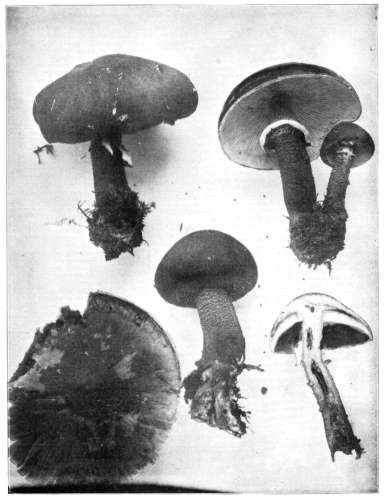
Photo by C. G. Lloyd.
Plate VIII. Figure 36.—Lepiota granosa.
Granosa means covered with granules.
The pileus is convex, obtuse or umbonate, even, radiately rugose-wrinkled, generally even and regular on the margin, reddish-yellow or light bay.
The gills are attached to the stem, slightly decurrent, somewhat crowded, whitish, then reddish-yellow.
The stem is thickened at the base, tapering toward the cap, flesh of the stem is yellow. The veil is membranous and forms a persistent ring on the stem.
It grows on decayed wood. I found it in large quantities, and tried to make it L. granulosa, but I found it fit better L. amianthinus, which it resembles very closely, but it is much larger and its habit is not the same. I was not satisfied with this description and sent the specimens to Prof. Atkinson, who set me right. It is a beautiful plant found on decayed wood in September and October.
Lepiota cepæstipes. Sow.
The Onion Stemmed Lepiota. Edible.
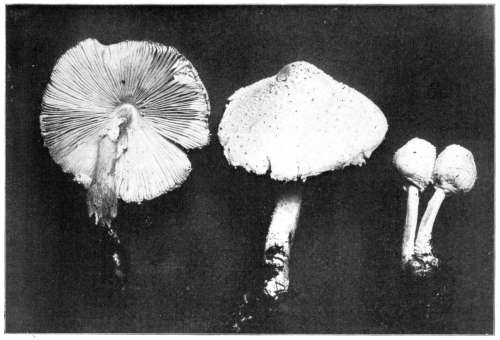
Figure 37.—Lepiota cepæstipes. Pileus thin, white or yellowish.
Cepæstipes is from cepa, an onion and stipes, a stem, Pileus is thin at first ovate, then bell-shaped or expanded, umbonate, soon adorned with numerous minute brownish scales, which are often granular or mealy, folded into lines on the margin, white or yellow, the umbo darker.
The gills are thin, close, free, white, becoming dingy with age or drying.
The stem is rather long, tapering toward the apex, generally enlarged in the middle or near the base, hollow. The ring is thin and subpersistent. The spores are subelliptical, with a single nucleus, 8–10×5–8µ.
The plants often cespitose, two to four inches high. Pileus is one to two inches broad. It is found in rich ground and decomposing vegetable matter. It is also found in graperies and conservatories. Peck.
This plant derives its specific name from the resemblance of its stem to that of the seed-stalk of an onion. One form has a yellow or yellowish cap, while the other has a white or fair cap. It seems to delight to grow in well rotted sawdust piles and hot houses. The specimens represented in Figure 37 were collected in Cleveland and photographed by Prof. H. C. Beardslee.
Lepiota acutesquamosa. Wein.
The Squarrose Lepiota. Edible.
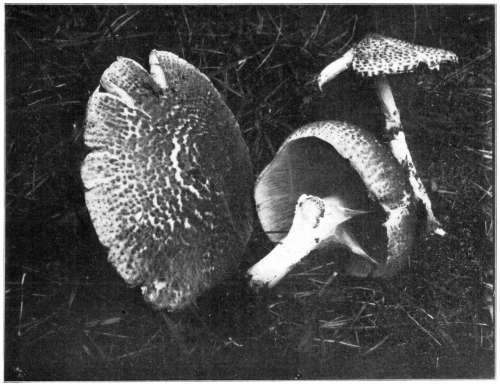
Figure 38.—Lepiota acutesquamosa. Two-thirds natural size, showing small pointed scales.
Acutesquamosa is from acutus, sharp, and squama, a scale; so called from the many bristling, erect scales on the pileus. The pileus is two to three inches broad, fleshy, convex, obtuse, or broadly umbonate; pale rusty with numerous small pointed scales, which are usually larger and more numerous at the disk.
The gills are free, crowded, simple, white or yellowish.
The stem is two to three inches or more long; stuffed or hollow, tapering upward slightly from a swollen base; below the ring rough or silky, pruinose above, ring large. The spores are 7–8×4µ.
They are found in the woods, in gardens, and frequently in greenhouses. There is a slight difference between the specimens growing in the woods and those in the greenhouse. In the latter the pubescent covering is less dense and the erect scales are more numerous than in the former. In older specimens these scales fall off and leave small scars on the cap where they were attached. The specimens in Figure 38 were gathered in Michigan and were photographed by Dr. Fisher of Detroit.
Armillaria. Fr.
Armillaria, from armilla, a bracelet—referring to the ring upon the stem. This genus differs from all the foregoing white-spored species in having the gills attached to the stem by their inner extremity. The spores are white and the stem has a collar, though a somewhat evanescent one, but no wrapper at the base of the stem as in the Amanita and Amanitopsis. By the collar the genus differs from the other genera which are to follow.
The Amanita and Lepiota have the flesh of the stem and the pileus not continuous, and their stems are, therefore, easily separated from the cap, but in the Armillaria the gills and the pileus are attached to the stem.
Armillaria mellea. Vahl.
The Honey-Colored Armillaria. Edible.
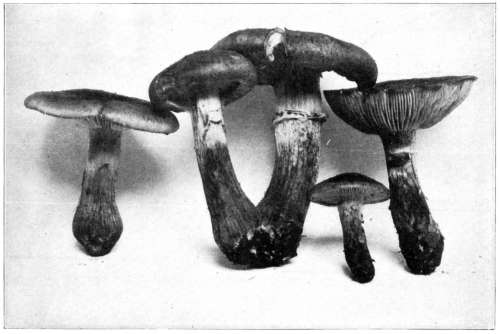
Figure 39.—Armillaria mellea. Two-thirds natural size. Honey colored. Tufted with dark-brown fugitive hairs. Flesh white.
Mellea, from melleus, of the color of honey. Cap fleshy, honey colored, or ochraceous, striate on the margin, shaded with darker brown toward the center, having a central boss-like elevation and sometimes a central depression in full grown specimens, tufted with dark-brown fugitive hairs. Color of the cap varies, depending upon climatic conditions and the character of the habitat. Gills distant, ending in a decurrent tooth, pallid or dirty white, very often showing brown or rust colored spots when old. Spores white and abundant. Frequently the ground under a clump of this species will be white from the fallen spores. Stem elastic and scaly, four inches or more in length. Ring downy. Diameter of cap from two to five inches. Manner of growth is frequently in tufts, and, as with most of the Armillarias, generally parasitic on old stumps.
The veil varies greatly. It may be membranaceous and thin, or quite thick, or may be wanting entirely, as will be seen in Figure 39; in Figure 40 only a slight trace of the ring can be seen. The two plants grew under very different environment; the last grew in the woods and Figure 39 on a lawn in the city. The species is very common and grows either in thin woods or in cleared lands, on the ground or on decaying wood. Its favorite habit is about stumps. It is either solitary, gregarious, or in dense clusters. It is very abundant about Chillicothe, where I have seen stumps literally surrounded with it. It has a slight acridity while raw, which it seems to lose in cooking. Those who like it may eat it without fear, all varieties being edible.
Prof. Peck gives the following varieties:
A. mellea var. obscura—has the cap covered with numerous small black scales.
A. mellea var. flava—has a cap yellow or reddish-yellow, otherwise normal.
A. mellea var. glabra—has a smooth cap, otherwise normal.
A. mellea var. radicata—has a tapering root penetrating the soil.
A. mellea var. bulbosa—has a bulbous base.
A. mellea var. exannulata—has the cap smooth and even on the margin, and the stem tapering at the base.
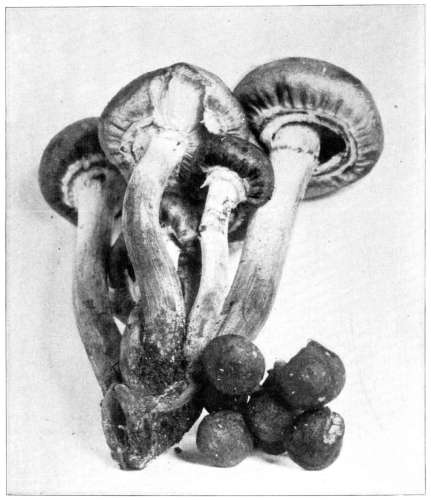
Figure 40.—Armillaria mellea. Two-thirds natural size, showing double ring present.
Armillaria bulbigera. A. & S.
Marginate-bulbed Armillaria.
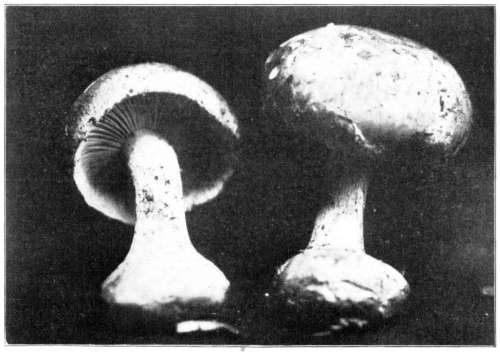
Figure 41.—Armillaria bulbigera. Reddish-gray caps and short bulbous stems.
Bulbigera is from bulbus, a bulb, and gero, to bear.
The pileus is fleshy, three to four inches across, convex, then expanded, obtuse, even, brownish, gray, sometimes reddish, dry, fibrillose near the margin.
The gills are notched at the stem, pallid, crowded at first, at length rather distant, becoming slightly colored.
The stem is distinctly bulbous, two to three inches long, stuffed, pallid, fibrillose, ring oblique, fugacious. The spores are 7–10×5µ.
I have found some very fine specimens in Poke Hollow, near Chillicothe. The stems were short and very bulbous, having hardly any trace of the ring on the older specimens. The caps were obtusely convex and of a grayish rufescent color. This species can readily be distinguished by the distinctly marginate bulb at the base of the stem. The specimens in Figure 41 were found in Poke Hollow, near Chillicothe, October 2d. I have no doubt of their edibility but I have not eaten them.
Armillaria nardosmia. Ellis.
Spikenard-Smelling Armillaria. Ellis.
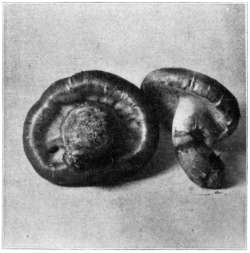
Figure 42.—Armillaria nardosmia. One-half natural size, showing the veil and incurved margin.
Nardosmia is from nardosmius, the odor of nardus or spikenard.
The pileus is quite thick, firm and compact, thinner toward the margin, strongly involute when young, grayish white and beautifully variegated with brown spots, like the breast of a pheasant, rather tough, with a separable epidermis, flesh white.
The gills are crowded, slightly notched or emarginate, somewhat ventricose, white.
The stem is solid, short, fibrous, sheathed by a veil forming a ring more or less evanescent. The spores are nearly round, 6µ in diameter.
This is the most beautiful species of the genus, and from its pheasant-like spotted cap, as well as its strong odor and taste of spikenard or almonds, it is easily determined. The almond taste and odor disappears in cooking. I found some very fine specimens around a pond in Mr. Shriver's woods, east of Chillicothe. In older specimens the cuticule of the caps frequently breaks into scales. Found in woods in September and October.
Armillaria appendiculata. Pk.
Appendiculata, bearing small appendages. Pileus is broadly convex, glabrous, whitish, often tinged with rust-color or brownish rust-color on the disk. Flesh white or whitish. Gills close, rounded behind, whitish. Stem equal or slightly tapering upward, solid, bulbous, whitish, the veil either membraneous or webby, white, commonly adhering in fragments to the margin of the pileus. Spores subelliptical, 8×5.
Pileus two to four inches broad. Stem 1.5–3.5 inches long; 5–10 lines thick.
The general appearance of this species is suggestive of Tricholoma album, but the appearance of a veil separates it from that fungus and places it in the genus Armillaria. The veil, however, is often slightly lacerated, or webby, and adherent to the margin of the pileus. Peck's Report.
I have found this at Salem and Chillicothe.
Tricholoma. Fr.
Tricholoma is from two Greek words meaning hair and fringe. This genus is known by its stout, fleshy stem, without any evidence of a ring, and by the gills being attached to the stem and having a notch in their edges near or at the extremity. The veil is absent, or, if present, it is downy and adherent to the margin of the cap. The cap is generally quite fleshy; the stem is homogeneous and confluent with the pileus, central and nearly fleshy, without either ring or volva, and with no distinct bark-like coat. The spores are white or grayish-white.
The distinguishing features are the fleshy stem, continuous with the flesh of the pileus, and the sinuate or notched gills. This is quite a universal genus. All the species grow on the ground, so far as I know them.
There are many edible species under this genus, there being only two, so far as I know, not edible; and no one is likely to touch those on account of their strong odor. They are T. sulphureum and T. saponaceum.
Tricholoma transmutans. Pk.
The Changing Tricholoma. Edible.
Transmutans means changing, from changes of color in both stem and gills in different stages of the plant. This species has a cap two to four inches broad, viscid or sticky when moist. It is at first tawny-brown, especially with advancing age. The flesh is white and has a decided farinaceous odor and taste.
The gills are crowded, rather narrow, sometimes branched, becoming reddish-spotted with age.
The stem is equal or slightly tapering upward; bare, or slightly silky-fibrillose; stuffed or hollow; whitish, often marked with reddish stains or becoming reddish-brown toward the base, white within. Spores subglobose, 5µ.
The species grows in woods and open places, also in clover pastures, either singly or in tufts. I have seen large tufts of them, and in that case the caps are more or less irregular on account of their crowded condition. I found it frequently about Salem, and this fall, 1905, I found it quite plentiful in a clover pasture near Chillicothe. Found in wet weather from August to September.
Tricholoma equestre. Linn.
The Knightly Tricholoma. Edible.
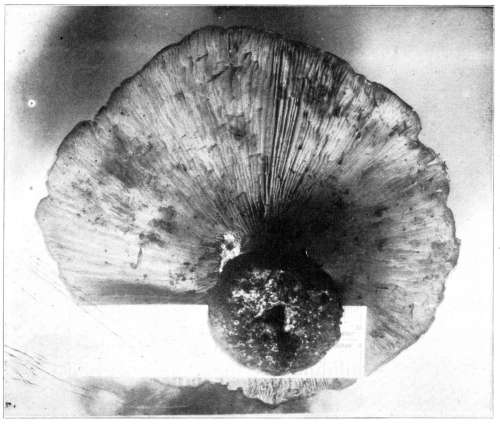
Figure 43.—Tricholoma equestre.
Equestre means belonging to a horseman; so called from its distinguished appearance in the woods.
The pileus is three to five inches broad, fleshy, compact, convex, expanded, obtuse, viscid, scaly, margin incurved at first, pale yellowish, with sometimes a slight tinge of green in both cap and gills. Flesh white or tinged with yellow.
The gills are free, crowded, rounded behind, yellow.
The stem is stout, solid, pale yellow or white, white within. The spores are 7–8×5µ.
It differs from T. coryphæum in having gills entirely yellow, while the edges only of the latter are yellow. It differs from T. sejunctum in the latter having pure white gills and a more slender stem.
It is found but occasionally here, and then only a specimen or two. It is an attractive plant and no one would pass it in the woods without admiring it. Found from August to October.
Tricholoma sordidum. Fr.
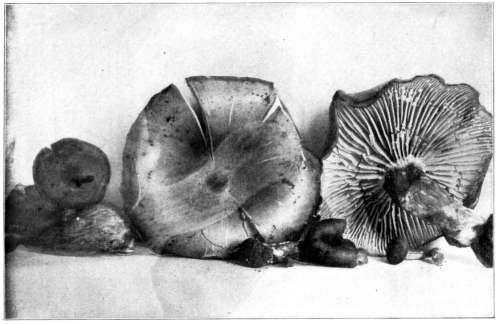
Figure 44.—Tricholoma sordidum.
Sordidum means dingy, dirty.
The pileus is two to three inches broad, rather tough, fleshy, convex, bell-shaped, then depressed, subumbonate, smooth, hygrophanous, margin slightly striate, brownish lilac, then dusky.
The gills are rounded, rather crowded, dingy violet then dusky, notched with a decurrent tooth.
The stem is colored like the pileus, fibrillose striate, usually slightly curved, stuffed, short, often thickened at the base.
The spores are 7–8×3–4, minutely rugulose.
This species differs from T. nudum in being smaller, tougher, and often hygrophanous.
It is found in richly manured gardens, about manure piles, and in hot-houses. The specimens in Figure 44 were found in a hot-house near Boston, Mass., and sent to me by Mrs. E. Blackford. They are found in September and October.
Tricholoma grammopodium. Bull.
The Grooved Stem Tricholoma. Edible.
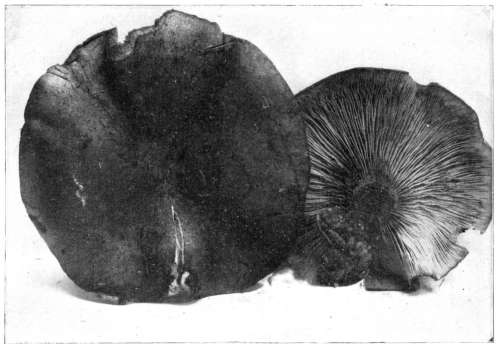
Figure 45.—Tricholoma grammopodium. Natural size.
Grammopodium is from two Greek words meaning line and foot.
The pileus is three to six inches broad, flesh thick at the center, thin at the margin, solid yet tender; brownish, blackish-umber, almost a dingy-lavender when moist, whitish when dry; at first bell-shaped, then convex, sometimes slightly wavy, obtusely umbonate; margin at first inclined to be involute, and extending beyond the gills.
The gills are attached to the stem, broadly notched as will be seen in the specimen, closely crowded, quite entire, shorter ones numerous, a few branched, white or whitish.
The stem is three to four inches long, thickened at the base, smooth, firm, longitudinally grooved from which it gets its specific name, whitish.
The spores are nearly round, 5–6µ.
It closely resembles T. fuligineum but can be distinguished by the grooved stem and crowded gills. The specimens in Figure 45 were found near Boston, and were sent to me by Mrs. Blackford. The plants keep well and are easily dried. They were found the first of June. They have an excellent flavor.
Tricholoma pædidum. Fr.
Paedidum means nasty, stinking.
The pileus is small, about one and a half inches broad, rather fleshy, tough; convex, then flattened, soon depressed around the conical umbo; fibrillose, becoming smooth; smoky gray, somewhat streaked; moist; margin involute, naked.
The gills are adnexed, crowded, narrow, white, then grayish, somewhat sinuate with a slight decurrent tooth.
The stem is short, slightly striate, dingy gray, thickened at the base. The spores are elliptical or fusiform, 10–11×5–6µ.
The specific name, "nasty" or "stinking," has really no application to the plant. It is said to be very good when cooked. It is found in well manured gardens and fields, or about manure piles.
It differs from T. sordidum in having no trace of violet color. T. lixivium differs in the free truncate gills.
Tricholoma lixivium. Fr.
Lixivium means made into lye; hence, of the color of ashes and water.
The pileus is two to three inches broad; flesh thin; convex then plane; umbonate, never depressed; even; smooth; grayish-brown when moist, then umber; margin membranaceous, at length slightly striate, sometimes wavy.
The gills are rounded behind and adnexed, free, soft, distant, often crisped, gray.
The stem is about two inches long, fibrous, hollow, or stuffed, equal, at first covered with a white down, fragile, gray.
The spores are elliptical, 7×4–5µ.
The umbonate pileus and the nearly free, broad, gray gills will distinguish it. They are a late grower and are found under pine trees in November.
Tricholoma sulphureum. Bull.
Sulphury Tricholoma. Poisonous.
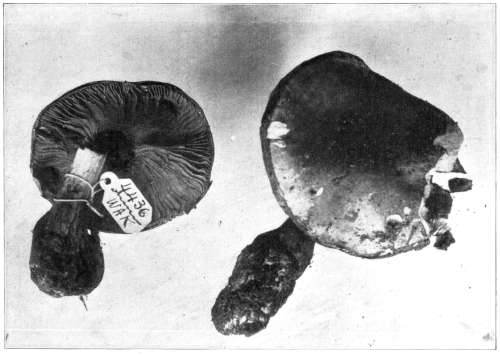
Figure 46.—Tricholoma sulphureum.
Sulphureum, sulphur; so called from the general color of the plant.
The pileus is one to three inches broad, fleshy, convex, then expanded, plane, slightly umbonate, sometimes depressed, or flexuous and irregular, margin at first involute, dingy or reddish-yellow, at first silky, becoming smooth and even.
The gills are rather thick, narrowed behind, emarginate or acutely adnate, sulphur-colored.
The stem is two to four inches long, somewhat bulbous, sometimes curved, frequently slightly striate; stuffed, often hollow; sulphur-yellow, yellow within; furnished at the base occasionally with many rather strong, yellow, fibrous roots. Odor strong and disagreeable. Flesh thick and yellow. Spores are 9–10×5µ.
It grows in mixed woods. I find it frequently where logs have decayed. The specimen in Figure 46 was found in Haynes' Hollow and photographed by Dr. Kellerman. Found in October and November.
Tricholoma quinquepartitum. Fr.
Quinquepartitum means divided into five parts. There is no apparent reason for the name. Fries could not identify Linnæus' Agaricus quinquepartitus and he attached the name of this species.
The pileus is three or four inches broad, slightly fleshy; convex, rather involute, then flattened, somewhat repand; viscid, smooth, even, pale yellowish.
The gills are notched at the point of attachment to the stem, broad, white.
The stem is three to four inches long, solid, striate or grooved, smooth. The spores are 5–6×3–4.
This species differs from T. portentosum in the pileus not being virgate, and from T. fucatum in the smooth, striate or grooved stem. This plant is found in thin woods where logs have decayed. I have not eaten this species but I have no doubt of its edibility. The taste is pleasant. Found in October and November.
Tricholoma laterarium. Pk.
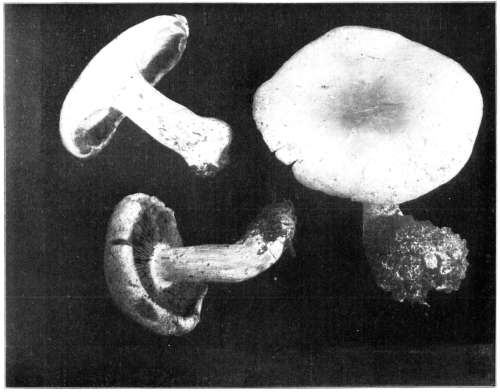
Figure 47.—Tricholoma laterarium.
Laterarium is from later, a brick; so called because there is nearly always a slight tinge of brick red on the disk.
The pileus is two to four inches broad, convex, then expanded, sometimes slightly depressed in the center; pruinose, whitish, the disk often tinged with red or brown, the thin margin marked with slight subdistant, short, radiating ridges.
The gills are narrow, crowded, white, prolonged in little decurrent lines on the stem. The stem is nearly equal, solid, white. The spores are globose, .00018 inch in diameter. Peck's 26th Rep.
This plant is quite widely distributed in the United States. It is found quite frequently in Ohio and is rather abundant on the hillsides about Chillicothe, where it is frequently somewhat bulbous. The tinge of brownish-red on the disk, and the short radiating ridges on the margin of the pileus will serve to identify the plant. It is edible and fairly good. Found on leaf-mold in rather damp woods from July to November.
Tricholoma panæolum. Fr.
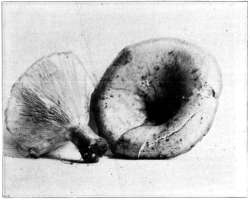
Figure 48.—Tricholoma panæolum.
Panæolum, all variegated. The pileus is from three to four inches broad, deeply depressed, dusky with a gray bloom, hygrophanous; margin at first inrolled, sometimes wavy or irregular when fully expanded.
The gills are quite crowded, adnate, arcuate, white at first, turning to a light gray tinged with an intimation of red, notched with a decurrent tooth.
The stem is short, slightly bulbous, tapering upward, solid, smooth, about the same color as the cap. The spores are subglobose, 5–6.
I found the specimens in Figure 48 under pine trees, growing on a bed of pine needles, on Cemetery Hill. They were found on the 9th of November.
Var. calceolum, Sterb., has the pileus spongy, deformed, thin, soft, expanded, edge incurved, sooty-gray; gills smoky; stem excentric, fusiform, very short.
Tricholoma columbetta. Fr.
The Dove-Colored Tricholoma. Edible.
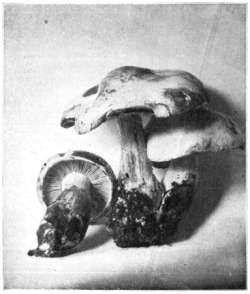
Figure 49.—Tricholoma columbetta. One-third natural size. Caps white. Stems bulbous.
Columbetta is the diminutive of columba, a dove; so called from the color of the plant. The pileus is from one to four inches broad, fleshy, convex, then expanded; at first smooth, then silky; white, center sometimes a dilute mouse color shading to a white, frequently a tinge of pink will be seen on the margin, which is at first inrolled, tomentose in young plants, sometimes cracked.
The gills are notched at the junction of the stem, crowded, thin, white, brittle.
The stem is two inches or more long, solid, white, cylindrical, unequal, often compressed, smooth, crooked, silky especially in young plants, bulbous. Spores .00023 by .00018 inch. Flesh white, taste mild.
This is a beautiful plant, seeming to be quite free from insects, and will remain sound for several days on your study table. I had no end of trouble with it till Dr. Herbst suggested the species. It is quite plentiful here. Dr. Peck gives quite a number of varieties. Curtis, McIlvaine, Stevenson, and Cooke all speak of its esculent qualities. Found in the woods in September and October.
Tricholoma melaleucum. Pers.
The Changeable Tricholoma.
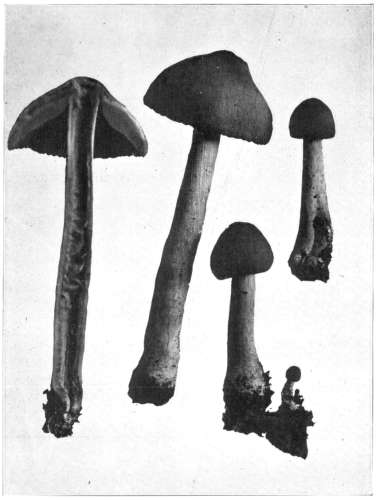
Figure 50.—Tricholoma melaleucum. Two-thirds natural size.
Melaleucum, black and white; from contrasted colors of the cap and gills.
This Tricholoma grows in abundance in northern Ohio. I have found it in the woods near Bowling Green, Ohio. The specimens in the halftone were found near Sandusky, Ohio, and were photographed by Dr. Kellerman. It is usually found in sandy soil, growing singly in shady woods.
The pileus fleshy, thin, from one to three inches broad, convex, rather broadly umbonate, smooth, moist, with variable color, usually pale, nearly white at first, later much darker, sometimes slightly wavy.
The gills are notched, adnexed, ventricose, crowded, white.
The stem is stuffed, then hollow, elastic, from two to four inches long, somewhat smooth, whitish, sprinkled with a few fibrils, usually thickened at the base. The flesh is soft and white. There is no report, so far as I know, regarding its edibility, and I have no doubt as to this, but would advise caution.
Tricholoma lascivum. Fr.
The Tarry Tricholoma.
Lascivum, playful, wanton; so called because of its many affinities, none of which are very close. The pileus is fleshy, convex, then expanded, slightly obtuse, somewhat depressed, silky at first, then smooth, even. The gills are notched, adnexed, crowded, white; the stem is solid, equal, rigid, rooting, white, tomentose at the base. Found in the woods, Haynes' Hollow near Chillicothe. September and October.
Tricholoma Russula. Schæff.
The Reddish Tricholoma. Edible.
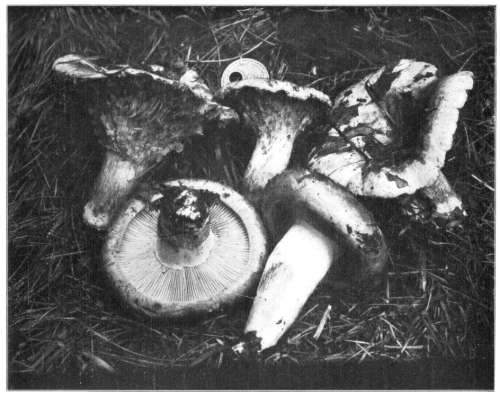
Figure 51.—Tricholoma Russula. Natural size. Caps reddish or flesh color.
Russula is so named because of its likeness in color to some species of the genus Russula.
The pileus is three to four inches broad, fleshy, convex, then depressed, viscid, even or dotted with granular scales, red or flesh color, the margin somewhat paler, involute and minutely downy in the young plant.
The gills are rounded or slightly decurrent, rather distant, white, often becoming red-spotted with age.
The stem is two to three inches long, solid, firm, whitish rosy-red, nearly equal, scaly at the apex. The spores are elliptical, 10×5µ.
This plant is quite variable in many of its peculiar characteristics, yet it usually has enough to readily distinguish it. The cap may be flesh-color and the stem rosy-red, the cap may be red and the stem white or whitish with stains of red. During wet weather the caps of all are viscid; when dry, all may be cracked more or less. The stems may not be scaly at the apex, often rosy when young. They are found in the woods solitary, in groups, or frequently in dense clusters. The specimens in Figure 51 were found in Michigan and photographed by Dr. Fischer.
I found this plant in Poke Hollow. The gills were quite decurrent.
Tricholoma acerbum. Bull.
The Bitter Tricholoma.
Acerbum means bitter to the taste.
The pileus is three to four inches broad, convex to expanded, obtuse, smooth, more or less spotted, margin thin, at first involute, rugose, sulcate, viscid, whitish, often tinged rufous, or yellow, quite bitter to the taste.
The gills are notched, crowded, pallid or rufescent, narrow.
The stem is solid, rather short, blunt, yellowish, squamulose above or about the apex. The spores are subglobose, 5–6µ.
These plants were found growing in a thick bed of moss along with Armillaria nardosmia. They were not perfect plants but I judged them to be T. acerbum from their taste and involute margin. I sent some to Prof. Atkinson, who confirmed my classification. They grow in open woods in October and November.
Tricholoma cinerascens. Bull.
Cinerascens means becoming the color of ashes.
The pileus is two to three inches broad, fleshy, convex to expanded, even, obtuse, smooth, white, then grayish, margin thin.
The gills are emarginate, crowded, rather undulate, dingy, reddish often yellowish, easily separating from the pileus.
The stem is stuffed, equal, smooth, elastic.
They grow in clusters in mixed wood. They are mild to the taste.
Tricholoma album. Schæff.
The White Tricholoma. Edible.
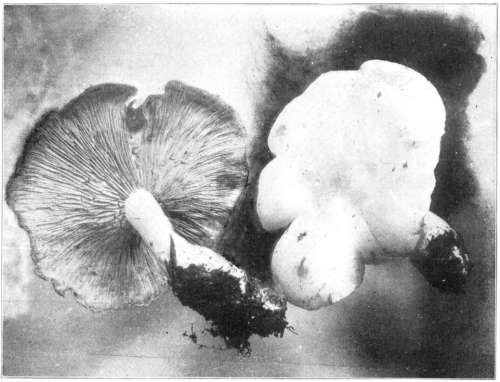
Figure 52.—Tricholoma album. Entirely white.
Album means white.
The pileus is two to four inches broad, fleshy, entirely white, convex, then depressed, obtuse, smooth, dry, disc frequently tinged with yellow, margin at first involute, at length repand.
The gills are rounded behind, rather crowded, thin, white, broad.
The stem is two to four inches long, solid, firm, narrowed upwards, smooth.
This plant is quite plentiful in our woods, growing usually in groups. It grows upon the leaf mould and is frequently quite large. It is quite acrid to the taste when raw, but this is overcome in cooking. It is found from August to October.
These plants are quite plentiful on the wooded hillsides about Chillicothe. Those in Figure 52 were found on Ralston's Run and photographed by Dr. Kellerman.
Tricholoma imbricatum. Fr.
The Imbricated Tricholoma. Edible.
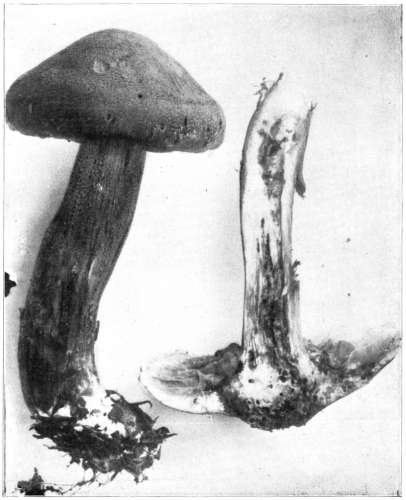
Photo by C. G. Lloyd
Figure 53.—Tricholoma imbricatum.
Imbricatum means covered with tiles, imbreces, referring to the lacerated condition of the cap. This species is very closely related to T. transmutans in size, color and taste. It is, however, easily separated by its dry cap and solid stem. Its cap is reddish-brown or cinnamon-brown, and its surface often presents a somewhat scaly appearance because the epidermis becomes lacerated or torn into small irregular fragments which adhere and seem to overlap like shingles on a roof. The flesh is firm, white, and has a farinaceous taste as well as odor. The gills are white, becoming red or rusty spotted, rather close, and notched. The stem is solid, firm, nearly equal, except slightly swollen at the base, colored much like the cap but usually paler. When old it is sometimes hollow on account of the insects mining it. The spores are white and elliptical, .00025 inch long.
I found this mushroom near Salem, Ohio, Bowling Green, Ohio, and on Ralston's Run near Chillicothe. Found in mixed woods from September to November.
Tricholoma terriferum. Pk.
The Earth-bearing Tricholoma. Edible.
Terriferum, earth-bearing, alluding to the viscid cap's holding particles of loam and pine needles to it as it breaks through the soil. This is a meaty mushroom, and when properly cleaned makes an appetizing dish.
The pileus is convex, irregular, wavy on the margin and rolled inward, smooth, viscid, pale yellow, sometimes whitish, generally covered with loam on account of the sticky surface of the cap, flesh white.
The gills are white, thin, close, slightly adnexed.
The stem is short, fleshy, solid, equal, mealy, very slightly bulbous at the base.
Found near Salem, Ohio, on Hon. J. Thwing Brooks' farm September to October.
Tricholoma fumidellum. Pk.
The Smoky Tricholoma. Edible.
Fumidellum—smoky, because of the clay-colored caps clouded with brown.
The pileus is one to two inches broad, convex, then expanded, subumbonate, bare, moist, dingy-white or clay-color clouded with brown, the disk or umbo generally smoky brown.
The gills are crowded, subventricose, whitish.
The stem is one and a half to two and a half inches long, equal, bare, solid whitish. The spores minute, subglobose, 4–5×4µ. Peck, 44 Rep.
The specimens I found grew in a mixed woods in the leaf-mold. They are found only occasionally in our woods in September and October.
Tricholoma leucocephalum. Fr.
The White-capped Tricholoma. Edible.
Leucocephalum is from two Greek words meaning white and head, referring to the white caps.
The pileus is one and a half to two inches across, convex, then plane; even, moist, smooth when the silky veil is gone, water-soaked after a rain; flesh thin, tough, smell mealy, taste mild and pleasant.
The gills are rounded behind and almost free, crowded, white.
The stem is about two inches long, hollow, solid at the base, smooth, cartilaginous, tough, rooting. The spores are 9–10×7–8µ.
It differs from T. album in having the odor of new meal strongly marked. It is found in open woods during September and October.
Tricholoma fumescens. Pk.
Smoky Tricholoma. Edible.
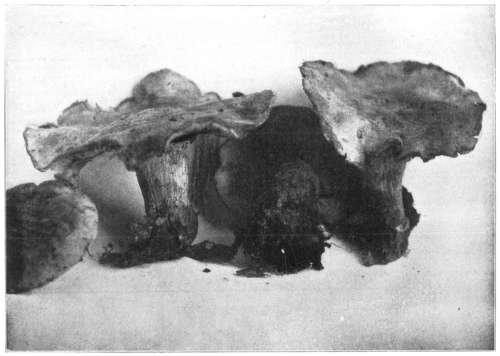
Figure 54.—Tricholoma fumescens.
Fumescens means growing smoky.
Pileus convex or expanded, dry, clothed with a very minute appressed tomentum, whitish.
The gills are narrow, crowded, rounded behind, whitish or pale cream color, changing to smoky blue or blackish where bruised.
The stem is short, cylindrical, whitish. Spores are oblong-elliptical, 5–6×5µ. Pileus is one inch broad. Stem one to one and a half inches high. Peck, 44th Rep. N. Y. State Bot.
The caps are quite a bit larger in the specimens found in Ohio than those described by Dr. Peck. So much so that I was in doubt as to the correct identification. I sent some specimens to Dr. Peck for his determination. The species will be readily identified by the fine crowded gills and the smoky blue or blackish hue they assume when bruised. The caps are frequently wavy, as will be seen in Figure 54.
I found the plants in Poke Hollow near Chillicothe, September to November.
Tricholoma terreum. Schaeff.
The Gray Tricholoma. Edible.
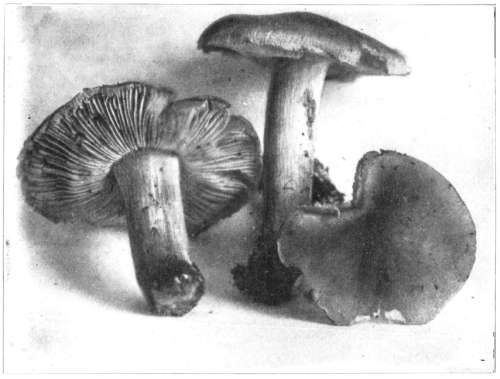
Figure 55.—Tricholoma terreum. Cap grayish-brown or mouse color.
Terreum is from terra, the earth; so called from the color. This is quite a variable species in color and size, as well as manner of growth.
The pileus is one to three inches broad, dry, fleshy, thin, convex, expanded, nearly plane, often having a central umbo; floccose-scaly, ashy-brown, grayish-brown or mouse-color.
The gills are adnexed, subdistant, white, becoming grayish, edges more or less eroded. Spores, 5–6µ.
The stem is whitish, fibrillose, equal, paler than the cap, varying from solid to stuffed or hollow, one to three inches high.
I find this plant on north hillsides, in beech woods. It is not plentiful. There are several varieties:
Var. orirubens. Q. Edge of gills reddish.
Var. atrosquamosum. Chev. Pileus gray with small black scales; g. whitish.
Var. argyraceum. Bull. Entirely pure white, or pileus grayish.
Var. chrysites. Jungh. Pileus tinged yellowish or greenish.
The plants in Figure 55 were found in Poke Hollow near Chillicothe. Their time is September to November.
Tricholoma saponaceum. Fr.
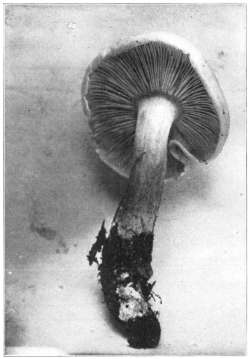
Figure 56.—Tricholoma saponaceum.
Saponaceum is from sapo, soap, so called from its peculiar odor.
The pileus is two to three inches broad, convex, then plane, involute at first as will be seen in Figure 56, smooth, moist in wet weather but not viscid, often cracked into scales or punctate, grayish or livid-brown, often with a tinge of olive, flesh firm, becoming more or less red when cut or wounded.
The gills are uncinately emarginate, thin, quite entire, not crowded, white, sometimes tinged with green. Spores subglobose, 5×4µ.
The stem is solid, unequal, rooting, smooth, sometimes reticulated with black fibrils or scaly.
This species is found quite frequently about Chillicothe. It is quite variable in size and color, but can be readily recognized from its peculiar odor and the flesh's becoming reddish when wounded. It is not poisonous but its odor will prevent any one from eating it. Found in mixed woods from August to November.
Tricholoma cartilagineum. Bull.
The Cartilaginous Tricholoma. Edible.
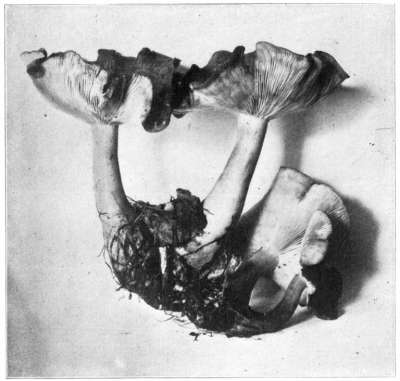
Figure 57.—Tricholoma cartilagineum. Two-thirds natural size.
Cartilagineum means gristly or cartilaginous.
The pileus is two to three inches broad, cartilaginous, elastic, fleshy, convex, soon expanded, wavy, as seen in Figure 57, margin incurved, smooth, inclined to be blackish at first, then broken up into small black spots.
The gills are slightly notched, adnexed, somewhat crowded, grayish.
The stem is one to two inches long, rather firm, stuffed, equal, smooth, white, often striate and mealy. Taste and odor pleasant.
A number of my friends ate it because of its inviting taste and odor. It grew in quantities among the clover in our city park during the wet weather of the last of May and the first of June.
Tricholoma squarrulosum. Bres.
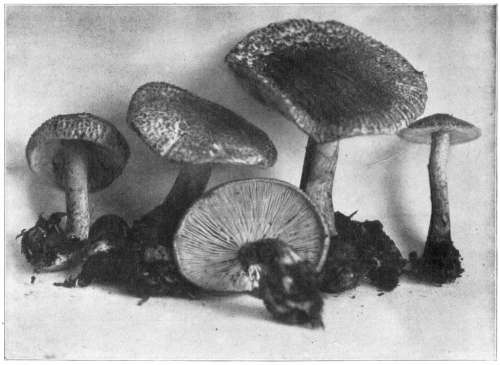
Figure 58.—Tricholoma squarrulosum. Caps showing black squamules.
Squarrulosum means full of scales.
The pileus is two to three inches broad, convex, then expanded, umbonate, dry; fuscous then lurid tan, center black, with black squamules; edge fibrillose, exceeding gills.
The gills are broad, crowded, whitish-gray, reddish when bruised.
The stem is of the same color as the pileus, punctato-squamulose. The spores are elliptical, 7–9×4–5µ.
This is a beautiful plant, growing in mixed woods among the leaves. The stem is short and apparently the same color as the pileus. The latter is covered with black squamules which give rise to the name of the species. I have succeeded in finding the plants only in October. The specimens in Figure 58 were found in Poke Hollow, near Chillicothe.
Tricholoma maculatescens. Pk.
Spotted Tricholoma.
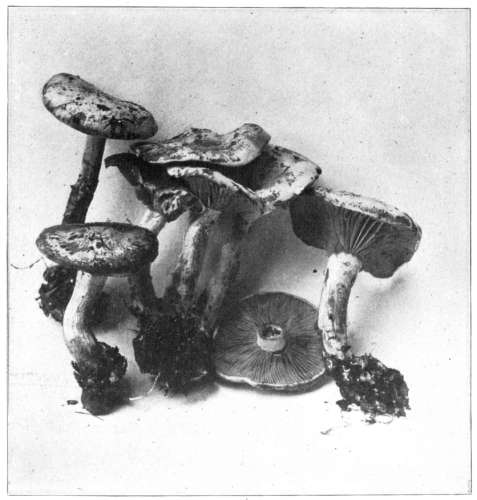
Figure 59.—Tricholoma maculatescens. One-third natural size.
Maculatescens means growing spotted; so called because when the specimen is dried the cap becomes more or less spotted.
The pileus is one and a half to three inches broad, compact, spongy, reddish-brown, convex, then expanded, obtuse, even, slightly viscid when wet, becoming rivulose and brown spotted in drying, flesh whitish, margin inflexed, exceeding the gills.
The gills are slightly emarginate, rather narrow, cinereous.
The stem is spongy-fleshy, equal, sometimes abruptly narrowed at the base, solid, stout, fibrillose, pallid or whitish. The spores are oblong or subfusiform, pointed at the ends, uninucleate, .0003 inch long, .00016 broad. Peck.
I found the plant on several occasions in the month of November, but was unable to fix it satisfactorily until Prof. Morgan helped me out. The specimens in Figure 59 were found on Thanksgiving day in the Morton woods, in Gallia County, Ohio. I had found several specimens about Chillicothe, previous to this.
This species seems to be very near T. flavobrunneum, T. graveolens, and T. Schumacheri, but may be distinguished from them by the spotting of the pileus when drying and the peculiar shape of the spores.
It is found among the leaves in mixed woods even during freezing weather. It is no doubt edible, but I should try it cautiously for the first time.
Tricholoma flavobrunneum. Fr.
The Yellow-Brown Tricholoma. Edible.
Flavobrunneum is from flavus, yellow; brunneus, brown; so called from the brown caps and yellow flesh.
The pileus is three to four or more inches broad, fleshy, conical, then convex, expanded, subumbonate, viscid, brownish-bay, scaly-streaked, flesh yellow, then tinged with red.
The gills are pale yellow, emarginate, slightly decurrent, somewhat crowded, and often tinged with red.
The stem is three to four inches long, hollow, slightly ventricose, brownish, flesh yellow, at first viscid, sometimes reddish-brown. The spores are 6–7×4–5. Found in mixed woods among leaves.
Tricholoma Schumacheri. Fr.
Schumacheri in honor of C. F. Schumacher, author of "Plantarum Sællandiæ." The pileus is from two to three inches broad, spongy, convex, then plane, obtuse, even, livid gray, moist, edge beyond gills incurved.
The gills are narrow, close, pure white, slightly emarginate.
The stem is three to four inches long, solid, fibrillosely-striate, white and fleshy.
This seems to be a domestic plant, found in greenhouses.
Tricholoma grande. Pk.
The Large Tricholoma. Edible.
Grande, large, showy. This was quite abundant in Haines' Hollow and on Ralston's Run during the wet weather of the fall of 1905. It seems to be very like T. columbetta and is found in the same localities.
The pileus is thick, firm, hemispherical, becoming convex, often irregular, dry, scaly, somewhat silky-fibrillose toward the margin, white, the margin at first involute. Flesh grayish-white, taste farinaceous.
The gills are close, rounded behind, adnexed, white.
The stem is stout, solid, fibrillose, at first tapering upward, then equal or but slightly thickened at the base, pure white. The spores are elliptical, 9–11×6µ.
The pileus is four to five inches broad, the stem two to four inches long, and an inch to an inch and a half thick. Peck, 44th Rep.
This is a very large and showy plant, growing among leaves after heavy rains. Both this and T. columbetta, as well as a white variety of T. personatum, were very plentiful in the same woods. They grow in groups so closely crowded that the caps are often quite irregular. The darker and scaly disk and larger sized spore will help you to distinguish it from T. columbetta. The very large specimens are too coarse to be good. Found in damp woods, among leaves, from August to November.
Tricholoma sejunctum. Sow.
The Separating Tricholoma. Edible.
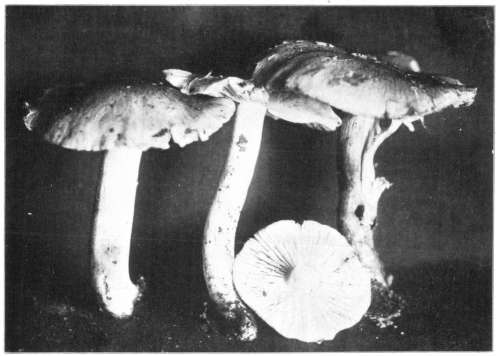
Figure 60.—Tricholoma sejunctum. One-half natural size.
Sejunctum means having separated. It refers to the separation of the gills from the stem. Pileus fleshy, convex, then expanded, umbonate, slightly viscid, streaked with innate brown or blackish fibrils, whitish or yellow, sometimes greenish-yellow, flesh white and fragile.
The gills are broad, subdistant, rounded behind or notched, white.
The stem is solid, stout, often irregular, white. The spores are subglobose, .00025 inch broad. The pileus is one to three inches broad; stem one to four inches long and from four to eight lines thick. Peck's Report.
This is quite common about Salem, Ohio; on the old Lake Shore line in Wood County near Bowling Green, Ohio; and I have found it frequently near Chillicothe. When cooked it has a pleasant flavor. It is always an attractive specimen. I find it under beech trees in the woods, September to November.
Tricholoma unifactum. Pk.
United Tricholoma. Edible.
Unifactum means united or made into one, referring to the stems united in one base root or stem.
The pileus is fleshy but thin, convex; often irregular, sometimes eccentric from its mode of growth; whitish, flesh whitish, taste mild.
The gills are thin, narrow, close, rounded behind, slightly adnexed, sometimes forked near the base, white.
The stems are equal or thicker at the base, solid, fibrous, white, united at the base in a large fleshy mass.
Spores are white, subglobose, .00016 to .0002 of an inch broad. Peck.
I found a beautiful specimen in Poke Hollow, in a beech woods with some oak and chestnut. There was but one cluster growing from a large whitish fleshy mass. There were fifteen caps growing from this fleshy mass. I could not identify species until too late to photograph.
Tricholoma albellum. Fr.
The Whitish Tricholoma. Edible.
The pileus is two to three inches broad, becoming pale-white, passing into gray when dry, fleshy, thick at the disk, thinner at the sides, conical then convex, gibbous when expanded, when in vigor moist on the surface, spotted as with scales, the thin margin naked, flesh soft, floccose, white, unchangeable.
The gills are very much attenuated behind, not emarginate, becoming broad in front; very crowded, quite entire, white.
The stem is one to two inches long, solid, fleshy-compact, ovate-bulbous (conical to the middle, cylindrical above), fibrillose-striate, white. Spores elliptical, 6–7×4µ.
Tricholoma personatum. Fr.
The Masked Tricholoma. Edible.
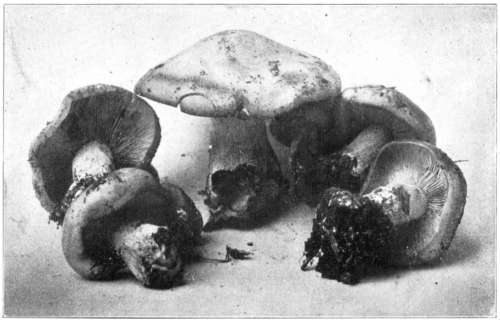
Figure 61.—Tricholoma personatum. One-third natural size. Caps usually tinged with lilac or violet. Stems bulbous.
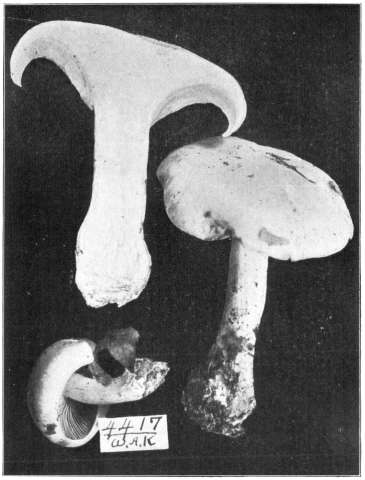
Figure 62.—Tricholoma personatum. Two-thirds natural size. The entire plant white.
Personatum means wearing a mask; so called because of the variety of colors it undergoes. This is a beautiful mushroom, and is excellently flavored; it has a wide range and is frequently found, in great abundance. I have often seen it growing in almost a straight line for over twenty feet, the caps so thoroughly crowded that they had lost their form. When young the cap is convex and quite firm, with the margin minutely downy or adorned with mealy particles, and incurved. In the mature plant it is softer, broadly convex, or nearly plane, with the thin margin spreading and more or less turned upward and wavy. When young it is pale lilac in color, but with advancing age it changes to a tawny or rusty hue, especially in the center. Sometimes the cap is white, whitish or gray, or of a pale violaceous color.
The gills are crowded, rounded next to the stem, and nearly free but approaching close to the stem, more narrow toward the margin, with a faint tinge of lilac or violet tint when young, but often white.
The stem is short, solid, adorned with very minute fibers, downy or mealy particles when young and fresh, but becoming smooth with advancing age. The color of the stem is much like the cap but perhaps a shade lighter.
The cap is from one to five inches broad, and the stem from one to three inches high. It grows singly or in groups. It is found in thin woods and thickets. It delights to grow where an old saw mill has stood.
The finest specimens of this species that I ever saw grew on a pile of compost of what had been green cobs from the canning factory. They had lain in the pile for about three years and late in November the compost was literally covered with this species, many of whose caps exceeded five inches while the color and figuration of the plants were quite typical.
In English books this plant is spoken of as Blewits and in France as Blue-stems, but the stems in this country are inclined to be lilac or violet, and then only in the younger plants.
The spores are nearly elliptical and dingy white, but in masses on white paper they have a salmon tint. Its smooth, almost shining, unbroken epidermis and its peculiar peach-blossom tint distinguish it from all other species of the Tricholoma. There is a white variety, very plentiful in our woods, which is illustrated in Figure 62. They are found only in leaf-mould in the woods. September to freezing weather.
Tricholoma nudum. Bull.
The Naked Tricholoma. Edible.
Nudum, naked, bare; from the character of the margin. The pileus is two to three inches broad, fleshy, rather thin, convex, then expanded, slightly depressed; smooth, moist, the whole plant violet at first, changing color, margin involute, thin, naked, often wavy.
The gills are narrow, rounded behind, slightly decurrent when the plant becomes depressed, crowded, violet at first, changing to a reddish-brown without any tinge of violet.
The stem is two to three inches long, stuffed, elastic, equal, at first violaceous, then becoming pale, more or less mealy. Spores 7×3.5µ
I found some very fine specimens among the leaves in the woods in Haynes' Hollow, near Chillicothe. October and November.
Tricholoma gambosum. Fr.
St. George's Mushroom. Edible.
Gambosum, with a swelling of the hoof, gamba. The pileus is three to six inches broad, sometimes even larger; very thick, convex, expanded, depressed, commonly cracked here and there; smooth, suggesting soft kid leather; margin involute at first, pale ochre or yellowish white.
The gills are notched, with an adnexed tooth, densely crowded, ventricose, moist, various lengths, yellowish white.
The stem is short, solid, flocculose at apex, substance creamy white; swollen slightly at the base. The spores are white.
It is called St. George's mushroom in England because it appears about the time of St. George's day, April 23d. It frequently grows in rings or crescents. It has a very strong odor. Its season is May and June.
Tricholoma portentosum. Fr.
The Strange Tricholoma. Edible.
Portentosum means strange or monstrous.
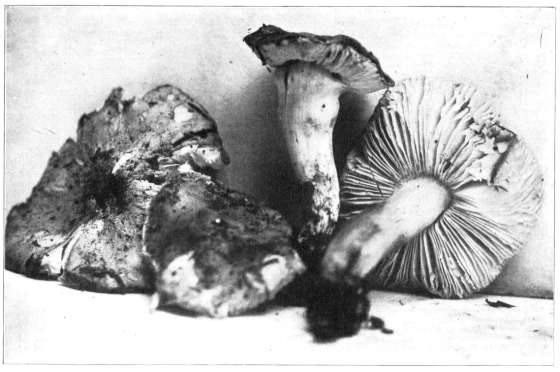
Figure 63.—Tricholoma portentosum.
The pileus is three to five inches broad, fleshy, convex, then expanded, subumbonate, viscid, sooty, often with purple tinge, frequently unequal and turned up, streaked with dark lines, the thin margin naked, flesh not compact, white, fragile, and mild.
The gills are white, very broad, rounded, almost free, distant, often becoming pale-gray or yellowish.
The stem is three to six inches long, solid, quite fibrous, sometimes equal, often tapering toward the base, white, stout, striate, villous at base. The spores are subglobose, 4–5×4µ.
The plants grow in pine woods and along the margins of mixed woods, frequently by roadsides. It is usually found in October and November. The plants in Figure 63 were found near Waltham, Mass., and were sent to me by Mrs. E. B. Blackford. This is said to even excel T. personatum in edible qualities.
Clitocybe. Fr.
Clitocybe is from two Greek words, a hillside, or declivity, and a head; so called from the central depression of the pileus.
The genus Clitocybe differs from Tricholoma in the character of the gills. They are attached to the stem by the whole width and usually are prolonged down the stem or decurrent. This is the first genus with decurrent gills. The genus has neither a volva nor a ring and the spores are white. The stem is elastic, spongy within, frequently hollow and extremely fibrous, continuous with the pileus.
The pileus is generally fleshy, growing thin toward the margin, plane or depressed or funnel-shaped, and with margin incurved. The universal veil, if present at all, is seen only on the margin of the pileus like frost or silky dew.
These plants usually grow on the ground and frequently in groups, though a few may be found on decayed wood.
The Collybia, Mycena, and Omphalia have cartilaginous stems, while the stem of the Clitocybe is extremely fibrous, and the Tricholoma is distinguished by its notched gills.
This genus, because of the variations in its species, will always be puzzling to the beginner, as it is to experts. We may easily decide it is a Clitocybe because of the gills squarely meeting the stem, or decurrent upon it, and its external fibrous stem, but to locate the species is quite a different matter.
Clitocybe media. Pk.
The Intermediate Clitocybe. Edible.
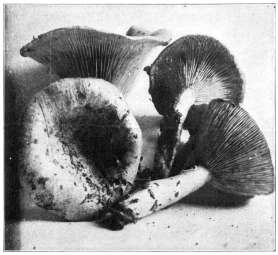
Figure 64.—Clitocybe media. One-half natural size.
Media is from medius, middle; it is so called because it is intermediate between C. nebularis and C. clavipes. It is not as plentiful as either of the others in our woods.
The pileus is grayish-brown or blackish-brown, always darker than C. nebularis. The flesh is white and farinaceous in taste.
The gills are rather broad, not crowded, adnate and decurrent, white, with few transverse ridges or veins in the spaces between the gills.
The stem is one to two inches long, usually tapering upward, paler than the pileus, rather elastic, smooth. The spores are plainly elliptical, 8×5µ.
This resembles very closely the two species mentioned above and is hard to separate. I found the specimens in Figure 64 along Ralston's Run where the ground is mossy and damp. Found in September and October.
Clitocybe infundibuliformis. Schaeff.
The Funnel-Formed Clitocybe. Edible.
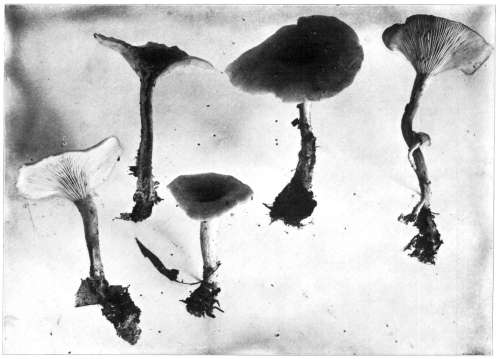
Photo by C. G. Lloyd.
Plate IX. Figure 65.—Clitocybe infundibuliformis.
Infundibuliformis means funnel-shaped. This is a beautiful plant and very abundant in woods after a heavy rain. It grows upon the leaves and especially among pine needles.
The pileus is at first convex and umbonate and as the plant advances in age the margin becomes elevated until the plant becomes funnel-shaped. The margin is frequently incurved and finally wavy. The flesh is soft and white. The color of the cap is a pale tan. If the cap is examined carefully it will be seen to be covered with a slight down or silky substance, especially on the margin. The color of the cap is apt to fade so that specimens will be found almost white.
The gills are thin, close, white or whitish, and very decurrent.
The stem is quite smooth, and generally tapers upward from the base. It is sometimes white or whitish, but more frequently like the cap. Mycelium will usually be found at the base on the leaves, forming a soft white down. I have found this species in several parts of the state. It is frequently found in clusters, when the caps will be irregular on account of the crowded condition. They are very tender and of excellent flavor. Found from August to October.
Clitocybe odora. Bull.
Sweet-smelling Clitocybe. Edible.
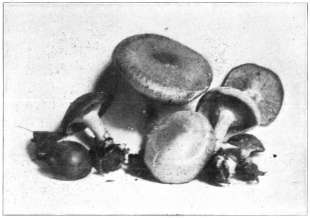
Figure 66.—Clitocybe odora. One-third natural size. Cap pale green.
Odora means fragrant. This is one of the easiest of the Clitocybes to identify. The collector will very readily recognize it by its olive-green color and its odor. The color in the old plant is quite variable but in young plants is well marked. The pileus is one to two and a half inches broad, flesh quite thick; at first convex, then expanded, plane, often depressed, sometimes inclined to be wavy; even, smooth, olive-green.
The gills are adnate, rather close, sometimes slightly decurrent, broad, pallid.
The stem is one to one and a half inches long, often slightly bulbous at the base.
These plants are found from August to October, in the woods, on leaves. They are quite common about Chillicothe after a rain. When cooked by themselves the flavor is a bit strong, but when mixed with other plants not so strong in flavor, they are fine.
Clitocybe illudens. Schw.
The Deceiving Clitocybe. Not Edible.
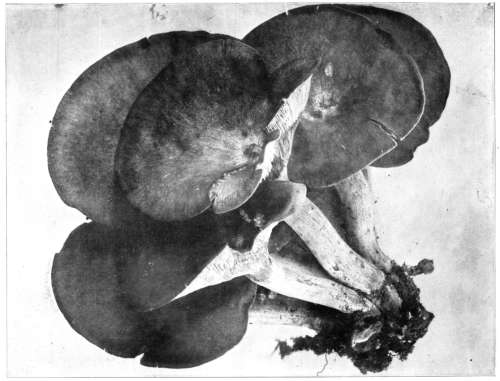
Photo by C. G. Lloyd.
Plate X. Figure 67.—Clitocybe illudens. Caps reddish-yellow to deep yellow. Gills yellow and decurrent.
Illudens means deceiving. Pileus of a beautiful yellow, very showy and inviting. Many a basketful has been brought to me to be identified with the hope of their edibility. The cap is convex, umbonate, spreading, depressed, smooth, often irregular from its crowded condition of growth; in older and larger plants the margin of the pileus is wavy. The flesh is thick at the center but thinner toward the margin. In old plants the color is brownish.
The gills are decurrent, some much further than others; yellow; not crowded; broad.
The stem is solid, long, firm, smooth tapering towards the base, as will be seen by Figure 67, sometimes the stems are very large.
The pileus is from four to six inches broad. The stem is six to eight inches high. It occurs in large clusters and the rich saffron color of the entire plant compels our admiration and we are reminded that "not all is gold that glitters." It will be interesting to gather a large cluster to show its phosphorescence and the heat which the plant will generate. You can show the phosphorescence by putting it in a dark room and by placing a thermometer in the cluster you can show the heat. It is frequently called "Jack-o'-lantern."
I have known people to eat it without harm, but the chances are that it will make most persons sick. It ought to be good, since it is so abundant and looks so rich. Found from July to October.
Clitocybe multiceps. Pk.
The Many-Headed Clitocybe. Edible.
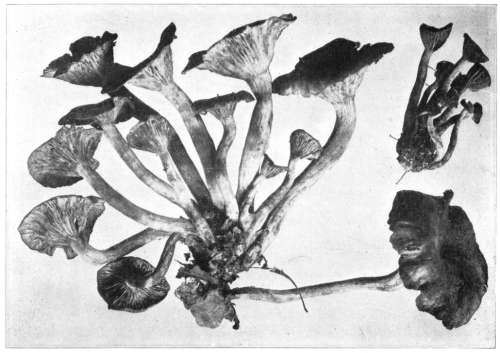
Figure 68.—Clitocybe multiceps. One-half natural size. Caps grayish-white.
Multiceps means many heads; so called because many caps are found in one cluster. It is a very common plant around Chillicothe. It has been found within the city limits. It is quite a typical species, too, having all the characteristics of the genus. I have often seen over fifty caps in one cluster.
The pileus is white or gray, brownish-gray or buff; smooth, thin at the margin, convex, slightly moist in rainy weather.
The gills are white, crowded, narrow at each end, decurrent.
The stem is tough, elastic, fleshy, solid, tinged with the same color as the cap.
The pileus is one to three inches broad; grows in dense tufts. Spores are white, smooth and globose.
When found in June the plants are a shade whiter than in the fall. The fall plants are very much the oyster color. The early plant is a more tender one and better for table use, however, I do not regard it as excellent. They are found in woods, in old pastures by logs and stumps, and in lawns. June to October.
Clitocybe clavipes. Pers.
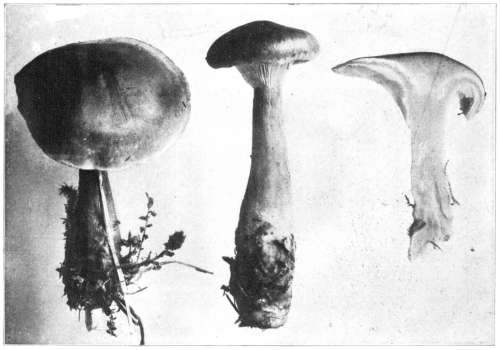
Photo by C. G. Lloyd.
Figure 69.—Clitocybe clavipes.
Clavipes is from clava, a club, and pes, a foot.
The pileus is one to two and a half inches broad, fleshy, rather spongy, convex to expanded, obtuse, even, smooth, gray or brownish, sometimes whitish toward the margin.
The gills are decurrent, descending, rather distant, nearly entire, rather broad, white.
The stem is two inches long, swollen at the base, attenuated upward, stuffed, spongy, fibrillose, livid sooty. Spores are elliptical, 6–7×4µ.
I found specimens on Cemetery Hill underneath pine trees. I sent some to Dr. Herbst and Prof. Atkinson; both pronounced them C. clavipes. They resemble quite closely C. nebularis. I have also found this plant in mixed woods. Edible and fairly good.
Clitocybe tornata. Fr.
Tornata means turned in a lathe; so called because of its neat and regular form.
The pileus is orbicular, plane, somewhat depressed, thin, smooth, shining, white, darker on the disk, very regular.
The gills are decurrent adnate, rather crowded, white.
The stem is stuffed, firm, slender, smooth, pubescent at the base.
The spores are elliptical, 4–6×3–4µ.
These are small, very regular, and inodorous plants. They are found in open fields in the grass about elm stumps. July to September. They are edible and cook readily.
Clitocybe metachroa. Fr.
The Obconic Clitocybe. Edible.
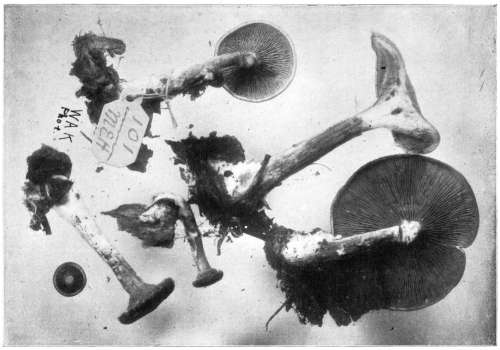
Figure 70.—Clitocybe metachroa. Caps dark gray. Gills pale gray.
Metachroa means changing color.
The pileus is one to two and a half inches broad, somewhat fleshy, convex, then plane, depressed, smooth, hygrophanous, brownish-gray, then livid, growing pale.
The gills are attached to the stem, crowded, pale gray, slightly decurrent.
The stem is one to two inches long, stuffed, then hollow, apex mealy, equal, gray.
It differs from C. ditopa in being inodorous and having a thicker and depressed pileus.
The caps are quite smooth and are frequently concentrically cracked or wrinkled, much as in Clitopilus noveboracensis.
It is found growing on leaves in mixed woods, after a rain, in August and September. When young the margin is incurved but wavy in age. It is quite a hardy plant.
Clitocybe adirondackensis. Pk.
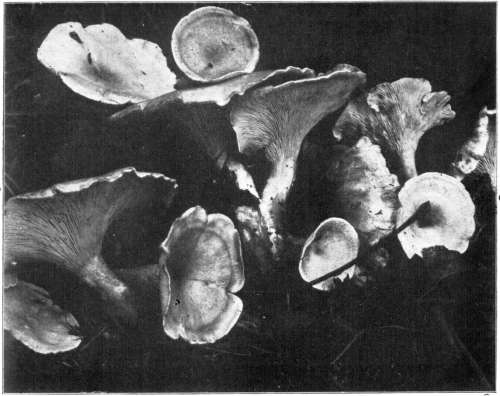
Figure 71.—Clitocybe adirondackensis. Three-fourths natural size. Caps white.
Adirondackensis, so called because the plant was first found in the Adirondack Mountains of New York.
The pileus is thin, submembranaceous, funnel-form, with the margin decurved, nearly smooth, hygrophanous, white, the disk often darker.
The gills are white, very narrow, scarcely broader than the thickness of the flesh of the pileus, crowded, long, decurrent, subarcuate, some of them forked.
The stem is slender, subequal, not hollow, whitish, mycelio-thickened at the base. Peck.
The pileus is one to two inches broad and the stem is one to two and a half long. This is quite a pretty mushroom and has the Clitocybe appearance in a marked degree. The long, narrow, decurrent gills, sometimes tinged with yellow, some of them forked, margin of the pileus sometimes wavy, will assist in distinguishing it. I have no doubt of its edibility. Found among leaves in woods after heavy rains. With us it is confined to the wooded hillsides. The specimens in Figure 71 were found in Michigan and photographed by Dr. Fischer. Found in July and August.