Chapter II · THE WHITE-SPORED AGARICS. (continued 3)
Reading edition
Lactarius chrysorrheus. Fr.
Yellow-Juiced Lactarius.
Chrysorrheus from two Greek words; chrysos, yellow or golden; reo, I flow, because the juice soon turns to a golden yellow.
The pileus is rather fleshy, depressed, then funnel-shaped, yellowish-flesh colored, marked with dark zones or spots.
The stem is stuffed, then hollow, equal, or tapering below, paler than the pileus, sometimes pitted.
The gills are decurrent, thin, crowded, yellowish, milk white, then golden-yellow, very acrid.
The milk is white, quite acrid, has a peculiar taste, and changes at once on exposure to a beautiful yellow. This is a common species about Salem, Ohio, and is quite variable in size. Found in woods and groves from July to October. I do not know whether its edible quality has ever been tested. When I found it some years ago I had less faith in mushrooms than I have now.
Lactarius vellereus. Fr.
The Wooly-White Lactarius. Edible.
Vellereus from vellus, a fleece. The pileus is white, compact, fleshy, depressed or convex, tomentose, zoneless, margin at first involute, milk white and acrid.
The gills are white or whitish, distant, forked, adnate or decurrent, connected by veins, bow-shaped, milk scanty.
The stem is solid, blunt, pubescent, white, tapering downward. Spores white and nearly smooth, .00019 by .00034 inch.
This species is quite common; and though very acrid to the taste, this acridity is entirely lost in cooking. It will be readily known by the downy covering of the cap. Found in thin woods and wood margins. July to October.
Russula. Pers.
Russula, red or reddish. The beginner will have little difficulty in determining this genus. There is such a strong family likeness that, finding one, he will say at once it is a Russula. The contour of the cap, the brittleness of its flesh and of its stem, the fragile gills, and the failure of any part of the plant to exude a milky or colored juice, the many gay colors—will all help in determining the genus.
Many species of Russula strongly resemble those of the genus Lactarius, in size, shape, and texture. The spores, too, are quite similar, but the absence of the milky juice will mark the difference at once.
The cap may be red, purple, violet, pink, blue, yellow, or green. The colored zones often seen in the Lactarii do not appear here. The beginner will possibly find trouble in identifying species, because of variation of size and color. The spores are white to very pale yellow, generally spiny. The pileus is fleshy, convex, then expanded, and at length depressed. The stem is brittle, stout, and smooth, generally spongy within, and confluent with the cap. The gills are milkless, with acute edge, and very tender.
Captain McIlvaine, in his very valuable book, One Thousand American Fungi, says: "To this genus authors have done special injustice; there is not a single species among them known to be poisonous, and where they are not too strong of cherry bark and other highly flavored substances, they are all edible; most of them favorites." I can testify to the fact that many of them are favorites, though a few are very peppery and it requires some courage to attack them.
They are all found on the ground in open woods, from early summer to late fall.
Russula delica. Fr.
The Weaned Russula. Edible.
Delica means weaned, so called because, though it resembles Lactarius vellereus in appearance, it is void of milk.
The pileus is quite large, fleshy, firm, depressed, even, shining, margin involute, smooth, not striated.
The gills are decurrent, thin, distant, unequal, white.
The stem is solid, compact, white, short.
Specimens will be found that resemble Lactarius piperatus and L. vellereus, but they may be easily distinguished because they have no milk in their gills and the taste is mild. They are not equal to most of the Russulas. Found in woods from August to October.
Russula adusta. Pers.
The Smoky Russula. Edible.
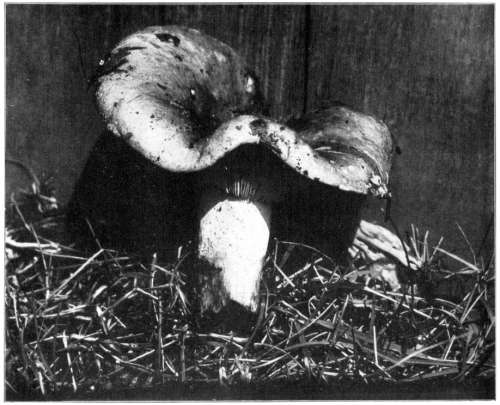
Figure 145.—Russula adusta.
Adusta means burned.
The pileus is fuliginous, cinereous, flesh compact, margin even and inflexed, depressed in the center.
The gills are attached to the stem, decurrent, thin, crowded, unequal, white, not reddening when bruised.
The stem is obese, solid, of the same color as the pileus, not turning red when bruised.
The plant resembles R. nigricans, but can readily be distinguished from it because of the thin, crowded gills and failure to turn red when cut or bruised. The spores are subglobose, almost smooth, 8–9µ; no cystidia. It is found in the woods during August and September. Edible but not first class. It is a plant very widely distributed.
Russula nigricans. Fr.
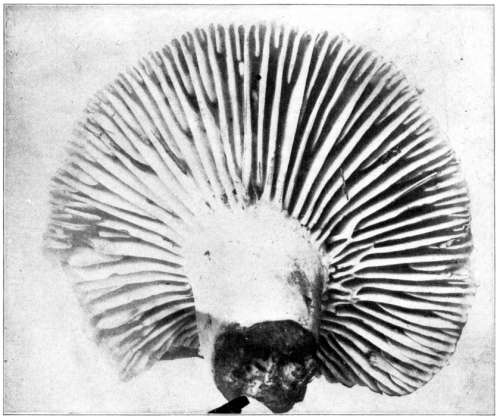
Photo by C. G. Lloyd.
Figure 146.—Russula nigricans.
Nigricans means blackish.
The pileus is two to four inches broad, dark grayish-brown, black with advancing age, fleshy, compact, flesh turning red when bruised or convex, flattened, then depressed, at length funnel-shaped, margin entire, without striate, margin at first incurved, young specimens are slightly viscid when moist, even, without a separable pellicle; whitish at first, soon sooty olive, at length becoming broken up into scales and black; flesh firm and white, becoming reddish when broken.
The gills are rounded behind, slightly adnexed, thick, distant, broad, unequal, the shorter ones sometimes very scanty, forked, reddening when touched.
The stem is rather short, thick, solid, equal, pallid when young, then black. The spores are subglobose, rough, 8–9µ.
The plant is quite compact, inodorous, becoming entirely black with age. It is easily distinguished from R. adusta by the flesh becoming reddish when bruised, and by the much thicker, and more distant gills. It is very close to R. densifolia but differs from it in that its gills are more distant and because of its mild taste.
I am pleased to present to my readers, in Figure 146, a photograph of a plant which grew in Sweden in the locality where Prof. Fries did his great work in fungal study and research. It is a typical specimen of this species. It was gathered and photographed by Mr. C. G. Lloyd.
It is found from June to October. Not poisonous, but not good.
Russula fœtens. Fr.
The Fetid Russula. Not Edible.
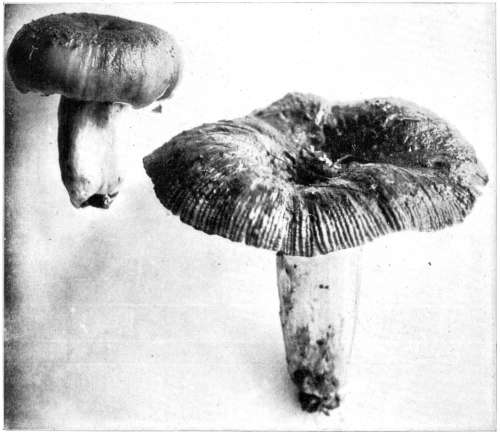
Photo by C. G. Lloyd.
Figure 147.—Russula fœtens.
Fœtens means stinking.
The pileus is four to six inches broad, dirty white or yellowish; flesh thin; at first hemispherical, then expanded, almost plane, often depressed in the center; covered with a pellicle which is adnate; viscid in wet weather; widely striate-tuberculate on the margin, which is at first incurved.
The gills are adnexed, connected by veins, crowded, irregular, many forked, rather broad, whitish, becoming dingy when bruised, exuding watery drops at first.
The stem is stout, stuffed, then hollow, concolor, two to four inches long. The spores are small, echinulate, almost round.
I have found the plants very generally diffused over the state. It is very coarse and uninviting. Its smell and taste are bad. Found from July to October. These plants are widely distributed and usually rather abundant.
Russula alutacea. Fr.
The Tan-Colored Russula. Edible.
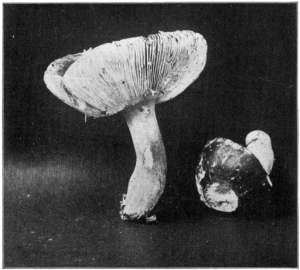
Figure 148.—Russula alutacea. Two-thirds natural size. Caps flesh color. Gills broad and yellowish.
Alutacea, tanned leather. The pileus is flesh-color, sometimes red; flesh white; bell-shaped, then convex; expanded, with a viscid covering, growing pale; slightly depressed; even; margin inclined to be thin, striate.
The gills are broad, ventricose, free, thick, somewhat distant, equal, yellow, then ochraceous.
The stem is stout, solid, even; white, though parts of the stem are red, sometimes purple; wrinkled lengthwise; spongy. The spores are yellow.
The taste is mild and pleasant when young, but quite acrid when old. Alutacea will be known mostly by its mild taste, broad, and yellow gills. It is quite common, but does not grow in groups. It is sweet and nutty.
From July to October.
Russula ochrophylla. Pk.
Ochrey Gilled Russula. Edible.
Ochrophylla is from two Greek words meaning ochre and leaf, because of its ochre-colored gills.
The pileus is two to four inches broad, firm, convex, becoming nearly plane or slightly depressed in the center; even, or rarely very slightly striate on the margin when old; purple or dark purplish-red; flesh white, purplish under the adnate cuticle; taste mild.
The gills are entire, a few of them forked at the base, subdistant, adnate at first yellowish, becoming bright, ochraceous-buff when mature and dusted by the spores, the interspaces somewhat venose.
The stem is equal or nearly so, solid or spongy within, reddish or rosy tinted, paler than the pileus. The spores are bright, ochraceous-buff, globose, verruculose, .0004 of an inch broad. Peck.
This is one of the easiest Russulas to determine because of its purple or purplish-red cap, entire gills, at first yellowish, then a bright, ochraceous-buff when mature. The taste is mild and the flavor fairly good.
There is also a plant which has a purplish cap and a white stem, called Russula ochrophylla albipes. Pk. It quite agrees in its edible qualities with the former.
R. ochrophylla is found in the woods, especially under oak trees, in July and August.
Russula lepida. Fr.
The Neat Russula. Edible.
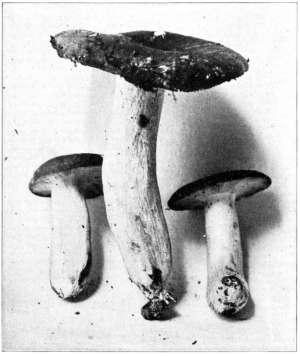
Figure 149.—Russula lepida. Two-thirds natural size. Caps, purplish-red, with more or less brown.
Lepida, from lepidus, neat.
The pileus firm, solid; varying in color from bright red to dull, subdued purplish with a distinct brown; compact; convex, then depressed, dry unpolished; margin even, sometimes cracked and scaly, not striated.
The gills are white, broad, principally even, occasionally forked, very brittle, rounded, somewhat crowded, connected by veins, sometimes red on the edge, especially near the margin.
The stem is solid, white, usually stained and streaked with pink, compact, even.
The surface is dull, as with a fine dust or plum-like bloom, and thus without polish. Often times the surface will appear almost velvety. The tints of the flesh and the gills will be found uniform. The plant when raw is sweet and nut-like to the taste. This is a beautiful species, the color being averaged under the general hue of dark, subdued red, inclining to maroon. It is simply delicious when properly cooked. Found in woods from July to September.
Russula cyanoxantha. Fr.
The Blue and Yellow Russula. Edible.
Cyanoxantha, from two Greek words, blue and yellow, referring to color of the plant.
The pileus is quite variable as to color, ranging from lilac or purplish to greenish; disk yellowish, margin bluish or livid-purple; convex, then plane, depressed in center; margin faintly striate, sometimes wrinkled.
The gills are rounded behind, connected by veins, forked, white, slightly crowded.
The stem is solid, spongy, stuffed, hollow when old, equal, smooth and white.
The color of the cap is quite variable but the peculiar combination of color will assist the student in distinguishing it. It is a beautiful plant and one of the best of the Russulas to eat. The mushroom-eater counts himself lucky indeed when he can find a basketful of this species after "the joiner squirrel" has satisfied his love of this special good thing. It is quite common in woods from August to October.
Russula vesca. Fr.
The Edible Russula. Edible.
Vesca from vesco, to feed. The pileus is from two to three inches broad; red-flesh-color, disk darker; fleshy; firm; convex, with a slight depression in the center, then funnel-shaped; slightly wrinkled; margin even, or remotely striate.
Gills adnate, rather crowded, unequal, forked, and white.
The stem is firm, solid, sometimes peculiarly reticulated, tapering at the base. The spores are globose, spiny, and white. I frequently found it near Salem, O., in thin chestnut woods and in pastures under such trees. A mushroom lover will be amply paid for the long tramps if he finds a basket full of these dainties. It is mild and sweet when raw. It is found in thin woods and in wood margins, sometimes under trees in pastures, from August to October.
Russula virescens. Fr.
The Green Russula. Edible.
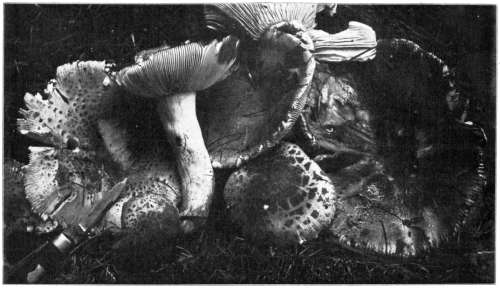
Figure 150.—Russula virescens. Two-thirds natural size. Caps pale-green. Gills white.
Virescens, being green. The Pileus is grayish-green; at first globose, then expanded, convex, at last depressed at the center; firm, adorned with flaky greenish or yellow patches, produced by the cracking of the skin; two to four inches broad, margin striate, often white.
The gills are white, moderately close, free or nearly so, narrow as they approach the stem, some being forked, others not; very brittle, breaking to pieces at the slightest touch.
The stem is shorter than the diameter of the cap, smooth, white, and solid or spongy. The spores are white, rough, and nearly globose.
This plant is especially sweet and nutty to the taste when young and unwilted. All Russulas should be eaten when fresh. I have found the plant over the state quite generally. It is a prime favorite with the squirrels. You will often find them half eaten by these little nibblers. Found in open woods from July to September. It is one of the best mushrooms to eat and one that is very easily identified. It is quite common about Chillicothe, Ohio. Its mouldy color is not as prepossessing as the brighter hues of many far less delicious fungi, but it stands the test of use.
Russula variata. Ban.
Variable Russula. Edible.
Pileus is firm, convex becoming centrally depressed or somewhat funnel-form, viscid, even on the thin margin, reddish-purple, often variegated with green, pea-green sometimes varied with purple, flesh white, taste acrid or tardily acrid.
The gills are thin, narrow, close, often forked, tapering toward each end, adnate or slightly decurrent, white.
The stem is equal or nearly so, solid, sometimes cavernous, white. The spores are white, subglobose, .0003 to .0004 of an inch long, .0003 broad. Peck, Rep. State Bot., 1905.
This plant grows in open beech woods, rather damp, and appears in July and August. The caps are often dark purple, often tinged with red, and sometimes the caps contains shades of green. I found the plants plentifully in Woodland Park, near Newtonville, Ohio, in July, 1907. We ate them on several occasions and found them very good. The greenish margin and purplish center will mark the plant.
Russula integra. Fr.
The Entire Russula. Edible.
Integra, whole or entire. The pileus is three or four inches in diameter, fleshy; typically red, but changing color; expanded, depressed, with a viscid cuticle, growing pale. Margin thin, furrowed and tuberculate. Flesh white, sometimes yellowish above.
The stem is at first short and conical, then club-shaped or ventricose, sometimes three inches long and up to one inch thick; spongy, stuffed, commonly striate; even, and shining white.
The gills are somewhat free, very broad, sometimes three-fourths of an inch; equal or bifid at the stem, rather distant and connected by veins; pallid or white, at length light yellow, being powdered yellow with the spores.
Although the taste is mild it is often astringent. One of the most changeable of all species, especially in the color of the pileus, which, though typically red, is often found inclining to azure-blue, bay-brown, olivaceous, etc. It occasionally happens that the gills are sterile and remain white. Fries.
The spores are spheroid, spiny, pale ochraceous.
R. integra so closely resembles R. alutacea that to distinguish them requires a knowledge of both plants, and even then one may not feel quite sure; however, it matters little as they are equally good. Its powdery gills will help to distinguish R. integra from R. alutacea. Found from July to October.
Russula roseipes. (secr) Bres.
The Rosy-Stemmed Russula. Edible.
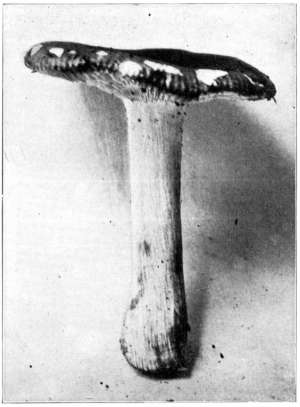
Figure 151.—Russula roseipes. Natural size.
Roseipes is from rosa, a rose; pes, a foot; so called because of its rose-colored or pinkish stem.
The pileus is two to three inches broad, convex, becoming nearly plane, or slightly depressed; at first viscid, soon dry, becoming slightly striate on the margin; rosy-red variously modified by pink, orange or ochraceous hues, sometimes becoming paler with age; taste mild.
The gills are moderately close, nearly entire, rounded behind and slightly adnexed, ventricose, whitish becoming yellow.
The stem is one to three inches long, slightly tapering upward, stuffed or somewhat cavernous, white tinged with red. The spores are yellow, round. Peck, 51 R.
This plant is widely distributed from Maine to the West. It grows best in pine and hemlock woods, but sometimes found in mixed woods. It is found in July and August.
Russula fragilis. Fr.
The Tender Russula.
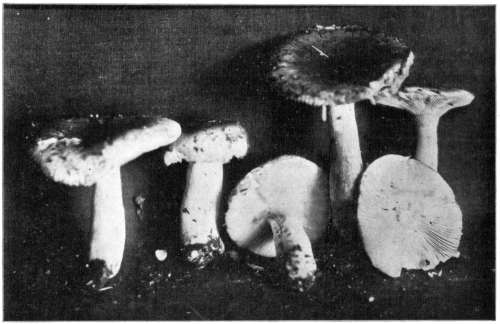
Figure 152.—Russula fragilis.
Fragilis means fragile.
The pileus is rather small, flesh-color or red, or reddish; thin, fleshy only at the disk; at first convex and often umbonate, then plane, depressed; cuticle thin, becoming pale, viscid in wet weather, margin tuberculate-striate.
The gills are thin, ventricose, white, slightly adnexed, equal, crowded, sometimes slightly eroded at the edge. The spores are minutely echinulate, 8–10×8µ.
The stem is stuffed, hollow, shining white.
Quite as acrid as R. emetica, which it resembles in many ways, especially the smaller plants. It can be distinguished by its thinner caps, thinner and crowded gills, more ventricose and often slightly eroded at the edge. It is generally classed among poisonous mushrooms; but Captain Charles McIlvaine in his book says: "Though one of the peppery kind, I have not, after fifteen years of eating it, had reason to question its edibility." I should advise caution. Eat of it sparingly till sure of its effects. Found in woods from July to October.
Russula emetica. Fr.
The Emetic Russula.
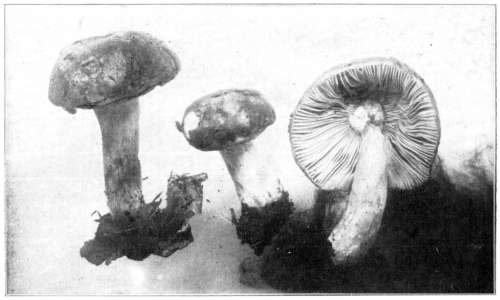
Figure 153.—Russula emetica. Two-thirds natural size. Caps rose-red to yellow-red. Gills white.
Emetica means making sick, inciting to vomit. The pileus is fleshy, quite viscid, expanded, polished, shining, oval, or bell-shaped when young; its color is very variable from rose-red to a yellow-red or even purple; margin furrowed, flesh white.
The gills are free, equal, broad, distant, white. The spores are round, 8µ.
The stem is stout, solid, though sometimes spongy stuffed, even, white or reddish. The spores are white, round, and spiny.
This species is recognized by its very acrid taste and free gills. A distinct channel will be seen between the gills and the stem. This very pretty mushroom is quite common in most parts of Ohio. I found it in abundance about Salem, Bowling Green, Sidney, and Chillicothe—all in this state.
Captain McIlvaine states that he has repeatedly eaten it and cites a number of others who ate it without bad results, although weight of authority would band it a reprobate. I am glad to report something in its favor, for it is a beautiful plant, yet I should advise caution in its use.
It is found in open woods or in pastures under trees, from July to October. Its viscid cap will distinguish it.
Russula furcata. Fr.
The Forked Gilled Russula. Edible.
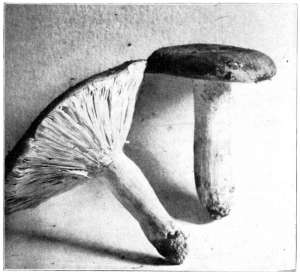
Figure 154.—Russula furcata. Two-thirds natural size. Caps greenish-umber to reddish.
Furca, a fork, so called from the forking of the gills. This is not peculiar, however, to this species. The pileus is two to three inches broad; greenish, usually greenish-umber, sometimes reddish; fleshy; compact; nearly round, then expanded, depressed in the center; even; smooth; often sprinkled with a silky luster, pellicle separable, margin at first inflexed, then expanded, always even, sometimes turned upward. The flesh is firm, white, dry, somewhat cheesy.
The gills are adnate or slightly decurrent, somewhat crowded, broad, narrowed at both ends, many forked, shining white. The spores, 7–8×9µ.
The stem is two to three inches long, solid, white, rather firm, even, equal or tapering downward. The spores are round and spiny.
I have found it frequently on the wooded hillsides of the state. The taste when raw is mild at first, but soon develops a slight bitterness which, however, is lost in cooking. Fried in butter they are excellent. July to October.
Russula rubra, Fr.
The Red Russula.
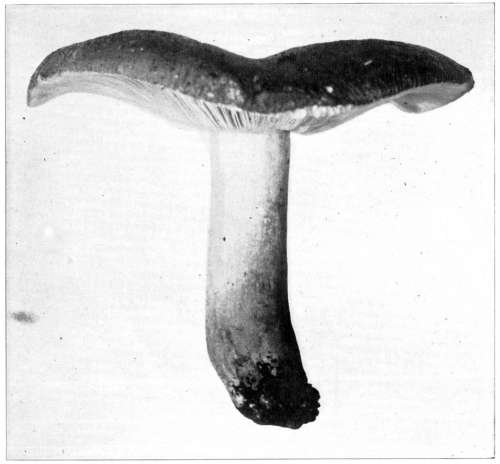
Figure 155.—Russula rubra. Two-thirds natural size. Caps bright-vermilion. Gills forked and tinged with red.
Rubra means red, so called from the cap being concolorous, bright vermillion; showy, becoming pale with age, center of the cap usually darker; compact, hard, fragile, convex, expanded, somewhat depressed, dry, no pellicle, often cracked when old. The flesh is white, often reddish under the cuticle.
The gills are adnate, rather crowded, white at first, then yellowish, many forked and with some short ones intermixed, frequently tinged with red at the edge. Spores 8–10µ, cystidia pointed.
The stem is two to three inches long, solid, even, white, often with a faint reddish hue. The spores are nearly round and white.
It is very acrid to the taste, and because of this acridity it is usually thought to be poisonous, but Captain McIlvaine says he does not hesitate to cook it either by itself or with other Russulæ. It is found very generally in the state and is quite plentiful in the woods about Chillicothe, from July to October.
Russula purpurina. Quel & Schulz.
The Purple Russula. Edible.
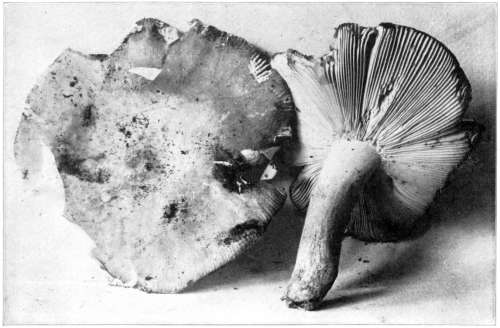
Figure 156.—Russula purpurina. Two-thirds natural size. Caps rosy-pink to light-yellow. Gills yellowish in age.
Purpurina means purple. The pileus is fleshy, margin acute, subglobose, then plane, at length depressed in the center, slightly viscid in wet weather, not striate, often split, pellicle separable, rosy-pink, paling to light-yellow.
Gills are crowded in youth, afterward subdistant, white, in age yellowish, reaching the stem, not greatly narrowed behind, almost equal, not forked.
The stem is stuffed, spongy, very variable, cylindrical, attenuated above, rosy-pink, becoming paler toward the base, color obscure in age. The flesh is fragile, white, reddish under the skin; odor slight and taste mild. The spores white, globose, sometimes subelliptical, 4–8µ long, minutely warted. Peck, 42 Rept., N. Y. State Bot.
This is not a large plant, but it can be readily determined by its red or reddish stem, mild taste and white spores. Found in open woods in July and August.
Russula densifolia. Gillet.
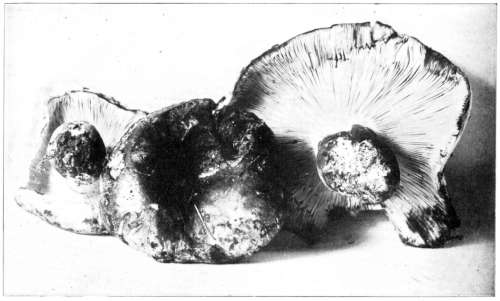
Figure 157.—Russula densifolia. Two-thirds natural size. Caps whitish, becoming fuliginous gray. Flesh turning red when exposed to the air.
Densifolia has reference to the crowded condition of the gills.
The pileus is from three to four inches broad, fleshy, quite compact, convex, expanded, then depressed, margin inflexed, smooth, not striate, white or whitish, becoming fuliginous, gray, or brownish, quite black in center, flesh red when broken.
The gills are attached to the stem, somewhat decurrent, unequal, thin, crowded, white or whitish, with a rosy tint. Spores, 7–8µ.
The stem is short, slightly mealy, white, then gray, at length blackish, smooth, round, turning red or brown on being handled.
It differs from R. nigricans in being much smaller, and in its crowded gills. It differs from R. adusta in flesh turning red when broken. The flesh or substance is white at first, turning red when exposed to the air, then blackish. This plant is not abundant in this state. I found a number of plants on Cemetery Hill, where some shale had been dumped under a large beech tree. Found in July and August.
Cantharellus. Adanson.
Cantharellus means a diminutive drinking-cup or vase. This genus can be distinguished from all other genera by the character of its gills which are quite blunt on the edge, like folds, polished, and are mostly forked or branched. In some species the gills vary in thickness and number. They are decurrent, folded, more or less thick and swollen. The spores are white. They grow on the ground, on rotten wood, and among moss. They seem to delight in damp shady places.
Cantharellus cibarius. Fr.
The Edible Cantharellus.
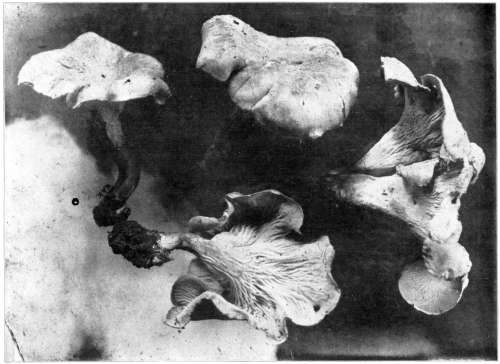
Plate XXII. Figure 158.—Cantharellus cibarius. Natural size. Entire plant egg-yellow.
Cibarius means pertaining to food. This plant is frequently spoken of as the Chanterelle. The entire plant is a rich egg-yellow. The pileus is fleshy, at first convex, later flat, three to five inches broad, depressed in the center, finally funnel-shaped; bright to deep yellow; firm, smooth, but often irregular, its margin often wavy; flesh white, the cap has the appearance of an inverted cone.
The gills are decurrent, shallow and fluted, resembling swollen veins, branched, more or less interconnected and tapering downward on the stem, color the same as the pileus.
The stem is solid, variable in length, often curved, tapering towards the base, paler than the pileus and gills.
It grows in woods and rather open places. I found it in great abundance in Stanley's woods, near Damascus, Ohio. I have found it very often about Chillicothe. The plant has a strong prune-like odor; when tasted raw they are peppery and pungent but sweet and quite delicious when cooked. My friends and myself have eaten it and pronounced very good. The plants in Figure 158 were gathered near Columbus, Ohio, and photographed by Dr. Kellerman.
The species is quite common in the state, and is found from June to September.
Cantharellus aurantiacus. Fr.
False Chantarelle.
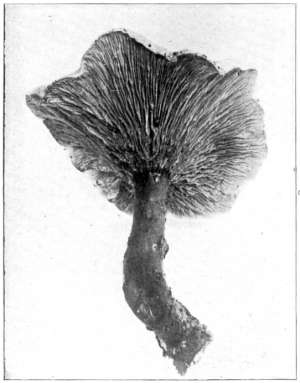
Photo by C. G. Lloyd.
Figure 159.—Cantharellus aurantiacus. One-third natural size. Caps orange-yellow. Gills yellow and forked.
Aurantiacus means orange-yellow. The pileus is fleshy, soft, depressed, downy, the margin strongly incurved when young, in mature plants it is wavy or lobed; color dull yellowish, usually brownish.
The gills are crowded, straight, dark-orange, branched, with a regular bifurcation.
The stem is lighter in color than the pileus, solid at first, spongy, stuffed, hollow, unequal, tapering upward, and somewhat curved.
It is generally labeled poisonous, but some good authorities say it is wholesome. I have never eaten it further than in its raw state. It is easily distinguished from the edible species by its dull orange cap and its orange gills, which are thinner and closer and more regularly forked than those of the Edible Chantarelle. It grows in woods and open places. Found from July to September.
Cantharellus floccosus. Schw.
The Woolly Cantharellus. Edible.
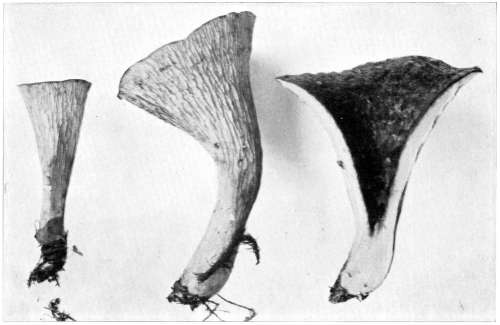
Photo by C. G. Lloyd.
Plate XXIII. Figure 160.—Cantharellus floccosus.
Floccosus means floccose or woolly.
The pileus at the top is from one to two inches broad, fleshy, elongated funnel-form or trumpet-shape, floccose-squamose, ochraceous-yellow.
The gills are vein-like, close, much anastomosing above, long decurrent and subparallel below, concolorous.
The stem is very short, thick, rather deeply rooted. The spores are elliptical, 12.5–15×7.6µ. Peck, 23 Rep., N. Y.
This plant is funnel-shaped nearly to the base of the stem. It is a small plant, never more than four inches high. I found it in Haynes's Hollow, in rather open woods, on mossy hillsides. July and August.
Cantharellus brevipes. Pk.
The Short-Stemmed Cantharellus. Edible.
Brevipes is from brevis, short; pes, foot; so called because of its short stem.
The pileus is fleshy, obconic, glabrous, alutaceous, or dingy cream-color, the thin margin erect, often irregular and lobed, tinged with lilac in the young plant; folds numerous, nearly straight in the margin, abundantly anastomosing below; pale umber, tinged with lilac.
The stem is short, tomentose-pubescent, ash-colored, solid, often tapering downward. Spores yellowish, oblong-elliptical, uninucleate, 10–12×5µ. Peck, 33d Rep., N. Y.
The plant is small; with us, not more than three inches high and the pileus not more than two inches broad at the top. It differs somewhat in color, in the character of the folds, and materially in the shape of the margin of the pileus. Found occasionally on the hillsides of Huntington Township, near Chillicothe, July to August.
Cantharellus cinnabarinus. Schw.
The Cinnabar Cantharellus. Edible.
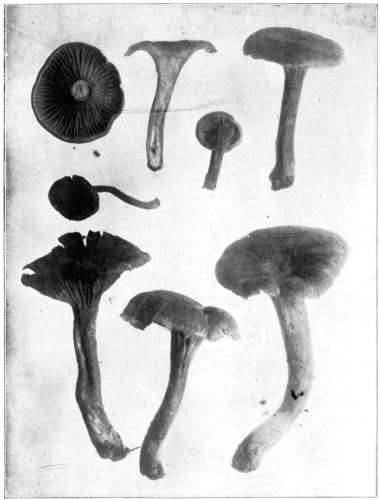
Figure 161.—Cantharellus cinnabarinus. Cap and stem cinnibar-red, flesh white. Natural size.
Cinnabarinus means cinnabar-red, from the color of the plant.
The pileus is firm, convex, or slightly depressed in the center, often irregular with wavy or lobed margin; glabrous, cinnabar-red, flesh white.
The gills are narrow, distant, branched, decurrent, of the same color as the cap, dull on the edge.
The stem is equal or tapering downward, glabrous, solid, sometimes stuffed, cinnabar-red.
The spores are elliptical, 8–10µ long, 4–5µ broad.
No one will have any difficulty in identifying this plant, since its color suggests the name at once. It is quite common about Chillicothe and throughout the state. It is found frequently with Craterellus cantharellus. It is a very pretty plant, growing in open woods or along the roadside in woods. It will keep for some time after it is gathered. It is found from July to October.
Cantharellus infundibuliformis. Fr.
Funnel-Shaped Cantharellus.
Infundibuliformis means shaped like a funnel.
The pileus is one to two and a half inches broad, somewhat membranaceous, umbilicate, then infundibuliform, usually perforated at the base, and opening into the cavity of the stem, floccosely rugose on the surface, yellowish-gray or smoky when moist, pale when dry, becoming wavy.
The gills are decurrent, thick, distant, regularly forked, straight, yellow or cenereous, at length pruinose.
The stem is two to three inches long, hollow, even, smooth, always yellow, slightly thickened at the base. The spores are elliptical, smooth, 9–10×6µ.
They grow on the ground, especially where wood has decayed and become a part of the ground. They also grow on decayed wood. They are found from July to October.
Nyctalis. Fr.
Nyctalis is from a Greek word meaning night.
Pileus symmetrical, in some species bearing large conidia upon its surface.
The gills are adnate or decurrent, thick, soft, margin obtuse.
The stem is central, its substance continuous with the flesh of the pileus. The spores are colorless, smooth, elliptical or globose. Fries.
Nyctalis asterophora. Fr.
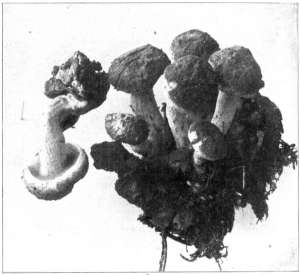
Photo by C. G. Lloyd.
Figure 162.—Nyctalis asterophora.
Asterophora means star-bearing.
The pileus is about one-half inch broad, fleshy; conical, then hemispherical; flocculose and rather mealy, owing to the large, stellate conidia; whitish, then tinged with fawn-color.
The gills are adnate, distant, narrow, somewhat forked, straight, dingy.
The stem is about one-half inch long, slender, twisted, stuffed, white then brownish, rather mealy. The spores are elliptical, smooth, 3×2µ. Fries, Hym.
I found, about the last of August, these plants growing on decaying specimens of Russula nigricans, along Ralston's Run, near Chillicothe.
Hygrophorus. Fr.
Hygrophorus is from two Greek words meaning bearing moisture. So called because the members of this genus may be known from their moist caps and the waxy nature of the gills, which distinguish them from all others. As in the Pleurotus, the gills of some of the species are rounded or notched at the end next to the stem, but of others they are decurrent on it; hence, in some species they are like the gills of Tricholoma in their attachment, in others they run down on the stem as in the Clitocybe. In many of them both cap and stem are very viscid, a characteristic not found in the Clitocybes; and the gills are generally thicker and much farther apart than in that genus. A number of the species are beautifully colored.
Hygrophorus pratensis. Fr.
The Pasture Hygrophorus. Edible.
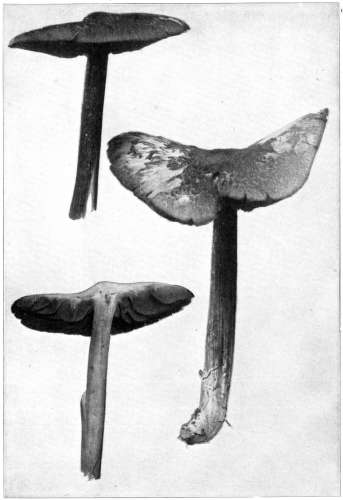
Plate XXIV. Figure 163.—Hygrophorus pratensis.
Pratensis, from pratum, a meadow. The pileus is one to two inches broad; when young almost hemispherical, then convex, turbinate or nearly flat, the center more or less convex, as if umbonate; margin often cracked, frequently contracted or lobed; white or various shades of yellow, buffish-reddish, or brownish. Flesh white, thick in the center, thin at the margin. The stem is stuffed, attenuated downwards. The gills are thick, distant, white or yellowish, bow-shaped, decurrent, and connected by vein-like folds. Spores are white, broadly elliptical, .00024 to .00028 inch long.
The pasture hygrophorus is a small but rather stout-appearing mushroom. It grows on the ground in pastures, waste places, clearings, and thin woods, from July to September. Sometimes all white or gray.
Var. cinereus, Fr. Pileus and gills gray. The stem whitish and slender.
Var. pallidus, B. & Br. Pileus depressed, edge wavy, entirely pale ochre.
This species differs mainly from H. leporinus in that the latter is quite floccose on the pileus.
Hygrophorus eburneus. Bull.
Shining White Hygrophorus. Edible.
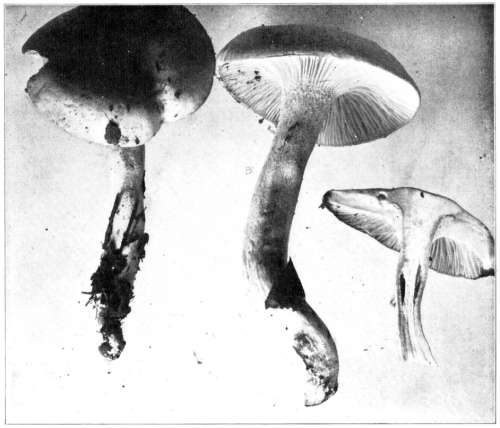
Photo by C. G. Lloyd.
Figure 164.—Hygrophorus eburneus.
Eburneus is from ebur, ivory. The pileus is two to four inches broad, sometimes thin, sometimes somewhat compact, white; very viscid or glutinous in wet weather, and slippery to the touch; margin uneven, sometimes wavy; smooth, and shining. When young, the margin is incurved.
The gills are firm, distant, straight, strongly decurrent, with vein-like elevations near the stem. The spores are white, rather long.
The stem is unequal, sometimes long and sometimes short; stuffed, then hollow, tapering downward, punctate above with granular scales. Odor and taste are rather pleasant. It is found in woods and pastures in all parts of Ohio, but it is not plentiful anywhere. I have found it only in damp woods about Chillicothe. August to October.
Hygrophorus cossus. Sow.
Cossus, because it smells like the caterpillar, Cossus ligniperda.
The pileus is small, quite viscid, shining when dry, white with a yellow tinge, edge naked, very strong-scented.
The gills are somewhat decurrent, thin, distant, straight, firm.
The stem is stuffed, nearly equal, scurvy-punctate upwards. Spores 8×4. Found in the woods. The strong smell will serve to identify the species.
Hygrophorus chlorophanus. Fr.
The Greenish-yellow Hygrophorus.
Chlorophanus is from two Greek words, meaning appearing greenish-yellow.
The pileus is one inch broad, commonly bright sulphur-yellow, sometimes scarlet-tinted, not changing color; slightly membranaceous, very fragile, often irregular, with the margin split or lobed, at first convex, then expanded; smooth, viscid, margin striate.
The gills are emarginate, adnexed, quite ventricose, with a thin decurrent tooth, thin, subdistant, distinct, pale-yellow.
The stem is two to three inches long, hollow, equal, round, viscid when moist, shining when dry, wholly unicolorous, rich light-yellow.
The spores are slightly elliptical, 8×5µ.
This species resembles in appearance H. ceraceus, but it can be identified by its emarginate gills and somewhat larger form. The plant has a wide distribution, having been found from the New England States through the Middle West. It is found in damp, mossy places from August to October. I have no doubt of its edibility. It has a mild and agreeable taste when eaten in the raw state.
Hygrophorus cantharellus. Schw.
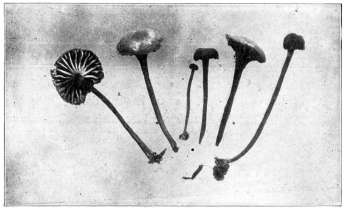
Figure 165.—Hygrophorus cantharellus. Natural size. Caps bright red.
Cantharellus means a small vase.
The pileus is thin, convex, at length umbilicate, or centrally depressed, minutely squamulose, moist, bright red, becoming orange or yellow.
The gills are distant, subarcuate, decurrent, yellow, sometimes tinged with vermilion.
The stem is one to three inches long, smooth, equal, sub-solid, sometimes becoming hollow, concolorous, whitish within. Peck.
I have found about Chillicothe a number of the varieties given by Dr. Peck.
Var. flava. Pileus and stem pale yellow. Gills arcuate, strongly decurrent.
Var. flavipes. Pileus red or reddish. Stem yellow.
Var. flaviceps. Pileus yellow. Stem reddish or red.
Var. rosea. Has the pileus expanded and margin wavy scalloped.
Found from July to September.
Hygrophorus coccineus. Fr.
The Scarlet Hygrophorus. Edible.
Coccineus, pertaining to scarlet. The pileus is thin, convex, obtuse, viscid, scarlet, growing pale, smooth, fragile.
The gills are attached to the stem, with a decurrent tooth, connected by veins, variously shaded.
The stem is hollow and compressed, rather even, not slippery, scarlet near the cap, yellow at the base.
This plant when young is of a bright scarlet, but it soon shades into a light-yellow with advancing age. It is quite fragile and varies very greatly in size in different localities. Found in woods and pastures from July to October.
Hygrophorus conicus. Fr.
The Conical Hygrophorus. Edible.
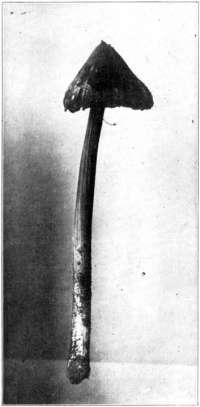
Figure 166.—Hygrophorus conicus.
The pileus is one to two inches broad, acutely conical, submembranaceous, smooth, somewhat lobed, at length expanded, and rimose; turning black, as does the whole plant when broken or bruised; orange, yellow, scarlet, brown, dusky.
The gills are free or adnexed, thick, attenuated, ventricose, yellowish with frequently a cinereous tinge, wavy, rather crowded.
The stem is three to four inches long, hollow, cylindrical, fibrillose, striated, colored like the pileus, turning black when handled.
This plant is quite fragile. It can be identified by its turning black when bruised. It sometimes appears early in the spring and continues till late in the fall. It is not abundant but is only occasionally found on the ground in woods and open places.
Hygrophorus flavodiscus. Frost.
Yellow-disked Hygrophorus. Edible.
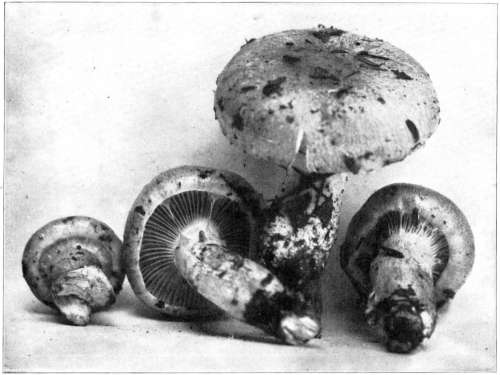
Figure 167.—Hygrophorus flavodiscus. Natural size. The gluten is shown connecting the margin of the cap to their stem.
Flavodiscus means yellow-disked.
The pileus is one-half to three inches broad, fleshy, convex or nearly plane, glabrous, very viscid or glutinous, white, pale-yellow or reddish-yellow in the center, flesh white.
The gills are adnate or decurrent, subdistant, white, sometimes with a slight flesh-colored tint, the interspaces sometimes venose.
The stem is one to three inches long, solid, subequal, very viscid, or glutinous, white at the top, white or yellowish elsewhere. The spores are elliptical, white, .00025 to .0003 of an inch long, .00016 to .0002 broad.
These mushrooms make a delicious dish. The specimens in the photograph were gathered at West Gloucester, Mass., by Mrs. E. B. Blackford, of Boston. I have found them about Chillicothe. They are very viscid, as the plants in Figure 167 will show. The caps are thick and the margin inrolled. They are found in October and November.
Hygrophorus speciosus. Pk.
Showy Hygrophorus. Edible.
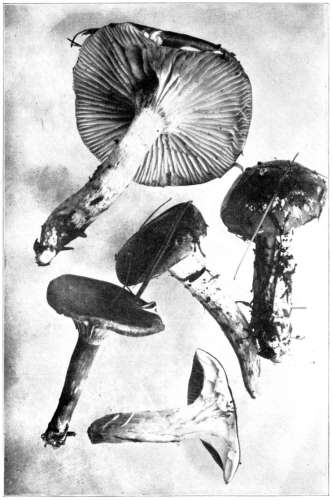
Figure 168.—Hygrophorus speciosus.
Speciosus means beautiful, showy; so called from the scarlet color of the umbo. The pileus is one to two inches in diameter, broadly convex, often with small central umbo; glabrous, very viscid or glutinous when moist; yellow, usually bright red or scarlet in the center; flesh white, yellow under the thin, separable pellicle.
The gills are distant, decurrent, white, or slightly tinged with yellow.
The stem is two to four inches long, nearly equal, solid, viscid, slightly fibrillose, whitish or yellowish. The spores are elliptic, .0003 of an inch long, .0002 broad. Peck.
This is a very beautiful and showy plant. It grows in swampy places and under tamarack trees. The specimens in Figure 168 were found in Massachusetts by Mrs. Blackford, and were photographed by Dr. Kellerman. It is found in September and August.
Hygrophorus fuligineus. Frost.
Sooty Hygrophorus. Edible.
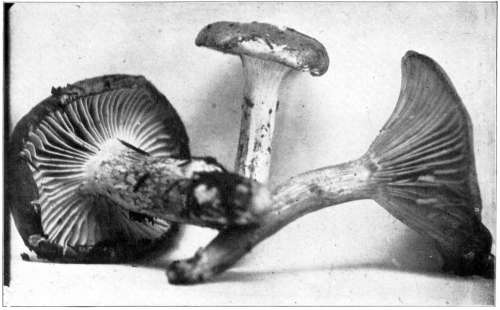
Figure 169.—Hygrophorus fuligineus. Natural size. Specimen on the right is H. caprinus.
Fuligineus means sooty or smoky.
The pileus is one to four inches broad, convex or nearly plane, glabrous, very viscid or glutinous, grayish-brown or fuliginous, the disk often darker or almost black.
The gills are subdistant, adnate or decurrent, white.
The stem is two to four inches long, solid, viscid or glutinous, white or whitish. The spores are elliptic, .0003 to .00035 of an inch long, .0002 broad. Peck, No. 4, Vol. 3.
This species is found frequently associated with H. flavodiscus, which it resembles very closely, save in color. When moist, the cap and stems are covered with a thick coating of gluten, and when the caps are dry this gives them a varnished appearance. I do not find them abundant here. The plants in Figure 169 were found by Mrs. Blackford near West Gloucester, Mass. They are found October and November.
Hygrophorus caprinus. Scop.
The Goat Hygrophorus. Edible.
Caprinus means belonging to a goat; it is so called from the fibrils resembling goat's hair.
The pileus is two to three inches broad, fleshy, fragile, conical, then flattened and umbonate, rather wavy, sooty, fibrillose.
The gills are very broad, quite distant, deeply decurrent, white, then glaucous.
The stem is two to four inches long, solid, fibrillose, sooty, often streaked or striate, as will be seen in Figure 169, page 212.
The spores are 10×7–8µ.
These plants grow in pine woods in company with H. fuligineus and H. flavodiscus. The specimen on the right in Figure 169 was found near West Gloucester, Mass., by Mrs. Blackford. It is found from September till hard frost.
Hygrophorus Lauræ. Morg.
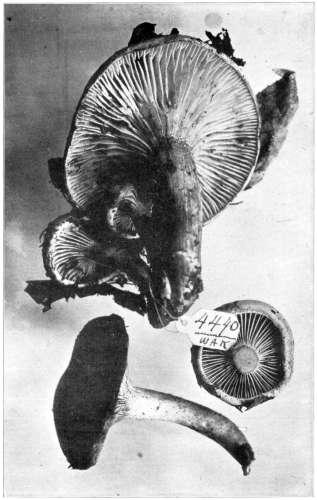
Figure 170.—Hygrophorus Lauræ.
This is a beautiful plant, found among leaves, and so completely covered with particles of leaves and soil that it is hard to clean them off. They are very viscid, both stem and cap. They are only occasionally found in our state.
The pileus is two to three inches broad; reddish-brown in the center, shading to a very light tan on the edges; very viscid; convex; margin at first slightly incurved, then expanded.
The gills are adnate, slightly decurrent, not crowded, unequal, yellowish.
The stem is stuffed, tapering downward, whitish, furfuraceous near the cap.
I have found this plant in Poke Hollow, near Chillicothe, on several occasions, also in Gallia county, Ohio. I have not found it elsewhere in this vicinity. While I have not found it in sufficient quantity to try it I have no doubt of its edible qualities. I have found it only about the last of September and the first of October. It grows in rather dense woods on the north sides of the hills, where it is constantly shaded and damp. Named in honor of Prof. Morgan's wife.
Hygrophorus micropus. Pk.
Short-stemmed Hygrophorus. Edible.
Micropus means short-stemmed. The pileus is thin, fragile, convex or centrally depressed, umbilicate; silky, gray, often with one or two narrow zones on the margin; taste and odor farinaceous.
The gills are narrow, close, adnate or slightly decurrent, gray, becoming salmon color with age.
The stem is short, solid or with a slight cavity, often slightly thickened at the top, pruinose, gray, with a white, mycelioid tomentum at the base. The spores are angular, uninucleate, salmon color, .0003–.0004 of an inch long, .00025–.0003 broad. Peck.
This is a very small plant and not frequently found, but widely distributed. I have always found it in open grassy places during damp weather. The caps are thin, often markedly depressed. Its silky appearance and narrow zones on the margin of the cap, together with its rather close gills, broadly attached to the stem, gray at first, then salmon color, will identify the species. July to September.
Hygrophorus miniatus. Fr.
The Vermilion Hygrophorus. Edible.
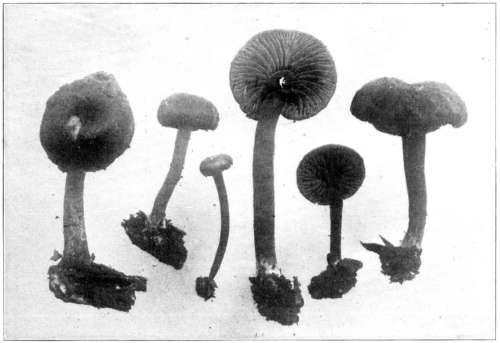
Figure 171.—Hygrophorus miniatus. Cap and stems vermilion-red. Gills yellowish and tinged with bright-red.
Miniatus is from minium, red lead.
This is a small but a very common species, highly colored and very attractive. The pileus and the stem are bright red and often vermilion. The pileus is at first convex, but, when fully expanded, it is nearly or quite flat, and in wet weather it is even concave by the elevation of the margin, smooth or minutely scaly, often umbilicate. Its color varies from a bright red or vermilion or blood-red to pale orange hues.
The gills are yellow and frequently strongly tinged with red, distant, attached to the stem, and sometimes notched.
The stem is usually short and slender, colored like, or a little paler, than the cap; solid, when young, but becoming stuffed or hollow with age. The spores are elliptical, white, 8µ long.
The Vermilion mushroom grows in woods and in open fields. It is more plentiful in wet weather. It seems to grow best where chestnut logs have decayed. It can be found in such places in sufficient quantities to eat. Few mushrooms are more tender or have a more delicate flavor. There are two other species having red caps, Hygrophorus coccineus and H. puniceus, but both are edible and no harm could come from any mistake. They are found from June to October. Those in Figure 171 were found in Poke Hollow September 29.
Hygrophorus miniatus sphagnophilus. Pk.
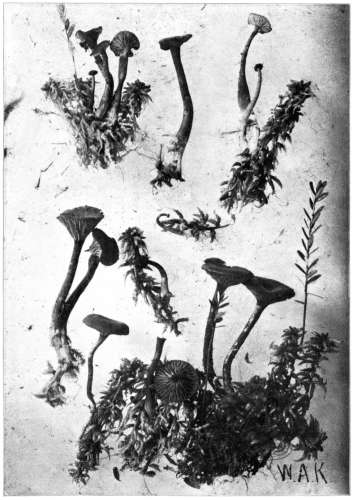
Plate XXV. Figure 172.—Hygrophorus miniatus sphagnophilus. Natural size.
Sphagnophilus means sphagnum-loving, so called because it is found growing on sphagnum.
The pileus is broadly convex, subumbilicate, red.
The gills are adnate, whitish, becoming yellowish or sometimes tinged with red, occasionally red on the edge.
The stem is colored like the pileus, whitish at the base, both it and the pileus are very fragile.
This is more fragile than the typical form and retains its color better in drying. Peck, 43d Rep.
This is a beautiful plant growing, as Figure 172 shows, on the lower dead portion of the stems of bog moss or sphagnum. It grows very abundantly in Buckeye Lake. The photograph was made by Dr. Kellerman. It is found from July to October. These plants cook readily, have an excellent flavor and because of their color make an inviting dish. I have eaten heartily of them several times.
Hygrophorus marginatus. Pk.
Margined Hygrophorus. Edible.
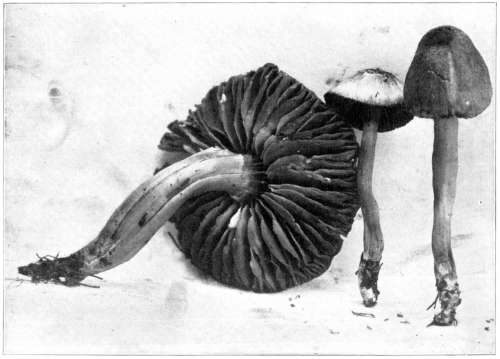
Figure 173.—Hygrophorus marginatus.
Marginatus, so called from the frequent vermilion edged gills.
The pileus is thin, fragile, convex, subcampanulate or nearly plane, often irregular, sometimes broadly umbonate, glabrous, shining, striatulate on the margin, bright golden-yellow.
The gills are rather broad, subdistant, ventricose, emarginate, adnexed, yellow, sometimes becoming orange or vermilion on the edge, interspaces venose.
The stem is fragile, glabrous, often flexous, compressed or irregular, hollow, pale-yellow; spores broadly elliptic, .00024–.0003 of an inch long, .00024–.0002 broad. Peck, N. Y., 1906.
This plant has the most beautiful yellow I have ever seen in a mushroom. This bright golden yellow and the orange or vermilion color on the margin or edge of the gills will always characterize the plant.
The specimen in Figure 173 were sent to me by Mrs. Blackford, of Boston, Mass., the last of August. They were not in the best condition when photographed.
Hygrophorus ceraceus. Fr.
The Wax-like Hygrophorus. Edible.
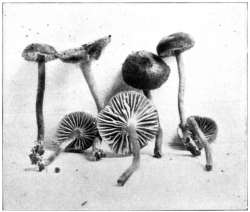
Figure 174.—Hygrophorus ceraceus. Caps waxy yellow.
Ceraceus is from cera, wax. The pileus is one inch and less broad, waxy-yellow, shining, fragile, thin, occasionally subumbonate, slightly fleshy, slightly striate.
The gills are firmly attached to the stem, subdecurrent, distant, broad, ventricose often connected with veins, almost triangular, yellow.
The stem is one to two inches long, hollow, often unequal, flexuous, sometimes compressed, yellow, occasionally orange at the base, waxy. The spores 8×6µ.
This is a very beautiful, fragile plant, usually found growing in the grass. It is easily distinguished by its waxy yellow color. The plants photographed were found on the Cemetery Hill. They are found from August to October.
Hygrophorus virgineus. Wulf.
The Ivory-Capped Hygrophorus. Edible.
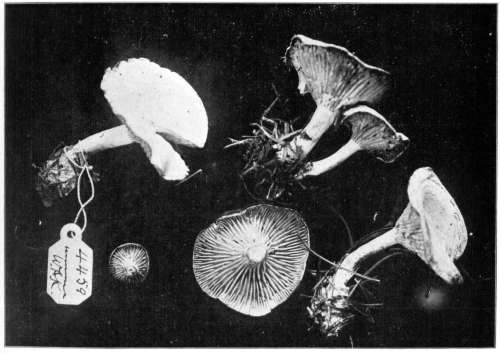
Figure 175.—Hygrophorus virgineus. Two-thirds natural size. Entire plant white.
Virgineus, virgin; so called from its whiteness. The pileus is fleshy, convex, then plane, obtuse, at length depressed; moist, sometimes cracked into patches, floccose when dry.
The gills are decurrent, distant, rather thick, often forked.
The stem is curt, stuffed, firm, attenuated at the base, externally becoming even and naked. Spores 12×5–6µ. Fries.
The plant is wholly white and never large. It is easily confounded with H. niveus and sometimes difficult to distinguish from the white forms of H. pratensis. This plant is quite common in pastures, both in the spring and in the fall. I found the specimens in Figure 175 on Cemetery Hill under the pine trees on November 11. They were photographed by Dr. Kellerman.
Hygrophorus niveus.
The Snow-White Hygrophorus. Edible.
Niveus, snow-white. The plant is wholly white. The pileus is scarcely one inch broad, somewhat membranaceous, bell-shaped, convex, then umbilicate, smooth, striate, viscid when moist, not cracked when dry, flesh thin, everywhere equal.
The gills are decurrent, thin, distant, acute, quite entire.
The stem is hollow, thin, equal, smooth. Spores 7×4µ. Found in pastures.
Hygrophorus sordidus. Pk.
The Dingy Hygrophorus. Edible.
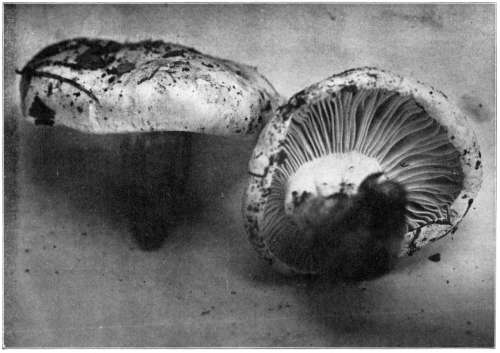
Figure 176.—Hygrophorus sordidus.
Sordidus means a dirty white, or dingy, referring to the color of the caps, so made by adhering earth.
The pileus is broadly convex or nearly plane, glabrous, slightly viscid, white, but usually defiled by adhering dirt; the margin at first strongly involute, then spreading or reflexed; flesh firm when young, tough when old.
The gills are subdistant, adnate, or decurrent, white or creamy-white.
The stem is five to ten Cm. long, firm, solid, white.
The spores are elliptical, 6.5–7.5×4–5µ. Peck.
The specimens I found were clear white, growing among leaves and were especially free from soil. The stems were short and were inclined to be slightly ventricose. Dr. Peck says that this "species is distinguished from H. penarius by its clear white color, though this is commonly obscured by the adhering dirt that is carried up in the growth of the fungus." The young, growing plants were strongly involute but the older plants were reflexed, giving the plants a funnel-shaped appearance and giving the gills a much stronger decurrent appearance. Found October 26th.
Hygrophorus serotinus. Pk.
Late Hygrophorus.
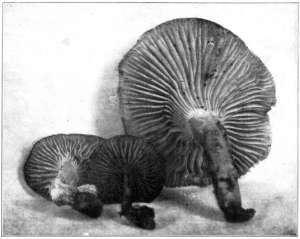
Figure 177.—Hygrophorus serotinus.
Serotinus means late. So called because it is late in the season.
Pileus is fleshy but thin, convex or nearly plane, often with the thin margin curved upward, glabrous or with a few obscure innate fibrils, reddish in the center, whitish on the margin, flesh white, taste mild.
The gills are thin, subdistant, adnate or decurrent, white, the interspaces slightly venose.
The stem is equal, stuffed or hollow, glabrous, whitish. The spores are white, elliptic, .0003 of an inch long, .0002 broad.
Pileus is 8–15 lines broad; stem about 1 inch long, 1.5–2.5 lines thick. Peck.
Some specimens of this species were sent to me from Boston by Mrs. Blackford, but after a careful study of them I was unable to place them. She then sent them to Dr. Peck, who gave them their very appropriate name. Those in Figure 177 were sent me in December, 1907.
They grow a number in the same locality and frequently in close groups or tufts. They seem to delight in oak and pine woods. Dr. Peck observes that this species is similar to Hygrophorus queletii, Bres., both in size and color, but the general characteristics of the plants do not agree. He also says it is similar in size and color to H. subrufescens, Pk., but differs materially in the specific description.
Panus. Fr.
Panus means swelling. The species under this genus are leathery plants, having the stems lateral and sometimes wanting. They dry up but revive with moisture. The gills are simple and thinner than the Lentinus, but with an entire, acute edge. There are a few species which give a phosphorescent light when growing on decayed logs. The genus closely resembles Lentinus but can be readily recognized on account of the smooth edged gills. A number of good authorities do not separate them but give both under the name Lentinus. This genus abounds wherever there are stumps and fallen timber.
Panus stypticus. Fr.
The Styptic Panus. Poisonous.
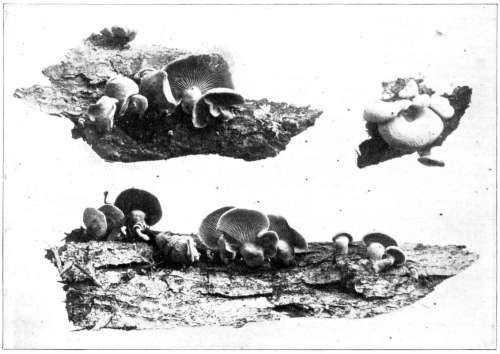
Photo by C. G. Lloyd.
Figure 178.—Panus stypticus. Two-thirds natural size. Cinnamon color.
Stypticus means astringent, styptic. The pileus is coriaceous, kidney-shaped, cinnamon-color, growing pale, cuticle breaking up into scales, margin entire or lobed, surface nearly even, sometimes zoned.
The gills are thin, crowded, connected by veins, of same color as cap, determinate, quite narrow.
The stem is lateral, quite short, swollen above, solid, compressed, pruinose, paler than the gills.
It is found very plentifully on decayed logs and stumps, and at times it is quite phosphorescent in its manifestations. It has an extremely unpleasant astringent taste. One might as well eat an Indian turnip as this species. Just a taste will betray it. Found from fall to winter.
Panus strigosus. B. & C.
The Hairy Panus. Edible.
Strigosus, covered with stiff hairs. The pileus is sometimes quite large, eccentric, covered with stiff hairs, margin thin, white.
The gills are broad, distant, decurrent, straw-color.
The stem is stout, two to four inches long, hairy like the pileus.
The favorite host of this species is an apple tree. I found a beautiful cluster on an apple tree in Chillicothe. Its creamy whiteness and hairy cap and short hairy stem will distinguish it from all other tree fungi. It is edible when young, but soon becomes woody.
Panus conchatus. Fr.
The Shell Panus.
Conchatus means shell-shaped. The pileus is thin, unequal, tough, fleshy, eccentric, dimidiate; cinnamon, then pale; becoming scaly; flaccid; margin often lobed.
The gills are narrow, forming decurrent lines on the stem, often branched, pinkish, then ochre.
The stem is short, unequal, solid, rather pale, base downy.
This species will frequently be found imbricated and very generally confluent. Its shell-like form, its tough substance, and its thin pileus are its distinguishing marks. The taste is pleasant but its substance very tough. Found from September to frost.
Panus rudis. Fr.
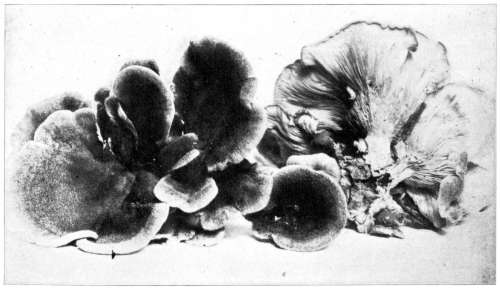
Figure 179.—Panus rudis.
This is a very plentiful plant about Chillicothe and is found throughout the United States, although it is a rare plant in Europe. It is generally given in American Mycology under the name Lentinus Lecomtei. It grows on logs and stumps. The form of the plant is quite different when growing on the top of a log or a stump, from those springing from the side. Those in the extreme left of Figure 179 grew on the side of the log, while those in the center grew on the top, in which case the plant has usually a funnel-shaped appearance.
The pileus is tough, reddish or reddish-brown, depressed, sinuate, bristling with tufts of hair, the margin quite strongly incurved, cæspitose.
The gills are narrow and crowded, decurrent, considerably paler than the cap.
The stem is short, hairy, tawny; sometimes the stem is almost obsolete.
There is a slight tinge of bitterness in the plant when raw, but in cooking this disappears. When prepared for food it should be chopped fine and well cooked. It can be dried for winter use. It is found from spring to late fall.
Panus torulosus. Fr.
The Twisted Panus. Edible.
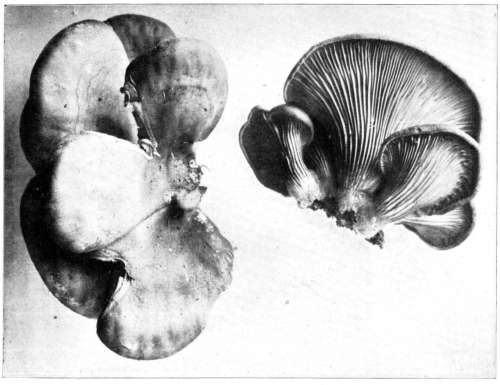
Photo by C. G. Lloyd.
Figure 180.—Panus torulosus.
Torulosus means a tuft of hair. The pileus is two to three inches broad, fleshy, then tough, coriaceous; plane, then funnel-shaped, or dimidiate; even; smooth; almost flesh color, varying to reddish-livid, sometimes violet tinted.
The gills are decurrent, rather distant, distinct behind, separate, simple, ruddy, then tan-colored.
The stem is short, stout, oblique, gray, covered with a violaceous down. The spores are 6×3µ.
The plant is variable both in form and color. Sometimes shaded very slightly with pink. It is not very common here. I found some very fine specimens growing on a log near Spider Bridge, Chillicothe.
It is edible but quite tough.
Panus levis. B. & C.
The Light Panus. Edible.
Levis, light. Pileus two to three inches broad, orbicular, somewhat depressed, white, covered with a dense mat of hair; margin inflexed and marked by triangular ridges.
The gills are broad, entire, decurrent.
The stem is two to three inches long, attenuated upward, eccentric, lateral, solid, hairy below like the pileus. The spores are white.
This certainly is a very beautiful plant and will hold the attention of the collector. It is not common with us. I have found it only on hickory logs. It is said to be of good flavor and to cook readily.
Lentinus. Fr.
Lentinus means tough. The pileus is fleshy, corky, tough, hard and dry, reviving when moist.
The stem is central or lateral and often wanting, but when present is continuous with the cap.
The gills are tough, unequal, thin, normally toothed, decurrent more or less, margin acute. The spores are smooth, white, orbicular.
All the species, so far as I know, grow on wood. They assume a great variety of forms. This genus is very closely related to Panus in the dry, coriaceous nature of the pileus and the gills, but it can be readily recognized by the toothed margin of the gills.
Lentinus vulpinus. Fr.
Strong-Scented Vulpinus.
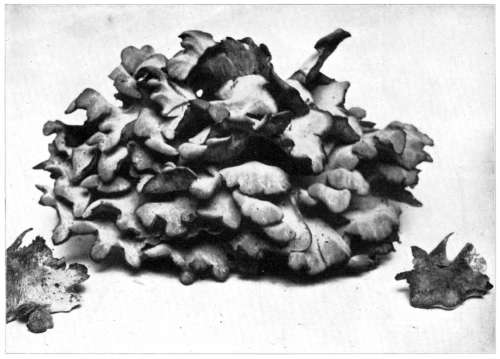
Plate XXVI. Figure 181.—Lentinus vulpinus. One-third natural size.
Vulpinus is from vulpes, a fox.
This is quite a large, massive plant, growing in a sessile and imbricated manner. It has appeared in large quantities for the past four years on an elm, very slightly decayed, but in quite a damp and dark place. The reader will get some idea of the size of the whole plant in Figure 181 if he will consider each pileus to be five to six inches broad. They are built up one on top of another, overlapping each other like shingles on a roof.
The pileus is fleshy but tough, shell-shaped, connate behind, longitudinally rough, costate, corrugate, tan-colored, and the margin is strongly incurved.
The gills are broad, nearly white, flesh-colored near the base, coarsely toothed.
The stem is usually obsolete, yet in some cases it is apparent.
The spores are almost round and very small, .00006 inch in diameter. In all plants which I have found the odor is somewhat strong and the taste is pungent. It grows in the woods in September and October.
Lentinus lepideus. Fr.
The Scaly Lentinus. Edible.
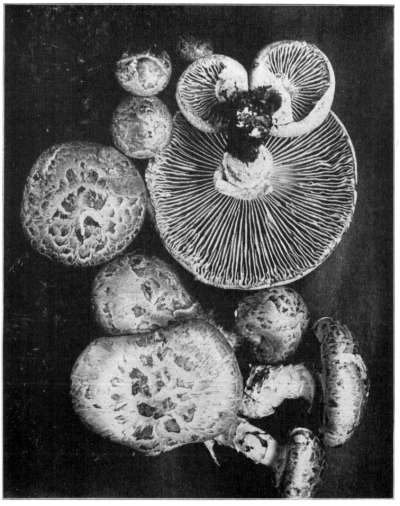
Figure 182.—Lentinus lepideus.
Lepideus is from lepis, a scale.
The pileus is fleshy, compact, convex, then depressed, unequal, broken up in dark scales, flesh white, tough.
The gills are sinuate, decurrent, broad, torn, transversely striate, whitish, or with white edges, irregularly toothed.
The stem is stout, central or lateral, tomentose or scaly, often crooked, rooting, whitish, solid, equal or tapering at the base.
This is a peculiar plant, growing sometimes to immense forms. It grows on wood, seemingly to be partial to railroad ties to which its mycelium is very injurious. I found the plant frequently about Salem, Ohio. The specimens in the halftone were found near Akron, Ohio, and photographed by Prof. Smith. As an esculent it almost rivals the Pleuroti. It is found from spring to autumn. I found a beautiful cluster on an oak stump near Chillicothe, while looking for Morels, about the last of April.
Lentinus cochleatus. Fr.
The Spiral-Formed Lentinus. Edible.
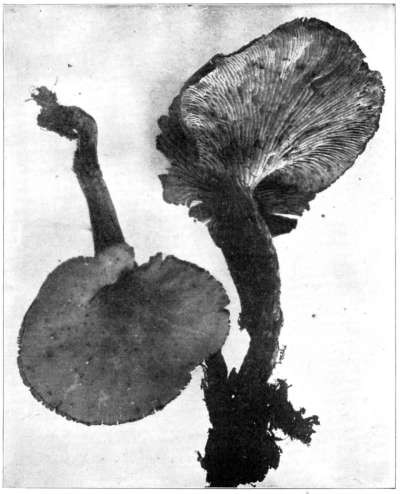
Photo by C. G. Lloyd.
Figure 183.—Lentinus cochleatus.
Cochleatus is from cochlea, a snail, from resembling its shell.
The pileus is two to three inches broad, tough, flaccid, irregular, depressed, sometimes funnel-shaped, sometimes lobed or contorted, flesh-color, becoming pale.
The gills are crowded, beautifully serrated, pinkish-white.
The stem is solid, length variable, sometimes central, frequently eccentric, often lateral, smooth. The spores are nearly round, 4µ.
This is a beautiful plant but sparingly found with us. I found a pretty cluster at the foot of a maple stump in Poke Hollow. The serrated form of the gills will attract attention at once. It is found in August and September.
Lenzites. Fr.
Lenzites, named after Lenz, a German botanist. The pileus is corky, dimidiate, sessile. The gills are corky, firm, unequal, branched, edge obtuse. It is very common in the woods, sometimes almost covering stumps and logs.
Lenzites betulina. Fr.
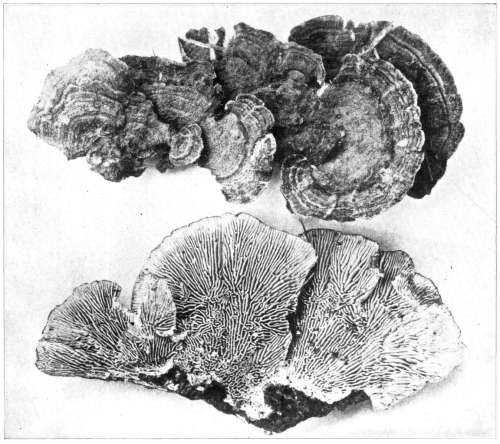
Photo by C. G. Lloyd.
Plate XXVII. Figure 184.—Lenzites betulina.
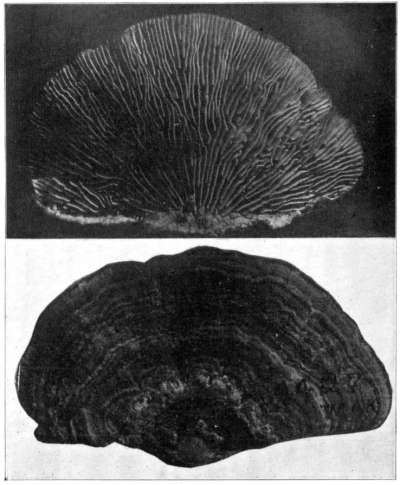
Figure 185.—Lenzites betulina.
Betulina, from betula, a birch. This has a somewhat corky, leathery cap, firm and without zones, woolly, sessile, deeply grooved concentrically, margin of the same color.
The gills are radial, somewhat branching, and coming together again, sordid white or tan-color.
This species is wide-spread and is quite variable. It grows in the form of brackets. Figure 185 was photographed by Dr. Kellerman.
Lenzites separia. Fr.
The Chocolate Lenzites.
The pileus is corky, leathery shells, with the upper surface marked with rough zones of various shades of brown; margin yellowish.
The gills are rather thick, branched, one running into another; yellowish. Stem obsolete. Growing on limbs and branches, especially of the fir tree.
Lenzites flaccida. Fr.
Flaccid Lenzites.
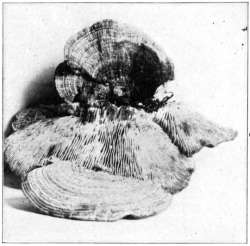
Figure 186.—Lenzites flaccida. Two-thirds natural size.
Flaccida means limp, flaccid. Pileus is coriaceous, thin, flaccid, unequal, hairy, zoned, pallid, more or less flabelliform, imbricated.
The gills are broad, crowded, straight, unequal, branched, white, becoming pallid. Spores are 5×7.
This is a very attractive plant and quite common. It runs almost imperceptibly into Lenzites betulina. It is found on stumps and trunks.
Lenzites vialis. Pk.
Pileus is corky, almost woody, firm, zoned.
Gills are thick, firm, serpentine.
Stem, none.
Schizophyllum. Fr.
Schizophyllum is from two Greek words, meaning to split, and a leaf.
The pileus is fleshy and arid. The gills are corky, fan-like, branched, united above by the tomentose pellicle, bifid, split longitudinally at the edge. The spores somewhat round and white.
The two lips of the split edge of the gills are commonly revolute. This genus is far removed from the type of Agaricini. It grows on wood and is very common. Stevenson.
Schizophyllum commune. Fr.
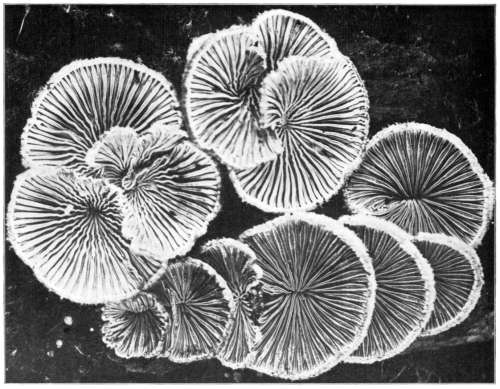
Figure 187.—Schizophyllum commune.
This is a very common plant, growing in the woods on branches and decayed wood, where it can be found in both winter and summer.
The pileus is thin, adnate behind, somewhat extended, more or less fan-shaped or kidney-shaped, simple, often much lobed, narrowed behind to the point of attachment; whitish, downy, then strigose.
The gills are radiating, gray, then brownish-purple, and sometimes white, branched, split along the edges and rather deeply rolled backwards. The spores are nearly round, 5–6µ.
This is a very common species all over the world. I found it in the winter of 1907 on decayed shade-trees along the streets of Chillicothe. It seems to be partial to maple timber. Some call this S. alneum. It is very easily identified from its purple gills being split.
Trogia. Fr.
Trogia is so called in honor of the Swiss botanist, Trog.
The pileus is nearly membranaceous, soft, quite tough, flaccid, dry, flexible, fibrillose, reviving when moist.
The gills are fold-like, venose, narrow, irregular, crisped.
Trogia crispa. Fr.
Crispa means crisp or curled. The pileus tough, cup-shaped, reflexed, lobed, villous, whitish or reddish toward the attachment, often tan-colored.
The gills are quite narrow, vein-like, irregular, more or less branched, blunt on the edge, white or bluish-gray, quite crisped, edge not channeled.
The caps are usually very much crowded and imbricated. It revives during wet weather and is found throughout the year, generally on beech limbs in our woods.