Chapter II · THE WHITE-SPORED AGARICS. (continued 2)
Reading edition
Clitocybe ochropurpurea. Berk.
The Clay-Purple Clitocybe. Edible.
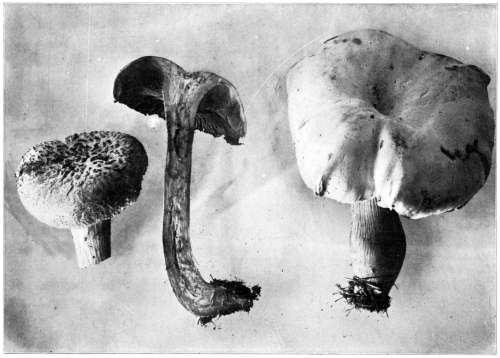
Photo by C. G. Lloyd.
Plate XI. Figure 72.—Clitocybe ochropurpurea.
Ochropurpurea is from ochra, ocher or clay color; purpureus, purple; it is so called because the caps are clay-color and the gills are purple. The caps are convex, fleshy, quite compact, clay-colored, sometimes tinged with purple around the margin, cuticle easily separating, margin involute, often at first tomentose, old forms often repand or wavy.
The gills are purple, sometimes whitish in old specimens from the white spores, broad behind, decurrent, distant.
The stem is paler than the cap, often tinted with purple, solid, frequently long and swollen in the middle, fibrous. The spores white or pale yellow.
The first time I found this species I never dreamed that it was a Clitocybe. It was especially abundant on our wooded clay banks or hillsides, near Chillicothe, during the wet weather in July and August of 1905. It is a hardy plant and will keep for days. Insects do not seem to work in it readily. When cooked carefully it is rather tender and fairly good.
Clitocybe subditopoda. Pk.
Subditopoda is so called because it is nearly (sub) like Fries' C. ditopus, which means living in two places, perhaps referring to the stem being sometimes central and sometimes eccentric.
The pileus is thin, convex or nearly plane, umbilicate, hygrophanous, grayish-brown, striate on the margin when moist, paler when dry, flesh concolorous, odor and taste farinaceous.
The gills are broad, close, adnate, whitish or pale cinereous.
The stem is equal, smooth, hollow, colored like the pileus. The spores are elliptical, .0002 to .00025 inch long, .00012 to .00016 broad. Peck.
It is found on mossy ground in woods. I have found them under pine trees on Cemetery Hill. Dr. Peck says he separated this species from C. ditopoda because of the "striate margin of the pileus, paler gills, longer stem, and elliptical spores." The plant is edible. September and October.
Clitocybe ditopoda. Fr.
Ditopoda is from two Greek words, di-totos, living in two places, and pus or poda, foot, having reference to the stem being central at times and again eccentric.
The pileus is rather fleshy, convex, then plane, depressed, even, smooth, hygrophanous.
The gills are adnate, crowded, thin, dark, cinereous.
The stem is hollow, equal, almost naked.
This species resembles in appearance C. metachroa but can be separated by the mild taste and farinaceous odor. Its favorite habit is on pine needles. August and September. I found this species in various places about Chillicothe and on Thanksgiving day I found it in a mixed wood in Gallia County, Ohio, along with Hygrophorus lauræ and Tricholoma maculatescens. I sent some specimens to Dr. Herbst, who pronounced it C. ditopoda.
Clitocybe pithyophila. Fr.
The Pine-Loving Clitocybe.
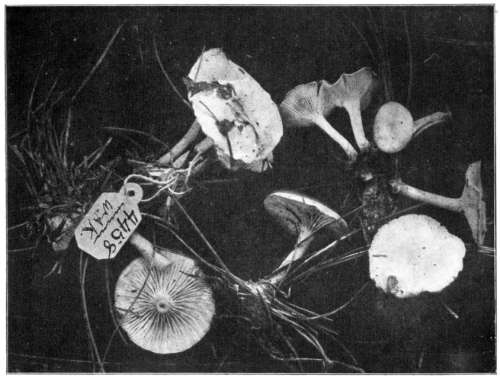
Figure 73.—Clitocybe pithyophila. Two-thirds natural size. Cap white and showing the pine needles upon which they grow.
Pithyophila means pine-loving. This plant is very abundant under pine trees on Cemetery Hill. They grow on the bed of pine needles. The pileus is very variable in size, white, one to two inches broad; fleshy, thin, becoming plane, umbonate, smooth, growing pale, at length irregularly shaped, repand, wavy, sometimes slightly striate.
The stem is hollow, terete, then compressed, smooth, equal, even, downy at the base.
The gills are adnate, somewhat decurrent, crowded, plane, always white. The spores are 6–7×4µ. The plants in Figure 73 are small, having been found during the cold weather in November. They are said to be good, but I have not eaten them.
Clitocybe candicans. Fr.
Candicans, whitish or shining white. Pileus is one inch broad, entirely white, somewhat fleshy, convex, then plane, or depressed, even, shining, with regularly deflexed margin.
The gills are adnate, crowded, thin, at length decurrent, narrow.
The stem is nearly hollow, even, waxy, shining, nearly equal, cartilaginous, smooth, incurved at the base. The spores are broadly elliptical, or subglobose, 5–6×4µ. Found in damp woods on leaves.
Clitocybe obbata. Fr.
The Beaker-Shaped Clitocybe. Edible.
Obbata means shaped like an obba or beaker.
The pileus is somewhat membranaceous, umbilicate, then rather deeply depressed, smooth, inclined to be hygrophanous, sooty-brown, margin at length striate.
The gills are decurrent, distant, grayish-white, pruinose.
The stem is hollow, grayish-brown, smooth, equal, rather tough.
I found plants growing on Cemetery Hill under pine trees. I had some trouble to identify the species until Prof. Atkinson helped me out. August to September.
Clitocybe gilva. Pers.
The Yellow Clitocybe. Edible.
Gilva means pale yellow or reddish yellow.
The pileus is two to four inches broad, fleshy, compact, soon depressed and wavy, smooth, moist, dingy ocher, flesh same color, sometimes spotted, margin involute.
The gills are decurrent, closely crowded, thin, sometimes branched, narrow but broader in the middle, ochraceous yellow.
The stem is two to three inches long, solid, smooth, nearly equal, somewhat paler than the cap, and inclined to be villous at the base.
The spores are nearly globose, 4–5µ.
This plant is sometimes found in mixed woods, but it seems to prefer pine trees. It has a wide distribution, found in the east and south as well as the west. I have found it in several localities in Ohio. Found from July to September.
Clitocybe flaccida. Sow.
The Limp Clitocybe. Edible.
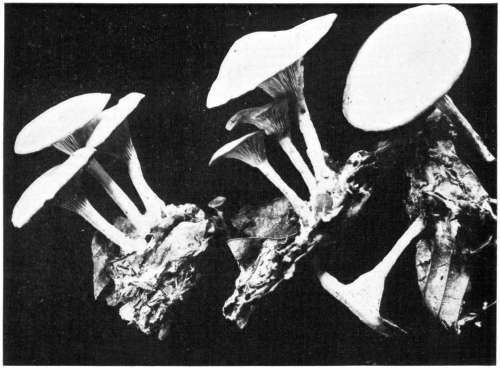
Figure 74.—Clitocybe flaccida. One-half natural size.
Flaccida means flabby, limp.
The pileus is two to three inches broad, rather fleshy, thin, limp, umbilicate, then funnel-shaped, even, smooth, sometimes cracking into minute scales, tawny or rust-colored, margin broadly reflexed.
The gills are strongly decurrent, yellowish, to whitish, close, arcuate.
The stem is tufted, unequal, rusty, somewhat wavy, tough, naked, villous at the base. The spores are globose or nearly so, 4–5×3–4µ.
This resembles the C. infundibuliformis very closely, both in its appearance and its habit. It grows among leaves in mixed woods during wet weather. It is gregarious, often many stems growing from one mass of mycelium. The plants in Figure 74 were collected in Ackerman's woods near Columbus, Ohio, and were photographed by Dr. Kellerman. They are found on all the hillsides about Chillicothe. Found from July to late in October.
Clitocybe monadelpha. Morg.
The One-Brotherhood Clitocybe. Edible.
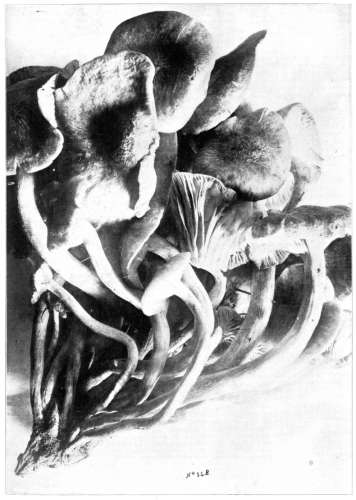
Photo by C. G. Lloyd.
Plate XII. Figure 75.—Clitocybe monadelpha.
Monadelpha is from monos, one and adelphos, brother.
Prof. Morgan of Preston, Ohio, gives the following description of the One-Brotherhood Clitocybe in the Mycological Flora of the Miama Valley: "Densely cespitose. Pileus fleshy, convex, then depressed, at first glabrous, then scaly, honey-colored, varying to pallid-brown or reddish. The stem elongated, solid, crooked, twisted, fibrous, tapering at the base, pallid-brownish or flesh color. Spores white, a little irregular, .0055MM."
It might be easily taken for the ringless Armillaria mellea, but the decidedly decurrent gills and the solid stem ought to set any one right. In very wet weather it soon becomes water-soaked, and is then not good. It is found in woods about stumps, and in newly cleared fields about roots or stumps. From spring to October. See Plate XII, Figure 75, for an illustration. Bresadola of Europe has determined this to be the same as that described by Scoparius in 1772 as Agaricus (Clitocybe) tabescens. I have preferred to retain the name given by Prof. Morgan.
Clitocybe dealbata. Sow.
The White Clytocybe. Edible.
Dealbata means whitewashed; so called from its white color.
The pileus is about one inch broad, rather fleshy, convex, then plane, upturned and wavy, smooth, shining, even.
The gills are crowded, white, attached to the stem.
The stem is fibrous, thin, equal, stuffed. Spores are 4–5×2.5µ.
This is a beautiful plant and widely distributed. Found among leaves and sometimes in the grass. It makes a delicious dish.
Clitocybe phyllophila. Fr.
The Leaf-Loving Clitocybe. Edible.
Phyllophila means leaf and fond of. It is so called because it is found on leaves in the woods during wet weather.
The pileus is one and a half to three inches in diameter, whitish-tan, rather fleshy, convex, then plane, at length depressed, even, dry, noticeably white around the margin.
The gills are attached to the stem, decurrent especially after the cap is depressed, somewhat distant, rather broad, white, becoming yellowish or ocher tinged, thin.
The stem is two to three inches long, stuffed, becoming hollow, silky, rather tough, whitish. The spores are elliptical., 6×4µ.
The whitish-tan cap with its white, silvery zone near the margin will serve to identify the species. August to October.
Clitocybe cyathiformis. Bull.
The Cup-Shaped Clitocybe. Edible.
Cyathiformis is from cyathus, a drinking cup; formis, form or shape.
The pileus is two to three inches broad, fleshy, rather thin; at first depressed, then funnel-shaped; even, smooth, moist, hygrophanous; the margin involute, sooty or dark brown when moist, becoming pale when dry, often dingy ochraceous or tan-color, inclined to be wavy.
The gills are attached to the stem, decurrent from the depressed form of the pileus, united behind, somewhat dingy, sparingly branched.
The stem is stuffed, elastic, tapering upward, fibrillose, base villous. The spores are elliptical, 9×6µ.
This plant has a wide distribution and is found in woods or wood margins. I found some very fine specimens on Ralston's Run, near Chillicothe. September to October.
Clitocybe laccata. Scop.
Waxy Clitocybe. Edible.
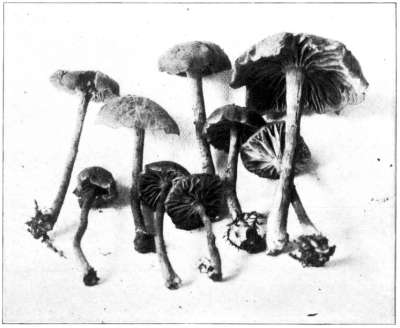
Figure 76.—Clitocybe laccata. Two-thirds natural size. Caps violet or reddish-brown. Gills broad and distant.
Laccata means made of shellac or sealing-wax. This is a very common, variable plant. Sometimes of a bright amethyst but usually of a reddish brown. The pileus is from one to two inches broad, almost membranaceous, convex, then plane, depressed in the center, downy with short hairs, violet or reddish-brown.
The gills are broad, distant, attached to the stem by the entire width; pale fleshy-red in hue which is more constant than the color of the cap and which forms an ear-mark to tell the species; adnate with a decurrent tooth, plane, the white spores being very abundant.
The stem is tough, fibrous, stuffed, crooked, white-villous at the base, rather long and slender, dull reddish yellow or reddish-flesh-colored, sometimes pallid or dull ochraceous, slightly striate; when the season is wet it is often watery.
This waxy Clitocybe has a wide range and is frequently very abundant. It is found through almost the entire season. It will grow almost anywhere, in woods, pastures, and lawns, and sometimes on naked ground. The plants in Figure 76 were found in tall grass in a grove in August. Those in Figure 77 were found the last of November on Cemetery Hill, under pine trees.
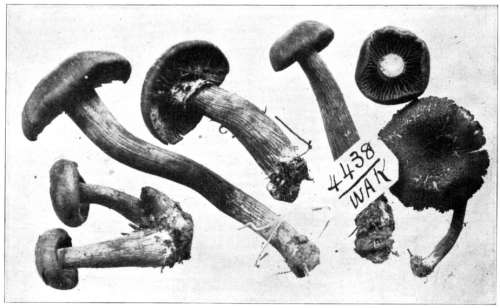
Figure 77.—Clitocybe laccata. Two-thirds natural size. Specimens growing late in the fall.
Prof. Peck gives the following varieties:
Var. amethystina—in which the cap is much darker in color.
Var. pallidifolia—gills much paler than usual.
Var. striatula—cap smooth, thin, so that shadowy lines are seen on cap, radiating from near the center to the margin. This grows in damp places. Some authors make Clitocybe laccata a type for a new genus and call it Lacaria laccata.
Collybia. Fr.
Collybia is from a Greek word meaning a small coin or a small round cake. The ring and volva are both wanting in this genus. The pileus is fleshy, generally thin, and when the plant is young the margin of the pileus is incurved.
The gills are adnate or nearly free, soft, membranaceous. Many species of Collybia will revive to some extent when moistened, but they are not coriaceous.
The stem differs in substance from the pileus, cartilaginous or has a cartilaginous cuticle, while the inside is stuffed or hollow. This is quite a large genus, containing fifty-four American species.
Collybia radicata. Rehl.
The Rooting Collybia. Edible.
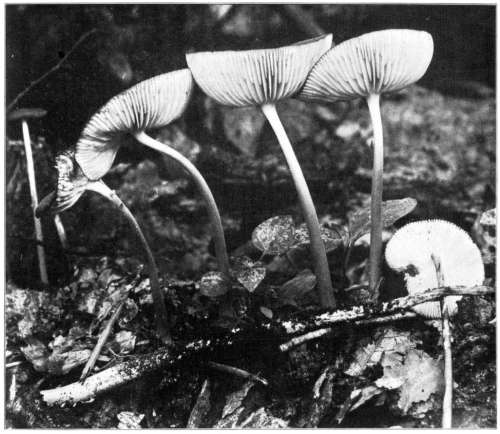
Plate XIII. Figure 78.—Collybia radicata.
This, in its season, is one of the most common mushrooms in the woods. It grows in the ground, frequently around old stumps, sometimes on lawns.
Those in Figure 78 were found in the woods on the ground. One plant, as will be seen by the square, is a foot high.
It is easily recognized by its long root and flat cap. The root extends into the ground and will frequently break before pulling up. This root gives name to the species.
The pileus is fleshy, rather thin, convex, then plane, often with margin upturned in old plants as in Figure 78, and frequently wrinkled at and toward the umbo, smooth, viscid when moist.
The color is quite variable, from almost white to gray, grayish-brown; flesh thin, very white, elastic.
The gills are usually snow white, broad, rather distant, broad in the middle, joined to the stem by the upper angle, unequal.
The stem is frequently long, of the same color as the cap, yet sometimes paler; smooth, firm, sometimes grooved, often twisted, tapering upward, ending in a long tapering root, deeply planted in the soil.
The spores are elliptical, 15×10µ.
They grow singly, but generally have many neighbors. They are found in open woods and around old stumps. I seldom have any trouble in getting enough for a large family and some for my neighbor, who may not know what to get but does know how to appreciate them. Found from June to October and from the New England states through the middle west. They differ from C. hariolarum in the densely tufted habit of the latter.
Colybia ingrata. Schum.
Ingrata means unpleasant; from its somewhat unpleasant odor.
The pileus is one to two inches broad, globose, bell-shaped, then convex, umbonate, even, brownish-tan.
The gills are free, narrow, crowded, pallid.
The stem is twisted, subcompressed, sprinkled with a mealy tomentum above, umber below, hollow, rather long, unequal.
I found this plant quite abundant on Cemetery Hill, growing under pine trees, from the mass of pine needles. Found in July and August.
Collybia platyphylla. Fr.
Broad-gilled Collybia. Edible.
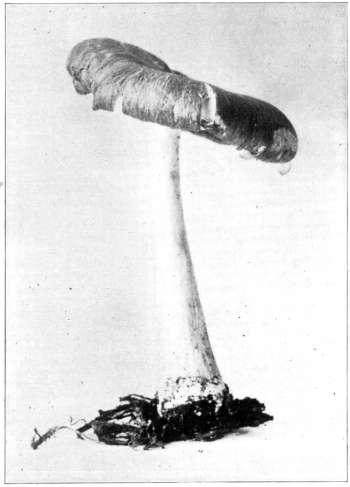
Figure 79.—Collybia platyphylla. One-third natural size.
Platyphylla is from two Greek words meaning broad and leaf, referring to the broad gills. It is a much larger and stouter plant than Collybia radicata. It is found in new ground on open pastures about stumps, also in woods, on rotten logs and about stumps.
The pileus is three to four inches broad, at first convex, then expanded, plane, margin often upturned, smoky brown to grayish, streaked with dark fibrils, watery when moist, flesh white.
The gills are adnexed, very broad, obliquely notched behind, distant, soft, white, in age more or less broken or cracked.
The stem is short, thick, often striated, whitish, soft, stuffed, sometimes slightly powdered at the apex, root blunt. The spores are white and elliptical.
It is easily distinguished from C. radicata by the blunt base of the root and the very broad gills. Like C. radicata they need to be cooked well or there is a slightly bitter taste to them. They are found from June to October.
Collybia dryophila. Bull.
Oak-loving Collybia. Edible.
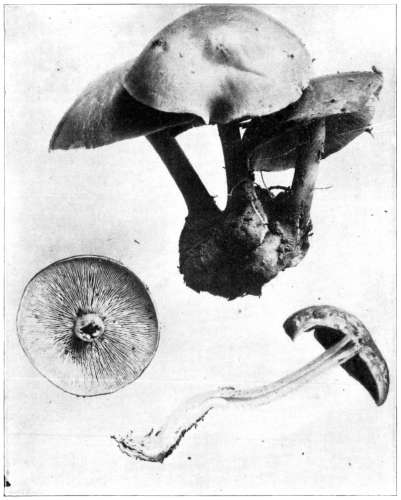
Photo by C. G. Lloyd.
Figure 80.—Collybia dryophila. Natural size. Caps bay-brown.
Dryophila is from two Greek words, oak and fond of. The pileus is bay-brown, bay red, or tan color, one or two inches broad, convex, plane, sometimes depressed and the margin elevated, flesh thin and white.
The gills are free with a decurrent tooth, crowded, narrow, white, or whitish, rarely yellow.
The stem is cartilaginous, smooth, hollow, yellow, or yellowish, equal, sometimes thickened at the base as will be seen in Figure 80. The color of the stem is usually the same as the cap. This is a very common plant about Chillicothe. They are found in woods, especially under oak trees, but are also found in open places. I found them on the High School lawn in Chillicothe. Some very fine specimens that were found growing in a well marked ring, in an old orchard, were brought to me about the first of May. Their season is from the first of May to October.
Collybia zonata. Pk.
The Zoned Collybia. Edible.
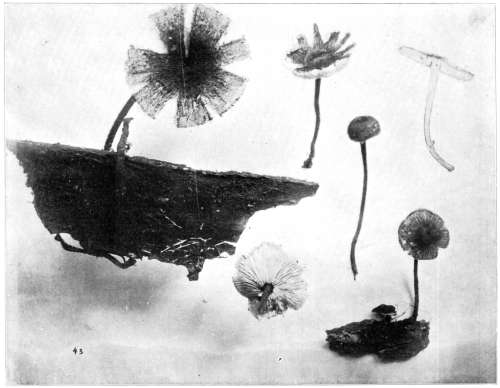
Photo by C. G. Lloyd.
Plate XIV. Figure 81.—Collybia Zonata.
Zonata, zoned; referring to the concentric zones on the cap which show faintly in Figure 81.
The pileus is about one inch broad, sometimes more, sometimes less; rather fleshy, thin, convex, when expanded nearly plane, slightly umbilicate, covered with fibrous down; tawny or ochraceous tawny, sometimes marked with faintly darker zones; even in the very young specimens the umbilicate condition is usually present.
The gills are narrow, close, free, white or nearly white, usually with a pulverulent edge.
The stem is one to three inches long, rather firm, equal, hollow, covered like the cap with a fibrous down, tawny, or brownish tawny. The spores are broadly elliptical, .0002 inch long, .00016 broad.
This species closely resembles C. stipitaria, but is easily distinguished from it because of its habits of growth, different gills, and shorter spores. It is found on or near decaying wood in mixed woods. I have found it frequently on Ralston's Run but always only a few specimens in one place. It does not grow in a cespitose manner with us. Found in August.
Collybia maculata. Alb. & Schw.
The Spotted Collybia. Edible.
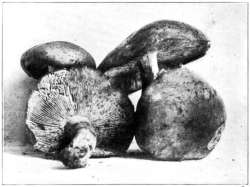
Figure 82.—Collybia maculata. Two-thirds natural size. Reddish-brown spots on caps and stems.
Maculata, spotted; referring to the reddish spots or stains both on the cap and on the stem. The pileus is two to three inches broad, at first white, then spotted (as well as the stem) with reddish brown spots or stains, fleshy, very firm, convex, sometimes nearly plane, even, smooth, truly carnose, compact, at first hemispherical and with an involute margin, often repand.
The gills are somewhat crowded, narrow, adnexed, often free, linear, white or whitish, often brownish cream, gills not reaching to the margin of the cap.
The stem is three to four inches long, nearly solid, more or less grooved, stout, unequal, sometimes ventricose, frequently partially bulbous, lighter than the gills, usually spotted in age, white at first. The spores are subglobose, 4–6µ. The plant is a hardy one. It will keep for several days. The plants in Figure 82 grew in the woods where a log had rotted down.
Var. immaculata, Cooke, differs from the typical form in not changing color or being spotted, and in the broader and serrated gills. This variety delights in fir woods. September to November.
Collybia atrata. Fr.
Charcoal Collybia.
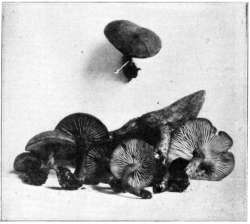
Figure 83.—Collybia atrata. One-half natural size. Caps dull blackish-brown. Gills grayish-white.
Atrata, clothed in black; from the pileus being very black when young. The pileus is from one to two inches broad, at first regular and convex, when expanded becoming, as a rule, irregular in shape, sometimes partially lobed or wavy; in young plants the cap is a dull blackish brown, faded in older specimens to a lighter brown, umbilicate, smooth, shining.
The gills are adnate, slightly crowded, with many short ones, rather broad, grayish-white.
The stem is smooth, equal, even, hollow, or stuffed, tough, short, brown within and without, but lighter than the cap. The plant grows in pastures where stumps have been burned out, always, so far as I have noticed, on burned ground. Spores .00023×.00016.
Collybia ambusta. Fr.
The Scorched Collybia.
Ambusta, burned or scorched, from its being found on burned soil.
The pileus is nearly membranaceous, convex, then expanded, nearly plane, papillate, striatulate, smooth, livid brown, hygrophanous, umbonate.
The gills are adnate, crowded, lanceolate, white, then of a smoky tinge.
The stem is somewhat stuffed, tough, short, livid. Spores 5–6×3–4.
This species differs from C. atrata in having an umbonate pileus.
Collybia confluens. Pers.
The Tufted Collybia. Edible.
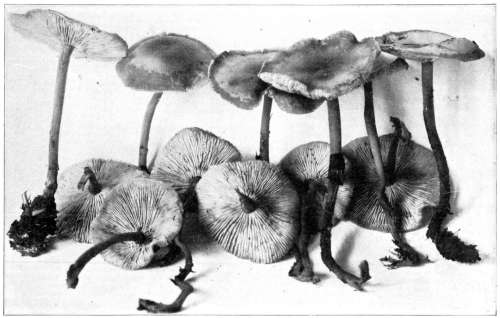
Figure 84.—Collybia confluens. Natural size, showing reddish stems.
Confluens means growing together; so called from the stems often being confluent or adhering to each other.
The pileus is from an inch to an inch and a quarter broad, reddish-brown, often densely cespitose, somewhat fleshy, convex, then plane, flaccid, smooth, often watery, margin thin, in old specimens slightly depressed and wavy.
The gills are free and in old plants remote from the stem, rather crowded, narrow, flesh colored, then whitish.
The stem is two to three inches long, hollow, pale red, sprinkled with a mealy pubescence. The spores are slightly ovate, inclined to be pointed at one end, 5–6×3–4µ.
These plants grow among leaves in the woods after warm rains, growing in tufts, sometimes in rows or lines. They are not as large as C. dryophylla, the stem is quite different and the plants seem to have the ability to revive like a Marasmius. They can be dried for winter use.
Collybia myriadophylla. Pk.
Many-leaved Collybia.
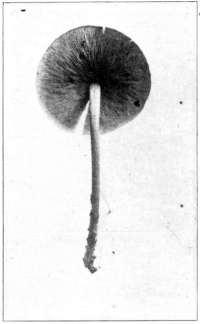
Figure 85.—Collybia myriadophylla.
Myriadophylla is from two Greek words, meaning many leaves. It has reference to its numerous gills.
The pileus is very thin, broadly convex, then plane or centrally depressed, sometimes umbillicate, hygrophanous, brown when moist, ochraceous or tan-color when dry.
The gills are very numerous, narrow, linear, crowded, rounded behind or slightly adnexed, brownish-lilac.
The stem is slender, but commonly short, equal, glabrous, stuffed or hollow, reddish-brown. The spores are minute, broadly elliptical, .00012 to .00016-inch long, .0008-inch broad. Peck, 49th Rep.
I found only a few specimens in Haynes's Hollow. The caps were about an inch broad and the stems were an inch and a half long. It will be easily identified if one has the description of it, because of its peculiarly colored gills. I found my plants on a decayed stump in August. In the dried specimens the gills assume a more brownish-red hue, as in the next following species.
Collybia colorea. Pk. They sometimes appear to have a glaucous reflection, probably from the abundance of the spores. The stem is more or less radicated and often slightly floccose-pruinose toward the base. The basidia are very short, being only .0006 to .0008-inch long.
Collybia atratoides. Pk.
The Blackish Collybia.
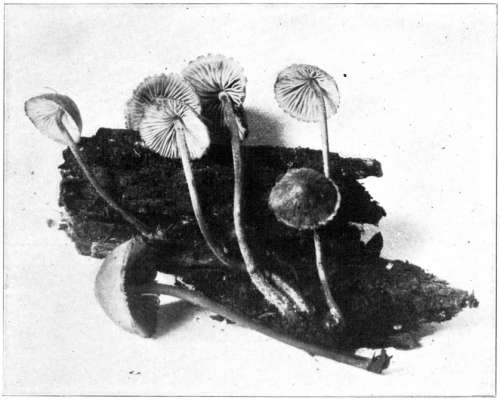
Figure 86.—Collybia atratoides. Two-thirds natural size. Caps blackish to grayish-brown.
Atratoides means like the species atrata, which means black; so called because the caps when fresh are quite black. Atratoides has a different habitat and is not so dark.
The pileus is thin, convex, subumbilicate, glabrous, hygrophanous, blackish-brown when moist, grayish-brown and shining when dry.
The gills are rather broad, subdistant, adnate, grayish-white, often transversely veiny above and venosely connected.
The stem is equal, hollow, smooth, grayish-brown with a whitish mycelioid tomentum at the base. The spores are nearly globose, about .0002-inch broad. The pileus is six to ten lines broad and the stem is about one inch long. Peck.
The plant is gregarious, growing on decayed wood and on mossy sticks in mixed woods. The margin of the cap is often serrated, as you will see in Figure 86, yet this does not seem to be a constant characteristic of the species. It is closely related to C. atrata, but its habitat and the color of its pileus and gills differ very greatly. I have not eaten it, but have no doubt of its good qualities.
Found in August and September. Quite common in all our woods.
Collybia acervata. Fr.
The Tufted Collybia. Edible.
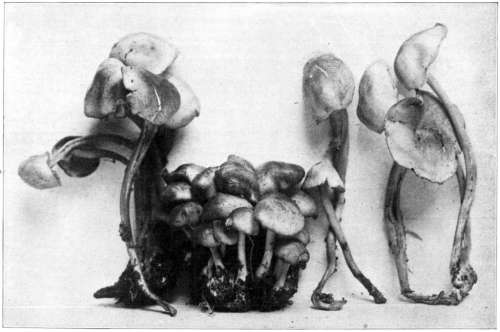
Figure 87.—Collybia acervata. Two-thirds natural size. Caps pale, tan or dingy pink.
Acervata, from acervus, a mass, a heap.
Pileus fleshy but thin, convex, or nearly plane, obtuse, glabrous, hygrophanous, pale, tan-color or dingy pinkish-red, and commonly striate on the margin when moist, paler or whitish when dry.
Gills narrow, close, adnexed or free, whitish or tinged with flesh-color.
The stem slender, rigid, hollow, glabrous, reddish, reddish-brown or brown, often whitish at the top, especially when young, commonly with a matted down at the base. Spores elliptical, 6×3–4µ.
The plant is cespitose. Pileus one-half inch broad. Stem two to three inches long. Peck's 49th Report.
This is a beautiful plant when growing in large tufts. The entire plant is tender and has a delicate flavor. I found the plant figured here on the Frankfort pike where an old saw mill had formerly stood. It grew abundantly there, along with Lepiota Americana and Pluteus cervinus.
Found from August to October.
Collybia velutipes. Curtis.
The Velvet-foot Collybia. Edible.
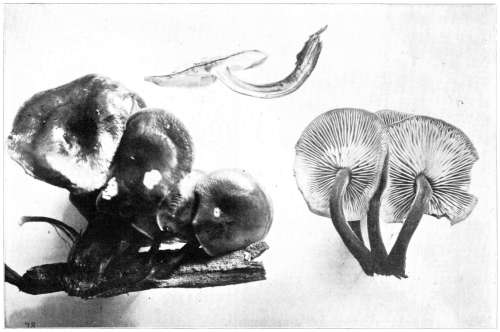
Photo by C. G. Lloyd.
Plate XV. Figure 88.—Collybia velutipes. Natural size, showing the velvet stems, which give name to the species.
Velutipes, from vellum, velvet and pes, foot.
Pileus from one to four inches broad, tawny yellow, fleshy at the center, thick on the margin, quite sticky or viscid when moist, margin slightly striate, sometimes inclined to be excentric.
Gills rounded behind, broad, slightly adnexed, tan or pale-yellow, somewhat distant.
The stem is cartilaginous, tough, hollow, umber, then becoming blackish, with a velvety coat. Spores are elliptical, 7×3–3.5µ.
It grows on stumps, logs and roots, in the ground. It grows almost the year round. I have gathered it to eat in February. Plate XV gives a very correct notion of the plant. It is most plentiful in September, October and November, yet found throughout the winter months.
Mycena. Fr.
Mycena is from a Greek word, meaning a fungus. The plants of this genus are small and rather fragile.
Pileus more or less membranaceous, generally striate, with the margin almost straight, and at first pressed to the stem, never involute, expanded, campanulate, and generally umbonate.
The stem is externally cartilaginous, hollow, not stuffed when young, confluent with the cap. Gills never decurrent, though some species have a broad sinus near the stem.
Most species are small and inodorous, but some which have a strong alkaline odor are probably not good. Some are known to be edible.
A few species exude a colored or watery juice when bruised. The Mycena resembles the Collybia, but never has the incurved margin of the latter. The plants are usually smaller, and the caps are more or less conical.
This genus might be mistaken for Omphalia, in which the gills are but slightly decurrent, but in Omphalia the cap is umbilicate while in Mycena it is umbonate.
Their being so small makes the determination of species somewhat difficult. Some have characteristic odors which greatly assist in establishing their identity.
Mycena galericulata. Scop.
The Small Peaked-cap Mycena. Edible.
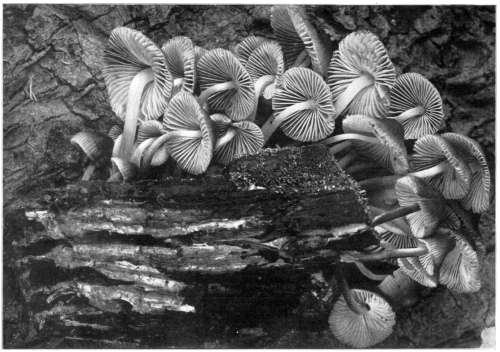
Plate XVI. Figure 89.—Mycena galericulata. Natural size.
Galericulata, a small peaked-cap.
The pileus is campanulate, whitish or grayish, center of the disk darker and lighter toward the margin, smooth, dry, margin striated nearly to the peak of the umbo, sometimes slightly depressed.
The gills are adnate with a tooth, connected by veins, whitish, then gray, often flesh color, rather distant, ventricose, edge sometimes entire, sometimes serrate.
The stem is rigid, cartilaginous, hollow, tough, straight, polished, smooth, hairy at the base.
It grows on logs and stumps in the woods. It is very common and sometimes found in abundance. The plants are frequently densely clustered, the numerous stems matted together by a soft hairy down at the base. There are many forms of this plant. Found from September to frost. The plants in Figure 89 were photographed by Prof. G. D. Smith, Akron, O.
Mycena rugosa. Fr.
The Wrinkled Mycena. Edible.
Rugosa means wrinkled. The pileus is somewhat fleshy, darker and smaller than the galericulata, quite tough, bell-shaped, then expanded, with unequal elevated wrinkles, always dry, striate on the margin.
The gills are adnate, with a tooth, united behind, connected by veins, somewhat distant, whitish, then gray, edge sometimes entire, sometimes serrate.
The stem is short, tough, rooted with a hairy base, strongly cartilaginous, hollow, rigid, smooth. It is found on stumps or decayed logs during September and October.
Mycena prolifera. Sow.
The Proliferous Mycena. Edible.
Prolifera is from proles, offspring, and fero, to bear. The pileus is somewhat fleshy, campanulate, then expanded, dry, with a broad, dark umbo; margin at length sulcate or furrowed and sometimes split, pale-yellowish or becoming brownish-tan.
The gills are adnexed, subdistant, white, then pallid.
The stem is firm, rigid, smooth, shining, minutely striate, rooting. Fries.
This species, as well as M. galericulata, is closely related to M. cohærens. I have found it in dense tufts or clusters, sometimes on lawns, on the bare ground, and in the woods. It is one of the plants in which the stems may be cooked with the caps.
Mycena capillaris. Schum.
Capillaris means hair-like. This is a very small but beautiful white plant.
The pileus is bell-shaped, at length umbilicate, smooth.
The gills are attached to the stem, ascending, rather distant.
The stem is thread-like, smooth, short.
The spores are 7–8×4. Fries.
These plants are very small and easily overlooked. They grow on leaves in the woods after a rain. July and August. Quite common.
Mycena setosa. Sow.
Setosa means full of setæ or hairs.
The pileus is very delicate, hemispherical, obtuse, smooth.
The gills are distant, white, almost free.
The stem is short, slender, and covered with spreading hairs which gives rise to its specific name.
Commonly found on dead leaves in the woods after a rain. Found in July and August.
Mycena hæmatopa. Pers.
The Blood-Foot Mycena. Edible.
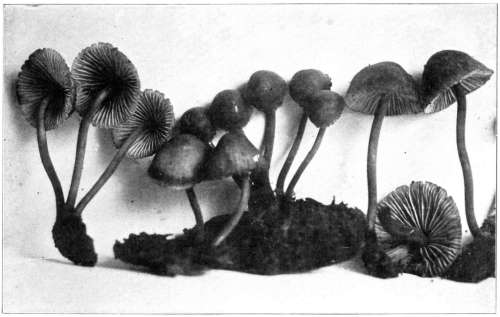
Figure 90.—Mycena hæmatopa. Brownish-red or flesh-color. A dull red juice exudes from the stem. Margin dentate by sterile flap.
Hæmatopa is from two Greek words, meaning blood and foot.
The pileus is fleshy, one inch broad, conic, or bell-shaped, somewhat umbonate, obtuse, whitish to flesh-color, with more or less dull red, even, or slightly striate at the margin, the margin extending beyond the gills and is toothed.
The gills are attached to the stem, often with a decurrent tooth, whitish. Spores, 10×6–7.
The stem is two to four inches long, firm, hollow, sometimes smooth, sometimes powdered with whitish, soft hairy down, in color the same as the pileus, yielding a dark red juice which gives name to the species.
The color varies quite a little in these plants, owing to some having more of the red juice than others. The genus is readily identified by the dull blood-red juice, hollow stem, the crenate margin of the cap, and its dense cespitose habits. It is found on decayed logs in damp places from August to October. The plants in Figure 90 were found in Haynes' Hollow, September 8. The plant is widely distributed over the United States. No one will have the slightest difficulty in recognizing this species after seeing the plants in the figure above.
Mycena alkalina. Fr.
The Stump Mycena.
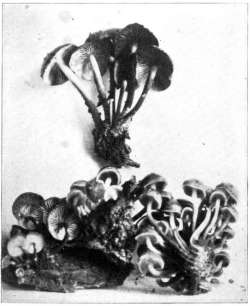
Figure 91.—Mycena alkalina. Two-thirds natural size, often larger. Young specimens.
Solitary or cespitose; pileus one-half to two inches broad, rather membranaceous, campanulate, obtuse, naked, deeply striate, moist, shining when dry, when old expanded or depressed, but little changed in color, though occasionally with a pink or yellow hue, whitish or grayish, the center of the disk darker.
The gills are adnate, rather distant, slightly ventricose, at first pale, then glaucous, pinkish, or yellow, more or less connected by veins.
The stem is smooth, slightly sticky, shining, villous at the base with a sometimes tawny-down, sometimes firm and tenacious, hollow, attenuated upward. The plant is rigid, but brittle, and strong-scented. Found on decayed stumps and logs, you will meet it frequently. August to November.
Mycena filopes. Bull.
Thready-Stemmed Mycena.
Pileus membranaceous, obtuse, campanulate, then expanded, striate, brown or umber, tinged with pink.
The gills are free or minutely adnexed, slightly ventricose, white or paler than the pileus, crowded.
The stem is hollow, juicy, smooth, filiform, rather brittle, whitish or brownish. Found in woods on leaves, after a rain, from July to October.
Mycena stannea. Fr.
The Tin-Colored Mycena.
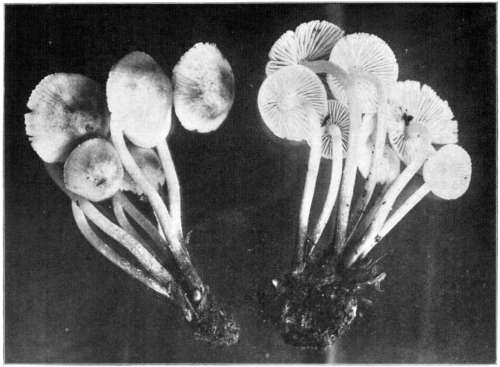
Figure 92.—Mycena stannea. Natural size. Caps white, sometimes smoky.
Stannea pertaining to the color of tin. This is a delicate species that grows in the woods in tufts on rotten wood in damp places. The general character is shown in the illustration, being nearly white but many of the pilei are somewhat smoky.
The pileus is firm, membranaceous, bell-shaped, then expanded, smooth, very slightly striate, hygrophanous, quite silky, tin-color.
The gills are firmly attached to the stem, with a decurrent tooth, connected by veins, grayish-white.
The stem is smooth, even, shining, becoming pale, at length compressed. This species differs from Mycena vitrea in having a tooth to the gills. May, June, and July.
Mycena vitrea. Fr.
Vitrea, glassy. This plant is quite fragile. The pileus is membranaceous, bell-shaped, livid-brown, finely striate, no trace of umbo.
The gills are firmly attached to the stem, not connected by veins, distinct, linear, whitish.
The stem is slender, slightly striate, polished, pale, base fibrillose. This species differs from M. ætites and M. stannea in gills not having a decurrent tooth and not being connected by veins.
Mycena corticola. Fr.
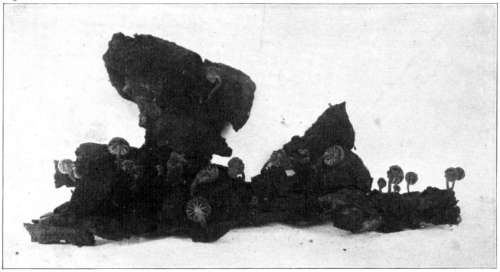
Figure 93.—Mycena corticola.
Corticola means dwelling on bark.
It is one of the smallest of the Mycenas, the pileus being about two to four lines across, thin, hemispherical, obtuse, becoming slightly umbilicate, deeply striate, glabrous or flocculosely pruinose, gray, tan, or brownish.
The gills are attached to the stem, with slight decurrent tooth, broad, rather ovate, pallid.
The stem, is short, slender, incurved, glabrous or minutely scurfy, somewhat paler than the pileus. The spores are elliptical, 5–6×3µ; cystidia obtusely fusiform, 50–60×8–10µ.
These plants are found on the bark of living trees. After rains I have seen the bark on the shade trees along the walks in Chillicothe, literally covered with these beautiful little plants. The plants in Figure 93 were taken from a maple tree the 4th of December. They are very close allied to M. hiemalis but can be distinguished by the broad, ovate gills bearing cystidia, and smaller spores.
Mycena hiemalis. Osbeck.
The Winter Mycena.
Hiemalis, of, or belonging to, winter. The pileus quite thin, bell-shaped, very slightly umbonate, margin striate; pinkish, rufescent, white, sometimes pruinose.
The gills are adnate, linear, white or whitish.
The stem is slender, curved, base downy, whitish, pinkish-red. The spores are 7–8×3.
This is a more delicate species than M. corticola and differs from it in its narrow gills, and striate, not sulcate, pileus, also in the color of the stem. Found on stumps and logs. October and November.
Mycena Leaiana. Berk.
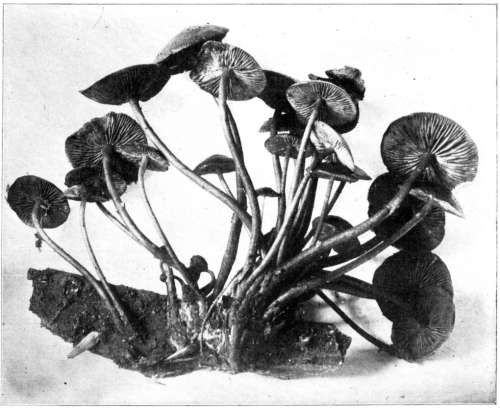
Figure 94.—Mycena leaiana. Natural size. Caps bright orange and very viscid.
Leaiana named in honor of Mr. Thomas G. Lea, who was the first man to study mycology in the Miami Valley. This is a very beautiful plant growing on decayed beech logs in rainy weather. The pileus is fleshy, very viscid, bright orange, the margin slightly striate as will be seen in the one whose cap shows.
The gills are distant, not entire, broad, notched at the stem, attached, the edge a dusky orange, or vermilion, the short gills beginning at the margin.
The stem is in most cases curved, attenuated toward the cap, smooth, hollow, rather firm, quite hirsute or strigose at the base. The spores are elliptical, apiculate, .0090×.0056 mm.
They are cæspitose, growing in dense tufts on logs somewhat decayed. It is extremely viscid, so much so that your hands will be stained yellow if you handle it much. It grows from spring to fall but is usually more abundant in August and September. Very common.
Mycena iris. B.
Pileus is small, convex, expanded, obtuse, slightly viscid, striate, quite blue when young, growing brownish with blue fibrils.
The gills are free, tinged with gray.
The stem is short, bluish below, tinged with brown above, somewhat pruinose. Found in damp woods after a rain, in August.
Mycena pura. Pers.
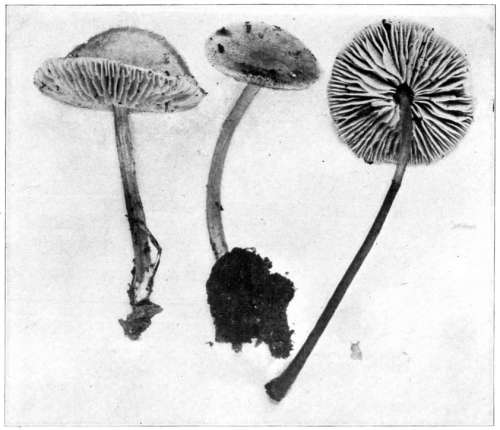
Photo by Prof. G. D. Smith.
Figure 95.—Mycena pura.
Pura means unstained, pure.
The pileus is fleshy, thin, bell-shaped, expanded, obtusely umbonate, finely striate on the margin, sometimes having margin upturned, violet to rose.
The gills are broad, adnate to sinuate, in older plants sometimes free by breaking away from the stem, connected by veins, sometimes wavy and crenate on the edge, the edge of the gills sometimes almost or quite white, violet, rose.
The stem is even, nearly naked, somewhat villous at the base, sometimes almost white when young, later assuming the color of the cap, hollow, smooth.
The spores are white and oblong, 6–8×3–3.5. M. Pelianthina differs from this in having dark-edged gills. It differs from M. pseudopura and M. zephira in having a strong smell. M. ianthina differs in having a conical cap.
This plant is quite widely distributed. Our plants are light-violet in color, and the color seems constant. I have found it in mixed woods. It is found in September and October.
Mycena vulgaris. Pers.
Vulgaris means common.
The pileus is small, convex, then depressed, papillate, viscid, brownish-gray, finely striate on the margin.
The gills are subdecurrent, thin, white; the depressed cap and decurrent gills make the plant resemble an Omphalia. Spores, 5×2.5µ.
The stem is viscid, pale, tough, fibrillose at the base, rooting, becoming hollow. It differs from M. pelliculosa in not having a separable cuticule and the fold-like gills.
This plant will be recognized by its smoky or grayish color, umbilicate pileus, and viscid stem. It is found in woods on leaves and decayed sticks. August and September.
Mycena epipterygia. Scop.
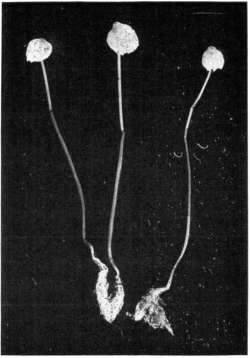
Figure 96.—Mycena epipterygia.
Epipterygia is Epi, upon, and Pterygion, a small wing.
These are small, the pileus being one-half to one inch broad, membranaceous, bell-shaped, then expanded, rather obtuse, not depressed, striate, the cuticule separable in every condition and viscid in damp weather, gray, often pale yellowish-green near the margin often minutely notched when young.
The gills are attached to the stem with a decurrent tooth, thin, whitish or tinged with gray.
The stem is two to four inches long, hollow, tough, rooting, viscid, yellowish, sometimes gray or even whitish. The spores are elliptical, 8–10×4–5µ.
These plants have a wide distribution and are found on branches, among moss and dead leaves. They are found in clusters and solitary. They resemble in many ways M. alcalina but do not have the peculiar smell.
The plants in Figure 96 were photographed by Prof. G. D. Smith of Akron.
Omphalia. Fr.
Omphalia is from a Greek word meaning the navel; referring here to the central depression in the cap.
The pileus from the first is centrally depressed, then funnel-shaped, almost membranaceous, and watery when moist; margin incurved or straight. Stem cartilaginous and hollow, often stuffed when young, continuous with the cap but different in character. Gills decurrent and sometimes branched.
They are generally found on wood, preferring a damp woody situation and a wet season. It is easily distinguished from Collybia and Mycena by its decurrent gills. In some of the species of the Mycena where the gills are slightly decurrent, the pileus is not centrally depressed as it is in corresponding species of Omphalia. There are a few species of Omphalia whose pileus is not centrally depressed but whose gills are plainly decurrent.
Omphalia campanella. Batsch.
The Bell Omphalia. Edible.
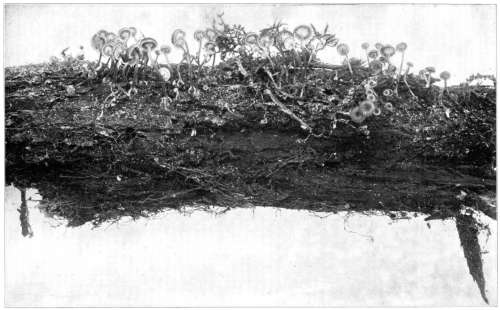
Photo by C. G. Lloyd.
Plate XVII. Figure 97.—Omphalia campanella.
Campanella means a little bell.
The pileus is membranaceous, convex to extended, centrally depressed, striate, watery, rusty-yellow in color.
The gills are moderately close, decurrent, bow-shaped, connected by veins, rigid, firm, yellowish. The spores elliptical, 6–7×3–4µ.
The stem is hollow, clothed with down, and paler above.
This plant is very common and plentiful in our woods and is widely distributed in the states. It grows on wood or on ground very heavily charged with decaying wood. It is found through the summer and fall. It is delicious if you have the patience to gather them.
Omphalia epichysia. Pers.
The pileus is thin, convex to expanded, depressed in the center, sooty-gray with a watery appearance, pallid to nearly white when dry.
The gills are slightly decurrent, whitish then gray, somewhat crowded.
The stem is slender, hollow, gray. The spores are elliptical, 8–10×4–5µ.
It grows in decayed wood. Its smoky color, funnel-shaped pileus, and gray short stem will distinguish it. I have some plants sent me from Massachusetts which seem to be much smaller than our plants.
Omphalia umbellifera. Linn.
The Umbel Omphalia. Edible.
Umbellifera—umbella, a small shade; ferro, to bear. Pileus one-half inch broad, membranaceous, whitish, convex, then plane, broadly obconic, slightly umbilicate even in the smallest plants, hygrophanous in wet weather, rayed with darker striæ.
The gills are decurrent, very distant, quite broad behind, triangular, with straight edges.
The stem is short, not more than one inch long, dilated at the apex, of same color as the pileus, at first stuffed, then hollow, firm, white, villous at the base.
It is a common plant in our woods, growing on decayed wood or ground largely made up of rotten wood. Decayed beech bark is a favorite habitat. Found from July till October.
Omphalia cæspitosa. Bol.
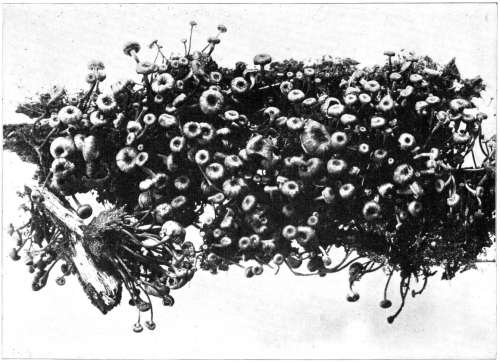
Figure 98.—Omphalia cæspitosa. Natural size.
Cæspitosa means growing in tufts; cæspes, turf. The pileus is submembranaceous, very small, convex, nearly hemispherical, umbilicate, thin, sulcate, light-ochre, margin crenate, smooth.
The gills are distant, rather broad, shortly decurrent, whitish.
The stem is curved, hollow, colored like the pileus, slightly bulbous at the base. The spores are 6×5.
This species is very much like Omphalia oniscus and they can only be distinguished by their habitats and color. It is found in August and September. It delights in well rotted wood. I have seen millions in one place.
Omphalia oniscus. Fr.
Bolton's Omphalia. Edible.
Oniscus, a name given to a species of codfish by the Greeks, so named because of their gray color. The pileus is flaccid, irregular, about one inch broad, convex, plane, or depressed, slightly fleshy, wavy, sometimes lobed, margin striate, dark cinereous, paler when dry.
The gills are adnate, decurrent, livid or whitish, arranged in groups of four, somewhat distant.
The stem is about one inch long, rather firm, straight or curved, sometimes unequal, nearly hollow. The spores are 12×7–8µ.
This is found in damp places from August to November.
Omphalia pyxidata. Bull.
The Box Omphalia.
Pyxidata means made like a box, from pyxis, a box.
The pileus is somewhat membranaceous, clearly umbilicate, then funnel-shaped, smooth when moist, margin often striate, brick-red.
The gills are decurrent, rather distant, triangular, narrow, reddish gray, often yellowish.
The stem is stuffed, then hollow, even, tough, pale-tawny. The spores are 7–8×5–6µ.
The plants are usually hygrophanous, but when dry, floccose or slightly silky. This is a small plant growing usually on lawns, nearly hidden in the grass. I found some very fine specimens on Dr. Sulzbacher's lawn on Second Street, Chillicothe. The plant is, however, widely distributed. I found many specimens on the 3d of November.
Omphalia fibula. Bull.
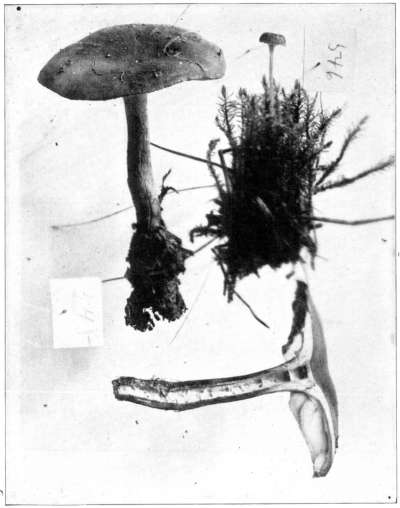
Photo by C. G. Lloyd.
Figure 99.—Omphalia fibula.
Fibula means a buckle or pin, from the pin-like stem.
The pileus is membranaceous, at first top-shaped, expanded, slightly umbilicate, striate, margin inclined to be inflexed, yellow or tawny, with a dusky center, minutely pilose.
The gills are deeply decurrent, paler, distinct.
The stem is slender, nearly orange color with a violet-brown apex, the whole minutely pilose. The spores are elliptical, 4–5×2µ.
They are found on mossy banks where it is more or less damp. I have only found it in October.
Omphalia alboflava. Moy.
The Golden-Gilled Omphalia.
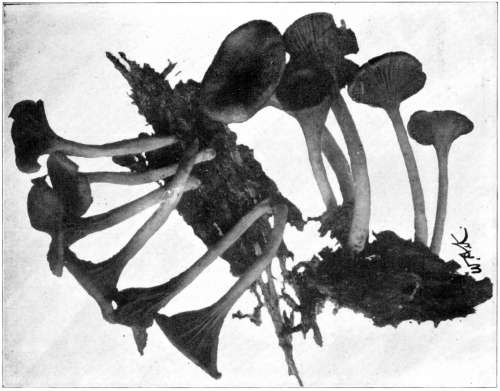
Figure 100.—Omphalia alboflava. Cap yellowish-brown, sometimes a greenish tinge. Gills golden yellow.
Alboflava is from two Greek words meaning whitish-yellow, from the yellow gills.
The pileus is one to two inches broad, thin, somewhat membranaceous, umbilicate, flaccid, covered with fine woolly material, yellow-brown, lighter when dry, margin reflexed.
The gills are distant, deep golden-yellow, occasionally forked.
The stem is hollow, equal, smooth, shining, egg-yellow.
The spores are elliptical, 8×4µ.
This plant, is found quite frequently on decayed branches and logs about Chillicothe. I have never had the opportunity to test its edibility but I have no doubt of its being good.
The plants in Figure 100 were found in Haynes' Hollow and were photographed by Dr. Kellerman. Found from July to October.
Marasmius. Fr.
Marasmius is a Greek participle meaning withered or shriveled; it is so called because the plant will wither and dry up, but revive with the coming of rain.
The spores are white and subelliptical. The pileus is tough and fleshy or membranaceous.
The stem is cartilaginous and continuous with the pileus, but of a different texture. The gills are thick, rather tough and distant, sometimes unequal, variously attached or free, rarely decurrent, with a sharp entire edge. It is quite a large genus and many of its species will be of great interest to the student.
Marasmius oreades. Fr.
The Fairy-Ring Mushroom. Edible.
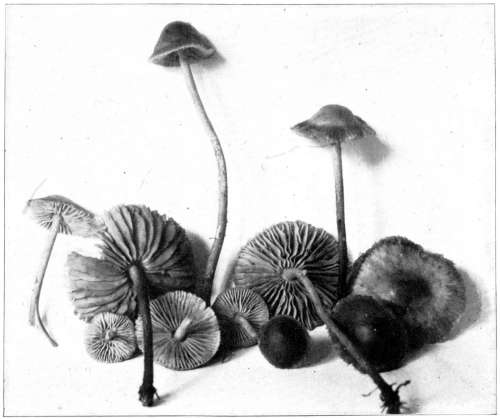
Figure 101.—Marasmius oreades. Two-thirds natural size.
Oreades, mountain nymphs. Pileus is fleshy, tough and pliable when moist, brittle when dry, convex, becoming flat, somewhat umbonate, brownish-buff at first, becoming cream-color; when old it is usually quite wrinkled.
The gills are broad and wide apart, creamy or yellowish, rounded at the stem end, unequal in length.
The stem is solid, equal, tough, fibrous, naked and smooth at base, everywhere with a downy surface. The spores are white, 8×5.
To my mind there is no more appetizing mushroom than the "Fairy Ring" mushroom. Figure 101 will give an accurate notion of the plant and Figure 102 will show how they grow in the grass. It is found in all parts of Ohio. Every old pasture field or lawn will be full of these rings. The plant is small but its plentifulness will make up for its size.
There are many conjectures why this and many other mushrooms grow in a circle. The explanation is quite obvious. The ring is started by a clump or an individual mushroom. The ground where the mushroom grew is rendered unfit for mushrooms again, the spores fall upon the ground and the mycelium spreads out from this point, consequently each year the ring is growing larger. Sometimes they appear only in a crescent form. One can tell, by looking over a lawn or pasture, where the rings are, because, from the decay of the mushroom, the grass is greener and more vigorous there.
Long ago, in England and Ireland, before the peasantry had begun to question the reality of the existence of the fairy folk and their beneficent interference in the affairs of life, these emerald-hued rings were firmly believed to be due to the fairy footsteps which nightly pressed their chosen haunts, and to mark the "little people's" favorite dancing ground. "They had always fine music among themselves, and danced in a moonshiny night around or in a ring, as one may see to this day upon every common in England where mushrooms grow," quaintly says one old writer. And the Rev. Gerard Smith still further voices the belief of the people as to the nature of these grassy rings:
"The nimble elves That do by moonshine green sour ringlets make, Whereof the ewe bites not; whose pastime 'tis To make these midnight mushrooms."
It is a very common plant, and it will pay any one to know it, as we cannot find anything in the markets that will equal it as a table delicacy.
Found in pastures and lawns during rainy weather from May till frost.
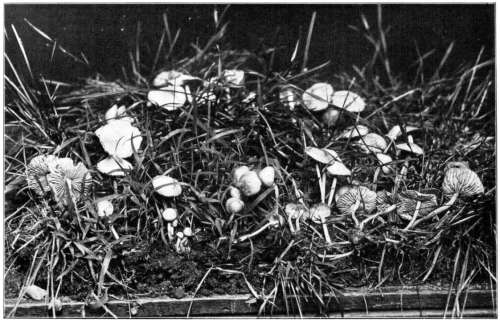
Figure 102.—Marasmius oreades. Showing a fairy ring.
Marasmius urens. Fr.
The Stinging Marasmius.
Urens means burning; so called from its acrid taste.
The pileus is pale-buff, tough, fleshy, convex or flat, becoming depressed and finally wrinkled, smooth, even, one to two inches broad.
The gills are unequal, cream-colored, becoming brownish, much closer than in the Fairy Ring, hardly reaching the stem proper, joined behind.
The stem is solid above and hollow below, fibrous, pale, its surface more or less covered with flocculent down, and densely covered with white down at the base.
It will be well for collectors to pass by this and M. peronatus, or to exercise the greatest caution in their use. They have been eaten without harm, but they also have so long been branded as poisonous that too great care cannot be taken. Its taste is acrid, and it grows in lawns and pastures from June to September.
Marasmius androsaceus. Linn.
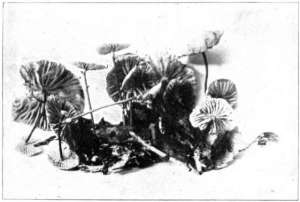
Figure 103.—Marasmius androsaceus. Natural size.
Androsaceus is from a Greek word which means an unidentified sea plant or zoophyte.
The pileus is three to six lines broad, membranaceous, convex, with a slight depression, pale-reddish, darker in the center, striate, smooth.
The gills are attached to the stem, frequently quite simple and few in number, about fifteen, with shorter ones between, sometimes forked, whitish.
The stem is one to two inches long, horny, filiform, hollow, quite smooth, black, often twisted when dry. The spores are 7×3–4µ.
This is a very attractive little plant found on the leaves in the woods after a rain. They are quite abundant. Found from July to October.
Marasmius fœtidus. Sow.
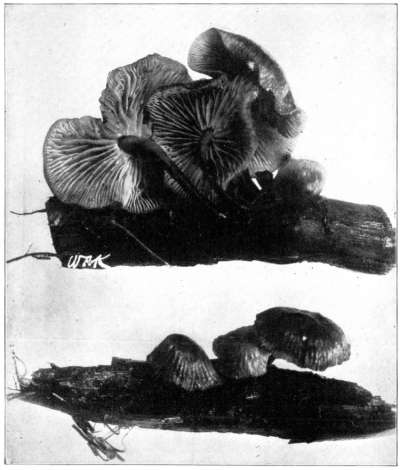
Figure 104.—Marasmius foetidus.
Fœtidus means stinking or fœtid.
The pileus is submembranaceous, tough, convex, then expanded, umbilicate striato-plicate, turning pale when dry, subpruinose.
The gills are annulato-adnexed, distant, rufescent with a yellow tinge.
The stem is hollow, minutely velvety, bay, base flocculose.
The caps are light brownish-red in color, fading when dry. When fresh it has a fœtid odor quite perceptible for such small plants. It is found on decayed sticks and leaves in woods. During wet weather or after heavy rains it is quite common in the woods about Chillicothe.
Found from July to October.
This is also called Heliomyces fœtens (Pat.) and is so classified by Prof. Morgan in his very excellent Monogram on North American Species of Marasmius.
Marasmius velutipes. B. & C.
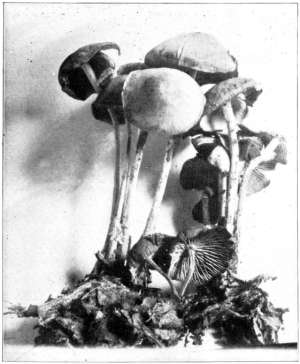
Figure 105.—Marasmius velutipes.
Velutipes means velvet-footed, from the velvety stem. The pileus is thin, submembranaceous, smooth, convex, or expanded, grayish-rufous when moist, cinereous when dry, a half to one and a half inches broad.
The gills are very narrow, crowded, whitish or grayish.
The stem is slender, three to five inches long, equal, hollow, clothed with a dense grayish velvety tomentum. Peck.
They usually grow in a very crowded condition, many plants growing from one mat of mycelium. It is quite a common plant with us, found in damp woods or around a swampy place. The pileus with us is convex. Some authorities speak of an umbilicate cap. The plant is quite hardy and easily identified because of its long and slender stem, with the grayish tomentum at the base. Found from July to October.
The specimens in Figure 105 were found at Ashville, Ohio.
Marasmius cohærens. (Fr.) Bres.
The Stemmed-Massed Marasmius. Edible.
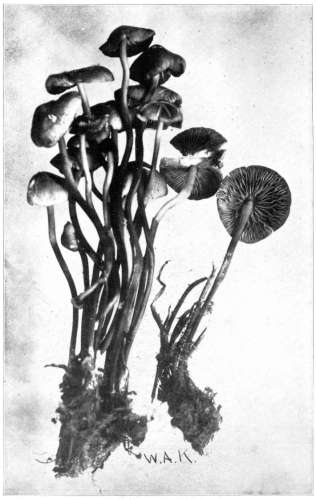
Figure 106.—Marasmius cohærens. Two-thirds natural size, showing how the stems are massed together.
Cohærens means holding together, referring to the stems being massed together.
The pileus is fleshy, thin, convex, campanulate, then expanded, sometimes slightly umbonate, in old specimens the margin upturned or wavy, velvety, reddish tan-color, darker in the center, indistinctly striate.
The gills are rather crowded, narrow, adnate, sometimes becoming free from the stem, connected by slight veins, pale cinnamon-color, becoming somewhat darker with age, the variation of color due to the number of cystidia scattered over the surface of the gills and on their edge. Spores, oval, white, small, 6×3µ.
The stem is hollow, long, rigid, even, smooth, shining, reddish-brown, growing paler or whitish toward the cap, a number of the stems growing together at the base with a whitish myceloid tomentum present.
The plant grows in dense clusters among leaves and in well rotted wood. I have found it quite often about Chillicothe. It is called Mycena cohærens, Fr., Collybia lachnophylla, Berk., Collybia spinulifera, Pk. The plants in Figure 106 were found near Ashville, Ohio. September to frost.
Marasmius candidus. Bolt.
The White Marasmius.
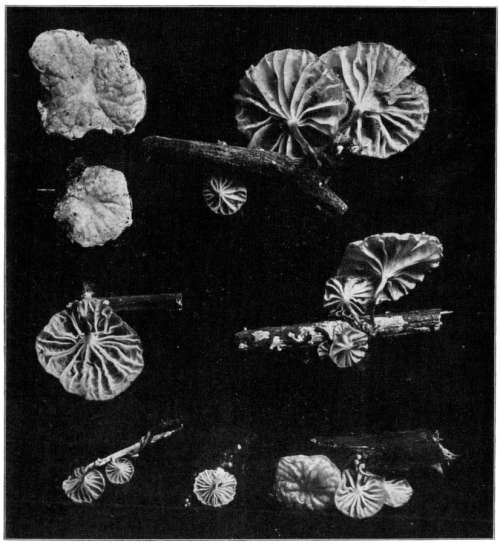
Figure 107.—Marasmius candidus. Natural size.
Candidus means shining white. This delicate species grows in moist and shady places in the woods. It grows on twigs, its habitat and structure are fully illustrated in the Figure 107.
The pileus is rather membranaceous, hemispherical, then plane or depressed, pellucid, wrinkled, naked, entirely white.
The gills are adnexed, ventricose, distant, not entire.
The stem is thin, stuffed, whitish, slightly pruinose, base tinged with brown. Spores are elliptical, 4×2µ.
This plant has a wide distribution in this country. The specimens figured were collected by H. H. York near Sandusky, Ohio, and were photographed by Dr. Kellerman. I have found them at various points in Ohio.
Marasmius rotula. Fr.
The Collared Marasmius.
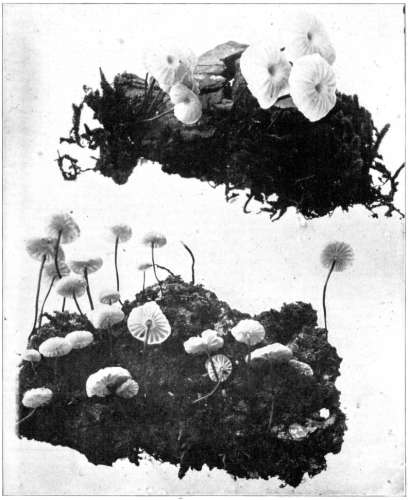
Photo by C. G. Lloyd.
Figure 108.—Marasmius rotula. Natural size. Caps white or pale-buff.
Rotula means a little wheel.
The pileus is one to three lines broad, hemispherical, umbilicate, and minutely umbonate, plaited, smooth, membranaceous, margin crenate, white, or pale buff, with a dark umbilicus.
The gills are broad, distant, few, equal, or occasionally with a few short ones, of the color of the pileus, attached to a free collar behind.
The stem is setiform, slightly flexuous, white above, then tawny, deep shining brown at the base, striate, hollow, frequently branched and sarmentose, with or without abortive pilei.—M. J. B. This plant is very common in woods on fallen twigs. The plants in Figure 108 were collected near Cincinnati. This plant has a wide distribution. It is in all our Ohio woods.
Marasmius scorodonius. Fr.
Strong-Scented Marasmius. Edible.
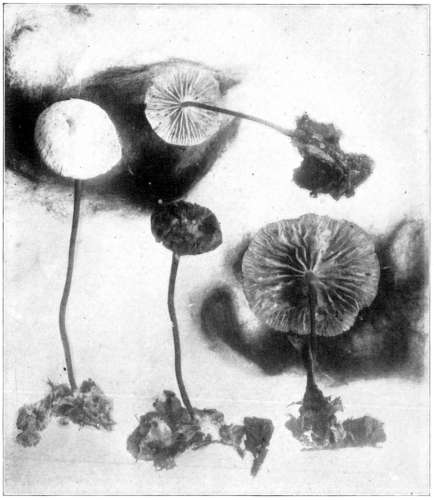
Figure 109.—Marasmius scorodonius.
Scorodonius is from a Greek word meaning like garlic.
The pileus is one-half inch or more broad, reddish when young, but becoming pale, whitish; somewhat fleshy, tough; even, soon plane, rugulose even when young, at length rugulose and crisped.
The gills are attached to the stem, often separating, connected by veins, crisped in drying, whitish.
The stem is at least one inch long, hollow, equal, quite smooth, shining, reddish. The spores are elliptical, 6×4µ.
It is found in woods growing on sticks and decayed wood. It is strong-smelling. It is frequently put with other plants to give a flavor of garlic to the dish. Found from July to October.
Marasmius calopus. Fr.
Calopus is from two Greek words meaning beautiful and foot, so called because of its beautiful stem.
The pileus is rather fleshy, tough, convex, plane then depressed, even, at length rugose, whitish.
The gills are emarginate, adnexed, thin, white, in groups of 2–4.
The stem is hollow, equal, smooth, not rooting, shining, reddish-bay. It is found growing on twigs and fallen leaves, in the woods. Smaller than M. Scorodonius but with longer stem.
Marasmius prasiosmus. Fr.
The Leek-Scented Marasmius.
Prasiosmus means smelling like a leek; from, prason, a leek. The pileus is one-half to one inch broad, somewhat membranaceous, tough, bell-shaped, pale yellow or whitish, disk often darker, wrinkled.
The gills are adnexed, somewhat close, white.
The stem is tough, hollow, pallid and smooth above, dilated at the base, tomentose and brown. It is found in woods adhering to oak leaves after heavy rains. It is very near M. porreus but differs from it in its gills being white and caps not being striated. It differs from M. terginus mainly in its habitat and leek-like scent.
Marasmius anomalus. Pk.
Anomalus, not conforming to rule, irregular. The pileus is one to two inches broad, somewhat fleshy, tough, convex, even, reddish-gray.
The stem is two to three inches long, hollow, equal, smooth, pallid above, reddish-brown below.
The gills are rotundate-free, close, narrow, whitish or pallid. Morgan.
This is quite a pretty plant, growing on sticks among leaves in the woods. It is larger than most of the small Marasmii found in similar habitats.
Marasmius semihirtipes. Pk.
Semihirtipes means a slightly hairy foot or stem.
The pileus is thin, tough, nearly plane or depressed, smooth, sometimes striate on the margin, hygrophanous, reddish-brown when moist, alutaceous when dry, the disk sometimes darker.
The gills are subdistant, reaching the stem, slightly venose-connected, sub-crenulate on the edge, white.
The stem is equal, even or finely striate, hollow, smooth above, velvety-tomentose toward the base, reddish-brown. Peck.
These plants are very small, often no doubt overlooked by the collector. They are gregarious in their mode of growth.
Marasmius longipes. Pk.
Longipes means long stem or foot.
The pileus is thin, convex, smooth, finely striate on the margin, tawny-red.
The gills are not crowded, attached, white.
The stem is tall, straight, hollow, equal, covered with a downy meal, rooting, brown or fawn-color, white at the top.
These plants are quite small and slender, sometimes four to five inches high. They are rather common in our woods after a rain.
Marasmius graminum. Berk.
Graminum is the gen. pl. of gramen, which means grass.
The pileus small, membranaceous, convex, then nearly plane, umbonate, deeply and distinctly striate or sulcate, tinged with rufous, the furrows paler, disc brown.
The gills are attached to a collar that is free around the stem, few in number, slightly ventricose, cream-color.
The stem is short, slender, equal, smooth, shining, black, whitish above.
The spores are globose, 3–4µ.
This species is very near M. rotula but it can be easily distinguished by the pale rufescent, distinctly sulcate pileus, and its growing on grass. I have frequently found it on the Chillicothe high school lawn.
Marasmius siccus. Schw.
The Bell-Shaped Marasmius.
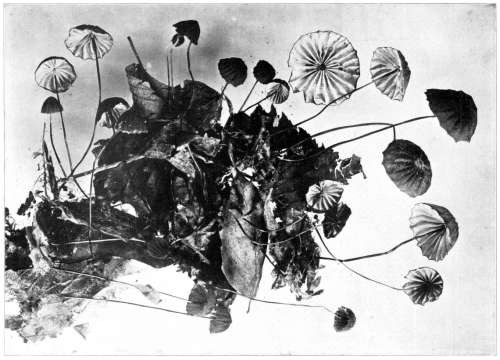
Plate XVII. Figure 110.—Marasmius siccus. Natural size. The cap ochraceous red, the disks somewhat darker, the stems shining and blackish-brown.
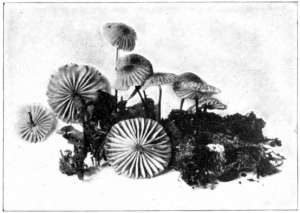
Figure 111.—Marasmius siccus. Natural size. Caps deeply furrowed and pinkish.
This is a very beautiful plant found in the woods after a rain, growing from the leaves. They are found singly, but usually in groups.
The pileus is at first nearly conical, then campanulate, membranaceous, dry, smooth, furrows radiating from almost the center, growing larger as they approach the margin, ochraceous-red, the disk a little darker.
The gills are free or slightly attached, few, distant, broad, narrowed toward the stem, whitish.
The stem is hollow, tough, smooth, shining, blackish-brown, two to three inches long. The pileus is about a half inch broad.
The plant is quite common in our woods. I have not found it elsewhere. The plants in the photograph represent the pink form, which is not so common as the ochraceous-red. In the pink form the center of the cap and the apex of the stem is a delicate pink, which gives the plant a beautiful appearance.
Found from June to October. I have not tested it but have no doubt of its esculent qualities.
Marasmius fagineus. Morgan.
Fagineus means belonging to beech.
Pileus a little fleshy, convex then plane or depressed, at length somewhat repand, rugose-striate, reddish-pallid or alutaceous.
The gills are short-adnate, somewhat crisped, close, pale reddish.
The stem is short, hollow, pubescent, thickened upward, concolorous; the base somewhat tuberculose. Morgan, Myc. Flora M. V.
This plant is quite frequently found in our woods growing on the bark at the base of living beech trees. Its habitat, its reddish or alutaceous cap, and its paler gills will clearly identify the species.
Marasmius peronatus. Fr.
The Masked Marasmius.
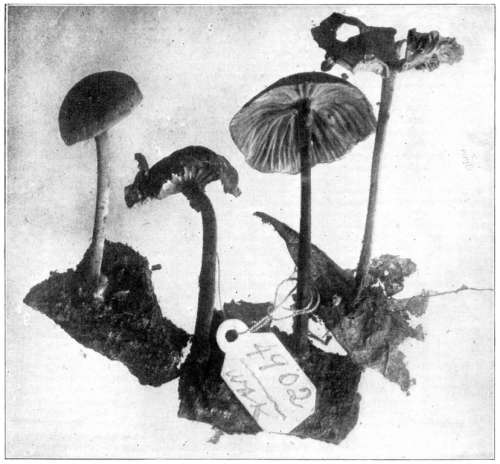
Figure 112.—Marasmius peronatus. Natural size. Cap reddish-buff. Gills creamy or light reddish-brown.
Peronatus is from pero, a boot.
The pileus is reddish-buff, convex, slightly flattened at the top, quite wrinkled when old; diameter, at full expansion, between one and two inches, margin striate.
The gills are thin and crowded, creamy, becoming light reddish-brown, continuing down the stem by a short curve.
The stem is fibrous-stuffed, pale, densely clothed at the base with stiff yellowish hairs.
It grows in the woods, among dead leaves, from May till frost.
It is usually solitary yet is sometimes found in clusters. It has been eaten frequently without injury, but by most writers is branded poisonous. It is quite acrid, but that disappears in cooking. The dense yellow hairs at the base of the stem appear to constitute the distinguishing characteristic. Found from July to October.
Marasmius ramealis. Fr.
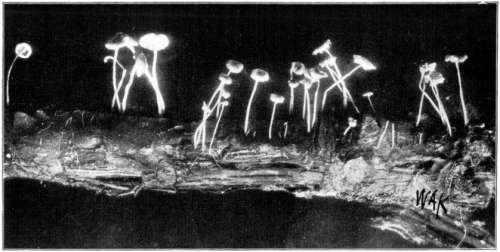
Figure 113.—Marasmius ramealis. Natural size.
Ramealis means a branch or stick; so called because the plant is found growing on sticks, in open woods.
The pileus is very small, somewhat fleshy, plane or a trifle depressed, obtuse, not striate, slightly rugulose, opaque.
The gills are attached to the stem, somewhat distant, narrow, white.
The stem is about one inch long, stuffed, mealy, white, inclined to be rufescent at the base.
The spores are elliptical, 4×2µ.
This is a very pretty plant, but easily overlooked. It is found on oak and beech branches, frequently in large groups. Figure 113 illustrates their mode of growth and will assist the collector in identifying the species. Not poisonous, but too small to gather. Found from July to October. The specimens in Figure 113 were found in Haynes' Hollow near Chillicothe and photographed by Dr. Kellerman.
Marasmius saccharinus. Batsch.
Granular Marasmius. Edible.
Saccharinus is from saccharum, sugar; it is so called because the white pileus looks very much like loaf sugar.
The pileus is entirely white, membranaceous, convex, somewhat papillate, smooth, sulcate and plicate.
The gills are broadly and firmly attached to the stem, narrow, thick, very distant, united by veins, whitish.
The stem is quite thin, thread-form, attenuated upward, at first flocculose, at length becoming smooth, inserted obliquely, reddish, pale at the apex. Spores, 5×3µ.
Quite common in wet weather on dead oak limbs in woods. This plant differs from M. epiphyllus in its habitat, in the papillate form of its pileus and the stem's being flocculose, then smooth; also in that the gills are united in a reticulated manner. Common. July to October.
Marasmius epiphyllus. Fr.
The Leaf Marasmius. Edible.
Epiphyllus means growing on leaves.
The pileus is white, membranaceous, nearly plane, at length umbilicate, smooth, wrinkled, plicate.
The gills are firmly attached to the stem, white, connected by veins, entire, distant, few.
The stem is rather horny, bay, minutely velvety, apex pale, inserted. The spores are 3×2µ. This plant is abundant everywhere, on fallen leaves in woods during rainy weather. July to October.
Marasmius delectans. Morgan.
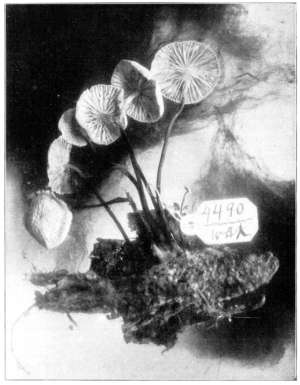
Figure 114.—Marasmius delectans. Natural size. Caps white. Gills broad and distant.
Delectans means pleasing or delightful.
The pileus is subcoriaceous, convex, then expanded and depressed, glabrous, rugulose, white, changing in drying to pale alutaceous.
The gills are moderately broad, unequal, rather distant, trabeculate between, white, emarginate, adnexed; the spores are lance-oblong, hyaline, 7–9×4µ.
The stem, arising from an abundant white-floccose mycelium, is long, slender, tapering slightly upward, smooth, brown and shining, white at the apex.
It is found growing on old leaves in woods. The plants in the figure were collected in the woods at Sugar Grove, Ohio, by R. A. Young, July 28, 1906, and photographed by Dr. Kellerman. Found from July to October.
Marasmius nigripes. Schw.
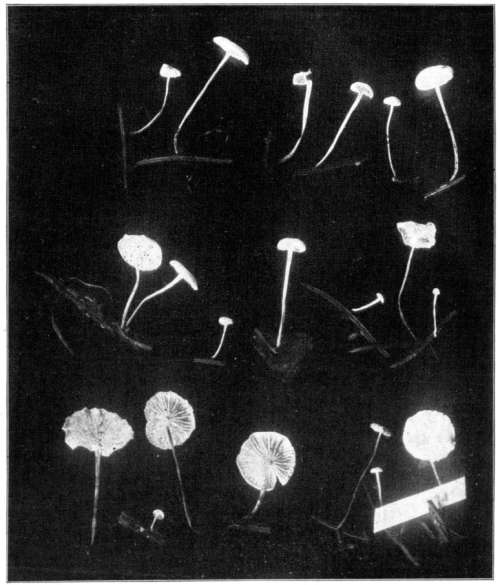
Figure 115.—Marasmius nigripes. Natural size. Caps and gills white, stems black.
Nigripes means black foot, so called because the stems are black.
Tremmelloid. Pileus very thin, pure white, pruinose, rugulose-sulcate, convex then expanded.
The gills are pure white, unequal, some of them forked, adnate, the interstices venulose.
The stem is thickest at the apex, tapering downward, black, white-pruinose, the base insititious. Morgan.
It is found on old leaves, sticks, and old acorns and hickory-nuts. When dry, the stem loses its black color and the gills become flesh-color. It is quite common in thin and open woods. The spores are hyaline and stellate, 3–5-rayed. Found from July to October.
This is called Heliomyces nigripes by some authors.
Pleurotus. Fr.
Pleurotus is from two Greek words meaning side and ear, alluding to its manner of growth on a log. This genus is very common everywhere in Ohio, and is easily determined by its eccentric, lateral, or even absent stem, but it must have white spores, and the characteristics of the Agaricini.
Pileus fleshy in the larger species and membranaceous in the smaller forms, but never becoming woody. Stem mostly lateral or wanting; when present, continuous with cap. Gills with sinus or broadly decurrent, toothed.
Grows in woods.
Pleurotus ostreatus. Jacq.
The Oyster Mushroom. Edible.
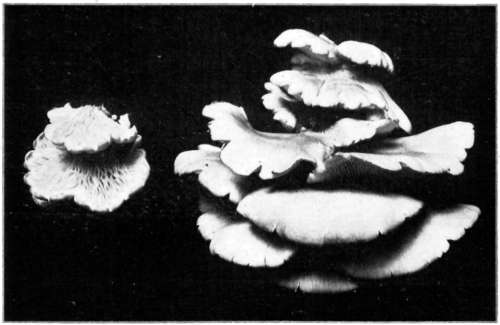
Figure 116.—Pleurotus ostreatus. Two-thirds natural size. Often growing very large.
Pileus two to six inches broad, soft, fleshy, convex, or slightly depressed behind, subordinate, often cespitosely imbricated, moist, smooth, margin involute; whitish, cinereous or brownish; flesh white, the whole surface shining and satiny when dry.
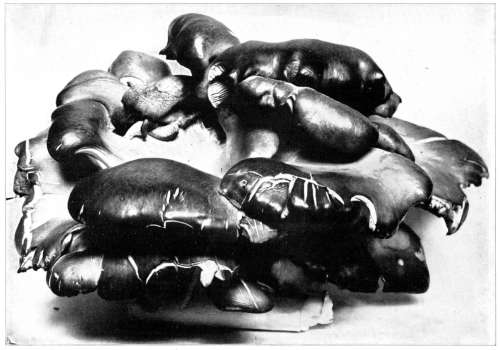
Plate XVIII. Figure 117.—Pleurotus ostreatus. Two-thirds natural size.
Gills broad, decurrent, subdistant, branching at the base, white or whitish. The stem when present is very short, firm, lateral, sometimes rough with stiff hair, hairy at the base. Spores oblong, white, .0003 to .0004 inch long, .00016 inch broad.
This is one of our most abundant mushrooms, and the easiest for the beginner to identify. In Figures 116 and 117, you will see the plant growing in imbricated form apparently without any stem. In Figure 118 is a variety that has a pronounced stem, showing how the stems grow together at the base, the slight grooving on the stems, also the decurrent gills. In most of these plants the stems are plainly lateral, but a few will appear to be central. It will be difficult to distinguish it from the Sapid mushroom and for table purposes there is little need to separate them. In Ohio the Oyster mushroom is very common everywhere. I have seen trees sixty to seventy feet high simply loaded with this mushroom. If one will locate a few logs or stumps upon which the Oyster mushroom grows, he can find there an abundant supply (when conditions are right for fungus growth) during the entire season. It is almost universally a favorite among mushroom eaters, but it must be carefully and thoroughly cooked. It grows very large and frequently in great masses. I have often found specimens whose caps were eight to ten inches broad. It is found from May to December.
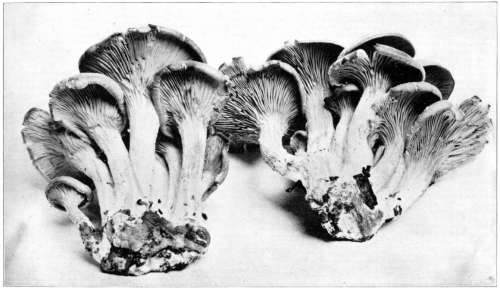
Figure 118.—Pleurotus ostreatus. One-half natural size, showing gills and stems.
Pleurotus salignus. Fr.
The Willow Pleurotus. Edible.
Salignus, from salix, a willow. Pileus is compact, nearly halved, horizontal, at first cushion-shaped, even, then with the disk depressed, substrigose, white or fuliginous. The stem, eccentric or lateral, sometimes obsolete, short, white-tomentose. The gills are decurrent, somewhat branched, eroded, distinct at the base, nearly of the same color. Spores .00036 by .00015 inch. Fries.
I found this species near Bowling Green on willow stumps. About every ten days the stumps offered me a very excellent dish, better than any meat market could afford. September to November.
Pleurotus ulmarius. Bull.
The Elm Pleurotus. Edible.
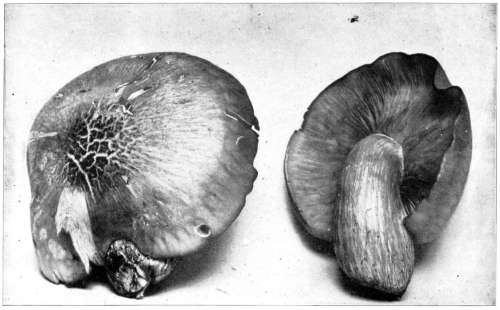
Figure 119.—Pleurotus ulmarius. One-third natural size.
Ulmarius, from ulmus, an elm. It takes its name from its habit of growing on elm trees and logs. It appears in the fall and may be found in company with the Oyster mushroom, late in December, frozen solid. This species is frequently seen on elm trees, both dead and alive, on live trees where they have been trimmed or injured in some way. It is often seen on elms in the cities, where the elm is a common shade tree. Its cap is large, thick and firm, smooth and broadly convex, sometimes pale yellow or buff. Frequently the epidermis in the center of the cap cracks, giving the surface a tessellated appearance as in Figure 119. The flesh is very white and quite compact. The gills are white or often becoming tawny at maturity, broad, rounded or notched, not closely placed, sometimes nearly decurrent. The stem is firm and solid, various in length, occasionally very short, inclined to be thick at the base and curved so that the plant will be upright, as will be seen in Figure 119.
The cap is from three to six inches broad. A specimen that measured over ten inches across the cap, was found some thirty feet high in a tree. While it was very large, it was quite tender and made several meals for two families. But this species is not limited entirely to the elm. I found it on hickory, about Chillicothe. There are a few elm logs along my rambles that afford me fine specimens with great regularity. Insects do not seem to infest it as they do the ostreatus and the sapidus. Sometimes, when the plant grows from the top of a log or the cut surface of a stump, the stem will be longer, straight, and in the center of the cap. This form is called by some authors var. verticalis.
For my own use I think the Elm mushroom, when properly prepared, very delicious. Like all tree mushrooms it should be eaten when young. It is easily dried and kept for winter use. Found from September to November.
Pleurotus petaloides. Bull.
The Petaloid Pleurotus. Edible.
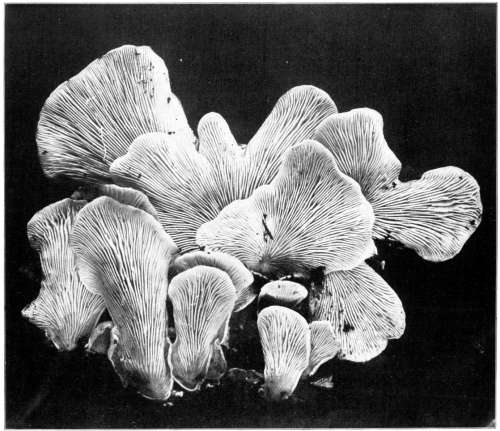
Figure 120.—Pleurotus petaloides.
This species is so called from its likeness to the petals of a flower. Pileus fleshy, spathulate, entire; margin at first involute, finally fully expanded; villous, depressed. The stem is compressed and villous, often channelled, nearly erect. The gills are strongly decurrent, crowded, narrow, and white or whitish. Spores minutely globose, .0003 by .00015.
The plant varies very greatly in form and size. Its chief characteristic is the presence of numerous short white cystidia in the hymenium, which dot the surface of the hymenium, and under an ordinary pocket lens give to the gills a sort of fuzzy appearance. Frequently it will have the appearance of growing from the ground, but a careful examination will reveal a piece of wood of some kind, which serves as a host for the mycelium. I have found this plant but a few times, It seems to be quite rare in our state, especially in the southern part of the state. The plants in Figure 120 were photographed by Prof. G. D. Smith of Akron, Ohio.
Pleurotus sapidus. Kalchb.
The Sapid Pleurotus. Edible.
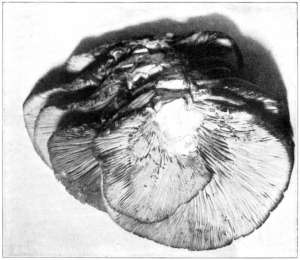
Figure 121.—Pleurotus sapidus. One-third natural size, showing imbricated growth. Spores lilac.
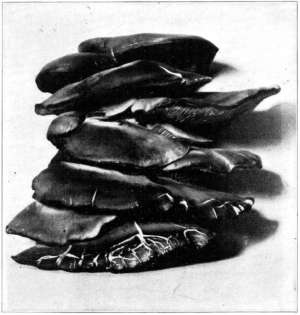
Figure 122.—Pleurotus sapidus.
Sapidus, savory. This plant grows in clusters whose stems are more or less united at the base as in Figure 121. The caps when densely crowded are often irregular. They are smooth and vary much in color, being whitish, ash-gray, brownish, yellowish-gray.
The flesh is thick and white. The gills are white or whitish, rather broad, running down on the stem, and slightly connected, at times, by oblique or transverse branches. The stem is generally short, solid, several usually springing from a thickened base, white or whitish and either laterally or eccentrically connected with the cap.
This plant is classed with the white-spored species, yet its spores, after a short exposure to the air, really exhibit a pale lilac tint. This can only be seen when the spores are in sufficient quantity and resting on a suitable surface.
The size of the plant varies, the cap being commonly from two to five inches long. It grows in woods and open places, on stumps and logs of various kinds. Its edible quality is quite as good as the Oyster mushroom. The only way by which it can be distinguished from the P. ostreatus is by its lilac-tinted spores. It is found from June to November.
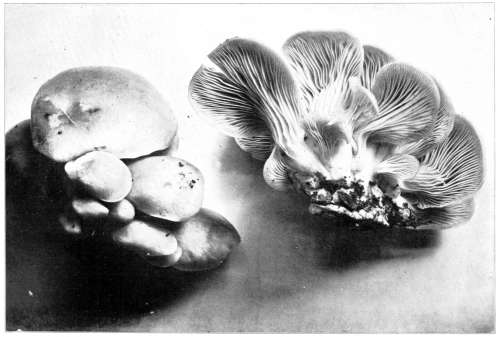
Photo by C. G. Lloyd.
Plate XX. Figure 123.—Pleurotus sapidus.
Pleurotus serotinoides. Pk.
The Yellowish Pleurotus. Edible.
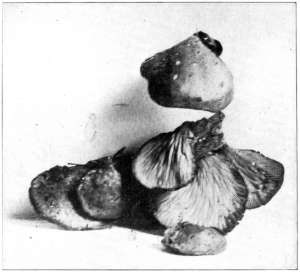
Figure 124.—Pleurotus serotinoides. One-third natural size.
Serotinoides, like serotinus, which means late-coming; from its appearing in the winter.
The pileus is fleshy, one to three inches broad, compact, convex or nearly plane, viscid when young and moist, half-kidney-shaped, roundish, solitary or crowded and imbricated, variously colored, dingy-yellow, reddish-brown, greenish-brown or olivaceous, the margin at first involute.
The gills are close, determinate, whitish or yellowish.
The stem is very short, lateral, thick, yellowish beneath, and minutely downy or scaly with blackish points.
The spores are minute, elliptical, .0002 inch long, .0001 inch broad.
There is probably no difference between this and P. serotinus, the European species. It is a beautiful plant. The color and size are quite variable. I found it on Ralston's Run and in Baird's woods on Frankfort Pike. It is found from September to January.
Pleurotus applicatus. Batsch.
Little Gray Pleurotus.
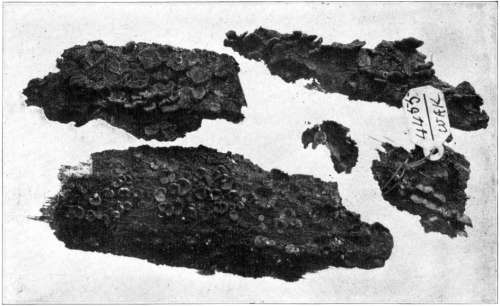
Figure 125.—Pleurotus applicatus. Natural size.
Applicatus means lying upon or close to; so named from the sessile pileus. The pileus is one-third of an inch across, when young cup-shaped, dark cinereous, somewhat membranaceous, quite firm, resupinate, then reflexed, somewhat striate, slightly pruinose, villous at the base.
The gills are thick, broad in proportion to the size of the cap, distant, radiating, gray, the margin lighter, sometimes the gills are as dark as the pileus.
Sometimes it is attached only by the center of the pileus; sometimes, growing on the side of a shelving log, it is attached laterally. It is not as abundant as some other forms of Pleurotus. It differs from P. tremulus in absence of a distinct stem.
Pleurotus cyphellæformis. Berk.
Cyphellæformis means shaped like the hollows of the ears. The pileus is cup-shaped, pendulous, downy or mealy, upper layer gelatinous, gray, very minutely hairy, especially at the base, margin paler.
The gills are narrow, rather distant, pure white, alternate ones being shorter. These are very small plants, found only in damp places on dead herbaceous plants. They resemble a Cyphella griseo-pallida in habit.
Pleurotus abscondens. Pk.
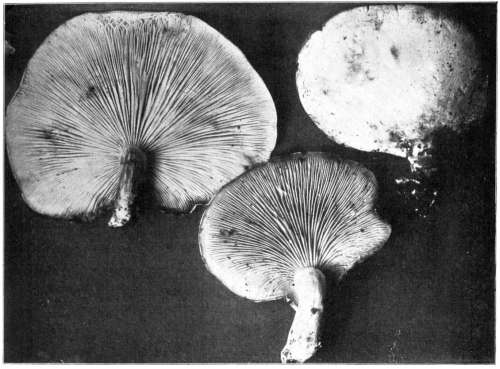
Figure 126.—Pleurotus abscondens. Entire plant white.
Abscondens means keeping out of view. It is so called because it persists in growing in places where it is hidden from sight.
The pileus is often two and a half inches broad, delicate-white, strong stringent odor, usually pruinose, margin slightly incurved.
The gills are attached to the stem, rather crowded, very white, somewhat narrow.
The stem is short, solid, pruinose, usually lateral, and curved.
The plant usually grows in hollow stumps or logs, and in this case the stem is always lateral and the plant grows very much as does the P. ostreatus, except that they are not imbricated. Occasionally the plant is found on the bottom of a hollow log and in that case the cap is central and considerably depressed in the center. I have never seen it growing except in a hollow stump or log. Its manner of growth and its delicate shape of white will serve to identify it. It is found from August to November.
Pleurotus circinatus. Fr.
Circinatus means to make round, referring to the shape of the pileus.
The pileus is two to three inches broad, white, plane, orbicular, convex at first, even, covered over with silky-pruinose lustre.
The gills are adnate-decurrent, rather crowded, quite broad, white.
The stem is equal, smooth, one to two inches long, stuffed, central or slightly eccentric, rooted at the base.
The form of these plants is quite constant and the round white caps will at first suggest a Collybia. The white gills and its decurrent form will distinguish it from P. lignatilis. It makes quite a delicious dish when well cooked. I found some beautiful specimens on a decayed beech log in Poke Hollow. Found in September and October.
Lactarius. Fr.
Lactarius means pertaining to milk. There is one feature of this genus that should easily mark it, the presence of milky or colored juice which exudes from a wound or a broken place on a fresh plant. This feature alone is sufficient to distinguish the genus but there are other points that serve to make the determination more certain.
The flesh, although it seems quite solid and firm, is very brittle. The fracture is always even, clean cut, and not ragged as in more fibrous substances.
The plants are fleshy and stout, and in this particular resemble the Clitocybes, but the brittleness of the flesh, milky juice, and the marking of the cap, will easily distinguish them.
Many species have a very acrid or peppery flavor. If a person tastes one when raw, he will not soon forget it. This acridity is usually lost in cooking.
The pileus in all species is fleshy, becoming more or less depressed, margin at first involute, often marked with concentric zones.
The stem is stout, often hollow when old, confluent with the cap.
The gills are usually unequal, edge acute, decurrent or adnate, milky; in nearly all the species the milk is white, changing to a sulphur yellow, red, or violet, on exposure to the air.
Lactarius torminosus. Fr.
The Woolly Lactarius. Poisonous.
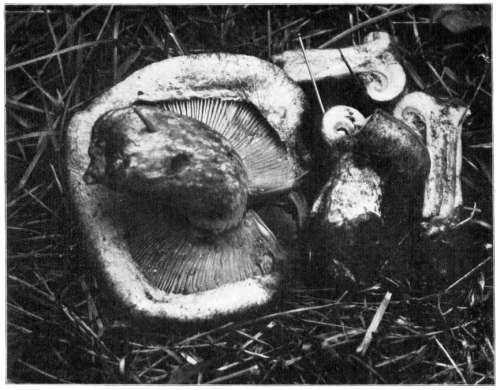
Figure 127.—Lactarius torminosus. Three-fourths natural size. Caps yellowish-red or ochraceous tinged with red, margin incurved.
Torminosus, full of grips, causing colic. The pileus is two to four inches broad, convex, then depressed, smooth, or nearly so, except the involute margin which is more or less shaggy, somewhat zoned, viscid when young and moist, yellowish-red or pale ochraceous, tinged with red.
The gills are thin, close, rather narrow, nearly of the same color as the pileus, but yellower and paler, slightly forked, subdecurrent.
The stem is one to two inches long, paler than the cap, equal or slightly tapering downward, stuffed or hollow, sometimes spotted, clothed with a very minute adpressed down.
The milk is white and very acrid. The spores are echinulate, subglobose, 9–1O×7–8µ.
This differs from L. cilicioides in its zoned pileus and white milk. Most authorities speak of it as dangerous. Captain McIlvaine speaks of the Russians as preserving it in salt and eating it seasoned with oil and vinegar. They grow in the woods, open places, and in fields. The specimens in Figure 127 were found in Michigan and photographed by Dr. Fischer.
Lactarius piperatus. Fr.
The Peppery Lactarius. Edible.
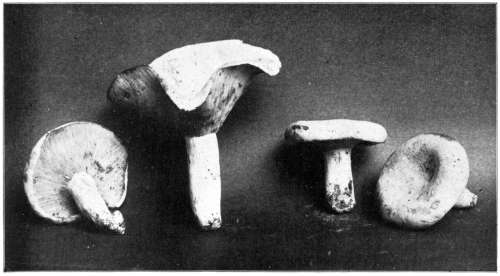
Figure 128.—Lactarius piperatus. One-third natural size.
Piperatus—having a peppery taste. The pileus is creamy-white, fleshy, firm, convex, then expanded, depressed in the center, dry, never viscid, and quite broad.
The gills are creamy-white, narrow, close, unequal, forked, decurrent, adnate, exuding a milky juice when bruised, milky-white, very acrid.
The stem is creamy white, short, thick, solid, smooth, rounded at the end, slightly tapering at the base. Spores generally with an apiculus, .0002 by .00024 inch.
The plant is found in all parts of Ohio, but most people are afraid of it on account of its very peppery taste. Although it can be eaten without harm, it will never prove a favorite.
It is found in open woods from July to October. In its season is one of the very common plants in all of our woods.
Lactarius pergamenus. Fr.
Pergamenus is from pergamena, parchment. The pileus is convex, then expanded, plane, depressed, wavy, wrinkled, without zones, often repand, smooth, white.
The gills are adnate, very narrow, tinged with straw-color, often white, branched, much crowded, horizontal.
The stem is smooth, stuffed, discolored, not long. The milk is white and acrid. Spores, 8×6. It differs from L. piperatus in its crowded, narrow gills and longer stem. Found in woods from August to October.
Lactarius deceptivus. Pk.
Deceiving Lactarius. Edible
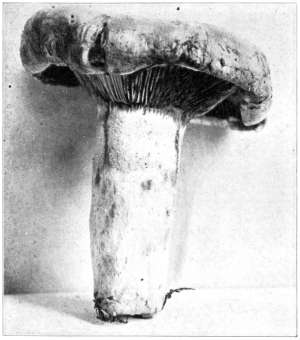
Figure 129.—Lactarius deceptivus.
Deceptivus means deceiving.
The pileus is three to five inches broad, compact, at first convex, and umbilicate, then expanded and centrally depressed or subinfundibuliform, obsoletely tomentose or glabrous except on the margin, white or whitish, often varied with yellowish or sordid strains, the margin at first involute and clothed with a dense, soft cottony tomentum, then spreading or elevated and more or less fibrillose.
The gills are rather broad, distant or subdistant, adnate or decurrent, some of them, forked, whitish, becoming cream-colored.
The stem is one to three inches long, equal or narrowed downward, solid, pruinose-pubescent, white. Spores are white, 9–12.7µ. Milk white, taste acrid.
This plant delights in woods and open groves, especially under coniferous trees. It is a large, meaty, acrid white species, with a thick, soft, cottony tomentum on the margin of the pileus of the young plant.
The specimen photographed was sent me from Massachusetts by Mrs. Blackford. It grows in July, August and September. Its sharp acridity is lost in cooking, but like all acrid Lactarius it is coarse and not very good.
Lactarius indigo. (Schw.) Fr.
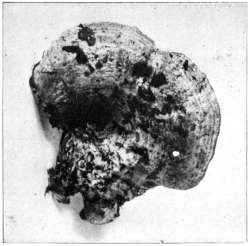
Figure 130.—Lactarius indigo. One-third natural size. Entire plant indigo blue.
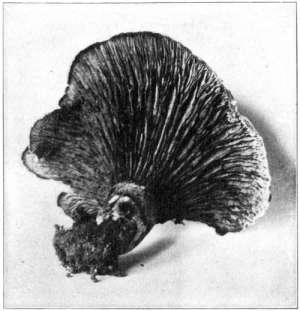
Figure 131.—Lactarius indigo. One-third natural size, showing gills.
This is one of our most striking plants. No one can fail to recognize it, because of the deep indigo blue that pervades the whole plant. I have found it in only one place, near what is known as the Lone-Tree Hill near Chillicothe. I have found it there on several different occasions.
The pileus is from three to five inches broad, the very young plants seem to be umbilicate with the margin strongly incurved, then depressed or funnel-shaped; as the plant ages the margin is elevated and sometimes waved. The entire plant is indigo blue, and the surface of the cap has a silvery-gray appearance through which the indigo color is seen. The surface of the cap is marked with a series of concentric zones of darker shade, as will be seen in Figure 130 especially on the margin; sometimes spotted, becoming paler and less distinctly zonate with age or in drying.
The gills are crowded, indigo blue, becoming yellowish and sometimes greenish, with age.
The stem is one to two inches long, short, nearly equal, hollow, often spotted with blue, colored like the pileus.
It is edible but rather coarse. Found in open woods July and August.
Lactarius regalis. Pk.
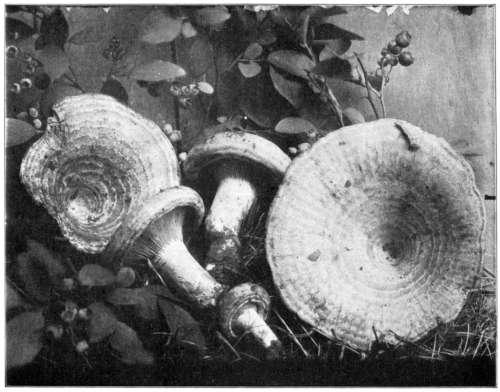
Figure 132.—Lactarius regalis. Natural size. Caps white, tinged with yellow.
Regalis means regal; so named from its large size. The pileus is four to six inches broad, convex, deeply depressed in the center; viscid when moist; often corrugated on the margin; white, tinged with yellow.
The gills are close, decurrent, whitish, some of them forked at the base.
The stem is two to three inches long and one inch thick, short, equal, hollow. The taste is acrid and the milk sparse, white, quickly changing to sulphur-yellow. The spores are .0003 of an inch in diameter. Peck.
This is frequently a very large plant, resembling in appearance L. piperatus but easily recognized because of its viscid cap and its spare milk changing to yellow, as in L. chrysorrhæus. It grows on the ground in the woods, in August and September. I find it here chiefly on the hillsides. The specimens in Figure 132 were found in Michigan and photographed by Dr. Fischer.
Lactarius scrobiculatus. Fr.
The Spotted-Stemmed Lactarius.
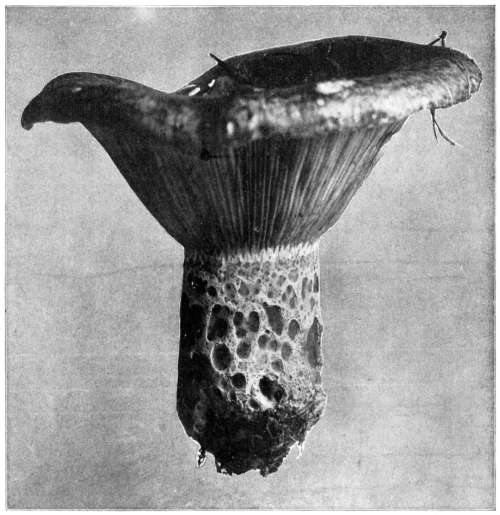
Photo by C. G. Lloyd.
Figure 133.—Lactarius scrobiculatus. Natural size. Caps reddish-yellow, zoned. Margin very much incurved, stem pitted.
Scrobiculatus is from scrobis, a trench, and ferro, to bear, referring to the pitted condition of the stem. The pileus is convex, centrally depressed, more or less zoned, reddish-yellow, viscid, the margin very much incurved, downy.
The gills are adnate, or slightly decurrent, whitish, and often very much curled, because of the incurved condition of the cap at first.
The stem is equal, stuffed, adorned often with pits of a darker color.
The spores are white, juice white, then yellowish.
The plant is very acrid to the taste, and solid. Too hot to be eaten. I have found it only a few times on the hills of Huntington township, near Chillicothe. The yellowish hue and markedly incurved margin will identify the plant. Found in August and September.
Lactarius trivialis. Fr.
Figure 134.—Lactarius trivialis. One-half natural size. Caps light tan with a pinkish hue. Very acrid.
Trivialis means common.
The pileus is three to four inches broad, usually damp or watery, sometimes quite viscid, shining when dry, convex, then expanded, depressed in the center, margin at first incurved, even, smooth; warm, soft tan, rather light, and sometimes a very slight pinkish hue prevails. The flesh is solid and persistent.
The gills are rather crowded, slightly decurrent, at first whitish, then a light yellow, many not reaching to the stem, none forked. The stem is from three to four inches long, of same color as the pileus, often a much lighter shade; tapering from the cap to the base, smooth, stuffed, and finally hollow. The plant is quite full of milk, white at first, then turning yellowish.
The plant is very acrid and peppery. It is quite plentiful along the streams of Ross county, Ohio. It is not poisonous, but it seems too hot to eat. It is found after rains from July to October, in mixed woods where it is damp.
Lactarius insulsus. Fr.
Figure 135.—Lactarius insulsus. One-third natural size. Caps yellowish or straw color. Very acrid.
Insulsus, insipid or tasteless. This is a very attractive plant. Quite solid and maintains its form for several days; The pileus is two to four inches broad, convex, depressed in the center, then funnel-shaped, smooth, viscid when moist, more or less zoned, the zones much narrower than L. scrobiculatus, yellowish or straw-color, margin slightly incurved and naked.
The gills are thin, rather crowded, adnate and sometimes decurrent, some of them forked at the base, whitish or pallid. Spores subglobose, rough, 10×8µ.
The stem is one to two inches long, equal or slightly tapering downward, stuffed, whitish, generally spotted. Milk, white.
Most authorities class this as an edible plant, but it is so hot and the flesh so solid that I have never tried it. I found two plants which fully answered the description of the European plants. The zones were orange-yellow and brick-red. I have visited the place many times since, but have never been able to find another. It is not an abundant plant with us. Found from July to October, in open woods.
Lactarius lignyotus. Fr.
The Sooty Lactarius. Edible.
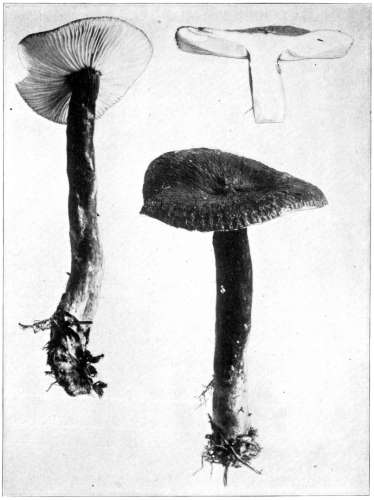
Photo by C. G. Lloyd.
Plate XXI. Figure, 136.—Lactarius lignyotus. Natural size. Caps a sooty umber. Flesh mild to the taste.
Lignyotus is from lignum, wood. The pileus is one to four inches in diameter, fleshy, convex, then expanded, sometimes slightly umbonate, often in age slightly depressed, smooth or often wrinkled, pruinosely velvety, sooty umber, the margin in the old plants wavy and distinctly plaited; the flesh white and mild to the taste.
The gills are attached to the stem; unequal; snow-white or yellowish-white, slowly changing to a pinkish-red or salmon color when bruised; distant in old plants.
The stem is one to three inches long, equal, abruptly constricted at the apex, smooth, stuffed, of the same color as the pileus. Milk white, taste mild or tardily acrid. The spores are globose, yellowish, 9–11.3µ.
This is called the Sooty Lactarius and is very easily identified. It will be frequently found associated with the Smoky Lactarius which it greatly resembles. It seems to delight in wet swampy woods. It is said to be one of the best of the Lactarii. The specimens in Figure 136 were collected at Sandusky, Ohio, and photographed by Dr. Kellerman.
Lactarius cinereus. Pk.
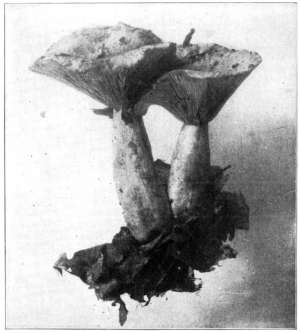
Figure 137.—Lactarius cinereus.
Cinereus is from cineres, ashes; so called from the color of the plant.
The pileus is one to two and a half inches broad, zoneless, somewhat viscid, floccose-scaly, depressed in the center, margin thin, even, flesh thin and white, mild to the taste, ashy-gray.
The gills are adnate, rather close, sometimes forked (usually near the stem), uneven, white or creamy-white, milk white, not plentiful.
The stem is two to three inches long, tapering upward, loosely stuffed, finally hollow, often floccose at the base.
This plant is quite common from September to November, growing in damp weather on leaves in mixed woods. It has a mild taste. While I have not eaten it I have no doubt of its edibility. The color of the pileus is sometimes quite dark.
Lactarius griseus. Pk.
Gray Lactarius.
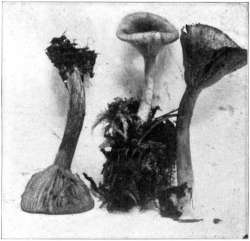
Figure 138.—Lactarius griseus.
Griseus means gray.
The pileus is thin, nearly plane, broadly umbilicate or centrally depressed, sometimes infundibuliform, generally with a small umbo or papilla, minutely squamulose tomentose, gray or brownish-gray, becoming paler with age.
The gills are thin, close, adnate, or slightly decurrent, whitish or yellowish.
The stem is slender, equal or slightly tapering upward, rather fragile; stuffed or hollow; generally villose or tomentose at the base; paler than, or colored like, the pileus.
The spores are .0003 to .00035 inch; milk white, taste subacrid. Pileus is 6 to 18 lines broad, stem 1 to 2 inches long, 1 to 3 lines thick. Peck.
It resembles L. mammosus and L. cinereus. It differs from the former in not having ferruginous gills and pubescent stems, and from the latter by its smaller size, its densely pubescent pileus, and its habitat. It grows on mossy logs or in mossy swamps. The base of one of the plants in Figure 138 is covered with the moss in which they grew. These plants were found in Purgatory Swamp, near Boston, by Mrs. Blackford. They grow from July to September.
Lactarius distans. Pk.
The Distant-Gilled Lactarius. Edible.
Distans means distant, so called because the gills are very wide apart.
The pileus is firm, broadly convex or nearly plane, umbilicate or slightly depressed in the center; with a minute, velvety pruinosity; yellowish-tawny or brownish-orange.
The gills are rather broad, distant, adnate or slightly decurrent, white or creamy yellow, interspaces veined; milk white, mild.
The stem is short, equal or tapering downward, solid, pruinose, colored like the pileus.
The spores are subglobose, 9–11µ broad. Peck, N. Y. Report, 52.
I frequently mistake this plant for L. volemus when seen growing in the ground, but the widely separated gills distinguish the plant as soon as it is gathered. The stem is short and round, tapering downward, solid, colored like the pileus. The milk is both white and mild. I find it on nearly every wooded hillside about Chillicothe. It is found from July to September.
Lactarius atroviridus. Pk.
The Dark-Green Lactarius.
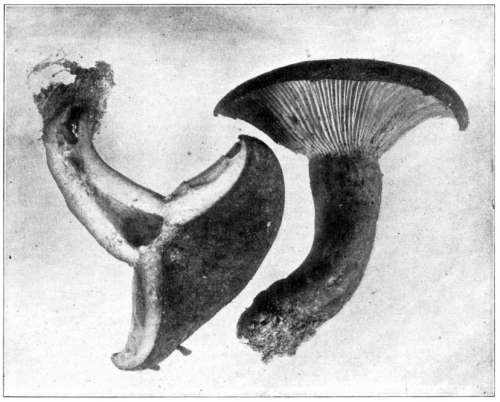
Figure 139.—Lactarius atroviridus. Cap and stem dark green. Cap depressed in center. Gills white.
Atroviridus is from ater, black; viridus, green; so called from the color of the cap and the stem of the plant.
The pileus is convex, plane, then depressed in the center, with an adherent pellicle, greenish with darker scales, margin involute.
The gills are slightly decurrent, whitish, broad, distant; milk white but not copious as in many of the Lactarii.
The stem is quite short, tapering downward, dark green, scaly.
The stem is so short that the cap seems to be right on the ground, hence it is very easily overlooked. It is found only occasionally on mossy hillsides, where there are not too many leaves. The plant in Figure 139 was found in Haynes' Hollow, near Chillicothe. I have found the plant on top of Mt. Logan. It is found from July to October. I do not know of its edibility. All specimens that I have found I have sent to my Mycological friends. It should be tasted with caution.
Lactarius subdulcis. Fr.
The Sweet Lactarius. Edible.
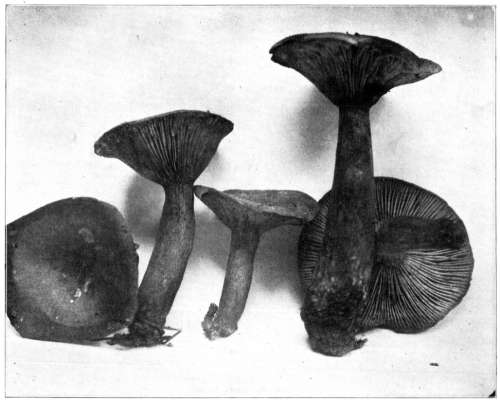
Figure 140.—Lactarius subdulcis.
Subdulcis means almost sweet, or sweetish.
The pileus is two to three inches broad, rather thin, papillate, convex, then depressed, smooth, even, zoneless, cinnamon-red or tawny-red, margin sometimes wavy.
The gills are rather narrow, thin, close, whitish, often reddish or tinged with red. Spores, 9–10µ.
The stem is stuffed, then hollow, equal, slightly tapering upward, slender, smooth, sometimes villous at the base. The milk is white, sometimes rather acrid and unpleasant to the taste when raw. It needs to be cooked a long time to make it good.
It is likely to be found anywhere, but it does best in damp places. The plants found with us all seem to have red or cinnamon-red gills, especially before the spores begin to fall. They are found growing on the ground, among leaves, or on well-rotted wood and sometimes on the bare ground. Found from July to November.
Lactarius serifluus. Fr.
Serifluus means flowing with serum, the watery part of milk.
The pileus is fleshy, depressed in the center, dry, smooth, not zoned, tawny-brown, margin thin, incurved.
The gills are crowded, light-brown, or yellowish, milk scanty and watery.
The stem is solid, equal, paler than the pileus. Spores, 7–8µ.
It differs from L. subdulcis in having a solid stem and perhaps a shade darker color. Found in woods, July to November.
Lactarius corrugis. Pk.
The Wrinkled Lactarius. Edible.
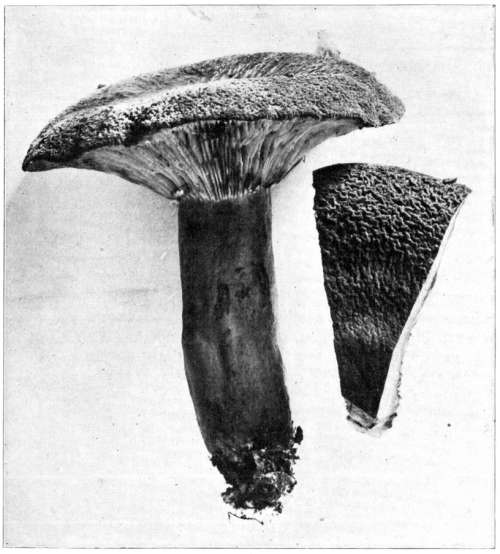
Figure 141.—Lactarius corrugis. Caps wrinkled, tawny-brown. Gills orange-brown.
Corrugis means wrinkled.
The pileus is convex, plane, expanded, slightly depressed in the center; surface of the cap wrinkled, dry, bay-brown; margin at first involute.
The gills are adnexed, broad, yellowish or brownish-yellow, growing paler with age. The stem is rather short, equal, solid, pruinose, of the same color as the pileus. The spores are subglobose, 10–13µ.
This species looks very much like L. volemus, and its only essential difference is in the wrinkled form, and color of the pileus. The milk when dry is very sticky and becomes rather black. It has just a touch of acridity.
Any one determining this species will not fail to note the number of brown cystidia or setæ, in the hymenium, which project above the surface of the gills. They are so numerous and so near the edge of the gills that they give these a downy appearance. The quality of this species is even better than L. volemus, though it is not as abundant here as the latter. Found in thin woods from August to September. The photograph, Figure 141, was made by Prof. H. C. Beardslee.
Lactarius volemus. Fr.
The Orange-Brown Lactarius. Edible.
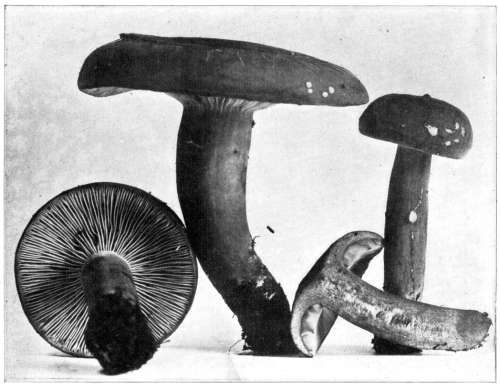
Photo by Prof. Atkinson.
Figure 142.—Lactarius volemus. Natural size. Caps golden-tawny. Milk copious, as will be seen where the plant has been pricked.
Volemus from volema pira, a kind of a pear, so called from the shape of the stem. The pileus is broad, flesh thick, compact, rigid, plane, then expanded, obtuse, dry, golden-tawny, at length somewhat wrinkly.
The gills are crowded, adnate or slightly decurrent, white, then yellowish; milk copious, sweet.
The stem is solid, hard, blunt, generally curved like a pear-stem; its color is that of the pileus but a shade lighter. Spores globose, white.
The milk in this species is very abundant and rather pleasant to the taste. It becomes quite sticky as it dries on your hands. This plant has a good record among mushroom eaters, both in this country and Europe.
There is no danger of mistaking it. The plants grow in damp woods from July to September. They are found singly or in patches. They were found quite plentifully about Salem, Ohio, and also about Chillicothe.
Lactarius deliciosus. Fr.
The Delicious Lactarius. Edible.
Figure 143.—Lactarius deliciosus. One-third natural size. Caps light reddish-yellow. Milk orange color.
Deliciosus, delicious. The pileus is three to five inches broad; color varying from yellow to dull orange or even brownish-yellow with mottled concentric zones of deeper color, especially in younger plants, sometimes a light reddish-yellow, without apparent zones (as is the case of those in Figure 143); convex, when expanded becoming very much depressed; funnel-shaped; smooth, moist, sometimes irregular, wavy; flesh brittle, creamy, more or less stained with orange.
The gills are slightly decurrent in the depressed specimens, somewhat crowded, forked at the stem, short ones beginning at the margin; when bruised exuding a copious supply of milky juice of an orange color; a pale tan-color, turning green in age or in drying. Spores are echinulate, 9–10×7–8µ.
The stem is two to three inches or more, equal, smooth, hollow, slightly pruinose, paler than the cap, occasionally spotted with orange, tinged with green in old plants.
The taste of the raw plant is slightly peppery. It grows in damp woods and is sometimes quite common. Its name suggests the estimation in which it is held by all who have eaten it. Like all Lactarii it must be well cooked. The specimens in Figure 143 were gathered on Cemetery Hill close to the pine trees and in company with Boletus Americanus. Found from July to November. I found the plant in a more typical form about Salem, Ohio.
Lactarius uvidus. Fr.
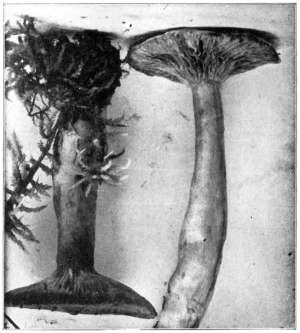
Figure 144.—Lactarius uvidus.
Uvidus is from uva, grape, so called because when exposed to the air changes to the color of a grape.
The pileus is two to four inches broad, flesh rather thin, convex, sometimes slightly umbonate, then depressed in the center, not zoned, viscid, dingy pale ochraceous-tan, margin at first involute, naked, milk mild at first then becoming acrid, white changing to lilac.
The gills are thin, slightly decurrent, crowded, shorter ones very obtuse and truncate behind, connected by veins, white, when wounded becoming lilac.
The stem is soon hollow, two to three inches long, viscid, pallid.
The spores are round, 10µ.
Not only the milk changes to a lilac when cut, but the flesh itself. They are found in damp woods during August and September. The plants in Figure 144 were found near Boston, by Mrs. Blackford. These plants grew in Purgatory Swamp. The Sphagnum moss will be seen at the base of the upright plant.