THE MOTOR SCOUT
Reading edition
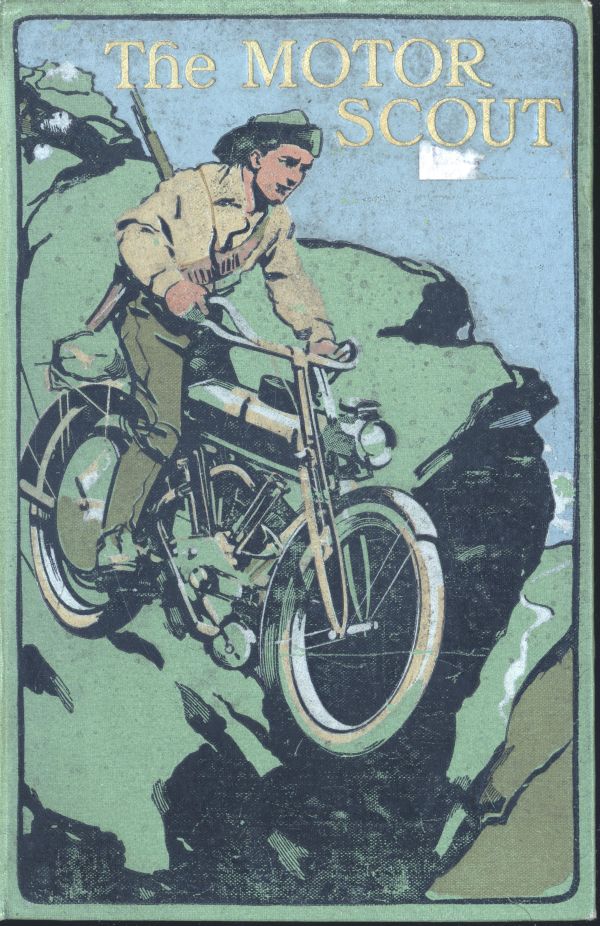
Cover
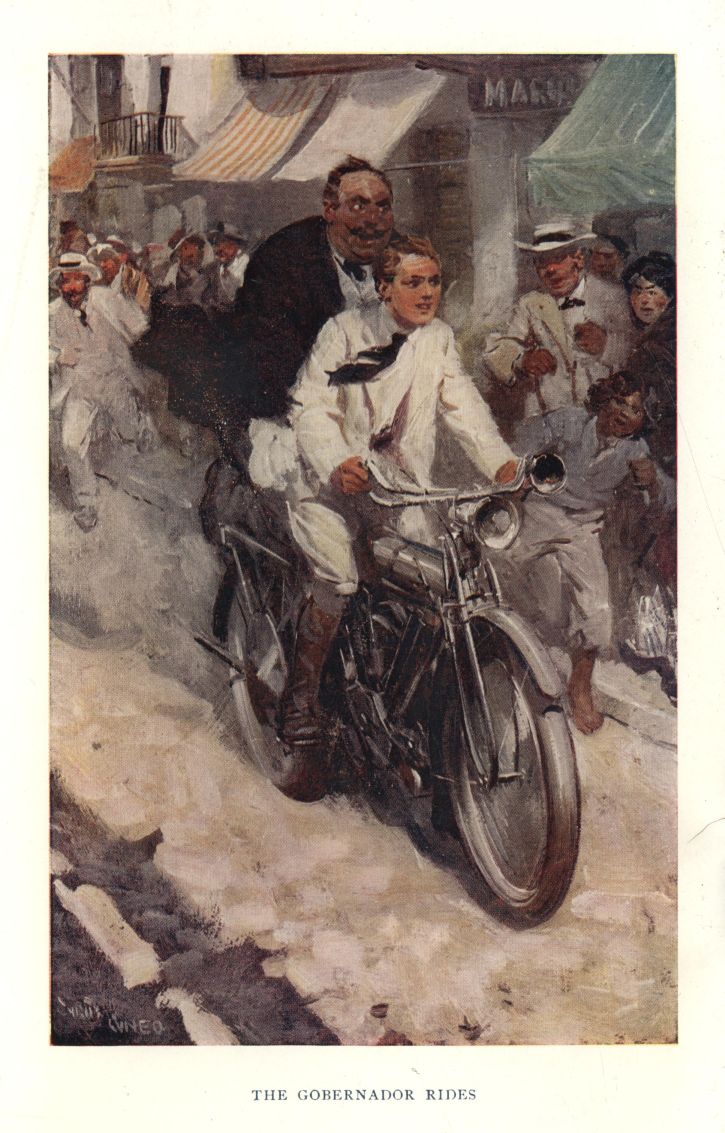
THE GOBERNADOR RIDES
THE MOTOR SCOUT
A STORY OF ADVENTURE IN SOUTH AMERICA
BY
HERBERT STRANG
ILLUSTRATED BY CYRUS CUNEO
LONDON HENRY FROWDE HODDER AND STOUGHTON 1913
RICHARD CLAY & SONS, LIMITED, BRUNSWICK STREET, STAMFORD STREET, S.E., AND BUNGAY, SUFFOLK.
CONTENTS
CHAPTER THE FIRST
BOMBASTES FURIOSO
CHAPTER THE SECOND
COMINGS AND GOINGS
CHAPTER THE THIRD
BENEVOLENCES
CHAPTER THE FOURTH
GAS
CHAPTER THE FIFTH
PARDO DISMISSES HIMSELF
CHAPTER THE SIXTH
TIM IS HELD TO RANSOM
CHAPTER THE SEVENTH
THE PREFECT MOVES
CHAPTER THE EIGHTH
SUSPENSE
CHAPTER THE NINTH
FLIGHT TO THE HILLS
CHAPTER THE TENTH
CINCINNATUS O'HAGAN
CHAPTER THE ELEVENTH
THE MOTOR-CYCLE
CHAPTER THE TWELFTH
FREE WHEEL
CHAPTER THE THIRTEENTH
A COMMISSION
CHAPTER THE FOURTEENTH
HIS FATHER'S HOUSE
CHAPTER THE FIFTEENTH
THE RAID ON SAN ROSARIO
CHAPTER THE SIXTEENTH
A SIEGE AND A SORTIE
CHAPTER THE SEVENTEENTH
IN POSSESSION
CHAPTER THE EIGHTEENTH
THE ORDER OF THE NASTURTIUM
CHAPTER THE NINETEENTH
PARDO SCORES A TRICK
CHAPTER THE TWENTIETH
PARDO LOSES A TRICK
CHAPTER THE TWENTY-FIRST
RUN TO EARTH
CHAPTER THE TWENTY-SECOND
A PUNCTURE
CHAPTER THE TWENTY-THIRD
A LEAP FOR LIFE
CHAPTER THE TWENTY-FOURTH
FROM DAN TO BEERSHEBA
CHAPTER THE TWENTY-FIFTH
THE RAVINE
CHAPTER THE TWENTY-SIXTH
HANDSOME ACKNOWLEDGMENTS
LIST OF ILLUSTRATIONS
THE GOBERNADOR RIDES (see page 10) . . . Frontispiece
CAPTURED BY BRIGANDS
HORSEMEN ON THE TRACK
TIM LEADS A CHARGE
THE HOLE IN THE FLOOR
A CHECK AT THE CAVE
MAP
CHAPTER I
BOMBASTES FURIOSO
One hot sultry afternoon in June, the population of the little town of San Rosario in the Peruvian Andes was struck with sudden amazement at the sight of a motor-bicycle clattering its way through the main street with some risk to the dogs, poultry, and small boys who had been lazily disporting themselves there. It was not the bicycle itself that evoked their wonder: that was an object familiar enough. Nor was it the youth seated in the saddle, and steering it deftly past all obstacles. It was a second figure, mounted uneasily on the carrier behind: a rotund and portly figure, which shook and quivered with the vibration of the machine as it jolted over the ill-paved road, maintaining its equilibrium with obvious difficulty. Children and women shrieked; the men leaning against the walls took their cigars from their lips and gasped; and the noise of the engine was almost smothered by the mingled din of barking dogs and screaming fowls. It was the figure of the gobernador himself: land-owner, chief magistrate, and father of a family.
The wondering populace might have supposed that the gentleman had taken leave of his senses--for surely no one of his mature years and serious responsibilities would have risked so much if he had been sane--had it not been plain to them that he was in desperate distress. His head was bare; his swarthy cheeks were shining with perspiration; his eyes rolled with fright; and his fat hands were clasped about the waist of the boy in the saddle with the convulsive grip of a man clinging for dear life. The face of the boy was, on the contrary, beaming with delight. His lips were parted in a wide smile; his blue eyes were dancing; and his mop of tow-coloured hair waved joyously in the breeze that the motion of the vehicle created.
The street filled, and soon there was a mingled crowd pouring in full cry behind the bicycle. There were young fellows in black coats and spotless collars--the well-to-do Peruvian is something of a dandy; men in white ducks and Panama hats; ladies in mantillas; Indians in bright-coloured ponchos; rough-clad muleteers; bare-legged Indian children. The rider waved his hand and grinned at a stripling who ran, pen in hand, from an office, to see the cause of the uproar, and smilingly watched the bicycle as it bowled along over the cobbles of the plaza, with much clamorous outcry from the hooter, finally coming to rest before a large house there. The perspiring passenger having descended from his uneasy perch, the rider dismounted and offered his arm as a support to the magistrate, whose legs, cramped by their unwonted strain, moved very stiffly as he approached his door.
Young Tim O'Hagan and his motor-bicycle had been for some time the talk of San Rosario. Tim was sixteen, but he was called "Young Tim" to distinguish him from his father, and also, perhaps, in the spirit of kindly tolerance with which elders sometimes regard their high-spirited juniors. Young Tim had always been what his father's English friends called a "pickle," and old Biddy Flanagan, the family maidservant, a "broth of a boy." As a small boy he had been in frequent scrapes, and a cause of bewilderment and trouble to the grave householders of the town. More than once they had politely complained to Mr. O'Hagan of his escapades: scrambling over their roofs, hunting for lost balls in their gardens without much regard for their carefully tended flower-beds, and engaging in many other nimble exercises which are natural enough to an English--or Irish--boy, but are rare with the less active Latins. Thrashings and admonitions were equally ineffective; he would promise not to repeat a certain offence, and keep his word, but only to break out in a new direction. Mr. O'Hagan at last despaired of further correction, and yielded to his wife's advice, to leave Tim to the sobering hand of time.
As he grew older Tim became less mischievous, without losing his wild spirits and love of frolic. To see him coast down the hills on his free-wheel bicycle with no hold upon the handle-bar filled the Peruvian boys with fear and amazement. And when, on his sixteenth birthday, his father surrendered to his importunities, and presented him with a motor-bicycle, there were not wanting many who foretold that young Tim would sooner or later break his neck. Tim laughed at them. He had come through his most daring exploits without any hurt more serious than scratches and bruises; and being very clear-headed and possessed of iron nerves he was accustomed to scoff at the warnings of timid people.
In spite of his prankishness, there was no more popular person in San Rosario. Nobody could dislike the boy with his fair Irish face, his honest eyes twinkling with fun, and the shaggy head that scorned hats and defied sunstroke. The Peruvian ladies would have made a pet of him if he would have allowed them; and their husbands, in a country where everybody, man, woman, and child, smokes, often made him presents of cigars, which he accepted gratefully, and dutifully handed over to his father.
His was the only motor-bicycle in the province, an object of a fearful awe to the young Peruvians. A crowd of these would surround him as he prepared to mount, and scatter with shrieks when they heard the clatter of the engine. Elderly ladies crossed themselves and drew their mantillas closer as they saw him flashing by, and the authorities of San Rosario were thinking of framing a bye-law for the protection of the inhabitants from furious driving. But they were slow to move; to-morrow would do; and Biddy Flanagan declared that no action would be taken until the gossoon had killed somebody dead.
On this June day, Tim had left home early in the afternoon for a twenty-mile trip into the hills. He was returning, and had just run down a steep and winding declivity which joined the highroad to San Juan, the provincial capital, when he caught sight of the gobernador, Señor José Fagasta, ambling ahead on his mule in the homeward direction. In half a minute he overtook the magistrate, and being always very sociably inclined, and having a certain liking for the large good-tempered gentleman, he stopped his machine, dismounted, and after a salutation in Spanish stepped on beside the rider, not finding it easy to keep pace with the mule's rapid march.
The gobernador was returning from the capital to his own little township, and it was not long before he confided to the boy the object and result of his visit.
"Brigands, my young friend," he said amiably.
"Are they caught, señor?" asked Tim.
"No, no; but they soon will be, the rascals!"
Tim pricked up his ears. Of late the so-called brigands had been very troublesome. They swept down from their unknown lairs in the mountains, falling unawares on some remote hacienda, and waylaying the trains of pack-mules on the roads. Tim, like many another honest boy, felt a sneaking admiration for these lawless adventurers, and was not wholly displeased that they had hitherto defied all attempts to track them and bring them to book. Besides, they were "against the government"; and there were many good Peruvians who had reason to abhor the officials under whose exactions they were then suffering.
"What is going to be done, señor?" he asked.
"What am I going to do, you should have said," replied the magistrate. "You will see, my boy. They sent for me to-day at San Juan, and I have had a long consultation with his excellency the Prefect. 'Señor Doctor,' said he, 'you are the man to catch these ruffians. I leave it to you.'"
There was an accent of pride in the gobernador's tone, and he looked at Tim with the air of a man demanding admiration.
"Why do they call you doctor, señor?" asked Tim. "You don't attend us."
"No, my son. I am a Doctor of Laws of San Marcos University. Yes, they have confidence in me," he continued. "And the brigands will soon have me to reckon with." He touched significantly the butt of his revolver. "I will hunt them down; I will catch them; I shall have no mercy on them, and they will find that such villainy is not to be allowed to go unpunished within twenty miles of Señor Doctor José Fagasta. I am a man of peace; nobody could be more mild and humane; but when I see the beneficent laws of our republic transgressed and defied, then I remember that I am chief magistrate; I become severe; I may even be called terrible."
"What will you do with them?" asked Tim, impressed by the gobernador's vigorous words, and fascinated by the shining weapon that peeped out of his pocket, and the long sword that dangled from his belt.
"They shall be shot, my boy. Not without trial, no; we shall be just even to the most villainous desperado. We shall catch them, and bring them in irons to the town. We shall give them a fair trial, and condemn them: that goes without saying; then we shall place them blindfolded in the plaza, and----"
"Shoot them!" added Tim, as the magistrate paused mysteriously.
Señor José nodded with official gravity, and for a little there was silence between the two, Tim conjuring up the anticipated scene, and wondering what the sensations of a man about to be shot must be.
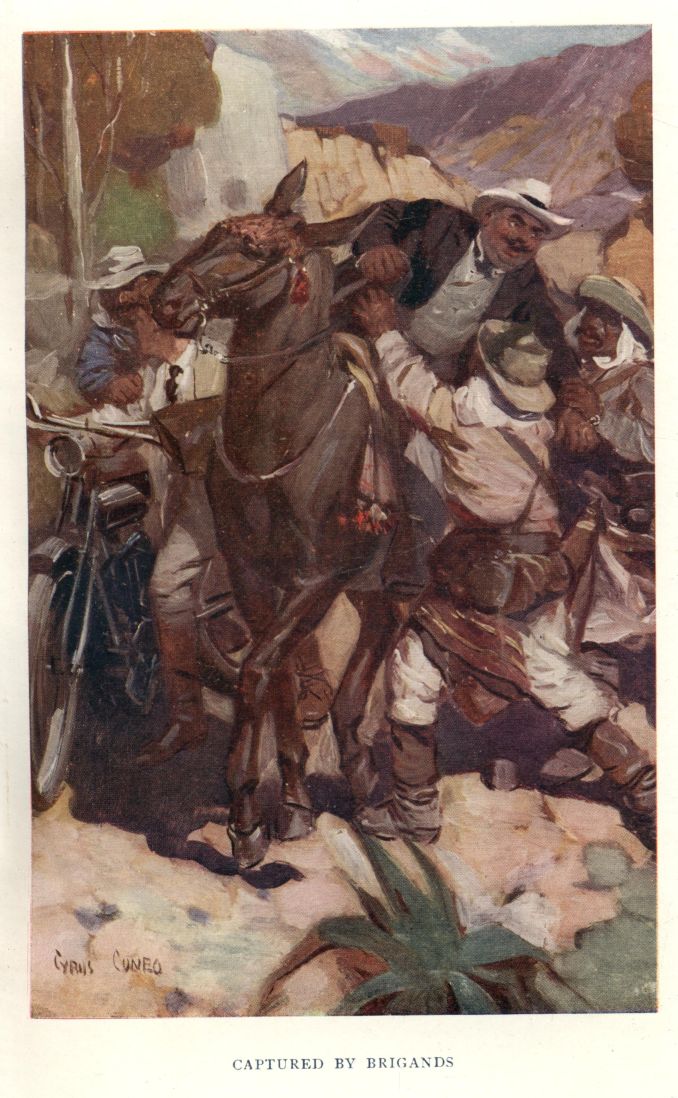
CAPTURED BY BRIGANDS
Suddenly, from behind a cluster of rocks at their left hand, there sprang into the road four men, who without a moment's warning flung themselves on the travellers. Two seized Tim, the other two dragged the gobernador from his mule, and in a trice had him on the ground at their feet. The attack was so sudden and unexpected that there had not been time even to cry out; but now the gobernador raised his voice in horrified protest, and Tim regained his wits and took stock of the situation. The men were attired in ragged tunics and breeches, with sashes about their waists, and feathered hats of varied hue. They were swarthy wild-eyed fellows; mestizos--men of mixed Spanish and Indian blood; and Tim knew at a glance that they must be members of the very gang of outlaws whom the magistrate had so valorously undertaken to extirpate. They began to talk to one another rapidly in a jargon which Tim, familiar as he was with Spanish, could not understand. But the upshot of their consultation was seen in a minute. One of the men who held the lad brought his face close to his, and said:
"You go home! We have nothing to do with you. Take your machine and go."
Tim glanced at the gobernador, who lay motionless in the hands of his captors, mingling protests, threats, and offers of money. The brigand cursed, and declared that the boy had better take his chance of escaping before they changed their mind. It was clear that nothing could be done for the gobernador; the brigands had him at their mercy; and Tim considered that there was nothing to be gained by remaining. Indeed, it must be confessed that he was a good deal afraid of these ferocious-looking fellows, and desired nothing better than to escape from their clutches. So he caught the handle-bar, ran a few feet with his bicycle, then sprang to the saddle, and in a few seconds was riding at full speed along the road.
At first he was conscious of nothing but relief and joy at his own lucky escape. But he had not ridden far before he began to think of the gobernador. His conscience pricked him. He felt like a deserter. He owed nothing, it was true, to Señor Fagasta, who, while genial enough in private life, had always struck Tim as a ridiculous, pompous kind of person in his public capacity. But it seemed rather mean to ride away and leave the magistrate to his fate. There was not time to reach the town and bring back help; he could not himself do anything for the gobernador; and he began to wonder what the brigands would do with him. Perhaps they would rob him of what valuables he had, and let him go. Surely they would not hurt him! But when Tim remembered stories of the lengths to which these outlaws sometimes went he grew more and more uneasy.
After a few minutes he slowed down, considered for a little, then dismounted and pushed his bicycle into a thick clump of bushes, where it was well hidden. He durst not ride back, for though his machine was furnished with a silencer, it did not run so quietly as not to be heard. He had made up his mind to retrace his path on foot, and see for himself what had happened. It was a long tramp uphill in the heat, and it took him nearly an hour to walk the distance which on the cycle he had covered in six or seven minutes. Fortunately the track wound so frequently that he ran no risk of being seen by the brigands.
As he approached the spot, he moved slowly and warily, peeping from behind bushes along straight stretches of the track, and glancing up into the hills to right and left. On reaching the scene of the capture he found that it was deserted. Nobody was in sight. He looked this way and that, and stooped to the ground to see if he could discover by their footmarks the direction in which the brigands had gone. But the ground was hard; he could scarcely discern the tracks of his own tyres. A trained scout might perhaps have noticed some slight indication, but Tim had had no such training.
"They've hauled him away," he thought, and there flashed into his mind recollections of fairy stories, in which ogres had carried human beings to their dens to make a meal of them. Tim had a vivid imagination.
He was on the point of returning when a sudden loud buzzing struck his ear. He listened: it was like the sound made by swarms of insects in the forest. And yet it was different--hoarser, less musical. Somehow it reminded Tim of the gobernador's speeches on great occasions in the plaza, He left the path, still on his guard, and scouted to the right among the trees, from which the humming seemed to come. And guiding himself by the sound, he presently started back when he saw Señor Fagasta himself, bound upright to a trunk, bare-headed, his mouth gagged.
The humming became very violent when Tim appeared. He noticed that the gobernador had managed to shift the gag a little. None of the brigands being in sight, he ran to the tree, removed the gag altogether, slit the cords about the señor's limbs, and was immediately embarrassed by two stout arms flung around him, and two hot lips pressing kisses on one cheek after the other.
"Oh, I say!" he exclaimed, wriggling. "Steady on, señor."
"Ah, my dear friend! My preserver! my deliverer!" Here there was another hug, but Tim evaded the kiss. "Tell me!" whispered the gobernador, "have those wretches gone away?"
"Indeed they have," said Tim. "You had better come away too."
"But they have taken my mule! I am not accustomed to walking. I shall faint: I shall be seized with apoplexy."
"I have left my cycle two or three miles away, señor. If you can manage to walk to that you can mount behind me, and we'll be home in no time."
"Yes, I will do so. Assist me with your arm. I am on thorns until I am on the machine; till then I am not safe. Hasten, my son. I have not walked a mile for twenty years, though in my youth--but no matter: I will do my best."
They set off, Tim linking arms with the gobernador, who marched down the track with the rolling gait of a sailor. Every now and then he stopped to rest and recover breath, and as at these moments he showed signs of repeating his embraces, Tim edged away until he was ready to start again.
"Ah, my preserver!" said the gobernador once, "you have laid a debt upon me which a lifetime of gratitude will not liquidate."
"Indeed it's nothing at all," said Tim. "You would have done the same for me."
"That is true; I certainly would; the blood of a long line of hidalgos runs in my veins. In Spain I might call myself Don José de Fagasta; in republics, alas! there is no aristocracy. But hasten, my son; I am not safe until I reach the machine."
Tim thought from the gobernador's manner that the current of noble blood must by this time have become a pretty thin trickle. But he kept that reflection to himself.
Señor Fagasta mounted behind Tim, proclaiming himself safe. But the rapid motion of the cycle down the steep and rugged track filled him with alarms of another kind. In vain he implored Tim to drive more slowly the boy replied that he would not be secure until he reached the town, and terrified him with apprehension of sunstroke. It must be confessed that the spirit of mischief was now fully awake in Tim. Every sigh, every ejaculation of the stout gentleman behind him gave him a thrill of joy. As they approached the town the gobernador, mindful of his dignity, begged Tim to stop and let him finish the journey on foot. But Tim could not resist the temptation to career through the street and set the magistrate down at his own door; he relished the idea of the wonder and excitement he would create.
"It's hardly worth while to set you down now, señor," he said. "You'll be home in less than a minute. Hold tight!"
As Señor Fagasta entered his house, he turned to Tim.
"My son," he said in a confidential tone, "no doubt you will be asked to explain this strange occurrence. Do not reveal the cause. I do not command you as gobernador of this town; I ask as one gentleman of another."
"I must tell my father, señor," said Tim.
"Certainly; your father's discretion is perfect. Not a word to any one else, then?"
"Very well, señor. But won't people ask you too?"
"Undoubtedly. The doings of their magistrate are intensely interesting to the citizens of San Rosario. I shall explain to them that I felt an urgent need, a positive passion, to try for myself the qualities and speed--yes, I may say speed--of your motor-bicycle."
"And your hat blew off in the wind. I see, señor," said Tim with twinkling eyes. "And now, of course, you will send the police after the brigands."
"I shall never forget that I am gobernador of San Rosario. Good-bye, my son."
CHAPTER II
COMINGS AND GOINGS
Tim rode on through the town, soon left the last house behind him, and came into the open country. A rough track led northward to Mr. O'Hagan's hacienda, three miles away. Several years before, Mr. O'Hagan had bought his estate, consisting of some thousands of acres, at a very low price, and planted it partly with coffee, partly with sugar. His workers were Cholos (the native Indians) and Japanese. The cost of living and of labour being low, and the soil very fertile, the plantations had in a short time brought him wealth. The chief drawback was difficulty of transport. San Rosario was in a remote province between the Andes and the forests, far from railways and from good roads. There were steep hills almost all round the town, crossed only by rough paths over which goods were carried on the backs of mules. Some of the planters had tried to introduce wheeled vehicles; but the customs of the country proved too strong for them, and the arriero or muleteer, dirty, cheerful, hard-working and incorrigibly unpunctual, remained the common carrier.
On first leaving the gobernador, Tim was glowing with pleasure and pride in his feat. But as he neared his home, his spirits gradually sank. He did not much relish the coming explanations with his father. Mr. O'Hagan was by no means strict with his only son as a general rule, but he was apt to look darkly on escapades which involved the townsfolk. By the time Tim came to the house he was in quite a sober frame of mind.
The dwelling was a long, one-storied building of adobe and wood, constructed in Peruvian style. The entrance hall led into a patio--a sort of courtyard open to the sky, with palms and boxes of flowers around the walls. To the right of this were the drawing-room and study. Beyond was another patio with a well in the centre, and a veranda looking on the garden. On the other side were the dining-room and bedrooms, and a small room used by Mr. O'Hagan as an office. Then came the servants' patio, the kitchen and servants' bedrooms, and at the end of the house a large enclosure, part vegetable garden, part poultry run.
Tim placed his bicycle in its shed behind the house, and entered, resolved to "get it over." He hoped to see his mother in the patio; she was often a very convenient buffer between him and his father; but she was not there, and he remembered that this was the time of her afternoon nap. He went on until he reached the office, where Mr. O'Hagan and a Peruvian clerk were at work.
Mr. O'Hagan threw a rapid glance at the boy as he entered, and was relieved to see no cuts, bruises, or other signs of accident.
"Had a good ride, Tim?" he said.
"Pretty good," replied Tim somewhat gloomily. "I saved Señor Fagasta's life."
"What's that you say? I suppose you overtook him and didn't run him down, eh?"
"It wasn't exactly that," said Tim. "I did overtake him on his mule; he'd been to San Juan; but we were pounced on by four rough-looking fellows he called brigands. They let me off, and I walked back and found the gobernador tied to a tree. I brought him in on my machine."
"You don't tell me so! This is very vexing; I wish it hadn't happened."
"But, Father, you wouldn't have left the old gentleman to die!"
"How do you know he'd have died?" said Mr. O'Hagan testily. "The fellows probably only wanted to squeeze a ransom out of him. Upon my word, Tim, you're a great trouble to me, with your machine. You know how careful I am to keep out of local squabbles, and yet you've run head-first into one."
"Really, I couldn't help it, Father."
"I suppose you couldn't, but it's a pity. You've made an enemy of the Mollendists, and in this country they may be our governors next week. You'll cost me a pretty penny. Still, you couldn't help it; only don't let it occur again."
Tim heaved a sigh of relief.
"You'd have laughed if you'd seen him," he said. "We came through the street in fine style. He was perched on the carrier, clinging on for dear life, and all the people shouting like anything."
"You don't mean to say you brought him right through the street?"
"Indeed I did."
"Why on earth did you do that?"
"It was such fun, Father. I really couldn't help it."
"And don't you know you must never be funny with a Peruvian? He has no sense of fun, especially when the fun is at his expense. You're terribly thoughtless. You ought to have dropped the gobernador before you came to the town. However!"
Mr. O'Hagan did not continue his rebuke. In his mind's eye he saw the recent scene, and remembered the time when he himself might have yielded to the temptation to which Tim had succumbed. Years before, when quite a young man, just arrived from home, he had thrown himself with Irish impetuosity into the struggle between Peru and Chile; and having been a lieutenant of volunteers when living in London, he had made use of his military knowledge in his new domicile. He had been given a commission in the Peruvian cavalry, and had led many a daring sortie, many a gallant charge. With those reckless feats still clear in his memory, he could not bear hardly on the boy who so much resembled him. "You can't put old heads on young shoulders," he thought; "but I was a fool to buy him that motor-cycle."
The conversation between father and son had, of course, been carried on in English. The Peruvian clerk, bending over his books, listened attentively, but could understand only a word or two here and there. What little he picked up whetted his curiosity, and by and by, when he found an opportunity of speaking to Tim alone, he tried to pump him. But Tim did not like Miguel Pardo. He could scarcely have told why; it was an instinctive feeling which did not need explanation. When the young Peruvian began to ply him with questions in Spanish, perfectly polite, but yet, as Tim thought, rather too pressing, he gave short and vague answers. Pardo saw that he was being fenced with, and presently desisted, breaking off the conversation with a smile.
A little later, when the O'Hagans were having tea in the patio, Pardo spent the last few minutes before closing work for the day in writing a letter. Then, locking up his books, he left the house by the servants' entrance and, instead of going to the huts half a mile away, in which Mr. O'Hagan's employees lodged, he set off for the town.
He had not gone far when he was met-by Nicolas Romaña, the young Peruvian who was storekeeper and general factotum of the estate. The two men were always so excessively polite to each other that Mr. O'Hagan shrewdly guessed them to be hostile at heart. They never quarrelled; but it was impossible to be in their company long without feeling that at any moment sparks might fly.
"Ah, señor," said Romaña, on meeting Pardo, "you are about to take the air? Let me give you a friendly warning: beware of a storm. I just now heard rumblings of thunder."
"Many thanks, señor," replied Pardo. "I shall not go far afield. Perhaps to the town. San Rosario is not Lima, unluckily. There I should have a friend's house at every few yards to give me shelter."
This, as Romaña very well knew, was a mere boast, an assumption of superiority: every Peruvian wishes to be regarded as a native of Lima.
"How strange we never met there!" he said politely. "I myself was born at Lima, and lived there fully twenty years."
"What a loss to me!" said Pardo. "I bid you good-evening."
He swept off his hat and passed on.
Romaña stood looking after him in some surprise. It was an unusually abrupt ending of the conversation. Ordinarily the bandying of words would have been kept up for several minutes. What was the reason of Pardo's haste? He was walking very quickly, too, as if he had an errand of importance.
A man who has weighty secrets himself is very apt to suspect others of harbouring secrets also. This may perhaps explain why Romaña, instead of proceeding on his way to the hacienda, turned about, and dogged Pardo to the outskirts of the town. There the clerk entered a small house--a chacara belonging to one of the Indian agriculturists of the neighbourhood. In a few minutes he returned, passed unsuspiciously the clump of bush behind which Romaña was spying, and retraced the road homeward.
Romaña remained on the watch. Presently an Indian came out of the house, went to his corral hard by, caught and saddled a horse, and rode off, not towards San Rosario, but along a bridle-path that ran westward and led into the high road to San Juan.
The watcher felt that he had not come in vain. Instead of returning to the hacienda, he walked rapidly into the town, and showed signs of pleasure on meeting, near the plaza, a thin, wiry man of about sixty years of age, with whom he entered into earnest conversation. A few minutes later this man might have been seen riding quickly out of the town, on the same road as that which the Indian had struck perhaps half an hour before.
Next morning, when the workers were busy about the plantation, and Mr. O'Hagan was engaged with Pardo in the office, Romaña strolled to an orange orchard a quarter of a mile southward from the house. After waiting there impatiently for nearly an hour, he was joined by the man with whom he had conversed in San Rosario on the previous evening.
"Well, caballero?" said Romaña eagerly.
"I followed him, señor, into San Juan."
"Where did he go?"
"To the Prefect's house."
"Good!" said Romaña with satisfaction. "Is there any news?"
"None, señor. The gobernador gives out that he very much enjoyed his ride."
Romaña smiled.
"Very well, caballero. Go back and keep eyes and ears open."
They parted, and Romaña returned to his work.
CHAPTER III
BENEVOLENCES
Señor José Fagasta was seated in a deep chair on the balcony of his house overlooking the plaza. It was a hot afternoon, and he had exchanged his black coat for a loose jacket of white alpaca. An awning and his broad-brimmed Panama hat gave shelter from the sun. At his side was a small table, with a glass and a decanter. Between his lips there was a long cigar. It had gone out: the gobernador was asleep.
He was suddenly roused by the sound of cheering up the street. Rubbing his eyes, and taking automatically a pull at his extinguished cigar, he let out a smothered ejaculation, struggled to his feet, and hastened into the house. The cause of these abrupt movements was the appearance of a party of horsemen trotting into the plaza at the upper end--the Prefect of the province, accompanied by a small escort.
The gobernador hurried to his dressing-room, threw off his jacket, and was struggling into his frock coat when he was summoned to attend the Prefect below. He durst not delay. He held the Prefect in awe, as was only natural, seeing that it was the Prefect who had appointed him to his office, at the cost of a very considerable fee. In his haste and perturbation he forgot that he wore a Panama, and was only reminded of it when the Prefect, who was just entering the hall as Señor Fagasta came to the foot of the staircase, looked with stern disapproval over his head.
"A thousand pardons, señor," said the confused gobernador. "I was taking a brief siesta, and did not expect to be honoured by a visit from your excellency."
He swept off his hat, bowed his head before his superior, and politely invited him to a seat in the patio.
The Prefect, a tall sharp-featured man of about forty years, with keen black eyes over which bushy eyebrows met, and a heavy moustache twisted into long points, accepted the chair, laying his three-cornered hat on a table. His manner made the gobernador uneasy.
"An extraordinary rumour has reached me, señor doctor," said the Prefect, "that you were seen yesterday in a very undignified position, unworthy of your office, riding on a motor-cycle behind the young Inglés."
"It is true, señor," said the gobernador. "I had never experienced that novel mode of locomotion, and I assure your excellency that I shall never try it again."
"Such conduct, señor, is calculated to bring your responsible office into contempt. It cannot be overlooked: you are dismissed."
For a moment the gobernador's emotion rendered him speechless. He thought of the many good English sovereigns with which he had bought his office, and the terrible eclipse of all his importance in the town. Then he pulled himself together: perhaps if the Prefect knew all he would have mercy.
"Your excellency," he said humbly, "I admit that my conduct may seem wanting in dignity; but I beg that you will hear my explanation. I was returning from my interview with you, full of zeal for the duty with which you had entrusted me, when I was seized by four villainous brigands in the hills. They bound me to a tree, and but for the courageous intervention of the young Inglés, who mounted me on his machine and brought me home, I should probably either not be alive to-day, or be a much poorer man than I am. Not that I am rich," he added hastily. "In these circumstances I trust that your excellency will have the goodness to overlook my unintentional delinquency."
"That is impossible, señor. Your dismissal is registered. It cannot be rescinded. Still, as a special act of grace, in consideration of your zeal, I may authorise your reappointment."
"Your kindness overwhelms me, señor," said the grateful gobernador, unaware how truly he spoke.
"But there is a condition, señor," the Prefect continued. "I am hard pressed for funds to carry on my campaign against the brigands. Your zeal is such that you will not refuse to make a small contribution on behalf of the cause--say £500. I shall then have the greatest pleasure in reinstating you as gobernador of this town."
Señor Fagasta writhed. He knew that protest was useless. He must pay, or be disgraced. How much of his contribution would go to support the cause, and how much into the Prefect's own pocket, he could only suspect. The interview soon came to an end, and the Prefect left the house richer by £500.
The idlers who had gathered outside cheered him again as he remounted. They expected to see him ride back to San Juan. To their surprise he struck into the rough track northward, which led only to the hacienda of Mr. O'Hagan, to another that lay some few miles beyond, and then to the hills. Evidently the Prefect's visit was of more than usual importance.
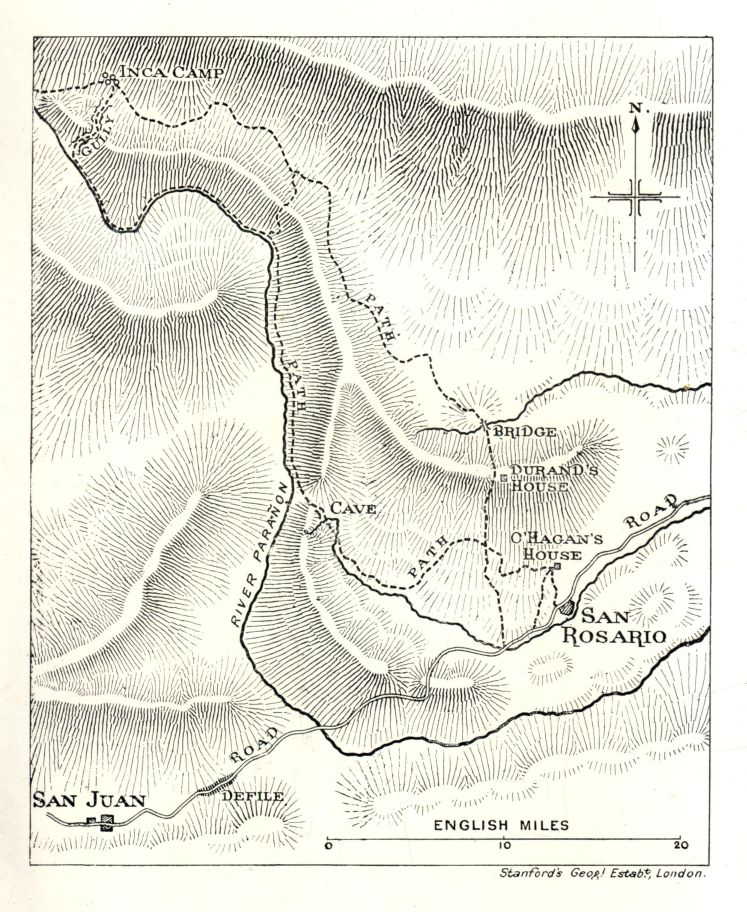
Map
Half an hour later the Prefect reined up at the door of Mr. O'Hagan's house. The family were at tea in the patio. On seeing his visitor through the open door, Mr. O'Hagan rose with a muttered exclamation of annoyance, and went to greet him. He was forestalled by Pardo, who had run from the office and was holding the horseman's stirrup. Mr. O'Hagan felt that he could do no other than invite the Prefect to drink a cup of tea, and that gentleman was soon seated in the patio, stirring his cup, and talking to Mrs. O'Hagan in the charming manner for which he had a name among ladies.
"I wish to thank your son, señor and señora," he said presently, "on behalf of the government, for his spirited action yesterday in the cause of law and order. There, my boy," he went on, taking a sol--equivalent to a florin--from his pocket, "accept that as a token of my high consideration."
Tim looked at his father.
"Pardon me, señor," said Mr. O'Hagan, swallowing his irritation, "your generosity is quite unnecessary. My son needs no reward."
"That is very high-minded," said the Prefect, pocketing the coin. "He will allow me to shake him by the hand and compliment him on his courage and resource?"
Tim gave him a limp hand: it was not so bad as the gobernador's hug and kiss.
"I am glad to be able to number you and your family, señor," the Prefect continued, "among my declared adherents."
"Don't make a mistake, señor," said Mr. O'Hagan quickly. "My son had no political motive in his action. It was a mere impulse of humanity."
"The cause of the government is the cause of humanity," said the Prefect impressively. "The brigands represent anarchy. Brigandage is chaos. I am determined to stamp it out. My action is in the true interests of all law-abiding citizens, and especially of such enterprises as yours, which depend on the reign of law for their prosperity."
At this point, after an almost imperceptible sign from Mr. O'Hagan, his wife rose and went with Tim into the drawing-room. The Prefect gallantly opened the door for her, and bowed with extreme deference: he was the pink of politeness. Then he returned to his chair. Mr. O'Hagan guessed what was coming. A few years before this, the Prefect, by bribery and intrigue, had ousted his predecessor in office, one Señor Mollendo, and had since maintained his position by corruption, and by levying forced loans on such of the wealthy men as had not the courage to resist him. The public taxes were already sufficiently heavy; but the province was so remote from Lima that its prefect was practically a dictator, and appeals to the central government would have been fruitless.
Señor Mollendo, knowing that his life was hardly safe, had taken refuge in the hilly district in the heart of the province, and was there joined by his partisans, who grew gradually in number as the Prefect's exactions increased. These Mollendists were what we should call a political party in opposition: in Peru the government termed them brigands. It was natural enough that they should include among their number many lawless irreconcilables of the true brigand type; and opposition which would in England take the form of public meetings and demonstrations found expression here in raids and robberies. Mr. O'Hagan had been several times approached indirectly for contributions to the Prefect's war fund, but he had always refused to comply.
"As I was saying, señor," the Prefect resumed, lighting the cigar Mr. O'Hagan offered, "your security depends on the supremacy of law. That being the case, and my treasury being in temporary need of funds, I have every confidence in inviting you to subscribe a small sum--say £1000--to a loan for the more active prosecution of the work of suppressing the brigands which we all have at heart."
"I am a man of few words, señor," said Mr. O'Hagan. "I have bought my land; I pay my legal taxes, which are heavy enough; and I am entitled to the protection of government. My people are contented; I have had no trouble with them; the people you call brigands have not molested me; if they do I shall claim your protection, but I don't anticipate anything of the kind. I must therefore decline your invitation."
"I beg you not to be hasty, señor. Your security may yet be rudely shocked: no man can call himself safe while the brigands are at large; and I should be very much distressed if you were to suffer loss through the unfortunate penury of the government. A contribution of £1000--merely by way of loan--would probably prevent a much greater loss."
"Not one peseta, señor," said Mr. O'Hagan bluntly. "I must beg you to believe that that is final."
The Prefect smiled blandly.
"Ah! you Inglésas!" he said.
"I'm an Irishman, señor: that's worse."
"Well, señor, I must thank you for your hospitality and take my leave. I wish you every success, and a large share of the sunlight of prosperity. I only regret that by your reluctance to support me you are helping to let loose the forces of lawlessness and giving hostages to brigandage--in fact, breeding worms that will eat into the tissues of industrial enterprise. I bid you good-day, señor."
Mr. O'Hagan was not impressed by the Prefect's picturesque language. Tall talk is the foible of Peruvians. But after he had seen the last of his visitor, he returned to the house in a state of intense irritation. His wife was awaiting him in the patio.
"He wants to bleed me," he said angrily: "demanded a trifle of £1000. This country is a hot-bed of corruption. And I wish that motor-cycle were at the bottom of the sea."
"Why, dear," said Mrs. O'Hagan placably, "what has that to do with it?"
"It gives the fellow an excuse for saying that I'm on the side of the Mollendists. Why do you let me spoil that boy, Rose?"
Mrs. O'Hagan smiled, remembering that she had begged her husband to wait until Tim was a little older before giving him the motor-cycle. Wisely she did not remind him of that, but simply said:
"Don't worry, dear. Things mayn't be so bad as you think.... And Tim is not really spoilt, you know."
CHAPTER IV
GAS
Next day Tim went into the town on an errand for his mother. He was looking at the window of the only book-shop, when he felt a touch on his sleeve. Looking round, he saw Alfonso, the gobernador's son, a sallow, weedy boy of about his own age, whom he had often vainly tried to induce to have a game at cricket in a field behind Mr. O'Hagan's house. He did not think much of Alfonso, who always called him señor!
"Follow me, señor," said the boy mysteriously, "but don't let people know."
He moved off at once. Tim might have thought that he was being enticed away for a practical joke of some kind, only he remembered that the Peruvians never played practical jokes except in carnival time. "I may as well go," he said to himself; so, pushing his hands into his pockets, he sauntered after Alfonso Fagasta. Several persons gave him pleasant greetings, and he stopped once or twice to exchange a word, always keeping his eye on Alfonso.
The Peruvian boy walked past the church in the plaza, and turned into a narrow street, or rather lane, bounded on one side by the wall of the presbytery, on the other by a high wall enclosing a garden. Tim knew the place well; indeed, in days gone by he had sometimes scaled the garden wall in quest of ripe plums or peaches. He followed Alfonso for some distance, until he came to the rear of the enclosure, where there was a dense plantation extending up the slope of a hill. Here Alfonso made signs to him to wait, and disappeared through a wicket gate into his father's garden.
"Why couldn't he tell me where to come?" thought Tim impatiently. "What's the silly secret?"
He climbed a tree by way of passing the time, and presently, from his leafy bower, he saw the gobernador open the wicket gate, glance cautiously round, and then come swiftly towards the plantation. He looked this way and that, and gave a jump when Tim called out, just above his head:
"Here I am, señor doctor."
"Ha! my young friend, come down," said the gobernador.
Tim dropped at his feet.
"I have something to say to you," continued the gobernador hurriedly. "Pardon me for not receiving you in my house with the respect due to my preserver, but there are reasons...." He nodded with an air of mystery. Then he went on in nervous haste: "Tell your good father to be on his guard to-night. See that everything is secure. He must be careful not to arouse suspicion among his staff. Few are to be trusted in these disturbed times. If he sleeps at all, let him sleep with one eye open."
"What's going to happen, señor?" asked Tim.
"I say no more. Perhaps I have said too much. But I owe you so much gratitude----"
"Don't mention it, señor," said Tim, backing. "Thanks for your warning."
"Do not breathe my name to any one but your father," said the gobernador anxiously. "I must go. Next time I see you I hope it will be at my front door, with open arms."
"I hope it won't," thought Tim. He shook hands with the flurried gentleman, who, with another cautious look around, returned to the gate and slipped through into his garden.
Tim was very thoughtful as he walked home. Such a warning in Spanish America was not to be disregarded, and he could not help connecting it with the Prefect's visit, the object of which he had learnt from his mother. He had a lively imagination. Such a man as the Prefect was not likely to accept amiably the snub administered by Mr. O'Hagan. He might use other means than persuasion to enforce his will.
He wanted money. To-morrow was pay-day at the hacienda, and there was a large sum in the safe. San Rosario had no bank. The branch of a Lima bank at San Juan had shut its doors on the accession of the present Prefect to office: the managers feared that their floating assets would be attached by the new official, ostensibly for public purposes. Since then the employers of labour had had to be their own bankers, drawing cash at intervals from Lima by well-armed convoys. There could be little doubt that the gobernador had somehow got wind of a plot to rob Mr. O'Hagan on the coming night.
Tim wondered what his father would do to defeat the attempt. How would the burglars go to work? The safe was kept in the office. The key was on Mr. O'Hagan's bunch. To reach the office the robbers would have to pass through one or other of the patios. The middle patio had French doors opening on the garden. They were always locked and bolted at night, like the main door and the servants' entrance. It would be difficult to enter without making a noise, unless the servants were in league with the burglars. Tim thought of each of them in turn, and felt sure that all were trustworthy.
All at once a brilliant idea struck him. His father was rather vexed with him--or with the motor-cycle, which amounted to the same thing; what a score it would be if he could deal with this matter himself, without his father knowing anything about it! He chuckled with delight as he imagined himself telling at the breakfast-table, as calmly as though it were an everyday matter, how he had defeated an attempted burglary. But how was it to be done? Mr. O'Hagan was a light sleeper; a slight noise would disturb him, and Tim was at a loss for any means of routing the burglars silently.
He thought of wire entanglements; but he could not erect them without his father's knowledge. He thought of a booby-trap; but that was bound to make a noise. He had almost reached home before a plan occurred to him; it pleased him so much that he laughed. There was a large quantity of ammonia solution in the house, kept for household purposes and for use with the refrigerator which was a domestic necessity in this tropical climate. Tim had only recently left school in England, so that his knowledge of chemistry had not yet evaporated. If he heated some of this liquid, and led the vapour into the patio at the critical moment, the fumes would be obnoxious enough, he thought, to choke off any rash intruders.
As soon as he got home, he took into consultation an old mestizo named Andrea, who was gardener and odd man, a family servant of many years' standing. Andrea was rather troubled, and advised that the warning should be given to Mr. O'Hagan; but few could resist Tim's persuasiveness, and the old man at length consented to assist his young master.
Tim's bedroom was next to the office. At the bottom of the wall next to the patio there was a grating which could be removed. That night, when all the rest had retired, Andrea brought to Tim's room a large oil-can with a narrow neck, containing a quantity of the ammonia solution. Tim had already provided himself with a short length of garden hose, with a nozzle at the end. Drawing the rubber tubing over the neck of the can, he placed the nozzle end in the hole from which the grating had been removed, in such a way that when the cock was turned it would allow the fumes to enter the patio within a few inches of the office door. Having lighted a large spirit-lamp beneath the oil-can, he set a chair against the door, on which he could mount to reach a ventilator above, opening on to the patio, and sat down on his bed, quivering with excitement, to wait for the expected attack.
Hours passed, and he grew fidgety. Every now and then he got on the chair, and peeped through the ventilator. All was dark and silent.
"I don't believe they're coming," he whispered disconsolately to Andrea.
"So much the better, señorito," said the old man.
But Tim did not agree with that; he did not want to be disappointed of his fun.
At last he heard a slight sound from without. Jumping on the chair, he peered through the ventilator. He could see nothing, but he guessed by the sounds that the putty was being scraped from one of the glass panes of the French door. Presently he dimly saw several dark, shadowy forms pass from side to side. The men were removing the pane. One after another the intruders stepped quietly across the patio towards the office door. Just as they reached it Tim slipped off the chair, stooped to the floor, and noiselessly turned on the cock of the nozzle.
For a few seconds there was no effect. He heard the slight click of a key as it was inserted in the lock of the office door. But then, as the ammonia fumes began to diffuse, there was a sniff, a stifled cough, and a whispered exclamation. Presently there were louder coughs, long-drawn gasps, and the men, in the effort to repress these fatal sounds, choked and spluttered violently, until, half-blinded, half-suffocated, they turned away, cursing with what breath was left to them, and tumbled over one another in a rush for the door.
At the same moment the door of Mr. O'Hagan's room was flung violently open, and that gentleman, roused by the noise, rushed into the patio in his pyjamas, a gun in his hand. Seeing that the pane was removed, he ran to the door, and sent a charge of duck-shot after the dark figures scampering over the garden-beds. The sound of firing roused all the household, and the affrighted servants came flocking into the patio.
"What's this confounded smell?" gasped Mr. O'Hagan, turning when the marauders had vanished into the night. There was a chorus of coughs from the servants.
Tim had turned off the stream of gas, and now opened his door; he felt very much annoyed with the burglars; why had they made such a silly row?
"One of your tricks, Tim?" said Mr. O'Hagan. He gasped again. "Ammonia, begore!"
"It is, Father," said Tim meekly.
"What on earth do you mean by disturbing the whole household in this way? ... Get back to bed," he cried in Spanish to the servants; "all's well now.... Now, sir, just explain this tomfoolery."
"May I come into your room?" asked Tim, anxious that old Andrea should not get into trouble.
"You may, and apologise to your poor mother for disturbing her rest. Now, what have you to say for yourself? Were those fellows outside friends of yours, in the plot too? If so, you're responsible for the murder or maiming of some of them."
"Indeed they're not. They are burglars, and I spoilt their game with ammonia."
"Burglars, eh? But how did you know they were coming? You must have made preparations?"
"I did. Old Fagasta told me to look out for them to-night, and I did so."
"Indeed now! What did the gobernador know about it, then?"
"He didn't tell me. He only asked me to tell you to be on your guard to-night."
"Why didn't you do so, then?"
"I thought I would make them scoot myself, and not disturb you. Who could know the donkeys would make such a silly row!"
Mr. O'Hagan's mouth twitched at his son's indignant tone.
"Well, Tim," he said, "sure 'twas very considerate of you, but next time you are asked to give me a message, give it. And no more tricks of this kind, mind ye. We don't wish to be blown up one night."
"I dished them, anyway."
"I don't deny it. But 'twas lucky the noise woke me; for a few pellets in their carcasses will be a more enduring lesson than a stink. Now, to bed!"
When Tim had gone, Mr. O'Hagan said to his wife:
"The Prefect has made his first move, Rose."
"Tim was quite upset, poor boy!" replied Mrs. O'Hagan.
CHAPTER V
PARDO DISMISSES HIMSELF
"I am going into the town," said Mr. O'Hagan at breakfast next morning. "Last night's affair must not be passed over. I shall lay a formal complaint before Señor Fagasta. It won't be any good, but it would never do to take no notice. When Pardo comes, Tim, tell him that he must get the ledger posted to-day; he is rather behind. And if any of the people are curious about the shots last night--they must have heard them--don't answer any questions. I have already told the servants to hold their tongues."
Setting off on horseback, he rode straight to the gobernador's house. He noticed that the magistrate greeted him nervously. When the usual civilities had been exchanged, he said:
"I have to report, señor, that an attempt was made last night to break into my house, and to ask that you will do what you can to discover the villains and bring them to justice."
"This is very distressing, señor," said the gobernador. "It will give the town a bad name, especially as it happened the day after the visit of our illustrious Prefect."
"Yes, that is decidedly unfortunate," remarked Mr. O'Hagan ironically.
"I will of course do what I can with the few police at my disposal," the gobernador continued. "Had it happened on the night before, I should have been better able to deal with the matter, for the Prefect left a few of his escort of gendarmes behind. They were quartered on me; but they departed yesterday evening. Perhaps you will give me full particulars, which I will draw up in proper form."
Mr. O'Hagan related the circumstances, which the gobernador wrote down with great deliberateness and solemnity. While he was doing this, Mr. O'Hagan had time to put two and two together. He had little doubt that the attack had been made by men left behind for that purpose by the Prefect, and guessed that the gobernador had learnt or suspected their design from something they had let fall while quartered in his house.
The report having been drawn up, Señor Fagasta gravely stamped it with the official seal, and said:
"Be assured I will do what I can, señor. I trust that the señora and your excellent son are well?"
"Quite, señor, thank you," said Mr. O'Hagan.
Neither had mentioned the incident of the bicycle or the warning given by the gobernador, from whose manner Mr. O'Hagan judged that he did not wish those matters to be alluded to. On his side, he felt that it would be indiscreet and probably useless to press the magistrate for particulars of what he knew or suspected. He had done a good turn in giving the warning, no doubt risking the vengeance of the Prefect if his action should come to that worthy's knowledge.
Taking leave of the gobernador, Mr. O'Hagan rode home and went straight to the office. It was empty. He called to Tim, who was practising with an air-gun at a target set up at the end of the lawn.
"Where's Pardo?" he asked.
"He hasn't turned up, Father. He sent a kid over to say that he's grieved to the heart at not being able to attend to his duties, owing to a painful attack of lumbago. I don't like the chap, Father."
"Because he's got lumbago?"
"No; because I think he's a bit of a fraud. Last time he stayed away it was a sore heel, you remember; but I happened to see him picking oranges in the evening when the men had gone home, and he walked well enough."
"You didn't mention it to me."
"Well, his heel might have been sore, and I didn't want to meddle, especially as you think a good deal of him, Father."
"I do. He's the best book-keeper I ever had. I'll get your mother to send him some turpentine: that'll put him to rights."
In the course of the day Romaña was despatched by Mrs. O'Hagan with a bottle of turpentine for the sick man. Pardo was not to be seen. The old half-breed woman who looked after him told Romaña that her master had not risen that day, complaining of pains and stiffness in his back.
"Has he sent for the doctor?" he asked.
"Not yet. He says it is a chill, and will soon pass."
"The mistress has sent some stuff to cure him. The instruction is to rub it into the skin very thoroughly. Take it to Señor Pardo, and ask if I can do anything for him."
The old woman went off with the bottle. Romaña had noticed Pardo's coat lying over the back of a chair. As soon as he was alone, he lifted the coat, cast a rapid but searching glance over it, and laid it on the chair again.
"Many thanks, señor," came Pardo's voice from the inner room. "Thank the gracious lady for me, and say that I hope to return to my beloved duty in a day or two."
"Is the pain very severe, señor?" asked Romaña sympathetically.
"Not so severe as the stiffness, señor. Take care that you don't take a chill."
"Thanks, my friend. I myself am always careful of the night air. Good-day; I will give the mistress your message."
Romaña hurried back to the house, and sought his master in the office.
"Well, how is the invalid?" asked Mr. O'Hagan. "Did you see him?"
"No, señor: he was keeping his bed. I would suggest that you should send your own doctor to him."
"That's not necessary, surely. A good rubbing is all that he needs for lumbago."
"If it is lumbago!" said the man. "Will you give me a moment, señor?"
"Of course," replied Mr. O'Hagan, laying down his pen. "What is it?"
He leant back in his chair, frowning a little. A most unsuspicious man himself, he was annoyed at Romaña's suggestion of malingering, coming on top of the doubts hinted by Tim.
"On the day when the señor gobernador rode on the bicycle," said Romaña, "Señor Pardo sent a letter to his excellency the Prefect."
"What of that? and how do you know?" asked Mr. O'Hagan sharply.
"I saw his Cholo messenger ride away with it to San Juan, señor, and a friend reported to me that the Cholo took it to the Prefect's house. As you know, the Prefect came to San Rosario two days after, and visited the gobernador. He then rode here. Señor Pardo held his stirrup while he dismounted. He returned to San Juan, but left some of his gendarmes behind. Then came the matter of last night. To-day Señor Pardo is not to be seen."
"What are you driving at?" asked Mr. O'Hagan irritably.
"Have patience, señor. I have been ten years in your service, and you have no complaint against me?"
"That is true, but I don't like this air of mystery and suspicion. Say plainly what you have in your mind."
"I have just seen Señor Pardo's coat--the one he was wearing yesterday: there were several little black holes in the back. I think if you send your doctor to him, you will find that he suffers not from lumbago but from shot wounds."
Mr. O'Hagan stared in amazement.
"You suggest that he was among those villains who tried to break in last night?" he asked.
"I do, señor."
"And that the Prefect was concerned in it?"
"The Prefect's gendarmes, señor. As for the Prefect himself!..."
He shrugged expressively.
"And that Señor Pardo is in the Prefect's pay?"
"That is my belief, señor."
"Romaña, are you a spy?"
"Señor, I am a Mollendist," replied the man with dignity.
Mr. O'Hagan was much perturbed. He was loth to believe that Pardo was a traitor, but the chain of events as linked together by Romaña was unpleasantly consistent. Perhaps what troubled him most of all was the discovery that, careful as he had been to hold aloof from local dissensions, two of his servants were mixed up in them, on opposite sides. It was now easier to understand the mutual antagonism between the two men, of which, though veiled by the outward forms of civility, he had always been conscious.
"You have told no one else what you suspect?" he said, after a few moments' deliberation.
"Nobody, señor."
"Then take care not to do so. I believe that you mean well, but I hope to find you mistaken. We shall see."
When Romaña had gone, Mr. O'Hagan sought his wife and told her everything.
"I have never liked Pardo," she said, "though I can't say why. Perhaps it would be as well to ask Dr. Pereira to see him."
"I prefer not to. I shall put it to the fellow direct when he comes back to work. One thing is certain: Romaña must go. I can't have a Mollendist about the place. If it became known, the Prefect would make it another reason for worrying me, or worse."
"Won't you write to the British consul at Lima?"
"I'm afraid that would be useless. He's too far away to be able to do anything. We're in a desperately awkward position, Rose. The Prefect will have his knife in me, and young Tim has certainly offended the Mollendists by releasing the gobernador. Whatever they meant to do with him, they will be furious at being baulked by a youngster. When I send my next convoy to the capital, I think you and the boy had better go too. You'll be out of harm's way there."
"Indeed I will do nothing of the kind, Tim. I will not leave you. And I can't believe that there's any danger to a British subject here. Write to the consul at once, dear; it's just as well to be beforehand with trouble."
"I will do so. Say nothing to Tim, by the way. He'd only worry."
Three days afterwards Pardo returned. He looked rather pale, and after greeting his employer launched out into a voluble description of his sufferings.
"But the gracious lady's lotion worked wonders, señor," he said.
"Rather painful, isn't it?" said Mr. O'Hagan, noticing with misgiving that the man wore a new coat.
"Not at all, señor. Its application was most soothing. It is a most excellent remedy."
Mr. O'Hagan remembered how, when suffering from lumbago himself, the friction with turpentine had left his back sore and smarting for days.
"Sit down, Pardo," he said. "I've something to say to you."
The man sat down awkwardly on his chair, smiling amiably.
"You remember the night of the attempted robbery," Mr. O'Hagan went on. "No doubt my shots disturbed you."
"Not at all, señor. I slept the sleep of the just."
"How often do you correspond with the Prefect?"
The sudden question obviously took Pardo aback. He looked uncomfortable, but recovered himself in a moment, and said with a feeble smile:
"A humble clerk and book-keeper does not correspond with so important a person as his excellency, señor."
"Nevertheless, you sent a letter to his excellency a few days ago. He visited me two days after, and left a party of his gendarmes in the town when he returned to San Juan. I have reason to suspect that they were concerned in the attempt to rob me. How did they know that at that precise moment I had a large sum of money in my safe?"
"These are very strange questions, señor," said Pardo. His manner was quiet and restrained, but Mr. O'Hagan, intently watching him, noticed a look of fear in his eyes.
"They are," he said. "Here's another: where is your old coat? I mean the coat you were wearing last time you were here. It was nearly new."
Pardo started to his feet.
"Señor, this is intolerable," he cried. "I don't know what you mean, but your questions are an insult to a perfect gentleman." (Every Peruvian is a perfect gentleman.) "You will please to accept my resignation."
"Very well, Pardo: perhaps it is best." He handed him his week's wages.
"And let me tell you this, Señor Inglés," cried the man furiously as he pocketed the money: "a Peruvian gentleman does not take lightly such insults to his honour. You will repent this. You will feel the weight of my just anger. You treat me like a dog: dogs can bite. I will not accept your money."
He took it from his pocket and threw it on the floor. "You shall learn what it is to insult a perfect gentleman."
Snatching up his hat, he swept it round in ironical salutation, and flung out of the room.
CHAPTER VI
TIM IS HELD TO RANSOM
Tim had many acquaintances but few friends among the youth of San Rosario and the neighbourhood. He often felt the lack of a chum of his own age, and looked forward eagerly to the time, now drawing very near, when he would return to England and enter an engineering college. His most intimate friend in Peru was a young fellow, two or three years older than himself, named Felipe Durand, who lived on his father's hacienda, about twelve miles north of the town. Durand had been educated in England, and being a very fair batsman, he sometimes joined Tim in getting up a cricket match between elevens of the Japanese workers.
On the day after Pardo's dismissal, Tim rode out to Durand's house to arrange for a match in the following week. The path was only a rough track; it was indeed not a public thoroughfare at all, but was maintained by Señor Durand and Mr. O'Hagan for their own convenience. Much of it ran through woods, and on each side the ground rose gradually to a considerable height.
Tim met nobody on the way, but within a few miles of the hacienda he noticed a group of men at the edge of the wood some little distance from the path. Thinking that they were peons of Señor Durand he gave them only a fleeting glance and passed by. He reached his friend's house about twenty minutes after starting, and discussed the proposed match in a little summer-house, over a dish of fruit and a glass of lemonade.
"I say, O'Hagan," said young Durand, after arrangements had been made, "I wish I had seen your performance with the gobernador. It must have been great sport."
The two boys always used English when together.
"Indeed, it was good fun," said Tim. "The pater was in a bit of a fizz: he thinks the Mollendists won't like it."
"I dare say not. He should do as my governor does."
"What's that?"
"Pay up. My father gives them a regular subscription."
"That's rather dangerous, isn't it? The Prefect would drop on him if he knew."
"The Prefect has dropped on him as it is. He has borrowed a good deal that he'll never pay back. My father grumbles, of course; but he likes a quiet life, and would rather pay than be worried. He subscribes to the Mollendists' funds for the same reason; they leave him alone. He says that old Mollendo will get the better of the Prefect one of these days, and as the old chap is fairly honest he won't be sorry. Your pater had better do the same."
"I'm sure he won't. He says corruption is the curse of this country, and he won't have anything to do with either of the parties."
"That's very honourable and British, but it won't pay.... Have those robbers been caught yet?"
"They have not. D'you know, I believe our man Pardo had a hand with them; the pater gave him the sack yesterday. He resigned, but only to avoid a sacking. I'm not sorry.... Well, you'll come over on Monday, then. It's a holiday, so we'll make a day of it."
Tim had ridden only a few miles on his homeward way when he was brought to a sudden check. The path was blocked by a tree which had apparently fallen since he passed a couple of hours before. He dismounted, resting his bicycle against the trunk. The tree was obviously too heavy to be lifted, and he was looking for a way round it when a number of men rushed at him from the bushes on each side of the track, and in a few seconds he was a prisoner. Among his captors he saw one of the brigands who had snapped up the gobernador.
"You will not get away this time, Señor Inglés," said the man, laughing. "You will please to come with us."
Tim was helpless. He could only put the best face on it. The men led him along the track northward, in the direction of Durand's house, two following with the bicycle. As they neared the house, they struck into the woods on the left, not returning to the track until they were some distance beyond, at a wooden bridge over a ravine. The district to the north had a bad name. It was the immemorial haunt of outlaws, whether revolutionist or criminal. The outlawed criminal was invariably a revolutionist; though among the revolutionists there were many, like their leader, Mollendo himself, who were quite respectable members of society.
After a few miles the country became very wild and rugged. The men in charge of the bicycle grumbled at their laborious task; they were not used to wheeling so heavy and cumbersome an object, and in the rougher places it was difficult to balance. Every minute Tim expected to see the machine escape from their hands, topple over, and dash itself to pieces on the rocky declivity.
The track became steeper and steeper. It wound this way and that, a rough wall of rock rising high on the left hand; on the right long slopes and sheer descents, crossed by yawning gullies, stretching downwards for hundreds of feet. Now and then white gull-like mountain birds flew screaming in front of the party; hundreds of squirrels were disporting on the rocky ramparts, darting among the trees that clothed the ravines when they saw the intruders upon their solitudes. They marched on for hours, covering, perhaps, a mile and a half an hour, until night threw its purple shade upon the hills. Then they halted in a narrow glen. The leader of the party gave Tim the option of being tied up or passing his word not to attempt escape.
"You are Inglés," he said. "I can trust your word."
Tim did not appreciate the compliment; but since it was quite clear that he could not escape with his bicycle, he gave his word, looking as pleasant as he could. The men bivouacked, making a supper of parched maize, which they took from their wallets, and weak spirits from their flasks. They offered Tim a share of their provisions; he accepted the maize, but declined the spirits, longing for a draught of water.
He spent a very uncomfortable night. The rocky ground cut into his light summer clothes, which afforded but a poor defence against the cold of this upland region. He slept fitfully, wondering in the wakeful intervals what was going to happen to him, and thinking of the distress his parents must suffer at his absence. "Durand was right," he thought. "When I get free I'll ask Father to give these Mollendists a subscription. But I bet he won't."
The march was resumed in the morning. The track still ascended, until it reached a ridge, from which Tim caught glimpses on the other side of a river meandering far below between wooded banks. In front the ridge rose gradually. In about three hours the party, passing between two tall rocks like gate-pillars on either side of the track, found themselves suddenly in an encampment of considerable size. Two or three hundred men were assembled in a sort of courtyard surrounded by tumble-down buildings of unworked stone. Tim knew at a glance that he was in the ruins of an ancient Inca fortification, castle, or observation plaza, built by that vanished race on a hill-top which had probably been flattened artificially. The men were encamped on two sides of the enclosure; on the other two sides a number of horses were hobbled.
Tim had no time to take in more details of the scene. The arrival of his captors was hailed with shouts, and he was led through the excited throng to an angle of the courtyard, where, in a little recess, a Peruvian between fifty and sixty years of age, and of benevolent aspect, was reclining on rugs before a slab that served as a table.
"Señor," said the leader of the party, "this is the young Inglés who released the man Fagasta."
Señor Mollendo rose and made a courtly salutation.
"Good-morning, Señor Inglés," he said. "I have heard of you and your respected father. It gives me the greatest pain to see you in your present unhappy plight."
"You can relieve your pain at once by releasing me, señor," said Tim boldly.
Mollendo gave him an indulgent smile.
"I have to consider the claims of justice, my young friend. See how the case stands. You were taken with the man Fagasta, the hireling of the usurping Prefect. You were released, but with rank ingratitude returned and set free the gobernador, the agent of the odious dictator, the man who had been heard to boast of his intention to root out the friends of liberty from this oppressed region. Your offence could scarcely be more serious. It is dangerous for a foreigner to interfere in our domestic affairs; especially is it unbecoming in an Englishman, a citizen of that glorious land of freedom, a lover of liberty and of equal laws, to associate himself with the agents of a corrupt and shameless tyranny. It is necessary to signalise the abhorrence with which such action must be viewed by all right-thinking men. You shall be a recipient of such poor hospitality as I can extend to you until your unworthy conduct is redeemed by the payment of £250, and the engine by means of which you effected your reprehensible intervention on behalf of the oppressor will be confiscated to the use of the patriots."
Tim was quite unused to having such eloquence hurled at him. His head master had contented himself with a few sharp words and half a dozen swishes--infinitely preferable to such a lot of "jaw." He felt overwhelmed, and had nothing to say. "Jolly cheek!" he thought, "asking £250. I wish he may get it."
His parole was demanded again, and he was strictly forbidden to stray beyond the limits of the enclosure. He was given a dinner consisting of mutton boiled with vegetables, and toasted maize, with water from a stream, almost dried up by the summer heat, that flowed into the broader river below. Mollendo offered him a Manilla cigar, which he put in his pocket.
He was allowed to roam about the encampment. So well placed that one might approach within a few yards without discovering it, it overlooked the surrounding country for hundreds of square miles. On the east he could see the track by which he had come, winding east and south-east through the hills. On the west a few steps cut in the rock led to what had once been an Inca road, running into the path that led southward to the highway to San Juan. Southward flowed the hill-stream, through a rough and precipitous gully. To the north the ground rose steeply to inaccessible snow-capped peaks.
Tim passed a restless and unhappy day. He supposed that Mollendo had sent one of his men to demand the ransom from his father; but no information was given him. The only mitigation of his captivity was afforded by the brigands' experiments with the motor-cycle. None of them was able to ride it; few were anxious to try. They were good horsemen, no doubt; but Tim soon came to the conclusion that they would never make motor-cyclists. He watched with amusement their first attempts in the middle of the courtyard. One man tried to mount the bicycle when stationary, and became violently angry at each failure to maintain his balance. Then he got two of his comrades to support him, one on each side, and thrust at the handles. No movement resulting, his supporters pushed the machine for a few yards, then let it go. It toppled over, and the rider's leg being crushed between the cycle and the ground, he swore bitterly, and retired to digest his discomfiture.
Señor Mollendo looked on at all this with much disappointment. The confiscated machine, apparently, was not to be so valuable an acquisition as he had supposed. He smiled with pleasure, however, when the machine was set in motion by a series of accidents. While one man was in the saddle; held up on both sides, another happened to discover the petrol tap, and turned it on. The supporters pushed the bicycle for a few feet, the engine began to fire, and the rider chancing to move the throttle switch, the machine started forward with a suddenness that caused the two men at the sides to lose their grip. There were shouts of delight from the onlookers; but the rider was so much amazed at his own inadvertent skill that he lost his head, and could neither stop nor steer his unmanageable steed. Only by sprinting across the courtyard at full speed did Tim save man and cycle from being dashed disastrously against the stone wall.
After this the machine was left severely alone, until Tim, weary for want of something to do, offered to instruct the men in its manipulation. This won Señor Mollendo's warm approval, and Tim spent several hours of that day and the next in teaching the younger members of the party how to ride. They had no personal feeling against him; and with the prospect of their lean treasury being increased by £250 on his account, they began to regard him with even more kindliness than his willingness and good temper had already won.
On the third day the messenger sent by Señor Mollendo to claim the ransom, returned, bringing with him not merely the money, but a rumour of the manner in which the midnight raiders had been received at Mr. O'Hagan's house. That they were part of the Prefect's escort was an open secret. Mollendo called Tim to him and asked if the story was true. Tim saw no reason to conceal anything, and gave a full description of what had happened, only suppressing the fact that his information had come from the gobernador.
"You showed remarkable ingenuity, my young friend," said Mollendo, greatly tickled by the picture of the spluttering crew stumbling out into the darkness. "I quite understand why your good father should consider you worth £250. He has sent the money; you are free. And as a mark of my appreciation of your service to the cause of liberty by discommoding the usurper's minions, I have much pleasure in returning"--("How much?" wondered Tim in excitement)--"your motor-cycle. Four of my supporters will assist you to the path below. When you meet your father, convey to him my salutations, and assure him that the money will be put to a good use in upholding the flag of freedom."
He shook hands warmly, bowed with his hat to his breast, and with a polite a reveder, the Spanish equivalent of au revoir, he ended Tim's captivity.
CHAPTER VII
THE PREFECT MOVES
Tim's adventure caused Mr. O'Hagan to change his mind about dismissing Romaña. To do so might be a new cause of offence to the sensitive patriots.
"You have already proved a very dear son," he said, with a humorous twinkle that disguised his real feeling.
"Durand says that his pater gives old Mollendo a regular subscription to keep him quiet," said Tim.
"Blackmail! He will soon get tired of that."
"I don't suppose what he has paid comes to £250."
"Ah! but he hasn't given his boy a motor-cycle! Young Durand came over to-day to play cricket, and seemed vastly tickled when I told him where you were."
"I could have boxed his ears," said Mrs. O'Hagan indignantly. "It was no laughing matter to me."
"Will I challenge him, Mother?" said Tim quizzingly. "I am going to ride over to-morrow to tell him all about it, and if you like----"
"Don't tease your mother," Mr. O'Hagan interposed. "She insisted on my sending the money at once, or I declare I would have been inclined to let you have a week of it."
The kidnapping of the young Inglés created much indignation and resentment among the people of San Rosario. The majority of them, having little to lose, were staunch supporters of the Prefect, and when next day they saw a dozen gendarmes ride into the town, they supposed them to be only the advanced guard of a force sent from the capital to begin the long-expected operations against the brigands. Some, however, viewed the soldiers with alarm. To the substantial citizens, a visit of the Prefect's gendarmes usually spelt trouble. Every man whose secret sympathies were with the Mollendists trembled in his shoes; even those who were conscious of innocence shivered if their worldly substance was large enough to be worth the attention of the Prefect and his harpies. Many, among them the gobernador, were greatly relieved when the gendarmes, instead of dismounting, halted only to refresh themselves in the saddle at one of the albergos, then rode through the town and along the track leading to Mr. O'Hagan's house.
Arriving there, the leader sprang from his horse, and strode with clanking spurs to the door, which stood open. The others formed up in line along the front of the house. To the servant who came in answer to the officer's summons, he explained that he wished to see the señor haciendado. Mr. O'Hagan left the office, where he had been alone, and invited his visitor into the patio.
"I regret, señor," said the officer, declining to be seated, "that I have come on a very disagreeable errand." He took a paper from his pocket. "You see here a warrant, signed by his excellency the Prefect, and sealed with the provincial seal, authorising the arrest of yourself and your son."
"On what charge, señor?" asked Mr. O'Hagan quietly.
"On the charge of furthering and abetting the treasonable designs of one Carlos Mollendo, who is stirring up sedition. It is useless to resist, señor; I have a sufficient body of troopers outside. I demand that you surrender yourself and your son to justice."
"I will come with you," said Mr. O'Hagan, "under protest. You will please to note that I am a British citizen. My son is not at home."
"Where is he?"
"That I must leave you to find out."
The officer at once called in a man to search the house, himself keeping guard over Mr. O'Hagan in the patio. The gendarme found Mrs. O'Hagan coming from the servants' quarters. He bowed respectfully, and asked her to go to the drawing-room and remain there.
"I am going to the patio, to my husband," replied the lady stoutly. "Stand out of my way, please."
The man tugged his moustache, stood aside, and then went on to complete his search. The half-minute's delay had allowed Romaña, whom his mistress had just quitted, to slip out of the house and into a shrubbery, whence he made his way swiftly in the direction of Señor Durand's estate.
He met Tim returning, half-way between Durand's house and the cross-roads.
"Stop, señorito," he called; "I have a message from the gracious lady."
"What is it?" asked Tim, jumping off his machine.
"The señora bids you come with me," said Romaña. "Gendarmes have ridden to arrest the señor and you, and the mistress sent me to take you to a place of safety."
"I won't go. I will join Father," said Tim at once, preparing to ride off. Romaña detained him.
"I beg you to do as the señora wishes," he said. "What is the use of your going to prison, too? There is more chance for every one if you are free. You will do better to remain in hiding until we see what is intended towards the señor. I have friends in San Rosario and the capital; we Mollendists have our spies, like the Prefect. The señor will no doubt be taken to San Juan. Nothing will be done immediately. The Prefect is always very careful to cloak his misdeeds under the forms of law."
"I'll go back to Señor Durand's, then."
"That is unwise, señorito. The gendarmes may come there to look for you, and then Señor Durand himself will be in danger. I know a better place, and if you will come with me----"
"Very well, then; but I don't like it. What is to become of Mother?"
"The señora will be quite safe: the Prefect is always very polite to the ladies," said Romaña.
Romaña mounted behind Tim, and they rode back to the cross-roads, then turned to the right into a track that was fairly level for some distance, then ascended gradually. Nearly nine miles from the cross-roads it wound round a steep cliff. On one side a sheer wall of rock rose to a great height; on the other a wooded precipice fell away to an equal depth. A small waterfall plunged from the heights above, forming a stream across the path, and flowing as a second waterfall over the edge of the precipice. At this point the hill-side was covered with scrub, amid which one large tree formed a conspicuous object. Stepping-stones were laid across the stream, and a few large slabs were let into the steep bank above the path on the farther side.
Here they dismounted and made their way along the bed of the stream towards the waterfall. Then they turned to the right, and proceeded over more large flat slabs leading into the scrub, Romaña remarking that their footsteps would leave no traces on the stones. On reaching the large tree before mentioned, they found themselves at the mouth of a cavern concealed by the foliage and the scrub. A projection of the cliff on the right hid the entrance of the cavern from observation by any one on the upper portion of the path.
It had been a task of no little difficulty to haul the cycle up the stream, and both were very hot and tired when they reached the cave. Drawing aside the screen of foliage, Romaña whispered the word Libertad. There was no answer. He led Tim inside.
"That is our password," he said with a smile. "If I had failed to give it I might have been shot. But there is no one here now. Only three men know of this place. Here you will be quite safe. You are now a Mollendist," he added, chuckling.
"Have you set a trap for me, Romaña?" said Tim indignantly.
"No, no; all that I mean is that now the señor your father is a prisoner he must be a Mollendist. All the Prefect's enemies are."
While speaking he had lit a lamp, by whose light Tim saw an earthen roof, walls, and floor; two or three stools; a three-legged table; a large cupboard in which were kept, as Romaña told him, food that would not spoil, and a few mugs; a large can for holding water, and two long boxes containing rugs which might serve on occasion as beds.
"Is there no other entrance?" Tim asked.
"Come and see."
Romaña led him for some distance into the cave, which bent away to the left. The air was very damp and mouldy, and Tim felt that he would not care to make too long a stay in so fusty a place. Presently he heard a gurgle and splash of water, and the light of the lamp which Romaña carried fell on an oblong slab of stone standing upright before them, about three feet in height. Romaña took hold of the upper part of it, and lowered the stone to the ground. Then Tim saw the waterfall within two or three feet of them. They were slightly above the bottom of it; about twelve feet of the cliff face separated them from the spot where the waterfall became a stream. Romaña explained that the other entrance of the cavern was some forty yards away.
"Now, señorito, you will remain here until I discover what is to be done. You are not afraid?"
"What is there to be afraid of? Only the damp, so far as I can see. It may give me lumbago!"
"That is better than duck-shot," said Romaña, smiling. "I shall not have time to explain to my comrades, but if any one comes, he will give the password, and you will answer Salvatore. You may trust any follower of Señor Mollendo. The path is open to you; none uses it except our own people; but do not stray far in case you are seen by an enemy. I will return as soon as may be."
"Can't your people make a raid and rescue my father?" asked Tim. "They ought to do something for the money they have got out of him."
"I fear we are not strong enough at the present time," answered Romaña. "But be assured that Señor Mollendo will do anything that is possible. He holds the señor in high respect."
Tim grunted. He did not think much of a respect that bled a man to the extent of £250.
CHAPTER VIII
SUSPENSE
Romaña did not return to Mr. O'Hagan's house. He guessed that every member of the household would be under suspicion; and though his part with the Mollendists was not known, Pardo, if he came on the scene, would not hesitate to trump up a charge against him. So he hung about until nightfall, and then slipped into the town and took shelter with Pedro Galdos, the agent who had dogged Pardo's messenger to San Juan.
Galdos was a strange illustration of the irony of circumstances in Spanish America. At one time, under another name, he had been sub-prefect of a provincial town; but he lost his office with a change of government, and drifted into poverty. He now earned a scanty livelihood by selling lottery tickets and doing any odd jobs that came his way. No one in San Rosario had known him in his official career; none would have suspected that the thin, shabby, down-at-heel old man who haunted the street-corners, pestering folks to buy his grimy lottery tickets, had formerly held a post of authority. As agent and spy of the Mollendists he was quite trustworthy. Since his dismissal he was always against the government; and his services were at the disposal of any opponent of the present prefect, whether Mollendo or another.
He lived alone in a little two-roomed mud cottage at the east end of the town. Here Romaña sought a temporary lodging. Galdos already had some news for him. Mr. O'Hagan had not been taken to the capital, but was imprisoned in the town jail.
"I will tell you why, señor," said the old man. "The Prefect wishes to manage things quietly. There is too much sunlight in San Juan! The Señor Inglés has many friends and a few compatriots there, and they would agitate if the thing were known. The Prefect's own party would be uneasy, for it is no light matter to oppress an Inglés; the British Government would say hard things at Lima, and the Prefect might find himself in hot water. He is a hotheaded, reckless imbecile; but some of his supporters are more prudent, and they would hesitate to provoke the anger of the government. But here, in this out-of-the-way town, many things can be done without making a noise. The Prefect has many creatures who will do just as he bids them. He needs much money; his troops are clamouring for arrears of pay, and he lacks arms and ammunition for the campaign he is meditating against our party. The Señor Inglés is known to be wealthy; that is his crime."
"What will the Prefect do with him?" asked Romaña.
"Who knows?" replied Galdos with a shrug. "We shall see. There was trouble at the hacienda to-day. When the Japanese workers heard that the caballero was arrested, they marched to the house and threatened mischief to the gendarmes. It was only the intervention of the señora that prevented a fight. She pled with the people to go back to their work for the señor's sake. The Inglésa is a clever woman. Where is the boy?"
"He is in a safe place, where he will remain until we know what is to be done. If the worst happens he must take refuge with Señor Mollendo until we can convey him and his mother to Lima. I shall go back to him to-morrow."
Meanwhile Tim had eaten his supper--a tin of beans which he found in the cupboard--and made himself as snug as possible among the rugs in one of the box beds. He was not frightened, but he would not have denied that he felt miserable. For a long time he lay wakeful, wondering how far the Prefect's tyranny might go, and taking a good deal of unnecessary blame to himself for having wished for a motor-bicycle. The machine, of course, was no more the cause of recent events than a ball of worsted is the cause of a kitten's playfulness. Just as a kitten's native energy makes the ball the occasion of leaps and gambols; so the Prefect had seized on Tim's adventure with the gobernador as a pretext for squeezing the gobernador himself, and for venting his spite on the man who would not be squeezed.