THE MOTOR SCOUT (continued 4)
Reading edition
In that critical dilemma, when a moment's hesitation would have been fatal, he remembered the cave, some little distance on his right towards the waterfall. He brought his machine up with a jerk, sprang off, pushed it into a bush--there was no time to attempt to hide it, still less to haul it with him--and dived among the scrub and saplings that fringed the banks of the little stream. Bending double he raced up the watercourse towards the beacon tree, tore aside the leafy screen at the entrance to the cave, and plunged breathless into the darkness. He was like a fox that has run to earth.
The cave must be discovered in a few minutes. He had no protection but the darkness and his weapons. Could he block up the entrance? Hurrying to the wall, he dragged the box-beds over the floor, and placed them across the gap, just within the threshold. The legs of the table were so deeply imbedded in the ground that he could not move that; but he set the stools on the boxes, thus forming a rough and very insecure barricade. It was the best that he could devise; and, posting himself in the dark a little to the left of the entrance, he hoped to be able to hold the enemy at bay for some time with his revolver.
But it was a ticklish situation. As yet he did not know with how many men he had to deal; there were probably enough to block up the track completely in either direction. The vedettes whom he had passed did not expect him to return by the same route; he would not be missed for a considerable time, unless they should have happened to hear the shots. This was unlikely. The wind was blowing from them to him; the windings of the track and the height of the hills did not favour the travel of sound. It seemed that the utmost he could hope was to be able to keep the enemy off until nightfall, and then try to steal past them in the darkness. They were probably, he thought, merely a scouting party, not an advanced guard of the main body. Evidently they had fallen upon his vedette unawares, killed him, and then divided. Seeing the motor bicycle approach, the three men scouting down the track had hidden until he had passed, knowing that he would be trapped between them and their comrades higher up.
When he had made his flimsy barricade, Tim stole to the entrance, pulled the foliage aside, and looked out. On the track he saw eleven men gathered, holding their horses. They were talking excitedly; one man pointed to the motor-bicycle, another in the direction of the cave. They must have realised that they had their quarry safe, if they could get at him. There was no way up the hill-side. He must be concealed somewhere in the patch of scrub between them and the hill. To escape he would have to come down to the track within a space of about a hundred yards above and below the stream. By thoroughly beating the scrub they supposed they could drive him out.
The discussion soon came to an end. They tied up their horses; then, leaving one man to guard the motor-cycle, so that if Tim ran from cover he could not escape them, they scattered, and began to advance. They might have been hunters stalking a tiger through jungle. They moved warily, and only now and then were visible to the anxious watcher at the cave. With a rifle he could have picked them off; the revolver was useless until they came to close quarters. He had a fleeting hope that they might pass the entrance to the cave without discovering it, and as they drew nearer he slipped back out of sight. His nerves tingled; minute after minute went by, and he had almost concluded that the men must have overshot the hiding-place when the curtain of foliage was bent aside, letting in a gleam of light. The entrance was discovered!
The screen was dropped again. No doubt the men were discussing what they should do. The opening was narrow. To attempt to carry such a place by assault might give the boldest pause. Some one must go first, and that man, if the defender was resolved to fight, was certain to be shot. The men were not particularly courageous; but there was a price on the Inglés boy, and even timorous folk will pluck up their courage when there is a reward in view.
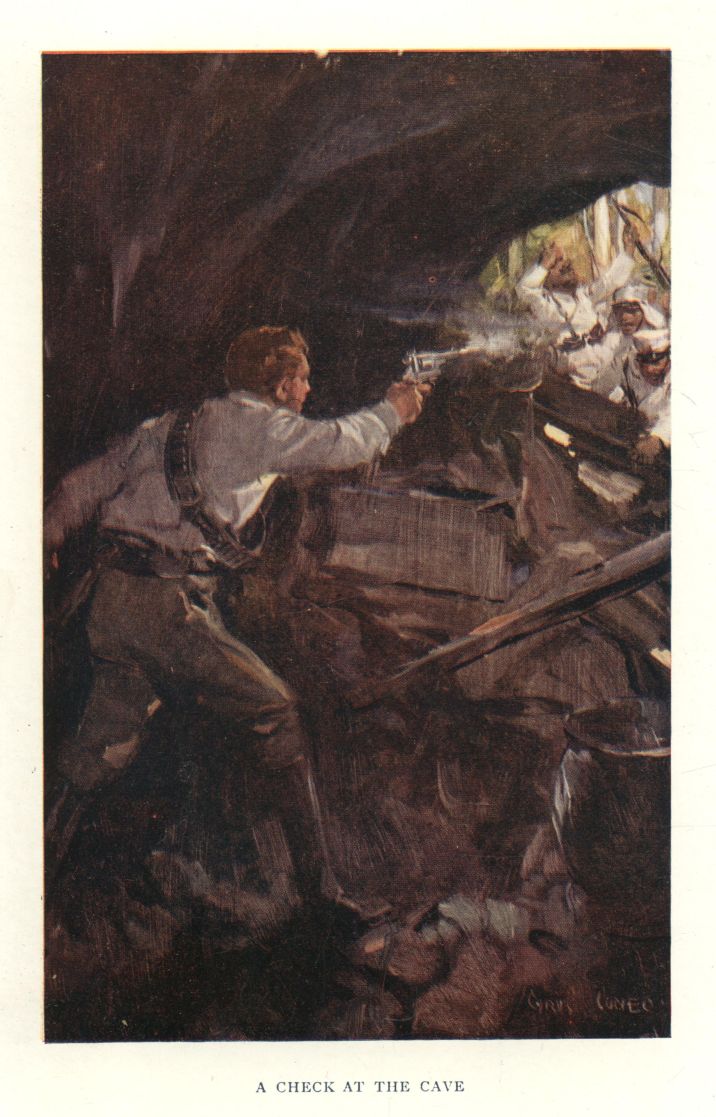
A CHECK AT THE CAVE
When some minutes had elapsed, Tim ventured to draw near to the entrance and peep out through the leaves. The men were grouped some little distance away at the brink of the stream; he heard the murmur of their voices. In a few moments they separated, and spread out to right and left of the cave, keeping as much as possible under cover. One climbed into the tree, and concealed himself amid the foliage. Tim guessed what was coming, and slipped away to the side of the cave. He was not a moment too soon. The enemy opened fire, and their shots, coming in different directions, flew criss-cross into the entrance. Fortunately the walls were soft, and the bullets dug into them instead of ricochetting or splintering. One fragment grazed Tim's wrist, a warning to retreat still farther.
After two or three volleys the firing ceased. The enemy supposed, no doubt, that some of their shots had taken effect, or had at any rate driven their quarry from the entrance. Tim rushed back to his former post, just in time to fire his revolver as the assailants, shouting to encourage one another, came with a dash through the foliage. At the threshold they were checked by the unexpected obstacle of Tim's barrier. For a few moments they stood there, trying to throw it down, cursing, yelling with pain as Tim, invisible in the inner darkness, slowly and deliberately emptied his revolver. This was too hot for them. They broke away, and Tim, running to the entrance, saw them hurrying down the slope to find cover. They were carrying one of their comrades; another lay across the threshold.
They returned to the track. There was another consultation among them; then four of them leapt on their horses and rode away northward. Three went on foot down the track, doubtless to guard against surprise in that direction; one man still remained in charge of the bicycle, the last held the horses. Clearly they had not abandoned their purpose. Tim wondered what their next move was to be. Surely the horsemen had not ridden back to the Inca camp for help! It was more than twenty miles distant. There and back the journey would take several hours. They would hardly spend so much time with the risk of assistance coming up from the Mollendists. The vedette who had been killed must be relieved ere long, and for all they knew there might be a numerous detachment of their enemy within reach.
Tim was not long left in doubt. In half an hour he saw the mounted men returning, and recognised the explanation of their absence. One of them carried an oblong object which revealed itself in a few moments as a sheet of corrugated iron. Tim wondered where they could have got it, until he remembered that some distance up the hill there was a deserted hut, which had probably been at some time occupied by a Cholo shepherd. He jumped to the use to which the iron was to be put. It was to serve as a shield against his bullets.
The riders dismounted at the stream, gave their horses to the man guarding the cycle, and disappeared into the scrub. Some time passed. When they emerged again Tim saw that they had surrounded the iron with a kind of wicker cage. It could now be carried in front of the bearer without his exposing himself in any way to Tim's fire. Wicker and iron together would be impervious to a revolver bullet.
Tim had a few moments to make up his mind how to meet this ingenious device. He slipped across the cave to the opposite side to that at which he had formerly been posted. The enemy would probably expect attack from the same quarter as before, and would turn their shield in that direction. He had just taken up his new position when bullets began to fly crosswise through the entrance. After this preparatory move the enemy made a determined rush. The first man, bearing the shield, came in and faced to the right, turning his back upon Tim, who had a momentary qualm about firing from the rear. That moment allowed the two next men time to pull away the stools. He felt that hesitation would be fatal, and fired. The first man dropped with a groan, and the shield fell clattering upon the long box. Before Tim could fire a second shot, two men had scrambled across on all fours, and the entrance was darkened by their comrades pressing behind.
One of those who had entered sprang to his feet and discharged his revolver at random in the direction of Tim, whom he was as yet unable to see, having come suddenly out of brilliant sunshine into gloom. Tim slipped back quickly along the wall until he was in complete darkness, then ran on tiptoe across the cave. Turning when he reached the wall, he fired his barrels one after another, slipped more cartridges into the chambers, and crossed again. By this manoeuvre he bewildered the enemy, who were now, however, all in the cave, and protected almost as much as himself by the darkness.
He did not fire again, lest the flashes revealed his whereabouts. All that he could hope to do was to find some defensible position in the interior and sell his life dearly. There was not even a chance of dodging his enemy and slipping out, for one man had been left near the entrance. He was determined not to surrender. Even if the men now hunting him did not butcher him on the spot to avenge their fallen comrades, the Prefect would have no mercy on his prisoner. He must defend himself to the last. Perhaps when it came to the final stand he might have an opportunity of dealing with the four men singly.
He retreated slowly along the wall, listening for the enemy, whom he was quite unable to see. All at once he remembered the opening at the farther end which Romaña had shown him. A last hope flashed into his mind. If he could slip out there, replace the turning stone before his exit was discovered, and pass through the waterfall into the open, there was a bare chance of escape. It was true that he might be discovered by the man with the cycle, or by the others on the watch down the track. But it was better to be killed in a dash for liberty than cooped up and slaughtered like a badger in a hole.
Now he hastened his steps, creeping as fast as possible along the curving wall. His hunters were no doubt feeling their way, on their guard against an ambuscade. Everything depended upon his gaining the exit before they came to a spot where the removal of the stone would let a little daylight upon the scene. He ran along on tip-toe, bruising his arms now and then when he encountered projections from the wall, and almost dashing his head against the stone when he suddenly stumbled upon it. Pressing the top, as he had seen Romaña do, he turned the stone, clambered through the gap on to a ledge, and in ten seconds restored the strange gate to its place. He reflected that the enemy, if they had seen the fleeting gleam of light, would take some time to find the stone and discover its manipulation, or, on the other hand, make their way back through the cave to the opening by which they had entered. Whatever they did, he had gained at least a few minutes.
From the ledge on which he now stood he looked eagerly about him. In front of him was the waterfall, forming a filmy screen. He could see through it and around it. There was the man on the track a hundred and fifty yards away. Farther down the three men were still posted: they were now on horseback. Tim hoped that they could not see him. He was, in fact, quite invisible to them, as a person behind a curtain in a room is invisible to those without; though it is difficult for the one within to realise this: he feels that, being himself able to see, he must himself be seen.
The rough ground and scrub in front of the cave was deserted. The solitary figure at the end of the watercourse was in charge of the horses of the men in the cave, and of the three who had fallen to Tim's shots. Near him, at the edge of the track, lay the man who had been carried away wounded after the first attack. Tim could not see the cycle, but he had no doubt that it was there.
What should he do? The men in the cave must soon discover that he was gone. If one had the courage to strike a match the discovery must be made almost at once. There was very little time. The obvious course was to steal along the watercourse, and gain possession either of a horse or of the cycle. Escape on foot was impossible. He could not go otherwise than by the track, and as soon as he appeared there he would be pursued by the horsemen and overtaken in a few minutes. He resolved to creep down to the man who stood alone, try to secure the cycle, or, if not that, a horse, and ride away.
To reach the watercourse he had to pass through the waterfall, or skirt it and appear within full view from the track. He decided on the former course. The magnified shower bath was shattering. Though it was soon over, he was almost stunned by the pelting water, and emerged breathless and wet to the skin. Pausing for a moment to recover breath, he crept down the watercourse. The channel was shallow; he had very little cover; but he could not waste time in careful scouting. At any moment the men might return to the entrance of the cave and discover him. But by taking advantage of every bush and patch of long grass that he encountered, he at last came within twenty yards of the Peruvian unperceived. The man had his eyes fixed on the cave, or he could hardly have failed to see the bent form stealing along.
Stooping until his eyes were level with the top of the bank, Tim looked ahead. There was the cycle, propped against a thick bush. It was headed down the track, as he had left it. He considered rapidly what he had better do. He could not shoot the man in cold blood. The alternatives were equally hazardous. He might make a dash for the cycle, start it, and try to get away before its guardian could seize him. But the man was only a few yards from it; this plan could hardly succeed. Or he might wriggle to within a few feet of the watchman, spring upon him with a sudden rush, and deal him a knock-out blow. He could not fail to be seen at that moment by the wounded man, if he was conscious; the alarm would be given; but there might be just time for him to get away before the three men lower down the track, or the four in the cave, could take aim at him.
The latter course was recommended by the fact that the watchman's attention was divided between the cave and the horses he held by the bridles. They were restless; the jingle of their harness and the stamping of their hoofs would mask any slight sound that Tim might make as he approached.
He slipped his revolver into his belt and crept along; then, gathering his strength, hurled himself upon the unsuspecting trooper. At the last moment of his rush the man half turned, hearing his footsteps, and gave him the opportunity for getting home a smashing blow on the point of his chin. He tumbled like a log. But the success of the attack was almost Tim's undoing. The horses kicked up their heels and stampeded wildly, some up, some down the track, one of them knocking Tim head over heels. But there were no bones broken. Springing to his feet, he rushed to the cycle, and wheeled it round. The engine was still firing; Tim ran a few yards, vaulted into the saddle, and throwing open the throttle to its full extent, rode up the hill after the galloping horses. He was scarcely conscious that the wounded man lying on the grass near by was shouting at the top of his voice.
CHAPTER XXII
A PUNCTURE
Tim's rush had been so swift, so silent, so effectual, that he was already running beside his cycle and preparing to mount before the three men down the track, more than a quarter of a mile away, became aware that something was wrong. The first intimation was the pounding of the horses' hoofs as they took flight. They looked up to see the cause of the sudden stampede, but Tim was hidden from them by the galloping animals, which were dashing downhill at so desperate a pace that the troopers, if they waited for them, must be almost inevitably swept off the narrow track over the precipice. Though they now heard the yells of the mounted trooper above, they durst not delay, but promptly wheeled round and set off to head the race, intending to pull up as soon as the frantic beasts behind them had recovered from their fright.
Meanwhile the shouts of their comrade had brought the other men hurriedly to the mouth of the cave, which they reached just in time to see Tim disappear round a curve in the track. They plunged through the scrub, and screamed with rage when they caught sight of the crowd of horses headed by the three troopers far down the hill to their right. Men of southern blood make little attempt to control their feelings, and these Peruvians, their vision of £500 vanished, stamped and gesticulated and wept, venting bitter curses upon the hapless trooper whom Tim had felled, and who was now sitting up and dizzily feeling his chin.
It was the presence of the three men on the track that had determined Tim to ride northward. With them waiting for him, ready to shoot as he passed, or before, there would have been little chance of successfully running the gauntlet. He had not reckoned on the stampeding of the horses; nor had it occurred to him at the first moment to follow at their heels and snatch an opportunity of slipping through in the confusion. When he did think of it, he felt very much annoyed with himself for being so stupid. Not that he could have run past them: his experience on the track soon proved that the attempt would have been hopeless. Paradoxical as it may appear, this only deepened his annoyance. Three of the horses had started up instead of down the hill. The ascent being rather steep, they were more fatigued than frightened before they had run a mile. The gallop became a trot, the trot a walk, and they were making up their simple minds to stop and refresh themselves with herbage from the side of the track when a creature on two wheels came up to meddle. At the appearance of the bicycle they kicked up their heels and fled, all their terrors revived.
It was now that Tim was angry with himself. If this was the effect uphill, what would it have been in the other direction? Flying downhill after the troop, with a judicious use of his hooter he might have kept them all madly on the run, and even driven them before him into the arms of his amiable commander. It was too late now. Tim was unreasonably irritated. An older person might have consoled himself with the reflection that it is easy to be wise after the event.
He had intended, when he started from camp, to ride northward along this very track; but he wished now that he had remained at the cross-roads, even though that might have involved playing nap with Colonel Zegarra, or making himself amiable to that gentleman's lady friends. There was danger behind him; there might be still graver danger ahead. Other parties of the enemy might be coming down; perhaps the junction of the tracks was held by them. It was a good defensible position, covering any possible attack on the Inca camp by way of the eastern route. If there had been any other path home, Tim might have taken it and bolted, without any reason to feel that he was a coward. But there was none; he was compelled to follow this only track--committed to an attempt to make the round.
There was not much reason to fear pursuit. The men whom he had tricked at the cave had lost their steeds; the other three would perhaps have to ride for many a mile in the wrong direction. Like John Gilpin, they could not help it. By the time they had checked the stampeded animals and brought them up the hill, a good many miles would separate them from the quarry who had baffled them. Tim felt quite easy on that score.
He began to take a little amusement in the chase in which he was, for his own part, involuntarily engaged. The riderless horses in front of him were not at all happy. They would gallop up the steeper inclines, out-distance the strange thudding creature behind them, and when they no longer heard its snorts, slow down and begin to take things easy. But on the more level portions of the track, and the occasional downward gradients, the machine made four or five yards to their one. They had no sooner settled down into an amble than the pertinacious pursuer came panting at their heels, and taking fresh alarm, they dashed on frantically until another rise gave muscle the advantage of mechanism. So it went on for eight or ten miles, until the horses must have thought--if horses think--that they were doomed to drop at length from exhaustion, and fall a prey to the modern centaur.
But Fate, after all, was kind to them. Tim suddenly became aware of that unpleasant sensation, abominable to every cyclist, which announces a punctured tyre. There was no loud bang, like the report of a monster pop-gun, such as sometimes startles pedestrians in the street, and makes horses tremble or prance. The air was oozing gradually away; moment by moment the rear tyre became softer and slacker; and Tim had to stop at once before irreparable damage was done.
Here was a disaster, the more serious because the track was no longer flanked by a cliff on one side and a precipice on the other, but ran along the crest of an exposed ridge, from which he could see a long way before and behind and on either hand. He could see--he might also be seen. The track afforded no cover, the country at either side very little. If he wheeled the cycle to right or left in search of a sheltered nook in which to make his repairs, he would spend much time in getting there and back again. The enemy were doubtless now hot in pursuit. Missing the tracks of his wheels they would hunt for him, and here there was no cave, no waterfall, only a scattered bush or two. They would easily find him, and then!...
Tim sprang off the machine in a hurry. His only chance was to mend it on the track. He rested it against a rock, shot a glance around, then knelt to examine the tyre. Now, as every one knows, it is sometimes not easy to locate a puncture. Tim hoped that it would not be a case of immersing the tube in water, for that would involve going down to the river half a mile away. Luckily the puncture was a fairly large one, and easily seen. The outer cover of the tyre was cut through for about two inches, and the perforation had extended to the inner tube.
He opened the pouch in which he carried a few small tools and material for making temporary repairs. From it he took a phial of rubber solution, a strip of canvas, and a "gaiter"--a thickness of rubber vulcanised to two or three layers of strong canvas, shaped to the tyre, with hooks at the bottom. The first step was to repair the inner tube. This he did by smearing the cut with the solution and sticking on a rubber patch. Then he fastened the canvas by means of the solution to the inside of the outer cover, over the rent, to prevent the inner tube from being chafed by the rough edges made by the cut. The last operation was to fix the gaiter to the rim by its hooks. All this took some time. In tyre mending, as in other things, the more haste the less speed. Tim worked with deliberate care, glancing up and down the track from time to time. At last, after about half an hour's work, he straightened himself, satisfied that the tyre was good for a few hundred miles, and much relieved that he had been able to complete the repairs without interruption.
It only remained to inflate the tyre. He had just inserted the pump when a succession of faint irregular clicks fell on his ear. Turning hastily, he looked down the track. He had a good view of it for half a mile. At that distance it curved out of sight, but was visible again for a short stretch a mile lower down, and still farther in patches. The air was very clear; every tree and hillock was sharply defined in the sunlight; there was nobody in sight.
But the clicks were growing louder; they seemed to be the sounds of iron-shod hoofs upon the rocky ground. He gazed down the track, passing from patch to patch over the intervening bluffs and the stretches of rough country where it was not visible. The sounds came beyond question from his left; still he could see nobody.
Meanwhile he was pumping hard, keeping his head turned in the direction of the sounds. All at once he caught sight of six or seven dark specks moving towards him along the sunlit track. He guessed that they were about a mile away. There was just time to fill his tyre before they came up with him.
The pursuers were now hidden by a curve in the track. He pumped on; the tyre was almost fully inflated. Suddenly he heard a shout, and saw a horseman round the bend half a mile below. He instantly whipped off the pump, turned the petrol tap, and had run a yard or two with the machine when he remembered that in his haste he had left his pouch on the ground. He could not afford to lose that. Backing, he recovered it, thrust it into his pocket, and in another twenty seconds was running slowly up the hill.
Glancing over his shoulder, he saw five men galloping after him. They were no more than a quarter-mile away, shouting, urging their horses to their utmost speed, gaining on him. But the crest of the hill was near; then the track was level for a while; then had a downward incline. The engine worked well; the cycle breasted the slope, gained the flat, and sped on at forty miles an hour.
A minute after Tim topped the crest, the horsemen reached the same spot on their panting steeds. They yelled with rage and disappointment when they saw their quarry bowling along at a speed that a Pegasus might envy. One took a shot at him, but Tim, bending over the handle-bar, offered a low target, and escaped injury. In two minutes he had turned a corner and was out of sight.
CHAPTER XXIII
A LEAP FOR LIFE
When Tim had ridden three or four miles farther, and felt at ease as far as the pursuers were concerned, he came upon the three stampeded horses again. They were peacefully browsing on some scanty herbage at the edge, quite content, no doubt, to be free from their human burdens. At the sound of the engine they once more took to flight, and the violent play they made with their heels suggested to Tim that they indignantly resented the disturbance of their meal.
He was now riding so fast that he could soon have overtaken the animals, in spite of the upward gradient. But if he did so, he would either run the risk of coming into collision with one of them, or drive them over the edge of the track on the left, and down the somewhat steep and dangerous slope to the river. It occurred to him that he might do better to moderate his pace and keep fairly close on their heels. They might prove useful. The cross-track to which he would come presently was somewhat looser than that on which he was riding. If the enemy happened to be at the cross-roads beyond, the horses and the dust they raised might serve him as a temporary screen. So he opened his air throttle a little, and closed the petrol throttle to the same extent, maintaining a speed that would keep the horses on the run without exposing him to the risk of being overtaken.
He soon found that there was a certain disadvantage in following upon the heels of the horses. On coming into the cross-track, he was enveloped in a cloud of dust, thick enough to prevent his seeing more than a few yards ahead. The dust and the bodies of the animals completely shut out the view, and he realised that as he neared the fork he would be quite unable to tell what awaited him there. He thought it advisable to drop a little behind. No doubt the horses would turn to the left when they reached the crossroads, and gallop towards the Inca camp--the place which for some days past they had associated with fodder. If the enemy had not actually passed the fork and marched down the eastern track, he might manage to turn into it unperceived under cover of the dust-cloud, and soon ride out of danger.
Slackening down until he had doubled his distance from the horses, he noticed on his right hand a belt of trees which, if his memory was not at fault, extended for nearly a mile along the southern edge of the cross-track until it joined the eastern path. With one eye on the horses and the other on the trees he watched for the branching of the tracks. It came sooner than he expected. Suddenly the horses swerved to the left; a few seconds afterwards he turned to the right, and felt the machine quicken under him on the downward incline.
At that instant he heard the loud crackle of rifles behind him. Posted among the trees just above the fork there was a body of men who, watching with astonishment the maddened gallop of three riderless horses, caught a faint glimpse of the motor-cycle as it emerged from the whirling dust. They fired too hurriedly to hit the mark. At the sound of the shots Tim bent double and let the machine go. Riding at the rate of thirty miles an hour he knew that the enemy could not catch him on horseback on this particular portion of the track. But when he came to the foot of the hill, and began to climb a long rise, he glanced round and saw a large troop of horsemen dashing down in pursuit. They were a long way behind, and unless some accident befell the machine, he was sure that he could outpace them with ease.
The track wound frequently. For long stretches he was hidden from the pursuers. Looking back now and then he noticed with satisfaction, whenever they came in sight, that he was steadily increasing the interval between him and them. He might have run away altogether if he had driven the machine at full speed; but the track was very rough, and he felt that he must watch it carefully if he was to avoid the risk of a second puncture, or of collision with some boulder. Downhill he often had to check his pace, and so could not take full advantage of the descents to give him impetus for the upward gradients of the switchback. But as mile after mile was covered he became less and less fearful of being caught; and when, at the end of a long, straight stretch, he saw that the enemy were at least two miles behind, he was perfectly easy in mind, and only wondered why they had not given up the hopeless chase.
His former journeys on this track had made him pretty familiar with the landmarks, and as he rode up a long incline, he knew that he would soon be in sight of the wooden bridge over the ravine, beyond which the party of Japanese were posted. A few miles of switchback, and then he would have a downward run home. But on rising slowly over the crest, he was staggered to see a troop of some twenty horsemen halted no more than half a mile in front of him. The track dipped to within about a hundred yards of the spot where they were standing, then bent somewhat sharply upwards, and disappeared over the brow rather more than half a mile ahead.
Tim instantly realised the desperate position into which he had come unawares. His first impulse was to screw on his brakes and dismount, to avoid rushing headlong among the enemy. But in a flash he saw that to do so would be simply to give himself into their hands, or into the hands of the men behind him. There was no escape either on the right or the left. The only possible course was to ride on and take his chance. Setting his teeth, and crouching almost flat over the handle-bar, he opened the throttle, and shot down the hill, sounding his hooter violently all the way.
If he had had the leisure to calculate the possible result he could scarcely have anticipated the success of his action. The horsemen instinctively edged away to the sides of the track, and on to the edge of the rough moorland which bounded it on the east. Some had the presence of mind to whip out their pistols, but as the cycle raced towards them with ever-quickening speed they found themselves in trouble with their horses, which began to quiver and sweat and prance at the strange sight and the terrifying sounds. Down flew the cycle, Tim gripping the handle-bar hard, no longer able to pick his course, but keeping the middle of the track, rough or smooth. He was unconscious of jerks and jolts; blind to the risk of puncture; in that critical half-minute he thought of nothing but the task of steering so as to avoid collision with the enemy, a disaster which they on their part were no less anxious to escape.
He was upon them, in a whirl of dust raised by the wind of his flight. A thrill shot through every fibre as he skimmed danger by a hair's breadth. One of the horses was cavorting on his hind legs, and his rider, almost as frantic as the animal, turned him into a whirligig by hard tugging at the bridle. A few shots were fired by the other troopers, but no man could take steady aim from the back of a rearing horse, at an object flashing by at forty miles an hour. With a rush and a whizz Tim was past.
But his momentary joy at having got through vanished as he felt the slackening of speed enforced by the steep incline beyond. On his former journey he had dismounted and wheeled the machine. There was a great hubbub behind him. The throbbing hum of his engine was smothered by the clatter of the horses' hoofs, and the yells of their riders spurring them on. Short as the ascent was, its angle was so sharp as to neutralise in great measure the impetus he had gained downhill. Moment by moment the machine flagged, and, without looking behind, he was conscious that the pursuers were gaining. He feared that his engine power would not suffice to bring him to the top, upon which he fixed his eyes as it were imploringly. How far away it seemed!
He pressed the pace to the uttermost. The machine toiled up and up; the uproar behind grew louder. He was beginning to despair. The cycle seemed to be crawling. Would the engine hold out? At last, with what appeared to be a final heave, it crept over the crest. The downward slope had begun, and the cycle dropped down with a rush which carried it easily to the top of the farther rise. With a sigh of thankfulness Tim knew that he had now increased his lead.
At this point the track began to wind round the face of the cliff on his right. A few minutes would bring him within sight of the bridge. But there was still one long climb before him, and here, if the pursuers could last the pace, they would have the advantage of him. He glanced back; they were just rounding the curve, perhaps a quarter-mile distant. This was the crisis of the chase. As the cycle laboured up the hill, Tim was aware that the gap was rapidly diminishing. When he gained the top, he had scarcely fifty yards to spare. But now for three or four hundred yards the track was level, and the horsemen yelled with rage as they saw their quarry once more slipping from their clutches. They had no chance against him on the flat. By the time he reached the point where the track dipped to the mile-long descent to the bridge, they had lost more than a hundred yards.
The bridge was not yet in sight. The track bent to the left somewhat sharply. In ordinary circumstances Tim would now have clapped on the brakes, but he was strung up to attempt any feat of daring, and after the first hundred yards of the hill he contented himself with closing the throttle. He swung perilously round the bend, and looking ahead, saw the bridged ravine three-quarters of a mile away. A horseman was galloping towards it--doubtless one of his vedettes. But why was he dashing so desperately towards the bridge?
Tim lowered his eyes, for he wore no goggles, and the wind created by his pace made them smart and tingle. He was halfway down the slope when a dull report below him caused him to look up again. Where, a few seconds before, the bridge had been, there was now a cloud of smoke. His orders had been carried out only too thoroughly: the bridge was blown up!
He was thunderstruck. Reckless and impulsive as he was, prone to play many a mad prank on his bicycle, he had never attempted such a feat as now, in the twinkling of an eye, he saw himself committed to. The ravine was more than thirty feet across. He would reach it in half a minute. No power on earth could check his descent. He must either plunge into the chasm, fifty feet deep, or leap the gap.
How can his sensations be described! Every second his speed was quickening. The steepness of the slope induced the feeling that he was dropping into space. He was conscious of the strange heaving sensation that a person feels on descending in a rapidly-moving lift. His body seemed to be flying upward. The air rushed past, scarifying his flesh, catching his breath, stunning his ears so that he did not hear the report of a dozen rifles across the gap. Down, down, faster than an express train, as fast as a racing motor-car, his body rigid, his mind working swifter than the electric flash--down to he knew not what.
On either side of the bridge the ground had been cleared. He must avoid the ruins of the bridge; he would steer to one side of it. As he swooped meteor-like towards the gap the space on his right widened out, and the ground made a slight ascent to the brink of the ravine. A touch on the handle-bar altered his course a point or two. Barely conscious of the rise, breathless and dizzy, he shut his eyes at the fateful moment--and the machine shot off the brink of the ravine like a stone from a catapult. For a fraction of a second he was in mid air, the wheels whirring beneath him. Then there was a tremendous thud as they struck the ground 011 the opposite side. The machine raced up the incline; the speed slackened; instinctively he applied the brakes; and in a few more seconds he fell rather than jumped from the saddle, and dropped panting, a mass of quivering nerves, upon the track.
A group of Japanese flocked about him. One gave him water from a mug. All were trembling with excitement. When he had collected himself, and inquired what had become of the pursuers, he learnt that, as they rode headlong down the hill behind him, two of the horses had slipped and brought their riders to the ground. The rest had reined up at the volley from the Japanese. Apparently none had been hit, but recognising that further pursuit was hopeless, they had stood watching the last few hundred yards of the cycle's flashing course. The Japanese had been too much amazed and alarmed to fire again. Both the parties looked on as at a thrilling spectacle. After the cycle had made its leap their amazement held them motionless for a while. Then, at a second volley, the enemy wheeled round and galloped away.
Tim asked why the bridge had been fired. The vedette explained that, descrying the heads of a large number of horsemen over the tops of the bushes on the crest of the hill, he had dashed back to give the alarm according to orders. The cycle, being lower, had been invisible to him. His comrades were so eager to carry out their instructions that even when Tim came into view they were too much occupied to see him, and only when the match was kindled, and they ran back to a position of safety, did they perceive with horror that they had, as they thought, cut off their master's chance of escape. Tim waived away their humble apologies; they had obeyed orders; and now that the strain of his nerve-shattering experiences was relaxed, he could afford to smile. The eastern track, at any rate, was impassable to the enemy.
CHAPTER XXIV
FROM DAN TO BEERSHEBA
Colonel Zegarra was holding a levee of his admirers from the town when Tim returned to camp.
"Well, my young friend, have you made any interesting discoveries?" he asked, from among a group of ladies as Tim passed.
"Several, señor," replied Tim. "Among other things, what it feels like to fly through the air on wheels."
"Very interesting," said the gentleman in amiable ignorance. "I was not aware that your machine could fly. How marvellous is the progress of invention!" he added, turning to the ladies.
"Wonderful!" they cried, clapping their hands.
"Will you show us how you do it, Señor Tim?" said the colonel's daughter.
"I regret, señorita, that it is impossible here," said Tim, laying his hand on his heart in the local way. "It requires a hill a mile long; a number of the Prefect's men pelting down after you, and bellowing like bulls; a ravine thirty feet wide spanned by a bridge; and some good obedient fellows who will blow up the bridge at the critical moment. These conditions do not exist every day, señorita."
The girl looked puzzled. Then a light dawned.
"Is it a joke, Señor Tim?" she asked with a smile. She knew something of Tim's jokes in carnival time.
"A joke that won't bear repetition, señorita," he replied, and then bowed himself away.
The eastern track being now impassable, he thought it sufficient to leave a few men at the broken bridge to guard against any attempt to repair it. The rest he withdrew to the camp. One of the vedettes on the western track having been surprised and killed, he decided as a precaution for the future to place the men in couples. He did not enlighten Colonel Zegarra, when the visitors had gone, as to his flight through the air, but simply informed him that the bridge had been blown up to check a troop of the Prefect's horsemen.
Before he retired for the night he thoroughly examined the cycle, and found that the tyres, though showing signs of wear, were as yet sound. He gave it to one of the Japanese to clean, and then sought his couch, worn out by the racking experiences of the day.
Next morning word was brought that the enemy were advancing in force along the western track. Colonel Zegarra was not lacking in courage, and the plan of action to be followed in the event of attack had been settled in several conversations between himself and Tim. The ground on both sides of the track for half a mile from the cross-roads was fairly open, affording a clear field for fire. Though the enemy outnumbered the Mollendists, the latter had the advantage of being the defenders. Their position, protected by earthworks and the fringe of wood, was so strong that an attempt to force it ought not to succeed. To harass the enemy in flank, Tim had arranged to post himself with a small detachment in a dense copse on the left of the track about a mile in front of the camp. With luck he might not be discovered; if he was attacked, the closeness of the trees would enable him to make a good defence. He chose thirty of his own Japanese for this duty, knowing their good fighting qualities and their absolute personal loyalty to him.
They had been stationed in the copse for some hours before the head of the enemy's column appeared. The men were on foot. Tim had intended to worry them as they advanced, but it now occurred to him that he would do better to hold his hand until the attack developed. If Colonel Zegarra should be in difficulties, a sudden assault on the enemy from the rear might turn the scale.
The enemy opened out as they approached the cross-roads, intending to surround the camp. They made a concerted rush, but in the lack of artillery they were seriously handicapped, and after several attempts had failed, they fell back to cover. Some retreated in the direction of the copse. Tim saw his opportunity. Bidding his men wait until they were within a few hundred yards, he then gave the order to fire. In the shock of surprise the enemy fell into disorder, and fled in all directions. Their confusion was communicated to the whole force, and soon the discomfited rabble were in full retreat, suffering severely as they crossed the line of fire from the camp.
Colonel Zegarra rose to the occasion. Ordering his men to mount, he led them in pursuit. The retreat became a rout. Ridden down by the horsemen, cut up by the steady firing of Tim's men in the copse, the enemy were a disorganised mob before they reached their horses, which they had left about two miles down the track. Some succeeded in mounting, and galloped away. Others were headed off, and were made prisoners. Within an hour of the first attack the Prefect's eastern force was shattered, and no longer existed as a fighting unit.
There was great jubilation among the Mollendists. On returning to camp Colonel Zegarra at once penned a flowery despatch to Mr. O'Hagan announcing his victory. The courier had not been gone long when Romaña rode up in haste, bearing a verbal message from the commander-in-chief. After long delay the Prefect was making a determined effort to force the defile, and Mr. O'Hagan asked for a reinforcement of fifty men, if they could be spared. It was arranged that Tim should start at once with fifty horsemen. It seemed unlikely that the troops just defeated would rally, but for assurance' sake he persuaded Romaña to remain at the cross-roads, to advise Colonel Zegarra if the enemy should attempt any movement which must be met rather by craft than by courage.
Tim rode ahead of his troop on the motorcycle. When about a third of the way to the defile, he suddenly discovered on his left a considerable number of men on foot descending from the hills towards the highroad. Their intention clearly was either to take the main Mollendist army in the rear, or to make a swoop on the cross-roads and then to San Rosario. Tim guessed that his father was unaware of this complication. The men must have been for at least two days on the march, for the hills were generally regarded as impracticable.
Tim halted for a few moments to make a rapid calculation. His father and Colonel Zegarra must be warned. If he rode on, the enemy, though at present a long distance away, would be on the road between him and Colonel Zegarra by the time he returned. On the other hand he might ride to the colonel and back before they reached the road, in which case he would still have a chance of slipping by.
He remounted and dashed back at full speed, ordering his horsemen when he met them to halt and be on the alert. Colonel Zegarra agreed to move out with all his troops, and if he found the enemy on the road, marching towards the defile, to hang on their rear. Then Tim set off again. He commanded his horsemen to await Colonel Zegarra; it seemed more important for the moment that the colonel should have his full number than that the party should press on to reinforce Mr. O'Hagan.
The head of the flanking column was only half a mile from the road when Tim dashed by. To some extent screened by trees and bushes, he became the target for the enemy's fire as he passed patches of open country. But he escaped unhurt, thanks to his speed and to the windings of the road, which caused his direction to alter frequently, and baffled the riflemen's aim. In a few minutes he was out of range, in a few more out of sight.
On approaching the defile, Tim heard sounds of heavy firing. The Prefect's attack was evidently being hotly pressed. He found the Mollendist force some distance farther east than he had expected. They occupied the rocks on either side of the road, and were firing along the defile. Just as Tim arrived he heard the distant roar of a gun, and a shell crashed high up among the rocks at his right hand. He slipped off his bicycle, and hurried to find his father.
Mr. O'Hagan greeted the boy with especial warmth.
"Pardo gave me a terrible scare when he told me he had got you," he said. "What happened?"
Tim related how he had been dealt with at the house.
"He had the cheek to come to you, then," he said. "Why didn't he go to the Prefect?"
"I suspect he did. He wanted to make sure of his price."
"The wretch said my price had gone up. What did he ask?"
"The hacienda!"
Tim whistled.
"You kicked him out, I hope?" he said indignantly.
"Well, Tim, you see Colonel Zegarra's despatch with your postscript came just in time, or---- But that's all over. How are things going?"
"We have fairly smashed the lot from the Inca camp. They attacked this morning. Romaña brought your message, and I was hurrying up with fifty men when I saw a detachment of the enemy, about two hundred strong, I think, marching over the hills towards the road, so I rode back and asked Zegarra to bring up all his men and then came on ahead to tell you."
"That's very bad news," said Mr. O'Hagan, somewhat perturbed. "I've as much as I can do to hold my own here. As you see, they've brought a couple of guns to bear on us."
"Where are they?"
"Up in the hills yonder. How they were dragged there I can't imagine. They're at least a thousand feet up. The Prefect has more energy and resource than I expected. When the guns opened fire this morning we had to abandon the head of the defile. We're pretty safe here for the moment, and can check any attempt to force the passage; but I dare say the Prefect will find another position for the guns where they can command us, and then we shall have to fall back again. With two hundred men threatening our rear----"
"Couldn't you spare some men to deal with them?"
"That's a capital idea, Tim. It will take a long time to move the guns to a new position. We'll try it. I'll take a hundred and fifty men myself. You had better stay here; you've done your share."
"I'd rather come with you," said Tim.
"I dare say, but you had better go and report to the President what you have been doing. He's rather down in the mouth, and your victory at the cross-roads will cheer him."
Mr. O'Hagan soon set off with his men, all mounted. When he returned a few hours later, he was flushed with success. The Prefect's hill column found itself in the position in which it had hoped to catch the Mollendists--bottled up between two forces, which equalled or exceeded it in number, and were much fresher. Instead of attacking, the enemy were attacked. Fatigued after their long and difficult march, they were in no condition to make a prolonged resistance, and fell back before Mr. O'Hagan's impetuous onset. They were seeking a strong position when Colonel Zegarra dashed suddenly upon their rear. Hopelessly entrapped, they lost heart. Some flung down their arms and surrendered, others dispersed and sought safety in the hills.
With Mr. O'Hagan returned Colonel Zegarra and the greater part of his force, a small detachment being sent back to keep an eye on the road to San Rosario. President Mollendo, whose volatile spirits had already been exalted by Tim's report of the morning's success, was carried away by delight at the Prefect's second discomfiture on the same day. He insisted on promoting Tim captain on the spot, and made an oration to the troops which moved many of them to tears, and confirmed their belief that they had in Carlos Mollendo a statesman of the highest rank.
While this orgy of sentiment was in progress, Mr. O'Hagan was discussing matters with Tim quietly in the background.
"That's all very well," he said, jerking his head towards the spot where Mollendo was perorating, "but it doesn't prevent the Prefect from hauling his guns. I quite expect that to-morrow he will begin to shift them in this direction, and when they begin to play we can't hold the defile another half-hour."
"What then, Father?" asked Tim.
"Why, then we shall be compelled to fall back on San Rosario. The Prefect has three men to our one; and the moment the tide seems to be turning in his favour a lot of ours are sure to desert. It's the way of things here. But for the guns we could hold him off for months, so long as Galdos keeps up the supplies--though I'm afraid of ammunition running short. The two checks the Prefect has had to-day are decided set-backs, but we are not much better off unless we can take the heart out of him. If we could only capture his guns, now!"
"Why not?"
"Well, if you can suggest a way, do so. But don't reckon without your host. They're at least a thousand feet up, somewhere on that ridge. The War Office of this republic being unable to supply field-glasses, I haven't located them exactly. To climb the hill in face of the enemy would be a pretty tough job in itself, and the guns are pretty sure to be well guarded."
"I'll try it to-night," said Tim, "with a few of our Japs. Some of them were in the war with Russia, and it won't be the first time they've had such night-work."
"I don't want to disappoint you," said Mr. O'Hagan, pulling at his moustache, "but it's too risky--indeed it is. What would your poor mother say?"
Tim was so well accustomed to this appeal ad matrem that it had quite lost its effect.
"She'd jib to begin with, to be sure," he said, "but she'd give in in the end; she always does when it's not an absolute question of right or wrong. You'd better say yes, Father."
It was on the tip of his tongue to relate the adventures of the previous day, but he reflected that the story might have quite the opposite effect from what he intended. Mr. O'Hagan's last instructions to him had been not to go adventuring, and though he felt that he could hardly be blamed for adventures which had hurled themselves at him unsought, it was probable that his father would not recognise any reasoning of that kind. So he confined his arguments strictly to the matter in hand. Mr. O'Hagan's opposition was really half-hearted. He had come to have great faith in Tim's resourcefulness and luck. Ultimately he agreed to let the boy do what he had suggested; the success of his scheme might prove to be the turning-point of the struggle.
Helped by a half-moon, Tim set off about midnight with a dozen of the Japanese who had served in the army, including three gunners. As weapons they carried only revolvers and knives, with a good supply of cartridges. One of them had a dark lantern for signalling the result of the expedition to Mr. O'Hagan. Slipping down the road for some distance in the direction of San Rosario, they turned to the right, and roped themselves together for the climb into the hills.
It was the hardest job that Tim had ever undertaken. He had no compass, and could only direct his course by the position of the moon. Its light was not sufficient to enable him to choose the easiest way. There was no path. At the head of the line he clambered up wherever he could find foothold, sometimes, indeed, crawling on all-fours up slippery slopes, scrambling over or between boulders, now and then brought up by a sheer wall of rock impossible to scale. The party had often to rest and recover breath, and the ascent was so arduous and slow that he was a little uneasy lest the dawn should surprise them before they gained the summit. To make matters worse the moon was dropping, and its incessant change of position rendered it a far from trustworthy guide.
At last, after three hours of fatiguing work, they reached the crest of the ridge, where they caught sight of the lights in the Prefect's camp below them far away to the west. Tim guessed that the guns were placed somewhere along the ridge. He stole along quietly, stopping now and again to listen for signs of the men in charge. Presently he came to a formidable buttress of rock projecting over the valley and rising many feet above the general level. It appeared to be the highest point in this part of the country, and if the top was flat, was the most likely place to have been chosen for the gun platform. Whispering to his men to move as quietly as possible, he led them along a narrow ledge on the face of the cliff below the buttress, edging into the wall on his left hand so as to avoid a fatal fall into the depths.
At the farther end of the ledge he halted. It was now almost dark; the moon had descended below the hills on the opposite side of the road. But by aid of the last lingering sheen he detected signs of recent pick-work on the ground, just beyond the spot where he stood. Evidently a squad of labourers had been employed to clear a passage for the guns. There was no sound. Casting off the rope, Tim stole forward alone, and soon discovered a rough path leading in the reverse direction towards the rear of the buttress.
His heart pumping with excitement, he returned to the men, and whispered his final instructions. There was to be no firing unless they had to defend themselves against overpowering numbers. Then he led them on noiselessly up the path. It ended sooner than he expected. He came suddenly to a level space of some extent, on which he saw two guns, pointing over the valley. Stretched on the ground behind them were ten men. They were asleep. Secure in their supposed inaccessibility, they had posted no guard.
Tim paused a moment, then ordered his men to steal round until they completely encompassed the sleeping crew. At a low whistle from him they sprang forward; there was a brief and almost silent struggle; and the enemy, only half awake, found themselves prisoners. Not a shot was fired; scarcely a wound was given.
Hurrying to the edge of the buttress with the lamp, Tim flashed it three times into the darkness. He knew that his father at the end of the defile, more than a mile away, would be anxiously watching. Then he returned to the guns. By the light of the lamp, carefully screened from the enemy's camp, the Japanese loaded the guns and swung them round until they pointed to the west. When he started, Tim had expected that, if he succeeded at all, he would only be able to spike the guns and then run for it. But having captured the small party of gunners, he saw no reason why he should not turn his success to account. It was now nearly four o'clock. Dawn would break very soon. And he thrilled with delight in the anticipated surprise in store for the Prefect.
The men waited impatiently. On this hill-top they would have earlier light than the troops below. By the time that the first rosy gleam stole out of the east the gunners were at their posts. This was work after their own hearts. The guns were not the perfect machines to which they were accustomed, and they laid them with especial care. The shadows upon the camp at the head of the defile dissolved. As soon as there was light enough, the two gunners fired almost at the same instant, shattering the still morning. A thousand echoes reverberated across the valley, and rolled diminuendo from crag to crag. Before they died away Tim caught the faint sound of cheers from his father's camp.
The two shells had plunged into the centre of the enemy's position, causing a wild rush for shelter. The Prefect's first feeling was consternation. There was no artillery in San Rosario; whence had the enemy obtained the guns? Why had not his own gunners replied? As he looked up towards the platform on which they were posted he saw two swift flashes, and two more shells whistled overhead and crashed on the rocks just above him. His question was answered; the Mollendists, the despised brigands, had captured his guns and turned them upon him. In that bitter moment he wished, perhaps, that he had lent a less ready ear to the suggestions of Miguel Pardo. All the enterprise and daring which his enemy had recently shown was inspired, not by Carlos Mollendo, but by the foreigners, and they, but for Pardo, might have been with him, or at least not against him.
It was soon apparent that matters were serious. Shells were dropping into the defile as fast as the gunners could load. Already they had done much damage, and panic was spreading through the ranks. The men were seeking cover; some were already running to the rear, where the horses were tethered; none had any spirit for fight. While this disorder reigned, there was a sudden cry that the brigands were charging up the defile. The Prefect's troops vastly outnumbered Mr. O'Hagan's, but he had no advantage of them now. They had no faith in their cause, no enthusiasm for their leader. Disheartened by previous failure, demoralised by the bombardment of their own guns, they were deaf to the Prefect's passionate entreaties to stand firm. They answered him with oaths and curses. Nor was the Prefect of the stuff of heroes. He was not the man to gather about him a few choice spirits and steadfastly defend the pass. Surrounded, almost swept away by the yelling mob of his terror-stricken army, he elbowed his way through them, to gain the tree to which his horse was tied. He had better have allowed himself to be borne away on foot among his men. Mounted, he presented a conspicuous object to the head of the eager little force charging up the road. A dozen rifles were levelled at him; a dozen bullets sang through the air; and when the Prefect's body was lifted after the defile was cleared, it was found riddled.
The attack having been made on foot, no effective pursuit could be maintained. So precipitate, indeed, was the flight of the cowed troops, that only the laggards of the rear were in much danger, Mr. O'Hagan's victory was almost bloodless. The fugitives poured into San Juan; the wildest reports found easy credence there. It became known by and by that the Prefect was killed, a piece of news at which more than his enemies rejoiced. The magnates of the town were hurriedly called together; they agreed to accept the new republic; and when, in the course of the afternoon, Señor Mollendo and Mr. O'Hagan rode in at the head of their troops, they were received with acclamations by the populace, and with a flowery address by the officials. The wheel of fortune had lifted the outlaw to the headship of the State.
CHAPTER XXV
THE RAVINE
Much to his disappointment, Tim was not a spectator of President Mollendo's triumphal entrance into his capital. He did not hear the eloquent oration delivered from the steps of the court house, nor was he present at the banquet at which the President fell on Mr. O'Hagan's neck, and kissed him amid the frantic plaudits of the company. When Tim saw the troops charging up the defile, he set off to join them, leaving the Japanese in charge of the guns. At some risk to his neck he scrambled down the face of the hill, and came up with the little army in time to take a share in the final scenes. When the victory was assured, Mr. O'Hagan sent him with Romaña and a hundred men back to San Rosario, to report the defeat and death of the Prefect, and keep order in the town.
San Rosario had quietly accepted the new régime. The few well-to-do people, who had suffered from the Prefect's levies, hoped that the system of benevolences was buried, and were prepared to give the new President a chance; the poorer folk cared little who their ruler was, or what the nature of the government, provided they were able to earn their living in peace. Señor Fagasta was perhaps the only unhappy man in the town.
Finding that everything was peaceful and orderly in the town, Tim thought he might venture to visit the hacienda, arrange for the necessary repairs to be made to the house against his father's return, and reopen work on the plantations, which would soon become a wilderness through neglect. Accordingly, on the second evening after his arrival in San Rosario, he rode over on his motor-cycle, accompanied by Romaña on horseback. Biddy Flanagan was still alone in possession of the house. She welcomed Tim heartily, but was less cordial to Romaña: he was one of "them foreigners." Her joy at the approaching return of "the master" was dulled by distress at the bareness of the rooms. The establishment of a republic was to her an insignificant event beside the loss of the best "chainey," and military glory did not compensate the theft of the silver spoons. And when, early next morning, she carried breakfast into the dining-room, she mournfully drew attention to the fact that she had had to make the coffee in a delf jug.
"'Tis because the silver coffee-pot be took, Master Tim," she said. "And there's no silver spoons for the eggs, and what will I say to the mistress when she comes home!"
"We can get some more, Biddy," said Tim. "And really, I always think that coffee tastes better out of a jug."
"'Deed now, that's true, but 'tis not for the likes of me to say so at all. If there was no difference between the kitchen and the dining-room of a gentleman's house, what would the country be after coming to? Sure I hope the villain is killed, and will not be the way of troubling us again."
"I wonder what became of Pardo?" said Tim to Romaña when the old woman was gone.
"You may be sure he is not killed," said Romaña. "Pardo is not the man to risk his skin in the fighting line."
"No, it may give him lumbago," rejoined Tim with a laugh. "I suppose he has gone off with his loot. A good riddance! After breakfast you might look round the house and see what repairs are needed, while I go over to the huts and tell the Jap women that their husbands are on the way home. It's a blessing none of the married men were killed except the one Pierola shot."
Some twenty minutes later Tim set off on foot for the labourers' huts half a mile across the plantation. He followed a path that intersected a field of sugar-cane, which grew so high that he was completely concealed. Presently it crossed a broad stretch of grass land separating the sugar from the coffee, and here Tim was surprised to see recent hoof-marks. None of his father's horses remained on the hacienda, and he wondered who could have ridden in this direction. If the tracks pointed towards the house he might have supposed that Felipe Durand had come over to see him; but they all led away from it, as though the rider had come either from the stables, or from the meadow behind the house.
Curiosity piqued him to follow up the marks. He took no pains to walk quietly, but his footfall was silent on the grass. The tracks led towards the road that ran past Durand's house and ultimately to the Inca ruins. After about a hundred yards the path bent to the right. On arriving at the bend Tim started back. A little ahead a horse was grazing. A bundle was slung from its crupper. Just beyond, there was a disused well, and here Tim saw a man, whose back was towards him, turning the windlass. He stood partially concealed among the plants to watch. Presently a second bundle appeared over the edge of the well. The man untied it from the rope and turned with it in his arms towards the horse. Tim had already suspected his identity, and he now saw without surprise that it was Miguel Pardo.
Acting on impulse, he dashed forward, hoping to reach the thief before he could mount. But Pardo caught sight of him, vaulted into the saddle, and galloped towards the road. It was hopeless to pursue him on foot. Tim had his revolver, but he was not one to use it in cold blood. Instantly he thought of the cycle, which was in its shed at the back of the house. He sprinted back, started the engine, and in a few minutes was dashing in chase.
He knew that Pardo, in spite of his start, must soon be overtaken, and he had little doubt of the direction of his flight. Neither San Juan nor San Rosario would be safe for him; he would almost certainly choose the track to the Inca ruins; trusting in course of time to be able to make his way round over the hills, and seek refuge in another province where he was unknown.
Tim flew along to the track, wheeled into it, and looked ahead. Pardo was not in sight. Suddenly he remembered the broken bridge. It would certainly not have been repaired. Tim wondered whether Pardo had heard of its destruction. In that case he would not have come this way, but would have chosen the western track. If he was in ignorance of what had happened, he would be checked perforce at the ravine, and the chase would soon be over. Even supposing he had followed the other track, Tim thought that the speed of his cycle would allow him to ride to the bridge, make sure, return to the cross-roads, and still overtake the fugitive, who would no doubt slacken his pace when he supposed himself to be unpursued.
As Tim passed Durand's house, Felipe came down the path. Tim afterwards discovered that he had seen the horseman dashing by, and wondered who could be so foolish as to ride along a track which within a few miles was impassable.
"Pardo!" shouted Tim as he flashed past, and Durand ran for his horse to follow the chase.
A mile beyond the house Tim caught sight of his quarry. In another minute or two he must turn at bay. No doubt he was armed, and Tim for the first time realised that he might presently be involved in rather a desperate struggle. While the horse was galloping, Pardo, encumbered as he was with his bundle, would be unable to take steady aim. But as soon as he came within sight of the bridgeless ravine, he would spring from his saddle and fire. Tim had set off in pursuit with the simple idea of capturing Pardo, and handing him over to the civic authorities for trial and punishment as a thief; but he saw now that he was not likely to succeed without a fight.
The distance between horseman and cyclist rapidly diminished. The long hill beyond the ravine came in sight, but the ruins of the bridge were as yet hidden by the short acclivity beyond which the track dipped. Pardo was just reaching the top of this ascent as Tim arrived at the bottom. There were only fifty yards between them. Before Tim was prepared for the movement Pardo suddenly made a half-turn in the saddle and fired. The shot flew wide, and Tim, edging in on the near side of the track, so that Pardo could only use his revolver again if he turned completely round, or twisted to the left and fired over his shoulder, rode relentlessly on up the ascent. In a few seconds he expected the final tussle.
On gaining the brow of the hill Pardo checked, drew his restive horse across the road, and pointing his revolver steadily, fired. Tim had guessed his intention, and his own shot rang out almost simultaneously. Pardo, not allowing for his altitude, fired too high: Tim's aim was spoilt by his bobbing movement on the machine, and his shot wounded the horse instead of the man. Before either could fire again, the situation was changed with a suddenness that for a moment took him aback. The horse, already alarmed by the clatter of the engine and the sound of the shots, was rendered frantic by its wound. Springing round on its hind legs, it took the bit between its teeth and bolted down the slope towards the ravine.
When Tim gained the top, he realised with horror the desperate peril of his enemy, and instantly forced down his brakes and stopped the machine, in the hope that with the cessation of the noise the animal's terror would lessen in time for its career to be checked. Pardo, a moment after the descent had begun, saw the hideous gap in front of him, and made a desperate effort to rein up. But it was too late. The maddened horse galloped on blindly, came to the edge of the chasm, and instinctively made a frantic leap for the opposite bank. It jumped short by several feet. Then, with a scream that rang in Tim's ears for many a day, horse and rider plunged to the bottom.
Tim had already leapt off his machine. He ran forward and at no small risk clambered down the steep side of the ravine. Both horse and horseman were dead, amid a litter of broken pottery and scattered plate, which had burst from the bundles. Tim shrank from touching any of the stolen property. White to the lips, he climbed up to the track, and staggered into the arms of Durand, who had followed on horseback.
CHAPTER XXVI
HANDSOME ACKNOWLEDGMENTS
One evening, a few weeks after the close of the brief campaign, the town-hall of San Juan presented a picturesque and even brilliant spectacle. All the important people, and a good many of the unimportant, of the capital and of San Rosario were assembled in response to the President's invitation, to celebrate the foundation of the Republic. Two long tables ran the length of the hall; at the top a cross table was ranged beneath a shield bearing the Mollendo arms. The President occupied the centre seat. On his right hand sat General O'Hagan, on his left a young captain of the same name. Next in order to these were the principal actors in this little drama: Colonel Zegarra, his friend the lawyer, Dr. Pereira, Nicolas Romaña, Pedro Galdos, the Durands, father and son--for Señor Durand, having contributed to the Mollendist war-fund, had apparently determined to get something for his money.
Two personages whom one would hardly have expected to see there were Señor Fagasta and Captain Pierola. Señor Mollendo had been informed by Tim of the warning given by the gobernador, which had resulted in the discomfiture of Pardo's night attack on the house. The President argued from this that Señor Fagasta had his good points; and being anxious to conciliate the officials under the old régime he reinstated the burly gentleman in his former office. For the same reason he offered to Captain Pierola, now recovered of his wound, the command of the republican forces, which Mr. O'Hagan, deaf to all entreaties, had relinquished.
In a balcony at the opposite end of the hall sat a bevy of ladies, to watch the feasting in which they, angelically, were not to partake, and to hear the speeches that would follow. Mrs. O'Hagan sat in the centre beside Señora Mollendo. The younger ladies, dressed with all the grace and charm of which the Peruvian belle is mistress, were impatient for the end of the tiresome preliminaries: the banquet in which they could not share, the speeches which some of them had already heard rehearsed, had less attractions for them than the dance which was to round off the proceedings.
The table decorations were unusual. The vases were filled with leaves, blossoms, and berries of the nasturtium, of which homely plant every guest had a flower in his button-hole.
The courses were handed round; the glasses of wine and pisco were filled and emptied and filled again; and then the President rose. A smile beamed upon his benevolent features as he surveyed the cheering company. A broad band of orange satin formed a graceful loop over his white waistcoat, and a large diamond in his shirt-front flashed as it caught the rays of the innumerable candles. He was a dignified and impressive figure.
When the cheers had subsided, he began to speak. After a few introductory sentences, he launched into a summary of the events which had led up to this culminating scene. He described the birth of the Republic, enunciated with great eloquence the principles which would govern his administration, and then, turning to personal matters, announced the honours and dignities which he had conferred on certain of the gentlemen whom he saw on either side. He made graceful references to the legal attainments of Señor Fagasta, to the military abilities of Captain Pierola, to the loyal services of Señores Pedro Galdos and Nicolas Romaña, whom he had appointed respectively treasurer and secretary of the Republic. Then, after an expressive pause, he proceeded:
"Gentlemen, on this great and auspicious occasion I have a duty to perform---a duty of which I acquit myself with all the ardour of an overflowing heart. There are epochs in the life of nations when the firmament is obscured by dark aggregations of cloud, which exclude the radiance of heaven's bright luminaries, and among which the thunder rumbles with awful and portentous reverberation. At such a period of distress and gloom, when Rome, the heart and centre of the ancient world, saw herself threatened by pestilent hosts of waspish barbarians, the eyes of men turned in their trouble towards a simple farmer, who pursued the avocations of bucolic life in his rural retreat, amid sounds no more horrific than the lowing of his cattle and the guttural ejaculations of his swine. To him repaired a deputation of his despairing countrymen, who found him cleaving the stubborn soil with his labouring plough, and besought him to quit those haunts of industry and peace, and, exchanging the gleaming ploughshare for the well-tempered sword, the smock of Ceres for the shining corslet of Mars, to return with them and save the State.
"You know, gentlemen, the sequel of that momentous domiciliary visit. You know how Cincinnatus marshalled his hosts, led them against the enveloping invaders, and having smitten Volscians and Æquians with irresistible might, laid aside the implements of war, and withdrew to replace the yoke upon his toiling oxen, and ruminate in rustic simplicity upon the vicissitudes of mortal things.
"Gentlemen, we too have our Cincinnatus. We have in our midst a gentleman who, driven from his peaceful fields by the shameless greed of tyranny, threw in his lot with the despairing victims of a rapacious despot: who, having laid down the sword which he had wielded with conspicuous dexterity in his youth against the enemies of his adopted country, girded it on in his maturer years at the call of an oppressed and suffering community. Gentlemen, it is to him we owe the inception of the reign of peace and prosperity in this elevated region. I bid you raise your glasses and drain them to the health of our illustrious friend and liberator, our Cincinnatus, Señor General O'Hagan."
The President's speech was hailed with a chorus of vivas as the company sprang to their feet to honour the toast. Handkerchiefs fluttered in the ladies' gallery. Tim, catching Durand's eye, winked, and his friend responded with a look which meant "Look out! The old buffer hasn't done yet." Tim wondered what his father would say in answer to this effusion. He found that the President, instead of resuming his seat when the cheers had died away, remained standing, took a sip from his glass, and went on:
"History does not record whether Cincinnatus was a married man, but, indulging our imaginations, we may suppose that he had a wife and family. We may see with our mind's eye the homely Roman matron, leaving the meal-tub when her husband broke to her the fateful news, and wiping the flour from her industrious hands that she might gird him with the sword, and furbish his shield, and arrange the folds of his toga in comely dignity. We may picture his sons and daughters gazing with admiration not unmixed with awe at their heroic father, watching him as he bestrode his fields with the proud senators who had brought the people's summons, gazing with longing eyes day after day into the misty distance, wondering with anxious fears how their beloved progenitor was faring in the stress and heat of strife. We can imagine their pride and gladness when he returned, crowned with the laurel wreath of victory, and, so far as history relates, without a wound. We can see them gathered about his knee, on the winter nights when the pine-logs crackle, and the wolf's long howl undulates across the marshes, and hang upon his lips as he relates the story of great doings on the stricken field.
"These, I say, are the pictures which imagination paints for us; but we need no aid from imagination to behold the domestic life of our own Cincinnatus. Integer vitae, sceleris purus, as the great Roman sang, he has lived among us, in a home graced by the presence of a beauteous spouse, and brightened by the lively merits of a gallant youth. Such praise and gratitude as we owe to the father we owe also in no small measure to the son, who sits beside me in all the glow of healthy juvenility, blushing with ingenuous pride in the achievements of his noble sire. What need to recount, gentlemen, the exploits of this youthful warrior! Modestly as he himself has veiled them, the admiration of his devoted men could not be silenced, and they proclaim his prowess with unbated enthusiasm. Picture the scene, gentlemen, when, pursued for long miles by the mounted warriors of the tyrant, our dauntless friend sped on unfaltering on his matchless steed, and was not abashed when he beheld the yawning gulf unbridged before him. For him Fate had not ordained the sacrificial leap of Marcus Curtius; the safety of the State did not demand his death. Flashing like a meteor to the very brink of the abyss, he defied the laws of Nature, and soared through the startled air with the swift legerity of a mountain bird. Thus wonderfully preserved from peril behind and before, he played a manful part in the final scenes of this glorious revolution, and, in the words of the august orator of Rome, de republica bene est meritus. I bid you raise your glasses, and drain them to the health of Señor Capitan O'Hagan."
The toast was hailed with thunderous applause. Tim sat with downcast eyes, wishing that the floor would open and swallow him. "I hope to goodness the old josser is done now!" he thought. But the President waited with a benignant smile until silence was restored, then went on:
"It is known to you, gentlemen, that the Señor Capitan is the first recipient of the Order of the Nasturtium, which I have founded in celebration of the new era upon which we have entered. Since it becomes us to invoke the gracious countenance of feminine loveliness upon the order, I have inscribed at the head of the roll the name of the Señora O'Hagan."
Here he bowed very gallantly towards the balcony, and Tim, glancing up, saw his mother incline her head, and raise her handkerchief to her mouth, as if to hide a smile.
"It is known to you also, gentlemen," the President continued, "that in deference to the unanimous wish of the citizens, I have consented that a statue of myself shall be erected in the plaza of this town, not in any spirit of vainglory, but as a permanent witness of the triumph of the principles which I profess. But I deemed it unfitting that the sister town of San Rosario should be without a similar memorial, and I have therefore taken upon myself to order, from Paris, the home of art, two other statues, to stand in the plaza of our neighbour. The one will represent the Señor General as Cincinnatus, garbed in the toga of ancient Rome, with a sword crossed upon a ploughshare at his feet. The other will exhibit the effigy of the Señor Capitan. It was a matter of much deliberation how to mould this second statue that it might form a harmonious companion of the first. As you are aware, the Romans did not anticipate the triumphs of the inventive modern mind. They did not possess the motor-bicycle. But by dint of much thought I have reconciled the old with the new. The Señor Capitan will appear as Mercury, the messenger of the gods, with his caduceus in his hand, and his winged feet planted on a globe. These statues will face each other in the public square, and proclaim to future generations the features and the characteristics of the two gentlemen whose achievements and merits we honour so heartily to-night."
The President at last sat down. Mr. O'Hagan, looking supremely uncomfortable, thanked him and the company, for himself and Tim, for the flattering honours that had been paid to them; and after speeches from Señor Fagasta, Colonel Zegarra, and half a dozen other notables, the proceedings came to an end, and the hall was cleared for dancing.
"I say, old chap," said Durand, when he had an opportunity of speaking to Tim, "won't you feel rather cold as Mercury?"
"Shut up!" growled Tim. "Old Moll's off his chump. But he doesn't mean it."
"But he does!"
"Well then, I'll waylay the silly old thing on the road, and smash it to bits. I never heard of such silly rot."
But these violent measures were not necessary. Every now and then during the next few months Durand put Tim in a rage by announcing that the statues had left Paris, that they had reached Lima, that they were on the road. But the truth is that the financial straits to which the new republic was soon reduced have hindered the realisation of President Mollendo's generous dream, and up to the present the plaza of San Rosario is destitute of classic statuary. Cincinnatus lives very contentedly on his farm, and Mercury is now leading a grimy existence in some famous engineering shops on the Tyne.