THE MOTOR SCOUT (continued 3)
Reading edition
The barracks occupied almost the whole of one side of the short street. Wide gates gave entrance to an open porch that cut the building in two. It was flanked on both sides by the lower floor, devoted to stores. Staircases led to the upper floor, in which were, on one side the quarters of the men, on the other the guardroom and armoury. Both right and left a palisaded balcony overlooked the porch. Beyond this was a long rectangular patio, bounded on three sides by the stables. The patio was surrounded by a high wall abutting on the gardens of the surrounding villas.
During the daytime the front gates were constantly open, and a sentry marched up and down the porch between the street and the patio. At night they were shut, and the sentry occupied his box just within. Tim had debated on the way whether to scale the rear wall or to rush the front entrance, and decided that the latter course had the better promise of success. The wall was spiked; if they safely surmounted it, to descend on the stable roof would cause a commotion among the horses, and before they could reach the main building they would have to cross the whole width of the patio, perhaps in the face of a hot fire. If the front gates were shut, the wicket would no doubt be opened in answer to a knock. Then his plan was to seize and silence the sentry, and send his men up the stairs, if possible before the alarm was given.
He halted at the end of the street, which was not overlooked by houses, and glanced up it towards the plaza. To his surprise and joy he saw a bar of light across the roadway at the position of the gates. They were open: evidently the surprising events of the evening had led to a modification or the neglect of the usual arrangements. The street was empty. Passing word along the line that the men were to follow at his heels as quickly as possible, he rushed along towards the open gates.
Within the porch the sentry at his box was talking to two of his comrades who, with their coats loosened, were leaning over the railing of the balcony on the guardroom side. The attackers had come within a few yards of the gates before the sound of their hurrying feet was audible above the hum of the excited crowd in the plaza. It awakened no alarm or suspicion; but the sentry moved leisurely to the street to see what was happening. He had just reached the gates when, before he could cry out, he was hurled to the ground, and a crowd of men dashed past and over him into the porch. The two men above stared in bewilderment for a moment; then, partially realising the situation, they ran back into the guardroom shouting with alarm.
By this time Tim was half-way up the stairs on that side. Some of his men followed closely; others were springing up the opposite staircase. As yet not a shot had been fired. But as Tim reached the balcony half a dozen mestizo soldiers of the Prefect came tumbling out of the guardroom, some loading their rifles, some hastily flinging on their bandoliers. Tim shouted to them to surrender, emphasising the demand with a shot from his revolver. At such close quarters they could not fire their rifles. The suddenness of the attack, and the sight of the swarm of Japanese and Cholos pressing on with billhooks, struck them with panic. All but two threw down their arms at once; one struck at Tim with his clubbed rifle; Tim dodged the blow, and throwing out his left foot behind his opponent, flung himself with all his weight against the man and hurled him backwards to the floor. The sixth man ran to the window opening on the patio, and sprang out, falling with a crash. It was afterwards discovered that his arm was broken.
On the other side, meanwhile, a brisk fight was in progress. There were a dozen men in quarters, including the second lieutenant. All the rest were in the plaza or had gone to Mr. O'Hagan's hacienda. Roused by the noise, they seized their arms and rushed to the balcony. The officer reached the head of the staircase at the same moment as the first of the Japanese, and instantly dropped him with a revolver shot. This momentarily checked the assailants, giving time to the troopers to come forward to the lieutenant's support. When Tim, after his bloodless victory, ran back to the balcony, he saw on the opposite side a confused mass of men in hand-to-hand fight, hacking at each other with rifles, swords and billhooks. He could not fire for fear of hitting one of his own party. Leaping down the staircase, he dashed across the porch, up the other stairs, and flinging himself into the midst of the mêlée, brought the butt of his revolver down heavily on the officer's head, at the same time crying to the Peruvians that all was lost. They were already hard pressed; seeing their officer fall, and more Japanese and Cholos mounting behind the lad with the ruddy cheeks and fair hair, they gave up the unequal contest.
Locking them in their rooms, Tim hurried down to the porch. He ordered some of his men to close and bar the gates, and led another party up to find the armoury beyond the guardroom. The door of it was locked, but he burst the lock with a shot from his revolver, and, ordering the men to go in and help themselves, he ran back, recalled by a clamour at the gates.
On reaching the balcony, he found his men at grips with a number of the enemy who had been patrolling the plaza on horseback, and hearing the shots had galloped down the street to discover their cause. The greater number of Tim's party being on the floor above, the Peruvians had been strong enough to prevent the closing of the gates, and some had already penetrated into the porch. Tim sang out to the men behind him in the guardroom and armoury to line the balcony, and fired down among the enemy. He was soon joined by a dozen eager Japanese. At his order they poured a volley into the crowd below, taking care not to hit their comrades, who were partially sheltered behind the half-open gates. The horsemen, thrown into confusion by this deadly attack from above, tried to wheel their horses and ride back into the street. This made the confusion worse than before. The horses plunged with fright and pain; several of the riders reeled from their saddles; in a few seconds the survivors fled in hopeless rout. The moment the last had gone the gates were slammed behind them and barred.
Running to a window overlooking the street, Tim saw more horsemen galloping from the plaza, followed by a shouting mob. He called his newly-armed men to his side, and ordered them to fire as soon as the troopers reached the barracks. One volley was enough. The horsemen reined up, wheeled about, and rode back in disorder, driving the shrieking crowd before them. The barracks were won.
CHAPTER XVI
A SIEGE AND A SORTIE
Tim had learnt his lesson against premature exultation. He did not at the barracks, as at the hacienda, allow his wits to be lulled by the heady incense of success. The flight of the troopers, the secure barring of the gates, gave him a breathing space in which he envisaged very clearly the dangers of his situation.
He was not much troubled about the men whom he had just defeated. They would probably take no further action until rejoined by the strong party who had ridden out to the hacienda. How long would that be? Nobody at the house would tell them in what direction the insurgents had marched. The Peruvian officer might suppose that they had fled to the hills, and if he pursued, it would be many hours before he could return with his troopers to San Rosario. But it was not unlikely that they had heard the sounds of firing, which would travel far across the open country in the night. In that case the party would gallop back at once. No doubt a messenger had already ridden from the town to acquaint them with what had happened, so that in all probability they would return within two hours. It was now nearly nine o'clock; by eleven the combined force, outnumbering Tim's band, would for their own credit's sake try to recapture the barracks. Behind walls Tim felt that he had a fair chance against them.
But this was only the first and the least of the dangers he had to anticipate. There were two hundred or more men in Mollendo's old camp in the hills: the news of the outbreak at the hacienda might already have been conveyed to them, with a summons to ride back to the town. If they started as soon as the call reached them, they might arrive by six or seven o'clock; but Tim hoped that with Spanish procrastination they would put off their departure until the morning. There was a much more pressing peril. San Juan was only thirty miles away--ten miles nearer than the Inca camp. The Prefect was there! Doubtless he was possessed of full information, flashed to him from San Rosario by telegraph. Spanish though he was by blood and habit, he was prompt and vigorous in action; and with his present authority and future security at stake he would surely set off within a little of receiving the news--perhaps was already hurrying across the hills. The road was bad; a march by night could not be fast; but even at the worst, by five o'clock an overwhelming force might be pouring into the town.
Tim wished that he had had the forethought to send a man to cut the telegraph wire. That would have gained five hours at the least. But he could not think of everything; he was as yet a novice in things military; and he had had no one with whom to take counsel. He reflected bitterly on Romaña's desertion. Romaña was not a soldier; but he was twice Tim's age; he had had some experience with the Mollendists, and was shrewd and far-seeing. Tim was surprised and angry to find that the man was apparently a coward.
Thrown upon his sole resources, Tim tried to think of some means of meeting the threatening dangers. His case would be hopeless as soon as the Prefect arrived with his main body of troops, unless--Tim grasped eagerly at an idea that had flashed upon him. If he could send a message to his father, the Mollendists, though ill-equipped and weak in numbers, might push down from the hills by way of the river bed and reach San Rosario in time to give him help. But they were twenty miles beyond the Inca camp, and could not arrive before the Prefect unless the approach of the force from San Juan could be hindered. That was not impossible. A few men posted on the hill road just above the place where the Mollendists had snapped up the gobernador could hold in check a much larger number in the darkness, and gain a few precious hours. Tim resolved to attempt both--to despatch a messenger to his father, and a little band to the defile on the high road to San Juan.
He had just risen from his seat in the guardroom to select men for these tasks when there was a commotion below--a shout of alarm, followed by a moment's silence, then a cheer. He looked over the balcony, and saw Romaña pushing his way from the patio through the crowd of Japanese and Cholos to the foot of the staircase.
"You are safe, señorito?" Romaña called, seeing Tim looking down at him.
Tim did not reply: he felt hurt and indignant.
"You come when the fight is over," he said, when Romaña joined him. "I thought I could trust you."
"Caramba, señorito, what do you mean?" cried Romaña, his usual forbearance giving way under a rush of hot blood. "Do you take me for a coward? I have saved you from making a thorough mess of your own hasty scheme. You did not think of the telegraph wire: I did. That is all."
"You have cut it?"
"Yes. I galloped straight to the road. I hope I cut the wire before Pardo reached the town."
"Forgive me, Nicolas," said Tim penitently, grasping his hand. "I am an ass. I ought to have known you had not deserted me."
"Say no more, señorito," said Romaña, cooling at once. "I am rejoiced at your success. But there is still much to do."
"How did you get in?"
"I climbed the wall and got over the stable roof. That must be guarded, señorito. When the men come from the hacienda they will certainly try to get in. The Prefect will hang them if they do not recapture the place."
"It shall be done: I ought to have seen to it before, but I have been thinking of other things."
He went on to tell Romaña his recent decisions.
"I thought of both, señorito," said the man. "I debated whether to ride at once from the road to Señor O'Hagan; it would have gained much time; but I felt that I must first see what had become of you. The duty is mine: I know the way: no one else does. Give me a dozen men; we will sally out on horseback down the street and get away before the men in the plaza are ready to pursue us. Galdos has my horse in the wood half a mile away, but I need a fresh one."
"What about the supplies?" asked Tim, remembering the errand on which they had come.
"I took out two laden mules to the place where we had arranged to meet. Finding that you were not there, I tied them up in the wood and went to the house to fetch petrol, as I promised. Little did I imagine what I should see there!"
"I got tired of waiting and went myself. There are several petrol cans in the shrubbery. Of course I had no intention of fighting; but I simply couldn't stand Pardo thrashing Asumi, and when the other Japs began to attack I saw a chance. It was a mad thing to do: I didn't look ahead."
"It may turn out to be the best thing that could possibly have happened. But I must go, señorito; time is precious."
They went down to the stables together, and chose twelve of the best horses. Then they selected eleven of the Cholos, who were quite at home on horseback. Tim explained the nature of the service required of them. They were eager to start. The lamp in the entrance was extinguished. Tim kept watch on the street from the window of the guardroom, with several men armed with rifles. The bars were quickly removed; the gates were thrown open; and the twelve men sallied out, turned to the right, and galloped at full speed down the street. There was instantly a rush from the plaza. But a volley from the windows checked the oncomers, and they fell back. Tim knew that before they could ride through the plaza, and down a side street in pursuit, the fugitives would have a start of at least half a mile. The gates were again closed and barred, and silence fell once more upon the scene.
Tim had little anxiety about Romaña. On reaching the outskirts of the town, he would follow a track parallel with a stream--the same which flowed past Romaña's cave--cross it a few miles to the west, then proceed across open country until he came to a wooden bridge over the river. He would then take to the high road, and in the course of little more than two hours arrive at the defile where Señor Fagasta had been captured. There posting the men, he would return to the river, and ride more rapidly upon the hard sand at the edge of the channel. In five or six hours he should reach the Mollendist camp. With nearly sixty miles to march, Mr. O'Hagan could not reach San Rosario before late on the next afternoon, even if he started with his mounted men only. But if the men posted at the defile were successful in delaying the Prefect's advance, the time gained might be enough to allow the Mollendists to secure the town.
Romaña's forethought in cutting the wire had diminished the most serious of Tim's anxieties. The telegraphist at San Rosario, of course, would soon have discovered the damage by the failure of response from San Juan, and after a certain delay no doubt a mounted courier had been despatched to convey the news--possibly a considerable party, for protection against enemies along the road. In all probability news of the affair at the hacienda had only just reached the Prefect, who might reasonably regard it as a trumpery disturbance that could be left to his subordinates. It would be some hours yet before he learnt of the attack on the barracks, and even if he then started immediately, Romaña would have placed his men on the defile before the force from San Juan could arrive.
When the gates had been secured, Tim had the lamp relit and called a parade of his men in the patio. His losses had been slight. Of the eighty-two left to him, seventy-five were still fit for service. All but eight were now armed with rifles; for the eight there were swords, bayonets, and lances, if they wished for other weapons than their own bill-hooks. A large proportion of the Japanese, having served in their national army, were expert with the rifle; and as there was plenty of ammunition in the armoury, and food in the stores on the ground floor, Tim felt himself very well situated, whether to withstand a siege or to repel an attack.
After parading the men, he told off a number of them to hold the roof of the stables on three sides of the patio. The rest were posted at all the windows overlooking the street. The rooms were left in darkness.
About an hour after Romaña's departure the sounds from the plaza, which had died down into a dull murmur, suddenly revived. Shouts and cheers mingled with the clatter of hoofs and the jingle of accoutrements. The party from the hacienda had returned. Tim sent word to the men on the stables to be on the alert.
Some time passed. The plaza had again relapsed into silence. Tim guessed that the enemy were organising an attack. He wondered whether they would attempt an assault on the gates, or trust to escalading the patio walls. The gates were of hard wood studded with iron; the bars were stout; it would not be easy to break them down. If the enemy once forced their way in and made good their position, they would have command of the stores, for Tim could not risk a hand-to-hand fight in the entrance porch. The party from the hacienda, combined with those who had been patrolling the plaza and probably with a certain number of the Prefect's supporters in the town, would outnumber his own men by at least three to one. Tim thought his best plan in the event of an inroad was to hold the balconies and staircases, and keep the enemy at bay until they were forced to retire by exhaustion of their ammunition.
He soon found that the danger was to be faced both in front and rear. Warning came first from the stables. The silence was broken by a sudden clamour. From the surrounding gardens men were attempting to scale the wall on all sides--an impossible feat in face of the forty men at their posts of vantage on the stable roof. But this attack was only designed as a means of occupying the defenders while the main assault was proceeding in front. Looking up the street, Tim saw a number of dark shapes rushing from the plaza along the opposite side. He had ordered his men to hold their fire until the enemy were well in view. But the attackers did not come far down the street. They suddenly turned to their left, and disappeared within a doorway. Their object was soon evident. In a few minutes there was a burst of flame from the houses exactly opposite the barracks, and bullets flew through the open windows at which Tim and his men had posted themselves. At the same moment a much larger body of men, all on foot, came dashing along from the plaza, keeping on the near side of the street. It was plain that under cover of the rifle fire opposite a determined attempt was to be made to break in the gates.
Tim ordered half his men, taking what cover was possible, to reply to the fire across the street, and the other half to be ready to shoot down upon the enemy below. He saw at once that at the windows his second party would be at a great disadvantage, because they could not fire effectively without exposing themselves. So he sent them up a wooden ladder to the roof, where they would be in less danger themselves, while better placed for dealing with the assailants.
Soon both patio and street were ringing with the noise of battle. At the rear and sides the troopers who tried to mount the walls, some on ladders, some by clambering up the stonework, were hurled down by the men above them. In the front, bullets rang across the street in opposite directions, and poured from the roof upon the dense mass now at the gates. Tim heard a resounding crash below; the enemy had brought with them a heavy beam which they were using as a battering ram. In the almost total darkness it was impossible to discover the effect of the fire from the roof. That it was comparatively ineffectual was soon proved. Three times the thundering blows rang on the gates; at the third one of the wings gave way, and with a yell of triumph men began to pour into the porch.
Tim at once called his men from the windows and posted them on the balconies overlooking the entrance, whence they fired on the crowd surging in. Some of the men on the stable roof, seeing by the light of the lamp what had occurred, began to shoot across the patio. Taken thus between two fires, the front ranks of the enemy lost heart and tried to push back to the street. They were checked by their comrades still pressing forward, and for a minute or two the porch was filled with a solid mass of men, into which the Japanese poured their shot as fast as they could load. The enemy were thrown into utter confusion and panic. With yells of rage and pain they struggled among themselves, fighting each other in their desperate efforts to get through the half-open gate into the street. But for the steady shooting of the men on the roof, which cleared the ground opposite the entrance, not one would have issued forth alive. An advance of their comrades had been checked. The pressure relaxed; the way was open; and in five minutes after the gate was broken the survivors of the fight were rushing headlong back to the plaza, driving the mob before them, and pursued by shots from the men on the roof.
Tim ran downstairs and across the patio to learn how his men were faring there. The assailants had been beaten back all along the wall, and were slinking away through the gardens to rejoin their friends. There had been much commotion among the horses in the stables, and a good deal of damage done by their heels when they lashed out in terror of the shots. On looking in at the quivering animals Tim was seized with an idea: why not keep the discomfited enemy on the run? They had had two rather sharp lessons: a charge on horseback might have at least the effect of discouraging another attack on the barracks. By starting at once he might even yet overtake the fugitives before they all reached the plaza.
He called up the twenty Cholos he had left; in half a minute they had led all the remaining horses into the patio, and without waiting to saddle, sprang upon their backs and followed Tim to the gate. As they came to the street, Tim saw that fortune favoured him. The men who had been firing from the opposite houses were at that moment issuing from the doorway some distance away, and moving off towards the plaza. With a wild whoop Tim led the charge. The enemy instantly picked up their heels and dashed for safety. Their comrades in the plaza were gloomily discussing their defeat. Only a few men who had been patrolling the square were mounted; the horses of the rest were ranged in a long line opposite the gobernador's house. At the sound of Tim's party galloping and the cries of the fugitives the whole body made a rush for their horses; but before they could cross the plaza the pursuers were upon them.
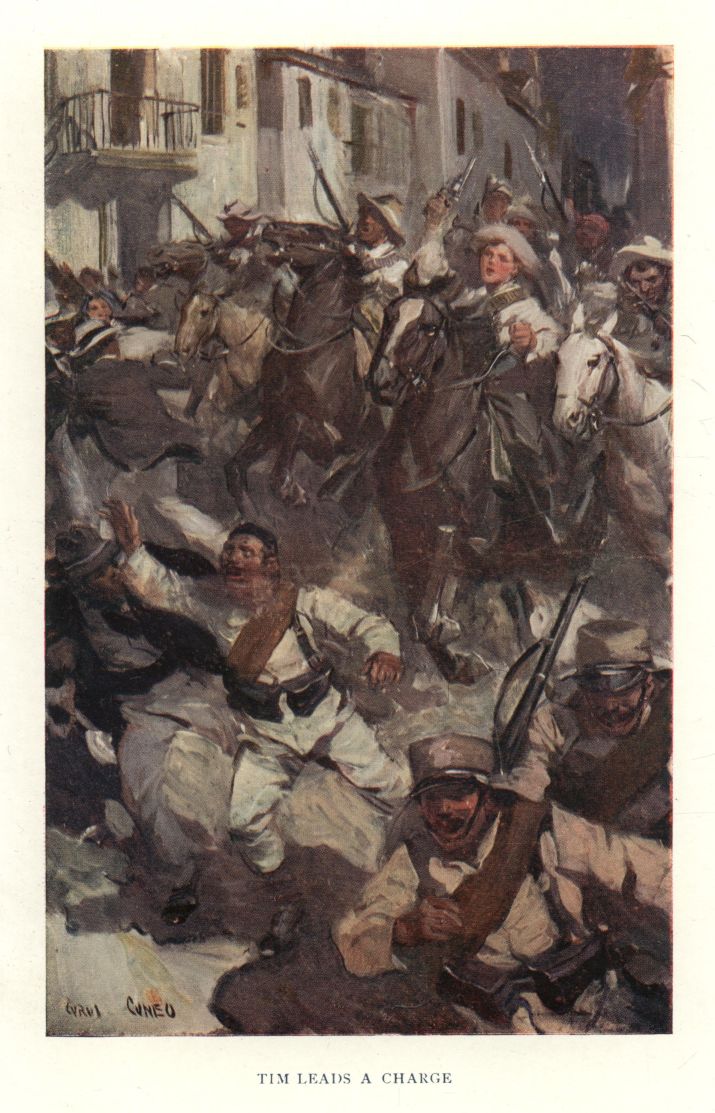
TIM LEADS A CHARGE
The place was ill lighted; the Prefect's men, even if they had not been flustered and disheartened, could scarcely have seen how small was the band clattering across the cobbles. The noise made by Tim's men, indeed, was worthy of a regiment, and being mingled with shouts and screams from the people who had been pushed back to the openings of the streets, the coolest of soldiers might have been deceived. These hirelings were not cool. One or two succeeded in mounting; the rest took panic and ran in all directions. Their horses caught the infection, and galloped riderless across the plaza, dashing in blind fear among the shrieking people. Men and animals fled helter-skelter into the dark streets and out into the open country. In a few minutes the whole garrison of San Rosario as a mounted force had ceased to exist.
Tim was prudent enough not to leave the plaza. He did not yet appreciate the full extent of his success. When the square was clear of the enemy, he hastened back to the barracks, blocked up the damaged gateway as well as he could, and then, feeling that he was safe for the rest of the night, sent his men to find a supper.
CHAPTER XVII
IN POSSESSION
Felipe Durand was enjoying an after-dinner cigar with Dr. Pereira when they heard the first commotion in the town consequent upon Pardo's arrival from the hacienda. Regarding it as nothing more than a street brawl they went to a window overlooking the plaza, and watched the crowd gathering, and the gendarmes come from the direction of the barracks to keep order. After a few minutes they returned to their chairs.
Presently a servant entered, and reported what was being said in the town. A wild and exaggerated rumour had spread that the Mollendists had swooped in vast numbers on Mr. O'Hagan's hacienda; the Prefect's troops had been sent to drive them out.
"Young Tim did not tell me that anything of that sort was in contemplation," said Durand.
"It is a mad proceeding," said the doctor. "By all accounts the Mollendists are a very small party, and badly provided. I am surprised at O'Hagan."
"Perhaps it is a move of Tim's," suggested Durand. "He's mad enough for anything at times."
"That boy has as many lives as a cat. It's a marvel that he hasn't broken his neck long before this."
"He was just the same at school. If he fell from a tree he never seemed to hurt himself. I remember once at rugger--a sort of football, you know--he had a terrible collision with a forward twice his size, and we thought he was killed for a certainty. But he got up after a minute and rubbed his shins and chaffed the other fellow about his fat. 'Soft as a cushion,' he said, 'lucky for me.'"
They sat smoking and talking until a renewed uproar drew them again to the window. There they watched what ensued upon Tim's capture of the barracks. They came to the conclusion, surprising as it was, that the Mollendists had attacked in force. The rumours brought from below stairs magnified every detail. The numbers of the assailants were greatly multiplied; Dr. Pereira was inclined to believe that Mr. O'Hagan, of whose exploits in the Chilian war he knew, had himself organised a dashing descent on the town. It was only later, when Tim led the charge into the plaza, that the two onlookers had an inkling of the truth.
"It's Tim after all, the young demon!" exclaimed Durand.
"But he must be backed up," said the doctor. "He would never attempt such a foolhardy exploit unless he could rely on support from his father."
"You don't know Tim so well as I do, señor," said Durand.
"You must stay the night, Felipe. We can't tell what may be happening on the road, and you mustn't risk being shot. The affair is evidently much more serious than I thought. In the morning we shall learn the truth of it."
A little while after the plaza had been cleared and the excited populace had melted away, two of the principal men in the town, both strong opponents of the Prefect, came to see Dr. Pereira. They pointed out that the town was now without responsible authorities. No gobernador had yet been appointed in place of Señor Fagasta, still under arrest; Captain Pierola, in command of the garrison, was reported killed; and next day the place would be in anarchy. They therefore begged the doctor to proclaim himself provisional gobernador, and to authorise the enrolment of special constables to keep order until matters developed.
"I don't think I can do that," said the doctor. "The town is now practically in the possession of the Mollendists. Any such action on my part would be resented by them, unless indeed I issued a proclamation in the name of Señor Mollendo. Do you suggest that I should do that?"
His visitors, one of whom was the principal lawyer in the town, hesitated. They recognised that to take such a step would be a burning of their boats. The Prefect was still to be reckoned with.
"My idea was to remain neutral between the two parties, señor doctor," said the lawyer, "and set up a provisional administration in the interests of the general order."
"That cannot be done without the consent of the gentleman now in military occupation," replied Dr. Pereira.
"But he is not in effective occupation, señor," the lawyer persisted. "He has withdrawn his men to the barracks."
"The Prefect's men are not in occupation, at any rate," said the doctor, dryly. "They have abandoned the town. The utmost that we can do is to send a deputation to the Mollendist leader, and ask him to authorise measures for the protection of the life and property of the civil population. I am willing to form one of such a deputation, and I suggest that you accompany me, señores."
"Let me come too, señor," said Durand eagerly.
"You had better remain here, Felipe," replied the doctor. "This is a matter for grave and reverend signors."
His eyes twinkled. He suspected that his visitors were as yet unaware of the identity of the "Mollendist leader," and relished the anticipated scene of Tim receiving the deputation. In a few minutes the three gentlemen set forth, the doctor bearing a note which Durand had hastily scribbled.
Meantime Tim, while his men were at supper, had been taking mental stock of the position. It did not occur to him that he was master of the town. No boy of his years and limited experience could suppose that by a single charge at the head of twenty men he had swept away all effective opposition. He did not know that the enemy had scattered in all directions over the surrounding country; and while he felt that they would probably not attack again during the night, he expected that they would rally and at any rate keep him closely invested pending the arrival of the Prefect. Consequently, after arranging for the efficient guarding of the barracks during the remaining hours of darkness, he threw himself on Captain Pierola's bed to snatch a rest in preparation for the anticipated work of the day.
He was called up about midnight by one of the sentries, who reported that three men were approaching from the plaza under a flag of truce. He hurried to the gate, and was surprised to hear Dr. Pereira's voice in answer to the question he asked through the wicket.
"We come as a deputation on behalf of the citizens," said the doctor.
Tim threw open the wicket, and the three gentlemen entered. The lawyer and his friend stared when they recognised in the "Mollendist leader" the boy whom they regarded as a harum-scarum young giddy-pate. Tim's surprise equalled theirs when the doctor, who thoroughly enjoyed the situation, explained the object of their visit.
"We have come to you, as the gentleman in military possession of the town," said the doctor, "to request that you will take measures for the maintenance of civil order. The official garrison has withdrawn; the gobernador is unable to act; and we fear that disturbances may arise among the populace. We offer no opinion and take no sides in the dissensions which presumably have led to the present circumstances; we approach you merely in the interests of the general good."
The doctor's words were grave and formal, but Tim caught the humorous twinkle of his eyes. He knew that Dr. Pereira was no friend to the Prefect. Maintaining equal gravity, he tried to adjust his thoughts to the new situation. If the doctor had been alone, he would have spoken to him freely, and asked his advice. The presence of the other two Peruvians, whom he knew only slightly, imposed a reserve. Quick-witted as he was, for a moment he found himself at a loss. But when he realised the full import of Dr. Pereira's words, he pulled himself together, and said:
"I am honoured by your visit, señores. I will at once send men to patrol the plaza." A sudden idea struck him. "Perhaps it would be in order if I issued a proclamation."
"That is the usual formality, señor," said the lawyer, with professional approval.
"Then will you be good enough to draw it up for me, señor? You will employ the correct forms. Announce that I hold the town in the name of Señor Mollendo, and that it is under martial law until the civil government is re-established. You will find paper and ink in the guardroom upstairs."
The lawyer and his friend having departed to draw up the document, Tim was left alone with his old friend.
"Bravo, Tim!" said the doctor. "You have carried it off well."
"But is it true?" asked Tim eagerly. "Are we in possession of the town?"
"Without a doubt. You have only to act boldly. Toujours l'audace! The garrison have bolted; without good leadership they won't rally, and Captain Pierola is dead, I hear."
"He is only wounded," said Tim.
"He is not here, at any rate. The Mollendists have a strong party in the town, and if you put a bold face on it the Prefect's adherents will not dare to rise. Of course your father is near?"
"I hope so, señor. I have sent a messenger for him."
"You don't mean to say that you have done this on your own account, unsupported?"
"We have been rather lucky," said Tim with a smile.
The doctor uttered an ejaculation of amazement.
"You must tell me all about it presently," he said, as the lawyer reappeared with the proclamation. Tim, with an ingenuous blush, scrawled his signature at the foot: "Timothy O'Hagan, Lieutenant;" and with grave salutations the three gentlemen withdrew. At the moment of parting, Dr. Pereira put into Tim's hand the note written by Durand. Opening it, he read:
"Good old Tim! I wish I had been in the scrum. I am going to ask my pater if I may join you."
CHAPTER XVIII
THE ORDER OF THE NASTURTIUM
Tim sent twenty of the Japanese to patrol the plaza, to be relieved after two hours. Then he returned to bed, feeling immensely elated at the astonishing turn of affairs.
Early in the morning, a group of men were seen approaching under a flag of truce from the end of the street remote from the plaza. Some were leading horses. Their leader was alone admitted through the gate, while a party of Japanese with loaded rifles kept watch on the others from the windows of the guardroom. The man announced that he had come with his companions, all members of the Prefect's mercenary army, to offer their services to the Señor Inglés. They had been for weeks without pay; they had served the Prefect from necessity rather than choice; and were ready to strike a blow for freedom.
Tim had a natural prejudice against turncoats. But he reflected that in this kind of warfare a wholesale change of sides was not uncommon. His father had expected that any Mollendist success would immediately result in a large accession of recruits, and he decided to accept the men's offer. When, however, later in the day, after his proclamation had been read in the plaza, more men came in, civilians of San Rosario as well as troopers of the Prefect's, he felt somewhat embarrassed. To admit more than a hundred to the barracks seemed to him rather hazardous. Such volatile soldiers of fortune might change sides again at any moment, and turn their arms against him. He therefore resolved to take no more than fifty into the barracks, bidding the rest to remain in their own homes, and hold themselves ready to take the field when summoned. If he could have been quite sure of their loyalty he would have despatched them to reinforce the party at the defile, but he felt that he must not run any risks for the present, hoping that ere long his father would arrive to take over his responsibilities, which were beginning to weigh upon him.
Just before midday a messenger arrived from Romaña. He reported that early in the morning he had had a brush with a small advance body of the enemy, who had retired after the exchange of a few shots. Romaña himself had only reached the spot a few minutes before the enemy appeared. He had ridden to the Mollendist camp with the news of Tim's movements, and Mr. O'Hagan, after a momentary outburst of anger, had promised to march at once for the town. But his progress would necessarily be slow, owing to the fact that more than half his men were unmounted, and to the need for care in slipping past the enemy in the Inca camp.
It seemed to Tim that the most serious element in the situation was the danger of an advance in force along the San Juan road. The men who had been checked by Romaña were probably few in number; the passage of a really strong detachment could not long be seriously disputed by so small a party. It must be reinforced at once. Here Tim was in a difficulty. He could not part with his own men; on the other hand, his new recruits had as yet given no proof of their loyalty. He saw that he must take risks to avoid greater risks, and decided to send a hundred men up the road to support Romaña. He arranged also for relays of mounted men to post themselves on the road and bring him early news of any fresh attack on the defile. To guard against danger from the Inca camp he despatched a few mounted men along the road in that direction, to keep watch and get in touch with the Mollendists as they approached. The rest of his little force he kept under arms in the barracks, ready to launch them in whatever quarter their support might be required.
In San Juan, meanwhile, the news of the successive disasters suffered by the official troops had struck the Prefect like thunder-claps. He had been busily organising his forces for a decisive blow against the Mollendists, and was finding it necessary, much against the grain, to part with a large portion of the money he had recently obtained from the gobernador and from Mr. O'Hagan's safe, in making up arrears of pay for his unruly mercenaries. The messengers and fugitives who had got through from San Rosario carried with them so startling a story of the vast numbers who had attacked the town that he hesitated to move out until he had made careful arrangements for securing his position at the capital. He had contented himself with sending a single troop along the road to San Rosario, to feel for the enemy and discover what the position really was. The speedy return of these men, with report of having been ambuscaded at the defile, filled him with as much uneasiness as dismay. Knowing how precarious was his hold upon the loyalty of his forces, he sought to attach them to him by lavish promises and considerable advance sums as earnest of his sincerity. As soon as day dawned he pushed on his preparations with feverish activity.
At San Rosario the day passed without incident. There was great excitement in the town, but no breach of order. Everybody knew by this time that the attack overnight had been led by the young foreigner, and he was so popular a person that the majority of the citizens were not at all displeased with his proclamation. The gendarmes who had held the gobernador captive in his house having fled, Señor Fagasta came forth into the plaza, and made an attempt to assert his authority. But being assured by Dr. Pereira that the reins of power were now definitely in other hands, he retired to his patio, exchanged his official dress for his old alpaca coat and a Panama hat, and solaced himself with strong cigars and many copitas of brandy for his compulsory withdrawal from public life. During the day sundry groups of Peruvian youths and other idlers ventured timorously along the street from the country end, and gazed open-mouthed at the gates of the barracks and at the smiling Japanese posted at the windows; but after a time Tim thought it advisable to keep the street clear, and posted a couple of his men at the end to keep off intruders.
Early next morning word was brought from his advanced scouts that the Mollendist army had been sighted far up the western track. Every few minutes further reports arrived. Tim, all tingling with excitement, paced up and down the guardroom, wondering whether he ought to remain at his post, or whether he might ride out to meet his father. Presently he heard that a crowd of the townsfolk were pouring out into the country to hail the Liberator. At this news boyish impetuosity prevailed over all considerations of form. Rushing to the stables, Tim sprang on a horse and galloped out, down the street, and through the rabble.
He met the ragged company a mile from the cross-roads, marching, horse and foot, at the heels of Mollendo and Mr. O'Hagan.
"Hallo, Father!" Tim shouted as he dashed up.
"You young scamp!" cried Mr. O'Hagan, who was nevertheless delighted with the scamp. He had begun to think that Tim's action in forcing his hand was going to bear good fruit: he had picked up several recruits on the way.
"Thank God you're safe!" he continued, clasping the boy's hand. "It was terribly rash of you, my boy: what your poor mother would say I don't know: I don't like to think about it. You have fairly taken the wind out of my sails; you ought to be generalissimo, bedad! Seriously, you have set the ball rolling to some purpose. Mollendo is in ecstasies."
Mollendo had tactfully ridden on, so that the meeting of father and son might be private. And being met at this point by some of his chief supporters in the town, he went forward with them, leaving word that he wished Lieutenant O'Hagan to follow him to the gobernador's house.
"You had better cut off and get a wash, my boy," said Mr. O'Hagan. "You're as black as a sweep."
"I don't wonder. I haven't had time to wash; but I'll ride back to the barracks and soon follow you. Old Moll looks considerably bucked."
"He is. A word of advice: don't call him Old Moll in the hearing of the men, and don't laugh when he addresses you."
"I don't mind so long as he doesn't kiss me," said Tim, and rode away.
Half an hour afterwards he rode into the plaza, blushing at the vivas that burst from the throats of the rag-tag and bobtail who were assembled at the sides, kept back by the armed Japanese. He found Mollendo in the official chamber, with Mr. O'Hagan, Dr. Pereira, the lawyer, and other notables of the town. Mollendo rose from his chair, advanced to meet Tim, and before the boy could draw back kissed him on both cheeks.
"I cannot sufficiently express my delight and gratitude, Señor Lieutenant O'Hagan," he said. "I heard some particulars of your noble conduct from Nicolas Romaña; the señor doctor has related your magnificent defence of the barracks; you have displayed the transcendent military aptitude of your race, and proved yourself a compeer of the illustrious Wellington, who so heroically defended the liberties of the land of my forefathers against the tyranny of the Corsican. I feel that I can best signalise this great occasion by promoting you to a colonelcy in the army of liberation. Viva Colonel O'Hagan!"
Tim had often laughed at the perfervid orations he had heard delivered by Peruvians, but he felt more abashed than amused now.
"Old gasser!" he thought. "Why can't he talk sense!" But his reply was very polite. "Thank you, excellency," he said; "you are very good, but if you don't mind I will remain as I am for the present. It was all a sort of accident; there wasn't really much of a fight, and--and----"
Mr. O'Hagan interposed as Tim found words fail him.
"Take my thanks also, excellency, for the honour you propose to confer on my son; but he is very young, and I think he should earn his promotion gradually."
"I defer to you, my dear general. I am charmed by your son's modesty--a virtue that is ever the attribute of great men. But I intend to establish an order of merit for distinguished service under the new republic"--here every one started--"it shall be styled the Order of the Nasturtium; and your son shall be the first recipient of the insignia."
This announcement fell rather flat after the startling declaration of Mollendo's intentions, made so casually. Mollendo had in fact determined to form a republic, independent of Peru, which had always failed to exercise efficient sovereignty in this remote province east of the Andes. The audacity of his scheme appealed to the imagination of the Peruvians present. After the first moments of surprise they hailed Mollendo as Don Carlos, the first President, and the lawyer asked eagerly that his excellency would allow him to draw up a proclamation. That historic document, when it appeared, bore many traces of Mollendo's own inspiration. He was nothing if not eloquent, and the sounding phrases which he dictated were calculated to impress a people peculiarly susceptible to fine language. The proclamation was taken to the only printing-press which San Rosario could boast, and within a few hours of Mollendo's arrival the pink leaflets were distributed broadcast.
There resulted a further rush of recruits. The people were captivated by the idea of an independent republic. Before evening the President's army had swollen to nearly five hundred men. This gave Mr. O'Hagan more pleasure than flamboyant proclamations and the founding of orders, which he regarded as premature and theatrical. He took up his quarters with Tim in the barracks, and pleased the boy intensely by discussing the military position with him. The important matter was to hold the Prefect in check, and at the same time prevent a junction of his forces from San Juan with the men in the Inca camp. These latter were probably now on the move, though they, like the Prefect, might be holding back through alarm at the exaggerated reports brought to them by any fugitives who had retreated in that direction. To save their face, runaways always overstate the numbers of the force that has discomfited them.
The fortunes of the Mollendists were decidedly in the ascendant. Their numbers, it was true, were still much inferior to those at the Prefect's disposal; but a few hours had already worked wonders, and time was in their favour--if the time were not too long drawn out. Recruits would no doubt continue to flock in: Mollendo's would be regarded as the winning side; but it was necessary to keep the machine in motion. If once the impetus due to the recent successes was lost, there would be a tendency to run back in the opposite direction.
Mr. O'Hagan decided to hold the crossroads, three miles west of his own house, with a force sufficient to prevent the advance of the enemy from the Inca camp, and to employ the greater part of his troops in defending the defile on the San Juan road.
"You will take command at the crossroads, Tim," he said. "Keep watch on those fellows from the north; if they try to force a passage, either this way or to San Juan, prevent them. But sit tight; don't go adventuring, and don't force an action if the enemy are quiet. I may need you at any moment to reinforce me against the Prefect. We have the advantage at present. The Prefect's two forces are separated by fifty miles of hills; we hold the only practicable routes; to effect a junction they'll have to make a detour of a hundred miles or more. You and I will be within touch, and can work together. My plan is to beat the enemy in detail--just as you have done, my boy."
"Inherited instinct, Father," said Tim with a sly look.
Mr. O'Hagan laughed.
"I don't know what your mother would say," he remarked. "Mollendo is sure to send his wife word of his new dignity. You'd better write a note for your mother to go with mine and the President's. Don't say too much: all that she really wants to know is that you are safe. The rest won't interest her."
"I'm not so sure of that," Tim thought.
CHAPTER XIX
PARDO SCORES A TRICK
Before putting his plans in action, Mr. O'Hagan went to the gobernador's house (now styled the Palace of Liberty) to lay them before Señor Mollendo. He supposed that the President, preoccupied with the administrative business of the infant republic, would cease to concern himself with the details of the campaign. A surprise awaited him. Mollendo approved his plans, but said that he would himself accompany the main force. His presence and his eloquence were, he thought, indispensable to success.
"Moreover, general," he said blandly, "since your son, with commendable modesty, has declined the colonel's commission which I offered him, it will be necessary for form's sake to appoint an officer of that rank to command the second army. I recommend for that honourable post Señor Zegarra, a gentleman of proved loyalty, upon whom I have just conferred a colonel's commission."
Mr. O'Hagan was annoyed. Señor Zegarra, the second of the trio who had formed the deputation to Tim, was a retired architect, with no military experience. Still, he was an amiable man, and Mr. O'Hagan hoped by a little judicious and tactful handling to prevent any interference with his plans.
Tim laughed heartily when his father returned and told him of the President's action.
"Old Moll means to be boss," he said.
"Old meddler!" grumbled Mr. O'Hagan. "However, it can't be helped. I'll get Zegarra to make you chief of staff, and if you go gently with him you can see that he doesn't upset the apple-cart."
Tim was secretly not ill-pleased at the change. It would give him, he hoped, greater freedom of action. As commander of the force he would have been tied to it. He could not leave his men. And since he had already made up his mind to fetch the petrol cans which he had concealed in the shrubbery, and make use of the motor-bicycle again, he needed no consolation for being superseded.
Mr. O'Hagan made a point of seeking out old Pedro Galdos, and thanking him for arranging his escape from prison. Knowing that the caballero, poor as he was, would disdain a pecuniary reward, Mr. O'Hagan had hit upon a more excellent way. He asked him to accept the appointment of commissary-general to the forces, taking care to couch the offer in the flowery terms that a Peruvian loves. Galdos accepted with dignity, straightened his shrunken old frame, and went off to harass all the provision dealers in the town.
In the afternoon the two forces rode out, Mr. O'Hagan and the President at the head of about 350 men, Tim and Señor Zegarra with 150, including his Japanese. These were on foot; all the rest were mounted. Mr. O'Hagan marched towards San Juan, Tim to the cross-roads north of the town. On reaching his post, carrying out his father's instructions, he set his men to throw up a light earthwork at the intersection, and rendered the woods on each side impassable by an abattis. He sent a number of horsemen forward for several miles on both the eastern and western tracks, to watch for the enemy and give timely warning if they should approach from the Inca camp.
Señor Zegarra was, as Mr. O'Hagan had said, a very amiable gentleman; and when Tim, after the bivouac had settled down, announced that he wished to fetch his motor-bicycle, which might be useful in scouting, the new-made colonel gave a gracious approval. Tim was rather perplexed as to the best way to set about it. To begin with, he had no petrol; but that difficulty was easily solved. He picked out four of his most trusty Japanese, explained to them clearly where they would find the cans he had hidden, and sent them through his father's plantations to bring them in. They would also report what they could discover about the state of affairs at the house: he thought it scarcely likely that Pardo had ventured back again. It was probably deserted.
But, having the petrol, how could he bring back the motor-cycle? To walk to the cave would be a long and wearisome job: to ride seemed to mean that on returning he must leave the horse behind. He could not ride both horse and cycle. He might, of course, take horsemen with him, and leave his own steed with them; but the existence of the cave was known only to Romaña and two others, and he thought it would be as well to keep the secret which was not his own. But before the Japanese returned laden with the petrol cans he had solved the problem. He would ride out on horseback, carrying just enough petrol to last for the run, leave the horse with one of his vedettes some distance from the cave, and go on alone for the cycle. The horse could be brought back at leisure.
When the petrol arrived, he filled two flasks and slung them on his saddle-bow. The messengers reported that all was quiet at the house. It appeared to be locked up and uninhabited. Tim suspected that Pardo had been among the men who had fled from the town, and had very likely gone to San Juan to stir up the Prefect. The loss of the hacienda would be a stinging blow to him. Tim wondered what had become of old Biddy and the other servants, and made up his mind to take the first opportunity of finding out.
He set off, rode along his chain of vedettes, and halting at the man nearest the cave on the San Rosario side, dismounted and proceeded on foot. In a few minutes he returned on the cycle, much to the surprise of the vedette. Colonel Zegarra smiled paternally when he rode into the camp, and made a laughing allusion to the gobernador's ludicrous appearance on that historic occasion a few days before. To Tim it seemed to have happened weeks ago.
The little force was not provided with tents. Men and officers slept on saddle cloths, spread in glades among the trees. The situation was far from pleasant. The low ground was infested with mosquitoes and other insects, whose pertinacious attentions kept awake many more than those who were on sentry duty.
During the night Tim resolved to make a circular reconnaissance next morning, if there was no warning of the enemy's advance. On his cycle he could cover the ground much more rapidly than on horseback, and, with the zeal of a novice, he was eager to examine the paths minutely from a strategical point of view. He would go by the western and return by the eastern path, trusting to the speed of his machine if he came in touch with the enemy and were pursued.
Colonel Zegarra raised no objection when Tim diplomatically suggested the importance of obtaining a thorough knowledge of the ground. The nominal commander was in fact a figure-head, conscious of his own ignorance, and quite content to leave everything to his chief of staff, and to reap the credit of the successes which he hoped that energetic young man would gain.
Tim rode off immediately after breakfast. On the way he passed the vedettes strung out at intervals of about three miles, and leaving the last vedette behind, near the cave, sped on beside the river. The only serious risk he had to guard against until he reached the cross-track leading to the eastern path was the possibility of meeting a party of the enemy approaching from round a bend. In such a case he might have scant time to turn his machine; indeed, in many places he would have to dismount to do so, owing to the narrowness of the track. If this occurred on a rising gradient, he might be overtaken before he could get away. But he had all his wits about him, and reflected that after all the enemy, if they moved, would probably follow the more direct road past Durand's house.
He arrived at the spot where his father's party had halted while Romaña scouted along the cross-track. Turning to the right, he rode for some little distance along this track, then suddenly made up his mind to return to the river, approach a little nearer to the camp, and leaving the machine well hidden, climb up to the ridge and try to see what the enemy were doing. From the top there was an uninterrupted view for many miles. The climb proved an even stiffer business than he expected, and on gaining the summit, hot, out of breath, and with trembling legs, he was disgusted to find that the Inca camp was too distant for him to distinguish anything very clearly without the aid of field-glasses. He saw figures moving about in the enclosure, but there was no sign, on the track or in the camp itself, of any general movement. It was quite possible that the events of the past two days were still unknown there. The fugitives from the town would naturally have turned towards San Juan, which was nearer than the Inca camp, and much more easily accessible. But the lack of communication between the camp and San Rosario struck Tim, raw hand though he was, as evidence of astonishing neglect of ordinary military precautions.
Returning to his machine, Tim rode along the cross-track, reversing the direction of his night escape, which already seemed ancient history. He was careful to profit by the screen of trees on his left hand, and so keep out of sight from the spot where Mollendo's scouts had been posted; and he approached the fork warily. There was no one in sight, either up or down the eastern track. He wheeled to the right, and rode on towards his own camp at the cross-roads.
Only once before had he travelled this part of the track on his cycle--when he returned home after being ransomed. He remembered how difficult he had found it, both when riding down, and when marching up with his captors. It was uneven, tortuous, and with many gradients. Its general tendency was downhill, but here and there it rose so steeply that, in spite of the power of his engine, he had to alight and push the machine. At similar descents he had some trouble in holding it in with his brakes, and where the track twisted and ran downhill at the same time, for safety's sake he dismounted again, and found that wheeling down was even more difficult than pushing up. But the worst was over when he arrived within about three miles of Durand's house. From this point the track ran almost uninterruptedly downhill, and was fairly smooth, and he sped along gaily at the rate of sixty miles an hour.
A downward run of about a mile brought him to the wooden footbridge spanning a deep fissure that cut across the track. For two hundred yards above the bridge the machine was quite beyond control; even a slight rise in the last fifty yards failed to check his speed appreciably. He dashed on to the rough timbers at a force that made him tremble for the framework of the cycle, and not until he was fifty yards up the gentle gradient on the farther side was he able to reduce his speed to a reasonable rate.
"I must have been going a tremendous lick that time," he thought, after these breathless moments. "Wonder I didn't come a cropper!"
When he reached Durand's house he decided to call and ask whether Felipe had obtained his father's consent to join the President's forces. He came away with what is colloquially termed "a flea in his ear." Señor Durand met him at the door, refused to let him see Felipe, and bundled him off as if he were a tramp. The gentleman acted very conscientiously on the old maxim that you go safest in the middle. He had subscribed to the funds of both factions impartially, and having no faith in the power of either to maintain a permanent superiority he bluntly declined to allow his son to take any part in the struggle. Tim, as he turned away, caught sight of his friend looking at him disconsolately from a window, and with a grimace which meant "Rotten bad luck, old man!" he resumed his ride.
It was early afternoon when he arrived in camp. He made a formal report to his amiable chief, whose wife and daughters had come out to admire him in his new role. Several other townspeople were chatting with their friends. Tim was very hungry after his long outing, and extricating himself from the flattering attentions of the ladies, he went away to get something to eat. Everything had been quiet during his absence. Galdos had brought a fresh supply of provisions. No news had been received from Mr. O'Hagan.
After a good meal Tim, finding that there was nothing to do except talk to the ladies, whom he thought quite out of place in a military camp, decided to ride over to his house, see for himself what his messengers had reported on the previous evening, and get a much-needed change of clothes. It was only three miles away. Leaving the cycle to be cleaned by one of the Japanese, he mounted a horse and set off. He found the house apparently deserted. The garden was trampled; the place had already taken on the signs of neglect; doors and windows were closed, and the shattered glass of the patio entrance had been replaced by boards.
Tim wondered what had become of the household. The mestizo servants had possibly taken, shelter with friends in the town; perhaps old Biddy Flanagan had sought a refuge with Señora Pereira. He tied his horse to a post and tried the front door. It was locked. Going round to the back, he found that the window of his bedroom had not been fastened. He opened it and climbed in. As he passed through the room into the patio he fancied he heard a slight sound somewhere in the house: but after listening for a moment decided that he was mistaken. All the same he moved on tiptoe, feeling an unaccountable nervousness.
He went from the patio into the corridor, glancing through the open doors into the rooms as he passed. They appeared to be just as they were left, except that the table in the dining-room was cleared. He came to the office. The door was shut, but not locked. He opened it and went in. The first thing that caught his eye was the safe, open and empty. Then he noticed a hole in the floor. The matting had been taken up, and two or three of the boards removed. At the edge of the hole lay a quantity of plate, some silver ornaments from the dining-room, the ormolu clock from the drawing-room, several porcelain vases, and other articles of more or less value.
All this he took in at a glance. Before he had time even to guess at the explanation of the strange scene there was a rush from behind the door, and he found himself grasped from the rear by two men. He tried to wrench himself away, dragging his captors about the room. It was useless to cry for help; he wished he had brought somebody with him. He managed to get one of his arms free, and twisting himself round, hit out at the man now in front of him, whom he did not recognise. There was some satisfaction in knowing that the fellow would have a black eye. But at this moment the other man flung a cloak over his head. With his one free hand he tried to tear it away, but it was drawn tighter and tighter across his mouth. His arm was caught again; he gasped for breath; his struggles became feebler; and by and by he lost consciousness.
When he came to himself, with a racking pain in his head, he found himself on the floor, gagged and securely bound. Pardo, now alone, was bundling the valuables together. Tim watched him as he corded them in a strip of canvas. In a moment Pardo glanced at him, and seeing his eyes open, smiled, and began to talk, while still going on with his occupation.
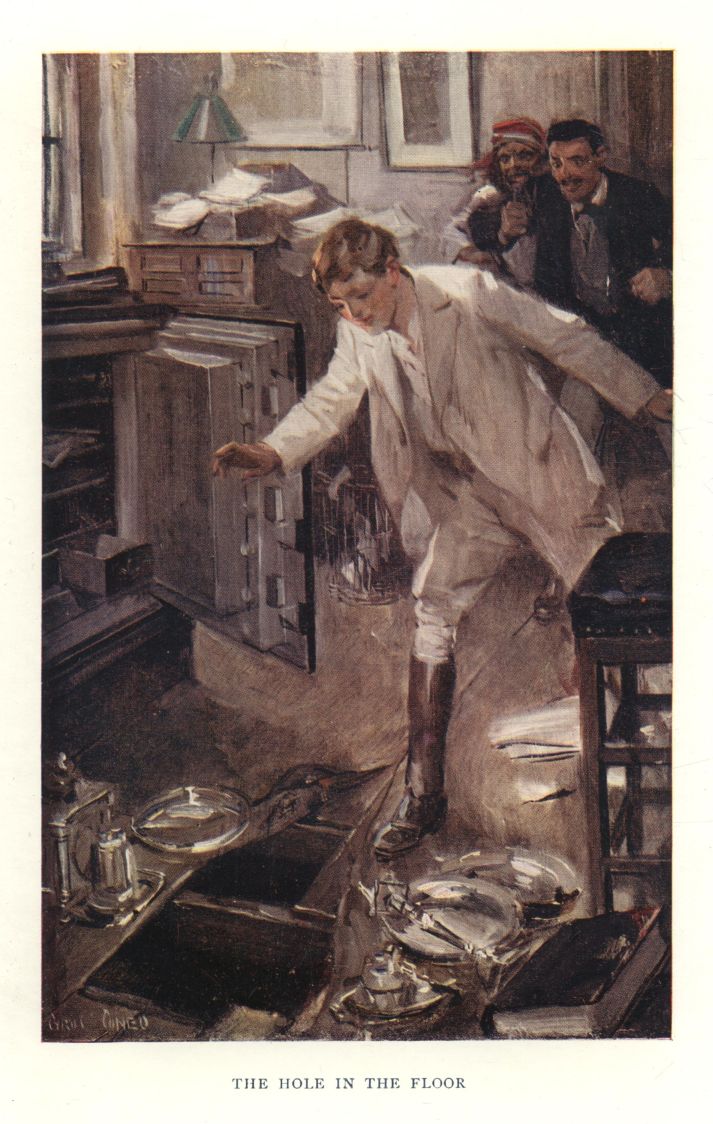
THE HOLE IN THE FLOOR
"Buenos dias, señor capitan," he said with a sarcastic intonation. "This is a little surprise, is it not? Not very pleasant; no. But strange as it may seem to you at this moment, I bear you no ill will personally. Your brigand father, to be sure, has treated me abominably. He has insulted the honour of a Peruvian gentleman, and that is an offence which, as you know, is frequently, and justly, avenged with blood. But you!--you are just a foolish boy; your impulses run away with you, and one is naturally lenient to the indiscretions of youth."
He paused while straining at the cord, then resumed:
"But one has to consider the public interest; and in fulfilment of my public duty I have felt it necessary to put a check upon your personal freedom. Having already had experience of similar restraint, you will no doubt be able to take your present condition with philosophic equanimity. If I am not mistaken, you owed your release on the former occasion to the payment of a ransom. Well, events sometimes repeat themselves. That lies in the discretion of his excellency the Prefect, whom I am about to join; he shall decide what to do with his prisoner."
Here he tied the last knot and stood erect, looking down at Tim with a sardonic grin that made his blood boil.
"But it would be inconvenient to take you with me," Pardo went on. "We might meet some of your bandit friends, who would probably jump to rash conclusions. Having a careful regard for your safety, I must leave you here, but I trust your solitude will not be protracted. In the public interest I ought perhaps to shoot you; but perhaps your market price now exceeds £250; you may be more valuable alive than dead. That thought will console you during your enforced seclusion. There is one little difficulty which it would be wrong not to mention. If any misadventure should befall me on my way to the Prefect, the secret of your hiding-place will be lost. That would be very regrettable, but I must ask you to consider that the responsibility will lie with your friends the brigands."
At this moment the second man entered.
"Is all ready?" asked Pardo.
"Yes; I have secured the horse."
"Very well. Oblige me by pulling up another board."
The man wrenched up the plank. Then the two lifted Tim, and bundled him into the cavity like a sack.
"A reveder, señor capitan," Pardo called through the hole.
The boards were replaced. Tim was in darkness. For some minutes he heard the men moving about above him, and the faint sound of laughter. Then their feet dragged heavily on the floor: no doubt they were removing the bundle. The footsteps died away; and Tim was left in solitude and silence.
The cavity into which Tim had been thrown had been excavated for the sake of keeping the rooms above dry, and extended beneath the house from end to end. It was not a pleasant place. The ground was damp; the atmosphere was stuffy; air could enter only by one narrow grating. Its humidity and the sub-tropical heat favoured the multiplication of innumerable insects, and Tim had not been there many minutes before the voracious creatures discovered him and began to make the most of their opportunity and their victim's helplessness. They crawled over his hands, up his sleeves, upon his face, into his hair. He did his best by shaking his head and twitching his features to rid himself of the tormenting pests; but they pricked and stung with great determination and vigour, and he was soon in pain and distress.
If only he could have removed the gag he would not have felt so utterly helpless. Not that shouting would have been of any use in an empty house, but the power to groan would have seemed a luxury. And when by and by he fancied that he heard shuffling footsteps about the house, he struggled in his bonds until he felt bruised and lacerated. All was in vain. His head began to ache; ideas the most incongruous jostled in his feverish brain. He tried to collect himself and keep his mind fixed; but he could not control his thoughts. Recollections of the Black Hole of history came to harass him, and in alarm and terror lest he should wholly lose his wits he strained his muscles to the uttermost. The effort exhausted him, and presently he fell into a dull stupor, in which he was conscious of nothing.
CHAPTER XX
PARDO LOSES A TRICK
At a late hour that night a rather weary horseman rode into the Prefect's camp, a few miles beyond the defile which Mr. O'Hagan was holding with his 400 men. News of the Mollendist extravagances in San Rosario having reached San Juan, the Prefect with a sudden burst of energy moved out with a motley force of 1500, and established himself on the hills in readiness to force the passage next day. The horseman sought out the Prefect's quarters, in a sheltered glade some distance from the track, and was checked every few yards by sentries demanding the countersign. The Prefect was always very careful that all proper precautions were taken for the safeguard of his person.
Pardo was rather annoyed by these frequent interruptions. He was very tired. The roundabout route which he had been forced to take by the presence of the enemy across the road had kept him for many hours in the saddle. He had hidden the loot from his late master's house; but, like all traitors, he did not trust the man who had assisted him, and almost wished that he had not left the spoils and his friend behind. But, knowing the kind of men who formed the bulk of the Prefect's army, he had prudently decided not to bring valuables within their reach and expose them to temptation.
He came to the last of the chain of sentries, and requested an interview with the Prefect.
"His excellency is asleep, señor," said the man dubiously. "It is very late."
"Tell his excellency that Señor Miguel Pardo desires to see him," returned Pardo with impatience.
The man durst not leave his post, but summoned a comrade, who conveyed the message.
"His excellency cursed and declined to see you until the morning, señor," said the man on his return.
Now, so far as Pardo knew, there was no need for haste. He had taken great care to gag and bind Tim very thoroughly. He had left the house locked up and the windows fastened, and even if anybody should break in, it was unlikely that the hiding-place beneath the floor of the office would be suspected and the prisoner discovered. But Pardo was eager to conclude a scheme which he had ingeniously concocted. He had also a rather exaggerated notion of his importance. So he sent the messenger back again, to say that he had something of great moment to communicate, and begged the Prefect to see him at once.
After a little delay he was admitted to his excellency, whom he found reclining on a camp bed in the open air; tents were not required in this rainless region.
"What is this important matter that justifies the disturbance of my rest?" asked the Prefect, rather haughtily.
"I regret the necessity, excellency," said Pardo, "but I think when you have heard me you will consider me justified."
"Well, say on."
"Your excellency would no doubt be glad to be rid of the man O'Hagan and his boy?"
"Caramba! I agree with you. Without them the brigands would be easily dealt with, and this ridiculous republic would tumble like a house of cards. You have some plan?"
"I have, excellency; but I beg you not to demand particulars. I have means of getting rid of them both. It has cost me a great deal of labour and not a little danger."
"Name your price," said the Prefect impatiently. "And I warn you to be moderate, for this expedition is draining me."
"It will not cost you a peseta, excellency. All that I ask is that you will bestow on me, free of taxes, the full ownership of O'Hagan's hacienda."
"Por Dios! That is your idea of moderation! The hacienda produces several thousand pounds a year. Not cost me a peseta, indeed! You are presumptuous, señor."
"What I shall do is worth the price, excellency. O'Hagan has great military capacity. The Mollendist cause is gaining ground. A single reverse will break up your army, and even if you win you will have endless trouble while the Inglés is at large."
The Prefect reflected. He had reckoned on making a large income out of Mr. O'Hagan's estate. He might still do so, even if he acceded to Pardo's terms. What he gave he could also take away. When the insurrection had been scotched, he could squeeze Pardo until he became troublesome, and then confiscate the property a second time. After a show of hesitation he agreed to the proposal, and did not demur when Pardo asked him to sign his name to a paper with which the man with admirable forethought had come provided.
Pardo took his leave. He might now have thought himself justified in seeking repose, but impatient greed still urged him on. He mounted his horse, rode through the lines, and did not halt until he had reached the Mollendist outposts, whom he approached under a flag of truce. It was perhaps fortunate that they were not Mr. O'Hagan's Japanese workmen. It was fortunate, too, that he did not encounter Romaña. He was taken to Mr. O'Hagan, who lacked the luxury of a camp bed: his couch was a bundle of straw.
"It's you, is it?" said Mr. O'Hagan dryly, as he recognised his visitor. "Going to turn traitor again?"
Pardo bit his lips; there was a dangerous gleam in his eyes. But he curbed his anger: he was a man of policy.
"I have the honour to inform you, señor," he said coldly, "that your son is a prisoner."
Mr. O'Hagan went pale. This was an unexpected blow. But he said nothing.
"The Prefect is, as you are aware, not so complaisant as the brigand Mollendo," Pardo continued. "He will not release the boy for a paltry £250. He will not accept any sum as ransom for so mischievous a rebel."
He paused, as a cat releases a mouse for a moment, for the pleasure, it would seem, of prolonging its victim's agony.
"What have you come here for?" cried Mr. O'Hagan impetuously. "Merely to harass me, you----"
He checked himself. It was no good abusing the man.
"I come to make a proposal," said Pardo. "Your son is at present my prisoner; it rests with you whether I hand him over to the Prefect, and then!..." He expressed his meaning by a gesture. "Or whether he is released, and allowed to rejoin you. My terms are quite simple, but absolutely unconditional. They are not open to discussion. You will make a formal assignment of your estate to me; you will then leave the country. Your son's life depends on your prompt acceptance."
Mr. O'Hagan sprang up.
"What is to prevent me from shooting you, you villain?" he cried, overmastered by his rage.
Pardo shrank from him. He felt a chill run down his spine like a trickle of cold water. But he recovered himself in a moment.
"The honour of an Englishman will prevent you," he said with an air of assurance. "Besides, if I die, your son dies. Nobody but myself and one other knows where he is. He will starve!"
Mr. O'Hagan shivered. Pardo quailed before his blazing eyes. For a moment there was silence; then Mr. O'Hagan, putting a restraint upon himself, said:
"If I assign my estate to you----"
"Discussion is mere waste of time," Pardo interposed. "The conditions are peremptory. You must not only assign your estate to me but leave the country. That is final."
"Go away," said Mr. O'Hagan.
"I cannot go without an answer."
"I will send for you--presently, when I have made up my mind--in a few minutes."
Pardo withdrew, lit a cigarette, and strolled up and down. He felt very confident, and flattered himself on his astuteness. He was by no means so sure of the success of the Prefect's arms as he had professed in his interview with that gentleman, even if Mr. O'Hagan were out of the way. The Mollendists were growing in number; Mollendo had made a clever move in declaring for a republic, and the loyalty of the Prefect's troops hung by a very slender thread. Pardo had schemed to secure possession of the estate in any event. But it was necessary to get rid of Mr. O'Hagan. Mollendo, if he gained the upper hand, might in O'Hagan's absence respect the assignment. He was a stickler for law. But the Prefect would certainly not do so unless his enemy were removed. Pardo considered that he had played his cards well.
Mr. O'Hagan was in a cruel predicament. He could not doubt Pardo's story. He would willingly have given up his estate to save Tim's life, but could he also desert the cause which he had taken up? His honour was engaged. He paced up and down the bare space in front of his couch: the sight of the red end of Pardo's cigarette a few yards away filled him with bitter anger. He knew that he must yield. With Tim's life and his own honour in the balance, there was no doubt which would outweigh the other. He was too proud to consult Señor Mollendo. The dilemma must be solved by himself alone. He could only make up his mind, go to the President, and confess that every other consideration--wealth, success, honour--must give way before the danger of his only son.
Out of the darkness Romaña came up to him.
"A despatch from Colonel Zegarra, señor," he said. "The courier waits for a reply."
Pardo saw Romaña, flung his cigarette away, and effaced himself among the trees. Mr. O'Hagan took the envelope, and tearing it open mechanically, read the few lines it contained. And then Romaña was amazed to find his hand grasped and shaken vigorously.
"He's safe, Nicolas!" said Mr. O'Hagan, working his arm up and down like a pump-handle. "My boy's safe!"
"Señor!"
"Go and kick that villain out," cried Mr. O'Hagan, recollecting himself.
"Señor, I don't understand!"
"Pardo! He's over there. Bring him to me."
Romaña followed the indication of his outstretched hand, and came back with Pardo, who, watching the scene, had been invaded by a vague uneasiness.
"Go and hang yourself; that's my answer," said Mr. O'Hagan, turning his back on the startled man. "See him safe out," he called over his shoulder to Romaña. "If the Japs get hold of him they'll throttle him."
And Pardo, feeling with a sinking heart that something had gone amiss, was escorted by Romaña to the outskirts of the camp.
Mr. O'Hagan read again the brief despatch. It was in Colonel Zegarra's writing.
SEÑOR,
I have the honour to report that the enemy has made no movement. A reconnaissance has been admirably carried out by Lieutenant O'Hagan alone, and I hope to report to you to-morrow the measures which I propose to take for our greater security.
I have the honour to be, señor,
Yours in the service of the Republic, ZEGARRA, Colonel.
And there was a postscript in Tim's hand:
Pardo has been playing tricks. Will write to-morrow, as I'm very tired. All well.
TIM,
Lieutenant and chief of staff.
At the second reading Mr. O'Hagan could smile at the odd subscription. He saw Tim's eyes twinkling as he wrote.
Unknown equally to Tim and to Pardo, the house was not deserted, as they supposed. Biddy Flanagan, the old Irish maid-servant, had stuck to it when all the other domestics fled, just as Puss will linger forlorn in an empty house. She shut herself in her room, and only ventured out to forage. She had thus sallied forth to make a cup of tea when she saw Pardo and his companion coming from the direction of the town. She at once slipped out at the back, locking the kitchen door and taking the key with her, and hid herself in the shrubbery. Thus she did not see Tim's arrival, though she heard the hoof-beats, and supposed that Pardo had been joined by another friend. When, after some time, she heard the thud of hoofs again, and guessed that the intruders had gone away, she let herself into the house, put the kettle on, and while she waited for the water to boil, went through the house to see what the spalpeens had been after.
"They've took the gold clock," she muttered, standing with arms folded at the drawing-room door; "and I wouldn't wonder if it did be after striking in the bundle, and maybe get them rogues into trouble. And the mistress's best chainey: faith, 'tis a mercy she took all her jools along with her, or there'd be none of um left at all." She went on to the dining-room. "The like of it! Sorra a silver spoon to be seen, nor the silver jug; I never heard tell of the way them villains have the place stripped, and that Pardo the master's man and all."
She made a mental inventory of the missing articles and proceeded to the office.
"What did they be after doing here?" she grunted, as she noticed, with the quick eye of one accustomed to superintend the cleaning operations, signs of disturbance about the matting. She stooped to straighten it, and discovered the loosened boards. "I wouldn't wonder but they did be hiding the things," she said, raising the planks one after another; "and mighty foolish will they look when they come back, if so be I can get myself down through the hole and back again. There! the kettle's on the boil; I'll just be wetting the tea, and fetch a candle for this same."
The daylight streaming in through the gap had roused Tim from his stupor, and seeing Biddy above he tried to shout, but could not utter a sound through the gag. Biddy soon returned with a candle and a kitchen chair. The latter she lowered into the hole, stepped on to it, carrying the candle, and so reached the ground. She stooped, to search for the stolen articles, and started back in a hurry.
"Holy St. Patrick!" she exclaimed; "but 'tis a man, sure. Is it murder they were after?"
Recovering herself, she held the candle lower.
"Mercy! 'Tis master Tim!" she cried, "and beasties crawling all over on the poor face of um. The like of it! Divil such a state ever I seen as the poor boy do be in."
She bent over him, whipped out a pair of scissors and snapped the cords, and whisked the insects from his spotted and swollen face with her apron.
"The poor lamb!" she said, lifting him. "Sure the life's fair bitten out of um."
Tim could neither speak nor use his numbed limbs. The old woman took him in her arms, climbed up through the hole, and carried him to the kitchen, where she made him swallow a cup of tea, and bathed his face with warm water, speaking her mind freely on the iniquities of Pardo.
He told her what had happened, and what Pardo had said.
"And is it pay that the master will be giving for a prisoner that is free!" cried the old woman. "Sure now, cannot ye telegraph to um?"
"I wish I could; we ought to have repaired the wire. But the Colonel will be sending a despatch to Father, and his courier will get there before Pardo."
"He might," said Biddy. "Faith, I hope the master will shoot the wretch; he has all the silver stolen, and I don't know what all. And what did ye be after, coming into this den of lions?"
"Just a change of clothes, Biddy. I suppose they haven't taken them."
"Not them. They're not clean inside or out. I will get ye the bits of things, my dear, and do ye rub this butter on your face. 'Tis the good thing for them bites."
In an hour or so Tim felt able to return to the camp.
"You had better go into the town, Biddy," he said as he set off.
"What for would I be doing that?" she rejoined. "I do not be in dread of the likes of them villains, and if so be they come back, I wouldn't say but I tell um what I think of um."
CHAPTER XXI
RUN TO EARTH
Young Tim was at an age when boys are a trifle sensitive about their personal appearance. He was glad that on returning to camp his ravaged complexion was obscured in the dark. Nobody seemed at all concerned about his protracted absence. Colonel Zegarra was playing at cards with a friend from the town; the other officers and the men were amusing themselves after their fancy. Tim made a round of the camp, and was almost surprised to find that sentries were properly posted. The vedettes along the roads had been changed at the intervals arranged; military routine had been observed. The only departure from custom, perhaps, was Colonel Zegarra's allowing Tim to append a postscript to his nightly despatch. Tim had intended to say nothing of his recent adventure; but reflecting that Pardo might visit his father for the purpose of extorting a ransom, he thought it just as well to certify his safety.
During the night, when his turn for guard duty came, he pondered the general situation. With a zeal natural in a young officer, he wanted to "do something": inactivity was boring; he wished the sluggish enemy would wake up. He wondered by which route they would march when the movement did at last begin: by the eastern track or by the western? In thinking over the probabilities, it suddenly struck him that by destroying the wooden bridge a few miles beyond Durand's house he could render the eastern road--the more likely one--impassable. The ravine was about thirty feet wide. The one other spot at which it could be crossed was several miles to the east, approachable only over very rough country. By preventing the passage of the enemy by the bridge he would compel them to return to the cross-track and come by the western route, at a loss of many hours.
To destroy the bridge would be a very simple matter. It wanted only a good charge of powder. But Tim reflected that it would be a pity to blow it up prematurely, in case the enemy elected to come by the other route after all. The bridge might be useful to his own side. So he decided to ask Colonel Zegarra's permission to mine it, to clear of all cover a space on each side of the ravine, and to leave a small detachment of his own Japanese at some distance on the south side with orders to fire the mine at the critical moment. One of the mounted vedettes might be posted at the top of the long incline beyond, to ride at full speed to the bridge as soon as he should discover signs of an approach in force. Such a headlong gallop would be dangerous in the dark, so Tim thought of replacing him at night by an infantry outpost of four men. He would station them say a hundred yards north of the bridge, and theirs would be the duty to fall back and blow it up if danger threatened.
He was explaining the scheme next morning to his complacent colonel when news arrived through his chain of vedettes that small parties of the enemy had been seen moving down from the Inca camp towards the upper junction of the paths. There was no indication of a general forward movement. They were merely feeling their way, having apparently discovered, perhaps by the want of news from the town, that something unusual was afoot. The wooden bridge being only a little more than five miles from Colonel Zegarra's position, there would probably be time to make all preparations for the explosion before the real advance of the enemy began. The colonel agreed to the suggestion. Tim was surprised at his extraordinary complaisance, his perfect contentment with the state of figure-head. Afterwards, with more knowledge, he felt considerable respect for President Mollendo's tact. Zegarra had been appointed to the command merely for the sake of appearances--to avoid any discontent among the Peruvians at being led by a foreigner. His compliance with every proposal of Tim's had been prearranged.
Tim chose the men for the work, took them out, and explained to them on the spot what he wished them to do. Then he left them. He had resolved to ride up the western road again, and see for himself what the enemy were about. Being convinced that their advance would be made along the eastern road, he intended to scout as far as the cross-track, and perhaps to ride some distance along it, till he came to a spot where any movement from the Inca camp would be visible to him.
His cycle had been well cleaned by one of the Japanese. He overhauled it finally himself, tested the sparking and the brakes, assured himself that the engine worked with the least possible noise, and that there was plenty of petrol. Having filled the chambers of his revolver, and put on a well-stocked bandolier, he took leave of the colonel and set off.
He felt safe for at least a dozen miles. There were four mounted vedettes along the track, the last of them being posted about a mile beyond Romaña's cave. If the enemy was moving on this route also, the fact would already have been reported.
The day was still young, and Tim, none the worse for his trouble of the previous afternoon, rode on in high spirits. Though continually rising, the track was not really steep for the first fifteen or twenty miles. He kept up a good speed, stopping every three miles to exchange a word with the vedettes, and had just reached the spot where he expected to find the last of them, when he was startled at seeing a man lying in a curiously huddled fashion at the side of the track a few yards ahead. He was slowing down, intending to stop and look more closely at the prone form; but suddenly there was a shot, and a bullet whistled past his head.
Instantly he clapped on the brakes, brought the cycle to a standstill, sprang off--for the track was too narrow to turn while riding--and wheeling it round, ran a few yards, remounted, and set off at full speed down the incline, bending over the handle-bar. There was a volley behind him: the bullets pattered on the cliff at his right hand; and as he wondered whether his pace would carry him out of danger, he heard the clatter of hoofs and the shouts of men at his back.
He had no doubt of being able to distance the pursuers. The cycle could leave the swiftest horse standing. They had ceased to fire, which he thought foolish. But his assurance was rudely dashed in a few seconds. A few hundred yards below the stream that crossed the track near Romaña's cavern, three men stood with levelled rifles, covering him. They were plainly waiting for him to come close enough to make certain of their aim.
It was a desperate situation. On the one side a high cliff; on the other a steep precipice; behind, an unknown number of galloping horsemen; before, the waiting marksmen. If he dashed on, the three men could scarcely fail to hit him; if he stopped, he would be quickly overtaken by the men behind.