THE MOTOR SCOUT (continued 2)
Reading edition
Romaña came back on the following afternoon. The news he brought was not calculated to lighten Tim's heaviness. Mr. O'Hagan was closely confined; gendarmes were flocking into the town, to overawe any who might be disaffected, Romaña supposed. He left again at dusk, begging Tim to be patient.
Next day his information was even more serious. The Prefect had arrived, accompanied by a number of officers, and it was rumoured that the prisoner was to be tried by court-martial. The ordinary process of law was evidently too slow for the dictator; it left, perhaps, too many loopholes for escape. With a court composed of his own particular tools he might depend on the proceedings being short and swift.
"But it is utterly illegal to try a civilian by court-martial in time of peace," Tim protested.
"The Prefect makes his own law," said Romaña. "He has proclaimed martial law in the town."
"He means Father to be condemned; what will the sentence be? A big fine?"
"Probably, with a term of imprisonment also," replied Romaña. In his heart of hearts he expected a much more terrible punishment. The Prefect would not be satisfied with a fine, however large; nor with a term of imprisonment, however long. Nor would he even stop at confiscating Mr. O'Hagan's property, and let him go. There is only one safe way in which tyranny can walk, and that is a road stained with blood. But Romaña did not impart his anticipations to Tim; there was no need to wring his young heart before the time.
He durst not go into the town next day, but waited in the wood for Galdos to bring him news of the trial. It confirmed his gloomiest forebodings. Pardo was the principal witness against his master. He repeated authentic fragments of Mr. O'Hagan's talk, which, harmless enough in themselves, might be construed as treasonable by prejudiced minds. He swore, falsely, that he had heard his master declare that he would not pay the taxes, which were mere extortion. He declared that the £250 which Mr. O'Hagan had sent to Mollendo was not a ransom, but a contribution to the brigands' funds. Similar testimony was given by two former servants of the prisoner. Mr. O'Hagan's denials were scouted. He was not allowed to employ counsel, and in two hours the sorry farce was over. He was found guilty, condemned to forfeit his estate and to be shot in the plaza, three days later.
Romaña shrank from conveying this heavy tidings to the boy awaiting his return in the cavern. But there was no help for it. He walked back slowly, and broke the news as gently as he could.
Tim was at first utterly overwhelmed. In his most despondent moments he had never looked for anything so bad as this. When his stupor passed, he cried out that he must go to his mother; that he would himself seek the Prefect, and plead with him to annul the sentence; that he must and would do something, he knew not what.
"It would be useless, señorito," said Romaña sadly. "You would yourself be arrested; you might suffer the same fate; then the gracious lady would be doubly bereaved, left without a protector, and that would embitter your father's last moments."
"But I can't sit still and do nothing," cried Tim, walking up and down in his misery. "Suppose it were your father! Won't your Mollendists do something? There's a lot of them; wouldn't Señor Mollendo lead them to the town if I begged and prayed him?"
"He is not strong enough," answered Romaña. "The town is full of gendarmes. I don't know the caballero's plans, but he cannot alter them for a foreigner."
"He will only send his men to pounce on solitary travellers like the gobernador," said Tim bitterly.
"Remember, señorito, that he is himself outlawed, in hiding. The men you saw in his camp are not numerous enough; they are ill-armed. There are a crowd of gendarmes and several troops of mercenaries already in the town, and another thousand men can be summoned from San Juan, and would arrive within a few hours."
"But I could get our Japs to join. They would fight like demons for my father."
"What arms have they?" said Romaña patiently. "It is useless, señorito. But there are three days. Perhaps the Prefect will think better of it. No doubt he is uneasy at not having captured you; he will never feel safe while you are at large; and he may delay the extreme step. We must hope for the best."
As he became calmer Tim recognised the force of all that Romaña had said, and his own helplessness. He could but wait and hope.
Very early next morning they were standing near the mouth of the cavern. Romaña was about to go again into the wood a few miles nearer the town, to receive any further information that Galdos might have for him.
"Ask him to go to my mother, and bring word how she is," Tim was saying.
"Look, señorito; what is that?" said Romaña suddenly, pointing down the track in the direction of the town. A mounted party of four was approaching, too far off for the individuals of which it was composed to be distinguished.
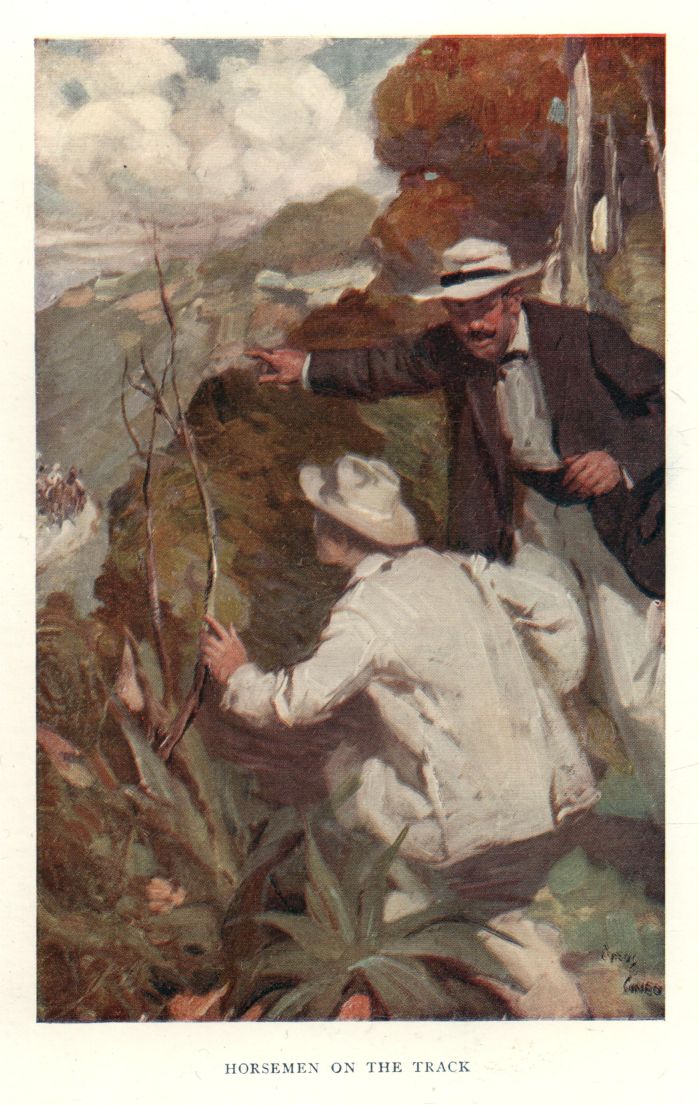
HORSEMEN ON THE TRACK
"They are after me!" said Tim at once.
"Back, señorito!" cried Romaña, drawing him behind the screen of foliage, through which they peered anxiously at the advancing party.
"There is a lady!" said Romaña presently. "They are riding very fast."
"Is it Mother?" said Tim. "I believe it is! And, Romaña, look; I believe it's Father too! Isn't it? Isn't it?"
"For Dios, señorito!" exclaimed Romaña, "you are right! It is the señor himself. He has escaped! Praise to our Lady and Sant Iago! Come! Let us meet them."
CHAPTER IX
FLIGHT TO THE HILLS
Tim could hardly contain himself. He raced along the bed of the stream, leapt across the stepping-stones, and bounded down the rocky track with small concern for his limbs. When he came in sight of the party he snatched off his hat and waved it wildly in the air. Romaña followed less swiftly and with more circumspection. He was smiling at his thoughts.
"First the son, then the father--both Mollendists!"
That was the happy consummation to which he flattered himself events were leading.
"Ah, Tim!" said Mr. O'Hagan as they met. "We were one too many for the Prefect, you see. Your mother was the one, bless her! But she must tell you all about it herself by and by. The first thing is to secure ourselves. Many thanks, Romaña. Now, are we going right for that camp of yours?"
"Straight on, señor," said Romaña. "You will presently come to the river. The path runs alongside it for several miles; then it diverges to the right, and meets the path that goes past Señor Durand's hacienda. The two paths become one. Keep straight on. The señor capitan will welcome you."
"But aren't you coming too, to make the introductions?"
"The señorito and I will follow. We must fetch the machine."
"I can't leave Tim," said Mrs. O'Hagan.
"What's the path like?" cried Tim. "Can I ride, Romaña?"
"For some distance, yes. There are steep places after the paths join."
"There are indeed," said Tim. "That's where the brigands--your friends, I mean--had to haul the cycle. A very stiff job too. Mother, ride on with Father. I'll catch you in no time. I'll mount Romaña behind me: he's lighter than the gobernador!"
"You're quite sure you'll catch us?" said Mrs. O'Hagan anxiously.
"Quite, so don't worry. Oh! you don't know how jolly glad I am to see you."
The other two members of the party, Andrea and another house servant, rode on with their master and mistress, while Tim and Romaña returned to the cave for the cycle. They had a good deal of difficulty in hoisting it up from the bed of the stream on to the path, but when they were once there, they soon made up on the riders, and went on all together at a rapid pace.
"Shall we run ahead and warn Señor Mollendo?" asked Tim presently.
"No: stay with us," said Mrs. O'Hagan. "I don't want to lose sight of you."
"Better not, señorito," added Romaña. "We must be careful as we approach the place where the paths join. If the escape has been discovered, and they are pursuing, they will come by the other path: it is shorter. Why did you choose this one, señor?"
"It was recommended to us by that ragged old man who sells lottery tickets. Is he a friend of yours?"
"He is a caballero, señor," replied Romaña with dignity. "Señor Galdos was once a sub-prefect."
"Was he indeed? He has been a very good friend to us, and I hope we may be able to reward him some day. How much farther is it? The path is becoming very rough."
"It is several miles, señor; but if all is well when we come to the junction of paths, there will be no need to hurry for the rest of the way."
Soon after this the path diverged from the stream, which wound away to the westward. Romaña now recommended that the party should ride slowly, while he himself scouted ahead on foot. The track here was too rough for the motor-cycle to gain anything in point of speed.
"When you come to a large stone, señor, which I will place in the middle of the track," said Romaña, "then halt. It will be no more than a mile from the forked path, and you will do better to go no farther until I return to you, lest the clatter of hoofs should be heard."
He went on and disappeared. About two miles farther on the riders came to the arranged signal. They halted, the men dismounted, and Tim, leaning against the flank of his mother's horse, and clasping her hand, begged her to tell him how the escape had been contrived.
"You had heard the result of the trial?" she asked.
Tim nodded.
"Were you there, Mother?"
"I was not. I thought it best for your father's sake to keep out of the town. Yesterday afternoon that wretch Pardo came and took possession of our house. He showed me a document authorising him to work the estate on behalf of the government----"
"Which means the Prefect, of course," Mr. O'Hagan put in.
"Then the wretched creature politely turned me out. I told him that he was in rather too much of a hurry; he might at least have had the decency to wait until all was over. But of course I didn't squabble with the worthless fellow. I packed up a few things, got my horse--he allowed me that!--and rode with Andrea and Juan into the town. Dr. Pereira was brave enough to take me in. No doubt the Prefect will make him pay for it."
"Was the Prefect still in the town?" asked Tim.
"He had gone back to San Juan, leaving Captain Pierola to carry out the sentence. I had made up my mind to see your father for the last time, and when it was dark Señora Pereira lent me a dress and a mantilla, and the doctor escorted me to the gobernador's house. Of course, his permission had to be got. He was very much distressed, poor man; he is terribly afraid of the Prefect: but he promised to admit me to the prison for a quarter of an hour to-morrow night. I asked him whether he couldn't let my husband escape, but he went nearly frantic at the idea.
"I was very much upset, as you may imagine. On the way back Dr. Pereira noticed a man following us. At first he paid no attention, but by and by got angry, and turned round upon the man, and asked him what he meant by it. 'Go on, señor doctor,' said the man. 'Do not notice me, but let me quietly into your house presently.' We went on, and I had only just taken off my borrowed things when the doctor brought the man to my room. It was the little old man who sells lottery tickets. He told me that if I would give him £200 he would set your father free. 'How?' I said. 'It will be better to ask no questions,' he said. I had no money----"
"The gendarmes stripped the safe when they arrested me," said Mr. O'Hagan.
"But I had brought my jewel-case," his wife went on. "I suppose I showed my doubts in my face, for the old man said, 'The señora can trust me,' and, looking at him, I felt that I could. I put my jewel-case in his hands and told him to take what was necessary, quite expecting that he would take everything. But he examined the things as if he knew something about them, and selected my pearl necklace and two bracelets. 'The señora will not like parting with them,' he said, 'but there is no other way.' I told him he might have everything if he would save my husband, and he seemed quite hurt. Then he told me that I must not go to bed, but be ready to leave the house at any moment. He kissed my hand in the most courtly way and was gone.
"About two o'clock he came again. 'All is ready,' he said: 'come with me.' You may imagine what a state I was in. I followed him through the dark streets until we came out into the country, and there I found your father and the two men waiting for me with a spare horse. The old man told us the way to come, and here we are. I love that dear old man."
"He bribed the jailers, I suppose--jolly old soul!" said Tim.
"The Prefect's own methods," said Mr. O'Hagan. "I'm afraid the gobernador will have a bad time of it. He was responsible for me."
"And won't the jailers suffer, too?" asked Tim.
"They decamped at once, you may be sure," replied his father. "But here's Romaña back again. He's in a hurry."
Romaña was running down the path.
"We cannot go on, señor," he said. "I crept as close as I dared to the fork, and caught sight of some men among the trees beyond. I don't know who they are, but it is not safe to proceed."
"What are we to do, then?"
"We must go back until we come to the river. The water is very low, and we can walk up along the sand at the edge. Presently we shall come to a stream that flows down the hill-side from near Señor Mollendo's camp. We can climb up there. It is very steep and rocky, but it is the only way."
"Very well: lead on."
On reaching the river, the party scrambled down the bank to the bottom. In times of rain the torrent had deposited large quantities of sand in the bed, which the shrinking of the channel in the summer had left bare and dry. On this firm floor, level as a billiard table, but ascending in a gentle plane, progress was easy; but when they reached the stream of which Romaña had spoken, and had to strike up the hill-side, they found themselves in difficulties. They had to dismount and lead the horses over great ledges of quartz, polished to a dangerous slipperiness by the action of sand and water, and round huge boulders, that offered, at first sight, insuperable obstacles. Difficult as the way was for the horses, it was doubly so for the motorcycle, which had to be carried for many yards at a time, and hauled up and over sharp-edged rocks that threatened damage to its tyres. Many times they had to stop and rest. It was now midday, and very hot, and Mr. O'Hagan's party, having had no food since the night before, were hungry as well as tired.
"Plucky little woman!" said Mr. O'Hagan at one of these halts, to his wife who sat beside him on a ledge of rock.
"Just think of Tim spending nights by himself in a cave!" said Mrs. O'Hagan. "How horrid for him!"
"Boys like that sort of thing," returned her husband with a smile. "Don't they, Tim?"
"If there's another fellow with them," said Tim. "There's no fun in camping-out alone. I wish I'd thought to bring some grub. Mother must be famished!"
"I confess I hope Señor Mollendo will have something for us," said Mrs. O'Hagan. "Going long without food is bad for a growing boy."
"I can eat anything," said Tim, "but I'm afraid you won't like their grub."
"My dear boy, I would rather eat parched peas with Señor Mollendo than sit down to a banquet with the Prefect.... Hark! What's that?"
She clutched her husband's arm at the sound of rifle-shots far to the east.
"We had better get on, I think," said Mr. O'Hagan, rising. "Where's Romaña?"
"He has gone ahead to warn Señor Mollendo of our coming," said Andrea. "He will come back to help with the machine."
An hour later the whole party, hot, exhausted, and hungry, entered the enclosure which Tim had described to his parents. The assembled Mollendists greeted them with loud vivas, and Señor Mollendo's face beamed as he came forward, hat in hand, to meet them.
"Welcome to my little castle, señor, señora," he said, with the air of a potentate. "I rejoice in the circumstances which have given me the honour of entertaining such distinguished guests."
"I don't," said Mr. O'Hagan bluntly, "though I thank you for your hospitality, señor. Do you know what is the dearest wish of my heart at the present moment?"
"If it is anything I can do----"
"A glass of wine for my wife, and then dinner, señor. Your guests, I should think, never reach you without an appetite."
CHAPTER X
CINCINNATUS O'HAGAN
"I have an apology to make to you, señor," said Mollendo, as they sat at dinner in his own little four-square apartment. "I perceive that I was under a misapprehension when I ordered the arrest of your son. I can never sufficiently lament my indiscretion, and beg that you will accept the expression of my profound regret."
"I quite understand, señor," said Mr. O'Hagan, reflecting that the indiscretion had cost him £250. "You party men find it difficult to understand that an action may be dictated by other than party considerations. My son helped Señor Fagasta because he's a man, not because he's gobernador."
"His action does honour to his humanity as well as his courage," said the courtly host. "In these circumstances I feel that it is inconsistent with the honour of a caballero to take advantage of a mistake, and I beg therefore that you will accept restitution of the sum of money which I demanded of you, but to which I had no just claim."
"Your suggestion is only what I should have expected from a caballero of your reputation, señor," said Mr. O'Hagan, politely adopting Mollendo's formality of speech. Mollendo bowed. "But in the circumstances I cannot do better than leave the money in your hands. And let me say that I thoroughly approve of the use to which you will put it."
"My dear!" ejaculated Mrs. O'Hagan in English.
"I am going the whole hog now," replied her husband quietly.
She pressed her lips together, and listened nervously as the conversation was resumed.
"I have made up my mind definitely to take sides with you," continued Mr. O'Hagan. "Hitherto I have held aloof, as you know; but I have always sympathised with your aims. You stand for political honesty and good government. That is a motive that appeals to me as a citizen. Personally, I have a strong inducement to support you; the Prefect has stripped me of my estate. If you succeed, I shall retrieve my fortunes; and in assisting you I shall not only consult my own interests, but do something, I believe, for the good of the country in which I have lived for so many years."
"A thousand thanks, señor," said Mollendo, his eyes beaming as he clasped Mr. O'Hagan's hand. "I rejoice in your generosity, and hail the approaching triumph of our cause. I remember how, in the brave days of old, the Roman Cincinnatus was called from his farm to assume command of the national forces; and how, within the space of sixteen days, he put the enemy to utter rout and confusion. You, señor, shall be our Cincinnatus. Caballeros," he cried, rising and addressing the motley throng in the courtyard, "the Señor Inglés is one of us. He espouses the cause of liberty; he will strike with us against the tyrant. I call upon you to acclaim our honoured guest with hearty vivas, and to drain your copitas to the caballero who will lead us to success."
Thundering cheers broke from the men, and they were only too eager to fill their cups and drink the health of the Señor Inglés and confusion to the dictator. Romaña smiled as he sat with Andrea and Juan at a little distance from his master. What he had hoped had come to pass; the señor was now a Mollendist. Tim also smiled, for a different reason.
"How do you like Cincinnatus O'Hagan?" he whispered slily in his mother's ear.
But Mrs. O'Hagan's sense of humour was at the present moment clouded by anxiety and misgiving.
"'Tis perfectly horrid," she said.
Mollendo had, in fact, jumped eagerly at the chance of securing Mr. O'Hagan as an active associate. He was himself well advanced in years; and though very popular with his followers, on whom he exercised a magnetic influence by his personal courage and his oratorical gifts, he had no military qualities or experience, and was conscious of his own defects as a leader. Mr. O'Hagan, on the other hand, as he well knew, had won a great repute as a soldier in the stormy days of the Chilian war. His advice in matters of strategy and tactics would be invaluable. He would bring to the cause just those factors of success in which hitherto it had been lacking, and for the first time Mollendo saw the gleam of coming triumph. Mrs. O'Hagan suffered many pangs as the conversation proceeded. The two men were settling the basis of their alliance. Mollendo was to retain the nominal command; the practical control of the movements of his little force was to be in the hands of Mr. O'Hagan. The good lady saw that her husband was back in the days of his youth. He always threw himself heart and soul into whatsoever he took up, and he discussed matters now with all the fire and eager enthusiasm of a boy. His wife was troubled; and when she noticed with what rapt attention Tim followed the talk, she made up her mind to drop a word of caution later.
In the midst of the conversation a man came hurriedly into the courtyard, and walking straight up to his leader saluted and said:
"Señor, I have news."
"What is it, Cristobal?"
"We were watching on the hills, señor, when we saw two parties drawing near, the larger on the eastern track, the smaller on the western. We hastened down to the fork, intending to give battle to them both; but suddenly we saw the smaller party halt; from it a man came forward, but presently hastened back again, and all his company retreated and disappeared. At the fork we met the others, and gave them so warm a reception that they withdrew towards the town. We followed them, but they did not halt, so we returned to the fork, and there our people are still posted."
"That is well, my son. The smaller party consisted of the Señor Inglés and his family whom you see here. They are now supporters of our cause. Carry that news to our men; it will encourage them. The señor was a great captain in the army of Peru years ago.... Will the señora excuse us for a few moments?" he asked, when the man had gone.
"You want to talk secrets, I suppose," said Mrs. O'Hagan; "but unless my husband objects, I should prefer to know all your arrangements. Tim," she added in English, "I am not to be kept in the dark. I do not like your turning yourself into a brigand, but I see your mind is made up. Only don't do anything without telling me."
"Señor, my wife and I have no secrets," said Mr. O'Hagan. "You may speak quite freely."
"What I had to say concerns the señora herself," said Mollendo. "This is no place for a lady; nor should she be subjected to the fatigues and dangers that we shall have to encounter. My wife lives peacefully in a remote corner of the country some fifty miles from here in the hills, and if the señora will deign to accept her hospitality----"
"Not at all, señor; I remain with my husband and son," said Mrs. O'Hagan firmly.
"Perhaps the señor will command otherwise," suggested Mollendo, who was not accustomed to domestic opposition.
From that moment Mrs. O'Hagan was his determined enemy. Mr. O'Hagan hurriedly explained that he would discuss the matter with his wife in private. He found an opportunity of doing so later in the day, when a corner of the ruins had been prepared for their accommodation. He pointed out that she would be unable to make the long and rapid marches which irregular warfare entailed. Her presence, and the necessity of protecting her, would be a source of weakness, possibly of disaster. Mrs. O'Hagan recognised this, and after a time reluctantly agreed to accept Señora Mollendo's hospitality.
"But I must take Tim with me," she said.
Mr. O'Hagan stroked his chin.
"The boy won't like that," he remarked.
"It will be for his good," she replied. "Surely you admit that fighting with these desperadoes is not fit work for a boy of his age."
"As to that, there are many here no older. Age doesn't count in these matters. He is perfectly healthy; he may be very useful to me, and the experience will be invaluable to him."
"Am I to lose both of you?" cried the lady, much troubled. "If it were for our own country I might endure it, like many another poor woman; but to think of you throwing away your lives for this miserable country--oh! it is too much."
Mr. O'Hagan was inclined to yield the point; but while he was still hesitating, his wife, dashing the tears from her eyes, suddenly forestalled him.
"I am an idiot," she said. "Of course the boy would eat his heart out away from you. I mustn't look on the black side. But do take care of him, won't you, Tim?"
And so it was settled that young Tim should remain with his father.
Next day Señor Mollendo provided an escort of half a dozen men, with whom Mrs. O'Hagan set off for the long ride into the hills. Mr. O'Hagan and Tim on horseback, each having a carbine, accompanied the party, having decided to go half the way. They left the camp at its northern side, and followed the track downward for several miles until it crossed the river by a narrow stone bridge. Then their course led to the north-west, the path rising steadily as it approached the spurs of the Andes. Progress was very slow; the day was already far advanced when they reached a little hut on the hill-side, about halfway to their destination, where Señor Mollendo was accustomed to break his journey when going to and fro between the camp and his home. Here they passed the night. In the morning Mrs. O'Hagan took leave of her husband and son, who watched her party until it disappeared along the winding track, then silently sprang to their saddles and rode in the opposite direction.
They had come within a few miles of the stone bridge over the river when they caught sight simultaneously of a number of horsemen strung out along the path far ahead, and riding towards them. Mr. O'Hagan felt the lack of one of the prime necessities of a soldier--a field-glass.
"We must hide up until we see who they are," he said to Tim. "They don't know how to order a march, at any rate."
The hill-side provided many convenient nooks for hiding and taking a look-out. But only a few minutes had passed when Tim, from behind his rock, called:
"It's old Mollendo, Father."
"Take care you don't call him that in the hearing of his men. It would be a deadly insult. Better call him 'excellency.' I wonder what has happened."
They returned to the track, and trotted downhill to meet the horsemen. There was about them an air of depression which did not escape Mr. O'Hagan. The explanation confirmed his foreboding.
"Good-day, señor," said Mollendo, with a graceful salutation as they met. "I grieve to say that you behold me a fugitive."
"What, excellency! Has the usurper taken the field at last?"
"It seems so, señor general." (Tim grinned as these complimentary titles passed.) "We were surprised at dawn by large numbers of the enemy who had advanced along the route by which you came to my camp. My sentries were, I fear, overcome by somnolence. The attack was so sudden that I had no time to form my ranks; but in the half light some of us were able to make our escape--some on horseback, others on foot. We are scattered to the four winds; all our stores are lost; it is a sad inauguration of our new alliance."
"Courage, excellency!" said Mr. O'Hagan. "We must consider how to retrieve this mishap. Are you pursued?"
"Not for the last five miles, señor."
"Then we will halt here, and wait for our men to rejoin us. No doubt some of them will come dropping in by and by. Let us ride forward, excellency, and choose a position."
Meanwhile Tim, seeing Romaña among the score of men who accompanied Mollendo, rode up to him with an eager question.
"Where is my cycle?"
"There was not time to bring it, señorito; but I managed to hide it under a heap of brushwood collected for the fires."
"They'll find it!" said Tim, his face falling.
"Perhaps we shall recapture the camp first. It was all I could do."
Tim thanked him, but felt that the chance of recovering his cycle was small indeed.
CHAPTER XI
THE MOTOR-CYCLE
Mr. O'Hagan was surprised at the rapidity with which this offensive movement had been executed. It was a bold stroke on the part of the enemy to make their way across the hills during the hours of darkness, and showed that they had among them a vigorous and enterprising leader. Its effect upon the fortunes of the Mollendists was likely to be serious. The success of their cause depended on the extent to which they could enlist active support among the disaffected. They had many sympathisers in San Rosario and the capital, but the most of these were too timid or too cautious to carry their sympathy into action. A great success would no doubt bring an influx of recruits; but a set-back such as this would not only discourage recruiting, but also dishearten those who had already taken up arms. Defeat breeds desertion.
The outlook was very gloomy. But Mr. O'Hagan was a man whose energies were stimulated by adversity. He had been wont to say that his plantation was too successful: he was growing soft. The present situation was a challenge to the qualities that had lain dormant in him since he hung up his sword at the close of the Chilian war.
Mollendo expected that some of the fugitives from the camp would in course of time make their way to the hut in the hills which Mr. O'Hagan had just left. There he always kept a small supply of provisions. It was therefore decided to return thither. Several mounted men joined them on the march, and within a few hours after reaching the hut the party was augmented by about two score, several of them wounded. These were attended by a medical student who had thrown in his lot with the Mollendists. There was great despondency among the little force. Some were disposed to continue their flight and even to abandon the cause; but Mr. O'Hagan set himself to rally them, appealing to their courage as caballeros and hidalgos, a compliment which especially flattered the mestizos among them.
Mr. O'Hagan was too old a campaigner to run any risks with a small force demoralised by their recent reverse. His first concern was to restore their morale. The great difficulty was provisions. The small supply in the hut would soon be exhausted, and in the inhospitable hills there was no chance of obtaining any food except wild fruit from the bushes. The river swarmed with fish, however, and Mr. O'Hagan, to give the men employment, set some of them to weave a seine net out of the creeping plants that flourished along the banks. With this primitive implement they caught a good number of fish.
Meanwhile he sent out half a dozen men to bring in any more fugitives whom they might meet, and Romaña with another man to discover what the enemy were doing. When these scouts returned late at night, they reported that the main body of the enemy had withdrawn southward, either to San Rosario or to San Juan. They were partly gendarmes, the mounted police of the province, partly the irregular troops which the Prefect attached to his cause by the hope of plunder. The camp was still occupied, but Romaña had not been able to ascertain by how many.
One of the last comers among the fugitives declared that he had seen the Prefect himself in the action. This seemed doubtful to Mr. O'Hagan, but Mollendo assured him that it was not at all improbable. The Prefect was a man of great, if spasmodic, energy, and of much personal courage and resource. In Spanish America no man could arrive at his position of virtual dictator without such qualities. He must have guessed that his escaped prisoner had taken refuge in the Mollendist camp, and having so much at stake had himself led the attack upon it, instead of leaving it to the gobernador, of whose prowess he had a mean opinion, by no means unjustified. Indeed, Señor Fagasta was in disgrace. The Prefect had accused him of conniving at the prisoner's escape, and put him under arrest in his own house--a prelude to another demand for money.
It seemed strange that the greater part of the Prefect's force should have been withdrawn so soon after the capture of the camp. Mollendo suggested that he was anxious not to be absent too long from San Juan. He had many enemies there, secret if not active; and if he allowed himself to be lured into the wilds he might return from a successful campaign only to find himself, as it were, locked out of his own house. No doubt he reckoned on the demoralising effect of his sudden swoop to break up the Mollendist party, and had left a portion of his force to harry the remnant at their leisure.
The position was discussed between Mollendo and Mr. O'Hagan in the hut. Tim was close at hand, giving eager attention to all that his elders said.
"I am much to blame for allowing the enemy to surprise me," said Mollendo bitterly. "I ought to have guarded my back door more diligently, but I was relying on the gobernador's known want of enterprise. He boasts of what he is going to do, but I have never known him to do anything."
"Don't take it to heart, excellency," said Mr. O'Hagan. "You were not to know that the Prefect would take matters into his own hands, nor would he have done so, I suspect, but for me. It is therefore incumbent on me, as the cause of your misfortune, to do what I can to retrieve it."
"And I trust much in your valour and skill, general."
"I thank you, excellency. Our most urgent need is food; the next is arms and ammunition; the next, men. That is the order in which our fortunes must be built up. And I confess that at the moment I am rather at a loss as to what steps to advise."
"We could get a certain amount of food at our own place," suggested Tim. "There can be no harm in robbing what we have been robbed of."
"That is all very well, but Pardo is in possession, no doubt with gendarmes to support him; and the enemy lie between us and home. It is very necessary to keep a careful watch on their movements, and I propose, with your consent, excellency, to send two scouts forward to-night to see what they are doing."
"Let me be one, Father," said Tim eagerly.
"You are rather too young," said Mr. O'Hagan, remembering his wife's injunctions. "Many of his excellency's men are no doubt experienced in such work."
"Let the boy go, general," said Mollendo. "I have already formed a high opinion of his courage. Such a task would give him invaluable experience. And if you send Nicolas Romaña as the second scout, you need have no fear; the boy will be safe with Romaña, one of the most active and trustworthy of my adherents."
Mr. O'Hagan felt himself in a difficulty. It would certainly weaken his own position with Mollendo if he refused to let his boy take a share in the operations. After so direct a proposal he could hardly hesitate to employ Tim when he would employ any one else. After a brief inward conflict he said:
"Very well, excellency; the boy must win his spurs; he shall go."
Tim was delighted, Romaña scarcely less; he felt much flattered by his chief's praises. Soon after dark, therefore, the two set off on horseback. It was a cold night; a biting wind blew down from the mountains; and the scouts were not sorry when, arriving within a few miles of the camp, they had to dismount and proceed on foot. They led their horses some distance from the track, and tethered them in a clump of trees, placing on their return three large boulders at the side of the path to mark the place. If they should have to hurry back in the darkness, without such signposts they might very well overshoot the spot. Then, keeping on the hill-side above the track, they crept along, listening for sounds from the enemy's outposts.
They were within half a mile of the camp when they had the first indication of the enemy's presence. They heard the sound of horses champing their bits in the distance, and a low murmur of voices. Moving stealthily forward, they found that two or three men were posted on the track. As far as they could tell, this was the only precaution taken by the enemy against surprise from this quarter.
The scouts wormed their way foot by foot towards the camp. Their course was difficult. They durst not advance along the track itself; and the hill-side above was rugged and broken, littered with loose stones which had been removed at some time from the Inca buildings. Their route brought them presently to a spot from which they saw a slight glow ahead. It evidently came from a camp fire; but the fire itself was hidden from them by the ruined wall. Skirting the enclosure, they made their way to the side where, as they knew by the sounds, the horses were tethered. Here they caught the footfalls of a sentry moving to and fro outside the wall. They stole past him to a point where the hill fell away steeply, crawled up the slope until they gained the foot of the wall, and clambering up its ruined face, peered over into the interior of the courtyard. The horses just beneath them snorted with alarm; their movements, quiet as they were, or their scent, had disturbed the sensitive beasts. The sentry close by stopped; but after a silent pause of a few moments resumed his beat.
The scouts clung to the wall, their eyes just above its top. They saw three fires in the courtyard; all were dying down. Around each lay a number of men, wrapped in their cloaks. They could not count them; indeed, only when the breeze stirred the embers could they distinguish the forms at all. But it was easier to count the horses, ranged in a close rank with their heads towards the wall. There were ninety. A similar line stood against the adjacent wall at right angles. Altogether there must be at least a hundred and eighty animals.
There seemed to be no chance of making any more discoveries, and the twain were about to move away, when a sudden gust of wind stirred the nearest of the dull fires to a momentary flame. By its light Tim caught a glimpse of his motor-cycle resting against the wall on the far side of the enclosure. He nudged Romaña's elbow to draw his attention to it. Neither dared to speak.
They remained thus for a few seconds; then, by a second nudge, Tim intimated his intention to retire. They let themselves down silently, and crept up the hill-side. When they were out of earshot from the camp, Tim said in a whisper:
"Romaña, I am going to get my bike."
CHAPTER XII
FREE WHEEL
Romaña gasped when Tim declared his intention.
"It is madness," he said. "Your father charged me to have care of you. I must forbid it."
"I don't care what you say. I am going to get my bike. Do you know that it cost £60 in London? Besides, I am not going to let the Prefect's fellows have it."
"But consider," said Romaña anxiously. "I don't deny you may steal in and get it; they are keeping very poor watch; but what then? You would have to bring it out----"
"I'd manage that."
"And then how get it to our camp? The track is very difficult, for miles too rough for you to ride. There are sure to be sentries at the eastern entrance; and as for the gully by which we came, you know how hard our task was in daylight: we could not possibly carry the machine down in the darkness."
"All that's perfectly true, but I am not going to leave it with these rascals, so we've just got to think it out."
He had to admit that the gully and the western track, by which they had just come, were impossible. The only other route was the path which he had travelled when first brought by his captors to the camp, and when he had returned home after being ransomed. The entrance, as Romaña had said, would undoubtedly be guarded; and judging by the position of the outposts whom they had passed on the way up, there would be a corresponding picket on the path below.
The path itself was difficult enough. For more than a quarter of a mile from the camp it was a steep descent. Then for about two miles it dropped more gradually, becoming from that point onward a sort of switchback with a generally downward trend until it reached the level not far from Durand's house. Having twice travelled along the path, Tim knew it well enough to feel sure that he could ride along it even in the darkness without much risk. The difficulty was threefold: to secure the bicycle unnoticed; to pass the sentry at the entrance; and to evade the picket at the foot of the hill. Romaña, who knew the weaknesses of his countrymen, admitted that the sentry in all probability would be asleep; but the members of the picket would certainly be awake: among two or three there would be conversation.
"Well then," said Tim, "if the sentry is asleep I'll chance the rest. But you won't be in it. We came out to scout, and you must get back and tell them what we have learnt: it isn't much."
"Your father will blame me severely if I return without you," said Romaña.
"You can tell him you protested. Besides, I'll very likely be back before you. If I get away safely I'll make a round to the river, and when I get there I can go so fast that I may overtake you somewhere up the road--provided the petrol lasts out. It must be getting low; I'd forgotten that; and we've no more. After this the machine will be useless."
"Then why not leave it, señorito? It will be useless to the enemy also."
"Don't go over it all again! I mean to have the bike; that's settled. You get back. I'll allow time for you to reach the horses before I do anything. You had better start at once."
Romaña knew that further expostulation would be useless. He had had much experience of his young master's firmness. Reluctantly he took his leave, and crept back over the hill-side. Tim listened for his footsteps, and hearing nothing he felt much encouraged. If Romaña could move silently, so could he. But for assurance' sake he took off his boots and slung them round his neck by their laces.
He waited a long time. The sky was moonless, a deep indigo blue, so dark that the starlight did not enable him to read the face of his watch. It was essential he should not start upon his own hazardous adventure until Romaña was out of danger, and he had waited probably twice as long as was necessary before he ventured to move. There were no sounds from the enclosure except the occasional stamp of a horse's hoof or the rattle of a chain. Even the sentry on his right had apparently ceased to trudge his monotonous beat. The other sentry, if there was one, at the entrance to his left, had not moved. Once or twice he thought he heard slight sounds from down the path: the fact that outposts were stationed below rendered it probable that the sentry above would not consider it necessary to be on the alert. Perhaps, thought Tim with a gush of hope, there was no sentry there at all!
At last, having heard no alarm from the direction in which Romaña had gone, he decided to start. He stole cautiously along and down the hill-side until he came to one of the tall rocks that stood at the entrance. Here he paused a moment to listen. There was no sound. Creeping round the rock, at two more strides he was within the enclosure. The breeze no longer woke fitful flames from the embers of the camp fires.
It was pitch dark: otherwise he might have seen the form of a sentry dozing on a ruined buttress near the entrance. In the absence of light, the only means of finding the cycle was to steal along by the wall until he came to it. Luckily he had to pass no horses: the animals would have been more easily disturbed than the men.
He moved as quickly and quietly as possible, but his heart was in his mouth more than once as he made the round. It was perilous work, picking his way in the darkness among the sleeping men. They were placed irregularly, some close to the wall, some at a little distance from it, some actually touching it. One man murmured in his sleep as Tim passed; another, flinging out an arm with a dreamer's sudden violence, struck it against Tim's leg, and growled an imprecation. But, no doubt supposing that he had hit a comrade, he suspected nothing, and rolled over. At the blow Tim felt an impulse to shout aloud and run; but he kept a tight rein upon his nerves, and went on without further alarm.
At last he reached the bicycle. There was no sleeper within a few yards of it. He passed his hand over it rapidly to make sure that it was complete. Then, bracing himself for the ordeal, he wheeled it between several of the men towards the centre of the courtyard. At this tense moment he had reason to be glad of the care which he had always spent in keeping the machine well oiled. This, and the fact that it was a free-engine model, made it noiseless.
Looking now eastward, he was just able to discern the two pillars of rock that stood high above the level of the adjacent wall at the entrance. Guided by them, he pushed the machine straight across the courtyard, skirting one of the dead fires. He passed between the rocks: he was now on the track: and the heedless sentry slumbered on.
Tim was breathing hard in his excitement. The first danger was past: what was he now to do? He stood beneath one of the tall rocks, thinking. Should he try to creep past the outpost stationed, as he suspected, at the foot of this, the steepest part of the track? Or should he mount and run the gauntlet? The men were probably not asleep: whether awake or not they would hear his machine approaching. It seemed perhaps the safer course to wheel the bicycle down at the side of the track, and not mount until he was within a few yards of them, when he might hope to dash past before they were ready to deal with him.
He was moving slowly downhill when an accident caused a change of plan. A loose piece of rock, displaced by the front wheel, bumped and rattled down the track, making what seemed a terribly loud noise in the still night air. The slumbering sentry awoke and let out a shout. There were faint answering shouts from below. It was Hobson's choice for Tim now. He vaulted into the saddle, and the cycle sped down the steep descent. He did not switch on the engine; indeed, he had some trouble in keeping the machine in hand with the brake. At renewed sounds of alarm ahead he allowed the speed to increase. It was a gamble with fate. If the outpost, deliberately or unawares, blocked the track at the foot of the hill, nothing could save either Tim or any person or thing he might strike. If the space was clear, nothing could arrest his course but a shot, so long as he retained control of the machine. Favoured by the darkness he might escape, even should the men fire at him.
Down he flew, steering by guesswork. He heard shouts and the plunging of horses ahead; then saw dimly several dark forms. They appeared to stretch across the track. He could not have checked now if he had wished to. He dashed on, as it were into their midst. On the left he grazed a man about to mount; on the right passed within a few inches of a horse; and while he was still in the throes of nervous anxiety and even terror, the machine had borne him safely through the outpost. He could hardly believe in his good fortune. But there was no doubt about it. He had now to face only the dangers of the track ahead.
These were formidable enough. It was a mad ride at the best: a boulder of any size, and there were many, would hurl him to destruction. Fortunately the track here was fairly straight. At one slight bend he narrowly shaved a tree; a little farther on the machine bumped into a transverse depression, probably the dry channel of a rivulet, and he just averted a side slip. His fortune held good. As he drew farther from the enemy he reduced his speed, and when the downward incline became less steep, and almost insensibly merged in a rise, he jumped off, lighted his lamp, and for the first time started the engine.
The men of the outpost, meanwhile, were scarcely aware of what had happened. The sentry's shout had alarmed them, but they knew not what to be prepared for. There was no firing, so that the Mollendists could not be attempting a surprise. While they were mounting, they were vaguely conscious that something had approached and passed them, swiftly, with scarcely a rustle. Only when the ghostly object was already two or three hundred yards down the track did it flash into the mind of one of them that this must be the machine which he had seen hauled out from under a heap of brushwood in the camp. None of his comrades could ride: it must have been purloined by an audacious Mollendist. Then the pursuit began. But the horsemen had to pick their way carefully in the darkness. Even before Tim gained the switchback portion of the track he had hopelessly distanced them. And having now his lamp to guide him, he was able to avoid obstacles, and dashed up and down the slopes at a great speed.
Presently he came to the forking of the paths, and turned to the right, intending to ride on to the river, and make his way up the channel until he was several miles west of the camp. He had ridden only a few yards along this path, however, when it suddenly struck him that the tracks of his wheels would be clearly visible in daylight, and would guide the enemy to the situation of his friends. Instantly he slowed down, wheeled round and, returning to the fork, ran some little distance along the path in the direction of San Rosario. Then, dismounting, he walked the cycle a little farther; this would have the effect of making the wheel tracks more shallow. On reaching a particularly hard stretch of the path, he lifted the machine on to the rocky ground at the side, and partly wheeling, partly carrying, made his way slowly back towards the cross path leading to the river.
Here he listened for sounds of pursuit. There were none. The horsemen had given it up. He debated whether to try to obliterate the few traces he had made before the necessity of hiding his trail occurred to him. But he reflected that in the deceptive light of the lamp he might leave still more compromising signs, whereas the obvious retracing of his course might suffice to lead the enemy off the scent. Accordingly he let the wheel marks remain, and, carrying or pushing the bicycle over many yards of the sloping ground above the track, he again mounted, and hastened on to the river bank. There he turned to the left in the direction of San Rosario, but after riding a short distance he stopped, wheeled the machine down the sloping bank between the bushes, and then started upstream through shallow water. When he had thus covered about a mile, he pulled on his boots, remounted, and set off along the sandy foreshore.
Remembering suddenly that the river was in full view from the ridge on his right hand, which led directly to the captured camp, he put out his light. He wished he had done so as soon as he turned northward, and felt very uneasy lest the enemy should have seen the lamp from above, and hurried down the gully to intercept him. The sandy bed being whitish, he was able to ride rapidly without a light. A stream trickling into the river from the right indicated the gully. He dashed past, half expecting to be assailed with shots; but there was no sign of an enemy, and he felt that, except for some unforeseen contingency, his dangers were over.
He kept to the river bed for several miles after leaving the vicinity of the camp. Then, however, he had to mount the bank and take the track leading to Mollendo's hut. By this time he was very tired, and the necessity of dismounting frequently, to push the machine up the steeper and more rugged stretches of the path, taxed his strength severely. To make matters worse, the petrol gave out, and riding, even in level places, was no longer possible. But he pressed on doggedly at a snail's pace. At last, when the sky behind him was beginning to lighten with the dawn, he saw three figures emerging from the gloom on the track ahead. In a few minutes Romaña and two other men met him, and relieved him of his burdensome machine. Soon after, exhausted but very happy, he dragged himself into the hut, greeted his father and Señor Mollendo with a smile, and, dropping on to an extended rug, fell instantly asleep.
CHAPTER XIII
A COMMISSION
It was high noon when Tim awoke. A breakfast was ready for him; so was his father.
"I am very glad your mother is not with us," said Mr. O'Hagan. "She would have been out of her mind with anxiety about you. Don't you know that a soldier's first duty is to obey? You were sent to scout: you exceeded your instructions, and I am not pleased with you."
"But, Father," said Tim, with his mouth full of beans, "I have often heard you say that a soldier ought to think for himself. Don't you remember saying that a man who has to be told everything isn't much good?"
"That's all very well," said Mr. O'Hagan, feeling himself on slippery ground. "I was referring to officers, as you are perfectly aware. If every private were to think and act for himself it would end in disaster."
"Am I a private?" asked Tim innocently.
"You are a raw recruit, with everything to learn. You are under discipline: remember that."
"I don't think it's fair," said Tim. "Señor Mollendo calls you general; I don't see why I shouldn't be an officer too! You might make me your aide-de-camp, Father."
"You are talking rubbish, sir. Understand me: you must do what you are told, and not go larking about on risky adventures like an irresponsible schoolboy."
Mr. O'Hagan spoke rather warmly. He had passed an anxious night. Secretly he was delighted with Tim's pluck and resourcefulness; but his pleasure was qualified by misgiving as to future dangers into which the boy's love of adventure might lead him. Besides, for his wife's sake he felt it his duty to assume a sternness that was not quite genuine.
"Aren't you glad I got the bike?" said Tim.
"Well, yes, I suppose I am," replied his father. "How did you manage it?"
Here Señor Mollendo entered, and Tim gave the story in Spanish for his benefit.
"I congratulate you, my boy," said the leader warmly, "and you too, señor, on possessing a son who unites courage with ingenuity, and caution with daring. He has twice proved himself more than a match for the enemy, and in recognition of his signal merits and as a mark of my approval I appoint him a lieutenant in the army of liberty."
Father and son glanced at each other. This, coming after their recent conversation, was almost too much for their gravity; they could hardly refrain from laughter. The contrast between Mollendo's lofty manner and his low fortunes was very comical.
"I thank you, excellency," said Mr. O'Hagan, as gravely as he could. "I hope my son will continue to merit your approbation--and mine."
The two men consulted together. The continued presence of the enemy at the Inca camp was disconcerting. By covering the roads to San Rosario and the capital, and restricting the Mollendists to the hills, they put an effectual bar upon recruiting. The northward region, sparsely settled and largely unexplored, was favourable ground for refuge, but for nothing else. A few more stragglers had rejoined their leader; but the recent reverse discouraged any large reinforcement. So long as the little band, now numbering about seventy, was cooped up in the hills, the cause was at a standstill. They might as well give up the struggle.
To approach the town with their present numbers would be madness. They would be opposed by vastly superior forces, and their retreat would be cut off by the Prefect's men at the Inca camp, who themselves outnumbered them by three to one. Yet the only chance of bringing about a general rising against the Prefect was to gain a brilliant success.
The situation of the Mollendists seemed desperate. There was scarcely any food left, either for men or horses, and little ammunition. Only fifty of the men had rifles; the remainder were armed with revolvers and steel weapons of various kinds, most of them rusty. Their attire was equally diversified. Some were clad in the ordinary costume of civil life; a few in the somewhat flashy habiliments affected by professional brigands; some had the parti-coloured ponchos worn by Cholos. There were at least a dozen different styles of hat. They were certainly what Cromwell would have called a "ragged regiment." Mr. O'Hagan felt that in casting in his lot with them he had sprung from the frying-pan into the fire. But he reflected that he had had no alternative; and having accepted the responsibility of organising the paltry army he was bound to make the best of it.
The necessity of securing provisions must be dealt with at once. Señor Mollendo could not offer a practicable suggestion: Mr. O'Hagan recalled Tim's notion of running off with supplies from his own estate, only to dismiss it as impossible of achievement. But Tim here made another proposal.
"Have you got any money, Father?" he asked.
"Not a peseta."
"I have £250," said Mollendo, with a conscious look.
"Let Romaña and me go down to his cave in the cliff," said Tim, "and see if we can't get into communication with Galdos. With your money, excellency, he might purchase stores secretly in the town."
"Both Romaña and you are marked men," said Mr. O'Hagan. "Anybody else would have a better chance."
"I am sorry to differ from my generalissimo," said Mollendo. "On the contrary, I consider that the excellent qualities already displayed by Lieutenant O'Hagan and Romaña are guarantees of success. I give my vote cordially in favour of this admirable proposal."
Tim could not help smiling. He took a mischievous joy in the overriding of his father's views. Mr. O'Hagan might be Cincinnatus, but he was certainly not dictator.
"Galdos will have no difficulty, of course, in buying provisions," he said; "the difficulty will be to convey them to us."
"It is the duty of my adherents to triumph over difficulties," returned Mollendo. "For £30 Galdos will be able to purchase provisions for three days. They will form a comfortable load for two pack-mules. As for the means by which he may secure their safety on the march, that must be left to the caballero's discretion."
"We shall have to do the same thing again in three days," said Mr. O'Hagan.
"Unless, señor general, we should by that time have won a signal victory, which is what I anticipate from your military genius."
"And that will lick old Cincinnatus hollow," thought Tim.
Mr. O'Hagan saw that to oppose the suggestion further would be to risk a loss of the harmony which ought to exist between the civil and military leaders of a community. He therefore yielded gracefully, and bent his mind on the details of the plan. He determined to send out one or two small parties to scout in the neighbourhood of the camp while Tim and Romaña went down the river. It was possible that the Prefect's men, having failed in what was no doubt their chief object, the recapture of the prisoner, might leave their present somewhat bleak quarters, and return to San Rosario or San Juan. If it were discovered that such was the case, it would be necessary to advise Tim of it, so that he might beware of stumbling among the retreating enemy. Mr. O'Hagan arranged to do this by lighting a beacon on a prominent hill-top, which could be seen from many miles around. One fire would indicate that the retirement was by the eastern road,--that by which Tim had first been brought to the camp; two fires, some distance apart, that the western road had been chosen. No definite instructions could be given for the guidance of the two scouts: they must act according to circumstances and their own discretion.
There was a whimsical smile on Mr. O'Hagan's face as Mollendo took from a leather case notes to the value of £30, and handed them to Tim. A strange turn of Fortune's wheel, indeed!
Tim left the cave to find Romaña, and arrange with him for their expedition. They agreed that they had better not start until evening; they were both tired after the work of the previous night; and an afternoon's sleep would be the best preparation for the task before them.
"I will choose two of the best horses," said Romaña.
"We shan't need them," replied Tim. "You can ride behind me on the bicycle."
"But you have no petrol!"
"That is no matter. It is downhill all the way, and if you hold on behind me we shall go more quickly and more quietly than on horseback."
"There is the coming back," Romaña objected. "We cannot ride back without petrol."
"True. Your friend Señor Galdos has got to get some petrol. That's part of his job."
"I don't believe there is any in the town."
"Well, if there isn't we must lay up the cycle in your cave until we can get some from San Juan or elsewhere. The machine is no good up here in the hills. We might just as well make what use of it we can."
Romaña said no more. Argument was never effective with Tim when he had made up his mind. They slept through the afternoon, and started about an hour before dusk, watched with much curiosity by the motley crew of Señor Mollendo's adherents. As Tim had said, the track ran generally downhill, switchbacking here and there, but most of the ascents being too short to necessitate their dismounting. Occasionally there was a long stretch upwards, where they had to push the machine. On reaching the river they descended the bank and pursued their way along the hard sand. The incline, though slight, was sufficient to keep the wheels rolling, and their progress was so silent that nobody beyond a dozen yards could have detected their presence by the ear.
On approaching the western end of the gully that led up to the camp they kept a wary look-out in the gathering darkness. At this hour it was unlikely that the enemy would be abroad unless they had some definite object in view. They had hitherto shown no evidence of enterprise. The departure of the Prefect seemed to have robbed them of initiative. There was some slight risk of their having discovered the wheel marks of the cycle in the sand if any parties had been prowling in the course of the day. But when the scouts had passed the junction of the river with the cross track in safety, they felt secure. A few miles farther down they left the river and returned to the track. The only danger now was that they might meet some one coming from San Rosario to the camp; but the ringing sound of hoofs on the hard track could be heard for a long distance in the silence of the night, and they would have warning in time to hide somewhere before the riders drew near. In any case it was unlikely that horsemen from the town would choose the longer route.
They had now an easy run down to the spot where the little hill stream cut across the track. Tim could not venture to light his lamp; but the sky was not so dark as on the previous night, and he had no difficulty in dodging the loose rocks which lay upon the track here and there. On arriving at the stream, they dismounted and carried the machine to the cavern. This was the most toilsome portion of their journey; the rest of it had been accomplished almost without exertion.
Romaña lit his lamp, and brought out from the cupboard a tin of biscuits and some potted beef. The waterfall gave them drink. As they ate their supper they discussed their plans.
"I will walk into the town to-night, señorito," said Romaña, "see my friend, and commission him to buy the provisions. I shall tell him to purchase only a small quantity at any one shop, so as not to awaken suspicion. To-morrow I shall remain secluded in his cottage, and return here with the mules in the evening."
"That's all very well, but what am I to do?" said Tim.
"You will remain here, señorito," said Romaña.
"Why should I? I had enough of this cave before. If that's all I'm to do I might just as well have remained in the hills. We were both sent on this job, remember."
"But there would be great danger in your going into the town. It is a needless risk. True, you speak our language perfectly; but your appearance, your complexion, your hair, señorito, are not those of a Peruvian. You would certainly be recognised----"
"So will you."
"Not certainly. In the dark I shall be like any other townsman; and though everybody knows me----"
"Look here, Romaña: old Moll--I mean his excellency--made me a lieutenant this morning, and if I choose to say I'll go, and order you to stay here, you'll have to obey."
Romaña blinked. But he was very patient with Tim, whom he had known ever since he was a two-years' toddler. He repeated his arguments, and Tim was not so pig-headed as to deny their force, disgusted though he was at the prospect of kicking his heels for a whole day while Romaña was doing the work.
"I tell you what," he said at length. "I'll agree to what you propose if you'll try to get me some petrol."
"How can I do that, señorito?"
"You won't leave the town till dusk. Slip up to our place and bring a can from the outhouse. Here's the key. Nobody will be about at that time, and you can come back through the sugar-canes."
"The cans are heavy."
"Well, I'll meet you where the path joins the road to Señor Durand's. There are plenty of trees to hide amongst. I won't leave here until it's getting dark, and I'll keep a good look-out. Between us we can carry a can or two easily."
Romaña was not unwilling to make the attempt. He knew the ground thoroughly; it would not be difficult to thread his way secretly through the plantations to the shed, fifty yards in the rear of the house, where the petrol was stored; the sugar-canes grew so high that he could pass among them without any risk of being espied. He agreed to the suggestion, only impressing on Tim the necessity for caution. Then, pulling his hat well down over his eyes, and gathering his cloak around him, he took his leave, and set off on the fifteen-mile walk to the town.
CHAPTER XIV
HIS FATHER'S HOUSE
Tim was not remarkable for patience. The morning and afternoon of the next day passed too slowly for him. In the cave there was nothing to do; outside, his activity was circumscribed. He gave himself a bath in the pool below the waterfall, then returned to the cave for his breakfast. The empty meat tin tempted him to set it up at one end of the cave as a target, and practise revolver-shooting. But recollecting that the shape of this hiding-place might set up tell-tale reverberations, he abandoned the idea, kicked the tin away, and by way of doing something went for another bathe.
While he was still disporting in the water he heard footsteps in the direction of the path, and scampered back lightly to the shelter of the leafy screen. Peering out somewhat anxiously, he saw an old Indian woman filling a pitcher from the brook. She carried it across the track among the brushwood on the other side, and disappeared. Tim guessed that she was one of the workers on Señor Durand's estate, which extended for several miles between the two paths from San Rosario. Some hours later a Cholo youth walked up the track, carrying a fishing-net and basket; he, no doubt, was going to the river to catch the family dinner. Except for these two, Tim saw no human being during the day. A number of waterfowl settled on the stream when the sun was high, and he caught glimpses of gaudy parrots occasionally; these were all the signs of life.
He had promised Romaña not to start too soon, and meant to keep his promise. It was twelve miles to the spot where they had arranged to meet, a walk of less than three or more than four hours according to the pace. Tim reasoned that by taking the longer period he would have more opportunities for scouting, and could make up for any time lost if he should have to conceal himself from passers-by. Accordingly he started, a full hour before he need have done. When once upon the path he forgot his intention to go slowly. He kept up a good swinging pace, though neglecting no precaution. In the plantations on his left hand he saw the distant forms of several of Señor Durand's workers, but he met nobody on the path, and nobody overtook him.
When he arrived at the place agreed upon, it wanted still nearly two hours of sunset. Romaña could not reach him for at least three hours, perhaps four or five if he brought petrol. Tim began to wish that he had not been in such a hurry. The spot was a cross-road--the junction of the path by which he had come with the track running northwards to Señor Durand's estate, with that running eastwards to his own home, and with another going southwards and emerging into the main road from San Rosario to San Juan. There were trees all around, and Tim decided to climb into one that gave him a partial view of all the tracks.
He had not been long settled in his perch when he heard on his left the sound of a horse trotting. Peering out through the foliage he presently caught sight of young Felipe Durand, riding alone towards the town. Tim, as we know, was impulsive; he often acted hastily, and sometimes repented afterwards, though not so frequently as might have been expected. When his friend was within a few yards of him, he hailed him cautiously. Durand reined up with a start, and looked wonderingly about him.
"Where are you?" he said, in a tone little above a whisper.
"Here, up a tree," replied Tim.
"You are up a tree!" said Durand.
"Don't be an ass. Ride in and tie your horse up. I'm coming down to talk to you. There's no one in sight."
Durand dismounted and led his horse some distance into the copse. There Tim joined him.
"You are pretty mad," said Durand, "to come so close to the town. What on earth are you up to?"
"Romaña has gone into the town to get some grub. We're very short up yonder."
"You'll be shot if you're caught. The Prefect is raging at your father's escape. He led the raid on Mollendo's camp, thinking to catch you and your father there."
"He'd better go on raging," said Tim, with a grin. "What is happening, Durand?"
"He has sacked the gobernador, fined him £1000 and put him under arrest. He has promised £500 to the man who captures you or your father."
"My price has doubled, then! Where is he now?"
"He has gone back to San Juan. It's rumoured that as soon as he has made things secure there he's going to lead an expedition into the hills. He has sworn to smash the Mollendists, and he'll have no mercy on Mollendo or your father when he catches them."
"He should say 'if.' 'Ifs and ans are pots and pans; 'there's a big difference between 'if' and 'when'--and 'now' and 'never.' What do they say in the town?"
"A good many people sympathise with you, but the Prefect has a strong party, as you know; otherwise he wouldn't have left only a hundred men behind. There's a big crowd in Mollendo's old camp."
"I know, and a very poor lot they are. What is happening at home?"
"Pardo is playing the tyrant. It's rather fun. He cleared out all your old servants, except the Irishwoman. Old Biddy flatly refused to go, and I suppose he's afraid of being a laughing-stock in the town if he sends the gendarmes in with her."
"He has got gendarmes, then?"
"A dozen or so. He needs them. He has cut down wages all round, forbidden any of the workpeople to go into the town, and generally played the fool. There was a row this morning. The Japs refused to go to work except on the old terms. The foreman went to see Pardo at the house, Pardo was insulting, and the Jap flew at his throat. Of course he had no chance with the gendarmes there. They collared him and marched him into the town, and he'll have a bad time when the Prefect comes back. Pardo's a fool. The Japs will bolt in a body if he isn't careful. They'll easily get work elsewhere, and he'll find it hard to run the plantations without them. But what are you doing here?"
"I'm waiting for Romaña. He's coming out after dark."
"Well, take my advice and don't run any risks. By the way, how is your mother? My mater was talking about her this morning."
"She's all right--out of harm's way. Old Mollendo is a funny old chap. He has made Father a general, and me a lieutenant."
"You don't mean to say that you have really joined his party?"
"Indeed we have."
"That's a mistake. The Prefect has got a real handle against you now. He'd be justified in shooting you."
"He must catch us first. You'll see something startling one of these days."
"I'm afraid I shall. Well, good-bye. I shan't say I've seen you, of course. I'm going to dine with Dr. Pereira."
"You can tell him. He's a good sort. Good-bye; glad I met you."
Durand rode on, and Tim went back to his tree. But he had not sat there more than a few minutes before a sudden impulse seized him to go himself to the house. It was only three miles away; he would have plenty of time to go there and back before Romaña arrived. He might get some petrol himself. Romaña had the key of the outhouse; but Tim knew of a couple of loose boards at the back which he could easily remove and so gain entrance. He threw a glance along each of the paths; nobody was in sight. Then he slipped down and hastened into the broken country that lay between him and the cultivated ground. The hour was drawing near for the cessation of work on the plantations. He might reach the neighbourhood of the house without meeting any of the labourers. Even if he did meet them, what Durand had said assured him that he need have no fear of betrayal.
He made all possible haste. No fence separated the waste land from the coffee plantations. In this region the coffee plants grew to an unusual height, and he could safely make his way through them without having to go farther northward to the equally tall sugar-canes.
He met no one. In less than an hour he came to the rear of the private grounds. A thick shrubbery enclosed the field on which he was accustomed to play cricket and lawn-tennis. To the left was the petrol shed. Between the field and the house were the kitchen garden and an orchard.
Tim made his way to the back of the shed. It was an easy matter to pull out the loose boards. He entered, took a can, and returning with it to the shrubbery, hid it among the dense foliage near the spot where he had emerged from the plantation. In the course of half an hour he had four cans ready for removal. By this time dusk had fallen. He heard the clatter of crockery from the house. It was dinner time. An uncontrollable desire seized him to look in upon Pardo at the meal. Carefully replacing the boards taken from the wall of the shed, he slipped quietly round by the shrubbery towards the end of the house remote from the servants' quarters. There was now a light in the dining-room. He stole through the intervening orchard, crept to the wall of the house; then, going down on hands and knees, peeped over the window-sill.
The table was laid profusely; evidently, he thought, Pardo was "doing himself well." The ex-bookkeeper had the head of the table; there were two guests, one of them the Captain Pierola who was to have superintended the execution of Mr. O'Hagan, the other Señor Fagasta's secretary. The men were on good terms with their fare and each other. They were chatting in high good temper, and Tim felt a flush of anger as he saw how free they were making with his father's Burgundy. It was a good wine, used but sparingly by its owner; these Peruvians had already emptied one bottle, and two more stood at Pardo's elbow.
Tim watched them for some minutes, conscious of a mad longing to rush in and break the bottles on their heads. But the night was deepening; it was time to get back; and he pictured Romaña's surprise when he met him, as he expected to do, coming through the plantation. Retracing his steps as stealthily as he had approached, he returned to the shrubbery, took up one of the cans, and set off with it towards the rendezvous.
He had taken only a few steps, however, when he heard a sudden commotion from the front of the house. Men's voices were raised in angry cries. He halted, wondering what was happening. After a moment's hesitation, he ran back, dropped the can in the shrubbery, and again hastened noiselessly to the house. Looking into the dining-room, he saw that it was now empty; but the door leading into the patio was open, and through it he caught sight of a group of gendarmes. At the same moment he heard the crack of a whip, then a cry of pain, followed by howls of rage and the crash of breaking glass.
The patio was brightly lit, but Tim's view of what was proceeding there was intercepted by the backs of the gendarmes. Throbbing with excitement, he ran to the side of the one-storeyed house, scrambled up the wall by means of holes which he had once made when climbing for a lost ball, and got upon the roof. A few steps more brought him to the edge of the open patio. Peeping over, he took in at a rapid glance a dramatic situation. In the centre of the floor lay a Japanese workman, held down by two gendarmes, while Pardo belaboured him with a raw-hide whip. In the veranda and on the lawn beyond there was a swarm of the Japanese labourers, howling with rage, brandishing bill-hooks, and pressing forward to the patio, the glass door of which had just been shattered by the men nearest it. Within stood more gendarmes with fixed bayonets, and just as Tim arrived, Captain Pierola stepped forward and fired his revolver into the midst of the crowd. A man fell back among his comrades, shot to the heart. The cries were stilled; the throng drew away out of the light; and Pardo went on with his thrashing.
Tim's first feeling was utter shame and indignant wrath. Then he had a sudden inspiration. Rushing back to the wall, he shinned down with the speed of a squirrel, ran round to the front, and dashing among the crowd of Japanese, who were standing in the darkness, enraged but irresolute, he called on them to follow him. They recognised him, hailed him with a shout of delight, and next moment the whole eighty were following him in a yelling horde back to the house.
He kept out of the light from the patio, until, as he expected, the gendarmes fired a scattered volley. Then springing on to the veranda, he discharged his revolver point-blank at Captain Pierola, and brought him to the ground. The fall of their officer took the gendarmes aback. Before they could recover themselves, the Japanese burst into the patio with a shout of triumph. The Peruvians did not await the cold steel of their flashing bill-hooks. Pardo had already dropped his whip and fled. The gendarmes flocked after him, across the patio, through the corridor and out at the main door towards the road to San Rosario. Not all escaped. The rearmost were swooped upon by the exultant Japanese, who took an ample vengeance for the death of their comrade and the brutal treatment of their foreman.
"Glory be!" said a voice from the rear of the patio, and Biddy Flanagan came hastily to greet Tim. "Is the master after coming back?"
"He is not, Biddy, but he and Mother are quite safe."
He turned to ask explanations of the recent scene. It appeared that the acting foreman had come to Pardo with an ultimatum from the whole body of Japanese, that unless he procured the instant release of the man imprisoned in the town they would at once quit the hacienda. Pardo, having drunk more than was good for him, forgot that he was not dealing with the timid, spiritless Indians of the Peruvian Amazon. He ordered in the gendarmes, and proceeded to flog the man, in full view of the crowd watching through the door of the patio. No doubt the Japanese would have had the courage to storm the house even without Tim; but his opportune arrival had quickened them with enthusiasm; they had the confidence of men fighting in a cause doubly just.
CHAPTER XV
THE RAID ON SAN ROSARIO
Tim was flushed with elation at his victory. With boyish impetuosity he had flung himself into the affair without a thought of consequences. He had driven away the interloper and regained possession of his father's house: a feat of which he was inclined to be proud. As to the future his mind was blank.
He was helping himself to some of the dainties on the table in the dining-room when Romaña rushed into the house.
"I'm here first, you see," said Tim, with a laugh. "Pardo has run away."
"Por Dios, señorito! are you mad?" cried the man. "We shall have the Prefect's men from the town upon us in little more than an hour. Come away at once. We can take horses and ride into the hills before they catch us."
"Wait a little," said Tim, sobered in a moment as he realised for the first time what his impulsive action involved. "I can't run away and leave the Japs to face it. It was all my fault."
"They must take their chance. They can hide in the plantations to-night and make off to-morrow. There will be no more work for them here."
"But they can't get away in such a terrific hurry with their families and belongings. The Prefect's men would hunt them down and serve them as they've sometimes served the Indians. I'm responsible for them."
"This is folly!" cried Romaña, who was much agitated. "You can do nothing for them. There are not enough horses to carry them with us to the hills, even if they could ride, and they would be overtaken if they came on foot. Come, señorito, there is no time to lose."
"Don't talk: let me think," said Tim, leaning forward with his elbows on the table and his head between his hands.
He was fully enlightened now. He saw what his rash act had led to. These eighty Japanese labourers were not merely mutinous "hands"; they would be regarded as rebels commanded by an acknowledged Mollendist. He was responsible for them, and he knew enough about the Prefect's temper to be sure that they would meet with no mercy at his hands. What could he do for them? As soon as Pardo reached the town and told his story there, without doubt a company of gendarmes and troopers would ride out intent on vengeance. The situation seemed desperate.
Gone was now all feeling of triumph. Tim was simply miserable. It would be useless to bring the Japanese into the house and attempt to defend it. Even if they could maintain their position for a time they could not beat off the enemy with bill-hooks against rifles, and before long hundreds more would be summoned from San Juan. And then he started up at a sudden recollection. Durand had told him that there were but a hundred of the Prefect's men in San Rosario. The others were divided between San Juan and the camp in the hills. Was it possible to lead the Japanese into the town, swoop down upon the garrison, diminished by the despatch of troopers to the hacienda, and at least arm his men? It would be a desperate adventure, one not to be undertaken in cold blood; but the men were seething with excitement and jubilant at their success; and while they were in this temper they might be capable of actions which at another time would appal them.
He jumped up and looked round for Romaña. Seeing that he was not in the room, he ran out into the patio and called for him. Romaña hurried in from the dark.
"I have two horses at the door, señorito," he said.
"Where are the Japs?" asked Tim.
"Out on the lawn. They are mad with joy. Come, señorito."
"I am going to lead them to the town," cried Tim, brushing past him and going out through the shattered door. Romaña stood for a moment paralysed with amazement, then followed Tim, who was hurrying towards the crowd. He heard him tell them what he intended to do; he heard them shout with enthusiasm; then he rushed back to the house, sprang on one of the horses, and galloped away into the darkness.
Tim explained to the men in detail, as quickly as the points occurred to him, what course he proposed to take. He would march rapidly to the town, enter by the east end, the quietest quarter, and lead them to the barracks. Only a few men were there; and if the attackers moved quietly, they might hope to surprise the garrison, seize the building, and supply themselves with arms from the armoury. He knew that some of the workers had pistols. These he sent to their huts to fetch their weapons, bidding them run all the way there and back. There was not a moment to lose; it was now a quarter of an hour since Pardo fled; by this time he was probably a third of the way to the town.
Impressing on the men that haste and silence were essential, Tim returned to the house in search of Romaña. But Romaña was not to be found. Seeing one horse where there had been two just before, Tim leapt to the conclusion that the man had taken fright and made good his own escape. His lip curled with disdain of his cowardice. He found Biddy Flanagan, told her to keep the servants quiet and attend to Captain Pierola, who lay wounded on the floor of the patio, then picked up the rifles which the gendarmes had cast aside in their hasty flight, and carried them out to the men. A few minutes afterwards he put himself at the head of the column, now increased by a score of Cholos, eager to share in the adventure, and set off at a rapid pace along the track to San Rosario.
He had spoken boldly and cheerfully to the men, but his mind was dark with misgiving. He could not be charged with lack of forethought now. As he marched his brain was busy. Nobody in San Rosario would dream of the audacious movement he was leading; no special guard would be maintained at the barracks; with the advantage of surprise he felt that a sudden swift onslaught might win the place. But what then? In a day or two at the most he would be besieged by an overwhelming force, and, unless aided by a popular rising against the Prefect, his little band of untrained men must be annihilated. The one consolation was that by a preliminary success he would certainly gain time; and recollecting that the Japanese, if they had remained on the plantation, or fled over the open country, would have been at the mercy of pursuing cavalry, he felt that the course he had chosen was the wisest in the circumstances.
After marching for nearly a mile along the track, he struck off to the left, over a marshy wilderness that lay between it and the highroad east of the town. By this time, no doubt, a detachment of mounted men was already riding out to deal with the mutiny. Pardo would have seen to that. They would follow the direct path; it was essential that they should neither see nor hear the body of men hastening in the opposite direction.
Ten minutes after he had quitted the track, he heard the thud of hoofs and the clinking of metal in the distance. He instantly called a halt, waited until the sounds had dwindled away behind him, then hurried on still more rapidly than before. The diminution of the garrison would render his task easier; but it was important that he should accomplish it before the horsemen, finding that the birds were flown, had time to return to the town. Luckily he knew every yard of the ground, and chose his route unerringly even before the distant lights of San Rosario came into view to give him guidance.
Fifty minutes after starting he reached the eastern outskirts of the town. This was the best quarter. A few substantial houses were scattered irregularly, surrounded by their gardens, and separated by crooked streets and lanes which all debouched upon the plaza. It was in one of these streets, on the opposite side of the plaza from the gobernador's house, that the barracks were situated--a large two-storey building, once a mansion, but now reserved for the accommodation of the gendarmes and the irregular troops of the Prefect whenever great occasions brought them from San Juan. The outlying streets were strangely quiet, though a murmurous hum came from the direction of the plaza. Choosing the narrowest and least frequented lane, Tim led his silent force to the end of the street of the barracks.
Meanwhile the centre of the town was in a ferment of excitement. The arrival of the fugitives with news of the revolt led by the outlawed Inglés, the attack on the house, the murder (thus it was exaggerated) of Captain Pierola, was like the coming of a whirlwind. The wildest rumours flew through the town, and the whole populace flocked into the plaza to discuss them. One of the two lieutenants in the barracks immediately set off with a troop for the hacienda; the other, summoned from the house where he had been dining, sent a second troop into the plaza to keep order and check any revolutionary demonstration to which the news of the outbreak might give rise. Thus all things conspired to favour the bold plan which Tim had conceived.