PART II. (continued 6)
Reading edition
The Orache Moth (Trachea atriplicis).
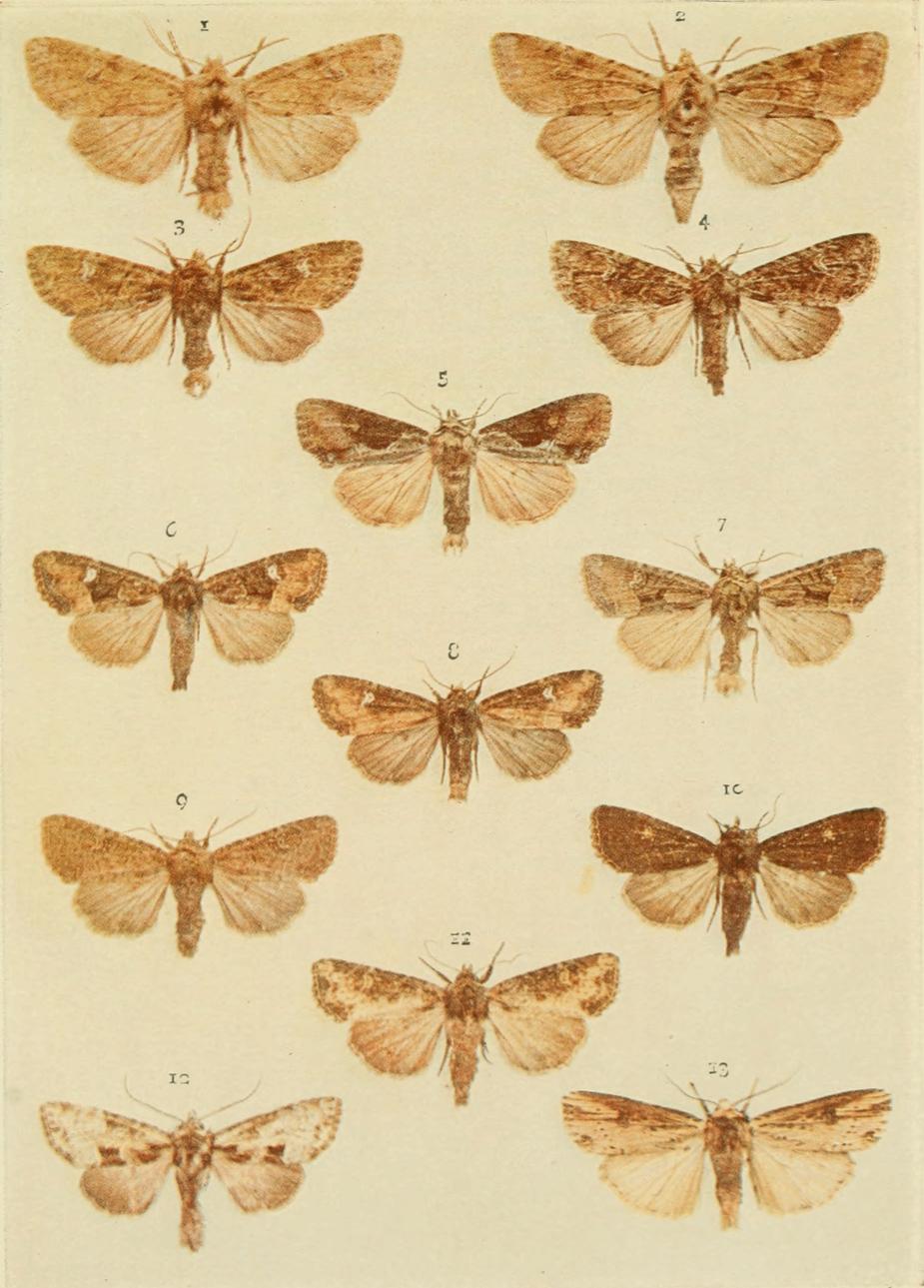
In the past this greenish-mottled brownish moth (Plate 126, Fig. 5) appears to have been commoner, and more widely distributed in England than it now is. Wilkes, in 1773, referring to it as "The Wild Arrach," states that it was taken occasionally near London. At the present time the species seems to occur only in the eastern counties, and chiefly in Cambridgeshire. In June, 1904 and 1905, specimens (three in all) were obtained at sugar in Huntingdonshire. The caterpillar is ochreous or reddish brown, dotted with white; three dark lines on the back, the central one only distinct. A yellowish stripe along the black-edged white spiracles; head light reddish brown, glossy. It feeds in July and August on orach (Atriplex), persicaria, knot-grass, and will also eat dock. The range abroad extends to Amurland, Corea, and Japan.
Note.—It may be mentioned here that Prodenia littoralis, Boisd., an inhabitant of tropical and sub-tropical regions, has been occasionally reared in this country from caterpillars found in imported tomatoes.
The Saxon (Lithomœa (Hyppa) rectilinea).
The brownish clouding, and reddish-brown central band, of this species (Plate 126, Figs. 6, 7) varies in tone; sometimes the band is olive grey and the clouding rather grey than brown. The caterpillar, according to Buckler, varies from dark brown to chestnut, ochreous, and orange browns; the spiracular stripe pale ochreous or cream colour, shading off in the middle to grey brown. It feeds from July to September, or later, on sallow, bramble, bearberry (Arctostaphylos uva-ursi), and will eat knot-grass. It hibernates when full grown, and pupates in the following spring. The moth is out in May, June, or July, and is taken at sugar, chiefly in woods. At one time it was found in Yorkshire, but Cumberland seems to be the only English county in which it now occurs. In Scotland it has been taken in the south. Renton states that near Hawick, Roxburghshire, he finds a few at raspberry blossom every year. It is more plentiful, however, from Perthshire to Sutherland. Kane notes it from Torc Wood, Killarney, near Galway, and Clonbrock; and that the form is identical with that from Aberdeen named semivirgata, Tutt. The range abroad extends to Siberia and Amurland; and the North American, xylinoides, Guen, seems to be a form of the present species.
The Figure of Eight Moth (Diloba cæruleocephala).
The greyish-centred white marks are the chief features on the brownish fore wings of this moth (Plate 127, Figs. 1, 2). The first one, or both when quite apart, is very like the figure 8; sometimes these marks are united, and form an irregular blotch. Rarely the area between the black lines is dark and the marks obscured or absent. The caterpillar (Plate 133, Fig. 1) is bluish grey, with a number of bristle-bearing black spots and minute black dots; a stripe along the back is yellow and interrupted; a yellow stripe low down along the sides. It feeds, from April to June, on hawthorn, sloe, and wild crab; also on the leaves of apple, plum, and other fruit trees. Sometimes these caterpillars are to be seen on the hedges in numbers, and usually seem to prefer the outer extremities of the longer shoots. The pale purplish brown chrysalis is enclosed in a strong somewhat oval cocoon, which is covered with fragments of litter, and often attached to some object, such as a bit of stick, leaves, etc., on the ground. The moth is out in October and November, but is rarely seen, except occasionally at gas lamps, etc. Generally common in the south and east of England, and widely distributed throughout the rest of the country to Cumberland. It has occurred in a few Clydesdale localities, and has been recorded by Renton as sometimes common in Roxburghshire. Widely distributed in Ireland, but not often plentiful.
The Green Brindled Dot (Valeria oleagina).
Nearly eighty years ago Stephens summed up all that was known of this species in Britain. As there is nothing to add in the way of later records, his remarks may be quoted. "Very rare; specimens have been found in Richmond Park, and one was taken in the pupa state by Mr. Plastead some twenty or thirty years ago in Battersea Fields; others have occurred near Bristol, and Mr. Donovan, I believe, captured one in South Wales; it has also been taken in Scotland. My specimens were from the former locality, and I have been fortunate enough to have had nearly a dozen examples at various periods." Most of the later authors mention only the Welsh specimen, taken at Fishguard in Pembrokeshire, July, 1800. A continental specimen is shown on Plate 127, Fig. 5.
The Beautiful Gothic (Heliophobus hispidus).
This species (Plate 127, Figs. 6, 7) varies in the brown colour of the fore wings, which is sometimes of a greyish tint; not infrequently the pale cross lines are tinged with brownish, or they may be rather broad, and, the submarginal especially, white and very distinct; the reniform and orbicular marks are sometimes tinged with pink. The caterpillar (Plate 133, Fig. 3) is pale rusty brown, with blackish markings, and three pale lines on the back; head glossy and rather paler than the body, and marked with two blackish lines. It feeds on grasses from September to March. The specimen figured (slightly enlarged) was received from Mr. Walker of Torquay on January 11, 1907. The chrysalis (Fig. 3A) is dull reddish, ring divisions and wing-cases paler and brighter; two hooks on last ring. The moth is out from the latter part of August to early October, and in its haunts, which are cliffs by the sea, it may be found at night sitting on grass stems. It is not known to visit flowers or the sugar patch, but has been taken at light. Although previously taken in the Isle of Portland, the earliest published record was that in the Zoologist for 1849 of a specimen taken on the sandhills at Exmouth, late in September. It still occurs at Portland and at Swanage in Dorset; also in the Isle of Wight and along the Devon coast to Cornwall. The range abroad is restricted, the species only being noted from Southern France, North-east and Southern Spain, Sicily, Palestine, and North-west Africa.
The Flounced Rustic (Luperina testacea).
Portraits of this moth will be found on Plate 128, Figs. 5, 6. The ground colour of the fore wings ranges from very pale brown through greyish brown to blackish. In some specimens the markings are very faint, and, excepting the whitish submarginal line, are hardly visible. Usually there is a black or dark brown bar connecting the first and second cross lines; not infrequently there is a black mark on the inner margin below the bar, and a black mark or two in the cell above. These marks are sometimes supplemented by others, and so form a more or less complete black central band. The reniform and orbicular stigmata are often only outlined in paler brown, but they may be whitish and very distinct. Var. guenéei, Doubleday, is pale ochreous brown, with the first line pale, interrupted, and terminating in a black dot on inner margin; and the second line made up of white-edged black crescents; the reniform distinctly edged with white, and there is a slender black line above the inner margin between the first line and the base of the wing. Hind wings pure white, with black marginal lunules.
The caterpillar is pinkish ochreous; usual dots not in evidence; skin much wrinkled and glossy; spiracles pink margined with black; head and plate on first ring pale brownish yellow. Robson (Cat. Lep. of Durham, etc.) states that the caterpillar feeds on grass roots, and adds, "I have known it abound in the grass tufts at the foot of palings around a large mill." The moth is out in August and September. At night it flies freely to light, but is not known to visit any of the usual floral attractions or the collector's sugar. Generally distributed and often common.
Dumeril's Luperina (Luperina dumerilii).
Fore wings ochreous grey or brown, two brownish streaks represent the basal line; the space between the first and second cross lines darker, and there is a darker band on the outer margin; the stigmata are pale inclining to yellowish, and the veins below them are white. Hind wings whitish tinged with darker on outer margin. Ab. desyllesi, Boisd., has almost unicolorous fore wings, and this form, according to Staudinger, has been found in Northern France and England. I have only seen a continental specimen of this species, which is very local and somewhat rare abroad.
Pl. 132.
1, 2.Rustic Shoulder-knot. 3, 4.Small Clouded Brindle.
5.Double-lobed Moth. 6-11.Common Rustic.
12.Union Rustic. 13.Flame Moth.
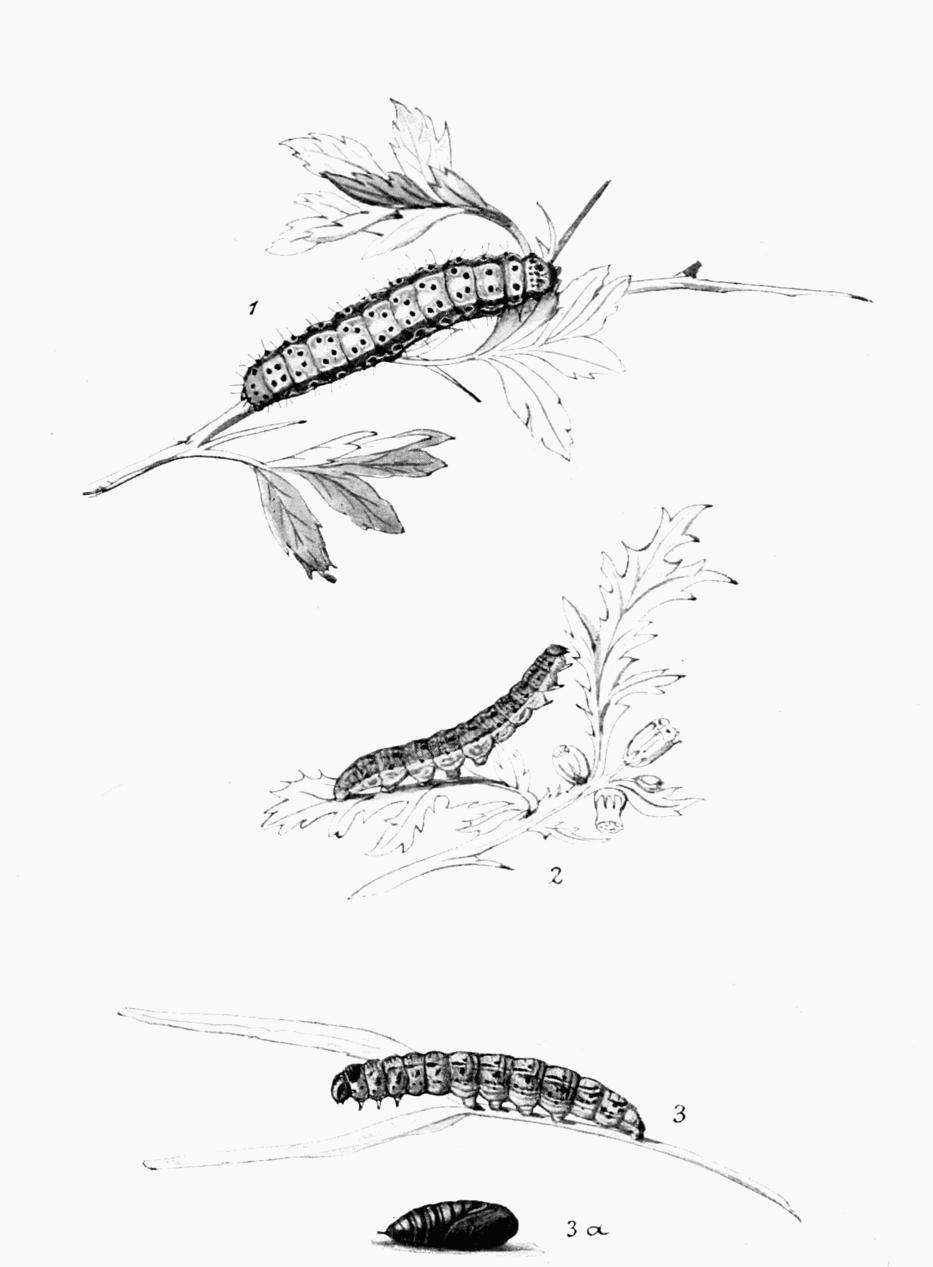
Pl. 133.
1.Figure of Eight: caterpillar.
2.Feathered Ranunculus: caterpillar.
3, 3a.Beautiful Gothic: caterpillar and chrysalis.
In his Manual, vol. i. (1857), Stainton states, "one specimen has occurred in the Isle of Arran." Reference is made in 1885 (Entom. xviii. 73) to two specimens taken in the Isle of Portland in 1858, and three others in 1859. Then, in the Entomologist for 1902, Mr. Stockwell records, from Dover, the capture of "a fine female of this rare Noctua, on a gas lamp in this town, during the latter part of September."
The Straw Underwing (Cerigo matura).
This moth, both sexes of which are shown on Plate 128, Figs. 2, 3, is readily recognized by the yellowish hind wings. The caterpillar is ochreous or dull reddish brown; series of greyish brown marks along the middle of the back, and a brown edged line on each side; a pale ochreous line edged above with brown low down along the sides; head pale brown, with darker streaks. It feeds from September to April, sometimes later, on grasses, chiefly in dry situations. The moth is out in July and August. Generally distributed throughout the British Isles, but in Scotland not recorded north of Moray. In suitable localities it is common, and sometimes is the only visitor to the sugar patch.
Haworth's Minor (Celæna haworthii).
In this reddish brown moth (Plate 128, Fig. 7) the reniform and orbicular stigmata are white or broadly outlined in white, and the vein below as well as the branches also white. The wings of the female are smaller than those of the male, and the body is distinctly stouter. The white markings referred to are sometimes obscured or absent, and such specimens are referable to var. hibernica, Haworth. The caterpillar is purplish brown, with the usual raised dots darker brown; three pale lines along the back, the central one least distinct; head and plates on first and last rings reddish brown; spiracles black. From April to July on cotton grass (Eriophorum vaginatum), feeding in the stems down towards the root. The moth flies in August and September. It was first noted as British in 1819, and Stephens in 1829 mentions it as common in Whittlesea Mere. Although still occurring in the fens, the species is far more common on the moors and mosses of Northern England, Scotland to the Shetlands, and in Ireland.
The Crescent Striped (Hama oblonga (abjecta)).
In its most frequent form this species (Plate 131, Figs. 5, 6) has the fore wings greyish brown and somewhat shining; the markings, especially the cross lines, indistinctly paler; the reniform is outwardly dotted with white. Sometimes the ground colour is paler grey with black markings arranged very similar to such marks in A. gemina, var. remissa (Fig. 8).
The caterpillar is greenish grey, with the raised dots rather greyer; a pinkish line along the back; head and plate on first and last rings shining reddish brown. It feeds on grasses growing in salt marshes, edges of tidal rivers, and ditches of brackish water: in the spring and until June; perhaps from September. The moth is out from June to August, and may be obtained at the flowers of marram grass as well as at sugar. The species is found in most of the eastern and southern seaboard counties of England; at Sandown and Freshwater in the Isle of Wight; in the fens of Huntingdon and Cambridge; also occasionally in Herefordshire, Gloucestershire, Lancs, Yorks, and Durham. In Scotland it has been obtained in Moray and in the Shetlands. Local in Ireland. The range abroad extends to Amurland.
The Large Nutmeg (Hama sordida).
The fore wings of this moth (Plate 131, Figs. 1, 2) are pale ochreous brown, much marbled with darker brown, and sometimes slightly tinged with reddish; the pale stigmata and submarginal line are the most distinct of the usual markings. The caterpillar is said to be very like that of Apamea basilinea. The moth flies in June, and is not uncommon in most parts of Southern England. It occurs in Lancashire and Cheshire, but is more frequent in Yorkshire and Durham; also found in South Wales, and although it has been obtained in the Shetlands, it seems to be very local and infrequent in Scotland. Only twice recorded from Ireland, one specimen on the Dublin coast, 1860, and one at Howth (Kane).
The Confused (Hama furva).
This darker mottled greyish brown moth (Plate 131, Figs. 3, 4) is very similar to the typical form of A. gemina (Fig. 7); the fore wings, however, are distinctly broader at the base, the W-like angles of the submarginal line are less noticeable, and this line is comparatively straighter. The reddish tinge so usual in A. gemina is absent in the present species.
The caterpillar is ochreous tinged with pinkish, except on the first three rings and the under surface; central line dusky; usual dots reddish brown, as also are the head and plates on first and last rings. On grasses, September to June, feeding chiefly on the shoots near the roots (condensed from Buckler). The moth occurs from July to September, and may be obtained at flowers of ragwort, scabious, etc., and freely at sugar, in rocky places from Lancashire northwards through Scotland to the Shetlands. It also occurs in Wales, and suitable places in Gloucester, Somerset, Devon, Cornwall, and has also been recorded from Sussex. In Ireland found on several parts of the coast, but not plentiful. Abroad the range extends to Amurland.
The Dusky Brocade (Apamea obscura (gemina)).
In its ordinary form the moth shown on Plate 131 is purplish brown, as in Fig. 7, sometimes mottled with greyish or pale ochreous. A more ornamented form is known as var. remissa (Fig. 8), and the ground colour of this is not infrequently pale ochreous brown, or almost whitish, with the black marking very conspicuous. The caterpillar is brownish grey, finely striated with darker; a yellowish white line along the middle of the back, and a brownish ochreous stripe on each side of it; stripe along the black edged spiracles greyish ochreous. It feeds from autumn till March on grasses in moist situations. The moth is perhaps most abundant in the south, but it occurs, in June and July, pretty well all over the British Isles; and abroad its range extends to Amurland and Japan.
The Rustic Shoulder Knot (Apamea basilinea).
The species shown on Plate 132, Figs. 1♂, 2♀, is found almost everywhere in the British Isles, is generally common, and in many parts abundant. Usually the pale brown fore wings are clouded or suffused with reddish, but this tint may be absent, or the wings may be tinged with greyish: the single black dash from middle of the base is the "Shoulder Knot." The caterpillar, according to Barrett, is pale olive brown varying to grey brown; a greyish white line along the middle of the back edged with short undulating black lines; spiracular line a row of blackish dashes, clouded with olive brown, or edged with greyish white and looped with grey brown; head black, plate on first ring black and white striped. It feeds from August to March on grasses, etc. The moth flies in May and June.
The Small Clouded Brindle (Apamea unanimis).
The fore wings are generally reddish brown mottled with darker, but the reddish tinge may be almost absent; the reniform is more or less outlined in white and there are two black streaks from the base. (Plate 132, Figs. 3♂, 4♀.) The caterpillar is pale ochreous brown, sometimes tinged with greenish; three dark edged pale lines on the back; spiracular line pale edged above with darker; head, and plate on first ring, brown and glossy. On grasses that occur in damp places, such as water meads, marshes and fens from July to April. The moth flies in June and July. It is widely distributed, and sometimes common in most moist localities throughout England. More local in Scotland but occurring in Aberdeenshire, and on the western side ranging to the Orkneys. Not frequent in Ireland, but has been obtained in several parts. The distribution abroad extends to Amurland.
The Union Rustic (Apamea pabulatricula).
The very distinctly marked, and sometimes brownish tinged, greyish white moth shown on Plate 132, Fig. 12, is very local in the British Isles, and apart from its reported occurrence in the Clyde and Tay districts of Scotland, seems to be found only in some of the woods of South Yorkshire, as near Rotherham, Sheffield (Wharncliffe Woods), and Barnsley. It has been obtained in Cumberland; and Barrett states that formerly it occurred in Norfolk. The caterpillar, which is little known, is said to feed on grasses in May. The moth flies in August and early September. It is also known as connexa, Bork.
The Common Rustic (Apamea secalis).
Following Guenée, British entomologists at one time knew this species as oculea; afterwards it became the habit to label it didyma, a name given to it by Esper in 1788. Just now the authorities insist on secalis, Linnæus, being adopted. The species is an exceedingly variable one, and six examples of it are shown on Plate 132, Figs. 6 to 11. The form with blackish fore wings and a white reniform mark is var. leucostigma, Esp. Nictitans, Esp., has brownish fore wings and a white reniform. I-niger, Haw., is greyish or grey brown with darker central band, and the cross lines united by a black bar. Ochreous or reddish ochreous specimens with the front marginal area broadly and irregularly reddish brown, and the outer margin bordered with reddish brown, are referable to var. furca, Haw. Many other forms have been named. The caterpillar is green with three reddish lines on the back; head and plate on the first ring pale brown, also plate on last ring. In stems of grasses such as Festuca, Dactylis, etc., also on wood-rush. From Autumn to April or May. The moth flies in July and August, and is common everywhere in the British Isles; its range abroad extends to Western China.
The Double Lobed (Apamea ophiogramma).
This species (Plate 132, Fig. 5) is usually found in marshy localities, or in gardens, over the eastern counties, and from Northamptonshire through Bucks, and Hertfordshire, to Kent, and Surrey. The caterpillar feeds from September on the shoots of Phalaris arundinacea and the cultivated form of that plant grown in gardens, and known as ribbon grass. Also said to feed on Poa aquatica. When the grass dies down in the late autumn the caterpillar enters the ground to hibernate, and emerges in the spring ready to attack the young grass shoots as soon as they appear. Where the new growth of ribbon grass assumes a brown and withered appearance this larva will probably be found at the bottom of the trouble. When nearly full grown it eats down the interior of the thicker stems to the base. In colour it is ochreous with a pinkish tinge; a pale brownish plate on first and last rings, each edged with blackish and that on the first ring traversed by a white line; head pale brown, glossy. The moth flies in July and August, sometimes in June.
The Marbled Minor (Miana strigilis).
Half a dozen specimens are shown on Plate 134, and these will serve to give some idea of the range of aberration in this species. The most typical of the species are those represented by Figs. 1 and 4; the farthest removed from the type is var. æthiops, Haworth (Fig. 16). In the reddish var. latruncula, Hübn., as figured by him, the most conspicuous character is the white lower curve of the second cross line, as in Fig. 7.
The caterpillar is purplish brown above, and ochreous below; striped on the back with pale yellow, and less distinctly on the sides; spiracles black and very distinct; head and plates on the first and last rings of the body ochreous brown and shining. Found in March and April, after hibernation, feeding on the stems of various grasses. The moth is out in June and July, and may frequently be seen at rest on palings, etc., but at night it often abounds at sugar or honey dew. Generally distributed in the British Isles, except perhaps in the islands of Scotland.
The Middle-barred Minor (Miana fasciuncula).
In its typical form this species (Plate 134, Fig. 3) has the fore wings reddish ochreous, with a darker central band, and the cross lines, especially the second, distinctly white towards the inner margin. Sometimes, chiefly in Scotland, the ground colour is much paler, occasionally almost whitish, and the band reddish (var. cana, Staud., Figs. 5, 8). There is a good deal of variation, both in the ground colour and in that of the band; the latter is often smoky brown in pale specimens of both sexes.
The caterpillar is of a pale flesh tint, rather inclining to greyish ochreous, the dorsal stripe of a darker tint of the same colour well defined on each side by the pale ground colour; next a very broad stripe of pinkish brown, followed by a narrow stripe of the ground colour, faintly edged below with pinkish brown; above the black spiracles is a stripe of pinkish brown freckles; head and plates on first and last rings of the body light brown, shining (Buckler). In the shoots of grasses such as Aira cespitosa, in April and early May, probably after hibernation. The moth is out in May and June, and its haunts are moist woods and marshy grounds, generally. The species is widely distributed, and often common, throughout the British Isles. Abroad it seems to have a very limited range.
The Rosy Minor (Miana literosa).
The ground colour is pale, or dark, violet grey, more or less clouded inwards from the submarginal line, and on the basal area, with purplish; a central reddish or reddish brown band is limited inwardly by the, sometimes, whitish edged black first line, and outwardly by an almost straight black line passing between the stigmata to the inner margin. (Plate 134, Figs. 11, 14.)
The caterpillar is dingy ochreous yellow, with a dark purplish stripe, enclosing a central line of the ground colour, on the back; spiracles black; head dark brown, plates pale brown (Porritt). From September to June, in stems of Carex glauca, Dactylis glomerata, and other grasses. The moth flies in July and August, and although rare inland is pretty generally distributed around the coasts of the British Isles; apparently, from the Clyde area, confined to the east coast of Scotland, and not extending north of Moray.
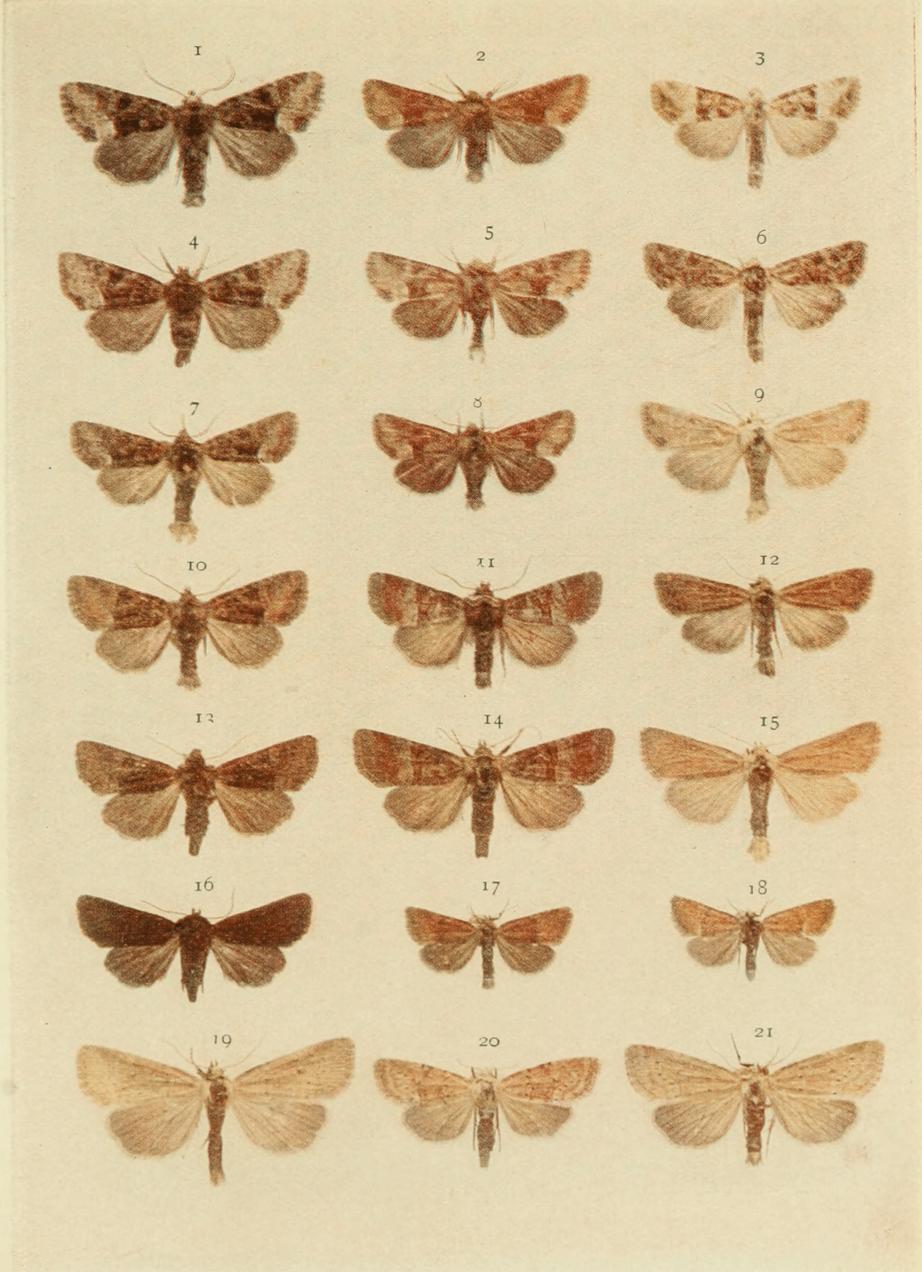
Pl. 134.
1, 4, 7, 10, 13, 16.Marbled Minor Moth. 2, 5, 8.Middle-barred Minor.
11, 14.Rosy Minor. 3, 6, 9, 12, 15.Cloaked Minor.
17, 18.Least Minor. 19-21.Small Dotted Buff.
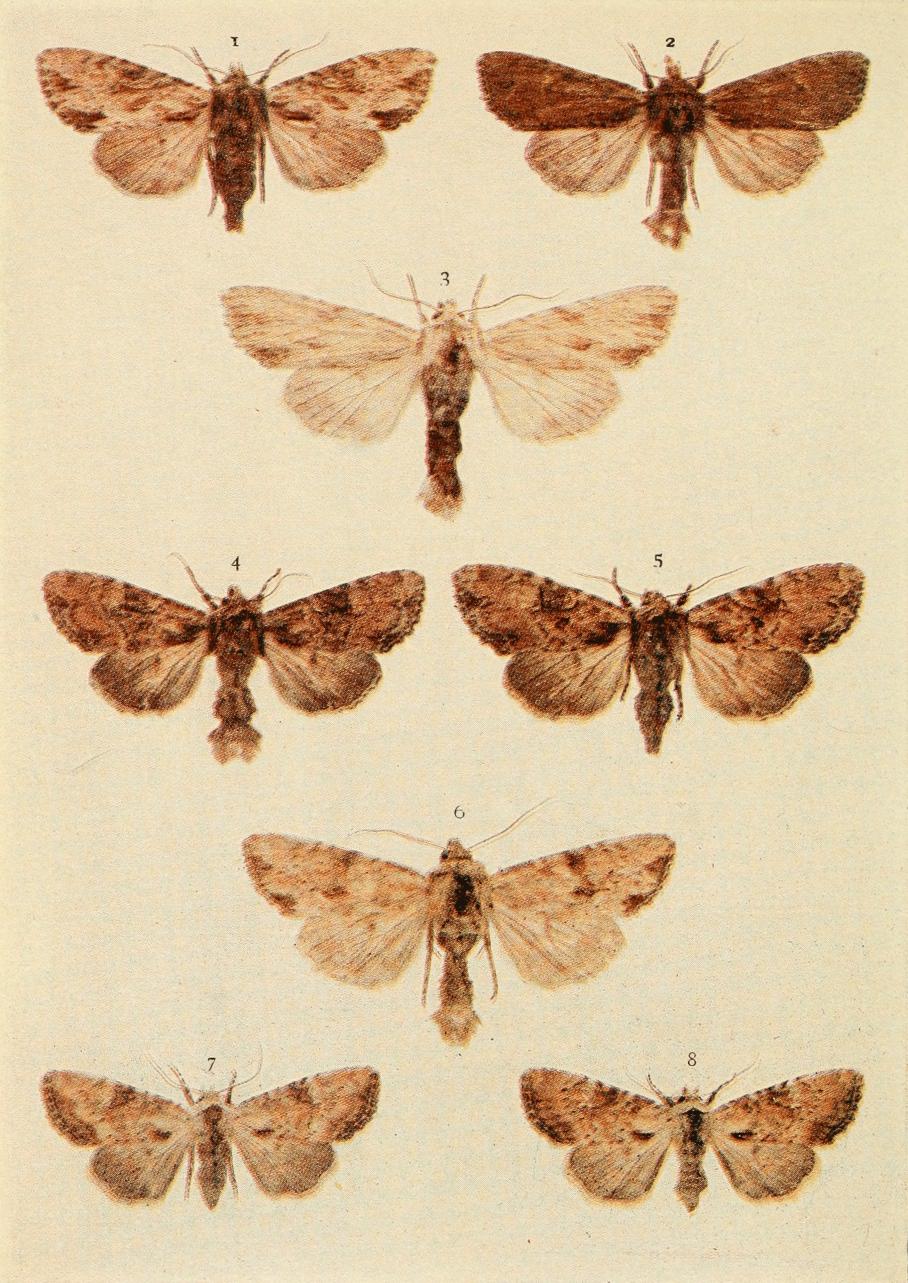
Pl. 135.
1, 2.Clouded-bordered Brindle. 3.Light Arches.
4, 5.Clouded Brindle. 6.Reddish Light Arches.
7, 8. Slender Brindle.
The Cloaked Minor (Miana bicoloria).
This is another variable species of the genus, and five specimens of it are shown on Plate 134. The typical form (Fig. 3) has the fore wings more or less brownish on the basal area, and whitish bordered with brownish on the outer area. Very frequently these wings are pale, or dark, brown marbled with darker brown, and with the stigmata and cross lines distinct, faint, or absent. Fig. 15 represents a form from Ireland, which is uniformly pale ochreous brown, sometimes reddish tinged. The caterpillar is yellowish ochreous, tinged with pink; three dull reddish interrupted bands, each intersected by a line of the ground colour; head reddish brown; plates on first and last rings of the body pale reddish brown (Buckler). In stems of grasses, such as Festuca and Aira—April and May; probably after hibernation. The moth flies in August and September, sometimes earlier. At dusk it is often common in rough fields and grassy places near the sea. Although found in some inland localities, it is more especially a coast species, and as such is widely distributed over the British Isles to the Orkneys.
The Least Minor (Phothedes captiuncula).
The pretty little moth shown on Plate 134, Figs. 17, 18, has the fore wings brownish ochreous, tinged with reddish brown, and with a darker central band and hind margin. Sometimes the whole basal area up to the white second line is reddish brown; and in a form from Ireland named tincta, Kane, the coloration is somewhat similar to that of M. literosa. This species was first discovered in Britain by Messrs. Law and Sang, in a locality near Darlington, Durham, in 1854. It is now obtained in several places in that county, and in Northumberland. Also found in North Lancashire, Westmoreland, and once in Yorkshire. It occurs commonly in Co. Galway and Clare, Ireland, and has once been taken in Killarney. There is also a record from Perthshire in Scotland.
The caterpillar is dull ochreous, with a reddish tinge inclining to purplish on rings two to seven; head reddish brown; plates on first and last rings yellow brown, the former edged in front with darker brown; spiracles black, three yellow spots on sides of rings two and three (Buckler). On Carex glauca and other sedges, eating down the stems close to the roots. Will also eat ribbon grass—August to June. The moth flies, often in the early afternoon, from late June to August. It seems partial to rough fields, and hillsides, chiefly on the coast.
The Clouded-bordered Brindle (Xylophasia rurea).
Of this common, generally distributed, and often abundant species, portraits of the typical form (Fig. 1), and of var. alopecurus, Esp. (Fig. 2), will be found on Plate 135. The ground colour varies from the normal greyish white to a silvery white (var. argentea, Tutt), and through yellowish shades to a reddish ochreous; the markings in all these colour aberrations are more or less typical. In the var. alopecurus, Esp., there are also gradations; thus combusta, Haworth, is dark greyish brown; and a blackish brown, red tinged form is nigro-rubidea, Tutt. The caterpillar (Plate 130, Fig. 4) is variable in colour, one form is ochreous grey with three lines on the back, the central one white shaded on each side with grey; usual dots and spiracles are black; head blackish and shining. From August to May on grasses. The range abroad extends to Amurland.
The Light Arches (Xylophasia lithoxylea).
In this whitish ochreous species (Plate 135, Fig. 3) there is little variation except that the darker clouding is more pronounced in some specimens than in others. The caterpillar is brownish grey, tinged with ochreous or with greenish; usual dots blackish, as also are the head and the plates on first and last rings of the body. October to May, feeding on stems of grasses, near the roots. The moth is out in June and July, and is often seen on fences, etc., in the daytime. Generally distributed, and common in most places throughout the British Isles. In Scotland, however, it does not range north of Moray, and only on the eastern side.
The Reddish Light Arches (Xylophasia sublustris).
Except that the fore wings are somewhat reddish tinged, and not so long, this species (Plate 135, Fig. 6) is very similar to the last. The caterpillar is also very like that of the Light Arches, but has more red in its coloration. The moth is out in June and July, and affects limestone and chalk localities, and these chiefly on the coast. In Berkshire and adjoining counties it occurs in beech woods. Specimens have been recorded from Kendal in Westmoreland, but Yorkshire has been considered the northern limit of the species in England. It has been recorded occasionally from the fens. Paisley and Bonhill are given as Scottish localities in the Fauna of the Clyde Area (1901). Widely distributed in Ireland but most abundant in the province of Connaught.
Xylophasia zollikoferi. The home of this species would seem to be in parts of Hungary, Russia and Western Asia, whence it very occasionally finds its way across the continent to England. Its British history is as follows:—a specimen taken at Deal, by Mr. Harding, October, 1867; one at Inverurie in Scotland, by Mr. Tait, September, 1871; and one at sugar by Mr. T. A. Lofthouse at Linthorpe, Middlesbrough, September 26, 1903. Also recorded from Norwich, September, 1905, and from Methley, Yorks, August, 1910. (Plate 153, Fig. 6.)
The Dark Arches (Xylophasia monoglypha).
The five portraits of this moth on Plate 136 will give some idea of the various forms it assumes. The blackish specimen is referable to var. infuscata, White, and an extreme aberration of this form has been named æthiops, Tutt. The caterpillar is greyish, inclining to brownish or reddish; usual dots blackish; head and plate on first ring of body dark brownish, and shining. August to September, feeding on grasses and devouring the stems near the base. The moth is out from June to August, sometimes in October and November. It occurs in all parts of the British Isles and is often abundant.
The Clouded Brindle (Xylophasia hepatica).
The most frequent form of this species (Plate 135) has the fore wings pale brown, with well-defined black markings, but without distinct cross lines. When the wings are more clouded and suffused with reddish or purplish brown the paler ground colour shows up as cross lines, and these are more or less edged with blackish (var. characterea, Hübner). The caterpillar (Plate 130, Fig. 2) is dingy brown with shining black dots; three pale ochreous lines along the back, the central one most distinct; head black and shining; plate on first ring of the body black crossed by white lines, another on the last ring is blackish. Feeds from August to April on grasses, but will also eat various low plants. The chrysalis (Fig. 2A) which is enclosed in a tender earthen cocoon, is reddish, blackish between the rings, and the last ring, which is blunt at apex, is furnished with four hooks. The moth is out in June and July. A common species in the eastern and southern counties of England, but less frequent or rare in the Midlands and northwards to Roxburgh in Scotland. Local and not numerous in Ireland. Range abroad extends to Amurland.
The Slender Brindle (Xylophasia scolopacina).
This is another species with reddish brown clouded, pale ochreous brown fore wings. The ground colour may be whiter or redder than in the specimens shown on Plate 135, Figs. 7, 8. The caterpillar (Plate 130, Fig. 1) is dusky green above and whitish green beneath, the green shading into blackish along the sides; a fine whitish line along the middle of the back; usual dots black; head honey-brown and glossy, the jaws and a spot on each cheek black. It feeds on the juicy lower part of the stems of grasses, such as Triticum, but will also eat the leaves. In the spring, and till June, probably after hibernation. The moth is out in July and August, and as an uncommon event may be seen at rest on a tree trunk or paling. Stephens (1829) refers to its occurrence in the London district, and it still appears in woods around Highgate. It seems to be most plentiful in the woods of South Yorkshire, and in the Sherwood district of Nottinghamshire; but it has been found more or less frequently in several of the southern counties of England, and also in some northern ones. Its range abroad extends to Amurland and Japan.
The Bird's Wing (Dipterygia scabriuscula).
The curious wing-like marks on the blackish fore wings of this moth (Plate 137, Figs. 1♂, 2♀) are its chief features. The stigmata are outlined in black, but are rarely paler than the ground colour. The caterpillar is reddish brown with yellow and black dots; three lines along the back, the central one white with a black edging, and the others blackish; head brown and glossy, marked with black; a blackish plate on first ring is also glossy, and is followed by a black mark on the next ring, both streaked with white. It feeds on dock, sorrel, and plants of the genus Polygonum, in July and August. The moth flies in late May and June, sometimes as a second generation in August or September. It occurs more or less commonly in most southern and eastern counties from Oxfordshire. In other parts of England, and in Scotland, it seems to be local or absent.
The Purple Cloud (Cloantha polyodon).
This moth is figured on Plate 137, Fig. 7. The first recorded British specimen was taken at Yarmouth, in June, 1839. In 1855 a specimen, found in a spider's web at Ashford, Hampshire, was exhibited at a meeting, held in May, of the Entomological Society of London. Two specimens were taken in 1892; one at Folkestone, Kent, at sugar, and the other outside Norwich, in Norfolk, at a gas lamp. In the Entomologist for 1894, there is a record of a specimen captured at sugar, July, 1891, at Clonbrock, Co. Galway, Ireland. The species has a wide range abroad, extending eastward to Amurland and Japan.
The Deep-brown Dart (Aporophyla lutulenta).
In the south of England the species (Plate 137, Figs. 9, 10) is generally of a dark brown coloration on the fore wings, and the markings are often indistinct; but blackish forms also occur, although the latter are more frequent northwards, and in Scotland and Ireland are the prevailing form of the species. In black or blackish specimens, usually referred to luneburgensis, Freyer, the hind wings in the male, have the veins more or less blackish and dotted with black beyond the middle; var. sedi, Guenée, has the fore wings pale greyish with the markings distinct, and the central area blackish.
The caterpillar is green, sometimes tinged with pink on the first three rings; three brownish broken lines along the back, and a violet edged white line along the spiracles. It feeds on grasses, yarrow, groundsel, dock, plantain, gromwell (Lithospermum), and other low herbage; also on buds of hawthorn and sloe in the spring. October to April. The moth is out in August and September, sometimes later. It is found most frequently on the coast, perhaps, but occurs in Cambridgeshire, Hunts, Oxfordshire, Gloucestershire, Berks, Kent, Surrey, Sussex, Hants, and Isle of Wight; from Somerset to Cornwall; North and South Wales, Cheshire, Lancashire, and Yorkshire, and apparently in all counties northward except Westmoreland. Widely distributed in Scotland from the border to the Hebrides and Orkneys. It is found only on the coast in Ireland, and chiefly in the north-west.
The Black Rustic (Aporophyla nigra).
This black or brownish black moth (Plate 137, Fig. 8) has the outer edge of the reniform stigma ochreous, and the cross lines are sometimes dotted with the same colour. The caterpillar is green, yellowish-brown, or dull purplish; first three rings often tinged with reddish; three darker, often broken, lines along the back; line along the black-edged white spiracles yellowish. It feeds on bedstraw (Galium mollugo), dock, plantain, grasses, etc. October to May. (The egg is figured on Plate 139, Fig. 3.) The moth is out in September and October. Chiefly a northern species, but it occurs in some of the southern counties. It is, however, most frequent in Northampton, Huntingdon, and Cambridgeshire; in Gloucestershire, and Wales, and in the Isle of Man, Cumberland, and Westmoreland. In Lincolnshire, Yorkshire, and Lancashire it seems to be local or rare. It is found up to Moray in Scotland, and is sometimes plentiful in Aberdeenshire, Inverness, and Moray. Very local in Ireland, but Kane says that it is found in the extreme north, south, east, and west.
The Feathered Brindle (Aporophyla australis).
The fore wings are pale grey, sometimes darker clouded, chiefly on the costa; the black cross lines, slender, wavy, but not always distinct; a short black bar from middle of the base and one below it on the inner margin; often two other bars, pretty much in a line with the basal ones, on the central area; a row of black wedges on the outer area, near margin. Hind wings white in the male, pale brownish grey in the female. Most of our specimens, perhaps all, are referable to var. pascuea, Curtis. The caterpillar is yellowish green tinged with reddish above; a pale reddish line along the middle of the back has black V-shaped marks upon it, and there is a series of black marks on each side; the line along the spiracles yellowish; head green, brown freckled. Feeds, from October to April, on grasses, catchfly (Silene maritima), etc. The moth, which is figured on Plate 137, Figs. 3, 4, is out from late August to October.
This is a local species in England and occurs on the south coast; in Kent, on the sand hills at Deal; in Sussex, on the downs at Brighton and Lewes; also on downs on the Isle of Wight. Farther west it is found at Portland in Dorset, and Torquay in Devon; thence along the Devon and Cornish coasts. In Ireland it is obtained, according to Kane, on the coast of Wicklow and Waterford, and is not scarce on the sand hills of Wexford Harbour.
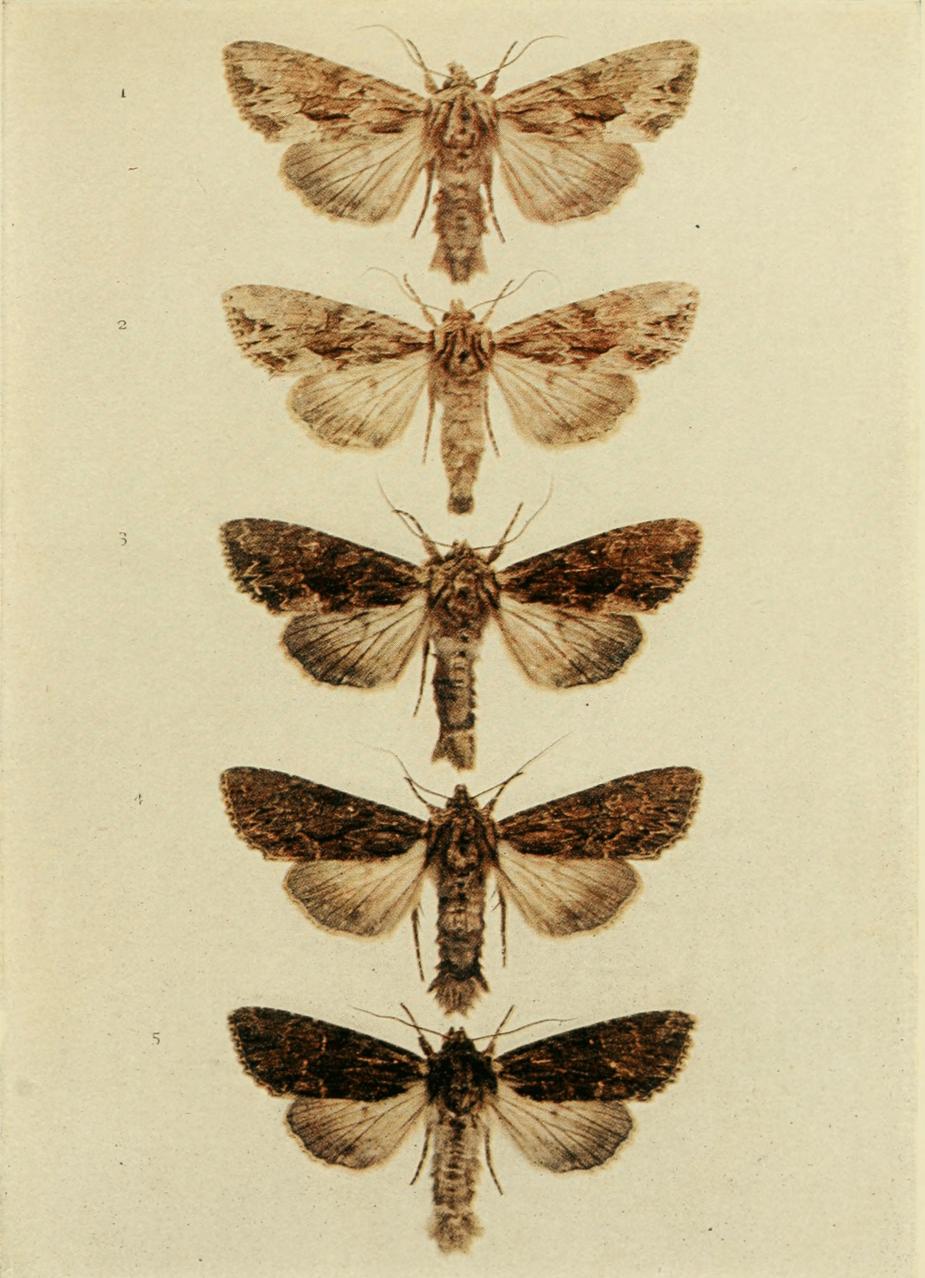
Pl. 136.
Dark Arches Moth.
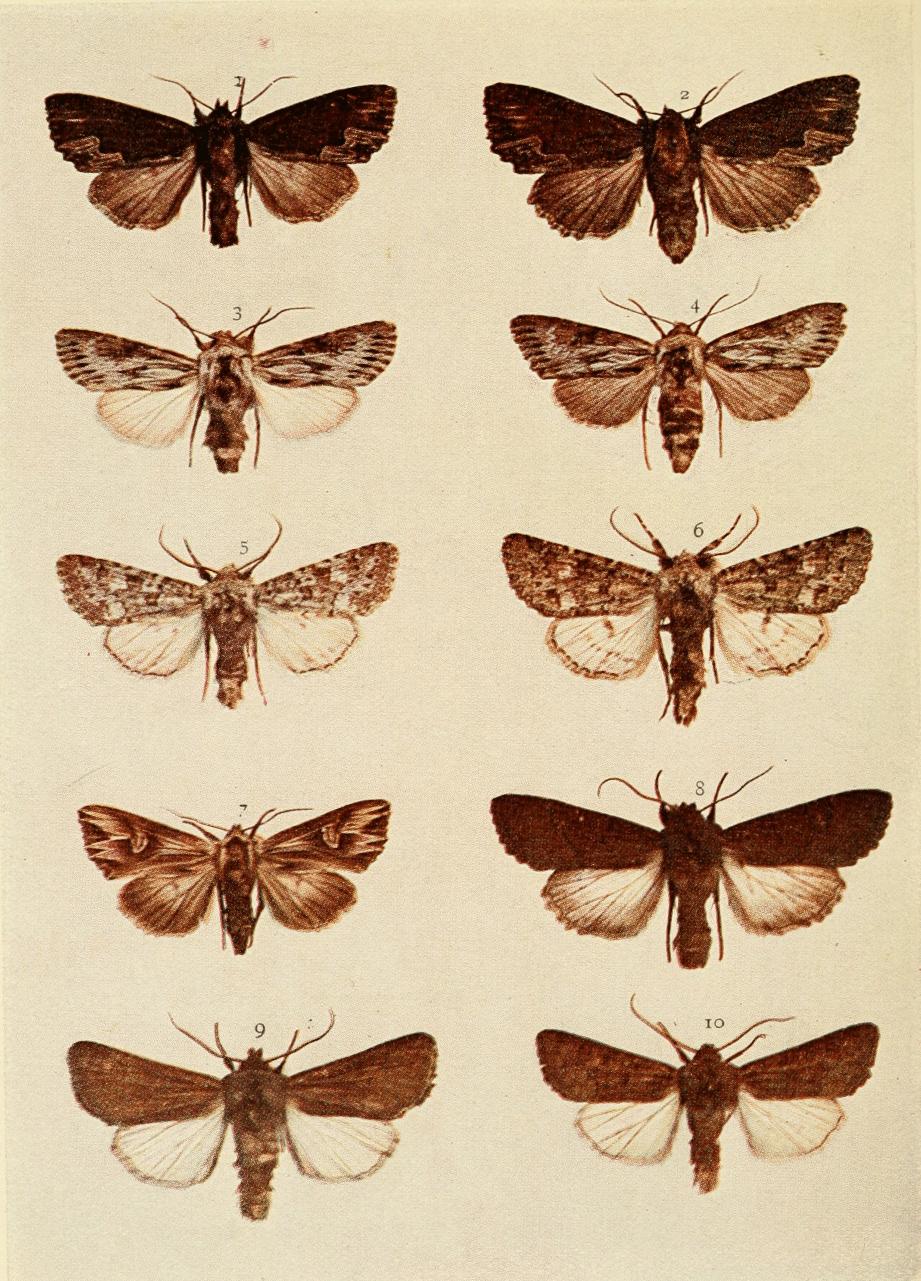
Pl. 137.
1, 2.Bird's Wing Moth. 3, 4.Feathered Brindle.
5, 6.Feathered Ranunculus. 7.Purple Cloud.
8.Black Rustic. 9, 10.Deep-brown Dart.
The Feathered Ranunculus (Epunda lichenea).
This is a maritime species and is chiefly found in the Isle of Wight, the Isle of Portland, and along the coasts of Cornwall, Devon, Somerset, Gloucester, and on the opposite Welsh coast. It is locally common in Cheshire and Lancashire, and occurs on the coast of North Wales, in Flint and Carnarvon. In Yorkshire it is not uncommon at Scarborough. Has been recorded from the Lincolnshire coast and from Eastbourne. There are two records from Scotland—Renfrew and Ayr. In Ireland it is common at Howth, and abundant at Rossbeigh, Co. Kerry. This species, and the last two, have a rather limited range abroad. On Plate 137 are portraits of two local forms, Fig. 5 is from Portland, and Fig. 6 from Plymouth. It will be noted that the former is greyish in tone whilst the latter is greenish and rather larger. Similar local variation occurs throughout the range of the species.
The caterpillar (Plate 133, Fig. 2) is olive green inclining to brownish above; along the back are darker markings forming a central stripe and a paler interrupted stripe on each side; a pale stripe along the spiracles. It feeds from autumn to May on various low plants. The moth flies from late August to early October. The first British specimen is said to have been taken in the New Forest in 1847; but in 1850 about a hundred were captured at New Brighton in Cheshire.
The Brindled Ochre (Dasypolia templi).
The dull ochreous-brown moth shown on Plate 138, Fig. 1, has hardly any well-defined markings, but the cross lines are generally darker, and the reniform and orbicular paler. The caterpillar, which feeds in the stems of cow-parsnip (Heracleum sphondylium) from April to August, is pinkish ochreous with a rather darker stripe on the back; raised spots brown; head reddish brown. The moth flies in the autumn, and, after hibernation, in the spring. It frequents rocky places on the coast and on hills. Its range in England is pretty much as in the last species, but it does not seem to occur on the south-east coast. In Scotland it is widely spread over the country to the Orkneys, and has been found in the most northern isle of the Shetlands, but it is generally uncommon. It has been taken near Dublin in Ireland, and less frequently in Antrim and Donegal.
The Large Ranunculus (Polia flavicincta).
The fore wings of this moth (Plate 138, Figs. 6 and 7), are pale grey, clouded, and marked with darker; yellowish freckles at the base, and on the central area and the submarginal line are usually, but not always, present. Sometimes, chiefly in northern specimens, these wings are much suffused with darker grey, approaching blackish. The caterpillar is green with a yellowish or bluish tinge; a dusky line along the back, and a dark green line along the black-edged white spiracles. It feeds on dock, groundsel, plantain, and many other plants from April to July. The moth flies in September and October, and, except in Kent, and perhaps Sussex, is rather uncommon in the southern counties of England. It occurs, however, not infrequently in the eastern counties, and through Oxford, Berks, Gloucester, Somerset to Cornwall, and northward through Hereford and parts of the Midlands to Lancashire, Yorkshire, and Durham.
The Grey Chi (Polia chi).
Four specimens are depicted on Plate 138. Figs. 2 and 3 represent the sexes of the type form, and Figs. 4 and 5, the greenish-grey var. olivacea, Stephens. Both forms may be paler or darker, but the green tinge is apt to fade out. Var. suffusa, Tutt, is a dark greyish suffused form.
The caterpillar is green, inclining to bluish green above; the lines on the back are whitish, edged with dark green; that along the black-margined white spiracles is white, shaded above with dark green. It feeds on dock, dandelion, groundsel, etc.; also on sallow and hawthorn, from April to June. The moth is out in August and September. It prefers the open country to woodlands, and is often seen resting on rocks, stone, or other walls, and buildings. Except that it occurs in Devon and Dorset, the species seems to be absent in the south of England, but its area of distribution extends in the British Isles from the Midlands of England to Moray and Ross in Scotland, and to Ireland.
The Black-banded (Polia xanthomista).
The form of this species occurring in Britain is var. nigrocincta, Tr. (Plate 140, Figs. 2, 3), which is pale grey, spotted with white, and clouded on the central area with black. The typical yellow flecking and dotting is in this form usually sparse, but occasionally it is prominent. A specimen reared from a caterpillar taken in the Isle of Man was suffused on the fore wings with bright orange.
The caterpillar is ochreous brown, varying in tint, above and pale green below the brown spiracles; the head is rather yellowish and very glossy. It feeds on sea thrift (flowers), and plantain in its haunts, which are the rocky coasts of Cornwall, North Devon, and the Isle of Man. In confinement it will eat groundsel, dock, dandelion, lettuce, etc. Usually the caterpillars do not hatch out until the spring, and then feed until June or July; but they have been known to hatch in the autumn, and then to hibernate. The moth flies in August and September, but, although it has been taken at sugar and light, is more frequently reared from caterpillars, which are readily found at night by those who may undertake the sometimes hazardous business of collecting them. The earliest known British specimen was taken at a lighthouse near Padstow in Cornwall, and five years later the moth was bred from a caterpillar found in the Isle of Man. In 1880 a specimen was taken at sugar in the middle of a small wood in South Pembrokeshire. According to Hampson this, and the other two species usually included in Polia, are referable to Antitype, Hübn. On the same authority nigrocincta, Treit., is the earlier name for the present species, as the figure of xanthomista, Hübn., was not published until 1827.
The Sprawler (Brachionycha (Asteroscopus) sphinx).
The black streaked and dotted, pale brownish grey moth (Plate 138, Fig. 8) occurs, more or less locally, in most of the English counties from Norfolk, Huntingdon, and Oxford, southwards; and from Gloucester northwards through Hereford and Worcester, to Cheshire, Lancashire, Yorkshire, to Darlington in Durham, and Cumberland. It is, however, rare in the northern counties. The caterpillar is yellowish green; three whitish lines on the back, the central one broadly edged with green on both sides, and the others inwardly by a dark line; the front ring is edged with whitish, and the head is greenish. It feeds on the foliage of various trees, including oak, beech, elm, ash, sallow, lime in May and June. The moth flies in November and December.
The Rannoch Sprawler (Brachionycha (Asteroscopus) nubeculosa).
The first British specimen was taken at Rannoch in the spring of 1854, and in that Perthshire locality the species is still to be found, sitting on the trunks of the birch trees in late March and in April. It has frequently been reared from the egg, but the caterpillars must be sleeved out on growing birch, or the mortality among them may be high. Even if they attain the chrysalis stage, the moth may not appear the following spring, as it has a habit of remaining in its shell for two winters, and sometimes more. (Plate 140, Figs. 1♂, 4♀.)
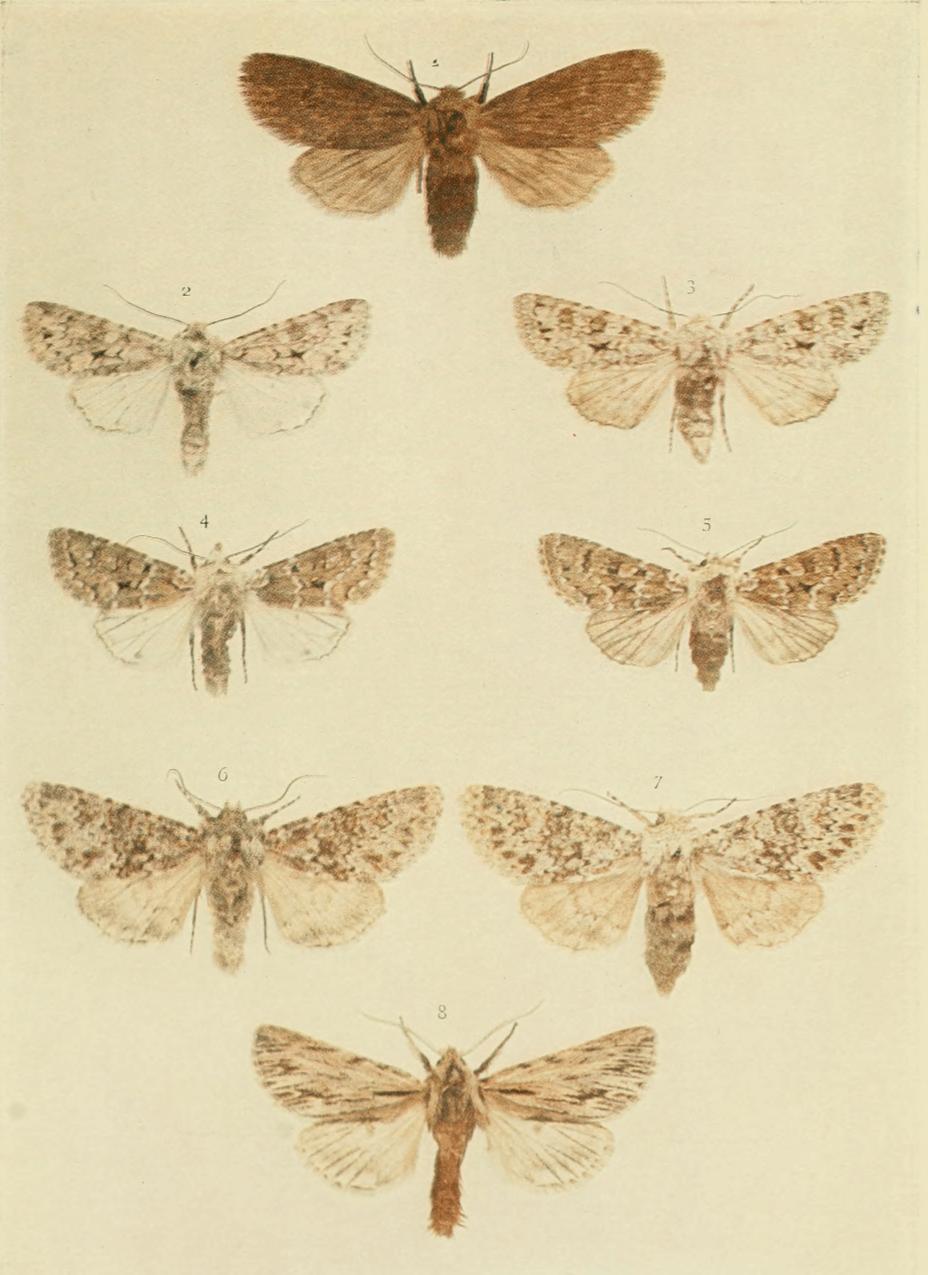
Pl. 138.
1.Brindled Ochre Moth. 2, 3.Grey Chi Moth.
4, 5.Grey Chi Moth, var. olivaceæ. 6, 7.Large Ranunculus.
8. Sprawler.
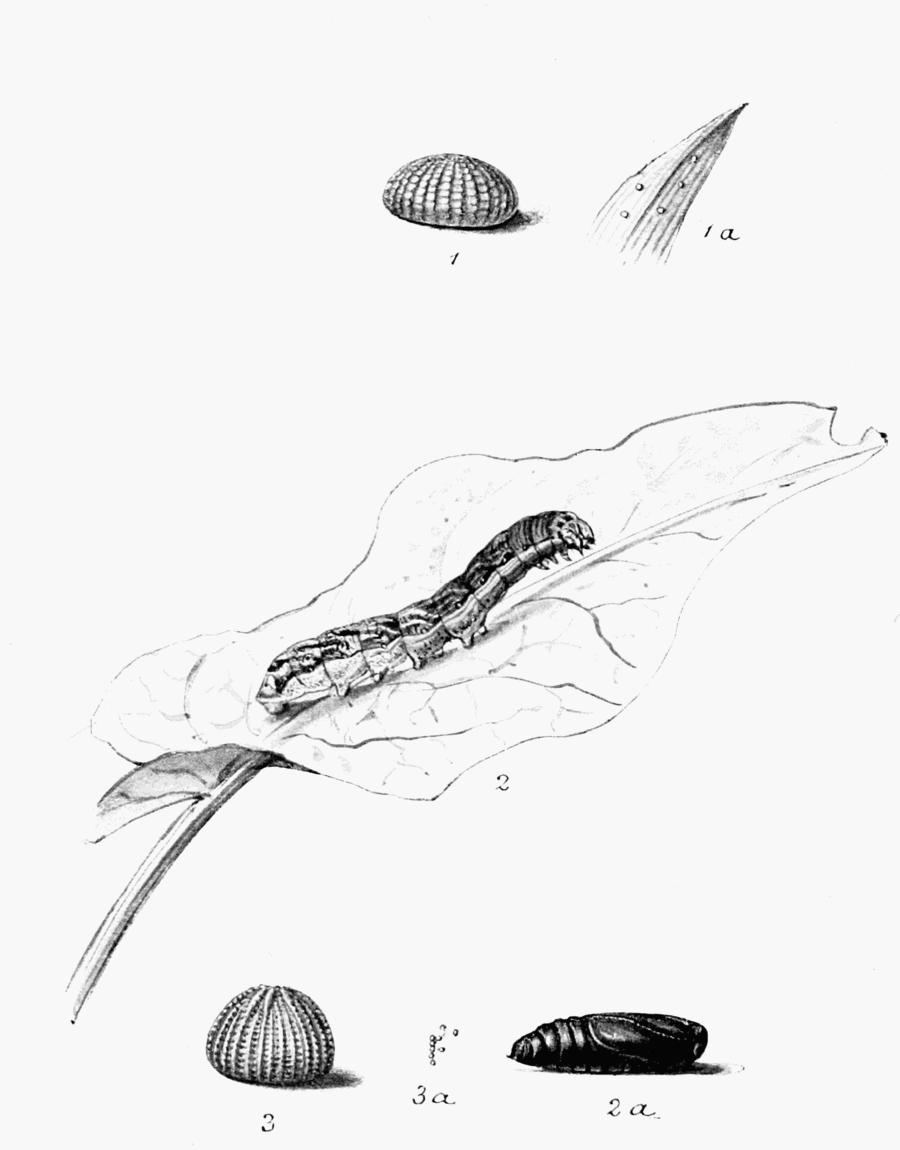
Pl. 139.
1, 1a.Black-banded Moth: eggs, natural size and enlarged.
2, 2a.Gothic Moth: caterpillar and chrysalis.
3, 3a.Black Rustic: eggs, natural size and enlarged.
The caterpillar is yellowish green, whiter on the back; the third ring is obliquely marked with yellow on each side; the eleventh ring is slightly raised and marked yellow, and there is an oblique yellow mark above the claspers; spiracles white edged with black, and the usual dots are pale yellow. It feeds on birch. May and June.
The Green-brindled Crescent (Miselia oxyacanthæ).
This moth, which in its typical form was known to the ancient fathers of entomology as "Ealing's Glory," is shown on Plate 141, Fig. 2. The var. capucina, Mill (Fig. 3), a purely British production by the way, has the fore wings dark sooty brown, inclining to blackish. The caterpillar, which has a white-marked and divided hump on ring eleven, is reddish or greyish brown, with dark grey and greenish mottling; the back has three darker lines along it, and there is a sort of diamond pattern in greyish between the outer ones; rings three and ten striped with black; head reddish brown. It feeds in April and May on hawthorn, sloe, crab, and apple. Widely distributed throughout the British Isles, but apparently not found north of Moray in Scotland.
The Double-spot Brocade (Miselia bimaculosa).
Stephens, referring to this species in 1829, states that he had only seen one British specimen. This was in the British Museum, "to which it was presented by Dr. Leach; it was captured near Bristol, I believe, in July, 1815." Barrett notes a specimen, said to have been taken by Peter Bouchard, in the collection of the late Dr. Mason. This is all that there seems to be known concerning this species in Britain. The specimen figured on Plate 141, Fig. 4, is continental.
The Merveille du Jour (Agriopis aprilina).
The pretty green moth, with white-edged black markings, shown on Plate 141, Fig. 1, is widely distributed over the greater part of the British Isles. It occurs in oak woods, or in localities where oak trees are plentiful. The caterpillar is of an obscure greenish-grey coloration, sometimes inclining to brownish; a white line along the back, and a dark one low down on the sides; over the back spreads a series of blackish marks showing a more or less diamond pattern. It feeds in the spring and until June on oak leaves, and often rests by day on the trunks, in the chinks of the bark. The moth flies in September and October, rather earlier in Scotland.
Flame Brocade (Rhizotype (Trigonophora) flammea).
The earliest record of this species (Plate 141, Fig. 6) in England dates back to 1855, when five specimens were obtained at sugar in a locality near Brighton, in Sussex. The next year, and subsequently, it was found, not only in the original place, but also in the Lewes and Shoreham districts. Later it was met with in other localities in the county, and for several years captures were made in most of its known haunts. For some years past, however, it seems to have disappeared from Sussex, and is not known to occur in any other part of the British Isles.
The caterpillar is ochreous brown, tinged with reddish; a dull brownish diamond pattern, and three lines along the back, the central line paler than the others; the spiracles and usual dots are white, ringed with brownish. Another form is green, as also are both forms in the younger stages. It feeds from December to April on pilewort (Ranunculus ficaria), R. repens, and other kinds of buttercup. When full grown it is said to prefer ash or privet. The moth flies in late September and October.
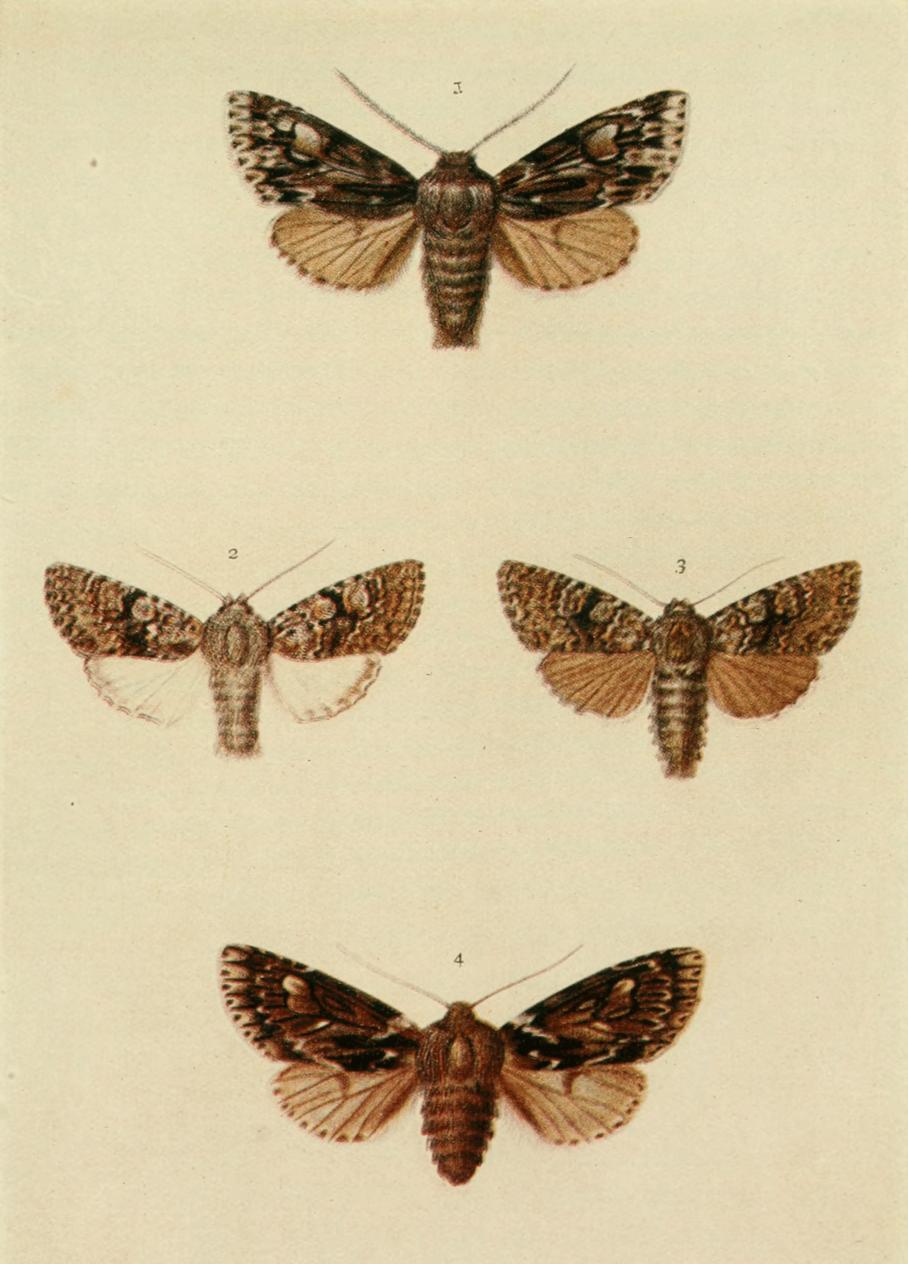
Pl. 140.
1, 4.Rannoch Sprawler.
2, 3.Black-banded Moth.
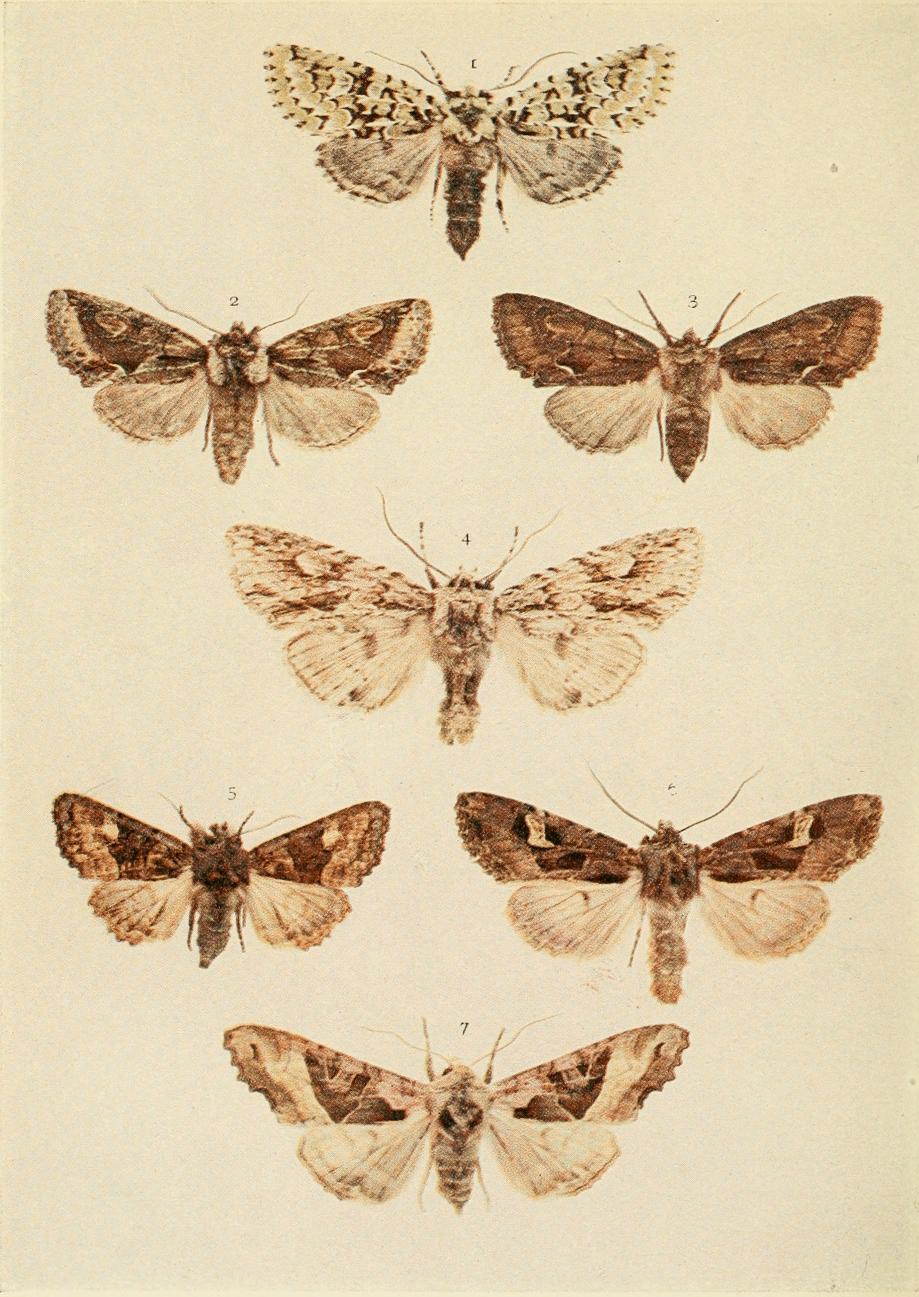
Pl. 141.
1.Merveille-du-Jour Moth. 2, 3.Green-brindled Crescent.
4.Double-spot Brocade. 5.Small Angle Shades.
6.Flame Brocade. 7.Angle Shades.
The Small Angle Shades (Euplexia lucipara).
The pale reniform mark on the outer edge of the blackish central area is the prominent feature of this pinkish- or purplish-brown moth. (Plate 141, Fig. 5.) The caterpillar is green, or pinkish-brown, and velvety in appearance; three indistinct lines and some dusky V-shaped marks on the back; a white line along the sides; usual dots white, and the spiracles black. It feeds in August and September on most low plants, birch, sallow, bracken, etc. It is often destructive to ferns in the garden or conservatory; usually selecting the choicer kinds, and as its depredations are carried on only at night, the culprit escapes detection. The moth flies in June and July, and a few specimens sometimes appear in the autumn. Generally distributed and often common in the South. The range abroad extends to Amurland, Japan, and North America.
The Angle Shades (Phlogophora meticulosa).
The moth shown on Plate 141, Fig. 7, is, when newly emerged from the chrysalis, an exceedingly pretty creature. After death the pinky-brown colour remains, but the olive green of the triangular central band, and border of outer margin, fades and distinctly mars the pleasing effect of the general colour scheme. Sometimes the central band and outer border are red, and in such specimens the ground colour is more rosy. The caterpillar is green or brown, minutely dotted with white; a pale central line and dusky V-shaped marks on each side of it; the outer arm of the V more distinct than the inner; the line along the dark ringed spiracles whitish; head green or brown freckled with darker. It feeds on groundsel, dock, bracken, and almost anything in the way of an herbaceous plant; often attacks geraniums in the greenhouse as well as outdoors. Has been found in almost every month of the year, but perhaps most common in July, August, and September. The moth also occurs at all seasons of the year, but seems to be most frequent in May and June, and sometimes in September and October. It is found throughout the British Isles. Both this species and the last mentioned, when resting on herbage, paling, or tree stem, chiefly the former, sit with the wings folded in to the body, but each fore wing is broadly wrinkled or folded throughout its length. In this position the moth is very like a crumpled decaying leaf, and for such may be readily mistaken.
The Old Lady (Mania (Mormo) maura).
From its habit of creeping behind curtains, shutters, etc., and otherwise disposing itself in dwelling-houses during the day, as well as in summer houses and other buildings, this moth (Plate 142, Figs. 1♂, 3♀) must often come under observation. The caterpillar is ochreous brown with a darker diamond pattern on the back; the central line is ochreous, but much broken, and on each side of it there is a series of pale oblique streaks; the spiracles are reddish ochreous, edged with black, and the line along them is ochreous; head pale brown, glossy. The general colour varies to greyish or purplish brown. It feeds on various low herbage in the autumn, and on the young shoots and leaves of sallow, hawthorn, birch, etc., in the spring after hibernation. The moth flies in July and August, and is generally common in the south of England. Sometimes it abounds even in the London suburbs, and in 1904 it was seen pretty frequently during August flying, in the evening, low down along the roads and in gardens all over the southern district. The species is also found more or less frequently throughout England northwards, and well into Scotland, as least as far as Clydesdale. Renton records it as common at sugar in Roxburghshire, and White gives the Forth and Tay districts. Widely distributed in Ireland, common in some parts.
The Gothic (Nænia typica).
This moth (Plate 142, Fig. 2) is common in gardens, as well as along the weedy wayside and hedgerow in all parts of England and Wales, Scotland to Sutherland, and in Ireland. The caterpillar (Plate 139, Fig. 2) varies in colour from brownish-grey to pale ochreous brown, or greenish grey, freckled with darker; three pale lines on the first ring, and partly on the second; some pale oblique streaks on the sides, and blackish marks on rings ten and eleven, the latter more or less united behind; head of the body colour darker marked. It feeds on all kinds of herbage, also on the leaves of sallow, sloe, apple, etc. When young in large companies on the underside of leaves. August to May. The moth flies in June and July.
The Crescent (Helotropha leucostigma).
Of this purplish-brown species the typical form (Fig. 1), and the pale banded form, var. fibrosa, Hübn., are shown on Plate 143. The caterpillar, according to Buckler, is slaty brown, inclining to olive drab above; three paler lines on the back; the spiracles are black and the usual dots black-brown; head warm brown, very glossy; plate on first ring glossy black, that on the last ring blackish brown. It feeds in the stems of Cladium mariscus, sedge (Carex paludosa), and yellow flag (Iris pseudacorus). May to July. The moth is out in late June, July, and August. It inhabits fens and marshy ground, and seems to be found in such localities throughout the British Isles, including the Hebrides and Shetlands. Abroad the range extends to Amurland, China, Japan, also North America.
The Ear Moth (Hydrœcia (Gortyna) nictitans).
On Plate 143 are shown a more or less typical specimen of this species (Fig. 3); the reddish spotted var. erythrostigma, Haw. (Fig. 4); and two examples of the marsh or saltern form, paludis, Tutt (Figs. 5, 6), for which specific rank has been claimed. Specimens found in marshes, especially those by the sea, are usually somewhat larger than normal, but I cannot see that they otherwise differ from forms of nictitans. The caterpillar is greenish pink with pinkish grey stripes on the back and sides; spiracles black, and usual dots dark brownish; head pinkish ochreous, plate on ring one of the body yellowish brown. It feeds from May to August on grasses, chiefly the lower part of the stems. The moth flies in August and September, and is sometimes seen in the daytime on the flowers of thistle and ragwort, etc., but far more frequently at night, when it also visits sugar more or less freely. Usually common in marshy places throughout our islands. The range abroad extends to Amurland, Corea, Japan, and North America.
The Rosy Rustic (Hydrœcia (Gortyna) micacea).
This moth (Plate 143, Figs. 8, 9) is also widely spread over the British Isles, occurring most freely on the coast, but not uncommonly inland. It appears in the autumn, and is frequently seen at light, and although not very partial to sugar it occasionally visits that attraction as well as ragwort blossom, etc. The caterpillar is dull smoky pink, with a faintly darker central stripe; the usual dots dark brown, and the spiracles black; head, and plates on first and last rings of the body ochreous brown. May to August on dock, plantain, feeding in the stems and down into the roots. Sometimes it attacks the potato, eating down the stalk into the tuber. The range abroad extends to Amurland.
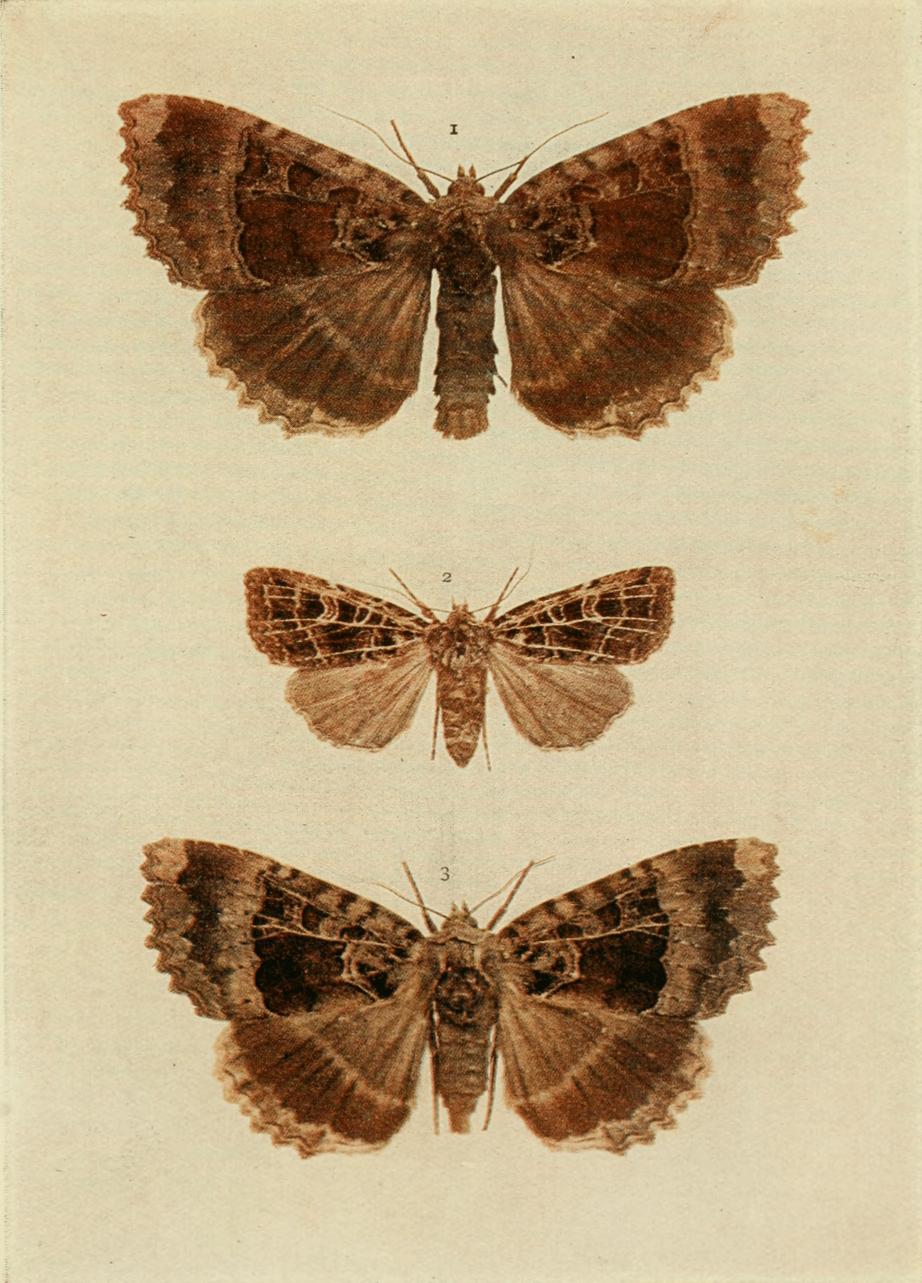
Pl. 142.
1, 3.Old Lady Moth.
2.Gothic Moth.
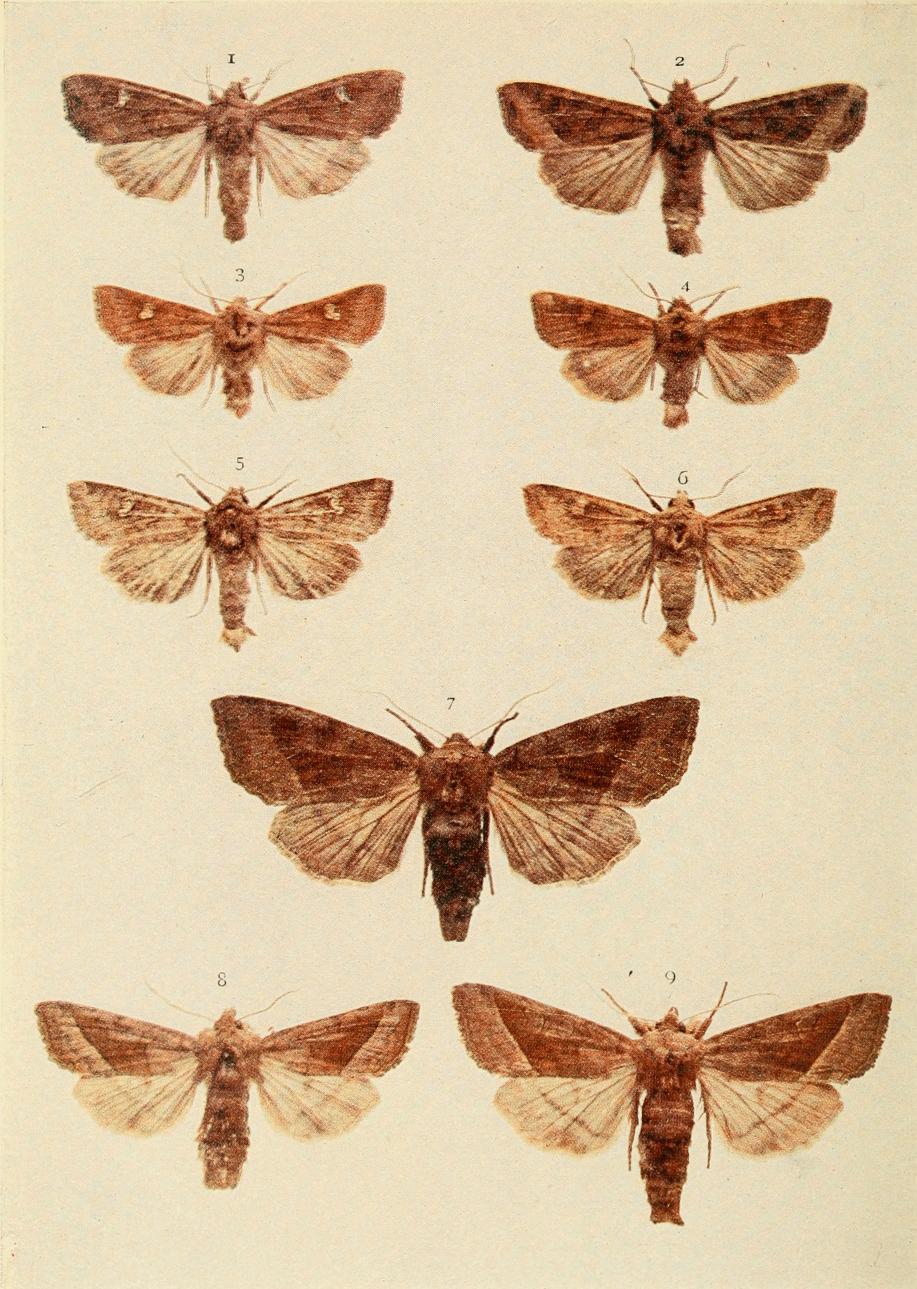
Pl. 143.
1, 2.The Crescent. 3, 4.Ear Moth.
5, 6.Ear Moth, saltern form. 7.Butterbur Moth.
8, 9. Rosy Rustic.
The Butterbur (Hydrœcia (Gortyna) petasitis).
This is a larger species than the last, and more dingy in coloration. Its chief haunts, among the butterbur (Petasites), are in the northern counties from Cheshire to Durham. It was first met with by Stainton in 1846 at Falkirk in Scotland, and Doubleday named and described it in 1847. An account of its caterpillar feeding in the roots of the butterbur was published by N. Cooke in 1850, and by 1855 the northern collectors had reared and distributed large numbers of the moths among their confrères in other parts of the country. The species is still common in the north of England, but continues scarce and very local in Scotland. Odd specimens have been reported from the eastern counties and once from Somerset. The caterpillar is greyish white with black dots; head, and plate on first ring of the body brown. July and August. The moth occurs among its food plant in August and September. (Plate 143, Fig. 7.)
The Frosted Orange (Ochria ochracea).
Except that it sometimes visits a strong light, and may then be captured, this moth (Plate 144, Figs. 1♂, 2♀) is most easily obtained in its early stages. The caterpillar is pale ochreous white with conspicuous black dots; head ochreous brown, the plate on first ring of the body is blackish with white lines upon it. It feeds in the stems of thistles, burdock, hemp-agrimony, etc. April to July, or later. The brownish chrysalis may be found in stems of the plants, generally low down near the ground. The moth, also known as flavago, Schiff., occurs from August to October in most places, especially marshy ground, where thistles flourish, throughout England and Wales. It is found in Scotland up to Perthshire and Aberdeen. Only recorded from Wicklow, Galway, Sligo, and Clare, in Ireland.
Reed Wainscot (Nonagria algæ (cannæ)).
This moth (Plate 144, Fig. 4) varies in size and also in the colour of the fore wings, which range from a pale ochreous, through reddish shades, to sooty brown. The cross lines are indicated by black dots. The black dotted greenish caterpillar has a brown head and a whitish green plate on first ring of the body. It feeds from May to July in the stems of reed-mace (Typha latifolia), often called the bulrush or catstail; also in the true bulrush (Scirpus lacustris). Fig. 5, Plate 148, shows the chrysalis in its characteristic position when in the stem, that is with the head upwards. The moth flies, in August and September, at dusk, over and among the reeds; the males especially freely responding to the attraction of light. Its chief localities are in the fens of Norfolk and Suffolk, but it has also occurred in Mid-Sussex.
Webb's Wainscot (Nonagria sparganii).
This moth also varies in the colour of the fore wings, from almost whitish through various shades of ochreous and red. The main veins are shaded with grey, and the median one has black dots upon it, chiefly at the end of the cell; the outer margin with a row of large or small black dots. (Plate 144, Fig. 3.) The caterpillar is yellowish green with darker lines; head and plate on first ring of the body pale brown. It feeds in July and August in stems of bur-reed (Sparganium), reed-mace, and yellow flag. Fig. 6, Plate 148, shows the chrysalis in its natural position in the stem. The hole in the stem from which the moth escapes is also clearly in evidence above the chrysalis. The moth flies among reeds, etc., in August and September. Its chief localities in England are in East and South-east Kent, in which county the first British specimens were obtained by Mr. Sydney Webb in 1879. In 1899 a specimen reared from a caterpillar found in a stem of Typha, was recorded from Suffolk (Woodbridge district); and in 1901 the species was recorded from South Devon. It is also not uncommon "between Old Head of Kinsale and Glandore," Co. Cork, Ireland.
The Bulrush Wainscot (Nonagria typhæ).
The fore wings of this species (Plate 144, Fig. 5), usually of a pale whity-brown colour, in some specimens are reddish tinged; or they may be almost uniformly reddish brown or blackish (var. fraterna, Treit.). The row of black spots on the outer area are wedge-shaped and are placed just before the margin. The caterpillar is pale ochreous more or less tinged with pink; a paler line along the spiracles; head and plate on first ring of the body red-brown. July to August, in stems of Typha. The moth flies in August and September, and although it may be netted when on the wing at dusk, or at light, it is obtained in better condition by rearing it from the chrysalis, which may be found in the stems (Plate 148, Fig. 3), those of the previous year for choice, of reed mace. Generally distributed in England up to Yorkshire; it has been recorded also from Northumberland and the Scottish border. It is common in southern Ireland, and found northwards up to Sligo, Tyrone, and Armagh.
The Twin-spotted (Nonagria geminipuncta).
This species, shown on Plate 144, Figs. 6, 7, varies in colour from pale brown, more or less suffused with grey, through darker, or reddish brown to blackish (var. nigricans, Staud.). In the brown typical form the reniform mark is represented by two dark-edged white dots, the upper one often tiny or absent (var. unipuncta, Tutt), or both may be absent (var. obsoleta, Tutt). The caterpillar in pale ochreous, pink-tinged, a pale line along the spiracles; head dark brown. May and June, in stems of reeds (Phragmites). The chrysalis lies in the reed stem with the head towards the oval hole above it from which the moth escapes. In August the moth may be found in its haunts in the south and east of England. These are marshes, often near the sea, in Cambridgeshire, Suffolk, Essex, the Thames valley, Sussex, Hants, and the Isle of Wight, Wiltshire and Somerset.
The Brown-veined Wainscot (Nonagria dissoluta).
The popular name applies more especially to the ordinary form of this species known as arundineta, Schmidt. (Plate 144, Fig. 8.) The dark brown or black typical form (dissoluta, Treit. = hessii, Boisd.) is local and uncommon; in fact until 1900 it had not been noted in England for a number of years, and specimens were only known from Yaxley. In the year just mentioned however, several examples of it were recorded from Suffolk, taken in the Needham Market district; and in 1905 specimens were reported from the East Kent marshes. Var. arundineta, the neurica of some authors, occurs in the fens of Norfolk, Suffolk, Cambridge, and Lincolnshire; also in marshes in Essex and Kent; and is said to have been taken in Middlesex and Lancashire. The caterpillar is dirty white, light reddish on the back; raised dots black inclining to brown on front three rings; spiracles white edged with black; head dark brown; plate on first and last rings of the body brownish grey. It feeds in June in the stems of reed and turns to a chrysalis in the lower part of the stem, head downwards in the direction of the exit hole below it. (Plate 148, Fig. 1.) The moth flies in July and August.
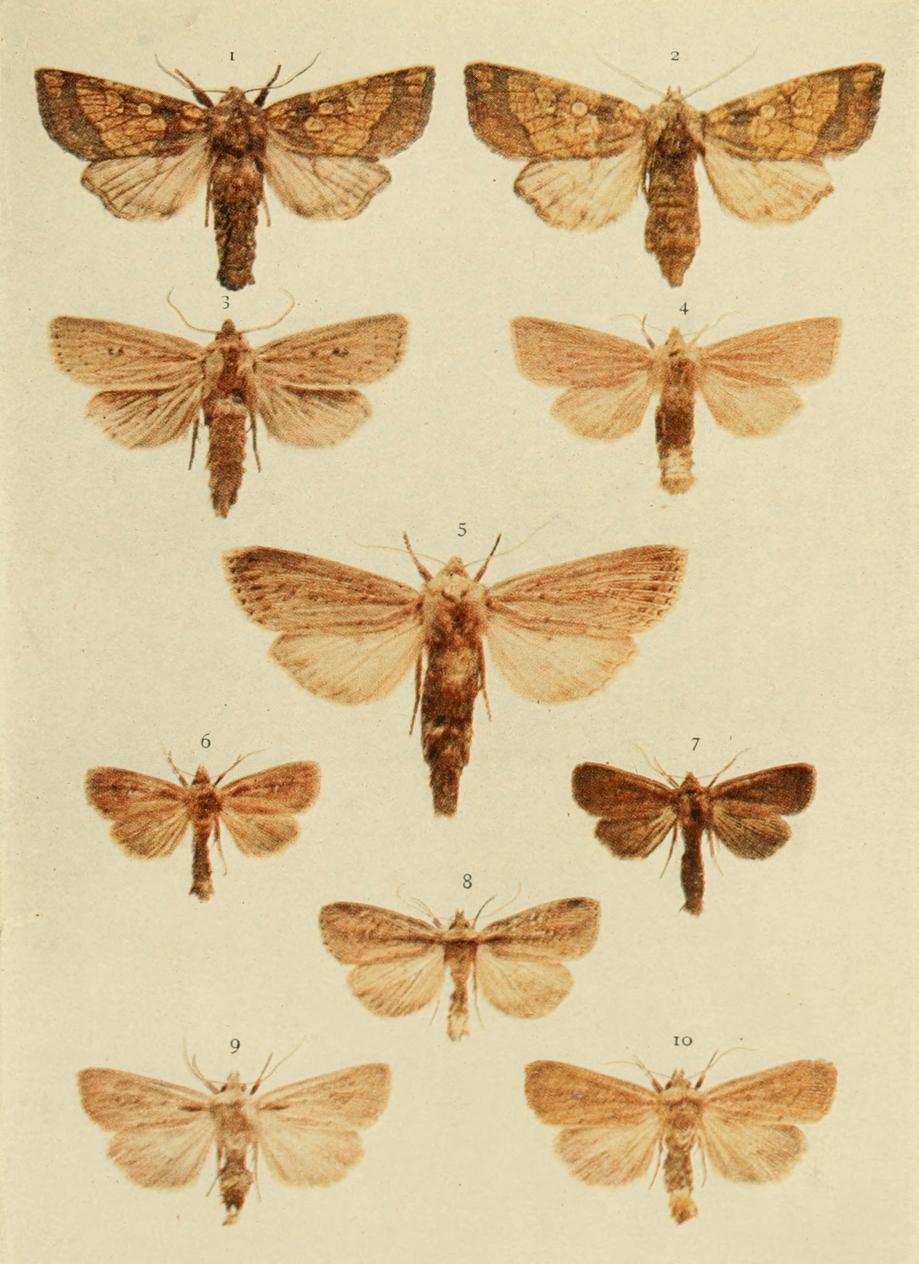
Pl. 144.
1, 2.Frosted Orange Moth. 3.Webb's Wainscot.
4.Reed Wainscot. 5.Bulrush Moth.
6, 7.Twin-spotted Wainscot. 8.Brown-veined Wainscot.
9. Fenn's Wainscot, 10. aberration sinelinea.
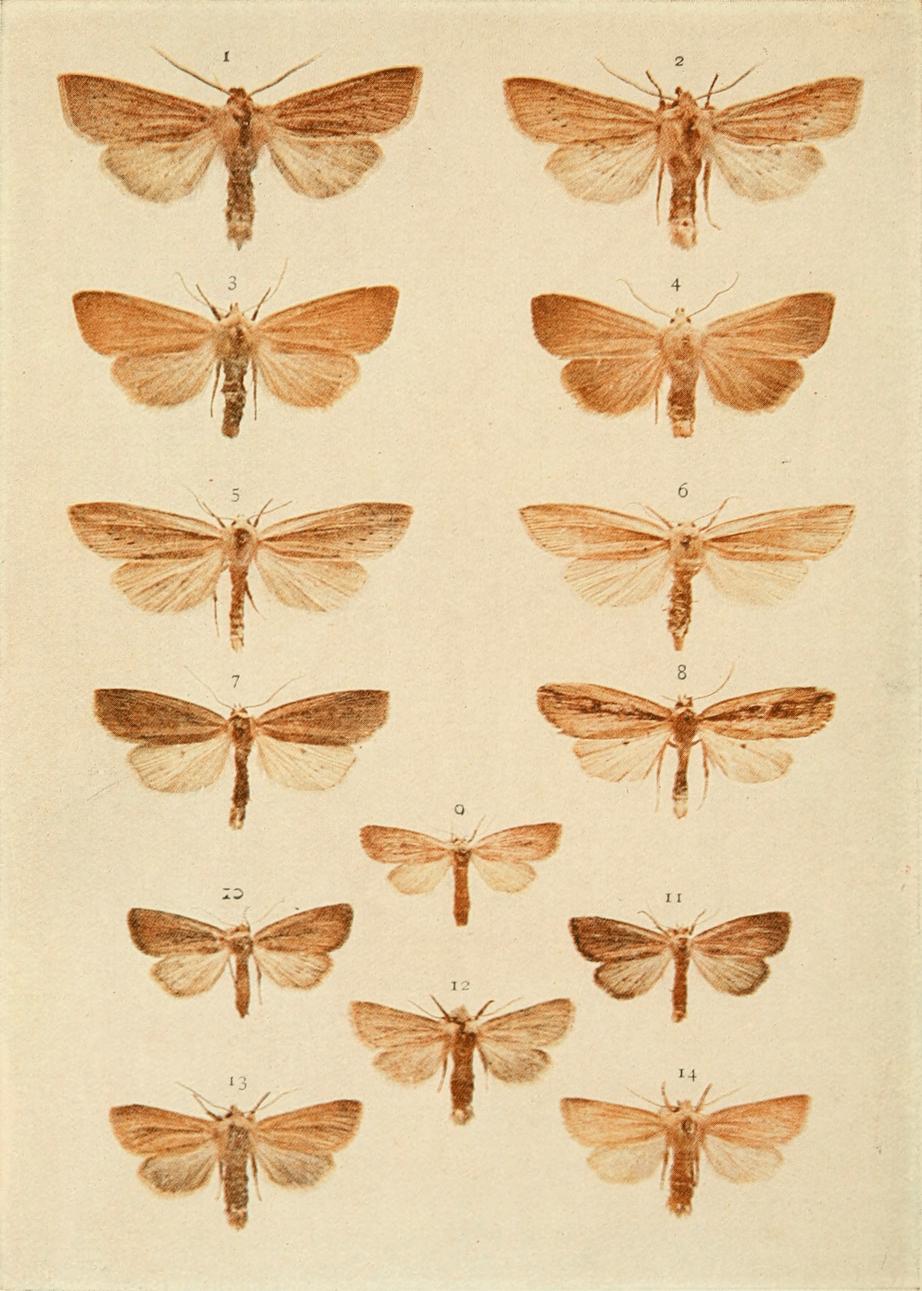
Pl. 145.
1, 2.Large Wainscot. 3, 4.Fen Wainscot.
5, 6.Flame Wainscot. 7, 8.Silky Wainscot.
9, 10, 11.Small Rufous Moth. 12, 13, 14.Small Wainscot.
The Small Rufous (Cœnobia rufa).
Varies from pale ochreous white, through reddish shades, to a greyish brown. (Plate 145, Figs. 9 to 11.) The caterpillar is described by Hofmann, as pale reddish above and whitish below, with minute dark dots on the back and a fine blackish line along the sides; head and plate on first ring of the body brown and glossy. May and June, in stems of the jointed rush (Juncus lamprocarpus). The moth flies in July and August, and occurs in fens and marshes. At one time it was not uncommon in marshy localities around London, and it is still to be obtained in Richmond Park, Surrey. In some years it abounds in the Norfolk and Cambridge fens, and in others is hardly seen. It is also to be found more or less frequently but always local in Suffolk, Essex, Berks, Kent, Sussex, Isle of Wight, Dorset (Isle of Purbeck), Devon, Somerset, Gloucester, North and South Wales, Cheshire, and Yorkshire; Argyllshire in Scotland; Ireland.
The Silky Wainscot (Senta maritima).
In its typical form (Fig. 7) the moth shown on Plate 145 is whity-brown, clouded with grey and sometimes tinged with brownish on the disc. The orbicular and reniform stigmata are round and faintly outlined in whitish. In var. bipunctata, Haworth, the stigmata are black and conspicuous: var. wismariensis, Schmidt, has a blackish central streak from the base broadening out towards the outer margin (Fig. 8): var. nigristriata, Staud., has the fore-wings finely streaked with black; and var. nigrocostata, Staud., has the front margin broadly black. The caterpillar is ochreous grey with three fine interrupted, whitish lines on the back; spiracles black with darker lines along their area; head dark brown and shining. September to May, hiding by day in stems of reed (Phragmites) and at night feeding on the caterpillars and chrysalids of other reed insects (Hofmann). The moth flies from late June to early August. It occurs in the fens of Norfolk and Cambridge, but in the former county it has been taken at Merton and King's Lynn. Dr. Wheeler states that it is usually found in the thicker reed beds where stems of the previous year's growth still remain. Specimens were obtained among reeds in the Harwich district, Essex, in 1902, and the species has also been recorded from Tring, Hertfordshire, Surrey, Sussex, and the Isle of Wight.
The Flame Wainscot (Meliana flammea).
The original British specimen, which Curtis in 1829 named, described, and figured, was stated to have been taken "near Lewisham, towards Lee, in July." Now it is only known to occur in Huntingdon, Norfolk, and Cambridgeshire, chiefly in the fens; in Wicken fen in the latter county it is most plentiful. (Plate 145, Figs. 5, 6.) The caterpillar is greyish ochreous brown, rather paler beneath, with paler lines along the back and sides, the central one edged on each side with darker; spiracles whitish, outlined with black, and a greyish drab spiracular stripe with paler edges; head shining, and faintly netted with darker grey. (Condensed from Buckler.) Hides by day in the old stems of reed (Phragmites), and feeds at night on the leaves, August to October.
The Small Wainscot (Tapinostola fulva).
The fore wings vary in colour from almost whitish through various shades of grey brown and reddish brown (Plate 145, Figs. 12 to 14). The caterpillar, pale shining pinkish ochreous; central stripe pale, bordered on each side with greyish brown. Head pale brown, marked with darker, shining. June and July in stems of sedges (Carex). The moth flies in August and September, and is found in fens and marshy ground pretty well all over the British Isles, including the Hebrides.
The Concolorous (Tapinostola extrema).
This species (Plate 146, Fig. 3) was at one time subsequent to 1844, when it was first discovered in Yaxley Fen, not at all scarce in that locality and in other fens in Huntingdonshire and Cambridgeshire. It then disappeared from all its old haunts, some of which were destroyed; but a few years since it was met with again in Hunts, and apparently not uncommonly.
Bond's Wainscot (Tapinostola bondii).
The whitish moth shown on Plate 146, Fig. 4, was first taken at Folkestone, Kent, by Dr. Knaggs, in 1859, and named and described by him in 1861. It still occurs in that locality and also on the Devon and Dorsetshire coast, the known localities being Charmouth, Lyme Regis, and Sidmouth.
The caterpillar is dirty white in colour inclining to brownish at each end; a whitish line along the middle of the back; head brown. Feeds from August to June in stems of Festuca arundinacea. The moth flies in June and July.
The Mere Wainscot (Tapinostola hellmanni).
Present localities for this reddish species (Plate 146, Figs. 1, 2) are Wicken and Chippenham fens, Chatteris and Whittlesford, in Cambridgeshire; Monk's Wood in Hunts. Formerly Yaxley, where it was first taken in 1847, used to be a noted locality, but the insect disappeared when the fen was drained. It has been reported from Norfolk (Yarmouth), Lincolnshire, Devonshire (Dartmoor), and Hertfordshire (Hitchin), chiefly in odd specimens. The caterpillar has been described by Hofmann as yellowish-white, or reddish above and paler beneath; plate on first ring of the body rather glossy, head glossy yellow brown. It lives from autumn to June of the next year in stems of the wood smallreed (Calamagrostis epigeios). The moth flies in July and August.
The Lyme Grass (Tapinostola elymi).
The more or less brownish-tinged, whitish-ochreous species shown on Plate 146, Figs. 5, 6, was not recorded as a British insect until 1861. It is now known to occur in England in many localities, but all on the east coast from Norfolk to Durham. In the Entomologist for 1894, it is recorded as occurring at Montrose on the Forfarshire coast in Scotland. The caterpillar is described by Buckler as pale flesh colour, with a rather darker stripe along the back; spiracles black; head reddish-brown, shining; shining yellowish-brown plates on the first and last rings of the body. It feeds on the stems of lyme-grass (Elymus arenarius) in May and June. The moth flies at early dusk over and among its food plants, and later on it settles on the stems, from which it may be easily boxed.
The Brighton Wainscot (Oria (Synia) musculosa).
This yellowish-clouded, whitish insect is a native of Southern Europe, Asia Minor, Syria, and North-west Africa. Occasionally it has occurred in England, and in the time of Haworth and Stephens one or two specimens seem to have been recorded as British. In 1855 an example was captured at Brighton, and others occurred in the same locality, and at Bexhill, Kent (Jenner), between that year and 1860. A specimen was recorded from Brighton in 1883, and one from South Devon in 1899. Reported from Wiltshire in 1910. (Plate 146, Fig. 7.)
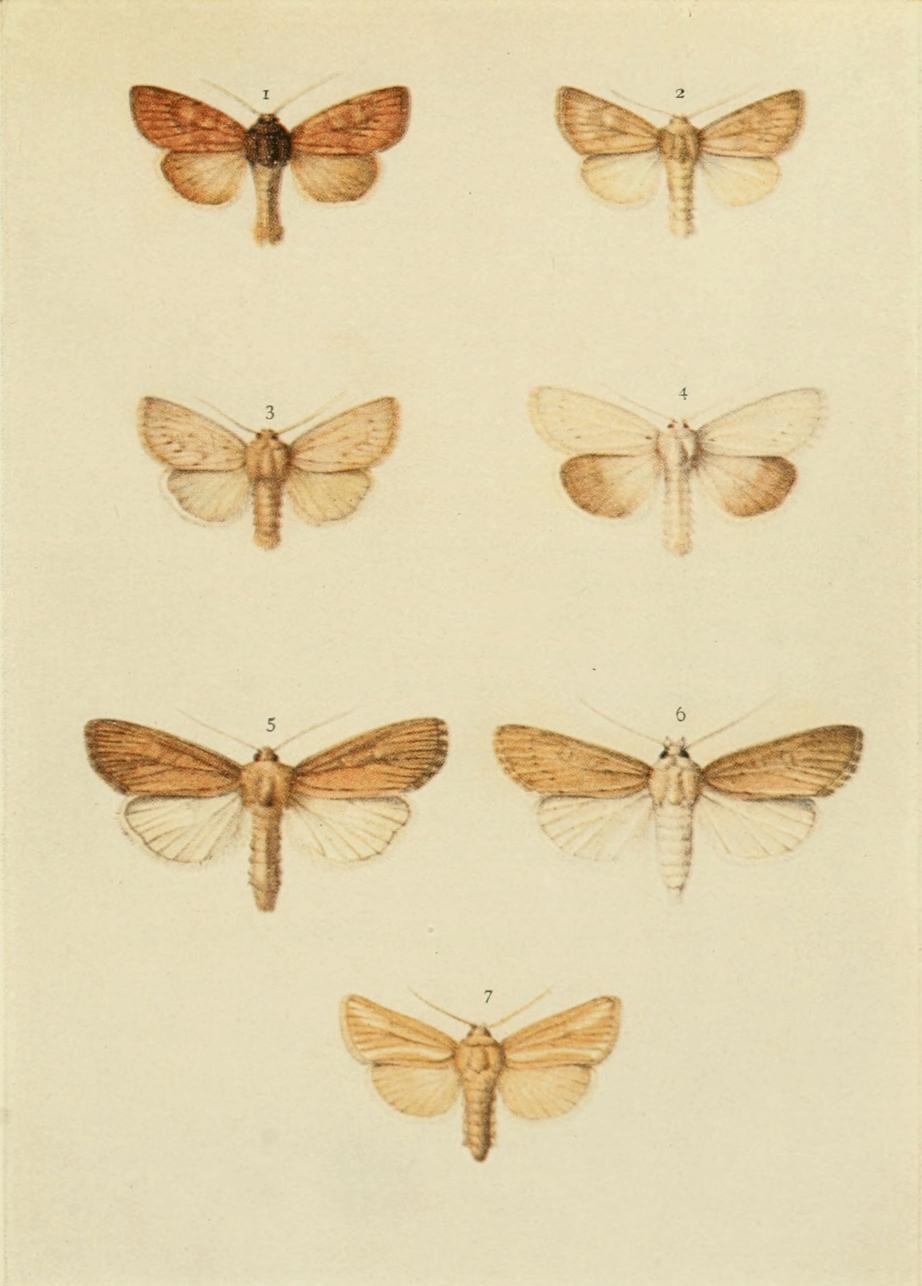
Pl. 146.
1, 2.Mere Wainscot. 3.The Concolorous.
4.Bond's Wainscot. 5, 6.Lyme Grass Moth.
7. Brighton Wainscot.
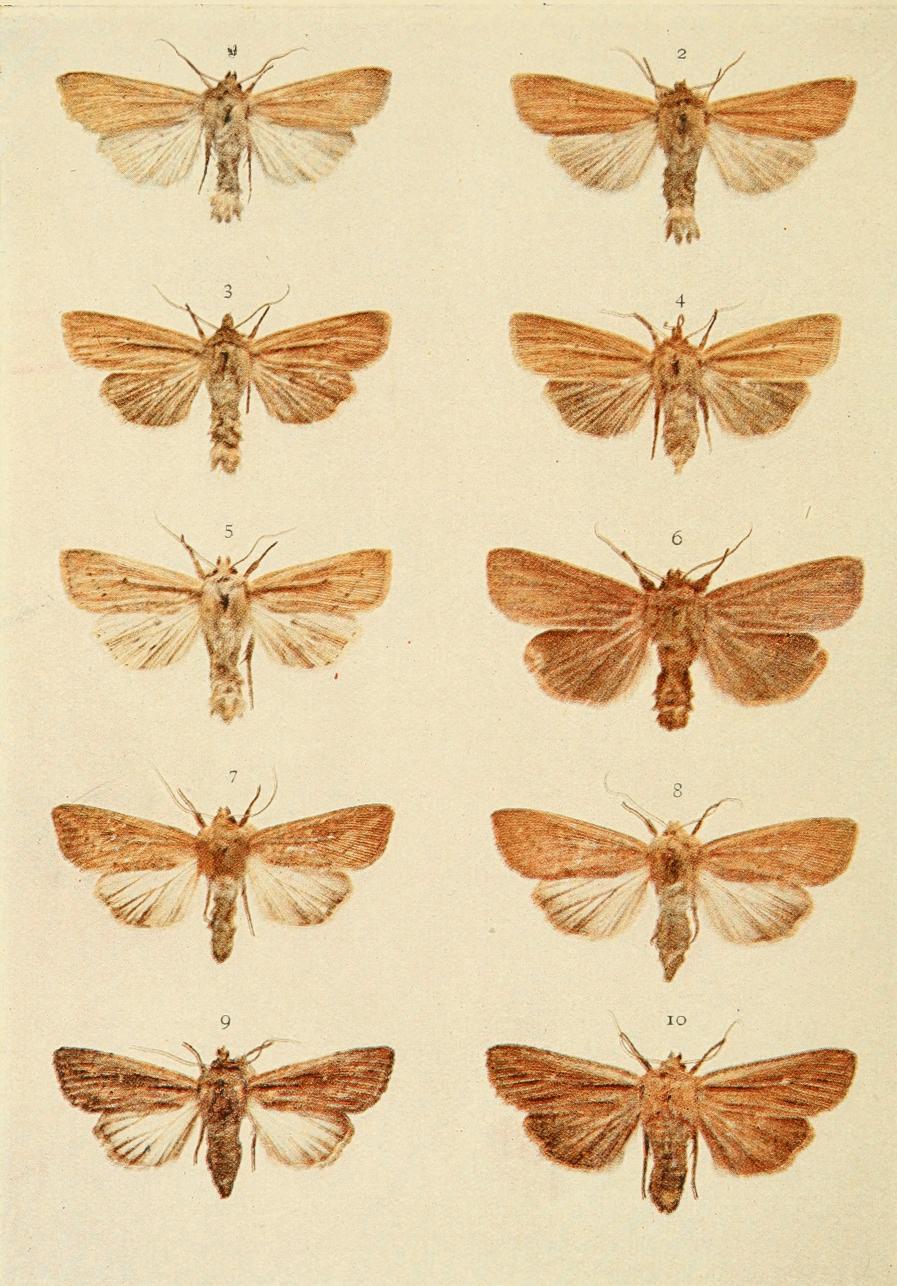
Pl. 147.
1, 2.Common Wainscot. 3, 4.Smoky Wainscot.
5.Southern Wainscot. 6.Striped Wainscot.
7, 8.Obscure Wainscot. 9.Devonshire Wainscot.
10. Shoulder-striped Wainscot.
The Large Wainscot (Calamia lutosa).
This species, shown on Plate 145, Figs. 1, 2, varies somewhat in the colour of the fore wings, which is usually pale ochreous brown, but may be more or less reddish tinged, or clouded with dusky; there is a row of black dots beyond the middle of the wing, but these are sometimes faint or absent. The range in size is considerable, some specimens are about the size of L. straminea whilst others will equal that of a large N. typhæ.
The caterpillar is whitish tinged with pink above, and with a dusky line along the back; head reddish brown and glossy; plates on first and last rings of the body shining pale brown. It feeds from April to June in the stems of reed (Phragmites), causing the leaves of the affected stems to whiten. The moth flies in August, September, and October, sometimes later, and occurs in marshes, and on the banks of streams and ditches, in most of the southern and eastern counties of England, and from Derbyshire to Durham; in Scotland it has been recorded from Roxburghshire (near Kelso, rare), Perthshire, Aberdeen, and Shetland. The species is widely spread in Ireland.
The Fen Wainscot (Calamia phragmitidis).
In the typical form this species (Plate 145, Figs. 3, 4) the fore wings are whitish on the basal half, and incline to reddish on the outer half; var. rufescens, Tutt, has these wings reddish all over, but somewhat darker on the outer margin. The caterpillar is ochreous white with a slightly paler stripe along the back, edged on each side with purplish; the spots are black, as also are the spiracles; head and plates on the first and last rings of the body black or blackish brown, glossy. It feeds from August to June in stems of reed (Phragmites), and is said to hatch from the egg in the autumn. The moth flies in July and August, and is fond of the flowers of grasses growing in its marshy haunts. It is common in the Norfolk and Cambridge fens, and is found in suitable locations in Huntingdon, Northampton, Lincoln, Yorkshire, Cheshire, and South Lancashire, also in Berkshire, Suffolk, Essex, Kent, and Sussex.
The Common Wainscot (Leucania pallens).
This common, often abundant species (Plate 147, Figs. 1, 2) is pretty generally distributed over the British Isles. The typical coloration is pale ochreous; ab. arcuata, Stephens, is pale brownish ochreous; ab. ectypa, Hübn. = rufescens, Haworth, is reddish; and ab. suffusa, Stephens, is also reddish, but powdered with blackish scales between the veins, and chiefly so under the median nervure. The hind wings in all forms are white in both sexes; but sometimes slightly tinged with greyish on the outer margin in the female. The caterpillar (Plate 152, Fig. 1) which feeds on grasses from August to May, is pale whity-brown freckled above with pinkish brown; three whitish lines along the back, the central one narrowly edged on each side, and the others on the inner side only, with blackish; a greyish stripe along the sides with two pinkish brown lines above it; dots, minute, black; head freckled with dark brown. Distribution abroad extends to Amurland.
Mathew's Wainscot (Leucania favicolor).
This species (Plate 149, Figs. 1, 2) has been mainly found on the coasts of North-east Essex and South-east Suffolk, but it has also been taken at Hemley in Suffolk, and has been recorded from near Southend in Essex, and Rochester in Kent. In 1906 six specimens were captured in the Isle of Sheppey. So far as is known at present this is its range in England, and it does not seem to occur anywhere abroad. It was first discovered by Paymaster-in-Chief G. F. Mathew, in 1895, and was described by the late Mr. C. G. Barrett in 1896.
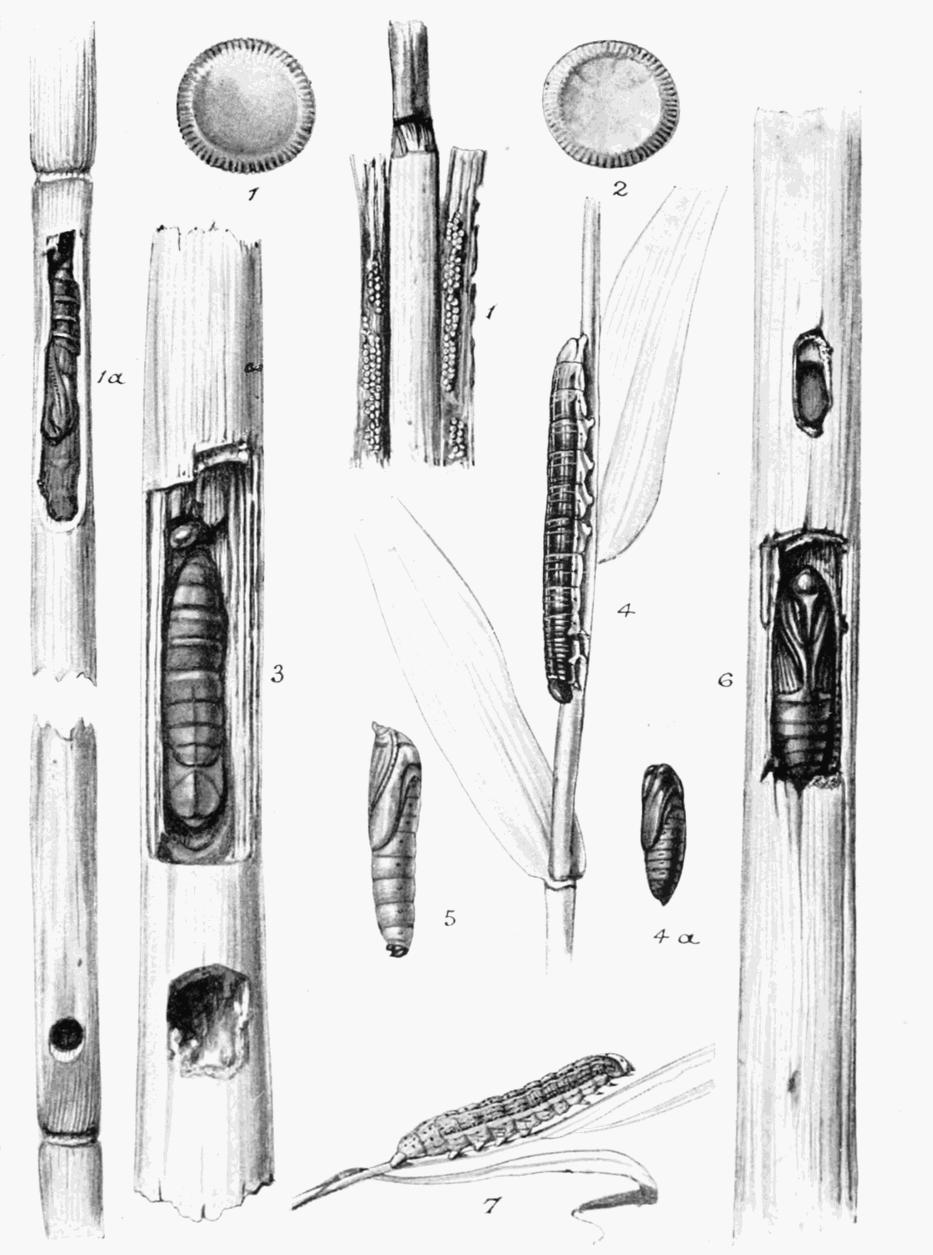
Pl. 148.
1, 1a. Brown-veined Wainscot: egg and chrysalis.
2.Twin-spotted Wainscot: egg, enlarged. 3.Bulrush Moth: chrysalis.
4, 4a.Fenn's Wainscot: caterpillar and chrysalis. 5.Reed Wainscot: chrysalis.
6.Webb's Wainscot: chrysalis. 7.Devonshire Wainscot: caterpillar.
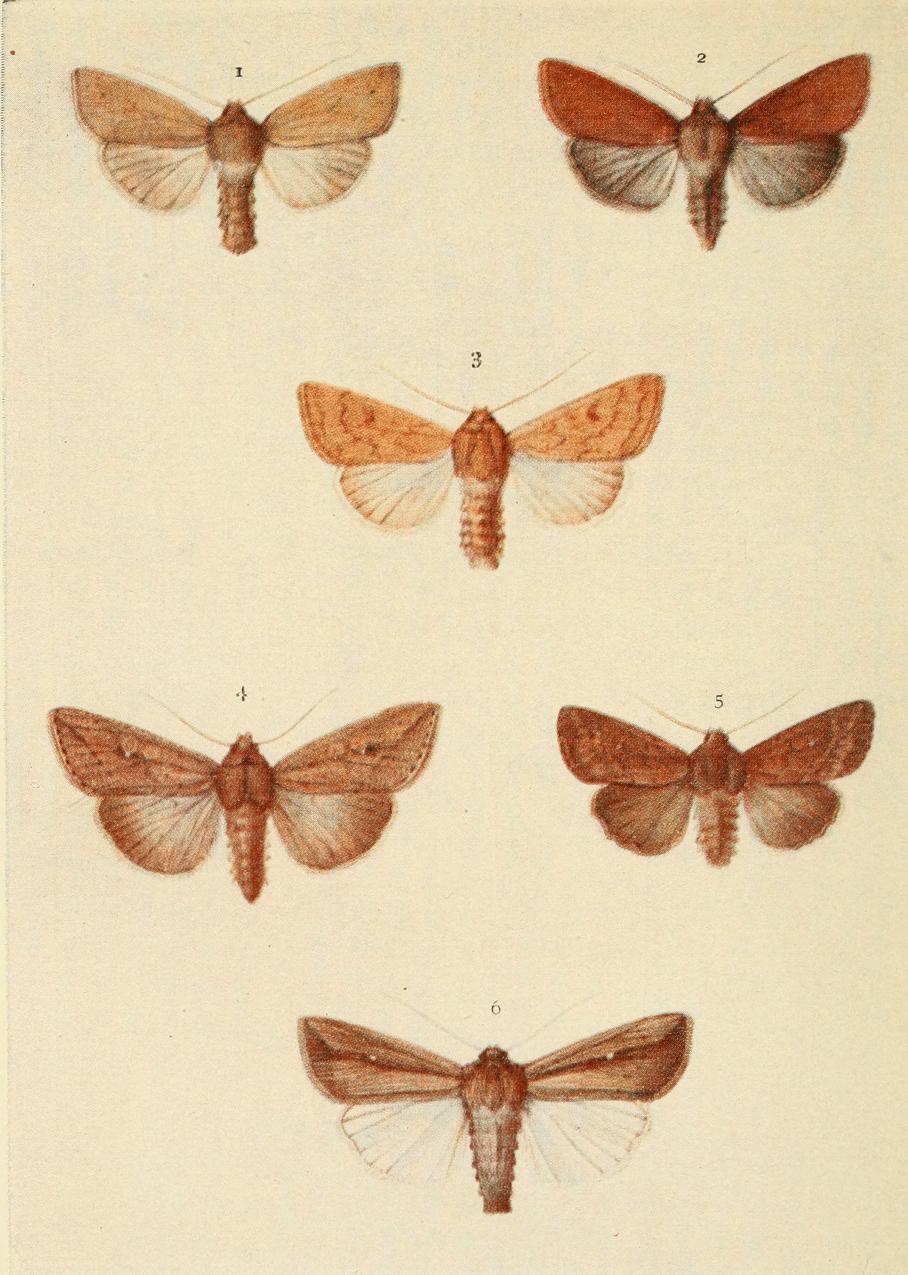
Pl. 149.
1, 2.Mathew's Wainscot. 3.The Delicate.
4.The White Speck. 5.The White Point.
6. The Cosmopolitan.
In the typical form the fore wings are of a smooth soft honey colour, or colour of the honeycomb, having the nervures faintly perceptible, but not paler; a black discal dot, and two more dots with some faint blackish dashes indicate the usual second line. Tutt has named several forms, the most important being ab. lutea, bright yellow buff with discal dot and two dots beyond; and ab. rufa, deep reddish with discal dot and two others beyond. Besides these there are ab. ænea, Mathew, deep orange, with only one dot representing second line; and ab. obscura, Mathew, cinnamon-brown, with smoky shading between some of the nervures. The hind wings vary from whitish with darker nervures, to smoky grey; but the fringes always remain whitish.
The caterpillar is a warm putty colour, or pinkish brown, mottled and shaded with darker shades; three pale whitish brown lines on the back, the central one bordered on each side by a darker shade, and the outer ones shaded inwardly with darker and edged below by a darker line; a brown or pinkish stripe above the spiracles, and a pinkish yellow stripe below them; head yellowish-brown, shining, and dotted with darker colour. It feeds on grasses from July to April (adapted from Mathew). The moth flies in June and July, and frequents the flowers of the large grasses growing on salt marshes. Sometimes specimens of a second brood appear in August or September.
The Smoky Wainscot (Leucania impura).
The range of this common species (Plate 147, Figs. 3♂, 4♀), in the British Isles is almost the same as that of L. pallens, but it does not extend further north than Moray in Scotland. The hind wings are greyish or blackish grey. A form with reddish fore wings is var. punctina, Haw., which sometimes has a row of black dots on the outer margin. The caterpillar is greyish ochreous above, greenish tinged beneath; a brown stripe along the middle of the back is intersected by a very fine white line; above the reddish black-edged spiracles is a brownish stripe; usual dots black; head pale brown, shining, netted with brown and lined with blackish. It feeds on grasses from August to May. The moth is out in July and August; rather later in the north. Distribution abroad extends to Amurland and Japan.
The Southern Wainscot (Leucania straminea).
In its more usual form this species (Plate 147, Fig. 5) has pale whity-brown or pale straw-coloured fore wings, and the black dots forming the second line not infrequently absent, at least as regards some of them. Var. rufolinea, Tutt, has the fore wings reddish ochreous, the rays whitish, and the shade under the median nervure reddish. Var. nigrostriata, Tutt, has the ground colour of the fore wings obscured by a thick powdering of black scales. The hind wings in all forms are whitish, sometimes greyish tinged. Generally there is a central black dot, and a more or less complete series of black dots beyond it; but some, or all, of these dots may be absent. The caterpillar, which feeds on the leaves of reeds, Phalaris, and other coarse grasses from October to May, is ochreous with an orange tinge, and dusted with grey; three white lines on the back are broadly shaded with bluish grey; on the sides are two grey shaded white lines; head shining brownish ochreous (Fenn). The moth flies in July and August, sometimes earlier.
Hammersmith Marshes, a once noted locality for this, the Obscure Wainscot, and other good species, have long since been built over; but the present insect, and perhaps some of the other ancient inhabitants of the said marshes, possibly still occur along the banks of the Thames. Anyhow, it does lower down in the Kentish marshes. It is found in most of the eastern counties from Essex to Huntington and Lincoln, and also, but less frequent, in Sussex, Devon, and Cornwall. Kane gives Dromoland, Co. Clare, and Enniskillen, Co. Fermanagh, Ireland.
The Striped Wainscot (Leucania impudens).
This is a rather larger insect than either of the last four species. The fore wings are whitish ochreous, powdered with blackish scales, and often tinged with pinkish. The black shading along the median nervure is sometimes very conspicuous. The caterpillar is ochreous brown, with three blackish-edged whitish lines on the back and dark stripes along the sides; head pale brown marked with darker. It feeds on the leaves of the reed (Phragmites) in June. The moth flies in July and August in fens, boggy heaths, and marshy ground, and is found in such places in most of the eastern counties, in Yorkshire, and from Berkshire and Kent to Devon, also in South Wales and in Galway, Cork, and Kerry, Ireland. Abroad the range extends to Siberia and Amurland. (Plate 147, Fig. 6.)
The Obscure Wainscot (Leucania obsoleta).
This species (Plate 147, Figs. 7♂, 8♀) will be recognized by the fine blackish lines on the fore wings, the white dot at lower end of the cell, and the row of black dots representing the second cross line. It is a very local species, chiefly found among reeds in Norfolk and Cambridgeshire, and may also occur in marshy places along the banks of the Thames from Bucks to Kent. The caterpillar is greyish ochreous above and paler beneath; three white lines on the back, the central one edged with greenish on each side, and the others edged with brownish; the line along the black-edged spiracles is greyish; head pale brown striped with darker. It feeds from August to October on the leaves of the reed (Phragmites), hiding by day in the stems. It also hibernates in the reeds when full grown, but does not change to the chrysalis state until the spring. The moth flies in June and July.
The Shore Wainscot (Leucania littoralis).
The white line running through the pale ochreous brown fore wings is the chief character of this species. (Plate 150, Figs. 4, 5.) The caterpillar (Plate 152, Fig. 2) is whity-brown with three lines on the back, the central one is whitish, shaded with dusky on each side, the others brown edged with whitish; the spiracles are whitish, outlined in blackish; head, and plate on first ring of the body, bone colour, shining. It feeds from August to May on marram grass (Psamma arenaria), but will eat meadow grass (Poa) and other kinds in confinement. The moth is out in June and July, sometimes earlier or later. It is a coast species, occurring only on sandhills where the marram grass flourishes, and in such localities is found all round England and Wales; on the east coast of Scotland to Forfarshire, and on the west to Clydesdale and Arran; and in Ireland on the north, south, and east coasts.
Fenn's Wainscot (Leucania brevilinea).
On Plate 144, Fig. 9 represents the type of this specimen, and Fig. 10 ab. sinelinea, Farn. This form, which has also been referred to as "alinea," is without the typical black streak at the base of the fore wings. The caterpillar is pale pinkish grey; dorsal line pale yellow or bone colour; subdorsal stripes of the same colour, edged on each side by a grey line, and each divided down the middle by a slender pale brown line; spiracular stripe of a dull opaque yellowish white edged above with grey; head, and plate on the first ring of the body, pale brown, the latter striped with pale yellow (Barrett). It feeds in the upper part of reed stems until nearly full grown, and then upon the leaves. April to July. Barrett states that it prefers the reeds near small trees or bushes to those growing in masses. The moth is out in July and August, and may be netted as it flies at dusk along the edges of the reed beds, etc.; later on it resorts to the honeydew-covered leaves of sallow and alder, and also visits light. This species was first taken in 1864 at Ranworth in Norfolk; it is now obtained in Barton Broad and several other localities in the Norfolk fens, but not in any other part of the British Isles. It does not appear to occur abroad.
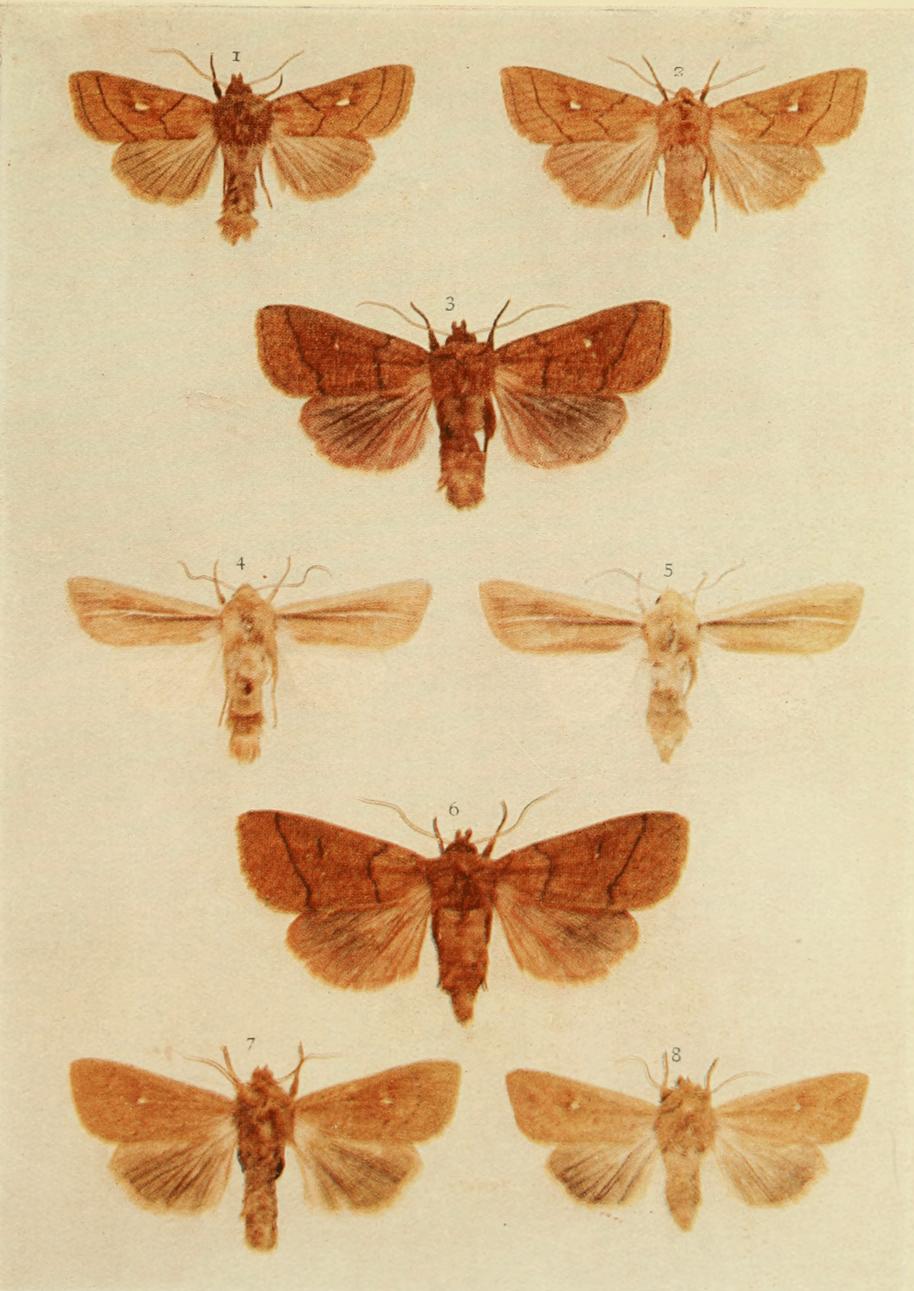
Pl. 150.
1, 2.Brown-line Bright-eye Moth. 3, 6.Double-line Moth.
4, 5.Shore Wainscot. 7, 8.Clay Moth.
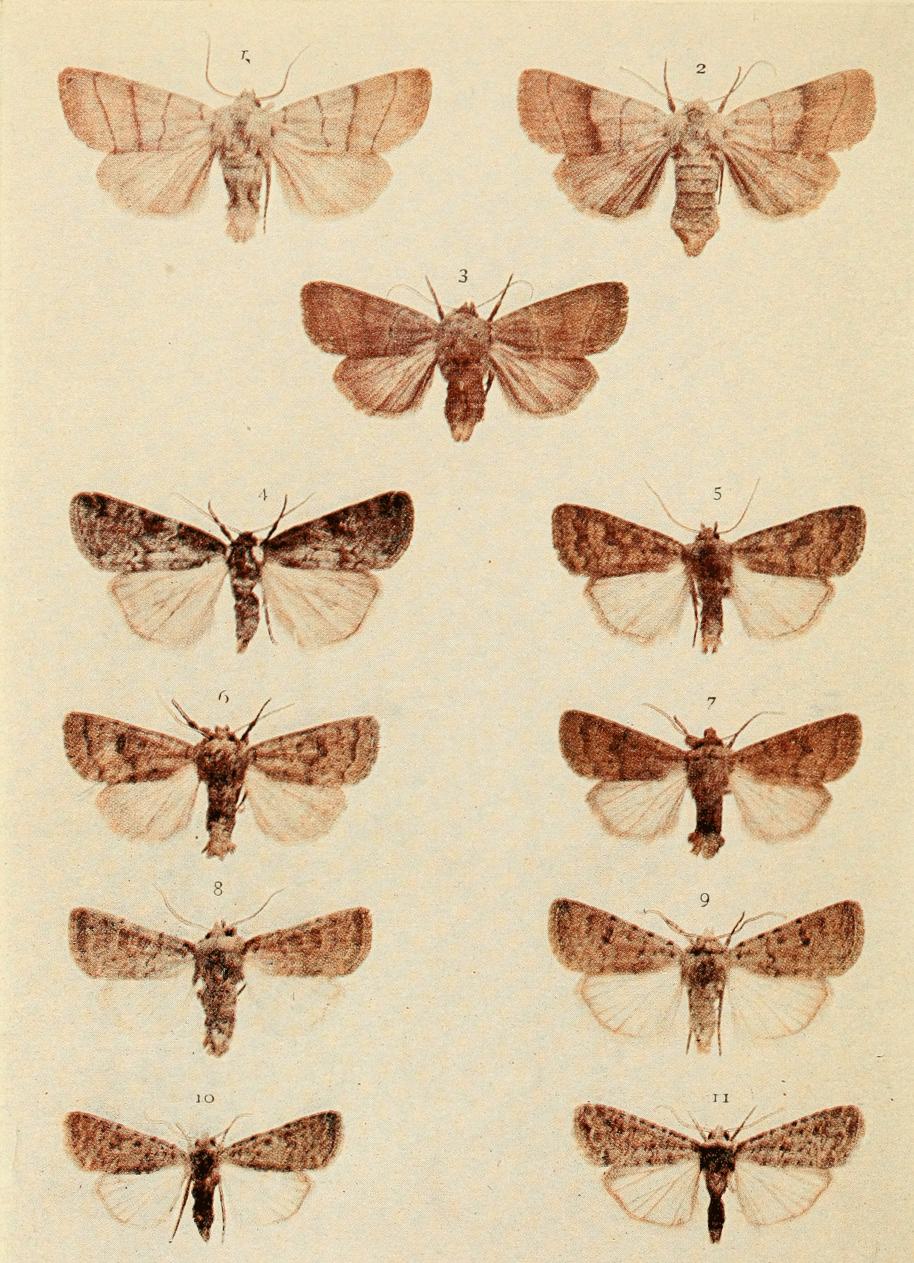
Pl. 151.
1, 2, 3.Treble Lines Moth. 4.Anomalous Moth.
5.Mottled Rustic. 6.Uncertain Moth.
7.Rustic Moth. 8.Vine's Rustic.
9, 10.Pale Mottled Willow. 11.Small-mottled Willow.
The Shoulder-striped Wainscot (Leucania (Cirphis) comma).
The striking features of this moth (Plate 147, Fig. 10) are the white median nervure, and the black streak below it, of the fore wings; there are also black marks on the veins before the outer margin. The caterpillar is very like that of L. impura, but there is a dark line on the back between the central and outer whitish lines. It feeds on cocksfoot and other grasses from June to August. The moth flies in June and July, and is not uncommon in meadows and grassy places, even by the roadside. Except that it does not, apparently, extend beyond Perthshire in Scotland, it seems to be widely, or even generally, distributed over the British Isles. Abroad it ranges to Siberia and Amurland.
Leucania l-album.—Barrett, "Lepidoptera of the British Islands," vol. ix. p. 450 (1904), remarks: "This species now seems to have made its way to this country, though it is still doubtful whether it has established itself. Mr. Eustace R. Bankes has captured a female specimen in South Devon, and he mentions the occurrence of one or two other specimens. It is a very pretty species, and widely distributed abroad."
The Devonshire Wainscot (Leucania (Cirphis) putrescens).
So far as the British distribution of this species (Plate 147, Fig. 9) is known, it seems to be confined to the coasts of South Devon and South Wales. It was first noted at Torquay in the year 1859, and about twelve years later was detected in Carmarthenshire. Abroad it occurs somewhat locally in France, Italy, Dalmatia, and in North-west Africa.
The caterpillar is pale brown with three whitish lines on the back, the central one edged on each side with blackish, the others shaded above with blackish with black dots in the shading, and edged below by a blackish line; all these lines become faint on the last three rings of the body; the usual dots are black; head rather paler, somewhat shiny, the lobes conspicuously edged with black, and the jaws marked with blackish. It feeds on grasses from September to January. The figure on Plate 148, Fig. 7, is from one of a few caterpillars kindly sent by Mr. J. Walker, of Torquay. He writes: "They are full fed by the beginning of January as a rule, and although they go down, they do not turn until the beginning of June." Mine unfortunately died in the cocoon. The moth flies in July and August, and favours particular coves and banks by the sea. It visits sugar, and also the flowers of wild sage.
The White-speck or American Wainscot (Leucania (Cirphis) unipuncta).
This moth (Plate 149, Fig. 4) is known in America, where it is exceedingly abundant and destructive, as the "Army Worm." It ranges through India, China, and Japan, and occurs in many other parts of the world, including Madeira and the Canary Isles. It is rare in Europe, and appears to have been noted in parts of Spain, Portugal, and France. Since Haworth described and named it unipuncta in 1803 it has been renamed many times, and was long known in England as extranea, Guenée. About a score have been recorded as taken in the British Isles altogether, and of these two only in Ireland; the others were captured in England and Wales, and nearly all on the south or south-west coast, chiefly in the month of September. The most recent being one in the New Forest, Hampshire, 1896, one in Devon, 1903, one in 1907, and one in 1911. Also in Isle of Wight, 1912.
The Cosmopolitan (Leucania (Cirphis) loreyi).
Barrett accepted this species as British, chiefly on the strength of two specimens captured at sugar by a sedgy ditch, nearer to Worthing than to Brighton in Sussex; the date was 1862. More recent records are one specimen at Torquay on September 27, 1900, and another, also in South Devon, September 6, 1903. The former taken at sugar, and the latter netted when "flying wildly over rough herbage at dusk." Ireland in 1908.
The species has a wide range through Southern and Eastern Asia, etc., but in Europe it is only found in the south and along the Mediterranean. The specimen shown on Plate 149, Fig. 6, is from India.
The Delicate (Leucania (Sideridis) vitellina).
The first recorded British specimen of this species (Plate 149, Fig. 3) was captured at Brighton, Sussex, some fifty odd years ago. The species has occurred in and around that locality several times since, but seems to have been found more frequently at Torquay and other places on the Devonshire coast. It has also been recorded from the Scilly Isles, Cornwall, the Isle of Wight, the New Forest, and Chichester; Kent, on the coast, and inland at Canterbury, Sussex. In 1902, a year in which several specimens were obtained on the south coast, one example was taken at Navestock, in Essex. August and September are the months during which it is seen in this country, but abroad it occurs also in June and July. The caterpillar, which feeds on grasses in the spring, is described by Hofmann as pinkish ochreous with three white lines on the back and black dots between them, two on each ring; below the black spiracles is a yellowish stripe; head brown with black dots.
The White-point (Leucania (Sideridis) albipuncta).
This species (Plate 149, Fig. 5) appears to have been confused with the following one. It may be distinguished by its generally smaller size and the pure white spot on the fore wings. The colour of the fore wings is brownish red, rather than rusty tinged as in some reddish forms of L. lithargyria; the second cross line is more distinct, and the series of black marks beyond less so. The hind wings are paler than those of the next species. The caterpillar is yellowish wainscot brown above, inclining to flesh-colour on the sides and beneath; three white lines on the back, the central one edged on each side by a wavy blackish line, the outer ones edged above by a blackish line and below by a brownish line; a pale stripe low down along the sides; head ochreous, shining, and lined on the face with greyish. It feeds from autumn to spring on grasses. The moth is out from August to October. It occurs more or less frequently, and chiefly on the coast, in Kent (first taken at Folkestone, in 1868), Sussex, Hants, Isle of Wight, South Devon, and Essex (Shoeburyness).
The Clay (Leucania (Sideridis) lithargyria).
Two specimens of this species are shown on Plate 150, Figs. 7 ♂, 8 ♀. The colour of the fore wings varies from pale ochreous brown, often with a pink tinge, to a deep rusty red; the reniform stigma is generally represented by a pale crescent with a white or whitish dot at its lower end; the cross lines are rarely distinct, but a series of black dots before the outer margin are usually well in evidence. The caterpillar is pale brown tinged with pinkish or yellowish; central line white edged with dark brown, and on each side of this is an interrupted broad blackish line edged below with white; a whitish line below the blackish spiracles; head and plate on the first ring of the body, pale brown, rather shining, the former freckled with blackish. It is found in April and May on grasses, probably after hibernation, The moth is out from late June to early August and is common in woods, and woody places throughout the greater part of the British Isles.
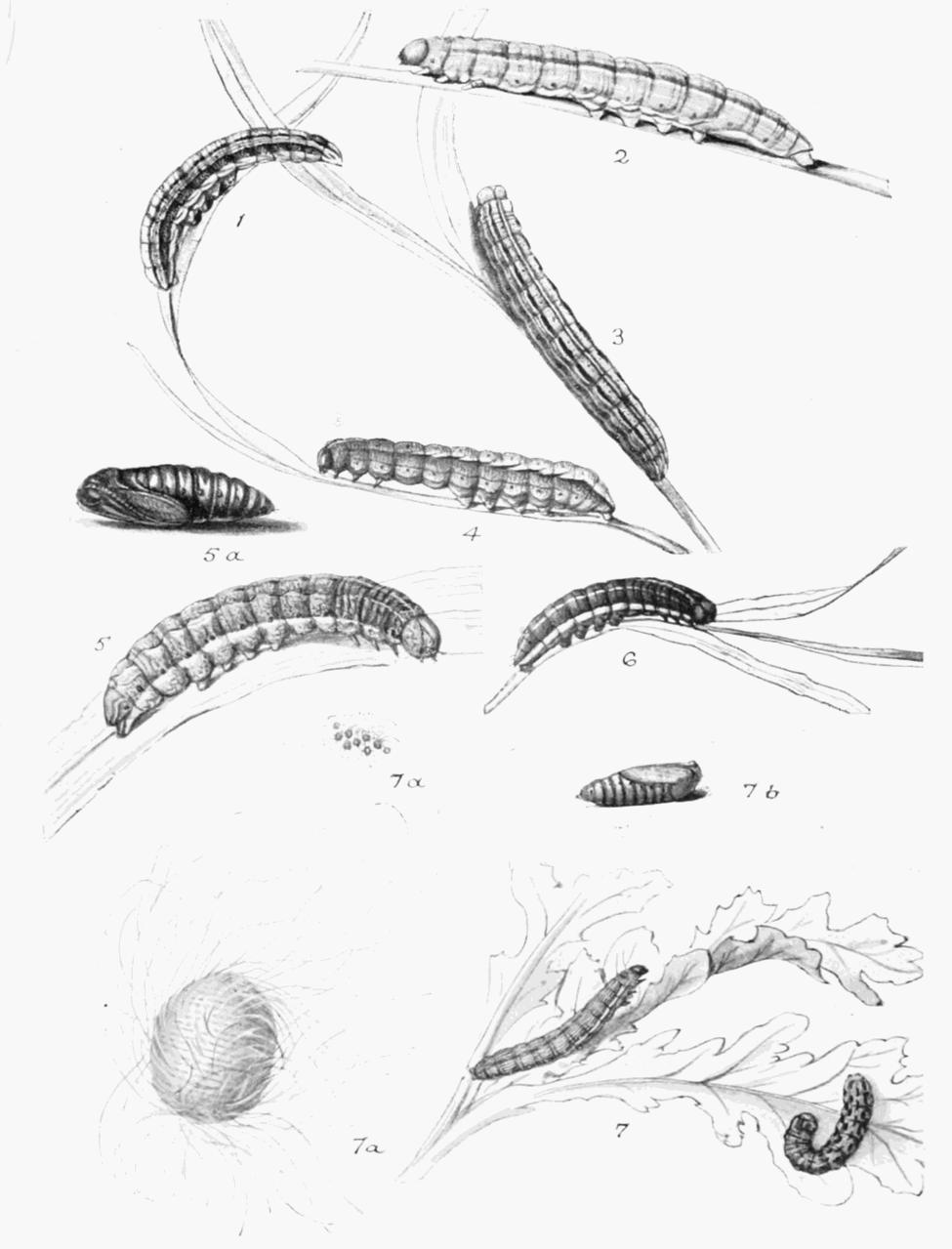
Pl. 152.
1.Common Wainscot: caterpillar. 2.Shore Wainscot: caterpillar.
3.Clay Moth: caterpillar. 4.Brown Rustic: caterpillar.
5, 5a.Double Line: caterpillar and chrysalis. 6.The Anomalous Moth: caterpillar.
7, 7a, 7b. Small Mottled Willow: eggs and caterpillars.
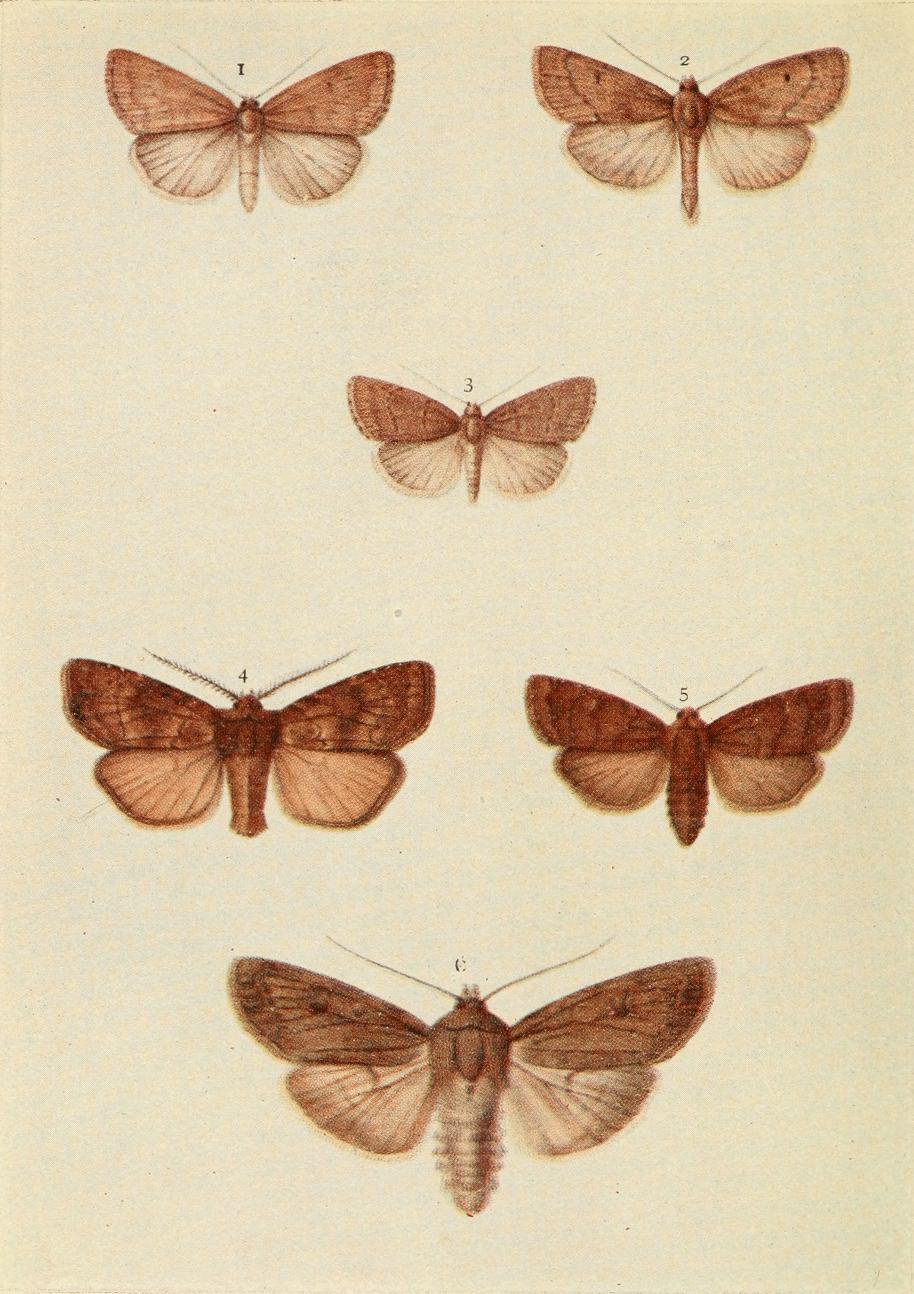
Pl. 153.
1, 3.Reddish Buff Moth. 2.Marsh Moth.
4, 5.Brown Rustic. 6.Xylophasia zollikoferi.
The Brown-line Bright-eye (Leucania (Chabuata) conigera).
This species (Plate 150, Figs. 1 ♂, 2 ♀) ranges in the colour of fore wings from pale ochreous brown to a dusky tawny hue; the cross lines are sometimes very faint, but otherwise the markings are constant. Var. suffusa, Tutt, is described as rusty red suffused with darker scales, markings typical, but deeper in colour and more distinct. The caterpillar is ochreous or greyish brown; three yellow lines on the back are black edged; a yellow line along the sides is often edged with black, and the line below the black spiracles is blackish; head pale brown marked with black. It feeds on grasses, and may be found in April and May. The moth appears in June and July and is pretty generally distributed. It is regarded as a common species in South England, but in the north seems to be rather local and most frequently found on the coast. In Scotland it does not appear to have been noted north of Ross or in the isles. Abroad the range extends through Northern and Central Asia to India and Japan.
The Double Line (Leucania (Eriopyga) turca).
The sexes of this species are shown on Plate 150, Figs. 3 ♂, 6 ♀. The general colour of the fore wings may be paler or darker than in the specimens shown. Sometimes the central area enclosed by the black cross lines is darker than the other parts of the fore wings; var. obscura, Tutt, has the fore wings obscure smoky grey, with a dull coppery tinge, much suffused with dark scales; markings indistinct.
The caterpillar is pale brown freckled with darker; a whitish line along the middle of the back is edged on both sides with blackish merging into black at the ring divisions; a rather wavy, but less distinct, whitish line on each side of the central one edged above with blackish; spiracles black ringed with pale brown and set in a broad dark brown line below which the colour is pinkish; head shining pale brown, freckled with darker on the cheeks. It feeds on cocksfoot and various other grasses occurring in woodlands. August to May. The moth, which inhabits woods and well-timbered parks, is out in June and July. It is, perhaps, most frequent in the New Forest, Hampshire, thence it is found more or less sparingly to Cornwall. Sometimes not uncommon in Savernake Forest, Wiltshire, and occurs in Berkshire, Buckinghamshire, Essex (Epping Forest, etc.), Surrey (Richmond Park). Recorded from Cheshire and from South Wales. In Scotland it is said to have been taken at Newfield, Ayrshire. The only records from Ireland are Clonbrock (1), and Merlin Park, Galway (2). Abroad it ranges to Amurland, China, Corea and Japan.
Treble Lines (Meristis (Grammesia) trigrammica).
The fore wings range in colour from whitish or greyish brown to ochreous brown; the cross lines are usually distinct, and the central one is often broad. (Plate 151, Fig. 1.) In var. approximans, Haw., the cross lines fall nearer together on the inner margin; and in var. semi-fuscans, Haw., the basal half is greyish or reddish grey, and the outer half is suffused with brownish (Fig. 2). Then there is a somewhat rarer form, with dark grey, brown, or blackish brown fore wings, with the cross lines more or less distinct, as in Fig. 3; or with the central one absent (var. bilinea, Hübn.); or all the lines may be obscured by the dark colour. Kane states that var. obscura, Tutt (= bilinea, Haw.), is pretty common at Howth and other places in Ireland, and, according to Barrett, it is not infrequent in Wales. The caterpillar is greyish or dingy reddish brown; three pale lines on the back, the central one partly edged with black, and the outer ones are broken and inwardly edged with blackish marks; the stripe along the black spiracles is ochreous brown; head brownish. From July to April on plantain and other low plants. The moth is out in June and July. In Scotland it is local and rare, but has been recorded from Clydesdale, Arran, and once from Perthshire. Local but widely distributed in Ireland.