PART II. (continued 2)
Reading edition
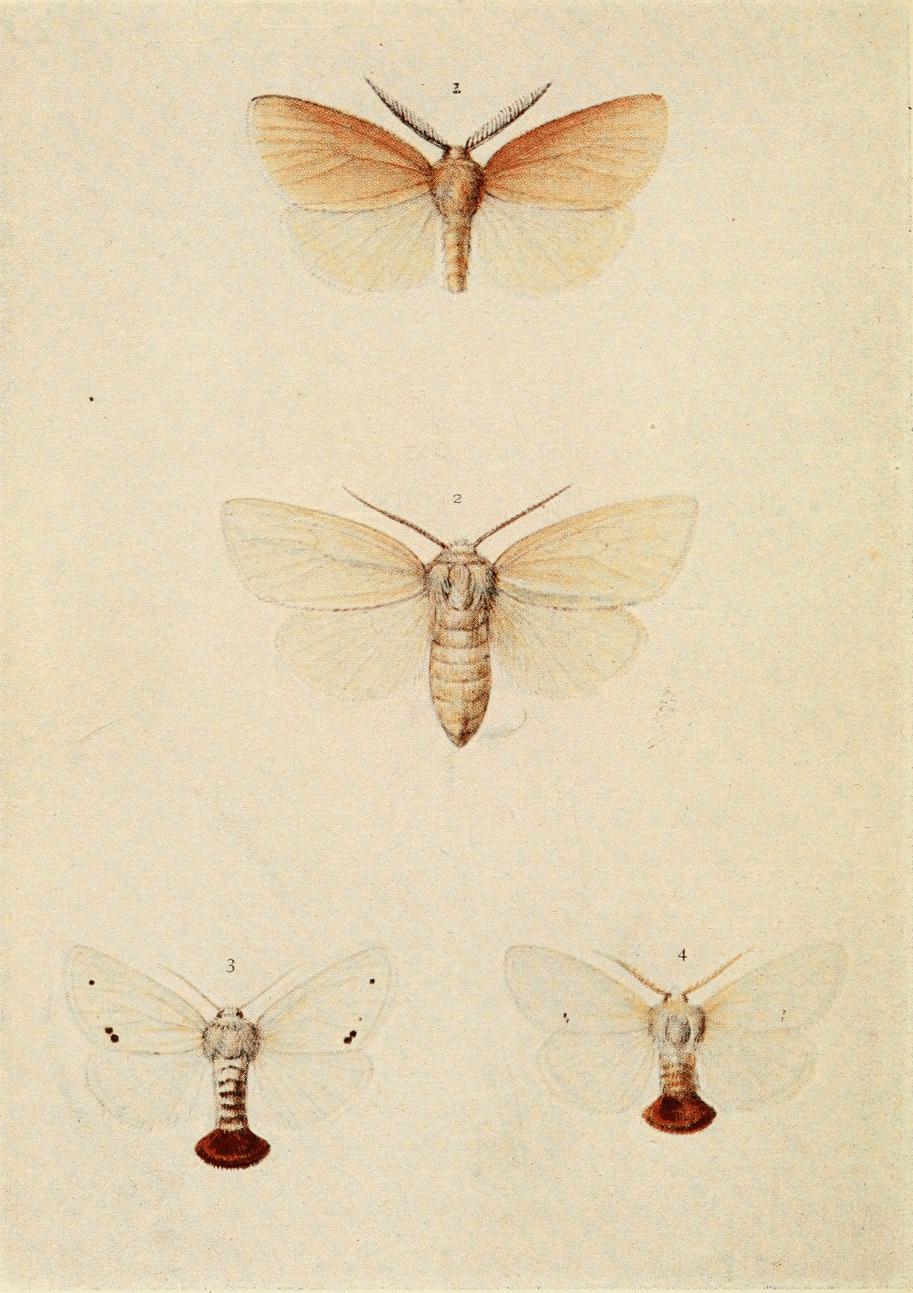
The Dusky Marbled Brown (Gluphisia crenata).
Only three authenticated British examples are known of this dingy grey-brown moth (Plate 28, Fig. 3). The earliest intimation we have of the occurrence of this species in England is the following record by the late Mr. Henry Doubleday in the Entomologist, vol. i. p. 156: "Chaonia crenata. The first British specimen of this insect was taken in Ongar Park Wood, in June, 1839; a second in the same place, in June of the present year. Both specimens were females." The locality mentioned in the foregoing notice which was penned July 10th, 1841, is in the County of Essex. At a meeting of the Entomological Society of London held in April, 1854, the Rev. Joseph Greene exhibited a specimen that he had reared from a caterpillar obtained from a poplar near Halton, in Bucks, August, 1853.
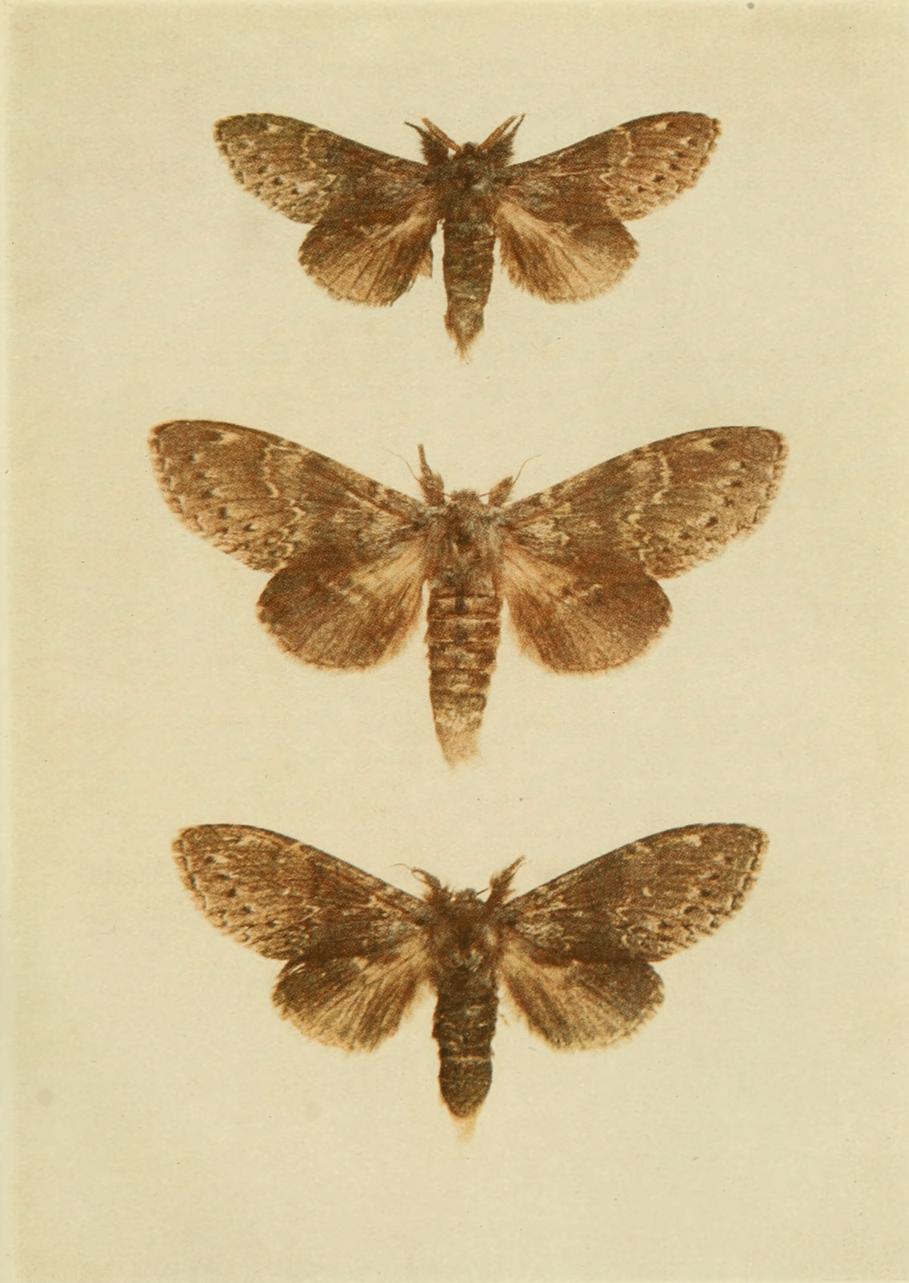
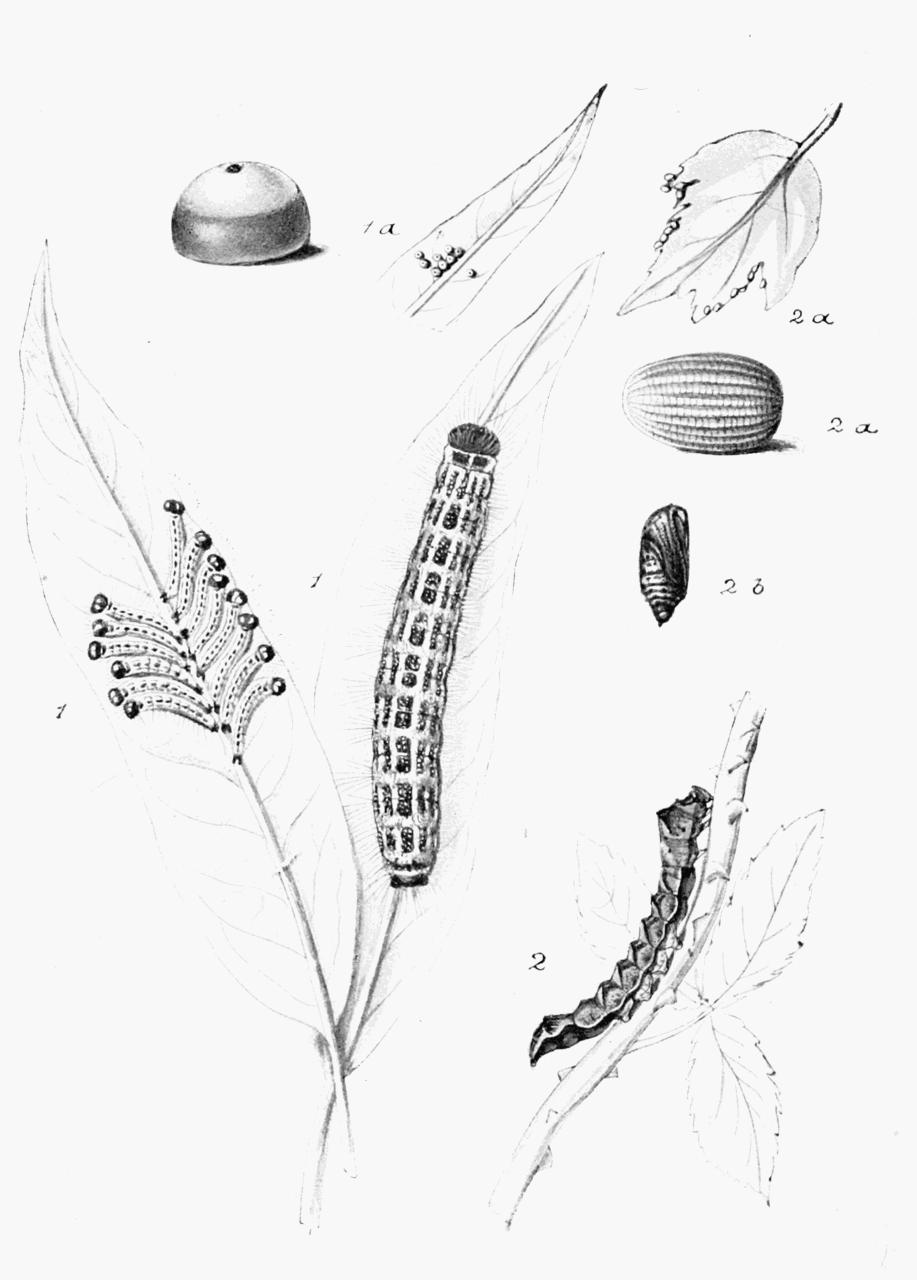
Pl. 26.
Lobster Moth.
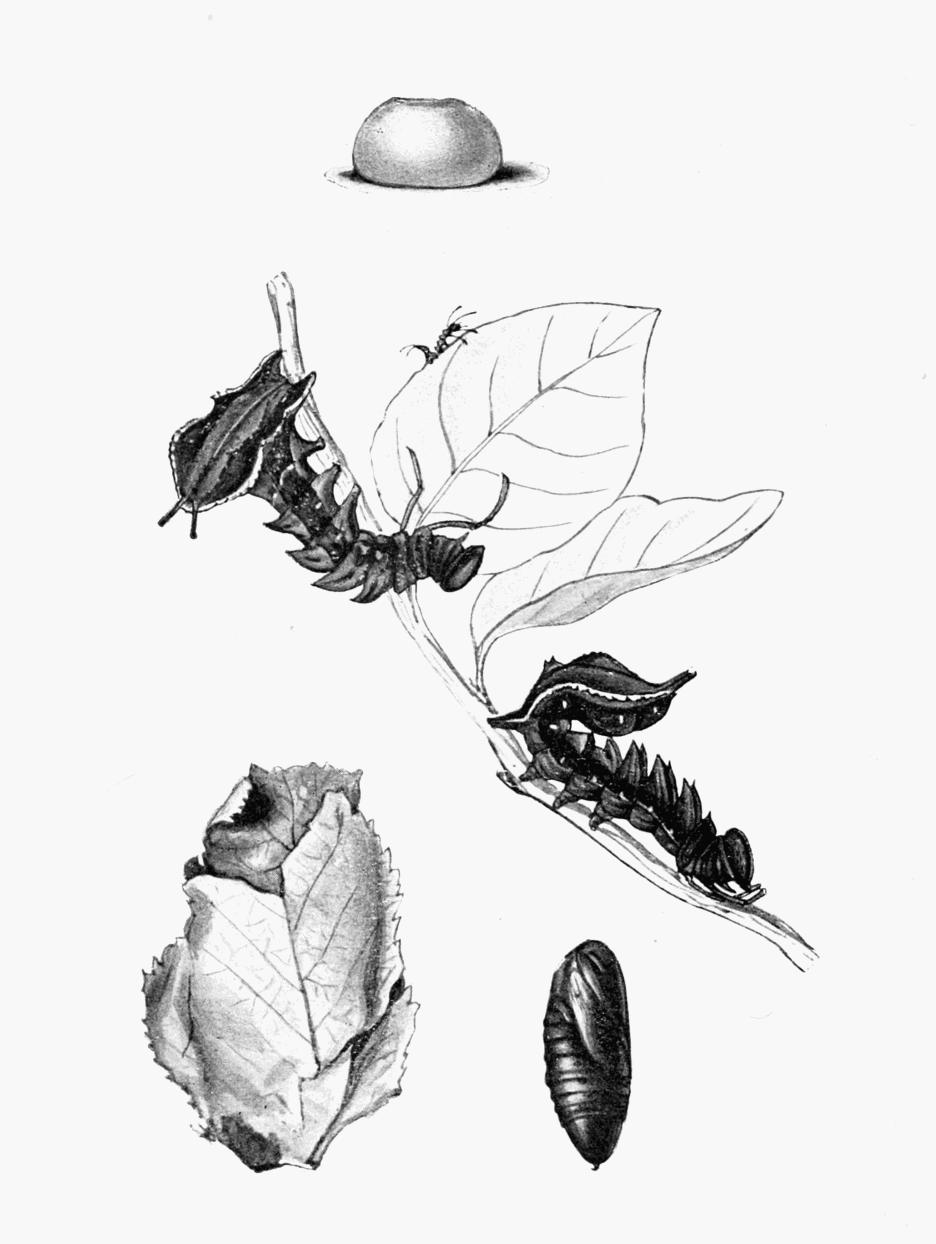
Pl. 27.
Lobster Moth.
Egg, enlarged, caterpillars, chrysalis and cocoon.
According to Buckler the caterpillar is pale green, with a thin whitish line down the middle of the back, a broader yellow line on each side, and some reddish spots on the front and hind rings of the body; the spiracles are black. It spins a somewhat oval-shaped cocoon between two poplar leaves, and therein turns to a glossy blackish brown chrysalis.
Abroad the species is found in Central Europe, North Italy, North-western Russia, Southern Norway, and also in Amurland and Ussuri. There are said to be two broods on the continent, one emergence of moths taking place in April and the other in June or July.
The Marbled Brown (Drymonia trimacula).
Somewhat similar to the next species, but the fore wings are generally whiter; the cross lines are not so straight, and there is no black crescent above the centre of the wings (Plate 28, Fig. 1).
The caterpillar is green, with two yellow lines on the back, and a yellow one along the spiracles, the latter edged above with reddish. It feeds on oak, and may be found from July to September; stated to hide by day in the chinks of the bark. The reddish brown chrysalis is enclosed in a cocoon of earth held together with silk. It may be searched for at the roots of grass, etc., around the foot of oak trees growing in parks or in the more open parts of woods. The moth appears in May.
Although nowhere really common, it seems to occur pretty generally over the southern portion of England, and as far north as Derbyshire and Staffordshire. Farther north, and in Wales and Scotland, it has been rarely met with. Recorded by Birchall to be not uncommon at Killarney; but Kane states that he has never seen an Irish specimen.
The species occurs locally throughout Central Europe, also in Transylvania, Northern and Central Italy, and Eastern Armenia. In Ussuri, and Japan, it is represented by the form dodonides, Staud.
The Lunar Marbled Brown (Drymonia chaonia).
The fore wings of this moth (Plate 28, Fig. 2) are dark fuscous, almost blackish, a short white line near the base; the central third is white clouded with the ground colour and limited by white edged black wavy lines; a black crescent just above the centre of the wing. Hind wings smoky grey with a pale curved line. The egg, which is bluish white in colour, is of the usual Notodont shape. Caterpillar green, merging into bluish-green on the back; the lines are pale yellow, or creamy white, that along the black margined spiracles is rather broad and is sometimes tinged with reddish on the three front rings. Head green, mouth marked with pale yellow. Feeds in June, July, and August on oak. From about a dozen eggs that I had in May, 1907, the caterpillars hatched on the 13th of the month. Only one got through safely to the chrysalis stage which it reached at the end of June. On June 26th some half-grown and smaller caterpillars were received from the New Forest, only one of these was seen on July 19th, but it was then nearly full grown and appeared to be quite healthy, and others had pupated or died.
The chrysalis is deep red brown, enclosed in a silken cocoon covered with particles of earth; generally found at the roots of isolated oak trees (Plate 29, Figs. 1, 1a).
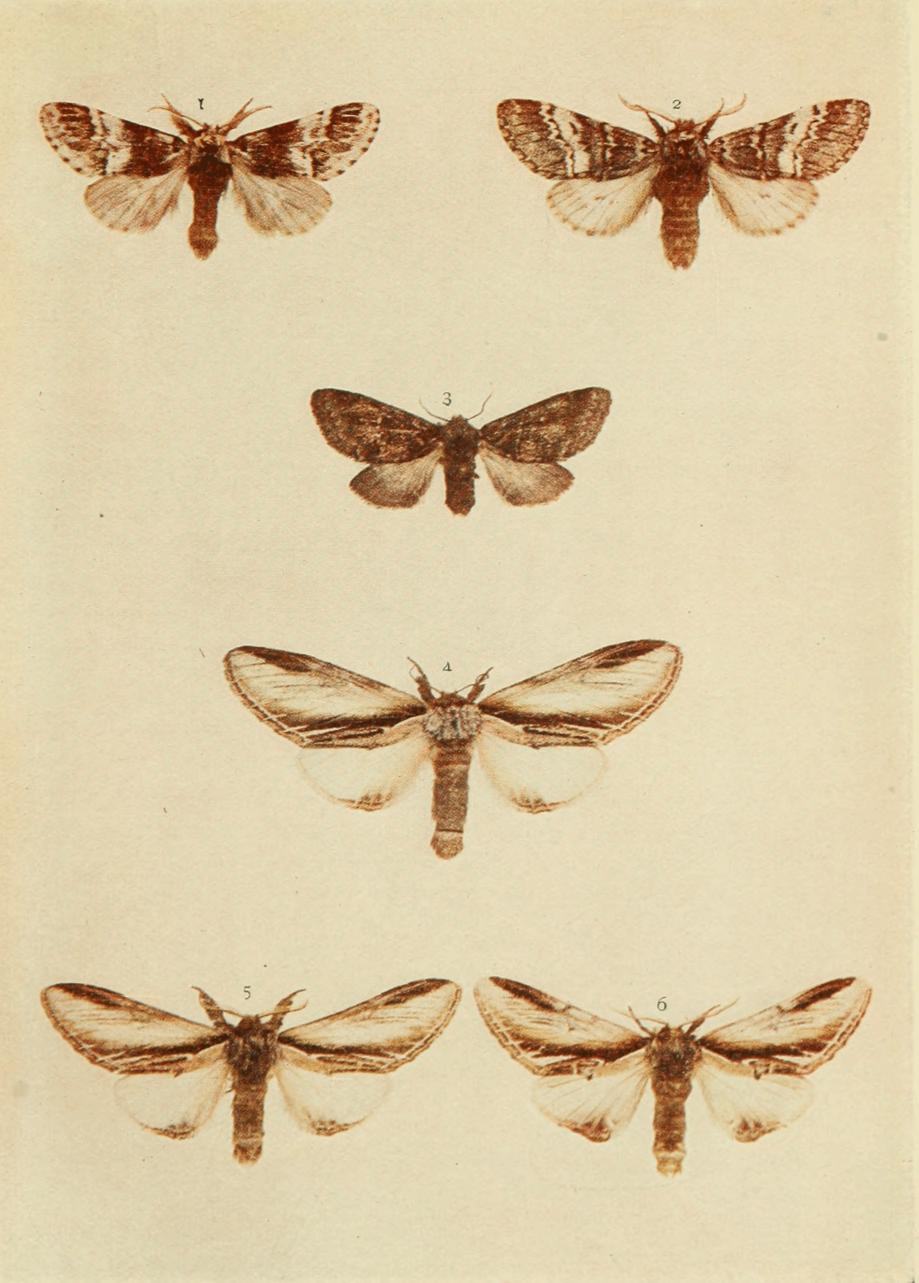
Pl. 28.
1.Marbled Brown Moth. 2.Lunar Marbled Brown.
3.Dusky Marbled Brown. 4.Swallow Prominent, female; 5 male.
6. Lesser Swallow Prominent.
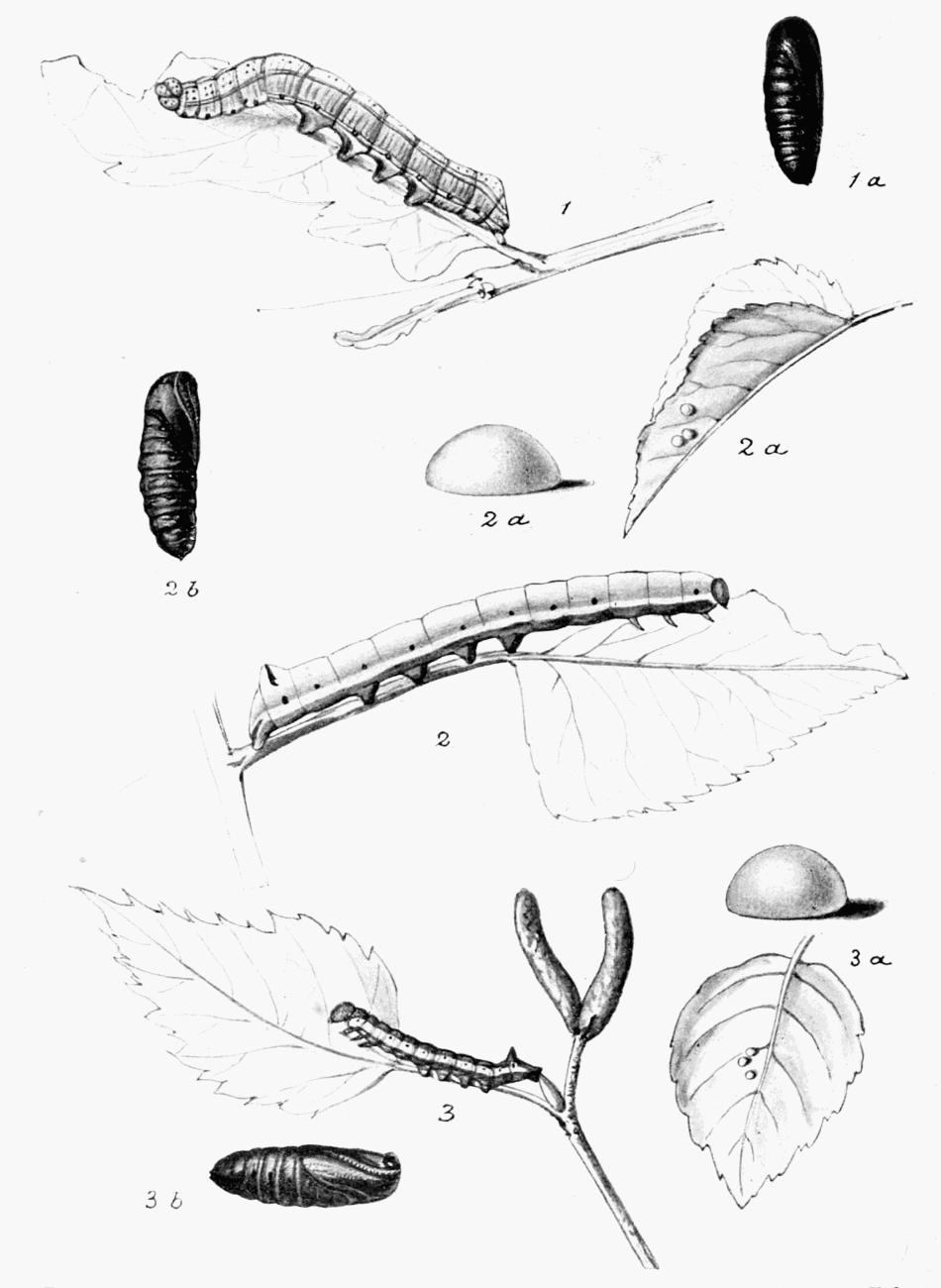
Pl. 29.
1, 1a.Lunar Marbled Brown: caterpillar and chrysalis.
2, 2a, 2b.Swallow Prominent: egg, caterpillar and chrysalis.
3, 3a, 3b.Lesser Swallow Prominent: egg, caterpillar and chrysalis.
The moth emerges in May, sometimes at the end of April, generally in the afternoon; it sits on the tree trunk to expand and dry its wings, and then ascends higher up the tree. It is found in Berkshire, Buckinghamshire, and in most of the southern counties of England, and in the west, but it seems to be rarer eastward and northward, and also in Scotland. In Ireland it has been found, very sparingly, in Wicklow and Kerry, and "numbers were taken in a moth trap at Clonbrook."
The range abroad is very similar to that of the next species.
The Swallow Prominent (Pheosia tremula).
Normally whitish, with a brown shaded black stripe along the inner margin of the fore wings, and a brownish cloud, with black streaks in it, towards the tips of these wings; the outer extremities of the veins are white, there is a white wedge-shaped streak between veins 1 and 2, and from the apex of this an indented white line runs to the base of the wing. Sometimes the whole discal area is suffused with brownish. The moth is shown on Plate 28, Figs. 4, 5, and the early stages on Plate 29, Figs. 2, 2a, and 2b. The egg when laid is creamy white, and the newly hatched caterpillar is pale green. When full grown the caterpillar is green with rather darker, but not always clearly defined, lines along the back, and a yellow line along the region of the black spiracles; the underside is sometimes reddish. Another form is brownish in colour and the yellow line is then generally obscure. The green form is figured on Plate 29. The usual food is poplar, but sallow is also eaten. It may be found in late June and early July and again in September and October. The chrysalis is reddish brown and glossy except on the wing covers, which are granulated and appear darker. The cocoon is roughly constructed of silk and earth, and before spinning it the autumnal caterpillar sometimes burrows a good depth under the surface of the soil; the summer cocoons are said to be made up among leaves. The moth is on the wing in May and August.
The species is perhaps most common in the southern and eastern counties of England, but seems to be pretty generally distributed throughout the country, and extends into Scotland as far as Moray. In Ireland it has a wide range but is only common near Londonderry. Abroad it is found in Central and Northern Europe, and as far east as Amurland and Ussuri. In America it is represented by P. dimidiata, H.-S., which does not seem to be really specifically distinct.
The Lesser Swallow Prominent (Pheosia dictæoides).
Very similar to the last species, but generally smaller, and the ground colour has usually less brown in it; the chief character, however, by which it may be distinguished, is the broader and clearer white wedge-shaped mark between veins one and two on the fore wings. Reference to the figures of each species on Plate 28 will show this at once.
The eggs are greenish white, and the full-grown caterpillar is purplish brown on the back merging into violet on the sides; there is a broad yellow stripe along the spiracle area; the head is violet, faintly marked with black. A noticeable feature of this caterpillar is its varnished appearance. It feeds on birch in June and July, and sometimes in September and October. The early stages are figured on Plate 29, Figs. 3, 3a, and 3b.
The species has a somewhat similar distribution to that mentioned for the preceding, but it seems to be commoner in the North of England and in Scotland than elsewhere in the British Isles.
The Pebble Prominent (Notodonta ziczac).
This moth varies in the colour of the fore wings from pale ochreous brown to a darker brown tinged with reddish; the usual pale greyish patch in the middle of the costal area is sometimes obliterated by a suffusion of the darker colour; the dark-brown first and second lines are often only visible towards the front edge of the wings; a blackish lunule or crescent forms, in conjunction with the strongly curved outer line, the outline of the characteristic pebble-like mark on the apical area of the wings; a pale saw-edged line, which is inwardly shaded with dusky and intersected by black streaks on the veins, traverses the pebble mark, but in the lighter coloured specimens this line is not traceable. The female has browner hind wings than the male. The moth is depicted on Plate 31, Fig. 2; and the early stages on Plate 30, Figs. 1, 1a, and 1b.
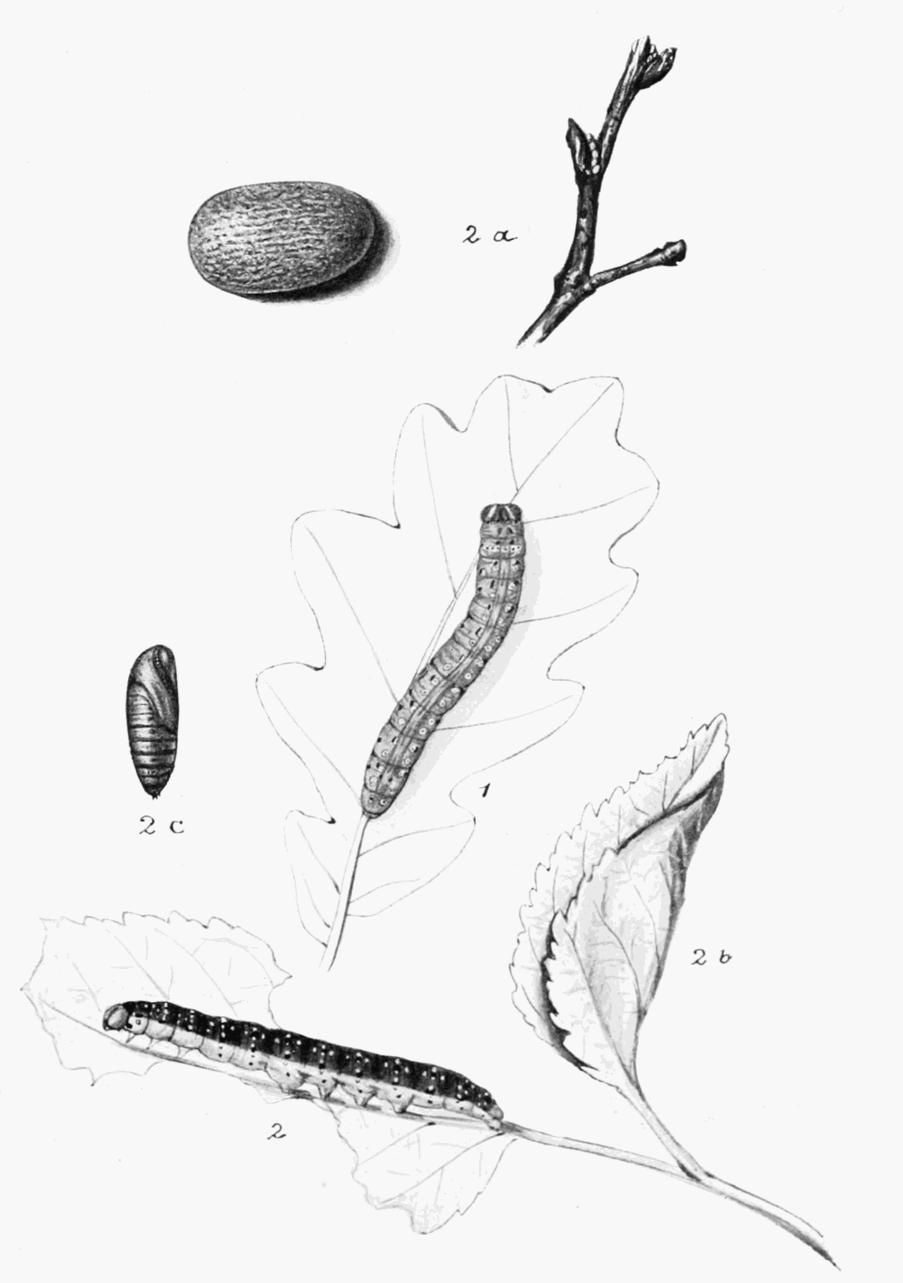
The caterpillar, when full grown, is pale ochreous grey, sometimes tinged with pink or purplish brown, or with yellowish, and especially on the hind rings; a yellow stripe along the back is edged here and there with brownish; the diffuse dusky line along the area of the black margined spiracles is edged with yellowish. It is occasionally found on poplar, but sallows and willow are the more usual food plants, and it feeds upon these in June and July and again in August and September. The reddish brown chrysalis is enclosed in an earthen cocoon just under the surface of the ground at the roots of tree or bush upon which the caterpillar fed. The moth emerges in May and June from chrysalides of the previous year, and in August as a second generation. Three broods in the year have been obtained in confinement, but this is probably exceptional.
Widely distributed throughout the British Isles, but seems to have a preference for fens and marshy ground. It occurs all over Central and Northern Europe, its range extends through France to Spain, Italy, and Corsica, and it has been recorded from Armenia and Amurland.
The Iron Prominent (Notodonta dromedarius).
The specimen shown on Plate 31 is from Surrey, and represents the form most frequently obtained in the south of England. Northwards the species becomes darker in colour, and the reddish and yellow marking much reduced. The form perfusca, as figured by Stephens, has the fore wings dark purplish grey, streaked with dark brown; a pale patch at the base is russet marked, the line before the middle of the wing is russet, and a dash of the same colour lies at the lower extremity of the line beyond the middle; the hind wings are brownish grey with a broad whitish cross line. The specimen, which is of the female sex, was from Dublin, and the form was not then supposed to occur in any other part of the British Isles. It is now, however, well known in Scotland and the North of England, and also in Ireland. Some examples that I have seen from Scotland are much larger and darker than the figure referred to. In his description of this form Stephens states that the fore wings are fuscous mixed with chestnut, with darker clouds. The caterpillar, which is figured on Plate 30, is green, becoming yellowish on the back; a rather broad stripe on the back of the front rings and the markings on the humps and on other parts of the body are purplish brown. It feeds on birch, alder, and sometimes hazel, usually on the former, in June, July, and August. In some seasons, and localities, the moth appears twice in the year: the caterpillar may then be found in September and October. The chrysalis is blackish-brown and rather glossy, enclosed in a cocoon composed of silk and sand or other soil, and may be obtained by lightly digging up the earth and sods at the roots of trees.
The Three Humped (Notodonta phœbe = tritophus).
Very little is known in Britain of this Central European moth (Plate 31, Fig. 3). The first specimen of which we have any knowledge was reared on August 10, 1842 from a caterpillar found in Essex on aspen. This example was included, with two others, one of which was captured in Suffolk, in the collection of the late Dr. Mason, which was dispersed at Stevens' Auction Rooms in March, 1905.
Besides the specimens mentioned above, a caterpillar, which subsequently died, was beaten from alder in the Exeter district in 1870; another was obtained from hazel in Gloucestershire, but this was "ichneumoned." Then there is a record of a moth or caterpillar, presumably the former, occurring in the neighbourhood of Paisley; and there is a report that a caterpillar was once found at the base of an aspen growing on Clapham Common. A specimen was taken at electric light at Bedford, May, 1907.
The caterpillar is green, with three reddish humps on the back, and an interrupted reddish line along the sides. It feeds on poplar in July and August.
The Large Dark Prominent (Notodonta tritophus = torva).
Another Central European species, of which only one specimen is known to have occurred in Britain. This was reared from an egg, or from a caterpillar, obtained in Norfolk in the latter part of the summer of 1882. The moth might be mistaken for a small dark coloured specimen of the next species (N. trepida), but the dark hindwings readily distinguish it (Plate 31, Fig. 4).
The caterpillar, although darker, bears considerable resemblance to that of the Pebble Prominent; it feeds in June and July, and also in September, on aspen.
According to Staudinger this species is the tritophus of Esper, an earlier name than torva, Hübn.; whilst the preceding species, that has so long been referred to tritophus, Fabricius (or trilophus), is found to be phœbe, Siebert, which name has seventeen years' priority.
The Great Prominent (Notodonta trepida).
Fore wings greyish, or ochreous grey, with dark cross lines; a blackish tuft from middle of inner margin, and a series of dark, or sometimes reddish, spots on a pale cross line before the inner margin. Hind wings whitish, sometimes ochreous tinged; clouded with greyish on costal area (Plate 31, Fig. 5). When full grown the caterpillar is rather larger than the one figured on Plate 30. In colour it is green, with yellow lines along the back, seven reddish-edged yellow oblique streaks on the sides, and a reddish tinged stripe on the two rings nearest the head. It is stated to assume a purplish tint when quite mature. May be found from end of June to early August on oak. The dark reddish brown chrysalis, which is enclosed in an earth-covered cocoon, may be found at the roots of oak trees in the autumn or winter.
The moth emerges between late April and early June, sometimes remaining in the chrysalis for two winters. Light attracts it freely, and it is frequently seen in the illuminated moth trap, and may be occasionally noted on the iron frame of a gas lamp in suitable places. Sometimes the moth is met with in the daytime, resting on the trunks or branches of oak trees in woods, or on palings adjacent thereto. When such specimens happen to be females, they should be kept for eggs, which they lay freely.
It occurs in most of the southern counties of England, is somewhat rare in the Midlands, and scarce in the northern counties and in Scotland. Recorded by Birchall as "not uncommon in Co. Wicklow," but Kane ("Cat. Lep. Ireland") states that he has no information concerning its occurrence in the sister island. Distributed throughout Central Europe, extending into Spain, Italy, and Corsica; also to South-east Russia, Armenia, and possibly Ussuri.
The White Prominent (Leucodonta bicoloria).
The glossy white moth, prettily marked with orange and black, shown on Plate 33, was not known to inhabit the British Isles until 1858 when Bonchard obtained one specimen in a large birch wood in the Killarney district, Ireland; in the following year he took a second specimen. Both captures were made in the month of June. In June, 1861, one example of the moth was found in Burnt Wood, Staffordshire; and in the same wood, June, 1865, no fewer than six specimens were secured, and eggs obtained from one of the females. The caterpillars duly hatched out, but most of them were lost, only seven attaining the moth state. Kane states that in 1866 a specimen was taken in Mucross demesne, and caterpillars "were said also to have been beaten." Miss Vernon of Clontarf showed him her collection of insects from Kerry, and he found therein two rather poor specimens of the White Prominent from a new locality in Kerry. Barrett mentions the capture, in 1880, of a specimen near Exeter, Devonshire. From the foregoing, which comprises all that appears to be definitely known about British L. bicoloria, it will be gathered that the species is not only very local, but exceedingly rare.
The caterpillar, figured on Plate 32, from a coloured drawing by Mr. A. Sich, is pale yellowish green, rather whiter on the upper surface; the lines are green, the central one darkest; the stripe along the spiracles is yellow edged with green. It feeds on birch in July; and changes in due course to a dark reddish brown chrysalis, which is enclosed in a compact silken cocoon spun up between leaves. The moth emerges in May or June. Abroad the species seems to be generally distributed in Central Europe, and is also found in the Ural, Amurland, Ussuri, and Japan.
The Maple Prominent (Lophopteryx cuculla).
To Donovan and the entomologists of his time this moth (Plate 33, Fig. 4) was known by the English name still in use, Stephens considered it a rare insect, and remarks that he once caught a specimen at Darenth Wood, by "mothing," in June, 1820; several other examples had been taken in the same place, and in the neighbouring woods. Although many more localities are now known for the moth, it still continues to be rather a scarce species. It appears to inhabit woods on a chalky soil almost exclusively, and is found less uncommonly in the woods of Buckinghamshire than in its other haunts in Berkshire, Oxfordshire, Kent, Sussex, Devonshire, Essex, Cambridgeshire, Suffolk, and Norfolk. The bulk of the specimens in collections were probably reared from the egg, or from caterpillars obtained by beating or searching the maple bushes growing in the woods frequented by the moth.
The caterpillar is whitish green, rather glossy, with a dark green line along the middle of the back, which is broadest on the front rings, and a pale yellow stripe on the sides, the latter edged above with pale green; spiracles pinkish edged with black; a hump on the eleventh ring is purplish tinted. Head pale ochreous brown marked with reddish brown. Sometimes the general colour is yellowish or pinkish ochreous. May be found in June and July on maple (Acer campestris) and in confinement will feed very well on sycamore (A. pseudoplatanus). The moth usually emerges in May or June, but in 1901 Mr. Adkin reared ten moths, July 24 to 31, from eggs deposited in the spring of that year. The species does not seem to be a common one even abroad; its range extends through Central Europe to Italy and Sicily, and it is also found in Ussuri.
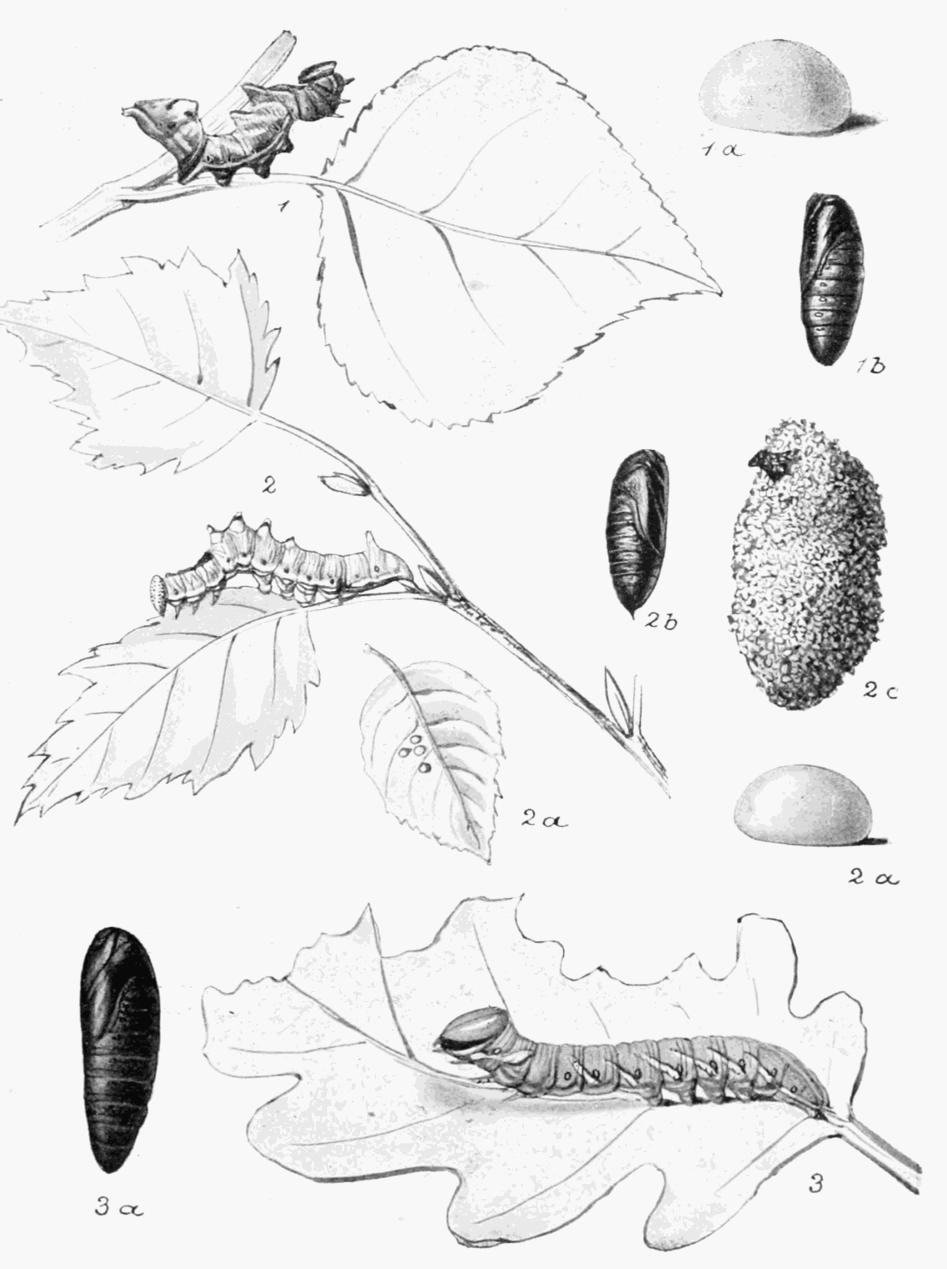
Pl. 30.
1, 1a, 1b.Pebble Prominent: egg, caterpillar and chrysalis.
2, 2a, 2b, 2c.Iron Prominent: eggs, caterpillar, chrysalis and cocoon.
3, 3a.Great Prominent: caterpillar and chrysalis.
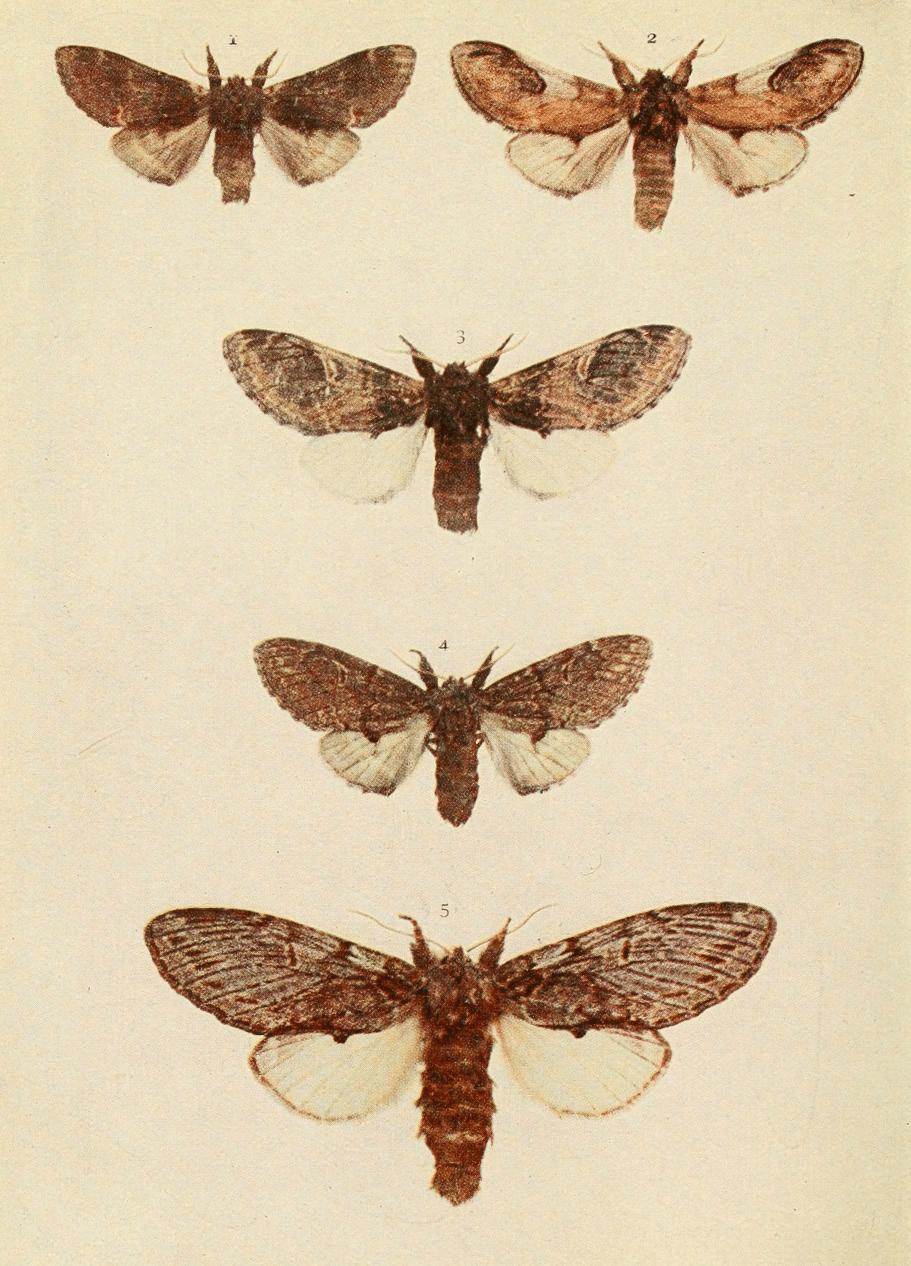
Pl. 31.
1.Iron Prominent. 2.Pebble Prominent.
3.Three Humped Moth. 4.Large Dark Prominent.
5. Great Prominent.
The Coxcomb Prominent (Lophopteryx camelina).
Probably the commonest of the true Prominents, and certainly the most variable. The early stages are figured on Plate 32, and two forms of the moth on Plate 33. In its typical and southern form the fore wings are more or less pale reddish brown with a darker cloud on the inner marginal area; there are three dusky, or blackish, cross lines, but two of these are generally very indistinct, the third runs from the blackish "tooth" on the inner margin to the front edge of the wing, and is followed by a pale wavy band often outwardly bordered with dusky. Sometimes the fore wings are clouded with dark brown, and in the North of England a dark reddish form occurs. In Scotland the fore wings vary in colour from dusky brown through reddish to pale yellowish brown; sometimes the "tooth" is reddish in chestnut coloured specimens. The whitish eggs are laid on the undersides of the leaves of various trees and bushes upon which the caterpillar feeds; these are chiefly birch, oak, hazel, sallow, and beech.
The caterpillar, which appears in July to October, and sometimes even later, is green, with a darker line on the back, and a yellow one on the sides; two reddish tipped wart-like projections on the back of ring eleven. Occasionally the general colour is ochreous with a pinkish tinge, or it may be even purplish. There are two broods in the south of England, but only one in the north. The moths of the first brood fly in May and June, and those of the second in July and August, sometimes rather later. Pretty generally distributed throughout England and Wales, Ireland and Scotland. Abroad its range extends over Northern and Central Europe to Northern Spain, Northern and Central Italy, Dalmatia, Turkey, Armenia, Siberia, Amurland, Corea, and Japan.
The Scarce Prominent (Odontosia carmelita).
In 1828, when Stephens figured this moth, he only knew of two British specimens, both of which had been reared about sixteen years previously from caterpillars found at Darenth Wood. The wings, which are not thickly scaled, are purplish grey, becoming reddish brown on the front margins of the fore wings; the outer transverse line of the fore wings starts from a conspicuous creamy patch on the front margin, and the line on the hind wings is most distinct above the anal angle, where it runs through a purplish cloud (Plate 33, Fig. 5).
In April and May the pale blue eggs are laid on the underside of birch leaves. The caterpillar in June feeds on the foliage of the birch, and when full grown is green freckled with yellowish above; a darker line runs along the middle of the back, and a reddish spotted, or tinted, yellow stripe along the sides; the small head, also green, is marked with yellowish. When the chrysalids are kept indoors the moths emerge earlier than in the open, and it therefore sometimes happens that eggs are laid and the caterpillars hatch before the birch leaves are ready for them. In such cases I have got over the difficulty in a measure by removing a portion of the outer covering of one or two of the most forward buds to give the caterpillars a chance of getting at the unexposed leaves. The moth emerges in April or May, and, as pointed out by Mr. R. Adkin, it sometimes remains in the chrysalis for two winters. Possibly this species may be found in most districts where birch abounds; but, so far as its distribution in our islands is known, it certainly appears to be distinctly local. Besides Darenth, it also occurs in West Wickham Wood, and at Wateringbury, in Kent; the Weybridge district, Dorking, and Haslemere, in Surrey; Ashdown Forest, Blackdown Woods, Haywards Heath, and Tilgate Forest, in Sussex; New Forest, Hampshire, and Berkshire. There seems to be no record of the moth having been found in any other part of England, except Keswick and Windermere. In Scotland it has been reported from Galashiels, Clydesdale, the Tay district, Argyleshire, and Moray.
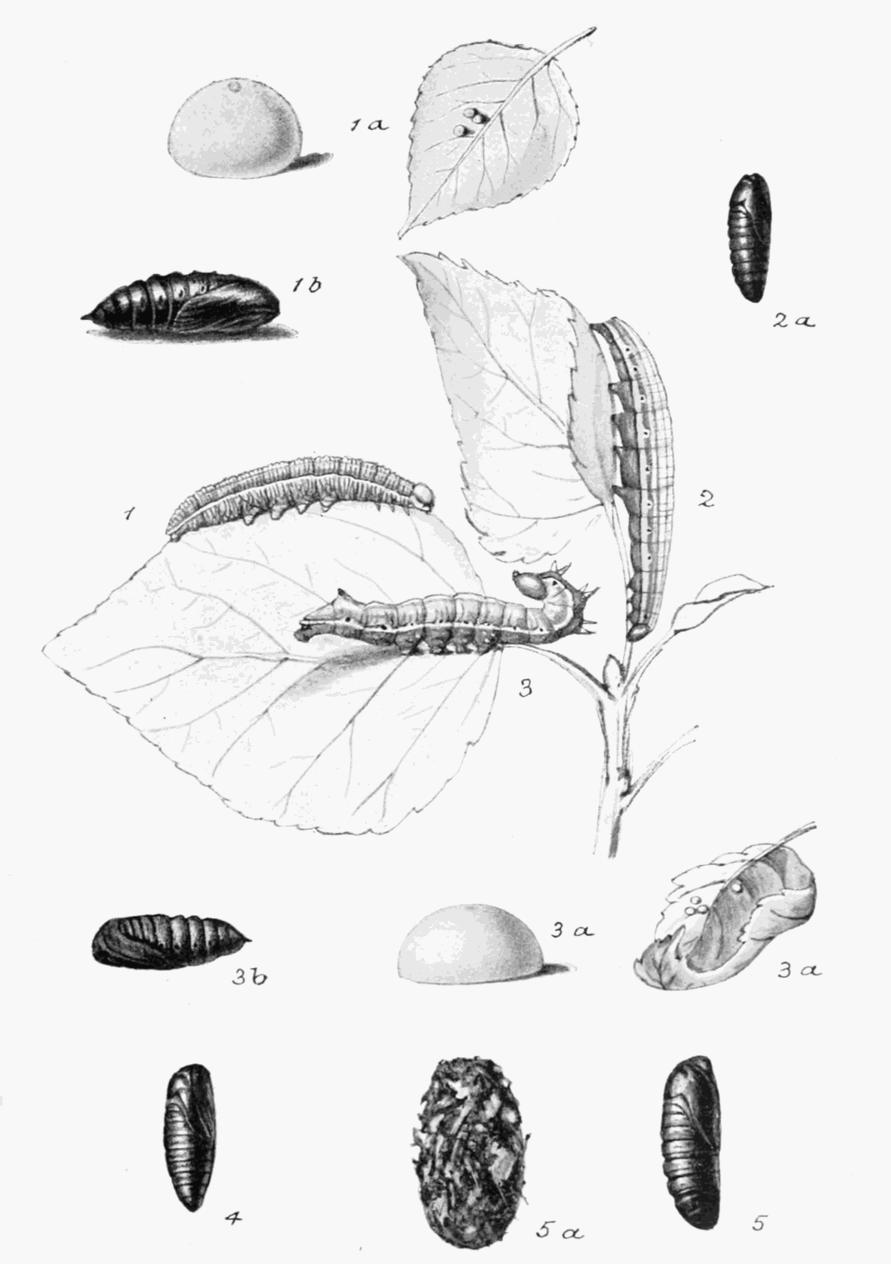
Pl. 32.
1, 1a, 1b.Pale Prominent: egg, caterpillar and chrysalis.
2, 2a.White Prominent: caterpillar and chrysalis.
3, 3a, 3b.Coxcomb Prominent: egg, caterpillar and chrysalis.
4.Maple Prominent: chrysalis. 5, 5a.Scarce Prominent: chrysalis and cocoon.
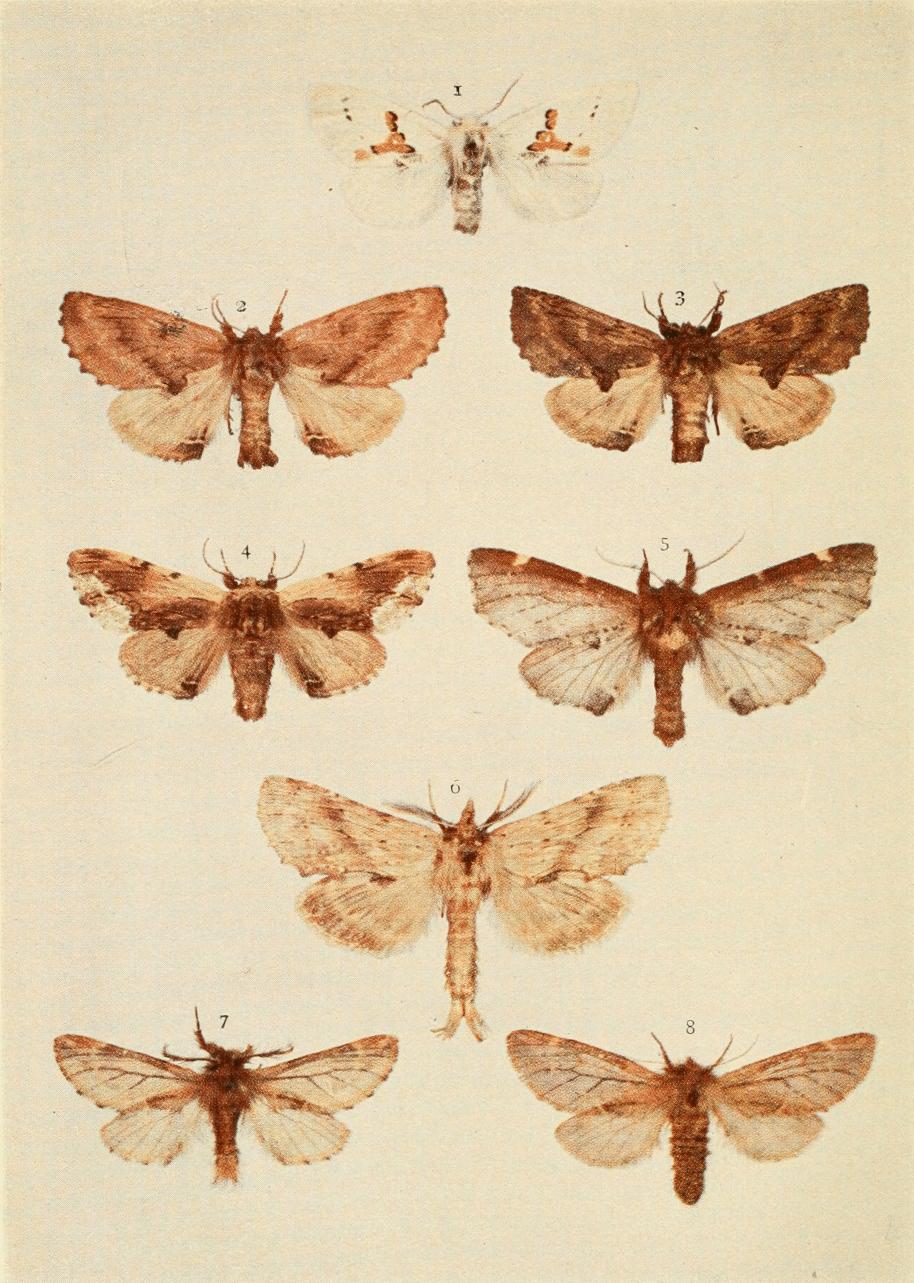
Pl. 33.
1.White Prominent. 2, 3.Coxcomb Prominent.
4.Maple Prominent. 5.Scarce Prominent.
6.Pale Prominent. 7.Plumed Prominent, male; 8, female.
The Plumed Prominent (Ptilophora plumigera).
The thinly scaled fore wings are ochreous brown in the male, and purplish brown in the female, and the markings, which are most in evidence in the male, are yellowish. Hind wings, more sparsely scaled than the fore wings, are pale ochreous brown in the male and darker in the female. It varies in the tint of general colour and in the intensity of the yellowish markings. In the female the antennæ are simple, but in the male they are very plume-like, hence the English name. Buckler describes the caterpillar as whitish blue-green, with a broad deep green stripe down the middle of the back, and a narrow yellow line on each side of it; spiracular line slender, white, and wavy; head rather small, glossy, yellowish green. When quite full grown and mature it changes to a uniform semi-transparent green, like the underside of a leaf of maple, upon which, and also sycamore, the caterpillar feeds in May and early June. Maple bushes growing in hedgerows are usually selected by the female moths when laying their eggs. These are placed on the twigs near a bud, and may be searched for at any time from November until April. The moth is shown on Plate 33.
This species was figured by Stephens (1828) as Ptilophora variegata and the only locality then known to him was Darenth Wood, where, he states, the caterpillar was obtained almost every year. It still occurs in Kent and possibly in its old haunt; it is also recorded from Watergate, Sussex; South Devon (Torquay district); and Gloucestershire. In Bucks, Berks, and Oxfordshire it is more frequent than in either of the counties previously mentioned, and in all it seems to be found chiefly in chalky localities. The moth, which is on the wing in November or sometimes in late October, has rarely been taken when flying at night or resting by day. Light has an attraction for the male, but apparently not for the female.
Distributed through Central Europe, its range extends to Southern Scandinavia, Northern Italy, Livonia, Bulgaria, S.E. Russia, and Japan.
The Pale Prominent (Pterostoma palpina).
This blackish streaked, pale brownish grey moth has been known as the Pale Prominent since 1775, when Moses Harris gave it this name. Beyond the black scaled tooth-like projection the inner margin is notched. The antennæ of the female are pectinated, but the teeth are shorter than those of the male; and the blackish streak on the wings are usually less defined. Except that some specimens are more strongly marked than others there is little to note in the way of aberration. Mr. Harwood of Colchester has, however, recorded an almost black variety, and this may be referable to the form from Russian Lapland, known as var. lapponica, Teich. The moth is figured on Plate 33, and the early stages on Plate 32.
The caterpillar is bluish green, with white lines along the back and sides, and a black edged yellow stripe along the spiracles; the stripe is marked with reddish on the three rings nearest the head. It feeds chiefly on poplar, but has been found on willow and sallow. Usually to be obtained full grown early in July or late in June; in the south and south-east of England, it is found also in September and October. The chrysalis is purplish, or reddish, brown and rather shining. It may be found, in a cocoon formed of silk mixed with particles of earth, among the roots of grass, etc., at the foot of poplar or willow trees. Moths are on the wing in May and June, and again in July and August. Coming to electric and gas lamps, as well as entering lighted rooms, and illuminated moth traps, they are often secured; otherwise they are rarely seen in a state of nature. The species is most frequent, perhaps, in the southern countries, but seems to occur throughout England; it becomes scarcer from the Midlands northwards to Durham and Cumberland. It occurs in Southern Scotland, and has been recorded from Moray. In Ireland it is widely distributed, but is not noted as common in any locality. The range abroad extends through temperate Europe into Asia Minor, and as far east as China and Japan.
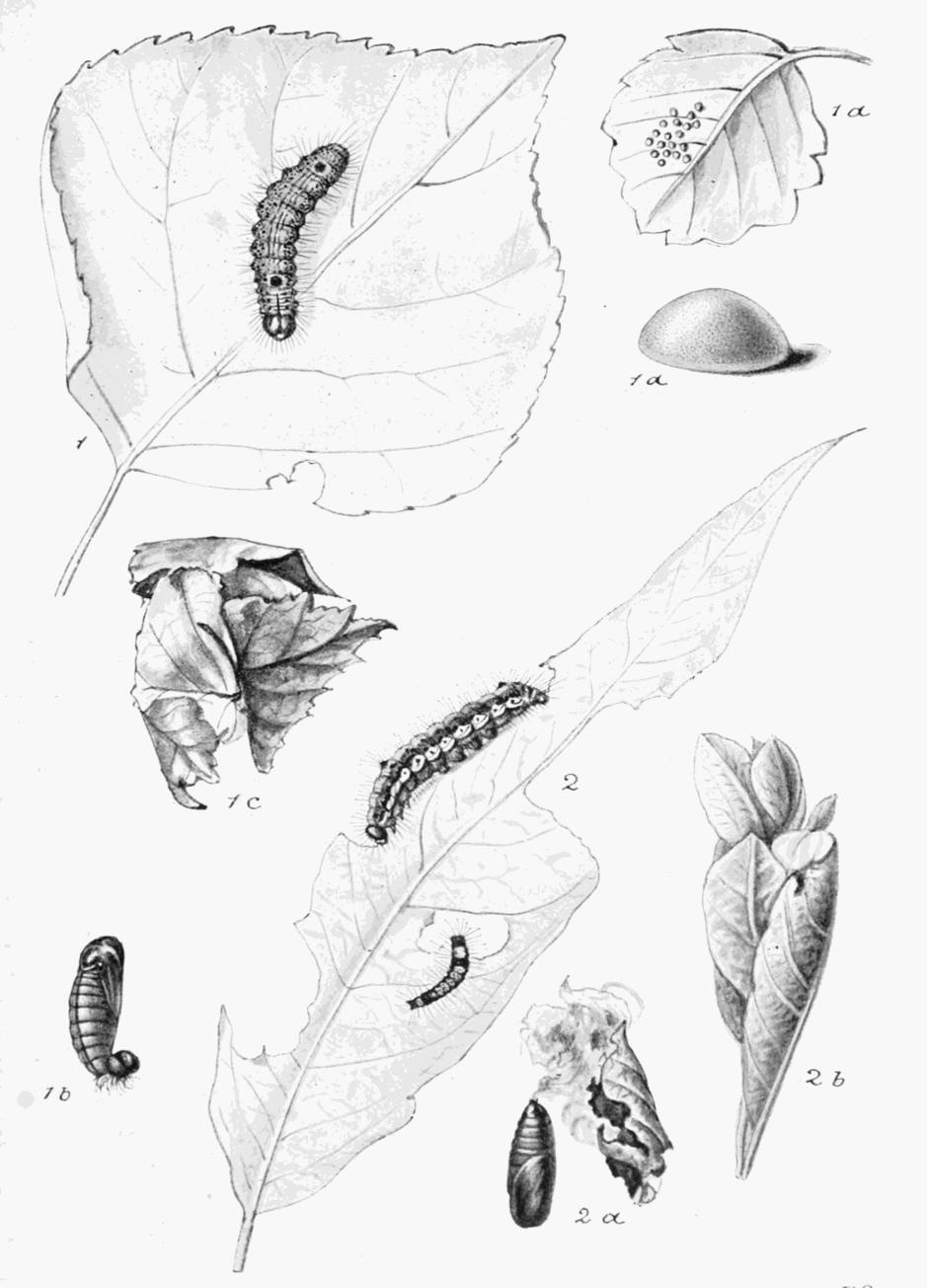
Pl. 34.
1, 1a, 1b, 1c.Chocolate Tip: egg, caterpillar, chrysalis and cocoon.
2, 2a, 2b.Small Chocolate Tip: caterpillar, chrysalis, cocoon and larval retreat.
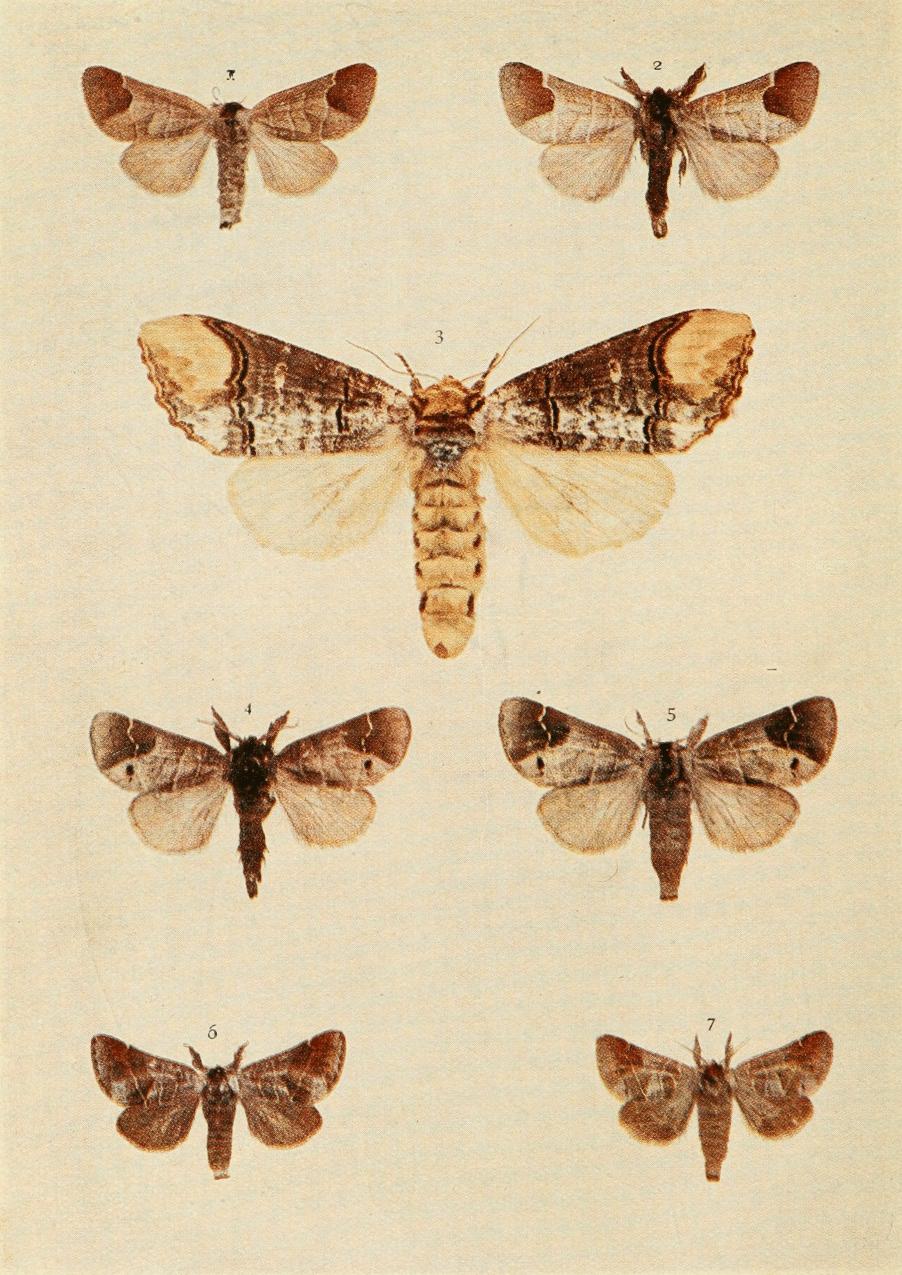
Pl. 35.
1, 2.Chocolate-tip Moth. 3.Buff-tip Moth.
4.Scarce Chocolate-tip, male; 5 female. 6.Small Chocolate-tip, male; 7 female.
The Buff-tip (Phalera bucephala).
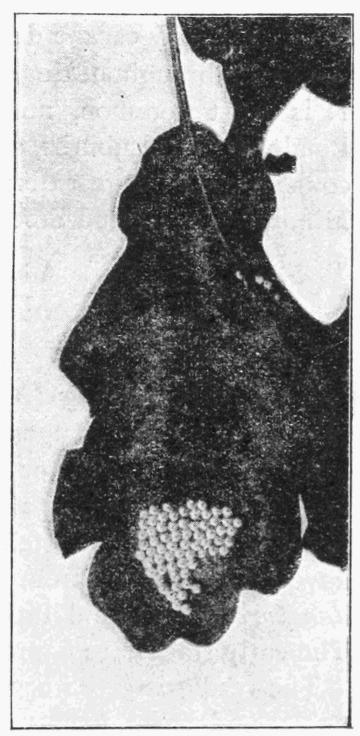
Fig. 21.
Eggs of Buff-tip Moth.
This species (Plate 35, Fig. 3) is easily recognized by its violet-grey fore wings, and the more or less round, pale, ochreous blotch on the outer third. The blotch is clouded, to a greater or lesser extent, with pale brown, and the inner area of the wings is flecked with silvery grey; the cross lines are edged with reddish brown.
The rather downy caterpillar is yellow, with several interrupted blackish lines, and of these the one along the middle of the back is the broadest and blackest; head black. It feeds, during August and September, in companies, until nearly full grown, and the foliage of almost any kind of tree or bush appears to be suitable food, although that of elm, lime, and hazel is often selected by the female moth when depositing her whitish eggs, which she lays in neatly arranged batches on the undersides of the leaves. If undisturbed, a company of these caterpillars quickly clear a fair-sized branch of all leafage. The chrysalis is purplish brown (the early stages are shown on Plate 37).
The moth flies in June and July, but is rarely seen in the daytime. The wings in repose are closely folded down to the body and the insect has then a very stick-like appearance, and may thus easily escape detection.
Occurs throughout England and Wales, Ireland, and Scotland. It is most common, and the caterpillar often abundant, in London and its suburbs, as well as other southern parts of the country. Its range extends through Europe to Northern Asia Minor, Armenia, and Siberia.
The Chocolate-tip (Pygæra curtula).
Two examples of this moth are shown on Plate 35. Fig. 2 represents the spring (April and May) form, and Fig. 1 the summer (July and August) form. Sometimes there is a third brood, in September or October, and Barrett describes the individuals of this as "pale drab, dusted with darker atoms, and with the chocolate blotch paler towards the apex." Hybrids have been obtained from a pairing between curtula female and anachoreta male, and these were most like the female parent. The early stages are figured on Plate 34, Figs. 1-1c.
The verdigris-green eggs are laid in batches on the leaves of poplar and aspen, upon which the caterpillars feed in May and June, and, as a second brood, in August and September. In colour the caterpillar, which is rather hairy, is grey, with a pinkish tinge, sprinkled with black, and with orange spots on the sides; there is a raised black spot on the fourth ring, and another on the eleventh; head blackish. The chrysalis is reddish-brown, spun up in a packet of leaves. This species appears to be less common in England than formerly. It is, perhaps, more often observed in Kent and Sussex than in the other counties it inhabits, which, according to Barrett, are Berks, Essex, Suffolk, Norfolk, Cambridge, in all of which it is local; also, but more rarely, in Gloucestershire, Worcestershire, Herefordshire, Leicestershire, Yorkshire, and Cumberland, the latter county being its northern limit. To the above may be added Hertfordshire and Middlesex. Although caterpillars are reported to have been found in Ireland, the moth has not been reared in that country.
This species is distributed through Northern and Central Europe, extending to South France, Corsica, North Italy, Bulgaria, Armenia, and Mongolia.
The Scarce Chocolate-tip (Pygæra anachoreta).
This moth is distinguished from that last referred to by the black spots in and just below the blotch at the tip of the fore wings; the blotch itself is dull reddish, merging outwardly into greyish, and is intersected by a white line. There is some variation in the tint of the general colour, ranging from dusky to reddish grey, but otherwise the species is constant (Plate 35, Figs. 4, 5).
The caterpillar, which feeds on poplar and sallow from May to August, or even later, is rather hairy, dark grey or blackish in colour; there are four ochreous or whitish lines on the back, and a row of black spots followed by a series of orange ones on the sides; below the spiracles are some yellowish markings; the raised spots on rings four and eleven are reddish brown; the former has a white spot on each side, and the back of the latter is edged with white; head black and rather glossy. Chrysalis blackish in hue, spun up among leaves. The moths emerge in May, and again in July; in confinement there is sometimes a third brood in September. Except that two specimens were reported as found in a street at Deal, the moth does not seem to have been noticed at large.
This species was known to Haworth, but, as a British insect, was exceedingly rare until 1859, when Dr. Knaggs found some caterpillars upon poplar in the neighbourhood of Folkestone. From the stock then obtained the moths were reared in numbers for some time. Batches of eggs were also put down in various localities, and the species seems to have flourished in some of them for a while, but failed eventually to establish itself in any of them. Then the species disappeared from the Folkestone locality, although a caterpillar or two were found there in 1861, and on to 1912 in other places on the Kentish coast. In 1893 eggs were obtained at St. Leonard's, in Sussex, and thus originated a new stock.
The species has a wide range in Central and Northern Europe, extending to some of the southern parts; it also occurs in Siberia, Amurland, China, and Japan.
The Small Chocolate-tip (Pygæra pigra).
This species will be recognized by its smaller size and less distinct chocolate blotch on the tips of the fore wings. The ground colour varies from whitish grey to pale brownish grey; the pale cross lines are usually well defined; the first is bordered with chocolate colour, and angled above the middle; the third line runs from a white spot on the costa and through the chocolate patch. The moth is shown on Plate 35, and the early stages on Plate 34.
Of the offspring resulting from eggs laid by a female curtula that had paired with a male pigra, and also those from a female pigra crossed with a male curtula, the hybrids in each case most nearly resembled the female parent.
The eggs are pale olive green tending to brownish, and all that I have seen have been laid in irregular lines on leaves, or on the sides of a chip box. The caterpillar is greyish, with some short hairs and black dots; the back is broadly marked with yellow, and there is a yellow stripe, with black dots on it, low down on the sides; rings four and eleven have each a raised black spot; head blackish. Feeds from June to September, on dwarf sallow (Salix repens), and also on young plants of aspen. Like other caterpillars of this genus, it hides by day in a packet of leaves spun together. There are certainly two broods, if not more, in the year. The moth emerges in May, and more irregularly in July or August, and October. Except when attracted to a light, the moth is rarely seen, but in fens, marshes, and boggy places generally, the caterpillars may often be obtained in numbers almost throughout the United Kingdom. Its distribution abroad embraces Northern and Central Europe, with extension into Northern Spain and Italy; Bulgaria, South-east Russia, and Armenia.
THYATIRIDÆ.
The nine British species next to be considered belong to the old family Cymatophoridæ, but as the name Cymatophora, as indicated by Hübner in the "Tentamen" (1816), is now generically used by authors for some species of Geometridæ; and as Hübner's Verzeichniss generic names will have to be used for the species previously included in Cymatophora, Tr., the term Thyatiridæ has here been adopted for this family—the Polyplocidæ of Meyrick and others.
The Buff Arches (Habrosyne derasa).
This pretty species (Plate 36, Figs. 1, 2) is well distributed over the greater part of England and not at all uncommon in the more sylvan districts of the southern counties. It occurs in Wales but has only once been recorded from Scotland. In Ireland it is found in almost every well-wooded locality, but is not generally common. The moth hides among the foliage of the bramble and also creeps under the withered leaves on the ground. It comes freely to sugar, and is often the earliest to attend the banquet, but is rather skittish at first and should be given time to settle down.
The fore wings are pale olive grey with two whitish streaks across them, the first oblique approaching the second towards the inner margin; the space between the streaks is clouded with brownish buff and there is a whitish cloud on the costal area, and some strongly waved cross lines before the second streak.
The caterpillar, which is rusty brown, with a blackish central line on the back, a black edged yellowish spot on ring four, a smaller one on ring five, and sometimes a tiny one on ring seven, feeds in August and September, sometimes later, on bramble, and is said to eat hawthorn and hazel. It hides during the day and comes up to feed at night. The chrysalis, which is enclosed in an earthen cocoon below the surface of the ground, or sometimes among moss, is purplish black with the ring divisions reddish; the anal spike is furnished with hooks. As a rule the moth does not emerge until June or July following the year of pupation, but it has been found on the wing in September and October.
Distributed over Central Europe, extending into Southern France, and Northern Italy, Southern Sweden and Livonia, and eastward to the Himalayas, Corea, and Japan.
The Peach-Blossom (Thyatira batis).
The olive brown fore wings of this moth are adorned with five pink-tinged whitish spots, and clouded with brown; the pink tinge varies in amount and in brightness, and sometimes gives place to pale ochreous. The moth is figured on Plate 36, and the early stages on Plate 37.
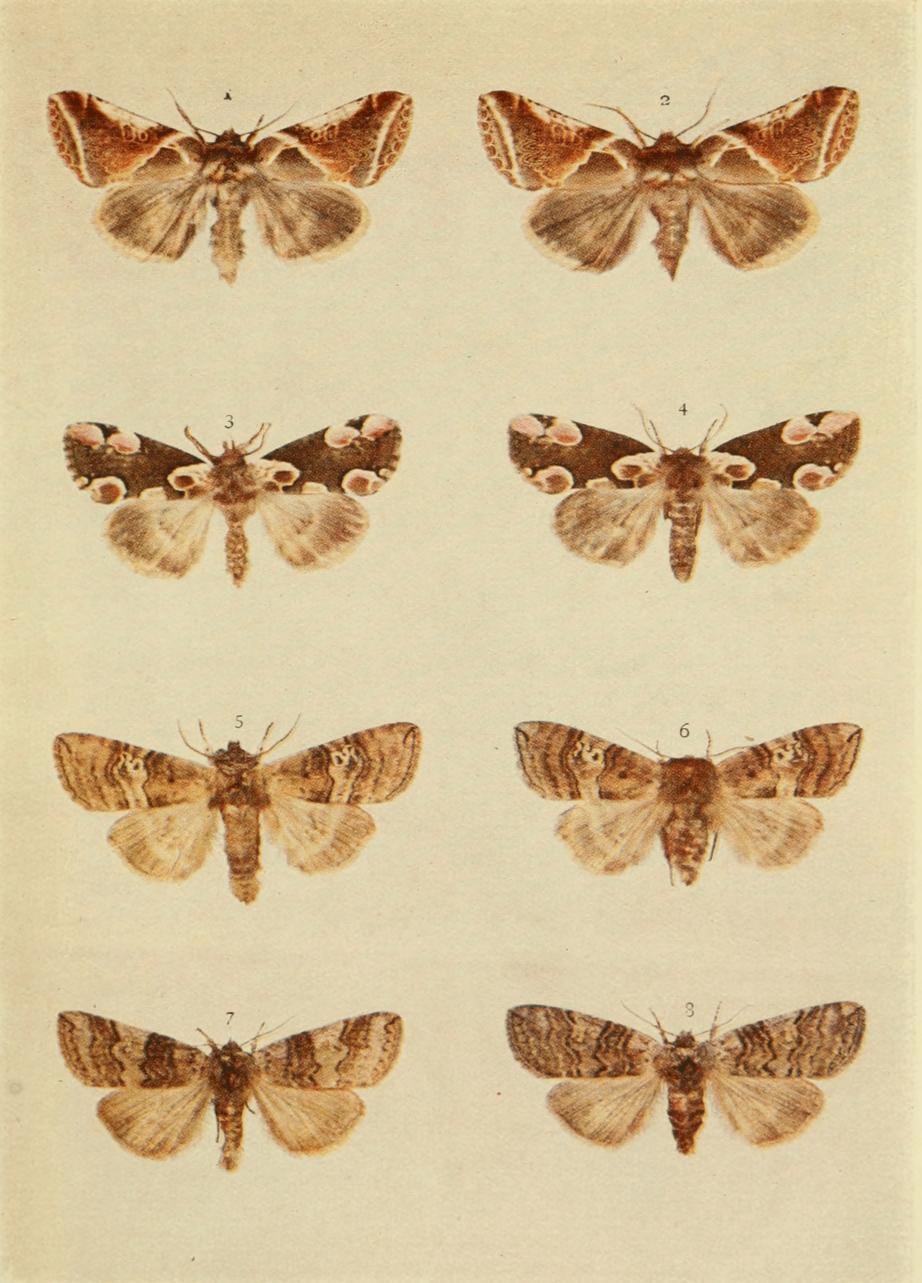
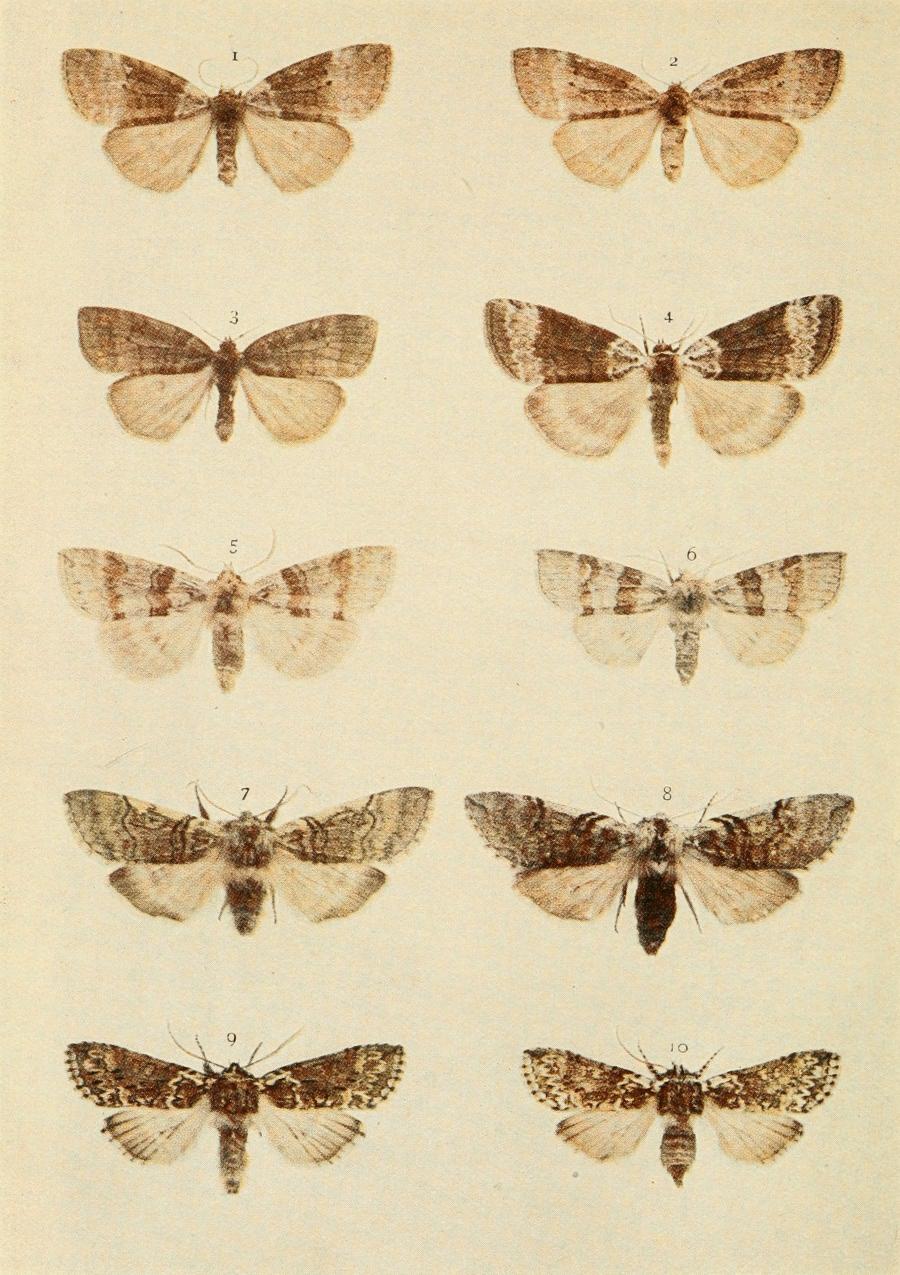
Pl. 36.
1.Buff Arches Moth, male; 2 female. 3.Peach-blossom Moth, male; 4 female.
5.Figure of Eighty, male; 6. female. 7.Poplar Lutestring, male; 8 female.
Pl. 37.
1, 1a.Buff-Tip: eggs and caterpillar.
2, 2a, 2b.Peach-Blossom: eggs, caterpillar and chrysalis.
The fluted greenish-white eggs are laid upon the edges of bramble-leaves.
The caterpillar is pale reddish brown shaded with darker and freckled with whitish (in the young stage the second and third rings are whitish above); a slender dark brown line along the middle of the back, and a broader one along the sides, the latter not distinct on the first three rings; the two rings nearest the head each have a divided ridge, the second being the larger; there are also similar ridges on the fifth to ninth rings, and the back of ring eleven is slightly raised; a series of pale triangular marks on the back. It feeds on bramble in July, and may be found from that month until September.
In confinement it will thrive on raspberry or the cultivated kinds of blackberry. From some thirty eggs I had in June this year (1907) the caterpillars hatched on the 27th; several of these fed up rapidly and one or two had spun up for pupation, among the leaves, in July (about 24th), whilst others remained quite small, and a few were in the last skin but one. Early in August the larger caterpillars just referred to pupated, and the smaller ones began to feed up, and by the end of the month they had attained to full growth, although they did not spin cocoons until the second week in September.
From July chrysalids moths will often emerge in August or September of the same year, but none have appeared from those under observation. The chrysalis is pale brown mottled with dark purplish or reddish brown, wing cases reddish. The species frequents woods or wooded localities, and is generally distributed throughout England and Wales, but commoner in some parts than others. Rather local in Scotland but not uncommon in Perthshire. Sometimes very abundant in Ireland, occurring in similar localities to the preceding species. It is found over the greater part of Northern and Central Europe, and as far east as Amurland and Japan.
The Figure of Eighty (Palimpsestis octogessima).
This moth (Plate 36, Figs. 5, 6) may be distinguished by two whitish marks on the fore wings which have some resemblance to the numerals 80, hence the common name. These are really the white outlines of the reniform and orbicular stigmata, each of which has the central part filled in with black; sometimes the lower portion of the 8 is obscure, but in a general way the character is not difficult to make out.
The caterpillar is yellowish tinged with greyish on the back; a greyish plate on the back of the ring nearest the black marked orange head; three black spots on each side of the first ring, two such spots on ring two, and one on each side of rings three to eleven; the back of the last ring has a greyish plate. It feeds in July and August, earlier or later in accordance with season, on poplar. During the day it hides between united leaves, or in a curled up withered leaf, upon the tree. The shining black chrysalis with somewhat reddish ring divisions is enclosed in a rather loosely constructed cocoon spun up between leaves, or among moss etc., at the base of poplar trees. The moth emerges in May or June. It is partial to sugar, and is said to prefer its sweets served up on poplar trunks. Probably it is most often and regularly obtained in the Eastern Counties, but it is locally not uncommon in Worcestershire and Herefordshire; also found in Gloucestershire, Somerset, Hertfordshire, Middlesex, Surrey, and, I believe, Sussex. The range abroad is similar to that of T. batis.
The Poplar Lutestring (Palimpsestis or).
May be recognized in the typical form by the four-lined bands, "lutestrings," on the greyish, sometimes pink-tinged fore wings; the reniform and orbicular marks are often present although the first is generally obscure, and they never assume the similarity to figures noted in the last species (Plate 36, Figs. 7, 8). In Scotland the moths have a paler ground colour generally, var. scotica, Tutt; one from Ireland with ground colour pearly white and broad black "lutestrings" has been named var. gaelica, Kane. Hybrids from a cross pairing of this species with the last have been obtained by Mr. W. H. B. Fletcher. These specimens have the "lutestrings" of or, and the "figure of 80" characteristic of octogessima. Caterpillar yellowish green with a dark line along the middle of the back, and two black spots on the front edge of the ring next the yellowish brown head. It feeds on poplar, and hides between united leaves in the daytime; may be found from July to September or even later. Chrysalis, reddish brown, the surface minutely pitted, and spike pointed, and thickened at the base; in a brownish cocoon spun up between leaves. The moth emerges in June or July, and it comes freely to sugar, but like other members of this family is not always easy to box. It seems to occur in most places where poplar trees are well established; widely distributed over England, and found throughout Scotland even to the Shetland Isles. In Ireland it seems to be local and rare. Distribution abroad much as in the last species.
The Lesser Satin Moth (Palimpsestis duplaris).
Figs. 1, 2, on Plate 39, represent the typical southern form of this species. The fore wings are pale greyish with a whitish edged, broad, dark central band; two black dots on the outer edge of the band distinguish this species from the next. In Scotland and in Northern England the general colour is blackish or purplish grey (Fig. 3), and sometimes specimens more or less suffused with the darker colour are found in the southern half of England. Quite the darkest, almost black, form seems to occur in Cannock Chase, Staffordshire, and in Delamere Forest, Cheshire. The caterpillar is greenish; central area of the back green, margined on each side by an olive green, or brighter green, stripe; some black dots along the sides; head reddish brown marked with black. Feeds on birch, and may be found from August to October. It spins the leaves together for a shelter during the daytime, and comes out to feed at night, when it may be obtained by beating the boughs. Other food plants mentioned are alder, oak, and hazel. The pupa is of a dull reddish colour, in a slight cocoon between leaves.
Widely distributed throughout England and common in most woodlands, especially in the south and east; it ranges through Scotland to the Shetlands. In Ireland, where the moth has the ground colour silvery grey (var. argentea, Tutt), it has been obtained in many localities, from Donegal and Tyrone to Kerry and Cork.
The Satin Carpet (Palimpsestis fluctuosa).
In colour and general pattern this species (Plate 39, Fig. 4) is very similar to the last in its typical form. The points of distinction are, the slightly larger size, whiter ground colour, and the absence of the two black dots from the edge of the band. In August and September the caterpillar feeds, at night, on birch, and by day conceals itself between leaves. It is reddish or violet grey above, and pale ochreous-white beneath; the lines down the centre of the back and along the sides are darker; on the first ring there is a greenish-tinged yellow plate, and from this to the eleventh ring there are two series of black dots along the back. Head yellow-brown, blackened above; a black circle on each cheek. Chrysalis reddish-brown, in a cocoon among leaves either on the tree or on the ground. The moth emerges in June, and is distinctly local. Sometimes it may be disturbed from its resting place among the foliage; it becomes active on the wing at dusk for a short time; sugar does not seem to possess any great attraction for it, anyway it does not attend the feast prepared for Noctuæ so frequently as other members of this family. It is known to occur, chiefly in woods, in Kent, Surrey, Sussex, and Hampshire in the south; Essex and Suffolk in the east; also in Worcestershire (Wyre Forest), and Herefordshire; in the Barnsley and Sheffield districts of Yorkshire; and it has been reported from Cumberland. In Ireland it is rare and only recorded from Killarney, Kerry, and Sligo. Abroad it occurs in Central Europe, the range extending to Southern Scandinavia, and to South-east Russia.
Pl. 38.
1. Frosted Green: caterpillar.
2, 2a, 2b, 2c. Yellow Horned: egg, caterpillar, chrysalis and cocoon.
Pl. 39.
1. Lesser Satin Moth, male; 2 female; 3 northern var. 4.Satin Carpet Moth.
5. Lesser Lutestring, male; 6 female. 7, 8.Yellow-horned Moth.
9. Frosted Green Moth, male; 10 female.
The Lesser Lutestring (Asphalia diluta).
The fore wings are whitish or greyish, and sometimes tinged with brown; crossed by two brownish bands. Variation is chiefly in the tint of the bands and also in their width and definition. In var. nubilata, which occurs in Yorkshire, the general colour of the fore wings is darker than normal, and there is a basal patch and three cross-bands of reddish or purplish brown (Plate 39, Figs. 5, 6).
Caterpillar, yellowish above and greyish beneath; a dusky line along the middle of the back, and one, dotted with black, low down on the sides; head dark brown, almost blackish. It feeds in May and June on oak, but only at night; it constructs a leafy chamber in which it sits tight during the day, and is not easily evicted unless its apartment is forcibly opened. The reddish chrysalis is enclosed in a flimsy cocoon between, or among, leaves. Although September is the month during which the moth usually emerges, it is sometimes seen earlier. It is so partial to sugar, that it may often be seen at an old patch before the new feast has been set out for the evening entertainment. The species is fairly well distributed throughout England and Wales, and most common in the south of the former country. It extends into Southern Scotland, but apparently does not occur in Ireland. Abroad it is found in Central Europe, Belgium, North Germany, North Italy, and North-east Asia Minor.
The Yellow Horned (Polyploca flavicornis).
In the South of England this species is greenish grey, sometimes speckled or dusted with darker grey; the reniform and orbicular marks are generally clear and distinct, but in some examples they are united and form a whitish blotch outlined in blackish; the cross lines are usually well defined, but in the dark grey dusted form are very obscure. Specimens from Scotland are generally larger, there is less green, if any, in the ground colour, and the markings are often more pronounced and brighter. This form is the var. scotica, Tutt, and may be more or less identical with the var. finmarchia, Schöyen, from Norway and Lapland (Fig. 7, Plate 39, shows the English form, and Fig. 8 the Scotch form).
The caterpillar is greenish, light olive green, or dark olive green above, and yellowish beneath; a line along the middle of the back is paler, and on each side there is a row of black spots and finely black-edged white dots; a line above the brownish outlined spiracles is yellowish: the head is yellow brown with blackish jaws and black mark on each cheek. It feeds in June and July on birch, preferring the foliage of bushes. During the daytime it resides in a leaf neatly folded in half; when quite young, the caterpillar then being blackish, a small leaf or just the turned-over edge of a large one answers its purpose. The chrysalis is reddish, enclosed in a flimsy cocoon among leaves, moss, or roots of grass, etc., sometimes just under the surface of the soil. The early stages are figured on Plate 38, Figs. 2-2c. The moth emerges in March or April of the year following pupation, as a rule, but it may remain in the chrysalis for two winters. It is often obtained in birch woods, or wherever there is a good growth of birch, by jarring the twigs and branches of birch upon which it rests during the day, or it may be found by searching the low bushes and underwood. Soon after dusk it is on the wing, and will then visit sugar and sallow bloom.
Generally distributed throughout Great Britain. In Ireland it appears to be very rare. Its range abroad, in the typical form, extends over Northern and Central Europe to North Italy and to South-east Russia.
The Frosted Green (Polyploca ridens).
This moth (Plate 39, Figs. 9, 10) is also on the wing early in the year, but although it is sometimes found on tree trunks in April or perhaps as late as the first week in May, it seems to be rarely obtained otherwise in the perfect state. It does not "come to sugar" often, if at all, and so far as is known, does not visit any of the usual natural attractions.
The ground colour of the fore wings varies from whitish to green, but in some specimens the general hue is olive or blackish green, and the markings then appear to be wavy whitish lines crossing the wings, one near the base, and the other before the outer margin.
The caterpillar (Plate 38, Fig. 1) is yellow above and rather greenish beneath; a greenish grey double stripe along the back is interrupted at the ring divisions; there are also white dots with black or blackish edges on the back and the sides; a yellow line along the spiracle area is shaded above and below with greenish grey; the head, which is notched on the crown, is yellowish, with a black mark on each cheek. It feeds, at night, on oak, from May to July; hiding by day on the underside of a leaf, a portion of which is folded over and secured with silk, to form a suitable retreat. These caterpillars respond more readily to the persuasive beating-stick than others of the group.
The species affects woodland localities in most of the southern counties of England, and it is also found in South Wales. Its range extends into the Eastern Counties and through the Midlands northward to Cumberland. It does not seem to have been noted from Scotland or Ireland. Abroad it is distributed over Central Europe and northward to Denmark and Livonia, and southward to South France and Andalusia.
Tussock-moths (Lymantriidæ).
About seventy-two species, referred to this family, are known to occur in various parts of the Palæarctic region; ten of these are found in our islands. The Black V-moth (Leucoma v-nigrum or Arctornis l-album) has been reported as British, but if the few examples that have been recorded were natives, the species has long since disappeared from this country.
Some of the caterpillars, as, for example, those of the Brown and Yellow-tails, are not altogether pleasant to handle, as the hairs with which they are covered have a disagreeable trick of transferring themselves to our hands, whence they find their way to our face, and when there are apt to set up most unpleasant irritation and swelling of the parts affected. These urticating hairs are more troublesome when received from the caterpillar or cocoon, but those from the moth itself communicate a very respectable simulation of the skin trouble known to the doctor as Urticaria.
The Scarce Vapourer (Orgyia gonostigma).
The male of this species, and also of the next, flies in the sunshine, but the female of each is wingless, or nearly so, and has to remain at home on the cocoon from which she emerged. Here she lays a large number of eggs, from four to five hundred, upon the exterior. The eggs of this species are whitish and rather glossy when first laid; the top is sunken. Apart from the deeper brown colour of the fore wings and the blacker hind wings, the male of this species has a white mark near the tip of each fore wing, and this character will distinguish it from the same sex of the Common Vapourer.
The caterpillar is blackish with star-like tufts of hair, white on the back and greyish on the sides; on rings four to seven are brushes of brown hairs; a pencil of black hair on side of the first ring pointing forward, and a thicker one on the back of ring eleven directed backward; the interrupted stripes along the back and sides are reddish orange, approaching vermilion; those along the back are united in front of the pencil on ring eleven, and those of the sides unite behind the pencil. Head glossy, black. The foliage of sallow, willow, and oak, is perhaps the more usual food, but it has been known to eat beech, elm, hawthorn, sloe, and nut, and has been found on meadow-sweet. The chrysalis is brown, inclining to yellowish between the rings, and the back is hairy; enclosed in a cocoon spun up among leaves or in any suitable cranny. The male and female moths are figured on Plate 40 (Fig. 3, 5), and the caterpillar and chrysalis on Plate 41.
The moths emerge in June, and from their eggs caterpillars result in July. These, feeding up quickly, attain the perfect state in late July or early August. Caterpillars from this second generation usually go into hibernation when quite small, and feed up in the following April and May; in confinement they may, however, get through their metamorphosis and reach the moth state in September or October. Sometimes it happens that a part of the summer brood of caterpillars will feed up straight away and produce moths in August; others, feeding and growing more slowly, assume the winged state in November; whilst a third portion will remain small and go into hibernation.
This very local species used to be obtained in the Wimbledon district, but it has not been seen there for some years past. Other localities for it are the Norfolk and Cambridge fens, Bewdley Forest in Shropshire, and Wyre Forest, Worcestershire; it is also found in some parts of Devonshire, Suffolk, Essex, and Yorks. Its range abroad extends through Northern and Central Europe, southward to North Spain, Piedmont, and Corsica, and eastward to Amurland, Corea, and Japan.
The Vapourer (Orgyia antiqua).
The male has the wings rather more ample than the same sex of the last species, the colour is a more ochreous red and there is a large white spot at the lower angle of the fore wings, but no white mark at the tips of these wings. Specimens from the north of England are rather darker than southern examples. In the course of temperature experiments it has been noted that the colour of the moth is darkened if the chrysalids are put in a refrigerator for a few weeks, and then brought into a mean temperature of 40° Fahr. In the female the appendages representing wings are somewhat larger than those of the female of the Scarce Vapourer, but are quite useless as organs of flight (Plate 40, Figs. 4, 6).
In general colour the caterpillar is violet or smoky grey; the markings on the back comprise a creamy, red-dotted line along the middle area, this is edged with black, and on each side of it is a series of raised red spots; the broken line along the sides is yellowish, and the four brushes of hair on the back are yellow, sometimes merging into brown above; the pencils of longer hairs are blackish on the ring nearest the head, and dark grey or brownish on the last ring. It may be found through the summer on the leaves of most trees and bushes. Chrysalis blackish, glossy, and rather hairy. The cocoons are spun up in the crevices of bark on tree trunks, or in the fork of a twig, under the eaves of an out-house or shed, on palings and fences, etc. The hairs of the caterpillar are mixed with the silk of the cocoon; the female lays her pale brownish eggs, which are minutely pitted and have a darker ring below the sunken top, on the outside of the cocoon, and there they remain through the winter.
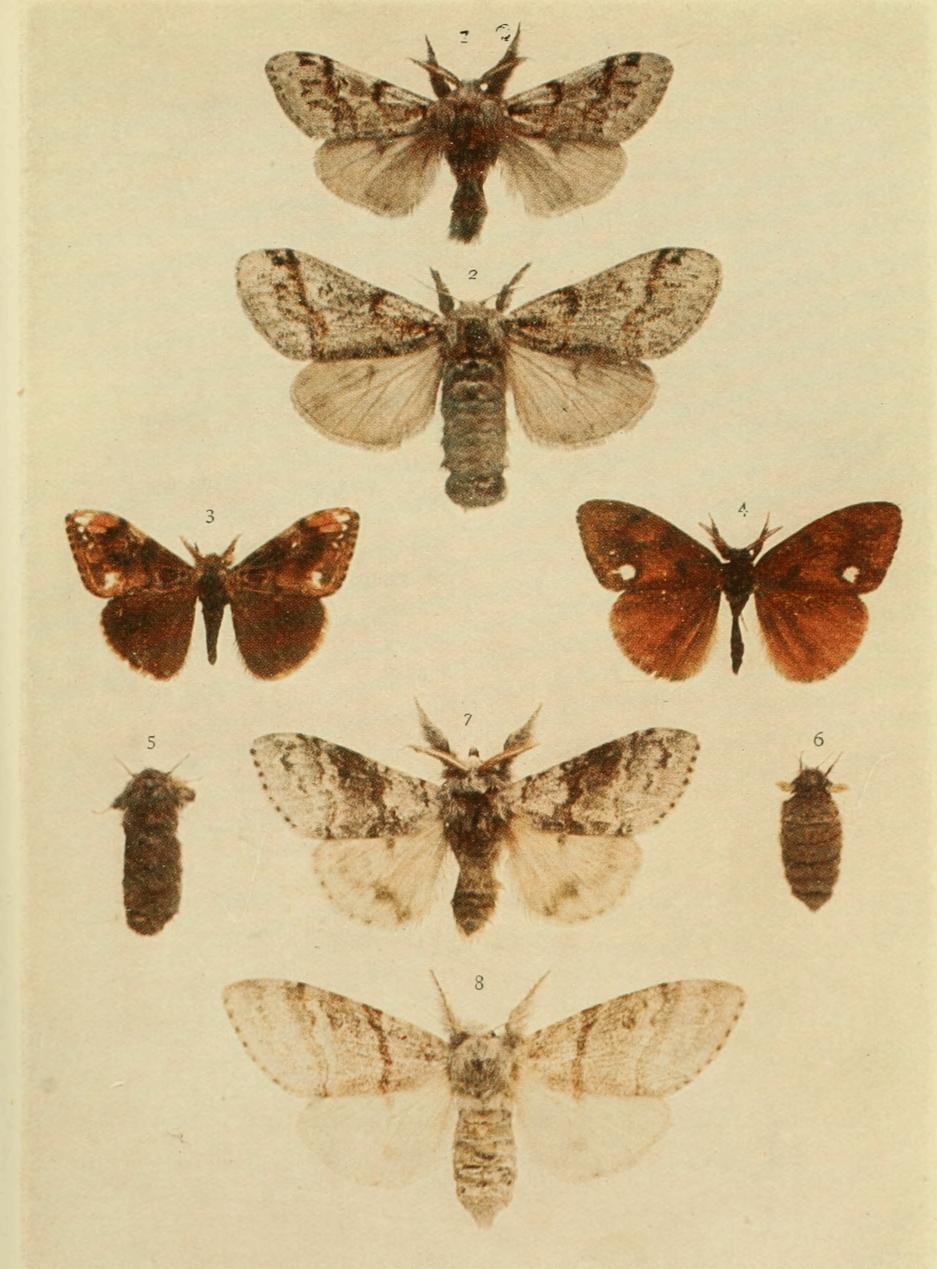
Pl. 40.
1. Dark Tussock Moth, male; 2 female. 3. Scarce Vapourer, male; 5 female.
4. Vapourer, male; 6 female. 7. Pale Tussock, male; 8 female.
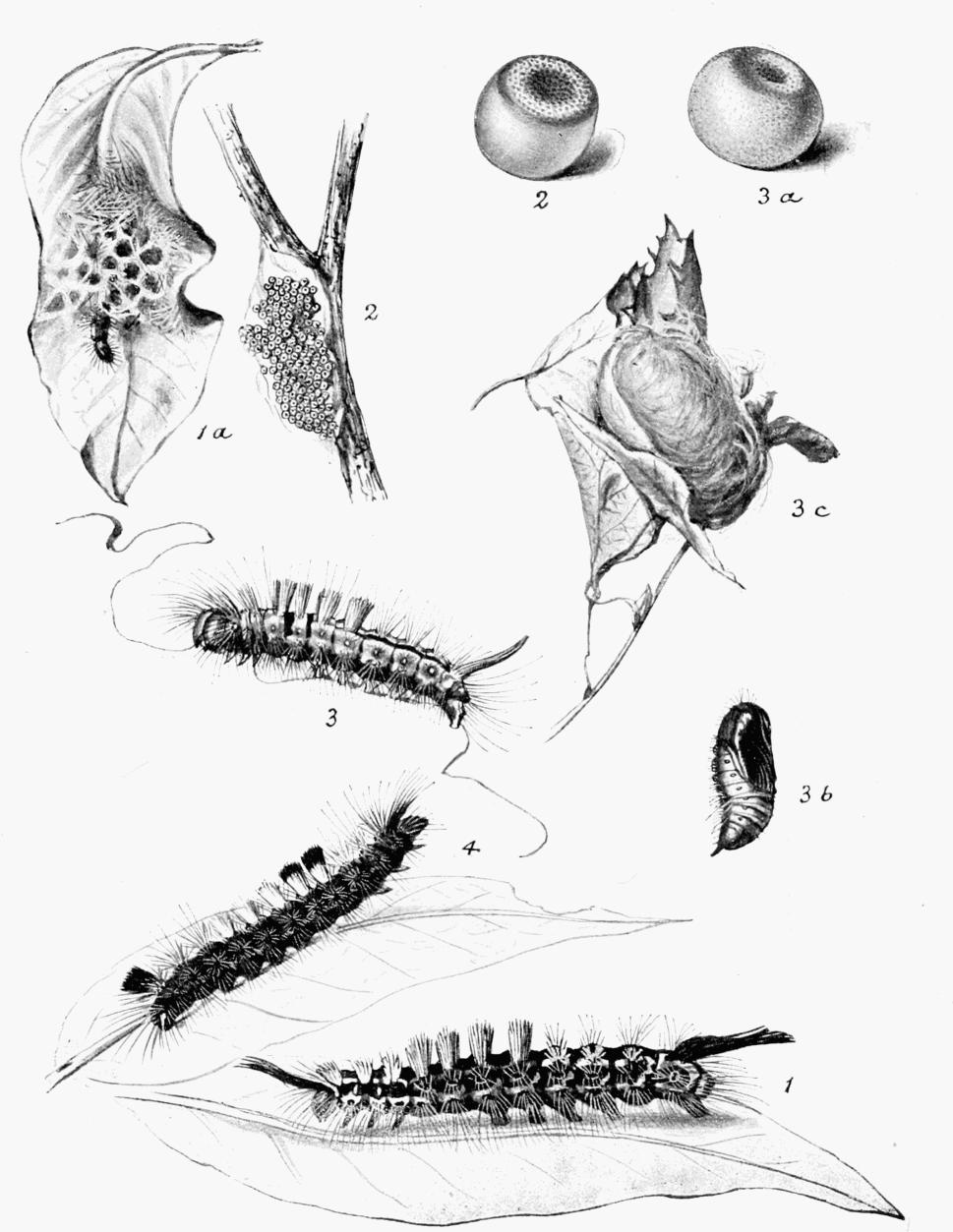
Pl. 41.
1, 1a.Scarce Vapourer: caterpillar and cocoon.
2, 2a.Common Vapourer: egg-batch on cocoon and enlarged egg.
3, 3a, 3b, 3c.Pale Tussock: egg, caterpillar, chrysalis and cocoon.
4.Dark Tussock: caterpillar.
Generally distributed throughout the United Kingdom, but not so common in Ireland as in England and Scotland. It is quite a Cockney insect, and is found in almost every part of the Metropolis where there are a few trees. Occurs practically over the whole of Europe, and in North-east Asia Minor, Armenia, Siberia, Amurland, and North America.
The Dark Tussock (Dasychira fascelina).
The figures of the sexes of this species on Plate 40 represent the dark grey form. Sometimes the forewings are whitish grey and occasionally slaty grey; the cross lines may be stronger or fainter, and in some specimens are nearly absent; the yellowish colour usually seen on the cross lines may be missing, or, on the other hand, other parts of the wings may be stippled with yellowish. Laying her eggs in batches, the female carefully covers them with dark brown hairs from the tuft at the end of her body.
The caterpillar (Plate 41, Fig. 4) is blackish, with star-like tufts of hairs, yellow, mixed with longer blackish ones towards the head and tail, brownish grey on the middle portion; a brush of black hairs on rings four, five, and eleven, and of white hairs on six, seven, and eight. Head black. When full grown (Plate 42, Fig. 3) the hairs of the body are greyish, and those of the brushes on the back are black flanked with white. When disturbed it rolls in a ring. It feeds on hawthorn, and various species of Salix, also on broom and ling. It hibernates when still small, in a silken cocoon-like envelope which it spins in the fork of a branch, or among the twigs of a bush; growth is completed in April or May, and the winged state attained in June or July. Sometimes the young caterpillars have been found in their winter quarters about the middle of July, and this would seem to imply that they occasionally lie dormant for two winters; at least this would appear to be so in Scotland whence such individuals have been recorded, with the additional information that they did not eat through the summer and that one was still alive in the following March. The chrysalis is glossy black, and hairy (Plate 42, Fig. 3a).
This is chiefly a northern insect, occurring most commonly on the Cheshire, Lancashire, and Cumberland coast. It is more generally distributed in Scotland and is often abundant on the moorlands. In Ireland three caterpillars were found by Mr. Kane in the Bog of Allen, and the species has also been recorded from Tullamore and Mullingar. Distribution: Northern and Central Europe, extending to the Altai.
The Pale Tussock (Dasychira pudibunda).
This moth is much commoner and more widely distributed in England than that last mentioned. The central area of the greyish white fore wings is subject to variation in width and also in tint; this latter may be darker or lighter than the example shown on Plate 40, and the cross lines are in some specimens black and very distinct. The colour of the female ranges from pale greyish white through various tones of grey, and the bands on the hind wings may be as well defined as in the male. Black males of the species have been recorded.
The hairy caterpillar is green or yellow, the former mottled with whitish and the latter with greenish; on rings 4 to 7 are thick brushes of yellow hairs, and on ring 11 there is a tuft of reddish hair; the back is marked with black between the brushes, and there are black spots on the sides of the hind rings. Sometimes the caterpillar is light or dark brownish and the brushes are then greyish, or tinged with pale reddish or blackish. Altogether it is a pretty creature, and as it is, or was previous to the modern "washing," common in hop gardens at picking time, it was christened the "hop dog." It may be found from July to September on the foliage of birch, hazel, oak, and many other trees, as well as on hop. The moth appears in May and June, and rests by day on herbage, especially on bracken in woods (see Fig. 6, p. 7); at night it comes readily to light, but specimens so obtained are generally of the female sex.
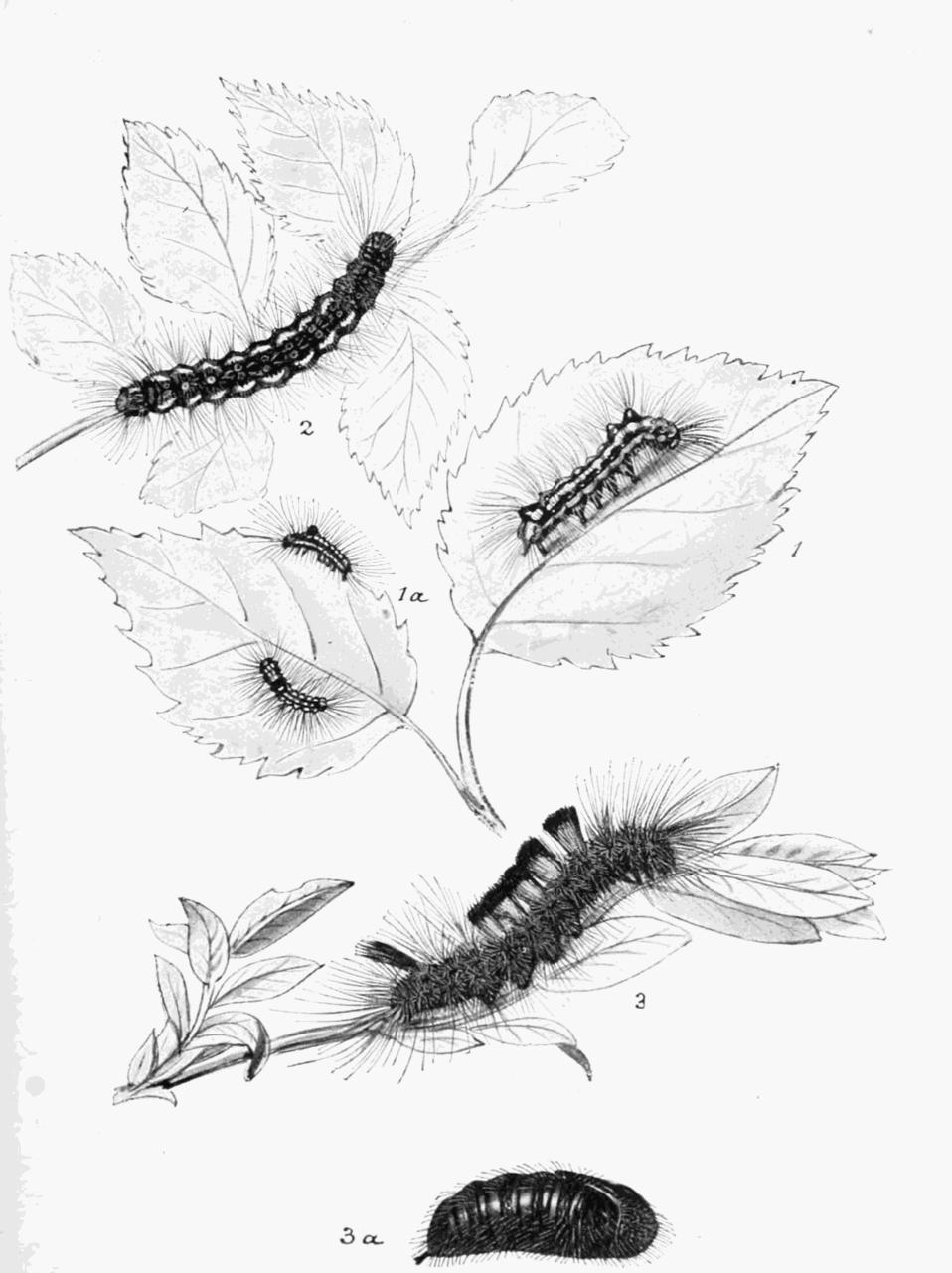
Pl. 42.
1, 1a.Yellow-tail: caterpillars.
2.Brown-tail: caterpillar.
3, 3a.Dark Tussock: caterpillar and chrysalis.
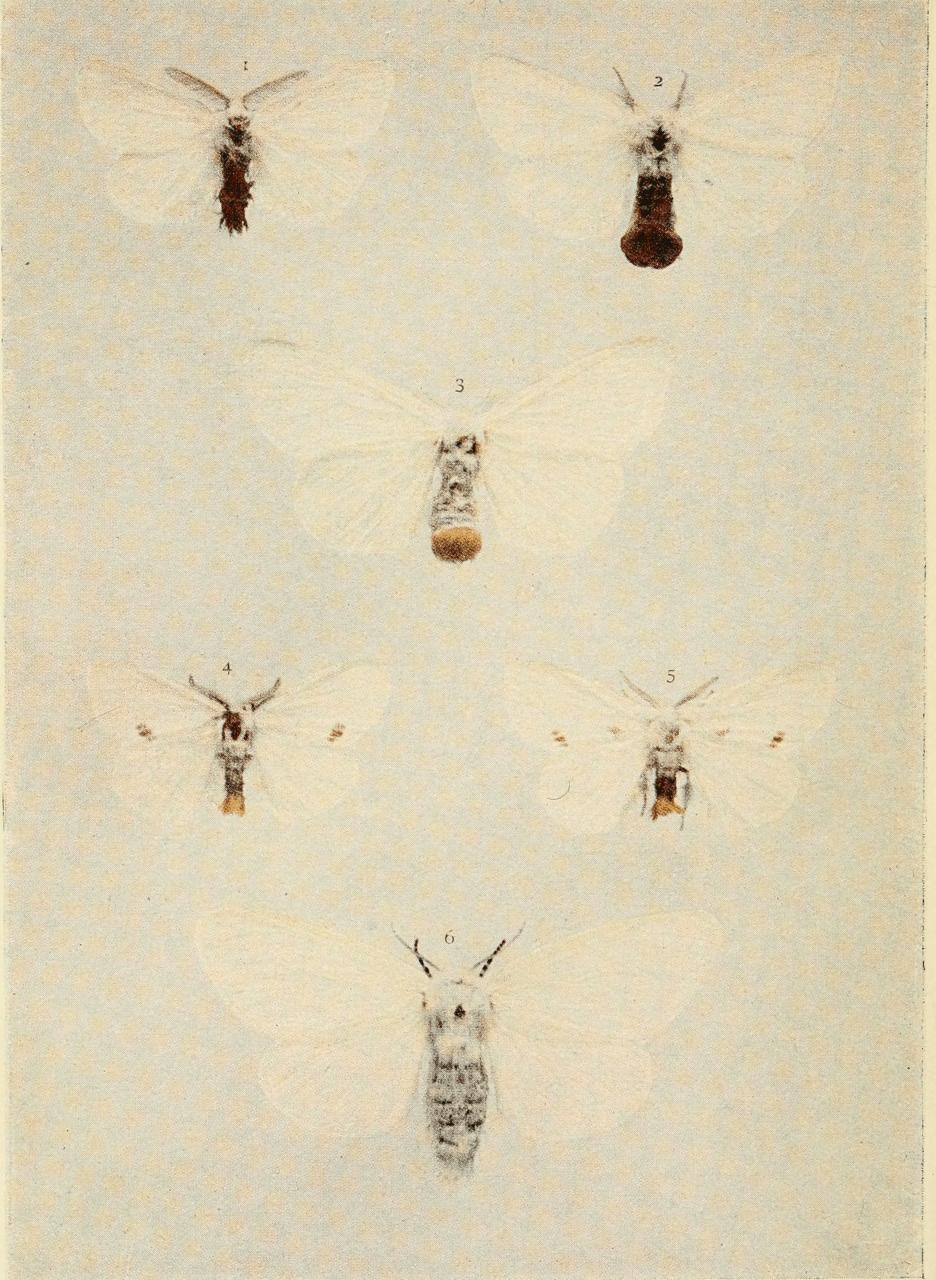
Pl. 43.
1.Brown-tail Moth, male; 2 female.
3.Yellow-tail Moth, female; 4, 5 males.
6.White Satin Moth, female.
It is most at home in the southern portion, but occurs throughout England and Wales, to Cumberland. Only doubtfully recorded from Scotland, but in Ireland it has occurred in Galway, Kerry, Waterford, Cork, and Wicklow.
Distribution: Central and Northern Europe eastward to North-east China and Japan.
The Brown-tail (Euproctis chrysorrhœa).
Although sometimes found in the East and West of England, and even in Yorkshire and Durham, this appears to be essentially a coast species in Britain, and confined at that to Kent and Sussex, the former especially. Even in these favoured localities where it is usually abundant, it is, however, not always in evidence. The moths sit about at the end of July and early August on leaves of hawthorn, sloe, sea-buckthorn (Hippophaë rhamnoides), and wild rose, generally on the underside. Near the females will be found batches of eggs, which are covered with "fur" from the anal tuft of the female. The caterpillars hatch out in August, and while still very small go into hibernation in a common nest. In the spring, when active again, they construct a new habitation, and another or perhaps two more before they are full grown, about June. The chrysalis is very dark, almost blackish-brown, with tufts of hair, and the fairly substantial brownish cocoon in which it is enclosed is composed of silk and caterpillar hairs, and is spun up on the food-plant, often singly, but not infrequently, several are made up in a common silken covering.
The caterpillar is blackish with brownish warts, each bearing a tuft of brownish hairs; a row of tufts of white downy scales on each side of the back of rings four to eleven; the central line on the back is black, edged on each side by a red line of variable width from rings six to ten; a vermillion round spot on nine and ten. Head blackish.
The moth is shown on Plates 43, 45, and the caterpillar on Plate 42, Fig. 1.
Distribution, Central and South Europe to North-west Africa and Asia Minor.
In 1897 an appeal was made to British entomologists to refrain from taking many specimens of this species; while American entomologists were seeking power to compel local authorities to suppress the Brown-tail, which about that time was a new, and no doubt introduced, insect pest in the State of Massachusetts.
The Yellow-tail (Porthesia similis).
The male has usually only one black mark on the fore wings, but sometimes there are two, as seen in Fig. 5, Plate 43; more rarely there is a dot or two towards the tips of the wings. The habit of the moth is to sit upon the foliage of bushes and the branches of trees, where it might easily be passed over for a fluffy white feather; occasionally it may be found on palings or even iron railings. About dark it is on the wing, and light has then a great attraction for it. The caterpillar is black with black and grey hairs; a vermillion stripe down the middle of the back has a black central line, and is expanded on rings four, eleven, and twelve; along each side there are tufts of snowy white fluffy scales; the back of rings four, five, and eleven is velvety black and slightly raised, especially on ring four. Head black and glossy.
The caterpillars hatch from the eggs, which are laid in batches, in August, hibernate, each in a silken case, and recommence feeding in the spring (Plate 42, Figs. 1, 1a). In May, when nearly full grown, they separate and are then common objects on hawthorn hedges in many districts. They also feed on the foliage of oak, beech, birch, sallow, rose, apple, pear, and other fruit trees. Sometimes a nearly fully mature caterpillar has been found in August, this has pupated and produced a moth the same year. The chrysalis is rather hairy and of a brownish colour; the cocoon is similar to that of the last species. In late June and through July the moth is generally common throughout the Southern part of England, and as far northwards as Lancashire and Yorkshire. It has been very rarely seen in Scotland, and not at all in Ireland.
Distribution, Central and South-eastern Europe, extending to Amurland, China, Corea, and Japan.
The Reed Tussock (Lælia coenosa).
This insect (Plate 45) was formerly abundant in some parts of fenland, and was first met with, as a British species, at Whittlesea Mere about 1819 or 1820. It was subsequently found in Yaxley and Burwell fens. Up to 1860 it continued to occur freely in all stages, but by 1865 larvæ at a shilling per dozen, the price at which they had been sold by the reed cutters, were no longer obtainable, and they became so scarce that in the year 1871 or thereabouts, only two caterpillars were seen. The species was at that time seemingly on the decline, but a year or two later a good many males were attracted by the rays of a powerful lamp that had been set up at Wicken. Then the moths became fewer and fewer until at last, somewhere about 1880, even the lamps would not draw a single specimen, and soon it appeared probable that the last of the Reed Tussock had been seen in the fens, its only known habitat in Britain.
Caterpillar, dusky with a blackish stripe along the middle of the back; the raised dots are ochreous grey with pale yellowish brown hairs arising from them; there are four brushes of yellow hairs on the back, bunches of long hairs on the first ring extended over the brownish head, and a pencil of similar hairs on ring eleven directed backward. The food plants given are bur-reed (Sparganium), Stephens; Cladium mariscus, Barrett, and reed (Phragmites communis). Stephens states that the caterpillar and the moth were found at the end of July and beginning of August, but other authorities give August to June for the caterpillar, and July for the moth. The caterpillar described above, and of which a figure is given on Plate 44, was obtained, together with eggs and cocoon, from Dr. Staudinger and Bang Haas, of Dresden. All are preserved examples.
Abroad this species is found in Northern Germany and France, Hungary, Bulgaria, Amurland, China, Corea, and Japan.
The White Satin Moth (Stilpnotia salicis).
The English name of this species dates back to about 1773, and is a very suitable one for it, the fore wings being especially glossy and satin-like. It seems to be less generally distributed over the country than formerly, but it is still common in most years, and in many places; more particularly in the south of England, and on the Lancashire coast. Even yet it occurs in the suburbs of London, and on the southern side is sometimes not uncommon. In Scotland it appears to be rare; Barrett mentions it from Aberdeen, Pitcaple, Inverurie, Peterhead, and Ayrshire. Kane states that in Ireland the species, so far as he knew, only occurred in a locality near Ahascragh.
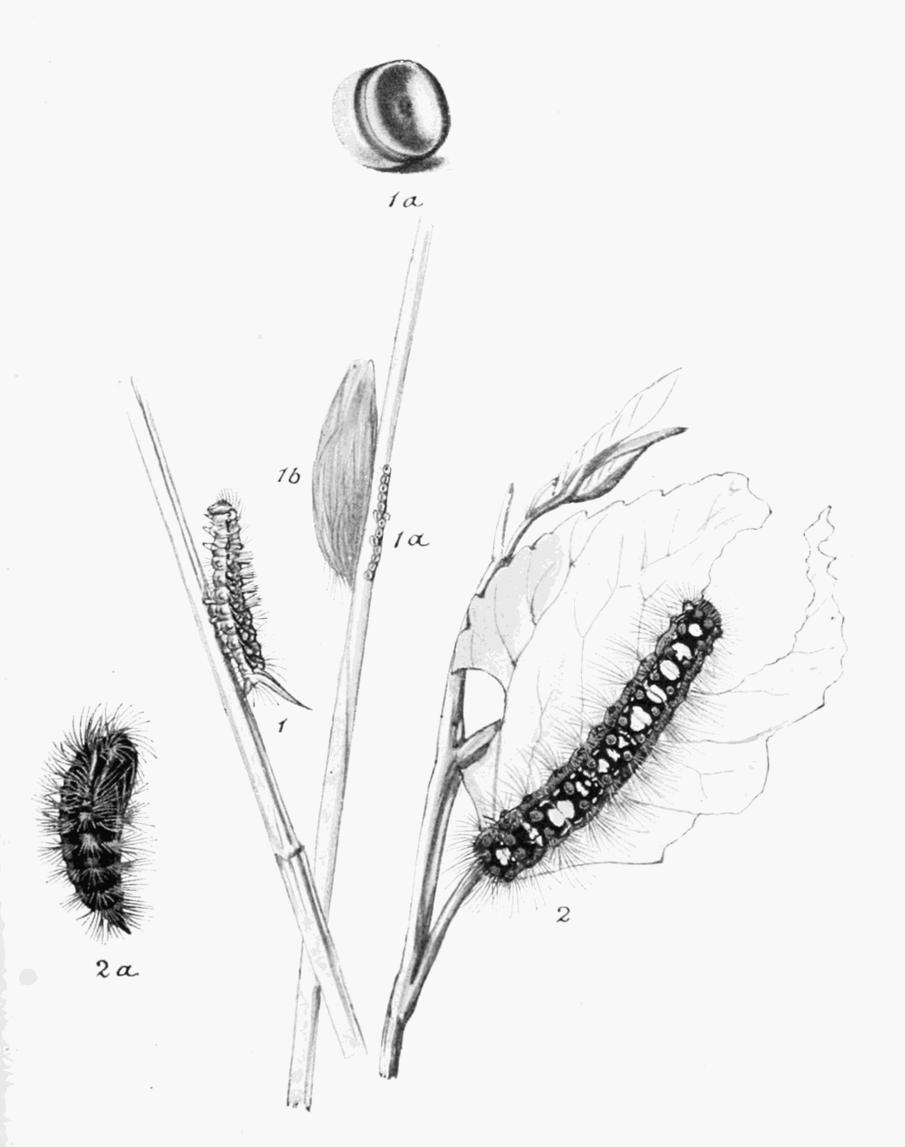
Pl. 44.
1, 1a, 1b.Reed Tussock: egg, caterpillar and cocoon.
2, 2a.White Satin: caterpillar and chrysalis.
Pl. 45.
1.Reed Tussock Moth, male; 2 female.
3, 4.Brown-tail varieties.
The caterpillar, which is hairy and variegated with reddish and black and white, may be recognised by the large bright white marks on the back. It is often seen in the daytime on the boles or branches of poplars, as well as on the foliage. It frequently falls a victim to the parasitical flies, and it is probably due to these enemies that the species is less common in some years than in others. Besides poplar, it will feed upon sallow and willow. Hibernating when quite tiny, it reappears in April, and, feeding up, is ready to enter the chrysalis state in June or July, when it spins a flimsy silken cocoon among the leaves, or in some suitable cranny on the tree or bush. The moth is shown on Plate 43, Fig. 6, and the caterpillar and chrysalis on Plate 44, Fig. 2, 2a.
The moth emerges in July or August, and may be found resting on or under the leaves, and on stems and branches of the trees upon which the caterpillar fed, or on palings, etc., adjacent thereto.
Distribution, Northern and Central Europe, Iberia, Corsica, Italy, Balkan Peninsula, South-east Russia, North-east Asia Minor, and Armenia. In the Far East, including China, Corea, and Japan, it is represented by the var. candida, Staud.
The Gipsy (Lymantria dispar).
Up to some sixty-five years ago, this species (Plate 46, Figs. 1 ♂, 2 ♀) seems to have flourished in a wild state in the fens of Norfolk and Cambridgeshire, and also in Huntingdonshire. Just how long it had been common in those localities history does not inform us, but about 1792 Donovan was unable to obtain a native specimen to figure. Stephens, however, writing in 1828 states that at that time it abounded in the Huntingdonshire fens. "It is said," he remarks "to have been introduced into Britain by eggs imported by Mr. Collinson, but the abundance with which it occurs near Whittlesea, and the dissimilarity of the indigenous specimens (which are invariably paler, with stronger markings) to the foreigner, sufficiently refute that opinion." There appears to be no doubt that some time near 1840 the Gipsy moth began to decrease in numbers, and that about 1850 it had almost or quite ceased to exist, as a wildling, in England. At the present time, and probably since the date last mentioned, the species has been semi-domesticated, and so reared year by year, at first possibly direct from the original wild stock, but afterwards from fresh stock derived from eggs of foreign origin. Futile attempts have been made to re-establish the species in various parts of England, and also in Ireland. Such failure is curious, seeing that in America the accidental introduction of a few moths has resulted in the species becoming so numerous that at least one state has been expending thousands of dollars in endeavouring to destroy it. The eggs are laid in batches and covered with the down-like scales from the anal tuft of the female.
The caterpillar hatches in April, and in warm weather feeds up pretty quickly. It is grey, covered with black dots and fine marks; the hairs arising in spreading tufts from the raised warts, are longer on the sides than on the back; these warts on the back on each side of the pale central line are bluish on rings one to five, and reddish thence to eleven. Head, pale brown marked with black. Feeds on the foliage of most fruit trees, also on oak, elm, sallow, hawthorn, and sloe.
Chrysalis rather hairy, brownish in colour, in a fairly strong silken cocoon, which is spun up in any suitable angle.
The moths appear in August, and there is a striking difference in the size and coloration of the sexes. The male is pale or greyish brown, lined and clouded with darker brown on the fore wings, and the female is whitish with brownish cross lines, and a black central V-mark on the fore wings.
Distributed over the whole of the Palæarctic Region, except the most northern, and, as adverted to, it has now become a pest in parts of North America.
The Black Arches (Lymantria monacha).
Two examples of each sex of this moth are figured on Plate 46, and these show the normal form of the species; the central markings of the fore wings vary in width and intensity, and in some specimens the whole of the central area is more or less filled up with black or sooty black. Sometimes the wings are partially suffused with blackish, and the normal markings are consequently somewhat obscured. Examples wholly suffused with black are referable to var. eremita, a form not uncommon on the continent, and modifications of it are found in a wild state in this country. By selecting parents showing a tendency to vary in the direction of this dark form, it has been found possible to obtain a good percentage of darkened specimens, some of them closely approximating to var. eremita.
The early stages are figured on Plate 47.
The eggs of this species are laid in August in the chinks of bark on tree trunks, and do not hatch until the spring.
Caterpillar, whitish varying to greyish, a deep brown stripe along the middle of the back with an irregular black line on each side of it; the stripe is interrupted by a whitish or greyish patch on rings seven to nine; on ring two there is a black mark, and occasionally red dots appear on eight and nine; black dots on the back and sides are furnished with hairs. Head, brownish marked with a paler tint. It feeds from April to July on the leaves of oak and various other trees, including apple and pine.
The chrysalis, which is enclosed in a somewhat transparent silken cocoon spun up in a fissure of the bark, is brownish, hairy, and has a very glossy metallic appearance.
The moth emerges at the end of July and in August. It flies at night, and may be seen resting by day on the trunks of trees. Although it occurs in most of the counties of England from Yorkshire southwards, and in some parts of Wales, it is nowhere so often met with as in the New Forest, Hants.
Distribution, Central Europe extending to parts of Northern Europe, and southwards to North Italy and Greece, and eastwards to Ussuri and Japan.
Lackeys and Eggars (Lasiocampidæ).
Staudinger in his catalogue of Palæarctic Lepidoptera refers twenty genera comprising sixty-three species to this family. Of these, eleven species belonging to ten genera occur in the British Isles. According to some authorities a twelfth species, Dendrolimus pini, Linn., should be included. This is the Eutricha pini of Stephens (1828) and the "Wild Pine tree Lappet moth" and "Pine tree Lappet" of the more ancient authors. The claim of this species to a place in the British list rests chiefly on a specimen captured in the Norwich Hospital, in July, 1809, by Mr. Sparshall. Wilkes (1773) states that he once found a caterpillar near Richmond Park, but the moth was not reared. For generations the species now classified as Lasiocampidæ have been referred to Bombycidæ, but the silkworm (Bombyx mori) is typical of that family, which has but few genera in it, and none of them occur in Europe. Although some of the moths are of considerable size, most of them are not large. The general colour is some shade of brown. Both sexes have the antennæ bipectinated, but more strongly in the male than the female.
In his treatment of the species here included under Lasiocampidæ, Tutt. ("A Natural History of the British Lepidoptera," vols. i., ii.) separates them into two families, Lachneidæ and Eutrichidæ. The first family is divided into five sub-families and the same number of tribes. The latter family has three sub-families and three tribes. The whole are embraced in a super-family styled Lachneides. Lasiocampidæ disappears as a family name, but the genus Lasiocampa is retained for quercus, L., whilst trifolii, Schiff., is referred to the genus Pachygastria, Hb., and these with Aurivillia, Tutt, not represented in Britain, constitute the Pachygastriidi tribe of the Pachygastriinæ, a sub-family of Lachneidæ. All this will no doubt appear very complicated to the beginner, but he need not worry himself very greatly about the matter at present. When he feels that he has a fair knowledge of the species in the group he will be in a position to grapple with the niceties of classification.
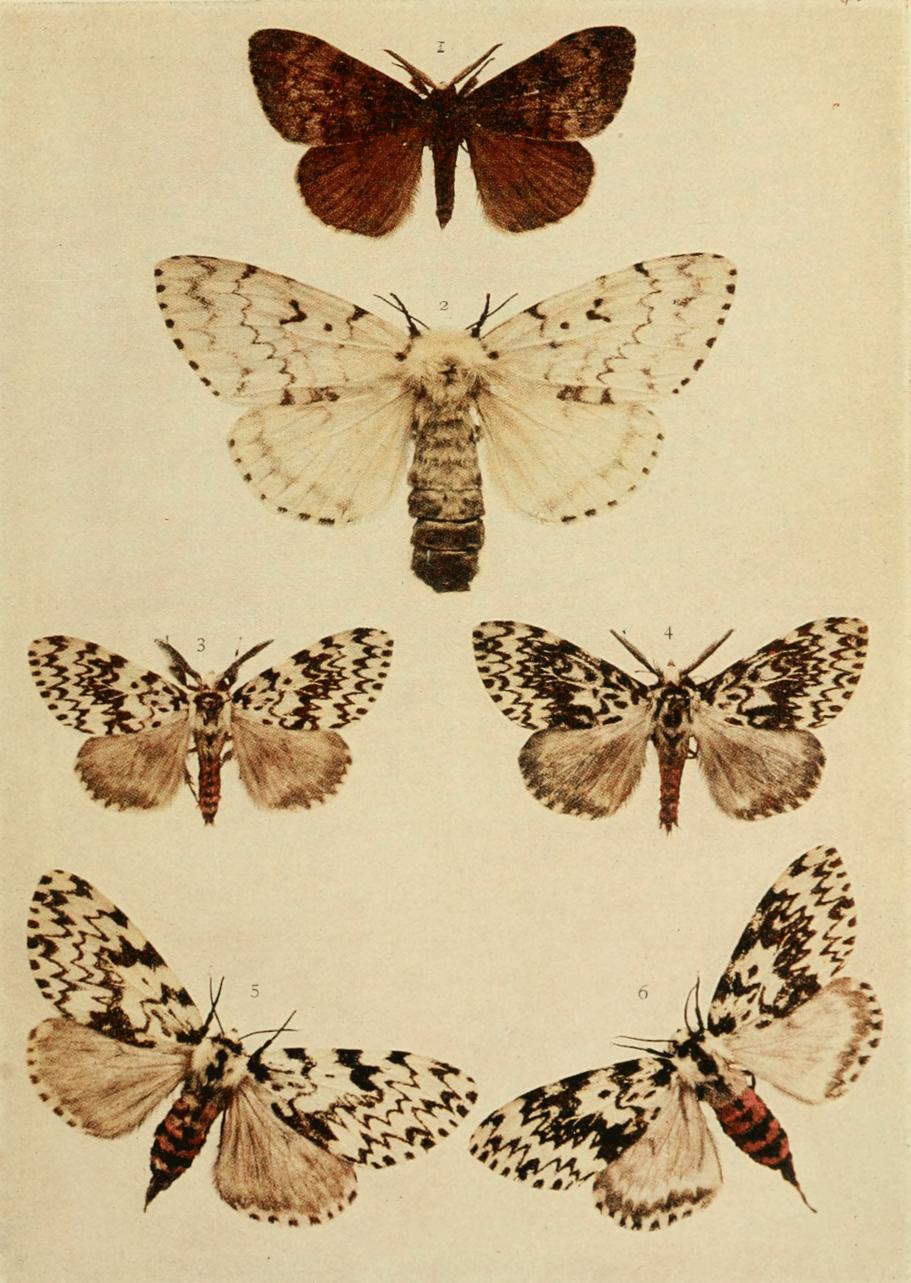
Pl. 46.
1.Gipsy Moth, male; 2 female.
3, 4.Black Arches, males; 5, 6 females.
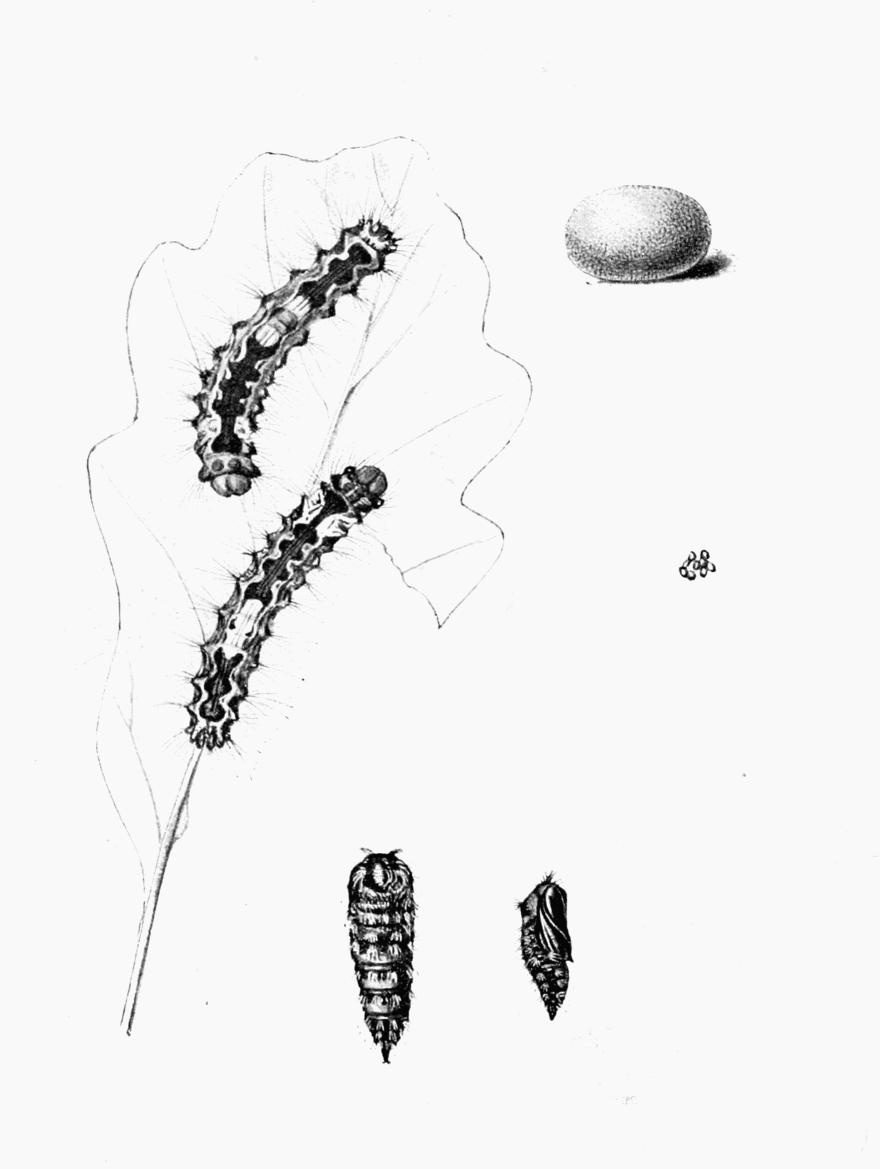
Pl. 47.
Black Arches Moth.
Eggs, natural size and enlarged; caterpillars and chrysalids.
The Lackey (Malacosoma neustria).
The colour of the male ranges from pale yellow ochre, through pale brown to reddish or dark brown; and in the female from pale brown to reddish brown; two cross lines are generally present on the fore wings; the space between the lines is usually darker in the female, and sometimes in the male also, forming a dark central band. All these colour forms were reared from some caterpillars taken by myself at Byfleet, Surrey, in 1901. Another year a few caterpillars taken at Esher produced ochreous coloured males and pale brown females only; the bands of the latter were narrower than usual and much contracted below the middle. As the females last mentioned are somewhat under the normal size I am inclined to think that the caterpillars from which they were reared had been on short commons during their last stage. Two males and a female are shown on Plate 48.
The greyish brown eggs are laid during July and August in a ring cluster around a twig as shown on Plate 49, and so they remain exposed to all weathers during the winter. In April the caterpillars hatch out, and as they live in company throughout the greater part of their larval existence, the first business is to construct a silken tent-like web (Fig. 22). The exterior of the tent affords a suitable surface upon which they can lie when they take a sun bath, which they seem fond of doing whenever the opportunity offers. It is also used, as well as the interior, for the process of skin-changing.
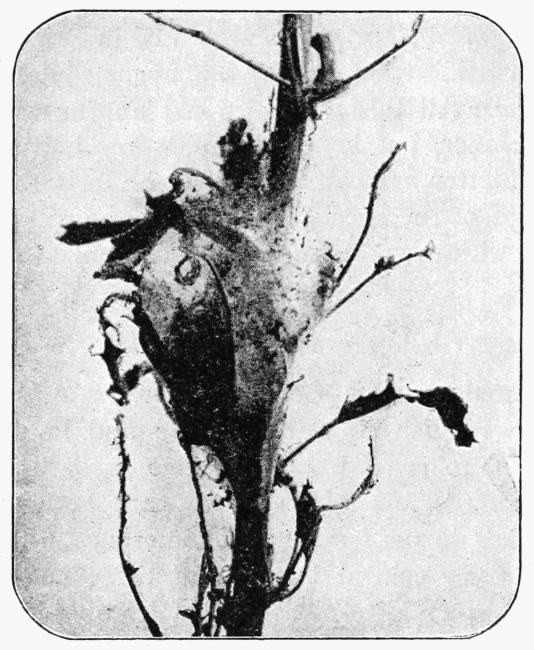
Fig. 22. Web of Lackey Caterpillars. (Photo by W. J. Lucas.)
The full-grown caterpillar is slaty blue above; along the middle of the back is a bluish white line, bordered on each side by a reddish-orange-lined black stripe; towards the lower limit of the slaty blue colour is a black edged reddish-orange line, and below this again the ground colour is flecked with orange, sometimes forming a line in the region of the spiracles; there are two velvety black spots on the back of the ring nearest the head, and a smaller black spot on each side of the next two rings; the hairs are brownish, rather more numerous on the sides than on the back. Head slaty-blue with two black eye-like spots. It feeds from April to June on hawthorn, sloe, and various fruit trees in orchards and gardens; also on birch, elm, oak, sallow, willow, etc.
Chrysalis blackish, rather downy enclosed in a double oval-shaped cocoon; the inner compartment is of rather closer woven silk, and is thickly covered with a yellowish substance, which is ejected by the caterpillar as a fluid, and afterwards drying forms a sulphur-like powder on the cocoon, and in a lesser degree on the chrysalis also. The moth is on the wing in July and August, but it is rarely seen in the daytime, and not often at night, except when attracted by light into the house, or to the gas or electric lamps. It is exceedingly easy to rear, either from eggs or from collected caterpillars; the latter are often abundant.
Generally distributed throughout England, but becoming scarcer from the Midlands to Lancashire and Yorkshire, and not often occurring further north than the last named county. In Ireland it is unknown in the north, but occurs in many parts of the south and south-west.
The Ground Lackey (Malacosoma castrensis).
This also is a variable species. Most frequently the fore wings of the male are pale buff, cross lined, and more or less clouded with brown; hind wings brown. The female has all the wings reddish brown, the front pair being crossed by two pale buff lines. The fringes are pale buff, chequered with brown in both sexes. Colour and marking are, however, subject to considerable variation. Sometimes all the wings are pale buff (male), or reddish brown (both sexes), and the fore wings without marking. The cross lines on fore wings of the female may be either very slender or very broad; occasionally almost the whole of the basal area up to, and including, the first cross line is buff. Two examples of each sex are shown on Plate 48.
The eggs are laid in a similar manner to those of the last species, around stems of wild carrot, sea wormwood, and other plants that flourish in the insects' favourite haunts, which, in this country, are the salt marshes along the estuaries of the Thames and Medway.
The caterpillar is black, inclining to bluish between the rings; along the back are four much broken reddish orange lines and a central bluish line; a bluish stripe followed by a reddish one along the sides, and below this the colour is bluish, speckled with black; the hairs are golden brown. Head blackish grey, without black spots (Plate 49, Fig. 3).
The chrysalis and its cocoon are similar to those of the Lackey, and spun up among herbage.
The moth emerges in July and August and, although it may be occasionally attracted by light, is rarely seen in the open. The caterpillars are to be found, most years, in plenty from May to July. They feed on almost every kind of plant growing on the salterns, and as they are fond of sunning themselves on sea wormwood, sea plantain, etc., are easily seen at such times. In dull weather they retire to their webs, which are generally rather low down in the herbage. In confinement they will do very well if supplied with fresh sprays or leaves of almost any fruit tree, or of birch, whitethorn, etc. The receptacle containing them should be constructed and placed so that the caterpillars get plenty of air and sunshine. It is considered desirable to sprinkle both food and caterpillars with water now and then; some rearers deem it necessary to put a tiny pinch of salt in the water used for sprinkling; and in my own experience I have found that better results were obtained when the food was thus treated than when the salt was omitted.
On the continent this species occurs in woods, and on heaths, etc., but in Britain it is seemingly confined to salt marshes. Although it has been recorded from the Suffolk coast, and other places, the best localities for it are probably the salterns, from Gravesend to the Isle of Sheppey, and at Southend and Shoeburyness.
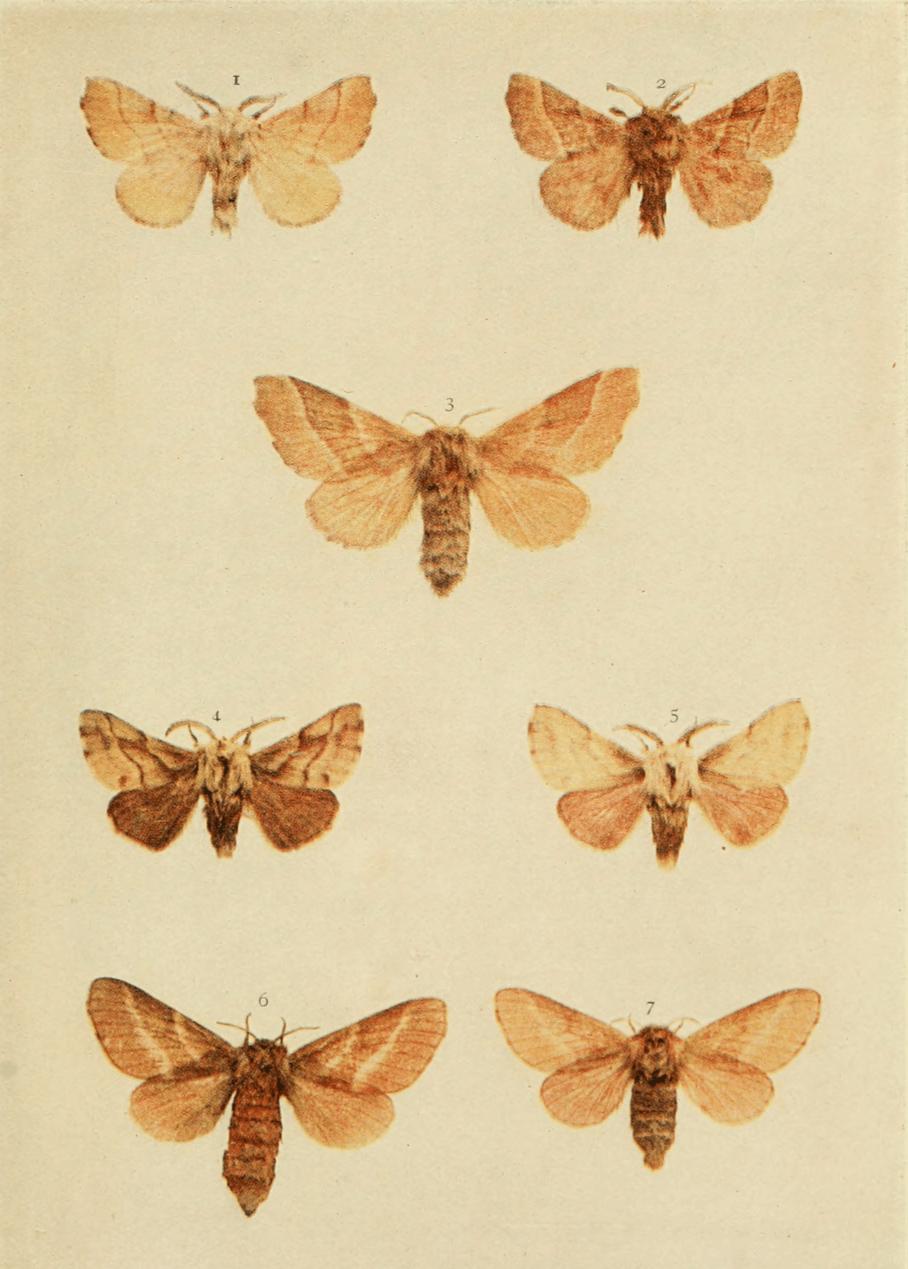
Pl. 48.
1, 2, 3.Lackey Moth.
4, 5, 6, 7.Ground Lackey.
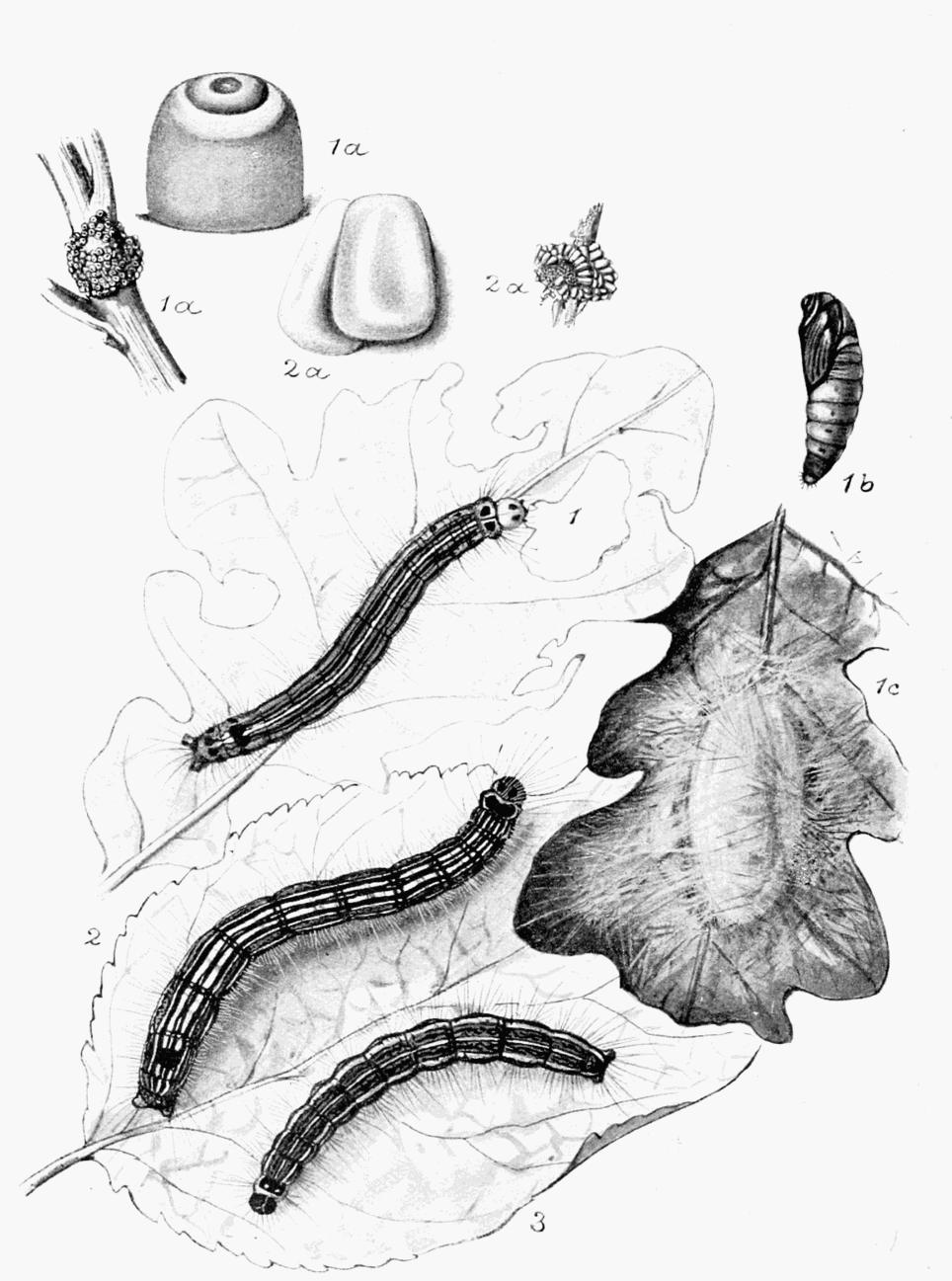
Pl. 49.
1, 1a, 1b, 1c.Lackey: eggs, caterpillar, chrysalis and cocoon.
2, 2a.Hybrid between Lackey and Ground Lackey: eggs and caterpillar.
3.Ground Lackey: caterpillar.
Malacosoma hybr. schaufussi, Standf.—In 1884 Dr. Standfuss made some experiments in crossing three species of Malacosoma, and one of these was the pairing of M. neustria ♂ with M. castrensis ♀; the offspring he christened as above. Since that time others have succeeded in crossing the two species with varying results.
On August 13, 1906, Mr. Percy Richards sent me a small batch of eggs (Plate 49, Fig. 2a) laid by a female, M. castrensis, that emerged in a breeding cage, and had paired with a captured male, M. neustria, he introduced. The larvæ hatched out one or two at a time, from April 7 over a period of more than a fortnight. Few of the caterpillars would commence to feed, and of those that took to the plum and sallow with which they were supplied, only four reached maturity. Three of these pupated during late June and early July, and three moths, all females, have emerged up to date, one on July 28, another on August 6, and a third on August 13. The second specimen was very much crippled, probably owing to the cocoon having been accidentally injured. One caterpillar was still feeding on August 14, but died about the 26th.
The mature larva (Plate 49, Fig. 2) has the head and markings thereon like neustria, also the black spots on the first thoracic segment, but they are rather large and inclined to unite. The bluish line along the sides is dotted and freckled with black rather more thickly than in castrensis; the dorsal line is very thin, but bluish as in castrensis, and the red lines on each side of it are broad.
In colour the three moths are deeper brown than any form of either parent species that I have seen, but the transverse lines, and especially the outer, are most like those of neustria.
It should be mentioned that much information on Hybridism in the Lackey moths and other species will be found in Tutt's "British Lepidoptera," vol. ii.
The Pale Oak Eggar (Trichiura cratægi).
In its typical form the male of this species (Plate 50, Figs. 1, 2) is ashy grey, with a darker central band on the fore wings; and the female is dusky greyish-brown, also with a darker band. The colour of the male varies in shade from almost whitish (var. pallida, Tutt), to blackish grey; in the paler forms the central band of the fore wings is often of a purplish tint, and in the darkest forms the band is almost black. The female var. pallida, is pale buff.
The eggs, which are brownish, inclining to reddish on the micropylar area, are covered with dark grey hairs from the body of the female and laid side by side in a chain-like arrangement on a twig of hawthorn or sloe (those figured on Plate 51 were deposited in a box, and not securely attached). From eight to twelve is said to be the usual number in a batch, and each female will deposit an average of 160 eggs.
The caterpillars do not hatch out all at the same time, but by ones and twos, at intervals spreading over a period of two, or perhaps three, weeks. Several forms of the caterpillar have been described, but the ground colour is generally more or less black above and greyish on the sides; the ornamentation comprises interrupted white or whitish stripes, streaked or clouded with reddish, and reddish warts; the hairs are reddish brown. The example figured on Plate 51 was from eggs laid by a female moth in Selkirk, South Scotland. From the age of three weeks until it became full grown it was black marked with yellow on the back and orange on the sides; hairs pale greyish mixed with black ones, especially on the back towards the black, glossy, and somewhat hairy head. It hatched on April 26, was reared on plum, pupated early in June, and the moth, a darkish grey female, emerged on July 31. Another caterpillar that hatched on May 1, and two others from still later hatchings, were then in chrysalis.
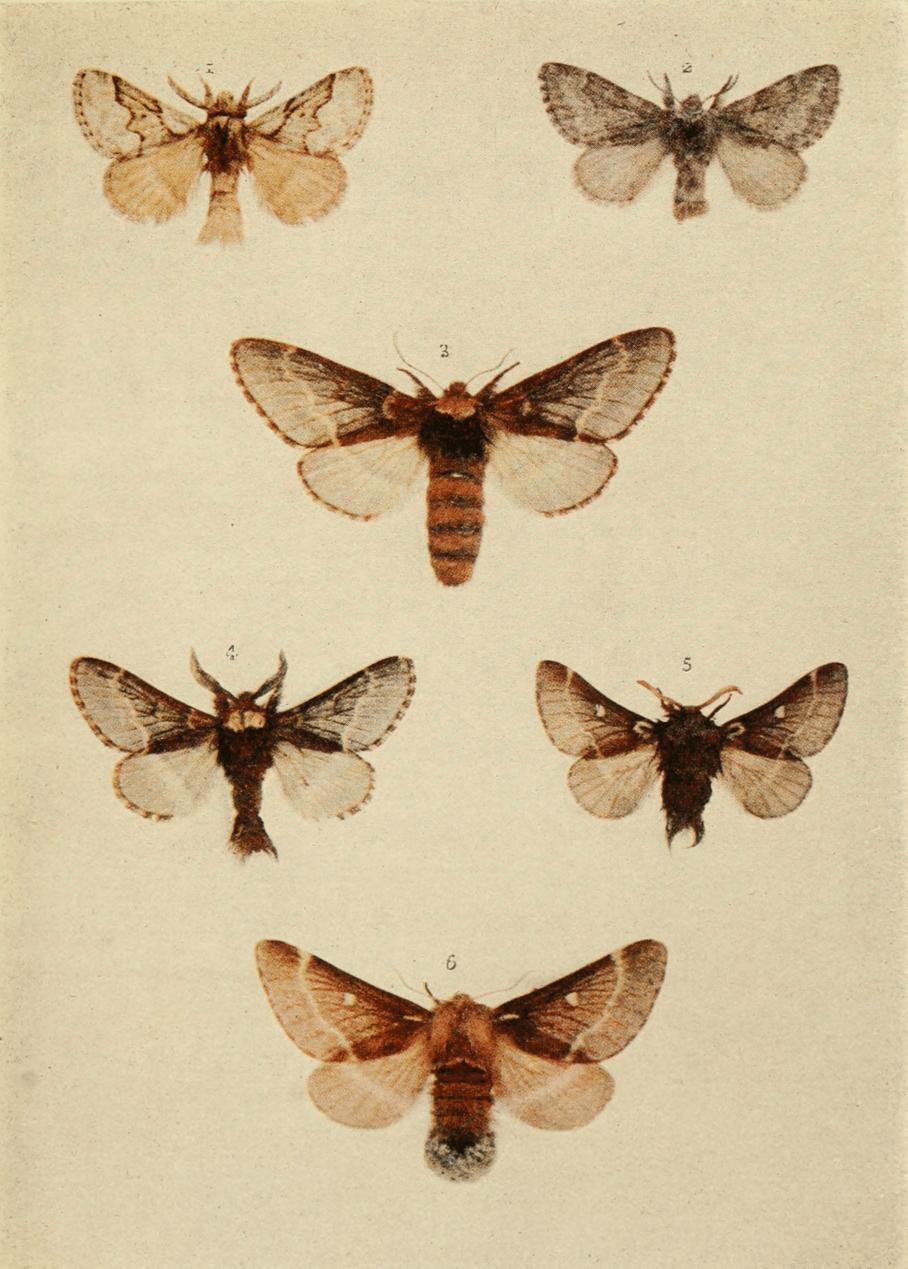
Pl. 50.
1.Pale Oak Eggar, male; 2 female.
3.December Moth, female; 4 male.
5.Small Eggar, male; 6 female.
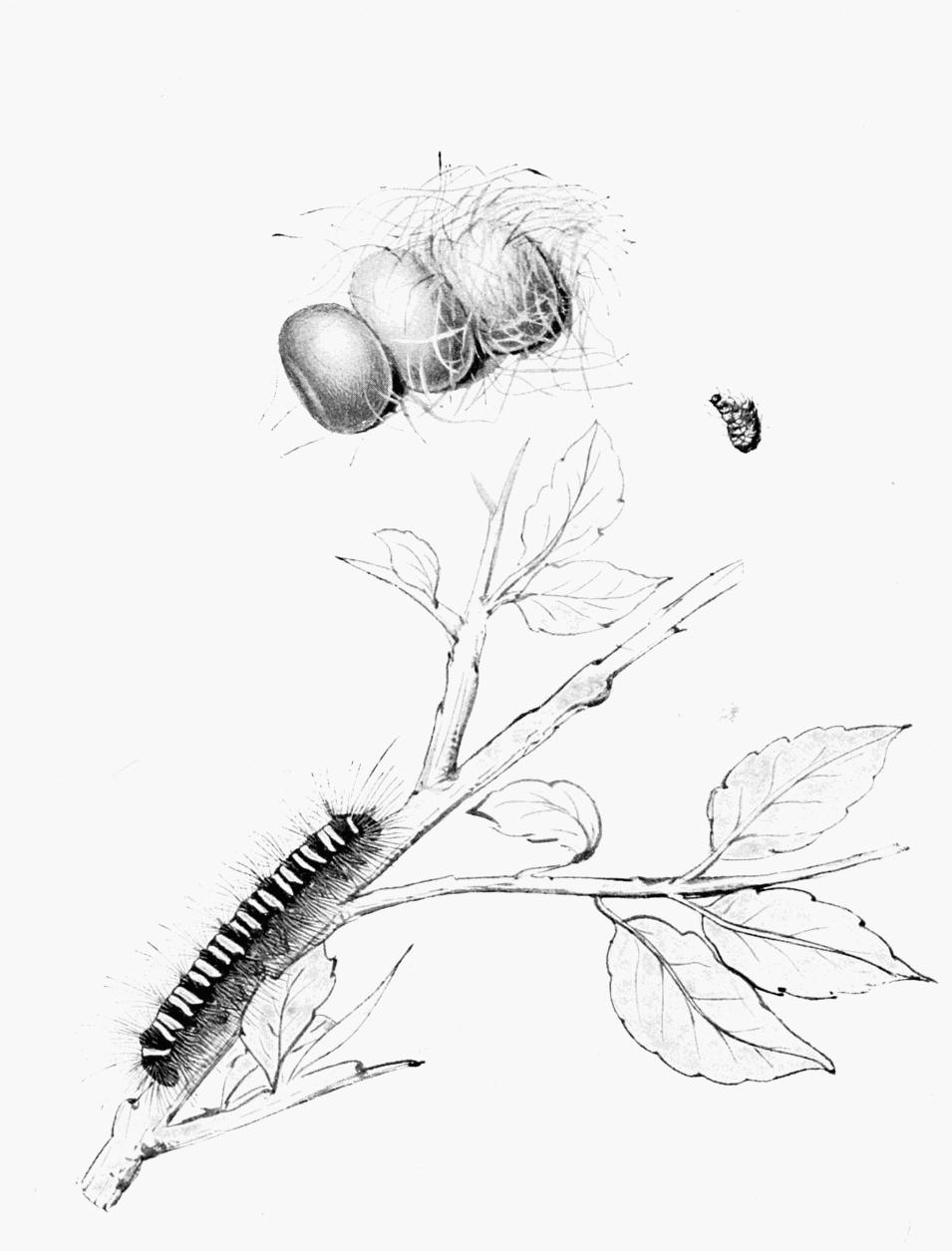
Pl. 51.
Pale Oak Eggar.
Eggs enlarged, and caterpillar.
The caterpillar may be found from April to June on hawthorn and sloe, and it is said also on birch, oak, sallow, apple, bramble, etc. Those that I have found resting by day on shoots of hawthorn, apparently enjoying the sunshine, have almost invariably been "ichneumoned"; but others that came up after sunset to feed on the shoots were generally healthy. Usually the caterpillar feeds up and pupates the same year, but on the moors in Aberdeenshire and some other parts of Scotland it is said to hibernate and to complete its life cycle the following summer and autumn. Furthermore, the moths from these winter larvæ are much darker than normal, and have been doubtfully referred to var. ariæ, Hübn., a form found in the Alps, Scandinavia, and Finland.
The moth is out in August and September, and occurs in wooded districts throughout the southern half of England, but northwards from the Midlands it is uncommon; it is found in several parts of Scotland to Inverness. In Ireland it is reported (Birchall) to have occurred in Killarney, and Kane mentions that "a blackish form was taken at Magilligan, near Derry, by W. Salvage. Its larvæ were feeding on blackthorn." The range abroad extends through Europe to Armenia and Asia Minor.
The December Moth (Pœcilocampa populi).
This is a rather thinly scaled moth; the general coloration is sooty brown; the wings are suffused more or less with greyish; there are two pale ochreous cross lines on the fore wings, the first enclosing a reddish brown basal patch; hind wings rather paler with a diffuse whitish central band; fringes brown chequered with pale ochreous. Head brown, collar brownish, tipped with pale ochreous in the male. The female is rather larger than the male. The moth is figured on Plate 50, and the eggs and caterpillar on Plate 53.
The eggs, which are laid on the bark of trees, are whitish grey, variegated or mottled with darker grey.
The caterpillar hatches out in April, and when nearly full grown is ochreous, but so thickly dotted and freckled with black as to appear of a dark brown coloration; the back is clothed with dark short hairs, and the sides with long paler hairs; on the back of the first ring is a reddish brown mark divided by a white line; a double row of whitish dots along the back, most distinct on rings two and three, where they are placed on a velvety black bar; on each side of the white dots is a reddish brown interrupted line. Head ochreous brown, thickly dotted with black and clothed with pale hairs. Underparts ochreous, spotted and lined with blackish. Feeds on the foliage of most trees, and is said to eat lettuce. April to June.
Chrysalis glossy red brown, in a cocoon spun up among dead leaves, etc., under loose bark, or on the ground.
The moth does not emerge until October, and in that month, but more frequently in November and December, the males may be seen around gas lamps quite late at night.
Although found chiefly in woods it is not essentially a woodland species, as it occurs in districts where there are no woods but plenty of trees growing in parks, fields, or even hedgerows. It is fairly common generally throughout England and Wales, but becoming rather more local northwards to Cumberland. It occurs through Scotland to Sutherland, but is nowhere common. In Ireland it is widely distributed, and not uncommon near Dublin, and at Favour Royal, Tyrone. Abroad it ranges through Northern and Central Europe.
The Small Eggar (Eriogaster lanestris).
Also a brownish insect with somewhat thinly-scaled wings. The fore wings are light reddish brown with a whitish patch at the base, a white spot about the centre, and a whitish transverse line beyond; the hind wings are smoky brown and have a pale central band. The female, which is larger than the male, has a conspicuous greyish anal tuft, the hairs from which she uses to cover over her pale oily green eggs when they are deposited in clusters on twigs of hawthorn or sloe in February or March. Plate 50, Figs. 5, 6; Plate 53, Figs. 2, 2a.
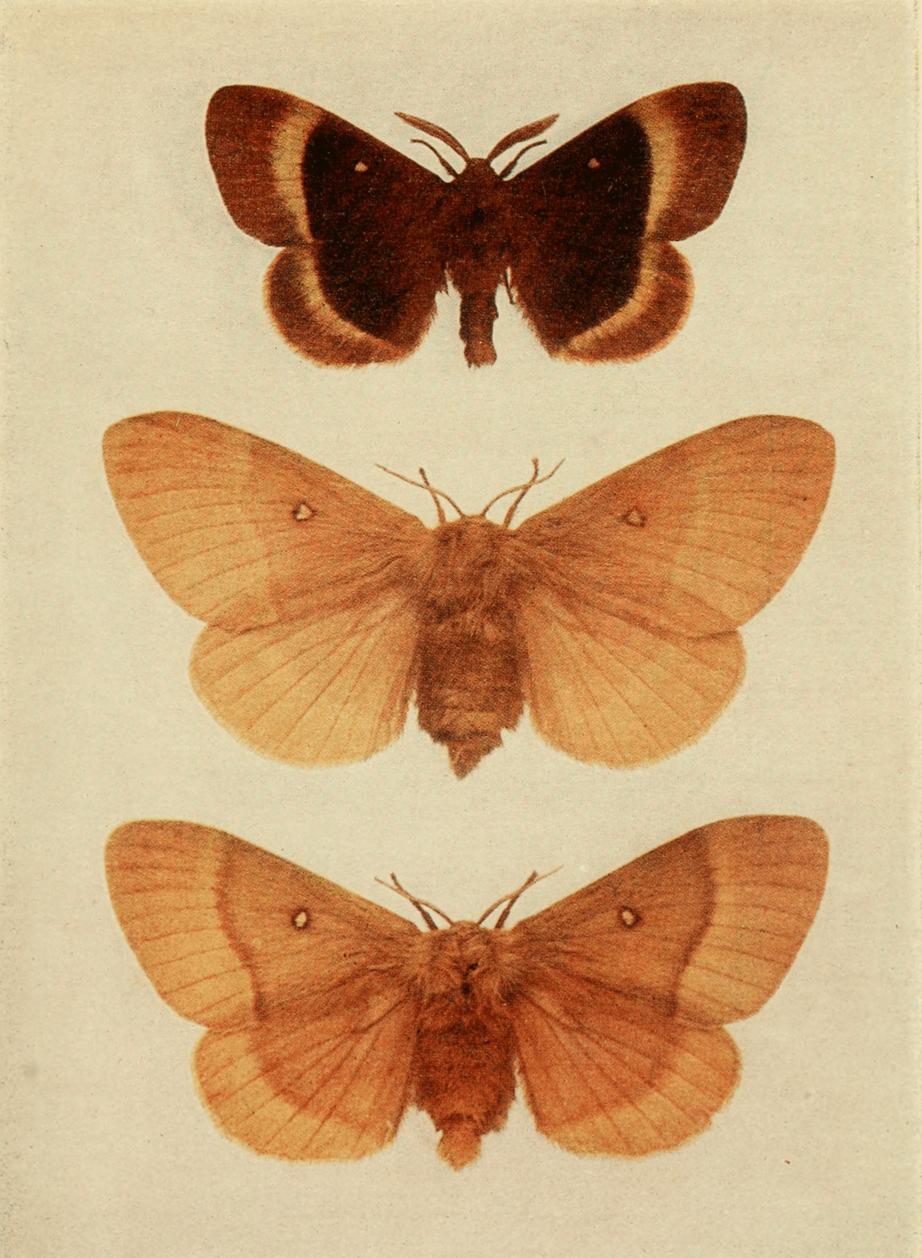
Pl. 52.
Oak Eggar Moth.
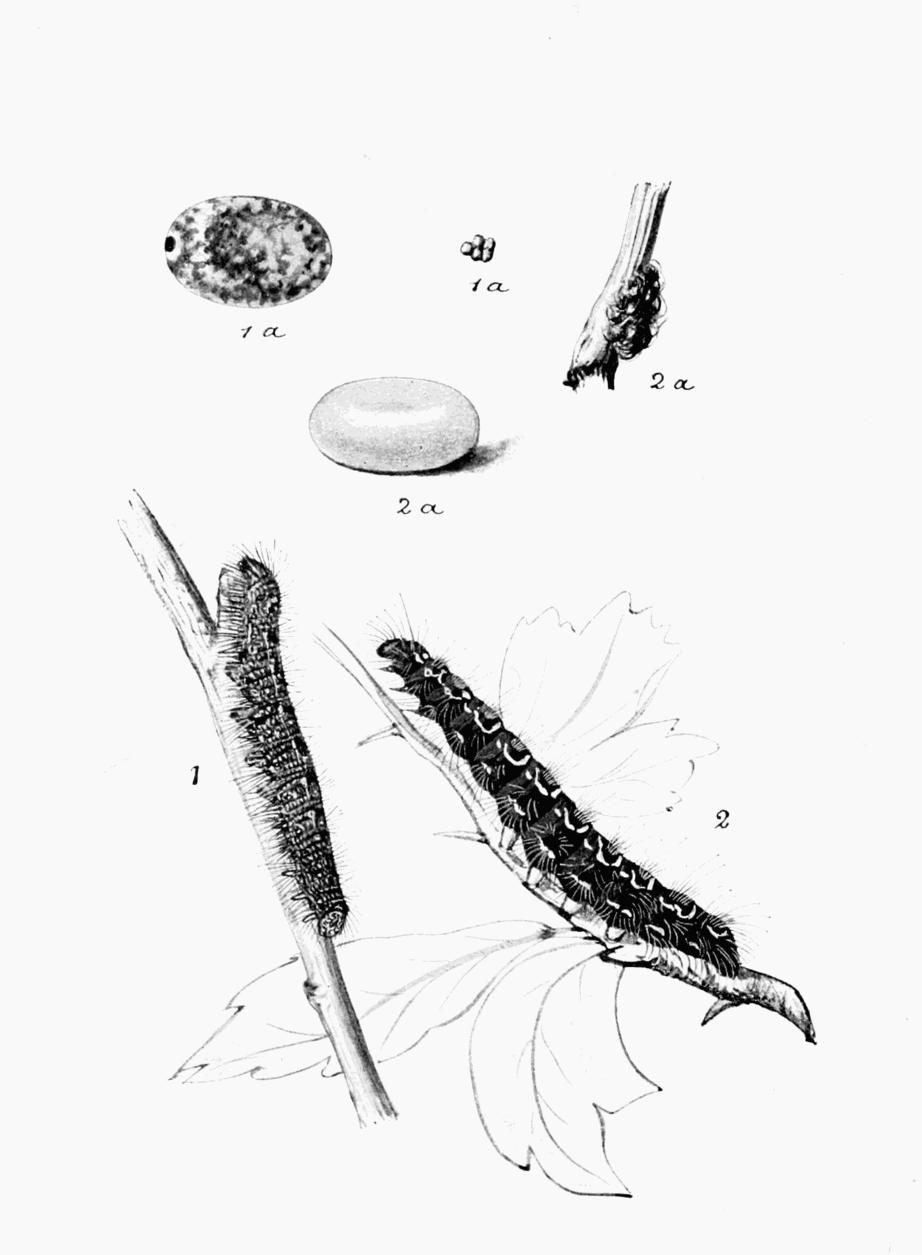
Pl. 53.
1, 1a.December Moth: eggs and caterpillar.
2, 2a.Small Eggar: eggs and caterpillar.
The caterpillar is black or greyish black, with reddish brown hairs, and a series of black-edged yellowish brown, or reddish brown blotches on each side of the back; these blotches are outlined in pale yellowish and occasionally connected by a line of the same colour. From the time they are hatched until nearly mature the caterpillars live in companies on a closely woven web of silk on a branch of hawthorn or sloe, only leaving their habitation to feed. These webs may often be seen on hedgerows from May to July. The brown chrysalis is enclosed in a solid-looking oval cocoon of a pale ochreous or whitish colour. Not all the moths emerge the following year: some will remain in the chrysalis over two or three winters, and occasionally they have been known to emerge seven years after pupation. The moth is said to be fully formed within the chrysalis all the time, but for some reason will not emerge, although if extracted from its shell, the moth has been known to expand its wings in the ordinary way. Barrett states that in the middle of February, after a moth had emerged, he "put a large number of cocoons upon a warm mantelpiece and obtained scores of moths within a few hours."