PART II. (continued 5)
Reading edition
The caterpillar is ochreous brown, dotted with brown, and marked with dark brown, sometimes greenish tinged, on the back; a white stripe below the spiracles; head brown and rather glossy. It feeds on grasses and low plants, such as dock, dandelion, groundsel, etc. September to May. The moth flies in July, August, and September. It occurs at various places on the Dorsetshire coast; on the Cotswolds in Gloucestershire; in North Wales, and the Isle of Man; also from Cheshire to Cumberland. Widely distributed in Scotland, extending to the Hebrides and the Orkneys. In Ireland only recorded from Sligo.
The Heath Rustic (Agrotis (Eueretagrotis) agathina).
The moth, shown on Plate 107, varies in colour and in marking. Fig. 2 depicts a specimen from Perthshire, and Fig. 3 one from North Devonshire. In Southern England the general tint is pinkish brown, and in the north and in Scotland it is dark reddish brown or blackish. A pale greyish form from Ireland has been named var. hebridicola, Staud. Sometimes specimens are distinctly rosy in tint, and these are referable to var. rosea, Tutt. The caterpillar (Plate 109, Fig. 2) is reddish brown, or green, with whitish lines on the back, the central one edged on each sides with blackish, and the others inwardly marked with black; a yellowish stripe low down along the sides, sometimes marked with reddish; usual dots black; spiracles white, dark ringed; head greenish yellow marked with darker in the green form, and yellowish brown marked with darker in the brown form. It feeds from September to June on heath and heather. The above brief description was made from apparently full-grown caterpillars received from the New Forest on May 28, 1907, but not one of them attained the chrysalis stage. The moth is out in August and September, and occurs on most of the larger heaths, and on moorlands throughout the British Isles, including the Hebrides and Orkneys.
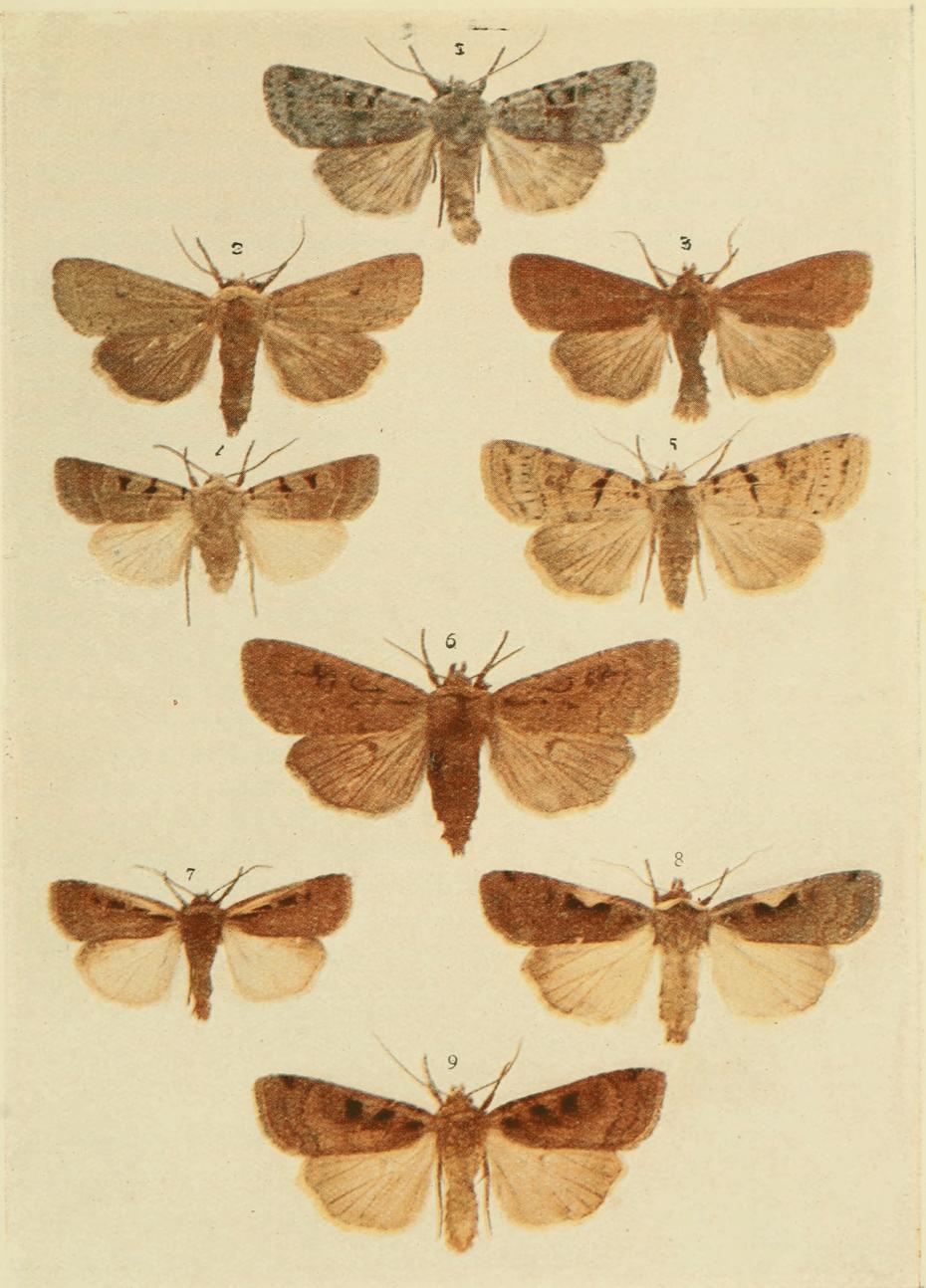
Pl. 110.
1.Ashworth's Rustic. 2, 3.Neglected Rustic. 4.Autumnal Rustic.
5.Plain Clay. 6.Double Dart. 7.Flame Shoulder.
8.Setaceous Hebrew Character. 9.Triple-spotted Clay.
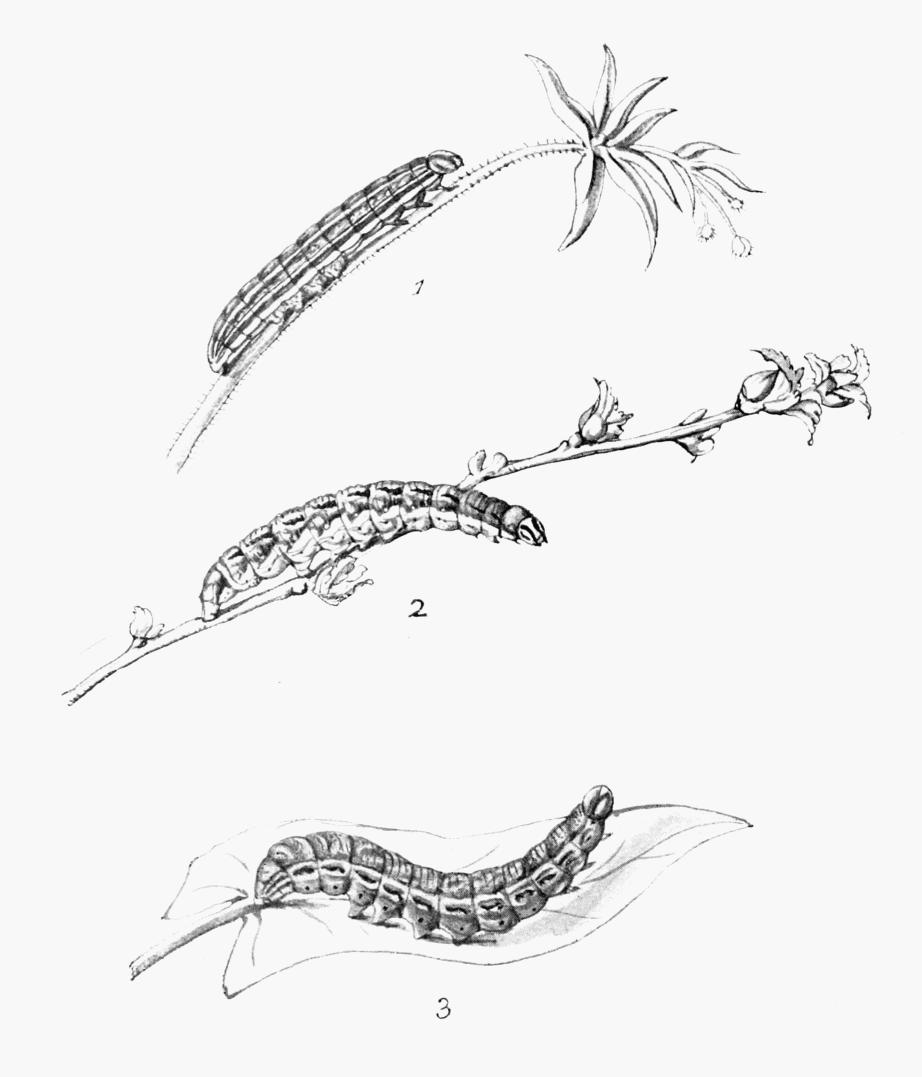
Pl. 111.
1.Flame Shoulder: caterpillar.
2.Triple-spotted Clay: caterpillar.
3.Double Dart: caterpillar.
The Stout Dart (Agrotis ravida (obscura)).
The somewhat dingy brown, or greyish brown moth (Plate 107, Figs. 5 ♂, 6 ♀) is sometimes tinged with reddish, and this tint is generally present on the front or costal area.
The caterpillar is ochreous brown with a paler line along the back, and a series of dark edged, oblique and more or less curved, yellowish marks on each side; head greyish freckled with brownish; plate on first ring brown marked with pale lines. It feeds on low-growing plants such as dock, dandelion, chickweed, etc.; September to May. The moth flies in July and August, but its occurrence in Britain is somewhat irregular. It is found, sometimes commonly, in most of the southern and eastern counties of England, and also in Durham; and has been occasionally recorded from other parts of the country, as well as from Scotland. For several years it may seem to quite disappear and then suddenly become common in various districts. Its range abroad extends to Amurland, North China, Corea, and Japan.
The Northern Dart (Agrotis (Episilia) hyperborea).
Of this pretty Scottish species (alpina, Westw. and Humph.) four examples are figured in Plate 108. Figs. 1 and 2 represent specimens from Shetland, and Figs. 4 and 5 are from Rannoch specimens. These will show something of the variation in this moth, which was not known to occur in the British Isles until 1839, when a single specimen was taken on Cairn Gowr in Perthshire. No other example seems to have been noted up to 1854, when one was found on a rock in the same part of Perthshire. Up to the year 1876, only a few specimens had been obtained, but in that year, which was a hot and dry one in the Highlands, quite a number were secured. A female was also detected laying her yellowish white eggs on crowberry (Empetrum nigrum) and thus gave a clue which led to the subsequent discovery of caterpillars and chrysalids; and these have been obtained in some quantity. The caterpillar is reddish, inclining to pinkish brown, freckled with darker; three whitish lines on the back, the central one irregularly black dotted, edged on both sides with black, and the others with black bars along their inside edge; head pale brown freckled and lined with darker brown. It feeds from August to June (of the second year following hatching from the egg, it is said), on crowberry, bilberry (Vaccinium), and bearberry (Arctostaphylos uva-ursi).
The moth is out from late June until about the middle of August. It only occurs with us on the higher mountains in Perthshire, notably those to the south of Loch Rannoch; and at lower elevations in Unst, the most northern isle of the Shetland group. It has also been recorded from the Orkneys. Kane mentions a specimen bred at the end of February, 1893, at Clonbrock, Co. Galway, from a caterpillar found at a bog in the vicinity, where crowberry grows abundantly. Abroad the species in its typical form is found on mountains in Central and Southern Scandinavia, and in modified form in Silesia, Hungary, and Switzerland.
Ashworth's Rustic (Agrotis (Episilia) ashworthii).
This moth, which is figured in Plate 110, is considered by some entomologists to be a form of A. candelarum peculiar to the hills and mountains of North Wales, and found chiefly at Llangollen, Penmaenmawr, and Snowdon. The colour of the fore wings varies from pale dove colour to dark slaty grey. The caterpillar is blackish, or dark slate colour, with two series of velvety black spots, or dashes along the back; head reddish brown. It feeds on various low-growing plants, among which are rock-rose, wild thyme, sheep's sorrel, bedstraw, etc. Towards the end of April, in Flint, they feed freely and crawl about their food plants in the day time as well as at night (E. W. H. Blagg). The moth has been reared in November and December from eggs found in July, about the second week; the caterpillars having been supplied mainly with sallow, with the addition of dock, groundsel, plantain, and knot grass (R. Tait). On another occasion moths were bred in October from eggs laid by a female reared from caterpillars taken in North Wales in the spring (A. Harrison). The moth is out in July and August and in its rugged haunts, may be disturbed from among the loose rubble, and from chinks in the rocks; but as they come freely to sugared herbage, captives in this way would probably be more numerous. Discovered at Llangollen in 1853, by Mr. Joseph Ashworth after whom it was named by Doubleday in 1855.
Note.—Barrett mentions the following Agrotids as having occurred in the British Isles.
A. crassa, Hübn., "one specimen in the cabinet of Mr. S. Stevens." A. spinifera, Hübn., a specimen taken in the Isle of Man, August, 1869. A. fennica, Tauscher, a specimen recorded in the Zoologist for 1850, as captured in Derbyshire.
The Rosy Marsh Moth (Noctua (Cœnophila) subrosea).
The last two moths were respectively productions of Scotland and Wales; the present one is exclusively English, at least it was, because now and for perhaps the last fifty years it has been extinct in its old fenny haunts at Whittlesea, in Cambridgeshire, and Yaxley, Huntingdonshire. In the latter fen it was first noted by Weaver about the year 1837. In 1846 and onwards it was plentiful, and the caterpillars were common. All was well with the species until about 1851 when the fens were drained, and the moth then ceased to appear. (Plate 108, Fig. 3.) In Sweden, Southern Russia, and in Amurland the species is represented by a bluish form, var. subcœrulea, Staud.
The Double Dart (Noctua (Exarnis) augur).
The dull brownish moth (Plate 110, Fig. 6), is generally distributed throughout the British Isles, including the Orkneys. The fore wings of southern specimens are usually suffused with reddish, but this is less obvious in northern examples. The markings are sometimes bold and striking or, on the other hand, only faintly defined, or largely absent. A pinkish-tinged brown form without markings was formerly confused with the Continental A. helvetina. The moth is on the wing in June and July, sometimes in August, especially in the north; and the caterpillar is to be found from July to May. When young it feeds on various low-growing plants, but later it crawls up at night to devour the leaves of hawthorn, sloe, sallow, birch, etc. It is brownish, tinged with pink, and marked on the back with a series of V-shaped dashes, and white points; on ring eleven there is a yellowish-edged black mark; above the white spiracles is a black-edged red-brown stripe. Head pale brown, freckled with darker brown.
The Autumnal Rustic (Noctua glareosa).
In its typical form as depicted on Plate 110, Fig. 4, this species is slaty grey with black markings. In Devonshire and other parts of the west of England, and also in Ireland, it assumes a decided pinkish tinge (var. rosea, Tutt). Through Scotland the colour becomes darker grey, and in Perthshire it merges into blackish grey. In the Shetlands a blackish, or sooty-brown form (var. edda, Staud.), occurs.
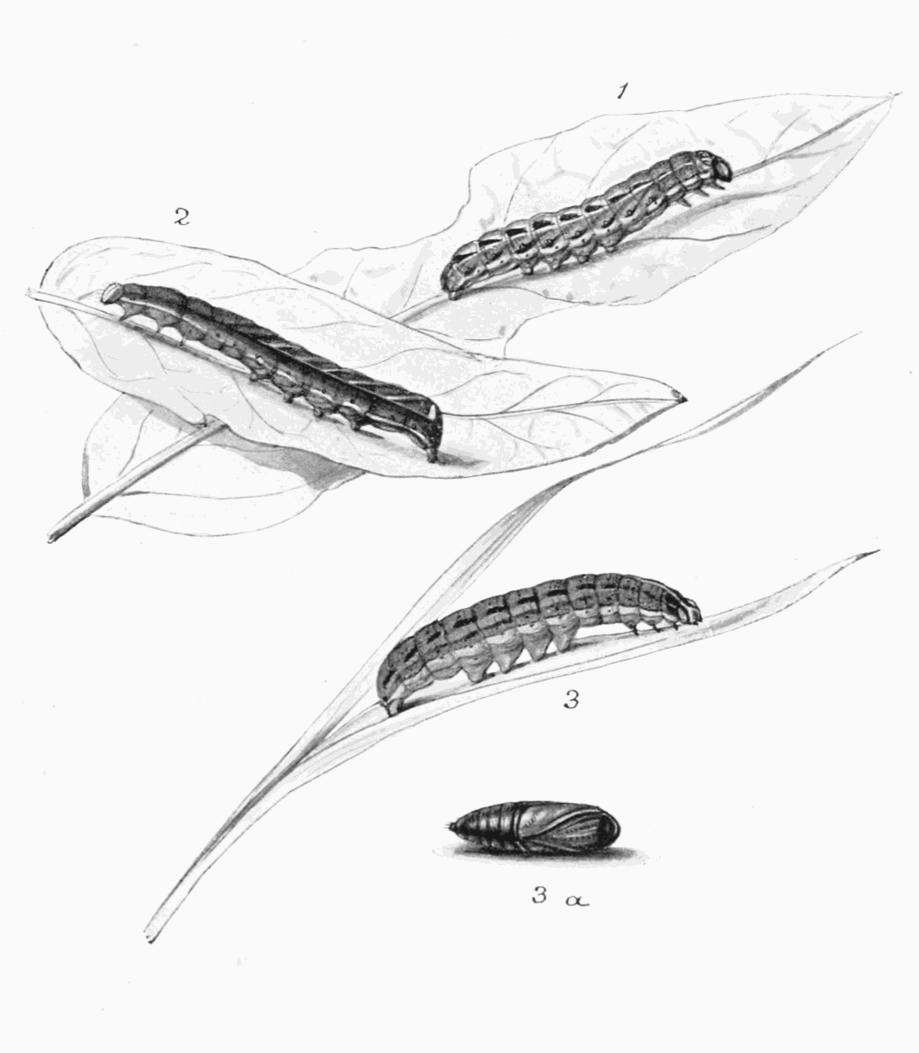
Pl. 112.
1.Ingrailed Clay: caterpillar.
2.Purple Clay: caterpillar.
3, 3a.Square-spot Rustic: caterpillar.
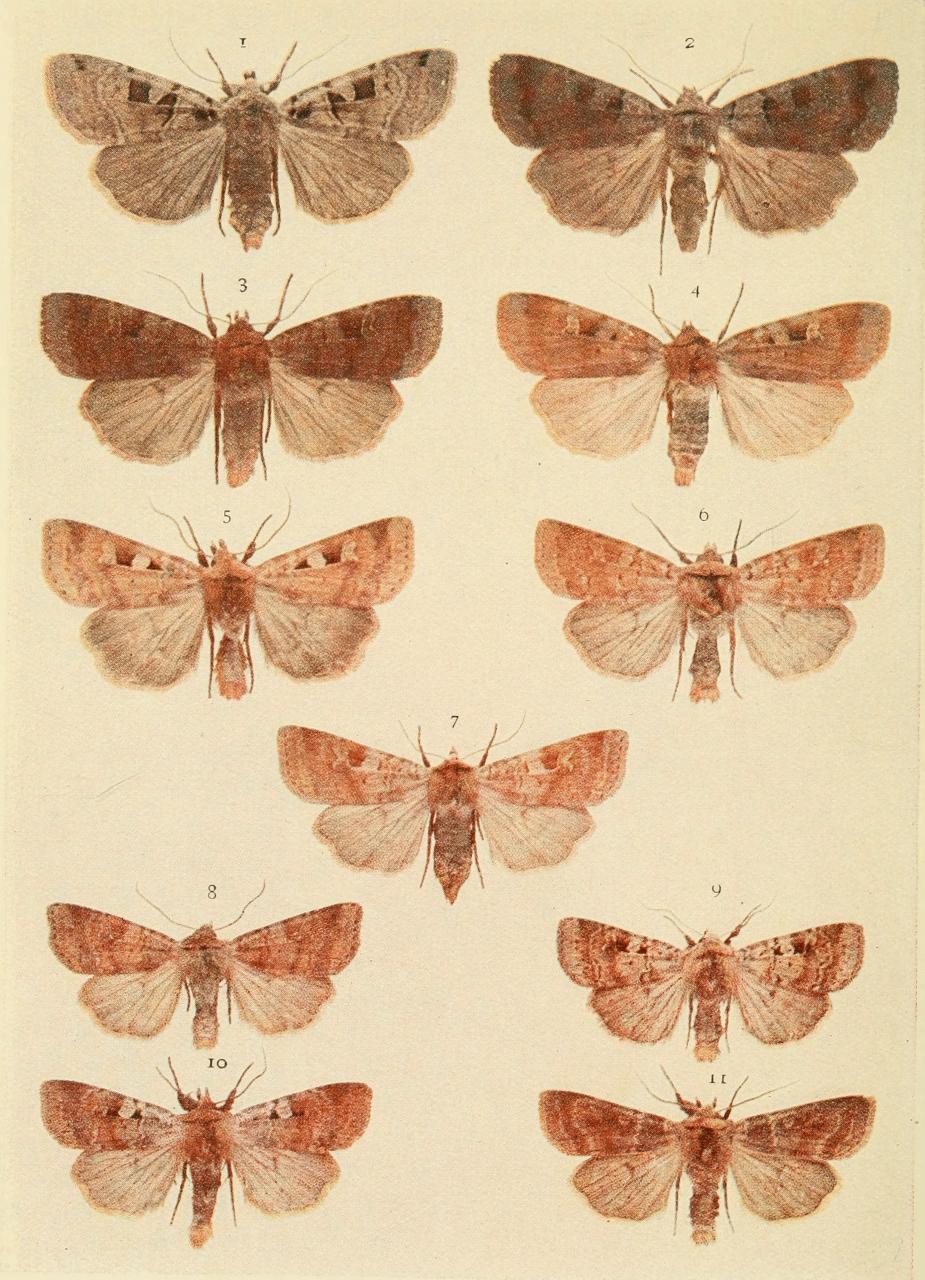
Pl. 113.
1.Double Square-spot. 2.Square-spotted Clay.
3, 4.Purple Clay. 5, 6, 7.Ingrailed Clay.
8, 9.Ingrailed Clay, var. conflua. 10, 11.Ingrailed Clay, var. thulei.
The caterpillar feeds on grasses and various low plants, also on ling, heath, sallow, and has been found on wild hyacinth. It is yellowish-brown with dark shaded pale lines on the back, and a dark brown stripe on the sides; spiracles and dots blackish. October to June. The moth flies in August and September, and affects heathy places, borders of woods, etc., throughout the British Isles, including the Hebrides, Orkneys, and Shetlands. Except in the New Forest, Hampshire, it does not seem to be common in the southern counties of England; it occurs in Epping Forest, and in other parts of the eastern counties; northwards it becomes more generally distributed and more plentiful.
The Neglected, or Grey Rustic (Noctua castanea).
The reddish typical form of this species is shown on Plate 110, Fig. 3. Fig. 2 represents the greyish form, var. neglecta, which is most frequently met with in southern England. Between these extremes intermediate forms occur connecting one with the other. Specimens of a pale ochreous colour have been obtained in the vicinity of Market Drayton, Shropshire. The caterpillar, which feeds on heather and sallow at night, is pale reddish-brown, finely powdered with greyish; below the pale ochreous stripe on the sides, the ground colour is greenish; head marked with darker brown. September to May. The moth flies in August, and occurs on the larger tracts of heathery ground throughout the British Isles, but it is commoner in some parts than in others, and appears to be scarce in Ireland. The red form, and intermediates, occasionally occur in the New Forest, and also in other parts of Southern England, but in Scotland it is not uncommon. The distribution abroad is, like that of the last species, pretty much confined to Western Europe.
The Dotted Clay (Noctua baja).
This species, a male and female of which are shown on Plate 114, Figs. 7 ♂ and 8 ♀ is common in wooded districts throughout the British Isles, except the Orkneys and the Shetlands. The colour of the fore wings ranges from pale greyish brown, or reddish grey, to reddish brown or purplish brown. Sometimes the first and second cross lines are bordered, or represented, by pale bands.
The caterpillar is dingy ochreous brown, or reddish brown; three yellowish lines along the back, the central one edged with blackish; the others have blackish bordered yellow triangular marks between them, on each ring from three to eleven; spiracles and dots black; head pale brown, shining. It feeds in the autumn on various low plants, and in the spring on hawthorn, sloe, sallow, bramble, etc. September to May. The moth flies in July and August. Its range abroad extends to Amurland and to North America.
The Plain Clay (Noctua depuncta).
This species is represented on Plate 110, Fig. 5, by a female specimen. Sometimes the fore wings are more reddish brown in colour, and the markings are occasionally bolder. The caterpillar is pale or dark reddish brown above, and rather greyish below; the back is marked with dark outlined diamonds, and the dark edged white spiracles have a dark shade above them, and an ochreous stripe below; head pale brown marked with darker. Feeds on primrose, dock, sorrel, nettle, etc. from September to May. The moth flies in July, August, and the early part of September. It seems to be more frequently and regularly obtained in Scotland, especially in the woods of Perthshire, Aberdeen and Moray. In England the species is, or has been, found in Oxfordshire (rare in beech woods), Berkshire, Wiltshire (Savernake Forest), Devonshire (Dartmoor), South Wales (near Swansea), North Wales (Mold), Cheshire (one specimen, Staley-brushes), Yorkshire (Scarborough), Durham (one at Bishop Auckland), Cumberland (Barrow Wood). The range abroad includes Central Europe (except Holland and Belgium), Southern Sweden, Lavonia, and South-east Russia, Armenia, and Northern Asia Minor. It may be noted that Stephens, writing in 1829, considered this to be a doubtful British species.
The Setaceous Hebrew Character (Noctua c-nigrum).
A male specimen of this often common and generally distributed species is shown on Plate 110, Fig. 8. The fore wings vary in colour, from pale reddish grey through bright reddish or pinkish brown to purplish brown; the costal mark may be whitish, ochreous, or pinkish tinged. The moth is most frequently obtained in the autumn, but it is sometimes met with from May to July.
The caterpillar is pale brownish or greenish grey, with two series of black streaks, and a dark-edged pale central line, on the back; below the black outlined white spiracles is a black-edged yellow ochreous, or whitish stripe; head ochreous brown streaked with darker brown. It feeds on dock, chickweed, groundsel, and other low plants. It is said to feed from September to April or May. Possibly, however, in favourable seasons, some may pupate either in the autumn or in the early months of the year, and so attain the moth state greatly in advance of the majority. The range of this species' distribution extends to India, Corea, Japan, and North America.
The Black Collar (Noctua flammatra).
Fore wings pale greyish brown, with dark-edged pale cross lines; a pale whitish brown pink-tinged streak along the front margin to the second line; below this is a short black dot; the reniform and orbicular marks are pale, the centre sometimes darker, and the claviform has a dark edge but is not distinct; the front of the thorax is broadly marked with black, hence the English name.
Only three British examples seem to be known; two of these were captured in the Isle of Wight, 1859 and 1876, and the third occurred in the lighthouse at Cromer in 1875. The range abroad is Central and Southern Europe, Western and Central Asia and India.
The Triple-spotted Clay (Noctua ditrapezium).
The ground colour of the fore wings of this moth ranges from pinkish brown through pale reddish brown to a purplish grey brown. The specimen shown on Plate 110, Fig. 9 ♂ is of the pinkish brown form from Tilgate Forest in Sussex. In a series bred from caterpillars obtained at Hampstead, North-west London, the bulk of the males are pale reddish brown, and the females purplish brown; one male, however, is as dark as the females. Caterpillar, purplish brown, mottled above with dark brown; a thin white line, interrupted with black, along the middle of the back, and a row of black marks on each side; on the sides are oblique blackish marks, with the white spiracles showing distinct at their lower ends. Head pale shining brown, the cheeks marked with darker brown. Feeds on dandelion, dock, chickweed, primrose, and other low plants; also on bramble and sallow, and in the spring on the young leaves of birch. September to May (Plate 111, Fig. 2).
The moth flies, in and around woods, in July. It is local and not always common, but has been found in the north-west and south-west districts of London, Kent, Surrey, Sussex, Hampshire, Dorsetshire, Devon, Wales (Swansea and Barmouth), and Norfolk (Cromer). It occurs in Scotland (Perthshire), and two specimens have been recorded from Ireland. Its range extends to Siberia and Amurland.
The Double Square-spot (Noctua triangulum).
This species (Plate 113, Fig. 1) is usually pale brown, more or less tinged with reddish, but some specimens are of a rather darker hue, and others inclined to greyish. The conspicuous marks in the discal cell, usually black or blackish, are sometimes pale or dark reddish brown. The moth flies in June and July, and occurs in woods or well-timbered districts throughout England (except in Somerset, Dorset, and westward), Wales, Scotland (mainland), and Ireland.
The Square-spotted Clay (Noctua stigmatica).
As will be seen from its portrait (Plate 113, Fig. 2), this moth, although darker in colour, is marked somewhat similarly to the last referred to. It should be noted, however, that the basal line is less distinct; the submarginal line is inwardly shaded with blackish, and there is no blackish spot at its costal extremity. The fore wings are sometimes pale reddish brown, and sometimes almost blackish.
The caterpillar, which is ochreous, or brownish, is somewhat similar in marking to that of A. ditrapezium, and feeds on dandelion, dock, chickweed, plantain, sallow, etc. In confinement it is said to eat sliced carrot or potato, and, if kept warm, may be induced to feed up and attain the moth state early in the year.
The moth flies in July and August and seems to be partial to woods. It is very local, but occurs not uncommonly in the New Forest, Hampshire, and in Oxfordshire and Berkshire beech woods; also found in Buckinghamshire, the Eastern Counties, Kent, Sussex, Dorsetshire, Devon, Lancashire (once), Yorkshire (very local), and North Wales (once). In Scotland it appears to be more widely spread, but has not been noted in Ireland.
The Purple Clay (Noctua brunnea).
The fore wings of this moth (Plate 113, Figs. 3, 4) range in colour from purplish brown to reddish brown, or pale reddish brown; some of the darker forms are suffused with greyish, and the central area is occasionally ochreous tinged. There is also variation in the markings, especially the reniform stigma which is usually more or less filled in with ochreous or whitish tint, but not infrequently it is merely outlined in one of these colours, and the centre is then dark grey brown, sometimes enclosing a whitish or ochreous crescent. These remarks are of general application, but refer to a long series I obtained in North Devon.
The caterpillar (Plate 112, Fig. 2) is reddish brown with a yellowish tinge and with black dots and ochreous markings. It feeds on bilberry, wood-rush (Luzula), various low plants, bramble, sallow, and in the spring it attacks the buds and young leaves of the birch saplings, etc. August to May. The moth flies in June and July, and is often common in woods over almost the whole of the British Isles, including the Hebrides and the Orkneys. The range abroad extends to Amurland.
The Ingrailed Clay (Noctua primulæ).
This species, long known as festiva, but for which Esper's earlier name primulæ will have to be adopted, is exceedingly variable. Specimens of the more or less typical form and also of the forms known as conflua and thulei are portrayed on Plate 113. The fore wings range in colour from pale ochreous to chestnut brown, and from grey to smoky grey brown. The cross lines are distinct in some specimens, but in others are hardly visible; the discal cell is often no darker than the general colour, but sometimes there is a reddish square spot in place of the usual black one; the reniform and orbicular marks may be only faintly outlined, and the latter sometimes cannot be traced; the brownish band-like shade between the outer and submarginal lines is frequently only indicated by a short dash from the front margin, and even this is occasionally absent.
The smaller moorland and mountain form, var. conflua, Treitschke, and in the vulgar tongue The Lesser Ingrailed, varies on somewhat similar lines. (Plate 113, Figs. 8, 9.) Var. thulei, Staudinger, also varies greatly in colour and in marking. Some specimens are dark reddish brown, or occasionally smoky brown; others are pale reddish brown, grey brown, reddish grey, or grey; the pale cross lines are generally distinct, in the darker specimens especially. This form, which is peculiar to the Shetland Isles, is shown on Plate 113, Figs. 10, 11. In the foregoing remarks reference has been made only to the general trend of variation; many other forms of aberration in this species might be mentioned if space permitted.
The caterpillar is pale or dark reddish or olive brown inclining to pinkish between the rings; the lines are yellowish, the central paler edged with brown, and the outer ones edged with blackish marks; oblique darker dashes on the sides; spiracles black, ochreous ringed, with a pale stripe below them; head pale brown marked with darker. It feeds on primrose, bilberry, dock, sallow, hawthorn, bramble, etc. August to May. (Plate 112, Fig. 1.) The moth flies in June, but specimens of a second generation have been obtained, in confinement, from August to October. The species in one form or another occurs in woods, on moorlands, etc., over the whole of the British Isles.
The Barred Chestnut (Noctua dahlii).
The sexes of this species are depicted on Plate 114. It will be noted that the female (Fig. 2) is darker in colour than the male (Fig. 1). The sexual colour difference holds good generally, but there are exceptions and the male may sometimes be dark, like the female; or the latter sex may occasionally assume a reddish coloration. As a rule the reniform mark is most distinct in the female. A form occurring in Ireland with the fore wings dark sepia colour and the reniform mark clear whitish has been named var. perfusca, Kane. The caterpillar varies in the colour of the back through various shades of ochreous and brown to dark reddish brown, and this is always in strong contrast with the colour of the lower parts; the lines are pale, and the outer ones on the back are edged with black dashes; spots and spiracles black; head pale brown. It feeds on dock, plantain, etc., and in the spring on young sallow leaves. In confinement will become full grown before Christmas, but normally it feeds from September to May. The moth is out in late July and in August. It is found on heaths, moorlands, and in woods; it is not uncommon in some parts of the Midlands, and is found in Cheshire and northwards to Cumberland. It also occurs in Herefordshire, Pembrokeshire; in the south and east of England it is not frequent, but has been taken in South Oxfordshire, Berkshire (Newbury), Suffolk, Hants (Winchester and New Forest), etc. Widely distributed in Scotland, and locally abundant in Ireland. The distribution abroad extends to Amurland and Japan.
The Small Square Spot (Noctua rubi).
There are two generations of this species. The first is on the wing in June, and the second in August, September, and sometimes even in October. An example of each brood is shown on Plate 114, Fig. 3, 1st gen., Fig. 4, 2nd gen. The early moths are larger in size than the later ones, but are fewer in number. Moths of the second generation often abound at the sugar patches, and on ragwort blossom. The colour of the fore wings varies from pale to dark reddish brown in both broods.
The caterpillar is greyish ochreous or brown, with dark-edged paler lines, and the brown head is marked with darker. It feeds on dandelion, dock, grass, etc. Those of the first generation feed from autumn to spring, and those of the second during the summer. The moth is found in almost every part of the British Isles, except, perhaps, the Hebrides and Shetlands.
The Six-striped Rustic (Noctua umbrosa).
This species (Plate 114, Fig. 5), is also generally distributed over our islands as far north as Moray, but it is rather partial to marshy situations. The caterpillar, which feeds from August to May on dock, plantain, bramble, bedstraw, etc., is pale ochreous or brownish, freckled with darker, and with dark-edged, pale ochreous lines on the back, the outer ones with a series of black wedges along them; a dark brown stripe low down along the sides; head pale brown marked with darker. The moth flies in July and August. It seems to prefer the flowers of the ragwort and the honey-dew on foliage to sugar, but the latter has attractions for it nevertheless.
Cousin German (Noctua (Mythimna) sobrina).
On Plate 114, Fig. 6, is a portrait of this greyish suffused purple-brown species, which in the British Isles is seemingly confined to certain localities in Perthshire and Aberdeen, and was first met with in the former county by Weaver in 1853. According to Barrett it is found chiefly in mountain districts from 700 feet above sea-level upwards.
The caterpillar is reddish or red brown, slightly mottled with grey; the marking on the back almost linear, widening a little, but narrowly lozenge-shaped near the end of each ring, and having on the widest part a round pale spot of dirty ochreous; sides much mottled with grey; dots and spiracles black, and under the latter a pale pinkish, ochreous, brown stripe; head shining brownish ochreous, with two black dots in front of each lobe. (Adapted from Buckler.) It feeds on heather, bilberry, birch, grass, etc. September to June. The moth flies in July and August.
The Square-spot Rustic (Noctua (Segetia) xanthographa).
Four examples of this very common and most variable species are shown on Plate 114, Figs. 9-12. The colour of the fore wings ranges from whity brown, or drab, through various shades of grey-brown and red-brown to blackish. The more or less square reniform, and the orbicular, marks are subject to a good deal of modification; in some specimens they are whitish or ochreous and very conspicuous, and in others exceedingly faint or entirely missing; or the reniform may be well defined and prominent, and the orbicular absent; the cross lines are frequently obscure, except the dark-edged, pale submarginal, and this, too, may be wanting; occasionally there is a blackish shade between the stigmata and extending from the front to inner margins. The hind wings of the males are whitish, with a dark marginal border of variable width, but rarely, so far as I have noted, entirely absent; those of the females are uniformly darker.
The full-grown caterpillar (Plate 112, Fig. 3) is hardly separable from that of N. umbrosa, and feeds at the same date on low-growing plants, etc. The moth flies in August and early September. It is generally distributed throughout the British Isles, and is abundant pretty well everywhere.
The Flame Shoulder (Noctua (Ochropleura) plecta).
This moth (Plate 110, Fig. 7) is also common, and generally distributed throughout England, Ireland, Scotland (mainland), and Wales. The fore wings are usually purplish brown, but sometimes they are palish red brown; the creamy stripe on the front margin is more or less sprinkled with scales of the ground colour, occasionally so thickly that these marks appear reddish in tint; there is often a pale, wavy submarginal line, and in some specimens a dusky second line can be detected; not infrequently there are traces of the claviform mark, but I do not remember ever seeing any indication of a first line. The hind wings are white, and frequently the fringes are pale pinky brown.
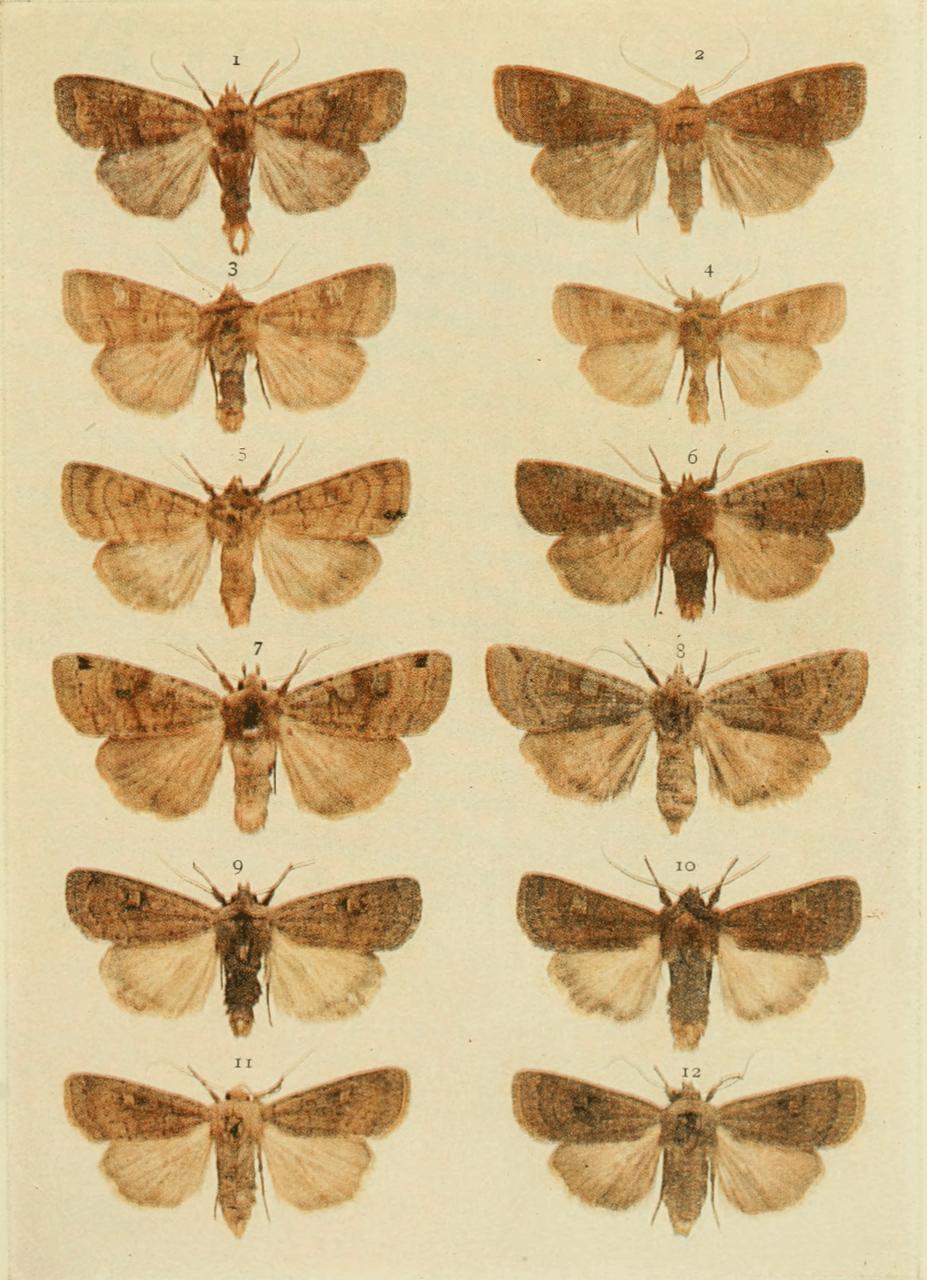
Pl. 114.
1, 2.Barred Chestnut. 3, 4.Small Square-spot.
5.Six-striped Rustic. 6.Cousin German.
7, 8.Dotted Clay. 9, 10, 11, 12.Square Spot Rustic.
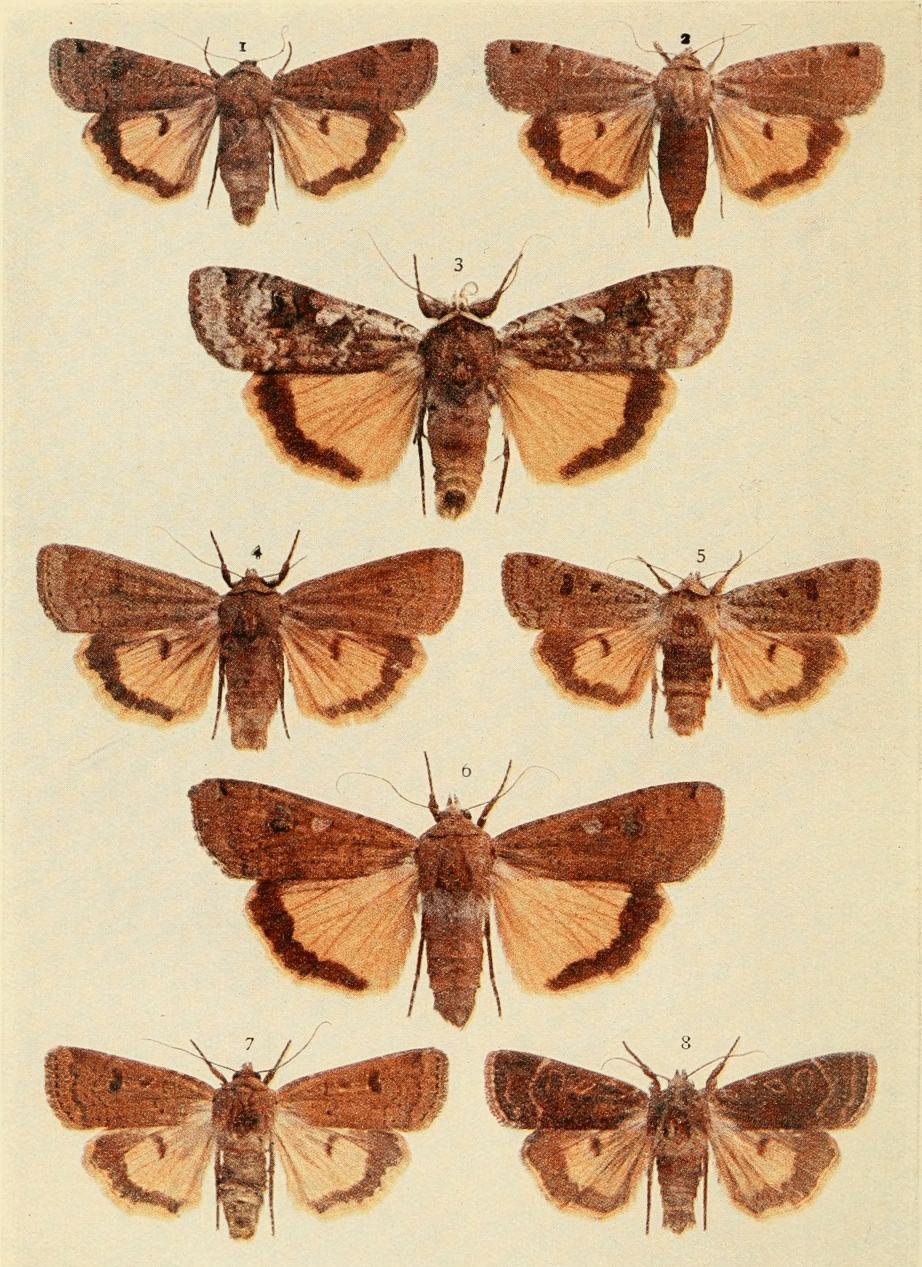
Pl. 115.
1, 2.Lunar Yellow Underwing.
4, 5, 7, 8.Lesser Yellow Underwing.
3, 6.Large Yellow Underwing.
The caterpillar is brownish, varying from ochreous to reddish, freckled with darker; the broken lines on the back are pale, with dark edges, and there is a brown freckled, pale ochreous stripe along the sides; the usual spots are black, and the spiracles whitish, edged with brownish; head brown marked with darker. It feeds on various low plants, and also on lettuce, beet, etc., in gardens; there are certainly two broods in most years, one in the summer and the other in the autumn. The moth is out in May and June, and again in August and September. Specimens have also been taken in July, and occasionally in April. The species has a very extensive range abroad, extending to India, Corea, Japan, and North America.
The Flame (Axylia putris).
This species, which is depicted on Plate 132, Fig. 13, is pretty constant in its pale coloration and darker markings. It is often common, and is widely spread throughout England, Wales, Ireland, and in Scotland up to Ross.
The caterpillar is greyish brown, mottled and dusted with blackish, chiefly so on the sides; the central line is darker but indistinct, and there is a yellow spot on each ring; a whitish line on each side of the central one is edged above with curved black dashes, and these are most distinct on rings four to ten; the eleventh ring is edged behind with ochreous; head dark brown; spiracles and raised dots blackish. (Adapted from Fenn.) It feeds on hedge bedstraw (Galium mollugo), dock, plantain, nettle, and many other low plants; also on lettuce. July to October. Generally the winter is passed in the chrysalis stage, and the moth comes out in the following June or July. Sometimes the moth has emerged in September.
The Lesser Yellow Underwing (Triphæna (Agrotis) comes = orbona).
This very variable species, of which the typical forms and two varieties are represented on Plate 115, is to be found, often abundantly, almost everywhere in the British Isles, except the Shetlands.
Apart from a form peculiar to Scotland, which will be separately referred to, the colour range of the fore wings is from pale ochreous-brown to a deep brown; in all shades there may be a tinge of reddish, or a suffusion of greyish. In Ireland and Scotland, and less frequently in England, a distinctly red form occurs. (Plate 115, Fig. 7.) Then there is variation in the markings, and more particularly in the reniform and orbicular marks; both stigmata are, perhaps, rarely absent, but they are frequently very faint, and of the orbicular there is often not a trace. On the other hand, both may be filled up with dark brown, or blackish, and very conspicuous. The cross lines, and more especially the shaded submarginal, are usually pretty much in evidence, but these are apt to disappear entirely. The yellow hind wings are occasionally smudged with blackish towards the base; the central crescents vary in size, and somewhat in shape, and although sometimes greatly reduced, they are only rarely quite missing; the black band before the outer margin is also subject to modification in width and the regularity of its edges.
Var. curtisii, Newman, was discovered in the Isle of Bute by Curtis in 1825, but until 1871, when Newman gave it the name it now bears, it had been known as consequa, the name assigned to it by Curtis when figured by him in 1831. The form is generally rather smaller than the type; the fore wings are rich reddish brown, clouded to a greater or lesser extent with blackish, and sometimes entirely suffused with that colour. The yellow ground of the hind wings is rarely quite free of black scales, but in some specimens they are so thick that the yellow is hidden. A specimen of this form is shown on Plate 115, Fig. 8. It is found in the Orkneys, Sutherlandshire, Elgin, Inverness, Aberdeenshire; also in the Hebrides, and in the Isles of Bute and Arran.
The caterpillar (Plate 118, Fig. 2), is greenish ochreous varying to greenish brown; three yellowish lines on the back, the central edged with blackish and the others with dark oblong marks; spiracles white, edged with blackish, and below them an ochreous stripe; head grey brown marked with darker. It feeds on grass and most low plants from September to April. The moth is out in July and August.
Abroad it occurs chiefly in Central and Southern Europe, but its range extends to Southern Scandinavia and eastward to Asia Minor and Armenia.
The Lunar Yellow Underwing (Triphæna (Agrotis) orbona = subsequa).
Two specimens of this species are shown on Plate 115. Fig. 1 represents a specimen from Forres, in Scotland, and Fig. 2 an example from the New Forest, Hants.
Although there is some variation in the colour of the fore wings (which ranges from pale greyish brown to dark reddish brown), and also in the intensity and clearness of the markings, this species is far less aberrant than that last referred to, and from which it is at once separated by the black mark on the front margin, placed on the inner edge of the submarginal line. The caterpillar is distinguished from that of comes by the black-edged broader ochreous central line, and a series of black oblong spots on each side of it; the stripe under the spiracles is broad, and ochreous. It feeds from September to April on grasses and various low plants. The moth flies in July and August. The species is widely distributed in Scotland, and occurs in Unst, the most northern of the Shetland Isles. In England it occurs, or has been found, in Durham, Yorkshire, Worcestershire (Malvern), Herefordshire, Gloucestershire, Oxfordshire, Norfolk, Suffolk (not uncommon in the "Breck" district), Surrey, Sussex, Wilts, Hants (rather commonly in the New Forest), and the Isle of Wight. For Wales, Barrett states that it is rare in Pembrokeshire; and Kane mentions Co. Galway (four specimens), Killarney, and Lisbellaw for Ireland. The range abroad is somewhat similar to that of comes, but it extends further north in Scandinavia.
The Large Yellow Underwing (Triphæna (Agrotis) pronuba).
The colour of the fore wings of this common, and often abundant, species ranges through various shades of brown to dark purplish. In the typical form (Plate 115, Fig. 3), the wings are of the paler shades, mottled with darker, and the thorax, except the pale front, agrees in colour with the darker mottling of the wings. Fig. 6 shows the plain form (var. innuba, Treitschke), and it is in this form that the darkest colours appear; the thorax is always of the wing colour, and without the pale front. The black mark at upper end of the submarginal line is rarely absent, but I have a pale reddish-brown example of the innuba form without the mark. In the black-bordered yellow hind wings a central crescent is very exceptional, but specimens in which it is more or less evident are not unknown.
The eggs figured on Plate 118 were found in August, 1906, on a leaf of gladiolus in the garden. When first noticed they were of a pale creamy-white colour, but two days afterwards the upper half of the batch became purplish grey, and the caterpillars hatched out the following morning, when the other half had also changed colour, and the larvæ hatched next day.
The caterpillar (Plate 118, Fig. 1), is obscure brownish, sometimes ochreous or green tinged; with ochreous lines on the back, the outer ones edged with blackish bars on rings four to eleven; head pale brown marked with darker. It feeds from August to May on grasses and low plants, and is often a pest in the flower or vegetable garden. When eggs are obtained early, the caterpillars from them will sometimes attain the moth state in the same year. The moth flies in June and July, and has occurred in April, September, and October.
The Broad-bordered Yellow Underwing (Triphæna fimbria).
This is another species with variable coloured fore wings, and four examples of it are shown on Plate 116. Pale ochreous brown and greyish brown is the most frequent colour, but various shades of greenish or olive brown are not uncommon. A dark reddish-brown form, known to collectors as the "mahogany form," seems to be somewhat rare. In the majority of specimens the basal third, and more or less of the central area adjacent to the second line seems to be the darkest coloured; but occasionally these parts are pretty much of the same tint as the rest of the wings.
The caterpillar (Plate 118, Fig. 4) is of a soft ochreous brown, sometimes red tinted, minutely dotted with blackish; the central line on the back is pale, and on each side are darkly-edged pale oblique streaks; the white spiracles are followed by blackish marks; head brown freckled with darker. It feeds in the autumn on primrose, violet, dock, etc., and in the spring it seems to prefer the buds and young leaves of birch, sallow, bramble, hawthorn, sloe, chestnut, etc. The chrysalis, which also is figured, is dark reddish-brown, with two short anal spikes.
This species occurs in June and July, and frequents woodland localities throughout England, Ireland, Scotland (up to Moray), and Wales.
The Lesser Broad-border (Triphæna ianthina).
Fore wings violet or purplish grey with blackish cross bands and brownish suffusion, the latter more especially on the basal area; reniform and orbicular stigma outlined in whitish. (Plate 116, Fig. 3.) In another form the bands and suffusion are reddish-brown. The black clouding on basal area of hind wings sometimes extends further towards the marginal band. The caterpillar (Plate 118, Fig. 3) is of a greenish tinged ochreous brown colour, with a pale central line and series of dusky dashes along the back, these dashes becoming blackish on the hind rings; the white spiracles are set in a blackish mark, and under them is a pale ochreous stripe. It feeds in the autumn on primrose, bramble, dock, etc., and in the spring on the young growth of sallow, elm, hawthorn, etc. The moth flies in July and August, frequenting lanes, hedgerows, and woods. It is pretty generally distributed throughout England, Wales, Ireland, and Scotland as far north as Moray.
The Least Yellow Underwing (Triphæna interjecta).
Fore wings, dull reddish brown with darker cross lines and shades, often faint. On the inner margin of the yellow hind wings, two dusky shades run from the border to the base; these are not infrequently as black as the border, which is often broader than in the specimen shown on Plate 116 (Fig. 4). The caterpillar is ochreous brown dotted with black; on the middle of the back is a brown stripe enclosing a whitish central line. A brown stripe along the sides is edged above with whitish; the head is pale ochreous brown lined with darker. Stated by Barrett to feed on grasses and low plants, or, in the spring, on young shoots of sallow; said also to eat primrose and dock. September to May. The moth is out in July and August, and affects lanes and hedgerows. I have found it more frequently on flowers of ragwort, and on "honey-dew," than on the sugar patch; but have met with it occasionally darting along some particular bit of hedgerow, in the late afternoon. Although apparently uncommon in the Midlands, it occurs more or less freely throughout England to Durham. In Ireland it has been found in counties Dublin, Wicklow, Waterford, Cork, Louth, Westmeath, Galway (Kane), and, Barrett adds, Antrim.
The Green Arches (Eurois prasina).
This moth is shown on Plate 117. When quite fresh the ground colour of the fore wings is a beautiful green, but this often fades after a time, and the wings then assume an ochreous hue. The cross lines are black relieved with whitish, and there is a whitish blotch on the second line touching the outer edges of the reniform stigma. The green colour varies in tint even when the insects are alive; and the black markings differ in intensity, being much stronger in some specimens than in others. The caterpillar is greyish brown, more or less tinged with violet; there are three fine whitish lines, and a series of blackish diamond-shaped marks on the back; the spiracles are white, and there is an ochreous stripe below them. It feeds on dock and other low plants, bramble, and in the spring on sallow shoots and the young growth of bilberry. July to April, or May. The moth, which frequents woods; flies in June, but has been reared, as a second generation, late in the year. The species seems to be pretty generally distributed over England and Ireland, and is often common, especially in the south and east of the former country. From the Midlands northwards it appears to be less common, and its range more restricted. In Scotland it has been recorded from Roxburghshire (common at sugar in 1898), the Clyde district, and, Barrett adds, Perthshire.
The Great Brocade (Eurois occulta).
On Plate 117, Fig. 3 represents the typical grey form of this species, and Fig. 4 the black var. passetii, Thierry-Mieg. Intermediates occur connecting the melanic form with the type, and sometimes specimens are found of a paler hue than the type. Bred specimens occasionally have a rosy tinge, and this is then usually most in evidence between the first and second cross lines. The caterpillar is brown, with three ochreous lines on the back, the outer with dark oblique dashes on each ring; a whitish stripe along the spiracles is blotched with reddish, and edged above with black. It feeds in the autumn on dock, plantain, primrose, dandelion, etc., and in the spring on bramble, bilberry, sallow, heather, and birch, among other things. Usually it hibernates when small, but when kept indoors, and fairly warm, it can be induced to complete growth, and attain the moth state in October or later, sometimes even earlier. In the open the moth flies from the end of June to August.
Scotland appears to be the British home of the species, and it is found in most woods throughout that country, including the isles, but it is rare in the Shetlands. It occurs in Durham (rare), and in Yorkshire was not uncommon at Everingham in 1897, and several were obtained at Middlesbrough in 1900. Further south its occurrence is even more casual, and the most recent captures I have any note of are, two specimens in Lincolnshire, August, 1896, and one each in Norfolk and North East London, August, 1900. Also recorded from Essex. Only two specimens are known from Ireland.
The range abroad extends to Amurland, Corea, and to North America.
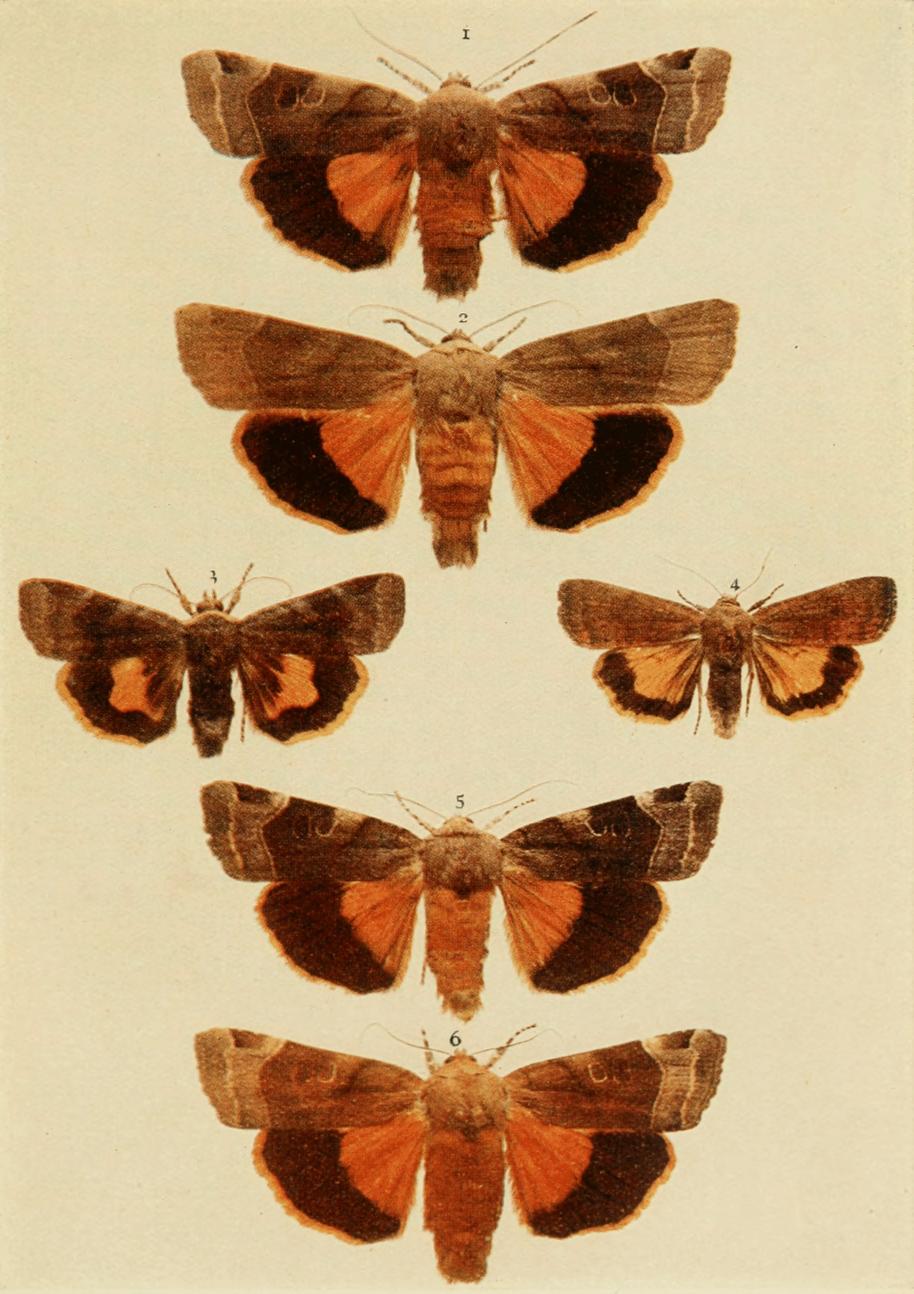
Pl. 116.
1, 2, 5, 6.Broad-Bordered Yellow Underwing.
3.Lesser Broad-Bordered Yellow Underwing.
4.Least Yellow Underwing.
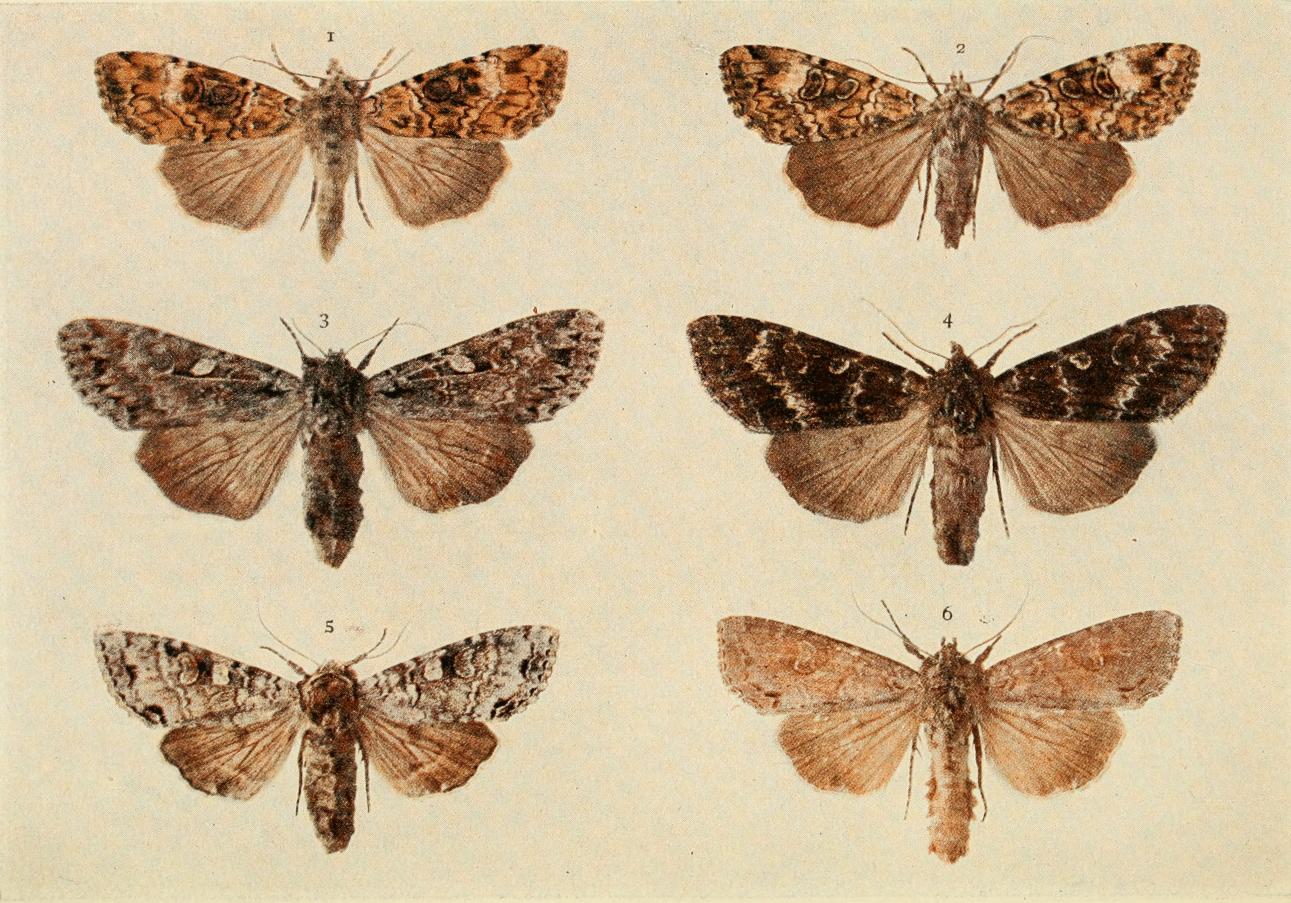
Pl. 117.
1, 2. Green Arches. 3, 4. Great Brocade. 5. Silvery Arches. 6. Pale Shining Brown.
The Silvery Arches (Aplecta (Mamestra) tincta).
The moth represented on Plate 117, Fig. 5, has the fore wings silvery grey clouded with brownish on the central area; or occasionally spreading over a larger portion of the wings, and sometimes purplish in tint. The caterpillar is brownish inclining to reddish, clouded on the back with paler and darker brown. The central line, which has a broken blackish edging, is only distinct on the front rings. Spiracles black; head pale brown marked with darker brown. In the autumn it feeds on low plants such as dock, plantain, etc.; but in the spring it is found at night on the young growth of birch and sallow bushes, and more rarely on hawthorn, and I believe, on bilberry. The moth which occurs in birch woods in June and July, is not uncommon in the south of England from Essex to Hampshire, and has been found in Dorset and Devonshire. It has also been obtained more or less frequently in Berkshire, Oxfordshire, Cambridgeshire (once), Huntingdon, Worcestershire (Wyre Forest and Malvern), Staffordshire (north), Lancashire (Witherslack), Yorkshire (Huddersfield, once), and Westmoreland. In Scotland it ranges on the west from Ayr to Argyllshire, but although local is more frequent in Perthshire, Moray, and Sutherland. Var. obscurata, Staud., is a form of this species occurring in Amurland and Southern Siberia.
The Pale Shining Brown (Aplecta (Mamestra) advena).
This moth (Plate 117, Fig. 6) is pale reddish brown and glossy, especially on the outer area, on the fore wings. The caterpillar is pale ochreous brown above, and inclining to greenish below; three dark-edged pale lines, and a series of dark diamond-shaped marks on the back. The usual dots are whitish encircled with blackish, and the blackish edged spiracles are reddish brown; head olive brown, and plate on first ring blackish with the three lines showing distinct. From July to September it feeds on various low plants, including rest-harrow, dandelion, and knotgrass, also on broom, bilberry (Barrett); and Newman mentions sowthistle (Sonchus) and lettuce. In confinement the moth sometimes emerges in the autumn, but in the open it flies in June and July. Flowers seem to have more attraction for it than sugar. I have taken it at the blossoms of wood sage, white campion, and woundwort (Stachys), and Barrett notes, bladder campion, viper's bugloss, and the martagon lily. The species is chiefly found, as regards England, in the southern and eastern counties; and in the Solway, Clyde, Forth, and Tay districts of Scotland. Louth is the only Irish county from which it has been reported. The range abroad extends to Amurland. In North America the species is represented by var. purpurissata, Grote.
The Grey Arches (Aplecta (Mamestra) nebulosa).
Grey of some shade is the more general hue of this species, but it varies in the West of England and in Ireland to white (var. pallida, Tutt), and this form is shown on Plate 119, Fig. 3. In Cheshire (Delamere), Lancashire (Warrington), and South Yorkshire black or blackish forms occur, and two examples of this melanic race are portrayed on the plate, Fig. 4 being var. robsoni, Collins, and Fig. 5 var. thompsoni, Arkle. Over the greater part of England, and in Scotland, the greyish form is most frequently met with, but the white form has been found in Argyllshire and in Sutherland. The caterpillar is ochreous brown or brownish grey, with a series of diamond-shaped blackish marks, and a pale central line, on the back; the dots and the spiracles are black, each of the latter with a blackish streak in front of it. In the autumn it feeds upon dock and other low plants; but in the spring, when it is more easily found, the caterpillar eats the buds and young leaves of birch, oak, sallow, bramble, etc. The moth is out in June and July, and is not uncommon in woods. The black form seems to be peculiar to north England. In Amurland the species is represented by var. askolda, Oberthür, and in North America by var. nimbosa, Guenée.
The Cabbage Moth (Barathra brassicæ).
The darker markings of this very common greyish moth are often very obscure, but the white outline of the reniform stigma, and the white submarginal line are usually distinct. The caterpillar varies in colour, but generally is some shade of dull brown or greenish, with the usual dots greyish or green tinged. The central line on the back is dusky, speckled with white, and the stripe low down on the sides is yellowish, greenish, or dingy brown; head ochreous brown marked with darker or greenish. Although it is exceedingly partial to the cabbage and other plants of the kind, it will feed upon almost every sort of low herbage, wild or cultivated. Barrett states that it has been found feeding on oak. I have taken it from birch in the garden, and it is known to eat leaves of almost any tree or shrub that may be offered to it in confinement. July to October. The moth is out in June and July, and sometimes there is an emergence in September. The species occurs over the whole of the British Isles, and abroad its range extends to India, Amurland, and Japan. (Plate 120, Figs. 3♂, 6♀.)
The Dot (Mamestra persicariæ).
The striking feature of the bluish-black moth shown on Plate 120, Figs. 1, 2, is the brownish centred white reniform stigma. Except that the yellowish submarginal line is sometimes obscured, the species is very constant in the British Isles. Abroad, a form without the white mark is known as unicolor, Staud., and one or two examples have been recorded as occurring in England, two in 1895 said to have been reared by a northern collector from caterpillars obtained in the London district. The caterpillar figured on Plate 129, Fig. 2, was pale green with darker green markings. In another form the colour is pale brown with the markings darker brown. It is found from August to October on all sorts of low plants, and in the garden, where it is often common in the suburbs of London, is very fond of the foliage of Anemone japonica and lupin, among other plants. The moth is out in July and August, but is not often common north of the Midlands, though it occurs, or has been found in almost all the counties of England. Its occurrence in Scotland seems to be doubtful, and Kane states that it is rare in Ireland, and almost absent from the northern counties. Its range abroad extends to China and Japan.
The White Colon (Mamestra albicolon).
Two specimens of this species are shown on Plate 120, Figs. 7, 8. It will be noted that, except for the two white dots at the lower outer edge, the outline of the reniform mark is very obscure; these dots are placed one below the other, thus forming a :, hence the English name of the moth. Blackish specimens have been obtained on the east coast of Scotland.
The caterpillar is green or bluish grey, with a dark-edged pale central line; spiracles white, margined with black. Barrett states that it feeds in June and July, and probably as a partial second generation in September, on plantain, dandelion, and other low plants growing in sand; probably also on Atriplex, Chenopodium, and Cruciferæ; but it is a larva of secret habits and is very little known.
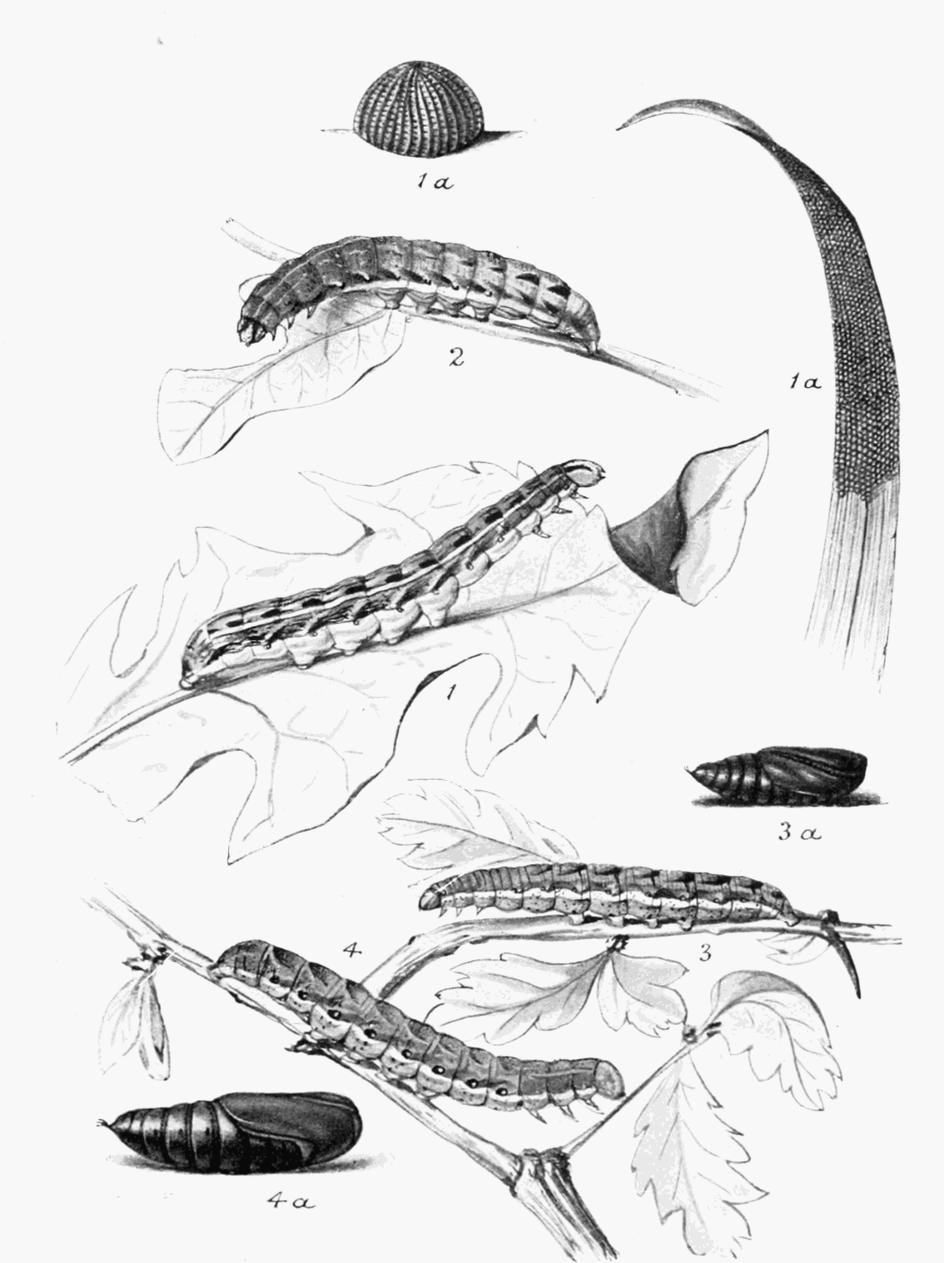
Pl. 118.
1, 1a.Large Yellow Underwing: eggs and caterpillar.
2.Lesser Yellow Underwing: caterpillar.
3, 3a.Lesser Broad-border: caterpillar and chrysalis.
4, 4a.Broad-bordered Yellow Underwing: caterpillar and chrysalis.
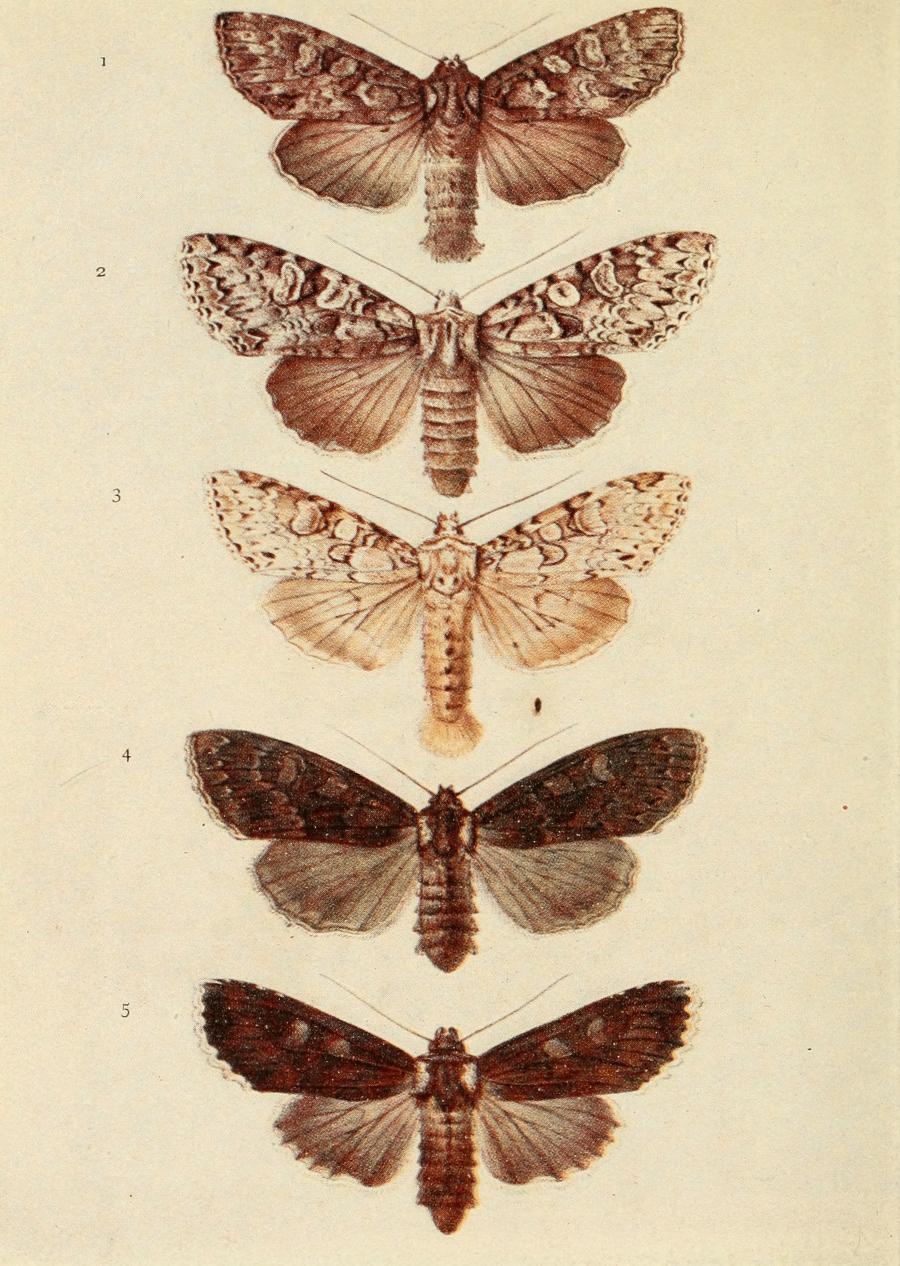
Pl. 119.
Grey Arches Moth and varieties.
The moth, which flies in May and June, and again in July and August, frequents sandhills on the west, especially those of Yorkshire, Lancashire, Cheshire, and Wales. In Norfolk and Suffolk it is found in the Breck Sand district as well as on the coast, and it also occurs on the coasts of Dorset, Somerset, Devon, and Cornwall, but seems to be uncommon in most of these counties. In Scotland it occurs in suitable parts of the east coast to Aberdeen, and on the west coast to the Clyde; and in Ireland on the coasts of Kerry, Louth, and Derry.
The Bright-line Brown-eye (Mamestra oleracea).
The English name of this very common moth (Plate 120, Figs. 4, 5), applies to the majority of specimens, but now and then the ochreous, or yellow reniform stigma, referred to as the brown eye, is blurred and indistinct, and the white submarginal line may almost disappear. The ground colour of the fore wings ranges from reddish or purple brown to dark brown. The caterpillar (Plate 129, Fig. 1), varies from green to light brown, sometimes the brownish forms are tinged with pink; the body is minutely dotted with white, and the usual dots are black; the spiracles are white, margined with black, and placed on the blackish edge of a yellow stripe; there are three greyish, but frequently indistinct, lines on the back. It feeds from July to September on most low plants, and is often found in abundance under spreading clumps of goose-foot (Chenopodium), and has been noted in profusion upon tamarisk growing by the sea. The moth flies in June and July, sometimes in the autumn. Except, perhaps, in the Hebrides, it has been found throughout the British Isles.
The Light Brocade (Mamestra genistæ).
The moth portrayed on Plate 121, Fig. 1, is not given to much variation. The central area enclosed by the cross lines is more or less clouded with reddish or purplish brown, not extending, as a rule, below the black bar between the lines, but sometimes the inner area is clouded with purplish from the second cross line to the base of the wing. The caterpillar is pale olive greenish above, with brownish and blackish diamonds or V-shaped markings; three lines on the back are dark-edged but indistinct; a cloudy line along the white spiracles. The colour varies from greenish to brownish grey or purplish brown, and all shades may occur in the same brood. It feeds in July and August on broom, dyer's greenweed (Genista tinctoria), persicaria, and other low plants. The moth is out in May and June, and may be seen in the daytime on palings and other kinds of fencing, and also on tree trunks. It occurs in England from Worcestershire and Northampton southwards, but seems to be rarely met with northwards. Four or five specimens were taken at electric light near Tarporley, Cheshire, about 1900 (Day's List). It has been recorded from Ayr, Argyll, and Paisley in Scotland, but its occurrence in Ireland is doubtful. The distribution abroad ranges to Eastern Siberia.
The Dog's Tooth (Mamestra dissimilis).
The example of this species shown on Plate 121, Fig. 2, is of the reddish-tinged pale brown form from Essex; but in that county, and also in other parts of England, the fore wings are sometimes clouded with sooty-brown. In other forms the fore wings are purplish or reddish brown, and the markings may be very distinct, or much obscured. The caterpillar is greenish or brown, minutely dotted with white, and freckled with dark greyish; the usual dots are black; there are indications of darker lines on the back, but these are not always clearly defined; the white spiracles are set in the black interrupted edge of a yellowish stripe. It feeds in July and August, on dock, plantain, etc. The moth flies in June and July, and occasionally in the autumn. Its haunts are marshy places, especially on the coast, and mosses; and it is found in most of the seaboard southern and eastern counties, and more rarely inland. Recorded from Ayr and Kirkcudbright in Scotland; is widely distributed in Ireland, and not rare in Louth and Kerry.
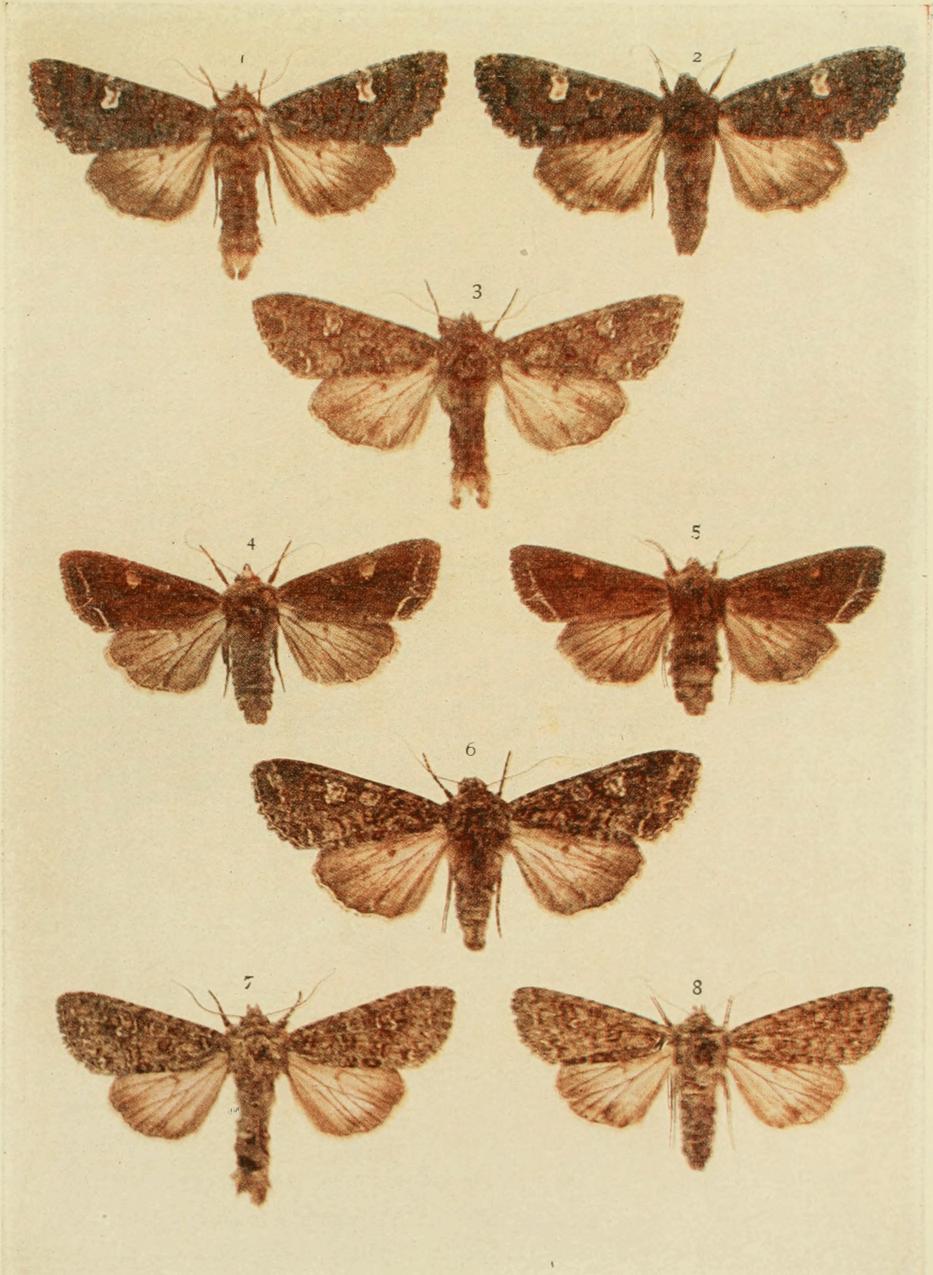
Pl. 120.
1, 2.Dot Moth. 4, 5.Bright-line Brown-eye.
3, 6.Cabbage Moth. 7, 8.White Colon.
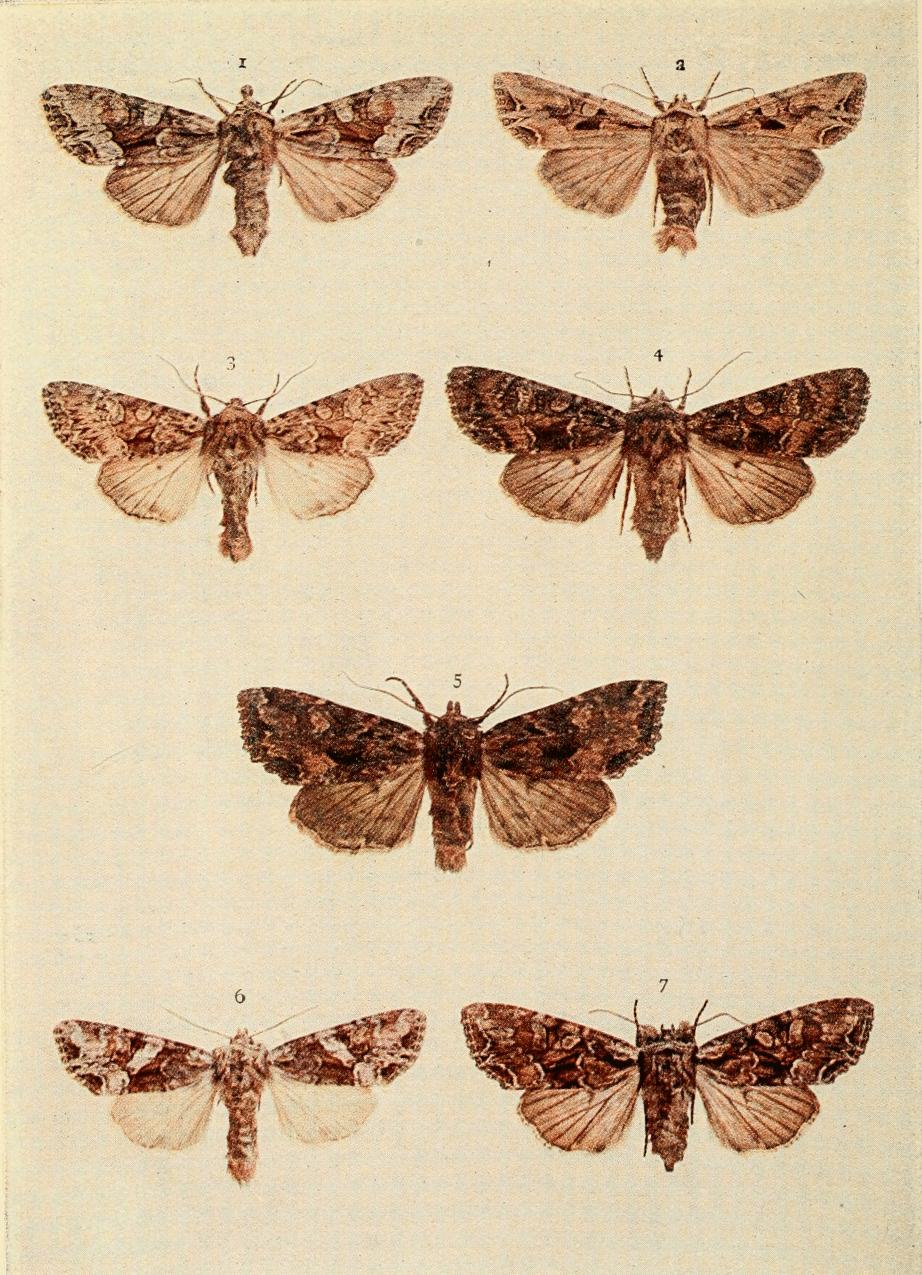
Pl. 121.
1.Light Brocade. 2.Dog's Tooth. 3, 4.Dark Brocade.
5.Beautiful Arches. 6.Beautiful Brocade. 7.Pale Shouldered Brocade.
The Pale-shouldered Brocade (Mamestra thalassina).
The whitish or creamy-white patch at the base of the reddish-brown fore wings is a noticeable feature of this moth (Plate 121, Fig. 7), and is almost always present, even when the wings are darkened and the other markings more or less obscured. The W-like angles of the white submarginal line run through to the fringes. In some specimens the general colour is purplish brown, and in others greyish brown. The caterpillar is greyish-brown with a slight reddish tinge, and freckled with darker brown; the usual dots are black; central line dusky, a series of darker oblique dashes on each side of it; the line along the spiracles is rather broad and sometimes edged above with blackish. It feeds in August and September on dock, groundsel, honeysuckle, broom, sallow, hawthorn, apple, etc. The moth is out in June, earlier or later according to the season; sometimes it appears again in August or September. It may be found, commonly as a rule, in most woods over the greater part of the British Isles.
The Beautiful Brocade (Mamestra contigua).
The moth (Plate 121, Fig. 6) has a pale patch at the base of the fore wing, but this is not so conspicuous as is the pale orbicular stigma, which is often united with a pale mark at its lower edge; another pale patch lies at the inner angle, and the whole area between the second cross line and the clouding on the outer margin may be pale. Sometimes these pale markings are tinged with pink, and more rarely the whole surface is pinkish suffused. The caterpillar is yellowish-green with reddish V-shaped marks on the back; a yellowish line along the black-margined white spiracles. Buckler figures a reddish-brown form, with a yellowish stripe below the spiracles. It feeds in August and September on birch, oak, golden rod, bog myrtle (Myrica gale), dock, brake-fern (Pteris aquilina), etc. The moth appears in June, and may sometimes be seen in the daytime on tree trunks or palings. It is a woodland species, but although it occurs in most southern and eastern counties, it is not common in any of them; it becomes commoner in the Midlands, but is scarce in, or absent from, the northern counties of England, and in Wales. In Scotland it is more frequent in some localities from Argyll to Ross. Kane notes it as local, and sometimes abundant, but from the localities given it would seem to be widely distributed in Ireland. The range abroad extends through Northern Asia to Japan.
The Broom Moth (Mamestra pisi).
The moth shown on Plate 122, Figs. 1, 2 varies considerably, in the colour of the forewings ranging from purplish red to dingy ochreous brown or greyish brown. The cross lines and occasionally the stigmata and shades may disappear, but the yellow submarginal line always remains, at least in part. The caterpillar (Plate 129, Fig. 3) feeds on the foliage of a variety of plants including brake fern or braken, sweet gale, broom, bramble, wild rose, and sallow, and may be found, often in the daytime, in August and September. It is usually of some shade of green or brown, occasionally blackish, with yellow stripes. The moth is out in June and July and is more or less common almost throughout the British Isles. The range abroad extends to Amurland.
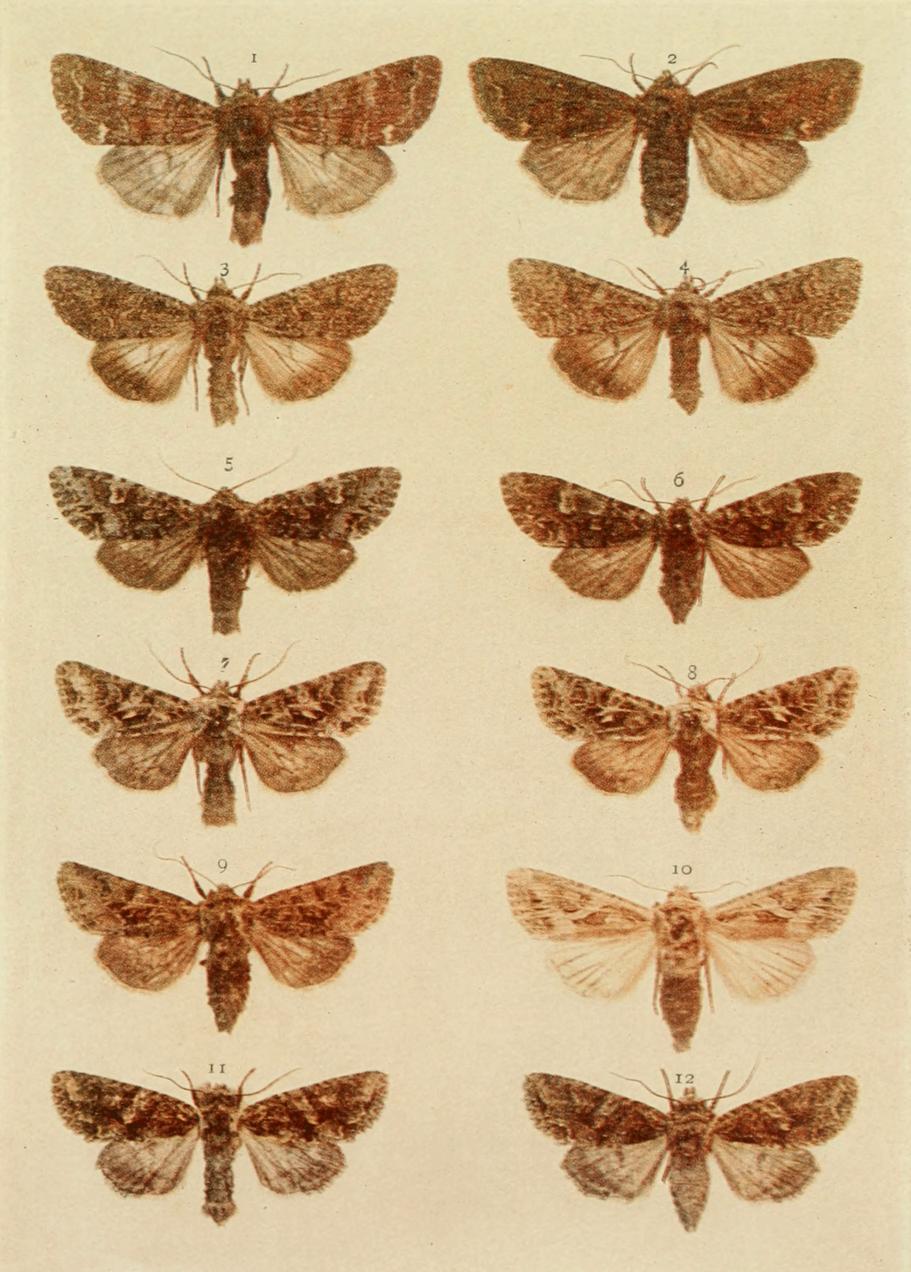
Pl. 122.
1, 2.Broom Moth. 3, 4.Nutmeg Moth.
5, 6.Glaucous Shears. 7, 8, 9.Shears Moth.
10.The Stranger. 11, 12.Brindled Green.
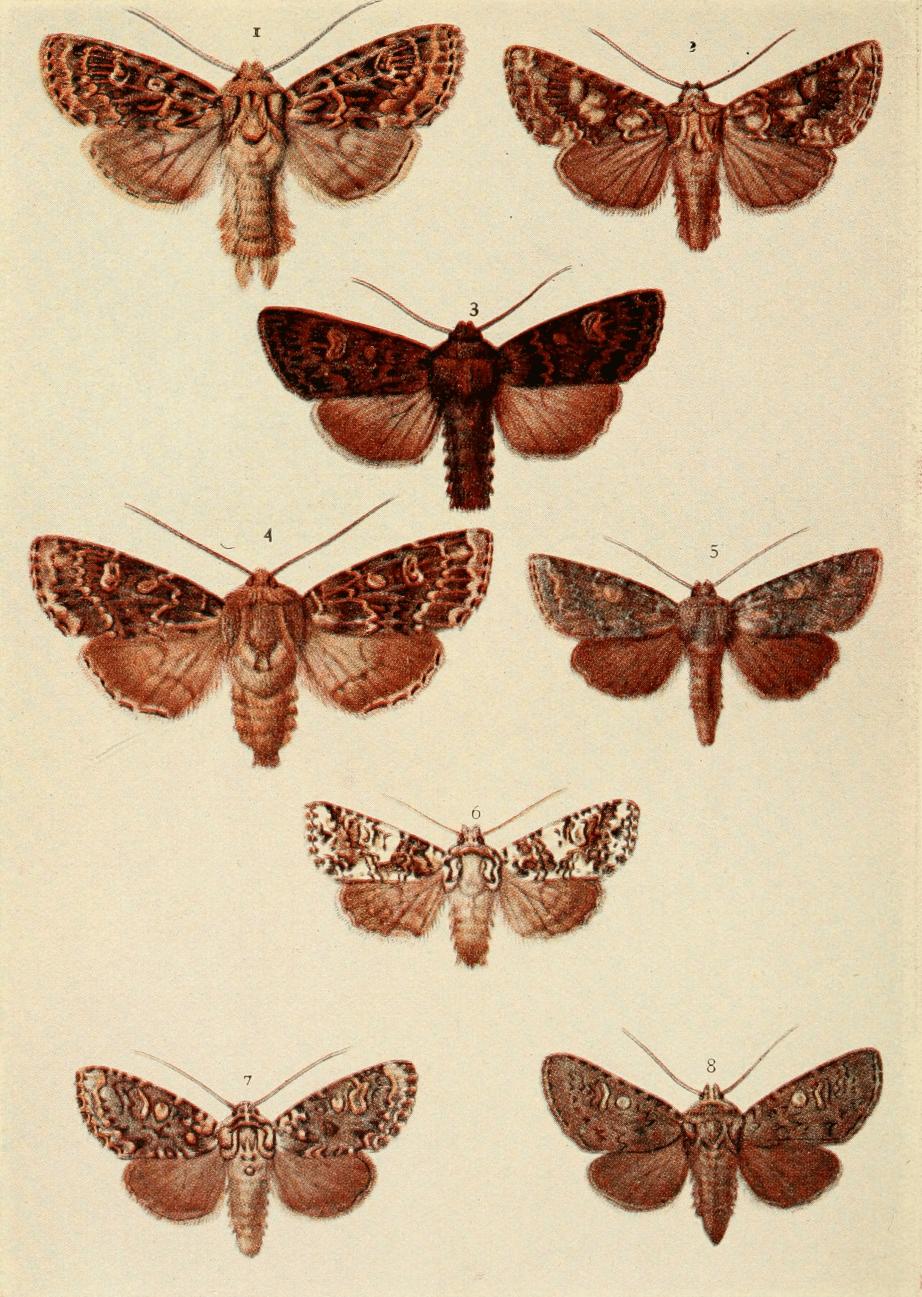
Pl. 123.
1, 4.Northern Arches Moth. 3.Northern Arches Moth, var. assimilis.
2.Barrett's Marbled Coronet. 5.Grey Moth.
6.Marbled Coronet. 7, 8.Marbled Coronet vars.
The Nutmeg (Mamestra trifolii).
The fore wings of this species (Plate 122, Figs. 3, 4) are usually greyish brown variegated with darker; cross lines pale with black edging. Sometimes the general colour is tinged with ochreous. The caterpillar is green with a darker central and two whitish lines on the back, the outer lines with black marks on them; a white edged pinkish stripe along the black-margined white spiracles. It feeds from July to September, sometimes earlier or later, on goose-foot, orach, beet, and other Chenopodiacæ, and has also been found on young leaves of onion. The moth is out in May and June, and as a second generation in late July and August. In 1903 a specimen was taken, at Boscombe, on March 21. The species is more especially attached to the coast, but is plentiful in the Breck Sand district of Norfolk and Suffolk, in market gardens and waste places around London, and is found more or less frequently up to Staffordshire. In Cheshire and Yorkshire it is scarce. Barrett states that in Scotland it is found rarely in Roxburghshire and Aberdeenshire; and not very uncommonly in the Clyde Valley; it is, however, not mentioned in the list of the lepidoptera of the Clyde area published in 1901. Only two specimens have been recorded from Ireland. The range abroad includes Northern Asia, Canada, and the United States of America.
The Glaucous Shears (Mamestra glauca).
Noticeable features of this dark-clouded whitish grey species (Plate 122, Figs. 5♂, 6♀) are the whitish, or whitish outlined, stigmata; and the conspicuous black wedges on the inner edge of the pale submarginal line. The ground colour is sometimes purplish tinged; the dark clouding may spread over the greater part of the fore wings. The caterpillar is dark red brown with darker freckles, a whitish central line, and two series of dusky dashes; a paler line along the black-edged white spiracles; head pale brown freckled with darker. Feeds in July and August on heather, sallow, bog myrtle, etc., and will thrive on lettuce. The moth is out in May and June, and may be found resting by day on tree trunks, fences, or rocks. This species in England occurs chiefly in hilly districts of the northern counties from Staffordshire to Cumberland; recorded from Glamorgan. In Scotland it is widely distributed from Ayr to Ross, and is also found in the Hebrides and the Orkneys; and in Ireland is obtained in several of the northern counties, and on the Hill of Howth. The range abroad extends to Amurland.
The Shears (Mamestra dentina).
The ground colour of this species, three specimens of which are shown on Plate 122, Figs. 7, 8♂, 9♀, ranges from the normal pale grey through various shades of brownish grey. The markings, usually well in evidence, are sometimes obscured in the darker specimens. The caterpillar is brownish with three white lines and a series of grey-brown diamond-pattern blotches on the back; the outer lines with blackish spots upon them; the stripe along the black spiracles greyish; head pale brown marked with blackish; plates on first and last rings of the body glossy. Feeds in July and August on dandelion, knotgrass, chickweed, hawk's-beard (Crepis), hawkweed (Hieracium), etc. The moth flies in May and June and appears to be found throughout the British Isles. Represented in Siberia by the dark form latenai, Pierret.
The Stranger (Mamestra peregrina).
This species, which is an inhabitant of Asia Minor, Southern Russia, Turkey, Dalmatia and Northern Italy, occurs in Southern, Western, and Northern France; and three specimens have been recorded as taken in England—all at Freshwater in the Isle of Wight—the first in 1858, the second in 1859, and the third about 1876. The specimen depicted on Plate 122, Fig. 10, was received from abroad.
Barrett's Marbled Coronet (Dianthœcia luteago, var. barrettii).
The type, which is of ochreous coloration, does not occur in the British Isles, although in one example of var. barrettii, reared by Mr. Kane, a faint ochreous tinge was apparent, but this faded out in a few weeks. Fig. 2, Plate 123, represents a specimen, kindly lent by Mr. R. Adkin, of var. barrettii, Doubleday, a form discovered in Ireland, at Howth, by the late Mr. C. G. Barrett, in June, 1861. In 1879 a specimen was taken on the coast at Ilfracombe, North Devon; one example was reared from a caterpillar found at Tenby, South Wales, in 1884, and one was captured in Carnarvonshire, North Wales, in 1897. In the last mentioned year specimens were taken by the late Major Ficklin on the coast of Cornwall, and as the Cornish form differs from the Irish form in being grey instead of brown, it has been named var. ficklini, Tutt. A second specimen was obtained in North Wales in 1899. Since its first detection at Howth the insect has been taken in limited numbers almost every year; and in 1906 Major C. Donovan recorded it as widely distributed along the coast of Co. Cork, the specimens being large, of a dark slate colour with distinct light whitish grey markings.
The caterpillar is pale ochreous with a pinkish tinge; the central line is greyish brown and the spiracles black; head reddish brown marked with darker. It feeds on the roots of seaside campion (Silene maritima), July to September. The moth flies from June to August. Like most of the species in this genus, it does not care for the collector's sugar, and except that an occasional specimen may be found resting on the rocks, the moths must be netted as they fly at dusk to the flowers of Silene. Staudinger considers that var. barrettii is identical with var. argillacea, Hübn.
The Grey (Dianthœcia cæsia).
The obscurely marked slate grey insect shown on Plate 124, Fig. 5, was first found at Tramore, Ireland, and in the Isle of Man about the same year (1866 or 1867). Kane mentions that he has found the insect at Tramore, and also in eleven other localities on the rocky coast line of the South of Ireland, from Hook Point to Dingle Bay. Our form of the species, var. manani, Gregson, differs from the greyish blue continental type in its darker coloration, and this is intensified in the south-west corner of Ireland where specimens of a uniform bluish black occur.
The caterpillar is pale ochreous brown minutely freckled with darker; the lines on the back are blackish, but indistinct; usual dots margined with black; head pale brown, marked with darker. It feeds on the buds, flowers, and seeds of campions (Silene maritima and S. inflata) from June to August. The moth flies in June, July, and early August, and may be taken, like the last species, at the flowers of the campions growing on the rocks in its seaside haunts.
The Marbled Coronet (Dianthœcia conspersa).
Three forms of this locally variable species are shown on Plate 123. Fig. 6 represents the typical form occurring generally in England, but in North Devonshire, on the coast, specimens are found closely approaching the Isle of Lewis form (Fig. 7), whilst others from that district agree in the blackish ground colour with specimens from Ireland. A still darker race occurs in the Shetland Isles, and chiefly on the east coasts, whence came the specimen depicted (Fig. 8). On the western sides of the Shetlands, Mr. McArthur found the species to be rather more typical as a whole, although some specimens approached the darker eastern form. The dark Shetland race has been named var. hethlandica by Staudinger, and the form with the white markings yellowish tinged is var. ochrea, Gregson.
The caterpillar is pale ochreous brown; the back sprinkled with darker, and forming still darker V-shaped marks, central line pale; spiracles ochreous with black outlines, set in the upper edge of a pale stripe; head shining pale yellowish-brown freckled and lined with darker. It feeds on the seeds of catchfly, campion, and will eat those of sweet-william and garden pinks. July to September. The moth is out in June and July, and at dusk visits the flowers of its food plants, and occasionally comes to sugar. It is chiefly found in the seaboard counties, but as regards England is commoner in the south than in the north. Although generally rare in the inland counties, it is sometimes not uncommon in some Surrey localities, such as the Croydon district, and Mr. Scollick has reared moths from caterpillars found in seed capsules of white campion at Horsley.
The distribution of this species extends to Amurland.
The White Spot (Dianthœcia albimacula).
The moth shown on Plate 124, Fig. 1, is "The Beautiful Coronet" of some writers. Although a specimen was taken in Kent in 1816, nothing further was heard of the species in England until 1865, when one example was captured in the Portsmouth district. Then in 1873 caterpillars were found in the Birchwood locality where the first moth was secured. The next year the species was found to occur at Folkestone, and subsequently at other places along the Kentish coast. Since 1889 it has been obtained, not uncommonly, at Seaton on the South Devon coast. The caterpillar, which is somewhat similar to that of the last species, feeds in July and August on the seeds of the Nottingham catchfly (Silene nutans), but will thrive on those of other kinds of catchfly, campion, or even sweet-william and garden pinks. The moth flies in May and June.
The Varied Coronet (Dianthœcia compta).
In Europe this species has a less northerly range than D. conspersa, and its eastward range extends to Japan. The caterpillar feeds on the seeds of Dianthus.
In his list of the lepidoptera of Ireland (Ent. Mo. Mag., 1866), Birchall remarks: "A pair of this well-known species, taken in Ireland by Mr. Tardy, are in the collection of Trinity College, but I am unable to indicate the exact locality of their capture." This is probably all the evidence we have of the occurrence of this species in the British Isles. The specimen represented on Plate 124, Fig. 2, is from the Continent.
The Lychnis (Dianthœcia capsincola).
Except that the brown ground colour is sometimes of a reddish shade, or greyish in tone, there is not much to notice in the variation of this species. Occasionally the outlines of the reniform and orbicular marks are usually white and distinct, and now and then the black markings are intensified. Two specimens are shown on Plate 124, Figs. 3 ♂, 4 ♀. The caterpillar is brownish ochreous freckled with darker, and with a pale central line and a series of dusky V-shaped marks on the back; a paler stripe along the whitish spiracles; head pale reddish brown, marked with darker brown. It feeds in July, sometimes in September, on campion, ragged robin, catchfly, and sweet-william and pinks. Fig. 3, Plate 130, is from a coloured drawing by Mr. A. Sich, and represents the caterpillar, as seen when making the sketch, holding a seed between its front pair of legs and up to its mouth. The moth is out in May and June, and in some years there is a second flight in the autumn. The species is more or less common over the greater part of the British Isles.
The Campion (Dianthœcia cucubali).
This moth (Plate 124, Figs. 5 ♂, 6 ♀) is very similar to the last, but it has a distinct violet tinge, the orbicular mark is lengthened, and its lower edge touches, or almost touches, the reniform; the second line is distinct and straighter above the inner margin. The caterpillar is greenish, tinged with orange-brown on the front rings; the central line is greyish-brown, and the V-marks on the back and oblique stripes low down on the sides are orange-brown. It feeds on the leaves as well as the unripe seeds of campion, ragged robin, and catchfly in July, August, and September. The moth is out in June, and examples of a second generation in August. Like the rest of the species of the genus, it is most partial to flowers, but it occasionally puts in an appearance at the sugar patch. Pretty generally distributed over the British Isles. The range abroad extends to Amurland, China, and Japan.
The Tawny Shears (Dianthœcia carpophaga).
This species ranges in the colour of the fore wings from almost white, through various shades of ochreous brown.
The white and ochreous-tinted specimens are found in Kent and Sussex chiefly, whilst the ochreous-brown forms are more generally distributed in England. Barrett states that in the south of Scotland a form occurs in which the ground colour is very pale dull brown with all the darker markings and cloudings deep umberous, the cloudings more extended. Var. capsophila (The Pod Lover), which represents the species in Ireland and the Isle of Man, is of a greyish coloration and lacks the ochreous tint; the dark markings, especially on the area between the first and second cross lines, are blackish or black, and the outlines of the stigmata are very distinct. Kane mentions dull black specimens, from the Blasket Islands, in which only vestiges of the stigmata and submarginal line remained clear. Pembrokeshire specimens have a colour range intermediate between carpophaga (Plate 124, Fig. 9) and var. capsophila (Figs. 7, 8), and serve to connect one with the other. The caterpillar, which is purplish brown with rather broad ochreous-brown lines on the back, feeds in June and July and again in September, on seeds of catchfly, campion, and sweet-william. The moth flies in May and June, sometimes in late July and August.
The Viper's Bugloss (Dianthœcia (Epia) irregularis).
The earliest British specimen of this moth (Plate 125, Fig. 1) of which there is any clear record is that found by the late Rev. A. H. Wratislaw, in July, 1868, resting on viper's bugloss (Echium vulgare), in a locality about ten miles from Bury St. Edmunds. Subsequently Tuddenham was indicated as the locality, and there, as well as in other parts of the Breck Sand district of Suffolk and Norfolk the species continues to flourish. Echium was at first supposed to be the food plant, but it was soon ascertained the larval pabulum was the flowers and seeds of the local catchfly (Silene otites). In September, 1870, Mr. Porritt described the caterpillar, and he found that in confinement it did not object to Ragged Robin (Lychnis flos-cuculi) in place of the Silene.
In colour the caterpillar is pale yellowish brown, tinged with green; three more or less distinct pale lines, and a series of smoke-coloured V-shaped marks on the back. Spiracles black with a yellowish white stripe below them, and a smoke-coloured one above; head wainscot brown dotted with black. It may be found on its food plant from late July to early September. The moth flies in June and July, but seems to have been very rarely met with in the open, although large numbers of the caterpillars, which are frequently "ichneumoned," are collected almost every year. A specimen, recently presented to the Lincoln Museum, is said to have been reared from a caterpillar found on viper's bugloss in the neighbourhood of East Ferry in North Lincolnshire.
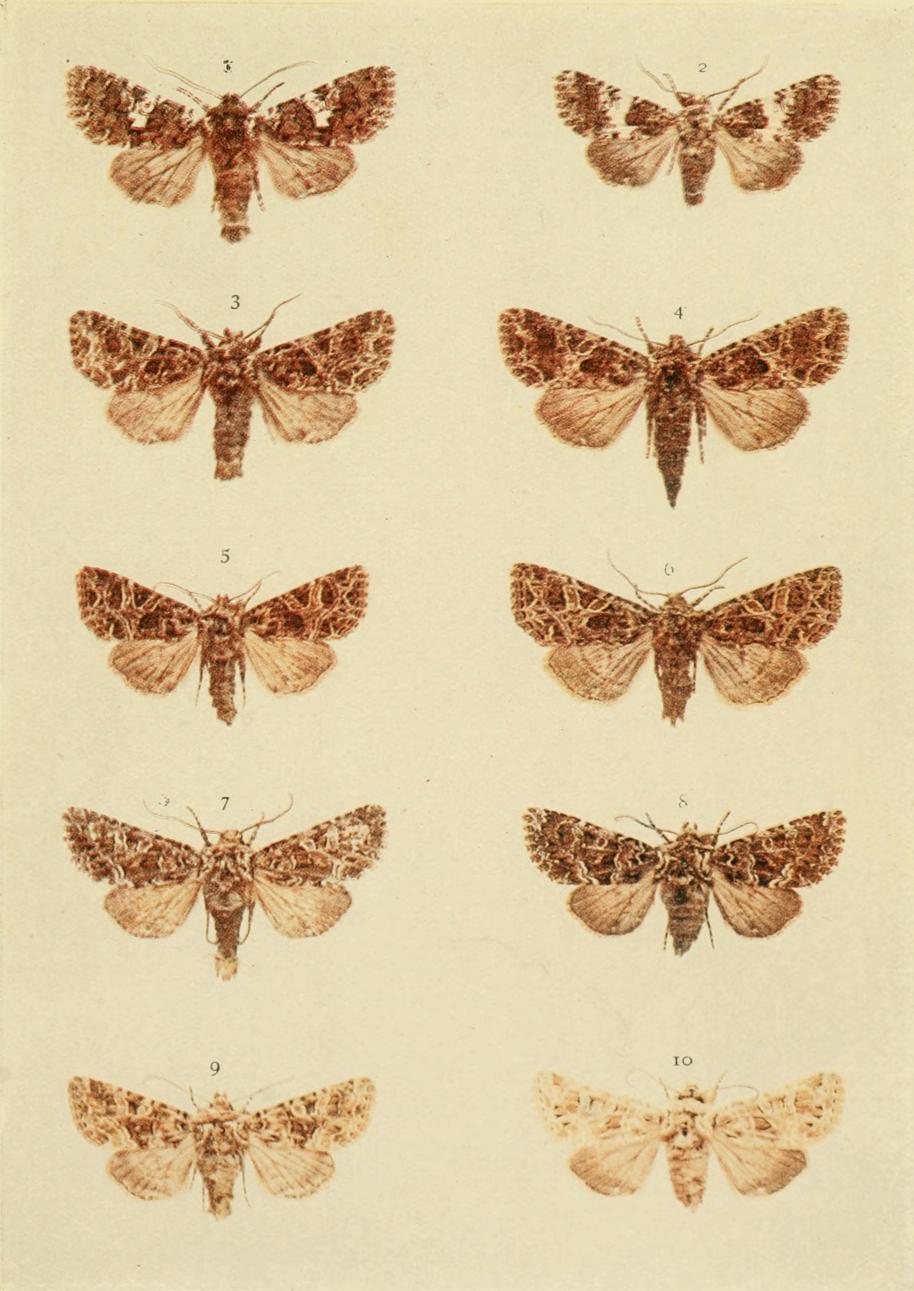
Pl. 124.
1.White Spot Moth. 2.Varied Coronet.
3, 4.Lychnis. 5, 6.Campion.
7, 8.Pod Lover. 9, 10.Tawny Shears.
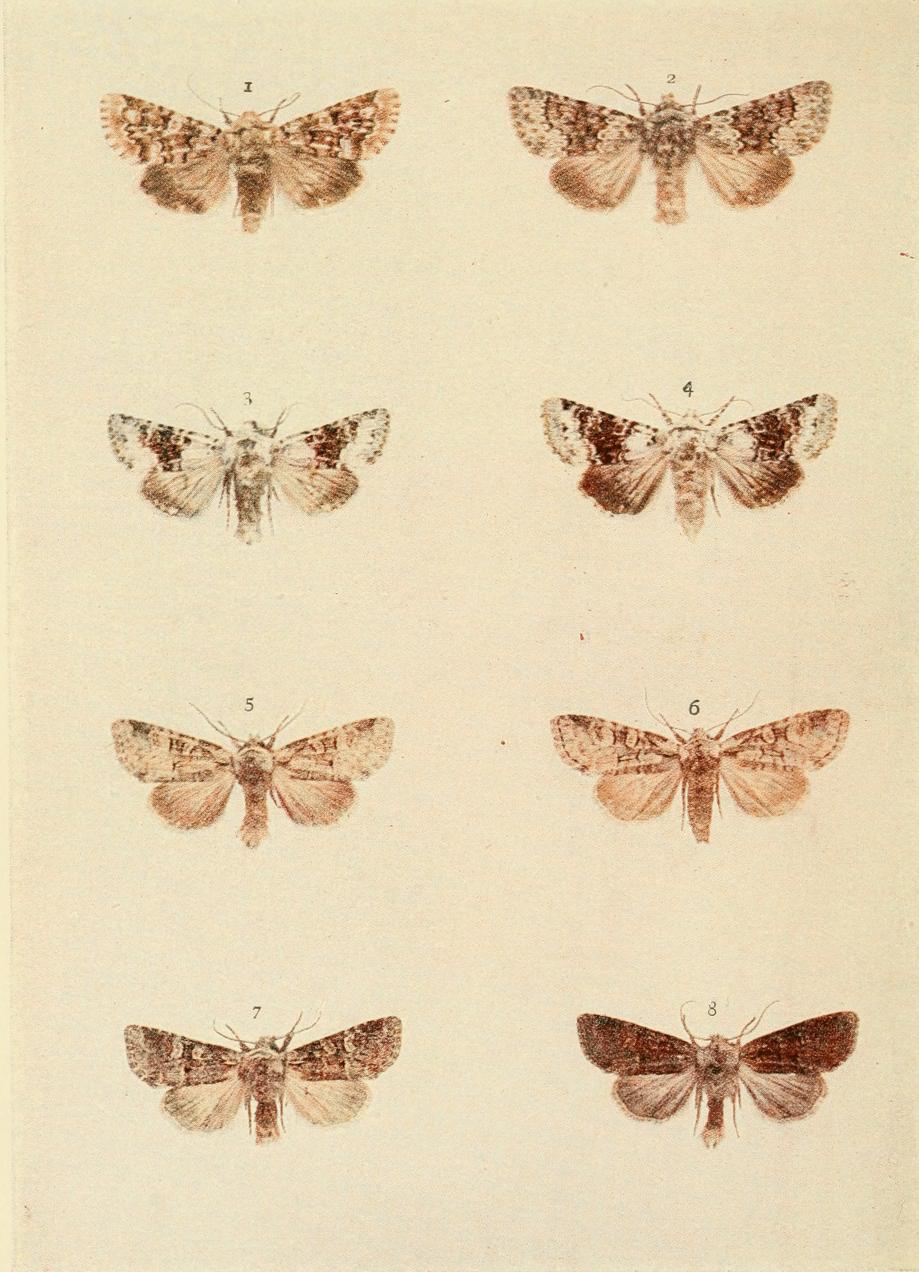
Pl. 125.
1.Viper's Bugloss. 2.Small Ranunculus.
3, 4.Broad-barred White. 5, 6.Minor Shoulder-knot.
7, 8. Minor Shoulder-knot varieties.
The Small Ranunculus (Hecatera chrysozona).
Except that the general grey coloration of the fore wings of this moth (Plate 125, Fig. 2) may be whiter or of a darker grey tint, there is little in the way of variation to refer to. Usually the area between the cross lines is dark grey, sometimes marked with yellow on the reniform and towards the inner margin. A series of yellow dots on the submarginal line is almost always present, but may be absent. The caterpillar is pale reddish brown; three fine double blackish lines and two rows of black dots on the back; a fine blackish line along the black spiracles. Head pale brown and glossy. In another form the general colour is some shade of green; yellowish to olive. It feeds in July and August on the flowers and seeds of the wild lettuce (Lactuca saligna, and L. virosa), hawk's-beard (Crepis), and also on those of the garden lettuce. The moth is out late in June and July, and at dusk may be seen at the blossoms of various plants in gardens and elsewhere, but seems to be most partial to those of spur-valerian (Centranthus ruber). It is found in the eastern counties, especially in Cambridgeshire; Surrey, and (rarely) in Sussex and Dorsetshire. Other English counties in which it has been noted are Hertford, Huntingdon, Northampton, Oxford, Berks, Somerset, and Hereford.
The Broad-barred White (Hecatera serena).
Most of the British examples of this species have the thorax and fore wings almost pure white, the latter with a central blackish grey band (var. leuconota, Ev., Plate 125, Figs. 3♂, 4♀). The white, however, especially on the outer margin, is sometimes clouded with greyish, and occasionally the ground colour has a greyish tinge, thus approaching var. obscura, Staudinger. The caterpillar is ochreous brown, more or less tinged with green, minutely dotted with dark grey, forming indistinct blotches; the stripe along the black spiracles is yellow tinged with green below. Head brownish, glossy. It feeds in July and August on hawk's-beard (Crepis). The smaller caterpillars may be found by day resting on the yellow flowers. In confinement they will eat the flowers and seeds of garden lettuce; and Prout mentions dandelion blossoms, and also those of almost any of the Compositæ. The moth is out from June to August, and in the daytime may be seen sitting on fences, tree trunks, rocks and walls. It is pretty generally distributed in the southern portion of England, but becomes scarce northwards. In Scotland it seems to be little known, but Renton records it as common in Roxburghshire, and in 1898 Mr. Kirkaldy kindly gave me three greyish-shaded specimens that he picked up casually at Pitlochry, Perthshire, in July of that year. It has been found in North Wales, but is more frequent in the southern parts of that country. Rather local and usually scarce in Ireland; but has been found in counties Waterford, Dublin, Wicklow, Louth, Antrim, Westmeath, Galway, Cork, and Kerry. The range abroad extends to Siberia and Amurland.
The Bordered Gothic (Neuria reticulata).
The cross lines and the veins are pale brown, sometimes tinged with pink. These markings give the moth (Plate 126, Figs. 1♂, 2♀) a netted appearance, which, apart from the different ground colour and clouding, distinguishes it from the Gothic, with which it is sometimes confused. The antennæ, too, of the male are only fringed with minute hairs, whilst those of the male Gothic are broadly pectinated. The caterpillar is greenish or pinkish ochreous, mottled with darker, and with slightly paler lines on the back and sides; head light brown. It will feed in July and August on knot-grass; and soapwort (Saponaria), Silene inflata, and Dianthus, have been mentioned as food plants. The moth is out in June and July. The species occurs in nearly all the counties of England to Yorkshire, but except in Cambridgeshire, and perhaps Oxfordshire, it is not common in any of the southern or eastern counties, although more frequently found in them than northwards. It has not been recorded from Scotland, and seems to be rare in Ireland, as it has only been noted from Co. Dublin and Co. Cork.
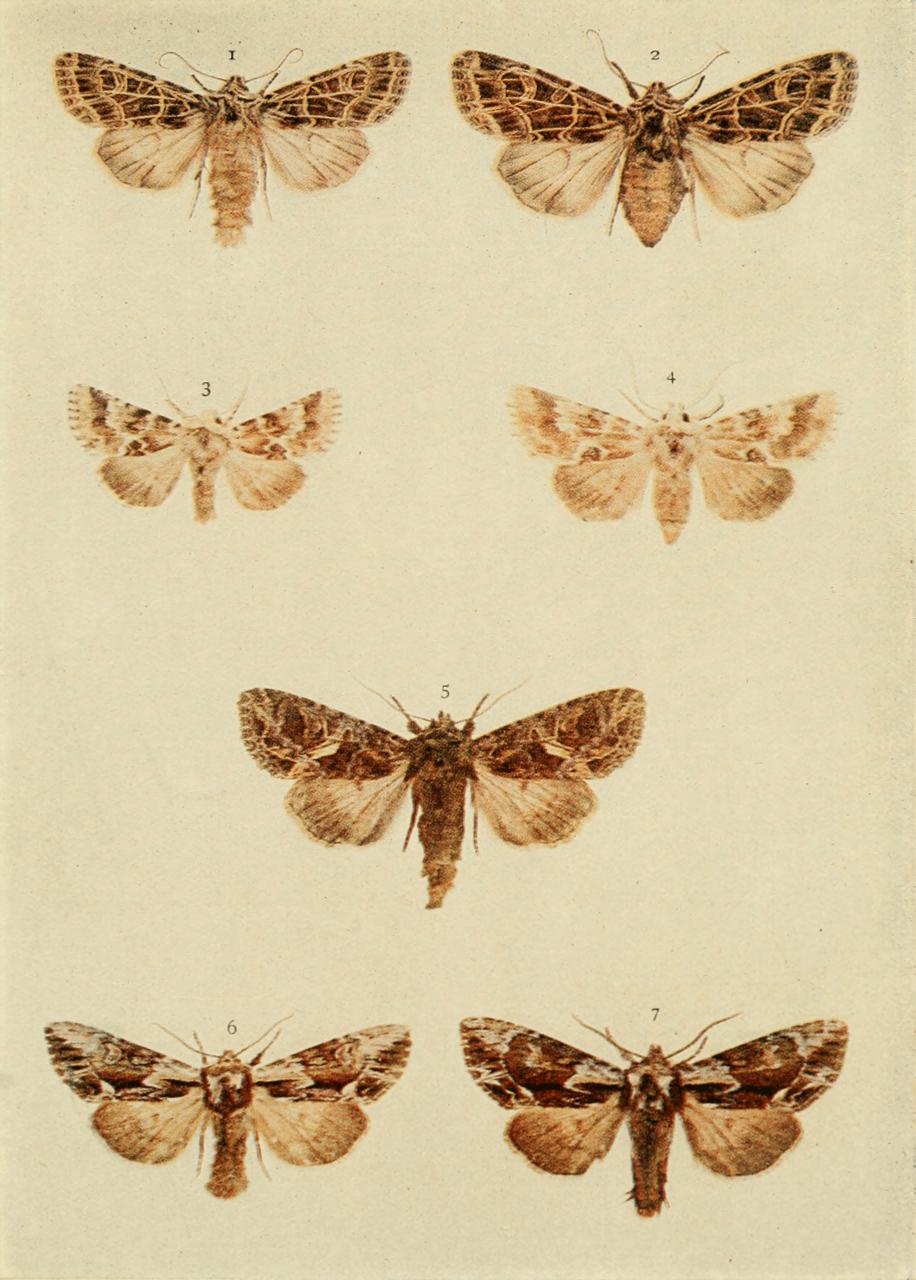
Pl. 126.
1, 2.Bordered Gothic. 3, 4.Dusky Sallow.
5.Orache Moth. 6, 7.Saxon Moth.
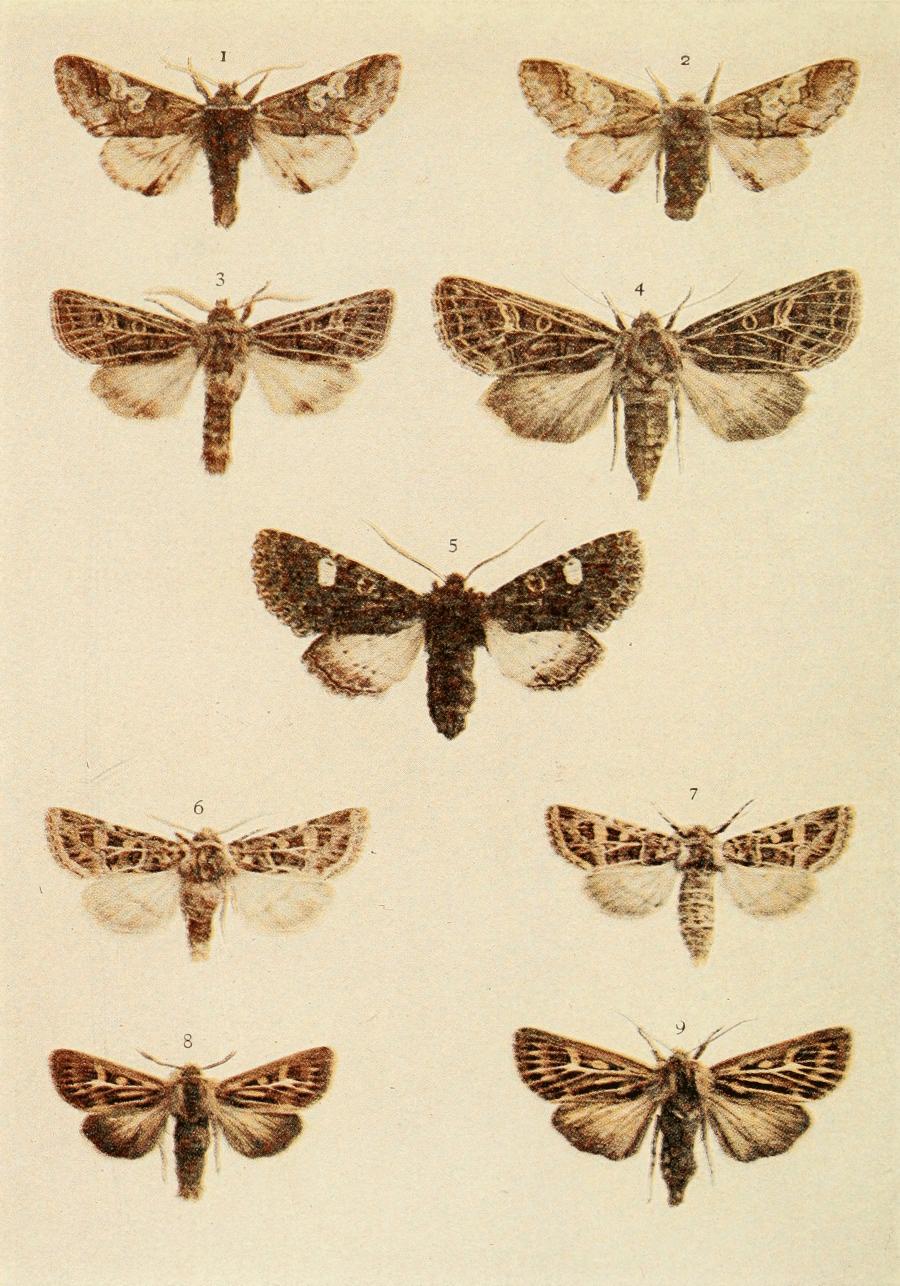
Pl. 127.
1, 2.Figure of Eight Moth. 3, 4.Feathered Gothic.
5.Green Brindled Dot. 6, 7.Beautiful Gothic.
8, 9. Antler Moth.
Feathered Gothic (Tholera (Epineuronia) popularis).
The male of this species (Plate 127, Fig. 3) is strongly attracted by light, and frequently seen in houses, and is no doubt a familiar object to most residents in the country, and even in the suburbs of London. The female (Fig. 4) does not visit light, but this sex, and the males also, may be found sitting after dark upon the upper erect leaves of the hard grasses, such as the matweed (Nardus stricta). Of course a lantern will be required to throw a light on the business of collecting them, and it is curious to note that even the brilliant glare of the acetylene lamp does not seem to disturb the moths very much, if at all.
The caterpillar is dark greenish brown and rather glossy, with a dusky plate on the first ring upon which are traces of the five dark-edged pale brownish stripes which traverse the body and meet on the last ring; the latter has a black plate. The spiracles are black, and the head is brownish, marked with darker. The caterpillars hatch in the spring from eggs laid the previous autumn, and may be found until July. They feed at night on the leaves of grasses, especially Nardus and such kinds, growing in parks and open places. The moth is out in August and September, and occurs more or less commonly throughout England and Wales. In Scotland it is found in Ayrshire, and in other localities in the Clyde area; thence eastward to Aberdeen. Kane states that in Ireland it is generally distributed, and in some localities very abundant, as at Clonbrock, and on the Wicklow coast.
The Hedge Rustic (Tholera cespitis).
The sexes of this moth are depicted on Plate 128, Figs. 8♂, 9♀. In habits, and also in the kind of places it frequents, this species has much in common with that last mentioned. It is certainly more local, but its range in the British Isles is somewhat similar to that of the Gothic. The life history also is very like that of the last species, and the caterpillar feeds on the same kinds of grass.
Antler Moth (Cerapteryx (Charæas) graminis).
This moth (Plate 127, Figs. 8♂, 9♀) has the fore wings greyish brown or reddish brown, sometimes tinged with ochreous in the paler forms, or with olive in the darker forms. There is also variation in the markings, and chiefly of the central forked streak which has been likened to the antler of the stag. In most British specimens of the greyish form this is white throughout its length, and it has three branches; the stigmata are whitish, and there is often a whitish bar below the central streak. A number of aberrations have been named, and of these the following seem to be the most important: var. tricuspis, Esp., reddish brown; branched streak, stigmata, and bar ochreous; var. rufa, Tutt = tricuspis, Hübn., as above, but the markings white; var. ruficosta, Tutt = graminis, Hübn., greyish brown, with reddish front margin, and ochreous markings; var. hibernicus, Curt., yellowish brown with the markings ochreous, and the stigmata more or less united with the central streak. In some specimens most of the markings are obscured or absent, and only the reniform stigma and the forked extremity of the central line remain distinct.
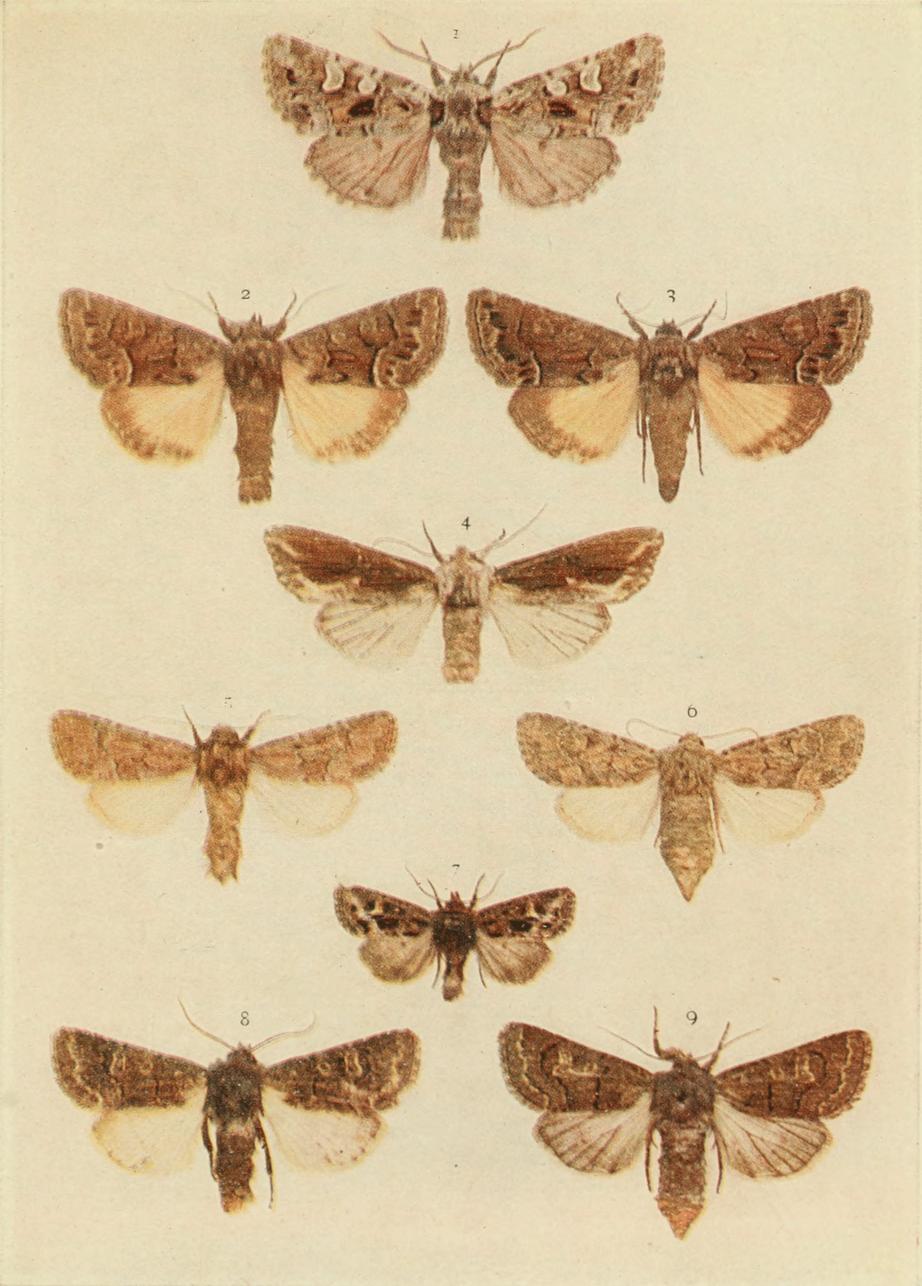
Pl. 128.
1.Feathered Ear Moth. 2, 3.Straw Underwing. 4.Silver Cloud.
5, 6.Flounced Rustic. 7.Haworth's Minor. 8, 9.Hedge Rustic.
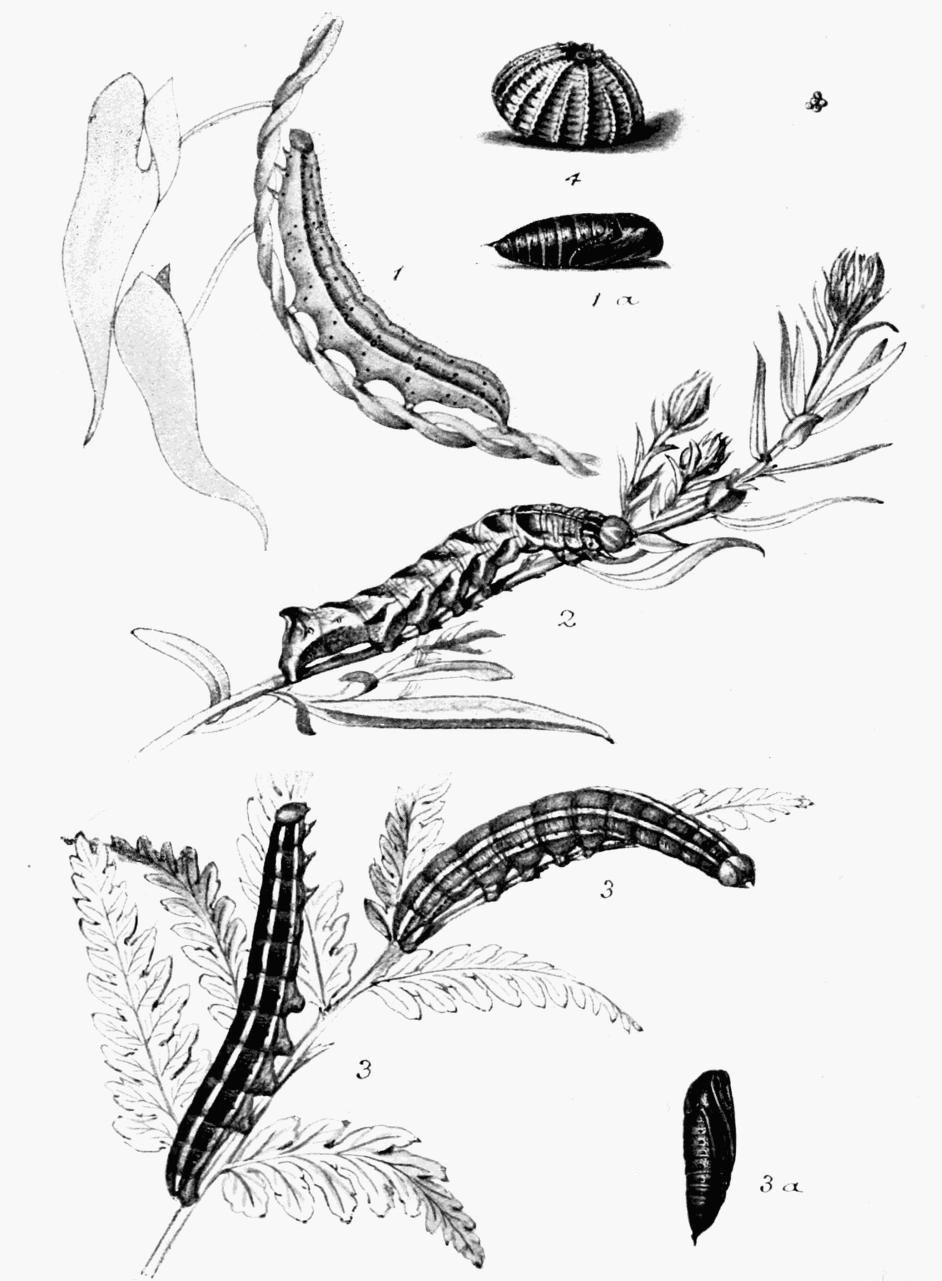
Pl. 129.
1, 1a. Bright-line Brown Eye: caterpillar and chrysalis.
2. Dot Moth: caterpillar. 3, 3a. Broom Moth: caterpillar and chrysalis.
4. Brindled Green Moth: egg, natural size and enlarged.
The caterpillar, which is glossy, and the skin much wrinkled, is of a bronzy-brown colour, with black-edged pale lines; there is a brownish plate on the first ring and a blackish one on the last; the spiracles are black and the head is brownish, marked with darker. It feeds from March to June on grasses, and in some years and localities occurs in enormous numbers, denuding considerable areas of grass land. Rooks and other birds devour them readily, and where their feeding places are on hillsides, they are apt to be washed off by heavy rain, so that the drains and ditches become filled up in places by masses of these caterpillars. Even after such wholesale destruction, the moths may still appear in the autumn in countless numbers. The male moths are sometimes seen flying in the sunshine and visiting the flowers of thistles, ragwort, etc. Such flight usually takes place between eight a.m. and noon, but both sexes have been seen flying over grass and heather continuously from just before midday to four p.m. The moths are also on the wing at night, and the male is very susceptible to the attraction of light. The species has occurred in all parts of the British Islands, but its presence in the south of England would appear to be more casual than elsewhere. The range abroad extends through Northern Asia to Siberia.
The Feathered Ear (Pachetra leucophæa).
Stephens, in 1829, figured one of two specimens of this species said to have been taken near Bristol in 1816, a part of England from which no other specimen has ever been recorded so far as I am aware. In June, 1855, the late Mr. S. Stevens obtained a few specimens at sugar, at Mickleham, Surrey. Between the year last mentioned and 1894 five other specimens have been recorded from the same county, these are Redhill (W. R. Jeffrey), Boxhill (G. Elisha, a pair, and B. A. Bower), Reigate (R. Adkin). In Kent, specimens have been found in the Folkestone and Tunbridge districts, but the chalk downs between Ashford and Wye appear to be the headquarters of the insect in Britain.
A portrait of a male specimen will be found on Plate 128, Fig. 1, but the ground colour is much whiter in the majority of British specimens.
According to Dr. Chapman, the caterpillar varies from a nearly uniform nankeen-yellow with the markings only indicated, to a handsome larva with distinct black stripes. There is a pale dorsal line, quite narrow; thence to the black spiracles is divided into three longitudinal stripes, a dark dorsal, a dark (but less dark) lower one and a pale intermediate. In all these the ground colour is the same, nankeen-yellow, and the darker areas depend on the greater or less darkness of fine black mottlings, generally in fine wavy streaks running more or less longitudinally. The head is rather brown than yellow, mottled in a honey-comb pattern, with some black marking about the mouth parts. It feeds at night from July to March on various grasses, but seems to prefer Poa annua, and P. nemoralis. Dr. Chapman reared some of these caterpillars by keeping each individual in a separate glass jar and supplying it at frequent intervals with a fresh tuft of Poa annua. The moth is out from May to July, and hides during the day among the tufts of grass on chalk hills. It comes freely to sugar, and has been taken at privet blossom.
The Silver Cloud (Xylomania conspicillaris).
Three forms of this species occur with us. In that represented on Plate 128, Fig. 4, the fore wings are almost entirely blackish. Another has a larger portion of the inner marginal area ochreous brown, or whitish, ab. melaleuca, Vieweg; a third form, and the least frequent, may be described as pale ochreous brown with darker mottling on the basal half, and black central markings representing a broken streak from the base of the wing to the outer margin, in this form the pale outlined stigmata are fairly distinct, and there is a blackish shade between them extending from the front to the inner margin. From chrysalids obtained by digging under oak and elm trees in a private park several miles from Taunton, Somerset, Mr. H. Doidge (1901) reared moths and obtained eggs which were laid in a batch on the covering of the cage in which the female was placed with a growing plant of bird's-foot trefoil. The eggs hatched on May 31, ten days after they were laid. The young caterpillars were purplish grey, but after feeding on the yellow flowers they assumed the same colour. "After finishing the flowers they commenced on the leaves, by which time they were a pale green colour, with a yellow spiracular stripe, and were fond of resting by day on the stems of the plant. As they approached the final stage, the green became shaded with brown and black," and then resembled the ripening seed pods. They were afterwards supplied with blackthorn, and did not object to the change of food. They also ate dock (sparingly), and Trifolium minus. "About July 8 they began to go under ground to pupate. The pupæ, which were of a dark reddish-brown colour, and somewhat obese and blunt, being enclosed in a very compact and brittle earthy cocoon" (Doidge).
The moth is out in April and May, but is very local in England. It has occasionally been found at rest on isolated tree trunks or on posts, but very rarely captured in any other way. Specimens have been obtained from chrysalids dug up now and then from about the roots of trees, but perhaps most of the specimens in collections, not numerous altogether, have been reared from eggs. In England the species is only known to occur in Kent, Surrey, Suffolk, Gloucester, Somersetshire, Worcestershire, and Herefordshire. Barrett also mentions one specimen at Gower, South Wales.
The Beautiful Arches (Eumichtis (Hadena) satura).
Of this species (Plate 121, Fig. 5) probably less than a dozen specimens have been taken in England, and apparently none in any other part of the British Isles. It is very similar to some of the darker forms of E. adusta, specimens of which have often been mistaken for examples of the present species and recorded as such. The wings are rather more ample; the reniform and orbicular stigmata are reddish, with a blackish cloud under them, and the space between the second and submarginal lines towards the inner margin is also reddish. The hind wings are dark in both sexes. The caterpillar, which is said to feed in July and August on hop, honey-suckle, and cherry, among other plants, is pinkish brown, darker above; the dusky-pink central line on the back is interrupted and indistinct, and on each side of it is a series of oblique greyish but not clearly defined streaks; the line low down on the sides is yellow-green. The moths flies in June, July, and August.
Abroad the species occurs in Central and Northern Europe (except the most northern parts, and perhaps Western France); eastward the range extends to Amurland.
The Dark Brocade (Eumichtis (Hadena) adusta).
The sexes of this moth are figured on Plate 121, Figs. 3♂, 4♀. The ground colour is grey-brown in some examples of this species, whilst in others, especially in the north of England and in Scotland, the colour ranges through rich reddish brown, blackish brown to almost black. In the lighter coloured forms the markings are usually clear and distinct, but in the darker forms are often much obscured. The caterpillar is somewhat variable in colour and markings. Barrett describes one form as pale sage green strongly tinged with ochreous and dusted with greyish brown; the line along the middle of the back is white, interrupted, and edged with greyish brown; a series of outlines of greyish-brown diamonds spread over to the brown margin of the pale ochreous stripe along the whitish spiracles, and form a network on the back and sides. Another form, described by Buckler, has the general colour brilliant yellow, suffused on the upper surface with deep rose pink; a stripe on the middle of the back composed of two darker pink lines, united and forming a spot at the beginning of each segment, and an interrupted yellow stripe on each side. It feeds from July to September on grass and various low plants, including knot-grass, bladder campion (Silene cucubalus); also sweet gale, sallow, etc. The moth flies in June and July, sometimes in May. The species occurs in woods and on heaths and moors, and is generally distributed, and more or less common throughout the British Isles. The range abroad extends to Amurland.
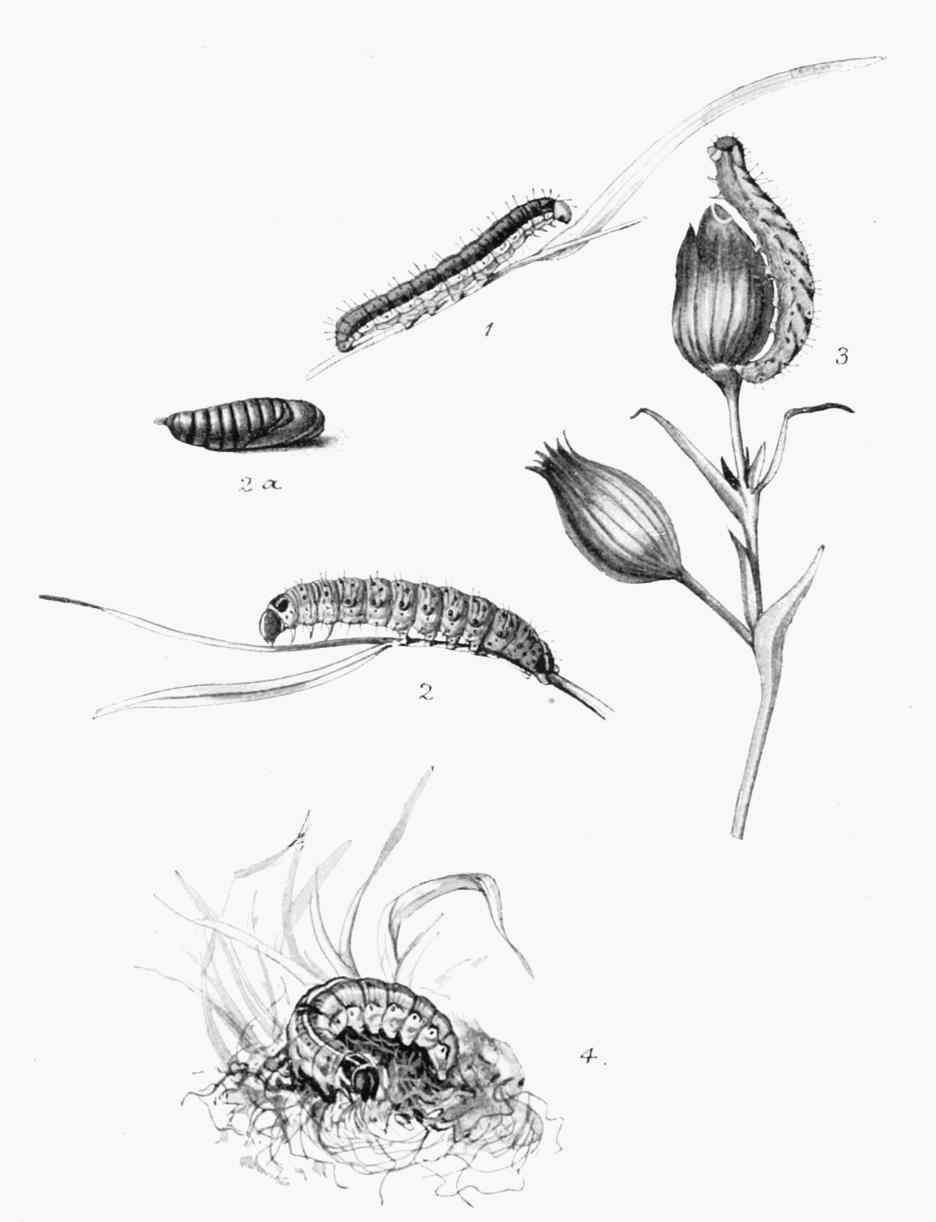
Pl. 130.
1.Slender Brindle: caterpillar. 2, 2a.Clouded Brindle: caterpillar and chrysalis.
3.Lychnis: caterpillar. 4.Clouded Bordered Brindle: caterpillar.
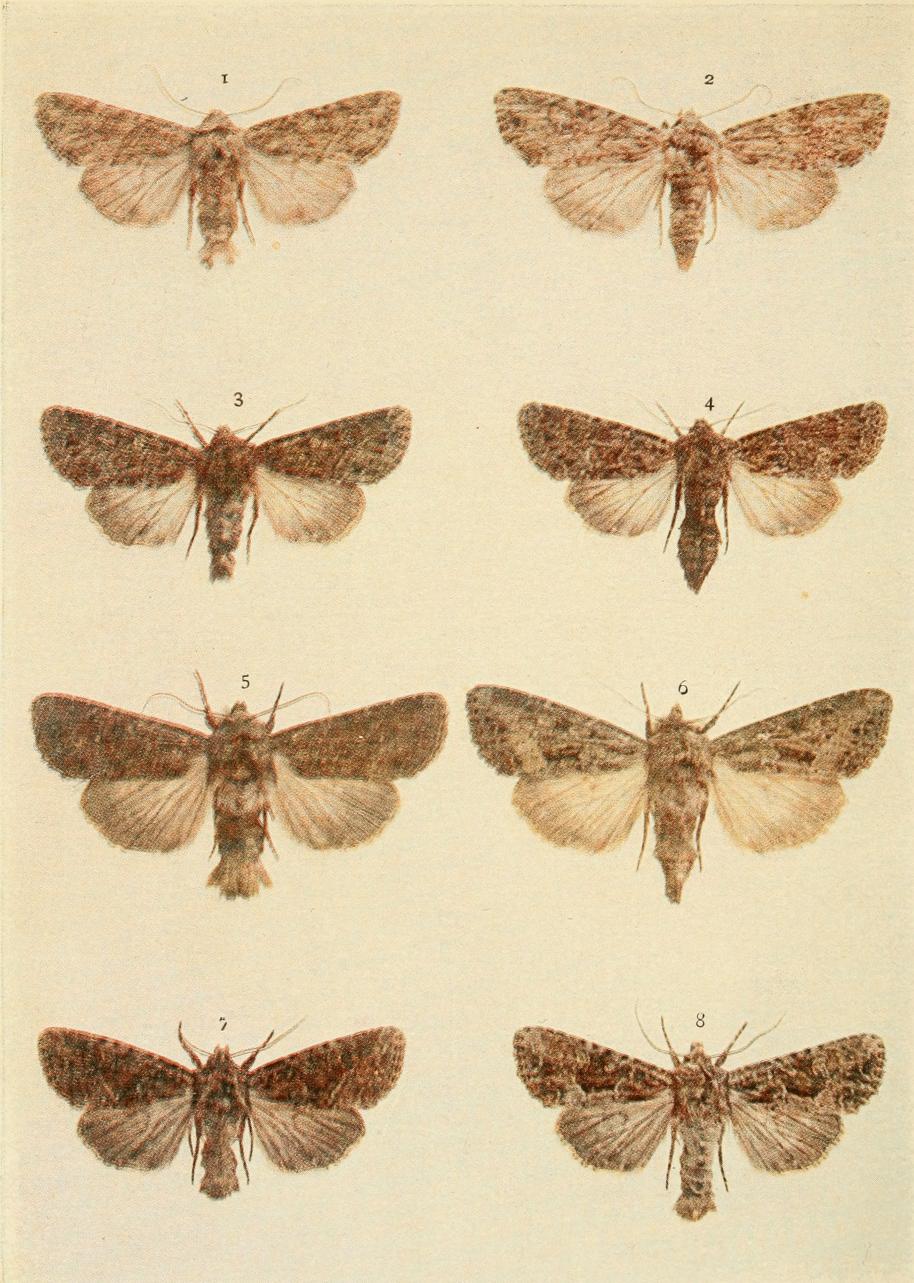
Pl. 131.
1, 2.Large Nutmeg Moth. 3, 4.Confused Moth.
5, 6.Crescent Striped Moth. 7, 8.Dusky Brocade Moth.
The Brindled Green (Eumichtis (Hadena) protea).
Green of some shade is often the prevailing colour in the much ornamented moth portrayed on Plate 122, Figs. 11, 12; but in some specimens the general colour is pinkish white. The variegation consists of reddish brown or pinkish, and white clouds and black streaks, chiefly as edging to the pale cross lines, or between the stigmata; these latter are as often obscure as distinct, but sometimes the orbicular is white with a white mark below it extending to the black bar connecting the first and second cross lines.
The caterpillar is green freckled with yellow, with a yellow central line on the back; head brownish. It feeds from March to June, and when it leaves the egg it bores into an oak bud to feed; later on it spins the young leaves together, and finally it dispenses with a retreat altogether and feeds openly on the leaves. The moth is out in the autumn, rather earlier in Scotland. It is widely distributed in England, and in some seasons and localities very abundant. In Scotland it is found from Roxburgh to Moray, and in the latter county as well as in Perthshire and Argyll it is often plentiful. Single specimens have been recorded from Ireland, and these from Co. Galway and Co. Westmeath.
The Northern Arches (Crymodes exulis).
The specimens of this species shown on Plate 123, Figs. 1, 4, are from Shetland, and more or less of the typical form, but rather more variegated, perhaps, than the actual type. In other specimens from the same locality the yellowish submarginal line is band-like; or the ground colour is browner, and sometimes blackish. These blackish examples approach var. assimilis, Doubleday (Fig. 3), from Perthshire, where it was first met with, at Rannoch, by Weaver, over sixty years ago. Exulis (The Exile) was discovered by Mr. H. McArthur in the Shetlands in 1883. In 1896 Mr. P. M. Bright captured a specimen in the Shetlands which Barrett considered referable to maillardi, Hübn. (Geyer, Fig. 833.) "Its ground colour is drab-brown, abundantly marked with umberous and dusted with black, and its only conspicuous marking is the reniform stigma, which is distinctly edged with white in such a manner as to give it a singular resemblance to Mamestra [Barathra] brassicæ." Staudinger, it may be added, adopts maillardi as the earlier name for this species, and it may have to be generally accepted. The caterpillar is ochreous whitish, shaded with grey, and with yellowish plates on the first and last rings; spiracles black, head reddish brown. It feeds on grasses from August to May, but is sometimes two, or even three, years in completing its growth. When young, and also later, it eats the lower part of the stem and partly into the root of the grass. The moth is out in July and August. Very few examples of the assimilis form have been obtained, and these only in Perthshire, Aberdeenshire, Inverness, and the Isle of Arran. Mr. W. M. Christy captured one specimen in Ross-shire in August, 1902. The geographical range of this species extends from the Alps and Pyrenees through Norway and Lapland to Iceland, Greenland, and Labrador.
The Minor Shoulder-Knot (Bombycia viminalis).
Figs. 5 and 6 on Plate 125 represent the typical form of this species. Fig. 8 shows the blackish var. obscura, Staud., and Fig. 7 an intermediate form. The pale form is most frequent in southern England, and dark forms are commoner in the north. Both forms occur in Scotland, but in some parts the pale form only is found. The caterpillar is green with three whitish lines on the back; the raised spots are also whitish; the line along the black spiracles is yellowish. It feeds from April to June on sallow and willow; at first on the terminal shoots, the leaves of which are spun together with silk. Later on the caterpillar folds down or rolls a leaf so as to form a shelter. The moth is on the wing in June and July, sometimes later, and is pretty widely distributed throughout the British Isles, but is rather local in Scotland, northern England, and Ireland. The dark form, it may be mentioned, does not seem to be found abroad. The range of the species extends to Amurland.
The Dusky Sallow (Eremobia ochroleuca).
This brownish tinged ochreous moth (Plate 126, Figs. 3, 4) has the fore wings crossed by whitish lines, the first and second of which approach or unite below the middle, dividing into two blotches the dark central band-like shade.
The caterpillar, which feeds on the seeds of cock's-foot (Dactylis) and other kinds of grass from May to early July, is whitish green and glossy; three whitish stripes on the back, the central one broadest; a stripe below the black spiracles is whitish, edged above with green. Mullein (Verbascum) has also been mentioned as eaten by this caterpillar. The moth is out in July and in August, and may often be seen resting on the flowers of knapweed (Centaurea) in the daytime. It flies at night, and has been taken at the flowers of centaurea, ragwort, etc., and at light. In some districts it is said to visit the sugar patch, but not to do so in other localities. Occurs in the chalk districts of most southern English counties, and especially those of Kent and Sussex; also, but only rarely, in Warwickshire and Yorkshire. One specimen has been recorded from Pembrokeshire in Wales.