PART II. (continued 4)
Reading edition
The moth emerges in May and June. Occasionally a few larvæ will feed up and the moths appear the same year, but this only happens in captivity and not in the open. When reposing in the daytime, on a hedgebank for example, with the fore wings closed down over and hiding the yellow hind wings this moth is not so conspicuous as one might suppose it would be. At night it is active on the wing and often flies into houses, attracted by the light. I have put up specimens now and then in hay fields, and once found half a dozen along a short stretch of the Upper cliff at Ventnor, Isle of Wight.
It is perhaps most frequent in the south-west, but the species seems to be widely distributed and fairly common from Kent to Cornwall, and westward from Hampshire to Gloucestershire. It also occurs in the eastern counties to Cambridge and Norfolk. From Cheshire it has been twice reported, and two specimens are said to have been taken, a few years ago, in the Lancaster district.
The Jersey Tiger (Callimorpha quadripunctaria).
This handsome species long known as C. hera, Linn., but for which Poda's earlier name quadripunctaria must be adopted, has its English home in South Devonshire. The species had been recorded as British as far back as 1855, when one moth was taken at Newhaven in Sussex; in 1859 a specimen was obtained in North Wales, two were taken in Sussex, 1868, and one was captured in the Isle of Wight in 1877. The last-mentioned example was kindly presented to me by the captor, Mr. Rowland Brown. For the county of Devon, the earliest record is that of a specimen netted in a garden at Alphington, near Exeter, in 1871, followed soon after by a report of others at a place near Lodderwell. Ten or eleven years later the moth was found at Dawlish, and in that neighbourhood and in other parts of a wide area stretching from Exeter to Teignmouth, and perhaps further west, it has been taken almost every year up to the present time (1907). Large numbers of eggs have been obtained and distributed among entomologists, many of whom have successfully wintered the caterpillars and eventually reared the moths.
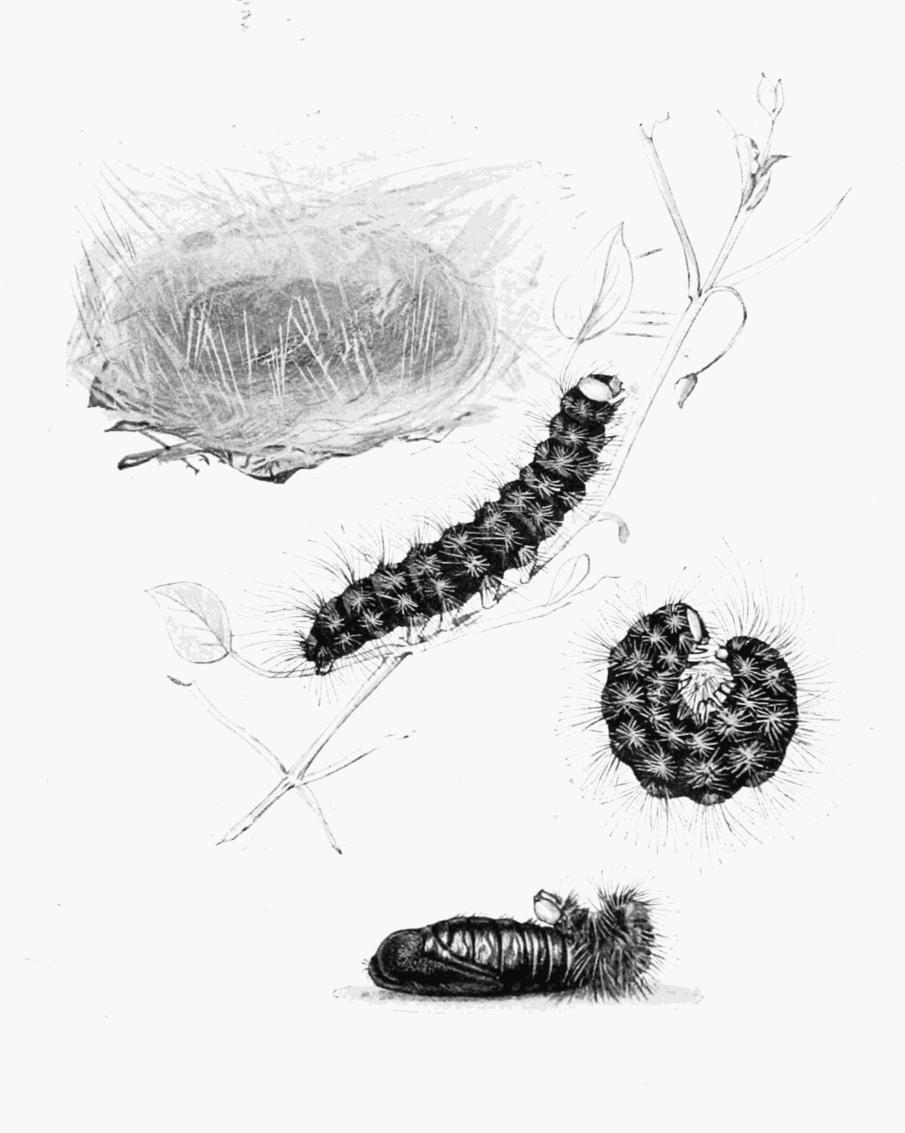
Pl. 86.
Cream-spot Tiger Moth.
Caterpillars, chrysalis and cocoon.
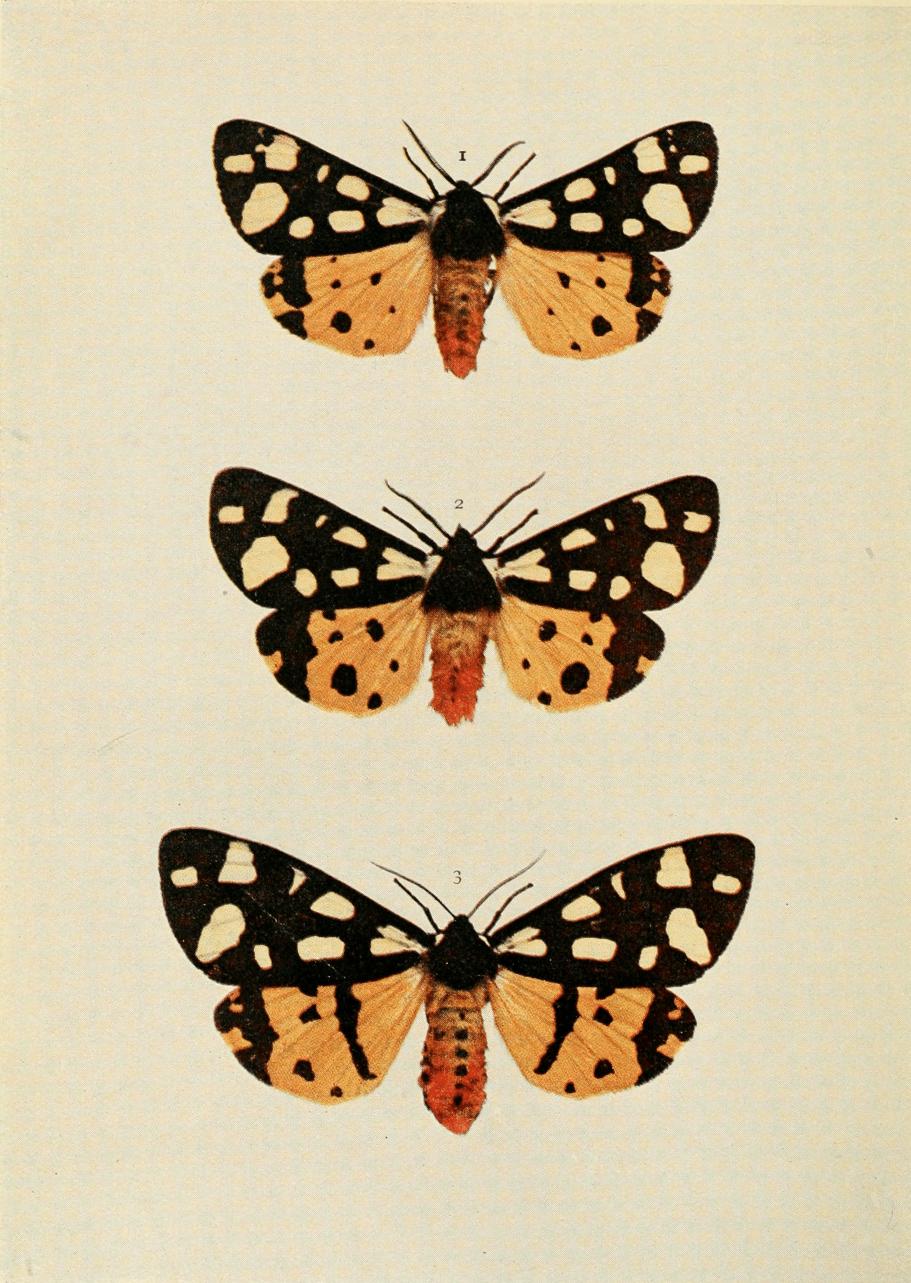
Pl. 87.
1, 2. Cream-spot Tiger Moth, males; 3 female.
The principal variation is in the colour of the hind wings and the body, which usually are red, but in var. lutescens, Staud., are yellow; between the red and the yellow forms there are all kinds of orange and other intergrades. There is also variation in the black markings at the inner angle of the fore wings, some or all of which are sometimes absent. A specimen with the inner margin of the fore wings black instead of creamy-white has been recorded, and a specimen with whitish hind wings is stated to have been seen but not secured. The moth is shown on Plate 89, and the early stages on Plate 88.
The eggs, which are laid in batches, are pale yellowish when deposited, but assume a deep violet tint before hatching. Mr. W. Hewett (Entom. xxviii.) states that in the case of seventeen female moths that he captured in August, 1895, the average number of eggs laid by each was 133, and as regards fourteen batches of eggs, the caterpillars hatched out in fifteen or sixteen days.
When nearly full grown the caterpillar is blackish with an orange stripe along the back and a series of creamy white spots on the sides; the hairs, arising from shining light brown warts, are pale brown mixed with greyish ones; spiracles black ringed with white, under surface greyish. Head black and glossy. It hatches from the egg in the autumn and goes into hibernation while still very small; reappearing in the spring and feeding on until July, when it spins a flimsy silken web-like cocoon well down among moss and litter. The food plants are dandelion, white deadnettle (Lamium album), ground ivy (Nepeta glechoma), groundsel, plantain, nettle, borage (Borago officinalis), and lettuce.
The moth emerges in July and August in a state of nature, but often as early as June in confinement. It sits by day among the herbage, and in the bushes of hedgerows, but readily quits its retreat when disturbed. The normal time of flight is at night; and that light has an attraction for the moths is evident from the fact that they have been known to fly into cottages at the rate of three or four in an evening.
The species is distributed throughout Southern Europe, its range extending to Holland, Belgium, and Livonia. It was known as an inhabitant of the Channel Islands long before it became established in England.
The Scarlet Tiger (Callimorpha dominula).
Except in minor details this tropical-looking moth (Plate 89) seems little given to variation in England. In parts of Central and Southern Europe, and Asia Minor, striking forms occur, and some of these are very occasionally found with us. Among such rare aberrations in this country are var. rossica, Kol., with yellow hind wings; and var. bithynica, Staud., with the spots on the fore wings yellow, and the hind wings of the normal crimson colour. A South European form, var. persona, Hübn., has the hind wings and body black, with some yellow marks on the basal area; spots on the fore wings smaller than in the type. Specimens approaching this form have been reported from Kent, which county is also noted for "black dominula." In the latter variety the hind wings, body, and spots on fore wings are blackish; it is exceedingly rare. A specimen taken at St. Margaret's Bay, Kent, some years back has the spots on the fore wings blurred, due to a cloudy suffusion filling up the space between them; the spots on the hind wings are pale.
Caterpillar, black, hairy, with bands of more or less connected spots, yellow or yellowish in colour, down the middle of the back, and along the sides; the hairs, arising from shining black warts, are grey with some black ones intermixed. Head, glossy black. It hatches from the egg in July or August, feeds for awhile, then hibernates, and completes its growth in April or May. A number of plants have been mentioned as suitable food for these caterpillars, but the favourites are, perhaps, nettle, groundsel, hound's-tongue (Cynoglossum officinale), bramble, sloe, and sallow (Plate 88).
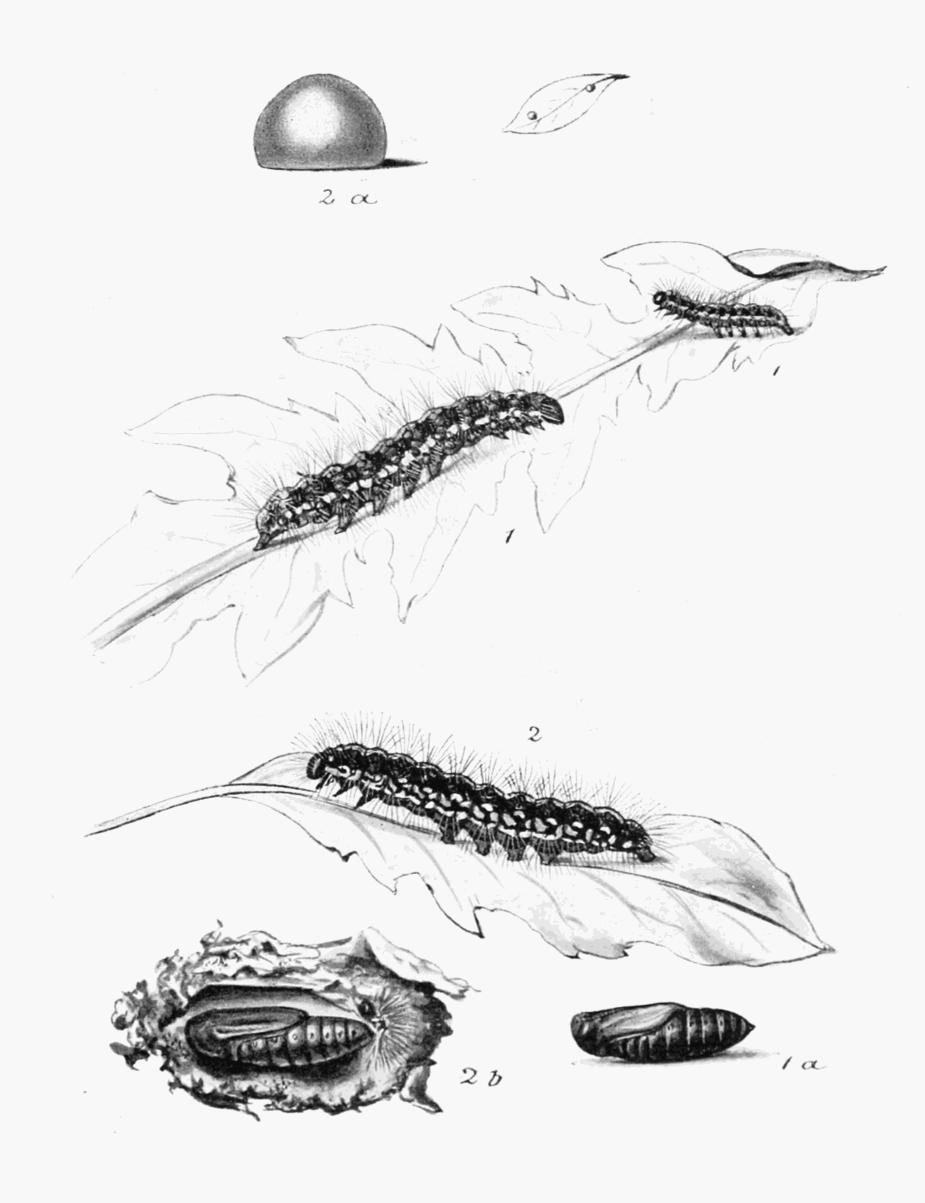
Pl. 88.
1, 1a.Jersey Tiger: caterpillars and chrysalis.
2, 2a, 2b.Scarlet Tiger: eggs, caterpillar, chrysallis and cocoon.
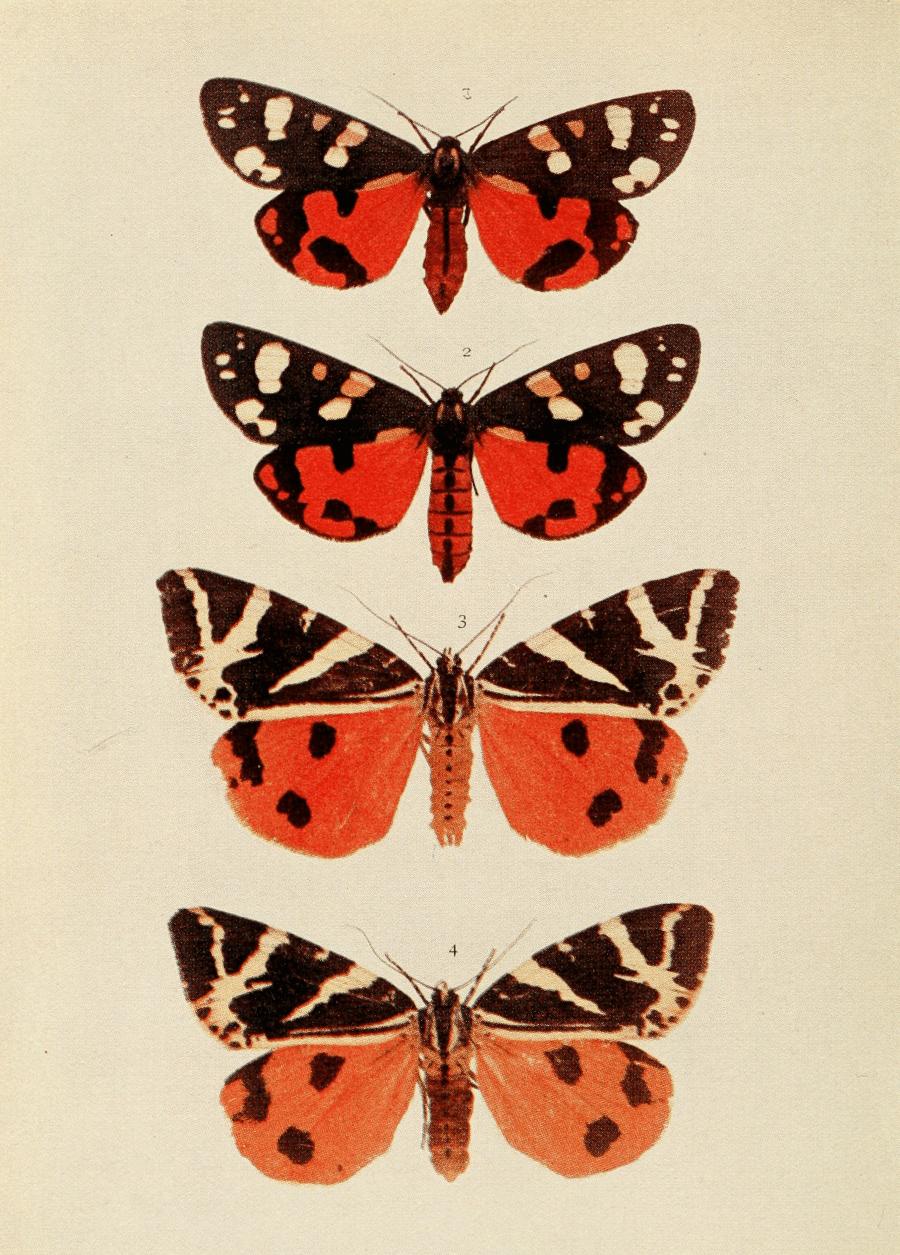
Pl. 89.
1, 2.Scarlet Tiger Moth.
3, 4.Jersey Tiger Moth.
The chrysalis is dark reddish, rather blacker above; enclosed in a silken cocoon spun up among leaves, etc., on the ground.
The moth emerges in June, and seems partial to marshy ground. It is found in the district between Dover and Deal commonly, and in other parts of Kent more rarely. Also in Hampshire, Devon, Dorset, South Wales, Gloucestershire, Wiltshire, Berkshire (water meadows by the Kennet), and Hertfordshire (rare). Some years ago I found a few specimens in the Brandon district, but it is not plentiful in Suffolk, and is rare in or absent from Norfolk. It is found in Cambridgeshire, chiefly in Wicken fen.
Note.—Although Callimorpha is here left in its old position among Arctiidæ, the genus has been referred by Hampson to Hypsidæ, a family of moths belonging to the African, Oriental, and Australian regions. Our two species are the sole representatives of the family in Europe.
The Feathered Footman (Coscinia striata).
Altogether there do not appear to have been more than six or seven specimens of this species (Plate 90) recorded as British. Stephens mentions three of these, two males taken in the autumn of 1815, near Windsor; and one specimen, without date, in the Isle of Anglesea. Of the others one appears to have been taken in Yorkshire (1832), one in Essex, and another in North Wales (1859). Barrett also refers to a specimen, which was captured but afterwards escaped, near Bettws-y-Coed, North Wales, June, 1859, and gives some circumstantial details of the event. It appears, therefore, that of the very limited number of British striata North Wales has furnished almost half. The species is widely distributed in Europe, except the most northern part; the range extending into Asia Minor, Syria, Armenia, and Amurland. Abroad, it occurs on heaths, and in warm dry places. The caterpillar is blackish-brown, marked with orange on the back, and white on the sides; the warts are yellowish, and the hairs arising therefrom are reddish brown; the head is black. It feeds in spring, after hibernation, on grasses, heather, and low herbage, and becomes full grown in May.
The Speckled Footman (Coscinia cribrum).
The fore wings are whitish, crossed by three rows of blackish grey dots, more or less connected, forming lines; and two streaks of the same colour through the length of the wings, but not always extending to the outer margin; a cross series of wedge-shaped marks or dots on the outer area; hind wings grey. Sometimes the fore wings are wholly suffused with the darker colour, and between such specimens and less frequent examples in which the wings are almost devoid of marking, there are many gradations (Plate 90, Figs. 1 ♂, 2 ♀; 4, 5, 6 vars.).
Eggs received from the New Forest, June 25, 1907, were laid around a slender, bare, twig of heather, the batch measuring about three-quarters of an inch in length. At first they were golden yellow, but afterwards became pale purplish brown and very glossy (Plate 91).
Although the eggs appear to be more frequently laid on heather than on anything else, the caterpillars do not seem to be very partial to the plant as an article of food if others are available. At the present time (October 13) I have about a score or so of young larvæ feeding, and apparently thriving, on dandelion, lettuce, and grass, but they certainly seem to prefer the first named. They are now rather over half an inch in length, and yellowish brown in colour; there is a whitish grey stripe along the back; the warts are shining black, and the hairs arising from them are black, mixed with a few longer white ones; head blackish.
Caterpillars after hibernation have been found on the grass, Aira cæspitosa, during March from about the 10th onwards; they are then about a quarter of an inch long, and according to the late Mr. Fowler, always found on the sunny side of the clumps of Aira stretched out, and evidently enjoying the warmth of the sun. Some collected in that month were reared on groundsel, and produced moths from July 12 to August 20. The chrysalis is at first reddish, afterwards shining jet black; in a slight egg-shaped white silken cocoon, spun up in tufts of grass.
In exceptional seasons the moth has emerged in late May, but June and July are the usual months, and it may occur as late as August. It rests among the heather, is easily disturbed on sunny days, and is very active on the wing, although it does not fly far before settling again. The species is very local in England, and only found on a heath near Bournemouth, in a heathy district between Ringwood and Verwood in Dorset, and in a not generally known part of the New Forest.
The Crimson Speckled (Deiopeia pulchella).
This white moth, prettily speckled with black and red dots, is a native of warmer countries than ours. However, it not only visits us now and then in the course of its wanderings, but if the migrants arrive in England at a suitable time of the year, the females most probably deposit eggs from which caterpillars may hatch, and some of them feed up and produce moths later in the same year. Stephens, writing in 1829, mentions a specimen taken many years previously in Yorkshire. This was no doubt the earliest known British example of Haworth's Crimson Speckled. A second specimen captured in a field near Christchurch, Hants, in October, 1818, was figured by Samouelle in 1819. Between the year last mentioned and 1827, two other specimens occurred, both at Hove, Sussex. Stainton (1857) adds Epping, Manchester, Stowmarket, and Worthing. In 1869 three specimens were taken in the autumn; and a specimen was found at Scarborough in June, 1870, and one in Sussex. In 1871 a record was established, when at least thirty specimens were obtained at various places on the east, south, and south-west coasts, and in the Isle of Wight; one specimen being also recorded from Manchester. Two specimens were taken in Cornwall, May, 1874, and in the autumn of that year three occurred on the south coast, and one in Derbyshire. The moth seems not to have been noticed in the springs of 1875 or 1876, but twenty-four specimens were recorded later in the former year, and twenty-three in the latter. Between 1876 and 1892 less than twenty specimens were reported altogether, and the species was either entirely absent or overlooked in 1877, 1882, 1883, and from 1887 to 1891, inclusive. In 1892 several moths were captured in May and June on the coast; one at Brighton in July, two in the Hastings' district, and one at Folkestone in August. Since 1892 and up to 1907, a period of fifteen years, the species seems to have been rarely noted in England; the records showing in 1894 (2), 1895 (1), 1906 (1). In 1901 three specimens were reported as captured, and one seen at Earlsfield, Surrey, July 1 to 15. (Plate 92, Figs. 3, 4.)
The caterpillar is greyish with black warts from which arise tufts of hairs, blackish on the back and pale greyish on the sides; a white line on the back, and one on the sides. Each ring is often barred with orange. Head reddish-ochreous marked with black. Feeds on forget-me-not (Myosotis), borage (Borago), etc. The chrysalis is reddish brown, enclosed in a white silken cocoon spun up among the food plant, or on the surface of the ground; in the latter case particles of earth adhere to the outside.
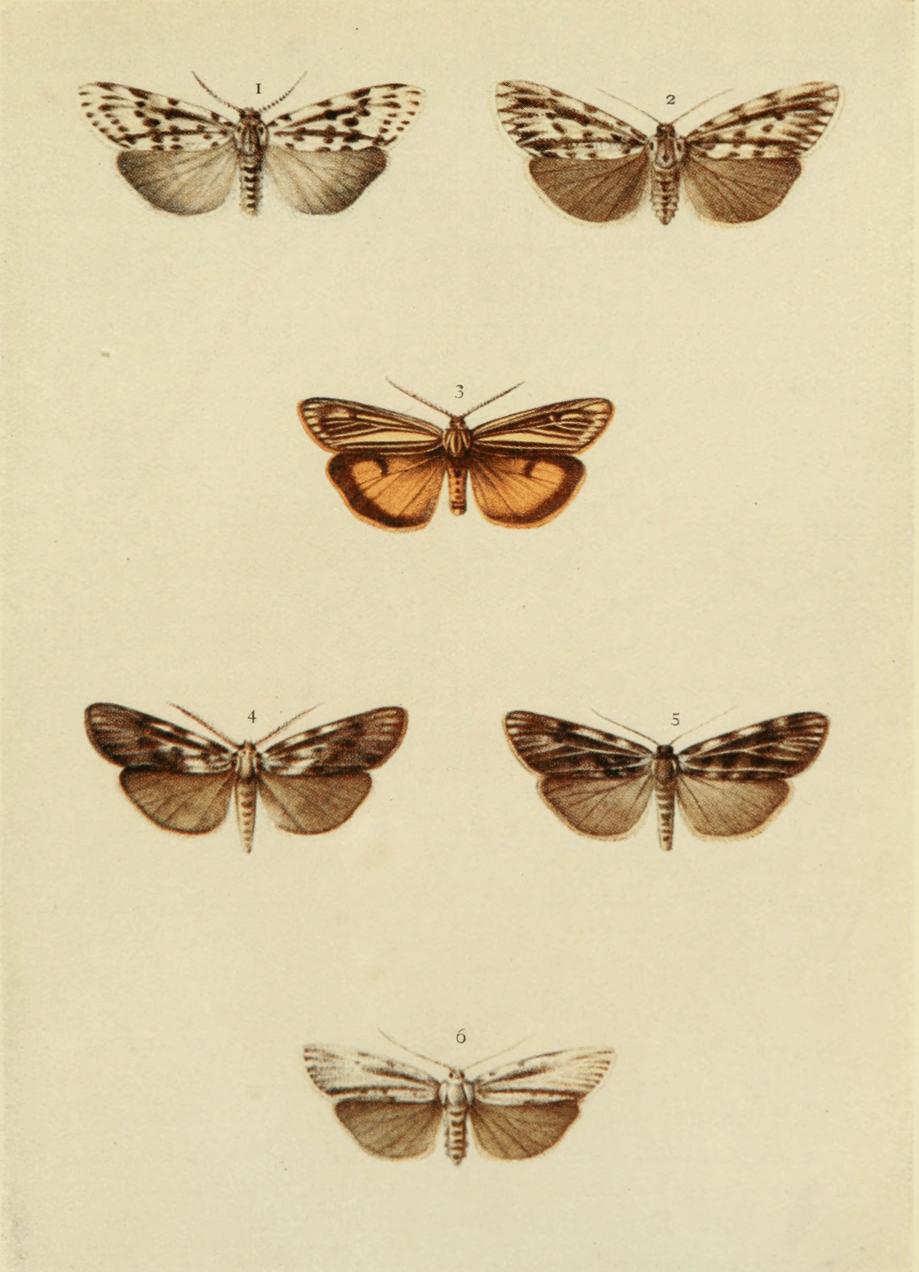
Pl. 90.
1, 2, 4, 5, 6.Speckled Footman Moth.
3.Feathered Footman Moth.
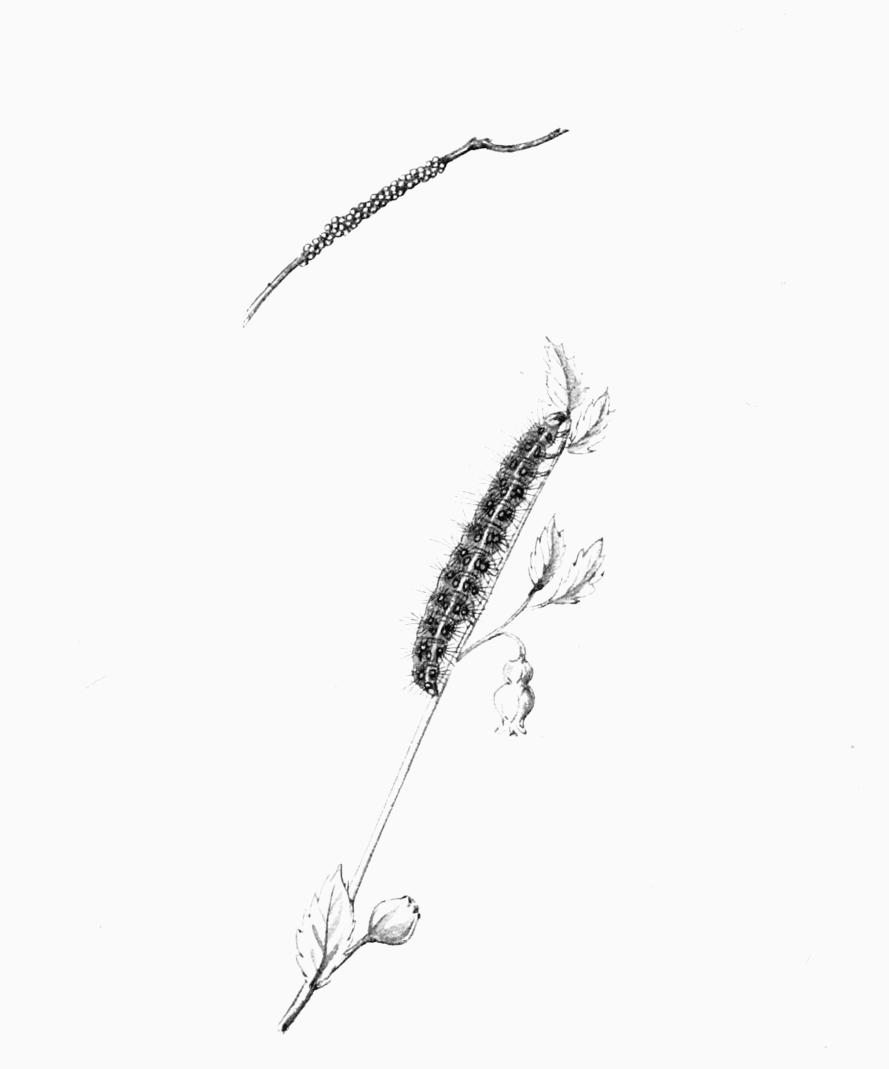
Pl. 91.
Speckled Footman: eggs and caterpillar.
The caterpillar is said to feed only in the sunshine, so that in our islands the weather conditions would often be most unfavourable to the species in the larval state. On the other hand its sun-loving habit would expose it to the attacks of parasitical flies and other enemies. Anyway, the Crimson Speckled seems quite unable to increase and multiply to any extent even for a season in any part of England. Along the African and European borders of the Mediterranean there are evidently several generations of the moth in each year; the life cycle of the summer broods being short, but more protracted in the later brood. Brownlow states that eggs laid on October 20, hatched on the 22nd of the same month, and the caterpillar stage lasted until February of the following year. Distribution: Southern Europe, Africa, Canaries, Madeira; Asia Minor, Armenia, Central Asia; India, and Australia.
Meyrick and others refer this species to Utetheisa, Hübn.
The Cinnabar (Hipocrita jacobææ).
This species was named the Cinnabar by Wilkes in 1773, such name of course referring to the more or less vermillion colour of the hind wings and the markings on the greyish black fore wings. The hind wings are often pinkish in tint, and probably it was to such specimens that Moses Harris gave the name "Pink Underwing." Very rarely the stripe on the front edge of the fore wings unites with the upper hind marginal spot; still less frequently there are some crimson scales in addition connecting the two hind marginal spots. Occasionally specimens have been recorded in which the usual red colour is replaced by bright yellow. The moth is shown on Plate 92, Figs. 1, 2, and the early stages on Plate 93, Fig. 1.
The caterpillar is orange yellow and each ring is banded with purplish black; the scanty hairs are short and blackish in colour. Head black. Feeds in July and August on ragwort (Senecio jacobæa) and sometimes occurs in such numbers as to completely clear large patches of the plant of every particle of green, leaving nothing but the tougher portions of the bare stems.
The chrysalis is dark-brown tinged with reddish; in a slight silken cocoon just under the surface of the ground, or among any loose material on the ground.
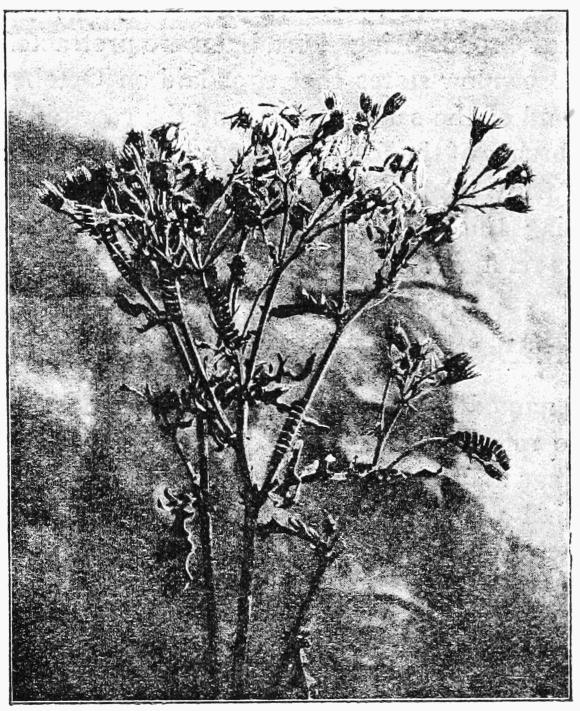
Fig. 24.
Cinnabar Caterpillars Feeding.
(Photo by W. J. Lucas.)
The moth is on the wing at the end of May and in June; odd specimens have occasionally been seen in April. It occurs on waste ground, sandy heaths, railway banks, downs, and hill-sides. Although fairly common generally, in some years it is not at all plentiful even when caterpillars may have abounded the previous season. When disturbed from among its food plant or herbage around, it is not very active on the wing, and is easily captured. Its usual time of flight is in the evening. Light seems to have an attraction for it, as it has been taken at gas lamps in towns, some distance from any place where the caterpillar could have fed.
Occurs in all suitable places throughout the greater part of England and in Scotland up to Moray. Common in Ireland. Its range abroad includes all Europe, except the extreme north and extends into Asia.
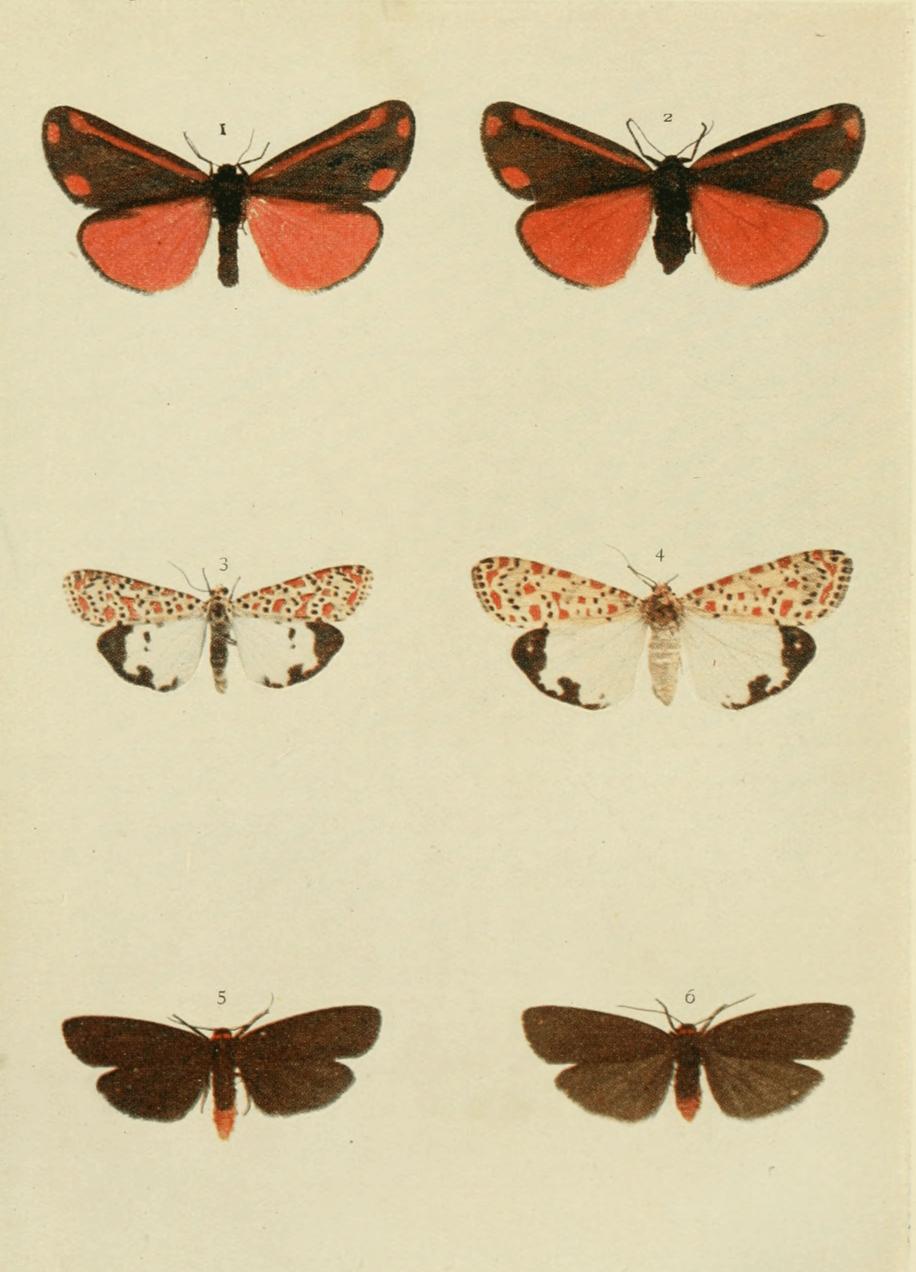
Pl. 92.
1.Cinnabar Moth, male; 2 female.
3.Crimson Speckled Footman, male; 4 female.
5.Red-necked Footman, male; 6 female.
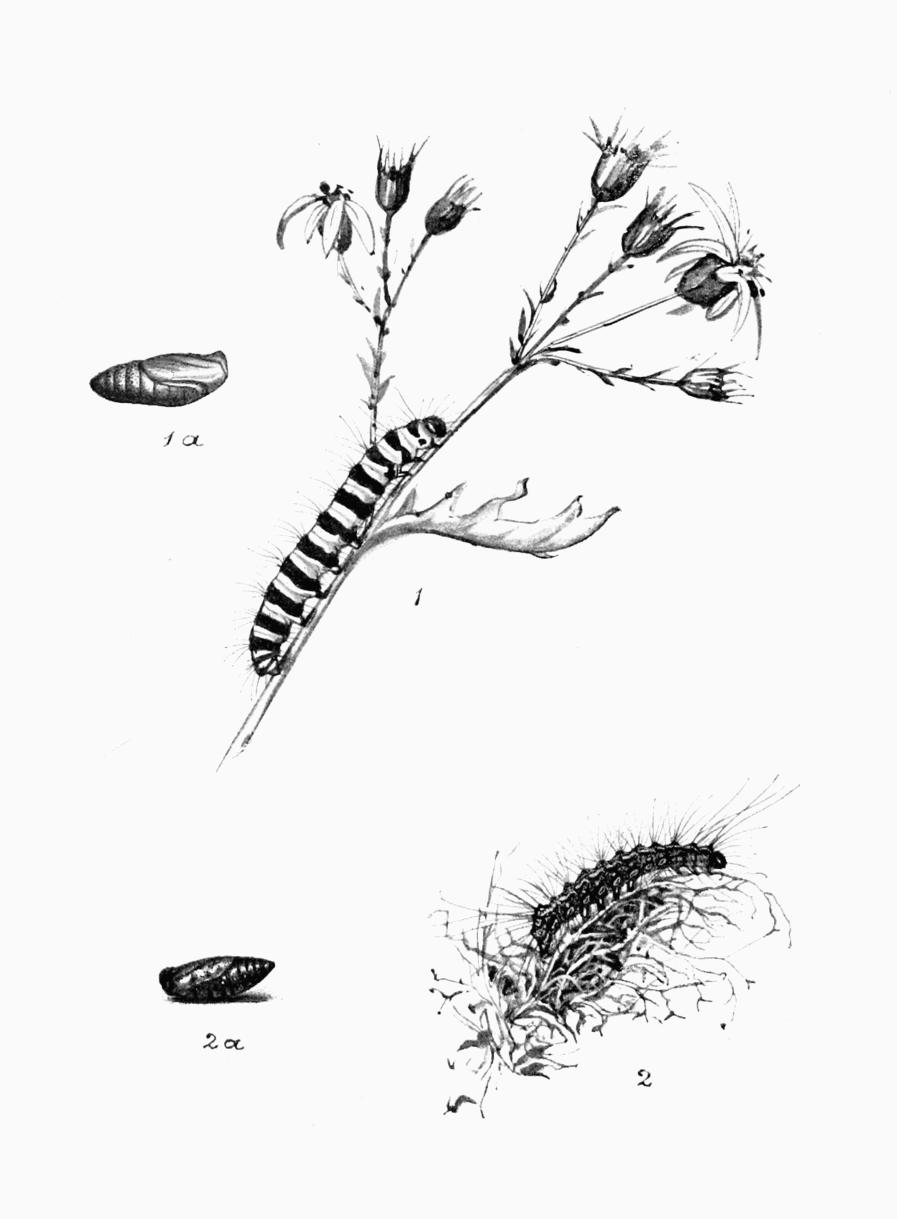
Pl. 93.
1, 1a.Cinnabar: caterpillar and chrysalis.
2, 2a.Rednecked Footman: caterpillar and chrysalis.
Footman Moths (Lithosiinæ).
The members of this sub-family of Arctiidæ occurring in the British Isles are not numerous; we can only muster some fifteen species, and although a few are not uncommon, several are exceedingly local.
The moths of the genus Lithosia, when resting, fold their drab or buff-coloured wings down closely along the body, and they then have a very elongate and stiff appearance which probably gave rise to their English name "Footmen." Most of them are very inactive, or even torpid during the daytime. They repose on the branches and leaves of trees and bushes, or among heather and other low herbage, and often fall to the ground when disturbed. At dusk they become active and then fly pretty briskly.
The caterpillars are very hairy, the hairs arising in tufts from warts (tubercles) are usually short, but in some species are of moderate length. The majority hatch from the egg in the late summer, and do not complete their growth until the following year, about May or June. Some of them are known to be more or less active through the winter. In a state of nature most of the caterpillars feed on lichens growing on trees, bushes, rocks, or on the ground, but many kinds in confinement will thrive on a diet of lettuce or even withered leaves.
In all cases the chrysalids are enclosed in silken cocoons, and these are spun up among the lichens, in crevices of bark, or other suitable crannies.
The Red-necked Footman (Atolmis rubricollis).
When newly emerged from the chrysalis this moth is black on all the wings, but it soon loses its early velvety sheen and becomes sooty in appearance; the last rings are orange, but all the rest of the body is black; the thorax also is black, but the part nearest the head, termed the collar, is red, hence the common English name Red-neck moth given to it by Harris (1778). Haworth called it the "Black Footman."
The caterpillar is greyish, more or less freckled with ochreous; three lines along the back, the central one whitish, the others black and interrupted; the hairs arising from reddish warts are brown or greyish brown. Head black. It feeds from July to October on lichens, chiefly those growing on fir and oak, but also on beech, and on old palings. Chrysalis, glossy dark red-brown in a tight-fitting cocoon of silk mixed with the hairs of the caterpillar; spun up among the lichen. The moth is shown on Plate 92, Figs. 5, 6, and the caterpillar and chrysalis on Plate 93.
The moth is on the wing in June and July; in forward seasons as early as the end of May. On a sunny afternoon it may be seen careering around trees, generally pretty high up. When resting the moths sit about on the trees or on the herbage under them. In some years it occurs in large numbers, but it is not usually very abundant, and sometimes even in its best localities only a few specimens will be seen during the season. It frequents woods, especially the larger ones, throughout the southern half of England up to Norfolk on the east, and Hereford on the west. In the northern counties it is rare, and is not common in Scotland or Ireland.
Abroad, its range is through Central and Northern Europe, except the extreme north, to Dalmatia, Altai, and Amurland.
The Muslin (Nudaria mundana).
This delicate little moth has the semi-transparent fore wings pale greyish, faintly tinged with brown; crossed by irregular brownish lines; the hind wings are paler, shaded with a darker tint on the outer margins. Occasionally all the wings have a smoky tinge. The moth is shown on Plate 95, Figs. 3, 6, and the caterpillar and chrysalis on Plate 94, Fig. 2.
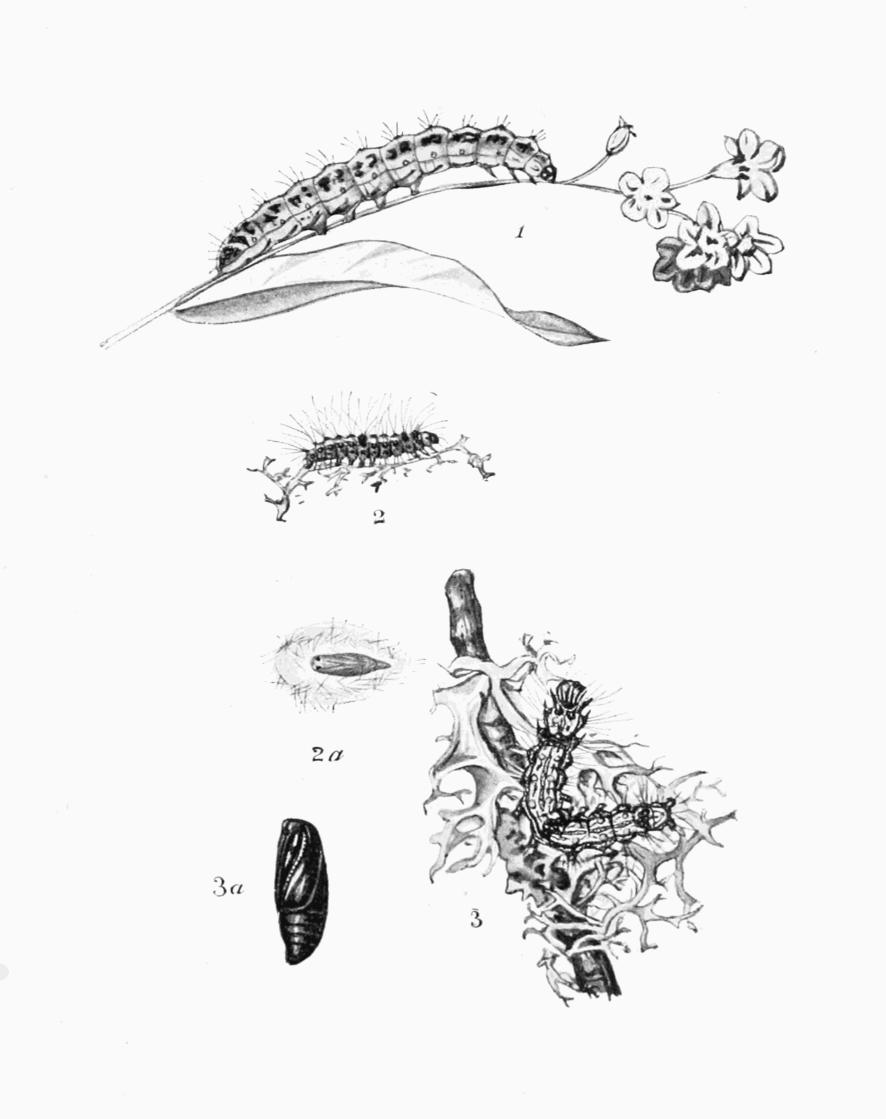
Pl. 94.
1.Crimson Speckled Footman: caterpillar.
2, 2a.Muslin Moth: caterpillar and chrysalis in cocoon.
3, 3a.Four-spotted Footman: caterpillar and chrysalis.
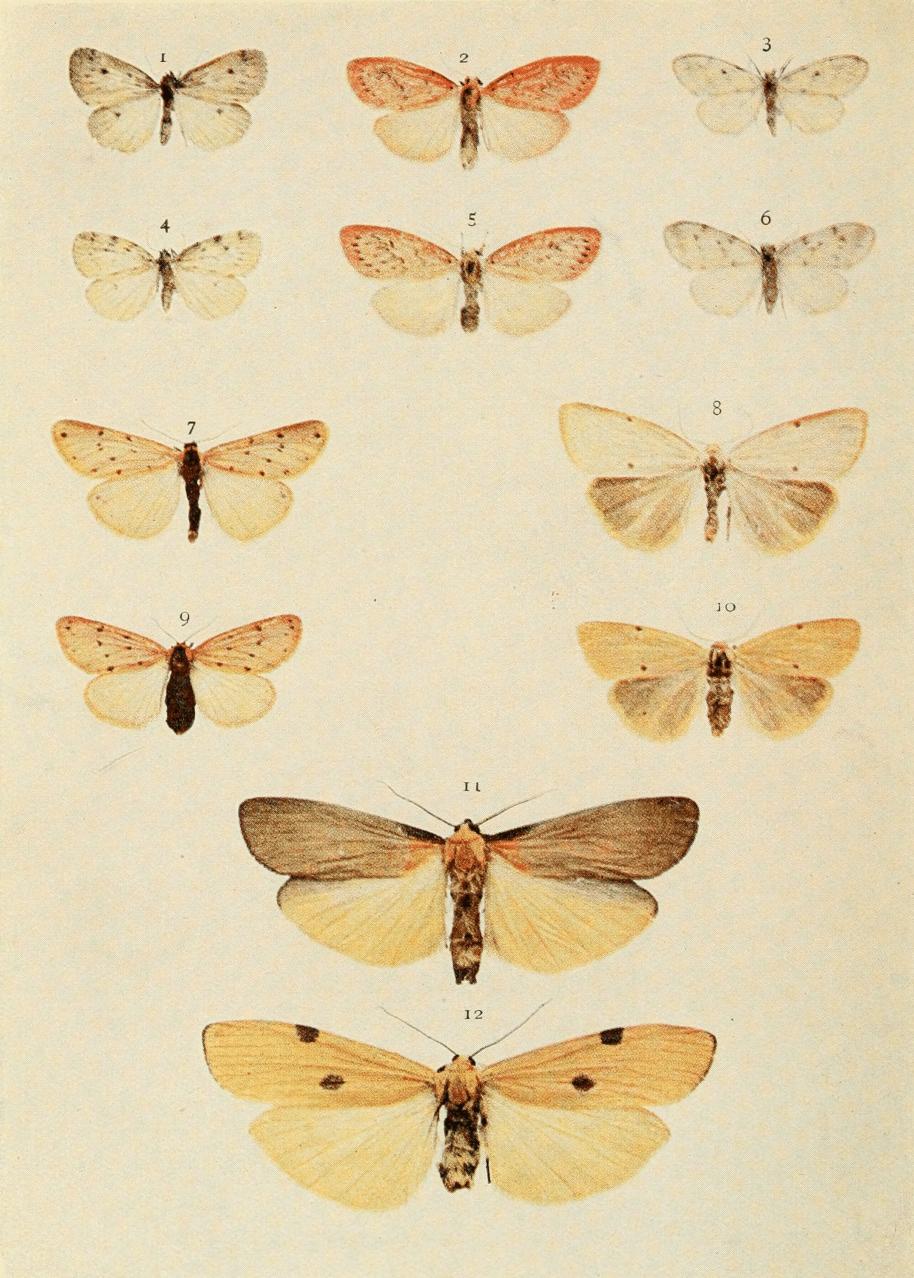
Pl. 95.
1.Round-winged Muslin Moth, male; 4 female. 2, 5.Rosy Footman.
3.Muslin Footman, male; 6 female. 7.Dew Moth, male; 9 female.
8.Four-dotted Footman, male; 10 female.
11.Four-spotted Footman, male; 12 female.
The caterpillar is greyish, with a broad whitish or yellowish stripe along the back, divided down the centre and edged by blackish lines; a velvety black mark on ring seven; raised warts and hairs dark greyish. Head black, shining; face yellowish. It may be found in April and May, after hibernation, on rocks, stone walls, especially those formed of loose cobbles or shale, trees, bushes, and even gate posts. I have beaten them from an old hawthorn hedge bordering a damp meadow in Middlesex, and collected them in numbers from the hollows of field boundary walls in North Devon. They feed on the tiny lichen that grows in such places as those indicated. The green, or yellowish-green chrysalis, is enclosed in a rather loose muslin-like silken cocoon, and is not difficult to obtain, especially from walls. It appears to be pretty generally distributed throughout England and Wales, except perhaps the midland and eastern counties; it occurs in the east and west of Scotland. In Ireland it is common, and often abundant, locally.
Distribution: Northern and Central Europe.
The Round-winged Muslin (Comacla senex).
As indicated by the English name given to it by Haworth, the wings of this moth are rounder in outline than those of the Muslin, also named by Haworth. In general colour it agrees with that species, but it differs in having a larger central dot, and the cross lines are represented by blackish dots which, however, are not always well defined (Plate 95, Figs. 1, 4).
The caterpillar, as described by Buckler, is deep reddish-grey, thickly covered with hairs which are of two kinds; the majority are pale brown with black points and slightly feathered, others are longer, black, and densely feathered with soft pale-brown plumage. Head black and shining. It feeds in August and, after hibernation, in May on lichens and mosses growing on the ground in marshes and fens. It is known to eat Peltigera canina, and the mosses Hypnum sericeum, and Weissia serrata. Although occurring, in July and August, in marshy places in several parts of Southern England and Wales, it is especially common in fen land. In such localities as Wicken, for example, it flies at early dusk in hundreds all over the fen on favourable nights, but if there happens to be a breeze the moths will not leave their retreat among the herbage. Later on in the night, if on the wing, they readily assemble around a brightly burning lamp, and are satisfied to sit on the herbage illuminated by its rays. In Northern England it is known to be not uncommon in some districts of Yorkshire, and it probably occurs in other counties also. There appears to be only a single record each from Ireland and Scotland.
The Rosy Footman (Miltochrista miniata).
The fore wings of this pretty little moth are ochreous yellow tinged with pink; the front and hind margins are bright pink, in some cases approaching vermillion; the markings are bluish black; hind wings rather paler. It varies in the amount of black markings, which are sometimes almost absent, and in colour ranges from yellow to orange. (Plate 95, Figs. 2, 5.)
The caterpillar is dark drab covered above with blackish, mouse-coloured plumed hairs; on rings one and eleven the plumose hairs are replaced by short simple ones; the hairs of the side tufts are plain. Head brown, the cheeks outlined in black (adapted from Hellins). Lichens growing upon the stems and branches of trees supply this caterpillar with food, and it seems to nibble on all favourable opportunities throughout the winter. It hatches from the egg in August, and is full grown in May. Boden, writing in September, 1896 (The Entomologist) noted that some caterpillars had then attained the perfect state, while others were still feeding, and he adds that the caterpillars actually attacked and ate up the moths. Although there seems to be few records from the Midlands, this species appears to be widely distributed over England as far north as Yorkshire. In Ireland it has been recorded from Claring Bridge and East Galway. The moth is out in July. It is a wood-loving insect, but is also found on heaths, and even in lanes and the borders of fields when plenty of trees occur in such places. It may occasionally be beaten out of trees and bushes in the day time but it is on the wing at dusk, and although it is a high flier, specimens come within reach now and then. Light and sugar both attract it. The species ranges through Central and Northern Europe, and in Asia to Japan.
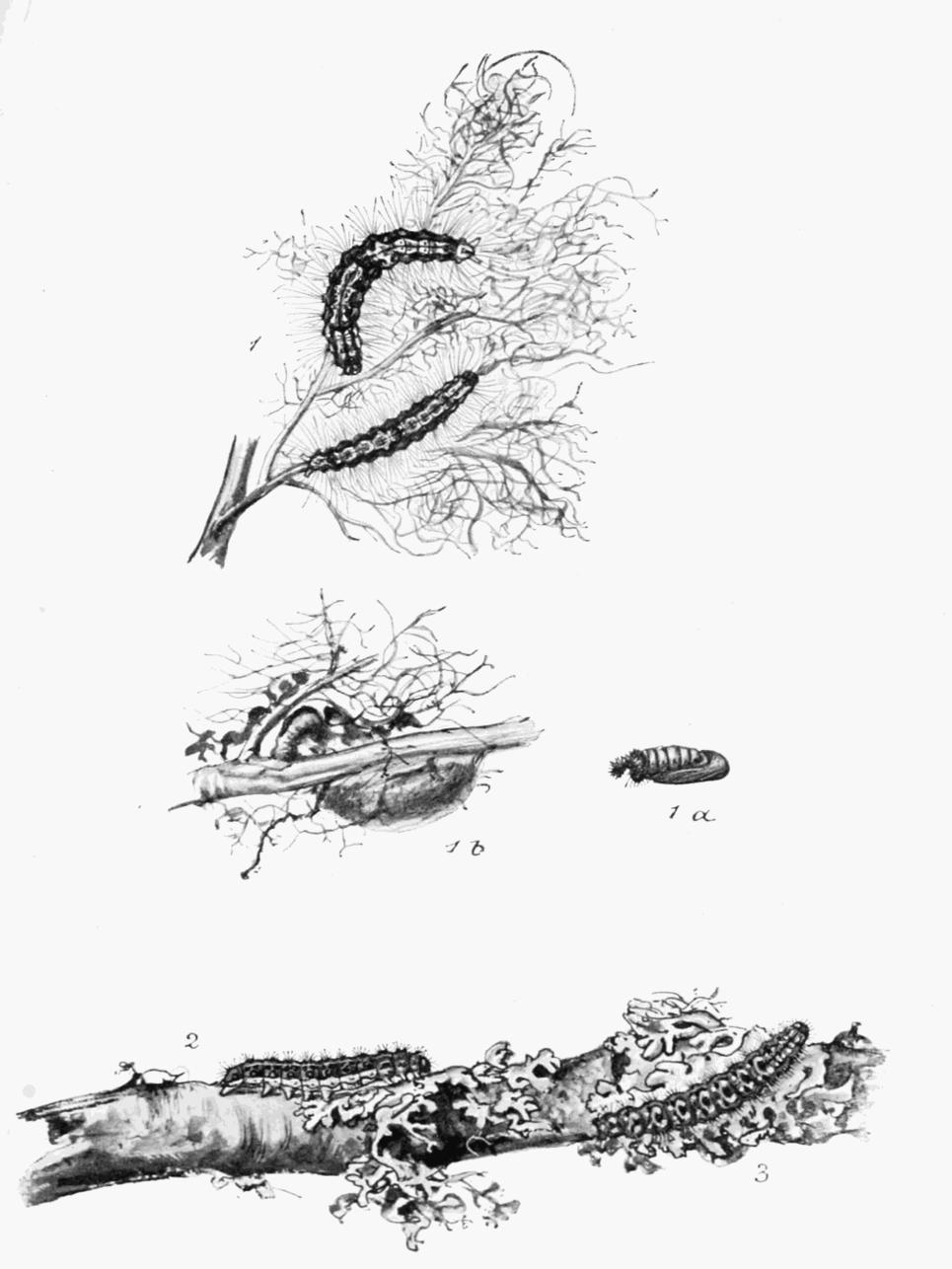
Pl. 96.
1, 1a, 1b.Buff Footman: caterpillar, chrysalis and cocoon.
2.Common Footman: caterpillar.
3.Scarce Footman: caterpillar.
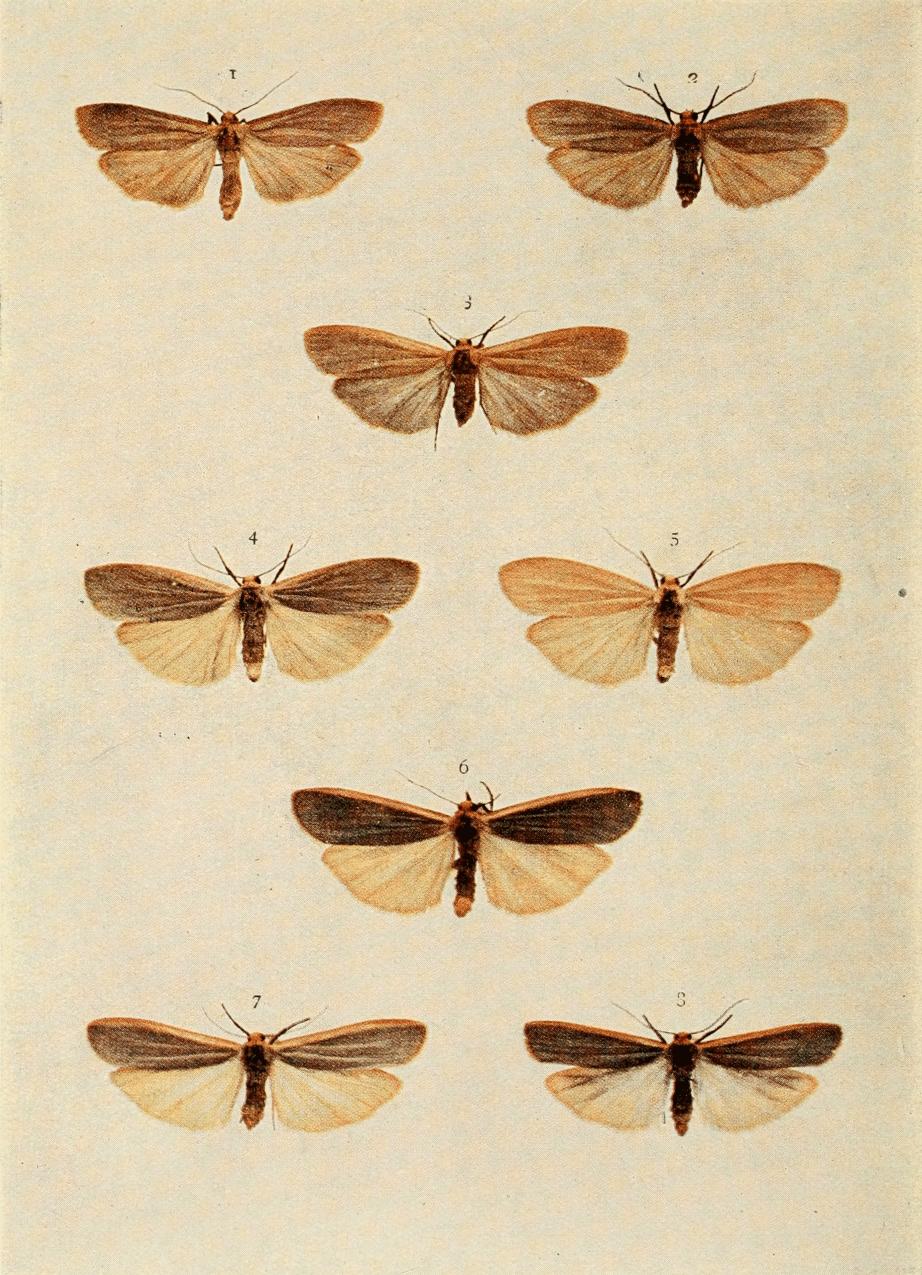
Pl. 97.
1.Buff Footman, male; 2, 3 females. 4.Dingy Footman.
5.Pale Footman. 6.Common Footman.
7.Scarce Footman. 8.Northern Footman.
The Dew Moth (Endrosa irrorella).
Varies in colour from yellowish buff to creamy white, the colour on the margins always deeper; the rows of black spots on the fore wings are usually well defined, but sometimes those of the two central series are very faint, or quite absent, whilst an unusual number appear in the outer marginal series, Occasionally black scales appear on the veins, connecting the spots, and forming the figures more or less distinctly; such forms are known as var. signata, Borkh. The moth appears in June and July. (Plate 95, Figs. 7, 9.)

When resting, the moth hangs from a blade of grass, or leaf of some plant; it then has a very transparent appearance. Barrett suggests that this gave rise to the English name it now bears, and by which it was known to Haworth and entomologists of his time.
Buckler and Hellins describe the caterpillar as blackish-brown above, and dark-reddish grey or purplish grey on the sides; a series of yellow spots along the middle of the back, then a white and yellow interrupted line, followed by a light yellow stripe under the spiracles; raised spots blackish, some white; hairs blackish brown. Head black.
It feeds, in the sunshine, on the black and yellow lichens growing in the haunts of the species, which are edges of cliffs and rough stony places near the sea, and also on hillsides. The species occurs, perhaps, more abundantly on the Kentish and Sussex coast than inland, but it is certainly not confined to the cliffs at Dover and Folkestone in Kent, or at Ventnor, Isle of Wight. Among inland localities for it are Box Hill, Ranmore, Reigate, and other places on the Surrey hills. It has also been recorded from the Cotswolds in Gloucestershire; the Isle of Man; St. Davids, South Wales; Aberdeenshire, Sutherlandshire, and the Tweed, Tay, Clyde, and Argyll districts in Scotland. For Ireland, Kane gives Mayo; "Ardrahan, County Galway, and west through the Burren of Clare, widely spread."
The Four-dotted Footman (Cybosia mesomella).
Fore wings pale creamy white, the margins yellowish: a black dot near the costa, and another below near the inner margin; hind wings suffused with blackish grey. Rarely the fore wings are yellow with a whitish central shade, and the hind wings are yellowish. (Plate 95, Figs. 8, 10.)
The caterpillar is velvety blackish grey; warts thickly set with densely feathered blackish hairs. Feeds in April and May, after hibernation, on lichens growing among heather. In confinement it will, according to Buckler, eat heather and fresh or withered leaves of sallow.
Fairly well distributed over England. It appears to be absent from Ireland, but in Scotland it is known to occur in the Clyde, Solway, and Moray districts, and has been recorded from Aberdeenshire. In the South of England it affects heaths and the more open woods; sometimes not uncommon in such places. The moth, in June, may be disturbed from bushes, or put up from the heather as one walks through. As the sun goes down it may often be seen on the wing, but later in the evening is its chief time of activity. In Lancashire and Cheshire it is found on the mosses, and Cannock Chase in Staffordshire is a noted locality for it. Still obtained in Chippenham fen, but Barrett states that it is now supposed to be extinct in the fens of Wicken, Yaxley, and Burwell, in all of which it used to abound.
The Four-spotted Footman (Œonestis quadra).
The sexes of this species are very different in appearance. The fore wings of the male are grey tinged with yellowish, except on the outer fourth; the basal fourth is yellow. The female is larger and yellow in colour; each fore wing has two black spots, sometimes unusually large, sometimes mere dots, and more rarely absent altogether. (Plate 95, Figs. 11, 12.)
Caterpillar blackish with four wavy yellow lines along the back, the spaces between the lines powdered and freckled with yellow giving a grey appearance; raised spots on the back red, those on the sides greyish; a black cross on rings three, seven, and eleven; hairs grey mixed with black. Head black and glossy. It feeds, after hibernation, in May and June, on lichens, preferring those upon oak trees. In the breeding cage it is apt to eat its companions, especially when many are crowded into a small receptacle. (Plate 94, Fig. 3.)
The moth emerges in July, and during that month, and sometimes in August, it may be seen on tree trunks; but it more often reposes on the branches, from which it may be dislodged by jarring the boughs with a stick, when it drops rather than flies towards the ground, but generally manages to arrest its downward course by catching hold of a spray of bracken or some other plant and there awaits capture. Night is the usual time of flight, but it is on the wing at dusk. It is partial to "sugar" and has been known to visit flowers.
This species has been recorded from a large number of localities in England extending from the Scilly Isles to the Scottish border. From the circumstances connected with many of such captures one is led to suspect that the insect has migratory habits. In England the most favoured locality is the New Forest in Hampshire, where it abounds in some seasons, but is quite scarce in others. It occurs, more or less regularly, in the larger woods in Dorset, extending into Devon; also in Sussex ranging into Kent, but is only occasionally common in either of these counties. Generally considered to be uncommon in the eastern counties, but has been reported to occur in large numbers at Aldeburgh in Suffolk. The localities given in Kane's catalogue of the Lepidoptera of Ireland are Killarney, Timoleague, Co. Cork, Curraghmore (abundant), Lismore, Borris, Co. Carlow, and Clonbrock. To these may be added Dublin, and Nenagh, Co. Tipperary.
Distribution: Central Europe, Southern Sweden, Livonia, Dalmatia, Armenia, Amurland, Corea, and Japan.
The Buff Footman (Lithosia deplana).
Fore wings, ochreous grey, tinged with yellow on the basal half of the front margins; hind wings paler, becoming greyer on the outer area; fringes of all the wings yellow. The male is fairly constant in colour, but the female sometimes has a distinct yellow stripe on the front margin of the fore wings extending to the fringes (var. ochreola, Hübn.); more rarely in the New Forest (?), and in the Isle of Purbeck a form occurs with the fore wings orange buff, and the hind wings only slightly tinged with grey (var. unicolor, Bankes). (Plate 97, Figs. 1-3.)
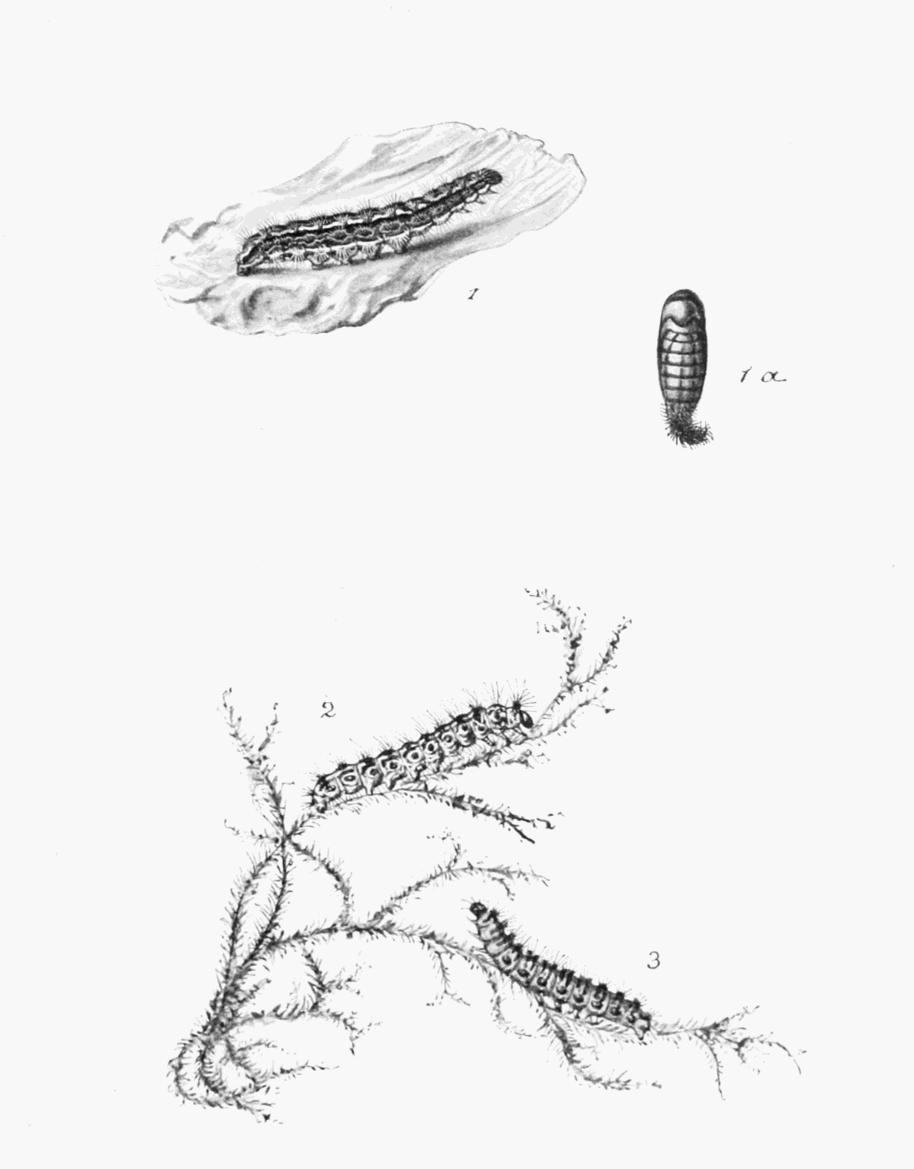
Pl. 98.
1, 1a.Hoary Footman: caterpillar and chrysalis.
2.Dingy Footman: caterpillar.
3.Dotted Footman: caterpillar.
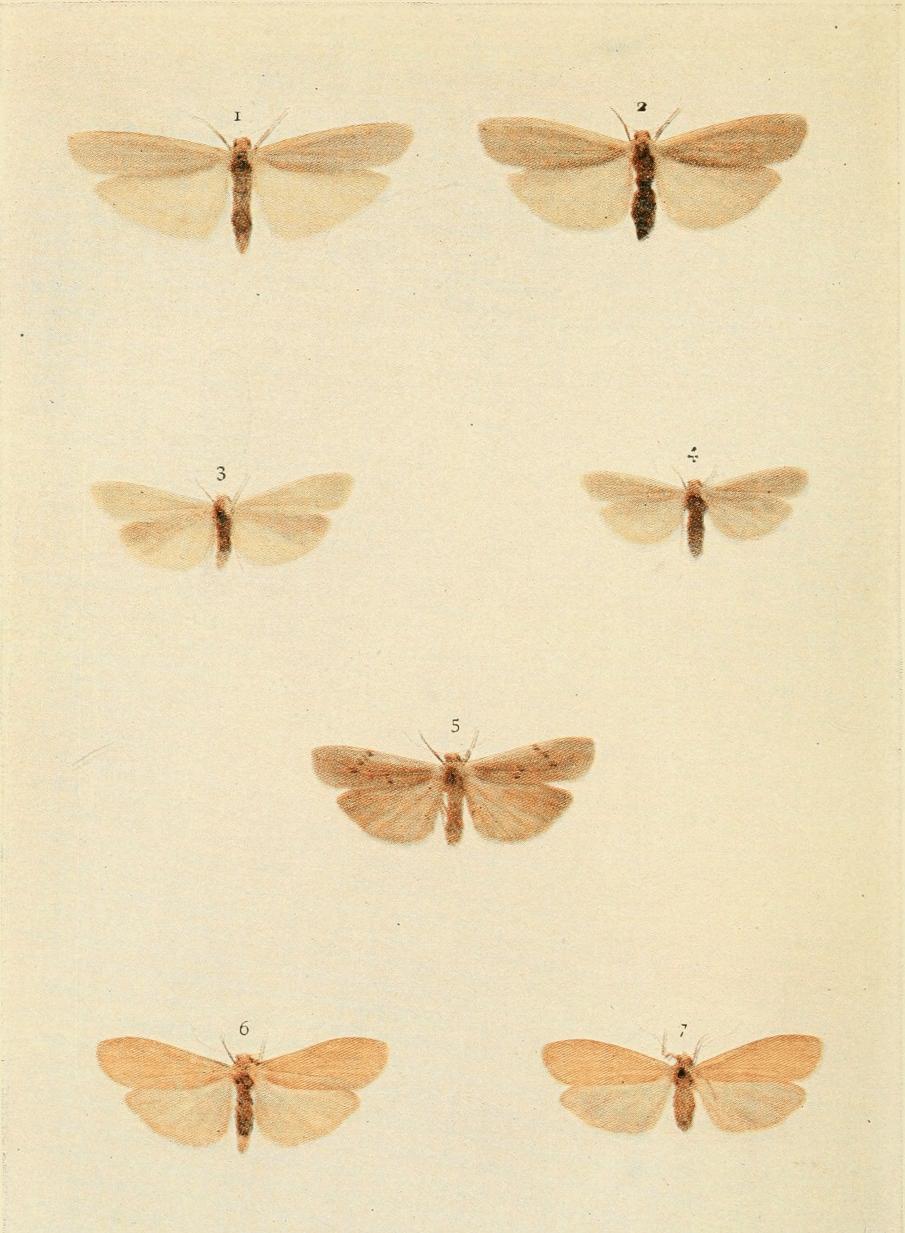
Pl. 99.
1, 2.Hoary Footman. 3, 4.Pigmy Footman.
5.Dotted Footman. 6, 7.Orange Footman.
Caterpillar, greyish, or greenish grey, freckled with darker, hairs grey inclining to brownish; a broad creamy or yellowish stripe, edged with black and traversed by a dark central line along the back. Head blackish and glossy. From August to June on lichens growing on stems and branches of yew, oak, and beech.
A local species, and although recorded now and then from several other parts of the country, and once from Killarney in Ireland, seems to be pretty much confined to the counties of Surrey, Sussex, Hants, Dorset, and Devon. The moth, which is out in July, rests during the day upon the boughs and among the foliage of oak, beech, and yew, the latter especially in the Dorking district of Surrey.
Distribution: Central Europe, Southern Scandinavia, Livonia, Northern Italy, Roumelia, and Russia.
The Dingy Footman (Lithosia griseola).
Haworth's English name for this moth was the "Dun Footman." In its typical form the fore wings are pale greyish with a yellowish front edging; the latter most distinct towards the base; the hind wings are whitish ochreous more or less suffused with grey. The pale form, var. flava, Haw. = stramineola, Doubl. at one time considered a distinct species (the Straw-coloured Footman of Haworth), has pale straw-coloured fore wings and white ochreous hind wings. (Plate 97, Figs. 4, 5.)
Caterpillar, sooty brown, with a darker line down the middle of the back and an interrupted yellow or orange line or stripe on each side of it; dark brown hairs arising from dark warts; head glossy black (described from a skin). It may be looked for in the spring months on the lichens affecting alders and sallows growing in fens and marshy places. (Plate 98, Fig. 2.)
The moth is abundant in the Cambridge and Norfolk fens, and is common in boggy places in the New Forest, but it probably occurs in all suitable places throughout England and Wales. It does not seem to have been observed in Ireland, but has been recorded from Moray in Scotland. The yellow variety, which by the way is not known to occur abroad, is found, with the ordinary form, chiefly in the Norfolk fens and in the New Forest; but it is also to be obtained, though less frequently, in Surrey (Weybridge district), Berkshire (Reading district), and still more rarely elsewhere. It is out in July.
Distribution: Central Europe, South Russia, Ural, Altai, Amurland, Corea, Japan, and West Africa.
The Common Footman (Lithosia lurideola).
Fore wings, leaden grey with a yellow stripe terminating in a point at the tip of the wing; the hind wings are pale ochreous yellow. It appears in July, sometimes at the end of June.
Caterpillar, dark greyish covered with blackish hairs arising from black warts on the back, and yellowish hairs from similar coloured warts on the sides; three black or blackish lines on the back, and an orange stripe along the sides from the fourth to eleventh rings; head black. August to June. Generally supposed to feed, in a state of nature, on lichen growing on trees and bushes. It has been reared on the foliage of sallow, apple, and oak; also known to eat buckthorn, clematis, dogwood, etc. I have occasionally beaten it from old hedgerows, and have frequently seen it on trunks of poplar and ash upon which not much in the way of lichen could be seen. Such caterpillars, when taken, have almost invariably spun up soon afterwards. The moth is shown on Plate 97, Fig. 6, and the early stages on Plate 96, Fig. 2.
This species is perhaps the commonest and most generally distributed member of the genus in England. It becomes much less frequent in northern pasts of Lancashire, and in Yorkshire it is local, but recorded as common in the south-east of that county. It occurs in Scotland, whence it has been recorded from Clydesdale, Aberdeenshire, and Moray. Kane states that it is common near Galway, and also gives Castle Bellingham, Clogher Head (not rare), and Athlone as Irish localities.
Distributed over Europe, except the extreme north, Andalusia and Southern Italy; the range extending to Asia Minor and Armenia. In Amurland, Corea, and Japan, it is represented by coreana, Leech.
The Scarce Footman (Lithosia complana).
Very similar in appearance to the last species, the yellow stripe along the front edge of the fore wings, however, does not terminate in a point, but is continued through to the fringes; the hind wings are sometimes distinctly yellow, and with but little, if any, greyish shading on the front area. (Plate 97, Fig. 7.)
Caterpillar, brown or brownish grey above, and paler beneath; a white-edged black line along the middle of the back, and a row of orange spots, alternating with whitish ones, on each side of the line; the orange spots faint or absent on rings one to three; an interrupted yellow or orange stripe along the sides; the brownish warts are thickly studded with short greyish brown hairs. Head black and glossy (described from a skin). From August to June. The most usual food is probably lichens on trees, but it is said to eat moss, knot-grass, clover, and the flowers of bird's-foot trefoil, etc. (Plate 96, Fig. 3.)
The moth is out in July and part of August, and may be disturbed in the daytime from its resting-place among heather and low herbage. It is on the wing in the dusk of the evening, and when the weather is favourable, flies freely. As it has a weakness for sweets, it should be looked for at night, by the aid of a lantern, on the flowers of knapweed and thistle. It chiefly affects heaths, but it is also found in woods, and on sandhills by the sea, as in Norfolk. A local species, but usually to be more or less frequently met with in all the eastern and southern counties, and in some of the midland. Rare in Wales, Cheshire, Lancashire, and York. Only doubtfully recorded from Scotland. In Ireland it is widely distributed, and, according to Kane, not uncommon where it occurs.
The Northern Footman (Lithosia sericea).
Gregson named and described this insect in 1860, and in the following year Guenée described it as L. molybdeola. It seems to be peculiar to England; and only occurs on the mosses of Lancashire and Cheshire. The fore wings are somewhat narrower and darker in colour than those of the Scarce Footman; and the hind wings are suffused, to a greater or lesser extent, with dark grey. Some entomologists maintain that this is probably only a small form of L. complana. According to Mr. Pierce it cannot be specifically separated from that species or from L. pygmæola by the genitalia, the usual test in such matters. Prout, however, has stated that Speyer, in 1867, pointed out structural differences, not only in the shape of the wings, but also in the size of the costal tuft of scales on the underside of the fore wings. It should be added that there does not seem to be any material difference between the caterpillar of complana and that of sericea. Anyway, the question of form or species may here be left open. The fact of the Northern, or Gregson's, Footman being an exclusive British production invests the insect with an importance greatly above that attaching to the majority of our moths. The moth is depicted on Plate 97, Fig. 8.
The Pigmy Footman (Lithosia lutarella).
Ochreous white, sometimes tinged with greyish, or with yellowish; hind wings clouded with greyish on the front area. Female almost always smaller than the male. The fore wings vary a good deal in the matter of colour, the extremes being yellow and dark grey. (Plate 99, Figs. 3, 4.)
Buckler describes the caterpillar as brown on the back, with a central thick black line, and two dark brown lines; sides paler brown, with a dusty white line along the spiracles; the warts (tubercles) with short brown hairs, and the head black. August to June.
This extremely local little moth was unknown as an inhabitant of Britain until 1847, when it was described as L. pygmæola, by Doubleday in the Zoologist for that year, and noted as having been found among rushes on the coast of Kent. Two years later the insect was again referred to, and it was then stated to be confined to a "space of about four hundred yards in extent, on the coast of Deal." It then became known as the "Deal Footman." During the past seventy years or so large numbers have no doubt been removed from this locality, which is the only British one it was known to occur in. It is still to be found there, although said to be less common than formerly. In the Entomologist for September, 1912, this species was recorded as not uncommon on marram grass growing on the Norfolk coast.
Some present-day entomologists still incline to the opinion that the moth is a distinct species, and not a local race of lutarella, which is found throughout Central and Eastern Europe; ranging to South Scandinavia, Finland, and eastward to Siberia and Amurland. The var. pygmæola has been obtained in Holland.
The Hoary Footman (Lithosia caniola).
Fore wings silky whitish grey with a yellowish streak along the front edge; the hind wings are whitish with a faint yellowish tinge. Some of the specimens are entirely whitish (var. lacteola, Boisd.). July and August, sometimes earlier. (Plate 99, Figs. 1, 2.)
Caterpillar greyish brown, with a black line along the back, and a series of irregular orange marks, representing stripes, on each side of it; these orange marks are outwardly edged with black; an orange line low down along the sides; warts greyish or brownish, each bearing a tuft of short pale hairs. Head blackish, shining, notched on the crown, and studded with pale bristles in front. Fed on lettuce from April 30, the date they were received from Mr. Walker of Torquay. They were then quite small, the largest not more than half an inch in length. They pupated in June, and the moths emerged in July, all fine specimens. (Plate 98, Fig. 1.)
In the open the caterpillar feeds upon the black lichens growing on rocks, etc., by the sea; also upon Dutch clover (Trifolium repens), kidney vetch (Anthyllis vulneraria), and bird's-foot trefoil (Lotus corniculatus).
This species was not known to occur in any part of the British Isles until August, 1861, when the late Mr. C. G. Barrett took four specimens on the Hill of Howth in Ireland (vide Ent. Annual, 1862, p. 106). A large number were subsequently captured or reared from caterpillars obtained in the same locality by others. Kane ("Cat. Lep. Ireland") remarks that the colony flourished at Howth for many years, but that the species seemingly perished in the severe winters of 1878 or 1879, and unless a specimen taken in 1890 was this species, has not since been seen there. The only other Irish locality from which it has been recorded (August, 1866) is on the coast near Waterford. Torquay, where the species was first observed in 1864 is now a noted locality, and it is said to occur in certain spots along the coast to Babbicombe. Other localities in Devon are Dartmouth, Torcross, and Bolt Head. Barrett found the species rarely in two places by the sea in South Pembrokeshire, and mentions Rye in Sussex, and Romney Marsh in Kent, as localities where specimens have occurred.
Mr. J. Walker informs me that the moths fly at dusk, and that they all seem to get active at almost the same moment, and settle again in the same way at the end of their first flight, which lasts about half an hour. After dark the rays of an acetylene lamp directed downwards into the bushes will attract them from their retreat. Occasionally they visit "sugar."
Abroad this is a southern species, but its range extends to Western Germany, the Tyrol, Switzerland, and South Hungary, as well as to England; also to Asia Minor.
The Orange Footman (Lithosia sororcula).
This moth is orange yellow on the fore wings, and a paler shade of the same colour on the hind wings. Except that the tint is brighter in some specimens and darker in others, there is nothing to mention in the way of aberration. (Plate 99, Figs. 6, 7.)
The caterpillar is white on the back with five black stripes, the outer ones broader than the others; all these stripes are broken up by brownish patches, and they fail to show at all on the eighth ring, which, therefore, is conspicuously white; the sides are smoky grey marked with white on the second and third rings; the warts are reddish, bearing smoky grey hairs. It may be found from July to September on the lichens growing on the trunks of oak trees. The moth does not appear until the following May or June, when it may be beaten from branches. Not uncommon in the woods, chiefly oak, of Norfolk, Suffolk, Essex, Kent, Surrey, Hampshire, and Dorset; it also occurs in Cambridgeshire and Sussex. In Berkshire and Bucks it is fairly common, but seems to affect the beech woods in those counties. Recorded from Ireland by Birchall, who stated that it was abundant at Killarney.
The Dotted Footman (Pelosia muscerda).
The fore wings are pale grey suffused with pale reddish-brown except on the costal area: there are six black dots, two before the middle of the wing and placed above the inner margin, and four beyond the middle in an oblique series from the costa; the hind wings are pale brownish-grey, becoming somewhat darker towards the apex. (Plate 99, Fig. 5.)
Caterpillar velvety blackish-brown, marbled with reddish-grey; stripe along middle of the back, and a line on each side of it deep black; warts and hairs brown, the latter short but numerous; a pair of red spots on ring one, and another pair on ring twelve; beneath the spiracles is a fine reddish-grey line; under surface pinkish grey; head small and blackish (Buckler). So far it has escaped detection in its fenny home, but it has been reared from eggs laid by a captured female. Caterpillars obtained in this way seem to have thrived on a mixed diet of lichens, mosses, and withered leaves of bramble and sallow. August to May. Buckler states that the dark chestnut-brown pupa is enclosed in a double cocoon, the inner a webby one of greyish silk, and the outer one thinner and composed of white silk. The whole affair was formed in a curled-up bramble leaf. The caterpillar is figured on Plate 98, Fig. 5.
The moth is out in late July and through August. It has been obtained in a certain marshy locality in the New Forest, Hants, and also in some marshes at Sandwich, Kent. Its chief haunts are, however, in the fens of Norfolk, such as those on the river Bure, and Brundall fen on the Yare, but Horning and Ranworth are, perhaps, the headquarters of the species. It may be mentioned that when Stephens wrote about this insect in 1829 only two specimens had then occurred in Britain, and these had been found in a marsh at Horning floating upon the water in a ditch.
Distribution: Central Europe, Denmark, Sweden, Livonia, Dalmatia, Corsica and Sardinia, Amurland and Japan.
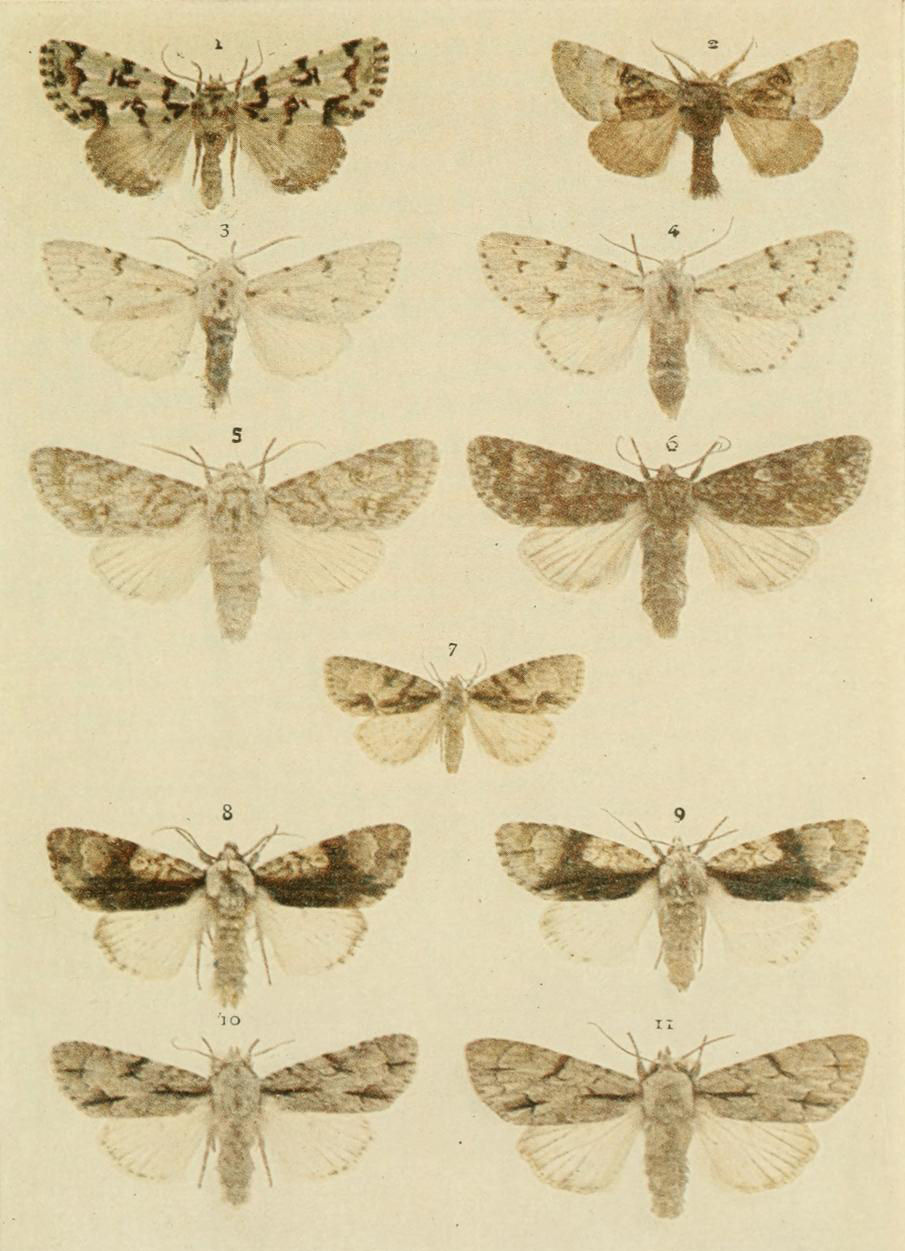
Pl. 100.
1.Scarce Merveille du Jour. 2.Nut-tree Tussock. 3, 4.Miller Moth.
5.Sycamore Moth. 6.Poplar Grey. 7.Marsh Dagger.
8, 9.Alder Moth. 10.Dark Dagger. 11.Gray Dagger.
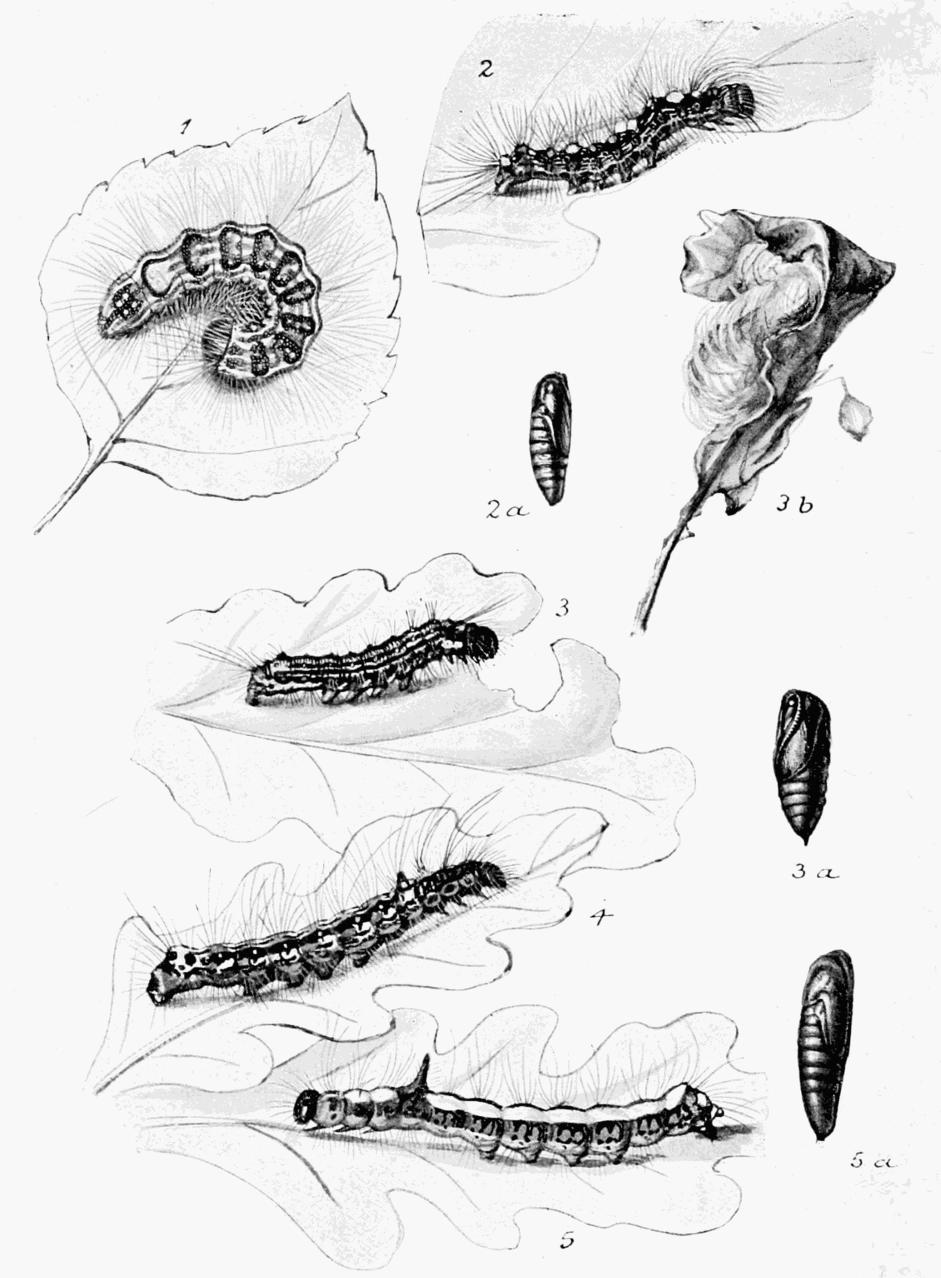
Pl. 101.
1.Poplar Grey: caterpillar.
2, 2a.Scarce Merveille du Jour: caterpillar and chrysalis.
3, 3a, 3b.Nut-tree Tussock: caterpillar, chrysalis and cocoon.
4. Dark Dagger: caterpillar. 5, 5a. Grey Dagger: caterpillar and chrysalis.
NOCTUIDÆ.
This extensive assemblage of moths, commonly known as noctuas, and locally as "millers," "owlets," and "buzzards," has been divided by Staudinger into five sub-families—Acronyctinæ, Trifinæ, Gonopterinæ, Quadrifinæ, and Hypeninæ. These divisions are here adopted, and the arrangement of species is adhered to pretty closely, except in the Trifinæ, where it has been considered necessary to make sundry alterations so as to fall more in line with later classification, at least so far as concerns genera.
The eggs of species in this family are round and somewhat flattened in shape, and the shell is fluted or netted. Some few examples of these have been figured.
Most of the larvæ conceal themselves during the day, in the ground, among low herbage, or in spun-together leaves, and only leave their retreat at night to feed. Most kinds change to the chrysalis state underground, but some pupate among leaves or in chinks of tree bark, etc.
With some few exceptions the moths fly only at night, by far the larger number will visit the sugar patch, and others come readily to flowers or to light.
Distribution abroad will only be referred to where this is restricted in Europe, or extends far beyond European limits.
ACRONYCTINÆ.
The Scarce Merveille du Jour (Diphtera orion).
This pretty moth has the fore wings green variegated with white stripes and black cross lines; the hind wings are greyish, marked with white at the anal angle. The spaces between the interrupted cross lines of the fore wings are often marked with black, and this is the typical form of the species; the plainer specimens—those less spotted with black—being referable to var. runica, Stephens. Stephens in 1829 notes that the species was then little known in England. It is still very local, inhabiting oak woods in Sussex (Hailsham), Hampshire (New Forest, sometimes common), Devonshire (Plymouth district), Cornwall (East Looe), Essex (Colchester), and Suffolk (Ipswich). The moth is out in June; on September 5, 1906, Mr. L. W. Newman bred a small specimen that had only been in the chrysalis seventeen days. Usually it rests by day on boughs, and sometimes on the trunks of trees (see Fig. 8, p. 9); it flies at night and then patronizes the sugar patch, but often is a late visitor. The caterpillar, which feeds upon oak in July and August, is black on the back with a yellow or whitish blotch on rings four, six, and nine; the reddish warts are crowned with tufts of brown or whitish hairs. Head black marked with yellow except on the top. It is also said to eat leaves of beech and birch. Staudinger gives alpium, Osbeck (1778), as an earlier name than orion, Esp. Hampson refers alpinum to Daseochæta, Warren.
Distribution: Central and Northern Europe, and represented by var. murrhina, Graes., in Amurland, China, and Japan.
The moth is depicted on Plate 100, Fig. 1, and the caterpillar and chrysalis on Plate 101, Figs. 2, 2a.
The Nut-tree Tussock (Demas coryli).
Usually the fore wings of this moth appear to be brownish, or reddish brown on the basal half, and whitish, more or less suffused with greyish, or sometimes reddish brown, on the outer half; the hind wings are pale brownish, or greyish, lighter towards the base. Not infrequently the fore wings are greyish white with some brownish clouding between the two blackish cross lines. The caterpillar is variable in colour, but generally of some shade of brown, ranging from dark chocolate brown to pale ochreous, covered with soft hair; the pencils of long hairs on the first ring, and the tufts of hairs on rings four, five, and eleven, may be red, greyish, or blackish; the broken stripe along the back is greyish, and the stripe low down on each side may be red, brown, or greyish. It feeds in June and July, and as a second generation in September, on the foliage of beech, birch, hazel, hornbeam, etc.: bushes growing in exposed positions such as a hedge bank or hill side are chiefly fancied. The moth flies in May and June, and again in August and September. It probably occurs in most of the English counties, but is most frequent in Berkshire, Bucks, and Devon. Not uncommon in Clydesdale, but more plentiful in Aberdeenshire, and is also obtained in Perthshire, and in other parts of Scotland. Widely distributed in Ireland.
The moth is shown on Plate 100, Fig. 2, and the early stages on Plate 101, Figs. 3, 3a, 3b.
The Miller (Acronycta leporina).
In its typical form the wings are quite white with but little in the way of marking. Most, if not all, the specimens occurring in Britain are the more or less greyish suffused and more marked, variety known as bradyporina, Treits. (Plate 100, Figs. 3 ♂, 4 ♀.) Sometimes the outer margins of the fore wings, beyond the second cross line, are shaded or dusted with blackish (var. semivirga, Tutt). In the Liverpool district a form is occasionally obtained in which the fore wings are darkly suffused, and the thorax is black (var. melanocephala, Mansbridge). A specimen with black fore wings and white fringes has been bred from a caterpillar found in Essex (Entomologist, xxxviii., 289, and xxxix., 97).
The caterpillar is pale green clothed with long white, and a few black hairs; these fall downwards, and on the one side curve forwards, and on the other side backwards. Sometimes in the south of England, more frequently in the north, the ground colour and hairs are yellow, and there are more or less distinct reddish brown bands on the back and sides. It may be found from July to September, or even later, on birch or alder, rarely on oak and poplar. The moth occurs in May and June, as a rule. In 1904 I took a freshly emerged specimen on July 23, at Byfleet in Surrey, and some half-grown caterpillars were obtained on the same day, and very near the same spot. The species is found in woods, and on heaths and mosses, where birch or alder flourishes, from Devonshire in England to Sutherlandshire in Scotland. It is not common anywhere in our islands, but is perhaps most frequently met with in the south and east of England. In Ireland it appears to have been found only in the southern counties.
The Sycamore (Acronycta aceris).
The dark mottled grey moth on Plate 100, Fig. 5, is not much given to variation, but occasionally brownish suffused forms occur (var. candelisequa, Esp. = infuscata, Haworth).
The caterpillar (Plate 102, Fig. 3) feeds in August and September upon sycamore, maple, and sometimes plum and chestnut. It has some black-edged white marks along the middle of the back; the pointed tufts of long hairs are yellow or reddish. When it is at rest on the underside of a leaf, or coils in a ring on being disturbed, the hair tufts gave the creature a somewhat prickly appearance. The moth is out in June and July.
The species is more or less common pretty well through the southern and eastern counties, and fairly so in and around London. Its range extends to Warwickshire and Herefordshire; but it is scarce in both counties. The Irish localities for it are Claring Bridge and Ahascragh, Co. Galway; Glandore and Timologue, Co. Cork; Enniskillen, Co. Fermanagh.
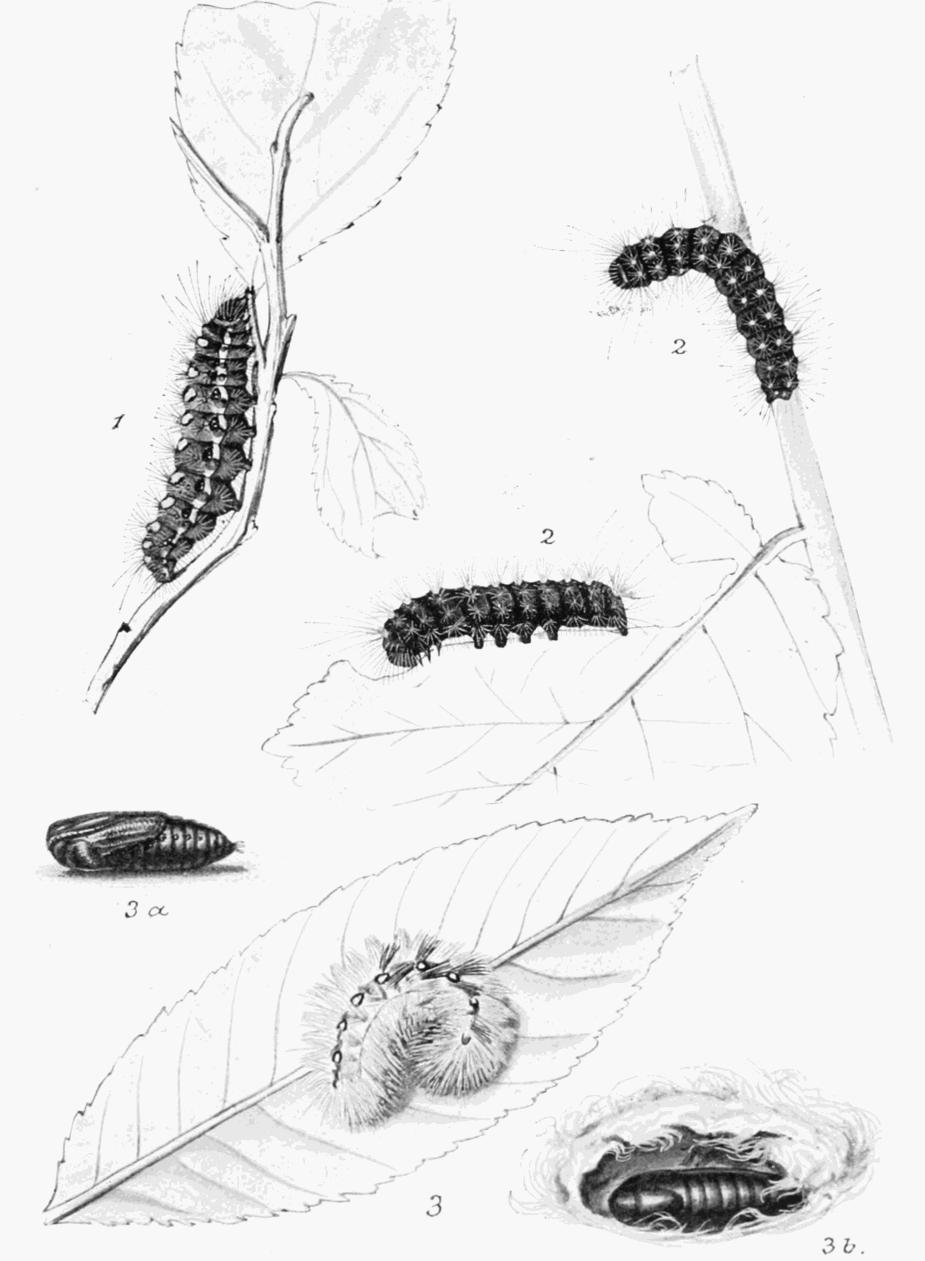
Pl. 102.
1.Knot Grass: caterpillar.
2.Scarce Dagger: caterpillars.
3, 3a, 3b.Sycamore: caterpillar, chrysalis and cocoon.
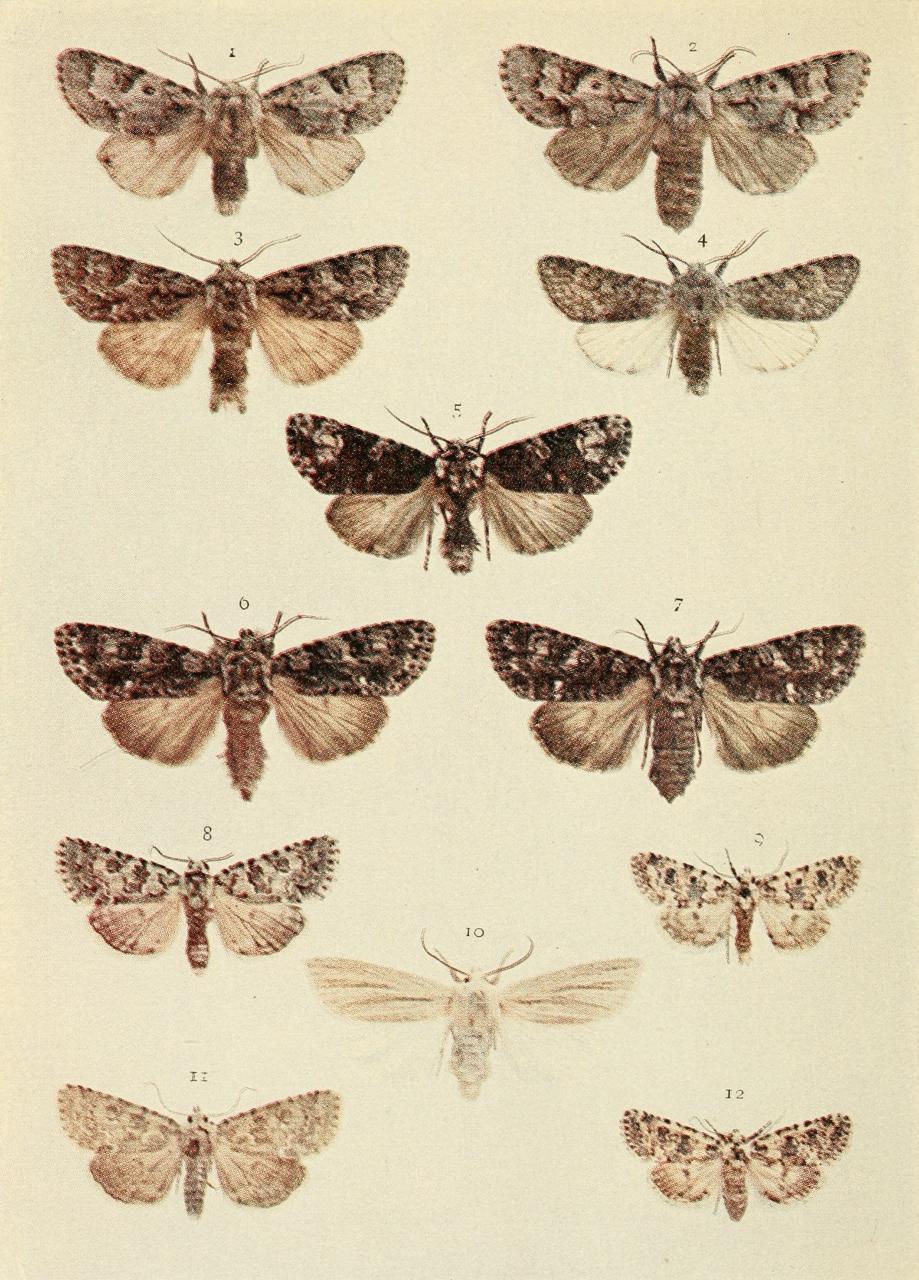
Pl. 103.
1, 2.Light Knot-grass. 3.Scarce Dagger. 4.Sweet Gale Moth.
5.Coronet Moth. 6, 7.Knot-grass Moth. 8.Marbled Green, male; 11 female.
9.Marbled Beauty, male; 12 female. 10.Powdered Wainscot.
The Poplar Grey (Acronycta megacephala).
This moth is somewhat like that last noticed, but the fore wings are darker grey; the whitish orbicular mark is margined with black, and has a dark central dot. Sometimes the fore wings are clouded with blackish, and occasionally entirely suffused with black. In several species of Acronycta newly disclosed specimens have a faint pinky tinge, but this is especially noticeable in the present species. (Plate 100, Fig. 6.)
The caterpillar is ochreous or grey brown, marked with blackish; a conspicuous character is a black-edged whitish or ochreous patch on ring ten; the hairs are whitish, those on the sides rather long. It feeds from July to September on the foliage of poplars. (Plate 101, Fig. 1).
This well-known cockney species is on the wing from late May to mid-August. Has been bred in September from a caterpillar taken in July, also in October from August larvæ. It is often abundant on poplars (especially the caterpillars) in London and suburbs. Common all over the southern parts of England, except perhaps in Devon and Cornwall; its range extends through Northern England to Ross in Scotland; and it is found in the south of Ireland.
The Alder (Acronycta alni).
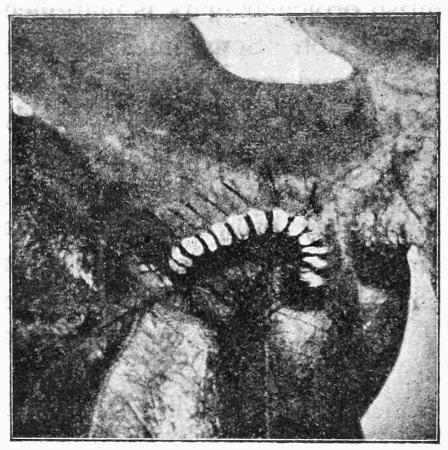
Fig. 26.
Caterpillar of the Alder-Moth.
(Photo by W. J. Lucas.)
The sexes of this black-clouded grey moth are shown on Plate 100, Figs. 8 and 9♀. Except that the black clouding sometimes spreads over a greater area of the fore wings, there is little to note in aberration, at least in a general way. In 1906 a melanic specimen was bred from a chrysalis taken from alder in Delamere Forest, Cheshire; this is probably referable to var. steinerti, Caspari.
The caterpillar (Fig. 26) is black, marked with yellow; the curious clubbed hairs are its distinguishing feature. Although named after the alder, it feeds on the leaves of most trees and bushes in July and August, sometimes earlier or later. The moth is out in May and June, but although an occasional specimen has been taken at sugar or light, once resting on nettles, it is rarely met with. Caterpillars also are not by any means common, and any one who may obtain even a single example in a season may congratulate himself on a good find. They are perhaps most frequent in the Hampshire (New Forest) district and some of the Sussex woodlands, but have occurred now and then in almost every county of England up to Yorkshire; also in Glamorganshire, Carmarthenshire, and at Trefriw in Wales. The only Irish locality is Powerscourt, Co. Wicklow. The range abroad extends to Armenia, Amurland, and Japan.
The Marsh Dagger (Acronycta strigosa).
This little moth, known also as the "Grisette," seems confined, as a British species, to the country around Cambridge; but it has been twice recorded from Norfolk, two specimens have been reported from Worcestershire, and one from Gloucestershire; the latter at sugar in June, 1897. The latest records that I have seen refer to a moth taken at sugar near Chatteris in 1904, two caterpillars beaten out of hawthorn in August, 1905, and a moth on an ash tree, Wicken, July 31, 1907. (Plate 100, Fig. 7).
The caterpillar is yellowish green, with a red brown stripe along the back; two small elevations on ring four, and one on ring eleven; the hairs are blackish on the back, one of each tuft longer than the others. It feeds on hawthorn in August and early September. The moth is out in July. This species is found abroad in Central Europe and Southern France; also in Amurland, Corea, and Japan.
The Dark Dagger (Acronycta tridens).
The English name of this moth is not very suitable, as in general colour it is often really paler than many examples of the next species. Specimens with a blackish cloud at the base, and a dark band-like suffusion on the outer margin of the fore wings are referable to var. virga, Tutt. It is widely distributed in England and Wales, but apparently not common; rare in Scotland and in Ireland. I am unable to indicate any character that will serve to distinguish this moth from the Grey Dagger. The moth flies in June; a second brood sometimes occurs in confinement in October. The caterpillars of the two species are very distinct. That of the present species is black, with a broad reddish stripe along the back, and one on each side; the first is interrupted with white, and the others with black; there is a black hump on the fourth ring, and a broader one on the eleventh ring. It feeds from August to October on hawthorn, sloe, plum, pear, and apple; also on birch and sallow.
The moth is shown on Plate 100, Fig. 10; and the caterpillar on Plate 101, Fig. 4.
The Grey Dagger (Acronycta psi).
The ground colour varies from whitish to blackish grey, Var. bivirgæ, Tutt, is similar to var. virga of the last species. In var. bidens, Chapman, the first cross line is double, enclosing a pale stripe; the upper part of second cross line is more angled, and the dagger mark at the anal angle is much shortened.
The caterpillar has a taller and more slender hump on ring four, and the stripe along the back is clear yellow, with black edged red spots on each side of it. Generally distributed, and often common.
The moth is shown on Plate 100, Fig. 11; and the caterpillar and chrysalis on Plate 101, Figs. 5 and 5a.
The Light Knot Grass (Acronycta menyanthidis).
Portraits of this moth will be found on Plate 103, Figs. 1♂, 2♀. Several modifications have been named, the most important of these are var. scotica, Tutt, which is larger and brighter than the type, with the markings clear and distinct; var. suffusa, Tutt, is much suffused with black. The former is chiefly found in Scotland, and the latter in Yorkshire.
The caterpillar is black or sooty-brown, with a red stripe, or blotches, low down along the sides; hairs black or red-brown. In August and September feeding by day on sweet-gale or bog myrtle (Myrica gale), bilberry, heather, dwarf sallow, etc. The moth flies in June and July, and may be found on the mosses and moorlands of North England and Scotland. It rests by day on rocks, stones, and, where they are handy, on posts and rails. I found several on Danes Moss, Cheshire, sitting on a derelict tub. Also occurring in Ireland, but not common.
The Scarce Dagger (Acronycta auricoma).
The pale grey, darker-mottled moth depicted on Plate 103, Fig. 3, is very local, and only occurs in some of the woods of Kent and Sussex; the districts mentioned being those of Rochester, Canterbury, Hailsham, and Hastings.
The caterpillar is figured on Plate 102, Fig. 2. It is slaty grey in colour with a black plate on the first ring; on the back of each ring is a broad black band, and four orange warts from which arise golden-yellow silky hairs; the hairs on the sides are pale drab (adapted from Buckler). It feeds in June and early July, sometimes in September, on oak, birch, various kinds of Rubus, such as blackberry and raspberry, and also on bilberry (Vaccinium). The moth is out in late April and in May; occasionally late July and in August. It is rarely seen in the day time, but has been found resting on tree trunks. The range abroad extends to Southern Russia and Siberia.
The Sweet-Gale Moth (Acronycta euphorbiæ var. myricæ).
Our form of this species—var. myricæ, Guenée (Plate 103, Fig. 4), is rather larger and much darker than the type; but although it is generally somewhat smaller than the Alpine var. montivaga, Guenée, it is not otherwise separable from that form. So far as concerns the British Isles, it is only found in Scotland and, rarely, in Ireland. It was first obtained in Perthshire, in 1846, by Weaver, and it is now known to occur more or less commonly through Scotland from Ayr to Sutherlandshire. In Ireland it occurs in Cork, Kerry, Galway, and Sligo, and Kane considers that specimens from Markrea, and Lough Gill in the latter county are referable rather to var. montivaga, than to var. myricæ. The moth is out in April, May, and June.
The dark greyish caterpillar has a deep black, broken, stripe along the middle of the back, and a series of pale yellow marks on each side of it; along the black-margined white spiracles there is a reddish orange line, or broken stripe; pale brownish hairs arising from yellowish warts on the back, and a cross-bar of reddish orange near the head. It feeds on sweet gale, heather, birch, sallow, etc., and may be found from July to September. Two figures of it, from coloured drawings by Mr. Alfred Sich, will be found on Plate 102.
The Knot Grass (Acronycta rumicis).
The ordinary form of this moth is shown on Plate 103, Figs. 6♂, 7♀. The species varies greatly in the amount of dark mottling and clouding on the fore wings; sometimes this is much reduced, and the pale grey ground colour is then clearly seen; more often these wings are entirely clouded over with blackish or sooty brown, leaving only the white bracket-like mark above the inner margin, and the submarginal cross line, distinctly visible (var. salicis, Curtis). The moth flies in June and July, and sometimes in August and September.
The hairy caterpillar, which is somewhat humped on rings four and eleven, is figured in Plate 102, Fig. 1. It is dark brownish grey, marked on the back with a central series of black patches in which are reddish spots, and a row of white spots on each side; below the white spiracles is a yellowish wavy line with reddish warts upon it. Various low-growing plants, such as plantain, dock, sorrel, and also hawthorn, sallow, and bramble, afford it nourishment, and it is found in July, August, and September.
Generally distributed throughout England and Wales, its range extending into Scotland as far north as Morayshire; also in Ireland. The var. salicis occurs northwards from Shropshire through northern England into Scotland, but is perhaps most common in Ireland.
The Coronet (Craniophora ligustri).
This is also the Crown Moth of Moses Harris, both English names referring to a fancied resemblance of the whitish or pale greyish mark, just beyond the reniform stigma, to a crown or coronet (Plate 103, Fig. 5). The greenish or brownish-olive fore wings are subject to modification in the depth of tint; sometimes they are blackish in tone—var. nigra, Tutt, or dark olive-green—var. olivacea, Tutt. In both of these named forms the whitish markings are obscured, and in this respect they seem to be about identical with var. sundevalli, Lampa.
Pl. 104.
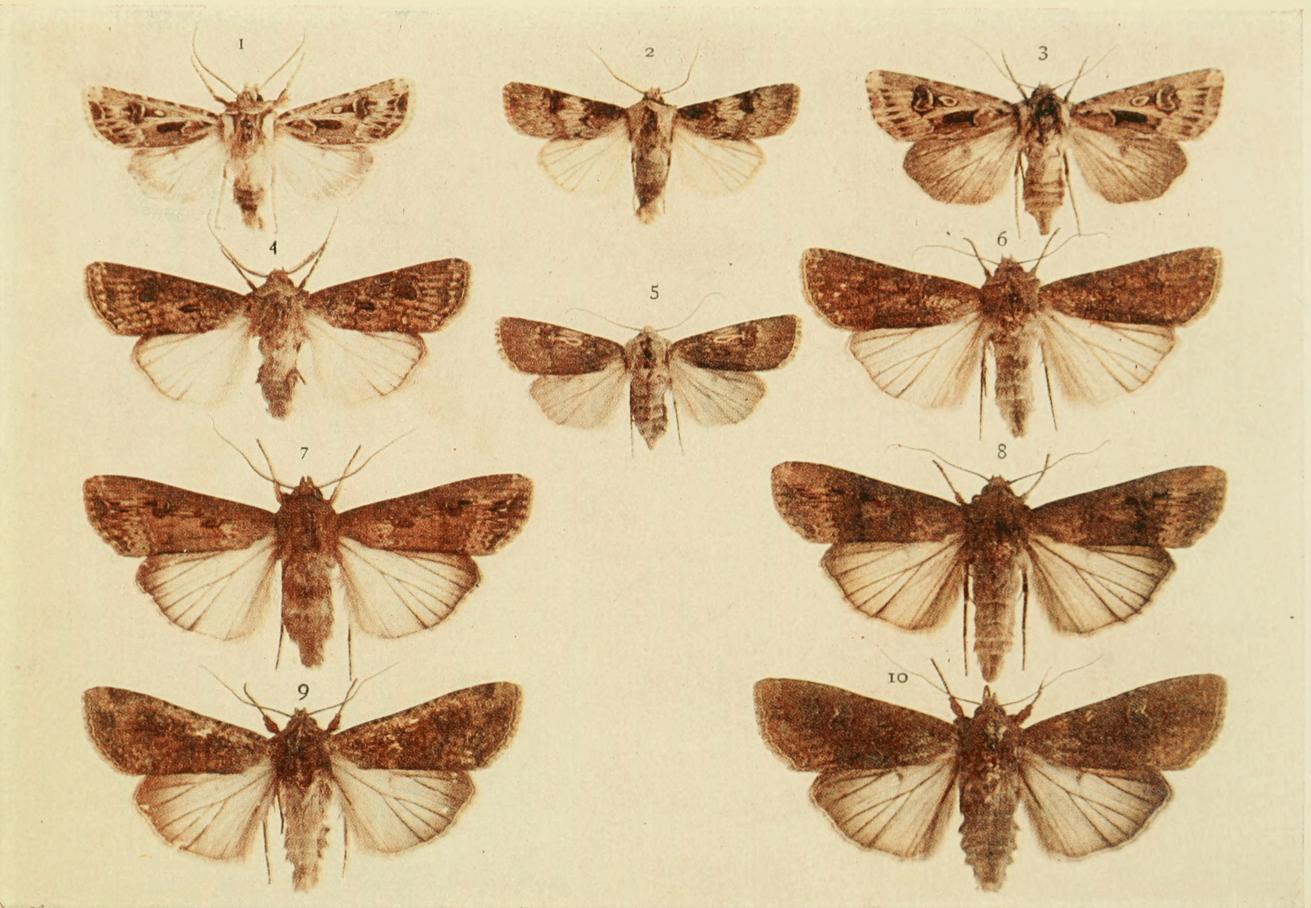
1, 3. Archer's Dart. 4, 6. Turnip Moth. 2, 5. Shuttle-shaped Dart. 7, 8. Dark Sword Grass.
9, 10. Pearly Underwing.
Pl. 105.
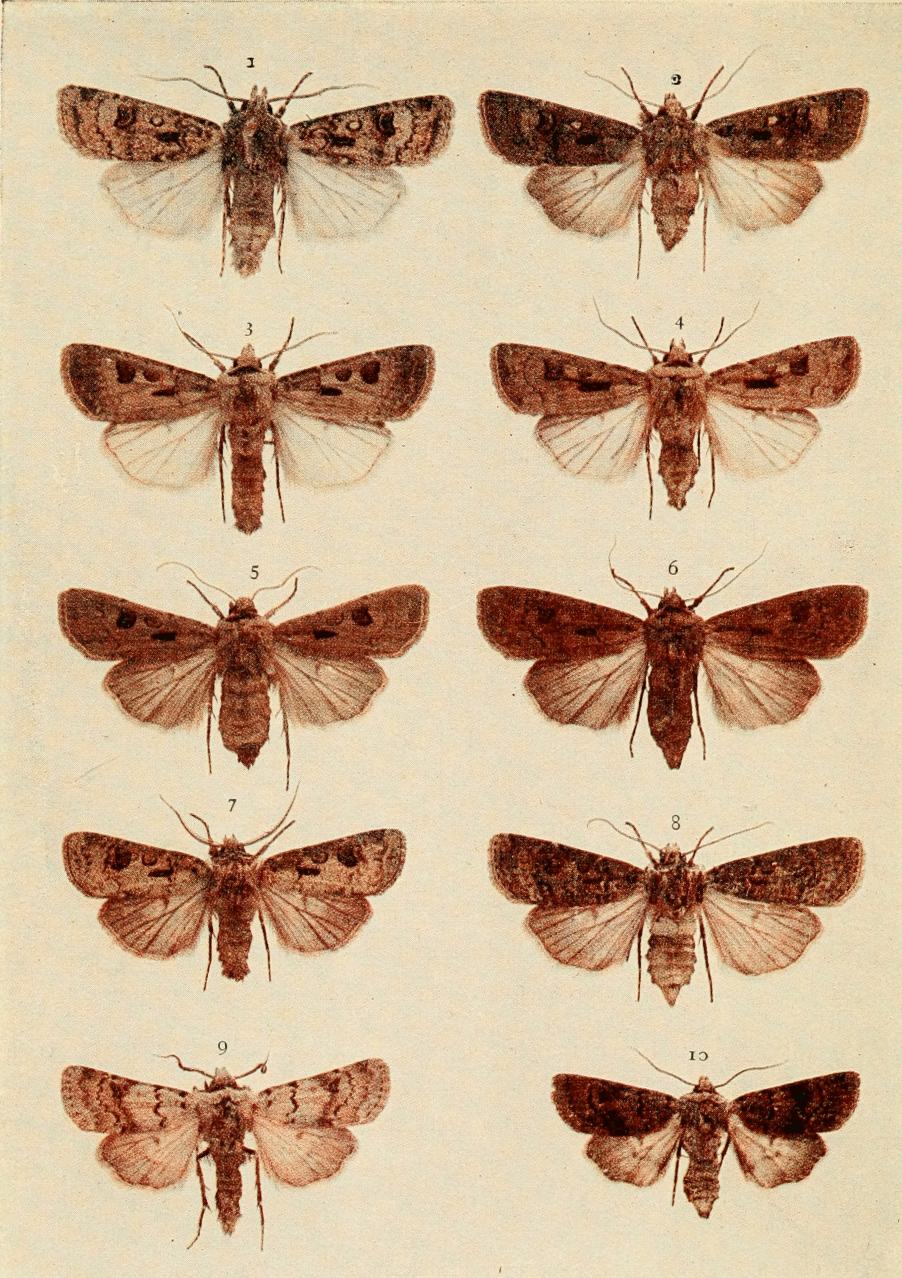
1, 2.Crescent Dart. 3, 4.Heart and Dart, males.
5, 6.Heart and Dart, females. 7, 8.Heart and Club.
9, 10. Light Feathered Rustic.
The caterpillar is bluish green above, and yellowish green below; a slender whitish line along the middle of the back, and a yellowish line on each side; the spiracles are reddish, and the raised spots, from each of which a single black hair arises, are black. It feeds in August and September on ash, and less frequently, perhaps, on privet. It is stated to eat hazel and alder, also.
The moth flies in June and July, and its occurrence in any locality depends largely upon the presence of ash. Widely distributed throughout England, Wales, and Scotland to Ross-shire. In Ireland it has only been noted from a few localities in Co. Galway.
Powdered Wainscot (Simyra (Arsilonche) albovenosa).
In its typical form (Plate 103, Fig. 10), the fore wings are whitish ochreous with the veins showing up white more or less clearly. A form with reddish ochreous fore wings has been named var. ochracea, Tutt; and another with silvery-white wings var. argentea by the same author. These seem to be identical with forms of this species named flavida and albida by Aurivillius some eight years earlier.
The hairy caterpillar is blackish or dark grey brown freckled with black; two stripes along the back and one on each side are yellow, sometimes marked with orange; the warts are orange with pale, and a few black, hairs; head black, marked with yellowish.
It feeds from July to September on the leaves of reeds, at night; hiding by day under leaves low down. The moth is out in June, but an autumn brood is sometimes obtained. It only occurs in fenland, chiefly Norfolk and Cambridgeshire.
The Marbled Beauty (Bryophila perla).
Typically the fore wings of this species are white, marbled with slaty grey, and with the stigmata dark grey (Plate 103, Figs. 9♂, 12♀). There is less colour variation than in the last species, but in some localities greenish, ochreous, and ochreous brown forms have been obtained. The caterpillar is pale slaty grey, with an irregular yellowish stripe on the back, with black spots forming a central line; the raised spots are black and shiny, as also is the head. Feeds on lichens growing on old walls from August to May. The moth, which occurs throughout England, Wales, Ireland, and Scotland up to the Clyde, is to be found, commonly as a rule, on walls by day, and gas lamps at night, in July and August. Sometimes I have found specimens on tree trunks.
Marbled Green (Bryophila muralis (glandifera)).
Two forms of this very variable little moth are represented on Plate 103, Figs. 8♂ (typical), 11♀. The ground colour of the fore wings ranges from almost white through pale green to bluish green or to a deep olive green, or through pale ochreous to orange brown. The markings, too, vary in intensity, and are sometimes very obscure. Several forms have been named, but only the Cambridge race, known as var. impar, Warren, can here be referred to. In this form the colour is more often greyish or brownish white, than green; the markings are cloudy and not clearly defined.
The caterpillar is obscure greenish, with whitish and rather shining raised spots; there is a black plate on the first ring, and from this three broken yellowish lines run along the back. Head black and glossy. It feeds from October to May on the lichens growing on walls and rocks; during the day it hides in a chamber formed of silk and lichen, which is not easy to detect in dry weather. The moth is out in July and August, and at Eastbourne I have found it in September. It may be found generally on walls, but sometimes on rocks at various places on the coast of Kent, Sussex, Dorset, Devon, and Cornwall; also in the Scilly Isles. Its range, according to Barrett, extends to Bath and Wells, Somersetshire, Marlborough and Chippenham in Wiltshire, and it has also occurred in Gloucestershire.
The Tree-lichen Beauty (Bryophila algæ).
The only record of this species in England that I am aware of is that by Mr. Edleston, in the Intelligencer for 1860, p. 11, as follows: "Two specimens of this pretty species (B. algæ) were taken in this district last July." The district referred to was Manchester, and the note was written on September 28, 1859.
TRIFINÆ.
The Turnip Moth (Agrotis (Euxoa) segetum).
The ordinary form of the male and the female is represented on Plate 104. The species is an exceedingly variable one, and Haworth (1803), believing them to be distinct species, gave Latin and English names to several of the different forms. The ground colour in the male ranges from pale whitish or brownish ochreous, with strong markings, to blackish brown, with the markings obscured. The female ranges in colour of fore wings from greyish to blackish. Caterpillar, greyish brown, tinged with ochreous, or sometimes pinkish; a glossy plate on first ring, greyish or brownish; spots glossy, each with a tiny hair; lines rather darker, but often indistinct. It feeds from July to April on various plants, but only attacks the tender stems near the surface of the ground. In fields it is destructive to turnips and swedes, making large cavities in the bulb, which it enters from just above the tap-root. The moth flies in June, and occasionally as a second generation in the autumn. Generally distributed over the British Isles, and often very common. Its range extends throughout nearly the whole of Europe and the greater part of Asia.
The Archer's Dart (Agrotis (Euxoa) vestigialis).
The specimens shown on Plate 104 are typical of the sexes (Figs. 1♂, 3♀). The normal pale brown colour is sometimes replaced by greyish, reddish, or olive brown. A specimen with black fore and hind wings has been recorded from North Wales by Mr. Jäger. The markings vary in intensity, and occasionally are almost or quite absent. Several of the varieties have been named. The caterpillar, which feeds on bed-straw and various grasses, etc., is greenish grey, inclining to brownish above, with a dark-edged pale line along the middle of the back, and a similar line on each side; the raised spots are black, and the plate on first ring brownish; head ochreous, marked with darker. August to May. The moth is out in July and August, and is chiefly found on sandhills by the sea. It is most plentiful on the eastern and southern coasts, and in Cheshire, Lancashire, and Yorkshire: it is often not uncommon in the Brandon and Tuddenham districts, and others, in the "Breck Sand" area of Suffolk and Norfolk. The species has been recorded from Worcestershire, and I understand that a few specimens were taken in Surrey last August (1907). In Scotland it occurs on the east coast, and in the Orkney Isles; also in Ayr, on the south-west. In Ireland, also, it is found on suitable parts of the coast.
Pl. 106.
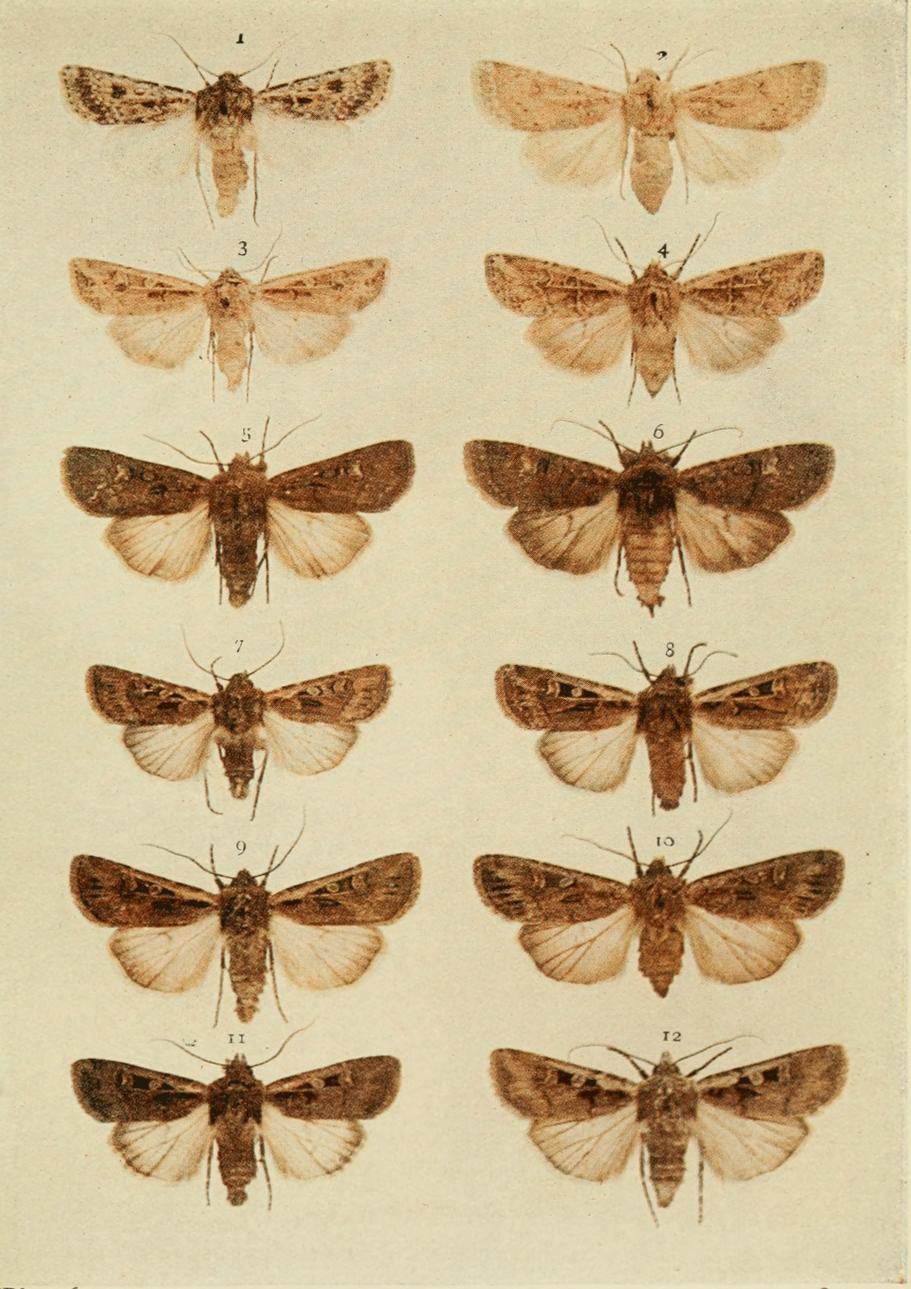
1, 2.Sand Dart. 3, 4.Coast Dart.
5, 6.Garden Dart. 7, 8, 11.White Line Dart.
9, 10.White-line Dart, var. aquilina. 12.Square-spot Dart.
Pl. 107.
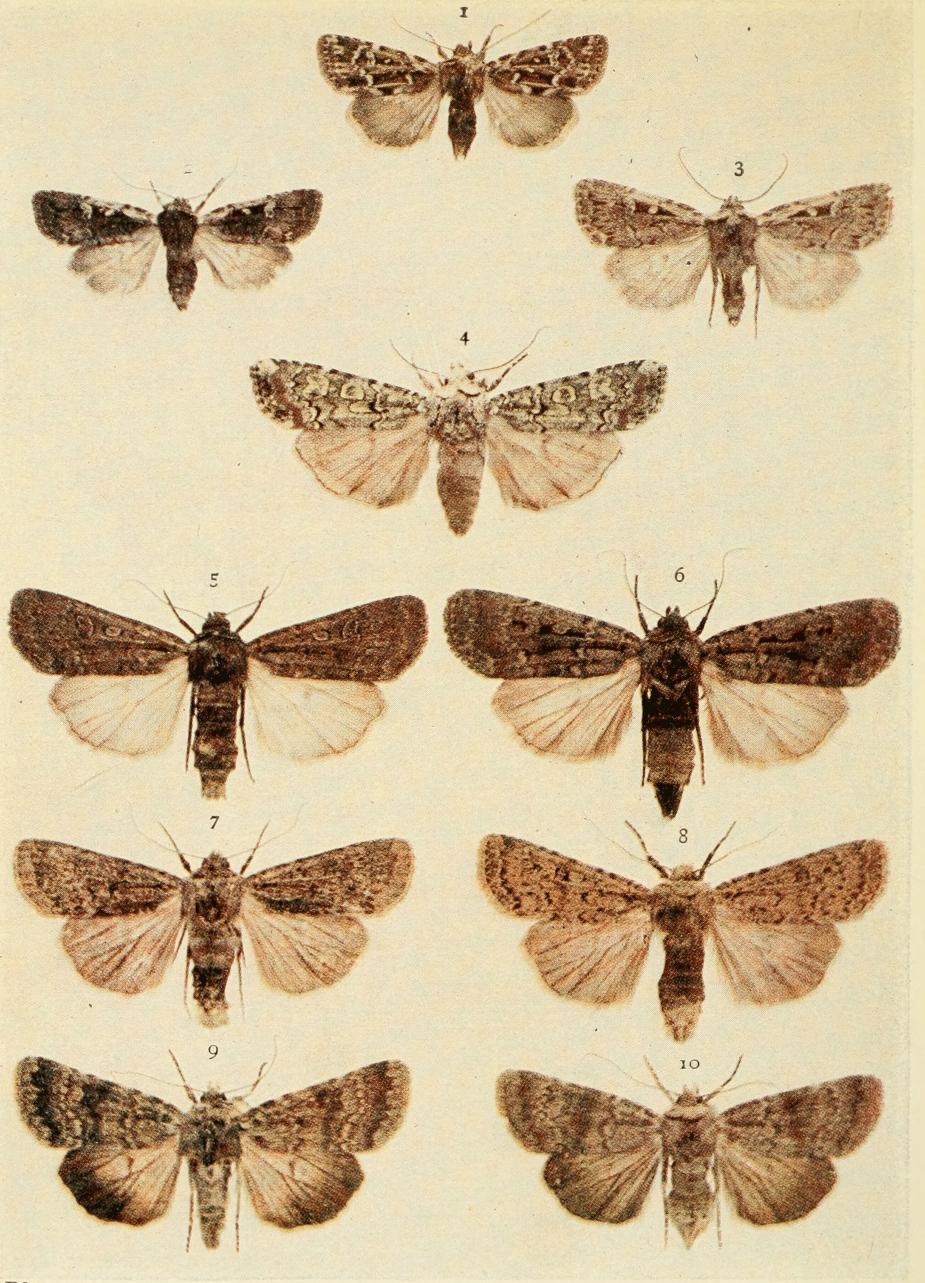
1.True-lover's Knot. 2, 3.Heath Rustic.
4.Portland Moth. 5, 6.Stout Dart.
7, 8.Dotted Rustic. 9, 10.Northern Rustic.
The Heart and Club (Agrotis (Euxoa) corticea).
The more usual form of the male and the female are shown on Plate 105 (Figs. 7♂, 8♀). The colour varies from pale brown to a whitish or greyish brown tint in one direction, and to reddish or blackish brown in another. The cross lines, generally well defined, are sometimes absent, or nearly so, in some of the pale forms, and much obscured in the dark forms. The black outlined reniform and orbicular stigmata are sometimes obscured by a blackish cloud; the pale-centred, club-like mark below them varies in length, and is occasionally reduced to a small spot. "Noctua subfusca," Haworth, has been determined by Mr. E. R. Bankes, who possesses the type, to be an obscurely marked fuscous ♂ example of this species. The greyish brown, rather rough-looking caterpillar, is freckled with a darker tint above, and inclined to greenish below; a fine, pale line along the middle of the back is edged with brownish, and on each side there is a pale line, edged above with brown, and below this a double pale line; head marked with blackish (Plate 109, Fig. 1). It feeds from March to April, after hibernation, on various low-growing plants, including goose-foot (Chenopodium), persicaria, knotgrass, dock, and clover. The moth is on the wing in June and July, and very occasionally in September. It is rather a common insect in eastern and southern counties bordering the sea, but extends into Surrey, and occasionally into Cambridgeshire, Oxfordshire, and Berkshire; and is also found more or less frequently in Herefordshire, Warwickshire, Staffordshire, Cheshire, Lancashire, and Yorkshire. In Scotland it occurs in Ayr, and on the eastern side to Moray. It has been taken in various counties, on the coast, of Ireland from Cork to Sligo, and from Wicklow to Derry.
The Light Feathered Rustic (Agrotis (Euxoa) cinerea).
Both sexes are shown in their typical forms on Plate 105. The fore wings of the male (Fig. 9) are generally pale greyish in colour, with blackish cross lines and central shade; the claviform mark is absent, and the orbicular stigma usually so, or represented by a dusky dot; sometimes the ground colour is brownish, occasionally purplish grey, and very rarely black. The female (Fig. 10) is smaller, and always much darker.
The caterpillar is blackish green or dark greyish, with three fine pale lines, the central one edged on both sides, and the others edged above, with a darker tint; a pale stripe along the black spiracles; head, and plate on first ring black. It feeds on wild thyme, and is said to eat dock. It hatches from the egg in late June or early July, and presumably hibernates when full grown, as it does not seem to feed again when it reappears in early spring.
The moth flies in May and June, and is only to be found on hills and downs in chalk or limestone districts. It occurs in Surrey, Dorset, Isle of Wight, Devon, Gloucestershire, Herefordshire, North Wales, Berkshire, Oxfordshire, Cambridge, and Suffolk; it seems to have been most frequently met with in Kent and Sussex. The small form, with narrow and distinctly marked fore wings, and whitish hind wings, occurring in the south of England, has been named var. tephrina, Staud.
The Shuttle-shaped Dart (Agrotis (Euxoa) puta).
As will be seen by the figures on Plate 104, the sexes of this species also differ greatly in colour. Usually the cross lines on the fore wings of the male do not show up so distinctly as in Fig. 2, which closely approaches a form figured and described as radiola by Stephens in 1829. Fig. 5 represents the typical blackish-brown female. Gynandrous specimens, one side ♂ the other ♀, have been recorded. The caterpillar feeds on dandelion, lettuce, knotgrass, and other low-growing plants, from September to April; probably full grown before hibernation. The moth, which is out in July and August, sometimes in May, is partial to low-lying, marshy ground and meadows, and is widely distributed over the whole of the south of England, but it is seemingly rare in the north, and still more so in Scotland and Ireland. Barrett states that it has been found commonly in Carmarthenshire, Wales.
The Crescent Dart (Agrotis (Euxoa) lunigera).
Although its position in classification is that of a local form of A. trux, Hübn., this moth, which is figured on Plate 105, Figs. 1♂, 2♀, may here retain the name that was given to it by Stephens in 1829. Except that it has been reported to occur in the north of France, it seems to be peculiar to the British Isles. The earliest known specimens were captured near Cork in Ireland, June, 1826, and it is now found not only on the coasts of Cork and Kerry, but also on the Hill of Howth, near Dublin. In England it occurs in the Isle of Wight, Dorsetshire (Portland), Devonshire (Torquay), Cornwall, and the Scilly Isles. Reported from Sussex in 1918. In Wales it is to be found above Barmouth, and in various parts of South Wales; and in Scotland around Edinburgh and on the Moray coast. The moth is out in July and August. Mr. A. E. Gibbs, writing of this species in Cornwall, remarks, "It is generally stated that A. lunigera is only to be taken on steep and dangerous cliffs, in places where sugaring is by no means a safe occupation; but its abundance at Polzeath showed that this is not invariably the case. Here it was found on posts and flower heads in the valley at some distance from the seashore, and so abundantly did it occur that one evening's work yielded upwards of fifty specimens."
The caterpillar is greyish or greenish grey, inclining to brownish above, and with darker brown marks on the back; lines paler, edged sometimes with darker grey; raised spots blackish, rather glossy; head brownish, marked with black, and the plate on first ring is black with a central yellow line. It feeds from August to May on various low plants growing in rocky places by the sea. Will eat dandelion, plantain, and knotgrass in confinement, also sliced carrot.
The Coast Dart (Agrotis (Euxoa) cursoria).
The specimens whose portraits will be found on Plate 106 are more or less typical of the sexes of this most variable species. The ground colour of the fore wings ranges from whitish ochreous through all shades of brown up to dark reddish, and from whitish grey through leaden grey to brown grey. The markings, too, are exceedingly variable; the cross lines are often faint, sometimes entirely absent; the stigmata are frequently obscure, and occasionally the blackish lower part of the reniform is the only indication of these marks. There is often a white streak along the costa, and in some specimens this is very conspicuous (Figs. 3♂, 4♀).
The caterpillar feeds from September to June on various grasses growing on sandhills, and is said to eat wormwood and violet. It is ochreous in colour, more or less tinged with green; the lines are pale grey, edged with darker grey; spots brown, and head ochreous brown.
The moth is on the wing from late July to early September, and is to be found on all the larger tracts of sandhills on the east coast from Suffolk northwards, and on the coasts of Cheshire and Lancashire. It is not common on our southern coasts, but occurs in Dorsetshire and Devon. In Scotland it is obtained on the Firth of Forth, Kincardine, and Aberdeen coasts, and also in the Hebrides, Orkney, and Shetland Isles; and on very many parts of the coast of Ireland.
The Garden Dart (Agrotis (Euxoa) nigricans).
This moth is typically sooty or blackish brown in both sexes (Plates 106, Figs. 5♂, 6♀), but varies to pale brown, or through various shades of red brown. The markings, usually obscure, occasionally are well defined, and sometimes there are additional black spots and pale streaks. The caterpillar is pale or dark ochreous brown on the back, inclining to greenish on the sides; lines greenish grey, edged with black, and a double whitish one low down on the sides. It feeds from September to June, on clover, plantain, dock, and various other low plants; and also cow-parsnip and other umbelliferæ. The moth flies in July and August, and is to be found in most English counties, but perhaps most commonly in the eastern. In Scotland it ranges to Moray, and seems to be generally distributed in Ireland.
The White-line Dart (Agrotis (Euxoa) tritici).
This is another exceedingly variable species. The ground colour of the fore wings ranges from pale whitish or ochreous brown, through various tints of greyish and red brown, up to black or sooty brown; variation in markings is somewhat similar to that referred to in A. cursoria. Three forms are shown on Plate 106, Figs. 7, 8, and 11; the latter represents a specimen closely approaching A. obelisca. Var. aquilina (Figs. 9 and 10), the English name of which is the Streaked Dart, is larger than the type, and the wings, consequently, are broader; by some entomologists it is considered to be a distinct species.
The caterpillar is obscure greyish or brownish, with a dark-edged pale line along the middle of the back, and a dusky line on each side of it; low down on the sides is another dusky line. It feeds from September to May on mouse-ear chickweed, bedstraw, plantain, and other low-growing plants growing on sandy soils.
The moth is out in July and August, and is widely distributed throughout the British Isles, including the Orkneys and Shetlands, but especially common on coast sandhills.
The Square-spot Dart (Agrotis (Euxoa) obelisca).
The fore wings of this moth (Plate 106, Fig. 12) are pale greyish brown, purplish brown, or sometimes slaty brown, with fairly distinct black cross lines, and a pale streak along the front edge; the first line is straight and less angled, and the second line less curved towards the front margin than in A. tritici. The caterpillar, which feeds from about October to July on rock rose, bedstraw, and other low plants growing in rocky places by the sea or on hillsides, is very similar to that of the last species. The moth is out in August and September in its special haunts. A well-known locality for it is Freshwater in the Isle of Wight, but it may be obtained at Torquay, Devonshire; Padstow, Cornwall; and the Scilly Isles. Also recorded from Sussex, Gloucestershire, Herefordshire, South Wales, Derbyshire, Cheshire, Lancashire, and Yorkshire. In Scotland on the south-west and east coasts; and in Ireland at Howth, Dublin; Dungarvan, Co. Waterford; and Mt. Charles, Donegal.
The Heart and Dart (Agrotis (Feltia) exclamationis).
On Plate 105 are figured two examples of the male (Figs. 3, 4) and two female specimens (Figs. 5, 6). The colour of the fore wings ranges from pale whitish brown through various shades of brown and grey to a sooty brown or black. The cross lines are rarely very distinct, the reniform, orbicular, and claviform marks are, however, generally much in evidence; but either of the two last, sometimes both, may occasionally disappear. Not infrequently the reniform is connected with the orbicular by a black streak from the former; more rarely the claviform is much widened and lengthened, and almost united with a dusky cloud above it (var. plaga, Steph.). This species is sometimes mistaken for A. corticea, but apart from the shorter teeth of the male antennæ, the present species has a distinct, and often conspicuous, black mark on the front of the thorax.
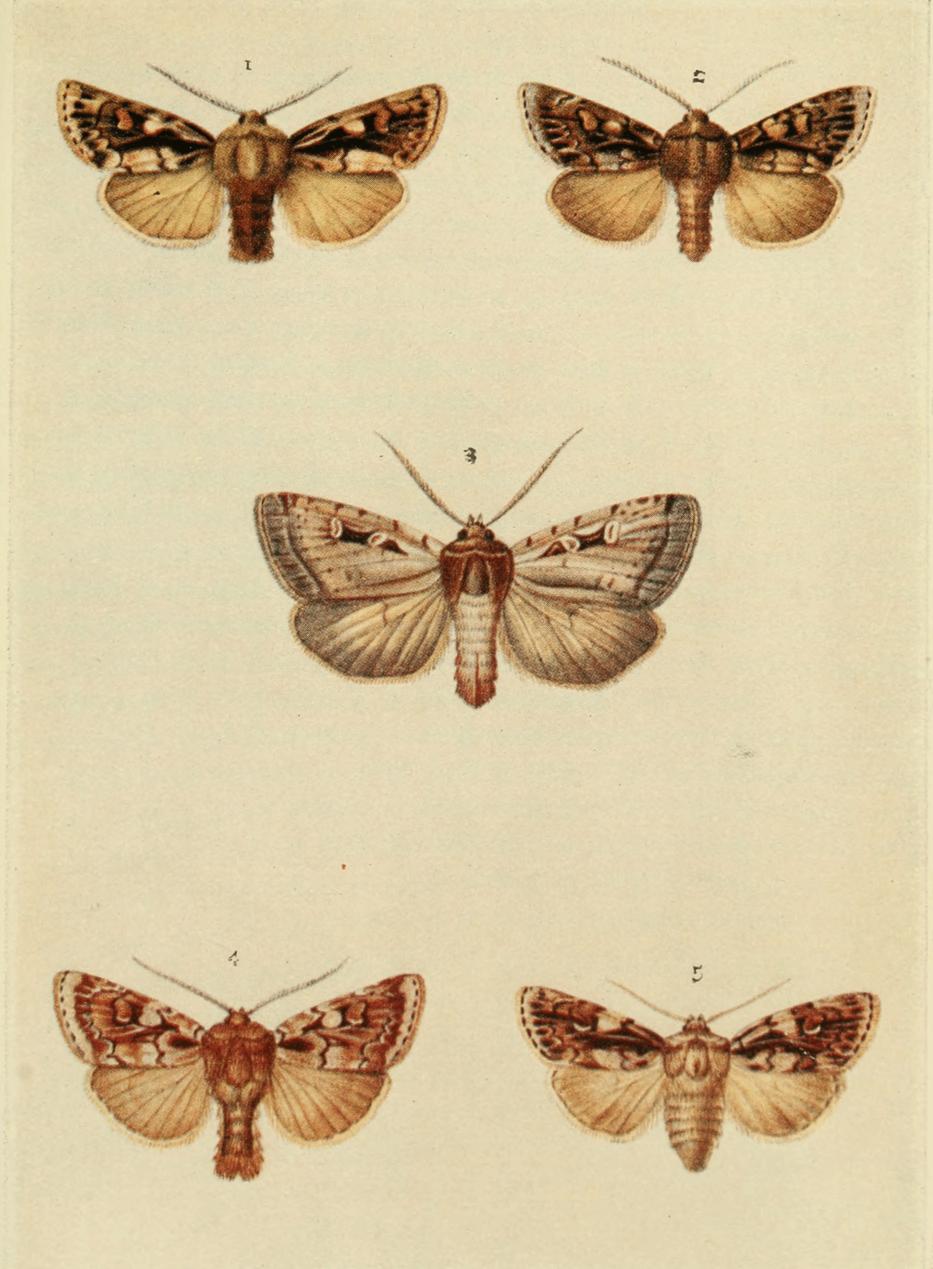
Pl. 108.
1, 2, 4, 5.Northern Dart.
3.Rosy Marsh Moth.
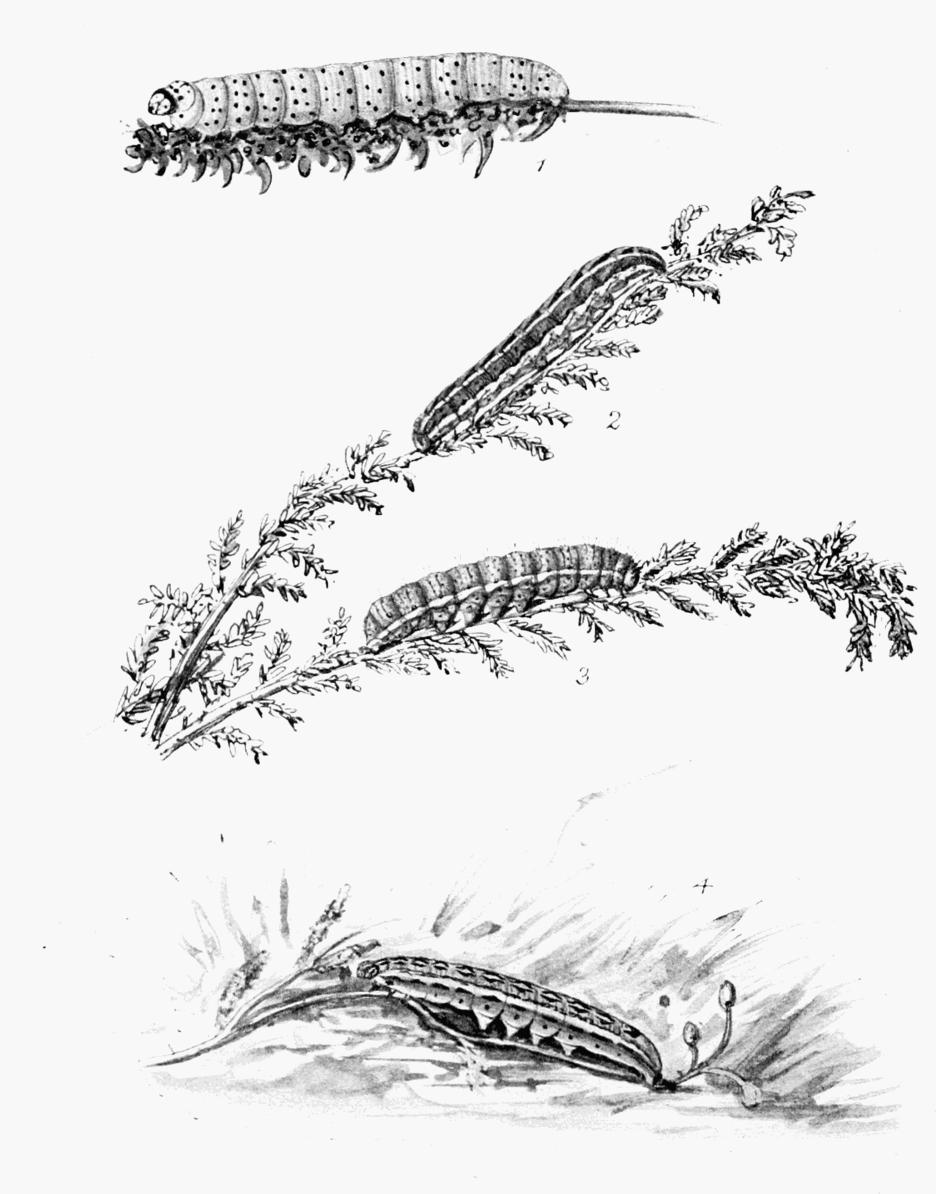
Pl. 109.
1.Heart and Club: caterpillar. 2.Heath Rustic: caterpillar.
3.Neglected Rustic: caterpillar. 4.True-lover's Knot: caterpillar.
The caterpillar is brownish with darker pear-shaped marks on the back; lines dark edged; spiracles black and of large size. Head pale marked with brown. It feeds from July to May on various low herbage, including lettuce, chickweed, plantain, and goose-foot; also turnips.
The moth flies in June and July (sometimes in September), and is generally common; but in Scotland it does not appear to extend north of Moray and Argyle.
The Dark Sword Grass (Agrotis ypsilon).
The sexes of this moth are represented on Plate 104, Figs. 7 ♂ and 8 ♀. In occasional specimens of the male the ground colour of the fore wings is rather pale brown; otherwise there is little variation to note. The caterpillar feeds from April to July on roots and leaves of cabbage, lettuce, goose-foot, and many low plants; also on swedes, mangold wurzel, etc. It is purplish or bronzy brown above and somewhat greener on the sides; the usual spots are blackish and the lines greyish edged with darker. Head black with two white spots. The moth is on the wing from July to September, and as it is sometimes seen in April and May and earlier, it is said to have probably hibernated. Possibly, however, such early specimens, found at least once in February, are immigrants. Sometimes the species is common and at others rare. It has occurred at one time or other almost everywhere in the British Isles, but it seems to be most regularly obtained in England and in Ireland. Abroad its range extends through Europe, Asia, and North America, and also to Australia, and Honolulu.
The Sand Dart (Agrotis (Lycophotia) ripæ).
This species varies a good deal in the ground colour of the fore wings. According to Barrett it ranges from pure white through pale reddish, rich reddish (var. desillii, Pierret) reddish drab, yellowish drab, and various shades of pale brown to brownish grey, and the markings to all degrees of distinctness or obliteration, especially the latter. The two specimens on Plate 106 have the markings fairly well defined (Fig. 1 is a male, and Fig. 2 a female).
The caterpillar is ochreous grey, whitish tinged with pink, or greenish; the lines and spots are greyish, and the spiracles large and black; head and plate on first ring ochreous brown. It feeds on saltwort (Salsola), sea rocket (Cakile), seablite (Suæda), sea holly (Eryngium), and various other plants that flourish on sandy shores. It is usually full grown in late autumn, when it goes down some depth into the sand, but does not pupate until the spring. If the caterpillars are not full fed when obtained they must be furnished with plenty of sand to burrow in, and kept supplied with slices of carrot until it is seen that the last put in remains untouched.
The moth flies in June and July, and may be found on the coasts of Lincolnshire, Norfolk, Suffolk, Essex, Kent (Deal), Isle of Wight, Dorset, Devon (Dawlish and Torquay), Somersetshire, South Wales, Cheshire, Lancashire, and the Isle of Man. Rare in Scotland and in Ireland.
The True Lover's Knot (Agrotis (Lycophotia) strigula).
The white marked reddish moth (Plate 107, Fig. 1) frequents most of the moorlands and heath and ling-clad heaths and commons throughout the British Isles. It varies in the tint of the reddish colour, and in the greater and lesser prominence of the white markings. Specimens from Scotland, especially from the Shetland Isles, are generally larger than English examples, and are often clouded with darker tints. The caterpillar, which is figured on Plate 109, Fig. 4, is reddish brown with a pale line along the middle of the back edged with dark brown or blackish marks on each side; a whitish or pinkish white stripe along the sides with a brown edging above. Head ochreous brown, marked with darker. It feeds on heath and heather, and hides by day in the moss or among dead leaves, etc., below the food plant, August to May. The moth flies, sometimes by day, but usually at night, in June, July, and in late seasons in August.
The Portland Moth (Agrotis (Lycophotia) præcox).
The pretty greenish moth with black cross lines, white spots, and reddish-brown clouding on the outer area (Plate 107, Fig. 4), is said to have been first reared in this country by the Duchess of Portland, early in the nineteenth century, hence the English name. Although occasionally found several miles from the sea, it is essentially a coast species, and may be obtained on the sandhills of Dorsetshire, Devon, Suffolk, Norfolk, Cheshire, Lancashire, Yorkshire, and the Isle of Man. Odd specimens occasionally occur inland, as for example at Kendal (1899), and in Worcestershire (1901 and 1903). In Scotland it is found in suitable places along the west coast, from the Firth of Clyde to Sutherland, and on the east to Moray; and it is widely spread on the coasts of Ireland. The caterpillar is slaty grey; central line on the back whitish or pale greyish, expanding on each ring and so forming a series of connected spots, edged with darker tint; then a whitish stripe, edged above by a slender black line; a whitish or bluish grey stripe along the black spiracles. Head pale brown, obscurely marked with darker. It feeds from September to June on dwarf sallow, grasses, chickweed, wormwood, etc. The moth flies in August.
The Pearly Underwing (Agrotis (Lycophotia) saucia).
Two specimens, both males, are represented on Plate 104. Fig. 10 is more or less typical and Fig. 9 is referable to var. margaritosa, Haworth; both occur together wherever the species is found, but the typical form is generally the most frequent.
The caterpillar, which tapers slightly towards the head, is reddish grey or brown above and paler on the sides; a line along the middle of the back is yellowish and edged with dark brown dashes; the line along the greyish ringed black spiracles is pale and edged above with black; a yellowish blotch on the last ring and a black bar on ring eleven; head pale brown or greyish brown marked with black. It feeds on most low plants; also on cabbage and rape. It occurs in June and July, and in a second generation in September, October, and sometimes November. From eggs laid in September the caterpillar hatched in from five days to a fortnight and moths resulted from these about six weeks later.
Although it certainly does occur in May and June sometimes, the moth is very much more frequently seen in autumn. On the south coast, extending to Cornwall and the Scilly Isles, the species is possibly a resident. In other parts of the British Isles its occurrence is more or less casual, and, although common in some years in other southern, and also eastern and northern counties, it does not seem to be permanently established therein. No doubt its more general distribution, and abundance here and there, in certain years, is due to the arrival of immigrants, either in small numbers in the spring, or in swarms later on in the year.
The distribution abroad includes Central, Western, and Southern Europe; Asia Minor; Northern Africa, Canaries, and Madeira; North America.
The Northern Rustic (Agrotis (Episilia) lucernea).
The specimens of this locally variable species shown on Plate 107 are from Scotland (Fig. 9 ♂), var. renigera, Stephens, and North Wales (Fig. 10 ♀). Barrett (Brit. Lep., vol. 3), discussing the variation, remarks, "On the south coast of England, and especially at Portland, the general tint is pale smoky grey, much darker towards the hind margin, and with the markings moderately distinct; inland mountainous districts, especially in North Wales, produce a still paler form; coast districts in the west and north a decidedly darker; and in the far west, as in Kerry, some specimens are actually slate-black, without more than the faintest trace of markings. The Isle of Wight produces deep slate-coloured specimens, darker than those from the Isle of Man, which are grey brown. Shetland specimens are large and dark, even to glossy blue-black." The caterpillar is dusky olive green, mottled all over with small black streaks and dapplings; each segment of the body having a faintly indicated pale olive-green spot on each subdorsal region, below which, on each side, is an oblique shading of blackish green. Head shining black-brown, rather lighter brown at the sides (Barrett). It feeds on harebell (Campanula), stonecrop (Sedum acre), saxifrage, cowslip, chickweed, and grasses, from August to May. The moth flies in July and August, and in the north and west in September. It occurs in rough stony places, on rocky places on the coast, and on hills inland, in Kent (Folkestone district), Isle of Wight, Dorset, Devon, Cornwall, Gloucestershire (rare), Sussex, Shropshire, Wales, Lancashire (rare), Yorkshire, and Westmoreland. It is widely distributed in Scotland and Ireland.
The Dotted Rustic (Agrotis (Episilia) simulans).
The sexes of this local moth are figured on Plate 107. Fig. 7 represents a male from Aberdeen, and Fig. 8 a female from Dorsetshire. The latter is of a pale brown colour on the fore wings, and this is somewhat unusual, as the prevailing colour of specimens from the Dorset coast is greyish brown.