PART II. (continued 7)
Reading edition
The Anomalous (Stilbia anomala).
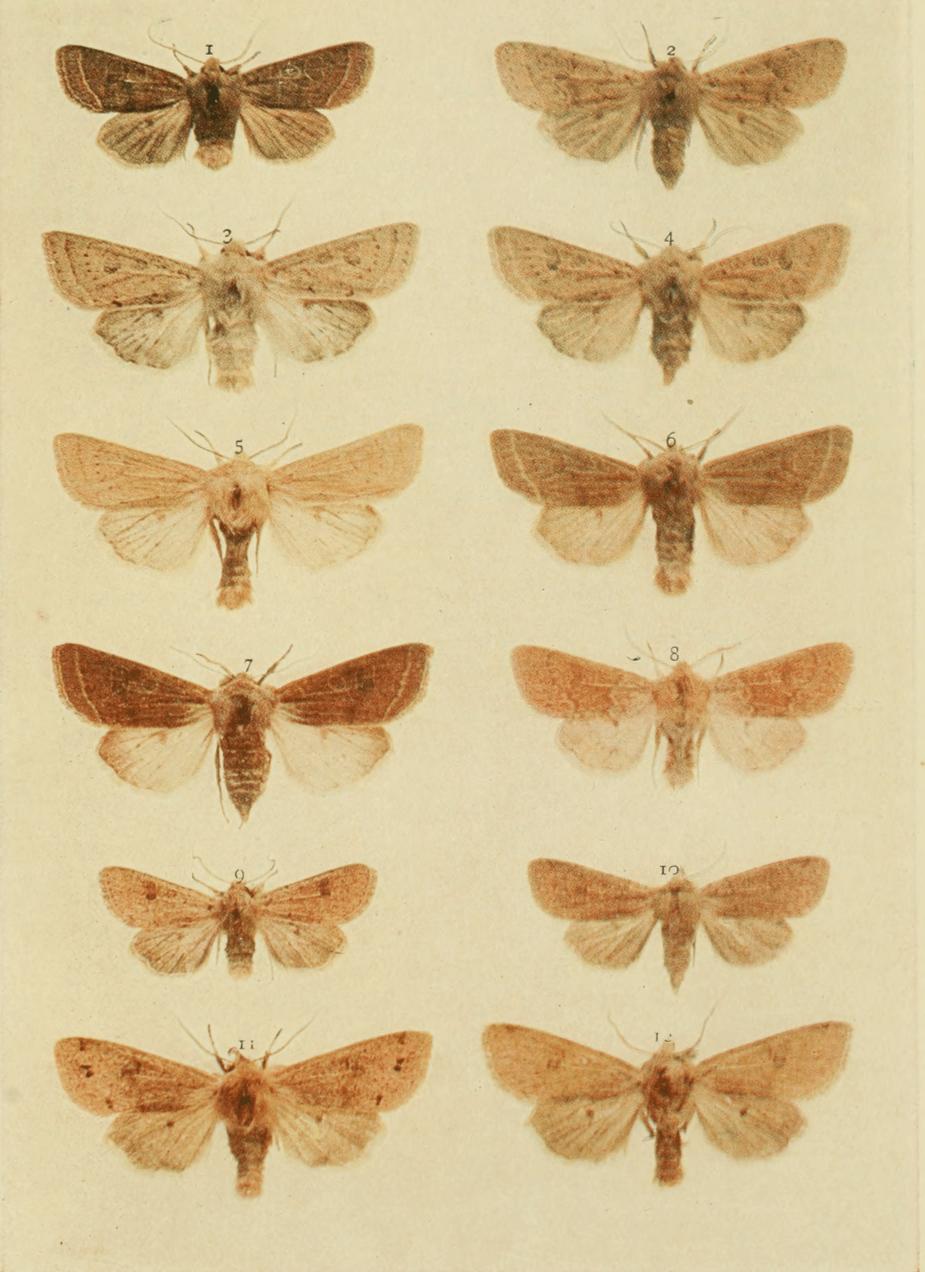
A local species, but sometimes not uncommon on heaths, or in rocky places by the sea. It is found from Surrey westward to Cornwall; and from Staffordshire, in which county it has been seen in abundance on Cannock Chase, it ranges into Derbyshire, Nottinghamshire, Cheshire, Wales (North and South), Lancashire, Yorkshire (commonly at Saltaire), Durham (once), and Cumberland. Generally distributed in Scotland, including the Orkneys. It occurs in the Isle of Man, and seems to be pretty widely spread in Ireland, but found chiefly on the coast. Abroad it seems to be only found in France and in Central and Western Germany. In Southern Spain it is represented by var. andalusiaca, Staud., and in Syria by var. syriaca, Staud. A typical male is shown on Plate 151, Fig. 4.
The caterpillar is green, inclining to yellowish between the rings of the body; three lines on the back are whitish, edged with dark green; a stripe low down on the sides is whitish, shaded above with dark green merging into the ground colour; head shining bright green, obscurely mottled with darker. In other forms the general colour is reddish or pinkish brown, with the lines edged and shaded with darker brown; the head is ochreous brown, mottled with darker brown. The green form is figured on Plate 152, Fig. 6, but the browner forms are more frequent. It feeds on grasses from the autumn until about March.
The Mottled Rustic (Caradrina morpheus).
A specimen of this species is shown on Plate 151, Fig. 5. There is some variation in the darker mottling and suffusion of the ochreous or pale brown fore wings. The dark brown or blackish stigmata are generally distinct. Hind wings whitish, tinged with smoky on the veins, and in the female on the outer marginal area. The caterpillar is brownish or greyish brown, inclining to ochreous on the back; central line whitish, with a broken edging of brown; on each side of the central line there is a series of blackish arrow heads; spiracles blackish; head dark brown, and very glossy. It feeds from August and through the autumn on various low plants, including goose-foot, knot-grass, dandelion, etc. The moth flies from June to August, and occasionally there is a second flight in October. The species is generally distributed and often common over the greater part of England, but is less frequent in the more northern counties, and in Wales, Ireland, and Scotland. Abroad the range extends to Amurland and Corea.
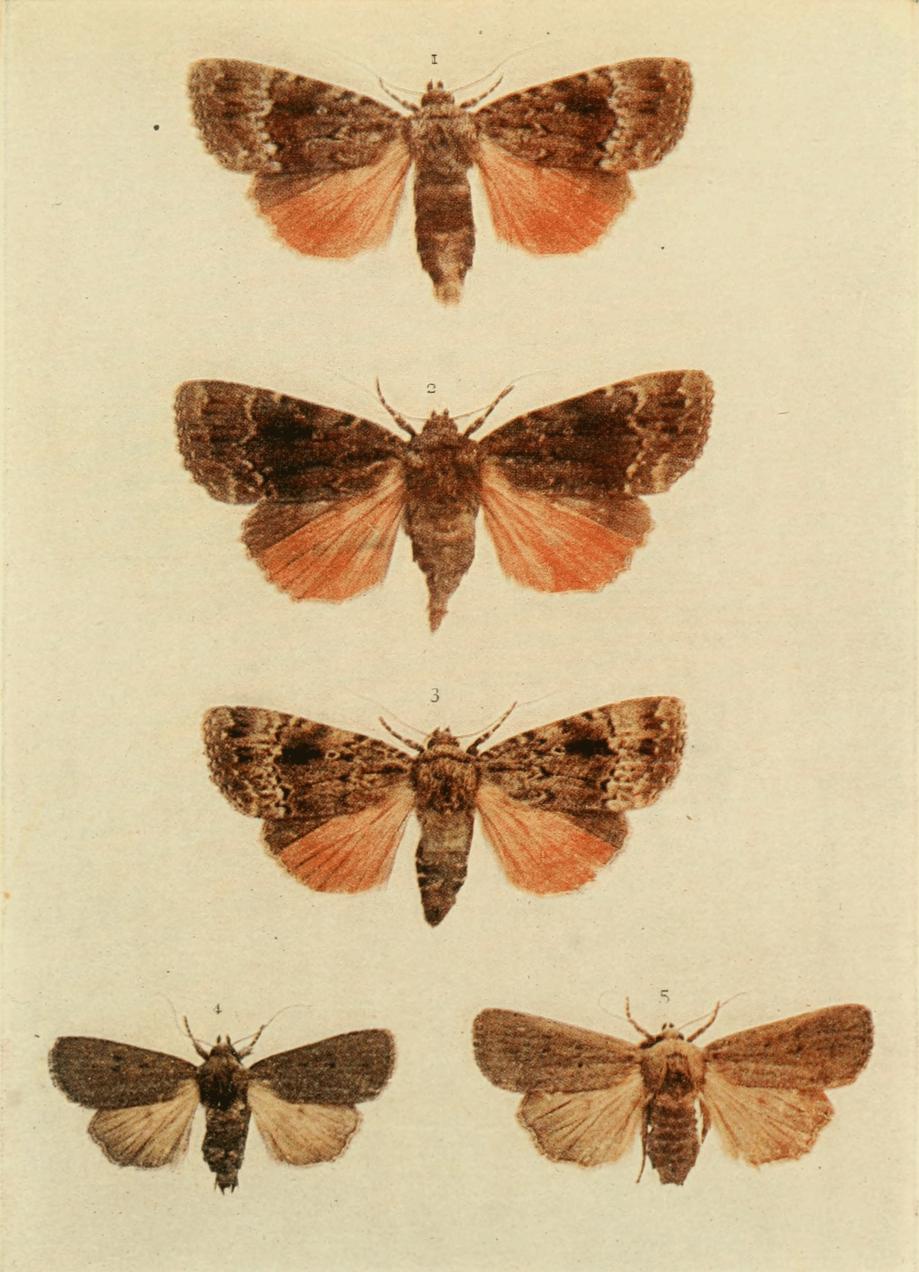
Pl. 154.
1, 2, 3.Copper Underwing Moth.
4, 5.Mouse Moth.
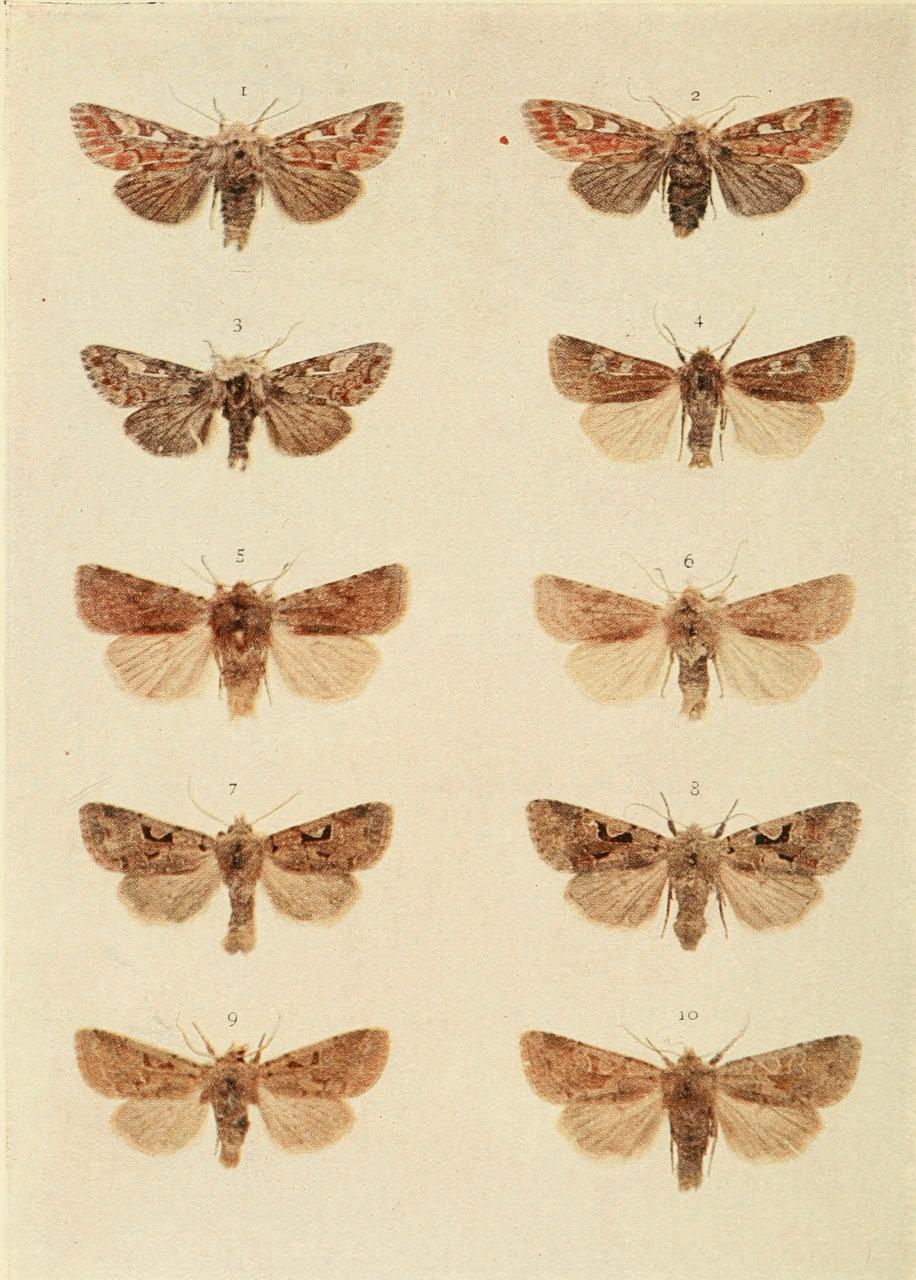
Pl. 155.
1, 2, 3.Pine Beauty Moth. 4.White-marked Moth.
5, 6.Red Chestnut Moth. 7, 8.Hebrew Character Moth.
9, 10. Hebrew Character Moth, var. gothicina.
The Uncertain (Caradrina alsines).
This species (Plate 151, Fig. 6) and the next one—The Rustic—are often confused, but the present one may be recognized by the more ochreous tinge of its fore wings, the more distinct markings, and the general rougher appearance of all the wings. The hind wings are more smoky, or sometimes brownish tinged.
The caterpillar is ochreous brown, frequently with a reddish tinge; three whitish lines on the back, edged with black, the edging of the central one interrupted at the ring divisions; a dusky area along the sides is edged above and below by a black line; head ochreous brown. It feeds from September to March on dock, chickweed, primrose, and various other low plants. The moth flies in July and August, and, like most of its congeners, is partial to the blossoms of privet. The species is widely distributed over England, but seems to occur more commonly in the south and east. It is also found in Wales, Scotland, and Ireland.
Note.—C. superstes, an inhabitant of Central and Southern Germany, Hungary, Southern Europe, and Asia Minor, has been mentioned as British, but the record needs confirmation.
The Rustic (Caradrina taraxaci).
Compared with the last species, the one now considered (Plate 151, Fig. 7) has browner fore wings, inclining to brownish or blackish, smoother and glossy; and the markings are usually rather obscure. The hind wings are silky, and whiter in the male.
The caterpillar is greyish brown, with an olive tinge; central line dark brown, expanding on each ring; on either side of this is a brown-edged white line; a light brown line along the spiracles; head ochreous brown. It feeds from September to April on low plants, such as dock, chickweed, plantain, etc. The moth flies from late June to early August, and its range in the British Isles is pretty much as in the last species, but more generally distributed than alsines in Ireland.
Vine's Rustic (Caradrina ambigua).
The fore wings of this species (Plate 151, Fig. 8) are rather greyer than those of the last, and the hind wings are shining white, tinged with greyish brown in the female, especially on the veins.
Barrett describes the caterpillar as follows: "Plump, cylindrical; head round, the lobes dark brown, but the face paler; dorsal region between the subdorsal lines broadly yellowish brown, with slender, delicate, oblique lines on each segment; dorsal line a row of black dots, one on each segment; lateral space from the subdorsal lines to the spiracles darker brown or umberous, containing a row of ovate, oblique, yellowish spots, each rather raised into a knob by the wrinkling of the skin; spiracles black; under surface, legs, and prolegs pale rosy brown, except the anal prolegs, which are brown." It feeds from October to May on dandelion, plantain, chickweed, and other low plants; also on lettuce and grass. The moth flies in August and September. Sometimes the caterpillars will feed up and attain the moth state the same year in November or December. The species was not known to occur in England until some specimens were taken by Mr. Vine at sugar, near Shoreham, Sussex, in 1879. Since that year it has been taken more or less freely at several places on the south and south-west coast, from Deal, in Kent, to Truro, in Cornwall.
The Pale Mottled Willow (Caradrina quadripunctata).
The black spots on the front margin of the fore wings of this species (Plate 151, Figs. 9, 10) are pretty constant characters, and are usually present even when most or all the other markings are absent. The caterpillar is greyish brown, often tinged with green above; the lines are faintly paler, and edged with darker; head blackish. It feeds from September to May on grasses, seeds of plantain; also on peas and corn; often common in stacks of wheat and other grain.
The moth flies chiefly in July and August, but it is sometimes seen as early as May and as late as October. Generally distributed, and often very common. Except that it does not occur in America the range abroad is almost as extensive as that of the next species.
Small Mottled Willow (Laphygma (Caradrina) exigua).
This species (Plate 151, Fig. 11) practically ranges over the globe. It is the "Beet Army-worm" of American economic entomologists; whilst in South Africa it is known in the early stage as "The Pigweed Caterpillar." In Asia, and especially in India, where it is destructive to the indigo plants, maize, etc., it is a familiar pest, but does not seem to bear a common name. As regards our own country, it was apparently unnoticed until somewhere about the middle of the last century, when a specimen was captured in the Isle of Wight. Its occurrence here is always considered a noteworthy event, but the records are very scanty except for the years 1896, 1897, 1900-03, and 1906. In the latter year there seems to have been an invasion on quite a large scale, and captures in some localities on the south and south-west coasts must have been in hundreds, whilst the species was also taken in fewer numbers in Essex, Surrey, Wiltshire, Somerset, Devon, and South Wales. A specimen occurred at Crosby, Lancs., in 1884. In 1903 one example was taken at Chester, Cheshire. At Keighley, Yorks, eight were secured, which, added to three taken in other years, gives a total of eleven specimens for the county. In Ireland one example was obtained at honeydew, September, 1899, at Timologue, Co. Cork.
The eggs (Plate 152, Fig. 7a) are laid in batches on a leaf, and more or less covered with whitish hairs. Some deposited on Sept. 8, 1906, hatched on the 20th of that month. When just hatched the caterpillar is greenish, paler on the last rings; head and plate on first ring shining black; when a week old a black plate appears on the last ring also. Later on the colour varies from green to olive green, brownish, and dark greyish. Green examples are figured on Plate 152, Fig. 7. The central line is ochreous, and there are series of black bars and blackish marks on the back; along the black-edged white spiracles is a pinkish brown band, edged above by an interrupted black line; the pinkish brown colour runs up the front part of each ring four to eleven; head blackish. The caterpillars were fed upon plantain, dandelion, and groundsel, but they would eat the foliage of any weed that was put in their cage. They formed fairly tough earthen cocoons on, or just below, the surface; but, although they pupated, the moths failed to emerge, probably because they were kept too dry. The ochreous or pinkish brown colour of the orbicular stigma, and sometimes of the reniform, distinguishes this moth; the hind wings are white with a very distinct pearly gloss.
The Small Dotted Buff (Petilampa arcuosa).
This pale whity-brown insect (Plate 134, Figs. 19 to 21) is often without markings, and where these are present on the fore wings they comprise two series of dusky dots representing two cross lines, and sometimes there is a dot at the end of the cell. These wings may be shaded with brown, and occasionally there is a dark band-like shade between the series of dots, in the male as well as in the smaller and narrower-winged female. Var. morrisii, Dale, seems to be a whiter form of this species. The caterpillar, which may be found in May and June in the flower stems of Aira cæspitosa, is of a pale pinkish ochreous with three darker bars on each ring, and a brown, glossy head. The moth flies in July and part of August, and may be found, often in abundance, in most English and Welsh counties, in Scotland to Aberdeenshire; and widely spread in Ireland.
The Reddish Buff (Acosmetia caliginosa).
Both sexes of this reddish tinged grey-brown species are shown on Plate 153, Figs. 1 ♂, 3 ♀. As will be noted, the female is much smaller than the male. Except that it has been recorded from the Isle of Wight and from Bloxworth, Dorset, in the past, this species is restricted to certain portions of the New Forest, Hampshire. Even in these favoured haunts its numbers have become far less than formerly. The moth is out in July. Apparently it has no taste for sugar, neither does it seem to visit blossoms of any kind. It may be disturbed from its retreat among the grass by day, or netted as it flies at dusk. The caterpillar is stated by Hofmann to live on saw-wort (Serratula tinctoria); it is sap-green, yellow at the ring divisions, and marked with fine white lines.
The Marsh Moth (Hydrilla palustris).
The fore wings of the male of this species (Plate 153, Fig. 2) are greyish brown in colour, and more or less tinged with violet; the cross lines are dusky, and the reniform and orbicular stigmata are represented by black dots, the former the larger; hind wings whitish with a smoky tinge. The female is much smaller, darker, and the cross lines heavier; hind wings blackish grey.
Stainton ("Manual," 1857) refers to a specimen taken at Compton's Wood, near York, and this, no doubt, is the same as that stated by Barrett to have been captured in a moist place at Stockton-in-the-Forest, about four miles from York, certainly before the year 1855. Then there is a record of a specimen from Quy Fen, Cambridgeshire, in May, 1862. Seven years later the late Mr. C. G. Barrett took a specimen as it fluttered about a gas-lamp outside Norwich. In 1877 and 1878 the use of bright collecting lanterns in Wicken Fen may have led to the capture of nearly twenty Marsh Moths, anyway it seems to have been a record for the time.
Very few specimens were taken in the fens between the year last mentioned and 1898, when the total secured by several collectors visiting the fens in June of that year amounted to something like fifty examples, all males. Two female specimens were captured in the Carlisle district, one in 1896, and the other in 1897. No male was noted in that locality until 1899, when a specimen was netted as it flew along a hedgeside at night, on May 20. Two other males have since been taken there, in much the same way. The life history of the species is little known. Hofmann describes the caterpillar as reddish brown with white dots, and a white line along the middle of the back; spiracles and head black. It feeds in the summer on low-growing plants in meadows, and hides in the daytime on the underside of a leaf.
The range of the species abroad extends to Siberia and Amurland.
The Brown Rustic (Rusina tenebrosa).
Here, again, the female is smaller than the male, as will be seen on Plate 153, Figs. 4 ♂, 5 ♀. Sometimes the general colour of the fore wings is of a blacker tint, and in such specimens the fine black cross lines are obscured.
The caterpillar is dark cinnamon brown; three whitish lines on the back, the central one, most distinct on the front rings, is edged on each side with dark brown, and the shading of the outer lines is interrupted by oblique pale dashes; head, shining dark brown, almost blackish. It feeds on grasses, and many low-growing plants from August to May. (Plate 152, Fig. 4.) The moth flies in June and July, sometimes earlier. The species is generally distributed over nearly the whole of England, but more local in the north than in the south. It is found in North and South Wales. In Scotland it is locally abundant and widely distributed up to Ross, and occurs in the Hebrides. It is also widely spread in Ireland, and common in some parts.
Umbratica, Goeze, is said to be an earlier name for this species, and will probably have to be adopted.
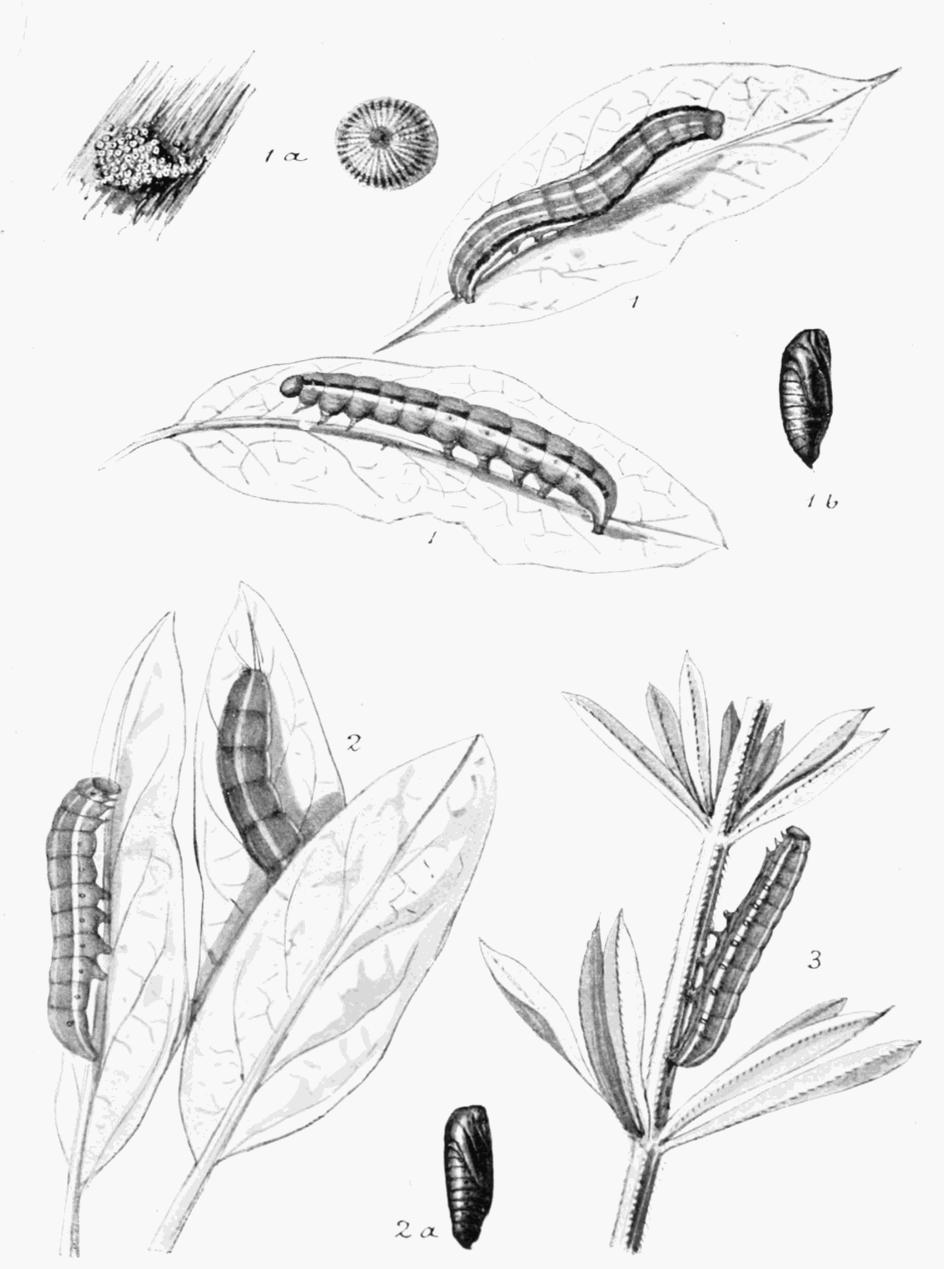
Pl. 156.
1, 1a, 1b.Hebrew Character: eggs, caterpillars and chrysalis.
2, 2a.Clouded Drab: caterpillars and chrysalis.
3.Mouse Moth: caterpillar.
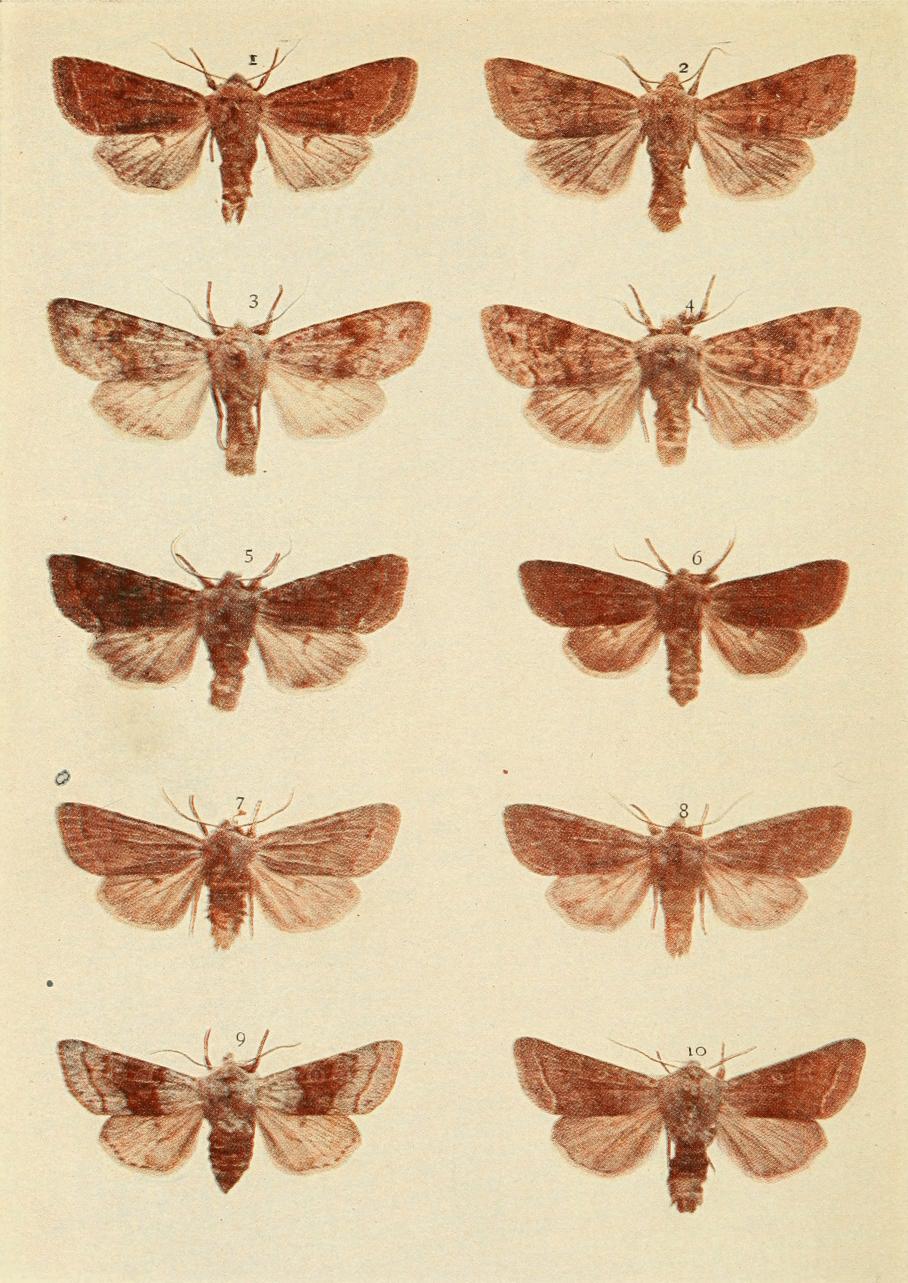
Pl. 157.
1-6.Clouded Drab Moth.
7, 8.Lead-coloured Drab Moth.
9, 10.Northern Drab.
The Copper Underwing (Amphipyra pyramidea).
The striking species shown on Plate 154, Figs. 1 to 3, varies somewhat in the tint of its brown-coloured fore wings, and in the greater or lesser amount of blackish shading on the central area; the latter is sometimes quite absent, and not infrequently the outer marginal area is pale ochreous brown. The hind wings, normally of a coppery colour, are occasionally paler, and sometimes of a reddish hue.
The caterpillar is green with three interrupted whitish stripes on the back; the dots are yellowish; and the stripe along the black-edged white spiracles is whitish; the back of ring eleven is raised, forming a cone, the apex of which is hornlike and slightly curved backwards; the head is green. It feeds from April, or in forward seasons from March, to June, on the foliage of oak, birch, sallow, plum, rose, and other trees and shrubs. The moth flies from late July to September, and sometimes later. Although somewhat local in Southern England, it is often common enough in the New Forest, and most of the larger woods from Essex to Devonshire. Northwards from Oxfordshire it becomes more local, less frequent, and even rare, except, perhaps, in Worcestershire (Malvern district, common) and Herefordshire. Apparently not recorded from Scotland. In Ireland it is sometimes plentiful in the south, but does not seem to occur north of Sligo on the west, and Howth on the east.
The Mouse (Amphipyra tragopogonis).
The English name of this generally distributed, and usually common, greyish-brown moth (Plate 154, Figs. 4, 5) applies more especially to the mouse-like way it scuttles off when discovered in its retreat by the collector. In colour, however, it is sometimes not unlike the familiar little rodent. The caterpillar (Plate 156, Fig. 3) is green with white lines and stripes along the back and sides; spiracles white, margined with black; head yellowish-green. In another form the ground colour is pale reddish brown. It feeds from April to June on sallow, hawthorn, and many other plants. Barrett states that it is partial to the blossoms, particularly yellow ones, of garden as well as wild plants. The moth flies in July and August, sometimes later.
The range abroad extends to Central Asia and to the Atlantic States of America.
Note.—Some recent authors refer this and the preceding species to Pyrophila, Hübn.
The Pine Beauty (Panolis griseo-variegata = piniperda).
The general colour of the fore wings of this species (Plate 155, Figs. 1, 3 ♂, 2 ♀) is ochreous brown, more or less reddish tinged; sometimes greenish grey. The cross markings are bright or dull reddish brown; the orbicular and reniform stigmata are white, or outlined in white, sometimes connected by a white line along the median nervure; occasionally these marks are united, forming a blotch.
The caterpillar is green with three broad white lines along the back, the outer ones edged above with black; a yellow, inclining to reddish orange, stripe along the black spiracles; head reddish brown. It greatly resembles the needles of the Scotch fir (Pinus sylvestris), upon which it feeds from May to July. The moth is out in the spring and continues on the wing until early May, and is often common at sallow bloom, where this occurs in the immediate vicinity of pine woods; it also comes to the sugar patch not infrequently, and may occasionally be seen on the trunks of fir trees, or beaten from the boughs. The species seems to occur wherever there are fir woods or plantations throughout England, Wales, and Scotland to Ross, and is found locally in Ireland.
The White-Marked (Pachnobia leucographa).
A portrait of this moth will be found on Plate 155, Fig. 4. The fore wings are reddish brown, sometimes tinged with purplish, or clouded with blackish. The reniform and orbicular stigmata are usually yellowish grey, often only outlined, but not infrequently indistinct, and sometimes absent. The cross lines are rarely well defined, although the second line may be indicated by blackish dots flanked by whitish ones on the veins.
The caterpillar is green freckled with whitish; three whitish lines along the back are edged with dark green, the outer ones with oblique dark-green dashes spreading to the central line; head paler green. In another form the general colour is pale reddish brown, lines yellowish, and dashes darker reddish brown. It feeds on sallow, bilberry, dock, plantain, and other low plants. May and June. The moth flies in March and April, and may be found at sallow bloom around woods. The species is obtained more or less frequently in Kent, Surrey, Sussex, Hampshire, Somerset, and Devon; also in Buckinghamshire and in Suffolk. In Herefordshire it is local but not uncommon, and I have taken it in the Malvern district. British specimens were first obtained near York. Porritt ("List of Yorks. Lep.," 1904) states that it is still abundant in Bishop's Wood, and is found in other Yorkshire localities; also occurs from Lancashire to Durham. In Ireland it has been reported from Clonbrock, Galway.
The Red Chestnut (Pachnobia rubricosa).
The fore wings of this moth (Plate 155, Figs. 5, 6) are purplish red and more or less suffused with greyish. Sometimes these wings are more distinctly reddish and without the greyish suffusion (var. rufa, Haw.). The egg is pale straw colour, with a reddish-brown girdled dot. The caterpillar (Plate 159, Fig. 3) is pinkish brown with three yellowish lines along the back, the central one rather obscure; a yellowish stripe along the sides; usual dots yellowish or whitish margined with blackish; head yellowish brown, lined with darker brown. It feeds from April to June on dock, dandelion, groundsel, and other low plants. The moth is out in March and April, and is often not uncommon at sallow and plum blossom. It seems to be pretty generally distributed throughout the British Isles, including the Orkneys.
The Hebrew Character (Tæniocampa gothica).
This species (Plate 155) varies in the general colour of the fore wings from pale purplish grey to dark reddish brown. Figs. 7♂ and 8♀ represent the more usual form. The black markings, often very conspicuous, are in the somewhat smaller var. gothicina, reddish (Fig. 9). Sometimes in Scotch specimens they are very indistinct or absent (Fig. 10).
The early stages are figured on Plate 156. The eggs (Fig. 1a) are laid in a batch, two deep towards the centre of the heap. In colour they are whitish with a dark grey ring and dot. When five days old the young caterpillars were pale whitish green with black dots; head and plates on first and last rings of the body black. The nearly full-grown caterpillar (Fig. 1) is green above and yellowish green below; three whitish lines on the back and a yellowish stripe along the sides; usual dots black, ringed with whitish; head shining yellowish, dotted with black. Feeding on dock, dandelion, etc., it will also eat sallow and hawthorn, and the foliage of other trees and bushes, in April, May, and June. The moth is common at sallow bloom all over the British Isles. The range of the species abroad extends to Amurland.
The Blossom Underwing (Tæniocampa miniosa).
A portrait of this species will be found on Plate 158, Fig. 8. The fore wings are pinkish, or reddish grey, and the redder central area is often tinged with orange; the hind wings are whitish, faintly shaded or tinged with pink.
The full-grown caterpillar is bluish, inclining to black on the sides; three yellow lines on the back, the central one broad; and a white blotched yellow stripe along the sides; head shining black. (Adapted from Fenn.) The eggs are laid in batches on the twigs of oak, usually just below a bud. When the caterpillars hatch out they spin a web of silk under which they live in company for a time; later on they separate, and then either continue to feed on the oak or betake themselves to birch, hawthorn, bramble, or some low-growing herbaceous plant. The "nests" of young caterpillars are found chiefly on oak bushes rather than trees.
The moth flies in March and April, and generally occurs only in oak woods. It is most frequently met with in the South of England—from Middlesex and Essex to Hampshire; but it occurs in most of the southern counties, and also northwards up to Yorkshire. It has been found in Wales (Pembroke and Dolgelly), and appears to be rare in Ireland, except at Glenmalure, Co. Wicklow.
The Small Quaker (Tæniocampa pulverulenta).
Most specimens of this species (Plate 158, Figs. 9♂, 10♀) have the fore wings pale greyish ochreous, more or less mottled or dusted with reddish brown. Occasionally these wings are pale grey (var. nana, Haworth); or dark grey brown and more rarely blackish. The dingy brownish dots representing the first and second cross lines are sometimes distinct and not infrequently absent.
The egg is whitish with brown girdled dot.
The caterpillar is greenish grey and rather greener between the rings; there are five yellow or whitish lines, that along the centre of the back being the broadest, usual dots black and glossy; head greenish, much marked with black: plates on first and last rings of the body black. It feeds from April to June on oak, hawthorn, sallow, rose, etc. (Plate 159, Fig. 2.) The moth flies in March and April, and is a constant visitor to the sallow catkins, also to the blossoms of plum, damson, and sloe. It appears to be common throughout England and Wales; more or less frequent in Scotland to Moray; and is not uncommon in some districts of Wicklow and Galway, but local and rather scarce in other parts of Ireland.
The Common Quaker (Tæniocampa stabilis).
The ground colour of the fore wings of this species (Plate 158, Figs. 1, 2) ranges from whitish or pale grey brown through tints of reddish brown to dark brown; the stigmata are outlined in pale ochreous, the centres often darker than the general colour of the wings; the orbicular is of large size and frequently touches the reniform; the ochreous submarginal line is usually inwardly edged with, and sometimes obscured by, blackish; very often the submarginal line and the dusky central shade are the only distinct cross markings.
The caterpillar is green, minutely dotted with yellow; three lines on the back, and a stripe on the sides, yellow, the latter most distinct, edged above with black, and united by a yellow bar on the last ring. It feeds on oak, birch, sallow, beech, elm, etc., from April to June. The moth flies in March and April, and is generally common throughout the British Isles, except, perhaps, the islands of Scotland.
The Lead-coloured Drab (Tæniocampa populeti).
The ground colour of the species shown on Plate 157, Figs. 7, 8, is usually some shade of purplish grey, ranging from very pale to dark; the cross lines are often indistinct, but occasionally they show up clearly; the central shade, usually in evidence, is sometimes almost blackish and broadened out to the second line; the orbicular and reniform have pale margins but the centres are frequently no darker than the general colour.
The egg is greyish white with dark grey girdled dot.
When full grown the caterpillar is whitish or yellowish green, but always whitish on the back: three white lines on the back, the central one rather broad; head ochreous brown with a blackish spot on each side. It feeds from April to June on aspen chiefly, but also on other kinds of poplar, hiding by day between two leaves. The moth is out in March and April, and may be found on the sallow catkins. It seems to be more or less rare in the South of England, but it is locally not uncommon in many parts of the country from Middlesex northwards to Yorkshire. Farther north it is again infrequent, and this is also the case in Scotland and in Ireland.
The Clouded Drab (Tæniocampa incerta).
Six specimens of this most variable species are shown on Plate 157, Figs. 1 to 6. To refer in detail to all the forms, named or otherwise, would occupy much space, so that it can only be stated here that the general colour of the fore wings ranges from pale greyish brown, through various shades of reddish brown, to deep brown or purplish brown; the darker greys range through slaty grey to purplish black. In all the lighter shades the wings are usually much variegated, but they may be nearly or quite plain.
The egg is yellowish white with brown girdled dot.
The caterpillar is green, minutely freckled with whitish; three white lines on the back, the central one broadest; a white stripe, edged above with black, along the sides; usual dots black, minute, ringed with whitish; head yellowish green with a few black dots. It feeds on sallow, oak, hawthorn, also on apple, elm, etc. (Plate 156, Fig. 2.) The moth is generally to be found at sallow-bloom in almost every part of the British Isles.
The Twin-spotted Quaker (Tæniocampa munda).
The fore wings range in ground colour from very pale ochreous (typical) or pale greyish (var. pallida, Tutt), through reddish shades to a dingy brown. The black or brownish twin spots on the middle of the submarginal line are sometimes accompanied by others above and below them (var. geminatus). In var. immaculata, Staud., the "twin spots," and also the others, are absent. (Plate 158, Figs. 11, 12.)
The caterpillar (Plate 159, Fig. 1) is pale brown minutely freckled with darker; a whitish line along the centre of the back finely edged with black; a broad velvety black stripe along the sides, edged with whitish; head reddish brown, freckled with darker. It feeds from April to June on elm, oak, sallow, plum, etc. The moth is out in March and April, but a specimen has been taken at "ivy bloom" in the autumn. Plum blossoms, as well as the sallow catkins, are an attraction to this moth, and it will also visit the sugar patch. The species probably occurs in most woodland districts throughout the greater part of England and Wales. It seems to be found in South Scotland, but is local and infrequent; in Ireland it is widely spread in the north, but uncommon in the south.
Pl. 158.
1, 2.Common Quaker Moth. 3-7.Powdered Quaker.
8.Blossom Underwing. 9, 10.Small Quaker.
11, 12. Twin-spotted Quaker.
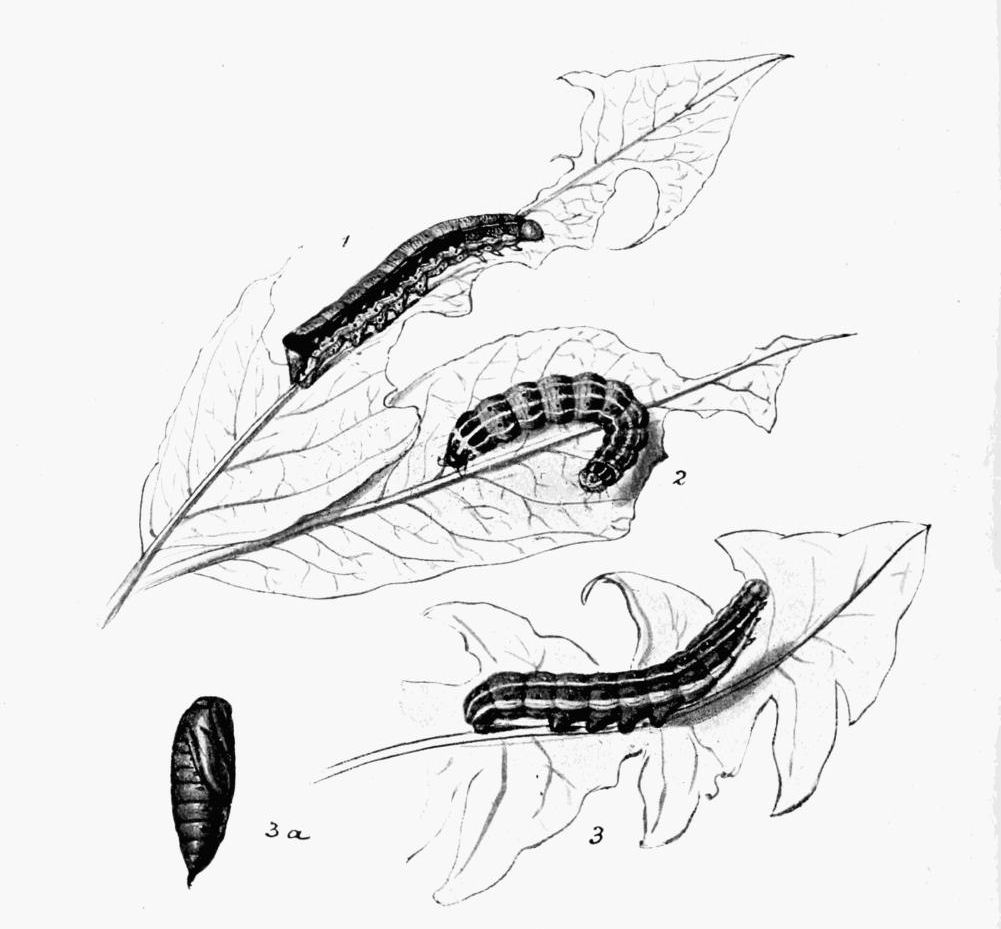
Pl. 159.
1.Twin-spotted Quaker: caterpillar.
2.Small Quaker: caterpillar.
3, 3a.Red Chestnut: caterpillar and chrysalis.
The Northern Drab (Tæniocampa opima).
The dark form (var. brunnea, Tutt) (Plate 157, Fig. 10 ♂) has the outlines of the orbicular and reniform stigmata, and the submarginal line pale and distinct; sometimes the general colour is much blacker than in the specimen shown. In the more typical greyish form (Fig. 9 ♀) the central area is blackish or dark reddish brown. The caterpillar is olive green above, inclining to yellowish beneath; three pale lines on the back, and a yellow stripe along the black-edged white spiracles; head olive green. It feeds from April to June on sallow, willow, birch, rose, etc. The moth flies in March and April.
As suggested by the English name, this moth was supposed to be confined to the northern counties from Cheshire to Cumberland and Northumberland, but it occurs more locally in Herefordshire, Worcestershire (Wyre Forest), Somerset, Gloucester, and Wales; also in Essex, Surrey, and Sussex. Renton records it from Roxburghshire in Scotland, and Kane states that it is local in Ireland.
The Powdered Quaker (Tæniocampa gracilis).
In the ordinary English form of this species (Plate 158, Figs. 3 ♂, 4 ♀) the fore wings are pale whity brown, more or less tinged with grey; the submarginal line, and the stigmata, are usually distinct, but the other cross lines are only indicated by blackish dots on the veins. In Ireland the specimens are creamy white and very often tinged with pink (Fig. 5), but in the New Forest, Hants (Fig. 7), and in the marshes of North Kent (Fig. 6), deep purplish grey, purplish brown, and reddish (var. rufescens, Cockerel) forms occur.
The caterpillar is green, sometimes tinged with yellowish or with bluish; usual spots whitish; three whitish or yellowish lines along the back and one along the sides, the latter shaded above with dark green or blackish; head ochreous brown. It feeds from May to July on meadow-sweet (Spiræa), fleabane (Inula), purple loosestrife (Lythrum salicaria), yellow loosestrife (Lysimachia vulgaris), sweet-gale, sallow, bramble, etc. The moth is out in April and May, and is often plentiful at damson and plum blossom, as well as sallow catkins. The species is widely distributed throughout the greater part of the British Isles, but is perhaps more generally common in the southern and eastern counties of England. The range abroad extends to Japan.
Peucephila essoni, Hampson.
Trans. Ent. Soc., Lond., 1909, Part IV., Pp. 461-463, Pl. xvi., Fig. 1, Dec. Entom., 1909, p. 258. See Appendix.
APPENDIX.
Page 28. Herse Convolvuli.—Reported from several English counties, August and September, 1911, and again in 1915. In 1917 the species seems to have been more widely spread over our islands, specimens being recorded from Ireland and Shetland.
Page 41. Phryxus Livornica.—Further records are: In July, 1909, a dead male specimen was found under an electric light standard at Exeter, and one was noted on a bowling green at Blackpool in October. Specimens were recorded from Surrey, Sussex, Hants, Devon, and Cornwall in 1911. On January 19, 1912, a male was taken from a shrub in a garden at Tavistock. Thirty-five were captured in South Cornwall between May 9 and 23 of the same year, and single specimens were reported from North Wales, Norfolk, Dorset, also in May.
Page 47. Daphnis Nerii.—Further records: Ilfracombe, September 22, 1909; Sydenham, September 24, 1910; Eastbourne (August 15), Ashford, 1911; Folkestone, August 30, 1916, on trunk of poplar tree; Littleover, Derbyshire, in a conservatory, August 18, 1917; Dovercourt, Essex, September, 1919.
Page 141. Nola Confusalis.—A grey form of this species, ab. columbina, Image, has been recorded from Epping Forest.
Page 146. Sarrothripa Revayana.—A number of forms of this species are named and described by Mr. Sheldon in the Entomologist for 1919.
Page 268. Luperina gueneei.—Over thirty years ago the late Mr. Baxter, of St. Anne's, Lancashire, sent me a specimen of Luperina that he had captured in his district. This I considered to be a form connecting gueneei with nickerlii, and that both were forms of L. testacea. Since that time gueneei has been found in some numbers on the Lancs. coast, and has been recognized as a distinct species, and its identity with nickerlii established.
The earlier published history of this species in Britain may here be quoted: "The late Mr. J. B. Hodgkinson, in a note on Luperina gueneei, published in the Entomologist for 1885, vol. 54, wrote:—'In 1860 or 1861, T. Porter (still living) brought me two fine specimens of a moth I did not know. They were of both sexes. I purchased them from him, and sent them on to the Rev. H. Burney, who forwarded them to Henry Doubleday. From him they went to Guenée, and he returned them with the remark that he had a specimen in his collection marked as a variety of L. testacea, but he was quite satisfied they represented a good species when he saw both sexes. H. Doubleday then named them after Guenée, as the latter was evidently the original captor. I saw Porter again, and he told me another man, by name H. Stephenson, had one. They took three in all near the ferry at Rhyl, North Wales. I sent Porter again, and went myself, but we failed to find more afterwards. I bought the specimen from Stephenson, and sent it to Miss Sulivan, of Fulham, where, I suppose, it remains. I think it was a female.'"
According to Barrett (British Lepidoptera, IV., p. 335), the three North Wales specimens "were raked from overhanging edges of sandhills."
Page 294. Hydrœcia crinanensis.
"Hydrœcia crinanensis, Burrows. Larger than H. nictitans. F.-w. slightly pointed at the apex, bright red-brown, longitudinal and transverse lines very distinct, fringes concolorous. Orbicular stigma, lighter than the ground colour. Reniform stigma orange, full, fairly straight edged inwardly, lower lobe projecting outwardly, interior lines faint. H.-w. red-brown, darker towards the outer margin; fringes yellow, the yellow colour intruding in dots upon the darker margin.
"Type specimen taken by Mr. A. W. Bacot at Crinan Canal, September, 1899."
The above is extracted from an instructive paper by the Rev. C. R. N. Burrows, entitled, "On the nictitans group of the genus Hydrœcia, Gn.," published in the Transactions of the Entomological Society, 1911, pp. 738-749, plates li.-lviii. In this paper specific rank is also claimed for lucens, Frr., and paludis, Tutt, both of which have been considered as merely forms of H. nictitans, L.
H. crinanensis has been recorded from Inveran, Crinan Canal, Aberfeldy, and Liddelbank, in Scotland; from Lough Foyle and Enniskillen, in Ireland; and from Bolton and Burnley, in England.
Page 298. Nonagria neurica.—In 1907, when the first edition of this volume was published, the fact of N. neurica being a British species was not truly ascertained. In the following year, however, some specimens of Nonagria, which were not identical with N. dissoluta, Treit. = arundineata, Schmidt, were named edelsteni, Tutt.
Quite a number of N. edelsteni were obtained by Messrs. Wightman and Sharp in the Cuckmere Valley of Sussex, July, 1908.
At a meeting of the Entomological Society of London, held on November 4, 1908, a series of bred edelsteni from Sussex was exhibited by Mr. Edelsten.
By a consensus of opinion among entomologists, Sussex specimens are now considered to be true British representatives of neurica, Hubn., Fig. 381.
Page 332. Peucephila Essoni, Hamps.—On July 12, 1909, Mr. Esson, of Aberdeen, captured a specimen of a noctuid moth at sugar on a fir tree. This he sent to me for identification. As the insect was a novelty to me, it was submitted to Sir George F. Hampson, who, finding that the moth was not only a species new to science, but not even congeneric with any other noctuid, described and figured it as indicated on page 332 of this volume.
Although keenly searched for, no other example of the species had been detected up to the end of 1919.
INDEX.
Acherontia Atropos, 24. Plates 8, 9, 11 Acosmetia caliginosa, 321 Acronyctinæ, 189 Acronycta aceris, 192, Plates 100, 102; alni, 193, Plate 100; auricoma, 196, Plates 102, 103; euphorbiæ, 197, Plate 103; leporina, 161, Plate 100; megacephala, 193, Plates 100, 101; menyanthidis, 196, Plate 103; myricæ, 197, Plate 103; psi, 195, Plates 100, 101; rumicis, 198, Plates 102, 103; strigosa, 194, Plate 100; tridens, 195, Plates 100, 101 Agriopis aprilina, 290. Plate 141 Agrotis agathina, 214, Plate 107; ashworthii, 216, Plate 110; cinerea, 204, Plate 105; comes, 230, Plates 115, 118 Agrotis corticea, 203, Plates 105, 109; crassa, 217; cursoria, 206, Plate 106; exclamationis, 208, Plate 105; fennica, 217; hyperborea, 215, Plate 108; lucernea, 213, Plate 107; lunigera, 205, Plate 105; nigricans, 207, Plate 106; obelisca, 208, Plate 106; obscura, 215, Plate 107; orbona, 230, 231, Plates 115, 118; præcox, 211, Plate 107; pronuba, 232, Plates 115, 118; puta, 204, Plate 104; ripæ, 210, Plate 106; saucia, 212, Plate 104; segetum, 201, Plate 104; simulans, 214, Plate 107; spinifera, 217 Agrotis strigula, 210, Plates 107, 109; subsequa, 231, Plate 115; tritici, 207, Plate 106; vestigialis, 202, Plate 104; ypsilon, 209, Plate 104 Alder Kitten, 58. Plate 22 Alder Moth, 193. Plate 100 Amorpha populi, 20. Plates 4, 5 Amphipyra pyramidea, 323, Plate 154; tragopogonis, 324, Plates 154, 156 Angle Shades, 291. Plate 141 Anomalous, 315. Plates 151, 152 Antennæ, 1, 3 Antler Moth, 256. Plate 127 Apamea basilinea, 272, Plate 132; gemina, 272, Plate 131; ophiogramma, 274, Plate 132; pabulatricula, 273, Plate 132; secalis, 274, Plate 132; unanimis, 273, Plate 132 Aplecta advena, 237, Plate 117; nebulosa, 238, Plate 119; tincta, 237, Plate 117 Aporophyla australis, 284. Plate 137 Aporophyla lutulenta, 289, Plate 137; nigra, 283, Plates 137, 139 Archer's Dart, 202. Plate 104 Arctiidæ, 7, 148 Arctia caia, 100, Plates 82, 84, 85; villica, 162, Plates 86, 87 Arctiinæ, 148 Areas of Wings, 5 Arsilonche albovenosa, 199. Plate 130 Ascometia caliginosa, 321. Plate 153 Ashworth's Rustic, 216. Plate 110 Asphalia diluta, 91. Plate 39 Asteroscopus nubeculosa, 288, Plate 140; sphinx, 288, Plate 138 Atolmis rubricollis, 173. Plates 92, 93 Autumnal Rustic, 218. Plate 119 Axylia putris, 219. Plate 132
Barathra brassicæ, 239. Plate 120 Barred Chestnut, 225. Plate 114 Barred Hook-tip, 135. Plates 70, 71 Barrett's Marbled Coronet, 247. Plate 123 "Beating," 14 Beautiful Arches, 260. Plate 121 Beautiful Brocade, 243. Plate 121 Beautiful Gothic, 267. Plates 127, 133 Bedstraw Hawk, 38. Plates 14, 15 Bird's Wing, 281. Plate 137 Black Arches, 105, Plates 46, 47 Black-banded, 287. Plates 139, 140 Black Collar, 221 Black Rustic, 283. Plates 137, 139 Blossom Underwing, 327. Plate 158 Bombycia viminalis, 263. Plate 125 Bond's Wainscot, 301. Plate 146 Bordered Gothic, 254. Plate 126 Brachionycha nubeculosa, 288, Plate 140; sphinx, 288, Plate 138 Bright-Line Brown Eye, 241. Plates 120, 129 Brighton Wainscot, 302. Plate 146 Brindled Green, 261. Plates 122, 129 Brindled Ochre, 285. Plate 138 Bristle and Catch, 4 Broad-barred White, 254. Plate 125 Broad-bordered Bee Hawk-Moth, 53. Plates 20, 21 Broad-bordered Yellow Underwing, 10, 233. Plates 116, 118 Broom Moth, 244. Plates 122, 129 Brown-Line Bright Eye, 313. Plate 150 Brown Rustic, 323. Plates 152, 153 Brown-tail, 99. Plates 42, 43, 44 Brown-veined Wainscot, 298. Plates 144, 148 Bryophila algæ, 201; glandifera, 200, Plate 103; perla, 200, Plate 103 Buff Arches, 85. Plate 36 Buff Ermine, 151. Plates 76, 77 Buff Footman, 180. Plates 96, 97 Buff-tip, 81. Plates 35, 37 Bulrush Wainscot, 297. Plates 144, 148 Burnets, 6 Butterbur, 295. Plate 143
Cabbage Moth, 239. Plate 120 Calamia lutosa, 303, Plate 145; phragmitidis, 303, Plate 145 Callimorpha dominula, 166, Plates 88, 89; quadripunctaria, 164, Plates 88, 89 Campion, 251. Plate 124 Caradrina alsines, 317, Plate 151; ambigua, 318, Plate 151; exigua, 319, Plates 151, 152; morpheus, 310, Plate 151; quadripunctata, 318, Plate 151; superstes, 317; taraxaci, 317, Plate 151 Catch and Bristle, 4 Caterpillar, 1 Celerio galii, 38. Plates 14, 15 Celæna haworthii, 269. Plate 128 Cerigo matura, 269. Plate 128 Cerura bicuspis, 58, Plate 22; bifida, 59, Plates 22, 23; furcula, 61, Plates 22, 23 Chabuata conigera, 313 Charæas graminis, 256. Plate 127 Chinese Character, 138. Plate 71 Chloephoridæ, 143 Chocolate-tip, 82. Plates 34, 35 Chærocampa celerio, 43, Plates 1, 16; elpenor, 49, Plates 17, 19; nerii, 45, Plates 1, 16; porcellus, 48, Plates 18, 19 Chrysalis, 1 Cilix glaucata, 138. Plate 71 Cinnabar, 171. Plates 92, 93 Cirphis comma, 309, Plate 147; loreyi, 311, Plate 149; putrescens, 310, Plates 147, 148; unipuncta, 310, Plate 149 Classification, 6 Clay, 312. Plates 150, 152 Clearwings, 6 Cloaked Minor, 277. Plate 134 Cloantha polyodon, 282 Clouded-Bordered Brindle, 278. Plates 130, 135 Clouded Brindle, 280. Plates 130, 135 Clouded Buff, 158. Plates 82, 83 Clouded Drab, 330. Plate 157 Coast Dart, 206. Plate 106 Cochliopodidæ, 6 Cœnobia rufa, 299. Plate 145 Cœnophila subrosea, 217. Plate 108 Comacla senex, 175. Plate 95 Common Footman, 182. Plates 96, 97 Common Quaker, 328. Plate 158 Common Rustic, 270. Plate 132 Common Wainscot, 304. Plates 147, 152 Concolorous, 301. Plate 146 Confused, 271. Plate 131 Convolvulus Hawk-Moth, 2, 28. Plates 9, 10, 11 Copper Underwing, 323. Plate 154 Coronet, 198. Plate 103 Coscinia cribrum, 168, Plates 90, 91; striata, 167, Plate 90 Cosmopolitan, 311. Plate 149 Cosmotriche potatoria, 123. Plates 60, 61 Cossidæ, 6 Cossus ligniperda, 6 Costa, 5 Cousin German, 227. Plate 114 Coxcomb Moth, 11 Coxcomb Prominent, 77. Plates 32, 33 Craniophora ligustri, 198. Plate 103 Cream-Bordered Green Pea, 144. Plate 73 Cream-spot Tiger, 162. Plates 86, 87 Crescent, 293. Plate 143 Crescent Dart, 205. Plate 105 Crescent Striped, 270. Plate 131 Crimson Speckled Footman, 169. Plates 92, 94 Crymodes exulis, 262. Plate 123 Cybosia mesomella, 178. Plate 95 Cymbidæ, 7
Daphnis nerii, 45. Plates 1, 16 Dark Arches, 280. Plate 136 Dark Brocade, 260. Plate 121 Dark Dagger, 195. Plates 100, 101 Dark Sword Grass, 209. Plate 104 Dark Tussock, 97. Plates 40, 41, 42 Dasychira fascelina, 97, Plates 40, 41, 42; pudibunda, 98, Plates 40, 41 Dasypolia templi, 285. Plate 138 Death's-Head Hawk Moth, 24. Plates 8, 9, 11 December Moth, 113. Plates 50, 53 Deep-brown Dart, 282. Plate 137 Deilephila euphorbiæ, 36, Plates 1, 14, 15; galii, 38, Plates 14, 15; livornica, 41, Plate 15 Deiopeia pulchella, 169. Plates 92, 94 Delicate, 311. Plate 149 Demas coryli, 190. Plates 100, 101 Dendrolimus pini, 106 Devonshire Wainscot, 310. Plates 147, 148 Dew Moth, 177. Plate 95 Diacrisia sanio, 158. Plates 82, 83 Dianthœcia albimacula, 249, Plate 124; barrettii, 247, Plate 123; capsophila, 251, Plate 124; capsincola, 250, Plates 124, 130; carpophaga, 251, Plate 124; cæsia, 248, Plate 123; compta, 250, Plate 124; conspersa, 248, Plate 123; cucubali, 251, Plate 124; irregularis, 252, Plate 125; luteago, 247, Plate 123 Diaphora mendica, 153. Plates 75, 78, 79 Dicranura vinula, 62. Plates 24, 25 Dilina tiliæ, 17. Plates 2, 3 Dingy Footman, 181. Plates 97, 98 Disc, 5 Diloba cæruleocephala, 265. Plates 127, 133 Diphtera orion, 189. Plates 100, 101 Dipterygia scabriuscula, 281. Plate 137 Dog's Tooth, 242. Plate 121 Dorsum, 5 Dot, 239. Plates 120, 129 Dotted Clay, 220. Plate 114 Dotted Footman, 187. Plates 98, 99 Dotted Rustic, 214. Plate 107 Double Dart, 218. Plates 110, 111 Double Line, 314. Plates 150, 152 Double Lobed, 274. Plate 132 Double-spot Brocade, 289. Plate 141 Double Square-spot, 223. Plate 113 Drepana binaria, 135. Plates 70, 71; cultraria, 135, Plates 70, 71; falcataria, 133, Plates 68, 69; harpagula, 134, Plates 68, 69; lacertinaria, 136, Plates, 69, 71 Drepanidæ, 132 Drinker, 8, 123. Plates 60, 61 Drymonia chaonia, 68, Plates 28, 29; trimacula, 67, Plate 28 Dumeril's Luperina, 268 Dusky Brocade, 272. Plate 131 Dusky Marbled Brown, 66. Plate 28 Dusky Sallow, 263. Plate 126
Ear Moth, 294. Plate 143 Earias chlorana, 144. Plate 73 Egg, 1 Elephant, 49. Plates 17, 19 Emperor Moth, 131. Plates 66, 67 Endromididæ, 129 Endromis versicolor, 129. Plates 64, 65 Endrosa irrorella, 177. Plate 95 Epia irregularis, 252 Epicnaptera ilicifolia, 125. Plates 62, 63 Epineuronia popularis, 255. Plate 127 Epipsilia ashworthii, 216, Plate 110; hyperborea, 215, Plate 108 Epunda lichenea, 285. Plates 133, 137 Eremobia ochroleuca, 263. Plate 126 Eriogaster lanestris, 114. Plates 50, 53 Eriopyga turca, 314. Plates 150, 152 Eumichtis adusta, 260, Plate 121; protea, 261, Plate 122; satura, 260, Plate 121 Eumorpha elpenor, 49. Plates 17, 19 Euplexia lucipara, 291. Plate 141 Euproctis chrysorrhœa, 99. Plates 42, 43 Euretagrotis agathina, 214. Plate 107 Eurois occulta, 236, Plate 117; prasina, 235, Plate 117 Euxoa cinerea, 204, Plate 105; corticea, 203, Plates 105, 109; cursoria, 206, Plate 106; lunigera, 205, Plate 105; nigricans, 207, Plate 106; obelisca, 208, Plate 106; puta, 204, Plate 104; segetum, 201, Plate 104; tritici, 207, Plate 106; vestigialis, 202, Plate 104 Eyed Hawk-moth, 14, 22. Plates 6, 7 Exarnis augur, 218. Plates 110, 111
Feathered Brindle, 284. Plate 137 Feathered Ear, 257. Plate 128 Feathered Footman, 167. Plate 90 Feathered Gothic, 255. Plate 127 Feathered Ranunculus, 285. Plates 133, 137 Feltia exclamationis, 208. Plate 104 Fen Wainscot, 303. Plate 145 Fenn's Wainscot, 308. Plates 144, 148 Field Work, 8 Figure of Eight Moth, 265. Plates 127, 133 Figure of Eighty, 88. Plate 36 Flame, 229. Plate 132 Flame Brocade, 290. Plate 141 Flame Shoulder, 228. Plates 110, 111 Flame Wainscot, 300. Plate 145 Flounced Rustic, 267. Plate 128 Footman Moths, 173. Plates 90-99 Four-dotted Footman, 178. Plate 95 Four-spotted Footman, 179. Plates 94, 95 Fox Moth, 121. Plates 58, 59 Frenulum, 4 Frosted Green, 93. Plates 38, 39 Frosted Orange, 295. Plate 144
Garden Dart, 207. Plate 106 Garden Tiger, 160. Plates 82, 84, 85 Gastropacha quercifolia, 126. Plates 62, 63 Geometridæ, 7 Gipsy, 103. Plate 46 Glaucous Shears, 245. Plate 122 Gluphisia crenata, 66. Plate 28 Goat-moth, 6 Gortyna micacea, 294, Plate 143; nictitans, 294, Plate 143; petasitis, 295, Plate 143 Gothic, 293. Plates 139, 142 Grammesia trigrammica, 314. Plate 151 Grass Eggar, 119. Plates 56, 57 Great Brocade, 236. Plate 117 Great Prominent, 74. Plates 30, 31 Green Arches, 235. Plate 117 Green-brindled Crescent, 289. Plate 141 Green Brindled Dot, 266. Plate 127 Green Silver Lines, 145. Plates 72, 73 Grey, 248. Plate 123 Grey Arches, 238. Plate 119 Grey Chi, 286. Plate 138 Grey Dagger, 192. Plates 100, 101 Ground Lackey, 109. Plates 48, 49
Habrosyne derasa, 85. Plate 36 Hadena adusta, 260; protea, 261, Plate 122; satura, 260 Hama abjecta, 270, Plate 131; furva, 271, Plate 131; sordida, 271, Plate 131 Hapalia præcox, 211. Plate 107 Hawk-Moths, 6, 17. Plates 1-21 Haworth's Minor, 269. Plate 128 Heart and Club, 203. Plates 105, 109 Heart and Dart, 208. Plate 105 Heath Rustic, 214. Plates 107, 109 Hebrew Character, 326. Plates 155, 156 Hecatera chrysozona, 253, Plate 125; serena, 254, Plate 125 Hedge Rustic, 256. Plate 128 Heliophobus hispidus, 267. Plates 127, 133 Helotropha leucostigma, 293. Plate 143 Hemaris fuciformis, 53, Plates 20, 21; tityus, 55, Plates 20, 21 Hepialidæ, 7 Heterogenea limacodes, 6 Heterocera, 1 Hippotion celerio, 43. Plates 1, 16 Hipocrita jacobææ, 171. Plates 92, 93 Hoary Footman, 185. Plates 98, 99 Hook-tips, 132 Humming-bird Hawk-moth, 51. Plate 21 Hydrilla palustris, 321. Plate 153 Hydrœcia micacea, 294, Plate 143; nictitans, 294, Plate 143; petasitis, 295, Plate 143 Hyles euphorbiæ, 36. Plates 1, 14, 15 Hyloicus pinastri, 34. Plates 11, 12 Hylophila bicolorana, 146, Plates 72, 73; prasinana, 145, Plates 72, 73 Hyppa rectilinea, 265. Plate 126
Imago, 1 Ingrailed Clay, 224. Plates 112, 113 Iron Prominent, 72. Plates 30, 31
Jersey Tiger, 164. Plates 88, 89 Jugum, 4
Kent Black Arches, 141. Plate 73 Kentish Glory, 129. Plates 64, 65 Knot Grass, 198. Plates 102, 103
Lackey, 167. Plates 48, 49 Lælia cœnosa, 101. Plates 44, 45 Lappet, 126. Plates 62, 63 Large Dark Prominent, 73. Plate 31 Large Marbled Tortrix, 146. Plate 72 Large Nutmeg, 271. Plate 131 Large Ranunculus, 286. Plate 138 Large Wainscot, 303. Plate 145 Large Yellow Underwing, 232. Plates 115, 118 Lasiocampa quercus, 115, Plates 52, 54, 55; trifolii, 119, Plates 56, 57 Lasiocampidæ, 106 Lead-coloured Drab, 326. Plate 157 Least Black Arches, 141. Plate 73 Least Minor, 277. Plate 134 Least Yellow Underwing, 234. Plate 116 Lesser Broad-border, 234. Plates 116, 118 Lesser Lutestring, 91. Plate 39 Lesser Satin Moth, 89. Plate 39 Lesser Swallow Prominent, 70. Plates 28, 29 Lesser Yellow Underwing, 230. Plates 115, 118 Leucania albipuncta, 312, Plate 149; brevilinea, 308, Plates 144, 148; comma, 309, Plate 147; conigera, 313, Plate 150; favicolor, 304, Plate 149; impudens, 307, Plate 147; impura, 305, Plate 147; lithargyria, 312, Plates 150, 152; littoralis, 308, Plates 150, 152; loreyi, 311, Plate 149; obsoleta, 307, Plate 147; pallens, 304, Plates 147, 152; putrescens, 310, Plates 147, 148; turca, 314, Plates 150, 152; straminea, 306, Plate 147; unipuncta, 310, Plate 149; vitellina, 311. Plate 149 Leucodonta bicoloria, 75. Plates 32, 33 Leucoma v-nigrum, 94 Light Arches, 279. Plate 135 Light Brocade, 241. Plate 121 Light Feathered Rustic, 204. Plate 105 Light Knot Grass, 196. Plate 103 Lime Hawk-moth, 17. Plates 2, 3 Lines of Wings, 5 Lithosia caniola, 185, Plates 98, 99; complana, 183, Plates 96, 97; deplana, 180, Plates 96, 97; griseola, 181, Plates 97, 98; lurideola, 182, Plates 96, 97; lutarella, 184, Plate 99; sericea, 184, Plate 97; sororcula, 187, Plate 99 Lithosiinæ, 173 Lobster, 64. Plates 26, 27 Lophopteryx camelina, 77, Plates 32, 33; cuculla, 76, Plates 32, 33 Lunar Marbled Brown, 68. Plates 28, 29 Lunar Yellow Underwing, 231. Plate 115 Luperina dumerilii, 268; testacea, 267, Plate 128 Lychnis, 250. Plates 124, 130 Lycophotia ripæ, 210. Plate 106; strigula, 210. Plates 107, 109 Lymantria dispar, 103, Plate 46; monacha, 105, Plates 46, 47 Lymantriidæ, 94 Lyme Grass, 302. Plate 146
Macrogaster castaneæ, 6 Macro-lepidoptera, 6 Macroglossa stellatarum, 52. Plate 21 Macrothylacia rubi, 121. Plates 58, 59 Malacosoma neustria, 107, Plates 48, 49; castrensis, 109, Plates 48, 49 Mamestra advena, 237, Plate 117; albicolon, 240, Plate 120; contigua, 243, Plate 121; dentina, 246, Plate 122; dissimilis, 242, Plate 121; genistæ, 241, Plate 121; glauca, 245, Plate 122; nebulosa, 238, Plate 119; oleracea, 241, Plates 120, 129; peregrina, 246, Plate 122; persicariæ, 239, Plates 120, 129; pisi, 244, Plates 122, 129; thalassina, 243, Plate 121; tincta, 237, Plate 117; trifolii, 245, Plate 122 Manduca atropos, 24. Plates 8, 9, 11 Maple Prominent, 76. Plates 32, 33 Marbled Beauty, 200. Plate 103 Marbled Brown, 67. Plate 28 Marbled Coronet, 248. Plate 123 Marbled Green, 200. Plate 103 Marbled Minor, 275. Plate 134 Marsh Dagger, 194. Plate 100 Marsh Moth, 321. Plate 153 Mathew's Wainscot, 304. Plate 149 Meliana flammea, 300. Plate 145 Mere Wainscot, 301. Plate 146 Merveille du jour, 290. Plate 141 Metopsilus porcellus, 48. Plates 18, 19 Miana bicoloria, 277, Plate 134; fasciuncula, 275, Plate 134; literosa, 276, Plate 134; strigilis, 275, Plate 134 Micro-lepidoptera, 6 Micropterygidæ, 7 Middle-barred Minor, 275. Plate 134 Miller, 191. Plate 100 Miltochrista miniata, 176. Plate 95 Mimas tiliæ, 17. Plates 2, 3 Minor Shoulder-knot, 263. Plate 125 Miselia bimaculosa, 289, Plate 141; oxyacanthæ, 289, Plate 141 Mormo maura, 292. Plate 142 Mottled Rustic, 316. Plate 151 Mouse, 324. Plates 154, 156 Muslin, 153. Plates 75, 78, 79 Muslin Footman, 174. Plates 94, 95
Nænia typica, 293. Plates 139, 142 Narrow-bordered Bee Hawk-moth, 55. Plates 20, 21 Neglected or Grey Rustic, 219. Plates 109, 110 Neuria reticulata, 254. Plate 126 Noctuidæ, 7, 189. Plates 100-159 Noctua augur, 218, Plates 110, 111; baja, 220; brunnea, 224, Plates 112, 113; castanea, 219, Plates 109, 110; c-nigrum, 221, Plate 110; dahlii, 225, Plate 114; depuncta, 220, Plate 110; ditrapezium, 222, Plates 110, 111; flammatra, 221; glareosa, 218, Plate 110; plecta, 228, Plates 110, 111; primulæ, 224, Plates 112, 113; rubi, 226, Plate 114; sobrina, 227, Plate 114; stigmatica, 223, Plate 113; subrosea, 217, Plate 108; triangulum, 223, Plate 113; umbrosa, 227, Plate 114; xanthographa, 228, Plates 112, 114 Nolidæ, 139. Plates 72, 73 Nola albula, 141, Plate 73; centonalis, 142, Plate 73; confusalis, 141, Plate 73; cucullatella, 139, Plates 72, 73; strigula, 140, Plate 73 Nonagria cannæ, 296, Plates 144, 148; dissoluta, 298, Plates 144, 148; geminipuncta, 297, Plates 144, 148; sparganii, 296, Plates 144, 148; typhæ, 297, Plates 144, 148 Notodonta dromedarius, 72, Plates 30, 31; phœbe, 72, Plate 31; torva, 73, Plate 31; trepida, 74, Plates 30, 31; tritophus, 72, 73, Plate 31; ziczac, 70, Plates 30, 31 Northern Arches, 262. Plate 123 Northern Dart, 215. Plate 108 Northern Drab, 331. Plate 157 Northern Eggar, 116. Plate 54 Northern Footman, 184. Plate 97 Northern Rustic, 213. Plate 107 Notodontidæ, 56 Nudaria mundana, 174, Plates 94, 95 Nutmeg, 245. Plate 122 Nut-tree Tussock, 190. Plates 100, 101
Oak Eggar, 115. Plates 52, 55 Oak Hook-tip, 135. Plates 70, 71 Obscure Wainscot, 307. Plate 147 Ochria ochracea, 295. Plate 144 Ochropleura plecta, 228. Plates 110, 111 Odontosia carmelita, 78. Plates 32, 33 Œonestis quadra, 179. Plates 94, 95 Ogygia obscura, 215, Plate 107 Old Lady, 292. Plate 142 Oleander Hawk-moth, 45. Plates 1, 16 Orache Moth, 264. Plate 126 Orange Footman, 187. Plate 99 Orgyia antiqua, 96, Plates 40, 41; gonostigma, 94, Plates 40, 41
Pachetra leucophæa, 257. Plate 128 Pachnobia Leucographa, 325, Plate 155; rubricosa, 326, Plates 155, 159 Palæarctic Fauna, 7 Pale Footman, 181. Plate 97 Pale Mottled Willow, 318. Plate 151 Pale Oak Eggar, 111. Plates 50, 51 Pale Prominent, 80. Plates 32, 33 Pale-shouldered Brocade, 243. Plate 121 Pale Shining Brown, 237. Plate 117 Pale Tussock, 7, 98. Plates 40, 41 Palimpsestis duplaris, 89, Plate 39; fluctuosa, 90, Plate 39; octogessima, 88, Plate 36; or, 88, Plate 36 Panolis griseo-variegata, 324. Plate 155; piniperda, 324. Plate 155 Parasemia plantaginis, 157. Plates 80, 81 Peach Blossom, 86. Plates 36, 37 Pearly Underwing, 212. Plate 104 Pebble Hook-tip 133. Plates 68, 69 Pebble Prominent, 70. Plates 30, 31 Pelosia muscerda, 187. Plates 98, 99 Peridroma saucia, 212. Plate 104 Petilampa arcuosa, 320. Plate 134 Phalera bucephala, 81. Plates 35, 37 Pheosia tremula, 69, Plates 28, 29; dictæoides, 70, Plates 28, 29 Phlogophora meticulosa, 291. Plate 141 Phothedes captiuncula, 277. Plate 134 Phragmatobia fuliginosa, 155. Plates 80, 81 Phryxus livornica, 41 Pigmy Footman, 184. Plate 99 Pine Beauty, 324. Plate 155 Pine Hawk, 34. Plates 11, 12 Plain Clay, 220. Plate 110 Plumed Prominent, 79. Plate 33 Pod-lover, 252. Plate 124 Pœcilocampa populi, 113. Plates 50, 53 Polia chi, 286, Plate 138; flavicincta, 286, Plate 138; xanthomista, 287, Plates 139, 140 Polyploca flavicornis, 92, Plates 38, 39; ridens, 93, Plates 38, 39 Poplar Grey, 193. Plates 100, 101 Poplar Hawk-moth, 20. Plates 4, 5 Poplar Kitten, 59. Plates 22, 23 Poplar Lutestring, 88. Plate 36 Porthesia similis, 100. Plates 42, 43 Portland Moth, 211. Plate 107 Powdered Quaker, 331. Plate 158 Powdered Wainscot, 199. Plate 103 Proboscis, 2 Privet Hawk, 15, 33. Plates 12, 13 Prodenia littoralis, 264 Prominents, 56 Psychina, 7 Pterostoma palpina, 80. Plates 32, 33 Ptilophora plumigera, 79, Plate 33 Pupa-digging, 16 Purple Clay, 11, 224. Plates 112, 113 Purple Cloud, 282. Plate 137 Puss Moth, 62. Plates 24, 25 Pygæra anachoreta, 83, Plate 35; curtula, 82, Plates 34, 35; pigra, 84, Plates 34, 35 Pyralidina, 7
Rannoch Sprawler, 288. Plate 140 Red Chestnut, 326. Plates 155, 159 Reed Tussock, 101. Plates 44, 45 Re"d Wainscot, 296. Plates 144, 148 Reddish Buff, 321. Plate 153 Red"ish Light Arches, 279. Plate 135 Red-necked Footman, 173. Plates 92, 93 Retinaculum, 4 Rosy Footman, 176. Plate 95 Ro"y Marsh Moth, 217. Plate 108 Ro"y Minor, 276. Plate 134 Ro"y Rustic, 294. Plate 143 Round-winged Muslin, 175. Plate 95 Ruby Tiger, 155. Plates 80, 81 Rusina tenebrosa, 322. Plate 153 Rustic, 317. Plate 151 Rus"ic Shoulder-knot 272. Plate 134
Sallow Kitten, 61. Plates 22, 23 Sand Dart, 210. Plate 106 Sarrothripinæ, 146 Sarrothripa revayana, 146. Plate 72 Satin Carpet, 90. Plate 39 Saturnia pavonia, 131. Plates 66, 67 Saxon, 265. Plate 126 Scalloped Hook-tip, 136. Plates 69, 71 Scarce Black Arches, 142. Plate 73 Sca"ce Chocolate-tip, 83. Plate 35 Sca"ce Dagger, 196. Plates 102, 103 Sca"ce Footman, 183. Plates 96, 97 Sca"ce Hook-tip, 134. Plates 68, 69 Sca"ce Merveille du jour, 9, 189. Plates 100, 101 Sca"ce Prominent, 78. Plates 32, 33 Sca"ce Silver Lines, 146. Plates 72, 73 Sca"ce Vapourer, 94. Plates 40, 41 Scarlet Tiger, 166. Plates 88, 89 Segetia xanthographa, 228. Plates 112, 114 Senta maritima, 299. Plate 145 Sesiidæ, 6 Setaceous Hebrew Character, 221 Plate 110 Shears, 246. Plate 122 Shore Wainscot, 308. Plates 150, 152 Short-cloaked Moth, 139. Plates 72, 73 Shoulder-striped Wainscot, 309. Plate 147 Shuttle-shaped Dart, 204. Plate 104 Sideridis albipuncta, 312, Plate 149; lithargyria, 312, Plates 150, 152; vitellina, 311, Plate 149 Silky Wainscot, 299. Plate 145 Silver Cloud, 258. Plate 128 Silvery Arches, 237. Plate 117 Silver-striped Hawk, 48. Plates 1, 16 Six-striped Rustic, 227. Plate 114 Slender Bridle, 281. Plate 135 Small Angle Shades, 291. Plate 141 Sm"ll Black Arches, 140. Plate 73 Sm"ll Chocolate-tip, 84. Plates 34, 35 Sm"ll Clouded Brindle, 273. Plate 132 Sm"ll Dotted Buff, 320. Plate 134 Sm"ll Eggar, 114. Plates 50, 53 Sm"ll Elephant, 48. Plates 18, 19 Sm"ll Lappet, 125. Plates 62, 63 Sm"ll Mottled Willow, 319. Plates 151, 152 Sm"ll Quaker, 328. Plates 158, 159 Sm"ll Ranunculus, 253. Plate 125 Sm"ll Rufous, 299. Plate 145 Sm"ll Square Spot, 226. Plate 114 Sm"ll Wainscot, 300. Plate 145 Smerinthus ocellatus, 22, Plates 6, 7; populi, 20, Plates 4, 5 Smoky Wainscot, 305. Plate 147 Southern Wainscot, 306. Plate 147 Speckled Footman, 168. Plates 90, 91 Sphingidæ, 6, 17 Sphinx convolvuli, 28, Plates 9, 10, 11; ligustri, 33, Plates 12, 13 Spilosoma lubricipeda, 151, Plates 76, 77; menthastri, 149, Plates 74, 75, 78; urticæ, 150, Plate 75 Sprawler, 288. Plate 138 Spurge Hawk, 36. Plates 1, 14, 15 Square-spot Dart, 208. Plate 106 Sq"are-s"ot Rustic, 228. Plates 112, 114 Square-spotted Clay, 223. Plate 113 Stauropus fagi, 64. Plates 26, 27 Stigmata, 5, 6 Stilbia anomala, 315. Plates 151, 152 Stilpnotia salicis, 112. Plates 43, 44 Stout Dart, 215. Plate 107 Stranger, 246. Plate 122 Straw Underwing, 269. Plate 128 Striped Hawk, 41. Plate 15 Striped Wainscot, 307. Plate 147 "Sugaring," 11 Swallow Prominent, 69. Plates 28, 29 Sweet-gale Moth, 197. Plate 103 Swifts, 4, 7 Sycamore, 192. Plates 100, 102 Synia musculosa, 302. Plate 146
Tapinostola bondii, 301, Plate 146; elymi, 302, Plate 146; extrema, 301, Plate, 146; fulva, 300, Plate 145; hellmanni, 301, Plate 146 Tawny Shears, 251. Plate 124 Tholera cespitis, 256. Plate 128 Three Humped, 72. Plate 31 Thyatiridæ, 85 Thyatira batis, 86. Plates 36, 37 Tiger Moths, 148 Tæniocampa gothica, 326, Plate 155; gracilis, 331, Plate 158; incerta, 330, Plate 157; miniosa, 327, Plate 158; munda, 330, Plates 158, 159; opima, 331, Plate 157; populeti, 329, Plate 157; pulverulenta, 328, Plates 158, 159; stabilis, 328, Plate 158 Tongue, 2 Tortricina, 7 Trachea atriplicis, 264. Plate 126 Treble Lines, 314. Plate 151 Tree-lichen Beauty, 201 Trichiura cratægi, 111. Plates 50, 51 Trigonophora flammea, 290. Plate 141 Trifinæ, 201 Triphæna comes, 230, Plates 115, 118; fimbria, 233, Plates 116, 118; ianthina, 234, Plates 116, 118; interjecta, 234, Plate 116; orbona, 230, 231, Plates 115, 118; pronuba, 232, Plates 115, 118; subsequa, 231, Plate 115 Triple-spotted Clay, 222. Plates 110, 111 True Lover's Knot, 210. Plate 107 Trypanus cossus, 6 Trypanidæ, 6 Turnip Moth, 201. Plate 104 Tussock Moths, 94 Twin-spotted, 297. Plates 114, 148 Twin-"potted Quaker, 330. Plates 158, 159
Uncertain, 317. Plate 151 Union Rustic, 273. Plate 132
Valeria oleagina, 266. Plate 127 Vapourer, 96. Plates 40, 41 Varied Coronet, 250. Plate 124 Vine's Rustic, 318. Plate 151 Viper's Bugloss, 252. Plate 125
Water Ermine, 150. Plate 75 Webb's Wainscot, 296. Plates 144, 148 White Colon, 240. Plate 120 Wh"te Ermine, 149. Plates 74, 75, 78 White-line Dart, 207. Plate 106 White-marked, 325. Plate 155 White-point, 312. Plate 149 White Prominent, 75. Plates 32, 33 Wh"te Satin Moth, 102. Plates 43, 44 Wh"te Speck or American Wainscot, 310. Plate 149 Wh"te Spot, 249. Plate 124 Wings, 3 Wing Areas and Lines, 4; cells, 6 Wood Tiger, 157. Plates 80, 81
Xylomania conspicillaris, 258. Plate 128 Xylophasia hepatica, 280, Plates 130, 135; lithoxylea, 279, Plate 135; monoglypha, 280, Plate 136; rurea, 278, Plates 130, 135; scolopacina, 281, Plate 135; sublustris, 279, Plate 135; zollikoferi, 279, Plate 153 Yellow Horned, 92. Plates 38, 39 Yellow-tail, 100. Plates 42, 43 Yoke, 4
Zeuzera pyrina, 6 Zygænidæ, 6
MOTHS.—Series I.
OLD EDITION. NEW EDITION.
For Sphinx convolvuli read Herse (Sphinx) convolvuli
" Arsilonche albovenosa " Simyra (Arsilonche) albovenosa
" Bryophila glandifera " Bryophila muralis (glandifera)
" Agrotis (Hapalia) præcox " Agrotis (Lycophotia) præcox
" Agrotis (Peridroma) saucia " Agrotis (Lycophotia) saucia
" Agrotis (Spaelotis) lucernea " Agrotis (Episilia) lucernea
" Agrotis (Pachnobia) simulans " Agrotis (Episilia) simulans
" Agrotis (Ogygia) obscura " Agrotis ravida (obscura)
" Noctua sobrina " Noctua (Mythimna) sobrina
" Epineuronia popularis " Tholera (Epineuronia) popularis
" Charæas graminis " Cerapteryx (Charæas) graminis
" Hyppa rectilinea " Lithomoea (Hyppa) rectilinea
" Hama abjecta " Hama oblonga (abjecta)
" Apamea gemina " Apamea obscura (gemina)
" Trigonophora flammea " Rhizotype flammea
" Mormo maura " Mania maura
" Nonagria cannæ " Nonagria algæ (cannæ)
" Synia musculosa " Oria (Synia) musculosa
" Grammesia trigrammica " Meristis (Grammesia) trigrammica
" Caradrina exigua " Laphygma exigua
SPECIAL INDEX.
abjecta (Hama), 270 aceris (Acronycta), 192 Acronyctinæ, 189 adusta (Eumichtis), 260 advena (Aplecta), 237 æstiva (Drepana), 136 æthiops (Miana), 275 agathina (Agrotis), 214 albicolon (Mamestra), 240 albida (Arsilonche), 199 albimacula (Dianthœcia), 249 albipuncta (Leucania), 312 algæ (Bryophila), 201 algæ (Nonagria), 296 albovenosa (Arsilonche), 199 albula (Nola), 141 alni (Acronycta), 193 alopecurus (Xylophasia), 278 alpinum (Diphtera), 190 alsines (Caradrina), 317 ambigua (Caradrina), 318 anachoreta (Pygæra), 82, 83 anceps (Hama), 271 anomola (Stilbia), 315 antiqua (Orgyia), 96 approximans (Meristis), 315 aprilina (Agriopis), 294 aqulina (Agrotis), 207 Arctiidæ, 148 arcuosa (Petilampa), 320 argentea (Palimpsestis), 90 argillacea (Dianthœcia), 241 ariæ (Trichiura), 113 arundineta (Nonagria), 298 ashworthii (Agrotis), 216 assimilis (Crymodes), 262 atriplicis (Trachea), 264 atropos (Acherontia), 24 augur (Noctua), 218 auricoma (Acronycta), 196 australis (Aporophyla), 284
baja (Noctua), 220 barrettii (Dianthœcia), 247 basilinea (Trachea), 272 batis (Thyatira), 86 bicolorana (Hylophila), 146 bicoloria (Leucodonta), 75 bicoloria (Miana), 277 bicuspis (Cerura), 58 bidens (Acronycta), 196 bifida (Cerura), 59 bilinea (Meristis), 315 bimaculosa (Miselia), 289 binaria (Drepana), 135 bipunctata (Senta), 299 bombyliformis (Hemaris), 55 bondii (Tapinostola), 301 borealis (Phragmatobia), 155 bradyporina (Acronycta), 191 brassicæ (Barathra), 239 brevilinea (Leucania), 308 brunnea (Noctua), 224 bucephala (Phalera), 81
cæruleocephala (Diloba), 265 caia (Arctia), 160 caliginosa (Acosmetia), 321 callunæ (Lasiocampa), 116 camelina (Lophopteryx), 77 cana (Miana), 276 candelarum (Agrotis), 216 candelisequa (Acronycta), 192 candida (Stilpnotia), 103 caniola (Lithosia), 185 cannæ (Nonagria), 296 capsincola (Dianthœcia), 250 capsophila (Dianthœcia), 251 captiuncula (Phothedes), 277 capucina (Miselia), 289 carmelita (Odentosia), 78 carpophaga (Dianthœcia), 251 castanea (Noctua), 219 celerio (Chærocampa), 43 celerio (Hippotion), 43 centonalis (Nola), 142 cespitis (Tholera), 256 chaonia (Drymonia), 68 characterea (Xylophasia), 280 chi (Polia), 286 Chlöephoridæ, 143 chlorana (Earias), 144 chrysorrhœa (Euproctis), 99 chrysozona (Hecatera), 253 cinerea (Agrotis), 204 c-nigrum (Noctua), 221 cœnosa (Lælia), 101 combusta (Xylophasia), 278 comes (Triphæna), 230 comma (Leucania), 309 complana (Lithosia), 183 compta (Dianthœcia), 250 conflua (Noctua), 224 confusalis (Nola), 141 conigera (Leucania), 313 connexa (Apamea), 273 consequa (Triphæna), 231 conspersa (Dianthœcia), 248 conspicilaris (Xylomania), 258 contigua (Mamestra), 243 convolvuli (Herse), 28 convolvuli (Sphinx), 28 corticea (Agrotis), 203, 209 coryli (Demas), 190 cratægi (Trichiura), 112 crenata (Chaonia), 66 crenata (Gluphisia), 66 cribrum (Coscinia), 168 crinanensis (Hydrœcia), App. cucubali (Dianthœcia), 251 cuculla (Lophopteryx), 76 cucullatella (Nola), 139 cultraria (Drepana), 135 cursoria (Agrotis), 206 curtisii (Triphæna), 231 curtula (Pygæra), 82, 84 Cymatophoridæ, 85
dahlii (Noctua), 225 dentina (Mamestra), 246 deplana (Lithosia), 180 depuncta (Noctua), 220 derasa (Habrosyne), 85 deschangei (Spilosoma), 152 desillii (Agrotis), 210 dictæoides (Pheosia), 70 didyma (Apamea), 274 diluta (Asphalia), 91 dimidiata (Pheosia), 70 dispar (Lymantria), 103 dissimilis (Mamestra), 242 dissoluta (Nonagria), 297 ditrapezium (Noctua), 222 dodonides (Drymonia), 68 dominula (Callimorpha), 166 Drepanidæ, 131 dromedarius (Notodonta), 70 dumerilli (Luperina), 268 duplaris (Palimpsestis), 89
eboraci (Spilosoma), 152 ectypa (Leucania), 304 edda (Noctua), 219 elpenor (Chærocampa), 49 elpenor (Eumorpha), 49 elpenorcellus (Metopsilus), 48 elymi (Tapinostola), 302 Endromididæ, 129 eremita (Lymantria), 105 erythrostigma (Hydrœcia), 294 euphorbiæ (Acronycta), 197 euphorbiæ (Deilephila), 36 euphorbiæ (Hyles), 36 exclamationis (Agrotis), 208 exigua (Laphygma), 319 extrema (Tapinostola), 301 exulis (Crymodes), 262
fagi (Stauropus), 64 falcataria (Drepana), 133 familiaris (Lasiocampa), 116 fascelina (Dasychira), 97 fasciata (Macrothylacia), 121 fasciata (Spilosoma), 152 fasciuncula (Miana), 275 fasciuncula (Oligia), 275 favicolor (Leucania), 304 festiva (Noctua), 224 fibrosa (Helotropha), 293 ficklini (Dianthœcia), 247 fimbria (Triphæna), 233 finmarchia (Polyploca), 92 flammea (Meliana), 300 flammea (Rhizotype), 290 flammatra (Noctua), 221 flava (Lithosia), 181 flavago (Ochria), 295 flavicincta (Polia), 286 flavicornis (Polyploca), 192 flavida (Arsilonche), 199 fluctuosa (Palimpsestis), 90 fraterna (Nonagria), 297 fuciformis (Hemaris), 53 fuliginosa (Phragmatobia), 155 fulva (Tapinostola), 300 furcula (Cerura), 61 furuncula (Miana), 277 furva (Hama), 271
gælica (Palimpsestis), 89 galii (Celerio), 38 galii (Deilephila), 38 gemina (Apamea), 272 geminipuncta (Nonagria), 297 genistæ (Mamestra), 241 glandifera (Bryophila), 200 glareosa (Noctua), 218 glauca (Mamestra), 245 glaucata (Cilix), 138 gonostigma (Orgyia), 94 gothica (Tæniocampa), 326 gothicina (Tæniocampa), 326 gracillis (Tæniocampa), 331 graminis (Cerapteryx), 256 graminis (Charæas), 256 griseo-variegata (Panolis), 324 griseola (Lithosia), 181 gueneei (Luperina), 268
harpagula (Drepana), 134 haworthii (Celæna), 269 hebridicola (Agrotis), 214 hellmanni (Tapinostola), 301 helvetina (Agrotis), 218 hepatica (Xylophasia), 280 hera (Callimorpha), 164 hethlandica (Dianthœcia), 249 hibernica (Celæna), 270 hibernicus (Cerapteryx), 257 hispidus (Heliophobus), 267 hœgei (Gastropacha), 127 hospita (Parasemia), 157 hybridus (Smerinthus), 22 hyperborea (Agrotis), 215 Hypsidæ, 167
ianthina (Triphæna), 234 ilicanus (Sarrothripa), 147 ilicifolia (Epicnaptera), 125 immaculata (Tæniocampa), 330 impar (Bryophila), 200 impudens (Leucania), 307 impura (Leucania), 305 incerta (Tæniocampa), 330 infuscata (Acronycta), 192 infuscata (Xylophasia), 280 innuba (Triphæna), 232 interjecta (Triphæna), 234 intermedia (Celerio), 41 inversa (Smerinthus), 22 irregularis (Dianthœcia, 252 irrorella (Endrosa), 177
jacobææ (Hipocrita), 171
l-album (Arctornis), 94 lacertinaria (Drepana), 136 lacteola (Lithosia), 185 lanestris (Eriogaster), 114 lapponica (Pterostoma), 80 Lasiocampidæ, 106 latruncula (Miana), 275 leucographa (Pachnobia), 325 leuconota (Hecatera), 254 leucophæa (Pachetra), 257 leucostigma (Helotropha), 293 lichenea (Epunda), 285 ligustri (Craniophora), 198 ligustri (Sphinx), 33 lineata (Deilephila), 41 literosa (Miana), 276 lithargyria (Leucania), 312 Lithosiinæ, 173 lithoxylea (Xylophasia), 279 littoralis (Leucania), 308 littoralis (Prodenia), 264 livornica (Deilephila), 41 livornica (Phryxus), 41 loreyi (Leucania), 311 lubricipeda (Spilosoma), 151 lucernea (Agrotis), 213 lucipara (Euplexia), 291 luneburgensis (Aporophyla), 282 lunigera (Agrotis), 205 lurideola (Lithosia), 182 luteago (Dianthœcia), 247 lutescens (Callimorpha), 164 lutulenta (Aporophyla), 282 Lymantriidæ, 94
maillardi (Crymodes), 262 margaritosa (Agrotis), 212 marginata (Lasiocampa), 116 maritima (Senta), 299 matura (Cerigo), 269 maura (Mania), 292 megacephala (Acronycta), 193 melaleuca (Xylomania), 259 melanocephala (Acronycta), 191 mendica (Diaphora), 153 menthastri (Spilosoma), 149 menyanthidis (Acronycta), 196 mesomella (Cybosia), 178 meticulosa (Phlogophora), 291 micacea (Hydrœcia), 294 miniata (Miltochrista), 176 miniosa (Tæniocampa), 327 molybdeola (Lithosia), 184 monacha (Lymantria), 105 monoglypha (Xylophasia), 280 montivaga (Acronycta), 197 mori (Bombyx), 106 morpheus (Caradrina), 316 morrisii (Petilampa), 320 munda (Tæniocampa), 330 mundana (Nudaria), 174 muralis (Bryophila), 200 muscerda (Pelosia), 187 musculosa (Oria), 302 myricæ (Acronycta), 197
nana (Tæniocampa), 328 nebeculosa (Brachionycha), 288 nebulosa (Aplecta), 238 neglecta (Noctua), 219 nerii (Daphnis), 45 nerii (Chærocampa), 45 neurica (Nonagria), 298 neustria (Malacosoma), 107, 111 nictitans (Hydrœcia), 294 nigra (Aporophyla), 282 nigricans (Agrotis), 207 nigricans (Nonagria), 297 nigristriata (Senta), 299 nigrocincta (Polia), 287 nigrocostata (Senta), 299 Noctuidæ, 189 Nolidæ, 139 Notodontidæ, 56 nubilata (Asphalia), 91
obelisca (Agrotis), 208 oblonga (Hama), 270 obscura (Apamea), 272 obscura (Bombycia), 263 obsoleta (Leucania), 307 occulta (Euoris), 236 ocellatus (Smerinthus), 22 ochrea (Dianthœcia), 249 ochreola (Lithosia), 180 ochroleuca (Eremobia), 263 octogessima (Palimpsestis), 88, 89 oculea (Apamea), 274 oleagina (Valeria), 266 oleracea (Mamestra), 241 olivacea (Lasiocampa), 116 olivacea (Polia), 286 olivaceo-fasciata (Lasiocampa), 126 ophiogramma (Apamea), 274 opima (Tæniocampa), 320 or (Palimpsestis), 88 orbona (Triphæna), 230 orion (Diphtera), 189 oxyacanthæ (Miselia), 289
pabulatricula (Apamea), 273 pallens (Leucania), 304 pallida (Aplecta), 238 pallida (Trichiura), 112 palpina (Pterostoma), 80 paludis (Hydrœcia), 294 palustris (Hydrilla), 321 papyrata (Spilosoma), 150 pascuea (Aporophyla), 284 passetii (Eurois), 236 pavonia (Saturnia), 131 peregrina (Mamestra), 246 perfusca (Noctua), 226 perla (Bryophila), 200 persicariæ (Mamestra), 239 petasitis (Hydrœcia), 295 phœbe (Notodonta), 72 phragmitidis (Calamia), 303 pigra (Pygæra), 84 pinastri (Hyloicus), 34 pini (Dendrolimus), 106 pini (Eutricha), 106 piniperda (Panolis), 324 pisi (Mamestra), 244 plaga (Agrotis), 209 plantaginis (Parasemia), 157 plecta (Noctua), 228 plumigera (Ptilophora), 79 polyodon (Cloantha), 282 Polyplocidæ, 95 popularis (Tholera), 255 populeti (Tæniocampa), 329 populi (Amorpha), 20 populi (Pœcilocampa), 113 populi (Smerinthus), 20, 22 porcellus (Chærocampa), 48 porcellus (Metopsilus), 48 potatoria (Cosmotriche), 123 præcox (Agrotis), 211 prasina (Euoris), 235 prasinana (Hylophila), 145 primulæ (Noctua), 224 pronuba (Triphæna), 232 protea (Eumichtis), 264 psi (Acronycta), 195 pudibunda (Dasychira), 98 pudorina (Leucania), 307 pulchella (Deiopeia), 169 pulverulenta (Tæniocampa), 328 punctina (Leucania), 306 puta (Agrotis), 204 putrescens (Leucania), 310 putris (Axylia), 229 pygmæola (Lithosia), 184, 185 pyramidea (Amphipyra), 323
quadra (Œonestis), 179 quadripunctaria (Callimorpha), 164 quadripunctata (Caradrina), 318 quercifolia (Gastropacha), 126 quercus (Lasiocampa), 115
radiata (Spilosoma), 152 radiola (Agrotis), 205 ramosana (Sarrothripa), 147 ravida (Agrotis), 215 rectilinea (Hyppa), 265 remissa (Apamea), 272 renigera (Agrotis), 213 reticulata (Neuria), 254 revayana (Sarrothripa), 144, 146 rhomboidea (Noctua), 223 ridens (Polyploca), 93 ripæ (Agrotis), 210 roboris (Aplecta), 238 roboris (Lasiocampa), 116 rosea (Agrotis), 214, 218 rossica (Callimorpha), 166 rubi (Macrothylacia), 121 rubi (Noctua), 226 rubricollis (Atolmis), 173 rubricosa (Pachnobia), 326 rufa (Cœnobia), 299 rufa (Tæniocampa), 326 rufescens (Tæniocampa), 332 rumicis (Acronycta), 198 runica (Diphtera), 190 rurea (Xylophasia), 278 russula (Diacrisia), 158 rustica (Diaphora), 153
salicis (Acronycta), 198 salicis (Stilpnotia), 102 sanio (Diacrisia), 158 Sarrothripinæ, 146 satura (Eumichtis), 260 Saturniidæ, 131 saucia (Agrotis), 212 scabriuncula (Dipterygia), 281 schaufussi (Malacosoma), 111 scincula (Drepana), 137 scolopacina (Xylophasia), 281 scotica (Acronycta), 196 scotica (Palimpsestis), 89 scotica (Polyploca), 92 secalis (Apamea), 274 sedi (Aporophyla), 283 segetum (Agrotis), 201 (segetis) semivirga (Acronycta), 191 semivirgata (Hyppa), 265 senex (Comacla), 175 serena (Hecatera), 254 sericea (Lithosia), 184 sexstrigata (Noctua), 227 (umbrosa) signata (Endrosa), 177 similis (Porthesia), 100 simulans (Agrotis), 214 sinelinea (Leucania), 308 sobrina (Noctua), 227 sororcula (Lithosia), 187 sparganii (Nonagria), 296 Sphingidæ, 17 sphinx (Brachionycha), 288 spinula (Cilix), 132 stabilis (Tæniocampa), 328 steinerti (Acronycta), 193 stellatarum (Macroglossa), 52 stigmatica (Noctua), 223 straminea (Leucania), 181 striata (Coscina), 167 strigilis (Miana), 274 strigosa (Acronycta), 194 strigula (Agrotis), 210 strigula (Nola), 140 suasa (Mamestra), 242 subfusca (Noctua), 203 subsequa (Triphæna), 231 sublustris (Xylophasia), 278 subrosea (Noctua), 217 suffusa (Polia), 286 sundevalli (Craniophora), 199 superstes (Caradrina), 317
taraxaci (Caradrina), 317 tenebrosa (Rusina), 322 templi (Dasypolia), 285 testacea (Luperina), 267 thalassina (Mamestra), 243 thompsoni (Aplecta), 238 thulei (Noctua), 224 Thyatiridæ, 85 tincta (Aplecta), 236 tiliæ (Dilina), 17 tiliæ (Mimas), 17 tityus (Hemaris), 55 torva (Notodonta), 73 tragopogonis (Amphipyra), 324 tremula (Pheosia), 69 trepida (Notodonta), 74 triangulum (Noctua), 223 tricuspis (Cerapteryx), 256 tridens (Acronycta), 195 trifolii (Lasiocampa), 119 trifolii (Mamestra), 245 trifolii (Pachygastria), 107 trigrammica (Meristis), 314 trimacula (Drymonia), 67 tritici (Agrotis), 207, 208 tritophus (Notodonta), 72, 73 trux (Agrotis), 205 turca (Leucania), 314 typhæ (Nonagria), 297 typica (Nænia), 293
ulmifolia (Gastropacha), 126 umbrosa (Noctua), 227 unanimis (Apamea), 273 unicolor (Lithosia), 180 unipuncta (Leucania), 310 urticæ (Spilosoma), 150
variegata (Ptilophora), 79 versicolor (Endromis), 129 vestigialis (Agrotis), 202 villica (Arctia), 162 viminalis (Bombycia), 263 vinula (Dicranura), 62 vitellina (Leucania), 311 v-nigrum (Leucoma), 94
walkeri (Spilosoma), 149 wismariensis (Senta), 299 w-latinum (Mamestra), 241
xanthographa (Noctua), 228 xanthomista (Polia), 287
ypsilon (Agrotis), 209
zatima (Spilosoma), 152 ziczac (Notodonta), 70 zollikoferi (Xylophasia), 279
A LIST OF THE FAMILIES OF BRITISH MOTHS described in this volume.
SPHINGIDÆ, 17-55 NOTODONTIDÆ, 56-84 THYATIRIDÆ, 85-93 LYMANTRIIDÆ, 94-105 LASIOCAMPIDÆ, 106-128 ENDROMIDIDÆ, 129, 130 SATURNIIDÆ, 131, 132 DREPANIDÆ, 132-138 NOLIDÆ, 139-142 CHLOËPHORIDÆ, 143-146 SARROTHRIPINÆ, 146 ARCTIIDÆ, 148-188 ARCTIINÆ, 148-172 LITHOSIINÆ, 173-188 NOCTUIDÆ, 189-331 ACRONYCTINÆ, 189-201 TRIFINÆ, 201-331