Front matter
Reading edition
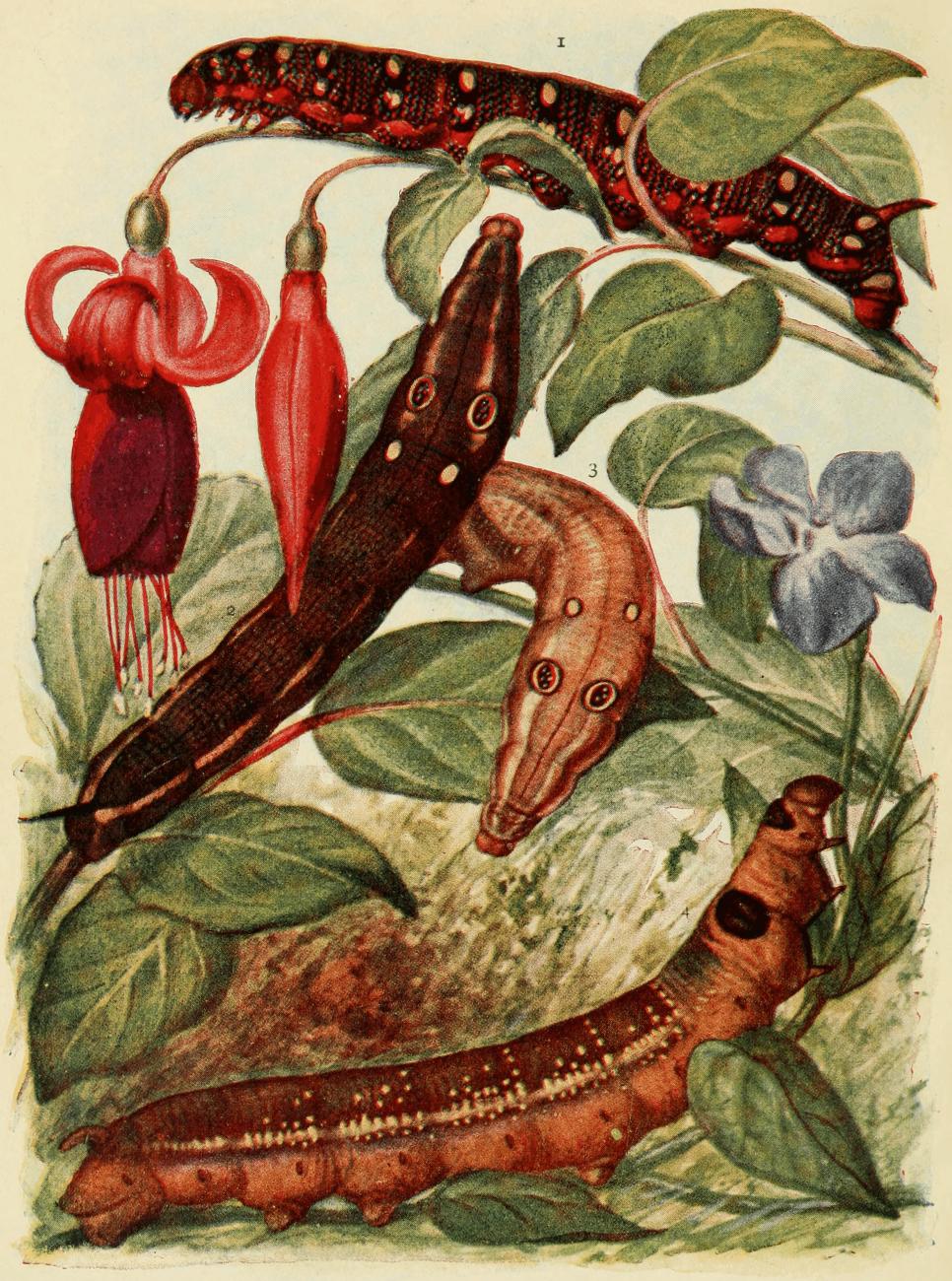
Pl. 1.
1.Spurge Hawk: caterpillar.
2, 3.Silver-striped Hawk: caterpillar.
4.Oleander Hawk: caterpillar.
THE MOTHS
OF THE
BRITISH ISLES
BY
RICHARD SOUTH, F.E.S.
AUTHOR OF "THE BUTTERFLIES OF THE BRITISH ISLES" EDITOR OF "THE ENTOMOLOGIST," ETC.
FIRST SERIES
COMPRISING
THE FAMILIES SPHINGIDÆ TO NOCTUIDÆ
WITH ACCURATELY COLOURED FIGURES OF EVERY SPECIES AND MANY VARIETIES ALSO DRAWINGS OF EGGS, CATERPILLARS, CHRYSALIDS AND FOOD-PLANTS
LONDON
FREDERICK WARNE & CO.
AND NEW YORK
1907
(All rights reserved)
PRINTED IN GREAT BRITAIN
PREFACE.
Compared with our butterflies, the number of moths found in the British Isles is very large. Like the butterflies, moths too are dependent upon plant life, and almost every kind of herb, bush, or tree, will be found to nourish the caterpillars of one or more species of moth.
Not only the field botanist, but every rambler in the country must constantly come across moths or caterpillars that will probably interest him, and of which he would be glad to learn something about their habits, life-history, and the position they occupy in the arrangement and classification of Natural History objects.
In the preparation of this little book on our moths, the author has proceeded closely on the lines adopted when dealing with the butterflies in his previous volume. That is, the chief aim has been to place before the nature lovers as much information concerning these creatures as could be condensed into moderate limits.
Lengthy descriptions were out of the question, but what might be considered an omission in this way, is amply compensated for by the life-like portraits of typical examples of the moths themselves, and in many cases of their more important varieties. Technicalities have been avoided as far as possible, the main object being to provide a guide to the identification of our moths, together with a simple account of the whole or a part of their earlier stages.
The author is fully aware that this method of treatment only enables him to touch the fringe of the subject, as it were, but he has been content to deal with it in this way, as it appeared to be the kind of information that would most nearly meet the requirements of the majority.
The author desires here to express his thanks to Mr. Robert Adkin, F.E.S., for the loan of specimens of L. cœnosa, E. ilicifolia, D. harpagula, N. albula, N. centonalis, D. barrettii, D. cæsia, P. xanthomista, T. extrema, L. favicolor, L. vitellina, and H. palustris. To Mr. Alfred Sich, F.E.S., for the use of drawings of the caterpillars of D. tiliæ, S. fagi, L. bicoloria, P. ridens, A. auricoma, A. rumicis, A. aceris, N. brunnea, M. oleracea, A. tragopogonis, T. gothica, and T. incerta. To Mr. H. L. Sich for the loan of drawings of the caterpillars of D. euphorbiæ, D. galii, D. chaonia, and P. dictœa. For the material figured on Plate 148, except the larva of L. putrescens, kindly sent by Mr. Walker, of Torquay, he is indebted to Mr. H. M. Edelsten, F.E.S.
Except where otherwise mentioned, the illustrations of moths and caterpillars at rest are from photographs by "A Forester."
To Mr. Horace Knight he is very greatly obliged for the care bestowed upon the drawings of ova, larvæ, and pupæ, the bulk of which were made from living examples; also the coloured drawings for Plates 1, 45, 63, 68, 73, 75, 80, 84, 90, 108, 119, 123, 140, 146, 149, and 153. The only figures copied from any previous publication are those of the caterpillars of S. fuliginosa, D. sanio, D. pulchella, A. corticea, A. strigula, N. plecta, and N. augur (Wilson's "Larvæ Brit. Lep."); and among the moths, the varieties of A. caia; D. mendica (4 Yorks.), Trans. Ent. Soc. Lond., 1889; S. walkeri, Curtis, and N. subrosea, Stephens.
RICHARD SOUTH.
PREFACE TO THE PRESENT EDITION.
A new edition of this volume having become necessary, it was deemed a fitting opportunity to bring the subject matter somewhat in line with our present knowledge of the Nomenclature, Habits, and Distribution of the Species considered therein. With this end in view, the new facts have been incorporated in the text so far as this was possible. Matter that could not be accommodated in this way has been presented in the form of an Appendix.
The changes in the names of genera are not numerous, and in every case where such change has been made, the name used in the first edition has been placed in brackets—i.e. Pieris daplidice of the 1st edition becomes in the present one Pontia (Pieris) daplidice.
By this treatment it has been found convenient to utilise the old Index and, at the same time, to provide a Specific Index for those who prefer to consult the volume by its aid.