WORSHIPERS OF THE SUN
Reading edition

The deity whose worship the Incas especially inculcated, and which they never failed to establish wherever their banners were known to penetrate, was the Sun. It was he who, in a particular manner, presided over the destinies of man; gave light and warmth to the nations, and life to the vegetable world; whom they reverenced as the father of their royal dynasty, the founder of their empire; and whose temples rose in every city and almost every village throughout the land.

Besides the Sun, the Incas acknowledged various objects of worship, in some way or other connected with this principal deity. Such was the Moon, his sister-wife; the Stars, revered as part of her heavenly train, though the fairest of them, Venus, known to the Peruvians by the name of Chasca, or the “youth with the long and curling locks,” was adored as the page of the Sun, whom he attends so closely in his rising and in his setting. They dedicated temples also to the Thunder and Lightning, in whom they recognized the Sun’s dread ministers, and to the Rainbow, whom they worshiped as a beautiful emanation of their glorious deity.
In addition to these, the subjects of the Incas enrolled among their inferior deities many objects in nature, as the elements, the winds, the earth, the air, great mountains and rivers, which impressed them with ideas of sublimity and power, or were supposed in some way or other to exercise a mysterious influence over the destinies of man.
But the worship of the Sun constituted the peculiar care of the Incas, and was the object of their lavish expenditure. The most renowned of the Peruvian temples, the pride of the capital, and the wonder of the empire, was at Cuzco, where, under the munificence of successive sovereigns, it had become so enriched that it received the name of “The Place of Gold.” It consisted of a principal building and several chapels and inferior edifices, covering a large extent of ground in the heart of the city, and completely encompassed by a wall, which, with the edifices, was all constructed of stone.
The interior of the temple was most worthy of admiration. It was literally a mine of gold. On the western wall was emblazoned a representation of the deity, consisting of a human countenance looking forth from amidst innumerable rays of light which emanated from it in every direction, in the same manner as the sun is often personified with us. The figure was engraved on a massive plate of gold of enormous dimensions, thickly powdered with emeralds and precious stones. It was so situated in front of the great eastern portal that the rays of the morning sun fell directly upon it at its rising, lighting up the whole apartment with an effulgence that seemed more than natural, and which was reflected back from the golden ornaments with which the walls and ceiling were everywhere encrusted. Gold, in the figurative language of the people, was “the tears wept by the Sun,” and every part of the interior of the temple glowed with burnished plates and studs of the precious metal.
From Prescott’s “Conquest of Peru.”
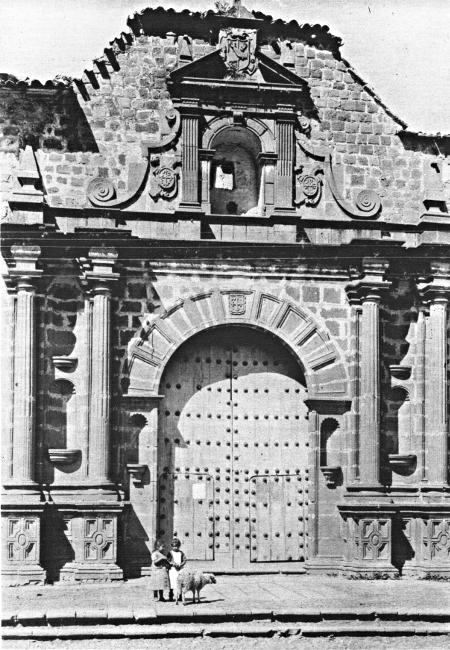
ENTRANCE TO DOMINICAN CHURCH, CUZCO, PERU