THE INCAS The Incas’ Food Supply
Reading edition
FOUR

One of the greatest aids to the Incas in extending their domains was their abundant food supply: the result, largely, of the great progress they had made along agricultural lines. Although Peru is a very mountainous country, by taking advantage of every available inch of fertile ground where the climate permitted the raising of crops, they were able to carry on a system of agriculture which, in the variety of products yielded, seems truly marvelous. It is stated by Mr. O. F. Cook, of the United States Department of Agriculture, that a complete census of the plants cultivated by the ancient Peruvians would probably include between seventy and eighty species.
The most important products are the maize and the potato, one world crop of which is today more valuable than all the gold the conquering Spaniards were able to take out of the country. The cultivation of corn goes very far back, for abundant specimens have been found in ancient graves, and the type of maize that furnishes the bulk of the Peruvian crop is peculiar to that region.
Other plants familiar to us are the pineapple, the sweet potato, peanuts, beans, Lima beans, guava (gwä´-vä), alligator pears, papayas (pä-pä´-yäs), and chirimoyas (chee-ree-mo´-yäs), as well as many with which we are not familiar, as affu (äf´-foo), arracacha (är-rä-cä´-chä), tintin (teen´-teen), tomate (to-mä´-tay), purutu (poo-roo´-too), quinoa (keen´-o-ä), occa (ok´-kä), and ullucu (ool-yoo´-koo). From the dried potato a nutritious flour was made called chuña (choon´-yä), which was used to thicken stews.
The coca plant (Erythroxylon) was widely cultivated, but in the days of the Incas, if we are to believe the historians, its use was regulated by the government. Commonly used today by their modern descendants, it is alcohol’s most potent aid in the degradation of the Peruvian Indian.
We must not think, however, that the Incas were vegetarians. Although they lacked sheep, hogs and cattle, in the llama (lyämä) and alpaca they had excellent meat, as well as animals to provide them with wool, and in the case of the llama, a serviceable pack animal. The guanacos (gwä-nä´-kos) and vicuñas (vi-coo´-nyas), first cousins of the llama, were never domesticated, but were hunted in large drives superintended by representatives of the government. In the mountains there were rodents, such as the viscacha (vee-scä´-chä), chinchilla (cheen-cheel´-yä), and guinea-pigs. In the valleys there were monkeys and parrots. At the sea-shore and near the larger rivers fish were plentiful. Such excellent means of communication existed between the capital at Cuzco and the coast, that the Incas were kept constantly supplied with fresh fish.
The prevalence of both fishing and hunting is attested by the many depictions of these industries found on ceramic art objects which have been encountered by the archeologists. Hunting was carried on to such an extent, and the country in general was so intensively cultivated, that the Peruvian highlands today have less to offer the nimrod than any other section of the world equally uninhabited and desolate.
Alcoholic beverages were used, of course, but the government saw to it that their manufacture did not affect other industries. Chica (chee-cha) was made from both potatoes and maize, but the favorite brand was brewed from the molle (mol-yay) berry. Then, as today, religious feasts provided the common people with an opportunity for debauchery, but under the Incas there was less of the consequent inebriety.
PREPARED BY THE EDITORIAL STAFF OF THE MENTOR ASSOCIATION ILLUSTRATION FOR THE MENTOR, VOL. 6, No 3, SERIAL No. 151 COPYRIGHT, 1918, BY THE MENTOR ASSOCIATION, INC.
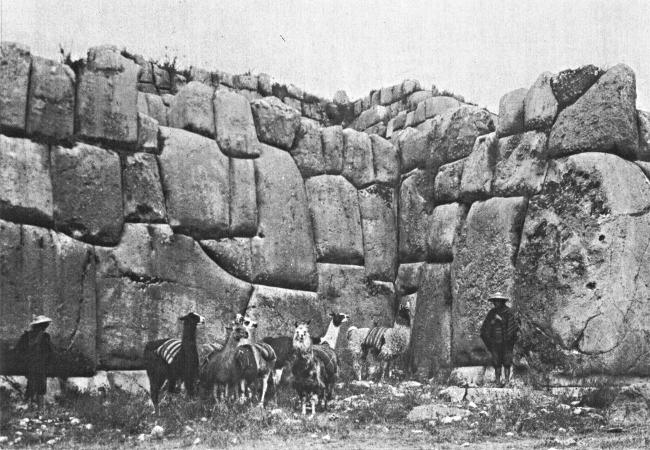
SACSAHUAMAN, THE INCAS’ GREATEST FORTRESS, CUZCO, PERU