THE INCAS The Tellers of the Story
Reading edition
ONE
Rude and destructive as were most of the Spanish conquistadores (con-kees-tä-dõ´-rays), many of them sympathized with the conquered people, and it is from the records of their impressions that we have obtained most of what we know about the Incas. Four of these Castilian diarists whose work is most valued were soldiers. Of their number, Pedro de Cieza de Leon (pay´-dro day see´-ay-sa day lay´-on) has given us the fullest and most interesting account of the ancient Peruvians. Only a boy of fourteen was he when he embarked on the Spanish Main, and he was only nineteen when, in 1538, he joined an expedition up the valley of the Cauca (kä-oo´-kä). He commenced his chronicle in 1541, and for ten years traveled from one end of Peru to the other, writing down his impressions as he went. The first part of his journal was published in 1554. Juan de Betanzos (hwän day bay-tän´-sos), another soldier, has left us but a portion of his work. We have only the record used by Friar Gregorio de Garcia (gray-go´-rio day gar-see´-a) in the first two chapters of his “Origen (o-ree´-hen) de los Indios,” and an incomplete manuscript in the Escurial (ay-skoo-ree-al). This was edited and printed in 1880 by Jimenez de la Espada (hee-may´-nes day lä ay-spä´-dä). Betanzos’ work is valuable, as he learned the Quichua (kee´-choo-a) language and was an official interpreter. Pedro Sarmiento de Gamboa (pay´-dro sär-mi-ayn´-to day gäm-bo´-ä), a militant sailor, accompanied the Viceroy Toledo (to-lay´-do), and was employed by him to write a history of the Incas. Finished in 1572, it is without doubt the most authentic and reliable we possess as regards the course of events. Pedro Pizarro, a cousin of the conqueror, was also a historian of merit, finishing the “Relaciones” (rā-lä-see´-o-nays) at Arequipa (är-ay-kee´-pä) in 1571.
The writings of lawyers have been of little value, although Prescott made use of the unpublished “Relaciones” of Polo de Ondegardo (po´-lo day on-day-gär´-do), written in 1561 and 1570.
The priests were the most diligent inquirers respecting the native religion, rites, and ceremonies. Vincente de Valverde (vis-ayn´-tä day väl-vayr-day) was the first priest to come to Peru, but he stayed only a short time and wrote very little. The best known clerical author is Josef de Acosta (hos´-ayf day ä-cos´-tä), who was in Peru from 1570 to 1586, and traveled over the greater part of the country. Cristoval Molina’s (krees-to´-väl mo-lee´-nä) “Report on the Fables and Rites of the Incas,” written previous to 1584, is also valuable, for he was a master of the Quichua language. Fernando Montesinos (fayr-nän-do mon-tay-see´-nos), who, with his amazing list of kings, traced Inca ancestry back to Noah, was until recently given little consideration. But lately his work, “Ophir de España, Memorias Historiales (o-feer´ day ay-spän-yä may-mo´-ree-äs ees-tor-ee-a´-läs) y Políticos del Peru (po-lee´-tee-cos dayl pay-roo´),” written about 1644, has been given more credence, since it seems probable that much of it was based on the writings of Blas Valera (bläs vä-lay-rä). The premature death of the latter and the disposal of his valuable manuscripts is described by Markham as the most deplorable loss that Inca civilization has sustained. His work was used extensively by Garcilaso de la Vega (gär-see-lä´-so day la vay-gä), a grandnephew of the Inca Huayna Ccapac (wy´-nä k-kä´-päk). He is the most famous of all the historians, and is quoted some eighty times by Prescott.
The works of many of these authors and of others less famous are available today in English, as a result of the indefatigable efforts of Sir Clements Markham, whose translations have been published by the Hakluyt Society. There are still many interesting and valuable old manuscripts reposing in the archives of Madrid (mäd-reed´) and Seville (say-veel´-yay), which have yet to be discovered, edited, and given to the world. Of the Spanish historians who have been engaged in this work, Dr. Marcos Jimenez de la Espada is probably the best known. An excellent bibliography of Peruviana has been prepared by Markham and is published in “The History of the Incas,” Publications of the Hakluyt Society, Series II, Vol. XXII, Cambridge, England.
PREPARED BY THE EDITORIAL STAFF OF THE MENTOR ASSOCIATION ILLUSTRATION FOR THE MENTOR, VOL. 6, No 3, SERIAL No. 151 COPYRIGHT, 1918, BY THE MENTOR ASSOCIATION, INC.
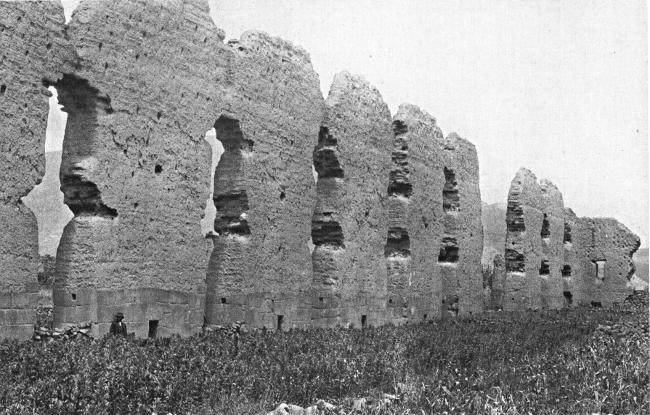
RUINS OF THE GREAT INCA TEMPLE OF VIRACCOCHA NEAR SICUANI, PERU