THE INCAS The Inca Sovereigns
Reading edition
TWO

The Inca sovereigns about whom tradition tells us enough so that they may be considered historical personages are twelve in number. The first of these, Sinchi Rocca (seen´-chee rok-kä), or Rocca the Great, was the first ruler after the return of the Incas to Cuzco (coos´-ko) at the close of their long exile in Tampu-tocco (täm-poo-tok´-ko). He reigned from 1134-1197, according to the chronology of Dr. Gonzales de la Rosa (gon-sä-lays day lä ro´-sä), the most eminent of modern Peruvian historians. Rocca owed his position to a cleverly executed plot contrived by his mother. She dressed him in glittering gold apparel, and hid him in the Chingana (cheen-gä´-nä) Cave on Sacsahuaman (säk-sä-wä´-män) Hill. At intervals for several days excited Cuzqueñans (koos-kayn-yäns) beheld a golden vision moving on the fortress heights. Eventually, after their curiosity and fanatical credulity had been sufficiently aroused, the vision descended into the city. It gave itself over to the crowd, allowed itself to be conducted to the temple, and there proclaimed itself the adopted son of the Solar Deity. Under Rocca, the Temple of the Sun was enlarged and the city greatly improved.
There is some question among historians as to the acts of Rocca’s successors, Lloque Yupanqui (lyo´-kay yoo-pän´-kee) and Mayta Ccapac (my´-tä k-kä´-päk), who reigned from 1197-1246, and 1246-1276, respectively. Garcilaso (gär-see-lä´-so) records their conquering the Cana (kä´-nä) and Colla (kol´-yä) people in the southwest, building a Sun Temple at Hatun-Colla (ä-toom-kol´-yä), carrying on warfare along the shores of Lake Titicaca (tee-tee-kä´-kä), and Lake Aullagas (aul-yä´-gas), and on the west, going as far as Lake Parinaccochas (pär-een-äk-ko´-chäs) and Arequipa (a-ray-kee´-pä). But the majority of historians represent the first three Incas as confining themselves more or less to the Cuzco Valley, and gradually, by diplomatic means, extending their influence over the surrounding inhabitants.
Ccapac Yupanqui (yoo-pän-kee), 1276-1321, made the region to the southeast the theatre of his operations, and Garcilaso credits him with reaching Potosi (po-tos´-ee). Inca Rocca, 1321-1348, improved the water supply of Cuzco (would that he might come again), founded schools, and militariwise, attempted to penetrate the Amazonian forests. His son, Yahuar-Huaccac (yä´-wär-wäk´-käk) (weeping-blood), 1348-1370, was rather a nonentity. His name was acquired as follows, says tradition: While a child he fell into hostile hands. At the point of death he was seen to be weeping tears of blood. This so affected his enemy that he was permitted to live; he eventually escaped to his own people after a life of hardship among some shepherds.
He was followed by Uiraccocha (weer-äk-ko´-chä), 1370-1425, in whose reign occurred the invasion of the Chancas (chän´-käs). The invaders were finally driven out, chiefly through the bravery of his son, Pachacuti (päch-ä-koo´-tee), who reigned from 1425-1478. Under this rule and that of his successors, Tupac Yupanqui, 1478-1488, and Huayna Ccapac (wy´-nä k-kä´-päk), 1488-1525, the Inca dominion grew from a comparatively small confederation to the great, imperial state found by the Spaniards. Huascar (wäs´-kär), the successor of Huayna Ccapac, was overthrown and taken prisoner by his natural brother, Atahuallpa (ä-tä-wäl´-pä), about the time that Pizarro entered Peru. When the latter heard of the quarrel between the two brothers he determined to settle it. Fearful lest the decision should go against him, Atahuallpa had Huascar murdered, and this act provided Pizarro with an excuse for the execution of Atahuallpa.
After he had acquired complete control of the country, Pizarro elevated the Inca Manco (män´-co) to the throne. This proud youth soon tired of the farce and fled to the fastnesses of the Vilcabamba (veel-cä-bäm´-bä) mountains. Here he and his successors, Sayri Tupac (sigh-ree too´-päk) and Tupac-Amaru (too´-päk-ä-mä´-roo), maintained their independence until 1571, when the latter was captured by the Viceroy Toledo, brought to Cuzco, and there beheaded in the great square.
In 1781, a descendant of Tupac-Amaru bearing his name, led a revolt against the barbarous oppression of the Spaniards, only to fail and suffer torture, together with his whole family. In 1814, Pumacagua (poo-mäk-ä´-wä), also of Inca ancestry, started an abortive uprising, which, although a failure, was the beginning of the struggle which was to eventually break the power of Spain in Peru.
PREPARED BY THE EDITORIAL STAFF OF THE MENTOR ASSOCIATION ILLUSTRATION FOR THE MENTOR, VOL. 6, No 3, SERIAL No. 151 COPYRIGHT, 1918, BY THE MENTOR ASSOCIATION, INC.
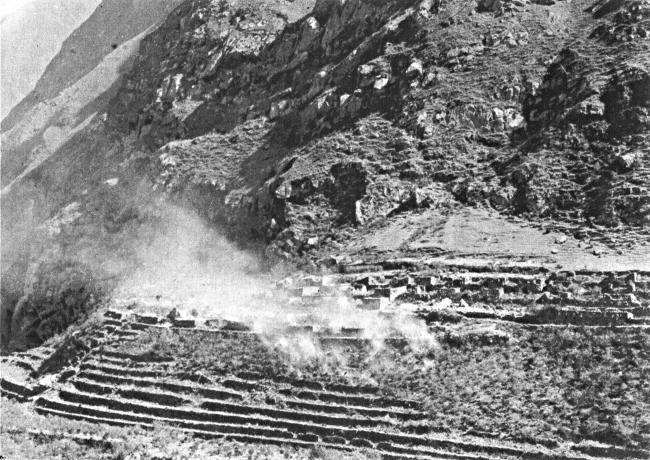
RUINS OF A TYPICAL INCA CITY