AMERICAN MURAL PAINTERS
Reading edition
By ARTHUR HOEBER
Author, Artist, and Critic

THE MENTOR · DEPARTMENT OF FINE ARTS · SEPT. 15, 1914
MENTOR GRAVURES
RETURN OF THE BATTLE FLAGS By Edward Simmons
THE APOTHEOSIS OF PENNSYLVANIA By E. A. Abbey
THE BENEFICENCE OF THE LAW By Kenyon Cox
HOSEA—DETAIL OF THE PROPHETS By John Sargent
DETAIL OF THE ANTHONY DREXEL MEMORIAL CHANCEL By E. H. Blashfield
THE PLEIADES By Elihu Vedder
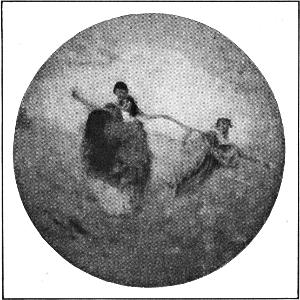
DAWN, by T. W. Dewing
Ceiling decoration in the grill of the Hotel Imperial, New York City
“Oh, tenderly the haughty day Fills his blue urn with fire!” —Ralph Waldo Emerson.
The story of mural painting in America dates back just a trifle over half a century; yet so rapidly do we develop things in this country that today the names of half a hundred men and women who have done distinguished work in this direction come to mind in any review of native accomplishment. However, the art of decoration is one of the oldest in the history of the world, examples of which have been handed down from almost prehistoric times. Traditions reach us—examples too—from the great civilizations of Egypt, Assyria, Greece, Rome, in Europe; while on our own continent there remain records of art in the way of wall decorations in Mexico and Central America, of beauty, taste, and invention, that baffle all efforts to classify as to their age. Says a great art writer, “No society, however rudimentary, has altogether ignored art.” Within the last few years prehistoric paintings by men who probably lived on reindeer flesh have been discovered in caves of the Pyrenees, paintings of no little artistic merit and surely artistic instinct.
With the name of John La Farge must begin any account of the history of mural painting in America. The name is an honored one in the annals of our art development, and he has been dead only a few years, after a long life of devotion to high artistic ideals. It was in 1861 that he completed a panel for the church of the Paulist Fathers, in New York. The theme was “Saint Paul Preaching at Athens.” The architects, however, rejected the work for reasons that seem never to have been recorded, and the next year La Farge began a large triptych[1] of “The Crucifixion”; though he completed only two of the smaller divisions of the composition. These he kept in his studio for many years, until they were purchased by the late William C. Whitney. But his work in the meantime had been remarked, and he received an order for some decorations for a dining room; while the architect H. H. Richardson, in 1876, offered him a commission to take charge of the interior decoration of Trinity Church, Boston. This work was completed in about four months. La Farge chose as assistants Francis Lathrop, Francis D. Millet, George W. Maynard, and Augustus Saint-Gaudens the sculptor, among others. The work was satisfactorily completed, and remains today one of the great accomplishments in this country. After this La Farge was asked to decorate Saint Thomas’ Church in New York, which was followed by his decorations for the Church of the Incarnation in the same city.
Copyright, 1904
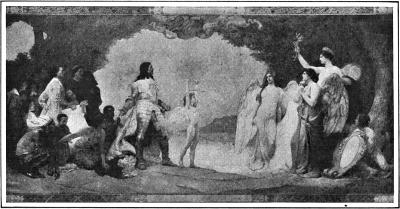
THE EDICT OF TOLERATION, by E. H. Blashfield
This is the central section of a decoration in the courthouse at Baltimore, Maryland
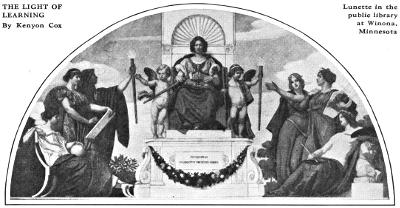
THE LIGHT OF LEARNING
By Kenyon Cox
Lunette in the public library at Winona, Minnesota
LA FARGE’S MASTERPIECE
In the Church of the Ascension, however, is La Farge’s masterpiece, without doubt the greatest piece of church decoration in this country. The theme is “The Ascension of Our Lord,” a composition arranged in two groups, one of the ascending Christ amid the clouds, the other of the disciples with Mary the Mother standing on the ground gazing upon the wonder passing beyond their vision. The composition is one of great dignity and deep religious feeling; the vision of the painter is most distinguished; while there are both balance and harmony, and the color scheme is highly decorative and rich.
The work was immediately followed by many others, including a music room for the residence of the late Whitelaw Reid, rooms in the residence of Cornelius Vanderbilt, and many churches; while later was to come the work for great public buildings, culminating in the decorations for the Supreme Court room of the new capitol at St. Paul, Minnesota, a colossal undertaking comprising many large panels. La Farge did not, however, confine his activities entirely to mural painting; for during his long career in art he was identified with work in stained glass, to which he gave great attention. His achievements in this direction were among the most distinguished that have ever been attained in the history of the world.
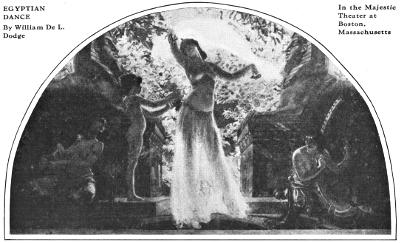
EGYPTIAN DANCE
By William De L. Dodge
In the Majestic Theater at Boston, Massachusetts
WILLIAM M. HUNT
Before we come to the group of present workers in mural painting it is necessary that we consider an earlier man, again one of the pioneers, the artist William M. Hunt of Boston, who in 1878 obtained the commission to decorate the New York state capitol at Albany. The result was a fine series of pictures, well composed; but unfortunately they survive only in reproductions, the originals having been painted directly on the walls. These, owing to faulty construction, did not long remain intact, falling out of plumb, and they had to be supported by beams until they were finally entirely destroyed. Hunt had been a pupil of Thomas Couture (koo-toor´) in Paris, a man who had strong influence on his work, and these decorations were very reminiscent of his master. The pictures were fifteen by forty-five feet in size, and the themes were “The Flight of Night” and “The Discoverer,” of which only photographs remain to tell the tale.
Today the mural painter produces his work on canvas instead of on the wall, a process that enables him to do most of the labor in the studio, and in case of necessity this, after being attached to the walls, can be taken down again and so preserved.
MURAL ART AT “THE WHITE CITY”
It was on the occasion of the planning of the World’s Columbian Exposition of 1893 in Chicago that the first real impetus to mural decoration was given in America. This occasion disclosed to the citizen the possibilities of the native artist, as well as the esthetic value of such embellishment in public edifice and in private home. The administrative body of the fair, determining upon a decorative scheme to be properly carried out, appointed to take charge of the mural painting Francis D. Millet, and as assistant, Charles Yardley Turner. A selection of artists was made to execute the work, who were J. Alden Weir, Edwin Howland Blashfield, George W. Maynard, Robert Reid, Edward Simmons, Charles Stanley Reinhart, Carroll Beckwith, Kenyon Cox, Gari Melchers, William De L. Dodge, and Walter McEwen.
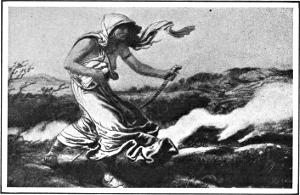
THE CUMÆAN SIBYL, by Elihu Vedder
At Wellesley College
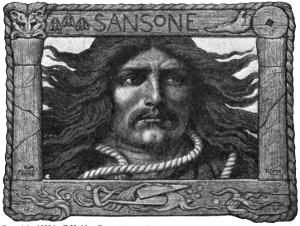
Copyright, 1898, by E. Vedder. From a Copley Print, copyright, 1899, by Curtis & Cameron, Inc.
SAMSON, by Elihu Vedder
Blashfield and Maynard had had some slight experience in decorative work; but the rest were practically novices, though all had been serious, capable students in Paris, and were familiar with examples of the decorative arts of history. Millet was a rare executive, a man who was subsequently to do an enormous amount of just such work. It will be remembered that he went down to his death in the ill-fated Titanic. Of the rest of the group Weir, Reinhart, Beckwith, Melchers, and McEwen returned to their easel picture work after the Chicago fair, with only an occasional decoration. Blashfield, Maynard, Simmons, Cox, and Dodge have, however, continued to be strongly identified with mural work, and these men must receive closer attention. The decorative scheme at Chicago was a remarkable achievement, all things considered, and the grounds were referred to as “The White City,” “The Fair City,” “The City of Dreams,” and finally, alas! as “The Vanishing City”; but in reality nothing like it was ever seen before and probably never will be again.
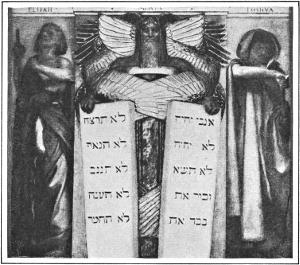
THE PROPHETS, by John Sargent
In the Boston Library. Center panel, showing Elijah, Moses, and Joshua
EDWIN HOWLAND BLASHFIELD
Of this group Mr. Blashfield has been more largely identified with decorations all over the land than the rest. The list of his mural work is a large one. A pupil of Bonnât’s (bo-nah´) in Paris, a writer of great charm, and a most serious student of his profession, Mr. Blashfield brought to his art scholarly endowments of a high order. After his work of decorating the dome of the Manufacturers’ Building at Chicago came a series of commissions to embellish various homes of private individuals,—Collis P. Huntington, the Drexels, the Vanderbilts, Adolf Lewisohn, and others,—with work for the Library of Congress, the Appellate Court of New York, the ballroom of the Waldorf-Astoria Hotel, the Prudential Life Insurance Company of Newark, New Jersey, the state capitols of Minnesota, Wisconsin, Idaho, and other states, with innumerable courthouses at Baltimore, Newark, Hudson County (New Jersey), Youngstown (Ohio), the Federal Building at Cleveland, some schools, and many more. In these he disclosed enormous invention, great facility, a good pictorial sense of composition, and generally a scholarly grasp of decorative requirements.
KENYON COX
Kenyon Cox, likewise a pupil of the Paris schools under J. L. Gérôme (zhay-rome´), has been largely identified with decorative work throughout the land. A distinguished draftsman and a writer on art as well, Mr. Cox is represented with decorations in the Walker Art Gallery, Bowdoin College, in various state capitols and public libraries, in the Appellate Court of New York and other courthouses throughout the Union, and was awarded the medal of honor for mural painting by the Architectural League in 1910. He too is represented in the mural decorations of the Congressional Library at Washington.
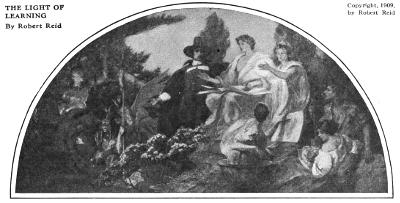
THE LIGHT OF LEARNING
By Robert Reid
Copyright, 1909, by Robert Reid
JOHN SINGER SARGENT
Mr. Sargent, perhaps the most prominent figure in the modern world of art, a man whose success has rarely been duplicated, a painter of the portrait above all, has confined his mural work to the decorations in the Boston Public Library. These are of such superlative quality as to cause regret that the man, in the course of a most active artistic life, could not have found time to do more. Mr. Sargent’s parents were Americans. They are his sole claim to nationality; for he was born in Italy, received his art education in France, and has resided for many years in England. Sargent, in short, is thoroughly cosmopolitan in himself and in his art. His Boston Library decorations are singularly original, of profound symbolism, disclosing deep intellectuality and serious study. His work here, says William A. Coffin, “as a whole is like a casket of jewels.” It consists of a frieze, a lunette,[2] and an arched ceiling. In the latter are depicted the gods of polytheism and idolatry; there are panels of the Prophets in the lunette, and the Jews are represented by twelve nude figures in subjection to the Egyptians and Assyrians, typified by figures of Pharaoh and the Assyrian king. It is a most elaborate symbolism, thoroughly consistent, wonderfully worked out, and of absorbing interest.
EDWIN A. ABBEY’S DECORATIONS
Edwin A. Abbey, in another chamber of this Boston Library, the delivery room, has his now world-famous decoration, the story of the Holy Grail, perhaps the most popular mural work in this country, certainly the best known, and the shrine for many years of the tourist. It is a series of panels narrating the history of the knights of the Arthurian legend, exquisitely told, for Abbey was a master illustrator, and there is great charm of arrangement and color, all making a popular appeal. Mr. Abbey was further commissioned to decorate the state capitol at Harrisburg, Pennsylvania. He attacked this work with great interest and enthusiasm, but his labors were interrupted by his death. The task was then taken up by Miss Violet Oakley, herself a distinguished mural painter, who, though handicapped by the circumstances of having to follow out the scheme of another artist, nevertheless disclosed great capacity and has made a success of the performance.
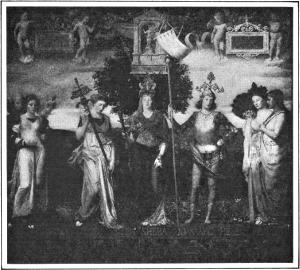
FAMOUS WOMEN, by Barry Faulkner
Decoration for the house of Mrs. E. H. Harriman at Arden, New York. From left to right the women pictured are Cornelia, Beatrice, Judith, Queen of Sheba, Joan of Arc, Helen of Troy, and Pocahontas
PUBLIC LIBRARY DECORATIONS
The Boston Library, it may be stated, offered opportunity for decorative work of an unusual nature, which was taken advantage of by several of the better known men. Elmer E. Garnsey made remarkable designs for the Pompeian lobby, and John Elliott a ceiling in the children’s reference room. The Congressional Library at Washington offered still greater opportunities, engaging the attention of a long list of painters. Here again is seen the hand of Mr. Garnsey, who planned the color scheme; while prominent among the decorations are the works of Elihu Vedder,—six large panels representing Government in its various phases, good and corrupt, of much invention in their allegorical way; for the artist is a highly imaginative man. Mr. Brownell places Vedder in the front rank of the imaginative painters of the day, adding, “Their name is not legion.” Other men who contributed to the Library of Congress include John W. Alexander, who is further represented at Pittsburgh, in the Carnegie Institute, with most important wall decorations; Gari Melchers; Robert Reid, whose list of other work is extensive, including decorations for the capitol at Boston; Henry O. Walker, also represented in the Appellate Court in New York.
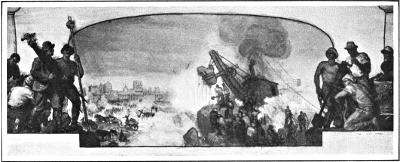
PENNSYLVANIA EXCAVATIONS, by Fred Dana Marsh
EDWARD SIMMONS, ROBERT BLUM, AND OTHERS
In addition to these was a painter who has also been one of the most prominent of the decorative men, Edward Simmons. Years ago he won the competition for a decoration for the Criminal Court room in New York, a prize awarded by the Municipal Art Society. A pupil of the Paris schools, a master draftsman, a singularly capable man, his three panels of the Fates won him instant place, and when he further made two decorations for the Massachusetts state capitol there was opened to him a field which he has since followed with distinction. Decorations for the ballroom of the Waldorf-Astoria, panels for the Appellate Court, for various state capitols and public buildings, and finally enormous embellishments for the Panama fair in San Francisco, place the man in the front rank.
For pure beauty of invention, for charm of drawing and delicacy of vision, no American decoration has surpassed the two lovely panels executed by the late Robert Blum for the frieze of the assembly room of the Mendelssohn Glee Club in New York. They attracted enormous attention when they were first completed, and have been reproduced in many forms. Blum was a highly original painter, and these many figures representing “Music” and “The Dance” have a grace quite their own.
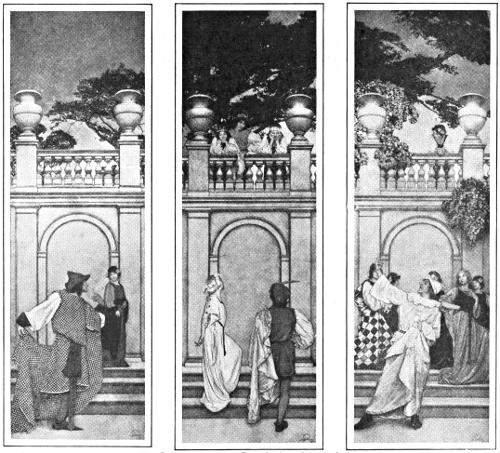
Reproductions of these paintings made by The Detroit Publishing Co.
Copyright, 1912, by The Curtis Publishing Co. Copyright, 1914, by The Detroit Publishing Co.
THREE PANELS, by Maxfield Parrish
These three panels are part of a series called “A Florentine Fête,” which decorates the entire front of the dining room of the Curtis Publishing Company’s building in Philadelphia
Thomas W. Dewing, more identified with easel work, has nevertheless executed several charming decorations, one in the Imperial Hotel, New York, “Dawn,” ranking high indeed. It has all the man’s personal color vision, and is exquisitely dainty and graceful.
Several men were concerned in the wall decorations of the Appellate Court, among them H. Siddons Mowbray and Willard L. Metcalf. The first named chose for theme “The Transmission of the Law,” which he rendered in a scholarly as well as artistic manner. Mr. Mowbray has executed a ceiling for the library of the University Club of New York, a large work for the Newark courthouse, and many private commissions.
The Waldorf-Astoria Hotel gave early opportunities for the work of Will H. Low and Frank Fowler, both of whom carried out interesting schemes of decoration; while work in the church of the Paulist Fathers in New York offered a similar chance for William Laurel Harris. Fred Dana Marsh showed the possibilities of large engineering achievements for decorative material in a large panel in the rooms of the United Engineering Societies. It is an apotheosis[3] of labor, of the pick, the shovel, and the iron and steel worker, and Mr. Marsh was singularly original in the composition.
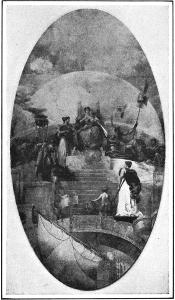
THE CITY OF NEW YORK, THE EASTERN GATEWAY OF THE AMERICAN CONTINENT
By Taber Sears, in the New York City Hall
John W. Alexander, better known as a portrait painter, also chose similar themes with which to decorate the Carnegie Institute of Art in Pittsburgh, a successful piece of work. Robert van V. Sewell, for the home of George Gould, at Lakewood, did a fine frieze representing “The Canterbury Tales.” And a later man is Barry Faulkner, whose panel for the home of Mrs. Harriman, “Famous Women,” is a happy arrangement of the many celebrated feminists. The work of Albert Herter is specially noteworthy. Hugo Ballin has executed large decorative work, and Howard G. Cushing has made strikingly original panels. Other men are Taber Sears, with altar pieces, Joseph Lauber, Charles M. Shean, Douglas Volk, and William B. Van Ingen. Walter Shirlaw occupied himself at times with decorations, and Abbott H. Thayer has likewise executed a few notable mural paintings.
SUPPLEMENTARY READING
MURAL PAINTING IN AMERICA By Edwin Howland Blashfield. Charles Scribner’s Sons, New York.
AMERICAN MURAL PAINTING By Pauline King. Noyes, Platt & Co., Boston.
THE HISTORY OF AMERICAN PAINTING By Samuel Isham. The Macmillan Company, New York.
THE STORY OF AMERICAN PAINTING By Charles H. Caffin. Frederick A. Stokes Company, New York.