American Mural Painters EDWIN AUSTIN ABBEY
Reading edition
Monograph Number Three in The Mentor Reading Course
Walk into the Public Library at Boston, and you will find yourself in the midst of some of the most magnificent mural decorations in America. There we find the great frieze of The Prophets, by John Sargent, and in the delivery room is the great decoration by Edwin Austin Abbey which is called “The Quest of the Holy Grail.”
In the early part of his life Edwin Abbey was an illustrator, celebrated chiefly for his pen drawings. In later life his work became larger in character, and he turned naturally to mural painting.
Edwin Austin Abbey was born in Philadelphia, April 1, 1852. He studied first at the schools of the Pennsylvania Academy of Fine Arts; but at the age of nineteen left this and entered the art department of the publishing house of Harper & Bros., New York City, where he became successful as an illustrator. Associated with him were such artists as Howard Pyle, C. S. Reinhart, and Joseph Pennell. In 1878 Harpers’ planned to publish the poems of Robert Herrick, and sent Abbey to England to gather material for the illustrations. These were published in 1882, and attracted much attention. Illustrations for Goldsmith’s “She Stoops to Conquer,” for a volume of old songs, and for the comedies and a few of the tragedies of Shakespeare, followed. His water colors and pastels were successful in the same degree.
Abbey by this time had become closely identified with the art life of England. In 1883 he was elected to the Royal Institute of Painters in Water Colors. His first oil painting was exhibited at the Royal Academy in London in 1890, which was called “A May Day Morning.” He became a full Royal Academician in 1898.
His mural decoration called “The Quest of the Holy Grail,” in the Boston Public Library, on which he was occupied for several years, deserves special mention. In 1901 King Edward VII commissioned him to paint a picture of the coronation. During his life many honors were showered upon him. Abbey died in 1911.
In “The Apotheosis of Pennsylvania,” below to the left are Sir Walter Raleigh, who had a grant in Pennsylvania; Henry Hudson, who discovered and sailed up the Delaware River; Captain Minuit, the explorer and navigator, and others. To the right are a pioneer and representatives of various religious sects that settled in Pennsylvania. Below these, beginning at the left, are ships on the stocks, the city troopers, General Wayne, Atkinson (the first American judge), the first provost of the University of Pennsylvania, Bishop White (the first American bishop), and others, among them Dr. Caspar Wistar, Benjamin Franklin, William Penn, and Robert Morris. At the left are Governor Curtis and Thaddeus Stevens cheering the soldiers of 1861 marching to defend the state, officered by Generals Hancock and Meade. On the right are miners and workers in steel and iron, machinery, and so forth.
PREPARED BY THE EDITORIAL STAFF OF THE MENTOR ASSOCIATION ILLUSTRATION FOR THE MENTOR, VOL. 2, No. 15. SERIAL No. 67 COPYRIGHT, 1914. BY THE MENTOR ASSOCIATION. INC.
Copyright by Edward Simmons.
From a Copley Print. Copyright by Curtis & Cameron, Inc.
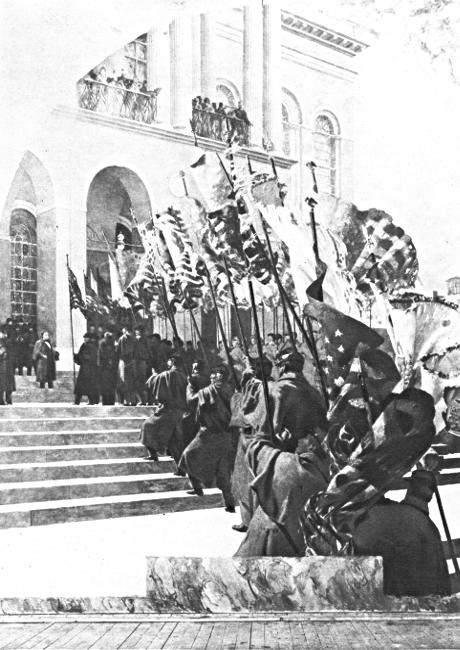
RETURN OF THE BATTLE FLAGS, by Edward Simmons. In the Massachusetts State House. Boston, Massachusetts.