American Mural Painters EDWARD EMERSON SIMMONS
Reading edition
Monograph Number Four in The Mentor Reading Course
Edward Emerson Simmons had many disappointments to contend with during the early part of his life; but he overcame them all, and has made for himself a place in the foremost rank of American artists.
He comes from good old Massachusetts stock. His mother was a sister of Ralph Waldo Emerson, the famous American poet and essayist. Simmons was born at Concord, Massachusetts, on October 27, 1852. He went to Harvard University, and graduated from there in 1874 with great honor. It is a fact worthy of remark that the class of 1874 contains many men who have achieved distinction.
After graduating Simmons went to Paris to study art, where his teachers were Lefebvre and Boulanger. At the schools he was very popular, and his easel was the favorite loafing place for the other members of his class.
In 1881 he exhibited at the Salon a portrait of a gentleman in Highland costume, which attracted great attention. The following summer he went to Brittany, where he remained for sometime. He made his home at Concarneau in Finistère, a fishing port famous for its sardines. There Simmons experimented with all kinds of painting,—landscape, marine, and figure,—and took the lead in the art life of the colony, among whom were painters from France, England, and America.
In 1882 he sent to the Salon a painting called “La Blanchisseuse,” a picture of a Breton girl carrying the clothes from the brookside, where she had been washing them, which is a custom in Brittany. The picture received honorable mention.
In 1891 his class at Harvard decided to give a memorial window, and Simmons got the commission. Then came the World’s Fair at Chicago in 1893, and Simmons obtained the commission to decorate the dome of the Liberal Arts Building. He chose for his subject four objects of American labor,—wood, iron, stone, and fiber. This painting shows strength, directness, simplicity, and dignity. It was his first mural decoration, and was a good experience. He saw his opportunity and made the most of it.
Almost immediately came the commission to decorate the Criminal Court Buildings of the Courts of Oyer and Terminer in the city of New York, which he worked out with enthusiasm. The subject represented is Justice, in the shape of a stately, dignified figure with a globe in one hand and the scales in the other. He draped this figure in an American flag; a hard problem, but cleverly worked out. The side panels to the right represent the Three Fates; those to the left, Liberty, Equality, and Fraternity.
Then came the commission for decorating the Congressional Library at Washington. He chose as his subject the nine muses.
Following this he received many commissions for work in private residences, and for a series of paintings for the Waldorf-Astoria Hotel, New York City.
Simmons was one of the original members of the Ten American Painters, and is a member of the National Institute of Arts and Letters.
PREPARED BY THE EDITORIAL STAFF OF THE MENTOR ASSOCIATION ILLUSTRATION FOR THE MENTOR, VOL. 2, No. 15. SERIAL No. 67 COPYRIGHT, 1914. BY THE MENTOR ASSOCIATION. INC.
FROM A COPLEY PRINT. COPYRIGHT BY CURTIS & CAMERON, INC.
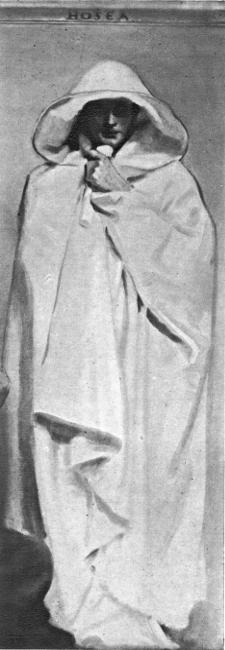
HOSEA—DETAIL OF THE PROPHETS, by John Sargent
IN THE PUBLIC LIBRARY. BOSTON, MASSACHUSETTS
“Hosea,” a detail of the frieze of “The Prophets,” by John Singer Sargent, in the Public Library, Boston, is the subject of one of the intaglio-gravure pictures illustrating “American Mural Painters.”