American Mural Painters ELIHU VEDDER
Reading edition
Monograph Number One in The Mentor Reading Course
Elihu Vedder said of his parents, “My mother went to church; but I know that wherever a fish was to be found my father went fishing,” and of his mother he said further, “It had always been my mother’s wish that I should be a great artist, and for her sake I wish it could have been so.”
Vedder was born in New York City on February 26, 1836, and as a boy attended the Brinkerhoff School in Brooklyn. In this institution the greatest virtue was a good memory; the pupil who could best memorize his lessons stood highest. Consequently Vedder, who always had a bad memory, stood at the foot of his class. Nevertheless he showed early evidences of his talent.
He first studied under the genre (jonr) and historical painter Tompkins H. Mattison, at Sherburne, New York. Then he went to Paris to study in the atelier of the French painter Picot. He went to Italy in 1857, where he worked for some years, and then returned to the United States and remained there until 1865. In that year he was elected to full membership in the National Academy of Design, New York City. He went back to Paris and spent one winter there; but in January, 1867, moved to Rome, where he has ever since resided. He has made many visits to the United States; but Italy is his favorite dwelling place.
At first Vedder devoted himself to the painting of genre pictures. These, however, attracted only a little attention until 1884, when he illustrated the Rubaiyat of Omar Khayyam. This immediately gave him a high place in the art world. His important decorative work came later. These subjects are principally imaginative.
A pen picture by H. T. Carpenter, of Vedder in his Italian home, gives a good idea of the personality of the man: “The picturesque personality of the painter would impress one, whatever and wherever the surroundings. As he came down those stone steps” (of his studio in Rome), “a bunch of large keys in his hand to open the gate, explaining the while the reason for the absence of the porter and attendant of all work, with a gentleness born of a natural sympathy for the under dog, he looked the man one might imagine the creator of such work as is shown in the series of drawings of the Rubaiyat of Omar Khayyam, or the Congressional Library and the Bowdoin College decorations, or the mural work in the Huntington house, with its incomparable central figure, Luna,—his abundant wavy white hair, features of marked strength, penetrating blue eyes, which alternately twinkled and analyzed, a long, flowing white mustache, a striking head on massive shoulders, tall in height; in fine, a picture of rugged picturesqueness that stood out even in that land of artistic individuality, but never for a moment taken for anything but a fine type of American. His manner was cordial, frank, sincere, and unaffected, and one soon found out he was a good hater of shams.”
PREPARED BY THE EDITORIAL STAFF OF THE MENTOR ASSOCIATION ILLUSTRATION FOR THE MENTOR, VOL. 2, No. 15. SERIAL No. 67 COPYRIGHT, 1914. BY THE MENTOR ASSOCIATION. INC.
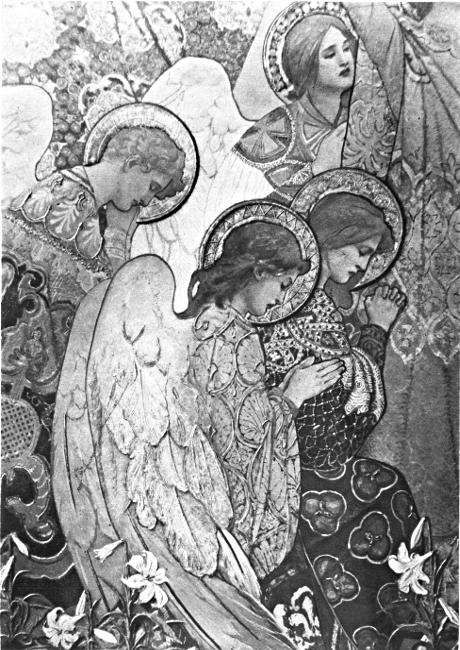
DETAIL OF THE ANTHONY DREXEL MEMORIAL CHANCEL, by E. H. Blashfield.
In the Church of the Savior, Philadelphia, Pennsylvania.