Volume 2 — CHAPTER XVII. (continued 2)
Reading edition
The sandstones of the New Red or Triassic series frequently retain the track-prints of animals, and numerous notices of such occurrences have been published.[713] In addition to the account of these invaluable evidences of the existence of bygone creatures that is here given, the attention of students is especially directed to Dr. Buckland’s most interesting description and illustrations of such as were known when his Treatise was published (Bd. i. p. 259, &c.; and ii. p. 36, pl. xxvi. &c.).
The imprints of the feet of some large quadrupeds, having the fore-paws much smaller than the hinder, have been found in Saxony (see Wond. p. 555, Bd. p. xxvi.); and also in strata of the same age in Warwickshire and Cheshire. The quarries at Storeton Hill, near Liverpool, are celebrated for the abundance and variety of these imprints.[714] Some of the strata of sandstone in this locality are divided by thin beds of clay; a lithological structure which admits of the ready separation of the stone in the direction of the sedimentary planes.
RAIN-PRINTS ON STONE.
Imprints are found on the face of each successive stratum; and on some of the layers, not only the tracks of animals that have walked over the clay when soft are distinctly observable, but the surface is often traversed with casts of the cracks caused by the desiccation of one layer of clay previously to the deposition of the succeeding layer of sand or mud; and it often presents a blistered or warty appearance, being covered with either little hemispherical eminences or depressions, which an accurate investigation of the phenomenon has proved to have been produced by showers of rain (Ly. figs. 526-528). On the slabs of sandstone, the forms of the sun-cracks, rain-drops, and foot-prints appear in relief, being casts moulded in the soft clayey mud upon which the original impressions were made; while on the clay or shale, corresponding depressions are apparent.[715]
The foot-prints on these strata are of several kinds; some appear to have been produced by small reptiles and crustaceans; but the principal imprints are identical with those which have been observed in Saxony, and are referable to some large quadruped, in which the fore-feet were of a much smaller size than the hind-feet (Lign. 245). From a supposed resemblance of the imprints to those of a human hand, Professor Kaup proposed the name of Cheirotherium, to designate the unknown animal which had left these "footsteps on the sands of Time." But since Professor Owen’s discovery, that the bones and teeth of reptiles found in similar strata in Warwickshire belong to gigantic Batrachians, and since the fore and hind-feet of the frog-tribe are often as dissimilar in size as the impressions of the Cheirotherium, it has been suggested, with much probability, that the foot-prints in question may be those of Labyrinthodonts; but until the form of the feet of these extinct Batrachians can be ascertained, this inference must be regarded as conjectural (Ly. fig. 331).
CHEIROTHERIUM.
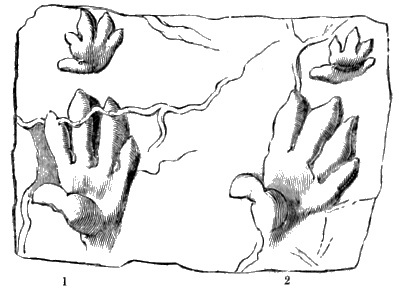
Lign. 245. Cheirotherium Kaupii.
1
/
8
nat. size
.
Casts of the foot-marks of a gigantic extinct Batrachian, probably a Labyrinthodon; with casts also of the cracks of the opposed surface.
Trias.
Hessburg, near Hildburghausen, Saxony.
Fig. 1.— Casts of the imprints of a hind and a fore-foot of the same animal.
2.— Similar tracks of another individual on the same stone.
Allusion has already been made to foot-prints, supposed to be those of tortoises (see p. 729), on slabs of Triassic sandstone in Scotland. Of these there are five species at Corncockle Muir, in Dumfriesshire: they are termed Chelichnus by Sir W. Jardine, who has lately described them in his Ichnology of Annandale, a splendid folio work, illustrated with full-sized lithographs, coloured after nature. They are accompanied with three other forms of footstep (Herpetichnus, Batrachnis, and Actibatis), one of which Sir W. Jardine regards as indicative of an animal probably of a saurian form.
At Grinsill quarry, from which the remains of the Rhynchosaurus (p. 712) were obtained, some small foot-prints have been observed, which, with some probability, have been referred to that animal (Rep. Brit. Assoc. 1841, p. 146).
A beautifully distinct series of foot-prints, with the mark of a trailing tail, on a rippled slab from the New Red of Shrewley Common, Warwickshire, are figured and described by Strickland and Murchison (Geol. Trans. 2d ser. vol. v. pl. xvviii.). This ichnolite has been provisionally assigned by Professor Owen to Labyrinthodon leptognathus.[716] Similar impressions occur in company with other Cheirotherian imprints at Storeton Hill and at Grinshill.
ON COLLECTING FOSSIL REPTILES.
On Collecting the Fossil Remains of Reptiles.—The length to which this article has extended, compels me to omit a retrospect of the geological distribution of fossil reptiles; and I must refer the reader to the brief review of the Age of Reptiles in Wond. p. 568, et seq., and Petrif. p. 147, &c., and close this chapter with some directions for collecting reptilian remains, and a list of a few British localities.[717]
The fossil Teeth of Reptiles are commonly found in as perfect a state of preservation as those of fishes; and require but the usual care for their preservation. But the collector should assiduously search for vestiges of the jaw and cranium; and it is desirable to place in the same drawer any undetermined bones found associated with the teeth; as they may ultimately afford some clue to the nature of the original animal. The microscopical examination of the teeth is to be conducted in the manner previously directed (p. 639); but for valuable specimens the lapidary should be employed, and transverse sections made from near the apex, the middle, and base of the tooth; if due care be taken, several slices may be obtained from one specimen. I have ten slices from one tooth of the Labyrinthodon. The bones imbedded in limestone generally partake of the chemical character of the rock, and are often permeated with calcareous spar; mere fragments, when polished, frequently display the internal structure.
The suggestions for repairing fossil bones (p. 46) render further instructions on that head unnecessary; and the description of the development of the specimen of Hylæosaurus (p. 689) affords a practical lesson to the young collector.
When a vertebra is found in an imperfect state, it should be closely examined on the spot, and, if it present proofs of recent fracture, the detached processes should be sought for; even if the body of a vertebra be imbedded in stone, and the processes appear to have been broken off before it was enveloped in the rock, the corresponding parts will often be found in the same mass of stone. There is in the British Museum a very fine Saurian vertebra imbedded in a large slab of Tilgate stone, in which the spinous process is seen lying in the same block, several inches distant from the centrum or body; when observed in the quarry the latter only was exposed, and I was about to detach it from the slab, for the convenience of carriage, when I perceived indications of the spinous process. The vertebra was therefore allowed to remain, and the stone chiselled away, so as to expose the spine; and the specimen then displayed its present interesting character.
It may frequently happen that a fragment of a large bone,—as, for example, the thigh-bone of the Iguanodon,—may be obtained from a quarry; and after an interval of some weeks the corresponding portions be discovered. This was remarkably exemplified in the first specimen which revealed to me the peculiar characters of the femur of the Iguanodon. The lower part, or condyloid extremity, of a gigantic bone, firmly impacted in a block of Tilgate-grit, was found in a quarry near Cuckfield; it was evidently but a fragment of the fossil, for the fracture was recent; I therefore requested the quarry-men to make diligent search for the corresponding portion, but without success. Several months afterwards, upon a fresh explosion in the quarry, the head of a large bone was found loose among the fallen mass; but there were no indications that it belonged to the specimen previously found; and it was regarded as another relic of some one of the colossal animals whose bones were distributed in the Wealden deposits. Teeth, fragments of bones, and other fossils were from time to time obtained from the same quarry; and among these a huge quadrangular fragment of bone, similar to the enormous mass that had so long been in my possession, and had defied all attempts to ascertain its character.[718] It was some time before it occurred to me, that the three portions of unknown colossal bone might belong to the same specimen; but eventually they were found to correspond, and upon cementing them together, the femur of the Iguanodon was, for the first time, developed.
The figures in Lign. 206 will assist the collector in recognising the different vertebral processes, even when occurring as detached fragments. When specimens are evidently rolled or water-worn, there is, of course, no probability that the corresponding portions will be met with. Every fragment of a bone the nature of which is not obvious should be carefully preserved; for sooner or later its characters may be ascertained. It is scarcely necessary again to remind the collector, that search should be made for indications of the soft parts around the bones; the specimen of the paddle of the Ichthyosaurus (Lign. 215, p. 669), with its integument, must have impressed this fact too strongly on the mind to be soon forgotten. If the impression of the extremities of a bone, of which a fragment only remains, be observed, the block of stone should be preserved, as a cast may be taken, and the entire form of the original be ascertained.
BRITISH LOCALITIES OF FOSSIL REPTILES.
Aust Cliff, near Bristol. Lias. Plesiosaurus.
Barrow-on-Soar. Lias. Ichthyosaurus, Plesiosaurus.
Bath. Lias. Plesiosaurus.
Battle, Sussex. Wealden. Iguanodon, Cetiosaurus, Goniopholis, Chelonians.
Binstead, Isle of Wight. Upper Eocene. Fresh-water Tortoises. Bognor. Lower Eocene. Chelone.
Bolney, Sussex. Wealden. Hylæosaurus, Iguanodon, Chelonia, Goniopholis.
Bracklesham Bay. Middle Eocene. Crocodiles, Serpents, Chelonians. Brighton. Chalk. Vertebra of Mosasaurus or Leiodon.
Bristol. Lias. Ichthyosaurus.
Brook-Point, Isle of Wight. Wealden. Iguanodon, Cetiosaurus, &c.
Burham, near Maidstone. Chalk. Chelone, Dolichosaurus, Pterodactylus.
Bur wash, Sussex. Wealden; quarries in the neighbourhood. Goniopholis, Turtles.
Cambridge. Lower Chalk. Raphiosaurus, Polyptychodon. Charmouth. Lias. Ichthyosaurus.
Charmouth. Lias. Ichthyosaurus.
Cheltenham. Lias. Ichthyosaurus.
Chipping Norton. Oolite. Streptospondylus.
Clayton. Chalk. Coniosaurus.
Corncockle Muir, Dumfries. New Red. Imprints of feet of Reptiles.
Coton-End, Warwickshire. New Red. Labyrinthodon, &c.
Cubbington, Warwickshire. New Red. Labyrinthodon.
Cuckfield. Wealden; quarries in the vicinity. Iguanodon, Pelorosaurus, Hylæosaurus, Trionyx, &c.
Culver Cliff, Isle of Wight. Wealden. Streptospondylus.
Dover. Chalk. Ichthyosaurus, Plesiosaurus.
Garsington, Oxfordshire. Oolite. Cetiosaurus.
Glastonbury. Lias. Ichthyosaurus.
Grinsill, Warwickshire. New Red. Rhynchosaurus.
Guy’s Cliff, Warwick. New Red. Labyrinthodon.
Harwich. London Clay. Chelonia.
Hastings. Wealden. Iguanodon, Pelorosaurus, Goniopholis, Turtles.
Heddington, Oxfordshire. Kimmeridge Clay. Pliosaurus.
Hordwell. Middle Eocene. Crocodiles, Chelonians, Serpents.
Horsham, Sussex. Wealden; quarries in the vicinity. Hylæosaurus, Iguanodon, Goniopholis, Turtles, &c.
Ilminster. Upper Lias. Ichthyosaurus, Teleosaurus.
Kyson, Suffolk. Eocene. Serpent, Lizard.
Leamington. New Red. Labyrinthodon.
Lewes. Chalk. Vertebra; of Mosasaurus or Leiodon.
Lyme Regis. Lias. Pterodactyles, Ichthyosauri, and Plesiosauri in abundance.
Maidstone. Lower Green Sand; quarries near the town; particularly Mr. Bensted’s "Iguanodon quarry." Iguanodon, Plesiosaurus, Polyptychodon, Fresh-water Tortoise.
Malton. Oolite. Megalosaurus.
Market Rasen. Kimmeridge Clay. Pliosaurus.
Norfolk? Chalk. Leiodon: very rare.
Portland, Isle of. Oolite. Turtles.
Purbeck, Isle of. Purbeck. Goniopholis, Chelonians. Kim. Clay. Pliosaurus.
Redland, near Bristol. Magnesian Conglomerate. Palæosaurus, Thecodontosaurus.
Saltwick. Lias. Teleosaurus.
Sheppey, Isle of. London Clay. Turtles, Serpents, Crocodiles.
Shotover, near Oxford. Kimmeridge Clay. Pliosaurus, Teleosaurus.
Southerham. Chalk. Mosasaurus, Plesiosaurus.
Stonesfield. Oolite. Megalosaurus, Teleosaurus, Pterodactyles.
Stourton, Cheshire. New Red. Foot-prints of reptiles (Cheirotherium), &c.
Street, Somersetshire. Lias. Ichthyosauri and Plesiosauri.
Swanage, Isle of Purbeck. Goniopholis, Chelonians.
Tilgate Forest. Wealden; quarries in various localities. Iguanodon, Megalosaurus, Hylæosaurus, Suchosaurus, Turtles, and Tortoises.
Watchett, Somersetshire. Lias. Plesiosauri, Ichthyosauri.
Warwick, Guy’s Cliff, near. New Red. Labyrinthodon.
Westbrook, Wilts. Kimmeridge Clay. Ichthyosaurus.
Weston, near Bath. Lias. Plesiosaurus.
Whitby, Yorkshire. Lias. Ichthyosauri, Plesiosauri, Teleosaurus.
Wight, Isle of; along the southern shore, near Brook-Point. Wealden. Iguanodon, Cetiosaurus, &c., washed up on the sea-shore.