Volume 1 / Part 3 — MEDALS OF CREATION.
Reading edition
VOL. II.
Pl. 2
J. Dinkel del. G. Scharf lithog. Printed by Hullmandel & Walton
THE

OR,
FIRST LESSONS IN GEOLOGY,
AND
THE STUDY OF ORGANIC REMAINS.
BY
GIDEON ALGERNON MANTELL, LL.D. F.R.S. V.P.G.S.
PRESIDENT OF THE WEST LONDON MEDICAL SOCIETY, ETC. AUTHOR OF THE WONDERS OF GEOLOGY, ETC.
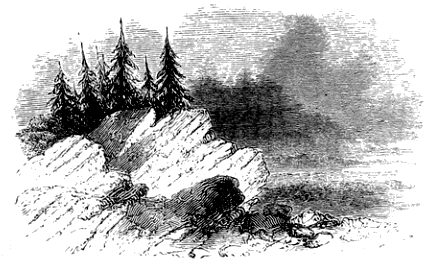
INCLINED STRATA OF MILLSTONE GRIT, CRICH HILL.

IN TWO VOLS.—VOL. II.
CONTAINING

WITH NOTES OF GEOLOGICAL EXCURSIONS.
SECOND EDITION, ENTIRELY REWRITTEN.
LONDON: HENRY G. BOHN, YORK STREET, COVENT GARDEN.
LONDON: R. CLAY, PRINTER, BREAD STREET HILL.
DESCRIPTION
OF THE
FRONTISPIECE OF VOL. II.
PLATE II.
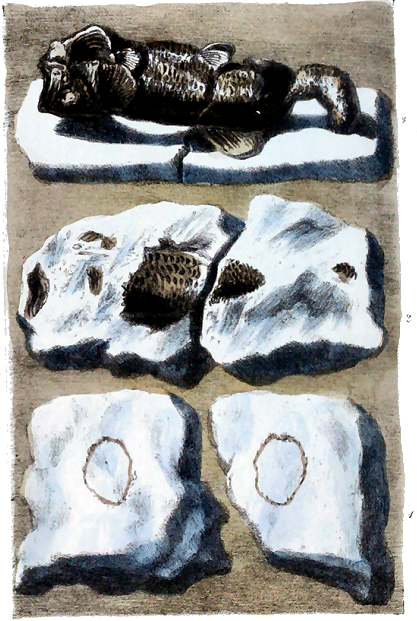
Illustrative of the mode of developing Fossil Fishes in Chalk.
Osmeroides Mantelli: a Fossil Smelt; from the Chalk, Lewes.
See page 626.
(One-third natural size.)
Fig. 1.— The two corresponding surfaces of a block of Chalk split asunder. The irregular oval lines, seen on each surface, are the only apparent indications that the stone contains an extraneous body.
2.— In this figure the two pieces represented above are shown cemented together; care having been taken that the oval markings on each surface were accurately adjusted. The chalk has been chiselled away in the supposed longitudinal direction of the enclosed extraneous body, and part of the scaly surface of a fish has been thus brought to light. A portion of chalk has also been removed towards both ends, with the view of ascertaining the extent and direction of the fossil; and at each place indications of its presence are visible.
3.— Represents the specimen completely developed. It proves to be a fish almost perfect, lying on its back, with the body uncompressed, the mouth open, the arches and opercula of the gills expanded, and the dorsal, pectoral, and ventral fins entire. The caudal fin, or tail, is imperfect. The original is nine inches long, and is one of the most extraordinary fossil fishes ever discovered. It belongs to the Salmon family, and is allied to the Osmerus, or Smelt; it is now in the British Museum. We thus perceive that the oval markings on the surface of fig. 1 were occasioned by the section of the scales covering the cylindrical body of the fish (see p. 627). A magnified view of one of the scales is figured Lign. 185, fig. 4, p. 567.