Volume 1 / Part 2 — CHAPTER VI. (continued 2)
Reading edition
The stem of the Clathraria is composed of a solid internal axis, the surface of which is covered with reticulated fibres; the large branched specimen of this part, figured in Lign. 52, is the finest example hitherto obtained: it was discovered, with bones of the Iguanodon, in a quarry near Cuckfield, Sussex, in 1820. The axis is invested with a very thick false-bark, formed of the consolidated bases of the leaf-stalks, the insertions of which are rhomboidal and transverse. The outer surface of the bark is consequently marked with elevated lozenge-shaped cicatrices (Lign. 53), separated from each other by a marginal furrow, which is surrounded by a parallel ridge or band of a fibrous structure.
Lign. 53. Clathraria Lyellii. 1/4 nat. A stem, with rhomboidal transverse scars, left by the petioles; broken transversely and separated, to show the internal axis at a, which, if the pieces were united, would be received in the cavity below the depression, or cicatrix, on the middle of the upper portion, b, was probably the situation of a resinous secretion, like the dragon-blood in the Dracæna.
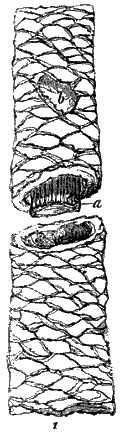
The cortical zone is generally converted into a cylinder of stone, which in some examples separates from the axis. In a beautiful specimen of this kind, Lign. 54, the axis projects and is surrounded by the false-bark.
The axis is solid, and has its surface strongly marked with interrupted ridges. This surface has generally patches of vascular tissue adhering to it; and there are here and there deep pits, or lacunæ, which probably contained a resinous secretion. Thin transverse sections of the axis, prepared with Canada balsam, and examined under the microscope, only give faint traces of cellular tissue.
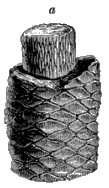
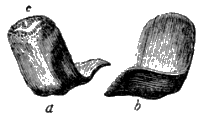
Lign. 54. Clathraria Lyellii; 1/4 nat. Wealden Sandstone. Tilgate Forest. Portion of a stem, scored by the cicatrices of the petioles; showing the Axis a, surrounded by the cortical cylinder. Lign. 55. Petiole of Clathraria Lyellii; a. External aspect. b. Inner surface. c. Vascular pits left by the separation of the leaf.
I have spared neither trouble nor expense in endeavouring to detect the organization of this plant; numerous sections of stems have been cut, and examined microscopically, but very few exhibit any traces of structure; and in those which retain some vestiges of organization, the siliceous mass which permeates the vascular tissue, is not sufficiently transparent to yield satisfactory results. It can only be inferred that in their internal organization, as in their external characters, the Clathrariæ were most nearly allied to the Cycadeæ or Zamiæ. A remarkable specimen, (Lign. 56,) discovered in a stratum of Chalk-marl, near Bonchurch, confirms this view, and throws much light on the nature and relations of these vegetables.
This fossil is a portion of the summit of a stem garnished with persistent petioles, or leaf-stalks; it is fifteen inches in length, and nearly perfect at the top; and at the lower end, which has been broken off transversely, the inner axis (Lign. 56 a.), surrounded by the false-bark formed by the confluence and consolidation of the bases of the petioles, is exposed. The stem has been stript of the leaf-stalks at the lowermost part, and exhibits the characteristic lattice-like scars. The petioles are for the most part entire; some of them are abortive, and others, which have supported leaves, are marked on the summits with vascular pits, indicating that the foliage was shed naturally; as shown in Lign. 55 a. These petioles were probably persistent for some years, as in the existing Cycads. The opposite side of the stem to that represented is covered with elongated and flattened petioles.
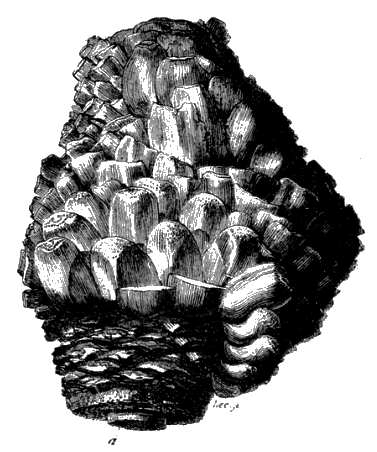
Lign. 56. Clathraria Lyellii; 1/4 nat. Chalk-marl. Bonchurch, Isle of Wight. The summit of a stem garnished with petioles; the lower part shows the cicatrices left by the removal of some of the petioles: a, the internal axis.
On the sea-shore bounded by cliffs of Wealden rocks, in the Isle of Wight, water-worn portions of stems of Clathrariæ are occasionally met with; and these are impressed with the lozenge-shaped areas left by the petioles, as in the specimen, Lign. 57. Mr. Saxby, of Bonchurch, has favoured me with the loan of a thin section of a stem of Clathraria in which the bundles of vascular tissue in the petioles appear to be made up of spiral vessels. From what has been advanced, it is obvious that these remarkable plants of the Wealden flora were gymnosperms, closely related to the Cycadeæ.
Vestiges of roots, seed-vessels, and panicles, have been found in the Wealden, which may possibly belong to the Clathraria; but the evidence as to their presumed relationship is at present too vague to require further notice.
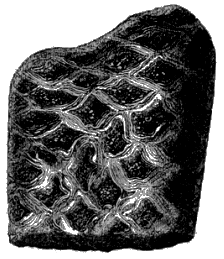
Lign. 57. Clathraria Lyellii; 1/2 nat. Specimen, showing the water-worn external surface.
ENDOGENITES.
Endogenites erosa.—(Geol S. E. pl. i.; Tilg. Foss. pl. iii.; and by Dr. Fitton in Geol. Trans. vol. iv.)—The genus Endogenites was established by M. Ad. Brongniart for the reception of those fossil stems and woods, whose internal structure is endogenous, but which are too imperfect to be referred to any particular family. In this category must be placed certain silicified stems having a carbonaceous cortical investment, which I discovered in the strata of Tilgate Forest, in 1820.
These fossils often occur in the layers of lignite which traverse the clay-beds in some parts of the Weald of Sussex. They are from one to eight inches in diameter, and five or six feet in length, and of very irregular shapes; I have not observed any indications of branches. Some specimens are subcylindrical in the middle, and gradually taper to a point at each end; others are of a depressed clavated form, like some of the Cacteæ or Euphorbiaceæ. They are generally silicified, and, when in situ, are invested with a friable carbonaceous crust, of a glossy lustre, which soon falls to pieces on exposure to the atmosphere, so that cabinet specimens seldom retain any vestiges of it. When this coaly matter is removed, the surface of the silicified stem is seen to be traversed by numerous fine meandering grooves, and deep, tortuous channels, disposed in an irregular manner, in a longitudinal direction. These channels or vessels, which are generally lined with quartz crystals, give the surface that eroded appearance which suggested the specific name, erosa; but this term is inapplicable, for the perforations and sinuosities are not the effect of erosion, but result from the structure of the original. Polished sections, seen by transmitted light, are represented in Dr. Fitton's memoir (Geol. Trans. vol. iv.); and I have had many slices ground as thin as possible, in the hope of detecting the characters of the vascular tissue. In one example there are indications of a cycadeous structure, which favour the conclusion, that the originals belonged to an extinct tribe of gymnosperms; but in other specimens, bundles of vascular tissue, resembling those of palms, are apparent.
Large water-worn stems of Endogenites are occasionally washed out of the Wealden cliffs at Hastings, and in Sandown and Brook Bays, in the Isle of Wight.
Fossil coniferæ.
FOSSIL CONIFERÆ.
The other great natural order of Gymnospermous phanerogamiæ,[135] the Coniferæ, or cone-bearing—so named from the form of their fruit, of which the fir-cones and larch-juli are familiar examples,—comprise the extensive tribes of Firs and Pines, and the Cypresses, Yews, Junipers, Cedars, &c., among which are the loftiest trees on the face of the globe.
The Conifers are all arborescent, having numerous branches, which are in general disposed with much regularity. The leaves are commonly acicular or needle-shaped, narrow, and linear: in two or three genera, however, (Dammara, Podocarpus,) the foliage departs remarkably from the ordinary type, the leaves being broad and flat. The structure of the stem, though in its general characters essentially exogenous (see Plate IV. fig. 4),—that is, having a central pith, medullary rays, zones of vascular tissue, and concentric circles of growth,—differs in the almost entire absence of spiral vessels, and in the peculiar modification of the radiating bands of woody fibre, which are made up of uniform longitudinal vessels, and run parallel with the medullary rays. The lateral walls of these vessels have longitudinal rows of areolæ, which are generally circular or elliptical, but when in contact are angular and polygonal: each areola has a small pore or punctation in the centre. These discs, glands, or ducts, as they are called, are variously arranged in different genera; they are generally confined to the contiguous and corresponding lateral surfaces of the fibres; and occur rarely, if ever, on the inner and outer aspects of the vessels. In the recent genus Pinus the rows of ducts are single in some species; in others both single and double series occur, but never more than two, and in the latter case the ducts are always parallel to each other (see pl. v. 3b. Wond. pp. 696, 725). But in the Araucariæ, or Norfolk Island Pines, the vessels have double, triple, and sometimes quadruple, rows of discs, of smaller size than in the common pines; and in the double series, these bodies are always arranged alternately (Wond. p. 696. Bd. 56 a.); Mr. Nicol states that there are about 50 discs in the length of 1/20 inch, the diameter of each not exceeding 1/1000 inch.
The form and arrangement of these ducts, and the structure of the medullary rays, are the characters on which the scientific botanist relies for the detection of the affinities of the coniferous trees, whose mineralized trunks and branches, in a fragmentary state, are, for the most part, the only relics of these important tribes of the lost floras of the earlier ages of our planet.[136]
The great value of these data will be shown in the sequel.
The stems, fruit, and foliage, of Coniferæ, occur in the various fossiliferous deposits, from those containing the earliest traces of terrestrial vegetation to the newest tertiary strata; and a large proportion of the petrified wood found in the British formations belongs to trees of this order. The presence of rows of ducts on the ligneous fibres, which is peculiar to this division of gymnosperms, as we have already explained (ante, p. 58.), is so easily detected by microscopic examination, that the merest fragment of fossil coniferous wood retaining internal structure, may without difficulty be recognized. The number of rows, and the opposite or alternate arrangement of the areolæ, are characters which, in the living pines and firs, enable us to refer the respective trees to European or exotic forms; but in the fossil coniferous wood, much diversity exists in other not less important points of structure, and for the successful cultivation of this department of fossil botany, works especially devoted to the subject must be consulted. To the English student, Mr. Witham's beautiful volume, "Observations on the Structure of Fossil Vegetables, Edinburgh, 1831," will be found a valuable guide.
FOSSIL CONIFEROUS WOOD.
Fossil Coniferous Wood.—The coniferous wood of the secondary formations of England, belongs for the most part to the Araucarian type: that is, the glands, when in double rows, are placed alternately, as in the Norfolk Island Pines (Wond. p. 696), and not side by side, as in the common European species of firs and pines (Bd. p. 486). Numerous sections of this kind of fossil wood are figured by Mr. Witham, from specimens obtained from Lennel Braes, on the banks of the Tweed, near Coldstream; and from near Allanbank Mill, in Berwickshire (Obs. Foss. Veg. p. 14); a fossil trunk, 40 feet long, discovered in Craigleith Quarry, near Edinburgh, at a depth of 136 feet, possessed the same structure.
Palæoxylon (coniferous wood of the Coal Measures).—The existence of coniferous trees in the Carboniferous flora, and the fact that their trunks and branches had contributed to the formation of coal, was first discovered and clearly demonstrated by Mr. Witham in the work to which reference has been made. Figures of the peculiar structure observable in thin slices of coal, are given in Obs. Foss. Veg. pl. iii. iv. v. This carbonized wood resembles that of the Araucariæ in the multiple series of ducts, and their alternate arrangement; but the presence of thick compound medullary rays in these stems,—a character unknown in any living conifers,—led M. Brongniart to place them in a separate genus—Palæoxylon (ancient wood); characterized by the presence of medullary rays formed of numerous layers of cells, which are not arranged in superimposed series, and that present a lanceolate or oval form, in a section perpendicular to their direction.[137]
Peuce.—Another species of coniferous wood from the coal is thus named; it differs from the former in the medullary rays being composed but of one layer of superposed cells.
Araucarites (Dadoxylon of Endlechen).—This term is employed to designate the fossil wood whose structure is apparently identical with that of the living species of Araucariæ, having the same kind of medullary rays, and the ligneous fibres studded with discs or areolæ, which are polygonal, often hexagonal, and disposed in several alternating series. This wood is common in the Lias, Oolite, Wealden, and Chalk.
Drifted fragments of coniferous wood of this type occur in the Stonesfield slate, associated with leaves and fruits of cycadeæ, and with marine shells, bones of reptiles, fishes, and mammalia; at Scarborough, with the ferns and zamiæ previously described; at Swindon, in the Portland oolite, with belemnites, ammonites, trigoniæ, &c.
STERNBERGIA.
Sternbergia.—To the Araucarian tribe, according to the recent investigations of Professor Williamson, must be referred certain fossil stems found in the coal-measures, and named Sternbergiæ.[138] These are long solid cylindrical casts of sandstone or clay, with annular constrictions, which are generally invested with a thin film of carbonaceous matter; when this crust is removed the surface is found to be marked with longitudinal ridges. These fossils were once supposed to be the stems of plants allied to Yucca or Dracæna; but, as was first shown by Mr. Dawson and Mr. Dawes,[139] they are merely sandstone casts of the medullary axis or cylinder of an extinct genus of coniferæ, allied to the Araucariæ: a specimen in which the cast was surrounded by a thick ligneous cylinder, heaving enabled that acute observer to detect the structure of the original.[140] The Sternbergiæ are sandstone casts of central cavities existing within the true pith; which cavities, under some favourable conditions, were filled with inorganic materials. Mr. Williamson is inclined to believe that all the coniferous wood from the coal-measures, belonging to the genus Dadoxylon, is referable to the trees of whose piths the Sternbergiæ approximatæ are internal casts; and that some of the foliaceous appendages of these trees have been confounded with Lepidodendra.[141]
Petrified Forests of Conifers.—The most remarkable assemblage of fossil conifers is that presented in the well-known quarries in the Island of Portland, to which allusion was made when describing the Mantelliæ obtained from that locality (ante, p. 157.). Referring to Wond. p. 385,[142] for an account of the geological circumstances under which the phenomena occur, it will suffice to state that a forest of pines appears to have been submerged, and the trunks to have become petrified, whilst standing erect on the spot where they grew; the Cycads still shoot up as it were between the stems, and the roots of the trees, though changed into flint, extend into the bed of mould whence they originally derived support, and which is so little altered in appearance, as to be called the Dirt-bed, by the quarrymen; thus realizing the fable of the petrified city in Arabian story, whose inhabitants were turned into stone, in the varied attitudes of life.
No foliage has been observed in connexion with these trees; not a leaf has been found in the rocks: a cone, nearly related to the fruit of Araucaria excelsa, was discovered in the Dirt-bed.
At Brook-point, in the Isle of Wight, an equally interesting fact may be observed. At the base of the cliff, which is entirely composed of Wealden clays, shales, and sandstones, there is a vast accumulation of petrified firs and pines, imbedded in the indurated grit that forms the lowermost strata on the sea-shore, and of which the reefs and rocks, produced by the encroachments of the sea, and that extend far from land, are composed. These can be examined at low-water, and the observer, upon lifting up the fuci and algæ which cover them, will find the rocks and masses of stone to consist of petrified trunks of coniferæ. There are no erect trees as in Portland; on the contrary, the stems are prostrate, and lie confusedly intermingled, and associated with bones of Iguanodons and other reptiles, and large mussel-shells; the whole presenting the characters of a raft of forest trees which had drifted down the stream of a vast river, and entangled in its course the limbs and carcasses of animals that were floating in the water, and the shells that inhabited the river, and at length became submerged in the bed of the delta or estuary. Both foliage and fruit have been found in the Wealden deposits at Brook, and will be described hereafter.[143]
In the sands of the Desert of Sahara, in Egypt,—among the mammalian bones of the Sub-Himalayas,—and in the tertiary deposits of Virginia associated with cycads,—drifted trunks of conifers have been discovered.
Fossil trees of this family also occur in various localities in Australia and Van Diemen's Land, the wood of which is in some parts calcified, and in others silicified. The same trunk often has externally a white friable calcareous zone, several inches thick, traversed by veins of silex, or opaline chalcedony, while the centre is a silicified mass; in both states the internal structure may be detected. This kind of fossil wood is to be seen in most cabinets, a large quantity having been sent to England by emigrants.[144] These fossil trees appear to have been subjected to the same mutations as those of the Isle of Portland, for they are described as standing erect to the height of several feet in a bed of arid sand, apparently in the places where they grew; their petrified branches being scattered around them. They so entirely preserve their natural appearance, that one of the colonists mentions among the extraordinary sights he witnessed on his first arrival in New Holland, the burning of trees into lime to manure the ground.
FOSSIL CONIFERÆ OF AUSTRALIA.
A fossil pine forest, on the eastern coast of Australia, in the inlet called Lake Macquarrie, is described by the Rev. B. Clarke, as occurring at the base of a mountain range, composed of conglomerate and sandstone, with subordinate beds of lignite; an alluvial plain extends to the water's edge, covering the sandstone rock which is seen in situ beneath. Throughout this plain, stumps of fossil trees project from the ground, and present the appearance of a forest in which the trees have all been broken off at the same level. At the distance of some yards from the shore, a reef is formed by vertical rows of the petrified stems, which project out of the water. Many of the fossil stems on the strand have the remains of roots extending into the sandstone below the alluvial deposit, and, like those in the Island of Portland, are in some instances surrounded by an accumulation of rock, which forms a mound of a higher level than the surface of the stratum. The trunks are, generally, three or four feet high, and from two to six feet in diameter. The wood is silicified, and veins of chalcedony traverse its substance between the concentric rings and medullary rays; in several examples, from 60 to 120 annual circles of growth were observable. Beds of lignite occur in the neighbouring hills, both above and below the fossil trees; many localities along the eastern coast of Australia are mentioned, as presenting similar phenomena. I may add that the only fragment of petrified wood found by Mr. Walter Mantell in New Zealand is coniferous.
In the valley of the Derwent, in Australia, opalized coniferous trees of a similar character were observed under very extraordinary circumstances, by the distinguished traveller, Count Strzelecki. Truncated stems were found standing erect in a bed of scoriaceous basalt (lava) and trachytic conglomerate: but in some instances only basaltic casts of the trunks remain. This curious phenomenon can only be explained by supposing the silicified stems to have resisted the intense heat of the incandescent lava, while trees placed in circumstances unfavourable to their petrifaction were consumed: but the latter, being either saturated with water, or fresh and green, were burnt slowly, and left cylindrical moulds in the cooled basaltic scoriæ, with impressions of the external surface of the bark; these moulds were filled Tip by a subsequent eruption, and thus basaltic casts of the consumed trees were formed.[145]
Coniferous Wood in Oxford Clay.—It would occupy too much space to notice the numerous localities in which fossil remains of conifers occur in the Liassic and Oolitic formations of England.
In the Oxford and Kimmeridge Clays water-worn trunks and branches of large pine-trees are often met with. An interesting deposit of these remains was brought to light by my youngest son (Mr. Reginald Mantell), when constructing the branch line of railway from the Great Western to Trowbridge, in Wilts. In the progress of the work, extensive sections were cut through the Oxford Clay, and laid bare a large quantity of drifted wood, much of which was not petrified, but in the state of bog-wood, and was used for fuel by the workmen. Trunks ten or twelve feet long were met with, to which serpulæ, oysters (Ostrea delta), and other shells were adherent. These vegetable remains were associated with Belemnites, Belemnoteuthides, Ammonites, &c.; and had evidently been drifted far out to sea by currents.[146]
FOSSIL CONIFEROUS WOOD.
Coniferous Wood in the Chalk formation.—The arenaceous limestones of the Greensand of Kent and Sussex abound, in some localities, in water-worn masses of coniferous wood, which are often perforated by boring mollusks, as Teredo, Fistulana, Gastrochæna, &c. In the Iguanodon quarry of Kentish rag, near Maidstone, large quantities of these remains occur, and Mr. Bensted has collected several cones belonging to different kinds of conifers; one of these appears to be a species of Abies, or Fir:[147] it was associated with fragments of trunks and branches, whose internal structure proved their relation to the fruit. Plate V. fig. 2, are microscopic views of transverse and longitudinal sections of this wood; 2a shows the cellular tissue in a transverse slice, seen by reflected light; 2b a vertical section in the direction of the medullary rays, exhibiting the vessels studded with single rows of glands. This wood occurs both in a calcareous and siliceous state; in some examples the external zones are calcareous, and the inner siliceous; in others the entire branch is changed into black flint, in which the coniferous structure is beautifully preserved.
Near Willingdon, in Sussex (Geol. S. E. p. 172), a bed of sand, immediately beneath the Galt, contains a layer of water-worn fragments of stems and branches, of small size; they are generally perforated by Gastrochænce, and the cavities formed by these depredators are filled with particles of green chlorite sand. The structure of this wood is represented in Plate V. fig. 3a a transverse, and 3b a vertical section, viewed by reflected light; in 3b the vessels are dotted with two parallel longitudinal rows of very minute glands, arranged alternately, as in the Araucariæ; a fragment of one of the medullary rays is seen near the middle of the specimen.
In this deposit of coniferous wood, two or more fruits apparently referable to Zamiæ have been discovered; one specimen, five and a half inches long, and of an elongated cylindrical form, covered with rhomboidal eminences, I have figured and described as Zamites Sussexiensis.[148]
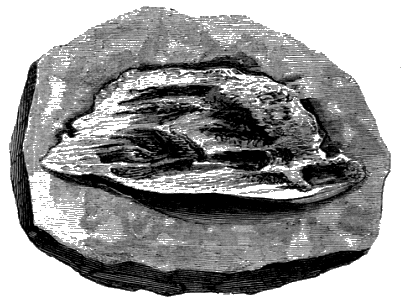
Lign. 58. Fragment of Coniferous Wood in Flint. From a wall in Lewes Priory,
The White Chalk of England has afforded but few traces of plants of this family. Fragments of coniferous wood are, however, occasionally found in the state of carbonaceous, or reddish brown friable masses, and when this substance is removed, the surface of the chalk is seen to be marked with impressions of ligneous fibres; sometimes the surface is studded over with little pyriform eminences, which are cretaceous casts of perforations made by insects in the wood. These specimens, when all traces of the wood are absent, are very puzzling to those who are not aware of their origin.
Occasionally silicified fragments of wood are found imbedded in flint. I have an interesting specimen of this kind obtained from a wall in Lewes Priory (Lign. 58), and though it must have been exposed to the influence of the weather for nearly eight centuries, its surface still exhibits coniferous structure.
WOOD IN FLINT.
Tertiary Coniferous Wood.—The Tertiary formations in some localities abound in coniferous plants and trees, which, in the Paris basin, are associated with bones of mammalia; several species of pine (Pinus) and of yew (Taxus) from those deposits are described by M. Brongniart. I have collected fossils of this kind from the London Clay of the Isle of Sheppey, Bracklesham Bay, and Bognor in Sussex, and Alum Bay, in the Isle of Wight; and from the plastic clay at Newhaven.
Fossil Foliage and Fruit of Conifers.—From this digression on the pine-forests and drift-wood of the secondary formations, we return to the examination of the foliage and fruits of this order of vegetables that are preserved in the mineral kingdom.
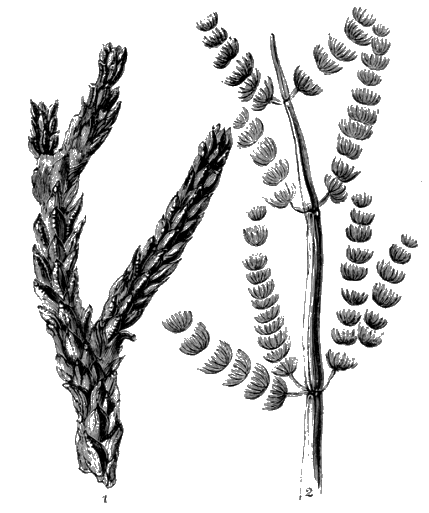
Araucaria peregrina (Lindley and Hutton). Lign. 59, fig. 1.—With the trunks and branches of conifers of the Lias, cones and foliage are occasionally found: a beautiful example of a branch with the leaves preserved, is figured, Lign. 59. This fossil has been so admirably cleared from the shale which invested it (by Miss Philpot) that even the surface of the leaves is exposed. It so closely resembles a twig of Altingia excelsa, that the eminent authors of Foss. Flor. have named it as above. But M. Brongniart states that the foliage differs from that of the two living groups of Araucariæ: in Araucaria Brasiliensis, the leaves are flat, in Altingia excelsa, quadrangular; in the fossil the leaves are short, fleshy, arranged spirally, and inserted.
Lign. 59
.
Fig. 1.— Part of a Branch of Araucaria peregrina; nat. Lias, Lyme Regis.
2.— Calamites nodosus with foliage; nat. Coal-shale, (see ante, p. 109.).
Pinites; a name applied to those fossil leaves and fruits which agree in their general character with the recent genus Pinus; upwards of thirty species are known.[149] In the Pines, as botanically distinguished from the Firs (Abies), the leaves arise in bundles of from two to five; and the scales of the cones are thickened, and terminate in discs more or less defined. In Firs, (Larch, Cedar, &c.) the scales have thin edges, and the leaves are solitary.
Pinites Fittoni. Geol. Isle of Wight; 2d edit, p. 457.—Several cones with the above characters have been found in the Wealden formation. A cone figured and described by Dr Fitton, is remarkable for a double prominence on each scale: It was supposed to resemble the fruit of Dammara, but the strobilus of the latter is like that of the Cedar of Lebanon, in which the edges of the scales are thin. The Wealden fossil appears to be a genuine pine, and may be distinguished by the name of its discoverer, Pinites Fittoni; a small figure of the only known specimen is given, Wond. p. 399, fig. 4.
I have collected from the Wealden strata of the Isle of Wight three or four small cones, which resemble those of a species of Araucaria; they are ovate, imbricated, with acuminated scales, which are recurved at the apex. The fossils figured in Wond. p. 399, figs. 2 and 3, are, I believe, water-worn specimens of the same species.[150]
WALCHIA.
Walchia. Lign. 60.—The fossil coniferæ thus named by Sternberg, have numerous closely set, regularly pinnated branches, resembling those of Araucaria excelsa, and which are thickly beset with foliage. The leaves are sessile, compact, enlarged at the base, tetragonal or falciform, and slightly decurrent; they often vary considerably in form and length on the same bough. The branches are in some examples terminated by oblong cones, composed of imbricated, oval or lanceolate, pointed scales, the summits of which are not recurved, as in the Araucariæ. The trees of this genus are closely related to the Araucaria excelsa, and A. Cunninghami. Some species occur in the Coal formation at St. Etienne and Autun;[151] others (as Walchia hypnoides) in the schists of Lodève, and in the copper slates of the Zechstein in Mansfeld.[152]
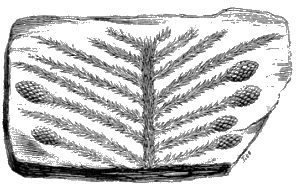
Lign. 60. Walchia hypnoides; 1/3 nat. Permian, Lodève. Part of a bough with six of the branches bearing terminal cones.
Abietites.—To the Abies, or Fir, several cones found in the Wealden deposits of Sussex and Hants closely approximate in the form and structure of their scales. The most remarkable is the very elongated coniferous fruit, first discovered by me in the Wealden at Brook Point, and described and figured in my Geology of the Isle of Wight (2d edit. p. 452), under the name of Abietites Dunkeri, in honour of the eminent geologist who has so successfully and diligently explored the Wealden of the North of Germany.
I have been so fortunate as to collect from thirty to forty specimens of these fruits of the conifers of the country of the Iguanodon, associated with trunks and branches, and imperfect vestiges of single lanceolate leaves.
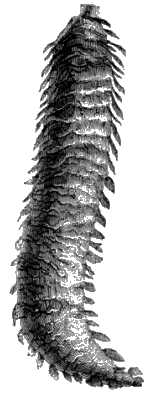
Lign. 61. Abietites Dunkeri. Wealden; Isle of Wight; 1/3 nat. Fir-cone, showing the imbricated scales, and many bracteæ.
ABIETITES DUNKERI.
Abietites Dunkeri. Lign. 61.—These cones are of a cylindrical form, and greatly elongated: the largest specimen is thirteen inches in length, and but three inches in circumference. The scales are broad, slightly convex without and concave within, obovate or subrotund, with a prominent midrib, edges thin and entire. Leaves solitary, slender, slightly curved, from 1 inch to 11/2 inch in length. The cones were garnished with bracteæ, which are seen on the margins of the fossil when imbedded in the rock. Whether the foliage that forms the constituent substance of a large proportion of the bituminous coal of Hanover (ante, p. 74.), and which has been figured and of the named by Dr. Dunker Abietites Linkii, belongs to the same species of Fir as these cones, I am unable to determine. The seeds are of an ovate form: the pericarp is in the state of carbon, and filled or lined with pyrites or calc-spar.
These cones are generally found more or less pyritified, and are extremely beautiful objects when first collected; but like the fruits from the Isle of Sheppey, similarly mineralized, often decompose, in spite of every precaution, after exposure to the air but for a few weeks.
A small sub-ovate fir-cone found with coniferous wood in the Kentish-rag of Mr. Bensted's quarry, near Maidstone, (ante, p. 173.), and figured and described by me as Abies Benstedi, probably belongs to the coniferæ of the Wealden, since it was associated with drifted bones of the Iguanodon.
Fossil Cypresses.—The tribe of conifers called Cupressus or Cypress, (distinguished from the firs and pines by the leaves being mere scales, and the cones consisting of small wooded peltate bracteæ, and by other botanical characters,) including the Juniper and Arbor-vitæ, appears to have flourished during the whole of the secondary epochs; for fossil leaves and stems referable to this family, but whose generic affinities cannot be determined with precision, have been found in the Trias, Lias, Oolite, and Wealden deposits.
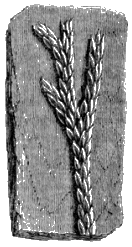
Lign. 62. Thuites Kurrianus nat. Wealden. Hastings.
Thuites Kurrianus. Lign. 62.—The Thuja or Arbor-vitæ, a plant too well known to require description, is the type of the fossil plants distinguished by the name of Thuites. Many years since I discovered vestiges of branches and leaves of some species of this genus, in the ironstone of the Wealden beds, at Heathfield in Sussex (Geol. S. E. p. 228); and of late, many specimens have been found in strata of the same formation in England and Germany. The branch here figured, from the cabinet of S. H. Beckles, Esq. will serve to illustrate the appearance of these fossil plants. Some small fruits found in the ironstone of Heathfield may possibly belong to Cypresses. The foliage and fruit of five or six distinct species of Thuites have been discovered in Tertiary strata.
Voltzia.[153] (Wond. p. 547).—This extinct genus of plants is peculiar to the Trias (Grès bigarré) or New Red deposits, and is one of the most characteristic of the fossil coniferæ. The specimens first found were from Sultz-les-Bains, near Strasburgh. The leaves are alternate, arranged spirally, sessile, and decurrent, and have much analogy with those of certain Araucariæ. The fruits are oblong cones, with cuneiform scales, slightly imbricated, not contiguous, and generally with from three to five lobes.
TAXITES. NŒGGERATHIA. FOSSIL RESINS.
Taxites.—Some branches found in the Stonesfield slate, and bearing a general resemblance to twigs of Yew (Taxus), are described under the above name, but their analogies are doubtful. (See ante, p. 145.)
Nœggerathia.[154]—I must briefly notice the coal-plants which M. Brongniart has placed under this genus, because the foliage of some species appears to have entered largely into the formation of certain seams of coal, although the perfect form of the leaves is unknown. The foliage referred to Nœggerathia consist of pinnated, or deeply pinnatifid, simple leaves. These leaves, or leaflets, are either elongated, linear, lanceolate, wedge-shaped or flabelliform, and entire, or deeply lobed at their extremity, and are traversed by numerous, fine, equal nerves, slightly diverging from the base, but almost parallel. The affinities of these plants are not satisfactorily made out: M. Brongniart considers them to approach nearest to the Cycads or Conifers; perhaps forming a connecting tribe between those two great groups of gymnosperms.[155]
Fossil Resins.—Amber.—The resinous secretions of Conifers are occasionally found in a fossil state. When the tunnel was carried through Highgate Hill, in 1811, concretionary lumps of a brittle substance were discovered, which proved, upon analysis, to be the resin of a coniferous tree changed by mineralization. In a bed of fossil wood, near Hythe, in Kent, a resin was found that partook of the properties of amber and retinasphalt; it was of a clear red colour, very infusible, and acted upon with difficulty by many chemical solvents.[156]
The pollen of pines or firs occurs in a tertiary deposit at Egra, in Bohemia; this bed is entirely composed of pollen and the frustules of many kinds of diatomaceæ.[157]
AMBER. FOSSIL PALMS.
Amber, so remarkable for its electrical properties, and so largely used for ornamental purposes, is a fossil resin, the product of an extinct species of pine (Pinus succinifer), which, though nearly allied to Pinus abies, and P. picea, is essentially distinct. The Amber in the European markets is principally collected from the shores of the Baltic, between Memel and Konigsberg, being washed out of submerged beds of lignite, and thrown up on the strand by the waves. Amber is occasionally found on the eastern and northern shores of England. The forests of Amber-pines appear to have been situated in the south-eastern part of what is now the bed of the Baltic, in about 55° north latitude, and 37° to 38° east longitude, and were probably destroyed at the commencement of the Drift period.
Insects, spiders, small crustaceans, leaves, and fragments of vegetable tissue, are often imbedded in amber; and a few hairs and feathers of mammalia and birds have been detected. These organic bodies must have become immersed in this substance when it exuded from the trees in a viscid state, for they are often preserved as fresh and beautiful as if recently embalmed in the liquid resin. Upwards of 800 species of insects have been discovered, chiefly referable to Aptera, Diptera, Neuroptera, Coleoptera, Libellula, &c.: by far the greater number belong to extinct forms.
The vegetable remains comprise four species of pine, and species of cedar, cypress, juniper, yew; and of oak, poplar, beech, ash, &c.; and a few ferns, mosses, liverworts, confervæ, and fungi. The Amber appears to have exuded from the bark and wood, but chiefly from the root-stock, as is the case with the Copal and Animé, which are resinous substances obtained from certain trees in India and America, and largely employed for varnish: these resins are often substituted for true amber, especially when they contain insects, &c.; but the latter are always of the existing indigenous species of the country. The difference observable in the colour of the various species of amber, is attributable to accidental chemical admixtures.[158]
Fossil Palms (Palmacites).—Reserving an account of the fossil plants belonging to the other grand division of Dicotyledons, the Angiosperms (ante, p. 61.), for the last section of the present chapter, I proceed to notice the most important family of the Endogens, or Monocotyledons, whose remains occur abundantly in many tertiary deposits—the Palms.
The Palms are, for the most part, lofty trees, having a single cylindrical stem, which, like that of the arborescent ferns, rises to a great height, and is crowned with a canopy of foliage. The trunks are solid, most dense on the outer part, and in some species (as the Cane-palms) are coated with a thin siliceous epidermis. At a little distance above the surface of the ground, strong, simple, rope-like roots are sent off from the stem, appearing like clusters of stays or braces to support the trunk; and the base of the petrified palm-trees often exhibits vestiges of these organs.[159] The leaves are supported by petioles, and are in most species very large;[160] they are either pinnated or flabellated (fan-shaped), and sometimes nearly split in half: the veins or nervures are parallel, and the interspaces plaited like the folds of a fan. The surface of the stem is scored by transverse scars formed by the separation of the petioles, and these markings assist in the identification of the fossil trunks of palm-trees. The fruit is in some kinds a single drupe, as the Cocoa-nut; in others a cluster of soft pericarps, as the Date.
The Palm family is divided into upwards of sixty genera, comprising more than a thousand species: the greater number are inhabitants of tropical countries. Stems, with the external surface and internal structure preserved, and the foliage, and fruit, of several kinds of Palms, have been found in a fossil state, and chiefly in the Tertiary formations. Examples of the large silicified palm-stems from the West India Islands, where they occur imbedded with corals petrified in the same manner, are to be seen in the British Museum,[161] and most public collections: and sliced polished sections, exhibiting the monocotyledonous structure, are common in private cabinets. The endogenous organization of the stems is so obvious as to leave no doubt as to the class to which the trees belong, but M. Brongniart states, that, in the absence of the foliage and fruit, it is seldom possible to pronounce with certainty that a fossil monocotyledonous stem belongs to a Palm; for the internal structure alone does not enable the botanist to fix upon any characters which will distinguish the stems of Palms from those of Pandanus, Agave, Yucca, Aloes, Dracæna, &c. Fossil monocotyledons known by their stems only, are therefore arranged by M. Brongniart under the general name of Endogenites.
The Palmacites carbonigenus of Corda, and other supposed palm-trees of the Coal formation, are regarded by the same eminent botanist as essentially differing in structure from this family, and belonging to an extinct tribe of exogens.
That a large proportion of the exogenous stems found in the Tertiary deposits are true palms, there can, however, be no doubt, for the foliage and fruit, which are occasionally associated with them, confirm the inference drawn from the characters of the trunks.
FOSSIL PALM LEAVES.
Stems, leaves, and fruits of Palms have been discovered in the Paris basin, by M. Ad. Brongniart (Bd. pl. lxiv. p. 515); and silicified trunks in many other places on the Continent; but no fossils of this kind surpass in beauty and interest those which are found in the West Indies. A slice of a silicified stem from Antigua is represented, as seen by reflected light, in Plate V. fig. 1; it admirably displays bundles of vessels imbedded in cellular tissue.
Silicified stems of monocotyledons, related to the Palms, are very widely distributed, and have been collected among mammalian remains in Ava, and in the Sub-Himalaya mountains.
Fossil Palm-leaves.—The pinnated and fan-shaped leaves of the Palms are so peculiar as to be easily recognized in a fossil state. Though many specimens have been found in the tertiary strata of the Continent, but two or three examples have been met with in England. The first discovered British specimen is in my cabinet, and was obtained by Mr. Fowlstone, of Ryde, from the fresh-water limestone of Whitecliff Bay, in the Isle of Wight. It is thirteen inches in length, and eleven in width: fresh-water shells and plants are imbedded with it. It is figured in Geol. I. of Wight, 2d edit. p. 431. This species (Palmacites Lamanonis) occurs also at Aix in Provence, in great perfection, associated with Insects, Fishes, fresh-water shells, &c. (Wond. p. 260. Petrif. p. 62).
Twelve species of palm-leaves are enumerated by M. Unger, from the Tertiary deposits of the Continent. One species has been found in the Chalk formation of Silesia; the most ancient strata in which the remains of undoubted palms have as yet been observed.
The fossil palm-leaves of the pinnated form are named Phœnicites,[162] and examples occur in the Tertiary grits of Puy en Velais, I am not aware that leaves of this type have been found in England: diligent research in our tertiary leaf-beds (at Whitecliff Bay, Alum Bay, Bournemouth, Wareham) will probably sooner or later discover them. The leaflets have a well-marked median nerve, with fine nervures running parallel with it; a character by which the foliage of Phœnicites may be distinguished from that of the Cycadeæ.
Fossil Fruits of Palms.—Although certain fruits found in the coal-measures have been referred to the palm-tribe by M. Unger, Dr. Lindley, and other botanists, M. Brongniart is of opinion that no such identification can be established; the same remark applies to the Carpolithes from the Oolite; in fine, the Tertiary deposits have alone yielded fruits that can be unquestionably referred to plants of this order. The most productive British locality of fossil fruits of Palms, and of many other vegetables, is the Island of Sheppey; and I purpose describing in this place, not only the remains of this family, but also of the other plants associated with them.
FOSSIL FRUITS OF THE ISLE OF SHEPPEY.
Fossil Fruits of the Isle of Sheppey.—This little island, which is situated in the mouth of the Thames, is entirely composed of the London Clay, with bands of septaria. On the north, there is a range of cliffs, about two hundred feet high, which is being continually undermined by the waves, and large masses of the clay are thrown down, and innumerable fruits, seeds, branches and stems of trees, and other fossils, are exposed on the strand at low-water. The vegetables are strongly impregnated with iron pyrites, and as this mineral speedily decomposes when exposed to the atmosphere, the choicest examples often fall to pieces, even when preserved in the cabinet.[163] The nodular masses of indurated clay, termed septaria, contain the best preserved and most durable fossils. The fossil fruits, or carpolithes, occur in such profusion, that a large collection can easily be made; they comprise several hundred species, few of which have been scientifically investigated.[164]
Mr. Parkinson has given admirable figures of several of the Sheppey fruits, particularly of the large palm-like nuts, called "petrified figs" (Org. Rem. vol. i. pl. vi. vii. Pict. Atlas, pl. vi. vii.) M. Ad. Brongniart has named several in his Prodrome; but without figures the descriptions are useless to the student. Mr. Bowerbank has published two numbers of a work entitled, "History of the Fossil Fruits of the London Clay," with seventeen plates; from which I have selected a few subjects for illustration. The fruits described are the following:
1. Fruits having a downy structure, like the Cotton plant.
2. Cucumites. Seeds of plants of the cucumber family. Lign. 63, fig. 1 and 3. These fossil fruits so closely resemble the seeds of various members of the recent genus Cucumis, or Cucumber, comprising the Gourd, Water-melon, &c., both in outward form and internal structure, that there is no reasonable doubt of their belonging to plants of the same family; hence the name Cucumites or fossil cucumbers.
3. Cones of a tree allied to the genus Petrophila, of New Holland. Lign. 63, figs. 2 and 8.
4. Seeds of the Bean family, some of which resemble those of the common Scarlet-runner. Lign. 63. figs. 5, 6, 7.
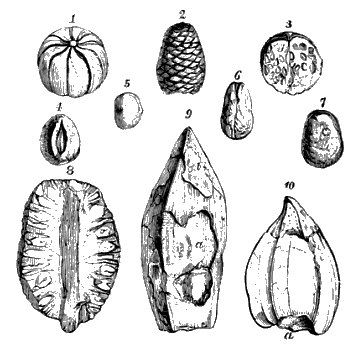
Lign. 63. Fossil Fruits from the Isle of Sheppey.
London Clay.
Fig. 1. and 3.— Cucumites variabilis: fig. 3, is a vertical section, showing the seeds. Lign. 64, fig. 6—1/2 nat.
2 and 8.— Petrophiloides Richardsoni: 1/3 nat. Fig. 8, is a vertical section, showing the disposition of the seeds in the cells formed by the confluent scales—1/2 nat.
4.— Wetherellia variabilis: a section of the fruit, in which state it is called coffee-berry by the collectors—1/3 nat.
5 and 6.— Faboidea semicurvilinearis: fig. 5, side view—1/4 nat.
6.— Is the face of a similar seed—1/3 nat.
7.— Faboidea bifalcis: side view—1/3 nat.
9.— Nipadites lanceolatus: a, the seed; b, the shell, or pericarp—1/2 nat.
10.— Nipadites cordiformis: a, the extremity of the seed, imbedded in the shell—1/3 nat.
5. Wetherellia; pulpy fruits divided into two lobes by the expansion of the ripe seeds. As the section thus exposed bears some resemblance to a coffee-berry, these fossils are popularly called petrified coffee-berries. This genus has no known living representative. Lign. 63, fig. 4.
6. Fruits allied to the Palm tribe. (Nipadites). Lign. 63, fig. 9, and 10.
7. Fruits of leguminous plants, differing from any known recent. Lign. 64, figs. 1, 2, 3, 4.
8. Seeds, allied to the Amomum, or Cardamom tribe. Lign. 64, fig. 5.
9. Seeds of Cupressinites, or plants related to the Cypress.
10. Seeds resembling those of the Laburnum.
11. Seed-pod of a species of Acacia, or Mimosa. Lign. 64, fig. 7.—2/3 nat.
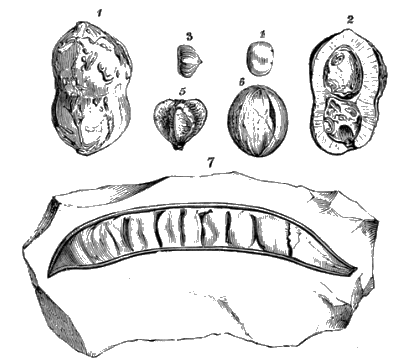
Lign. 64. Fossil Fruits from the Isle of Sheppey.
London Clay.
Fig. 1 and 2.— Zulinosprionites latus. 2. A section, showing the receptacles for two seeds.—2/3 nat.
3.— Leguminosites dimidiatus; side view.—1/2 nat.
4.— Leguminosites subquadrangularis; side view.—1/2 nat.
5.— Cupanoides lobatus.—1/2 nat.
6.— Cucumites variabilis.—1/2 nat.
7.— Mimosites Browniana; from Ossington, Suffolk. A seed-pod of an Acacia, or other plant of the Mimosa family.—2/3 nat.
Nipadites. Lign. 63. (Pict. Atlas, pl. vi. vii.)—The most remarkable fruits in the above catalogue are those which, from their appearance when compressed, are known to collectors by the name of "petrified figs" (Lign. 63, fig. 9, 10). Some specimens attain a considerable size, and are from five to seven inches long. The nut, and the pericarp or shell, are often well preserved. These fossils were referred to the Cocos by Mr. Parkinson, but they have not a ligneous endocarp with three pores as in the Cocoa-nut.
Mr. Bowerbank has shown that they are nearly related to the fruit of the Nipa, or Molucca-Palm, a tree which abounds in Bengal, and in the Molucca and Philippine Islands. The Nipæ are low, shrub-like plants, having the general aspect of palms; they grow in marshy tracts, at the mouths of great rivers, particularly where the waters are brackish. They are allied to the Cocoa-nut tribe, on the one hand, and to the Pandanus, or Screw-pine, on the other.
The Nipadites, according to Mr. Bowerbank, have the epicarp and endocarp thin and membranous, and the sarcocarp thick and pulpy, and composed of cellular tissue, through which run numerous bundles of vessels. Nearly in the centre of the pericarp is situated a large seed which, when broken, is more or less hollow. This seed consists of regular layers of cells, radiating from a spot situated near the middle, and apparently inclosing a central embryo.
The same author remarks, that "if the habits of the plants to which the fossil fruits belonged were similar to those of the recent Nipa, it will account for their abundance in the London Clay in the Isle of Sheppey; which formation, from the great variety of stems and branches, mixed up with star-fishes, shells of mollusks, and bones of fishes, crustaceans, and reptiles of numerous marine and fresh-water genera, is strikingly characteristic of the delta of a river, which probably flowed from near the Equator towards the spot where these interesting relics are deposited." The fact that the seed-vessels of several species of Nipadites abound in the Isle of Sheppey, and have not been observed in any other locality in England, tends to support this opinion.
Carpolithes of this kind occur in great perfection in the Eocene strata of Belgium, and were figured and described, nearly seventy years since, in Burton's "Oryctographie de Bruxelles," as petrified cocoa-nuts; the uncompressed state in which these fossils occur makes the resemblance to the recent fruit more striking than in the flattened pyritous specimens from the clay of Sheppey.
NIPADITES OF BELGIUM.
The Nipadites of Brussels have recently been brought under the more immediate notice of English geologists, in a memoir "On the Tertiary Strata of Belgium and French Flanders," by Sir Charles Lyell, in which several specimens are figured and described.[165] These fossils are found in sands and sandstone, presumed to be of the age of the Bracklesham beds of Sussex. They are procured from Schaerbeek, in the northern suburbs of Brussels, where extensive quarries are worked for paving-stones, and have long been celebrated for remains of turtles, trunks of palms, and dicotyledonous trees, and the fruits, now called Nipadites. The vegetable remains often occur silicified; Sir C. Lyell was shown by the workmen "the trunk of a petrified exogenous tree, with forty rings of annual growth; it had lain in a horizontal position, and was bored by teredinæ. The silicified base of the trunk of a Palm-tree, apparently broken off short at about the level of the soil, had numerous air-roots, or rootlets, attached."[166]
Of the thirteen species of Nipadites enumerated by Mr. Bowerbank, some of which are, however, only accidental varieties, four have been identified among those obtained from Schaerbeek: two of them belong to but one species—the Nipadites Burtoni: the others are N. lanceolata (Lign. 63, fig. 9), and N. Parkinsoni (Pictorial Atlas, plate vii.). These fossil nuts closely resemble the fruit of Nipas fruticans, a palm which abounds in the delta of the Ganges, and other parts of Bengal, and is the only living species of the genus known.[167] In an immature or abortive specimen of Nipadites giganteus (of Bowerbank), figured in Geol. Journ. pl. xix. fig. 2, the angularity of the pericarp observable in the ripe fruit (Lign. 63. fig. 9) is well marked. The largest specimen of Nipadites from Schaerbeek, is above seven inches long and four wide. The arenaceous strata containing these fruits, and stems of palms and dicotyledonous trees, are supposed to have been formed in the sea near the mouth of a river, as in the case of the clay-beds at Sheppey: the vegetable remains are associated with bones of fresh-water Turtles, teeth of Sharks, cases and spines of Echinoderms, and shells of the genera Ostrea, Pinna, &c.[168]
FOSSIL PANDANUS.
Fossil Fruit of Pandanus. (Popocarya. Bd. pl. lxii. p. 503.)—The Pandanaceæ are monocotyledonous trees, named Screw Pines from the spiral insertion of their long, rigid, sword-like leaves, along the stem; they are natives of hot climates, and abound in the groups of islands in the Pacific; being generally the first important vegetable tenants of the newly-formed Atols or coral-islands. As in the palms, the stem is supported near the base by long side-roots, which enable these trees to maintain an erect position, and flourish on the newly-elevated coral-reefs, where but little soil has accumulated.
The existence of this tribe of plants during the secondary ages is known only by a single example of a fossil fruit, which was discovered by Mr. Page, of Bishport, in the Inferior Oolite, to the east of Charmouth, Dorsetshire, and is preserved in the museum at Oxford; no vestiges of the stems or foliage have been observed.
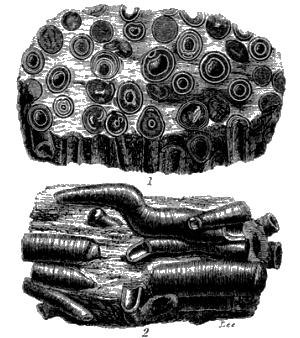
Lign. 65. Fossil Wood with Teredines
;
nat.
London Clay, Regent's Park.
Fig. 1.— A polished transverse section, showing the tubes lined with spar.
2.— Portions of mineralized Teredines, seen in relief on the wood.
This carpolithe, (for a detailed account and figures see Bd. p. 504, pl. lxiii.) is of the size of a large orange; the surface is covered with a stellated epicarpium, composed of hexagonal tubercles forming the summits of cells which occupy the entire circumference of the fruit. Each cell contains a single seed, usually hexagonal, resembling a small grain of rice, and is supported by a foot-stalk, formed of dense fibres; a character exhibited only by the seed-vessels of Pandanus. The fossil fruit differs from that of the recent Screw-pines in the seeds being neither inclosed in a hard nut, nor collected into drupes, but dispersed uniformly over the entire mass; this forms the essential generic distinction between them. Dr. Buckland has named this unique carpolithe Podocarya. (Bd. p. 505.)
Wood perforated by Teredinæ. Lign. 65.—The drifted trunks and masses of wood found in the London Clay, at Sheppey, Bognor, Bracklesham, &c., some of which belong to Palms, others to Conifers, and Dicotyledons, are commonly more or less perforated by the boring mollusks called Teredo, or Teredina; and remains of their testaceous tubes are often well preserved. The tortuous channels excavated in the wood by these borers, are lined or filled up with calcareous spar, indurated clay, or other mineral matter, of various shades of grey, blue, yellow, &c.; and the polished slabs of this fossil wood are beautifully diversified by the sections of the sparry tubes, crossed at right angles by the ligneous structure; as in the specimen fig. 1, Lign. 65, from the Canal in the Regent's Park.[169]
In the fossil, fig. 2. Lign. 65, from the Isle of Sheppey, the tubes of the teredinæ are seen in relief, in consequence of the surface of the block of wood having decayed and been removed.
Fossil Liliaceæ.—The family of endogens, termed Liliaceæ, comprises many beautiful plants; those with annual stems, as the Lily, Hyacinth, Tulip, &c. are well known for the variety and splendour of their blossoms; some of the arborescent forms, as the Tulip-tree, attain a large size, but the flowers of this division are relatively small. In tertiary strata, the stems, leaves, fruits, and even the imprints of flowers, have been discovered, of plants related to Sagittaria (Arrow-head), Smilax (Bind-weed), Convallaria (Lily of the valley), &c.
The Dracæna (Dragon-blood tree), a tall, slender, elegant tree with amplexicaul leaves (common in our hot-houses), belongs to this family; and certain stems found with Clathrariæ, and bones of the Iguanodon, in the Kentish-rag at Maidstone (ante, p. 173.), so closely resemble the trunk of this plant, that they have been named by Mr. König,[170] Dracæna Benstedi; the specimens are in the British Museum. Until the internal structure of these fossils has been examined, the correctness of this identification is, however, uncertain: the external resemblance to the stem of the Dracæna consists in the interrupted annular ridges, denoting amplexicaul leaves: no vestiges of the foliage have been observed.
FRESH-WATER PLANTS. FOSSIL CHARÆ.
Fossil Fresh-water Plants.—The tertiary fresh-water strata often contain abundance of the remains of the aquatic vegetables that inhabited the lakes and rivers in which those deposits were formed. The remains of several species of the common lacustrine plant, the Chara, are found in immense quantities in the fresh-water limestones and marls of the Isle of Wight, of the coast of Hampshire, and of the Paris Basin. The shell-marls, still in progress of formation in the lakes of Scotland, and the travertine precipitated from thermal springs, in like manner envelop and preserve the leaves and fruits of recent species.
Fossil Fruits of Chara. (Gyrogonites.) Lign. 66.—The Chara is a well-known inhabitant of almost every stream and rivulet. The stems are hollow, and composed of tubes filled with a fluid in which green globules circulate; they form beautiful microscopic objects for exhibiting the circulation in vegetables. The fruit consists of very small nuclei, contained in a calcareous pericarp, composed of five spirally twisted plates, that unite at the summit. These seed-vessels, when first discovered in a fossil state, were supposed to be the shells of mollusks, and a genus was formed for their reception with the name of Gyrogonites (twisted-stones); a term still employed, though the vegetable nature of these bodies is well known. In Plate III. fig. 5, a branch of the common Chara with seeds is represented: and figures of the seed-vessels, of two fossil species are given in Lign. 66, figs. 1, 2.
Specimens of the fossil fruits and stems of Charæ, may be collected in abundance in the fresh-water limestone at East Cliff Bay, Isle of Wight.[171]
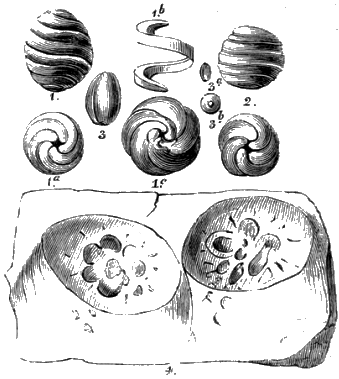
Lign. 66. Fossil Fresh-water Plants.
Eocene, Paris.
Fig. 1.— Seed-vessel of Chara helicteres × 10; side view. 1a.—View of the base of the same. 1b.—One of the spiral valves separated. 1c.—View from above.
2.— Seed-vessel of Chara medicaginula × 10. The upper figure is a side view: the lower, a view of the base.
3.— Carpolithes ovulum, magnified side view. 3a.—The same, natural size. 3b.—Magnified view of the base of the same.
4.— A piece of fresh-water limestone, with impressions of two stems of Nymphea arethusa ×.
The Purbeck beds at Durlstone Bay, near Swanage, also contain numerous Gyrogonites associated with fresh-water shells. The bands of siliceous sinter, which occur in the lowermost deposits, are especially rich in these remains.[172]
Fossil Nympheæ. Lign. 66, fig. 4.—Those magnificent aquatic plants, the Water-Lilies (Nympheæ), that adorn our rivers and lakes with flowers and foliage which partake more of the characters of an exotic flora than any other of our indigenous plants, are also found fossil in the lacustrine marls and limestones of the tertiary formations of France; but the nature of these remains could only be recognized by a profound botanist, for they consist of impressions of the internal structure of the stems, which, however, is so peculiar, that no reasonable doubt of their origin can be entertained. Two imprints on a piece of limestone from Lonjumeau, presented to me by the late M. Alex. Brongniart, are figured in Lign. 66, fig. 4; some minute seed-vessels (Lign. 66, fig. 3), found with them, closely resemble those of Nympheæ, and are supposed to belong to the same plants (Class. Vég. Foss. p. 72).
Fossil Flowers.—The tertiary limestones of Monte Bolca (Wond. p. 565), so rich in ichthyolites, and other fossil remains of great interest, contain leaves, and even flowers, of liliaceous plants. The specimen figured (Lign. 67, fig. 3) is in the Museum at Paris, and described by M. Brongniart under the name of Antholithes (stone-flower) liliaceus; it consists of the corolla and calyx: the anthers and pistils have not been observed in any example. The discovery of this fossil should excite the young collector to search diligently for such objects in the tertiary strata of England.
FOSSIL ANGIOSPERMS.
Fossil Angiosperms.—The fossil remains of the class which constitutes the grand features of the existing floras of most countries, the Exogenous Angiosperms, are now to be considered; and though our survey of fossil botany has partaken but little of a geological arrangement, yet the reader may have observed, that a large proportion of the vegetables composing the floras of the ancient secondary formations, belonged to the Cryptogamous and Gymnospermous classes. A striking contrast is presented in the geological position of the mineralized dicotyledonous plants, of existing genera. These abound in the tertiary strata, and generally in an inverse ratio to the antiquity of the deposit, while their remains are almost wholly absent in the older rocks; neither have there been discovered in the Tertiary, any beds of vascular cryptogamia, at all approaching the immense accumulations in the Carboniferous formations.
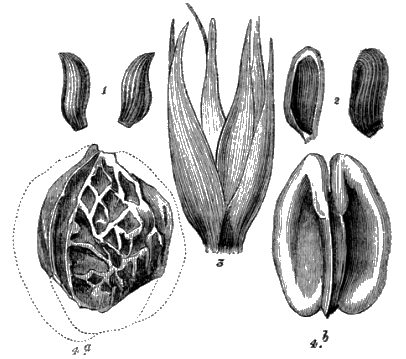
Lign. 67. Fossil Nuts, and Flower.
Fig. 1.— Thalictroides Parisensis; Tertiary strata, Paris.
2.— Thalictroides Websteri. Isle of Wight.
3.— Antholithes liliaceus. Monte Bolca.
4.— Juglans nux-taurinensis: fossil Walnut, Turin. 4a.—-Portion of the husk of the shell. 4b.—The kernel, formed of calcareous spar.
The most remarkable exception, is the single instance of a large leaf of a dicotyledonous plant in the Trias, or New Red sandstone, near Liverpool, described by Sir Roderick Murchison, which much resembles the foliage of a thick-ribbed Cabbage.[173]
It would be impossible, within the limits necessarily assigned to these volumes, to offer even a general view of the fossil remains of this grand class of vegetables; our remarks must be limited to a few interesting examples and localities.
When stems of dicotyledonous trees only are found, but little certainty can be obtained as to the family to which they belonged; the foliage of many well-known genera offer more positive characters; the flowers are rarely in a state of preservation to afford any valuable data; but the fruits, or seed-vessels, are frequently well preserved, and these may enable the botanist to arrive at precise determinations as to generic, and, perhaps, specific relations.
The tertiary marls of Aix, in Provence, which abound in insects, crustaceans, and lacustrine shells, contain many kinds of dicotyledonous leaves, associated with those of palms. (Wond. p. 260.)
The Lignite, or Brown-coal deposits, are almost entirely composed of dicotyledonous trees, belonging to many genera, which are inhabitants of Europe; namely, the Poplar, Willow, Elm, Chestnut, Walnut, Sycamore, Maple, Linden, Buckthorn, Vine, &c. (Bd. vol. i. pp. 508-514.)
The beds of brown coal, on the banks of the Rhine, are literally carbonized submerged forests, which in some remote period were drifted from the interior of the Continent into a vast lake or gulf; for the trees bear evident marks of transport, and are destitute of roots and branches. These masses resemble the rafts of forest trees, which are daily floated down the Mississippi into the Atlantic, where they become engulfed in the profound depths of the ocean, and probably will be converted into coal or lignite; and in future ages, may be elevated above the waters, become dry land, and present to the then existing communities of mankind an inexhaustible supply of mineral fuel, composed of species and genera of plants, which possibly may then be extinct, and replaced by peculiar types of vegetation.
Fossil Flora of Œningen. (Bd. pp. 511-514).—The celebrated lacustrine tertiary formation of Œningen, whose fossil reptiles and mammalia we shall have to notice hereafter, contains a rich assemblage of dicotyledonous and gymnospermous ligneous vegetables, with a few ferns and grasses. Not only branches and leaves of a species of Vine[174] occur, but even the fruit; fossil grapes being found in these deposits;[175] there are also many aquatic plants. A descriptive list of these fossils, by Professor Braun, of Carlsruhe, is given by Dr. Buckland. The brown-coal of this basin is in thin beds of but little economical importance, but so rich in the vegetation of the miocene tertiary period, that a few days spent in collecting those treasures will amply reward the intelligent tourist who may visit Constance. (See Wond. p. 263.)
FOSSIL DICOTYLEDONOUS LEAVES.
The foliage of dicotyledonous trees frequently occurs in the Eocene marls and limestones, and in some localities in considerable abundance, and in beautiful preservation. Near Bournemouth, on the Hampshire coast, the leaves of many species are met with in a bed of sandy marl, between three and four feet thick: the vegetable substance is carbonized; some of the leaves are referable to the Lauraceæ and Amentaceæ, others to the Characeæ;[176] a similar deposit of tertiary plants has been discovered near Wareham. These beds belong to the lower group of the Hampshire Basin.[177]
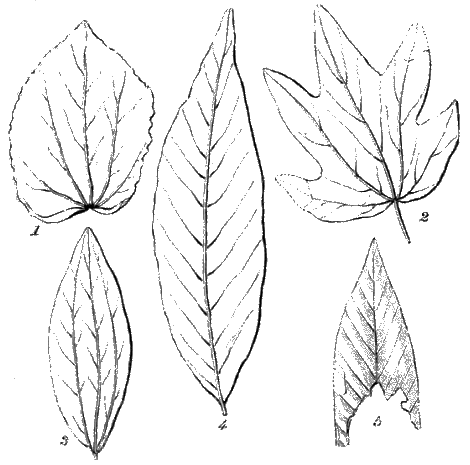
Lign. 68. Imprints of Dicotyledonous Leaves in Gypseous Marl.
Tertiary. Stradella, near Pavia.
Fig. 1.— Leaf of Poplar (Populus græca).
2.— ———– Maple (Acer).
3.— ———– Water-spike (Potamogeton).
4.— ———– Willow (Salix).
5.— ———– Chestnut (Æsculvs).
The red marlstone associated with lignite in the plastic clay beds at Castle Hill, Newhaven (Geol. S. E. p. 54), contains leaves of a similar kind; a seed-vessel of a coniferous tree has also been found in it.
Some of the most interesting examples of dicotyledonous leaves that have come under my notice, are from the Sub-Apennine tertiary strata, at Stradella, near Pavia. They belong to several genera of arborescent, or at least ligneous plants, and most of them to species which still grow in Italy. In some examples the substance of the leaves is changed into carbon, and the structure well preserved; but, in general, sharp imprints on the stone are the only traces of the originals. They are found in a gypseous marl, of a cream colour; and, from their perfect state, it is inferred that they were enveloped in the soft matrix immediately after their fall, and preserved by the rapid crystallization of the gypsum. Two specimens from my cabinet are figured in Plate III. figs. 4 and 8; and outlines of a few other examples, in Lign. 68.
Carpolithes (Fossil Fruits).—In the description of the fossil fruits from the Isle of Sheppey, several kinds of dicotyledons were included. Many species also abound in the lignites of Germany, France, and Italy; in those near Frankfort, seed-vessels of the Maple, Elm, Hornbeam, Birch, Willow, and Walnut, &c. In the environs of Turin, fruits of a species of Walnut (Juglans, Lign. 67), occur in the newer tertiary deposits, and are called Turin-nuts; the ligneous envelope has perished, but the form of its surface, and of the inclosed kernel, is preserved in calcareous spar. These nuts differ, both in the pericarp and kernel, from the living species: the lobes are simple (Lign. 67, fig. 4b), and not subdivided as in the common walnut; a species has been discovered at Lons-le-Saulnier, in which the lobes are mamillated.
Two kinds of fruits belonging to plants of the order Ranunculaceæ, and related to Thalictrum (Meadow-rue), have been found in the eocene deposits of France and England; one in the Paris basin, (meulière du terrain d'eau douce supérieur,) by M. Alexandre Brongniart, and the other in the Isle of Wight, by Mr. Webster. In the specimen from the last-named locality the pericarp is carbonized, and its cavity filled with clay. Figures of these seed-vessels are given in Lign. 67, figs. 1, 2.
Carpolithes Smithiæ.—I would notice in this place some very remarkable fossil fruits that are occasionally met with in the White Chalk of Sussex and Kent, and appear to belong to dicotyledonous trees. The first specimen was discovered by me in a chalk-pit near Lewes, and is described in my "Fossils of the South Downs:" some illustrative examples collected by Mrs Smith, of Tunbridge Wells, tending to elucidate the nature of the original more satisfactorily than those in my collection, are figured and described by me in the Journal of the Geological Society, 1843, under the above name. These fruits are of an oval form, about one and a half inch long, and one inch wide, and are pressed almost flat. They are of a rich burnt-sienna colour, mottled with white, from the chalk having permeated their substance, and are studded over with slight eminences, which are the exposed summits of oblong flattened seeds. Although the internal structure is not preserved, there can be no doubt that the originals were spurious compound berries, having, like the Mulberry, the seeds imbedded in a soft pulpy mass.
FOSSIL DICOTYLEDONOUS TREES.
Fossil Dicotyledonous Trees.—The occurrence of trunks and branches of angiospermous trees in a carbonized state has already been described; like the monocotyledons and conifers, they also occur silicified.
The most beautiful specimens I have seen are from the Lybian and Egyptian deserts, and were collected by my friend, the late Colonel Head. In these the most delicate vascular tissue is permeated by chalcedony and jasper, and the vessels are filled with silex of a bright vermilion and blue colour, while the cellular structure is of a rich yellow. Fragments of these fossil trees are scattered everywhere among the sands of the desert; the most interesting locality is an irregular plateau, which reposes on marine limestone, considerably above the level of the Nile, about seven miles east by south from Cairo. This district is called the petrified forest, from the immense quantities of silicified trees with which it is covered. It is thus graphically described by a late traveller:—
"Having passed the tombs of the Caliphs, just beyond the gates of Cairo, we proceed to the southward nearly at right angles to the road, across the Desert to Suez: and after travelling some ten miles up a low barren valley covered with sand, gravel, and sea-shells, fresh as if the tide had retired but yesterday, we cross a low range of sand-hills, which has for some distance run parallel to our path. The scene now presented is beyond conception singular and desolate. Heaps of fragments of large trees converted into stone everywhere meet the eye, and when struck by our horses' hoofs rang like cast iron; they extend for miles in the form of a decayed and prostrate forest; and the appearance is so natural, that were it in Scotland or Ireland, it would pass without remark as a drained bog, on which the exhumed trees lay rotting in the sun. The roots, and rudiments of the branches, are in many cases nearly perfect, and in some the worm-holes eaten under the bark are distinctly recognizable."[178]
Many of the trunks are scattered over the surface, among rolled and angular fragments of dark grit, and pebbles of jasper,[179] chert, and quartz. The large trunks occur in great numbers on dark-coloured knolls, where they lie, like the broken stems of a prostrate forest, crossing each other at various angles. Two of the largest measured respectively forty-eight, and sixty feet in length, and two and a half, and three feet in diameter, at the base. With but two or three exceptions, all the specimens examined microscopically, are dicotyledons. No traces of seed-vessels or leaves have been detected.
The situation and condition of these petrified forests, indicate great changes in the relative position of the land and sea in that part of Egypt; for the trees must have grown on the dry land formed by the elevated bottom of a former ocean; which must have subsided, and been covered by beds of sand and pebbles; another elevatory movement must have raised the entire series of deposits to their present situation, and the retiring waters have removed the loose portions of the last formed strata, and dispersed them, with fragments of the silicified trees, over the surface of the Egyptian and Lybian deserts.[180]
DICOTYLEDONOUS OF THE CRETACEOUS EPOCH.
Dicotyledons of the Cretaceous Epoch.—Among the crowd of interesting facts relating to the botanical character of the earlier periods of geology which recent observations have brought to light, one discovery demands especial notice, and I have reserved it for this place, rather than introduce it in an earlier section.
In the neighbourhood of Aix-la-Chapelle the lower members of the Cretaceous formation, viz. the Greensand, Galt, and Chalk-marl, are well developed, and comprise a series of littoral deposits of the great Chalk ocean that extended westwardly between France and England, on both sides of the existing Channel, and eastwardly over North and Central Germany, Sweden, Poland, and Russia, far into Asia. The series of strata at Aix-la-Chapelle is several hundred feet in thickness, and the lowermost beds lie immediately on the Carboniferous rocks of the country.
Dr. M. H. Debey,[181] to whose scientific labours we are indebted for an accurate knowledge of these interesting facts, divides these cretaceous deposits into four groups, the lowermost of which appears to be the equivalent of our Greensand; it consists of beds of clay and sand, the middle portion abounding in stems, leaves, and fruit, and the resin of coniferous trees.
The epidermis of the leaves often occurs in a carbonized state, and is recognizable by its microscopic structure. Xylophagous mollusks are found in the petrified and carbonized wood. Fresh-water Desmidiaceæ, and a few marine remains, are associated with this fossil flora, which is distinguished by the abundance of Ferns and dicotyledonous leaves, and the scarcity of Cycads; among them are undoubted Proteaceæ.
The specimens collected by M. Debey from the lower cretaceous beds are the following:
Algæ, 15. Filices, 28. Hydropteridæ, 2. Cycadeæ, 5. Naiadeæ, 5. Palmæ, 1. Coniferæ, 20. Julifloræ, 5. Credneriæ, 3. Leaves of Dicotyledons, undetermined, 26. Fruits undetermined, 8. Woods.[182]
This assemblage of angiosperms, with gymnosperms, and cryptogamia, at the commencement of the Cretaceous epoch, when the Iguanodon and other reptilian forms of the Oolite and Wealden still inhabited the land and water, proves, as Sir Charles Lyell has remarked,[183] that the meteorological phenomena of that remote period differed in no essential particular from those which now prevail.
RETROSPECT OF FOSSIL BOTANY.
RETROSPECT OF FOSSIL BOTANY.
If we pass from the consideration of details of structure, and of botanical affinities, to a general survey of the mineralized remains of the vegetable kingdom, we perceive that from the palæozoic deposits, to those which are contemporaneous with the human race,—from the coal-measures to the peat-bogs of modern times,—vast accumulations of vegetable matter, in various states of carbonization, have been produced from the imbedded relics of the terrestrial floras that flourished during the respective periods of their formation; petrifaction, or the transmutation of vegetable tissues into stone, from the infiltration of siliceous, calcareous, or metallic solutions, being an accidental process, dependent on the physical conditions under which the trees and plants were submerged, and entombed in the strata.
Although the entire system of vegetable life which prevailed during the earlier ages of the world is but partially revealed by the fossil remains which geological researches have brought under the examination of the naturalist,—for numerous tribes of plants may have existed of which no traces have been detected, while of species of delicate tissues all vestiges may have perished,—yet a review of the facts hitherto obtained, presents some highly important and unexpected results, as to the characters of the successive floras which prevailed during the palæozoic, secondary, and tertiary epochs. And though deductions of this nature must, in the present state of our knowledge, be regarded in the light of shifting hypotheses to be modified or abandoned with the progress of discovery,—yet the predominating types which characterize the flora of one system of formations, differ so essentially from those of another, that it may be reasonably inferred such apparent distinctions are the effect of organic laws, and not illusions arising from our misinterpretation of the natural records of former conditions of the vegetable world.
The absence in the most ancient deposits of the entire class of Angiosperms, or flowering plants, which constitutes the leading features of the floras with which we are familiar,—the abundance of unknown types of Cryptogamia, and the extinction or disappearance of those tribes in the succeeding formations, and the prevalence of new species and genera belonging to another class;—the predominance in one flora, both in number and variety, of certain tribes, and their decadence in the next period; while a family subordinate in the antecedent epoch, and known but by a small number of species, suddenly acquires a pre-eminence both in numbers and variety;—are phenomena, which the facts brought before us in the course of this argument, present in a striking point of view.
Assuming these data as the basis of a philosophical generalization, M. Brongniart arranges the known species of fossil plants into three grand systems, which correspond with the great geological periods, comprehended in the palæozoic, secondary, and tertiary formations.
The first or most ancient flora is characterized by the predominance of Cryptogamic Acrogens—the Ferns and Club-mosses; the second by the large development of the Dicotyledonous Gymnosperms—the Cycads and Conifers: the third by the appearance and prevalence of the Angiosperms, both dicotyledonous and monocotyledonous. The following table presents a concise view of the results of M. Brongniart's investigation.[184]
CHARACTER OF THE FLORAS. GEOLOGICAL EPOCHS.
I. Règne des Acrogènes; the Flora of Vascular Cryptogamia. } The Devonian, Carboniferous, and Permian, Formations.
II. Règne des Gymnospermes; the Flora of Cycadaceæ and Coniferæ. } The Triassic, Jurassic (or Lias and Oolite), and Wealden, Formations.
III. Règne des Angiospermes. Flora of Dicotyledonous and Monocotyledonous flowering plants, or Angiosperms. } The Cretaceous, and Tertiary (Eocene, Miocene, and Pliocene), Formations.
It must be observed that this table is only designed to indicate the successive predominance of each of the three classes of the vegetable kingdom, in the respective epochs, and not the entire exclusion of the others. Thus, in the two first, both Acrogens and Gymnosperms existed; but in the first period the former greatly exceeded the latter, both in number and magnitude; while in the next the Gymnosperms acquired the ascendancy; but in both these epochs, from the Devonian to the Wealden inclusive, very few if any Angiosperms, or flowering dicotyledons, existed. With the Cretaceous period the Angiosperms appear in great numbers, and in the Tertiary epochs acquire the importance they possess in the existing floras.
The following analysis of the flora of the Carboniferous epoch, by M. Brongniart, will exemplify these remarks.[185]
ANALYSIS OF THE CARBONIFEROUS FLORA
Cryptogamia (Amphigens). Algæ 4
Champignons 6
—– 6
(Acrogens). Ferns 250
Lycopodiaceæ (Club-mosses) 83
Equisetaceæ 13
—– 346
Dicotyledonous Gymnosperms. Asterophyllites 44
Sigillariæ 60
Nœggerathiæ 12
Cycadeæ? 3
Coniferæ 16
—– 135
Dicotyledonous Angiosperms 0
Monocotyledons? (very doubtful) 15
—–
502
—–
Thus out of five hundred species, 352 are Cryptogamia; and with the exception of six, belong to the Acrogens.[186]
In conclusion, I must direct attention to a remarkable character of the palæozoic and secondary floras, namely, the almost entire absence of the Gramineæ or Grasses, which constitute so large a proportion of the existing vegetation.
Above six hundred species of plants have been discovered in the British strata;[187] and yet two species of Poa (a tribe of grasses), from Coalbrook Dale, are the only known examples of Gramineæ. It has been suggested that the greater or lesser durability of the foliage of certain vegetables, may have occasioned their presence or absence in the carboniferous deposits, and experiments were instituted by Dr. Lindley with the view of determining this question. But though it was found that, when the foliage of various families was subjected to long maceration, the leaves of dicotyledons and grasses disappeared, while those of ferns and cycads remained, this fact does not meet the exigencies of the case, for we have no evidence to show that the fossil leaves were ever placed in similar conditions; on the contrary, there is reason to conclude that they were imbedded under circumstances that arrested the usual progress of decomposition, prevented the escape of the hydrogen and other gaseous elements, and gave rise to the bituminous fermentation by which they were converted into lignite and coal; and we have no proof that, had grasses been associated with the ferns, they would not have undergone a similar change. Moreover, there are countries in which the ferns now assume the numerical proportion of the grasses of other latitudes; for example. New Zealand, which also presents in its fauna a striking analogy to that of the carboniferous deposits, in the almost entire absence of indigenous mammalia; one species of Rat being the only known living quadruped.
On this subject Dr. Dieffenbach remarks, that "although in its flora New Zealand has some relationship with the two large continents between which it is situated, America and Australia, and even possesses some species identical with those of Europe, without the Latter being referable to an introduction by Europeans, yet the greater number of species, and even genera, are peculiar to it. New Zealand, with the adjacent islands, Chatham, Auckland, and Macquarrie, forms a botanical centre. It is sufficiently distant from both continents to preserve its botanical peculiarities, and it offers the most striking instance of an acknowledged fact in all branches of natural history, viz. that the different regions of the globe are endowed with peculiar forms of animal and vegetable life. The number of species of plants at present known is 632, of which 314 are dicotyledonous, and the rest, or 318, are monocotyledonous and cellular. The monocotyledons are few in comparison with the cellular plants, for there are but seventy-six species. The grasses have given way to ferns, for the ferns and fern-like plants are by far the most abundant in New Zealand, and cover immense districts. They replace the Gramineæ of other countries, and give a character to all the open land of the hills and plains. Some of the arborescent kinds grow to thirty feet and more in height, and the variety and elegance of their forms, from the minutest species to the most gigantic, are very remarkable."[188] In the accumulations of vegetable matter now in the progress of formation in the morasses, bays, and creeks of New Zealand, the remains of ferns largely predominate; and I am informed by my son,[189] that in the estuaries they are associated with numerous shells of brachiopodous mollusca.
ON COLLECTING BRITISH FOSSIL VEGETABLES.
ON COLLECTING FOSSIL VEGETABLES.
From what has been advanced, the student will perceive that to obtain an illustrative collection of the fossil plants of Great Britain, many different localities must be visited.
The fruits and stems of Palms, Conifers, and many dicotyledons, may be collected in the Isle of Sheppey, and other places where the London Clay is exposed. (See Excursion to the Isle of Sheppey, Part IV.) Cycadeous stems and coniferous wood may be procured in the Isle of Portland; from the Wealden Cliffs along the southern shore of the Isle of Wight; and on the Sussex coast, from Bexhill, by St. Leonard's, to the east of Hastings. The foliage of several species of Zamiæ and ferns, occur abundantly in the lower Oolite, along the Yorkshire coast, near Scarborough, and at Gristhorpe Bay. The Lias of Lyme Regis, Charmouth, and their vicinity, affords stems and branches of coniferous trees, and leaves of cycads.
Ferns, Sigillariæ, Calamites, and the usual plants of the carboniferous flora, may be found in every coal-mine; and the Devonian limestones of the South of Ireland yield ferns and Lepidodendra. In Forfarshire the lower Devonian shales abound in the foliage of aquatic, apparently fluviatile, plants.[190]
A list of some of the most productive British localities is subjoined.
In addition to the suggestions already given as to the mode of collecting specimens, it may be necessary to state that the leaves in the tertiary marls and clays are generally very delicate and friable, and liable to flake off in the state of a carbonaceous film. This may, in a great measure, be prevented by carefully covering them with a thin coating either of mastic varnish, or gum-water, before they are placed in the cabinet. In extracting these specimens, a broad chisel will be found the most convenient instrument. In searching for fossils in coal-mines, the collector should remember that the ironstone nodules often contain beautiful examples of the leaves of ferns, and fruits of Lepidodendra. These nodules, when of an oblong shape, should be split open in a longitudinal direction, by a smart blow of a hammer, and the inclosed leaf will thus be exposed, as shown in Lign. 3, figs. 2, 3, ante, p. 69.
BRITISH LOCALITIES OF FOSSIL VEGETABLES.
BRITISH LOCALITIES OF FOSSIL VEGETABLES.
Allenbank, Berwickshire Carb. Stems of Conifers, &c.
Alum Bay, Isle of Wight Tert. Fruit, dicotyledonous leaves, lignite; Charge, stems and seed-vessels.
Ashby-de-la-Zouch, Leicestershire Carb. Coal plants in great abundance.
Bignor, Sussex Cret. Firestone Fucoids.
Binstead Quarries, near Ryde, Isle of Wight Tert. Charæ, stems and seed-vessels.
Blackdown, Devonshire Gr. Sand. Silicified wood—coniferous.
Bognor, Sussex Tert. Coniferous and monocotyledonous wood; washed up on the shore.
Bolton, Lancashire Carb. Lepidodendra, Sigillariæ, &c.
Bournemouth, Hants Tert. Dicotyledonous leaves.[191]
Brook-point, Isle of Wight Wealden Cycads, and coniferous wood.
Burdie House, near Edinburgh Carb. Ferns, wood, &c.
Calbourn, Isle of Wight Tert. Charæ, stems and fruits.
Camerton, near Bath Carb. Usual plants of the coal.
Charmouth, Dorset Oolite Coniferous wood; Cycads; fruit of Pandanus.
Clifton, near Manchester Carb. Coal plants in great perfection.
Coalbrook Dale, Shropshire Carb. Usual plants of the coal, in abundance. The ironstone nodules are rich in fern-leaves, fruits of lepidodendrons, &c.
Cuckfield, Sussex Wealden Clathraria, Endogenites, Ferns, and Lignite.
Durlstone Bay, near Swanage Wealden Charæ; Gyrogonites in abundance.
Folkstone, Kent Galt Coniferous wood—bituminous, and pyritified.
Glasgow Carb. Coal plants, and large trunks of Coniferæ.
Hastings, Sussex Wealden Clathrariæ, Cycads, Endogenites, Ferns, Thuites, &c.
Herne Bay, Kent London Clay Fruits of Conifers, and Palms: wood.
Kilkenny, Ireland Carb. Calamites, ferns, &c.
Knocktopher, nr. Kilkenny, Ireland Devonian Ferns, Lepidodendrons, &c.
Leeds Carb. Beautiful coal-plants from the pits in the vicinity.
Liverpool New Red Fuci.
Lyme Regis, Dorset Lias Cycads; Conifers; wood.
Maidstone, Kent Greensand Fruits and wood of Abies, Pinus, Dracæna; Fuci.
Malton Oolite Fruits, and Cycads.
Newcastle (Jarrow Colliery) Carb. Coal plants in great variety.[192]
Newhaven (Castle Hill), Sussex Tert. Dicotyledonous leaves and fruit—rarely.
Portishead (on the shore) Millstone Grit Sigillariæ, Stigmariæ, &c.
Portland, Isle of Wealden Petrified forest of Conifers, with Cycads.
Pounceford, Sussex Wealden Equiseta, Ferns, Lignite.
Runswick, Yorkshire Coast Lower Oolite Cycads, Ferns, &c.
Saltwick, near Whitby Lower Oolite Foliage of Cycads, Ferns, &c.
Sandown Bay, Isle of Wight Wealden Conifers, Cycads, wood.
Scarborough Oolite Ferns, Cycads, Equiseta, &c.
Selmeston, Sussex Greensand Coniferous wood.
Sheppey, Isle of London Clay Fruits innumerable, wood, &c. (ante, p. 186.)
Stonesfield, Oxfordshire Oolite Fuci, Cycads, Thuites, &c.
Swindon, Wilts Oolite Coniferous wood, & Cycads.
Tunbridge Wells (vicinity) Wealden Ferns, several species.
Ventnor, Isle of Wight Firestone Clathraria, Conifers.
Wareham, Dorset Tert. Dicotyledonous foliage, and Palm-leaves.
Whitecliff Bay, I. of Wight Tert. Palm-leaves, Charæ, &c.
Whitwick, Leicestershire Carb. The usual coal-plants.
The above list must, of course, be considered as merely suggestive: many other localities are mentioned in the previous notices of the fossil genera.