Volume 1 / Part 2 — CHAPTER VI.
Reading edition
FOSSIL VEGETABLES.
In the present section of this work, I propose to explain the botanical arrangement and nomenclature of fossil plants; and figure and describe one or more species of the genera that are most likely to come under the observation of the student, either in public or private collections, or in the course of his researches in the field.
To determine the botanical relations of fossil leaves and stems, reference must be had to works expressly devoted to the subject; namely, the "British Fossil Flora," by Dr. Lindley and Mr. Hutton, and the "Histoire des Végétaux Fossiles," by M. Adolphe Brongniart. The classification of the last-named eminent botanist is here adopted, as the most easy of application.
With regard to the nomenclature, it may be necessary to remark, that when a fossil plant undoubtedly belongs to a recent genus, the usual botanical name is employed: for example, Equisetum Lyellii; when the fossil does not possess all the generic characters, yet is evidently allied to a recent genus, the term ites (from λιθος, lithos, stone), is added—as Equisetites, Palmacites, &c.; and this termination is invariably adopted by some authors. When the fossil plant differs altogether from any known type, it is distinguished by some arbitrary generic name, as Bucklandia, Sigillaria, &c.
There are also a few provisional genera for the reception of fossil leaves, fruits, and stems, whose characters and relations are but imperfectly known; as Carpolithes, Endogenites, &c. Upon these principles the present arrangement has been founded: the progress of discovery will, of course, be continually adding to the list, and the classification require to be modified.
FOSSIL CRYPTOGAMIA.
The following account of the principal types of the ancient floras whose relics are preserved in the mineral kingdom, though commencing with those of the most simple structure, the Cryptogamia, and advancing to the higher orders, is not strictly botanical; for it was found convenient, in some instances, to notice certain species and genera of different orders under the same head, from their occurrence in the same geological formations.
It is estimated that not more than two thousand species of plants have been discovered in a fossil state, while the known recent species amount to upwards of eighty thousand.
Cellular Cryptogamia; Algæ.—The plants designated by botanists Algæ, and commonly known as sea-weeds, lavers, and fresh-water mosses, are of the most simple structure—mere aggregations of cells—but present innumerable varieties of form and magnitude: many species are mere vesicles of such minuteness as to be invisible to the unassisted eye, except accumulated in countless myriads, when they appear as a green, purple, or reddish, slime in the water; or as a film on wood or stone, or on the ground, in damp situations; while others are tough branched marine plants, many fathoms in length.
The Algæ form three principal groups: 1. the jointless, as the Fuci, the Dulses, Tangles, and Lavers: 2. the jointed, which are composed of thread-like articulated tubes; such are the fresh-water Confervæ: 3. the disjointed, or Brittle-worts, so called from their spontaneous self-division, which is in some kinds complete, in others only partial; and these, by separating transversely, and leaving each cell or frustule attached at the angles, produce those beautiful chains of angular green transparent cases, so constantly seen under the microscope when substances from fresh-water streams or lakes are submitted to examination.
As many of these forms are endowed with spontaneous motion, and possess other properties common to animal organization, it is not surprising that their vegetable nature was doubted, and that even so profound a naturalist as M. Ehrenberg placed them in the animal kingdom: the greater number being comprised in his family of Bacillariæ, were described in the former edition of this work, as Infusoria or Animalcules; in conformity with the classification of the illustrious microscopist, whose splendid works and indefatigable labours have so greatly promoted the advancement of microscopical investigation.[61]
FOSSIL DIATOMACEÆ.
These minute vegetable organisms are placed by botanists in two tribes, the Diatomaceæ or the Brittle-worts, and the Desmidieæ. The latter are exclusively inhabitants of fresh-water, while a large proportion of the former are marine plants. Some naturalists (M. Brébisson) restrict the name Diatomaceæ to those species which secrete siliceous envelopes; and that of Desmidieæ to those whose structures are not siliceous, and are reducible by heat to carbon. As the durable parts of these plants alone concern the geologist, the name Diatomaceæ will be employed as a general term in reference to their fossil remains.
These tribes of Algæ abound in every lake and stream of fresh-water, in every pool or bay, and throughout the ocean from the equator to the poles. Certain kinds of sea-weeds secrete carbonate of lime; but the Diatomaceæ have the power of separating silex, or the earth of flint, from the water, by some unknown process, and their tissues are composed of pure quartz: hence, under the microscope, their remains, consisting wholly of rock crystal, exhibit the most exquisite forms, elaborately fretted and ornamented (see Lign. 4). After the death and decomposition of these plants, their durable frustules or cases appear as colourless discs, cups, spheres, shields, &c., and these accumulate at the bottom of the water in such inconceivable numbers, as to form strata of great thickness and extent. Slowly, imperceptibly, and incessantly, are the vital energies of these atoms separating from the element in which they live the most refractory and enduring of mineral substances, silex, and elaborating it into imperishable structures, and thus adding enormous contributions to the accumulations of detritus, which make up the sedimentary rocks of the crust of the globe.
The extent of this infinitesimal flora throughout regions where no other forms of vegetation are known, is strikingly demonstrated by the observations of our eminent botanical traveller. Dr. Joseph Hooker, in his account of the Antarctic regions.[62]
"Everywhere," Dr. Hooker states, "the waters and the ice alike abound in these microscopic vegetables. Though too small to be visible to the unassisted eye, their aggregated masses stained the iceberg and pack-ice wherever the latter were washed by the sea, and imparted a pale ochreous colour to the ice. From the south of the belt of ice which encircles the globe, to the highest latitudes reached by man, this vegetation is everywhere conspicuous, from the contrast between its colour and that of the white snow and ice in which it is imbedded.
"In the 80° of south latitude all the surface ice carried along by currents, and the sides of every berg, and the base of the great Victoria barrier itself—a perpendicular wall of ice, from one to two hundred feet above the sea level—were tinged brown from this cause, as if the waters were charged with oxide of iron. The majority of these plants consist of simple vegetable cells enclosed in indestructible silex; and it is obvious that the death of such multitudes must form sedimentary deposits of immense extent.
"The universal existence of such an invisible vegetation as that of the Antarctic Ocean is a truly wonderful fact, and the more so from its being unaccompanied by plants of a high order. This ocean swarms with mollusca, and entomostracous crustaceans, small whales, and porpoises; and the sea with penguins and seals, and the air with birds; the animal kingdom is everywhere present, the larger creatures preying on the smaller, and these again on those more minute; all living nature seems to be carnivorous. This microscopic vegetation is the sole nutrition of the herbivorous animals; and it may likewise serve to purify the atmosphere, and thus execute in the Antarctic latitudes the office of the trees and grasses of the temperate regions, and the broad foliage of the palms of the tropics."
Dr. Hooker also remarks that the siliceous envelopes of the same kinds of diatomaceæ now living in the waters of the South Polar Ocean, have contributed in past ages to the formation of European strata; for the tripoli and the phonolite stones of the Rhine, contain the siliceous envelopes of identical species.
Such are the comments of one of our most distinguished botanists, on the phenomena under review. The reader will perhaps ask, what then are the essential characters which separate the animal from the vegetable kingdom? To this question it is impossible to give a satisfactory reply: perhaps the only distinction that will be generally admitted by zoologists and botanists is the following:—animals require organic substances for their support; vegetables derive their sustenance from inorganic matter.
RECENT DIATOMACEÆ.
Recent Diatomaceæ. Plate IV.—To familiarize the reader with the nature of these vegetable organisms, a few recent species are represented in Plate IV., coloured as they appear when alive, under the microscope; the figures are magnified as expressed by the fractions.
Xanthidium. Plate IV. figs. 1, 2, 3, 4, 5.—The case or frustule of this genus consists of a hollow, siliceous globe, beset with spines. The increase of the Xanthidia by self-division, produces the double appearance in the figures, all of which are in the progress of separation.[63]
Pyxidiculum. Plate IV. fig. 2.—The case is a little saucer-shaped box, and is invested by a membrane.
Bacillaria. Plate IV. fig. 6.—A simple siliceous frustule, of a prismatic shape, forming a brilliant chain, which often appears in zigzag, in consequence of incomplete self-division. An immense number and variety of forms are placed in this family by Ehrenberg, with a multitude of generic and specific names. The fresh-water species inhabit every pond and lake, and the marine every sea. Fossil species are equally abundant.
Cocconeis. Plate IV. fig. 7.—This is a very elegant type; the frustule consists of a simple siliceous case, with a central opening; it never occurs in chains like the former. It has been found fossil near Cassel.
Navicula. Plate IV. figs. 8, 9, 14, 15.—The plants of this genus are free, and float in the water apparently by the agency of cilia. Their case is a boat-like envelope with six openings, composed of pure silex, and in many species is exquisitely ornamented. Figs. 8 and 9. show a living Navicula, viewed in front, and in profile: in fig. 9 are represented the currents produced when the body is moving through the water; after Ehrenberg. Fossil Naviculæ abound in many tertiary strata.
Galionella. Plate IV. figs. 10, 11.—These algæ are free, and the frustules of a cylindrical, globular, or discoidal form; they occur in chains, in consequence of the self-division being imperfect, and the new individuals remaining attached to the old. The Galionellæ are most abundant and prolific, and inhabit every pool, stream, and lake: fossil species occur in the Virginian marls, and other strata.
Synhedra. Plate IV. fig. 12.—The frustules are siliceous, and of a slender, elongated form. The plant is attached by the base (fig. 12 a.) in youth, and afterwards becomes free. It is found fossil in the Mountain-meal of Santa Flora, and many other deposits.
Podosphenia. Plate IV. fig. 13.—The frustule is cruciform, or wedge-shaped, and attached in youth by the small end, but afterwards becomes free. These plants are often arranged in clusters, as in the figure. M. Ehrenberg states that they inhabit the sea, and not fresh-water; but I have found them in streams communicating with the Thames. Podospheniæ abound in the polishing slate of Bilin.
Eunotia. Plate IV. figs. 16, 17.—The frustule is siliceous, and either simple or bivalve; flat below, and convex, and often richly dentated above. An empty case is shown fig. 16; and a group of living Eunotice attached to a stem of conferva, fig. 17. Several fossil species have been discovered at Santa Flora.
That the general reader, whose attention is for the first time directed to this subject, may be prepared for the enormous deposits of fossil diatomaceæ that are found in some formations, I subjoin the observations of Dr. Bailey on an elegant fragile species, which hangs together in clusters, appearing like spiral chains, and is about 1/20 of a line in diameter; it is named Meridion vernale.
"This fresh-water plant is seen in immense quantities in the mountain brooks around West Point, the bottoms of which are literally covered in the first warm days of spring with a ferruginous-coloured mucous matter, about a quarter of an inch thick, that, on examination by the microscope, proves to be filled with millions and millions of these exquisitely beautiful siliceous organisms. Every submerged stone, twig, and spear of grass, is enveloped by them; and the waving plume-like appearance of a filamentous body covered in this manner, is often extremely elegant. Alcohol completely dissolves the endochrome (soft colouring matter) of this species, and the frustules are left as colourless as glass, and resist the action of fire."[64]
The yellow or ochreous scum observable in ponds, ditches, and stagnant pools, is an aggregation of diatomaceæ, whose frustules are feriniginous, and of such extreme minuteness, that a billion of their cases would not be more than a cubic inch in bulk.[65]
Fossil Diatomaceæ.—From this notice of a few recent types, we proceed to the investigation of the fossil remains of this tribe of Algæ.
In peat-bogs and swamps, both of modern and ancient date, masses of a white marly or siliceous paste (hydrate of silica), are often observed, and these are found upon microscopical observation to be wholly made up of the frustules of Naviculæ, Bacillariæ, Galionellæ, &c., with an intermixture of the needle-like spicules of fresh-water sponges. Many of the peat-bogs of Ireland contain layers of a white earthy substance, which, when dry, is of the appearance and consistence of friable chalk, and entirely consists of the siliceous cases of various kinds of diatomaceæ.
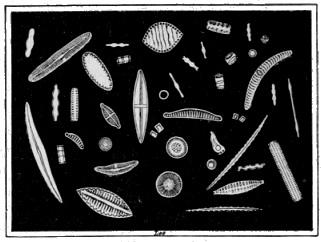
Lign. 4. Siliceous Frustules of Diatomaceæ, and Spicules of Spongillæ; from a deposit on the banks of the river Bann, Ireland. (Seen by transmitted light, and highly magnified.)
FOSSIL DIATOMACEÆ OF IRELAND.
Fossil Diatomaceæ from Ireland, Lign. 4.—Dr. Drummond describes a bed of this kind near the base of the Mourne Mountains, in the County of Down, Ireland. It consists of a very light white substance, resembling in appearance carbonate of magnesia: it has a coarse and somewhat fibrous fracture, and is easily reduced to powder. It is almost entirely siliceous, and is composed of the cases of diatomaceæ of the usual fresh-water species, without any admixture of inorganic matter.[66]
On the banks of the river Bann, in the same county, there is an extensive stratum of a similar earth, and which, from being in much request for polishing plate, is locally known as Lord Roden's plate powder. This earth is wholly made up of the siliceous frustules of many kinds of this tribe of Algæ, and a few grains under the microscope yield a great variety of exquisite forms: figures of several are given in Lign. 4, from specimens of this earth, with which I was favoured by the Countess of Caledon. They comprise two or three species of Navicula, Galionella, Coscinodiscus, Gomphonema, Bacillaria, Stauroneis, &c., and spicules or spines of fresh-water sponges.[67]
Beds of siliceous marl—that is, of argillaceous earth combined with a large amount of minute particles of silex, all of which prove to be organisms when examined by a high magnifying power,—have been found in numerous places not only in England, but all over the world, since M. Ehrenberg first directed attention to their nature and origin.
Near Bryansford (Newcastle), Binstwick in Holderness, and in the Fens of Lincolnshire and Cambridgeshire, extensive fresh-water microphytal deposits have been discovered and examined.
From our Antipodes I have received many examples of these vegetable earths. My eldest son, Mr. Walter Mantell, discovered an extensive bed of white marl on the banks of the great brackish-water lake of Waihora, in the middle island of New Zealand, consisting entirely of frustules of Bacillariæ. From New Plymouth he obtained some new and exquisite forms of Navicula, Stauroneis, &c.; ranges of low hillocks of sand, of considerable extent, being made up of microphytes (microscopic plants).[68]
Mr. Dean, of Clapham Common, informs me that a large quantity of white earth sent from New Zealand as native magnesia, he found to consist wholly of frustules of diatomaceæ, chiefly of Galionellæ. (See Lign. 5.)
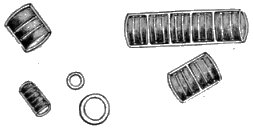
Lign. 5. Fossil. Galiomellæ; highly magnified.
In America, recent beds of this kind of great extent have been observed and examined by that distinguished microscopist, Dr. Bailey, Professor of Chemistry in the Military Academy at West Point: and the pages of that excellent scientific periodical, Silliman's American Journal of Science, are enriched with figures and descriptions of the microphytes of which they are mainly composed.
But the Tertiary formations contain strata of this nature, which far surpass in the abundance and variety of their organic contents, any of the modern deposits we have noticed. The Polierschiefer, or polishing-slate of Bilin, is stated, by M. Ehrenberg, to form a series of strata fourteen feet in thickness, entirely made up of the siliceous shells of Galionellæ, of such extreme minuteness, that a cubic inch of the stone contains forty-one thousand millions. The Berghmehl (mountain-meal, or fossil farina), of San Flora, in Tuscany, is one mass of these organisms.
In Lapland a similar earth is met with, which, in times of scarcity, is mixed by the inhabitants with the ground bark of trees, for food; some of this earth was found to contain twenty different species of algæ.
In the district of Soos, near Egra, in Bohemia, a fine white infusorial earth occurs, about three feet beneath the surface; this substance, when dried, appears to the naked eve like pure magnesia, but under the microscope is seen to be mainly constituted of elegant disciform cases of a species of Campilodiscus, of which figures are given, Lign. 111, figs. 1, 2.
Some beds of porcelain-earth M. Ehrenberg found to be in a great measure made up of concentric articulated rings, entire and in fragments (see Lign. 6), which he believes to be bacillariæ.
FOSSIL DIATOMACEÆ OF VIRGINIA.
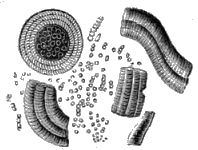
Lign. 6 Organic Bodies in Porcelain Earth; highly magnified.
Fossil Diatomaceæ of the Richmond-earth; Virginia.—The town of Richmond, in Virginia, is built on strata of siliceous marl of great extent, which earth; highly magnified. have a total thickness, beneath and around the town, of more than twenty feet. These marls, whose organic composition was first detected by Professor W. B. Rogers, are referred by that eminent American geologist, to the older tertiary (eocene, or miocene) formations. They occupy considerable districts, spreading out into sterile tracts along the flanks of the hills, their siliceous character rendering them unfavourable to vegetation. The investigations of Dr. Bailey have shown that the frustules so abundant in this earth, consist of several species of Navicula (Lign. 1, fig. 1, 1a.), Galionella (Lign. 1. fig. 3, 3a.), Actinocyclus (Lign. 1, figs. 4, 5), &c.
The most remarkable forms are disciform frustules, having their surfaces elaborately ornamented with hexagonal spots disposed in curves, and bearing some resemblance to the engine-turned case of a watch. Lign. 7, fig. 2, is a small segment of a disc, very highly magnified. These frustules vary in size from 1/100 to 1/1000 of an inch in diameter; they are named Coscinodiscus (sieve-like disc), and there are several species: one less richly sculptured, C. patina, is figured Lign. 7, fig. 6. Circular bodies, with five or six lines radiating from the centre to the circumference, like the spokes of a wheel, hence named Actinocyclus (Lign. 7, figs. 4, 5), and spicules of Sponges, are also abundant.
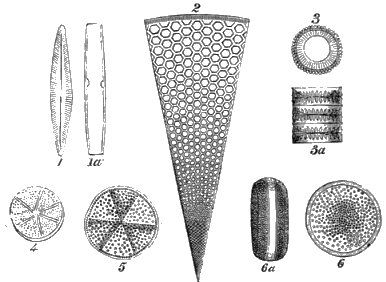
Lign. 7. Microphytes
from the Richmond-earth
;
highly magnified
.
Tertiary. Virginia.
Fig. 1.— Navicula. 1a. Side view.
2.— Coscinodiscus radiatus; a portion of the circular shield.
3.— Galionella sulcata; the upper figure shows the transverse face of one of the frustules. 3a.—Three united cells viewed laterally.
4, 5.— Actinocyclus. Two species.
6.— Coscinodiscus patina; transverse view. 6a. Lateral view.
When a few grains of the marl are prepared, and mounted on a glass, almost all these varieties will be manifest, so largely is this earth composed of organic structures; in fact, very few inorganic particles are intermixed, the merest pellicle left by the evaporation of a drop of water in which some of the marl has been mixed, teeming with the most beautiful structures.
At Petersburg, in Virginia, a sandy marl occurs, interstratified with deposits which, from their shells, are referred to the older tertiary formations. Probably this marl is a continuation of that of Richmond, but it is full of many new forms, associated with those common in the earth of the latter locality.[70]
It is an interesting fact, (first observed by Mr. Hamlin Lee,) that the common Scallop (Pecten maximus), as well as the Barnacle (Balanus), feed on diatomaceæ, and their stomachs generally contain numerous cases of Coscinodisci, Dichtyochi, Actinocycli, &c.: a slide prepared and mounted with the contents of the stomachs of these mollusks, presents an assemblage of forms identical with those found in the tertiary earths of Virginia.[71]
In the mud of the quicksands on the shore at Brighton, Mr. Reginald Mantell found recent Coscinodisci, &c. associated with fossil polythalamia that had been washed out of the chalk, and precipitated with the frustules of the recent diatomaceæ, into the sediments now in progress.
The prevalence of marine and fresh-water forms in the same deposit is not unusual; and the remarks of Dr. Bailey on this fact are so pertinent, that I insert them, as a salutary caution against hasty generalizations on subjects connected with these investigations. After describing a species of Galionella (G. moniliformis), as an inhabitant only of salt and brackish water, and stating that he had also found it sixty miles up the Hudson River, near West Point, Dr. Bailey observes—"The Fauna and Flora of the Hudson at this place would, if in a fossil state, be rather puzzling to the geologist, on account of the singular mixture of marine and fluviatile species. While Valisneria and Potamogeton (two common fresh-water plants), grow in such vast quantities, in some places, as to prevent the passage of a boat, and the shore is strewn with fluviatile shells (such as Planorbis, Physa, &c.) in a living state, yet the above plants are entangled with Algæ (sea-weeds), and marine parasitic zoophytes; while the rocks below low-water mark are covered with Balani (barnacles) and minute corallines, and the marine Flora is represented by vast quantities of very elegant sea plants."[72]
I must here close this extended notice of the fossil remains of a class of vegetable organisms, which, though for the most part invisible to the unassisted eye as individual forms, constitute by their inconceivable multitudes an important element in the formation of sedimentary deposits. The fact of their having been formerly treated of as animalcules, and generally regarded as belonging to the animal kingdom, rendered a full consideration of the phenomena necessary, in order to place the subject before the reader in a clear and comprehensive point of view.[73]
Confervites.—The cellular aquatic plants named Confervæ are sometimes found in transparent quartz pebbles, and in chalk, appearing as delicate simple or branched filaments, which, by the aid of the microscope, are seen to be articulated. Seven species are described by authors, but the vegetable nature of some of these is doubtful. A beautiful species in Chalk, first noticed by the late Samuel Woodward, Esq. (author of the Geology of Norfolk), is here figured.
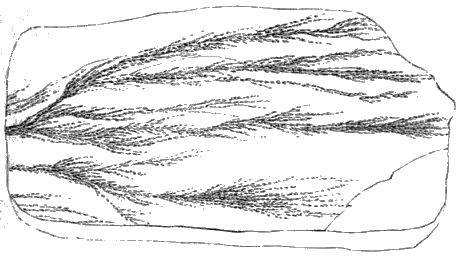
Lign. 8. Confervites Woodwardii; nat. Chalk. Norfolk.
FOSSIL FUCOIDS.
Fossil Fucoids.—Of the tribe of Algæ which comprises the sea-weeds that are not articulated, many fossil species occur in very ancient, as well as in modern, fossiliferous deposits. In the Lower Silurian rocks of North America, beds of limestone of great extent are full of a large digitated Fucus (Fucoides Alleghaniensis).[74] The Firestone or Malm-rock of Bignor in Sussex abounds in a ramose variety (Fucoides Targionii, Vég. Foss. p. 56), of which specimens are figured in the vignette of this volume, and in Lign. 9.
Chondrites.—These fossil algæ approach nearest to the living species of Chondrus (hence the name of the genus). The frond is thick, branched, dichotomous, with cylindrical or claviform divisions, with a smooth surface and without tubercles. The substance of the Bignor fossils is a white friable earth, which strikingly contrasts with the dark grey malm-rock that forms the matrix. As the Sussex Chalk Chondrites appear to be distinct from the Tertiary species named by M. Brongniart C. Targionii, I have, at the suggestion of Mr. Morris, substituted C. Bignoriensis, to indicate the locality in Sussex in which I discovered it forty years since. In the chalk-flints ramose fuci occasionally occur, but not in a state of preservation that admits of the determination of the forms of the originals.
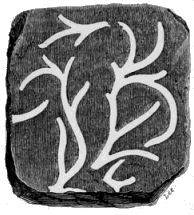
Lign. 9. Chondrites Bignoriensis; nat. Malm-rock. Bignor, Sussex.
The tertiary marls and limestones of Monte Bolca yield several beautiful species of Algæ, one of which is figured in Lign. 10. It is referred to the fossil genus Delesserites (Sternberg), which includes those algæ that have thin, and flat or undulated, smooth, membranous fronds, with a median rib.
Of the little plants comprised in the class of cellular cryptogamia, which have stems, leaves, and fructification, but no true vessels, two or three species of Moss and Liverwort have been met with in tertiary strata. Mosses as well as Fuci are occasionally imbedded in quartz pebbles, in which they appear of their natural colour, and apparently floating in the transparent medium. A beautiful green moss, with a Conferva twined round its base, is figured Lign. 11, p. 104, from a specimen described by the late Dr. Macculloch. It is supposed to be related to Hypnum (Geol. Trans. vol. ii.).
MOCHA-STONES.
Moss-agates and Mocha-stones.—The beautiful siliceous pebbles called Moss-agates, and Mocha-stones, will so often come under the notice of the collector, that, although but extremely few, if any, of these objects contain organic remains, the arborescent substances they inclose being merely metallic oxides, a few remarks on their nature may be expected. The late Dr. Macculloch paid considerable attention to the investigation of these bodies, and believed that some of the objects imbedded in the pure and compact quartz were really of vegetable or animal origin; the specimen figured Lign. 11 is of this kind; the fossils being apparently cellular cryptogamous plants. In Geol. Trans, vol. ii., other examples are figured and described by the same sagacious observer. Mr. Bowerbank is of opinion that spongeous structure enters into the composition of almost all the moss-agates, and I have no doubt that in some instances such organisms are present: but in by far the greater number of agates and mocha-stones the inclosed bodies are mere crystallizations; they are arborescent or dendritical oxides of manganese, copper, chlorite, iron, &c.
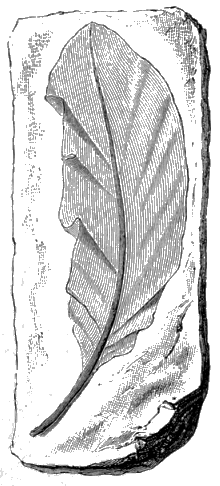
Lign. 10 Delesserites (Fucoides) Lamourouxii. Monte Bolca. (Vég. Foss. Br.)
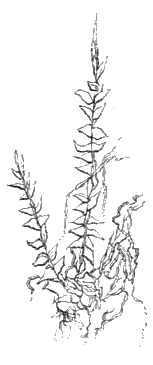
Lign. 11. Moss and Conferva, in transparent quartz, × 3.
M. Brongniart, who carefully examined a great number of agates and pebbles, with the view of determining if vegetable substances were ever imbedded in them, could not detect a single instance in which the apparent mosses, confervæ, or algæ, were organic; in every case the mineral origin of the pseudo-vegetation was, in his opinion, unequivocal. Some of the beautiful green arborescent bodies in quartz pebbles, even under the microscope, present so close a resemblance to confervæ and mosses, that it is difficult to persuade oneself they are not vegetable structures; but the observations of M. Brongniart appear to me conclusive as to their mineral nature.[75] With the exception of three or four species of Jungermannia, and four or five of Muscites in Amber, M. Brongniart states that he knows but one true fossil plant of the family of Mosses; the Muscites Tournalii from the fresh-water tertiary deposits of Armissan.
Vascular, or Acrogenous Cryptogamia.—These plants, as the name implies, possess a more complicated structure than the preceding, having vascular tissue as varied as in the phanerogamia.
Equisetaceæ.—The common species of Equisetum, or Marestail, is a plant that grows in marshy tracts, and on the banks of ditches and rivers; it has a jointed stalk, garnished with elegant sheaths which embrace the stem, and verticillate linear leaves: it attains a height of two feet, and is half an inch in diameter. In the fossil state there are many plants allied to the Equisetum, but only a few that are generically the same.
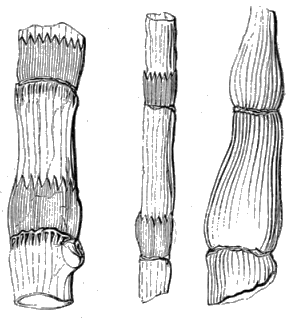
Lign. 12. Equisetum Lyellii.
Wealden. Pounceford.
nat.
Fig. 1.— A stem, having two sheaths, and a bud at the lowermost joint.
2.— Stem of a young plant, with sheaths, preserved in pyrites.
3.— Stem, with the cryptogamous head or upper end.
EQUISETITES.
Equisetum Lyellii, Lign. 12.—A species which I discovered in Wealden limestone, at Pounceford (Geol. S. E. p. 245), must have closely resembled the Equisetum fluviatile: it has an articulated cylindrical stem, and regularly dentated sheaths, embracing the stem at the joints.
A transverse slice of the stem exhibits under the microscope a cellular structure filled with calc-spar, and forms a beautiful object when viewed with the polarizing apparatus. This plant occurs in many localities of the Wealden in Sussex and Kent; from the railway cuttings near Tonbridge, I collected several fine specimens; it is met with also in the cliffs near Hastings.
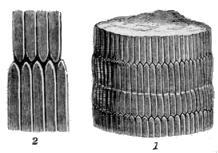
Lign. 13. Equisetites columnaris.
(Ad. Brongn. Pl. 13.)
Lower Oolite. Whitby.
Fig. 1.— Portion of a stem, showing two articulations, and an intermediate constriction. 1/3 nat.
2.— A few of the denticulations produced by the sheath, nat.
Equisetites columnaris. Lign. 13.—A gigantic species of Equisetum abounds in the strata of the lower division of the Oolitic or Jurassic formation of Yorkshire, and many fine specimens have been collected, especially from the vicinity of Whitby. In the sandstone of the Inferior Oolite of the Cleveland Hills, Yorkshire, numerous stems of this colossal marestail have been observed standing erect, as if occupying the position in which they grew; the same fact was also discovered at Carlton Bank, near Stokesly, forty miles from the coast. In both localities fossil shells of fresh-water mussels (Uniones) were associated with the vegetable remains.
This plant is a true equisetum, differing chiefly from existing species in its gigantic size and arborescent character. The sheaths surrounding the stem, and the verticillate linear leaves, are preserved in some examples: and in all, the furrows left by the imprints of the sheaths are more or less strongly impressed. The stem is not channelled throughout, as in Calamites, the carboniferous plant whose stems at first sight might be mistaken for those of Equisetites, but which are entirely distinct, as will be explained hereafter. The Equisetites columnaris is peculiar to the Oolite; it does not occur in the coal-measures. Specimens have been discovered which indicate a height of twenty feet, and a diameter of several inches.[76]
A small species of Equisetum (Eq. Brodiei[77]) occurs in the insectiferous limestone of the lower Lias, at Strensham, Worcestershire, associated with the foliage of fresh-water endogenous plants resembling the Potamogeton, or pond-weed, and of supposed dicotyledonous vegetables.
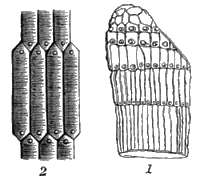
Lign. 14. Calamites decoratus.
1
/
3
nat.
(Ad. Brongniart. Pl. 14.)
Coal Formation. Yorkshire.
Fig. 1.— Part of a stem, showing the tubercles for the attachment of leaves.
2.— A portion of the same on a larger scale.
CALAMITES.
Calamites. Lign. 14, 15.—Stem articulated, regularly furrowed longitudinally, the articulations naked, or studded with tubercles.
The plants of this genus were supposed to be related to the marestail, but to differ in the absence of the encircling sheaths, and in being uniformly striated; but an examination of specimens in a better state of preservation than those previously known, shows their affinity to the gymnosperms. Some of the species are of a gigantic size, being from one to three feet in diameter, and from thirty to forty feet in height. Calamites abound in the coal formation, and must have constituted an important feature in the forests of the carboniferous period; they occur also in more ancient deposits, and some species belong to the earliest terrestrial Flora of which any vestiges are known. In most instances when specimens are found lying in the same plane with the strata, they are pressed flat, but those occurring in a vertical position retain their natural cylindrical form. An outer crust or cylinder of coal generally invests the stem, but traces of the internal structure are rarely preserved.
The Calamite consists of a large central column of tissue, surrounded by a ligneous cylinder. The central part has in most instances perished after the death of the plant, and the cavity thus left been filled up with mineral matter. As the hollow ligneous zone is almost always carbonized, and very friable, it is seldom attached to the cast, and consequently the surface of the latter is generally jointed and ribbed.
The true external surface of the cortical investment is marked with longitudinal striæ, without any indications of joints or constrictions; but the position of the original articulations is indicated in some specimens by the presence of small verticillate scars, to which leaves were appended[78] as in the example figured by M. Brongniart, of which Lign. 14, fig. 1, is a reduced figure.
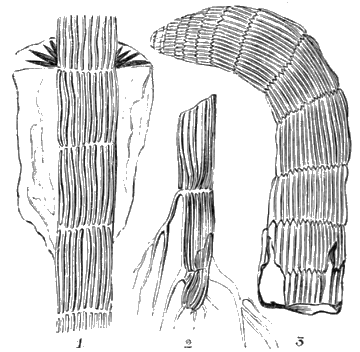
Lign. 15. Calamites, in Coal Shale.
Fig. 1.— Calamites radiatus, with the remains of one of the sheaths.—1/2 nat.
2.— Stem, with remains of roots.—1/2 nat.
3.— Calamites approximatus, showing the curved lower end of the plant.[79]—1/5 nat.
The stellate appearance on the upper part of the stem figured in Lign. 15, fig. 1, is produced by the zone of leaves which surrounded the joint: this character is entirely distinct from the sheath of the Equisetum shown in Lign. 12. This specimen points out the importance of carefully examining and preserving the stone around fossil stems; had this precaution been lost sight of in this instance, no knowledge would have been obtained of this important botanical character. It is rarely that any traces of the roots remain; the fossil figured (fig. 2) is from the Foss. Flor. A beautiful example of the foliage of a species of Calamites is represented in Lign. 59, fig. 2.
Upright stems of Calamites occur in the Coal formation near Pictou, in North America; and in one example a group of ten or twelve stems, covering an area of two square feet, sprung from one root.[80]
FOSSIL FERNS.
Filicites, or Ferns.
We now arrive at the consideration of one of the most interesting families of the vascular cryptogamia that adorned the Flora of the ancient world, and the living species of which impart beauty and elegance to the scenery of the countries where they prevail. The most essential character of these vegetables, is that of developing their fructification on the leaves; a fact familiar to every one who has even but cursorily examined the Polypody growing on our walls, or the Brake of our hedge-rows and commons. The largest species of British ferns scarcely exceed four or five feet in height; but the arborescent or tree-ferns, of warm climates, attain an altitude of from thirty to forty feet. There is too this peculiarity in the arborescent forms, that while in our indigenous species the leaves surround the stem, and incline towards the upper part of the plant, the foliage of the former bends downwards, and spreads out from the crown, or summit, into an elegant canopy.
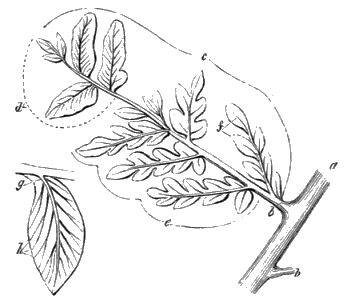
Lign. 16. Pecopteris Sillimani; nat. Coal Shale. Ohio.
a. The Stem.
b. Leaf-stalk, or petiole.
c. Leaf, or frond, which is bipinnate.
d. e. Leaflets, or pinnæ; the upper, d, are entire; the lower, e, are pinnatifid.
f. The pinnules, lobes, or segments.
g. The midrib, or median vein.
h. The veins. The veins are introduced in the leaflets, d; but in the lower ones, e, the midribs only are marked.
The leaves of our branched ferns are persistent, and when shed, the markings left by their attachment to the stalk are soon obliterated. In the arborescent ferns, on the contrary, the petioles become detached from their bases, and fall entire, leaving scars or cicatrices on the stem; and these impressions are so regularly and symmetrically disposed, as to afford characters by which the trunks may be distinguished from those of other trees. The stems of the tree-ferns are therefore easily recognized in a fossil state externally, by their cylindrical forms without ramification, and by the regular disposition and peculiar character of the scars left by the separation of the petioles; and, internally by that peculiar zone, formed of bundles of ligneous tissue inclosed in sheaths, which encircles the central axis, as shown in the transverse sections in Lign. 2, ante, p. 62. The leaves may be identified by the form of their segments, which are disposed with remarkable regularity, and have a peculiar mode of subdivision; and above all, by the delicacy, evenness, and distribution of the veins. There are upwards of two thousand species of living ferns, and in the fossil kingdom the number is considerable; more than two hundred have been collected from the carboniferous formation. The recent tree-ferns are confined almost exclusively to the equinoctial regions; humidity and heat being the conditions most favourable to their development (Vég. Foss. p. 141. Bd. p. 461. Wond. p. 727).
From the elegance and diversity of form of their foliage, fossil ferns are the most remarkable and attractive vegetable remains in the ancient strata. The greater number are from the coal deposits, the fern-leaves generally occurring in the schists or shales that form the roof of the beds of coal. Many of the strata are made up of carbonized fern-leaves and stems closely pressed together. The roof of a coal-mine, when newly exposed, often presents a most interesting appearance, from the abundance and variety of leaves, branches, and stems, that occur either in relief, or impressed on the dark glossy surface. The specimens selected for illustration exhibit the principal modes of venation on which the genera are founded.
The fossil genera have been established by M. Ad. Brongniart, from the form of the leaves and the characters of their venation; that is, the distribution of the vessels. In the following descriptions some botanical phrases are necessarily employed; a few terms of frequent occurrence are explained in Lign. 16.
Pachypteris[81] (thick-fern). Lign. 17.—In this genus from the lower Oolite, the fronds are pinnated, or bipinnated, the leaflets entire, without visible veins, having but a single midrib, and contracted at the base. The absence of veins, and the leaflets not being lobed, are the essential generic distinctions.
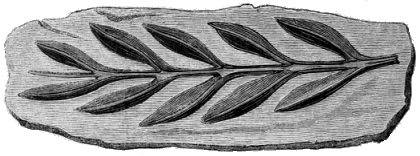
Lign. 17. Pachypteris lanceolata. Inferior Oolite. Whitby.
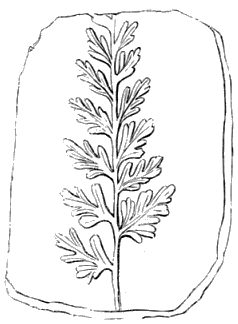
Lign. 18. Sphenopteris elegans Coal-shale, Waldenburg, Silesia.
FOSSIL FERNS. SPHENOPTERIS.
Sphenopteris (wedge-leaf). Lign. 18.—The leaves are twice or thrice pinnated, the leaflets wedge-shaped, contracted or narrowest at their base, and more or less deeply lobed: the lobes divergent and palmated: the veins radiating from the base.
The ferns of this genus are extremely elegant, and comprise upwards of forty species. A beautiful Sphenopteris (S. affinis, Wond. p. 716,) occurs abundantly in the fresh-water carboniferous strata at Burdie House, near Edinburgh;[82] another elegant form, in coal-shale, is represented in Lign. 18.
It is so rarely that the fructification of any species of Sphenopteris is preserved in a fossil state that I am induced to figure a leaflet of a remarkable plant, of this genus from the fluvio-marine oolitic deposits of Scarborough. Lign. 19 is copied from the lithograph accompanying a notice of some rare plants from that locality, by the eminent botanist, C. J. F. Bunbury, Esq.[83]
This fossil fern closely resembles certain species of Dicksonia (natives of New Granada). Each segment of the leaflet or pinnate is dilated at the apex into a reniform indusium; no capsules are visible, the fructification being, probably, in a young state.
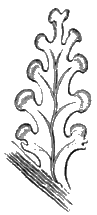
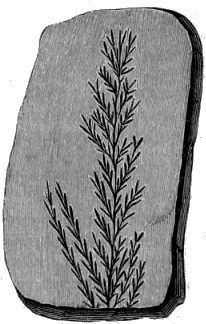
Lign. 19. Sphenopteris nephrocarpa. Inferior Oolite, Scarborough. A magnified vein of a leaflet, showing the fructification at the extremities of the lobes, × two diameters. Lign. 20. Sphenopteris Mantelli; nat. Wealden, Tilgate Forest.
In the Wealden deposits, both of England and Germany, several species of Sphenopteris abound; one of which (Foss. Tilg. For. 1827), often occurs in the calciferous grit of Tilgate Forest, in a beautiful state of preservation: a small branch is figured in Lign. 20. This species is characterized by its slender and minutely divided wedge-shaped leaflets. The Sphenopteris Mantelli did not attain a considerable size; the largest stem I have seen indicated a plant of five or six feet in height. This Sphenopteris is sometimes associated with the remains of a beautiful plant of the genus Alethoptris,[84] the leaflets of which, in some examples, bear the fructification. (Wond. p. 394, Lign. 89.)
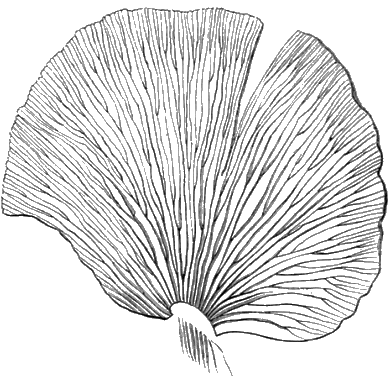
Lign. 21. Cyclopteris trichomanoides; a single leaflet; nat. Oolite, near Scarborough.
Cyclopteris (round-leaf). Lign. 21.—The frond is simple and entire, or but slightly lobed at the margin, and generally orbicular, or kidney-shaped: there is no midrib; the veins are numerous, equal, and dichotomous, or forked, and radiate from the base. The form and disposition of the veins resemble those of some living species of fern; the absence of a median rib, or vein, is the most striking character of this genus. The fructification is supposed to have been marginal.
FOSSIL FERNS. NEUROPTERIS.
Neuropteris (nerved-leaf). Lign. 22.—The fronds are pinnate or bipinnate; the leaflets more or less ovate or cordiform and entire, adhering to the rachis by their centre only; veins very fine, arched, rising obliquely from the base of the leaflet; the midrib does not extend' to the apex of the leaflets, but terminates by subdividing into veins.
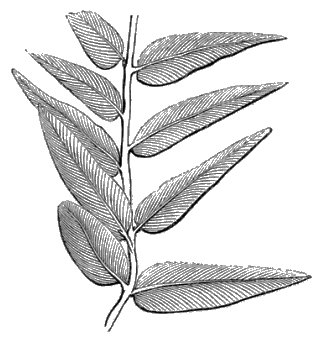
Lign. 22. Neuropteris acuminata; nat. In Coal-shale, Yorkshire.
This is a very numerous genus, comprising thirty or more species, which are principally found in the coal-shale. Some of these plants bear a general resemblance to the Osmunda regalis, but differ in their essential characters; their leaflets often form the nuclei of ironstone nodules.
Glossopteris (tongue-leaf). Lign. 23.—Leaves simple, sub-lanceolate, gradually contracting towards the base; midrib thick at the base, and vanishing towards the apex of the leaf; veins very fine, curved, oblique, frequently dichotomous, sometimes reticulated, or anastomosing at their base. The plants of this genus resemble the ferns with simple leaves. A few species only are known; of these, two are from the coal-shale, one from the Lias, and one from the oolite.
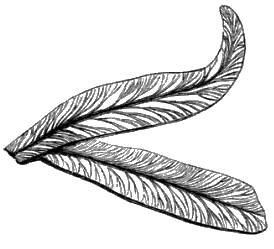
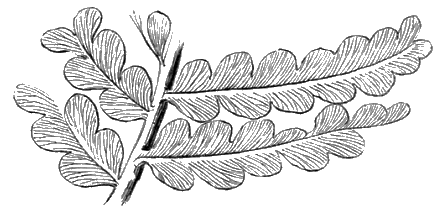
Lign. 23. Glossopteris Phillipsii; nat. Oolite, Scarborough. Lign. 24. Odontopteris Schlotheimii; nat. Coal-shale of Saxony.
Odontopteris (tooth-leaf). Lign. 24.—Leaf bipinnate, the leaflets adhering to the rachis or stalk by their whole base, which is not contracted; the veins equal, simple, dichotomous, arising side by side from the base of the leaflet; no distinct midrib. In their general aspect these plants resemble some South American species of Osmunda. Five species only are known, all of which belong to the most ancient coal strata.
Anomopteris (anomalous fern—so named because the plants differ from all recent and fossil ferns). Lign. 25.—Leaves deeply pinnated; leaflets very long, entire, linear, traversed by a distinct midrib, equal throughout; secondary veins simple, perpendicular to the median vein, swollen at their free extremities, and not extending to the margin of the leaflet. But one species is known. These leaves are of great size, and doubtless belonged to some arborescent fern; in several examples the fructification is preserved. My collection contained a splendid specimen from near Strasburgh, presented by the late M. Voltz, which is now in the British Museum.[85]
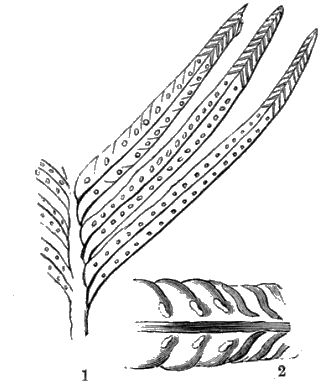
Lign. 25. Anomopteris Mougeotii
;
nat.
New Red Sandstone; Sultz-les-Bains, near Strasburgh.
Fig. 1.— Three leaflets of a very large frond.
2.— A portion magnified to show the fructification.
FOSSIL FERNS. TŒNIOPTERIS.
Tœniopteris (wreathed fern). Lign. 26.—Leaves simple, entire, straight, with parallel margins, traversed by a strong midrib, which extends to the apex; secondary veins, simple or bifurcated at their base, and almost perpendicular to the median vein. These ferns are related to certain species of Polypodium. Three species are known; two from the Oolite, and one from a tertiary deposit. The specimen figured is a fragment.
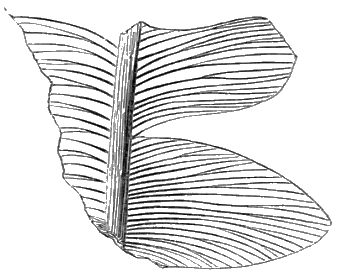
Lign. 26. Tœniopteris latifolia; fragment of a frond; nat. Stonesfield Slate.
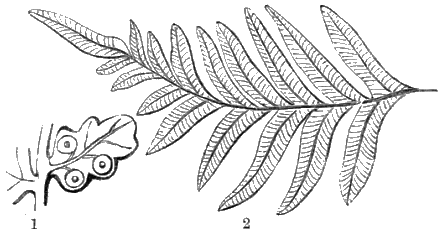
Lign. 27.
Fig. 1.— Pecopteris Murrayana; a pinnule with the fructification; magnified. Inf. Oolite, Scarborough.
2.— Pecopteris lonchitica. Coal-shale, France.
Pecopteris (embroidered fern). Lign. 27.—Leaves once, twice, or thrice pinnated: leaflets adhering by their whole base to the rachis, rarely by the centre only; traversed by a strong midrib, which extends to the apex; veins simple, or once or twice dichotomous, proceeding almost at right angles from the median vein.
This genus embraces a very large proportion of the ferns which have contributed to the formation of the coal, and whose leaves and stems are preserved in the associated strata. The originals of many species were undoubtedly arborescent, and attained a large size; some leaves four feet wide, and of a proportionate length, have been observed. More than one hundred species are determined. An American species (Pecopteris Sillimani) is figured in illustration of certain botanical terms, Lign. 16, ante, p. 110. Several species of Pecopteris occur in the fluvio-marine oolitic deposits near Scarborough, and leaves in fructification are not uncommon: fig. 1, Lign. 27, represents a leaflet slightly magnified.
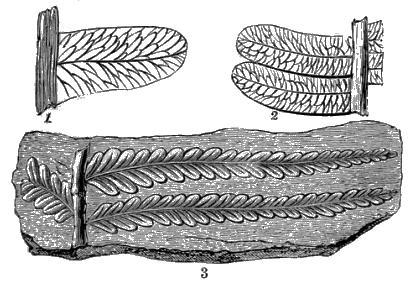
Lign. 28. Lonchopteris Mantelli.
Wealden, Tilgate Forest.
Fig. 1. & 2.— Leaflets magnified, to show the reticulated venation.
3.— A fragment of a frond; nat.
FOSSIL FERNS. LONCHOPTERIS.
Lonchopteris (spear-leafed.) Lign. 28.—Leaves many times pinnated; leaflets more or less adherent to each other at their base, traversed by a midrib; secondary veins reticulated.
The three known species which compose this genus resemble the living ferns of the genera Lonchitis, Woodwardia, &c. Two have been found in the coal-measures, and one species in the Wealden formation of England and Germany (Foss. Tilg. For. pl. iii.) This last appears to have been a delicate plant; for though fragments are very common in the micaceous grits and clays, any considerable portion of a leaf is of rare occurrence. M. Graves found the same fern near Beauvais in France, in strata, which, from the presence of the fresh-water limestone called Sussex marble, are supposed to be referable to the Wealden epoch. This Lonchopteris is widely spread through the Wealden; and occurs also in the Greensand. Mr. Morris first observed it in the iron-sandstone of Shanklin Chine.[86]
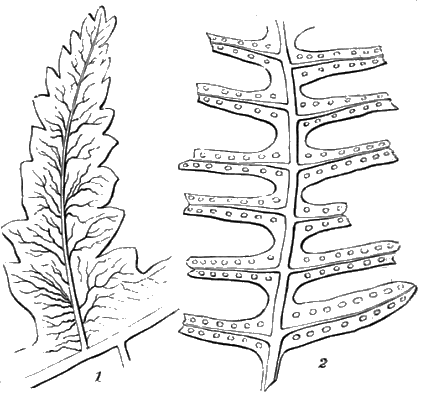
Lign. 29.
Fig. 1.— Phlebopteris[87] Phillipsii. Oolite, Scorborough.
2.— Phlebopteris propinqua, showing fructification.
Phlebopteris (veined-leaf). Lign. 29.—Leaves pinnated; leaflets with the margin entire, or crenulated, the midrib strong; secondary veins anastomosing by arches, with large angular spaces, often unequally disposed; the finer veins are simple or divided; the apex sometimes free. The fructification is punctiform, and placed at the apices of the veins.
The foliage of these remarkable ferns has been mistaken for the leaves of dicotyledonous plants; but M. Brongniart has demonstrated that they belong to the present family. Six species have been found in the Oolite and Lias.
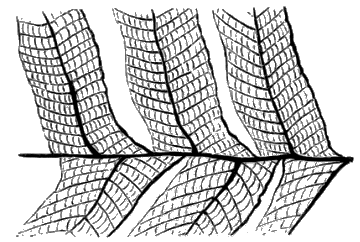
Lign. 30. Clathropteris meniscoides. Portion of a leaflet: the original 11/2 ft. long. Wealden? Scania.
FOSSIL FERNS. CLATHROPTERIS.
Clathropteris (latticed-leaf). Lign. 30.—Leaf deeply pinnatifid; leaflets elongated, traversed by a strong midrib extending to the apex; secondary veins numerous, simple, parallel, almost perpendicular to the midrib, united by transverse branches, which, with the finer veins, produce on the surface of the leaf a net-work of quadrangular meshes.
This genus was instituted by M. Brongniart, for the reception of some very large fern-leaves from the shale of Hoer, in Scania, which resemble in structure the foliage of the recent Polypodium quercifolium, a native of the East Indies, and the Moluccas. One leaf was four feet wide, and the leaflets, though imperfect, were eighteen inches long.[88]
Many other genera of fossil ferns have been established from the form and venation of the leaves, and are described in Brit. Foss. Flor., and other British and foreign works.
Stems of arborescent Ferns.—Notwithstanding the profusion with which the foliage of many kinds of ferns is distributed throughout the coal formation, the undoubted stems of plants of this family are rarely met with; for the numerous tribe called Sigillariæ is now removed altogether from this class. It may, however, admit of question whether much of the foliage which, from the analogy of structure, has been referred to ferns, may not have belonged to those trees; for as in the animal kingdom, so in the vegetable, distinct types of living organisms are often found blended in the lost races; and as the stems of recent tree-ferns are even more durable than their leaves, it seems impossible to account for their absence in strata, that inclose entire layers of the foliage matted together. A few fossils, supposed to possess the essential characters of recent fern-stems, have been discovered, and arranged under the following genus.
FOSSIL FERN-STEMS.
Caulopteris (fern-stem). Lign. 31.—Stems not channelled, marked with discoidal, oblong, or ovate scars, arranged longitudinally; vascular cicatrices numerous.
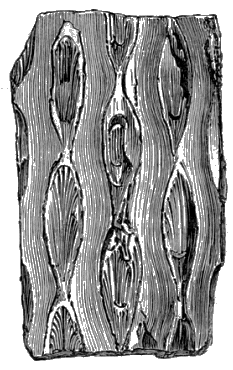
Lign. 31. Caulopteris macrodiscus. Coal.
The fragment of stem here figured, resembles the trunks of some recent tree-ferns in its proportions, and in the number, disposition, and size, of the scars of the leaf-stalks; but these markings differ in their more lanceolate form, and pointed terminations, and in their peculiarly striated surface, from those of any known existing species.
Psarolites (Silicified Fern-Stems).—In the New Red sandstone, near Hillersdorf, in the neighbourhood of Chemnitz, in Saxony, silicified stems, apparently of tree-ferns, occur in great numbers. They are remarkably beautiful, and the organization of the original is so well preserved by the silex, that slices, examined by the microscope, display the peculiar structure almost as perfectly as if the plants were recent: transverse sections exhibit the arched bundles of vascular fibres which compose the ligneous cylinder, surrounded by the cellular tissue. From the stellated markings produced by sections of the vessels that compose the tissues, and which are visible to the naked eye, these fossils have obtained the popular name of Staaren-stein, or Star-stone. The external surface of the specimens I have examined has a ligneous structure, and is of a dark reddish brown colour; internally the stems are of a dull red, mottled with various tints of blue and yellow, from the infiltrated chalcedony with which the vessels are permeated.[89]
An excellent work ("Dendrolithen") on these fossils, in which thirty species are described, has been published at Dresden by M. Cotta; who arranges them under the genus Psaronius or Psarolites. The stem is composed of two distinct parts; an outer zone, consisting of a great number of nearly cylindrical bundles of vessels, supposed to have been roots which proceeded from the stem near its base; and an inner part or axis. In the outer portion, the fossil air-roots have a vascular tissue, but there is often a delicate cellular tissue interposed. In the axis the vessels form zigzag or wavy bands, resembling those of ferns.[90] These flexuous and vermiform bands are entirely composed of barred or scalariform vessels, similar to those of ferns and club-mosses. The Psarolites are therefore considered by M. Ad. Brongniart to be the bases of the trunks of lycopodiaceous trees, while M. Cotta and other botanists regard them as true arborescent ferns.[91]
Dr. Buckland has discovered in the New Bed sandstone formation at Allesley, near Coventry, silicified trunks of coniferous trees, and it is not improbable that further research in that locality may bring to light fern-stems like those of Chemnitz.[92] Dr. Lloyd, of Warwick, has recently obtained leaves of several coniferæ from the same locality.[93]
Sigillarlæ and Stigmariæ.
SIGILLARLÆ AND STIGMARIÆ.
Among the most common and striking objects that arrest the attention of a person who visits a coal-mine for the first time, and examines the numerous vegetable relics that are profusely dispersed among the heaps of slate, coal, and shale, are long flat slabs, from half an inch to an inch thick, having both surfaces longitudinally fluted, and uniformly pitted with deep symmetrical imprints; these are disposed with such perfect regularity between the grooves, that the specimens are often supposed, by persons not conversant with palæontology, to be engraven stones, and not natural productions. These fossils are the flattened trunks of gigantic trees covered by the bark in the state of coal; the regular imprints on the surface, being the scars left by the separation of the petioles or leaf-stalks, as in the arborescent ferns previously examined. The name Sigillaria, commonly applied to these fossils, is derived from sigillum, a seal, and alludes to the regular and uniform pattern of the imprints on the surface. These stems are from a few inches to several feet in diameter, and the largest attain a height of sixty feet; they are generally found lying in a horizontal position in the strata, and quite flat, from the pressure produced by the superincumbent rocks; but when the trunks are in an erect position, and at right angles to the plane of the beds, the cylindrical form of the original is preserved.
A remarkable instance, in which five stems of Sigillaria were standing upright, with their roots in the soil below, apparently in the position in which they grew, was brought to light a few years since, in forming the Bolton and Manchester railway.[94] They stand on the same plane, and near to each other. Their roots are branched, and spread out in the bed of impure coal in which they are implanted. The trunks are surrounded by a soft blue shale. The largest tree is eleven feet high, and seven and a half feet in circumference at the base; its trunk is gnarled and knotted, and has many decorticated prominences, like those in barked timber of our old dicotyledonous trees; the roots, too, partake of the same character.[95] The others are respectively from three to five feet in height. A sketch of one of the short stems is subjoined. All the trees were broken off as if by violence, and no traces of the upper part of the stems or branches were detected.
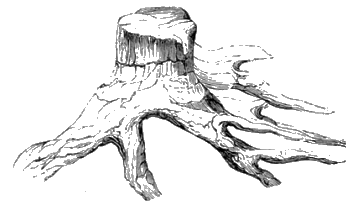
Lign. 32. Base of a Trunk of a Sigillaria. with roots, standing erect with five other stems, in Carboniferous strata. (The original is four feet high.)
In the stratum through which the roots extend, a considerable quantity of the fossil cones, called Lepidostrobi, hereafter described, were imbedded (see Lign. 40). A thin layer of coal which invested the stems, was evidently the carbonized bark. All the stems were filled with blue clay, or shale, a proof that they were hollow when submerged in the mud, which is now consolidated into the shale in which they are imbedded. But it is not probable that they were originally tubular, like a reed: on the contrary, there is evidence to show that they were highly organized. Their internal structure may have decayed, or been destroyed by insects or other depredators; as is often the case in tropical climates, where the trunks of timber trees are speedily excavated after their fall, and afford shelter to innumerable insects and reptiles, as the weary traveller often finds to his surprise and annoyance.[96] The late Mr. Bowman affirmed[97] that these trees were dicotyledonous, and stated that medullary rays and coniferous structure could be detected; an opinion, which the researches of M. Brongniart on the Sigillariæ have fully corroborated.
ERECT STIGMARIÆ.
Many other instances have been noticed of Sigillariæ standing more or less erect in the strata. In forming the railway tunnel at Claycross, five miles south of Chesterfield, through the middle portion of the Derbyshire coal-measures, in 1838, a group of nearly forty trees (Sigillariæ) was discovered, standing not more than three or four feet apart, at right angles to the plane of the strata.[98] On the coast of Northumberland, within the length of half a mile, twenty trees were observed by Mr. Trevelyan, in 1816 (Bd. p. 470). The coal-pit at St. Etienne, in France, described by M. Alex. Brongniart, is celebrated for affording an example of this phenomenon (Wond. p. 673); but the positions of many of those stems are inclined at various angles, and their roots implanted in different beds, so that the perpendicularity of the erect trees is probably accidental (Bd. p. 471).
The most remarkable instance hitherto observed, is on the southern shore of the Bay of Fundy, in Nova Scotia, where the cliffs, which are about two hundred feet high, are composed of carboniferous strata, consisting of coal, clay, grit, and shale, in which numerous erect trees, probably Sigillariæ, are seen on the face of the cliff; there are ten rows one above another, indicating, in the opinion of Sir C. Lyell, repeated subsidences of the land, so as to allow of the growth often successive forests![99] (Wond. p. 674).
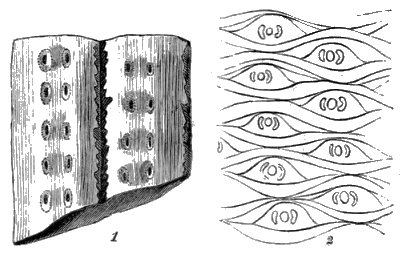
Lign. 33. Sigillariæ
;
in Coal-shale
.
Fig. 1.— A specimen deprived of its carbonaceous bark, except in the interstices of the channels, and showing pits left by the external scars.
2.— The markings of S. Defrancii. (Vég. Foss. Br.)
SIGILLARLÆ.
The stems of Sigillariæ vary in size from a few inches to five feet in diameter; and in length from five to sixty feet; they gradually taper from the base to the summit. A specimen measured by M. Brongniart was forty feet long, one foot in diameter at the base, and but six inches at the top, where it divided into two equal branches. These stems may be readily distinguished from those of other trees with which they are associated, by the fluted surface produced by the deep longitudinal grooves, and the regularly disposed imprints between the channels.[100] The carbonized bark, in large specimens, is often an inch thick, but in small examples is a mere pellicle, and being extremely brittle, flakes off with the slightest touch, leaving the inner surface exposed, with the coal remaining in the deep furrows and pits, as in Lign. 33, fig. 1. No traces of leaves, or fruit, in connexion with the stems, have been observed. The subjoined sketches (Lign. 33, and 34,) illustrate the usual aspect of these fossils. The difference between the imprints on the outside of the bark, and those on the exposed surface of the stem, from the removal of the cortical covering, is well marked in Lign. 34.
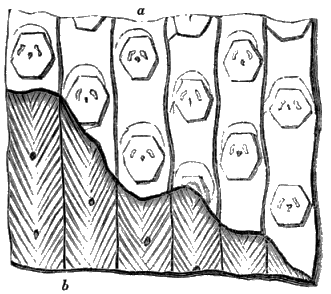
Lign. 34. Sigillaria Saullii.
Carb. Manchester.
a. The imprints of the petioles on the external surface of the carbonized cortical investment.
b. The inner surface, exposed by the removal of the crust or bark.
Internal Structure of Sigillariæ.—Our knowledge of the structure of this numerous tribe of plants, has received an important accession by the discovery of the silicified fragment of a stem, which, fortunately for the advancement of science, was placed at the disposal of M. Adolphe Brongniart. It has been described and illustrated by that eminent botanist, in a memoir which is one of the most valuable contributions to fossil botany that has hitherto appeared.[101]
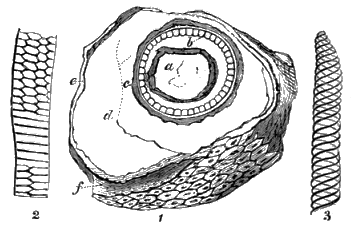
Lign. 35. Silicified Stem of Sigillaria elegans.
Autun. France. (M. Adolphe Brongniart.)
Fig. 1.— A transverse section of the silicified stem, from Autun; nat. a. Situation of the medullary tissue, occupied by coloured silex. b. Zone composed of bundles of vessels, forming the woody tissue. c. Band of cellular tissue d. Space between the ligneous cylinder and the bark, with no evident structure, but originally occupied by the external cellular tissue. e. Zone of indistinct cellular substance. f. External cortical envelopment, or bark.
2.— Portion of one of the vessels of the medullary tissue, as seen in a longitudinal section, (× ×.)
3.— Portion of a spiral vessel of the same tissue. (× ×.)
The annexed figure (Lign. 35) is an outline of the specimen, of the natural size; but this sketch is a mere plan or diagram, for it is impossible without the aid of colour to convey a faithful idea of the original. The student should observe, that when mineral matter has permeated the stems of plants, the vascular tissue is often so well preserved, that one such specimen affords more important information, than hundreds of examples in which the form alone remains.
SIGILLARLA ELEGANS.
The external surface of this specimen possesses the characteristic markings of the insertion of the leaf-stalks of Sigillaria elegans. The internal organization, as seen in the transverse section, is as follows:—
a. The centre, filled with silex; it exhibits no traces of structure.
b. The zone which surrounds the interspace on which this letter is placed, is composed of bundles of vascular tissue. A portion of one of these bundles, highly magnified, is represented in Plate V. fig. 7.
The inner circle of this zone, indicated by the convex undulating line, is made up of medullary vascular tissue; the external circle is divided by rays, and is composed of woody fibre, constituting a ligneous cylinder. One of the spiral vessels (fig. 3), and another showing a remarkable difference of structure in a short space (fig. 2), as seen in a longitudinal section of the medullary tissue, are figured in Lign. 35.
The ligneous cylinder is surrounded by a band of cellular tissue, and the space between this and the cortical integument is occupied by silex, in which there are but obscure traces of structure.
The inner layer of bark, f, is composed of elongated cells, disposed in a radiating manner, and traversed by fibro-vascular bundles, which pass towards the leaves.
Upon instituting a comparison between the fossil and the stems of those recent plants which present the closest analogy to it, M. Brongniart was led to conclude that the Sigillariæ constituted a peculiar extinct family, belonging to the great division of gymnospermous dicotyledons.
The Sigillariæ were tall erect trees, with a regular and cylindrical stem, without side branches, but dichotomous towards the summit. Their superficial bark was hard and durable, channelled longitudinally, bearing leaf-scars that are of a rounded form above and below, and angular at the sides, often oblong in relation to the stem, and having three vascular pits, one central and small, and two lateral of a larger size. The internal structure bears most analogy to that of the Cycadeæ, and the foliage consisted of long linear carinated leaves. The Sigillariæ, therefore, differ essentially from the arborescent cryptogamia, which they somewhat approach in having scalariform vascular tissue, symmetrical and regular leaf-scars, and branchless trunks. More than fifty species have been determined.[102]
STIGMARIA.
Stigmaria. Lign. 36.—This extended notice of the structure of the Sigillariæ,.will enable us to understand the nature of the fossil vegetables termed Stigmariæ, or spotted-stems, which abound in the beds of under-clay of most coal-fields, as stated in a former part of this work (ante, p. 81.). These bodies when uncompressed are of a cylindrical form, from one to six or seven inches in diameter, and of considerable length—sometimes upwards of twenty feet—and gradually diminish in size towards their termination. The surface is marked with distinct pits or areolæ, of a circular or oval form, with a small tubercle in the centre of each, disposed around the stem in a quincunx and somewhat regular order. When broken transversely, a small cylindrical axis is seen to extend in a longitudinal direction through the stem, like a medullary column; it seldom occupies the centre, but lies near to one side, and parallel with a depression on the outer surface of the fossil. This internal body is often loose, and removable; its surface is covered with interrupted, irregular, longitudinal, ridges, which leave corresponding depressions on the walls of the cavity in which it was inclosed. Lign. 36, represents a fragment exhibiting the characters above described.
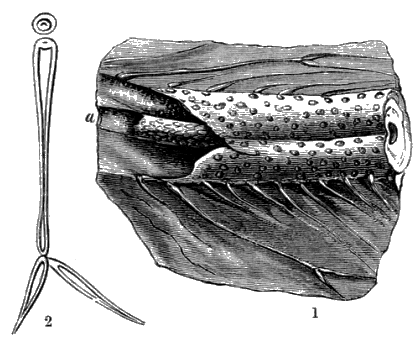
Lign. 36. Stigmaria ficoides.
Carboniferous. Derbyshire.
—
1
/
4
nat.
Fig. 1.— Portion of a stem, with some of the rootlets (formerly considered as leaves) extending into the surrounding clay. The internal axis is seen at a; and the corresponding groove on the portion of external surface that remains.
2.— An outline of one of the rootlets, with a tubercle to show the mode of its attachment by a ball and socket joint to the root.
When Stigmariæ are observed in the under-clay, to which stratum they are principally confined, long, tapering, subcylindrical fibres, often several feet in length, are seen affixed to the tubercles with which the surface is covered; their form and mode of attachment are shown in Lign. 36. Instances occur in which several Stigmariæ spring from a common centre, of a dome-like form, whence they radiate in every direction (Bd. pl. lvi. fig. 8), and the main branches divide and subdivide till they are lost in the surrounding rock.
The nature of these fossil vegetables was long a perplexing question, for no specimens had been found in connexion with any of the stems, branches, or foliage, that abound in the coal deposits. At length, the discovery of a dome-shaped mass, to which were attached numerous Stigmariæ, seemed to afford a clue to the solution of this botanical problem; and it was concluded by the eminent authors of the "Fossil Flora of Great Britain," that the original belonged to a tribe of plants which inhabited swamps, or still and shallow lakes, and were characterized by a low truncated stem, having long horizontal branches beset with cylindrical, and, probably, succulent leaves, that either trailed on the surface of the swamp, or floated in the water.
But within the last few years, the occurrence in various carboniferous deposits of erect stems of Sigillariæ, has shown that the Stigmariæ are nothing more than the roots of these and other congenerous trees; an opinion maintained by the Rev. H. Steinhaur more than thirty years ago, and subsequently affirmed by M. Adolphe Brongniart, who found, on examining microscopically the internal structure of a silicified specimen in which the vascular tissue was preserved, that it bore as close an analogy to that of the Sigillariæ, as exists between the roots and trunks of certain dicotyledonous trees.
The annexed figure, Lign. 37, represents the transverse section of a small Stigmaria, with the axis displaced from its natural situation; this circumstance, as well as the corresponding external groove, has arisen from compression, by which the tough cylinder has been forced from its original position in the middle of the soft cellular tissue, to one side.
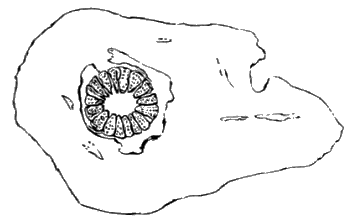
Lign. 37. Transverse Section of Stigmaria ficoides; nat. (M. Adolphe Brongniart.) This specimen shows that the cylinder (a in Lign. 36) is formed of bundles of vascular tissue, disposed in rays.
The central axis is thus shown to be a cylinder composed of bundles of vessels, disposed in a radiating manner, and separated from each other by medullary rays; the whole constituting a ligneous zone resembling that of Sigillaria (see Lign. 35); but the inner circle of medullary tissue seen in the latter is altogether wanting. This difference is similar to that observable in the stems or branches of a dicotyledonous tree, in which the woody cylinder is associated internally with bundles of medullary tissue, and the roots of the same tree that are destitute of them. Part of a vascular bundle from the woody tissue of a Stigmaria, seen by a high power and transmitted light, is figured Pl. V. fig. 6; the smooth interspaces are composed of cellular tissue.
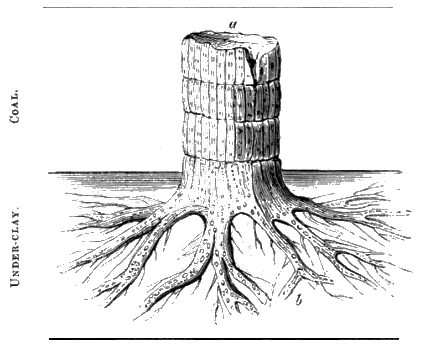
Lign. 38. Erect Stem of a Sigillaria, with roots.
Coal Mine, near Liverpool.
a. The trunk of the tree, traversing a bed of Coal.
b. The roots (Stigmariæ) spreading out in the Under-clay.
ERECT SIGILLARLA WITH ROOTS.
This opinion of M. Brongniart was confirmed by the discovery, in 1843, at St. Helen's, near Liverpool, of an upright trunk of a Sigillaria, nine feet high, with ten roots eight or nine feet in length, still attached, and extending in their natural position. These roots are undoubted Stigmariæ of the usual species, S. ficoides; and the radicles, formerly considered leaves, are spread out in all directions, to the extent of several feet.[103] To the sagacity and perseverance of Mr. Binney, of Manchester, science is indebted for this important discovery; the same gentleman laid bare, on the floor of the mine at Dunkinfold, near Manchester, a large erect trunk of a Sigillaria, with numerous Stigmariæ roots.
In the Pictou coal-field of Cape Breton, in Nova Scotia, similar facts have been brought to light; the remarkable phenomena existing in that locality, of successive carboniferous deposits containing scores of erect trees with roots spreading into their native soil, presenting peculiar facilities for verifying the observations made in England. In an interesting memoir on the coal-fields of Nova Scotia, Mr. Richard Brown has given a detailed account of numerous examples of stems of Sigillariæ, and of Lepidodendra, (a tribe of gigantic club-mosses of which we shall presently treat,) with the roots attached; these roots, in every instance, had the characters and structure of Stigmariæ. In one instance, the stem of the tree was broken off close to the roots, and the hollow cylinder of bark was bent down and doubled over by the pressure of the surrounding mud, so as effectually to close up the aperture, and leave only a few irregular cicatrices converging near the apex; this fossil explains the true nature of the "dome-shaped" plant figured in the Fossil Flora, and in Dr. Buckland's Essay.[104]
LEPIDODENDRON.
Lepidodendron (scaly-tree). Lign. 39.—Stems cylindrical, covered towards their extremities with simple, linear, or lanceolate leaves, which are attached to elevated rhomboidal spaces, or papillæ; papillæ marked in the upper part with a large transverse triangular scar; lower part of the stem destitute of leaves.
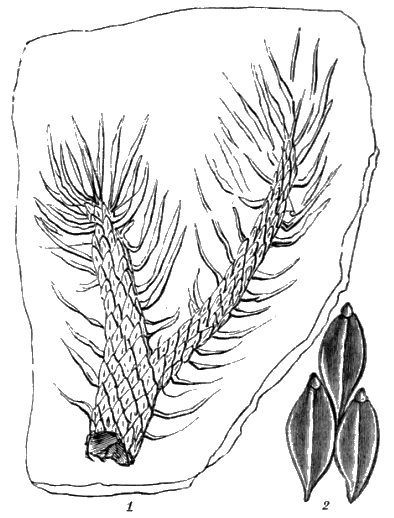
Lign. 39.
Fig. 1.— A terminal Branch of a Lepidodendron; nat.
2.— Leaf-scars on the stem of a Lepidodendron; nat.
In Coal-shale, Newcastle.
The remains of this tribe of plants abound in the coal formation, and rival in number and magnitude the Calamites and Sigillariæ previously described. These trees have received the name of Lepidodendra, from the scaly character of their stems, occasioned by the angular scars left by the separation of the foliage, as is the case in arborescent ferns: the term, however, simply indicates the appearance, for the surface is not imbricated. Some of these trees have been found almost entire, from the roots to their topmost branches. One specimen, forty feet high, and thirteen feet in diameter at the base, divided towards the summit into fifteen or twenty branches, was discovered in the Jarrow coal-mine.[105] The foliage consists of simple, linear leaves, spirally arranged around the stem, and appears to have been shed from the base of the tree with age. The scars produced by the attachment of the petioles were persistent; and the twigs and branches are generally found covered with foliage, as in Lign. 39. The roots are Stigmariæ, like those of the Sigillariæ, as proved by specimens in the Pictou coal-field, discovered by Mr. Brown.[106]
The internal organization of the stem of Lepidodendron differs from that of Sigillaria, in the absence of the woody cylinder and medullary rays which constitute so peculiar and important a character in the latter. The Lepidodendra have only an eccentric, vascular, medullary zone, the interval between which and the bark is filled up by cellular tissue.[107] In their structure, external configuration, mode of ramification, and disposition of the leaves, they accord so closely with the Lycopodiaceæ, that, notwithstanding the disparity in size, M. Brongniart, Dr. Joseph Hooker, and other eminent botanists, concur in regarding them as gigantic arborescent club-mosses[108] The living species of Lycopodiaceæ amount to nearly two hundred, the greater number of which, like the arborescent ferns, inhabit the islands of intertropical regions. They are diminutive plants, with delicate foliage, none exceeding three feet in height; most of them trail on the ground, but there are a few erect species, one of which (Lycopodium densum) is abundant in New Zealand.
The fruit of the Club-mosses is an oval or cylindrical cone, which in some species is situated at the extremity of the branches, and constitutes an imbricated spike. Now associated with the stems of the Lepidodendra, and very often in masses of their foliage, and in some instances attached to the extremities of the branches, are numerous oblong, or sub-cylindrical, scaly cones, garnished with leaves. These have received the names of Lepidostrobi (scaly-cones), and are unquestionably the fruit of the trees with which they are imbedded.
LEPIDOSTROBUS.
Lepidostrobus. Lign. 40.—A cylindrical strobilus or cone, imbricated from above downwards, composed of winged scales, terminating in rhomboidal discs: the axis traversed by a longitudinal cavity or receptacle.
These fossils have long been known to collectors, and are figured by Martin (Petrif. Derbiensia), Parkinson (Org. Rem. vol. i. pl. ix.), and others. They are cylindrical imbricated bodies, rounded at both extremities, from two to six or seven inches in length, and one or two inches in circumference. When broken asunder, a cylindrical cavity is exposed, which is sometimes hollow, but commonly filled with mineral matter; and when specimens are found imbedded in shale, the cone is fringed with linear-lanceolate bracteæ, as in Lign. 40, fig. 3. These fruits, like the fronds of ferns, often form the nuclei of ironstone nodules, and the leaves are frequently replaced either by a white hydrate of alumine, or by the mineral called galena, or sulphuret of lead, and the receptacles filled with the same substances. The specimens from Coalbrook Dale are generally in this state of mineralization, and possess great brilliancy; they are interesting examples of the electro-chemical changes which these fruits of the carboniferous forests have undergone.[109]
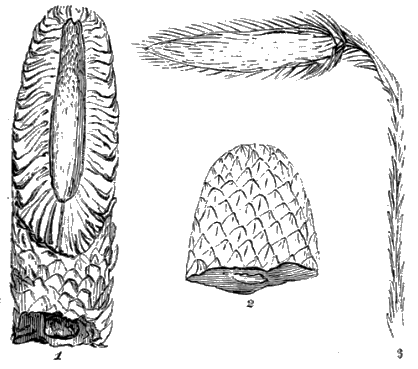
Lign. 40. Lepidostrobi, the fruit of Lepidodendra
;
nat.
Coalbrook Dale.
Fig. 1.— A portion of a cone, showing the imbricated structure and internal cavity.
2.— The upper part of a cone, displaying the imbricated surface.
3.— A young specimen attached to the extremity of a branch.
The figures in Lign. 40, represent the usual characters of these fruits. Of the young specimen, (fig. 3,) situated at the termination of a branch, M. Brongniart observes, "qu'il est impossible de ne pas reconnaître pour un Lepidostrobus jeune, fixé à l'extrémité d'un rameau."[110] As it is only in their young state that the spikes are found attached to the branches, it is probable they were shed as soon as they arrived at maturity.
Triplosporite.—Additional light has recently been thrown on the structure of the Lepidostrobi, by Dr. Robert Brown's examination of a silicified specimen of the upper part of a strobilus, in which the internal organization is beautifully displayed. The reader specially interested in this department of fossil botany should refer to the original memoir by the illustrious President of the Linnæan Society, with the accompanying plates that admirably exhibit the microscopic analysis of the structure of this remarkable fossil; a slice of which was shown me some years since by the late Marquis of Northampton.[111] The external surface of the specimen is covered with hexagonal areolæ; the transverse sections exhibit the appearance of the bracteæ and sporangia. The strobilus is formed of a central axis of relatively small diameter, from which proceed bracteæ, about thirteen in number, that are densely approximated, and much imbricated; and of an equal number of sporangia, filled with innumerable microscopic sporules, originally connected in threes. This triple composition of sporules (which differs from the constant quadruple union in the tribes of existing plants presumed to be most nearly allied to the fossil, namely the Ophioglosseæ and Lycopodiaceæ) is expressed by the name Triplosporite, adopted by Dr. Brown to indicate this peculiarity of structure, and the class or primary division to which the original plant is supposed to belong.[112]
Lycopodites.—Species of true Lycopodiaceæ occur in tertiary marls; a beautiful specimen, from Germany, Lycopodites Benettiæ, is figured Wond. p. 723.
HALONIA. KNORRIA.
Halonia; Knorria. Lign. 41.—Associated with the plants already described from the coal-measures, there are trunks and branches of other trees, presenting peculiar and but imperfectly known characters, which it will be convenient to notice in this place. Fragments of these stems are to be seen in most public collections of the carboniferous flora, and should be examined by the student, for figures and descriptions can convey but an imperfect idea of their nature.
Mr. Denny, the intelligent and indefatigable Curator of the Leeds Philosophical Society, has given the following admirable summary of the distinctive characters of the stems of most frequent occurrence in the Coal,[113] which will be found a useful guide to the collector.
1. Sigillaria.—Stem furrowed, not branched, leaf-scars small, round, much narrower than the ridges of the stem.
2. Favularia.—Stem furrowed, not branched, leaf-scars small, square, and as broad as the ridges of the stem.
3. Lepidodendron.—Stem not furrowed, branched, covered with lozenge-shaped scars in quincuncial order, each having a papilla in the upper part; the upper portion of the stem and branches with simple linear leaves; the lower portion destitute of leaves.
4. Halonia.—Stem not furrowed, branched, covered with indistinct rhomboidal marks, and tubercular projections disposed in quincunx.
5. Knorria.—Stem not furrowed, branched, marked with projecting scars of petioles disposed spirally.
6. Megaphyton.—Stem dotted, neither furrowed nor branched, leaf-scars very large, of a horse-shoe figure.[114]
7. Bothrodendron.—Stem pitted, neither furrowed nor branched, scars of cones (?) obliquely oval.
8. Ulodendron.—Stem neither furrowed nor branched, covered with rhomboidal marks; scars of cones (?) circular.
The characters of the roots called Stigmariæ (ante, p. 134.), and of the stems named Calamities (ante, p. 107.), and Equisetites (ante, p. 106.), are sufficiently distinct from the above to be easily recognized, I will briefly notice those not previously described.
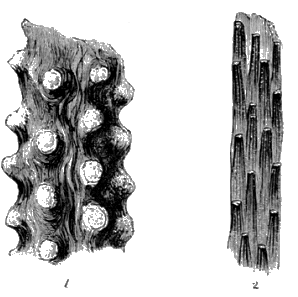
Lign. 41. Stems from the Coal Formation.
Fig. 1.— Halonia regularis. Coalbrook Dale.
2.— Knorria Taxina. Roof of the High-main Coal seam, Jarrow Colliery. (Brit. Foss. Flor.)
Halonia.—The specimens usually seen are mere sandstone casts having a thin carbonaceous crust; the stem is branched and beset with large elevated knobs, or subcortical protuberances, as shown in fig. 1, Lign. 41. These plants appear to be closely related to the Lepidodendra; their mode of branching is shown in a beautiful specimen (in the museum of the Leeds Philos. Soc.) figured and described by Mr. Denny, which is also remarkable because it indicates the probability that the Haloniæ, and the fossil stems, termed Knorriæ, are identical; for the specimen in question, which in its branches is unquestionably of the former type, has the base of the stem impressed with the leaf-scars of the latter.
Knorria.—To this genus the authors of the Fossil Flora of Great Britain referred those stems which have projecting leaf-scars, arranged spirally. The beautiful specimen figured as Knorria taxina, Lign. 41, fig. 2, closely resembles a young branch of Yew (Taxus), and perhaps might be more correctly named Taxites.
Bothrodendron and Ulodendron.—These genera, together with Megaphyton, are stems of a very remarkable character, and are easily distinguished by the vertical rows of large and distant scars. The two first have two series of very deep oval depressions on opposite sides of the stems, arranged alternately in the specimens I have examined: from the size and form of these obliquely-oval cavities, it is supposed that they were formed by the attachment of cones, and not by petioles; but their real nature is involved in obscurity.[115]
In Megaphyton, the large ovate scars indicate the attachment of deciduous branches or gigantic leaves, which did not grow all round the stem, but in a regular order of superposition on each side.[116]
ASTEROPHYLLITES.
Asterophyllites.—I shall conclude this notice of some of the most characteristic trees of the Carboniferous Flora, with an account of a tribe of plants whose remains are so common in the coal-shales and grits, that there are but few large slabs with vegetable remains that do not exhibit examples of the elegant verticillate foliage of one or more species. The term Asterophyllites, (expressive of the star-like form of the leaves,) applied to this family by M. Ad. Brongniart, includes several fossil plants which are known to geologists under different generic names; the following concise account may be useful to the student.[117]
1. Calamodendron.—These are arborescent stems, ligneous internally, and covered with a smooth carbonaceous crust, without regular longitudinal striæ, and not articulated; but the woody axis covered by this bark is deeply striated and articulated, resembling in this respect the true Calamites. These stems have a large central pith, or medullary column, surrounded by a ligneous zone, which is formed of radiated bands, without circles of growth: the structure of the carbonized bark is unknown.
2. Asterophyllites.—These are supposed to be the branches and foliage of the stems above described.
3. Sphenophyllum.—Plants, differing in the form of the leaves, but analogous in structure and mode of fructification to the Asterophyllites.
4. Annularia.—Herbaceous aquatic plants, distinct from the preceding.
5. Volkmannia.—These fossil plants are Asterophyllites in fructification.
The Asterophyllites (Lign. 42) had branched articulated stems, with verticillate leaves, arranged perpendicularly to the branches which supported them: but as the foliage is in most instances partially concealed, the natural form is but seldom observable.
The original plants are supposed to have been a tribe of flowering dicotyledons, for small seed-vessels resembling those of the Cypress are often found with the foliage.
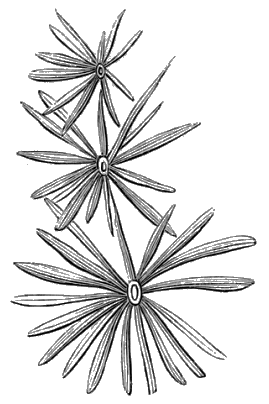
Lign. 42. Asterophyllites equisetiformis; nat. Coal-shale. (Foss. Flor.)
ANNULARIA CARDIOCARPON.
The Annulariæ were herbaceous plants with verticillate foliage like the former, but the whorls were arranged on the same plane with the stems on which they grew, and their remains have a very elegant appearance when expanded in the coal schists. It is supposed that they were aquatic plants, and that the stems and leaves floated on the surface of the water.[118]
Sphenophyllum (wedge-shaped leaf). Lign. 43.—The fossil vegetables thus named, though somewhat resembling in their elegant verticillate foliage the Asterophyllites, differ essentially, and are regarded by M. Brongniart as herbaceous plants related to the Marsiliaceæ, or Pepper-worts. The leaves are triangular, truncated at the summit, and very deeply lobed and dentated. The fructification consists of sessile axillary or terminal spikes, composed of verticillate bracteæ, covering the receptacles. This mode of fructification resembles that of the Asterophyllites.[119]
Cardiocarpon.—Lign. 44. fig. 1.—These are small fossil fruits or seed-vessels, which much resemble those of the Thuja or Arbor-vitæ, and are so often found imbedded with masses of the foliage of Asterophyllites, that it is conjectured they belong to those plants. They occur in groups of from five to twenty, and evidently were didymous, i.e. grew in pairs. Fig. 1a. is an enlarged view, to show the surface left by the attachment of the twin-seed.
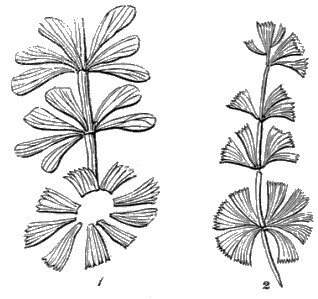
Lign. 43.
Fig. 1.— Sphenophyllum Schlotheimii; nat.
2.— Sphenophyllum erosum.
Coal-Shale.
Trigonocarpum. Lign. 44. figs. 3. 4.—These fruits, which resemble those of certain Palms, are often met with in the coal-mines of Leicestershire and Yorkshire; frequently occurring in groups of thirty or forty, as if they were the scattered seeds of a raceme of a Palm: they are referred to the genus Nœggerathia, a tree of the carboniferous formation allied to the Palms.
FOSSIL FRUITS.
A figure of a fossil fruit from the Oolite—Carpolithes Bucklandi, is introduced in Lign. 44, fig. 2, and will be described hereafter.
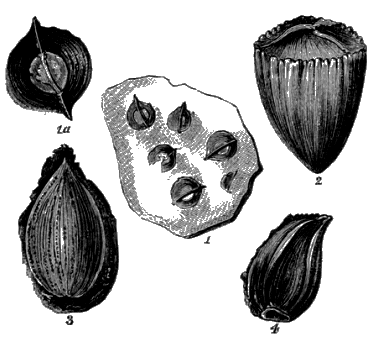
Lign. 44. Fossil Fruits, or Seed-vessels
;
nat.
Fig. 1.— Cardiocarpon acutum. Snibstone Coal-mine, Leicestershire.
1a.— 1a.—One of the above magnified.
2.— 2.—Carpolithes Bucklandii. Coralline Oolite, Malton.
3.— Trigonocarpum olivæforme. Snibstone Colliery.
4.— Trigonocarpum Nöggerathi.
The reader will observe that the fossil vegetables hitherto described belong, with but few exceptions, to the Carboniferous flora; and that the remains of Ferns, Calamites, Sigillariæ, and Lepidodendra, compose in a great measure those prodigious accumulations of mineral fuel, or coal, which supply the luxuries and necessities created by civilization.
Our review of fossil plants will now assume somewhat of a botanical arrangement, and we proceed to notice some of the most characteristic vegetable forms of the secondary and tertiary formations. We commence our examination with those remarkable tribes of gymnosperms, the Cycadaceæ, which comprise the Zamiæ and Cycadeæ.
Fossil Cycadaceæ.
The plants of this subdivision of the vegetable kingdom, from their singular structure and mode of growth, their simple cylindrical stems, and coronets of pinnated foliage, resembling that of certain palms, their usually gyrate vernation like that of the ferns, and their anomalous inflorescence and fructification, are objects of great interest to the scientific botanist; while the abundance of their fossil remains in the secondary formations renders them of the highest importance to the geologist.
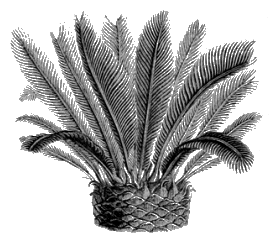
Lign. 45. Foliage and upper part of the Stem of Cycas revoluta 1/12 nat. In Kew Conservatory.
As many kinds of Zamia[120] and Cycas are cultivated in our hot-houses, the general appearance of the plants of this order must be familiar to the reader: the annexed figure of a beautiful living Cycas in the Royal Gardens at Kew, will serve to illustrate the general aspect of these exotics.
The Zamiæ are short plants, with stout cylindrical stems, beset with thick scales, which are the bases of the petioles that have been shed: towards the summit the stem is garnished with a crown of elegant leaves; the fruit resembles the cones of pines. The leaves are pinnated, and very tough; their venation is either parallel as in endogens, or dichotomous as in ferns, but never reticulated as in exogens: in a young state they are coiled up like a crosier, as in ferns.
The Cycadeæ have the general aspect of the Zamiæ, but differ in their fructification and other characters; and some species have the stem bifurcated towards the top, and attain a height of upwards of twenty feet; for example, C. circinalis.
The stem in its internal structure[121] bears a close analogy to that of the Coniferæ; it has a central medullary column surrounded by a ligneous cylinder, divided by cellular medullary rays, each composed of bundles of vessels, and a thick cellular cortical investment or false-bark,[122] composed of the persistent scales that formed the bases of the petioles. (See Pl. V. fig. 5.)
The existing species of Cycadaceæ are exclusively natives of hot regions, and chiefly inhabit the West Indies, South Africa, Equinoctial America, Japan, New Holland, &c.; not one species is known in Europe: a fact in striking contrast with the abundance of fossil plants of this order, which occur throughout the secondary formations of England and the continent.[123]
No true cycads have hitherto been discovered in the carboniferous deposits; it is in the floras of the secondary epochs, from the new Red to the Cretaceous inclusive, that this tribe of plants forms an important feature. The foliage, stems, and fruits, occur in a fossil state; and as these organs cannot be referred with certainty to their respective plants, distinct genera are formed for their reception.
Foliage.—From the tough and durable nature of the leaves, the foliage of the Cycadeæ occurs in a fine state of preservation; and in the fluvio-marine deposits of the Oolite of Yorkshire, many specimens of great beauty have been collected. I know not another locality in England so rich in fossils of this kind, as the cliffs along the coast near Scarborough; Gristhorpe Bay is well known to collectors. Not only the leaves, but also the fruits or cones occur, and of these, examples are to be seen in most public museums.[124] The leaves are carbonized, but the venation is well preserved.
The leaflet of the recent Cycas is distinguished by a strong nervure, which runs along the middle; that of Zamia has no midrib, but fine parallel veins that pass direct to the margin.
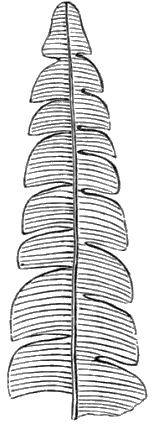
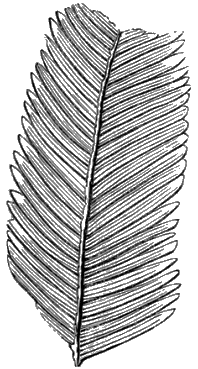
Lign. 46. Part of a leaf of Pterophyllum comptum; nat. Oolite, Scarborough. Lign. 47. Part of a leaf of Zamites pectinatus; nat. Oolite, Stonesfield.
Pterophyllum comptum. Lign. 46.—The general aspect of these fossils is shown in this figure of a leaf, referred to the genus Pterophyllum, which is characterized by leaflets, often slightly united at their base, truncated at the summit, of a quadrangular or oblong form, and having fine, straight, parallel veins. The leaves are ten or twelve inches long, and have fine lanceolate leaflets; they are abundant in the same beds, and are often associated with the cones or fruit[125] figured in Lign. 48.
ZAMITES PECTINATUS.
Zamites pectinatus. Lign. 47.—In the Stonesfield slate, collocated with remains of reptiles, fishes, insects, and mollusks, leaves and fruits of cycads are occasionally met with. A portion of a leaf nine inches long is here figured. The Lias of Dorsetshire has yielded many beautiful relics of this family[126]
But few vestiges of the foliage of Cycads have been observed in the Wealden formation of England; one elegant leaf, however, of an undescribed species, was obtained some years since, from a sandstone quarry in Surrey, and is figured in my Geology of the South-east of England, p. 238; it is named in honour of my distinguished friend, M. Ad. Brongniart, Cycadites Brongniarti. The Wealden of the north of Germany is very rich in fossil Cycadeæ; my friend. Dr. Dunker, has figured and described twelve species in his admirable work on the organic remains of that formation.[127]
Fruits.—The cones or fruits which occur with the foliage of Zamiæ in the carbonaceous shales and marls of the Oolite of the Yorkshire coast, are very fine, and have been described under the various names of Zamites Mantelli, Z. gigas, and Z. lanceolatus.
An interesting memoir on the structure of these fossils, by James Yates, Esq. (a gentleman distinguished for his knowledge of the recent Cycadaceæ), is published in the Proceedings of the Yorkshire Philosophical Society for 1849, p. 37; and another communication on the same subject by my friend Professor Williamson, of Manchester, in York. Phil. Trans. 1819, p. 45; to these papers I must refer for a detailed account of all that is at present known respecting their organization.
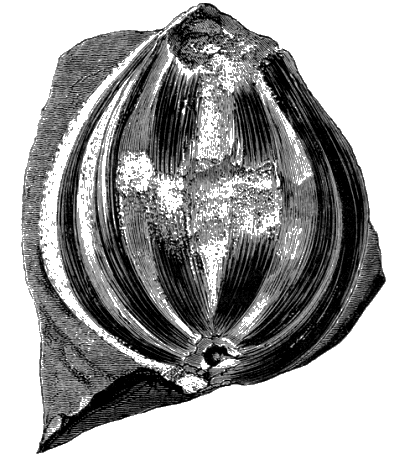
Lign. 48. Fruit of Zamites Mantelli, (Brongniart); nat. From near Scarborough. The surface of the cone is concealed by the bracteæ.
Zamites Mantelli.[128] Lign. 48.—The leaves associated with the fruit here figured, have lanceolate leaflets that insensibly contract at the base, and are inserted obliquely into the rachis; thus resembling the foliage of the recent Encephalartos. With these leaves, and the ovate cones (Lign. 48), are occasionally found a circle of leaves or elongated scales, locally termed "collars," which Professor Williamson has shown to be a zone formed by a scaly bud in which the germ of the plants was inclosed. In the progress of development, the fruit burst through the upper part of the investing sheath, and, as it grew to maturity, rose above the incurved elongated bracteæ, till the latter formed a zone or "collar" around the pedicle of the cone.[129] These fossils have been mistaken for flowers.[130]
It does not appear that the structure of the cone has been preserved in any of the specimens, so as to demonstrate the characters of the original; in all those I have examined, the surface of the fruit is concealed by the elongated bracteæ, which are pressed flat, and adhere so firmly to the inclosed body, as to render it impossible to ascertain its nature.[131] Mr. Williamson is of opinion that the plant resembled the recent Cycas circinalis, in its great height, and lax habits; and states, that he had seen portions of leaves that were three feet in length.
Zamites crassus. Lign. 49, fig. 1.—In Sandown Bay, on the south coast of the Isle of Wight, where the Wealden beds rise to the surface from beneath the lowest strata of Greensand on the east and west, several cones have been found, associated with other vegetable remains, and bones of the Iguanodon, &c. A fossil cone from this locality is here figured; it bears considerable resemblance to the fruit of the recent Encephalartos.
ZAMITES OVATUS.
Zamites ovatus. Lign. 49, fig. 2.—A few examples of cycadeous fruits have been collected from the Greensand of Kent and Sussex. The beautiful fossil represented, Lign. 49, fig. 2, from Foss. Flor. is referred to the Zamiæ, by the eminent authors of that work; but it presents in its imbricated character a greater analogy to a pine cone.
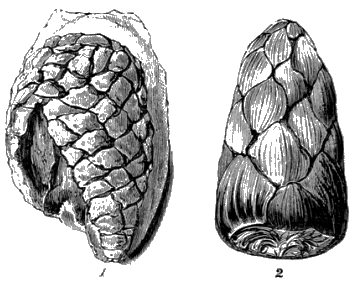
Lign. 49. Fossil Fruits of Cycadeous Plants
;
1
/
2
nat.
Fig. 1.— Zamites Crassus. Wealden, Isle of Wight.
2.— Zamites Ovatus. Greensand, Kent.
Zamites Sussexiensis.—At Willingdon, near Eastbourn, in Sussex, a cone nearly six inches long was discovered in a bed of Greensand, which abounds in fossil coniferous wood: it is of an elongated cylindrical form, and covered with hexagonal scales. I have provisionally named it Zamites Sussexiensis (Geol. Proc. 1843), as it presents a nearer resemblance to the fruit of Zamiæ than to that of Conifers.
Trunks and Stems of Cycadaceæ.—In this section I shall notice the fossil plants which occur so abundantly in the fresh-water deposits that overlie the marine oolitic limestone of the Isle of Portland, and which must be familiar to my readers, from the graphic account of the circumstances under which they occur, by Mr. Webster, and subsequently by Dr. Buckland, and Sir H. De la Beche. In my Wonders of Geology, p. 387, and Geol. Isle of Wight, p. 395, the geological phenomena of that most interesting locality, the Isle of Portland, are so fully described, that it will not be necessary to dwell upon them; the structure and affinities of the fossil vegetables are the especial objects of our present inquiry.
MANTELLIA NIDIFORMIS.
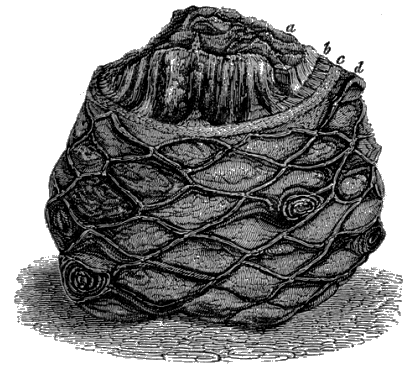
Lign. 50. Silicified Trunk of Mantellia nidiformis (Brongn.); 1/4 nat. (Cycadites megalophyllus. Bd.) Wealden. Isle of Portland. a. Central mass of cellular tissue, b. Circle of ligneous plates, c. Zone of cellular tissue, d. False-bark.
Mantellia. Lign. 50, 51.—The fossil Cycadeæ of the Isle of Portland were first described botanically by Dr. Buckland, (Geol. Trans, vol. ii. 2d Series,) under the name of Cycadeoidea; of which Memoir the account in Bd. p. 404, is an abstract. M. Ad. Brongniart, considering these plants as a peculiar type, referred them to a new genus, which he did me the honour to name Mantellia (Prod. Veg. Foss.). These stems or trunks are from one to two feet in height; the circumference of the largest not exceeding three feet. The stem is subcylindrical, and the external surface covered with the rhomboidal scars formed by the attachment of the leaf-stalks, and which are widest in their transverse diameter.
There are two species, which are readily distinguished by the form of the stems, and the difference in the size of the cicatrices left by the petioles.
The most common kind is short, and spheroidal, and the leaf-scars are relatively large; its shape has caused it to be named "Crows' nest," by the quarrymen, who believe these plants to be nests that were built by crows in the trees of the petrified forest with which they are imbedded. The specific name (nidiformis) adopted by M. Brongniart, expresses this popular notion.
Lign. 50. represents a fine example from the Portland Dirt-bed, which exhibits a structure altogether similar to that which characterizes the stems of recent cycadeous plants; namely, (a) a central mass of cellular tissue surrounded by circles of laminated ligneous rays or plates (b); then a zone of cellular tissue (c), and an external cylinder of false-bark (d). The mode of increase by buds, from germs in the axillæ of the petioles, as in the living plants, is also distinctly seen.
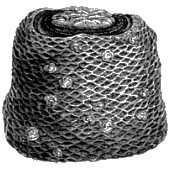
Lign. 51. Mantellia cylindrica. (Brongn.); 1/8 nat. (Cycadites microphyllus. Bd.) Wealden. Petrified Forest of the Isle of Portland.
The other species is subcylindrical, and the leaf-scars are much smaller and more regular than in M. nidiformis, indicating a more delicate foliage, as expressed by Buckland's specific name: that of M. Brongniart refers to the cylindrical form of the stem. This plant was higher and more slender than its associate. Numerous buds are seen in the axillæ of the petioles in the specimen figured.
These fossils present, both externally and internally, a close relation to the bulbiform stems of the recent Cycadeæ, named Encephalartos, of South Africa.[132]
Neither the leaves nor the fruit are known: a cone found in the Dirt-bed of Portland, and attributed to these plants, appears to belong to the coniferæ of the petrified forest. Examples of Mantelliæ have been found in the quarry of Portland-stone at Swindon, Wilts.
CLATHRARIA LYELLII.
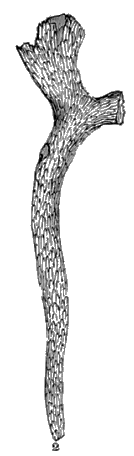
Lign. 52. Clathraria Lyellii. Wealden. A branched example of the inner axis: the original 31/2 feet high.
Clathraria[133] Lyellii. Lign. 52-57.—The fossil plants to which I would next direct attention were first discovered by me in the Wealden strata of Sussex, in 1820, and were figured and described under the name they still bear, in my Fossils of Tilgate Forest, in 1827. The specimens figured in that work are the most illustrative hitherto discovered, with but one exception.[134]
From the imperfect state of the remains of these plants, the structure and affinities of the originals were very ambiguous, and the fossils have been placed by some eminent botanists with the Liliaceæ, and by others with the Asphodeleæ; their true botanical position is doubtless with the Cycadaceæ; for in some points they resemble the Zamiæ, in others the Cycadeæ.