Part 2 — DESCRIPTION OF MOUNDS
Reading edition
Mound No. 1
Mound No. 1 (No. 24 on the plan of Santa Rita (fig. 14), situated midway between Nos. 6 and 22) was conical in shape, nearly circular at the base, 18 feet high, and 90 feet in circumference. It was built throughout of large irregular blocks of limestone, the interstices being filled with limestone dust and earth, forming together a sort of friable mortar, which rendered the whole structure nearly as compact as a solid block of masonry.
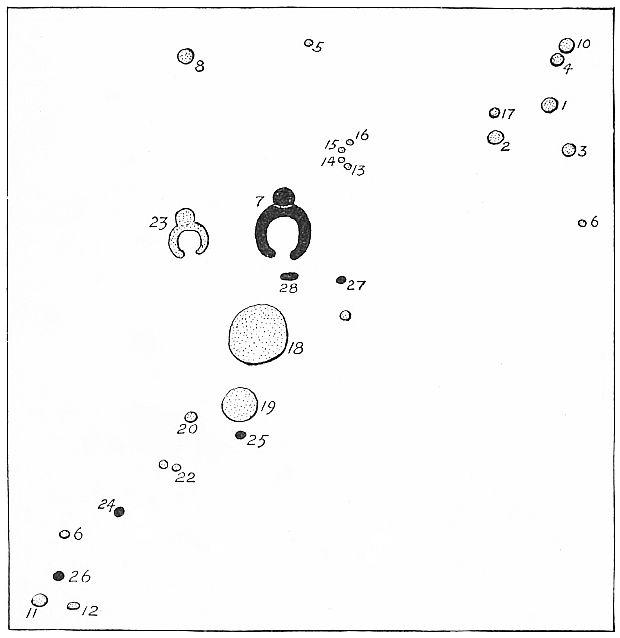
Fig. 14.—Plan of Santa Rita mounds.
Excavation near the center of the mound, at a depth of 2 feet below the surface, brought to light a large circular disk of roughly hewn limestone, 3 feet in diameter by 8 inches thick. On lifting this it was found to cover the mouth of a bell-like cist, nearly 3 feet in diameter and about 5 feet in depth. On opening the cist, which was slightly narrower at the bottom than at the top, it was found to be nearly half filled with very fine brown dust, at the bottom of which lay a roughly made circular urn 18 inches in diameter, covered by a mushroom-shaped lid.
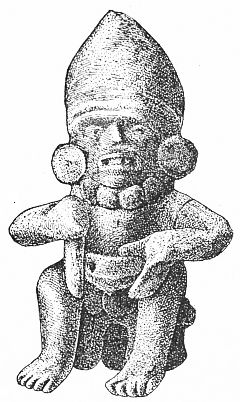
Fig. 15.—Figurine from Mound No. 1.
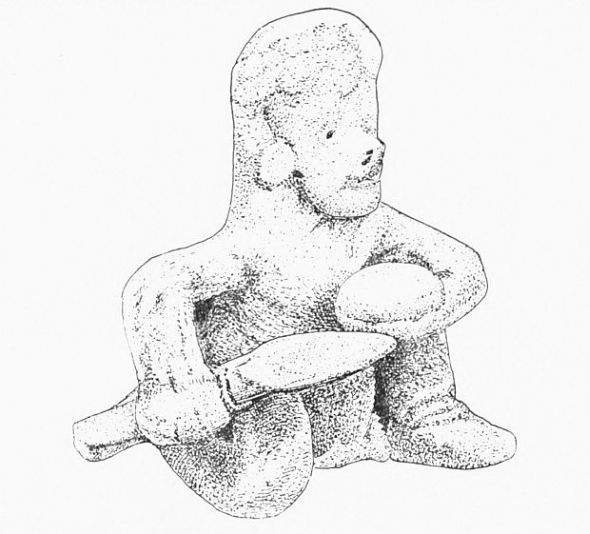
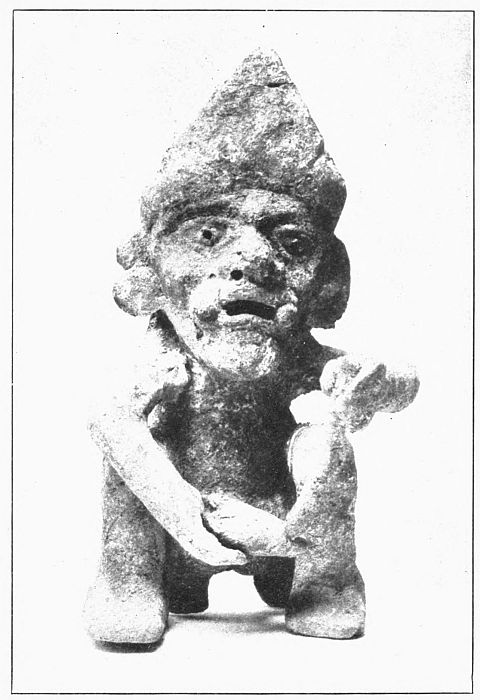
The urn was filled to the top with small crudely executed pottery figurines of men and animals. There were 49 of these in all, consisting of 4 warriors, with shield and spear, 3 seated human figures, 4 standing figures (eating and fanning themselves), 4 lizards, 4 alligators, 4 snakes, 4 birds, 4 dragon-like creatures, 4 tigers, and 14 quashes or picotes. The warriors (pl. 8) are represented in a crouching position, with the right knee and left foot upon the ground; each holds in the right hand a small spear and on the left forearm a circular shield.[25] Two of them exhibit tusk-like objects projecting from their mouths. The figures are 41/2 inches high; they are painted in red and white throughout. The headdress consists of a boat-shaped cap worn with the bow and stern projecting over the ears. The seated figures (pl. 9; fig. 15) are each 6 inches in height; these are painted throughout in red, white, and green. Each is seated upon a low four-legged stool, and grasps in one hand by its greatly enlarged spatulate glans the projecting penis, on which he is seemingly performing some sort of surgical operation with a long knife held in the other hand.
The headdress consists of a mitre-like erection in front, with a long queue hanging down to the waist behind. Button-like labrets are worn on each side of the mouth in two of the figures, and all wear large circular ear plugs. The standing figures (fig. 16) are each 51/2 inches high, and had been painted throughout in red and white, though not much of the original color now remains. The headdress consists of a broad flat cap decorated in front with a row of circular beads, and on each side with a large tassel, which hangs down over the ear plugs. Each figure wears a small narrow maxtli and button-like labrets at each angle of the mouth. In one of the figures the right hand is extended, while the left holds a circular fan. In the other the forearms are flexed at right angles, with hands held open in front of the waist, as if about to receive something. The lizard effigies, though crudely made, are most lifelike representations about 6 inches in length. The alligators resemble very closely those taken from another mound at Santa Rita.[26]
BUREAU OF AMERICAN ETHNOLOGY BULLETIN 64 PLATE 8.
FIGURINES OF WARRIORS FROM MOUND NO. 1
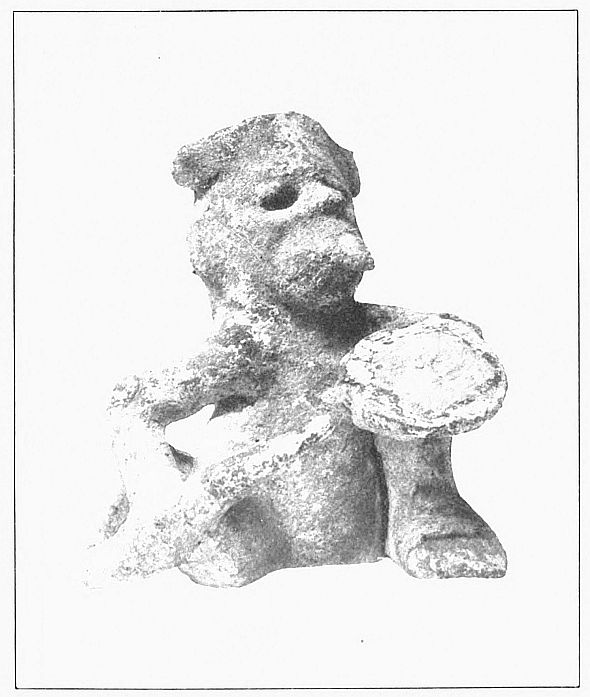
BUREAU OF AMERICAN ETHNOLOGY BULLETIN 64 PLATE 9.
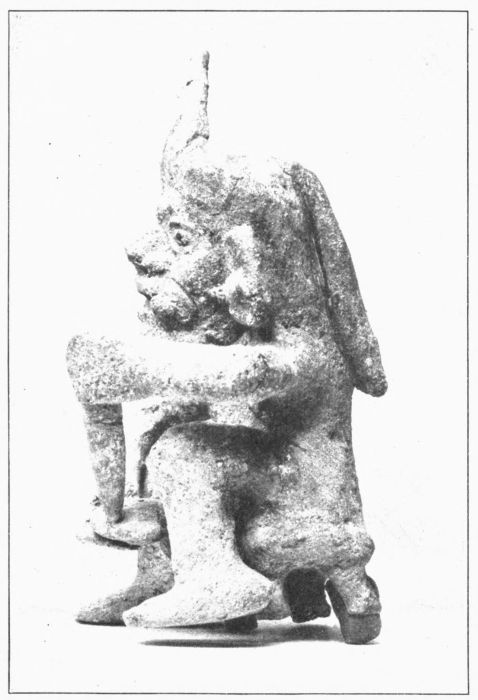
FIGURINES FROM MOUND NO. 1
The tigers and dragon-like creatures are exactly similar to those figured in Nos. 6 and 4 of the same plate. The bird and snake effigies are very crude and ill made; the former, about 11/2 inches in length, represent birds in the act of flying, with wings extended. The snakes, each represented with a double curve in the body, are about 51/2 inches in length and one-half inch in diameter; they are made of rough clay, painted red. The effigies of the quashes, though rough and crudely made, are rather vigorous and lifelike in execution. Each is about 3 inches long. This small arboreal animal, which abounds in the district, is represented in a variety of comical positions; so well indeed has the artist studied his model that one can not help thinking that he must have kept some of the little animals as pets, as many of the Maya Indians do at the present day. The figures when first found were so brittle that it was impossible to remove them from the pot without breakage, as they had been seemingly only sun dried. After exposure to the sun and air, however, for a few days they gradually hardened.
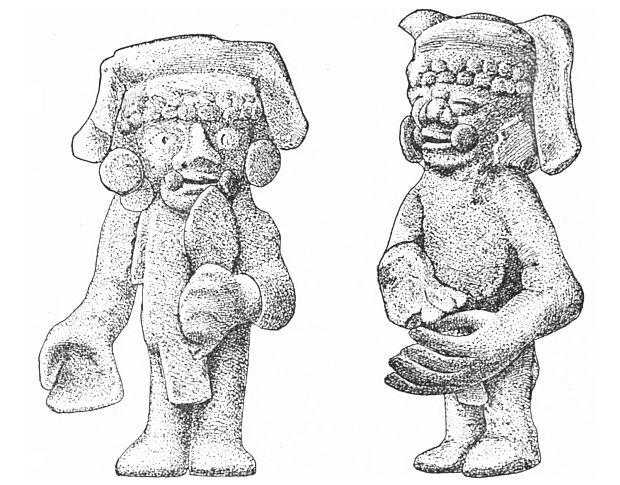
Fig. 16.—Figurines from Mound No. 1.
The only unpainted object found in the urn was a natural-size model of the human penis, in a state of semierection (fig. 17). This differed from all the other objects in that it had been fired, instead of merely sun dried, and is on that account much harder. Upon the upper surface of the glans penis are three longitudinal incisions, extending almost from base to apex, evidently made with a sharp-pointed implement while the clay was still soft.
With these figurines a number of perforated beads of jade and some of a dark-red stone, all nicely polished, were found; also the tooth of a large alligator, perforated at the base, evidently for suspension with the beads.
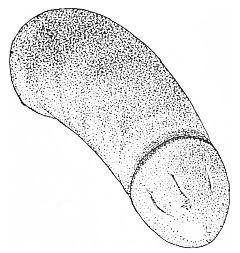
Fig. 17.—Unpainted object from Mound No. 1.
About 6 feet to the north of the center of the mound, at a depth of 3 feet below the surface, was discovered a small stone cist or chamber, 18 inches square, built of roughly cut blocks of limestone. Within this were found most of the bones of a male of medium height and fair muscular development. These bones were exceedingly friable, but showed no effects of fire; with the exception of the tibiæ, they were in no way abnormal. The upper articular surface of the right tibia had disappeared. The shaft was rounded in section, the prominent angles at the front and sides being obliterated. It was slightly bowed, with the convexity anteriorly, and was considerably enlarged, especially in its upper two-thirds, which were composed chiefly of very friable cancellous tissue, rendering the bone much lighter than its appearance indicated. The surface of the upper part of the bone was marked by the presence of a number of small pits or depressions. Of the left tibia only a few fragments were found, but so far as could be judged from these a change somewhat similar to that observed in the right tibia had taken place in it. The bones and other objects found in this mound would suggest at first sight the possibility of the individual buried beneath it having suffered during life from some form of venereal disease, closely allied to, if not identical with, syphilis. On reading Landa's account[27] of two forms of ceremonial self-mutilation carried out by the Yucatecan Maya at the time of the conquest there can be little doubt, however, that the figurines shown in plate 9 and figure 15 are meant to represent individuals inflicting on themselves one or other of these, but, owing to the crudeness of the workmanship, it is difficult to determine which. In one the foreskin was pierced and expanded in much the same way that the ears were treated when sacrificing to the idols. In the other, a number of men, sitting in a row in the temple, each pierced his glans penis from side to side, and passing a long piece of cord through all the apertures, strung themselves together in this way.
Mound No. 2
Mound No. 2 (No. 25 on the plan, fig. 14) was situated a short distance to the south of Mound No. 19. It was circular at the base, conical in shape, 6 feet high at its highest point, and 40 yards in circumference. On the summit of the mound, partially buried in the earth, was found a conch shell, much worn by the weather, with the tip cut smoothly off, and still capable of being used as a trumpet. The surface layer of the mound was composed of earth, in which were embedded a few limestone blocks. Within this layer, which was 18 inches thick, near the center of the mound and a few inches beneath the surface, was found a turtle, hewn from a block of limestone, measuring 13 inches in length and 10 inches in breadth. The next layer was composed of ashes, charcoal, and pieces of half-charred wood. This layer, which varied from 3 to 8 inches in thickness, extended evenly over the whole surface of the mound, and within it were found 16 beads of jade, two small round three-legged vases, and the fragments of two pottery images. The beads were all perforated and finely polished; two of them represented human faces, and one the head of some animal, probably an alligator. One is unusually large, measuring 33/4 inches in length by 3/4 inch in breadth.
The clay images are so fragmentary as not to be worth figuring, but in construction, ornamentation, and size they appear to be almost identical with those found in the mounds at Santa Rita, already described.[28] One of the vases is 31/4 inches and the other 23/4 inches in height; both are ovate. All the objects taken from this layer show traces of having been exposed to the action of fire. The beads are all more or less cracked and blackened, and the pottery images and vases are discolored. The next layer was composed of mortar, embedded in which were numerous pieces of limestone; it varied in depth from 18 inches to 2 feet. The upper part of this layer, to a depth of 2 to 3 inches, was yellow and very hard, and seemingly had been fired; the lower part was lighter in color and very friable. Within this layer, toward the center of the mound, was found the alligator effigy shown in figure 18. This animal is 151/2 inches in length from the snout to the tip of the tail. The interior is hollow, and in the center of the dorsal region is a circular opening 31/2 inches in diameter, surrounded by a rim 11/2 inches high and covered by a saucer-like lid. Within the widely opened jaws is seen a human face, having at each corner of the mouth a small pottery disk, and in the ears two large circular ear plugs.[29] Between the eyes of the alligator are two claw-like horns, 1 inch in length, each terminating in three curved prongs, which point forward. Within the body were found two small perforated beads of polished jade. The inside of the jaws is colored red; the whole of the body, together with the head and limbs, is colored brown; the forehead and cheeks of the face held between the animal's jaws are colored blue; the nose, mouth, and chin, white.
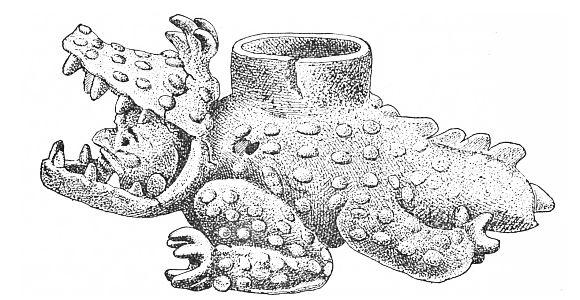
Fig. 18.—Clay alligator found in Mound No. 2.
This is by far the largest and most carefully modeled of the pottery figurines found at Santa Rita, the smallest detail having received careful attention, and the scales, claws, and teeth being separately and accurately formed.[30]
The fourth and deepest layer was 21/2 feet in thickness, and was built of blocks of limestone, each weighing from 50 to 200 pounds, roughly fitted together, without clay or mortar to fill in the crevices. Scattered all through this layer were great numbers of fragments of pottery censers decorated externally with human figures; nearly 150 pounds of these were taken from it, representing probably 20 incense burners. The whole of the pottery when first found was exceedingly brittle, but hardened in a few hours on being exposed to the air and sun. At the bottom of this layer, and resting on the ground, were found a number of pieces of black porous material with a peculiar odor. The bottom of a large round pot, 10 inches in diameter, was also found full of the same substance, which is probably a mixture of copal gum with various aromatic substances, which had been used as incense and partially charred at the bottom of the incense burner. Fragments of the bottoms of round pots were found scattered about on the ground level, many of them having bits of this charred incense still adhering to them.
The mound appears to have been constructed in the following manner: First, a number of pieces of burning incense and round jars containing the same substance were strewn thickly over an area approximately 40 yards in circumference; next a foundation or platform 21/2 feet in height was formed by placing together a number of large rough blocks of limestone, among which were scattered the fragments of about 20 incense burners, decorated outside with human figures in high relief. Over this was plastered a layer of mortar 18 inches to 2 feet in thickness in which was embedded the alligator seen in figure 18. Fires were lighted on top of this mortar till its upper layers were discolored, and into the fire while still burning were thrown fragments of two clay images, two small oval vases, and a number of beads. Over the ashes and charcoal left by the fires earth and blocks of limestone were heaped to a height of 18 inches, and in this layer was buried the stone turtle already referred to; finally on top of the earth layer was placed a conch-shell trumpet.
Mound No. 3
Mound No. 3 (No. 26 on the plan, fig. 14) was situated immediately between Mounds Nos. 6 and 11. It was roughly circular in shape, 120 feet in circumference and 3 feet in height. On being dug away to the ground level it was found to be composed of earth and small blocks of limestone, among which were numerous potsherds and fragments of terra-cotta images, though the latter were so small that it was impossible to tell how many images they represented. The potsherds varied very much, some being rough and undecorated, others polished and well painted in geometrical devices. Fragments of flint spearheads and obsidian knives were also found in this mound. On reaching the ground level the opening of a narrow passage 18 inches square was discovered which led obliquely downward toward the east for a distance of 8 feet; it was lined with roughly squared flags of limestone and terminated in a small stone-lined chamber 2 feet square. On the floor, half buried in fine dry earth, lay a small urn, roughly made of coarse pottery, neither painted nor glazed. It was circular in form, 381/2 inches in circumference, with a semicircular handle at each side, and was covered by a mushroom-shaped lid; with the lid in situ the whole formed a somewhat irregular sphere. In the urn and almost completely filling it were 20 small pottery figurines, comprising 3 warriors, 1 seated human figure, 4 alligators, 4 dragons, 6 quashes or picotes, and 2 serpent-like creatures.
The warrior figures resemble very closely those found in Mound No. 24 (see pl. 8), the only difference being that while two of them hold shields on their left forearms, and grasp spears in their right hands (as in pl. 8), the third warrior from this mound grasps a long dagger, instead of a spear, in his right hand. The seated figure is very similar to those from Mound No. 24 (see fig. 15), the only difference being that the glans penis is grasped in the left hand while the right hand wields the knife. The alligators are closely similar to those already described, except that they are solid throughout instead of being hollow. They are painted red, white, and black, and vary in length from 51/2 to 61/2 inches. The tigers are similar to those found in Mound No. 24, but are rougher, and not so carefully modeled; all are hollow and are painted red throughout. The four dragon-like creatures vary from 6 to 7 inches in length; the body, which is round and slender, ends in a flattened bifid tail; the mouth, which is held wide open, is furnished with a set of formidable teeth. Upon the upper lip is a horn-like excrescence, and over the thorax are one dorsal and two lateral fins. Each animal is painted white over the whole surface; the inside of the mouth is painted red over the white layer. The six quashes are exactly similar to those found in Mound No. 24, as are also the two serpents.
Mounds containing animal and human effigies appear to be singularly limited in their distribution. At Santa Rita seven have been explored in all, each containing 1 to 49 effigies, some very crudely and roughly made from sun-dried clay, others nicely modeled and painted in various colors. Probably several more of these mounds had been removed by the former owners of the estate to obtain stone for building and road-making purposes, as figurines similar to those taken from the excavated mounds were found in the possession of coolie laborers working on the estate, which they said they had found from time to time when digging for stone. The effigies comprise figures of men, alligators, turtles, quashes, lizards, birds, sharks, and snakes, together with two-headed dragons and other mythologic animals. Similar mounds containing animal effigies have been found at Douglas, about 18 miles southwest of Santa Rita; at Bacalar, 25 miles northwest; at Corozal, less than a mile south; and near San Antonio, about 9 miles north of it. In each of these localities only a single effigy was found, the workmanship of which resembled so closely that of the Santa Rita specimens that it would be difficult to decide from which locality they had come.
So far as it has been possible to ascertain, no similar human and animal effigies have been previously discovered in this section of the Maya area. The significance of these figurines appears to be somewhat obscure. They are not invariably found associated with human remains, though this may be owing to the fact that the bones have completely perished through decay or because cremation has been practiced. They show no signs of use or wear and were evidently made only to be buried. The hollow specimens frequently contain one or more beads of red shell, greenstone, or clay in their interiors, while in most cases they have been found associated with fragments of pottery incense burners, which in this region seem to have been very commonly mortuary in use. On the whole it seems probable that these figurines were merely votive offerings to the gods, buried with the dead. Some of them may indicate the occupation of the individual with whom they were buried. A priest and warrior from the same mound have been described, whose occupant may have combined the double office, while a small statuette of an old man, with a macapal slung over his shoulders, by a strap passing across the forehead (typical of an Indian laborer of the present day), was found by a coolie digging out stone from a mound at Santa Rita many years ago.
Mound No. 4
Mound No. 4 (No. 7 on the plan of the Santa Rita mounds)[31] has recently been excavated, together with nearly the whole of the earthwork on its south side. The mound was circular at the base, conical in shape, 57 feet in height, 471 feet in circumference, and was built of blocks of limestone held together by mortar. On the south side of the mound and continuous with it was a circular earthwork 100 yards in diameter. The walls inclosing the circular space varied from 10 to 25 feet in height. They were higher toward the north, where they were continuous with the large mound, and lower toward the south, where an opening 30 feet wide gave access to the inclosure. The summit of the mound was truncated, circular, and about 20 feet in diameter.
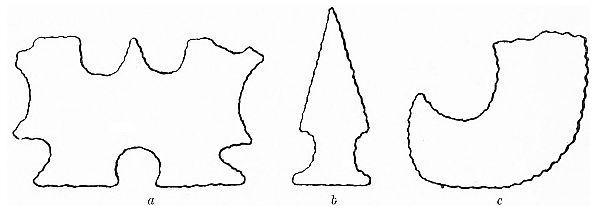
Fig. 19.—Objects from Mound No. 4.
It was covered by a layer of alluvial earth 4 inches in thickness, on removing which the following objects were brought to light, lying on the layer immediately subjacent, near the center of the mound: (a) A leaf-shaped spearhead of very light yellow flint, 5 inches in length; (b) a leaf-shaped spearhead of reddish flint, 51/2 inches in length; (c) an eccentrically-shaped flint object (fig. 19, a), 41/4 inches in breadth by 23/4 inches in depth, of light grayish flint, very neatly and carefully chipped; (d) a large, well-made flint arrowhead, deeply grooved on each side of the base, 21/2 inches in length, and of light grayish color (fig. 19, b); (e) the broken end of a roughly chipped flint hook or crescent (fig. 19, c). With these flint objects were found a small red-stone bead and a quantity of pieces of broken images, as arms, legs, faces, hands, breastplates, etc., in rough pottery. Below the alluvial layer the mound was composed of large blocks of limestone, held together by mortar, giving it the consistency of masonry and rendering digging in it very difficult. At a depth of 6 feet a small oblong chamber was opened, built of rough blocks of limestone, about 8 feet by 3 feet, within which were found fragments of human bones, the head pointing to the north. At both head and feet a few very roughly chipped spearheads were found. At a depth of 10 feet another small chamber, 4 feet in length by 2 feet in height and 2 feet in breadth, was opened, also composed of rough blocks of limestone. Within this were four basin-shaped vessels; two, somewhat larger than their fellows, were superimposed upon them (fig. 20). These basins were made of rough pottery, colored yellow, with a broad red stripe round the rim. Each was pierced by a pair of small round holes, 1 inch apart, repeated at equal intervals four times round the circumference, about one-half inch from the margin. The perforations in the upper vase corresponded exactly to those in the lower when they were discovered, suggesting that they had been connected by cords of henequen fiber, ti-ti, or some perishable material which had disintegrated. It was considered certain that these vessels would contain a number of the small pottery figures which similar vessels from neighboring mounds had yielded. On removing the cover from the first one, however, it was found to contain nothing but a small quantity of impalpable dust. The second contained about an equal quantity of similar dust, together with a small rough opal. The excavation of this mound was continued to a depth of about 18 feet, but nothing further was discovered.
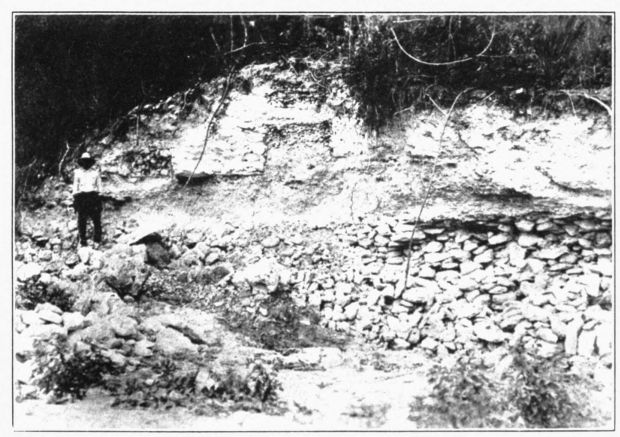
The circular space inclosed within the earthwork was surfaced by a layer varying from 2 feet to 3 feet in thickness, resting on the bedrock, and composed of rubble and powdered marl beaten into a compact mass, covered by two layers of cement, one beneath the other, which formed a smooth level floor over the whole inclosure. A great part of the earthwork and the rubble from the floor of the inclosed space have been removed to repair the Corozal streets. Nothing, however, was found within them with the exception of a few broken flint axheads and spearheads, some hammerstones (which are found practically everywhere), fragments of obsidian knives, and quantities of potsherds. Plate 10 shows a section through the earthwork in process of removal at its western extremity.
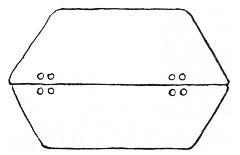
Fig. 20.—Pottery vessels from Mound No. 4.
The wall is 21 feet 8 inches in height at this point, though only about 17 or 18 feet are shown in the photograph, as the ground was filled up behind the men excavating by a heap of limestone dust 3 or 4 feet high, left after the stones had been removed. The wall is composed here from the ground up of—(1) a layer of small rubble, 18 inches in thickness, the stones composing which had apparently been picked off the land; (2) a layer of cement, 6 to 8 inches in thickness (the upper surface of this layer is continuous with the upper surface of the cement covering the inclosed space, and the two together evidently formed originally one continuous flat, smooth pavement); (3) a layer of large rough blocks of limestone, 8 feet in thickness, built in together with some care, but without the intervention of mortar (these blocks had evidently been quarried out especially for this purpose, as they were quite fresh and showed no signs of weathering); (4) a cement layer 3 feet in thickness, composed of alternate thin layers of bluish gray cement and thick layers of yellowish cement, which can be faintly seen in the photograph. At the point B, plate 10, were found a quantity of ashes and small pieces of charred wood; the large stones in the neighborhood were also blackened by the action of fire, and ashes were mixed with the lower part of the cement layer, which would seemingly indicate that a large fire, lasting a considerable period, had been kept up at this point on top of layer c before the cement capping was added. The top layer, 8 feet high, is composed of loose, friable mortar with rough blocks of limestone set in it irregularly and finished with a conical cap. In the upper center of plate 10, b, may be distinguished a trench, 3 feet in width, which runs through the whole thickness of this layer. Its walls are composed of rough limestone blocks mortared together. The trench was completely filled in with small loose rubble similar to that found in layer a.
The high, steep, solidly constructed mounds, the bases of many of which are connected with more or less circular earthworks, were probably lookouts or observation mounds. Most of these mounds terminate in a narrow flattened summit too small to have supported even the smallest temple, while many of them form the centers or nuclei of other groups of mounds. Few contain anything besides the stone, mortar, and earth of which they are constructed, though some of them contain superficial interments. That at Santa Rita is exceptional in that it includes stone-faced cysts. These mounds extend in a more or less regular chain along the coast of Quintana Roo and British Honduras, reaching from the top of Chetumal Bay nearly as far south as Northern River, and extending inland in a southwesterly direction along the courses of the Rio Hondo and Rio Nuevo, though many are situated at a considerable distance from either sea or rivers.
Mound No. 5
Mound No. 5 (No. 27 on the plan, fig. 14), situated about 200 yards to the southeast of the fortification, was 3 feet in height, 30 feet in diameter, and nearly circular. It was built of blocks of limestone, rubble, limestone dust, and earth. Many of these blocks had evidently been taken from some building, as they were well squared. About the center of the mound, at the ground level, a small cyst was discovered, 3 feet long, 2 feet broad, and 1 foot high, built throughout of rough flags of limestone. Within it were two vases; one, shown in figure 21, a, is of rough unpainted pottery, 41/2 inches high, with a small ear-like projection on each side, each of which is ornamented with an ear plug. Vases with these ear-like projections and ear plugs are not uncommon in this area, and are probably highly conventionalized incense burners. The figure of the god outside (which, as will be shown later on, was represented after a time by the face only) has here had every feature and ornament of the face eliminated with the exception of the ears and ear plugs, which would always be unmistakable.
BUREAU OF AMERICAN ETHNOLOGY BULLETIN 64 PLATE 10.
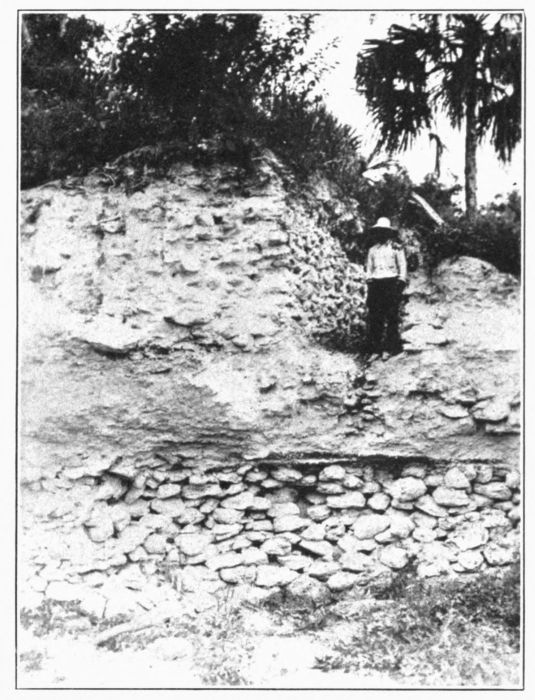
a. SECTION THROUGH EARTHWORK INCLOSING CIRCULAR SPACE. SANTA RITA.
b. SECTION OF WALL THROUGH SANTA RITA.
BUREAU OF AMERICAN ETHNOLOGY BULLETIN 64 PLATE 11.
EGG-SHAPED VASE FROM MOUND NO. 5
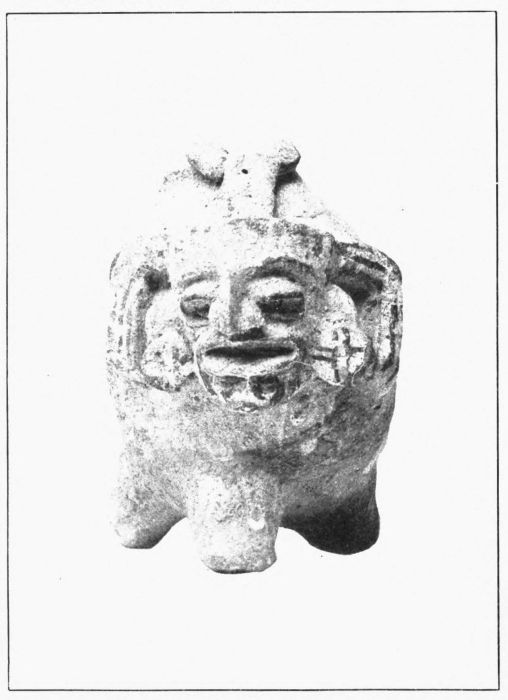
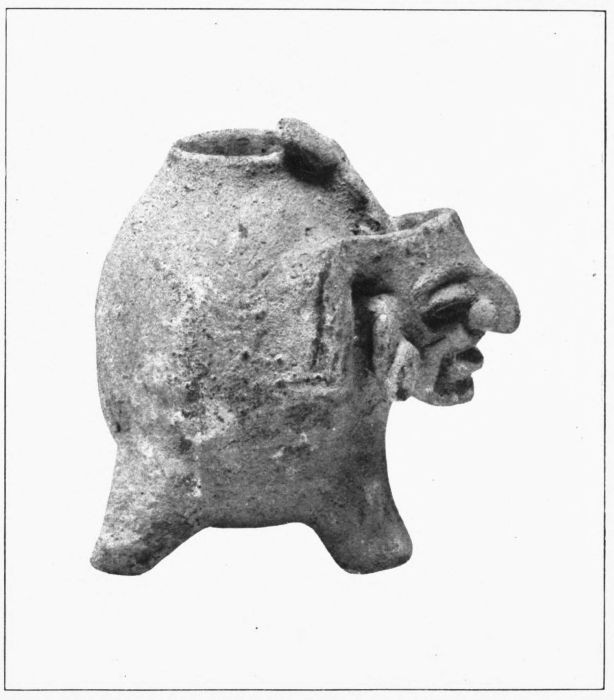
The other, seen in plate 11, is an egg-shaped vase standing on three short legs. It is decorated outside with a human face and was originally painted white throughout and ornamented with black lines. It has a small opening at the top covered by a triangular stopper. Within this vase were found two small polished beads, one of greenstone, the other of red shell. Throughout the mound were found numerous fragments of incense burners, with the small head of a tiger, 2 birds, 5 small beads, 2 malachates, 4 net sinkers, and the ceremonial bar shown in figure 21, c; all in rough pottery. About 5 feet from the northern edge of the mound were found human bones, representing a single interment, seemingly of a male of middle age. The skull and long bones, which were very brittle, though they hardened on being exposed to the air for a day, were gotten out only in fragments. The molar and premolar teeth are heavily coated with tartar but are not greatly worn down at the crown; the incisors, on the other hand, are very much worn and in life must have been nearly level with the gum. Marked attrition of the incisors seems to be present in nearly all the teeth of individuals past middle life found in sepulchral mounds throughout this area, which is rather remarkable, as the staple diet of the ancient inhabitants must have been nearly identical with that of the Indians of the present day; that is, maize ground to a fine paste on a stone metate, which of necessity contains a good deal of grit from the metate, so much so that the modern Maya say that an old man eats two rubbing stones and six rubbers during his life. This gritty nistamal wears down the back teeth of the modern Maya almost to the gum, but does not materially affect the front teeth; yet it is the latter, not the former, which we find affected in maxillæ from the mounds. One of the molar teeth from this burial has had a triangular piece removed from its crown (fig. 21, f). Along one edge of the gap left the tooth is carious.
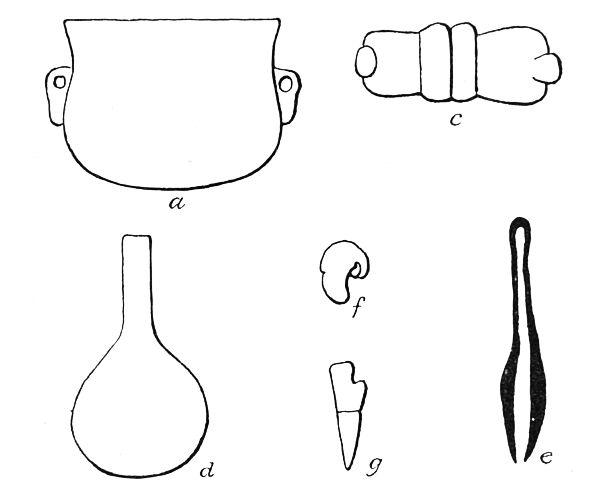
Fig. 21.—Objects found in Mound No. 5.
Mingled with the human bones were found: (a) A flat, oblong object, made of finely polished bone, 1 inch broad and one-tenth inch thick. Its original length could not be determined, as the upper part had been broken away. (b) Three beads, one of polished greenstone, two of polished red shell; one of the latter was 11/3 inches long, with two incomplete perforations passing through it longitudinally. It had probably been intended to form part of a wristlet. (c) Parts of three small obsidian knives which had evidently seen considerable use, as their edges were much chipped. (d) The curious object shown in figure 21, d, front view, and e, side view. It is made of copper, and was evidently used as tweezers, either for the removal of hair, for which purpose it would be admirably adapted, as the lower expanded parts of the blades when pressed together come into such close apposition that the smallest and most delicate hair can be removed by means of them;[32] or for the extraction of small thorns from the skin. Landa mentions the fact that the Maya were in the habit of removing the hairs from their chins and lips, but if this little implement was the only one employed for the purpose the custom can not have been a very common one in this locality, as no other similar specimen was found in any of the mounds. Passing from north to south through the mound, about 8 feet from its center, were two parallel rows of limestone flags, set perpendicularly, about 18 inches apart. Against the outer of these rows lay a considerable accumulation of animal bones, probably those of the tapir. In the space between the outer row of flags and the edge of the mound were found 10 oblong blocks of limestone, averaging 18 by 10 inches, the upper surfaces of which were hollowed out to a depth of 3 or 4 inches. These were probably intended as water receptacles for the use of fowls or small animals kept about the home, as precisely similar small stone troughs are made and used by the modern Indians for this purpose. The space between the rows of flags was floored with mortar, but nothing was found within it.
Mound No. 5 A
Mound No. 5 A (No. 28 on the plan, fig. 14) was situated within a few yards of the opening into the circular earthwork attached to Mound No. 7. It was long and narrow, nowhere exceeding 2 feet in height. It was built throughout of small limestone bowlders, mixed with a large proportion of black earth. The limits of the mound were difficult to define, as the earth of which it was built had been washed down and mingled with the surrounding soil to so great an extent that it was almost impossible to determine where one began and the other ended.
This mound or ridge has not as yet been completely explored, but in the part which has already been dug down two interments were found. The first was quite superficial, about 1 foot below the surface, near the eastern extremity of the ridge. The bones were those of a well-developed male, of rather unusual height and muscular development for a Maya Indian; they were in an exceptionally good state of preservation, though not protected from the surrounding earth by cist or burial chamber. Unfortunately, the skull was smashed into small fragments by a careless blow of the pickax before it was realized that a burial existed at the spot. The body appeared to have been buried lying upon the right side, with the legs flexed at the knees and thighs. From one of the incisor teeth a quadrangular piece had been cleanly removed (fig. 21, g). Unfortunately, the tooth in contact with it on the other side could not be found, so that it was impossible to ascertain whether a corresponding piece had been removed from this also. The tooth was much worn at the cutting edge. Landa describes a grinding down of the teeth to a sawlike edge, for ornamental purposes, practiced by the Yucatecans at the time of the conquest,[33] and it seems probable that this tooth was operated on for a similar purpose.
With the bones were found: (a) An oblong piece of marble-like stone, 2 inches long, 11/2 inches broad, and 1 inch deep, polished on all its surfaces, probably used for smoothing or burnishing; (b) what appeared to be a piece broken from a rubbing stone which had been squared, and which showed marks on its upper surface indicating that it had been used for giving an edge to stone implements; (c) fragments of rough unpainted pottery.
The second interment was that of a child 8 to 10 years of age. The site of this burial was within a few feet of the first, at a depth of about a foot below the surface. The bones, which were in a fair state of preservation, were in contact with the earth of which the mound was built. The corpse appeared to have been laid on the side, with the legs drawn up. With the bones were found only a few ornaments broken from pottery incense burners, as ear plugs, small animal heads, and part of a quilted breastplate.
This mound was probably of a much later date than the other mounds described at Santa Rita. It is merely an irregular ridge built of earth and stones, while the earlier mounds just referred to are well defined and constructed of blocks of limestone with rubble, limestone dust, and mortar filling in the interstices. The bones, though placed under the most unfavorable conditions, having been in direct contact with the damp earth, are in an excellent state of preservation, far better, indeed, than even the best preserved of those in the other mounds where the conditions are decidedly more favorable. The skeletons of children are practically never found in the other mounds, as the bones have long since disappeared completely, while here we find the bones of a child under 12 years of age in a fairly good state of preservation. There are a number of those sepulchral ridges at Santa Rita, many of them hardly distinguishable from the surrounding soil; they are all seemingly of much more recent date than the other mounds, and are probably the work of Maya Indian tribes who flourished long after the conquest.
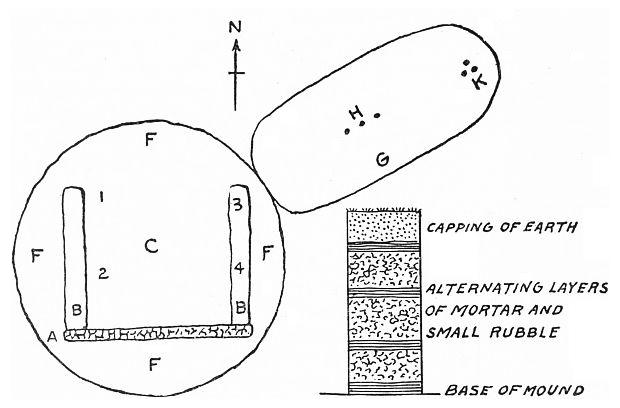
Fig. 22.—Diagram of Mound No. 6.
MOUND No. 6
Mound No. 6 was situated near the southwestern boundary of Santa Rita. The mound was nearly circular, with flattened top, 25 yards in diameter, and 10 feet high at its highest point. Toward the southern side of the mound was unearthed a wall (fig. 22, A) 2 feet thick, 2 feet high, and about 15 yards long. From the ends of the wall roughly made masses of limestone and mortar (fig. 22, BB) passed almost through the mound, inclosing a rectangular space, C. The wall was evidently the remains of an older structure, as it was built of well-squared stones and had been broken down at both the top and sides. The masses of masonry (fig. 22, BB) were 5 to 6 feet thick by about 5 feet high. The space C was filled with alternating layers of mortar and small rubble. The spaces (fig. 22, FFF) at the periphery of the mound were filled with rubble mixed with earth.
BUREAU OF AMERICAN ETHNOLOGY BULLETIN 64 PLATE 12.
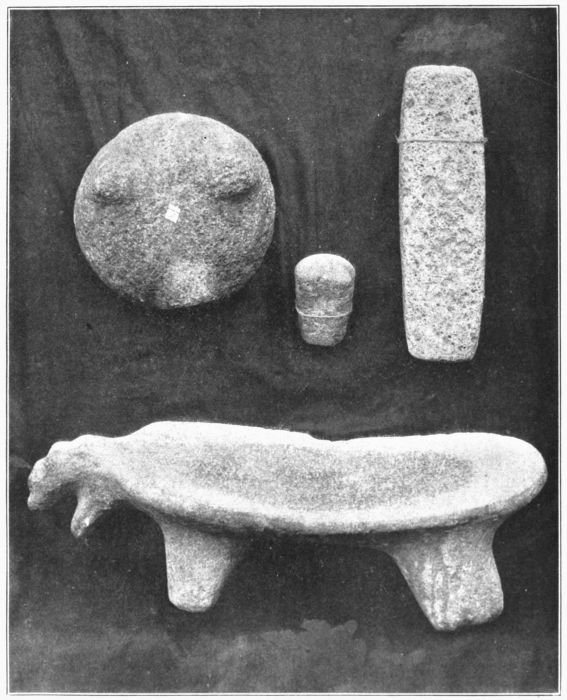
METATES AND BRAZOS FROM MOUND NO. 6
BUREAU OF AMERICAN ETHNOLOGY BULLETIN 64 PLATE 13.
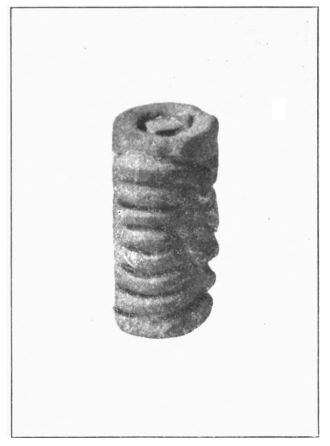
a. SMALL POTTERY SEAL
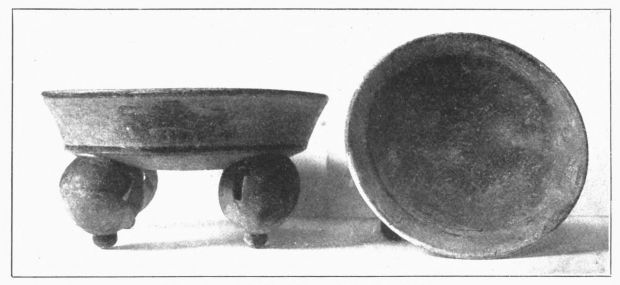
b. BOWL IN WHICH SKULL WAS FOUND
c. SKULL Length, 15.9 cm.; breadth, 15.9 cm.; height, 13.3 cm.; circumference, 47.9 cm.
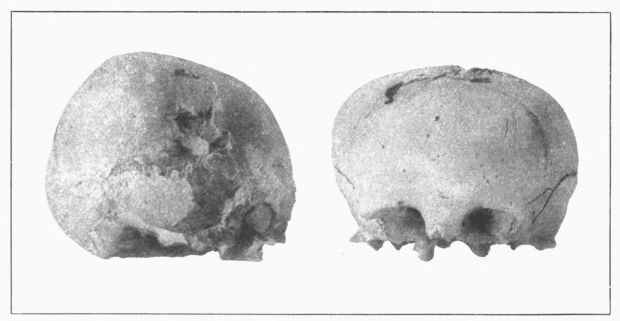
The rubble, wherever found in the mound, contained large quantities of potsherds, together with flint chips and a few hammerstones. In the spaces FFF were found numerous fragments of metates and brazos, with one unbroken specimen of each (pl. 12). At the points marked (fig. 22, 1, 2, 3, 4) four human interments were encountered at a depth of 12 to 18 inches beneath the surface. The bodies had been buried lying on the back, fully extended. The bones were in a very poor state of preservation, and with each interment were found a few flint chips, hammerstones, broken spearheads, obsidian knives, and one or two small, very roughly made, round cooking pots. The whole mound was removed to provide material for the Corozal streets. On reaching the ground level it was found that a series of trenches had been cut through the earth beneath, to the bedrock, and filled in with small rubble. Figure 23 gives a plan of these trenches, which are in the form of two parallelograms, measuring 9 yards by 6 yards, joined by a third of approximately the same area. The trenches varied from 3 to 4 feet in breadth and from 11/2 to 31/2 feet in depth, according to the thickness of the layer of earth over the bedrock. The space marked figure 23, A, contained remains of at least 30 interments; some of these were in small semicircular excavations made in the surrounding earth from the sides of the trenches; these are shown at figure 23, D; others were made in holes dug in the earth at various points within the space A. The bodies buried in the excavations at the sides of the trenches seem to have been crowded in, in a variety of positions, in order to accommodate themselves to the size and shape of the cavity. Most of those in the space A had been buried head downward, the skulls resting in some cases in earthenware bowls, with the back bent, legs flexed, and knees drawn up against the chin. Nearly all these bones were decayed and friable, and could not be removed without crumbling away. The only exception was the burial marked figure 23, D', from which the upper part of the skull was recovered almost entire, though the facial bones and lower jaw were lost. This skull (pl. 13, c) rested in the bowl shown in plate 13, b, a handsome piece of pottery, standing upon four nearly globular hollow legs, with slits in their sides, and within them small spheres of clay which rattled when the bowl was moved. It is painted yellow and red throughout, and is nicely polished. A great number of objects were found accompanying the bones in the space A. These included flint ax heads and spearheads, flint scrapers, and hammerstones, two obsidian spearheads, and fragments of obsidian knives, shell and clay beads, and a small cylindrical pottery seal about 3 inches in length, with a geometrical device in low relief stamped upon it (pl. 13, a). The bones of the peccary, curassow, snake, and of some variety of fish were also found, together with the shells of conches, cockles, snails, and hooties (a large variety of freshwater snail still eaten by the natives). A block of crystalline limestone, 18 inches long by 8 inches high and 12 inches broad, was found in one of the semicircular pits leading from the trench at the upper border of space A, figure 23. It was traversed by 14 longitudinal grooves on its upper surface, which was slightly concave; each groove was 1/2 inch broad by 1/4 inch deep, quite smooth, and nearly straight. The stone had seemingly been used as a hone for giving an edge to small stone implements.
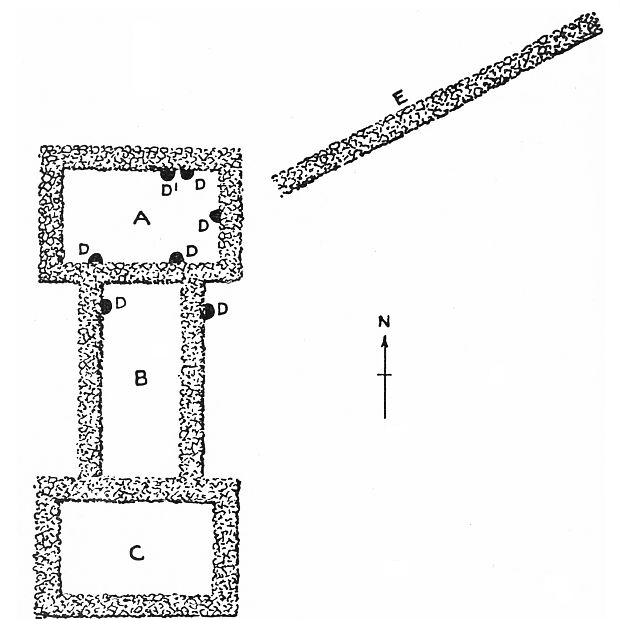
Fig. 23.—Diagram of trenches in Mound No. 6.
Extending out toward the northeast from the main mound was a low structure (fig. 22, G) 4 feet in height and 25 yards in length. It was composed throughout of layers of clay, rubble, and limestone dust, not very clearly separated. Three separate interments were found beneath this mound near its center (fig. 22, H), the bones in all of which were very much decayed. From the first of these the shallow bowl (fig. 24, a), 71/2 inches in diameter by 11/2 inches deep, together with the vase d, 8 inches in height, were taken. The vase was of rather fine pottery, painted a uniform dark red throughout. Nothing else was found with this interment.
From the second grave were taken a bowl exactly similar to that shown in figure 24, a, two flat dishes 12 inches in diameter (fig. 24, e), and a small polished bone ring 1 inch in length, seemingly a section from one of the larger long bones of some large animal. The vessel g, 6 inches in diameter, was also found with this burial; it is made of fine pottery, painted red, and possesses a curious upturned spout, which bends inward toward the rim of the pot to such an extent that it would be impossible either to drink or pour out the contents therefrom. These curious pots, usually with the spout parallel to the perpendicular axis of the vessel, are quite common among Maya pottery from this district; they were supposed to have been used as chocolate pots, but drinking from them must have been a feat of legerdemain.
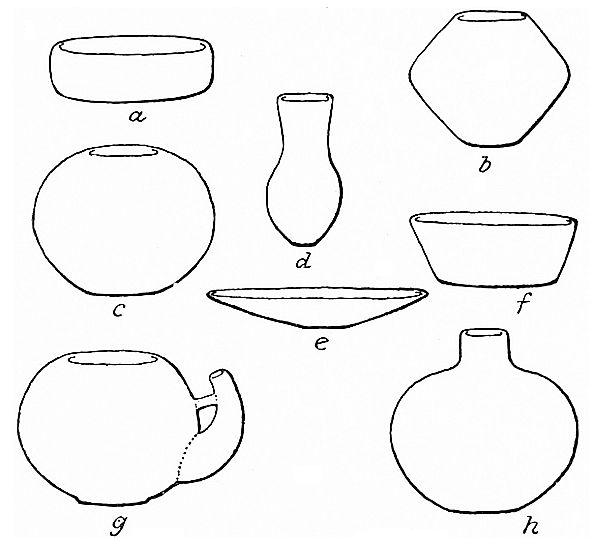
Fig. 24.—Bowls, vases, and dishes found in Mound No. 6.
From the third grave came two bowls, both almost spherical, the one 12 inches, the other 6 inches, in diameter (fig. 24, c). At the point K, near the end of the mound G (fig. 22), three interments were found, very close together, on the ground level; these had evidently been contained at one time in a small oval cist, built of rough blocks of limestone, which had now completely caved in. With the bones were found the vases shown in figure 24, b, f, h, of the same red-painted pottery as was found elsewhere in the mound. Six well-made bone awls, or lance heads, each about 6 inches in length, together with a heap of the shells of some large bivalve, one of which was polished and perforated for use as an ornament, were also found among these bones. The stones of which the cist had been built, the bones, and the objects accompanying them were so inextricably mixed that it was impossible to tell which objects belonged to each set of bones. Passing through the long axis of this mound was a rubble-filled trench, 3 feet in breadth, dug down to the bedrock, exactly similar in structure to those already described. No interments were found at the sides of this trench, which is shown in figure 23, E.
Mound No. 6 A
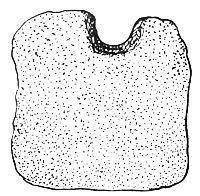
Mound No. 6 A, another of the group of mounds adjoining the southwesterly boundary of Santa Rita, measured 18 feet by 15 feet at the base, by about 3 feet high at the highest point, and was built throughout of earth, large blocks of limestone, and limestone dust. The mound rested directly on the limestone formation. Into this, near the center of the mound, an oval excavation had been made (see C C, fig. 25) about 10 inches in depth, and in size just large enough to contain the skull which was found within it. A ledgelike projection was left at one edge of the excavation (see E, fig. 25), and just beneath this rested the point of the jaw. A large heavy flag of limestone (see D, fig. 25), from which a semicircular segment had been chipped, was placed above the excavation opposite the lip, so that the groove in the stone inclosed the neck and clamped the skull tightly down in the little hole which had been made to receive it. On each side of the skull the femora were found, in a nearly vertical position, condyles downward, and between the femora many fragments of other bones were brought to light, including the tibiæ, arm bones, and vertebræ. Resting upon the limestone flag which covered the skull lay a large, rudely made chert hammerstone, 8 inches long by 4 inches broad, which had probably been used in chipping out the semicircular groove to fit the neck. Near the center of this mound, 2 feet below the surface, two very neatly made flint hammerstones were found. The dimensions of this skull were: Length, 14.22 cm.; breadth, 16.76 cm.; circumference, 48.26 cm.; cephalic index, 123. The base of the skull was so much damaged that the height could not be ascertained. The extreme breadth in comparison with the length, giving it a remarkably brachicephalic appearance, was possibly, to some extent at least, the result of post-mortem compression from before backward within the little cavity which contained it.
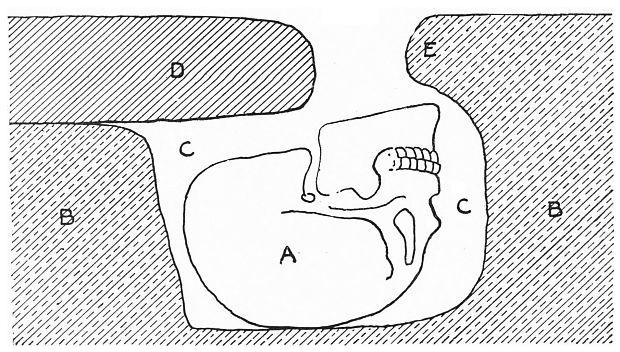
Fig. 25.—A, skull; B, limestone formation; C, excavation; D, grooved flag in situ; E, projecting lip.
Mound No. 7
Mound No. 7, situated very close to No. 6 A, was oval in shape, measuring 30 yards by 10 yards at the base, and 8 feet high along the summit. It was built throughout of large blocks of limestone, limestone dust, and a small proportion of earth. It rested upon the natural limestone formation, into which, near the western end of the mound, a shallow oval pit 18 inches in length by 10 inches in depth had been dug. In this was found a somewhat imperfect skull, resting with the foramen magnum uppermost. The other bones, which were distributed irregularly around the hole, were in a poor state of preservation. Upon one side of the skull lay a small shallow bowl, with four hollow legs, each containing a pellet of dry clay loose in its interior; and upon the other side a small three-legged vase. Both of these were of rather crude pottery, painted dark-red throughout and polished. Two other excavations similar to this were found in the limestone beneath this mound, each containing fragments of a skull in a very advanced state of decay, surrounded by fragments of the other bones. No additional pottery or other objects were found beside them. The two mounds last described are the only ones in which this peculiar method of interment appears to have been employed. The procedure seems to have been somewhat as follows: First, the earth capping was removed from the limestone rock, over the area to be occupied by the mound; next, shallow oval pits were dug in the rock into which the skulls were wedged; each body was bent, and the thighs were flexed on the abdomen, so that the knees touched the rock on each side of the head; finally, the mound was built up of limestone dust, earth, and blocks of limestone around the body, in this position.
Mound No. 8
Mound No. 8, situated very close to Mound No. 7, was roughly circular, 36 feet in diameter and 4 feet high on its flattened top. It was built throughout of earth, limestone dust, and blocks of limestone. Projecting from the western edge of the mound was a large, roughly hewn block of limestone, 3 feet by 4 feet, and 8 inches in thickness. Running through the center of the mound from east to west were two parallel rows of limestone flags, 2 feet apart, projecting 18 inches from the limestone rock upon which the mound was erected and in which they were embedded. Near the center of the mound, between the rows of limestone flags and resting on the earth, covered only with limestone dust, was found a single interment. The skull is shown in plate 14. Its dimensions are: Length, 17.01 cm.; breadth, 16.51 cm.; height, 10.68 cm.; circumference, 51.30 cm.; cephalic index, 97. The body, which was stretched at full length, had probably been laid face downward, as the bones of the forearms, also shown in plate 14, were found beneath the skull. With the bones of the hands were found four copper rings, considerably oxidized; three were plain narrow bands, while the fourth was a broad flat band decorated with incised double volutes. Some of the phalanges were colored a bright-greenish tinge, from contact with the rings. Three of the rings and three phalanges are shown in plate 14. These bones were all in a remarkably good state of preservation, probably owing to the fact that they were completely surrounded by fine limestone dust.
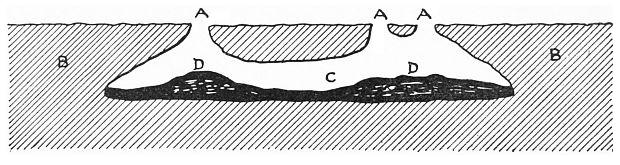
Fig. 26.—Circular openings leading into natural cavity.
Within a few yards of this mound was the opening of a small chultun, with steps leading to the interior. It was oval in shape, 15 feet long, and at one time had been covered with plaster, which had nearly all peeled off. The floor was covered with earth, of which there was a pyramidal heap under the opening. Nothing was found in this chultun except great quantities of fragments of large, rough earthenware water vessels.
BUREAU OF AMERICAN ETHNOLOGY BULLETIN 64 PLATE 14.
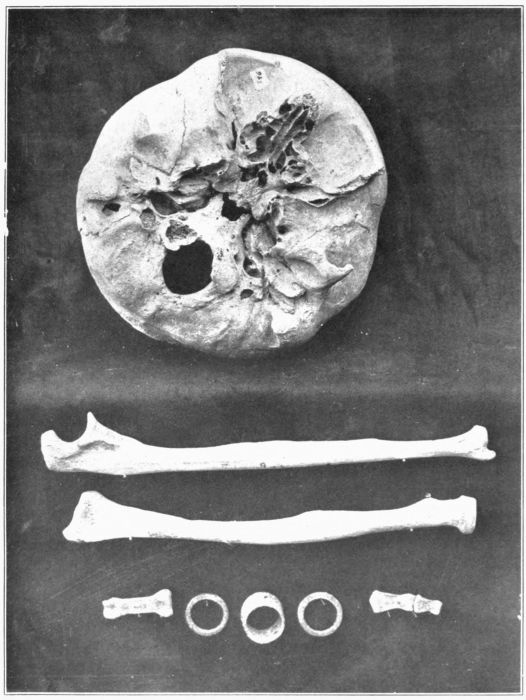
SKULL AND BONES FROM MOUND NO. 8
About 300 yards to the east of the mound three circular openings were found (see AAA, fig. 26) leading into a large irregular natural cavity (see C, fig. 26) formed in the limestone (see BB, fig. 26). Each of these openings was about 2 feet in diameter, and close to one of them a circular slab of stone, 6 inches in thickness, and of about the same diameter as the opening, was found, which had probably been used as a cover for the latter. This chultun, unlike the first one, was of purely natural formation; the walls, which were rough and irregular, showed no signs of tool marks. The chamber varied in height from 8 to 9 feet beneath the openings, where it was highest, to 2 to 3 feet at the sides. There was a considerable accumulation of earth upon the floor (see DD, fig. 26), which had evidently fallen and been blown in, as it was collected in two heaps beneath the openings. There were no stone steps leading down into this chultun, and access must have been gained to the interior by means of wooden ladders, which had long since disappeared. Numbers of potsherds, shells, pieces of charcoal, clay beads, and fragments of flint and obsidian implements were found upon the floor. Several skeletons of small mammals were also found among the earth, but these creatures had probably fallen in after the chultun ceased to be used, and had been unable to get out.
At a distance of less than half a mile from the last-mentioned chultun another was discovered under somewhat curious circumstances. A large flat mound was completely removed for the sake of the stone and limestone dust which it contained, to be used in repairing the Corozal streets. About the center of the mound, at the ground level, a heavy circular flag of limestone, 2 feet 4 inches in diameter, was brought to light. On removing this it was found to cover a round well-like opening, which expanded below into a small chultun, 12 feet long by 9 feet in greatest diameter. The chamber was egg-shaped and showed no signs of having ever been stucco-covered. From the opening a short flight of steps, cut in the rock, led to the bottom of the chultun. Nothing was found in this chultun with the exception of two small bowls of rather coarse earthenware, painted red and polished; one almost globular in shape, 6 inches in diameter; the other circular, flat-bottomed, 31/2 inches in height. The mound which covered this chultun appeared to have been one of the commonest kind of burial mounds. At its summit fragments of a rude circular earthenware pot were found, and near its center fragments of human bones, together with three flint hammerstones and two small round vessels, one of light yellow, the other of yellowish-red, pottery.
One of the most remarkable of the chultuns found in this area is situated at San Andres, within a mile of the village of Corozal. It was accidentally found by some coolies in digging marl, and as, unfortunately, the entire roof of the larger chamber and a considerable part of that of the smaller had caved in, it was impossible to discover how it had been entered from outside, as no trace of steps remained. A ground plan of this chultun is shown in figure 27. The small chamber, A, is 8 feet long, 7 feet broad, and 5 feet 6 inches high in the center; it is cut out of solid rock. The large chamber (C) is 15 feet in diameter, but as nearly the entire roof has fallen in, it is impossible to estimate its exact height. The chambers are partially separated by a wall (B) built of rough blocks of stone and tough mortar, which has been partly broken down. In the side of the small chamber, opposite the wall, are three oblong shafts (D, D, D, fig. 27) cut into the rock, by the side of the chamber wall, which is here nearly perpendicular. Each of these is about 1 foot in depth by 8 to 9 inches in breadth, and is separated from the chamber by a single row of bricks (E, E, E, fig. 27) mortared together, reaching from the roof to the floor, so that there is no communication between the shafts and the chamber. Each shaft opened originally on the surface of the ground, but the openings had become blocked by vegetable refuse from the surrounding bush. The bricks which fill in one side of each shaft are of two kinds. The first, by far the more numerous, are made of sun-dried clay, yellowish in color, and very friable: they contain considerable powdered marl. They measure 8 by 4 by 23/4 inches. The bricks of the second kind also are made of clay, mixed with many pebbles; they have been fired, are of a reddish color, far harder and tougher than the first variety; they measure 8 by 4 by 21/4 inches. Nothing was found in either chamber except a few potsherds of various kinds.
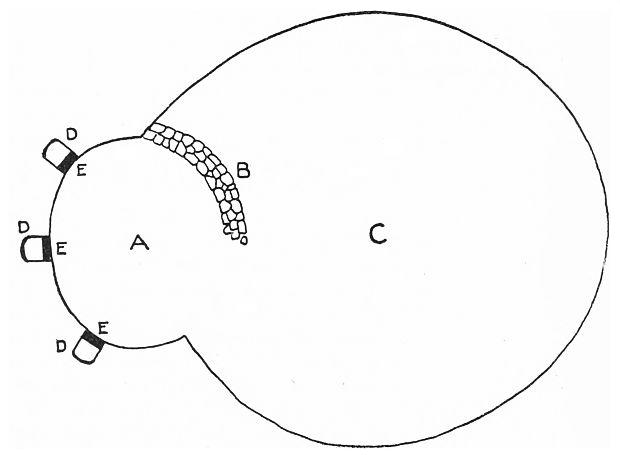
Fig. 27.—Ground plan of chultun.
These underground chambers, or chultuns, seem to be fairly common throughout Yucatan. Considerable doubt exists as to the uses to which they were put.[34] It seems probable that those the walls of which were plastered with an impervious cement lining were intended as water receptacles, since they could easily have been filled by drainage from the thatched roofs of buildings in the vicinity, which have long since completely disappeared. Though the southern part of Yucatan, unlike the northern, is fairly well watered, plastered chultuns are not infrequently found there, but always situated at considerable distances from a good permanent water supply, as a lagoon or river. The uncemented chultuns would not hold water, and had probably been used as storehouses for corn and other provisions. Some of these chambers were undoubtedly used as burial places, as one at Platon, on the Old River,[35] was covered by a burial mound, and itself contained human bones; but it is possible that their use for this purpose may have been secondary only. The San Andres chultun is somewhat puzzling, as it was certainly not a reservoir for water, nor were any traces of human burial found within it. It had probably been used as a storehouse for food, though it is difficult to understand the object of the oblong shafts, leading into the open air, found at the side of the smaller chamber, as they must have been quite useless for ventilating purposes, not having any opening into the chamber itself through which the air might circulate.
Mound No. 9
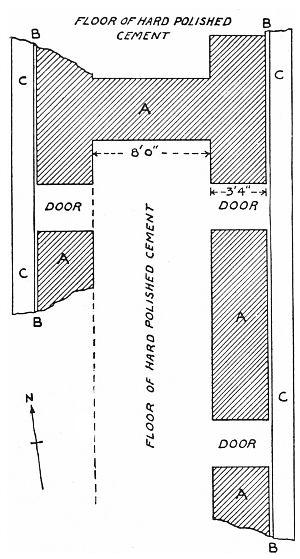
Fig. 28.—Ground plan of Mound No. 9.
Mound No. 9, situated close to the chultun, with three openings, was oval in shape with flattened summit, 44 feet in breadth, 66 feet in length, and 14 feet high at its highest point. On removing the summit of the mound to a depth of about 4 feet the floor of a building, with parts of the walls, was exposed. The cap of the mound, covering the ruins of the building, was composed of blocks of marl, clay, rubble, and limestone. The lower part of the mound, upon which the building stood, was constructed of large blocks of limestone mortared together, forming a solid block of masonry. The building was in a very ruinous condition; as much of its ground plan as could be traced is shown in figure 28. The walls, A, A, A, are 3 feet 4 inches in thickness.
Such parts as remain standing are built of well-squared stones held together by mortar (see fig. 30). They are covered with stucco inside, which is continuous with the cement flooring of the rooms; outside they were also covered with stucco above the water table (B, figs. 28 and 29) but nearly all of this had been broken away. The water table, which projects 3 inches from the wall, is 12 inches deep; it is built of well-squared stones not covered with stucco, and is continuous below (figs. 29 and 30) with C, a layer of hard cement 18 inches broad, which apparently ran completely round the building, and possibly acted as a drain to carry off the water after heavy tropical showers. The main room was 8 feet in breadth and had probably been about 30 feet in length, with four doors opening into it, two on each side. This was floored with very hard, smooth, polished cement, which even now is in an excellent state of preservation; this flooring is continuous through the doorways with the top of the water table, with which it is on the same level. Nothing was found in excavating this mound, with the exception of a fragment of a conch-shell trumpet, a piece of an obsidian knife, numerous potsherds, and half of a flint paint grinder, with traces of green paint still adherent to it. All of these objects were found on the floor of the main room.
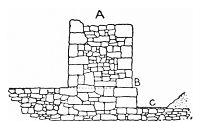
Fig. 29.—Wall construction of Mound No. 9.
Mounds erected over the ruins of buildings are extremely common all through this part of the Maya area; some are very large, covering buildings which had been placed on lofty stone pyramids; some are very small, as when they cover buildings of a single small room, built almost on the ground level. All the buildings are in ruins, all are raised more or less on stone platforms above the ground level, and all show traces of having been covered with stucco, both internally and externally. In some cases this stucco is very beautifully decorated in colored devices, as in the mound already described at Santa Rita;[36] in others the stucco is molded in various designs and ornaments, which may or may not be colored, as in the mound at Pueblo Nuevo on the Rio Nuevo, presently to be described. Most of these mounds contain nothing except the building which they cover, but some had been used as burial places, the interments evidently having taken place after the building had been covered in, as they are found irregularly distributed through the loose superstructure which forms the cap of the mound, quite close to the surface.[37]
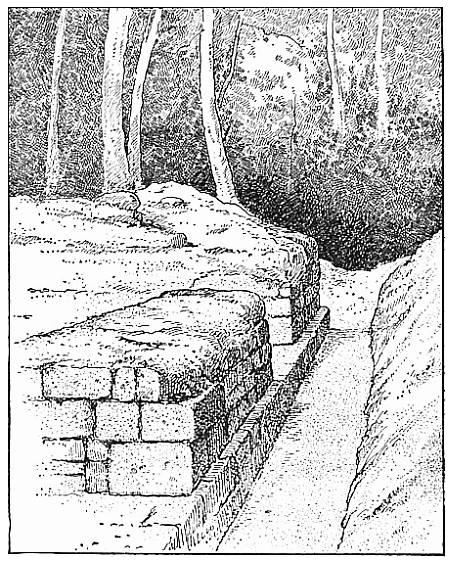
Fig. 30.—Details of Mound No. 9.
Mound No. 10
Vague reports had been in circulation for some years as to the existence of a mound close to the headwaters of the Rio Hondo, where the Indians still practiced to some extent their ancient religion. It was said that the mound contained a stone chamber in which stood on a stone pedestal a life-sized image, painted in various colors, and that around the walls of the chamber were niches in which rested life-sized stone turtles, also painted; furthermore, that the bush Indians of the neighborhood were in the habit of coming to the mound for the purpose of burning incense before the idol.
The mound was found situated quite close to the bank of the Rio Hondo, buried in the bush which covers this part of Yucatan. It was 80 feet in height, 350 feet in circumference, conical in shape, and completely covered by high bush continuous with that of the surrounding forest. After clearing the underbrush from the mound an opening 3 feet square was discovered about 17 feet from the summit of the mound on its northern aspect, the walls of which were faced with cut stone. From this opening a low passage led to a small stone-faced chamber 8 feet high, 6 feet broad, and 10 feet long, the floor of which was composed of earth and lime well beaten down to form a hard, smooth surface. Projecting from the walls were eight small stone brackets, upon which nothing was found. No trace whatever was seen of a painted image or of turtles. The walls and ceiling of the room, especially the latter, were considerably blackened by smoke, possibly caused by burning incense.
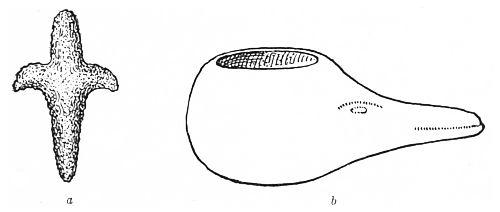
Fig. 31.—Obsidian object and pottery vase from Mound No. 10.
Excavation was commenced at once in the floor of the chamber. At a depth of 8 inches the hard floor gave place to soft brown sand, which was continuous to a depth of 2 feet, where several small deposits or pockets of lime were found inclosed within it, each of which contained a number of obsidian knives and small cores. The knives were deeply indented on each side of the base, as if to facilitate hafting. The cores, of which 20 were found, were slender and varied from 1 to 3 inches in length. On digging down through an additional 18 inches of the brown sand a layer of lime was exposed about 18 inches in thickness, filling the entire lumen of the chamber, in which were found irregularly scattered 60 cruciform objects, finely chipped in obsidian, each from 3 to 4 inches in length (fig. 31, a). These would have served as either arrowheads or small javelin heads, or possibly were intended for ceremonial purposes only. With them were a single pottery vase and two small triangular javelin heads of obsidian. The vase (fig. 31, b) was circular in shape, 6 inches in diameter, with a long piglike face protruding from one side. It was made of dark-brownish pottery, painted red and finely polished externally. It was filled with small mussel-like bivalve shells embedded in lime. A number of these shells were found also closely adjacent to the vase in the lime which surrounded it. Beneath the layer of lime lay a layer of brown sand, 3 feet thick, in which absolutely nothing was found. Below this appeared another layer of lime, mixed with sand, 4 feet thick, near the bottom of which were found 40 human skulls, neatly disposed in rows. These, when first uncovered, seemed to be in a moderately good state of preservation, but when removed from their bed of lime and sand they crumbled so easily that it was found impossible to preserve them. The skulls were all placed in the same horizontal plane, each one nearly in contact with its neighbor. No other bones were found with them, or in fact in any other part of this mound, with the exception of two small oblong objects of bone, about 2 inches in length, each still bearing traces of paint, which were discovered among the skulls. These skulls would seem to have been either the result of secondary interments or the remains of sacrificial victims whose bodies were either eaten or buried elsewhere. In favor of the first theory is the fact that the Maya did not practice human sacrifice to anything like the same extent that their neighbors, the Aztecs, did, and slaughter involving forty-odd victims must have been practically unknown among them. Furthermore, in one or two instances small shallow stone-lined graves, covered with large slabs of stone, have been found at and around the bases of large mounds, and it seems quite possible that these graves may have held the bodies of distinguished dead until their skulls were in a fit condition to be removed to the mound or until a sufficient number had accumulated to make it worth while opening the chamber for their reception. In favor of the second theory is the fact that, judging by what could be seen of the teeth and lower jaws, all the skulls were of individuals in the prime of life, no jaws of very young or of very old individuals being discovered. Immediately beneath the skulls were unearthed 12 objects of chert fashioned with great care. Seven of these were spearheads, the other five of eccentric form. The spearheads varied in length from 37 cm. (pl. 15, c) to 29 cm. (pl. 15, f); they were very well made, some from gray, others from brownish-yellow, chert. The eccentric flints comprised: (a) An animal form, possibly meant to represent a bush rabbit, 30 cm. in length from the forehead to the tip of the tail (pl. 15, a); (b) an animal form, evidently meant to represent a turtle or tortoise, 28 cm. in length from the head to the tip of the tail (pl. 15, g); (c) a halberd-shaped implement (pl. 15, b), exquisitely chipped from light-ocher-colored chert, 44 cm. in its greatest length by 19 cm. in breadth across the widest part of the head. This implement is furnished with two sharp-pointed cutting projections in front, separated by a groove; at the back is a larger triangular sharp projection. The whole implement is well balanced, for use in the hand, by a bulging or thickening of its body between these three projections; (d) an implement chipped from yellowish chert, 44 cm. in length, serrated on each side, pointed at one end and rounded at the other (pl. 15, d); (e) a crescentic implement, chipped from yellowish chert, 26 cm. in its greatest length, 171/2 cm. across the widest part of the crescent. From the convexity of the crescent project three spines, the central one long and serrated, the lateral ones merely pointed knobs. This object is more crudely chipped and less symmetrical than any of the others (pl. 15, e).
These eccentrically shaped flint and chert objects seem to be limited in their distribution to that part of the Maya area comprised in southern Yucatan, eastern Guatemala, and most of the colony of British Honduras. The earliest known specimens are probably those now preserved in the Salisbury Museum, England, which have been thus described:
Among the numerous stone weapons and implements which have been discovered, and serve to illustrate the primitive arts of the New World, three remarkable relics from the Bay of Honduras, in South America, are deserving of special attention. They were found about the year 1794, with other examples, in a cave between two and three miles inland. * * * One is a serrated weapon, pointed at both ends, measuring 161/2 inches long. [This object is almost exactly similar to plate 15, d, except that the latter is pointed at one end only, the opposite one being rounded.] Another is in the form of a crescent, with projecting points. It measures 17 inches in its greatest length, and it is conjectured may have served as a weapon of parade, like the state partisan or halbert of later times. The third, which is imperfect, has probably resembled the previous one in general form.[38]
The second of these implements very closely resembles that shown in plate 15, e, the Salisbury specimen being somewhat larger, more symmetrical, and more carefully chipped.
About 3 feet beneath these flint objects, embedded in the sand which filled this part of the chamber, were discovered 20 cruciform obsidian arrowheads or javelin heads, similar to that shown in figure 31, a; 40 small obsidian cores; 2 obsidian arrowheads, of the shape shown in figure 32; 12 well-made obsidian knives, grooved on each side of the base, and two crescentic objects chipped from chert, somewhat resembling that seen in plate 15, e, but smaller, without projecting spines at the convexity of the crescent, and altogether more crudely and carelessly made.
BUREAU OF AMERICAN ETHNOLOGY BULLETIN 64 PLATE 15.
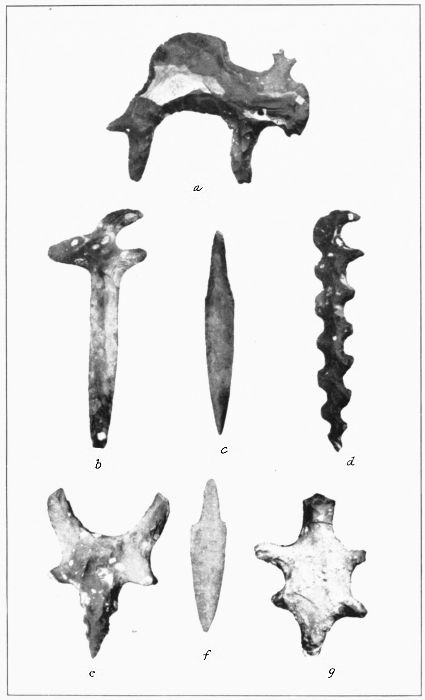
STONE OBJECTS FROM MOUND NO. 10
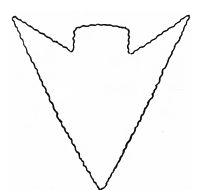
Fig. 32.—Obsidian arrowhead from Mound No. 10.
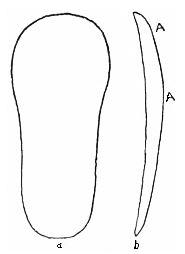
Fig. 33.—Flint object from Mound No. 10.
After the sand and lime had been removed from this chamber to a depth of nearly 30 feet it was found that the walls became continuous with the solid foundation of masonry upon which the mound stood. This was very difficult to penetrate, and so far as was ascertained contained nothing further of interest. The roof of the chamber was next attacked from the summit of the mound. To a depth of nearly 2 feet nothing was found but fine, brown alluvial soil, full of the roots of plants and trees. Beneath this the real structure of the mound began, for not so much as a solitary potsherd or chip of flint was found in the earth on the summit of the mound, indicating clearly that this layer had accumulated since its construction. Beneath the earth layer, to the roof of the chamber, the mound was composed of blocks of limestone of varying size, loose friable mortar, and powdered limestone. In the first 8 feet nothing except a few potsherds was found. At this depth two shallow circular saucers, each 71/2 cm. in diameter, were unearthed. These were made of coarse red unpainted pottery, and close to them lay a finely chipped flint object (fig. 33, a, b). This was rounded at both ends, narrower at the handle than at the base, and markedly convex on its under surface (fig. 33, a, b). The front part of the under surface was quite smooth and polished, evidently from attrition, while that part of it marked A A bore distinct traces of blue paint. There can be little doubt that this implement was a paint grinder, as a specimen almost exactly similar was found in a mound near Corozal, bearing traces of green paint on the under surface. Fourteen nicely polished reddish stone beads, spherical in shape, together with four smaller beads of a light-green color, and a leaf-shaped spearhead of flint, were found adjacent to the paint grinder. Immediately beneath these was found an object made of what seems to be reddish-brown agate; this is 10 cm. in length, oval in section, 1 cm. in its greatest breadth, tapering off to a blunt point at each end, and finely polished all over. With it were nearly 300 small triangular obsidian objects of the shape shown in figure 34. These vary in length from 11/2 to 21/2 cm. They are thick at the upper angle, the side subtending this forming a sharp cutting edge. In some of the implements this edge is notched, as if from use. These implements were probably used as scrapers, or small chisels or gouges, for which purposes they would be suitable, either hafted or unhafted. It is possible that they may have been used as teeth for the sword known to the Aztec as mextatl, which was also in use among the Maya at the time of the conquest. This weapon was constructed by setting a number of sharp obsidian splinters in deep lateral grooves, cut in a long piece of hard wood, which were filled with liquid resin, in order to prevent the splinters from shifting from their positions.
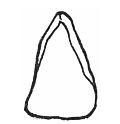
Fig. 34.—Obsidian object from Mound No. 10.
In the Stann Creek district of British Honduras, on the banks of the Sittec River, at a distance of approximately 15 miles from its mouth, there exists an extensive clearing in the bush known as "Kendal Estate." The soil here is remarkably fertile and well suited for the cultivation of every kind of tropical vegetable product. As has been pointed out before, wherever throughout northern Central America one finds patches of exceptionally rich soil, there, on clearing the bush, will be found in greater or less numbers the mounds erected by the former inhabitants, together with the indestructible refuse usually associated with former village sites, as fragments of pottery, flint and obsidian chips, broken and rejected implements and weapons, shells of various edible shellfish, clay beads, net sinkers, malacates, broken rubbing stones, etc. The converse of this holds true to some extent, as one of the guides relied on by the modern degenerate Maya Indian in his annual selection of land for a milpa, or corn plantation, is the number of mounds which he finds upon it. Indeed this remarkable index as to the degree of fertility of the soil appears to be almost the only useful heritage transmitted to him by his courageous and comparatively highly civilized ancestors.
Mound No. 11
Mound No. 11, at Kendal, occupies a conspicuous position upon the summit of a small natural elevation, situated on the left bank of the river close to its margin. It is 60 feet long, 40 feet broad, and 20 feet high, its long diameter running due east and west. An excavation was made into the north slope of the mound, which exposed a three-walled chamber, 8 feet in length by 4 feet 8 inches in width. There was no wall on the south side. The north wall, owing to the outer slope of the mound trending over it, was only 1 foot in height; the east and west walls were each 4 feet high. All three walls were about 18 inches thick. The chamber was packed with water-worn boulders and earth, among which nothing was found but scattered patches of charcoal, with a few small red pots, so rotten and friable from long exposure to the damp that it was found impossible to remove them. Had there ever been bones in the chamber, as seems probable, they must have completely disintegrated long before from contact with the damp clay. The floor was composed of flags of shale. About the center of the west wall a recess was discovered 2 feet wide by 11/2 feet high. This was half filled with earth, in which the following objects were found:
BUREAU OF AMERICAN ETHNOLOGY BULLETIN 64 PLATE 16.
d. TERRA-COTTA CYLINDER.
a. MODEL OF JADEITE BIVALVE SHELL. b. LIGHT-GREEN JADEITE MASK. c. AX HEAD, OR CELT.
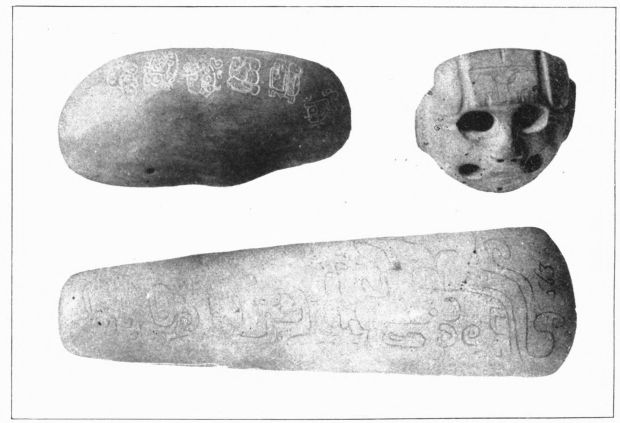
(1) The model of half a bivalve shell in light-green jadeite, very well executed and polished both inside and out (pl. 16, a). On its outer surface, following the contour of the outer edge, are seven glyphs, the chief component of each of which is a grotesque human face.[39]
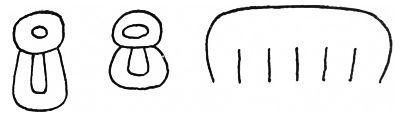
Fig. 35.—Inscription on mask, plate 16, b.
(2) A small mask of light-green jadeite, well polished on both surfaces, measuring approximately 7 cm. in both diameters (pl. 16, b). Inscribed on the forehead in shallow lines are the glyphs shown in figure 35, somewhat enlarged from the actual size. Around the edge of the lower half of the mask are seven minute perforations, while running across the back of the forehead from ear to ear is a larger hole, evidently used for suspension. No doubt this mask was used as a breast ornament, similar to those portrayed in the codices and on the monoliths, the small holes being intended for the suspension of the alligator-head beads found with the mask, which again may have been connected along their outward-pointing snouts by the cylindrical beads.
(3) An ax head, or celt, of light-green stone, finely polished throughout (pl. 16, c), 21 cm. in length by 6.5 cm. in breadth at the cutting edge. One side is engraved with hieroglyphs done in shallow lines, much less carefully and neatly than those on the shell. The lower two-thirds of the engraved side have evidently been subjected to considerable attrition, as the surface of the stone, especially along the lower third of the ax, has been so worn away as to render the lines almost undecipherable. This inscription, somewhat smaller than the original, is shown in figure 36. With these engraved objects were a number of cylindrical beads, pierced in their long diameter, made of very pretty mottled light and dark green jade, well polished. They varied from 1.2 to 1.6 cm. in length, and the substance of the stone from which they were made was distinctly crystalline on fracture.
With them were a number of small alligator heads, made of similar stone and about the same size as the beads, pierced at the base of the skull for suspension, six celts of green and chocolate-colored stone, all finely polished, varying from 9 to 18 cm. in length, and a circular disk of iron pyrites 8 cm. in diameter by 5 mm. in thickness. This object was milled round the edges like a coin and perforated in the center. With it was the broken half of a similar ornament; probably both of these had been used as ear ornaments. Trenches were dug through this mound in all directions, but nothing further was found therein.
Mound No. 12
Mound No. 12, at Kendal, was situated close to the last-described mound. Its flattened summit measured 28 feet by 20 feet; the average height was approximately 15 feet. The mound extended east and west, and on its eastern slope large slate slabs were seen protruding from the surface. On excavating round these they were found to be part of a chamber measuring 7 feet by 3 feet; the south wall had caved in and the roof slabs also had been somewhat displaced. The chamber was filled with earth, on removing which the following objects were found upon the floor slabs: (1) Three nearly spherical red pots, averaging 6 inches in diameter; they were so rotten from the effect of moisture that it was impossible to remove them. (2) Two small, rather crudely executed human faces cut in mottled jadeite, and finely polished, with which were three green jadeite beads. (3) A small quantity of greenish powder. (4) Four small chisels of polished greenstone, varying from 2 to 4 cm. in length. (5) One chisel made of very soft gray stone, which had been covered externally with greenish paint somewhat resembling enamel, and very closely simulating the genuine greenstone chisels with which it was placed, except that it was much lighter in weight. Instances of counterfeit implements and ornaments buried with the dead have been found more than once throughout this area.
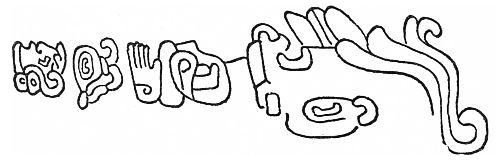
Fig. 36.—Inscription on ax head, plate 16, c.
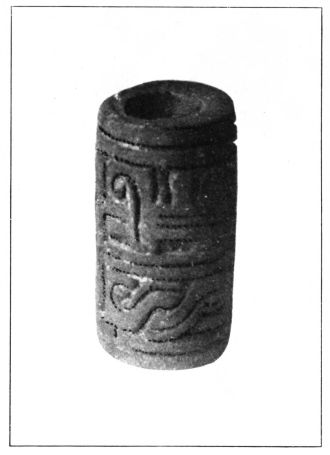
Excavations were made along the flattened top of this mound, and about 16 feet to the westward of the first one a second grave was discovered. This was in a much better state of preservation than the first, as all the walls and the roof were in situ. It was composed throughout of large flat irregular slabs of slate, averaging about 2 inches in thickness. It measured 8 feet by 2 feet by 2 feet in height. The chamber was filled with earth, and the roof was not more than 6 or 8 inches below the surface of the mound. The following objects were found in this chamber, all resting upon the slate slabs which formed the floor. At the north end five nearly globular red earthenware pots, of rather coarse manufacture, each containing a stone celt, were found. These pots had been packed closely together, in earth, and over them a large slab of slate had been placed as if to protect them; this, however, it failed to do, as the pots were so saturated with moisture that it was found possible to remove only one unbroken. The celts averaged 6 inches in length; all were well made and polished; four were of greenstone, one of a bluish-gray stone. Close to the pots were found a small jadeite face and three greenstone beads or pendants. Nearer the center of the floor of the chamber were found two small cubical objects of light greenstone 1 cm. in diameter, very closely resembling dice, with a geometrical device inscribed in rather deep lines upon two of their opposed surfaces; these might have been seals or stamps, or they might have been used in playing some game. With them were a small solid cylinder, of light greenstone, finely polished for suspension, 12 small obsidian knives, seemingly quite new, as they showed no signs of notching from use, and six convolvulus-shaped ornaments of light greenstone, finely polished, which had probably been used as ear plugs. Close to the last lay a hollow cylinder of extremely hard terra cotta 7 cm. in height, inscribed externally with a geometrical device in low relief (pl. 16, d). This object was undoubtedly a cylindrical seal or stamp for use on a handle; similar specimens are not uncommon in the south of British Honduras and in Guatemala, though in the north of the colony and in Yucatan they are of much less frequent occurrence. Small patches of charcoal and of green powder were found in several places scattered over the floor of this chamber. Nothing further was found in this mound, which was composed throughout of earth and water-worn bowlders.
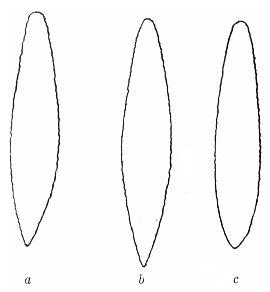
Fig. 37.—Flint spearheads.
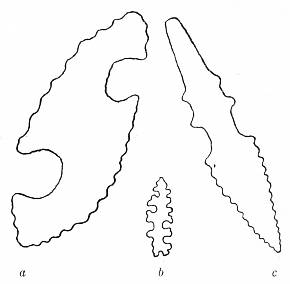
Fig. 38.—Flint objects.
Several more mounds were excavated at Kendal, but nothing was found in them. They were all composed of earth and large, water-worn bowlders, the former greatly predominating. Close to many of the mounds a deep excavation in the surface is to be seen, from which the material to construct the mound was evidently taken. These mounds form a decided contrast to those in the north of British Honduras and in southern Yucatan: they are lower, flatter, more diffuse and irregular in outline, with the line of demarcation between the base of the mound and the surrounding soil very poorly defined. The northern mounds are more clearly defined, with steeper sides, smaller summits, and base lines easily distinguishable. The reason for this difference is to be sought in the material from which the mounds were constructed, which in the south is clay, with a small admixture of river bowlders, both of which are easily washed down by the torrential tropical rains of the district. Year by year the mound becomes flatter and less well defined, till at length most of these mounds will be hardly distinguishable from the surrounding earth. In the north, on the contrary, the mounds are built of large blocks of limestone, with only a small admixture of earth and limestone dust. In many cases the blocks are mortared together, and in nearly all cases layers of cement are alternated with layers of stone. The whole forms a practically solid block of masonry, capable of withstanding for all time the less heavy rainfall of this part of British Honduras and Yucatan. About the center of a triangular space, bounded at each angle by a small mound, situated close to the mound last described, was found a piece of water-worn rock measuring 4 feet 10 inches in length, which had evidently been carried up from the river bed a quarter of a mile away. Three or four inches of it appeared above the soil. Beneath the rock extended a layer of water-worn river stones to a depth of 2 feet. Among these were found numerous fragments of pottery and patches of charcoal. On the western side of the rock, close to its edge, and buried 10 inches beneath the surface, were found three rather well-chipped flint spearheads, the largest of which was 25 cm. in length (fig. 37, a, b, c); these were placed erect in the earth, points upward, and close to them lay the small, eccentrically shaped object seen in figure 38, b, very well chipped from dark-blue flint, measuring 71/2 cm. in length. A few feet to the north of these objects, buried at about the same depth and quite close to the rock, were found the serrated flint spearhead shown in figure 38, c, 27 cm. in length, together with the eccentrically shaped object seen in figure 38, a, 28 cm. in length; both of these were placed perpendicularly, the spearhead point upward.
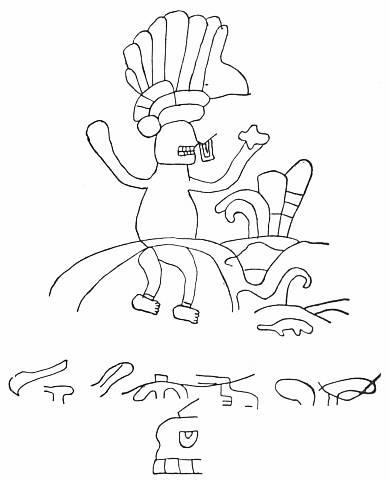
Fig. 39.—Devices scratched on stucco in aboriginal building.
About 11/2 miles from the village of Benque Viejo, in the Western District, is the only considerable aboriginal building in British Honduras, still in a fairly good state of preservation. This is a two-story temple standing upon a small natural elevation. Each story contains 12 small rooms, three on the north side and three on the south side, each of which has a narrower room in the rear. The central rooms are 27 feet in length, the side rooms 17 feet 6 inches. The breadth of the smaller rooms is 4 feet 6 inches; the dividing walls are 3 feet thick. All the rooms in the lower story are filled in with large blocks of stone, loosely held together with a small amount of mortar. This seems to have been a favorite device among the Maya architects, its object probably having been to give greater strength and stability to the new upper story erected upon a building of older date. All the rooms are roofed with the triangular so-called "American arch." The height of the rooms is 5 feet 10 inches to the top of the wall, and 5 feet 10 inches from the top of the wall to the apex of the arch. All the rooms had been covered with stucco, and upon the wall of one of the inner chambers completely covered over with green mold the devices shown in figure 39 were found, rudely scratched upon the stucco. In both the upper and the lower part of the drawing are what may be taken as crude representations of "Cimi," the God of Death, probably, like the "grafiti" of Rome and Pompeii, scratched on the wall after the abandonment of the temple by its original builders.[40] Whoever executed the drawing must have had some knowledge, however crude, of Maya art and mythology, as the Cimi head shown in the lower and the conventional feather ornaments in the upper part of figure 39 are unmistakably of Maya origin. To the north of this building lies a considerable group of ruins.
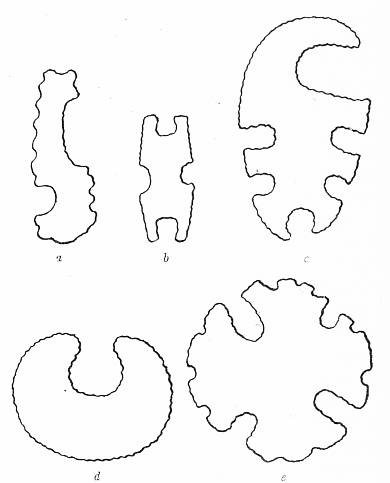
Fig. 40.—Eccentrically shaped implements found at summit of mound.
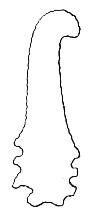
Fig. 41.—Flint object found at base of stela.
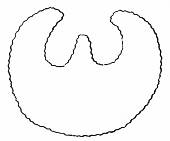
Fig. 42.—Flint object found at base of stela.
Among these three large pyramidal structures are conspicuous, which no doubt at one time carried small temples upon their summits, some remains of which are still to be seen. At the base of these pyramids stand three small plain stelæ, quite unornamented. Upon the summit of one of these mounds the eccentrically shaped implements shown in figures 40 and 44 were found. Of these, figure 40, a, b, and figure 44, m, n, o, p, are of obsidian, while the rest are of flint. Sixty-four of these objects were found in all, at depths varying from one or two inches to a foot beneath the surface; all were within an area of about 2 square yards. Some of the objects, especially the obsidians, were chipped out with great care and accuracy; others were merely flint flakes with a few shallow indentations chipped in their sides. On the south side of the largest of the pyramids stood a large sculptured stela, the upper part of which had been broken off and lay close to the lower part, which was still embedded in cement. The sculptured part of this stela measured 10 feet 2 inches in length by 4 feet 3 inches in breadth, and about 16 inches in thickness. The sculpture, which is in low relief, represents a captive, or sacrificial victim, prone on his face and knees, while above him rises the figure of the priest or warrior, with elaborately decorated feather headdress, holding in his extended right hand a small figure of the manikin god. The limestone from which the stela is cut has been very much defaced by the weather, and the finer details of the sculpture can not now be deciphered. The back and sides are plain and unsculptured. Close to this monolith lay a small stone altar, 2 feet 6 inches by 2 feet 4 inches; on its upper surface is represented the figure of a skeleton with head bent over the extended right arm, while the left is held in to the side, the elbow joint at right angles. In front of the skeleton is a double row of hieroglyphs, each row containing 7 glyphs, most of which are in a fairly good state of preservation. An excavation was made round the part of the monolith still standing. It was found to be surrounded by a solid foundation of blocks of limestone, held together by cement, among which were found, near the base of the stela, and actually in contact with it, the two eccentrically shaped flint objects shown in figures 41 and 42. In excavating a stela at the ruins of Naranjo, Republic of Guatemala, Teobert Maler found the flint illustrated in figure 43, a, and in clearing another stela at the same ruins 24 similar flints were found (fig. 43, b-s). Of these he says:
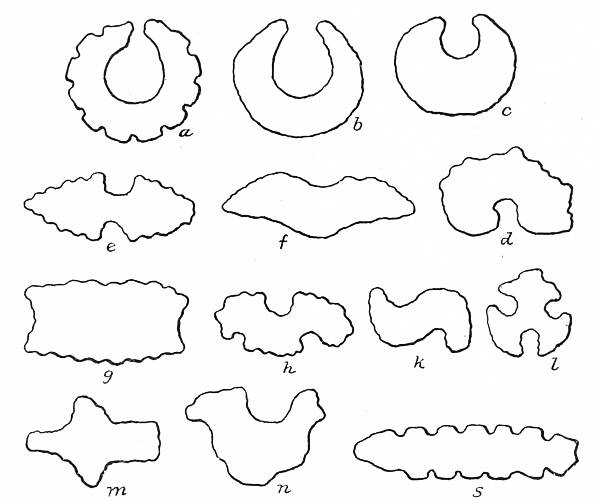
Fig. 43.—Flints found in ruins at Naranjo.
During the excavation of this "starfish stela" quite a collection of very interesting flint ornaments, 24 in number, came to light. Among them were crescents, such as are seen as ear ornaments on certain stelæ of Yāxhá and Tikal, several curved or even S-shaped pieces, which, perhaps, were used as nose ornaments, a serrated lance and a serrated plate, a piece in the shape of a cross, and one composed of three leaves, a double lance, single lances, etc.
We may assume that near many stelæ, as well as in the interior or on the exterior of temples, in addition to incense burners and sacrificial bowls, there were placed certain death's-head masks or other figures of perishable material tricked out with ornaments, feathers, and locks of hair, which have long since mouldered away, leaving behind only those of indestructible stone. For elsewhere, in the vicinity of stelæ, objects of flint and obsidian are found in addition to pottery sherds.[41]
It will be seen that figure 43, a, from Naranjo is practically identical with figure 44; h, from Benque Viejo, as is figure 43, c, from Naranjo with figure 40, d, from Benque Viejo, and figure 43, k, from Naranjo with figure 44, k, from Benque Viejo, while the objects shown in figure 43, h, l, m, respectively, from Naranjo very closely resemble those seen in figure 44, o, a, l, from Benque Viejo.
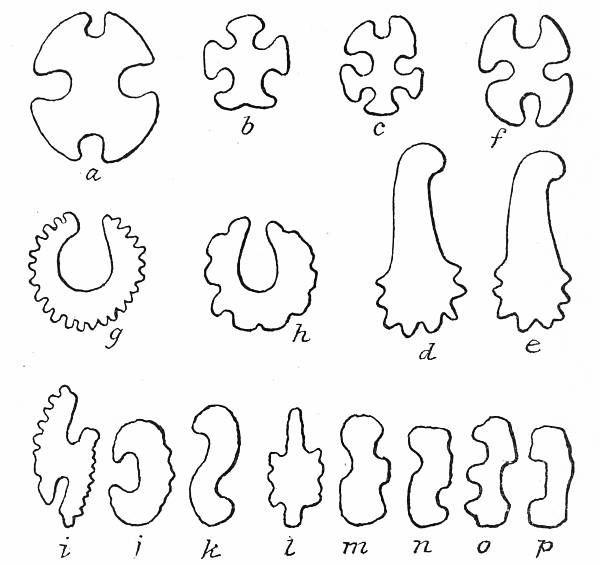
Fig. 44.—Objects from Benque Viejo.
Close to Succots, which is an extension of the village of Benque Viejo, a small mound was opened by Dr. Davis some years ago, within which were found the objects illustrated in figure 45. These are all of obsidian and of very eccentric and irregular shapes. The object shown in figure 45, c, closely resembles that shown in figure 43, c, from Naranjo, and that in figure 40, d, from Benque Viejo, and still more closely figure 44, p, from Benque Viejo, both being made of obsidian.
Mound No. 13
Close to Corozal, in the northern district of British Honduras, the sea in its gradual encroachment along the coast had partially washed away a small mound. On the beach, by the side of the mound, were found a few fragments of human long bones, a small triangular arrowhead or javelin head of black flint, a number of potsherds of coarse, thick, reddish pottery, and two small obsidian knives. These had evidently been washed out of the mound by the sea. The remaining part of the mound was dug down. It was found to be 18 feet in diameter, less than 4 feet high at its highest point, and built throughout of water-worn stones, sand, and earth. Near the center and on the ground level were found human vertebræ and parts of a skull, probably belonging with the leg bones found on the beach. Close to these were found a small three-legged earthenware bead vase, containing two pottery and one small polished greenstone bead, together with one eccentrically shaped flint object. This is probably meant to represent a "quash," or picote, with bushy tail coiled over his back. It is rather neatly chipped from dark-yellow flint. It measures nearly 3 inches from the curve of the tail to the tip of the forepaw.