Part 2 — TWO PAINTED STUCCO FACES FROM UXMAL
Reading edition
Two human faces molded in stucco and painted were discovered in a small stone-lined chamber situated beneath one of the end rooms of the Casa del Gobernador in the ruins of Uxmal, northern Yucatan. The room was accidentally disclosed by the caving in of a small part of its roof. One of its walls was covered, above a stone cornice, by a frieze of hieroglyphs, and against this wall stood a small square stone altar, each side of which had been decorated with a human figure molded in stucco and painted. Unfortunately these figures had fallen: the two heads here described are the best preserved parts of them which remain. Describing the sculpture in stone which adorns the outside of the Casa del Gobernador, Stevens ventures the opinion that some of the heads were portraits of celebrated men of the period.
The discovery of this chamber is extremely interesting, as it opens up the possibility that many, if not all, of these vast substructures, built apparently of solid stone, which throughout Yucatan support more or less ruined buildings, may in fact be honeycombed with chambers. Stevens first suggests the possibility of this. Unfortunately since Stevens's day little or nothing has been done throughout Yucatan in the way of excavation to verify the truth of his surmise.
Of the two heads now described, one probably represents a male, the other a female; there is, moreover, a marked individuality about each of them which renders it extremely probable that they are portraits, possibly of some "Halach Uinic" (real man, or chief) of Uxmal and his wife, during the palmy days of the triple alliance.
Each face is painted black with white circles round the orbital margin, red rims to the eyes, and brick-red oval patches at either angle of the mouth. The center of each upper lip is decorated by a figure 8 shaped labret, the lower portion of which has been broken away in the male head. Over the bridge of each nose is a curious ornament consisting of a small oblong object with rounded corners, held in place by a loop passing down the median line of the bridge. Over the center of the forehead in both faces hangs a pendant, that of the male composed of four small round beads, that of the female appearing as a rounded comblike excrescence. Traces of the headdresses remain as a few feathers above each forehead. Both heads were probably held within widely distended animal jaws, as a part of the lower jaw is seen below the chin in the male head, where also the large circular red ear plug still remains on the right side. The measurements of the faces are as follows:
Male.—Top of headdress to bottom of lower jaw of animal head holding the face, 11-3/10 inches; top of headdress to bottom of chin, 9-3/10 inches; forehead below headdress, to bottom of chin, 8-3/10 inches; extreme breadth of face (midway between a transverse line passing through the pupils and one passing immediately beneath the lower margin of the nasal septum), 7-1/10 inches; extreme breadth at level of the pupils, 7 inches; length of nose, 2-6/10 inches; breadth of nose, 1-6/10 inches.
Female.—Top of headdress to bottom of chin, 10-4/10 inches; forehead below headdress to bottom of chin, 8-8/10 inches; greatest breadth of face, at same level as the male, 7-8/10 inches; greatest breadth at the level of eyes, 7-6/10 inches; length of nose, 2-8/10 inches; breadth of nose, 1-9/10 inches.
The city of Uxmal belongs to the later, or northern Maya, civilization. Unlike the earlier southern cities, Uxmal is without a single initial series date by which its age might be approximately determined. It was founded by Achuitok Tutulxu, probably about the year 1000 of the Christian era. In the "Series of Katuns from the Book of Chilam Balam of Mani" the date given is Katun 2 Ahau, whereas in that from Tizimin it is recorded as having taken place 180 years later.[60] The cities of Uxmal, Chichen Itza, and Mayapan formed a triple alliance, which lasted for nearly 200 years, during probably the most prosperous period of the whole Maya rule in Yucatan. After the disruption of this alliance, caused by a quarrel between the rulers of Chichen Itza and Mayapan, Uxmal gradually declined in prosperity, till at the time of the conquest its temples and palaces seem to have been completely abandoned. The city was visited in 1586 by the Franciscan delegate Alonzo Ponce, one of whose companions gives an interesting account of the ruins. Describing the house of the governor, he says:
Besides these four buildings there is on the south of them, distant from them about an arquebus shot, another very large building built on a "Mul" or hill made by hand, with abundance of buttresses on the corners made of massive carved stones. The ascent of this "mul" is made with difficulty, since the staircase by which the ascent is made is now almost destroyed. The building which is raised on this "mul" is of extraordinary sumptuousness and grandeur, and like the others very fine and beautiful. It has on its front, which faces the east, many figures and bodies of men and of shields, and of forms like the eagle which are found on the arms of the Mexicans, as well as of certain characters and letters which the Maya Indians used in old time—all carved with so great dexterity as surely to excite admiration. The other façade, which faces the west, showed the same carving, although more than half the carved part had fallen. The ends stood firm and whole with their four corners much carved in the round, like those of the other building below.... The Indians do not know surely who built these buildings or when they were built, though some of them did their best in trying to explain the matter, but in doing so showed foolish fancies and dreams, and nothing fitted into the facts or was satisfactory. The truth is that to-day the place is called Uxmal, and an intelligent old Indian declared to the father delegate that according to what the ancients had said it was known that it was more than nine hundred years since the buildings were built.[59]
From this account there appears to be little doubt that at the time of the conquest the great buildings of Uxmal were deserted and already falling into ruins. In the minds of the Indians they were evidently associated with the practice of their ancient religious rites at a much later date, for one of the reasons given by the regidor when he applied for a grant of the land upon which the ruins stand was that—
It would prevent the Indians in those places from worshipping the devil in the ancient buildings which are there, having in them idols to which they burn copal, and performing other detestable sacrifices as they are doing every day notoriously and publicly.[61]
The ruins of Uxmal were probably venerated by the Indians up to a very recent period, as in one of the chants used by the modern Maya of southern Yucatan in their "Cha chac" or rain ceremony the "Noh Nah ti Uxmal," "Great house of Uxmal," is introduced, which possibly refers to the Casa del Gobernador, as this is the largest building among the ruins.
BUREAU OF AMERICAN ETHNOLOGY BULLETIN 64 PLATE 23.
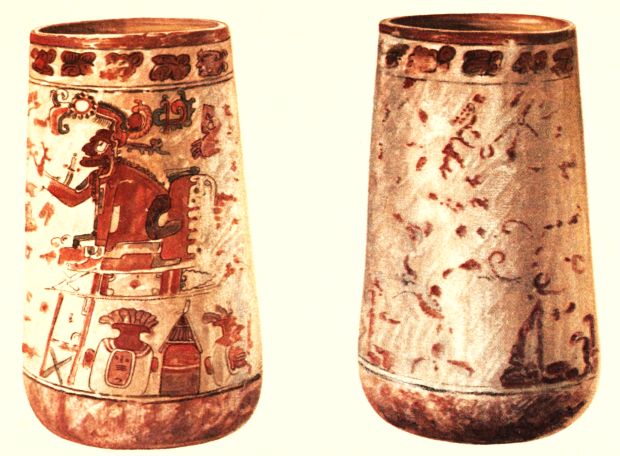
POTTERY VASE FROM YALLOCH, GUATEMALA
EXPLANATION OF PLATE 23
The ovoid vase shown in plate 23 is 11 inches high by 61/2 inches in diameter at its widest part. It is of very fine pottery, with decorations in red, black, and reddish yellow on a background of light yellow. The outer surface is divided by double black lines into three zones. The uppermost and narrowest zone contains, between a broad red band above and two narrow black bands below, a row of 10 glyphs surrounding the edge of the vase. The middle zone, the broadest, contains upon one side (unfortunately the decoration upon the other side has been almost obliterated by time or wear) a human figure, in a crouching position, the right hand extended, the left resting upon the ground. The face is in profile, and around the left eye is seen the ornament usually associated with the representation of a god. This may be intended to represent Schellhas's God D of the Codices, known as the Roman-nosed God, probably Itzamna, as this peculiar eye ornament is often associated with him. The headdress is exceedingly elaborate, projecting far in front of and behind the head, and is decorated with plumes of feathers. The whole figure strongly suggests the bas-relief on the side of the door of the altar at Palenque, which is undoubtedly a representation of the god Itzamna. The curious eye ornaments, the construction of the elaborate headdress, the contour, of the face, and the platted objects hanging down in front of and behind the chest, from the neck, are similar in both. The lowest zone is decorated with vases having handles at the sides, narrow necks, and flaring rims from which project flame-like tongues; on the outer surface of each is depicted an "Ahau" sign. The vases alternate with curious objects which might represent bales of merchandise; the whole, indeed, closely resembles the tribute count of some Aztec city.
EXPLANATION OF PLATE 24
The cylindrical vase shown in plate 24 is 6 inches in diameter by 11 inches high. It is divided into three zones, the uppermost of which contains a single row of hieroglyphics, in fair preservation, between a broad red band above and two narrow black bands below. The middle zone, by far the broadest, contains two very spirited representations of the Long-nosed God, one on each side of the vase, done in red, black, white, and dark yellow. The Long-nosed God, called by Schellhas in his "Representation of Deities of the Maya Manuscripts" God B, is usually identified with Cuculcan, the feathered serpent; the Aztec Quetzalcoatl. This god is usually represented with a long pendulous nose and one or two projecting tusks, and is almost in variably associated with the serpent. The head of the god is often held between the serpent's open jaws, or has added to it a serpentine body; again the god may be encircled by intertwining serpents, or may hold the reptile's body in his hand, like a wand. Though the serpentine attributes of the god are in this instance conspicuous by their absence, and the tapir attributes are emphasized, there can be little doubt that the painting is meant to represent God B, as the long pendulous nose and projecting tusks are highly characteristic of that god. The lowest and narrowest zone of this vase is covered with alternating red and black lines.
BUREAU OF AMERICAN ETHNOLOGY BULLETIN 64 PLATE 24.
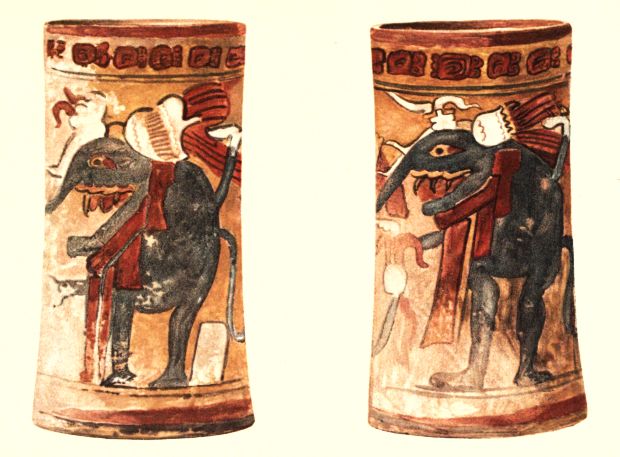
POTTERY VASE FROM YALLOCH, GUATEMALA
BUREAU OF AMERICAN ETHNOLOGY BULLETIN 64 PLATE 25.
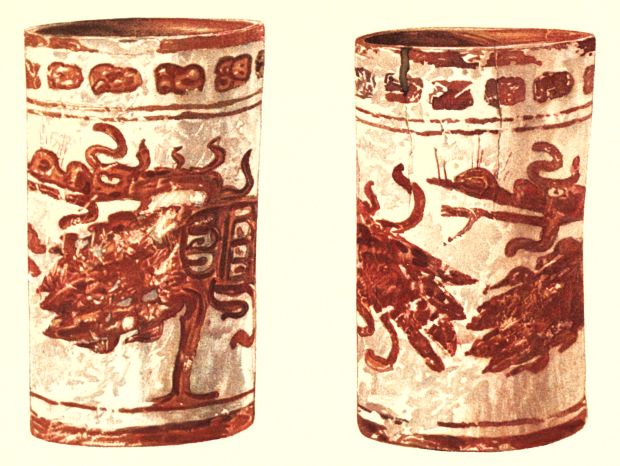
POTTERY VASE FROM YALLOCH, GUATEMALA
EXPLANATION OF PLATE 25
The cylindrical vase shown in plate 25 is 71/2 inches in height by 41/2 inches in diameter. The whole of the decoration upon it is in light and dark red on a light yellow background, and, like the two previously described vases, it is divided into three decorative zones. The uppermost zone contains a single row of glyphs, almost indecipherable, apparently from constant use of the vase before it was buried. The middle zone contains two very remarkable mythological creatures, one on each side, whose feather-covered bodies, long legs, and large feet are suggestive of the ostrich. The necks are long and covered with flame-like projections, and both they and the heads, with their huge elongated jaws, are evidently intended for those of feathered serpents. The lowest zone of the vase is narrow, and contains only a narrow and a broad red stripe.
EXPLANATION OF PLATES 26, 27, AND 28
The pottery cylinder shown in plates 26, 27, and 28 is 101/2 inches high by 4 inches in diameter and is without a bottom. It is most exquisitely decorated in light and dark red and dark yellow on a light yellow background, and is also divided into three decorative zones. The uppermost zone contains only a single row of hieroglyphs, very much defaced, among which may still be recognized several of the Maya day signs. The middle zone, by far the broadest, is covered by a most intricate design, containing human and mythological figures and hieroglyphs, with ornamental plumes, plats, and pendants; the whole, owing to the partial obliteration of the design, being extremely difficult to make out. On one side is seen a highly conventional representation of what is undoubtedly intended for the feathered serpent, with tail bent around to join the upper part of the head. The feathered serpent appears to permeate all Maya art in this section of the Maya area; whether painted on pottery or stucco, or incised on bone, pottery, or other material, one encounters him at every step. The serpent rests upon a row of glyphs, very much defaced, and below this is a mass of bows, knots, plumes, and glyphs. Farther along is a fierce-faced human figure, probably a warrior, with lofty and elaborate headdress, ornamented with many long feather plumes. Between the warrior and the serpent is a row of eight cartouches, superimposed one upon the other, each containing glyphs, a good deal defaced, among which the "Ahau" sign may still be clearly made out. The opening glyph in this panel may refer to the katun 8 Ahau. This katun can end in 8 Ahau only once in 260 years, or twice in the ninth cycle, namely, on 9.0.0.0.0.8 Ahau, 3 Ceh, and on 9.13.0.0.0.8 Ahau, 8 Uo; and it is reasonable to suppose that if this is a calendar record it refers to some date in the ninth cycle. Naranjo, the nearest ancient Maya city to Yalloch, was occupied for a period of approximately 12 katuns, or 240 years,[62] between 9.7.10.0.0 and 9.19.10.0.0; if this glyph, therefore, refers to a katun ending in 8 Ahau in the ninth cycle, the date 9.13.0.0.0 is certainly indicated.
BUREAU OF AMERICAN ETHNOLOGY BULLETIN 64 PLATE 26.
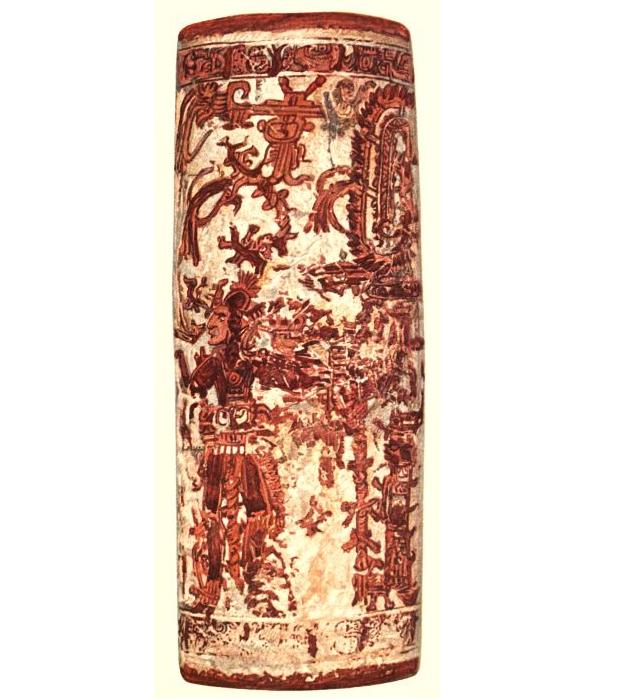
POTTERY CYLINDER FROM YALLOCH, GUATEMALA
(OTHER VIEWS IN PLATES 27 AND 28)
BUREAU OF AMERICAN ETHNOLOGY BULLETIN 64 PLATE 27.
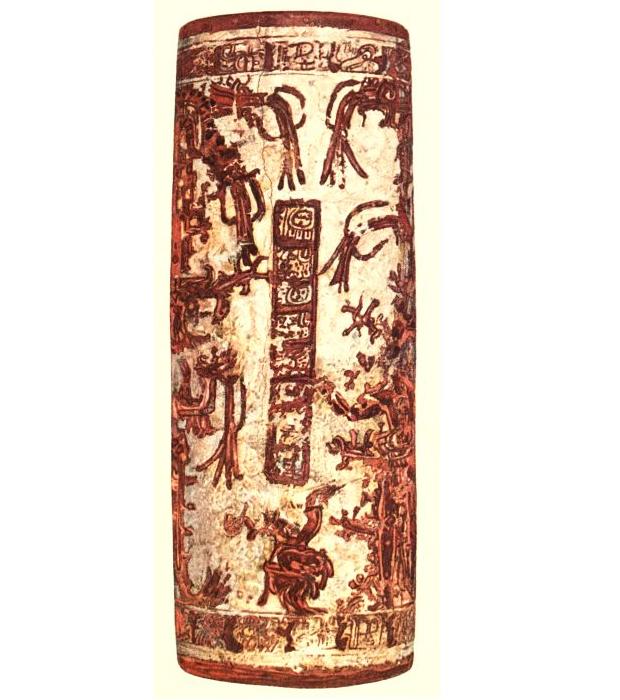
POTTERY CYLINDER FROM YALLOCH, GUATEMALA
(OTHER VIEWS IN PLATES 26 AND 28)
BUREAU OF AMERICAN ETHNOLOGY BULLETIN 64 PLATE 28.
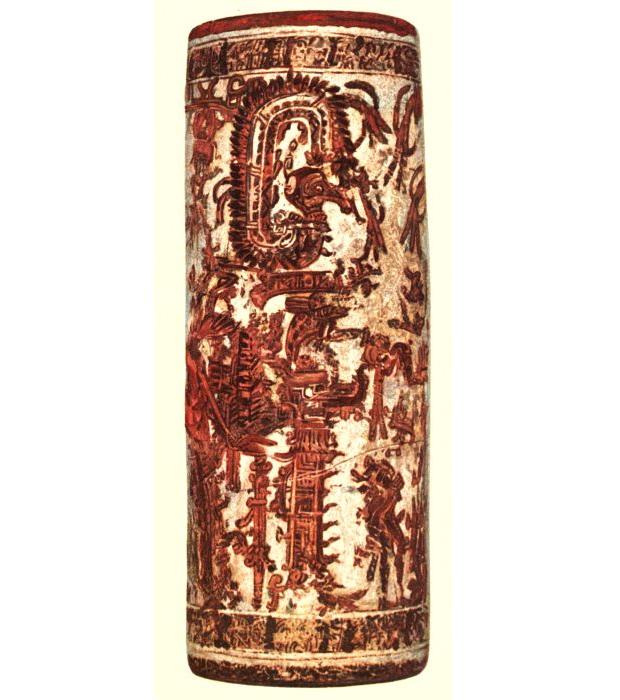
POTTERY CYLINDER FROM YALLOCH, GUATEMALA
(OTHER VIEWS IN PLATES 26 AND 27)