Part 2 — DESCRIPTION OF MOUNDS (continued 2)
Reading edition
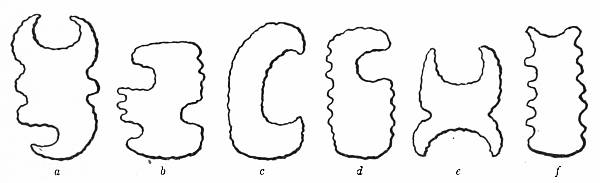
Fig. 45.—Obsidian objects found in a mound near Benque Viejo.
Mound No. 14
The next mound in which an eccentrically shaped flint was discovered is a very large one situated far away from any settlement, at the headwaters of the Rio Hondo, in northern British Honduras. The stone implements found in it lay near the summit, about a couple of feet beneath the surface. They were discovered accidentally by an Indian (from whom they were purchased) while digging out a halib, or gibnut, from its hole, and consisted of: (a) A spindle-shaped stone brazo 12 inches long by 93/4 inches in circumference, finely polished from grinding corn on a metate. (b) A chipped flint brazo, 71/2 inches long by 101/2 inches in circumference, polished on one side only. Flint brazos are exceedingly rare, as the rough surface necessary for corn grinding must have been difficult to produce on so refractory a material. (c) Eight stone ax heads, varying from 31/2 to 81/2 inches in length. (d) A dark greenstone ax head, 91/2 inches in length, with two shallow notches, one on each side of a shoulder situated 3 inches from the base, probably intended to afford greater facility in hafting the implement. (e) Two well-chipped flint spearheads, one 101/4, the other 71/2, inches in length. (f) An oblong block of flint 61/2 inches in length and 61/2 inches in circumference. This had probably been used as a hammerstone, since it exhibits well-defined percussion marks at each extremity. (g) A rather roughly chipped stellate disk of flint, 10 inches in diameter, with 13 sharp-pointed triangular rays or spines, each about 2 inches in length, at equal intervals around its periphery. Near the center of this object is a natural hole 33/4 inches in diameter.
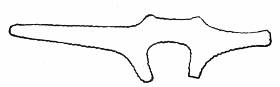
Fig. 46.—Flint object from Seven Hills.
The upper part of this mound consisted of earth and blocks of limestone; the lower part was not excavated. The implements were found lying close together in a cache, loose in the soil. Numerous rough potsherds were found, but there was no trace of human interment discovered.
In the southern part of British Honduras, not far from Punta Gorda, is a group of small natural elevations, known as Seven Hills. Upon the summit of the highest of these, some years ago, the object illustrated in figure 46 was found. This somewhat resembles a horseshoe with two long bars, each tapering off to a point, projecting from either side. It is very neatly chipped from grayish flint. Its extreme length is 16 inches. This implement was found just beneath the surface, covered only by a few inches of soil. At a later date a number of trenches were dug on the summit of this mound, but nothing except potsherds of various kinds with flint and obsidian chips came to light.
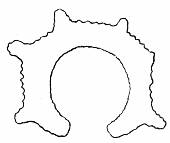
Fig. 47.—Horseshoe-shaped flint object found near San Antonio.
In figure 47 is seen one of the finest of these eccentrically shaped flints ever found in this part of the Maya area. It is horseshoe-shaped, chipped to a sharp edge all round, and has six sharp spines projecting from the outer periphery (one of which has been broken off, as shown in the figure), with shallow indentations between them. The implement, which is 35 cm. in its greatest diameter, is made of nearly black flint, covered with a beautiful creamy white porcelain-like patina. It was found by an Indian in the neighborhood of San Antonio, on the Rio Hondo, which here forms the boundary line between Mexico and British Honduras. He was idly scratching on the top of a small mound, buried in the bush, with his machete, when a few inches below the surface he came upon this very remarkable flint. Unfortunately, he took no pains to locate the mound, and as the bush in this neighborhood is literally covered with mounds in all directions, he has never been able to find this particular one again.
The implement shown in figure 48 was dredged up from the River Thames, near London, at a spot where foreign-going ships were in the habit of dumping their ballast. There can be little doubt that it came originally from British Honduras, as flint implements of such large size and of this peculiar type are not found outside the Maya area. This object, as may be seen, is a crude representation of the human form; it is 91/2 inches in length and is neatly chipped. A closely similar anthropomorphic specimen is preserved in the Northesk collection, a cast of which may be seen in the British Museum.
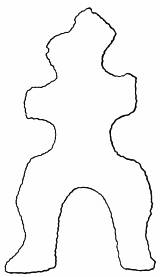
Fig. 48.—Figure from River Thames, near London.
It is extremely difficult to form any satisfactory theory as to the use of these eccentrically shaped flints which will cover all the instances in which they have been found. Teobert Maler, judging by the small specimens, closely packed, which he found at Naranjo, considers that they may have been used as ornaments upon death's head masks, placed near stelæ and temples, the more perishable parts of which have disappeared. This theory could hardly apply to the immense specimens from the Douglas, Orange Walk, and Seven Hills mounds, some of which are, moreover, obviously intended as weapons, and not as ornaments. Stevens, the author of "Flint Chips," with only the three large specimens found in a cave inland from the Bay of Honduras to judge from, considers that they may have served as "weapons of parade, like the state partisan or halbert of later times;" it is perfectly obvious, however, that the zoomorphic forms from Corozal and Douglas, and the small specimens from Benque Viejo, Naranjo, Kendal, and Santa Rita, could not have been intended for this purpose. Finding small, beautifully chipped crescents, crosses, and rings of obsidian and varicolored flints, as have been discovered at Benque Viejo and Succots, one would be inclined to think that they were intended as earrings, gorgets, and breast ornaments, especially as one sees such forms frequently recurring in the ornaments worn by figures on the stelæ in the neighborhood. Finding the huge flints pictured in plate 15, b, d, especially when associated, as they were, with the large flint spearheads illustrated in plate 15, c, f, the conclusion that they were intended as weapons would be almost irresistible.
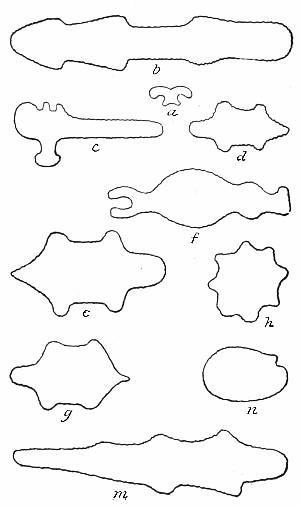
Fig. 49.—Flint objects from Tennessee.
The number of these objects found at each of the 11 sites which have been described varies from 1 to 64. On 5 of the 11 occasions they were undoubtedly associated with human interments; in 4 of the remaining 6 they were found lying, superficially placed, on the summits of mounds, which for various reasons were not thoroughly excavated, and may or may not have been sepulchral in function; in the two remaining finds the flints were placed closely adjacent to sculptured stelæ, and these again may have been used to mark the grave of some priest or cacique, though they more frequently marked the lapse of certain time periods. The commonest form assumed by these objects is the crescent or some variant of it. Of the 11 sites excavated, this form was found in no fewer than 8. The crescent is in some cases quite plain, in some indented or spiked along the convexity, and is in one instance furnished with long spines on each side.
In every instance (except that of the chambered mound at Douglas) where these implements were found in mounds they were placed quite superficially at the summit of the mound; indeed at Benque Viejo, Seven Hills, and Santa Rita it seems probable that they had not been buried originally at all, but merely placed upon the summit of the mound and in course of time became covered with a layer of humus from decaying vegetation in the vicinity.
Similar flint objects have been found in other parts of the world, notably at Brionio in Italy and in Stuart, Smith, and Humphrey Counties, Tennessee. In figure 49, b-n, are shown somewhat rough outline sketches of the Tennessee objects, and in figure 50, a-p, are represented a selection of the most important objects found at Brionio, now in the collection of the late Professor Giglioli at Florence. The Tennessee objects are to be seen at Washington. The latter are small when compared with the largest of the Maya specimens, but are neatly chipped, whereas the Brionio objects are very crudely blocked out, mostly from black flint.
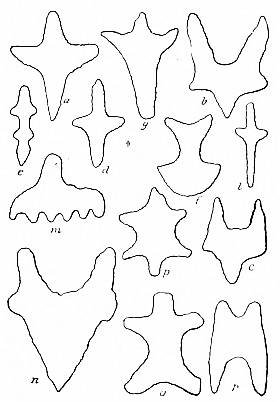
Fig. 50.—Flint objects from Italy.
It will be observed that figure 49, c, d, g, from Tennessee, shows specimens almost identical with figure 50, p, from Brionio, and with the turtle, pictured in plate 15, g, from the Douglas chambered mound; again the spiked crescents, figure 50, b, c, n, from Brionio, closely resemble the very much larger spiked crescent illustrated in plate 15, e, from the Douglas chambered mound, and still more closely the spiked crescent figured in "Flint Chips" (from Wilson, Prehistoric Man, op. cit., p. 214). Though these objects are not found in Central America outside the Maya area, the Aztec were sufficiently expert in the art of flint and obsidian chipping to have produced them had they wished. In figure 49, a, is seen the outline of a type of labret worn by the Aztecs, chipped out of both flint and obsidian, which compares favorably in workmanship with any of the objects from the Maya area.
In reviewing the evidence it would appear that these eccentrically shaped objects were not employed either as implements or as weapons, most of them being utterly unsuited in both size and shape for such purposes; moreover, none of them show any signs of wear or use. Neither were they used as ornaments, as many of them are too large and heavy, while the more roughly chipped specimens would be quite unadapted for such a purpose. Judging by the fact that 5 at least of the 11 separate finds wore associated with human burials, it seems probable that these objects were purely ceremonial in use; that they were most frequently, if not invariably, buried with the dead, either on top of the sepulchral mound, in close association with the corpse, or by the side of a memorial stela; and that they were manufactured and used solely for this purpose.
Mound No. 15
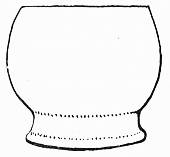
Fig. 51.—Small cup-shaped vase from Mound No. 15.
Mound No. 15 was situated on the south bank of the Rio Hondo, about 5 miles from its mouth, near the village of Santa Helena. This was a conical mound 25 feet in height and 120 feet in circumference at the base. Excavation was begun at the summit of the mound, which was somewhat flattened. For the first foot the soil consisted of light-brown earth, which contained nothing of interest.
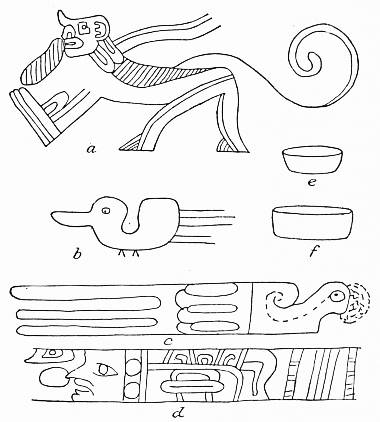
Fig. 52.—Objects from Mound No. 15.
For the next 31/2 feet there were large blocks of limestone, the interstices between which were filled with limestone dust and débris. In these were found large quantities of potsherds, some well painted and polished, together with part of the inferior maxilla of a medium-sized carnivore, probably a puma. At a depth of 31/2 feet a number of stone flags, each nearly 5 feet in length and from 4 to 6 inches in thickness, were exposed; on removing these a small chamber appeared, of which the flags formed the roof. The walls of the chamber, or cist, were built of squared stones mortared together; it was 6 feet long, 6 feet high, and 4 feet broad; the floor was of light-brown, very fine river sand. On carefully removing the sand the following objects were brought to light at depths varying from 3 feet below the surface of the sand to the bottom of the chamber: (a) A small round, cup-shaped vase, shown in figure 51, painted bright yellow and finely polished. It is 10 cm. high by 81/2 cm. in its greatest diameter. On its outer surface are two grotesque monkey-like figures, the outline of one of which is shown in figure 52 a. (b) A small thin bowl of the shape shown in figure 52 e, painted yellow throughout, well polished, and ornamented exteriorly with geometrical devices in red and black. (c) A somewhat larger bowl than the next preceding, of the shape seen in figure 52 f. The geometrical ornamentation on the outer surface is executed in low relief, and was afterwards painted over. (d) A large circular plaque painted yellow throughout, 42 cm. in diameter. This plaque had been polished but shows considerable signs of hard usage before burial. (e) A plaque-like vessel, 9 cm. in height, with the design represented in figure 52 d, of a human face separated from a dragon's head by the Maya numeral 7, repeated around the outer surface of its rim. (f) A shallow plaque, 36 cm. in diameter, painted yellow throughout, and polished; on the inner surface of the rim are repeated twice, outlined in black lines, the bird and the curious mythological animal seen in figure 52, b, c. (g) A basin-shaped vessel, painted a deep reddish-brown and finely polished throughout, with a very attractive and intricate device of interlacing diamond-shaped figures around the inside of the rim. (h) A vessel closely similar to the preceding, but smaller and not so well polished. It was broken into a number of pieces when found. (i) A small round pot, with flaring rim, of common red ware, showing no attempt at decoration. (j) Scattered throughout the sand, in the midst of these pots, were found 35 very small, flat, circular disks or beads, averaging about one-twelfth inch in thickness. Some were of greenstone, others of a reddish-yellow stone mottled with white. All were well polished.
BUREAU OF AMERICAN ETHNOLOGY BULLETIN 64 PLATE 17.
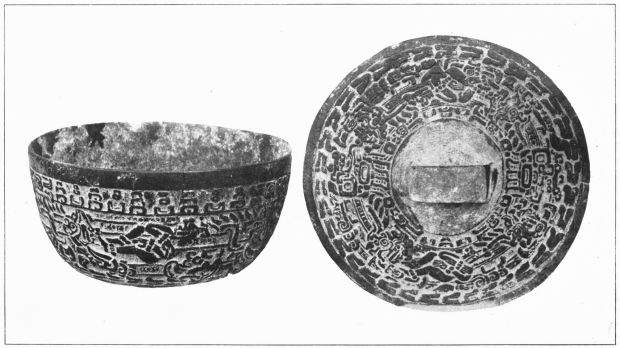
PAINTED BASIN AND COVER FROM MOUND NO. 16
On removing the sand to a depth of 12 feet the bottom of the chamber was reached. The floor, which was composed of hard mortar, measured 4 by 3 feet, as the chamber was somewhat funnel-shaped, narrowing as it descended. On the bottom of the chamber were found a number of small oyster and cockle shells, with fragments of human bones. Among these was an inferior maxilla in fairly good state of preservation; from the facts that the tooth sockets had disappeared, that there was considerable atrophy along the alveolar processes and widening of the angle between the horizontal and vertical sections of the bone, it had probably belonged to a person of advanced age.
Mound No. 16
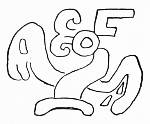
Fig. 53.—Conventionalized representation of bird on vessel shown in plate 17.
Mound No. 16 was situated about 2 miles due north of the last-described mound, close to the north bank of the Rio Hondo, within the territory of Quintana Roo. It was discovered by an Indian, who had cut a piece of virgin bush with the object of making a milpa. The mound was 35 feet in height by 250 feet in circumference at the base; in shape it resembled a truncated cone, the flattened summit of which measured 30 feet in one direction by 6 feet in the other. The mound was composed throughout of rough blocks of limestone, the interstices of which were filled in with limestone dust and an unusually large quantity of light-brown earth. Excavation was commenced at the top of the mound; for the first 6 feet nothing except a few potsherds was found. Scattered through the next 2 feet of the mound the following objects were brought to light; these were mingled indiscriminately with the limestone blocks of which the mound was built, quite unprotected by cist or chamber: (a) A basin-shaped vessel 20 cm. in diameter, 10 cm. in height (pl. 17), covered by a round conical lid with a semicircular handle. Both basin and cover are painted black and polished, inside and out. Upon the outer surface of the vase and the upper surface of the lid are incised in low relief a series of pictographs, identical upon both. From the nature of the design and the fact that the vase contained a number of fragments of human bones, it seems probable that it was intended for a cinerary urn. The design is of considerable interest and worthy of detailed consideration. The most prominent object upon both the lid and the vase itself is a naked human figure in a recumbent position, with the arms flexed over the chest and abdomen and the knees and thighs semiflexed. The ornaments worn consist of an elaborate feather-decorated headdress, a labret, or nose ornament (it is somewhat difficult to determine which), and large bead anklets and wristlets. Below the head, on the body of the vase, is the conventionalized representation of a bird (fig. 53) with extended drooping wings, and a rectangular object occupying the position of the beak. On the lid, probably from lack of room, this bird is represented only by the rectangular object, beneath which is seen the conventionalized serpent's head, represented only by the upper jaw, from which project the head and hand of a human being, whom it is in the act of swallowing. This monster, with a human head projecting from its mouth, is frequently represented in mounds in this area, usually in the form of a clay figurine.
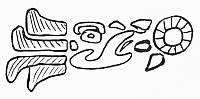
Fig. 54.—Decoration on vessel shown in plate 17.
The next figure is probably intended to represent Quetzalcoatl, the Cuculcan of the Maya, and God B of the Codices. It is the shrunken bearded face of an old man, with a single tooth in the lower jaw, very prominent nose, and a bird's head (probably that of the owl) in the headdress. These are all well-recognized characteristics of this god. At the back part of the headdress of the god, and connected with it, is a human face. Immediately above the head of Cuculcan is depicted a fish, with a flower-like object in front of its mouth (fig. 54), which is probably connected with this god, who is frequently associated with objects connoting water, vegetation, and fertility, as fish, flowers, water plants, leaves, and shells.
The next figure probably represents Schellhas's God K of the Codices. This god possesses an elaborate foliated nose, and is usually closely associated with God B, as he is in the present instance; indeed Brinton and Fewkes regard him as being merely a special manifestation of the latter god, while Spinden is of the opinion that his face is derived from that of the serpent so constantly associated with God B.[42] The lower jaw of the god seems to consist of a dry bone.
BUREAU OF AMERICAN ETHNOLOGY BULLETIN 64 PLATE 18.
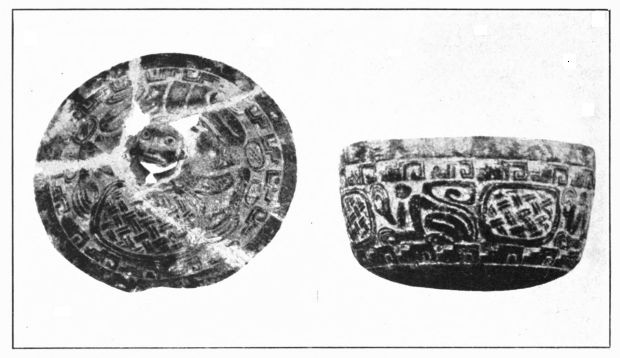
POTTERY FROM MOUND NO. 16
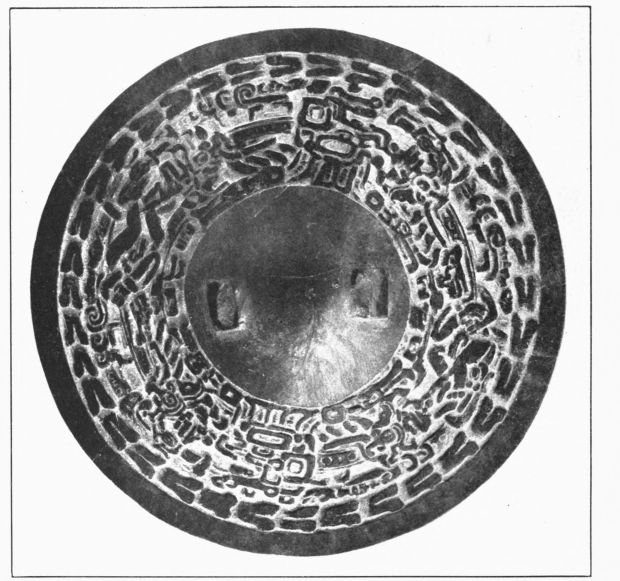
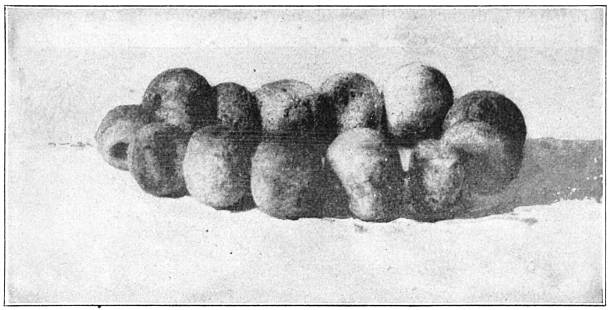
Fig. 55.—Perforated beads found in Mound No. 16.
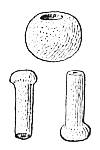
Fig. 56.—Jadeite beads found in Mound No. 16.
Immediately behind God K is repeated the design of the serpent swallowing a human head, above which is a striated bar, whose sole purpose seemingly is to decorate a vacant space. Above this again is a bar with feathers or leaves projecting from it, which may possibly be connected with the headdress of God B, and at the top is repeated the figure of the fish, with the circular object in front of its mouth. Next to these is again seen the head of the god Cuculcan, after which the whole series recommences with the prone naked human figure. (b) A vessel exactly similar in size, color, and shape to the one last described (pl. 18, a). The outer surface is decorated by four curious monkey-like creatures, sculptured in low relief, separated from each other by ovate spaces inclosed in double parallel lines and filled with cross-hatching. Above and below is a border of frets, also executed in low relief. The faces of these monkeys are represented by a simple oval, no attempt having been made to depict any of the features. The hands are furnished with huge claw-like fingers, and the tails, which are of great length, are curled over the back. The cover of this vessel (pl. 18, a) is circular, somewhat funnel-shaped, 23 cm. in diameter. Upon its outer surface is executed, in low relief, a monkey almost exactly similar to those which appear on the outer surface of the vase, except that it is somewhat larger and is seen in front view, not in profile. The face of the monkey is carefully molded in high relief to form the handle of the lid, while between his hands he grasps an ovate object identical with those on the vase. (c) The lid of a vessel corresponding exactly to the lid of the vessel first described. The pot to which it belonged could not be found (pl. 18, b). (d) A pair of cylindrical vases, each standing upon three short, hollow, oval legs.
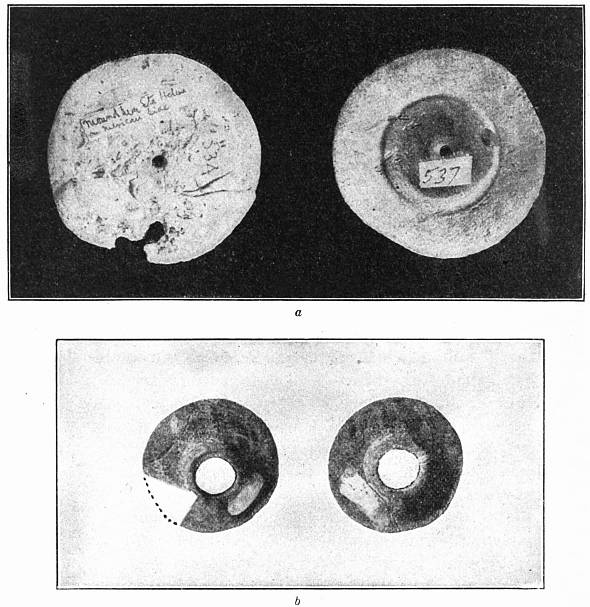
Fig. 57.—a. Circular shell disks from Mound No. 16. b. Greenstone ear plugs from Mound No. 17.
Both are made of extremely thin, brittle pottery painted a dirty yellow and polished throughout, with no ornament except a broad red stripe, which passes obliquely around the whole of the outer surface of each vase. (e) Two shallow circular plaques, painted reddish-brown, and polished throughout, with a geometrical device in thin black lines around the inner surface of the rim of each. (f) A quantity of bones, probably those of a halib or gibnut, and of a wild turkey. These were found under a large block of rough limestone. (g) A number of univalve shells, each about 1 inch in length, perforated at the apex in two places, as if for suspension in the form of a necklace or ornamental border.[43] With these shells was found half of a large cockle-like bivalve, painted red throughout, and perforated, possibly for use as a gorget. (h) Thirteen large, round, perforated beads (fig. 55). Some of these are reddish in color, and show traces of polishing. With these were the three jadeite beads pictured in figure 56; two of these are cylindrical, with a knob at one end, while the third is nearly spherical; all are finely polished; they are made of light and dark-green mottled jadeite. (i) A single small oyster shell, with a great number of cockle shells. (j) Two circular disks of shell, represented in figure 57, a, exhibiting the front and back view. The central part is of a deep reddish color, and is well polished. Each disk is 5 cm. in diameter and is perforated at the center. They were probably used as ear ornaments. Excavations were made in this mound to the ground level, but no additional objects were found in it.
Mound No. 17
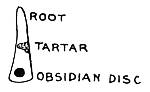
Fig. 58.—Obsidian disk inserted in tooth of skeleton found in Mound No. 17.
Mound No. 17 was situated within a mile of the mound last described, on high ground, about 11/2 miles from the Rio Hondo, from which it is separated by a belt of swamp. It was conical in shape, about 40 feet high, nearly 90 yards in circumference, and was built throughout of large blocks of limestone, the interstices being filled with a friable mortar, made seemingly from limestone dust, earth, and sand mixed together. Near the summit was an irregular opening, about 4 feet across, which led into a small stone-faced chamber, 15 feet long, 5 feet broad, and 6 feet high. The opening had been made by the falling in of one of the flags which formed the roof of the chamber; this was found within the chamber with a pile of débris. The floor was composed of large flat flags, on removing one of which an aperture was made which led into a second chamber, of exactly the same size as the first, and immediately beneath it. The floor of this was covered to a depth of about 12 inches with a layer of soft brown river sand, in which were found: (a) Parts of a human skeleton, seemingly belonging to an adult male, the bones of which were very friable and greatly eroded. In one of the incisor teeth was inserted a small disk of obsidian, the outer surface of which was highly polished (fig. 58). These ornamental tooth fillings are rather rare, though they have been found from time to time in Yucatan and as far south as Quirigua. They were usually made from greenstone, obsidian, or iron pyrites, all highly polished, the only teeth ornamented being the incisors and canines, usually in the upper jaw. The plugging seems to have been exclusively for ornamental purposes, not with any idea of filling a cavity, the result of caries in the tooth.[44]
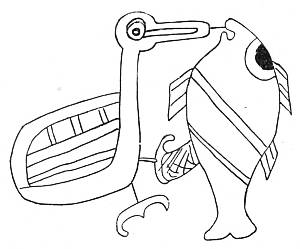
Fig. 59.—Bird carrying a fish outlined on shallow plaque found in Mound No. 17.
(b) A shallow plaque, 28 cm. in diameter, painted throughout a dark reddish-yellow, and finely polished. Upon the upper surface was outlined in fine black lines a bird, apparently a sea hawk, carrying in its claw a good-sized fish, possibly a stone bass (fig. 59). The artist probably witnessed this event many times, as the mouth of the Rio Hondo, where stone bass abound, is a favorite fishing ground for sea hawks and frigate birds.
(c) A number of painted and glazed potsherds of all sizes.
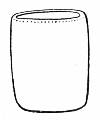
Fig. 60.—Cylindrical pottery vase found in Mound No. 17.
Beneath this second chamber a third was discovered, roofed in with rough flags, of the same dimensions as the other two. The floor of this chamber was cemented over; nothing except limestone blocks and mortar was found between it and the bottom of the mound. Upon the floor lay a solitary plaque, of a deep reddish-yellow color, the upper surface divided by black lines into four equal spaces, in each of which was crudely outlined in black a fish, probably meant to represent a stone bass. On digging into the summit of the mound outside the area occupied by the chambers, the following objects were brought to light: (a) A cylindrical vase of light, thin, well-made pottery, 161/2 cm. high by 13 cm. in diameter, painted light yellow throughout and finely polished (fig. 60). Upon one side of the vase, within an oblong space outlined in black, are a number of curious mythological animals, above which is a row of six glyphs, seemingly explanatory of the picture beneath (pl. 19, a). Both animals and glyphs are very carefully executed in red, black, and brown, on a yellow background. The lowest figure on the right somewhat resembles that on a vase in the American Museum of Natural History,[45] upon which the Long-nosed god is associated with bulblike objects, flowers, and a bird (probably a pelican). On this vase the Long-nosed god is seen with a bulblike object, possibly a root, from which project interlacing stalks, at the ends of which are water-lily buds.
BUREAU OF AMERICAN ETHNOLOGY BULLETIN 64 PLATE 19.
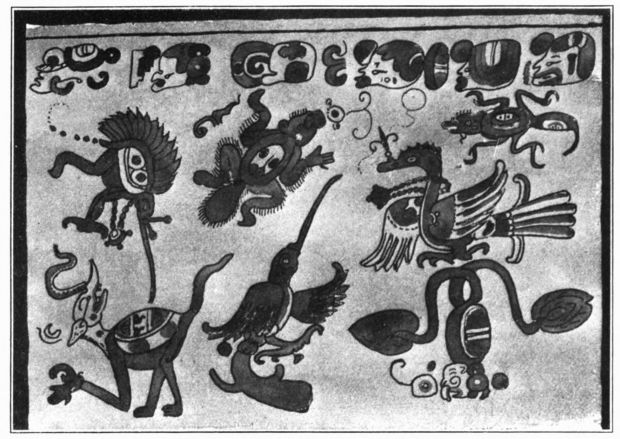
a. DECORATION ON VASE SHOWN IN FIGURE
60
b. DECORATION OF VESSEL FROM MOUND NO. 17
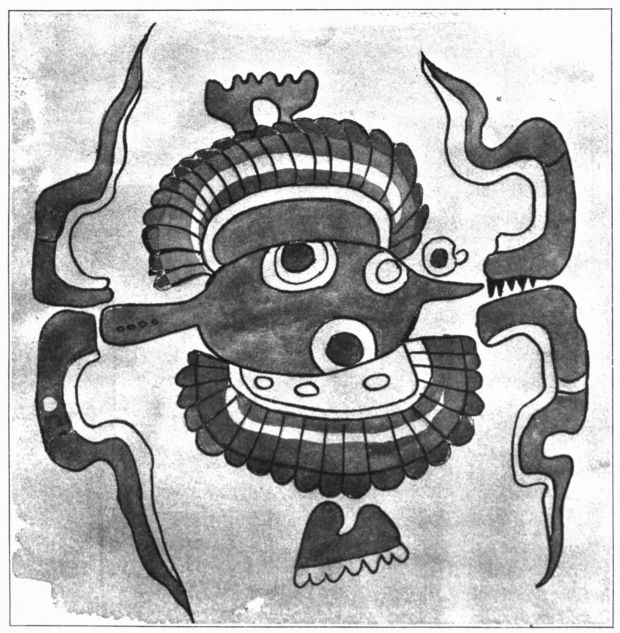
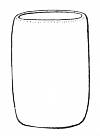
Fig. 61.—Larger pottery vase found in Mound No. 17.
Above these is a bird, possibly a sea hawk. The whole connotes water, or fertility. (b) A second vase, similar in shape, but somewhat larger (fig. 61), is painted yellow and polished throughout. Upon this is depicted a cruciform object, with outgrowths from the upper and lateral limbs of the cross, probably a highly conventionalized tree. (c) A shallow circular plaque, 36 cm. in diameter, painted light yellow, and polished throughout. Upon its upper surface is painted, in red and black, a coiled plumed serpent (fig. 62), doubtless intended to represent Cuculcan, the "Feathered Serpent." (d) Two circular objects of polished greenstone, somewhat resembling broad-brimmed hats from which the crowns have been removed (see fig. 57, b). Each has on the upper surface of the brim a small ovate piece of mother-of-pearl, firmly cemented to the stone. These objects were probably used as ear plugs; with them were five small perforated spherical beads of polished greenstone.
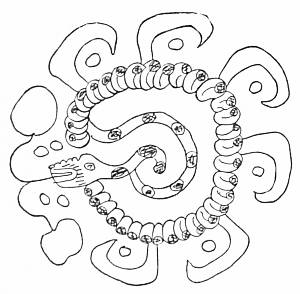
Fig. 62.—Coiled plumed serpent painted on plaque found in Mound No. 17.
At the base of the northern aspect of this mound was a small square enclosure, surrounded by a stone wall 2 to 3 feet in height. On digging into this, near its center, an alligator made of rough pottery, 15 inches long, was discovered. In the center of its back is a small circular opening, covered by a conical stopper, leading into the hollow interior, in which was found a small perforated polished jadeite bead, in the form of a grotesque human face. Close to the alligator lay a basin-shaped vessel, 28 cm. in diameter, painted yellow, and polished throughout. In the center of this, outlined in thin black lines, is the object seen in plate 19, b, probably meant to represent the two-headed dragon so common in Maya art.
Mound No. 18
Mound No. 18, situated less than half a mile from the next preceding, was 10 feet high, 70 feet in circumference, roughly conical in shape, and firmly built throughout of blocks of limestone the interstices between which were filled with earth and limestone dust. At the bottom of the mound, near its center, resting on the ground, was a cist, about 2 feet in diameter, roughly constructed of large flags of limestone. Within this were found two vessels: (a) A basin-shaped specimen of thin pottery, painted reddish-yellow and polished throughout; on its inner surface is depicted, in fine black lines, an object closely resembling a four-leafed shamrock. (b) A vase of the shape shown in figure 63, 13 cm. high and 13 cm. in diameter. This is made of rather thick pottery; it is painted light yellow and polished throughout. On the outer surface of the rim, outlined in thin black lines, is the glyph represented in figure 64, which is repeated all the way round the circumference. No additional objects were found in this cyst, nor were there any traces of bones in it, or in the rest of the mound, which was afterward examined.
Mound No. 19
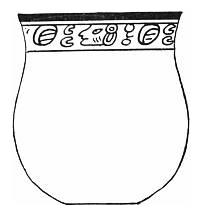
Fig. 63.—Pottery vase found in Mound No. 18.
Mound No. 19, situated close to the preceding, was 6 feet in height, with flattened top, built solidly throughout of limestone blocks and a friable mortarlike substance. At the ground level, near the center of the mound, were discovered two cists, placed side by side, separated by a partition wall built of blocks of cut stone. Each cist was 6 feet long, 3 feet broad, nearly 4 feet deep, solidly constructed of stones mortared together. Neither the cists nor the body of the mound contained anything of interest except a few fragments of bone in the last stages of disintegration.
Mound No. 20
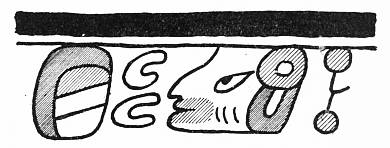
Fig. 64.—Glyph outlined on outer surface of rim of vase shown in fig. 63.
Mound No. 20 was situated at Pueblo Nuevo, about 6 miles from the mouth of the Rio Nuevo, in the northern district of British Honduras. The mound was about 100 feet in length and varied from 8 to 12 feet in height and from 15 to 25 feet in breadth. It was built throughout of earth, limestone dust, and blocks of limestone, a great many of which had been squared. Immediately beneath the surface, running east and west along the long diameter of the mound and nearly centrally placed in it, was the upper surface of a wall, which had evidently at one time formed part of a building of considerable size. This wall was built of finely squared blocks of limestone mortared together, and was somewhat more than 18 inches thick. It extended for 40 feet, turning at right angles at both the eastern and western extremities and was broken by a single opening, 31/2 feet broad at the center. The part of the wall left standing varied from 2 to 31/2 feet in height and was covered on its inner surface by a layer of smooth, yellow, very hard cement; the outer surface, which still retained traces of painted stucco moldings, ended below in a floor of hard cement 12 inches thick. The greater part of these moldings had been broken away, but portions were still adherent to the wall and great quantities of fragments, painted red and blue, were found immediately beneath the wall from which they had been broken. The most important of these were:
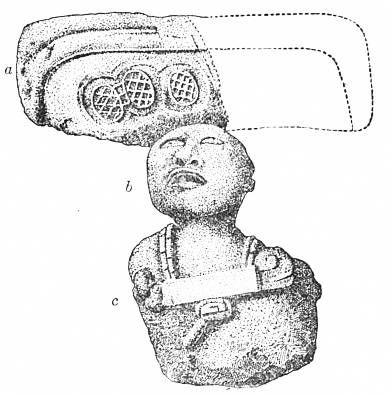
Fig. 65.—Torso, head, and headdress from Mound No. 20.
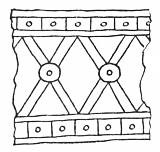
Fig. 66.—Fragment of pillar found in Mound No. 20.
(a) Two human torsos, one (the more elaborate) of which is seen in figure 65, c. (b) Three human heads, one of which is represented in figure 65, b, in situ. Both heads and torsos are life size, and both are painted red and blue throughout.[46] (c) Two headdresses, one of which is seen in situ in figure 65, a; the other is almost precisely similar in coloring and design. (d) Fragments of elaborately molded pillars, which had originally separated the figures on the wall. A portion of one of these is shown in figure 66. This design was repeated three times upon the front of the pillar, the back of which was flattened for attachment to the wall. Great quantities of fragments of painted stucco, of all shapes and sizes, were dug out of the mound, but the human figures, with the pillars which separated them, were the only objects the original positions of which on the wall it was possible to determine with certainty. Resting upon the layer of hard cement in which the wall terminated below, between 5 and 6 feet from the eastern end and close to the wall itself, was found an adult human skeleton, the bones of which were huddled together within a very small compass, in a manner suggesting secondary burial. In removing these bones nearly all of them crumbled to pieces. Throughout the whole mound were found numerous potsherds, some of very fine pottery, colored and polished; others thick, rough, and undecorated. Fragments of flint and obsidian, broken flint spearheads and scrapers, and broken obsidian knives were also found.
Mound No. 21
Mound No. 21 was situated near Corozal, in the northern district of British Honduras. This mound had very steep sides; it was 50 foot in height by 200 feet in circumference, and was built of blocks of limestone, the interstices of which were filled with friable mortar. Toward the west the mound joined a smaller mound, 20 feet in height. A rumor was current among the Indians in the neighborhood that some years before a number of fragments of clay idols had been found lying on the surface of the earth near the mound. Excavations were consequently made all around the mound, for a distance of 10 to 15 yards from its base, through the alluvial soil, down to the limestone rock, a distance of 6 inches to 2 feet. These excavations brought to light enormous quantities of fragments of crude, coarse pottery vessels, for the greater part the remains of large hourglass-shaped incense burners, which had been decorated on their outer surfaces with either a human head or an entire human figure. Among these fragments were animal heads in terra cotta, the snake and the dragon being of most frequent occurrence, but the deer, alligator, and tiger also being represented. Heads of the owl, the wild turkey, and the humming bird likewise were found. Fragments of about a dozen human faces were brought to light, with the usual nose ornaments, large round earrings, and labrets. Quilted cotton, stud decorated breastplates, sandaled feet, and bracelet-decorated hands and arms were also plentiful. The right arm seems in most cases to have been extended, holding in the upward turned palm some object as a gift or offering. These objects vary considerably; three are undoubtedly wild turkeys, with their long necks coiled around their bodies; two are palm-leaf fans attached to handles; one appears to be a shallow saucer containing three small cakes; while two are pyramidal, spike-covered objects, possibly meant to represent the fruit of the pitaya cactus. With these fragments of pottery were found four entire oval pottery vases, each about 4 inches high, standing on three short legs, each containing a few clay and polished greenstone beads. Close to these was a pair of vases, shaped like a right and left foot and leg, of the size approximately of those of a child 7 or 8 years of age, greatly expanded above the ankle. These vases showed traces of white and blue paint, which had, however, almost completely worn off; around them were a considerable number of fragments of the bones of deer and peccary, very much decayed. Close to the base of the mound was found an oval block of limestone, which formed the nucleus of a small hill, 2 to 3 feet high and 5 to 6 feet in diameter, composed almost entirely of pottery fragments, with a capping of humus. It is not improbable that this was the spot on which the ceremonial destruction of these incense burners took place, the fragments being scattered in all directions around the entire circumference of the large mound.
Mound No. 22
Mound No. 22, situated at Saltillo, near the mouth of the Rio Nuevo, northern district of British Honduras, was partially explored in 1908-9 on behalf of the Institute of Archæology of Liverpool University. The mound was about 30 feet high; it was built of limestone blocks, limestone dust, and rubble. It stands at one corner of a quadrangular space measuring 80 by 35 yards, and elevated from 4 to 5 feet above the surrounding ground level. This space is encompassed by four mounds, joined by a bank or rampart averaging 10 feet high. Around the base of the mound a great number of fragments of pottery incense burners were found, with the images of the gods, which decorated them externally. Eight complete heads and two broken ones were recovered, together with arms, legs, bodies with quilted cotton breastplates and maxtlis, elaborate headdresses, and various objects held in the hands of the figures. These vessels are almost exactly similar to those found along the valley of the Usumasintla and Rio de la Pasion, described by Seler in his "Antiquities of Guatemala." Rude specimens, with the face of the god only decorating the outside of the vessel, were found by Sapper and Charnay in use among the Lacandon Indians a few years ago. The dress and ornaments of these clay figurines, which vary from 1 to 2 feet in height, are those found almost universally throughout the Maya area. The large circular ear ornaments, with a tassel or twisted pendant hanging from the center, the curious projecting curved ornament above the nose, the small button-like labrets at each corner of the mouth, are present in all, and are highly characteristic. On all the feet elaborate sandals are worn, fastened by thongs attached between the first and second and third and fourth toes, with a band passing around the ankle ending in a broad dependent flap. Around the legs are plain bands and strings of beads; around the wrists, strings of beads, in some cases fastened by an ornamental loop. The breastplates are of quilted cotton, some very elaborate, and decorated with beads, studs, and tassels, while below the breastplate covering the genitals is the maxtli, or small apron, commonly worn by both Maya and Aztec. The objects held in the hands consist of birds, fans, globes, incense burners, and other less easily distinguishable articles. The whole of the space within the earthwork appears to have been sprinkled with these fragments of pottery vases and idols, but it was only around the base of the large mound that entire heads were found. The fragments seem to have been originally placed on the earth, and in course of time to have been covered by a thin layer of humus from decaying vegetation, as many of them still lie on the surface, and nowhere are they buried more than a few inches, except at the base of the mound, where earth from its side, washed down by rains, would naturally have covered them with a slightly deeper layer. On making excavations at various points within the enclosed space, the floor was found to consist first of the earth which contained the broken incense burners, with some blocks of limestone, and beneath this of a layer about 4 feet thick composed of marl dust, very small fragments of pottery, and rubble, welded together into an almost cement-like mass.
Mound No. 23
Mound No. 23 was situated near the northern end of Chetumal Bay, on the east coast of Yucatan. The mound was 12 feet in height, roughly circular in shape, and 12 yards in diameter at the base. The top was flattened, and near its center a circular space 10 feet in diameter was inclosed by a low, roughly built stone wall. On digging within this space there were brought to light, immediately beneath the surface, the following objects:
(a) Part of a large hourglass-shaped incense burner in rough pottery, decorated with a human figure in high relief, 20 inches high. Unfortunately the left arm and leg and part of the chest are missing from this figure, which, judging by the headdress, curved nose, and tusk-like teeth, is probably intended to represent the God Cuculcan. The left foot is sandaled, and on the left wrist is a loop-fastened string of beads, while over the front of the chest hangs a breastplate of quilted cotton, decorated with flaps and fastened over the shoulders.[47] Round the neck is a flat gorget, decorated with round bosses, and in the ears are large circular ear plugs with tassels dependent from their centers. Over the upper part of the nose is a curious curved, snake-like ornament. The lofty headdress, with broad flaps extending over each ear almost to the shoulders, has in front the head and upper jaw of some mythological animal, the latter projecting well over the face of the god, as if in the act of swallowing him. Pointing downward from the plumed ornament on the right side of the figure (the corresponding one on the left has been broken away) is a crotalus head, which so often accompanies representations of this god. The figure still exhibits traces of blue and white paint on that part of the face protected by the broad flap of the headdress, and originally doubtless the whole was painted in various colors, which first exposure to rain and afterward burial in moist earth, have almost completely obliterated. (b) An earthenware figure, 26 inches in height, which doubtless at one time ornamented the outer surface of a large incense burner. The left foot and leg are gone; the right foot is covered with a sandal held on by a curved heelpiece rising above the back of the ankle, and fastened in a bow in front of the instep, while a leather thong passing between the great and second toe is attached to this, holding the front part of the sandal in place. Round the leg is a broad band, with a row of semilunar ornaments projecting downward from it. The maxtli has been broken away, but the quilted cotton chest covering is still in position. This is held in place by bands passing over the shoulders, and is ornamented by a row of five circular studs passing down its center, with long tassels below, which must have hung on each side of the maxtli, and tassels above, attached near the shoulder, which hang down on each side of it. The throat is covered by a broad band, decorated along its lower edge with four pairs of small circular studs. Round the left wrist is a bracelet composed of six flat oval beads, fastened in front by an ornamental loop. The left arm is extended, and in the hand, held palm upward, is grasped an acorn-shaped object from which project nine spikes. From each side of the mouth project long curved tusks. The nose is of unusual shape, being long, straight, and slender; the bridge is covered by a curved snake-like object. The headdress rises 6 inches above the superciliary ridges; its lower part consists of the head and upper mandible of the bill of some bird, probably a hawk or eagle. Above this rises a hollow cylindrical erection, with the upper border scalloped, supported on each side by objects which suggest broad stone blades, hafted in club-shaped handles, and ornamented in front with a plume of feathers. There can be little doubt that this figure is meant to represent the God Itzamna, as the sunken cheeks, the single large tooth on each side of the mouth, and the prominent, though well-formed nose, are all characteristics of this god. (c) An earthenware figure, closely similar in size and appearance to those just described. Of the face only the left eye, the left side of the mouth, and the nose are left; the last named is short, rounded, and well formed, and is ornamented at its root with a small round stud. (d) Fragments of a rough bowl of yellowish pottery, which must have been of considerable size. Unfortunately only four fragments were found; these exhibit on their outer surfaces parts of a hieroglyphic inscription, roughly incised in the clay while it was soft, with some sharp-pointed instrument. Of the many glyphic inscriptions which have been found at different times in British Honduras, painted on pottery and stucco and incised on pottery, stone, and other material, none has proved to be an initial series, which would fix the period in the Maya long count when the mounds, temples, burial places, and other monuments scattered throughout this colony, were constructed. According to recent researches the latest date recorded by an initial series on the monoliths of Quirigua, in Guatemala, is within about 70 years of the earliest date recorded by any of the initial series found up to the present among the ruins of Yucatan.[48] As the tide of Maya migration was undoubtedly from south to north, and as British Honduras stands midway between Guatemala and Yucatan, it is only reasonable to suppose that the colonization of the greater part of it by the Maya took place at some period between the abandonment of the cities of Quirigua and Coban, and the rise of Chichen Itza, Uxmal, and other Yucatan cities. This theory is borne out by the fact that the hieroglyphic inscriptions and pictographs found in the colony are closely allied to those found both in the northern and southern cities; moreover, the painted stucco and wooden lintels so common in Yucatan, but not found in the south, are present here, while the sculptured stelæ found in the south, but of extreme rarity in northern Yucatan, are (though not very numerous and poorly executed) found in British Honduras. (e) Large quantities of fragments of rough pottery vases and bowls; some of these evidently belonged to hourglass-shaped incense burners, 2 to 3 feet high, decorated with incised lines and glyphs, raised bands, and studs, but without human figures on their exterior surfaces. A number of these fragments were taken down to the camp of some chicle bleeders in the vicinity; unfortunately in the night the palm-leaf shelters caught fire and the whole camp was burned to the ground, most of the potsherds being lost or destroyed. Among these were probably the missing parts of the clay figures and of the hieroglyphic-covered pot. The whole of the mound was dug down, but with the exception of traces of a wall built of squared stones on the ground level, nothing worthy of note was found in it. It is almost certain that this mound had never been visited from the time of its erection till its discovery last year by chicle bleeders looking for sapodilla trees in this very remote corner of Yucatan. The clay images were lying on the top of the mound, partially uncovered, and had anyone, even an Indian, visited the place, they would almost certainly have removed these, as there is always a ready market for ídolos, as the Indians call every relic of their ancestors, among curio collectors who visit Belize.
BUREAU OF AMERICAN ETHNOLOGY BULLETIN 64 PLATE 20.
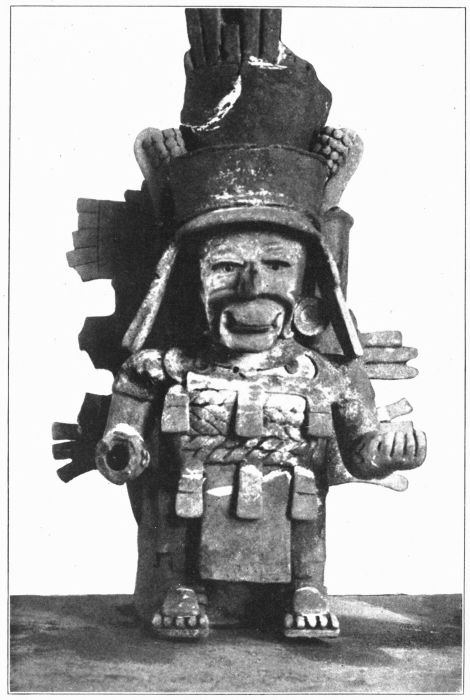
INCENSE BURNER FROM MOUND NO. 24
Mound No. 24
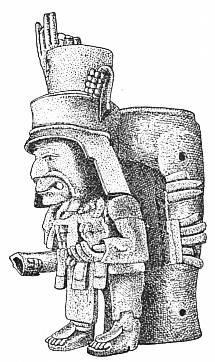
Fig. 67.—Another view of incense burner shown in plate 20.
Mound No. 24 was situated near the coast, at the northern extremity of Chetumal Bay, in Yucatan. This mound was 10 feet high by about 10 yards in diameter. Upon the summit, which was flattened, were found a great number of rough potsherds, partially buried in a layer of humus from 6 to 12 inches deep. These were evidently fragments of incense burners, as arms, legs, and parts of headdresses, faces, maxtlis, and breastplates were plentiful among them. Near the center of the summit, partially projecting from the earth, was discovered the almost complete incense burner shown in plate 20 and figure 67. The vessel which served as a receptacle for the incense is 151/2 inches high by 9 inches in diameter at the mouth. The human figure which decorates the side of the vessel is 22 inches in height from the top of the headdress to the sole of the sandals. The figurine was not complete when first discovered, as the hands, arms, foot, maxtli, and feather ornaments from the sides and headdress were missing; nearly all of these, however, were unearthed, mixed with other pieces of pottery, not far from the incense burner. The headdress consists of a flat, broad cap with slightly projecting rim and large quadrangular flaps, which extend downward and outward over the large ear plugs. The back of the cap extends upward 3 inches; the crown is decorated with feather ornaments, while on each side appears an object resembling half an ear of maize, from the top of which depends a tassel. The nose is sharp, thin, and prominent; starting on each side of it and passing down almost to the angles of the jaw, where it ends in a little upward curl, is what might be intended as either a mustache or some form of nose ornament. From each angle of the mouth projects a circular labret; this evidently passes behind the upper lip, which it causes to bulge considerably. The ear plugs are large, round, and funnel-shaped (pl. 20); these, as well as the shoulders, show traces of blue paint, with which the entire figure was evidently at one time covered. Around the neck is a flat collar decorated with five circular studs, to the sides and front of which is attached a hollow cylindrical bar, which supports the quilted cotton breastplate. The latter is decorated with six tassels, three above and three below, and below it is seen the plain apron (maxtli), which descends almost to the sandals. The shoulders are covered with caps or epaulets reaching just below the armpits; on the forearms are bracelets, fastened with loops on the inner side, and on the feet sandals, held in place by vertical heelpieces and thongs, and decorated with large flaps, which almost cover the dorsum of each foot. Attached to the incense burner, and forming a background for the figure, are projecting feather ornaments extending from the headdress to the elbow.
The mound was dug away to the ground level. It was found to be built of blocks of limestone and earth, but nothing of moment was found in it with the exception of numerous potsherds of all kinds.
Mound No. 25
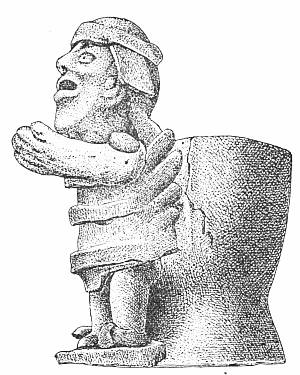
Fig. 68.—Incense burner decorated with crude clay figurine from Mound No. 25.
Mound No. 25 was situated in the country of the Icaichè Indians, Quintana Roo, Yucatan. The mound was discovered by the Indians when cutting down virgin bush to make a milpa, or corn plantation. It was a moderate-sized mound, about 10 feet high, and upon its summit, uncovered, lay the objects illustrated in figures 68, 69, and 70. Figure 68 exhibits a roughly formed clay figurine, nearly 1 foot in height, decorating a small hourglass-shaped incense burner. Both figure and vase are very crudely modeled in rough pottery; most of the prominent characteristics of the carefully modeled and elaborately decorated incense burner represented in plate 20 and figure 67 are still retained. The large round ear plugs, with long flaps from the headdress overlapping them, the horizontally striated breastplate, and even a rudimentary maxtli, together with the extended position of the arms, as if in the act of making an offering, and the background of featherwork are features which may be recognized. There is exhibited, however, a lamentable decadence from the art which fabricated the more elaborate vase. In figure 69 may be seen what probably represents a further stage of degeneration—namely, the substitution of the head for the entire figure on the outside of the incense burner. The last stage of all in the decadence of this branch of Maya art is to be seen in the small crude bowls found by Sapper in the great Christa of the settlement of Izan, and by Charnay in the ruins of Menche Tinamit.[49]
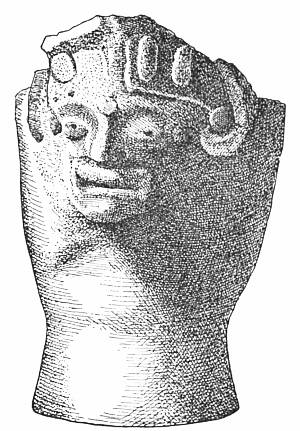
Fig. 69.—Crude clay figurine found in Mound No. 25.
These bowls, each decorated with a roughly modeled human face, are manufactured by the modern Indians and used by them in burning copal gum in the ruins of the temples erected by their ancestors. Figure 70 shows a life-sized hollow head, in rough pottery, with a thin hollow neck, probably used to carry around in processions on the top of a long pole. There can be no doubt that these bowls and hourglass-shaped vessels, each decorated externally with a human figure or face, usually that of a god, were used as incense burners, since a number of them, as already stated, were found in a mound at Santa Rita with half burnt out incense still contained in them. Moreover, their use for this purpose persists to the present day among the Lacandones[50] and even among the Santa Cruz Indians. These incense burners occur most frequently in the central part of the Maya area and are not common in northern Yucatan or southern Guatemala. Three distinct types are found: The first include the large, well-modeled specimens found in and around burial mounds, decorated with the complete figure of the god (usually Cuculcan or Itzamna), having every detail in clothing and ornament carefully executed in high relief. These are all probably pre-Columbian, and such as have been found seem to have been used only as ceremonial mortuary incense burners, to be broken into fragments (which were scattered through or over the burial mound) immediately after use.
The specimen shown in plate 20 and figure 67 is a typical example of this class.
Incense burners of the second type are smaller, cruder, and probably later in date than those of the first type. Some of these are decorated with the entire figure, but more of them with the face only of the god.
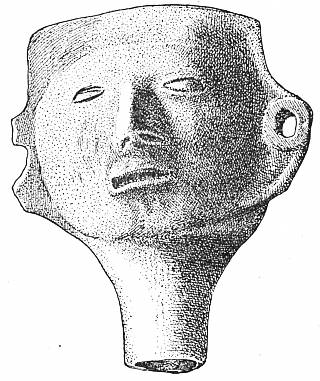
Fig. 70.—Crude clay figurine found in Mound No. 25.
Villagutierre tells us that the Indians of this region as late as the end of the seventeenth century still practiced to some extent the rites of their ancient religion;[51] and in the voyages which he describes up the Rio Hondo, and to Tipu, the Spaniards must frequently have come in contact with the ancestors of the present Santa Cruz and Icaichè Indians, from whose territory the specimens shown in figures 68 and 69, typical examples of this class, were taken. During the early years of the Spanish occupancy it is probable that the Indians, even in this remote and little visited region, living in a constant state of semiwarfare and rebellion, robbed, enslaved, driven from their villages, with little time to cultivate their milpas, gradually lost their ancient traditions and arts, and, long neglecting, ultimately almost entirely forgot, the elaborate ritual connected with their former religion. Such a decadence may be observed in comparing the incense burners illustrated in plate 20 and figure 68. The very marked facial characteristics of the former have given place to the crudely modeled, vacuous face of the latter, resembling the work of a child; while the elaborate dress and ornament, each minutest part of which probably had a special significance and symbolism, though retaining to some extent the form of their main constituents—the headdress, breastplate, maxtli, and sandals—have almost completely lost the wealth of detail which gave them significance.
Incense burners of the third type are decorated with a very crude representation of the face only of the god, consisting in some cases merely of slits for the eyes and mouth, with a conical projection for the nose, on the outer surface of the vessel. Some of the faces are represented conventionally by two ears, with ear plugs, one on each side of the vessel, or by knobs of clay on its outer edge, which represent the hair. Lastly, the incense burner, which may be recognized by its hourglass shape, may be quite plain and undecorated.
The third type is probably the latest in point of time;[52] this includes the crude face-decorated bowls still used by the modern Lacandones,[53] among whom the ritual, as is so frequently the case, seems to have survived almost in its entirety the faith which gave birth to it. This is the more readily comprehensible when we remember that the manufacture and use of these ceremonial incense burners was practiced commonly by all classes of the people, not having been restricted, like most other details of the Maya ritual, solely to the priests.
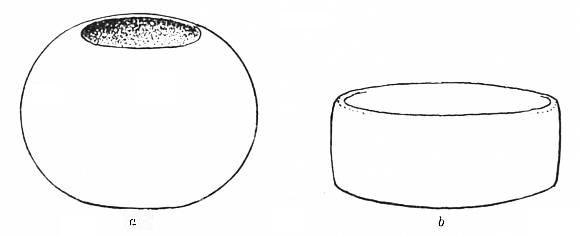
Fig. 71.—Small pottery vases found in Mound No. 26.
Mound No. 26
Mound No. 26 was situated in a clearing about 7 miles to the south of Corozal, in the northern part of British Honduras. There were about 20 mounds, irregularly grouped, in this clearing, varying from 6 to 12 feet in height and from 50 to 120 feet in circumference. The mound was 8 feet high by 80 feet in circumference. It was built of rough blocks of limestone, limestone dust, and earth, tightly packed together, forming a tough, resistant mass. The mound was completely removed to the ground level, but nothing of interest except chips of flint, fragments of obsidian knives, and potsherds was found till the ground level was reached. Lying upon this, near the center of the mound, were found the two small vases represented in figure 71, a, b. Each is about 6 inches in diameter; the one marked a is of polished red pottery, nearly globular in shape; b is of dark chocolate-colored pottery, also finely polished. There was a space of about 4 feet between the two vessels, in which were found fragments of human bones.
Mound No. 27
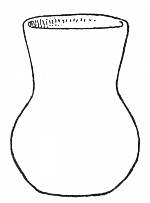
Fig. 72.—Red pottery vase found in Mound No. 27.
Mound No. 27 was situated within 100 yards of the next preceding, compared with which it was slightly smaller. It was built of blocks of limestone, limestone dust, and earth. No remains were found in the mound till the ground level was reached. Resting on this, about the center of the mound, lay a small vase (fig. 72), 8 inches in height, of rough red pottery. Close to this were a few fragments of human bones and some teeth. This mound contained nothing else of interest.
Mound No. 28
Mound No. 28 was situated close to Nos. 26 and 27, and was built of similar material. It was 6 feet high by 120 feet in circumference. On the ground level about the center of the mound lay a circular, flat-bottomed bowl 8 inches in diameter, painted a dark chocolate color and polished. A hole had been bored in its bottom and the bowl itself was broken into three pieces. With it was an irregularly shaped piece of flint about 5 inches in length, into which nearly 20 circular holes had been bored. It would appear that this piece of flint had been used to test the merits of various boring implements, as some of the holes were shallow depressions, while others were half an inch deep. Most of them were mere circular depressions of varying diameters, with a smooth flat bottom, and had evidently been made with a solid cylindrical borer, others, however, had a solid core projecting from their bottom, and appeared to have been bored with a hollow cylinder; while a third variety had a small indentation at the summit of this central core. No further excavation was done in this group of mounds, as they all appeared to be sepulchral, belonging to persons of the poorer class, hence it was considered very improbable that objects of interest would be found in them.
BUREAU OF AMERICAN ETHNOLOGY BULLETIN 64 PLATE 21.
a. SMALL VASE DECORATED WITH HUMAN HEAD
b. HUMAN BONES FROM MOUND NO. 29
Mound No. 29
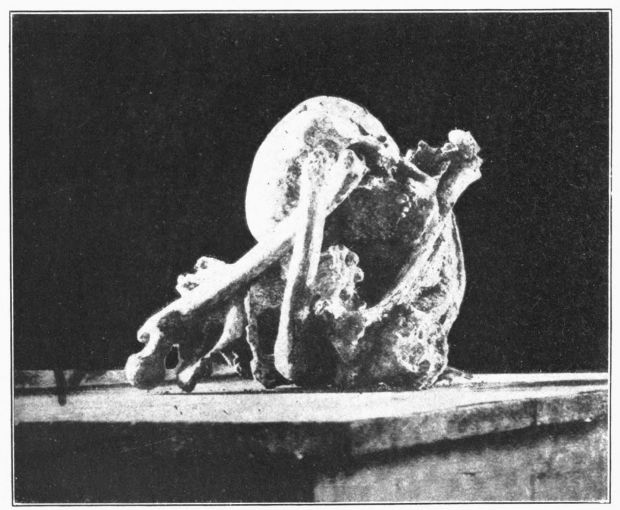
Mound No. 29, situated close to the seashore, near Corozal, was of unusual construction, being built throughout of marl dust. It was a low, flat mound, 2 feet in height by 25 feet in diameter. Nothing of human origin was found in it with the exception of a few rough potsherds. On reaching the ground level two circular well-like holes, 2 feet in diameter, were discovered, about 15 feet apart. At the top both openings were covered with large blocks of limestone, on removing which it was found that each hole was filled with marl dust, enclosing in both cases a single male human skeleton. The knees had been forcibly flexed on the thighs, and the thighs on the pelvis, while the back had been bent till the head, which rested on the folded arms, almost touched the symphysis pubis. Evidently the body had been doubled up at the time of burial, so as to fit tightly into the cavity, and had been further compressed by ramming down large stones on top of the marl dust with which it was surrounded.[54] The bones in one of the graves were in an excellent state of preservation, as may be seen from plate 21, b; they are those of a young adult male, probably somewhat more than 5 feet in height, of poor muscular development. The teeth are excellent; the skull is decidedly brachicephalic, the measurements being: Length, 15.4 cm.; breadth, 17.5 cm.; circumference, 52 cm.; cephalic index, 113. Beneath this skeleton were found an unfinished flint arrowhead, four fragments of small obsidian knives, and the broken fragments of a small, round, unpolished chocolate-colored bowl.
The bones in the other cist, though placed apparently under precisely the same conditions as the one first opened, were found to be so friable that they crumbled into fragments when an effort was made to remove them. Beneath them were found only fragments of obsidian knives.
Mound No. 30
Mound No. 30, situated close to Corozal, was completely dug down, and was found to contain multiple burials. The mound was 8 feet in height, roughly circular, and 40 feet in diameter. It was capped by a layer of reddish-brown earth, 6 inches to 1 foot in thickness, beneath which were alternate layers of soft cement, each about 1 foot thick, and of small limestone rubble about 2 feet thick. Scattered over the surface of the mound, just beneath the earth capping, were found a number of fragments of clay figurines. The best preserved of these were three human faces, an arm with the hand holding a small bird, a bird's head, an alligator's head, and a plaited cotton breastplate. At depths varying from 2 to 3 feet, six interments were found; of these only a few fragments of the skull and long bones remained, not enough to determine even the position in which the corpse had been placed at burial. With the bones, in some cases close to them, in others at some little distance, the following objects were discovered: One rubbing stone (for grinding corn), 2 pear-shaped flints, 9 flint hammerstones, 1 ax head, 1 flint scraper, 1 broken hone of slate, 1 flint spearhead, 2 fossil shells, 2 pieces of brick-like pottery, 1 pottery disk, 3 small beads, and 1 shell.
On reaching the ground level of hard compact earth, it was found that an oblong trench had been cut through the latter down to the limestone rock beneath, 3 feet in breadth, and varying from 2 to 4 feet in depth; this trench had been filled in with small rubble. In its inner wall, at the north side of the quadrangle, three interments had been made by scooping out small cists in the earth, depositing the remains therein, and filling in with limestone dust and rubble. With one of these burials was found a small three-legged pot, of rough, unpolished pottery; with another, a vessel in the form of a quadruped, 7 inches in length, the identity of which is difficult to determine; and with the third a small saucer-shaped vessel of red ware, and a nearly spherical vessel of dark polished red ware. Within the latter were discovered a few small animal bones, some freshwater snail shells (as are found at the present day in the neighboring swamps and eaten by the Indians), and a few bivalve shells. It seems probable that this vessel contained food, either as an offering to the gods or for the use of the deceased in his passage to the next world. It is not uncommon to find considerable accumulations of the shells of conchs, cockles, snails, and other edible shellfish, with the bones and teeth of deer, tiger, gibnut, snake, and (along the seashore) manatee, in British Honduras mounds; but the remains of food offerings contained within a vessel are of rare occurrence.[55]
A number of these large flat mounds containing multiple burials have been from time to time completely dug down near Corozal, in order to obtain stone for repairing the streets. Beneath nearly all of them were found trenches cut through the earth down to the subjacent limestone. These trenches varied from 2 to 5 feet in breadth; in the case of the smaller mounds they formed a parallelogram, a triangle, or even a single straight line; in the larger mounds two parallelograms were joined by parallel trenches (see fig. 23). They were invariably filled with small rubble, and a few of them contained interments in their walls. The purpose of these trenches is difficult to surmise, as they could hardly have served as foundations; drainage was unnecessary; and, while the trenches themselves were never employed for sepulchral purposes, it is only occasionally that a few burials are found within cists excavated in the earth along their margins.
Three kinds of burial seem to have been commonly employed among the ancient inhabitants of this part of the Maya area. The poorest class were buried in large flat mounds, some of them a half an acre in extent and containing as many as 40 to 50 interments. The body was usually buried with the feet drawn under the pelvis, the knees flexed on the abdomen, the arms crossed over the chest, and the face pressed down on the knees; the position, in fact, in which it would occupy the smallest possible space. With the remains are usually found a few objects of the roughest workmanship, as flint hammerstones, scrapers, and spearheads, pottery or shell beads, stone metates and henequen scrapers, small obsidian knives and cores, and unglazed, rough pottery vessels. In the second class of burials, each individual has a mound, varying from 2 to 30 feet in height, to himself. Several mounds of this class have already been described from the neighborhood of Corozal. The objects found with interments of this class are usually more numerous and of better workmanship than those found in the multiple burial mounds, though they do not show much greater variety. The position of the skeleton, where it has been possible to ascertain this, is usually the same as in the multiple burial mounds; occasionally, however, it is found in the prone position, and, in rare instances, buried head down. The third mode of burial was probably reserved for priests, caciques, and other important individuals. The interment took place in a stone cist or chamber, within a large mound, varying from 20 to 50 feet in height. The skeleton is found in the prone position, surrounded by well painted and decorated vases, together with beautiful greenstone, shell, obsidian, and mother-of-pearl beads, gorgets, studs, ear plugs, and other ornaments.[56] Some of these mounds contain two or even three chambers or cists, superimposed one upon the other. The skeleton is then usually found in the top cist, the accompanying objects being placed in the lower ones. In one instance partial cremation seemed to have been practiced, as fragments of half-burned human bones were found in a largo pottery urn.
Mound No. 31
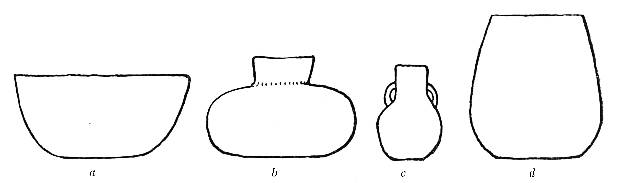
Fig. 73.—Pottery vessels found in Mound No. 31.
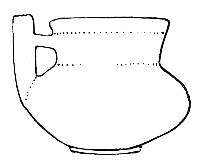
Fig. 74.—Chocolate pot found in Mound No. 31.
Mound No. 31 was situated close to the Rio Nuevo, about 16 miles from its mouth, in the northern part of British Honduras. It was a somewhat flattened mound, 15 feet in height, built of blocks of limestone, limestone dust, and earth. At a depth of 9 feet, the angle of a ruined building, formed by two walls averaging 2 feet high, intersecting at right angles, and built of squared blocks of limestone, was brought to light. The walls enclosed part of a floor of smooth, hard cement. Numbers of blocks of squared stone were found throughout the upper part of the mound, which had evidently at one time formed part of the ruined building. Resting on the cement floor, close to the wall, were found nine pottery vessels, covered with limestone dust. Five of these were of the type shown in figure 73, a, of dark-red, rather coarse pottery, 12 inches in diameter at the rim. One, pictured in figure 74, is the usual Maya chocolate pot, similar to the one already described (see fig. 24, g), except that the spout, instead of bending inward toward the vessel, passes directly upward parallel to its perpendicular axis, an arrangement which must have rendered it far easier to drink from the vessel or pour fluid out of it. The three other vessels found are illustrated in figures 73, b, c, and d; b is of polished chocolate-brown pottery, 3 inches in diameter by 5 inches in height; c is of thick red pottery, 3 inches high, with two small handles for suspension, one on each side; d is of coarse polished red ware, unusually thick and clumsy, 12 inches high by 8 inches in diameter. Each of these vessels contained a single small polished greenstone bead. No other objects were found associated with them, and there was no trace of human bones. Excavations were made in this mound to the ground level without results. The lower part of the mound was built of large blocks of limestone and rubble, held loosely together with friable mortar.
Mound No. 32
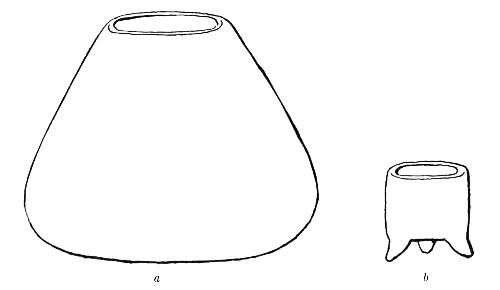
Fig. 75.—Pottery vessels found in Mound No. 32.
Mound No. 32 was situated quite close to No. 31, which it very closely resembled in both size and construction. At a depth of 9 feet the end of a small building constructed of squared blocks of limestone was brought to light. The walls were still standing to a height of 2 to 3 feet, and showed traces of a red stucco covering on their inner surfaces. The cement floor of the building and the platform upon which it stood could also be traced. Lying upon this floor were five pottery vessels and an unfinished flint celt. Two of these vessels were precisely similar to that shown in figure 73, a; one is a large, circular, shallow plaque, of rather thick reddish-brown pottery, in the center of which a small hole has been made, evidently with the object of rendering the plaque useless. The last two vessels are illustrated in figure 75, a, b. A is an unusually large vessel of very coarse, thick, red pottery, 18 inches high, which had probably been used to contain corn or some such dry material, as the pottery was too friable and soft for a cooking pot, or even to hold water. B is a small three-legged vase, 4 inches high, of coarse, unpainted pottery. Each of these five vessels, with the exception of the plaque, contained a single polished greenstone bead. The celt was roughly blocked out of yellowish flint. No objects except those above described were found with these vessels, nor were there any traces of human burial. Excavations were made in the mound to the ground level, and it was found to be composed below the platform upon which the building stood of a solid mass of rubble and limestone held together by loose, friable mortar. There are numerous groups of mounds of all sizes in the neighborhood, and judging by these, and by the potsherds and flint and obsidian chips which one finds strewn over the surface of the soil in great profusion, it must have been a densely populated region at one time. The two life-size human heads shown in figures 76 and 77 were found close to these two mounds in digging a posthole. Figure 76 represents a grotesque head cut from a solid block of crystalline limestone. Figure 77 is a mask, rather crudely cut from greenstone and unpolished. Both were buried in the marl and were unaccompanied by other objects.
Mound No. 33
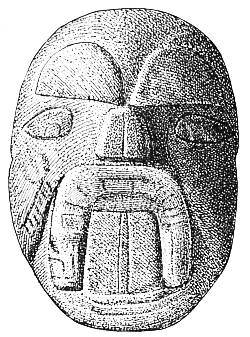
Fig. 76.—Head cut from limestone found in Mound No. 32.
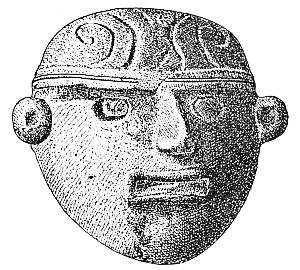
Fig. 77.—Greenstone mask found in Mound No. 32.
Mound No. 33 was situated near Bacalar, in the Province of Quintana Roo, Mexico. It was 6 feet in height by 20 feet in diameter, and was built of blocks of limestone, limestone dust, and earth. Near the summit of this mound, close to the surface, was found the small soapstone lamp illustrated in figure 78, 43/4 inches in length by 13/4 inches in depth. The lamp is decorated in front with a floral design, and at the back by wing or feather-like ornaments, possibly meant to represent the tail and half-folded wings of a bird. It is finely polished throughout but had probably never been used, as in hollowing out the interior the maker had carried one of his strokes too close to the surface, making a small hole, which would have allowed the oil to escape. There is a freedom and lack of conventionality, both in the pleasing and natural floral design and in the flowing lines of the back part of this little lamp, which are totally unlike the cramped and highly conventional style to be observed in similar small objects of ancient Maya manufacture. So widely does it differ from Maya standards that there can be but little doubt that it was introduced in post-Columbian days, probably very soon after the conquest, especially as in the same mound was found one of the small painted clay figurines so common in mounds in this neighborhood, which with the censers probably belonged to the latest period of Maya culture.
BUREAU OF AMERICAN ETHNOLOGY BULLETIN 64 PLATE 22.
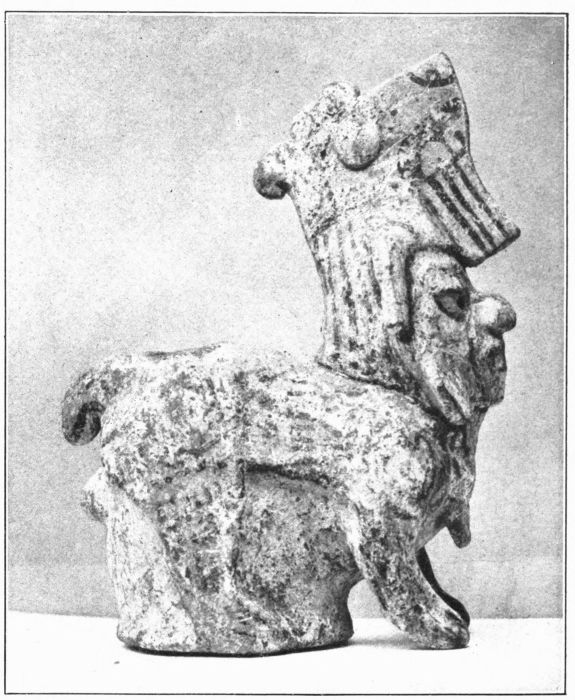
PAINTED CLAY FIGURINE FROM MOUND NO. 33
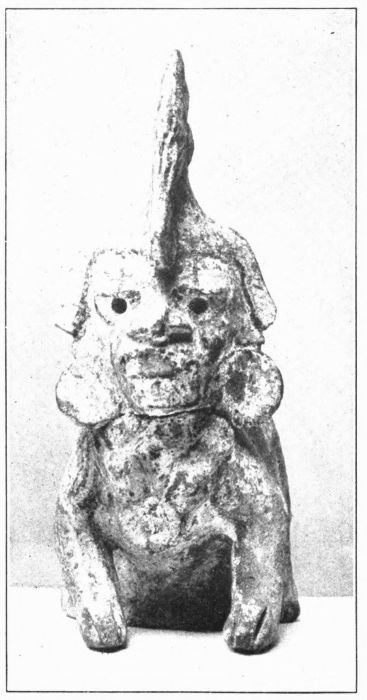
Another explanation which suggests itself is that the lamp was buried in the mound at a much later date (possibly during the troublous times of the Indian rebellions, between 1840 and 1850) by someone who wished to hide it temporarily, and that it had no connection with the original purpose of the mound. No other objects were found in this mound, with the exception of a number of potsherds, till the ground level was reached, where, near the center of the mound, the painted clay figurine shown in plate 22 was uncovered. This represents a deer with a human head, whose headdress is the upper jaw of some mythological animal. The back of the figure, which is hollow, contains a small opening near the tail, covered with a conical plug of clay. Within were two small beads, one of polished red shell, the other of polished greenstone. The whole figurine had been coated with lime wash, over which were painted black lines, dots, and circles.[57] The human face, earrings, gorget, and part of the headdress are painted blue, while the mouth of both the human face and the face in the headdress are painted red. Near the figurine lay a vessel (fig. 79) of rough yellow pottery, unpainted and undecorated, with two small ear-like projections just below the rim. No bones and no trace of human burial were found in the mound.
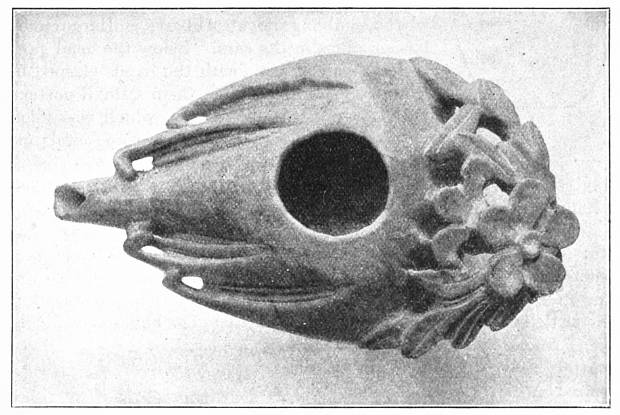
Fig. 78.—Soapstone lamp found in Mound No. 33.
Mound No. 34
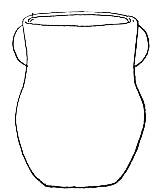
Fig. 79.—Rough pottery vessel found in Mound No. 33.
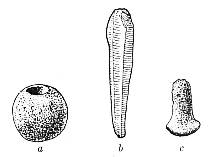
Fig. 80.—Objects found in Mound No. 34.
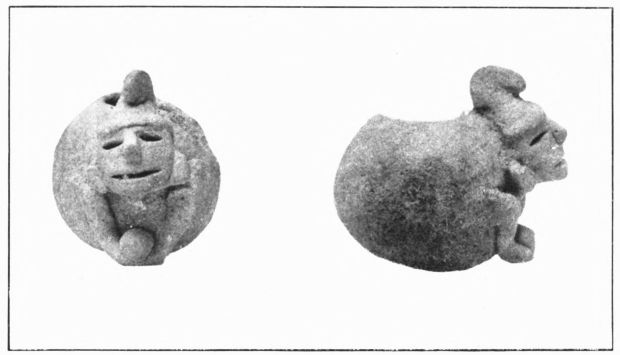
Mound No. 34, situated near Progreso, in the northern district of British Honduras, was 5 feet in height, roughly circular, and about 20 feet in diameter at the base. The mound was built throughout of rough blocks of limestone, rubble, and earth. At the ground level, about the center of the mound, were found large flat unworked flags, which seemed to have formed the roof of a small cist that had caved in. Beneath these were found a few fragments of bone, which crumbled away as they were being removed, with a small spherical vase of rough unpainted pottery, 11/2 inches in diameter (pl. 21, a). This was decorated on the outside with a human head wearing a peaked headdress, somewhat resembling the cap of liberty, and large circular ear plugs in the ears. Below the head projected a pair of arms with the hands clasped in front, supporting between them a small pottery ball. Within this little vase, which was filled with earth and limestone dust, were found: (a) A small earthenware bead (fig. 80, a). (b) A small, very delicate obsidian knife, the tip of which is broken off, but which otherwise shows hardly any signs of use (fig. 80, b). (c) The terminal phalanx of a small and delicate finger, in a very fair state of preservation (fig. 80, c). The burial of a terminal phalanx of one of the fingers of the mother, with a favorite child, is not an unknown custom among semicivilized peoples, and it is possible that this little mound contains such an interment. The bones of the child being fragile and deficient in calcareous matter, may well have almost disappeared, while the finger bone of the mother, being of more compact bony tissue, and protected to some extent by the vase in which it lay, has been preserved. The crudeness of the modeling of the little vase and of the face and arms thereon would suggest that it may have been a plaything of the child during life, and even perhaps may have been modeled by its own hands. The obsidian knife may have been used by the mother to separate the bone at the last finger joint. The little figure which decorates the outside of this vase closely resembles those curious figures in a diving position, with arms pointed downward and feet upward, which are not uncommon in this area. Figure 81 shows one represented on the outside of a small vase; several are to be found, molded in stucco, on the ruined buildings of Tuluum, on the eastern coast of Yucatan, just below the island of Cozumel, and they are occasionally, though rarely, found decorating pottery incense burners, instead of the commoner representations of the Gods Itzamna and Cuculcan. Neither Landa, Villagutierre, nor Cogolludo mention the custom as practiced by Maya mothers or relatives on the deaths of their children. Had it been prevalent at the time of the conquest it seems hardly possible that such a practice could have escaped their notice; on the other hand, if the solitary phalanx had not been buried with the dead as a memorial, its presence under these circumstances is very difficult to explain.
In nearly all extensive groups of mounds one or more middens, or refuse mounds, are to be found. The four mounds next described, though varying much from one another, are all distinctly of this type.
Mound No. 35
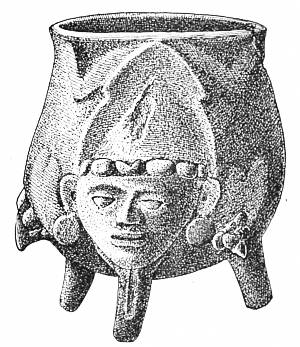
Fig. 81.—Figure in diving position on small vase.
Mound No. 35 was situated near the Cayo, on the Mopan River; it forms one of a group of about 30 mounds scattered over a considerable area. It was 12 feet in height and seemingly had been about 30 feet in diameter, but situated as it was, immediately on the river bank, nearly half of it had been washed away by the floods of successive rainy seasons, leaving a clean section almost through the center of the mound, very favorable for observing its construction. The lowest layer, 1 to 2 inches in thickness, resting on the ground level, was composed of ashes mixed with fragments of charcoal; above this was a layer of earth and stones about 1 foot in thickness, and above this a further layer of ashes; and so on to the top of the mound—strata of ashes averaging 2 inches thick alternating with strata of earth averaging about 1 foot. No objects with the exception of a few potsherds were found in the earth layers, but the layers of ashes were rich in flint and obsidian chips, fragments of conch and snail shells, clay beads and malacates, potsherds in great variety and abundance, with the bones of the deer, gibnut, and peccary. It would seem that this mound had formed a sort of kitchen midden; that when a certain amount of refuse had been deposited it was covered with a layer of earth, and that the mound must have been in use for a considerable time to have reached its present height.
Small mounds containing considerable quantities of ashes and charcoal mixed with earth and stones, together with refuse material, as flint and obsidian chips, broken implements, potsherds, bones, shells, clay beads and malacates, and similar indestructible objects, are not of infrequent occurrence, and probably mark the sites of ancient kitchen middens. Two such mounds were found on the mainland, south of the island of Tamalcab, in Chetumal Bay, Yucatan, situated in what seemingly had been a village site, occupying an area of approximately 20 acres. Great numbers of potsherds, fragments of pottery, images, beads, malacates, chips and broken implements of stone and obsidian, broken metates, fragments of conch and cockle shells, stone water troughs, and other indestructible rubbish were found scattered in great profusion over the whole of this site.
Mound No. 36
Mound No. 36 was situated at Sarteneja, in the northern district of British Honduras, quite close to the seashore. This mound was 2 feet 6 inches in height, about 12 feet in diameter; it was composed throughout of conch shells mingled with cockle and whelklike shells. Nothing except the shells was found in this mound, which forms one of a group of similar mounds, evidently dumping places used by each house, for the disposal of the shells of shellfish brought in from the reef by the fishermen after the fish had been extracted and eaten.
Mound No. 37
Mound No. 37, situated close to the next preceding mound on the seashore, at Sarteneja, is about 2 feet high by 12 to 15 feet in diameter. It is composed almost entirely of fragments of rather rough unpainted pottery and seemingly marks the site of a manufactory of this class of ware, as great quantities of fragments are also to be found scattered in all directions around the mound. A small quantity of earth was mingled with the potsherds, but nothing else was found in the mound.
Mound No. 38
Mound No. 38, situated about 5 miles from Corozal, in the northern district of British Honduras, was 6 feet in height by 15 feet in diameter, with a flattened top. It was covered with a layer of humus and contained nothing but fragments of weathered stone, of sizes varying from small rubble to blocks weighing 30 to 40 pounds. Similar mounds are found elsewhere and are apparently merely heaps of stones, which have been picked up on the surface of the fields, as, unlike other mounds, they contain no clay, limestone, or marl dust, mortar, or other binding material and no trace of burials or any object of human construction.
Mound No. 39
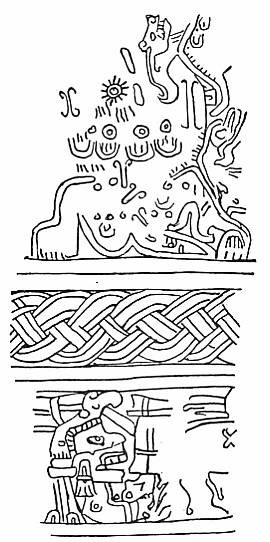
Fig. 82.—Design incised on femur of deer found in Mound No. 39.
Mound No. 39 was situated on Wild Cane Cay, a small island off the southern coast of British Honduras. The island seems to have been built up with stone and other material brought from the mainland and to have been used as a burial place. Several small mounds are scattered over the face of the island; unfortunately most of them had been dug down for the sake of the stone they contained and the objects from the graves lost or given away. Those which could be traced consisted chiefly of copper ornaments, as rings, gorgets, and studs. Mound No. 39, the only one whose contents were ascertained with any degree of accuracy, was a small circular mound 10 feet high, built of sand and blocks of reef stone; near the ground level, about the center of the mound, a single human interment was found, the bones of which were in an advanced state of decay; mingled with these were: (a) A round red earthenware pot, containing a few small circular beads made from conch shell and five or six medium-sized, unused obsidian knives. (b) A second somewhat larger pot, of the same shape and material, which contained the upper part of the femur of a deer, on which is incised the design shown in figure 82. This is neatly executed in shallow lines; the upper part evidently represents a tiger, or the skin of that animal, and is separated by a platted design from the lower, which may be intended as a representation of the God Itzamna. With the bone were two objects of copper, one a finger ring constructed of thin flat bands two-fifths inch apart, joined by double scrolls; this is very much worn, either from use or from oxidization, consequent on long exposure in the damp soil.
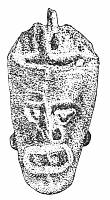
Fig. 83.—Copper object found in Mound No. 39.
The second copper object (fig. 83) was probably used as a gorget, or for attachment to a headdress, as at the back is seen a cruciform grille, evidently intended to hold it in place. This object is in the form of a human face, the lower part with its large mouth, thick prominent lips, and flattened nose, exhibiting marked negroid characteristics, which the upper part with its bulging prominent forehead contradicts. The headdress is ornamented with three spikes passing along the sagittal suture from front to back, while under the chin is a projection probably intended to represent a short beard. The ring and ornament are both strongly suggestive of Spanish influence, as the face with its thick lips, flattened nose, and bulging forehead is totally unlike any type with which the Maya were likely to come in contact, unless, indeed, it were the Carib, who even at this early date had possibly formed small settlements as far north as the southern coast of British Honduras. If the objects were of Spanish origin they were probably obtained from some Spanish settlement farther north, possibly Bakhalal, as there was no settlement between that town and the coast of Guatemala till many years after the conquest. That the cult of Itzamna was still flourishing is shown by the effigy of the god incised on the deer bone, and according to Villagutierre, the Indians of this neighborhood up to the end of the seventeenth century were closely allied to the Itzaex,[58] who still freely practiced their ancient religious rites.
Mound No. 40
Mound No. 40, situated near Pueblo Nuevo, on the Rio Hondo, consisted of a ridge about 10 feet high by 40 feet in length. On the summit of the ridge near its center, covered only by a layer of humus, was found a small rough three-legged vase 3 inches high, containing a single long, polished, greenstone bead. The upper part of the ridge was found to consist of blocks of limestone, limestone dust, and rubble, on removing which to a depth of about 4 feet the ruins of a building were brought to light (fig. 84). The bones were in so poor a state of preservation that it was difficult to determine the exact position in which the body had been placed at the time of burial; it had, however, certainly been fully extended.
Close to the head were found fragments of three round bowls, all precisely similar in both size and coloring. Each was of the shape shown in figure 71, b, 31/2 inches high by 61/2 inches in diameter, and was made of rather fine ash-colored pottery, finely polished. Each of these bowls before burial had the bottom knocked out. The mound beneath the building was composed of blocks of limestone, rubble, and limestone dust, forming a tough, solid, compact mass. This would seem to have been a small private house, not a temple, which (probably on account of the death of its owner) had been deliberately wrecked, and the owner's body buried beneath the cement floor of the one chamber remaining partially intact. Fresh cement seems to have been applied over the grave before the greater part of the house was pulled down and the wreckage piled up, to form a capping to the mound upon which the house stood.
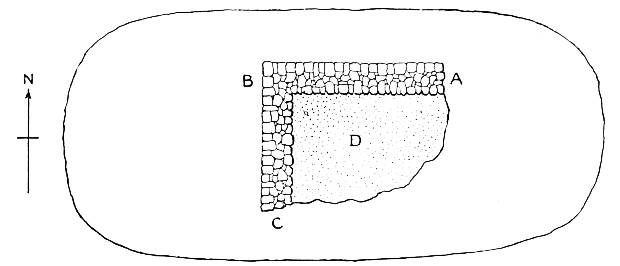
Fig. 84.—Ruins found in Mound No. 40. These consisted of broken-down walls about 2 feet high, joining each other at right angles. Of the wall A-B, 10 feet remained standing; of the wall B-C, 8 feet. The shaded space included between the walls was covered with hard smooth cement, which had been broken away to a rough edge at its outer border and was continuous at its inner border with the stucco which was still partly adherent to the walls. The walls themselves were built of blocks of limestone (squared on their outer surfaces but rough within), rubble, and mortar; they were nearly 2 feet thick. The long diameter of the ridge pointed almost due east and west. An excavation was made in the cement floor, and at the depth of 18 inches, at the point marked D, a single interment was brought to light.
Mound No. 41
Mound No. 41 was situated in the northern district of British Honduras, about 9 miles from Corozal. It consisted of a circular wall or rampart varying from 4 to 10 feet in height, inclosing a space 30 yards in diameter. The wall was built of earth and blocks of limestone, and in places had become considerably flattened out from the action of the heavy tropical rains of this region. To the north an opening or gap existed about 10 yards across. Excavations were made in the encircling wall of the inclosure, and also in the central space, but nothing except fragments of pottery was discovered.
Mounds of this kind are found throughout the area, though not in great numbers. Some of these are circular or horseshoe shaped, some crescentic, and others curved or even straight ridges. As a rule they contain nothing except a few potsherds, which would naturally be picked up with the earth of which most of them are made; in some, however (especially in the straight ridges), superficial interments have been found. These mounds were probably used as fortifications, the circular, horseshoe-shaped, and crescentic mounds being particularly well adapted to this purpose.
At Yalloch, just across the Guatemala boundary line from Choro, a small village in the western district of British Honduras, the Alcalde made a remarkable discovery a few years ago. While hunting for a gibnut he traced one to a hole in the ground; on poking a stick into this hole, he was astonished on withdrawing it to find that he had brought out on its end a small painted pottery cylinder. The hole on being enlarged proved to be the entrance to a chultun, one of those curious underground chambers cut in the limestone rock found throughout Yucatan and the northern part of British Honduras, especially in the neighborhood of ruins. This chultun contained numbers of fragments of very finely painted and decorated pottery vases, together with two complete cylindrical vases, an ovoid vase, and a pottery cylinder without bottom. Some of these were within the chultun, some in a pit sunk in its floor, from which at a later date several pieces of beautifully decorated pottery were taken. The pit had evidently been used as a burial place, in which the memorial pottery was deposited with the body. Merwin found similar painted Maya vases some years later in a chamber covered by a mound, at Holmul, within a few miles of Yalloch, and at Platon, on the Mopan River, a sepulchral chultun was cleared out in which human bones still remained. (Pls. 23-28.)
Near the point where Blue Creek or Rio Azul joins the Rio Hondo, in the northern district of British Honduras, is situated in the bush about 100 yards from the latter river a small circular lagoon, of a deep blue color and considerable depth; from this flows a narrow stream, also deep blue in color and highly impregnated with copper, which opens into the main river just below the mouth of the Rio Azul. The little lake is bounded on its eastern side by an almost perpendicular cliff of limestone, in which are several small caves and one large cave. The interior of one of the smallest of these caverns, situated near the base of the cliff, not more than a few yards in depth, was roughly hewn out so as to form shelves. Upon these were found several hundred small binequins of incense, varying in size from 3 to 4 inches in length by 11/2 to 2 inches in breadth, to 8 to 10 inches in length by 3 to 4 inches in breadth. The incense was composed of the gum of the white acacia mixed with various aromatic substances; when burned it gave off a very pleasant odor. The gum had evidently been poured while in a liquid state into small bags, made of palm leaves, as in some of the binequins considerable fragments of the palm leaves were still adherent to the copal, and in all, casts of the leaves were left on the soft surface of the gum before it solidified. The binequins which the present-day Maya Indians manufacture as receptacles for their homemade lime, though vastly larger, are precisely similar in shape, construction, and appearance to those their ancestors used as receptacles for copal. The entrance to the large cave was near the summit of the cliff and so difficult to reach that it can never have been long used as a place of residence, though it would form an exceedingly strong position to hold against an attack from without, as it is necessary to cross a fallen tree trunk in order to enter, and this might easily be hauled back into the cave or pushed away from its mouth, leaving it practically inaccessible. Nothing was found in the cave except a large quantity of bats' excrement and of rough red potsherds.