THE STORIES OF THE FOURTH DAY
Reading edition
MUSIC BEWITCHED.—ANN CATCHES A THIEF.—JOHN AND MARGARET PATON AMONG SAVAGES.—THE STRANGE GUEST.—ROBERT OF SICILY.—THE MAN WITHOUT A COUNTRY.—YOUR FLAG AND MY FLAG.
THE STORIES OF THE FOURTH DAY
XXVII MUSIC BEWITCHED
WHEN all the Story People were assembled, the Story King in his place, Mary Frances in the blue velvet chair beside the Story Queen, the Ready Writer with pen upraised, the Story Lady began:
“To-day we have six short stories. The first is about a school boy named Bob, and how he conquered his worst enemies.”
* * * * * *
Bob’s Three Foes
Thud! thud! thud! “Hit him in the eye!” “Knock the pipe out of his mouth!” “Ha! ha! there goes his nose! I hit him that time!”
These dreadful sounds seemed to say that some barbarous piece of cruelty was going on; but the victim was only a snow-man, which the boys of Strappington School had set up in their playground. Truth to tell, the snow-man did not like it much, but boys cannot be expected to understand the feelings of a snow-man, so he bore it very patiently, and when one snowball came in each eye, and a third in his mouth, he never spoke a word or flinched a muscle.
But how was the schoolmaster to know that it was only a snow-man? And what was more natural than that he should peep over the playground wall to see what was going on? And how was little Ralph Ruddy to know that the schoolmaster was there? And how was he to know that the snowball which was meant for the snow-man’s pipe would land itself on the schoolmaster’s nose? Oh, the horror that seized upon the school at that dire event! and the dead silence that reigned in that playground! For those were the good old times of long ago when anything that went wrong was set right with a birch rod. Little Ralph Ruddy knew only too well what was coming when the angry schoolmaster ordered him into the schoolroom.
The snow-man, of course, was left in the playground all alone. He saw the boys troop indoors and heard some angry words and some cries of pain and saw poor little Ralph thrust into the cold playground, and heard the door slam behind him, and stared without once turning his head or blinking his eyes, while the little fellow sat on the snowy doorstep, with a knuckle screwed into each eye; and indeed the good snow-man himself felt half inclined to cry, only the tears froze inside before they got out of his eyes. So he couldn’t.
When the bell rang at four o’clock, the boys came out, and among them Bob Hardy, the son of a poor farm laborer.
“A cruel shame I call it,” muttered Bob, “to whip a little chap like that, and then shut him out in the cold. I told him Ralph Ruddy never meant to do it, and then he caned me as well. A real brute I call him, and I’ll pay him out, too. I declare I’ll break his bedroom windows this very night, and let him try how he likes the winter wind!”
And Bob meant to do it, too. He climbed out of the cottage window when all were asleep, and made his way down to the schoolhouse by moonlight, with a pocketfull of stones, and climbed the wall of the playground, and stood there all ready to open fire, when a voice startled him, a sort of shivering whisper.
“Better not, Bob! Better wait a bit!” said the voice.
Bob dropped the stone and looked about, but there was no one near except the snow-man shining weirdly in the pale moonlight. However, the words, whoever spoke them, set Bob a thinking, and instead of breaking the schoolmaster’s windows, he went home again and got into bed.
That was in January, and when January was done February came, as happens in most years. February brought good fortune—at least Bob’s mother said so, for she got a job as charwoman at the squire’s, for which she was well paid.
It did not turn out so very well, though, after all, for the butler said she stole a silver spoon, and told the squire so; and if the butler could have proved what he said, the squire would have sent her to prison; only he could not, so she got off, and Bob’s mother declared that she had no doubt the butler took the spoon himself.
“All right,” said Bob to himself, “I’ll try the strength of my new oaken stick across that butler’s back.”
And he meant it, too, for that very evening he shouldered his cudgel and tramped away to the big house. And when he got there the door stood wide open, so in he walked.
Now there hung in the hall the portrait of a queer old lady in a stiff frill and a long waist, and an old-fashioned hoop petticoat; and when Bob entered the house what should this old lady do but shake her head at him! To be sure there was only a flickering lamp in the entry, and Bob thought at first it must have been the dim light and his own fancy, so he went striding through the hall with his cudgel in his hand.
“Better not, Bob!” said the old lady. “Better wait a bit!”
“Why, they won’t let me do anything!” grumbled Bob; but he went home without thrashing the butler, all the same.
That was in February, you know. Well, when February was done, March came, and with it came greater ill-fortune than ever; for Bob’s father was driving his master’s horse and cart to market, when, what should jump out of the ditch but old Nanny Jones’s donkey, an ugly beast at the best of times, and enough to frighten any horse; but what must the brute do on this occasion but set up a terrific braying, which sent Farmer Thornycroft’s new horse nearly out of his wits, so that he backed the cart and all that was in it—including Bob’s father—into the ditch. A pretty sight they looked there, for the horse was sitting where the driver ought to be, and Bob’s father was seated, much against his wish, in a large basket full of eggs, with his legs sticking out one side and his head the other.
Of course Farmer Thornycroft did not like to lose his eggs—who would?—for even the most obliging hens cannot be persuaded to lay an extra number in order to make up for those that are broken; but for all that Farmer Thornycroft had no right to lay all the blame on Bob’s father, and stop two shillings out of his week’s wage. So Bob’s father protested, and that made Farmer Thornycroft angry, and then, since fire kindles fire, Bob’s father grew angry too, and called the farmer a cruel brute; so the farmer dismissed him, and gave him no wages at all.
We can hardly be surprised that when Bob heard of all this he felt a trifle out of sorts, but the desire for vengeance which he felt could hardly be justified. He went pelting over the fields, and all the way he went he muttered to himself:
“A cruel shame I call it, but I’ll pay him out; I mean to let his sheep out of the pen, and then I will just go and tell him that I’ve done it.”
Now, the field just before you come to Farmer Thornycroft’s sheep-pen was sown with spring wheat, and they had put up a scarecrow there to frighten the birds away. The scarecrow was very much down in the world—his coat had no buttons and his hat had no brim, and his trousers had only a leg and a half—his well-to-do relations in the tailors’ windows would not have cared to meet him in the street at all. But even the ragged and unfortunate have their feelings, and the scarecrow was truly sorry to see Bob scouring across the field in such a temper; so just as Bob passed him, he flapped out at him with one sleeve, and the boy turned sharply round to see who it was.
“Only a scarecrow,” said he, “blown about by the wind,” and went on his way. But as he went, strange to say, he heard, or thought he heard, a voice call after him, “Better not, Bob! Better wait a bit!”
So Bob went home again and never let the sheep astray after all, but he thought it very hard that he might not punish either the schoolmaster, or the butler, or the farmer.
Father Pan’s Revenge
Now the folk that hide behind the shadows thought well of Bob for his self-restraint, and they determined that they would work for him and make all straight again; so when Bob went down to the river side next day, and took out his knife to cut some reeds for “whistle-pipes,” Father Pan breathed upon the reeds and enchanted them.
“What a breeze!” exclaimed Bob; but he knew nothing at all of what had in reality happened.
Bob finished his pan-pipes, and trudged along and whistled on them to his heart’s content. When he got to the village he was surprised to see a little girl begin to dance to his tune, and then another little girl, and then another. Bob was so astonished that he left off playing and stood looking at them, open-mouthed, with wonder; but so soon as ever he left off playing, the little girls ceased to dance; and as soon as they had recovered their breath they began to beg him not to play again, for the whistle-pipes, they were sure, must be bewitched.
“Ho! ho!” cried Bob, “here’s a pretty game; I’ll just give the schoolmaster a turn. Come, that will not do him any harm, at any rate!”
Strange to say, at that very moment the schoolmaster came along the street.
“Toot! toot! toot! tweedle, tweedle, toot!” went the pan-pipes, and away went the schoolmaster’s legs, cutting such capers as the world never looked upon before. Gayly trudged Bob along the street, and gayly danced the schoolmaster. The people looked out of their windows and laughed, and the poor schoolmaster begged Bob to leave off playing.
“No, no,” answered Bob; “I saw you make poor little Ralph Ruddy dance with pain. It is your turn now.”
Just then the squire’s butler came down the street. Of course he was much puzzled to see the schoolmaster dancing to the sound of a boy’s whistle, but he was presently more surprised to find himself doing the very same thing. He tried with all his might to retain his stately gait; but it was all of no use, his legs flew up in spite of himself, and away he went behind the schoolmaster, following Bob all through the village.
The best sight was still to come; for the tyrannical Farmer Thornycroft was just then walking home from market in a great heat, with a big sample of corn in each of his side-pockets, and turning suddenly round a corner, went right into the middle of the strange procession and caught the infection in a moment. Up flew his great fat legs, and away he went, pitching and tossing, and jumping and twirling, and jigging up and down like an elephant in a fit.
How the people laughed, to be sure, standing in their doorways and viewing this odd trio! It was good for them that they did not come too near, or they would have been seized with the fit as well. The schoolmaster was nearly fainting, the butler was in despair, and the perspiration poured down the farmer’s face; but that mattered not to Bob; he had promised himself to take them for a dance all round the village, and he did it; and, at length, when he had completed the tour, he stopped for just one minute, and asked the schoolmaster whether he would beg Ralph Ruddy’s pardon, and the schoolmaster said he would if only Bob would leave off playing. Then he asked the farmer if he would take his father back and pay him his wages, and the farmer said he would; and finally he asked the butler if he would give up the spoon that he had stolen, and confess to the squire that Bob’s mother had nothing to do with it, but the butler said, “Oh, no, indeed!”
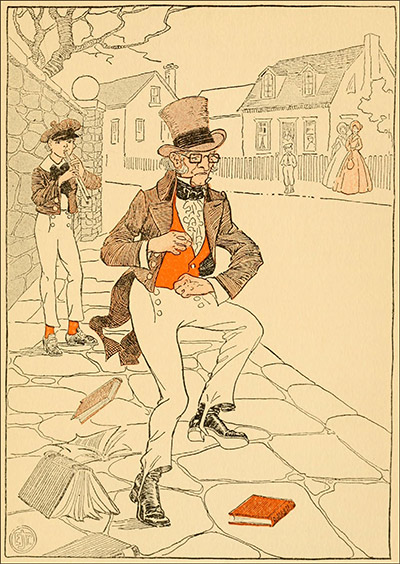
Away Went the Schoolmaster’s Legs, Cutting such Capers as the World Never Looked Upon Before
So Bob began to play again, and they all began to dance again, till at last the schoolmaster and the farmer both punched the butler until he promised; and then Bob left off playing. The three poor men went home in a terrible plight; and the schoolmaster begged little Ralph’s pardon, and the butler cleared the stain from Bob’s mother’s character, and Bob’s father went back to work, and Farmer Thornycroft soon afterwards took Bob on too, and he made the best farm-boy that ever lived.
* * * * * *
The Story Lady rested a minute while the Story People were laughing and talking about what they had heard. As she began again, there was instant silence.
“The next story,” she said, “is that of a brave girl who lived in the work-a-day world.”
XXVIII ANN CATCHES A THIEF

AS a rule the office in which Ann Carstairs was employed did not close until six o’clock, but at five-thirty on the December afternoon of this story Ann found herself alone.
At four, the heads of the firm left for the day; and the billing clerk and the stenographer, taking advantage of the absence of authority, helped themselves to an extra half hour.
“We have a little shopping to do,” the billing clerk explained as they passed Ann’s desk.
Before they reached the stair door, the inside salesman closed his desk with a snap, and seized his hat and coat.
“Wait a minute, girls,” he called; “I’ll take you down to Broadway in my machine.” As he followed them he said to Ann, “Good night, Miss Carstairs, don’t stay late!”
A few minutes after they had gone, Mr. Bradford, the bookkeeper, closed the safe and twirled the nickel knob gayly; “I’m off, too,” he announced. “I’m going to leave the vault for you to close to-night, Miss Ann.”
He shrugged himself into his overcoat and departed stiffly. He had worked hard over his books that afternoon, and his legs and arms were aching in unison with his head. He came back for a moment to turn off some of the big lights.
“No use wasting electricity,” he explained. “No one will be in this evening, and a little girl like you can’t use all this light.”
A minute later Ann heard the street door at the foot of the stairs close with a bang, and she was left all alone in the big office.
She was not sorry to be alone. The day had been hard, and her nerves had been near the breaking point all the afternoon. The switchboard was Ann’s special charge, but she also took care of the odds and ends of copy work and dictation for her busy associates. Odds and ends have a curious way of accumulating and Ann seldom had a spare moment.
“I’m just dead tired,” she declared aloud, raising her arms above her head in a vain effort to relieve their ache. “I’m always snowed under with work, yet no one seems to think I have anything to do. It’s just: ‘Miss Carstairs, will you copy that for me?’ ‘I’ll give you a letter now, Miss Carstairs, and you can run it off in your spare time.’ Spare time! Did any one ever see me with a moment to spare? They don’t think I amount to a row of pins, anyway. I’d just like to show them; I’d like to let Mr. Ross see that I do amount to something.”
Mr. Ross was the senior partner of the big manufacturing plant, and eighteen-year-old Ann admired him immensely. He was so calm, so quiet, and yet so forceful; a splendid business man, but one whose family’s wants and wishes were cared for before all else. Ann knew he must be an ideal father, for he possessed all the qualities that Ann’s own father had lacked.
Mr. Carstairs had been far from an ideal parent and had ended his selfish, careless life just as Ann was preparing to enter college. Ann and her mother had bravely gathered together what money remained, and Ann started off to a business school instead.
For three months she worked feverishly night and day, and at the end of that time, when their finances were in a precarious condition, she left the school to enter the manufacturing firm of Ross and Hayward. She had been there for nearly two years now, years of worry and careful planning to make the slender salary cover growing needs.
“We have almost proved that the necessities of life are unnecessary, so nearly have we come to getting along on next to nothing,” she had laughingly told her mother only the evening before.
But though she joked about it, the situation was becoming serious, and Ann had reached the place where she felt that she must steel herself to the point of asking for more wages.
“Do people always have to ask for an increase?” she wondered. “Everybody here treats me as if I were a child, except when it comes to giving me work. That’s a different matter.”
Ann did not as a rule complain about the amount of work she had to do. Instead, she was rather proud of being able to accomplish so much in a single day. To-night, however, she was tired and all out of sorts. She felt, too, that her looks were all against her. Curly hair and freckles, added to a diminutive figure, gave her a decidedly childlike appearance.
“I wish,” she declared to herself, “I wish I were tall and had straight hair, and wrinkles around my mouth. What chance has anyone to advance when she is short and freckled? I just must make them sit up and take notice!”
She glanced around her with a proprietary look as she spoke. Her desk and switchboard were in the outer office near the head of the short flight of stairs leading from the street door, and commanded a view of the entrance door and the stairway leading to the upper floors. At the extreme end of the room was the entrance to the stock room, and beside it the great iron door leading to the vault where the business records were kept. In the dark corner by the vault door stood two tall piles of sales books. Since the bookkeeper had turned off the extra lights, the big office was lighted only by the globe above Ann’s head. The heavy presses and machinery in the factory, running at full speed, shook the building, and their roar and clatter sounded unusually loud now that the office was quiet.
The switchboard was never very busy after half-past five, and Ann leaned back in her chair and closed her eyes for a moment. She opened them almost immediately with a start, suddenly aware of another presence in the big office. The new janitor, a scraggly feather duster in his hand, stood by her desk.
“Did you want something?” Ann asked sharply.
She did not approve of the new janitor; his hair was too long and shaggy, his chin too stubbly, and his bushy eyebrows shaded eyelids that drooped. His appearance was in accord with his shiftless way of dusting and sweeping, Ann thought with disfavor. Her voice was decidedly sharp as she asked again, “Did you want something?”
“I wanted to see the cashier,” the man answered. His drooping eyelids gave a peculiar, leering expression to his face that filled Ann with repulsion. Then she braced herself; no matter how afraid she was, he must not know it.
“He has gone for the day. Come back in the morning,” she said, turning to her typewriter to cut the conversation short. The man hesitated for a moment, but her preoccupied air chilled him and Ann soon heard him walk away.
At that moment a tall young woman came hurrying down the stairs from the upper floor.
“I declare!” she cried, looking about the darkened office. “Everybody has gone home! And Mr. Bradford has locked the safe! Now will you tell me, Miss Carstairs, what I am going to do with all this money?”
She waved a green cardboard box in the air as she spoke, her voice rising higher and higher in her agitation.
“I have collected eight hundred dollars on those Liberty Bond payments, and here Mr. Bradford has locked the safe and gone home. I’m going to the country to-night and I can’t take all this money with me.”
“Sh! Miss Benson!” Ann warned, glancing quickly at the swing door that had not yet ceased swaying after the departing janitor. “Don’t tell any one. Can’t you put it in the vault? Mr. Bradford left it for me to lock to-night.”
“But,” Miss Benson objected, “something may happen to it and I am responsible. I can’t take it with me, though. I’ll have to put it in there, I guess.”
“See, Miss Carstairs,” she called a moment later from the depths of the vault, “I’m putting it beside the stamp box.”
With Miss Benson’s departure the big office suddenly seemed doubly large, and dim and empty. Ann shivered slightly, appalled by the fact that she was alone with eight hundred dollars in cash in the open vault. The factory machinery made such a din that none of the employees could hear if she called for help. What would she do if the janitor had overheard Miss Benson and should make up his mind to steal the money? She glanced sharply at the swinging door. It was quiet now.
She reassured herself. “I’m as nervous as Miss Benson. I’ll just shut that vault now, though, and have it over with. It is almost six o’clock anyway.”
At that moment a call came in on the telephone, the strident whir startling the girl with its suddenness.
“Ross and Hayward,” she answered mechanically into the receiver.
“Miss Carstairs,”—it was Mr. Ross speaking—“I left a couple of Liberty Bonds in my desk. Please tell Bradford to put them into the safe.”
“Mr. Bradford has gone for the day, Mr. Ross,” she answered, “but he has left the vault for me to close; I’ll put them in.”
“All right. Put them in the stamp box; I guess they’ll be all right there. Good night!”
Ann pulled out the plug and rose from her desk. Her rubber-soled shoes made no noise as she crossed the room. She found the bonds face down on Mr. Ross’s desk, and as she picked them up she could not fail to notice the denominations. She stared at them.
“Two thousand dollars!” she whispered awestruck. “If only they were mine!”
As she started to place them in the stamp box, its shabbiness caught her eye. She hesitated, then laid the bonds down.
“I’ll get a new box for the stamps,” she decided, snapping off the light as she left the vault.
Ann knew just where to find the particular box that she wanted and did not stop to turn on the light as she entered the stockroom. She was in the act of reaching up for the box, when the door stealthily opened. She shrank back against the shelves as the new janitor came in. He stopped for a moment and glanced around, then a minute later Ann heard the snap of the electric button as the light in the vault was turned on. She gasped in dismay. The bonds and the Liberty Loan money were all there in plain sight! For a brief moment the girl was paralyzed with fright. The janitor was after the money! She rushed forward. As she paused by the open doorway of the vault she had a momentary glimpse of the janitor with the green box in one hand, and heard the familiar crackly paper of the bonds as he hurriedly thrust them into his pocket. In a panic she caught the huge iron door and slammed it shut, hurriedly throwing the big bolt in place.
“I’ve got him,” she gasped exultantly; but the words had not left her lips before she was knocked from her feet by a sudden blow on her shoulder. As she fell, another stunning blow came upon her head.
A minute later, so it seemed to the girl, she opened her eyes to find Mr. Ross and his daughter, Margaret, bending over her.
“She’s coming to, now,” she could faintly hear Mr. Ross say. “Bathe her head some more.”
Then he added jokingly, “Well, now, Miss Ann, you certainly gave us a start. What were you trying to do?”
Ann’s head ached agonizingly. She lifted her hand to her forehead, and felt it gingerly. A lump as large as a walnut was there just above the temple. She became aware, now that the mist was fading from her eyes and the ringing from her ears, that the factory was quiet. All the noise of machinery had ceased.
“What time is it?” she asked; and then, without waiting for an answer, “Where did you come from?”
“It is after eight. We were driving by on our way to see a friend on the East Side, and I thought I would drop in and see if you had remembered to lock the safe.” Mr. Ross laughed. “Fortunate for you that I doubted your ability.”
Ann raised her head and looked about her; then she dropped it heavily back on the improvised pillow Miss Ross had tucked under her head.
“It was that old sales book that knocked me down. It must have been on the edge of the pile and tipped over when I slammed the door.” She felt the bump on her head again. “I suppose I hit the wrapping desk when I fell.”
“It wouldn’t take much to knock out a little thing like you,” Mr. Ross laughed.
Ann opened her eyes again, a thought flashed through her mind, and she sat bolt upright on the floor.
“Mr. Ross,” she said, “if I can prove to you that I was big enough to save you two thousand dollars, would you think me big enough to be given an increase in salary?”
“I surely would, Miss Carstairs!” Mr. Ross answered, becoming suddenly grave.
Ann’s voice shook with excitement.
“Your bonds are safe in the vault, Mr. Ross, together with eight hundred dollars that Miss Benson collected on Liberty Loan payments—and the new janitor!”
“You’re a brave girl,” said Mr. Ross, helping her to her feet. “The increase is yours; you have certainly earned it.”
* * * * * *
“She was, indeed, a brave girl,” said the Story King, as the Story Lady paused; “and deserved all her good fortune.”
“The next,” went on the Story Lady, smiling, “is the story of a young man and a young woman whose only ambition in life was to help others.”
XXIX JOHN AND MARGARET PATON AMONG SAVAGES

THE tropical island of Aniwa drowsed in the afternoon sunshine. Long, lazy swells rolling in from the Pacific broke on the outlying reefs, overflowed into the turquoise bay, and gently lapped the stretch of sandy beach. The softest of breezes stirred the palm trees and rustled the banana thickets.
Before the door of a low, thatched hut, nestling under a clump of date-palms, stood a fair-haired young woman anxiously watching a canoe which was making a perilous passage through the surf to the shelter of the bay. When at last it slid into smooth water she breathed a sigh of relief and went slowly down the hill toward the shore.
The craft nosed stealthily up to the beach, where a stalwart, grave-faced white man sprang out; then the boat, propelled by the muscular arms of two kinky-headed blacks, slipped away and vanished around a little promontory.
“I’m glad you’re safe home, John,” the young woman cried, as the big man came swiftly toward her. “Is all well?”
“Very far from that, Margaret,” the newcomer answered, as he reached her side. “I’ve found a great deal of unrest throughout the island.”
“Because of the drought?”
“Yes,” he replied, and stood looking down upon her thoughtfully.
She came nearer and slipped her arm through his.
“I can see that you are anxious, John,” she said softly. “Do you fear an uprising?”
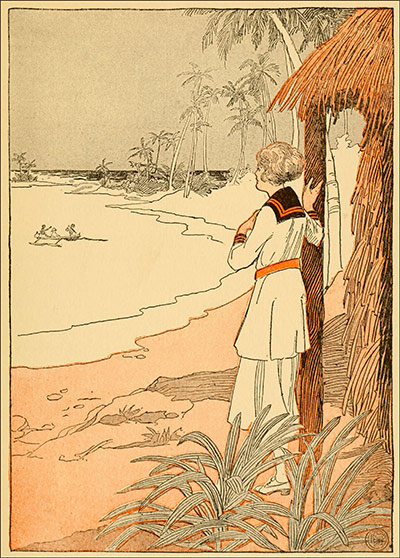
Before the Door of a Low, Thatched Hut Stood a Fair-haired Young Woman
“Margaret,” he exclaimed, as they turned and began to climb the hill to the hut, “I should not have brought you here!”
“Oh!” she cried. “More than anything else I desired the privilege of helping you in your work. Do you mean that I have failed? That I have proved a burden rather than a help?”
“You know it is not that,” he replied quickly. “You have been wonderful, dear. But I should not have allowed you to leave old Scotland for the hardships and perils of these heathen isles.”
“It has not been easy,” she acknowledged; “but I have never once regretted coming.”
“I thought I was doing right to bring you,” he went on; “but now—now—”
“You feel,” she interposed, “that we are in real danger?”
“We shall be if the natives rise,” he replied. “I think you should know the truth, dear.”
Her blue eyes darkened, but there was no fear in them.
“But the people have come to feel we are their friends,” she protested. “Some of them love us. Surely they will not harm us.”
By this time they had reached the hut. He put her gently into a camp-chair before the door, and flung himself upon the white sand at her feet.
“A trading-ship touched on the other side of the island yesterday,” he told her.
“And paid for five hundred pounds’ worth of sandalwood with a barrel of rum, I suppose,” she commented.
“They were a little more generous this time,” he replied grimly. “They left several barrels.”
“No wonder then,” she said, “that the people are mad to-day.”
“They also left,” he continued, “in the mind of the old chief the impression that we missionaries are responsible for the drought.”
“Oh, too bad!” she exclaimed softly.
“Yes,” he agreed. “Old Namakei informed me just now that if another moon passes without rain the island will have no more of our God or of us.”
“What did you answer?” she asked.
“I told him,” and he smiled, “that I would dig in the earth and reveal a place where God’s rain is buried. He scoffed at first, but finally agreed to come with his warriors and help with the digging.”
“But, John,” she queried, “will you really be able to dig a well on this island?”
“Of course, I can’t be certain,” he answered; “but I’ve been studying the soil, and it seems probable. Anyway, it’s our one chance to appease the old chief’s ire and continue our work.”
John Gibson Paton had come out to the New Hebrides some years before, and settled on the cannibal island of Tanna.
He had begun at once to teach the people and had succeeded in greatly improving their condition, when a trading vessel had brought measles to the island. An epidemic followed, and the natives died like flies.
They were so bitterly angry against those who had brought the plague that they became suspicious of all white men, even the missionary who had always helped them, and he was finally obliged to flee for his life.
With great difficulty he escaped to a passing ship bound for Australia. From Australia, he went to his homeland, Scotland.
He had a wonderfully happy time on this visit among his friends and relatives, for he was married to the pretty Scotch lassie whom he had learned to love.
He felt that life would be very hard for her on the island of Tanna, and he decided to go, instead, to Aniwa, where the natives were less fierce and more intelligent. Besides, they had asked that a missionary be sent to them.
They were very glad when he came bringing his pretty wife, and they tried to learn all he told them.
All went well until the traders who came to the South Seas for sandalwood and cocoanuts and the rich tropical fruits, discovered that the natives were becoming more intelligent, and could not be cheated or swindled so easily since the missionaries were teaching them.
So the traders made up their minds to try to turn the blacks against Doctor Paton and his wife, and his native helpers.
They had not been able to do much until the time of the long drought, told about at the beginning of this story. You see, they depended almost entirely upon rain for fresh water to drink.
Never before in the memory of living men had the islands been so long without rain. The people were terrified and ready for any outbreak.
But the young missionaries, sitting silently under the palms, realized that the traders might so excite the natives with their talk, and with the rum, that they might become murderers and revert to cannibalism.
“Where will you dig the well, John?” Margaret asked at length.
“On the slope over there.” He nodded toward the opposite hill. “I shall begin work to-morrow. Chief Namakei comes an hour after sunrise.”
“If you succeed in reaching fresh water, shall we be safe?”
“Yes, and if not, I hate to think of what may happen.”
“But anyway,” she declared, “I’m sure you will find God’s rain, John.”
Weary days and nights followed; days when the doctor and his band of native helpers dug from dawn to dark in the sandy soil; nights when the young white people, too anxious to sleep, sat under their palm trees and watched while the moon sank into the sea, and the volcano of Tann, “the lighthouse of the Pacific,” flung its blazing banners high against the heavens.
Two weeks passed and the diggers found no water. Then one day the continued drought left the old chief’s favorite water-hole quite dry. On the same day the side of the new well caved in.
The two troubles coming together turned the interest of Namakei to suspicion. When the digging began again he forbade his men to take part in the work, and, though he still watched the other toilers, his beady eyes had the look of a hawk’s just ready to pounce upon its prey.
The moon was full before the cave-in was repaired. The next morning the two remaining helpers did not report for duty, and old Namakei told the doctor that they would not come back.
“They are my prisoners,” he laughed. “If Missi Paton wish help in finding the buried rain, let his God give it.”
“His God will give it,” the missionary replied, calmly.
And alone Doctor Paton went on with his undertaking.
Two days, three days, passed, and still no water. Namakei assumed a more threatening attitude.
“The moon wanes!” he warned the missionary.
And then one morning when the doctor went down into the well he saw something gleaming at his feet. He bent down, gazing with eager eyes. It was water!
“But will it be fresh?” he asked himself, with fast-beating heart. On so tiny an island the sea water might easily penetrate the soil.
Very slowly he dipped his finger into the now fast-rising water and lifted it to his lips. And then suddenly he sank down in the dampness and wept like a child. The water was fresh and pure and sweet, God’s rain indeed.
By noonday the well was filled with the life-giving water, and from every part of the island the natives gathered to behold the miracle of the rain which had come up from the earth instead of down from the sky, and to do honor to Missi Paton who had given it to them.
And when he assured them that it would always be there so long as the island remained in the sea, and that drought would nevermore bring suffering and distress among them, they kissed his hands in gratitude.
Never again did the evil words of the traders against their beloved Missi have any weight with the natives of Aniwa, and never again did they turn away from the Christian religion and the Christian God; and, if you should visit the island to-day, you would be shown by the proud people the well where John Gibson Paton found by faith and prayer and labor the buried blessing so many years ago.
* * * * * *
Again the Story People clapped their hands as the story ended, for they love to hear of nothing better than a brave and an unselfish deed.
“That is a good story,” said Mary Frances.
“Yes,” said the Story King; “the stories of those who risk their lives for others are the best of all our stories.”
“Yes,” agreed the Story Queen; “they are the best of all.”
“Now,” said the Story Lady, “we come to our fourth story.”
XXX THE STRANGE GUEST
ON the summit of one of the heights of a wild country district along the Rhine, there stood many years ago an old castle. In this castle lived a beautiful maiden with her father and two elderly aunts.
Her father was a jolly old nobleman, very fond of his beer, and very fond of hearing himself talk, too. He enjoyed his own jokes better than anyone else, perhaps.
Even so, his dearest possession was his beautiful daughter, his only child. He loved her as the apple of his eye, and wished to give her all happiness.
She had little chance of being lonely, for there were always a large number of poor relatives visiting the nobleman, and indeed they made these visits so long that they sometimes stayed for years.
She often wondered, however, who might be living in the castle on the heights across the valley. She could just see the outlines of the walls and towers on clear days from the balcony outside her bedroom window.
“Father,” she said one day, “could we not ride over to that castle some time? I’m forever dreaming stories about those who live within it.”
A heavy cloud settled over her father’s countenance.
“Never let me hear you make mention of it again, my daughter!” he thundered.
And of course she said no more, but she spoke about it to one of her aunts that evening.
“Dear aunt, why was my father vexed when I mentioned that castle this morning?” she asked, pointing out of her window.
“Hush, my child,” replied her aunt. “There is a feud between the two families.”
“A feud?” questioned the maiden. “A feud? Why, we do not even know them! How can there be a feud?”
“It dates back to the time of our great-great-grandfathers,” her aunt told her, “and no loyal member of this family would ever have anything to do with a member of that family. Never mention the matter again!” Then suddenly changing the subject, “Did you finish your embroidery stint for to-day? How far have you worked? Let me see.”
The maiden blushed, arose, and brought a large sheet of unfinished tapestry to her aunt, which she unfolded before her.
Her aunt put on her spectacles to examine the work.
“Wait!” she exclaimed. “I’ll call my sister.”
The other aunt was in the doorway, however, and joined her in examining the work.
“I see a missed stitch here!” she commented.
“Ah, yes, and a loose end there!” added the other. “It is growing dark. No knowing how many flaws we would find by daylight. To-morrow you will do better, I hope.”
“I will try,” promised the niece.
And so the maiden grew. By the time she was eighteen, she could not only embroider tapestries, and play a dozen airs on her guitar and harp, but could write a short note, with not more than ten misspelled words, and could sign her own full name without missing a letter.
These accomplishments, in that day, were considered quite a finished education for a young lady.
On her eighteenth birthday the castle was in bustling excitement because there was to be an affair of utmost importance. And this affair was none other than a great family gathering to receive the intended bridegroom of the maiden.
Her father had promised her in marriage to the son of an old nobleman, a friend of his who lived in a distant province.
The parents had arranged all the details, and the young people were engaged to be married without even seeing each other. The time was appointed for the wedding, which was to take place at the home of the maiden on her eighteenth birthday.
The bridegroom had already set out on his journey and was expected to arrive at any moment.
The castle was in a tumult. The fair bride had been decked out with uncommon care. Her aunts had quarreled about every article of her dress, and while they were quarreling, she had made up her own mind about each article she would wear. The result was that she looked as lovely as a dream. The soft lustre of her eyes, the rose-petal hue of her cheeks, the quick rise and fall of her bosom, showed the excitement in her heart.
Meanwhile her aunts gave her all kinds of directions as to her behavior.
“When you first see him, my dear niece,” advised one aunt, “lower your eyes, as becomes a modest young lady.”
“Yes,” added the other aunt, “and when you courtesy, catch your skirts, so,” and she made a deep old-fashioned bow.
The old baron was no less busy with preparations than the others. Having, in fact, nothing to do but wait, he worried everybody else about every detail. He wandered from the top to the bottom of the castle, begging everybody to be diligent, and filling everybody with anxiety. He was naturally a bustling little man, and he buzzed about in every hall and chamber like a blue-bottle fly on a warm summer’s day.
In the meantime, things had been gathered together for the making of a great feast. The forests had rung with the sound of the huntsman’s horn. The kitchen was crowded with good cheer, and the castle was a model of ancient hospitality.
The long tables had been spread with the handsomest trenchers and dishes within the castle. The last finishing touches had been added to the wedding gown, the bride waited trembling with anxious expectation. Everything was ready to receive the distinguished guest—but the guest did not come.
Hour after hour rolled by. The sun began to set, and the baron mounted for the eleventh time to the high tower, and strained his eyes in hope of catching sight of the count and his attendants.
Once he thought he saw them, for there were a number of men seen advancing slowly on horseback, but when they had nearly reached the foot of the mountain, they suddenly struck off in a different direction.
The last rays of the sun departed. The bats began to flit by in the twilight. The road grew dimmer and dimmer to sight, and nothing seemed to be stirring in it except, now and then, a peasant lagging homeward from his day’s labor.
While the old castle was in this nervous state, very different things were happening to the bridegroom.
The young count was riding along on horseback in a jog-trot fashion toward the bride he had never seen.
“There is no haste necessary,” he said to his attendants; “we will be there all in good time. Let us enjoy the scenery.”
At the inn where he stopped for refreshment, he met another young nobleman with whom he had been good friends several years before while both were in the army.
“And which way do you travel?” asked the count’s friend.
“We go through the East pass, and upward through the mountain road,” he replied.
“How fortunate!” exclaimed his friend. “I am going in the same direction.”
So they agreed to travel together, and soon set off, the count leaving word for his servants to follow and overtake him later.
“Now, tell what has happened in your life since we last met,” said the count’s friend as their horses stepped out abreast. “Has your heart been touched by the beauty of any maiden?”
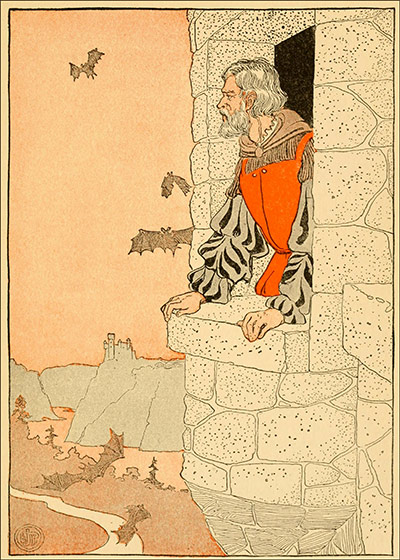
Once He Thought He Saw Them
Then the count told him about his coming wedding with a young lady he had never seen, but who was said to be very lovely.
In this way they entered one of the loneliest and most thickly wooded passes in the mountains.
All this happened in the days when bands of robbers lived in woods, and when ghosts were said to haunt old castles.
As the count turned to speak to his companion, suddenly from out the woods there sprang a small band of robbers who immediately attacked them.
They made a brave fight, but were nearly overcome by numbers when the count’s retinue of servants came riding up. The robbers fled at sight of them, but not until they had given the count a dreadful wound.
He was carried back to the nearest town through which he had so joyfully ridden such a short while before. A priest, who was also quite a doctor, was brought to his bedside, but everyone knew that the poor young count’s moments were few to live in this world.
He motioned his friend near, and whispered between gasping breaths, “I—beg—you—to—go—to—the—castle—of—my—betrothed—and—tell—why—I—did—not—keep—my—appointment.”
Then gathering strength, he added in a stronger voice, “Unless this is done, I shall not sleep quietly in my grave!”
He spoke so solemnly that his friend gave his promise without hesitating. This seemed to soothe him, and he closed his eyes as if in sleep, but he soon began to talk wildly, and call for his horse, saying he must hasten to the home of his bride, and thinking he was leaping into the saddle, he suddenly drew his last breath.
His friend was deeply grieved. His heart was heavy within him. He scarcely knew how to keep his promise, for he was the son of the nobleman whose castle the maiden had been forbidden to mention; and, because of the feud between the two families, he hated all the more to be the bearer of such bad news. Still he thought that he would like to see the lovely girl, and he felt that he must try to carry out the promise he had made to his dying friend. So he made arrangements for the poor count’s burial in the cathedral near the graves of his noble ancestors, and set out on his journey.
It is now high time that we should return to the castle, where everybody was hungrily awaiting the guest.
Night closed in, but still no guest arrived. The baron descended from the high tower in despair.
“It is so dark that I can see nothing now,” he said. “There is no use in watching longer.”
The banquet had been postponed from hour to hour. The cooks in the kitchen were desperate. The meats were already overdone, and every one was beginning to look as though it were a time of famine.
“We cannot delay longer,” the baron finally said. “I fear we must proceed with the feast without our guest.”
All were seated at the table and on the point of commencing, when the sound of a horn from outside the gate gave notice that a stranger was approaching.
Another long blast filled the old courts of the castle with its echoes, and was answered by the warden from the walls.
The baron hastened to receive his future son-in-law.
The drawbridge had been let down, and the stranger was before the gate.
He was a tall, gallant cavalier, mounted on a beautiful black steed. His face was pale. He had a gleaming eye, and yet wore an air of sadness.
The baron was a little embarrassed to think that he should come in so simple a way without a retinue of friends and servants. He thought that the young count did not show proper appreciation of the honor of marrying his daughter, but he comforted himself by thinking, “He has been so anxious to see his bride that he has hurried off without waiting for attendants.”
“I am sorry,” began the stranger, “to break in upon you at such an hour——”
“Oh, pray, do not worry,” interrupted the baron, “it is as nothing,” and he continued with a world of compliment and greeting. For, to tell the truth, the baron was very proud of his ability to make pretty speeches.
He kept on talking so fast that the stranger was unable to put a word in edgewise, and by the time he paused, they had reached the inner court of the castle.
The stranger was again about to speak when he was once more interrupted by a group of the baron’s relatives leading forth the blushing bride.
The Wedding Feast
The stranger gazed on her for a moment as one entranced. It seemed as if his whole soul beamed forth in the gaze, and rested upon her beauty.
One of the maiden aunts whispered something in her ear. She made an effort to speak. Her moist blue eyes were timidly raised, gave a shy glance at the stranger, and were cast again to the ground.
Her words died away, but there was a sweet smile playing about her lips, and a soft dimpling of the cheek showed that she was pleased to meet so charming a person.
The late hour at which the guest had arrived left no time for talk. The stranger attempted again to tell his sad news, but the baron would not listen, and immediately led the way to the untasted banquet.
The feast was served in the great hall of the castle. Around the walls hung the portraits of the bride’s ancestors, and the horns and tusks of animals they had killed in the hunt. Armor and spears, and torn banners hung next to jaws of wolves and tusks of boars, and spears and battle axes. A large pair of antlers hung just over the head of the youthful bridegroom.
The stranger took but little notice of the company or of the entertainment. He scarcely tasted the banquet, but seemed absorbed in admiring the bride. He talked with her in a low tone that could not be overheard. The bride’s color came and went, and she listened to him with deep attention. Now and then she made some reply, but she was very quiet most of the time, and when his glance was turned she looked at him with much pleasure.
“They have fallen in love at first sight,” whispered one aunt.
“I felt that it would be so,” said the other.
The feast went on merrily, or at least noisily, for the guests were all blessed with large appetites.
The baron told his longest and best stories. If he told anything marvelous, his hearers were lost in astonishment. If he told anything funny, they laughed just loud and long enough to please him greatly.
Amidst all this frolic, the stranger seemed lost in thought. His only conversation was with the bride, and seemed to grow more and more earnest and mysterious. Clouds began to steal over her fair face, and the guests noticed that she trembled.
Their gayety was chilled by such actions. The song and laughter grew less and less frequent. There were pauses in the conversation.
Dismal stories were told by several people. The baron nearly frightened some of the ladies into hysterics with the history of the ghost horseman that carried away the fair young woman, Lenora.
The bridegroom listened to this tale with great attention. He kept his eye fixed on the baron, and, as the story drew to a close, began gradually to rise from his seat, growing taller and taller, until, to the baron’s eye, he seemed almost to tower into a giant.
The moment the tale was finished, he heaved a deep sigh, and took a solemn farewell of the company. They were all in amazement. The baron was perfectly thunderstruck.
“What! going to leave the castle at midnight? Why, everything is ready for your reception; a room is ready for you if you wish to retire.”
The stranger shook his head mournfully and said: “I must lay my head in a different place to-night.”
Then waving his farewell to the company, he stalked slowly out of the hall.
The maiden aunts seemed turned to stone. The bride hung her head, and a tear stole down her cheek.
The baron followed the stranger to the great court of the castle, where the black horse stood pawing the earth and snorting with impatience.
When they reached the portal whose deep, high archway was dimly lighted by a lantern, the stranger paused and spoke to the baron in a hollow tone of voice.
“Now that we are alone,” said he, “I will tell you my reason for leaving. I have an engagement in——”
“Why,” asked the baron, “cannot you send some one in your place?”
“I must keep this engagement myself—I must go myself——”
“Ay,” said the baron, “but not until to-morrow—to-morrow you shall take your bride there.”
“No! No!” replied the stranger with greater solemnity. “My engagement is with no bride. The grave awaits me! I must go back where I came from!”
He sprang upon his black charger, dashed over the drawbridge, and the sound of the clatter of his horse’s hoofs was lost in the whistling of the night’s blast.
The baron watched him until out of sight, then muttered, “He must have been a ghost!”
He returned to the hall in great bewilderment, and related what had just passed. Two ladies fainted; others sickened with the idea of having banqueted with a spectre.
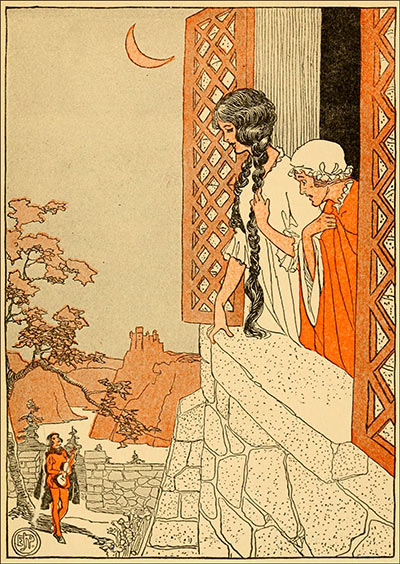
A Tall Figure Stood Among the Shadows of the Trees
The company tried to guess whose ghost it might have been. Some talked of wood-demons and others of mountain sprites, but all was dim uncertainty and mystery.
The next morning, however, put an end to guessing, for word came of the death of the young count on his way to the castle, and every one felt sure that the stranger of the night before was indeed his spectre.
You can imagine how dreadful the baron felt. He shut himself up in his rooms. His guests stayed on, for they could not think of going when he was in such trouble, and then, too, the remnants of the feast were to be eaten and drunk!
But the poor bride was most to be pitied. To have lost a promised husband before she was acquainted with him! And such a husband! Everybody wept for her.
The Midnight Music
On the night of the second day after, she retired to her room with one of her aunts who insisted upon sleeping with her.
The aunt was one of the best tellers of ghost stories in all the land, and in telling one of her longest, fell asleep in the midst of it.
The room was in a distant corner of the castle, and overlooked a small garden. The niece lay gazing at the beams of the rising moon as they shone on the trembling leaves of an aspen tree before the latticed window.
The castle clock had just tolled midnight when a soft strain of music stole up from the garden.
She rose hastily from her bed and stepped lightly to the window.
A tall figure stood among the shadows of the trees. As it raised its head, a beam of moonlight fell on its face. In a moment she knew him—her promised bridegroom!
A loud shriek at that moment burst upon her ear, and her aunt, who had been awakened by the music and had followed her to the window, fell into her arms.
When she looked again, the spectre had disappeared.
Of the two, the aunt required the more soothing. She was beside herself with terror.
As for the young lady, she did not feel frightened. There was something, even in the spectre of her lover, very charming.
The aunt declared she would never sleep in that room again. The niece for once was determined to have her own way, and declared she would not sleep in any other room. The consequence was that she had to sleep there alone.
She begged her aunt to promise not to tell about this moonlight visitor, for she said it was the only comfort she had in her great disappointment, and the good old lady promised. How long she would have kept her promise is uncertain, for she dearly loved to talk about mysterious happenings.
She did keep it to herself for a whole week; and then, suddenly, she did not need to keep it longer. For word was brought to the breakfast table that the young lady was not to be found.
Her room was empty. Her bed had not been slept in. The window was open! The bird had flown!
Nearly every one was struck speechless, when the aunt who had slept with her, suddenly regained her speech, and wringing her hands, shrieked out, “The goblin! the goblin! She’s carried away by the goblin!”
In a few words, she told of the dreadful scene in the garden; and all concluded that the spectre must have carried off his bride. Two of the servants said they had heard the clatter of horse’s hoofs down the mountain-side about midnight, and had no doubt it was the black charger of the spectre.
The poor baron was inconsolable. What sorrow to have his only child, his daughter, carried off by a goblin! How terrible to have, perhaps, goblin grandchildren! As usual, he was completely bewildered, and all the castle was in an uproar.
The men were ordered to take horses, and hunt in every road and path and by-way. The baron himself had just drawn on his jack-boots and girded on his sword, when he glanced out the window, and paused because of what he saw.
A lady was approaching the castle on horseback. Beside her, mounted on a black charger, was a cavalier.
She galloped up to the gate, sprang from the horse, and running into the castle, fell at the baron’s feet.
It was his lost daughter, and her companion—the spectre bridegroom.
The baron was astonished. He looked at his daughter, then at the spectre, and almost doubted his eyes.
The spectre was wonderfully improved in appearance. His dress was splendid, and set off his noble figure. He was no longer pale and sad. His face was flushed with the joy of youth.
The mystery was soon cleared up. The cavalier (for you must have known all along he was no goblin) told the whole story—how he had met his young friend; how they had traveled together; how the young nobleman had met his death. He said that the sight of the beautiful young lady had made him forget everything except the desire to be near her. At first, when the baron would not listen to his explanation, he thought it would do no harm to accept the situation as it was.
If the baron’s family had not had a feud with his own family, he would have explained everything after the banquet, but he feared that, under the circumstances, he might never see the young lady again. When the baron had told how the fair Lenora had been carried off by the goblin, the idea of being a goblin himself came to him. And he said that he did not feel exactly right about doing this, but his friends had told him to remember the old saying that “everything was fair in love.”
The baron pardoned the young couple on the spot. The festival at the castle was continued.
Only the aunt was disappointed. She who had told so many stories about true ghosts, was embarrassed to find the only ghost which she had actually seen should turn out to be a real live person, but she was so happy at having her niece back again that her embarrassment was as nothing.
But the niece was perfectly happy in having found him a real living person, and—since they lived happily ever after—here the story ends.
* * * * * *
“And another begins,” added the Story Lady, after a slight pause.
At the Story King’s nod of approval, she proceeded.
XXXI ROBERT OF SICILY
THERE is an old legend of a proud king, named Robert of Sicily. This legend tells of the greatest event of Robert’s life; and the poet, Longfellow, has written a beautiful poem about it, which every one should read. This is the story:
Robert, King of Sicily, was a very proud monarch and a very selfish one. He spent most of his time enjoying himself, and gave little heed to the wants of his people.
On St. John’s eve he attended vesper service with a great retinue of knights and lords and pages. He was dressed most magnificently, and proudly sat while the choir chanted some strange Latin words.
The king did not understand Latin, and turning to a learned clerk nearby, he said, “What do those words mean?”
The clerk answered, “They mean,
‘He has put down the mighty from their seat, And has exalted them of low degree!’”
The king laughed scornfully, and said, “It is well that such words are sung in Latin, for there is no power on earth that can push me from my throne.”
Then he leaned back yawning, and fell asleep.
When he awoke it was already night; the church was empty and all in darkness.
The king was angry at finding himself alone. He groped his way toward the great doors, but found them locked.
Then he thought of the windows, but they were high above his reach. Then he became frightened and cried aloud. He listened, but all that he heard was the resounding echoes of his cries, as they rang, again and again, through the high, vaulted ceiling of the church.
He knocked with his fists against the doors, and swore awful oaths against every one in his court. He became so angry that he tore his magnificent robes into shreds. He had long since lost his hat and cloak.
At length the sexton of the church heard the noise, and he thought that perhaps thieves were breaking into the church, so he lit his lantern and went to the door. When he could make himself heard, he asked, “Who is there?”
The king, half choked with rage, answered fiercely, “Open, ’tis I, the king. Are you afraid?”
The frightened sexton muttered to himself: “It is some drunken beggar, or some one crazy;” and, turning the great key, he flung open the doors.
A man in torn garments, without hat or cloak, rushed past him. He neither looked at him nor spoke, but, leaping into the darkness, vanished almost like a spectre from his sight.
Bareheaded, breathless, covered with dust and cobwebs, Robert strode on through the darkness, and came to the palace gates. He rushed through the courtyard, thrusting aside the guards and pages, and hurried up the broad stairs. From hall to hall he passed in breathless speed, although he heard voices and cries to stop him, until he came to the banquet room, which was blazing with light.
There he stood motionless, speechless, amazed; for on the throne there sat another king, wearing his crown, his robes, and even his signet ring. He looked at first glance exactly like King Robert. He was of the same height and the same form and features; but there was a gracious beauty about him which Robert lacked.
King Robert stood there, gazing at him in anger and rage when he looked up. With a glance of surprise and pity, he asked, “Who are you?”
Robert answered, “I am the king, and I have come to take my place; you are an imposter who pretends to be king.”
At these words the angry guests sprang up with drawn swords, but the man on the throne said, “No, not the king, but the king’s jester. You shall from now on wear the bells and scalloped cape of the court jester, and make fun for us all. Your companion shall be an ape.” Then he turned away toward his guests.
Some of the servants came forward to take Robert away, and they were quite deaf to his ravings and angry threats. With shouts of laughter they pushed him on before them down the stairs, and mockingly bowed before him, and pretended to honor him, all the while laughing and tittering and making fun of him. They left him in a room in the stable where at length, exhausted, he fell asleep.
The next morning, waking with the day’s first light, he thought to himself: “I’ve had an ugly dream.” But the straw rustled when he turned his head, and there were the jester’s cap and bells lying near. He heard the horses champing in their stalls, and on looking around the room saw the poor ape. So he remembered. It was no dream. His happy life that he thought could not be changed, had vanished from him.
The days came and went. Under the rule of the new king the island prospered as never before. Robert continued to be the jester, laughed at and scorned. His only friend was the ape. His only food, what others left.
Sometimes the other king would meet him, and ask, “Are you still the king?” and always Robert would throw back his head and fling the answer haughtily, “I am, I am the king!”
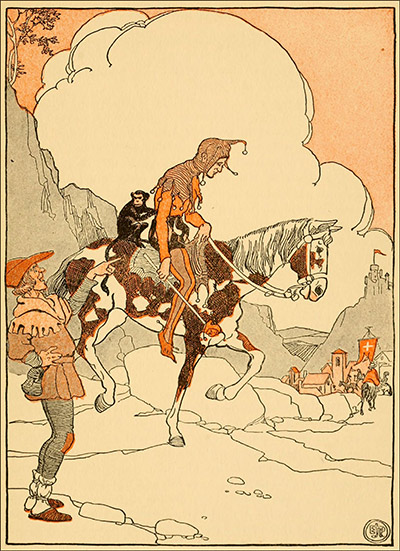
Toward the Very Last, Robert, the Jester, Rode on a Piebald Pony
Robert had two brothers; one was Valmond, Emperor of Allemaine, the other was Pope Urbane. One day, almost three years after the wild night that Robert had been locked in the church, ambassadors came from Valmond, Emperor of Allemaine, bringing letters. The letters asked King Robert to join his brother Valmond in a visit to their brother at Rome. The ambassadors were received with great pleasure, and were presented with many beautiful gifts of robes and jewels.
Then the king who was not King Robert went with them across the sea to Italy. He was accompanied by a great retinue of knights, all dressed in uniform, wearing gay plumes in their helmets. They rode horses with jeweled bridles, and even wore golden spurs. They were followed by pages and servants; and, toward the very last, Robert, the jester, rode on a piebald pony, and behind was perched the ape. Through every town they went they made much fun for the people, who followed along after, laughing and poking fun at them. The company were received with great pomp and ceremony, and the three brothers seemed delighted at being together again.
Suddenly Robert burst through the crowd, and running up to them cried, “I am the king! Do you not know me? Look at me. I am your brother, Robert of Sicily. This man is but an imposter! He is not the king!”
The emperor and the pope looked at the angry worried jester for a long moment; then the emperor laughed, and said, “What strange sport to keep a crazy fellow for a jester!” and the poor baffled jester was hustled back into the crowd.
Then came Easter Sunday, and the beauty and the solemnity of the Easter services touched the hearts of all men. Robert was deeply moved. For the first time in his life he saw what kind of man he had been. He saw how selfish and proud and haughty he had been. He wished with all his soul that he had been a better man, and he made up his mind that, no matter what happened, he would never be so selfish and mean again.
Now, the visit ended; the grand visitors left Rome and journeyed homeward. And when they were once more established, the king on the throne sent for Robert. He motioned every one else out of the room and beckoned Robert to draw near.
And when they were alone, he asked, “Art thou the king?”
Robert bowed his head, and folding his arms, said, “You know best. I only know that I have sinned, and have been proud and selfish. Let me go from here and try to make up in some way for the wrong which I have done!”
And just as he finished saying this, there rose through the windows loud and clear the words of the chant:
“He has put down the mighty from their seat, And has exalted them of low degree!”
Then the man who was with Robert cried joyously. “I am not the king! I am an angel! You are the king!”
When King Robert raised his eyes—lo! he was alone, but all dressed in his magnificent apparel as of old; and when his courtiers came, they found him kneeling upon the floor in silent prayer.
* * * * * *
“Robert was fortunate,” said the Story King, “in learning his lesson before it was too late.”
“Yes, indeed, he was,” answered the Story Lady. “The fourth story is of a young man who repented when it was too late.”
XXXII THE MAN WITHOUT A COUNTRY
ONCE there was a man, a young officer in the United States Army, who did a dreadful thing—he cursed his native country!
He pretended for a while that he did not care, when he was punished, but in the end he was very, very sorry. Because he wore his uniform without the official buttons, the sailors on the ships on which he was imprisoned called him “Plain Buttons.”
His name was Philip Nolan. Lieutenant Nolan was as fine a young officer as there was in the “Legion of the West,” as the Western division of the United States Army was called in those early days, one hundred years ago.
At that time the Mississippi valley was the Far West to most people, and seemed a very distant land indeed. There were a number of forts along the river and Nolan was stationed in one of these. Nolan’s idol was the brilliant and dashing Aaron Burr, who visited the fort several times between 1805 and 1807. He walked and talked with Nolan and obtained a very strong influence over him. He got Nolan to take him out in his skiff and show him something of the great river and the plans for the new post; and by the time Burr’s visit was over Nolan was enlisted body and soul in Burr’s disloyal schemes. From then on, though he did not yet know it, Nolan lived as a man without a country.
Burr soon got into trouble with the government, and some of his friends were tried for treason, Nolan among them. It became very plain during the trial that Nolan would do anything Burr told him; that he would obey Burr far quicker than his country in spite of his oath as an officer of the army.
So when Colonel Morgan, who was president of the court, asked Nolan, at the close of the trial, whether he wished to say anything to show that he had always been faithful to the United States, he cried out, in a fit of frenzy: “Curse the United States! I wish I may never hear of the United States again!”
Probably he did not realize how the words would shock old Colonel Morgan and the other members of the court. Half the officers who sat with him had served through the Revolutionary War, and had risked their lives, not to say their necks, cheerfully and loyally for the country which Nolan so lightly cursed in his madness.
It may be said for Nolan that he had grown up in the West of those days, then an almost unknown country. He had been educated on a plantation, where the most welcome guests were Spanish officers and French merchants from Orleans, who, to say the least, were unfriendly to the United States. He had spent half his youth with an older brother, hunting horses in Texas, which was not then a part of the United States. In a word, the “United States” meant almost nothing to him.
Yet there was little excuse for Nolan. He had sworn on his faith as a Christian to be true to the United States. It was the United States which gave him the uniform he wore and the sword by his side. Nay, Burr cared nothing for poor Nolan, but had picked him out to aid him in his wicked plots, only because of the uniform he wore. Of course, Nolan did not know this, and it did not excuse him; but it does partly explain why he cursed his country and wished that he might never hear her name again.
He never did hear her name but once again. From that moment, September 23, 1807, till the day he died, May 11, 1863, he never heard her name again. For that half-century and more he was a man without a country.
Colonel Morgan, as you may suppose, was terribly shocked. If Nolan had compared George Washington to Benedict Arnold, or had cried, “God save King George,” Morgan would not have felt worse. He called the court into his private room, and returned in fifteen minutes, with a face white as a sheet, to say:
“Prisoner, hear the sentence of the Court! The Court decides, subject to the approval of the President, that you never hear the name of the United States again.”
Nolan laughed; but nobody else laughed—the whole room was hushed dead as night for a minute. Then Colonel Morgan added, “Mr. Marshall, take the prisoner to Orleans in an armed boat and deliver him to the naval commander there. Request him to order that no one shall mention the United States to the prisoner while he is on board ship.”
Colonel Morgan himself went to Washington and President Jefferson approved the sentence, so a plan was formed to keep Nolan constantly at sea, far from his own country. The ships of our navy took few long cruises then, but one ship was directed to carry the prisoner as far away as it was going, then transfer him to another vessel before it sailed for home. He was to be confined only so far as necessary to prevent his escape and to make it certain that he never saw or heard of his country again.
As soon as a vessel on which Nolan sailed was homeward bound, Nolan was transferred to an outward-bound vessel for another cruise. At first he made light of it—but in time he learned something he had not thought of, perhaps—that there was no going home for him, even to a prison.
There were some twenty such transfers which took him all over the world, but which kept him all his life at least some hundred miles from the country he had hoped he might never hear of again.
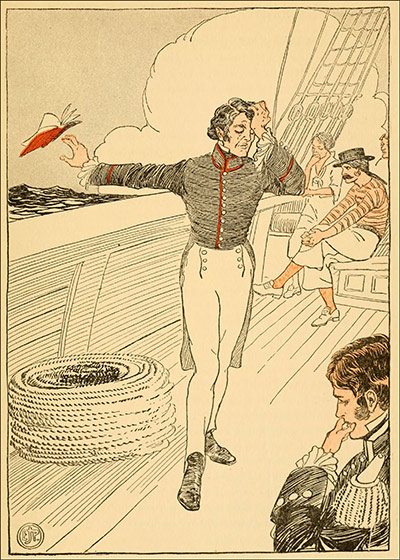
He Flung the Book into the Sea
Nolan wore his uniform, but with plain buttons. He always had a sentry before his door, but the men were as good to him as his sentence permitted. No mess wanted to have him with them too steadily because they could never talk about home matters when he was present—more than half the talk men liked to have at sea. They took turns inviting him to dinner, and the captain always asked him on Mondays. He could have any books or papers not printed in America. Newspapers having any mention of America had to be gone over and the allusions cut out. He used to join the men as they were reading on deck and take his turn in reading aloud.
Once when they were cruising around the Cape of Good Hope, somebody got hold of Scott’s “Lay of the Last Minstrel,” which was then new and famous. Nolan was reading to the others when he came to this passage:
“Breathes there the man with soul so dead Who never to himself hath said, This is my own, my native land! Whose heart hath ne’er within him burned, As home his footsteps he hath turned From wandering on a foreign strand? “If such there breathe, go, mark him well; For him no minstrel raptures swell; High though his titles, proud his name, Boundless his wealth as wish can claim,— Despite those titles, power and pelf, The wretch, concentred all in self”——
Here the poor fellow choked, and could not go on, but started up and flung the book into the sea and fled to his stateroom. It was two months before he dared join the men again.
There was a change in Nolan after this. He never read aloud again, unless it was the Bible or Shakespeare, or something else he was sure of. He was always shy afterwards and very seldom spoke unless spoken to, except to a very few friends. He generally had the nervous, tired look of a heart-wounded man. Sometimes he tried to trap people into mentioning his country, but he never succeeded; his sentence was too well known among the men who had him in charge.
There was only one day on which, perhaps, he was really happy, except when he knew his lonely life was closing. Once, during the war of 1812, the ship on which he was staying had a fight with an English frigate. A round shot from the enemy entered one of the ports and killed the officer of the gun himself and many of the gun’s crew. Now you may say what you choose about courage, but that is not a nice thing to see. But, as the men who were not killed picked themselves up, and as they and the surgeon’s people were carrying off the bodies, there appeared Nolan, in his shirt sleeves, with the rammer in his hand, and, just as if he had been the officer, told them off with authority—who should go to the cock-pit with the wounded men, who should stay with him—perfectly cheery, and with that way which makes men feel sure all is right and is going to be right. And he finished loading the gun with his own hands, aimed it, and bade the men fire. And there he stayed, captain of that gun, keeping those fellows in spirits, till the enemy struck—sitting on the carriage while the gun was cooling, though he was exposed all the time,—showing them easier ways to handle heavy shot—making the raw hands laugh at their own blunders—and when the gun cooled again, getting it loaded and fired twice as often as any other gun on the ship. The commodore walked forward by way of encouraging the men, and Nolan touched his hat and said:
“I am showing them how we do this in the artillery, sir.”
“I see you are, and I thank you, sir,” the commodore said; “and I shall never forget this day, sir, and you never shall, sir.”
And after the whole thing was over, and he had the Englishman’s sword, in the midst of the state and ceremony of the quarter-deck, he said:
“Where is Mr. Nolan? Ask Mr. Nolan to come here.” And when Nolan came, he said:
“Mr. Nolan, we are all very grateful to you; you are one of us to-day; you will be named in the despatches.”
And then the commodore took off his own sword of ceremony, and gave it to Nolan, and made him put it on. Nolan cried like a baby, and well he might. He had not worn a sword since that infernal day at Fort Adams. But always afterwards on occasions of ceremony, he wore that quaint old French sword of the commodore’s.
The commodore did mention him in the despatches, and asked that he might be pardoned. He wrote a special letter to the Secretary of War. But nothing ever came of it.
At another time Nolan went with a young officer named Vaughan to overhaul a dirty little schooner which had slaves on board. Nolan was the only one who could speak Portuguese, the language used by the slavers. There were but few of the negroes. Vaughan had their handcuffs and ankle-cuffs knocked off and put these on the rascals of the schooner’s crew. Then Nolan told the blacks that they were free, and that Vaughan would take them to Cape Palmas.
Now, Cape Palmas was a long way from their native land, and they said, “Not Palmas. Take us home, take us to our own country, take us to our own pickaninnies and our own women.” One complained that he had not heard from home for more than six months. It was terribly hard for Nolan, but he translated these speeches, and told the negroes Vaughan’s answer in some fashion.
“Tell them—yes, yes, yes!” Vaughan said. “Tell them they shall go to the Mountains of the Moon, if they will. If I sail the schooner through the Great White Desert, they shall go home!”
And then they all fell to kissing Nolan, and wanted to rub his nose with theirs.
As they were being rowed back to the ship, he lay in the stern sheets and said to a young midshipman of whom he was very fond:
“Youngster, let that show you what it is to be without a family, without a home, and without a country. And if you are ever tempted to say a word or do a thing that shall put a bar between you and your family, your home, and your country, pray God in His mercy to take you that instant home to His own heaven. Stick by your family, boy; forget you have a self, while you do everything for them. Think of your home, boy; write, and send, and talk about it. Let it be nearer and nearer to your thought, the farther you have to travel from it; and rush back to it when you are free, as that poor black slave is doing now. And for your country, boy,” and the words rattled in his throat, “and for that flag,” and he pointed to the ship, “never dream a dream but of serving her as she bids you, though the service carry you through a thousand hells. No matter what happens to you, no matter who flatters you or who abuses you, never look at another flag, never let a night pass but you pray God to bless that flag. Remember, boy, that behind all these men you have to do with, behind officers, and government, and people even, there is the country herself, your country, and that you belong to her as you belong to your own mother. Stand by her, boy, as you would stand by your mother, if those devils there had got hold of her to-day!”
And then Nolan added, almost in a whisper, “Oh, if anybody had said so to me when I was of your age!”
Years passed on, and Nolan’s sentence was unrevoked, though his friends had more than once asked for a pardon.
The end came when he had been upwards of fifty years at sea, and he asked the ship’s doctor for a visit from Captain Danforth, whom he liked. Danforth tells us about Nolan’s last hours and calls him “dear old Nolan,” so we know his love was returned.
The officer saw what a little shrine poor Nolan had made of his stateroom. Up above were the stars and stripes, and around a portrait of Washington he had painted a majestic eagle, with lightnings blazing from his beak and his foot just clasping the whole globe, which the wings overshadowed. Nolan said, with a sad smile, “Here, you see, I have a country!” Over the foot of the bed was a great map of the United States, drawn from memory, which he had there to look upon as he lay in his berth. Quaint old names were on it, in large letters: Indiana Territory, Mississippi Territory, and Louisiana Territory.
“Danforth,” he said, “I know I am dying. I cannot get home. Surely you will tell me something now? Stop! Stop! Do not speak till I say what I am sure you know, that there is not in this ship, that there is not in America—God bless her!—a more loyal man than I. There cannot be a man who loves the old flag or prays for it as I do. There are thirty-four stars in it now, Danforth. I thank God for that, though I do not know what their names are. There has never been one taken away. I thank God for that. But tell me something—tell me everything, Danforth, before I die!”
Captain Danforth, in writing about it afterwards says: “I felt like a monster that I had not told him everything before. Though obeying orders, who was I that I should have been acting the tyrant all this time over this dear, sainted old man, who had expiated, in his whole manhood’s life, the madness of a boy’s treason.”
“Mr. Nolan,” he said, “I will tell you everything you ask about.”
Then he told him the names of all the new states, and drew them in on the map. He told him of the inventions—the steamboats, the railroads and telegraphs; he tried to tell him all that had happened to the great and growing country in fifty years. He told him about Abraham Lincoln, who was then President—except that he could not wound his friend by mentioning a word about the cruel Civil War which was then raging.
Nolan drank it in and enjoyed it more than we can tell. After that he seemed to grow weary and said he would go to sleep. He bent Danforth down and kissed him, and then said, “Look in my Bible, Captain, when I am gone.”
Danforth went away with no thought that this was the end. But in an hour, when the doctor went in gently, he found Nolan had breathed away his life with a smile.
They looked in his Bible, and there was a slip of paper at the place where he had marked the text:
“They desire a country, even a heavenly: wherefore God is not ashamed to be called their God: for He hath prepared for them a city.”
On this slip of paper he had written:
“Bury me in the sea; it has been my home, and I love it. But will not some one set up a stone for my memory at Fort Adams or at Orleans, that my disgrace may not be more than I ought to bear? Say on it:
‘In Memory of Philip Nolan Lieutenant in the Army of the United States.
He loved his country as no other man has loved her; but no man deserved less at her hands.’”
XXXIII YOUR FLAG AND MY FLAG
WHEN the story was finished the Story People did not applaud; they felt sorry for poor Philip who had repented so bitterly.
Mary Frances felt sad, and sorry, too; as she did every time she heard the story, for she had often heard it before.
“How Americans love their country!” said the Story King. “They must love it as much as we love our island!”
“Indeed, they do love it,” answered Mary Frances patriotically. “I think it’s the greatest big country in all the world!”
The Story People smiled and clapped their hands at this speech, for they admire loyalty wherever shown.
“Yes, it is,” said the Story Queen, “and we think our island is the greatest little country in all the world.”
“So it is! Indeed, it is! I love it next to my own!” cried Mary Frances; and the Story People applauded again.
“There is a little poem about the Stars and Stripes that is very popular in America,” said the Story Lady, smiling. “Now that the stories are finished for the day, perhaps our guest will recite it for us.”
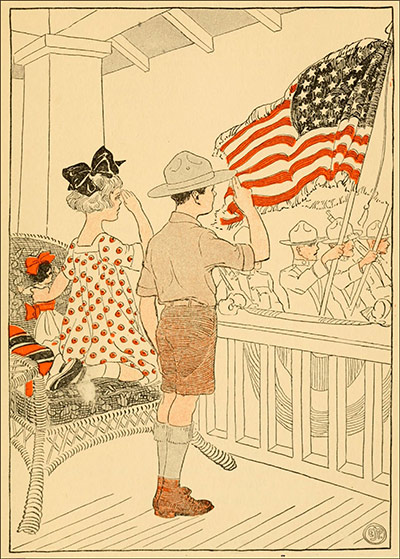
Your Flag and My Flag
Mary Frances blushed, and then rose in her place and recited:
Your flag and my flag, And how it flies to-day In your land and my land And half a world away! Rose-red and blood-red The stripes forever gleam; Snow-white and soul-white— The good forefathers’ dream; Sky-blue and true-blue, with stars to gleam aright— The gloried guidon of the day; a shelter through the night. Your flag and my flag! And, oh, how much it holds— Your land and my land— Secure within its folds! Your heart and my heart Beat quicker at the sight; Sun-kissed and wind-tossed— Red and blue and white. The one flag—the great flag—the flag for me and you— Glorified all else beside—the red and white and blue! Your flag and my flag! To every star and stripe The drums beat as hearts beat, And fifers shrilly pipe! Your flag and my flag— A blessing in the sky; Your hope and my hope— It never hid a lie! Home land and far land and half the world around, Old Glory hears our glad salute and ripples to the sound.[C]
As Mary Frances sat down, the Story People clapped their hands enthusiastically; and the Ready Writer handed her her copies of the stories for the day. The copy of the poem which he had made, he kept for themselves.
As Mary Frances and the Story Lady were going out, the Story Queen stopped them and said:
“We shall expect you both to dinner to-night—just a little family party, you know.”
“Oh, thank you, that will be delightful,” both replied.
Mary Frances thought ruefully of her best dress hanging uselessly in the closet at home and wished she had it. “But it’s no use wishing,” she thought. “It’s all so unexpected.”
However, with the help of the Story Lady, she was arrayed for the occasion, and when she saw herself in the mirror she said, “There must be two of us; that doesn’t look like me.”
But it was she. So when they left their apartments and went downstairs into the dining-hall, she was in very high spirits.
Mary Frances had eaten many dinners, but never one like that. Yet, strange to say, she doesn’t remember what she ate. But she does remember how kind and friendly the Story King and Queen were, and how they plied her with questions about her own country. She thinks, perhaps, she bragged a little too much in telling of its wonders, but she excuses herself to herself, thinking, “Well, my country is worth bragging about, I’m sure.” During a lull in the conversation, Mary Frances asked the King, “Won’t you tell me where all the stories come from?”
“With pleasure,” he replied. “They come from all countries. The world is full of people who are doing brave and noble deeds, and when we hear of such deeds, we have them written down and pass them on.”
“Of course,” he added, “there are other people who are doing cowardly and selfish things, but we don’t bother with them, except to punish them as we did the pirate. We see to it that no good story is ever lost; that is why we were so concerned about the lost story.”
“You can see,” said the Queen, “that it keeps us pretty busy.”
“Indeed, it must,” returned Mary Frances. “I think it’s very kind of you to let me visit you.”
“Dear child,” said the Queen, “we shall make a story about it—several stories——”
“Yes, delightful stories,” interrupted the Story Lady, “and I shall tell them! Oh, yes, I shall tell them!”