STORIES TOLD THE FIRST DAY
Reading edition
MISCHIEVOUS ANNA AND PETER.—DIAMONDS AND TOADS.—THE MAGIC NECKLACE.—THE CAT AND THE CARROTS.—THE BRAHMIN, THE TIGER, AND THE JACKAL.—THE RED DRAGON.—TWO POEMS.—TINY’S ADVENTURES IN TINYTOWN.—MORE ADVENTURES.
STORIES TOLD THE FIRST DAY
XI MISCHIEVOUS ANNA AND PETER
NOW, you must know that the Story People met at a certain hour every day to hear and to tell stories, new and old; for, as you may well believe, it is no small task to provide stories enough to feed the story-hungry children of the world.
Accordingly, when all were assembled, the Story King in his place, and Mary Frances in the seat of honor beside the Story Queen, the Story Lady began to tell the story of Mischievous Anna and Peter.
* * * * * *
Anna and Peter were always in mischief. One day they climbed to the top of a high wall. It was a fairy wall, and it grew higher and higher, until at last it went so high that they got frightened, for they did not know how they should get down again. So they held tight by each other and the wall, and began to cry.
But no one heard them. For they were far away from home; besides, they were as high up in the air as the top of a mountain.
“Oh! oh! oh!” sobbed Anna.
“Oh! oh! oh!” sobbed Peter.
And their eyes were red and their faces quite wet and dirty.
“I shall fall,” said Peter.
“I can’t hold on much longer,” said Anna. And then they both sobbed “Oh! oh! oh!” again.
Then they heard a voice saying, “Oh! oh! oh!” after them. Only it was not any one crying, for the “oh! oh! oh!” had a very sweet sound.
They could not look round, for they dared not move their heads, and they dared not look down for fear of getting dizzy. But the voice seemed to be coming nearer. And so it was, for a fairy gate, with a tree beside it, and a little bit of ground to stand upon, was shooting up into the air just as the wall had done. And when it was as high as the wall it stopped, and Peter and Anna saw that a boy was leaning against the gate. He was playing on a whistle-pipe, and that made the sound they had heard.
“I will play you a tune,” said the boy. And he played so softly and sweetly that Peter and Anna left off crying.
“How did you come up?” asked Anna.
“On the gate,” said the boy.
“How are you going down?” asked Peter.
“On the gate, to be sure,” said the boy; “I have only to say—
“Gate, gate, let me go Far down to the earth below.”
And as he said the words, down he went.
“Let us also try,” said Anna.
“Wall, wall, let us go Far down to the earth below.”
Then down went the wall to the ground, and Peter and Anna slid off, and stood staring at the boy, who was still playing on his pipe.
“What do you want most?” asked the boy. “My pipe will bring anything I ask for.”
“A silk frock with a flounce and a sash, and a bonnet with blue ribbons,” said Anna, who was fond of fine clothes.
“A new suit and pair of leather reins to play at horses with,” said Peter.
The boy played a lively tune, and before Anna could say “ready,” she found herself dressed in a fine new frock; while Peter had the reins in his hands, and a new suit of clothes with a great frill and a round hat.
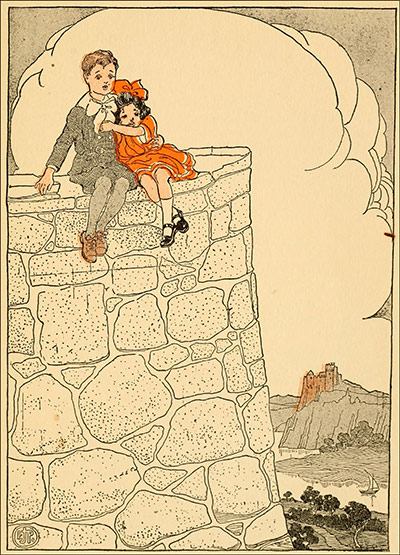
They were as High Up in the Air as the Top of a Mountain
Then the boy said “Good-by,” and Peter and Anna went towards home.
“I will go this way,” said Peter.
“I will go that,” said Anna.
So they parted.
Anna, as she walked along, heard little feet behind her; and when she reached the steps leading to her home she looked round, and what was her surprise when she saw a large mouse dressed like a lady, with a parasol in its hand.
“I am the Countess Mouse Coming to your house; With you I’ll stay Every day,”
said the mouse.
Now Anna was afraid of mice, and she said, “But I do not want you; besides, we have a large cat that will eat you up.”
“No, it will not; I am a fairy mouse, and can eat up the cat if I please.”
Anna was much frightened; this was truly a dreadful mouse.
“Go away! Oh, go away!” she said.
“No,” answered the mouse; “as long as you wear my clothes I shall stay with you and take care of them.”
“They are not yours,” said Anna; “a boy with a whistle-pipe gave them to me.”
“But he piped to me for them,” said the mouse; “I have wardrobes full in my castle. You are quite welcome to them; but I must see that you do not spoil them. I shall sit by you at dinner, and play with you, and walk out with you, and sleep on your pillow at night.”
“Oh dear! oh dear!” said Anna; “I wish I had never asked for a silk frock and bonnet.”
“Shall I take them back?”
“Oh yes! oh yes! please, Countess Mouse, Take them all back to your house.”
“Well, as you have made a rhyme, I will do so,” said the mouse, and she slapped Anna’s arm sharply with her parasol. Then Anna’s new clothes fell off, and she found herself in her old cotton dress again. And the mouse grew larger and larger, and ran away to her castle with the silk frock and the grand bonnet.
Now while this was happening to Anna a queer-looking man in a peaked hat and long overcoat said to Peter, “Shall I be your horse?”
“Yes,” said Peter. And the man took the reins, and they went along merrily enough.
When they were close by his home, Peter said, “I am going in here.”
But the man said—
“No, no, you are going with me; These are my reins, you cannot get free.”
“They cannot be yours,” said Peter; “a boy with a whistle-pipe gave them to me.”
“Ah, but he got them from me! I am a saddler, and have hundreds of them. And I want some little boys to help me to make more.”
“I don’t want to go,” said Peter.
But he could not loose the reins, and the man pulled him along faster and faster.
“Oh! oh! oh! I should be glad If these reins I hadn’t had,”
said Peter.
“As you have made a rhyme,” said the man, “I’ll take them back, and you may go home.”
Then the man hit Peter sharply with one end of the reins, and his new suit fell off, and he found himself in his old pinafore.
Then Peter went home and told Anna what had happened to him; and Anna told Peter all about the mouse, and they both thought that they had had a lucky escape.
Just then the boy with the pipe came down the street. And the pipe played these words—
“Keep out of mischief; you never know What may come to cause you woe; What you may think is very good fun, May give you trouble before you’ve done.”
Then the boy turned round the corner of the street, and Anna and Peter never saw him again.
* * * * * *
“My, but the mouse must have looked cunning!” Mary Frances said. “Thank you for telling me that story. I—I wish——”
“Would you like to hear another—about Isabella and her cruel stepsisters?” asked the Story Lady.
“I should love to hear it!” replied Mary Frances.
The story people smiled and nodded, and the Story Lady proceeded.
XII DIAMONDS AND TOADS
ONCE upon a time there was a dear little girl named Isabella. She lived with her father, and her stepmother, and her two stepsisters.
Isabella was a pretty child and had sweet manners. Her stepsisters were not pretty, and they and their mother were jealous of Isabella.
They seldom spoke kindly to her; they made her do the hard work of the home, and treated her in a harsh manner, very much as Cinderella’s stepmother and stepsisters treated Cinderella.
One of her hard duties was to fetch the water for the household from the well just outside the village.
It was quite a long walk to the well, and after Isabella had worked all the morning, cooking, and washing the dishes, and washing and ironing, or sweeping, she felt sometimes that she was too tired to go so far and carry home such a heavy load.
One day after washing and ironing, she said, “I wish one of you girls would go with me to the well to-day, and help me bring back the water. I am so tired.”
“Indeed, they shall not!” exclaimed her stepmother angrily. “What do you think—that my daughters shall wait on you?”
“I do not care to get tanned in the sun,” yawned one.
“I do not wish my hands to look as though I work,” said the other haughtily.
So Isabella set out alone. She sat down to rest several times on her way, but after a while she reached the well. It was an old-fashioned affair, and had a moss-covered bucket on a long chain which wound on a roller. It was not hard work to drop the bucket down the well, but it was hard work to turn the handle of the roller until the dripping bucket reached the top. It was still harder work to empty the bucket into the pail she carried.
This day, when Isabella came to the well there was an old woman sitting on the well-curb. She was a wretched-looking old woman. She wore an old shawl about her head and shoulders.
When she saw Isabella she said, “Good-morrow, little maid.”
“Good morning,” said the little girl. “How do you do?”
“I should do very well, thank you,” said the old woman, “if I had a drink of water.”
“That you shall soon have,” said Isabella, forgetting her own tiredness because she felt sorry for her.
Isabella soon had the well bucket up, filled her pail, and then held it so that the thirsty woman could drink out of the side. She drank long and eagerly.
“Thank you,” she said at length. “Dear child, you will never be sorry for your kindness;” and she rose and walked away.
Isabella threw away the rest of the water, and after refilling her pail, set out for home.
When she reached the house, her stepmother said, “You are late! Where have you been?”
Isabella opened her mouth to answer—and what do you think happened? Out fell diamonds and roses.
Quickly the stepmother called her daughters and they began to sweep them up.
“Where have you been?” cried the stepsisters. “What has happened to you?”
Isabella tried to think what could have brought such a thing about, for she was as much surprised as any of them, but she could not think of anything unusual except the meeting with the old woman.
“Speak!” demanded her stepmother. “Are you trying to hide something from us?”
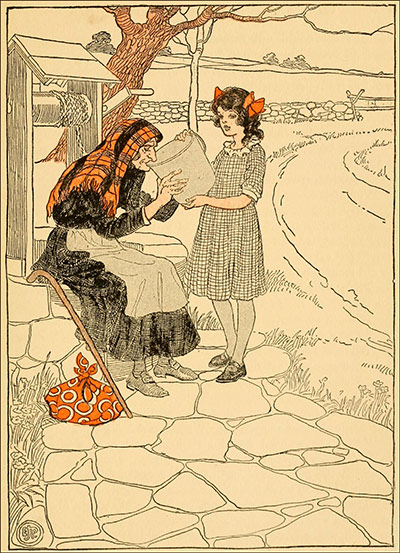
She Drank Long and Eagerly
Isabella said that she had met a strange old lady at the well, but that she could not remember anything else that had not happened every time she had gone for water.
Every once in a while as she was speaking diamonds and roses fell from her mouth.
“You need not go for the water the next time,” said her stepmother. “I shall send my own girls.”
The next day the two stepsisters went to fetch the water.
When they came to the well, there sat the old ragged woman on the curb.
“Good-morrow, young maidens,” said the old woman.
The stepsisters just stared at her.
“My, it is a warm day,” said the old woman, “and I am very thirsty. Will you give me a drink of water?”
“Indeed, we will not!” said the older one haughtily.
“The very idea!” exclaimed the younger one, looking at the old woman’s ragged clothes. “I should think not!”
Then they drew the water, all the time complaining and groaning about the hard work.
When they started to go home, the old woman spoke.
“You are not kind,” she said, “you will be sorry.” But they only laughed and hurried away.
Their mother met them at the door.
“Well, my dears,” she said, “how fared you? Did you meet any good fortune?”
“All we saw was an old woman at the well—such a ragged, wretched old thing she was, too!” answered one girl.
“And she wanted us to give her a drink of water. The idea!” the other girl said at the same time.
With the last words, out of their mouths fell several snakes and toads, which went scudding across the floor.
Their mother screamed and, gathering her skirts about her, jumped on a chair.
“Oh, where have you been?” she cried. “What has happened to you?”
And when the girls told her that they did not know, more snakes and toads fell from their mouths.
“This is an outrage!” exclaimed their mother. “Isabella has formed some terrible plot against you. She is to blame! Go bring her here, and I shall punish her. I shall whip her until she tells us the charm she has found.”
The girls ran out, and soon came back dragging Isabella between them.
Just as they reached their mother a bright light appeared in the room, and suddenly a beautiful fairy stood before them.
“Do not touch Isabella!” she said to the stepmother. “She is not in the least to blame for your children’s misfortune. Their cruel fate is their own fault. When I met Isabella at the well and asked her for a drink of water, she gave it to me gladly and willingly, but when I met your daughters and asked them for a drink they treated me proudly and unkindly.”
“You!” exclaimed the stepmother, looking upon the radiant creature with her shining fairy robes about her. “Met you, and would not give you a drink of water!”
The fairy smiled. “Ah, yes; it was I, but I did not look then as I now do. I was the ragged old woman at the well.”
“If they had known it was you—” said the stepmother.
“If they had known it was I,” the fairy said, “how could I have judged whether they were kind of heart, and polite to old people, and helpful to people in need?”
“When I met Isabella,” the fairy went on, “I looked just as when I met your daughters, and she was very polite and kind to me, and gave me a drink, holding the pail while I drank, even though she was very tired. Because only polite and kind words came from her mouth, I gave her a good fairy gift, and because only impolite and unkind words came from the mouths of your daughters, I gave them another kind of gift.”
“Oh, please take back the one you gave them,” pleaded the mother.
“Do you mean Isabella’s gift, too?” asked the fairy.
“Oh, no,” the mother said. “Let her have her gift—but please, please take away the awful gift of my daughters!”
“Let me see,” said the fairy, “what Isabella says about that. Shall I take back the gift of your stepsisters, my dear?”
“Oh, please, please do!” cried Isabella. “I am so sorry that they are unhappy.”
“Very well, then,” said the fairy. “For Isabella’s sake, I shall take their gifts back, but only on one condition—that they promise to be kind and polite from now on.”
“Oh, we promise! We promise!” cried both stepsisters at once.
“Unless you keep your promise,” said the fairy, “the snakes and toads will come from your mouths again.” And the fairy disappeared as suddenly as she had come.
But the snakes and toads did not come again, for the stepsisters and their mother were very kind to every one ever after, and Isabella lived a happy life from that day.
* * * * * *
“They just had to keep their promise, didn’t they?” commented Mary Frances. “I am glad they did, for I do not like people to break promises.”
“Neither do I,” agreed the Story Lady; “and that reminds me of one of our favorite stories—Coralie and the Magic Necklace.”
“Oh,” said Mary Frances, “but I like a story with magic in it.”
“Very well,” said the Story Lady, “I will tell you the story.”
XIII THE MAGIC NECKLACE
ONCE there was a girl whose name was Coralie. She was a very pretty girl, and very clever. She was so bright in her lessons at school that all she needed to do was to read them over once, and she knew them.
She lived in a pretty home, and was a great pet. Her parents loved her dearly, and although they were not well off, they gave Coralie everything she wished for that they could afford. So, you see, she had all the comforts of life, if not the luxuries.
You would think she would have been a very happy child, wouldn’t you? Well, she would have been if she had not had one very dreadful fault. Sometimes she told only half the truth; sometimes she told only quarter the truth; sometimes she stretched the truth so far that she broke it.
Her parents did everything they could to cure her of her dreadful fault, but everything failed. Even being in her room for a whole day with only bread and butter and milk did not help her. At last they became almost desperate.
One evening, after Coralie had gone to bed, her father said, “There is only one thing left, I suppose. We must take Coralie to the magician, Merlin.”
“Yes,” replied her mother with a sigh, “it is the only thing I can think of. You need not go, dear husband, for it will mean the loss of several days’ work. I will take her myself. We can start to-morrow morning.”
So in the morning, her mother and Coralie set out on their journey.
Now, the enchanter, Merlin, knew untruthful people even a long way off. He could tell them by their odor. So as Coralie and her mother drew near his palace, which was built of frosted glass, he threw some incense on the fire to keep himself from becoming ill.
At length, Coralie’s mother rang the door bell, and Merlin himself came to the door. “Good afternoon,” he said.
“Good afternoon,” replied Coralie’s mother; “we have come a long distance to see you, sir, because——”
Merlin raised his hand. “I know all about the reason,” he said. “You have come to see me because you cannot make your daughter tell the truth. She is one of the most untruthful children that ever lived. I know, because her lies often make me ill. When I smelled her coming, I had to burn incense;” and he frowned terribly.
You can imagine how this frightened Coralie. She hid behind her mother. Her mother seemed frightened, too.
“Oh, sir,” she begged, “please deal as gently with her as you can. We love her so dearly. We are so grieved that we cannot cure her our own selves.”
“Do not fear,” answered the magician. “I am not going to hurt her. All that I wish to do is to make her a present.”
So he invited them into the palace, and led the way to his workroom. All the woodwork in the room was light green. The windows were studded with red and blue and green jewels, and they threw rainbow colors on the floor.
Merlin went to a golden table, and, opening a drawer, took out a beautiful amethyst necklace, with a diamond clasp. He threw the necklace around Coralie’s neck.
“That is all,” he said to her mother. “You may go. I am going to lend my magic necklace of truth to Coralie. I shall come for it in one year.” Then he turned to Coralie, and said, “Do not take it off. If you do, great harm may come to you. Good-by,” and he clapped his hands twice.
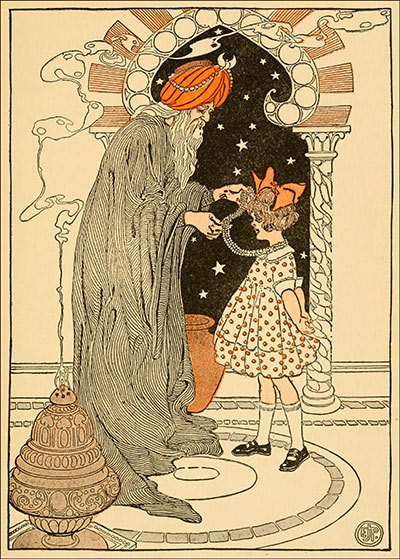
He Threw the Necklace Around Coralie’s Neck
Two slaves appeared, and after bowing before Merlin, showed Coralie and her mother to the door.
Coralie, of course, was delighted with the necklace. All her life long she had wished for jewelry, but her parents could not afford to get her anything but the pretty seal ring which she wore. As to getting such a necklace as Merlin had given her, it would have taken everything they owned in the world to so much as buy the diamond clasp.
When she went back to school, the girls all gathered about her and began to admire the necklace.
“Isn’t it beautiful!” they exclaimed. “What a lucky girl! Your people must have fallen heirs to a fortune!”
“Isn’t it pretty!” said Coralie, lifting the sparkling string for them to see better. “Yes, my father and mother gave it to me. You see, I have been ill, and they were so glad when I got well that they gave me this for a present.”
“Oh! Oh! Oh!” cried the girls.
And no wonder they did, for all the sparkle left the necklace, and it looked dull and old and scratched.
“What is the matter?” asked Coralie. “Don’t you think my parents could give it to me? They bought it, and paid an immense sum for it.”
At that falsehood, the necklace turned from the light purple amethyst color to a dull gray agate, and the diamond clasp to a mud-color shade. Then Coralie saw what had happened, and she was frightened.
“No,” she said, “they did not give it to me. We went to the magician, Merlin, and he lent it to me.”
At these truthful words, the necklace became as beautiful as ever. But the children began to laugh.
“What are you laughing at?” asked Coralie. “You needn’t make fun. Merlin was very glad to see us. When he saw us in the distance he sent his carriage to meet us. It was drawn by two fawn-colored horses, and the coachman wore livery. There was a great feast spread for us, and each of us had a servant in back of our chairs. We had golden plates to eat from, and——”
Suddenly Coralie stopped speaking, for the children were laughing at her harder than ever. She looked down at her necklace. No wonder they laughed. It was dull again in color, and had grown so long it rested upon the ground.
“Ho, ho, Coralie!” cried one. “Come, now! You are stretching the truth! Set us right!”
“Well,” confessed Coralie, “Merlin didn’t send any one to meet us. We walked, and we were in his palace only a little while.”
At these words, the necklace shrank to its right size, and resumed its own beautiful color.
“But now, Coralie,” cried the children, “but now tell us truly where you got the necklace. Did the magician give it to you?”
“Yes,” said Coralie, “he just handed it to me without saying a word. I think he——”
She did not finish the sentence, for the necklace had suddenly grown so tight that it was choking her, and she was gasping for breath.
“Come, come, Coralie!” cried one of the girls. “You are keeping back part of the truth! Tell the truth! What happened?”
“He said I was one of the most untruthful persons in the world,” admitted Coralie; and the necklace became itself again.
And so things kept on. Every time Coralie tried to say one untruthful thing, the necklace behaved in some queer, frightful way. Even the children became sorry for her, for she began to look worried all the time.
“If I were you, I’d take the necklace back,” one of the girls told her. “It gives you no happiness at all.”
“Indeed it doesn’t,” said Coralie, “I wish I——”
“Why don’t you take it back?” the girl asked.
Now, Coralie did not wish to tell her, and kept still, for she was wondering what she could possibly say; but the necklace began to act wildly. The stones began to dance up and down so hard that they hurt her.
“Merlin told me I must not take it off,” she said. “If I should do so, great harm would come to me. He is coming for it when I’ve worn it for a year.”
And the necklace shone just a little more brightly than before, and the diamond clasp sparkled so that it would have dazzled your eyes to look at it.
And after that Coralie began to lose the worried look, for the telling of the truth was beginning to be a habit with her. The necklace very seldom had to remind her, for every day it grew easier for her to tell the truth.
And when Merlin came for his necklace, he brought her a far more beautiful gift than the necklace, but it was one that she could not wear showily. It was a necklace of pearls, pearls of great price which she wore just over her heart. You see, Merlin needed his magic necklace for another child who did not tell the truth.
Nobody knows where the magic necklace is to-day; but if I were a child in the habit of telling falsehoods, I should not feel quite sure that it would not be found again.
* * * * * *
“Will it?” asked Mary Frances, as the Story Lady finished the story.
“It may be,” said the Story King. “I have an idea where it is. Why? Do you know any children who do not speak the truth?”
“I—I am sorry to say that I do,” Mary Frances said. “I do not know many, though. I know two who do not always tell the truth; and I know one child who isn’t kind to her pet cat. I wish I knew a story to tell her when I go home.”
“All right, perhaps you would like to hear the story of Linda.”
“Please tell it to me?” she asked.
So the Story Lady told the story of “The Cat and the Carrots.”
XIV THE CAT AND THE CARROTS
LINDA was a little girl who rarely thought of any one but herself. She would take the warmest place by the fire and the largest piece of cake on the dish, or the finest apple or pear; and she would take away the toys from the other children, and did not care for anything as long as she was amused herself.
Her mother was very sorry to see that Linda was selfish, and used to talk very seriously to her about it, and to tell her that no one would love her if she did not mend her ways.
But Linda did not care, and she did not believe what her mother said.
“You will always love me, Mother,” said she.
“Perhaps so,” said her mother; “but then you are my own little girl, and it is my duty to take care of you. Besides, I shall be very sorry for you, because you will be very unhappy. But no one else will care for you. Every one will dislike you because you are selfish—every one in the world.”
Linda did not say anything, but the words “every one in the world” came into her head many times during the day, and at night they came into her dreams, and she fancied she saw the words written in letters of fire, from which the flames shot up in all directions, and she was saying half aloud, “The bed will be on fire,” when a voice said—
“But you are not in bed, you are in the farmyard.”
Then she looked round, and saw that she was near the barn, and that there was a ladder not far off, and a great barrel close by. Also there was a heap of carrots, which Linda began to toss about, and to snap in two, and to pull the leaves off; and at last she was throwing them all into the duck-pond, when a voice suddenly said, “Stop!”
Linda looked round, but no one was to be seen.
“Stop!” said the voice again.
Then Linda looked down, and seated upon a stone she saw a carrot whose green top-knot of leaves she had broken off. Two little legs and two little arms had sprouted out, and it had eyes and a mouth, but no nose.
“Have you no feelings?” said the carrot. “Is it not enough to be taken from my home in the earth, without being knocked about and flung into a duck-pond? How would you like it?”
“I’m not a carrot,” said Linda.
“You don’t care for any one but yourself,” replied the carrot, growing redder and redder; “no one likes you, not even carrots, and you will find that some day people will pay you back for being so selfish. I am going to begin at once. Come carrots, carrots, carrots!” he shouted.
“In and out Whirl about; Pinch and beat her; Let her know Selfishness will bring her woe; Come at once and greet her.”
Then suddenly all the carrots that were lying about sprang up, and those that were in the duck-pond sprang out of it. They were joined by those in the gardens near, and they came trooping along like an army. They could walk as well in the air as on the ground; and they whirled around Linda and pulled her hair and pinched her arms, till she cried aloud for mercy.
“Ho! ho! ho! only see What it is our foe to be,”
shouted the carrots, as they twirled up and down and round and round.
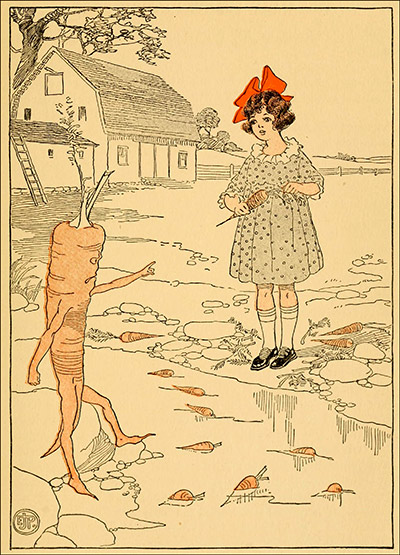
“Have You no Feelings?” said the Carrot
The air was full of carrots, and the ground was covered by them, and Linda made up her mind that if she ever got clear of them she would never meddle with a carrot again as long as she lived. She kept off their blows as long as she could, but at last she was too tired to do so any longer, and she sank down to the ground crying, “Oh, please leave off! please leave off!”
“We now have done, But we’ve had some fun,”
said the carrot who had first spoken to her.
“Carrots, depart,” said he, waving his hand.
The last carrot had said “Good-by,” but Linda had not spoken.
She waited till she thought he had gone, and then she looked up. The carrot certainly was not there, but a large cat was sitting beside her.
“Topsy, poor Topsy!” said Linda.
But Topsy put up her back, and her eyes looked very fierce.
“Poor Topsy, indeed!” said the cat, angrily; “don’t think to coax me, you never think of me in the house, you pull my whiskers and my tail, and you never give me a bit of meat, or anything nice that you are eating; and this morning, though I sat on the chair beside you, longing for a little new milk, you drank it all up—you did not leave me a drop. You are the most selfish little girl I know, and I don’t like you, so I am going to scratch you.”
“Oh dear! oh dear!” said Linda, “please don’t. The carrots have punished me till I am quite sore.”
“Cats, cats, one and all, Tabby, tortoise-shell, come when I call, Gray and yellow, black and white Cats and kittens, come hither to-night.”
called the cat loudly.
Ah! all the cats and kittens in the world must have come. So many! And they all thronged round her, and sat upon her shoulders, and clung round her arms.
“All the cats in the world hate you,” said Topsy.
“We do! we do! we do!” mewed the cats. “She never cares what becomes of poor cats and kittens.”
Then the cats tumbled over each other, and tumbled over Linda, and crowded round her and upon her, until she was sitting under a heap of cats, with only her face peeping out, and Topsy was crouching in front, looking fiercely at her.
“Now that you cannot stir,” said Topsy, “I am going to scratch you.”
“Oh! oh! oh!” shrieked Linda, and she gave such a start that all the cats fell down upon the ground; and at that moment she opened her eyes, and found herself in her bed, with her mother standing beside her.
“What is the matter?” asked her mother, for she had heard Linda scream.
“Oh! oh! oh!” sobbed Linda, “I have had such a horrid dream.”
“Well, it was only a dream. You are awake now, and I am with you.”
“Every one in the world hates me, even the cats and the carrots,” sobbed Linda, and bit by bit she told her mother all her dream.
“It was such a horrid dream, and I was so frightened,” said Linda, “I can’t think why it came.”
“I will tell you,” said her mother; “it came out of your own heart. You had been thinking of the words I said to you, that every one would dislike you but myself. I am glad that you have had this dream, for it shows me that my words have sunk into my little girl’s heart, and I hope now that she will try to improve.”
“I will try,” said Linda.
And she did try, and whenever she was inclined to do any selfish act she thought of her wonderful dream, and said to herself, “I should not wish all the world to be like the cats and the carrots.”
* * * * * *
“That’s a good story,” said Mary Frances to the Queen. “I shall try to remember it.”
“It is a good story,” replied the Queen, smiling; “but we have still better, as you shall hear.”
Here a page boy who sat on a stool at the foot of the Story Lady began to fidget, as if to ask a question.
“Well, what is it, Roland?” asked the Story Lady.
“If you please, can’t we have a story about a boy?” answered Roland.
“Yes,” said the Story Lady; “you shall have two stories—one about a tiger, and the other about a page boy who killed a dragon.”
XV THE BRAHMIN, THE TIGER, AND THE JACKAL
ONCE upon a time a Brahmin, who was walking along the road, came upon an iron cage in which some men had shut up a great Tiger.
As the Brahmin passed by, the Tiger called out:
“O brother Brahmin, brother Brahmin, have pity on me, and let me out for only one minute! I am so thirsty I shall die unless I can have a drink of water.”
“I am afraid,” said the Brahmin, “that if I let you out you will eat me.”
“No, indeed,” said the Tiger. “As soon as I have had some water, I will go back to my cage.”
Then the Brahmin was sorry for the thirsty beast, and opened the cage door. Instantly the Tiger jumped out, and cried, “I will eat you first and drink the water afterwards.”
“Do not be in such a hurry,” said the Brahmin. “Let us ask the opinions of six, and, if they all say it is fair for you to kill me, then I am willing to die.”
“Very well,” said the Tiger, “we will ask the first six living things we meet.”
So they walked on till they came to a Banyan-tree, and the Brahmin said, “Banyan-tree, Banyan-tree, hear and judge.”
“Let me hear,” said the Banyan-tree.
“This Tiger,” said the Brahmin, “begged me to let him out of his cage to drink a little water and he promised not to hurt me. Now that he is free, he wishes to eat me. Is it fair that he should do so?”
Then the Banyan-tree said: “Men come to rest in my cool shade. When they have rested, they break my branches and scatter my leaves. They are a cruel race. Let the Tiger eat the man.”
“Tiger, Tiger,” said the Brahmin, “do not eat me yet. You said that you would hear the judgment of six.”
“Very well,” said the Tiger, and they went on their way. Soon they met a Camel.
“Camel, Camel,” cried the Brahmin, “hear and judge.”
“Let me hear,” said the Camel.
Then the Brahmin told his story.
“When I was young and strong and could work, my master took good care of me,” said the Camel; “but now that I am old, he starves me and beats me without mercy. Men are a cruel race. Let the Tiger eat the man.”
The Tiger would have killed the Brahmin then and there, but he said:
“Tiger, Tiger, do not eat me yet. You said that you would hear the judgment of six.”
“Very well,” said the Tiger, and they went on their way. Soon they saw an Ox lying near the road.
“Brother Ox, brother Ox,” cried the Brahmin, “hear and judge.”
“Let me hear,” said the Ox, and the Brahmin told his story.
“When I was young,” said the Ox, “my master was kind to me. Now that I am too old to work he has left me here to die. Men are a cruel race. Let the Tiger eat the man.”
They next saw an Eagle flying through the air, and the Brahmin cried:
“O Eagle, great Eagle, hear and judge.”
“Let me hear,” said the Eagle.
The Brahmin told his story, and the Eagle said:
“Whenever men see me, they try to shoot me; they climb the rocks to my nest and steal away my little ones. Men are a cruel race. Let the Tiger eat the man.”
Then the Tiger began to roar, but the Brahmin said, “Wait! we have yet two to ask.”
Soon they saw an Alligator, and the Brahmin told his story. But the Alligator said:
“Whenever I put my nose out of the water, men torment me. They are a cruel race. Let the Tiger eat the man.”
The Brahmin was now in despair, but the Tiger was willing to keep his word. And the sixth judge was a Jackal. Now the Jackal is a miserable little beast whom no one likes, but he listened to the Brahmin’s story.
“You must show me just where it was and how it happened,” said the Jackal.
So they all went back to the cage.
“I was here,” said the Brahmin, standing in the road.
“And I was in the cage,” said the Tiger.
“Which way were you looking?” said the Jackal; “and show me the side of the cage where you stood.”
“I was on this side,” said the Tiger, jumping into the cage.
“Oh, yes, I see,” said the Jackal. “And was the cage door shut?”
“Shut and bolted,” said the Brahmin.
“Then shut and bolt it,” said the Jackal.
When the Brahmin had done this, the Jackal said: “O wicked and ungrateful Tiger, you would have killed the good Brahmin who opened your cage door. Your cruelty shall be punished, for no one will ever let you out again. Go your way, friend Brahmin, and go in peace.”
* * * * * *
“Good for the jackal!” said Roland, clapping his hands. “Now for the dragon!”
So the Story Lady went right on.
XVI THE RED DRAGON
THERE lived in a marsh near a certain village, a red dragon which terrorized all the people round about; so the king of the country offered a great reward to any one who would kill the frightful beast.
A great many knights of the king’s army went out one after the other to slay it, and each came back with a wonderful tale of how he had fought with the dragon; and, after wounding it, had given up the fight only for fear of being slain by the monster.
“Never mind; you will have better success next time,” the kind king would say to each defeated knight. Then he would give him a valuable gift as a reward for his brave effort.
There was among the king’s pages a little boy who was a great butterfly hunter. The king’s librarian paid him a gold piece for every new butterfly he found.
This page was a great favorite of the king, and often rode with him on long journeys. One day when the king stopped in the neighborhood in which the dragon lived, the page boy slipped off with his net to hunt butterflies; and, in chasing a rare specimen, lost his way and wandered into the very swamp where the dragon was roaming about.
When the fierce old dragon saw the boy, he came rushing and roaring at him in a great rage. The frightened boy looked around; there were no trees to climb for safety, and he knew that if he ran he could not escape, for run as he might, the dragon could run still faster.
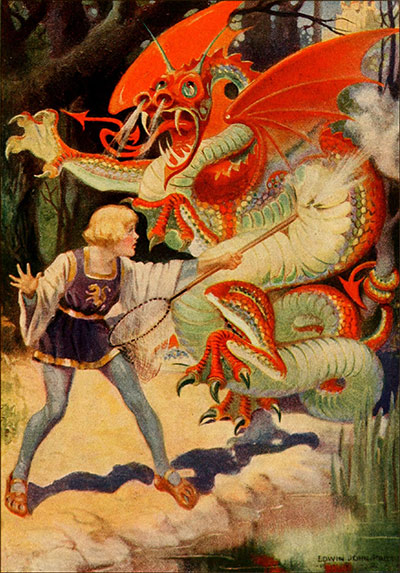
“Wow,” shrieked the Dragon
He had nothing with which to fight except his butterfly net. The net was fastened to the end of a long stout stick, and the boy decided to defend himself with this as best he could. When the monster charged down upon him, bellowing fearfully, he raised his stick and thrust it with all his might into the bulging side of the beast.
“Wow!” shrieked the dragon; and with a puff it went up in the air and burst, just as a balloon does when a hole is slashed in its cover.
The fierce old dragon was nothing but skin and air!
When he was sure it was quite dead, the boy grasped the empty dragon skin by its spiked tail, and dragged it back to the castle and showed it to the king. He was the maddest king you ever heard of when he saw the dead dragon lying there, and sent off at once for the bold knights who had pretended to fight it so bravely.
“You old humbugs,” he cried. “There lies the red dragon you bragged so much about fighting. It wasn’t a thing but skin and air. If any one of you had so much as touched it with the point of a sword, it would have gone to pieces, as it did when my brave page boy struck it with his butterfly net.”
The cowardly knights had no word to say. So the king ordered them to give the gifts they had received for fighting the dragon to the page boy, who was then so rich that he was able to buy a castle of his own. When he grew up, he was known as one of the bravest knights of that country.
XVII TWO POEMS
“THE page was pretty brave,” said Roland. “When I was little I used to be scared of the dark, and my mother taught me a poem about being brave.”
“Oh, say it for us, please!” cried a girl near him.
The boy shook his head in refusal, but Mary Frances gave him a smile and said, encouragingly, “Please, I want to hear it.”
Then Roland rose, made a bow, and recited his poem:
If I Could Crow
Sometimes I waken up at night, And cannot see a speck of light; I snuggle down into my bed, And pull the clothes in overhead. I look and peer into the dark, As something seems to whisper, “Hark!” Then, with an awful sudden jump, My heart begins to thump and thump. Oh, my, I think I’ll be so brave, And all my courage try to save; Then, as I feel my courage go, Our yellow rooster starts to crow. Then I’m ashamed, and feel so small To think that I’m not brave at all; To know that in the black, black night, Our rooster crows—no soul in sight. He flaps his wings and crows for fair; His voice sounds like he didn’t care— Oh, well, what if I’m scared—I know I’d be brave, too, if I could crow!
Just at this point the cat came bouncing into their midst.
“I have just time enough,” he said, breathlessly; “if you are quite ready, I will begin.”
You should have heard the children shout!
“We are quite ready! Go on, Puss! Begin, please,” they cried.
So the cat made a bow, twirled his whiskers, and began:
The Twins[A]
There were two little kittens, a black and a gray, And grandmother said, with a frown: “It never will do to keep them both, The black one we better drown. “Don’t cry, my dear,” to tiny Bess, “One kitten’s enough to keep; Now run to nurse, for ’tis growing late, And time you were fast asleep.” The morrow dawned, and rosy and sweet Came little Bess from her nap; The nurse said, “Go into mother’s room, And look in grandmother’s lap.” “Come here,” said grandmother, with a smile, From the rocking-chair where she sat; “God has sent you two little brothers; Now what do you think of that?” Bess looked at the babies a moment, With their wee heads, yellow and brown, And then to grandmother soberly said, “Which one are you going to drown?”
As soon as he had finished, he waltzed around three times, turned a somersault, and bounded out of the circle as quickly as he had appeared.
When the Story People had stopped laughing the Story King rose and waved his hand and said:
“That will do for to-day; we must not tire our guest.”
“Oh, I am not tired,” said Mary Frances; “I could listen to such stories forever.”
“Dear child, I believe you love stories as much as we do,” said the Queen, smiling at her enthusiasm. “Well, you shall have a delightful surprise to-morrow.”
While the stories were being told, Mary Frances had noticed a little dried-up man, sitting at a table near the Story Lady, and writing rapidly with an immense quill pen. Before him was a pile of white paper and an inkwell. As she told the story he wrote it down, keeping even pace with her words. Mary Frances had never seen any one write so fast and she watched him, fascinated. Almost without an effort his pen flew over the paper, and as the last word of the story left the Story Lady’s lips his pen stopped. Then he folded his papers neatly and laid them on the table.
As Mary Frances was passing out with the Story Lady, this little man, much to her surprise, stepped up and handed her the papers he had been writing.
“These,” said he, “are your copies of the stories you have just heard.”
“Oh, thank you, thank you,” she replied, hesitating to take them.
“Yes, they are for you,” said the Story Lady. “This is the Ready Writer; he will give you copies of all the stories you hear.”
“Oh, thank you,” said Mary Frances again to the Ready Writer. “How fast you write! You must be the fastest writer in the world!”
The little man bowed and retired, evidently much pleased with her praise of his skill.
XVIII TINY’S ADVENTURES IN TINYTOWN
“BEFORE it grows dark, I have something to show you—one of the most interesting sights on Story Island,” said the Story Lady. “But we must hasten, because darkness falls here very suddenly; it drops like a curtain—all at once.”
Together they walked down the castle steps and through the town. All was so strange to Mary Frances; the houses, the streets—everything was so fairy-like or story-like, and yet so familiar, that it seemed as if she had seen them all before.
“You live in Story Land, indeed,” said Mary Frances, gazing eagerly about her.
“Yes,” returned the Story Lady, “we are not a very matter-of-fact people.”
Soon they came to a beautiful park on the outskirts of the town.
“This is the Queen’s Garden,” said the Story Lady. “Here are many of the trees, flowers and birds you read about in the story books.”
“Oh! Oh!” cried Mary Frances, with delight, as she looked about her.
Many of the wonders were strange, but here and there others were familiar and she lingered to examine them.
“Not too long,” warned the Story Lady, smiling, “or darkness will overtake us. Here is a surprise for you.”
They came to an enclosure, surrounded by a white picket-fence about a foot high.
“What a tiny little town!” cried Mary Frances, looking down.
“Yes, that is what we call it—Tinytown.”
“Why, it’s just like the towns at home,” said Mary Frances, looking closer. “There’s the school and the flag-staff, the public square and the fountain, the church, the fire-house, the stores and houses—just as they are at home! Oh, where did you get it?”
“We found it in your country,” replied the Story Lady; “and we brought it here and set it up just as you see it and named it after Tiny, the girl who discovered it—but it’s a long story.”
“Oh, won’t you tell me the story?”
“Yes; this evening.”
Mary Frances walked all around the fence and examined the little town minutely. “To think of finding that on Story Island!” she exclaimed. At the same time she felt a little pang of homesickness, but said nothing about it.
“Now we must hasten home,” said the Story Lady.
As it was broad daylight, Mary Frances thought it rather strange to hurry so, but just as they reached the castle, darkness fell and the daylight went just as if some one had pressed a button and shut it out.
That evening while they were resting comfortably in their apartments, the Story Lady related Tiny’s Adventures in Tinytown just as they are set down here.
Tiny Gets Lost
Tiny was out in the woods hunting chestnuts, when a bird flew overhead, a bright-colored bird.
Tiny saw the bird twice before she was certain it was a flicker.
At first it seemed like a golden streak of yellow as it flew by, but when it rested on a low bush, she felt sure there wasn’t any yellow about it. Instead, it was bluish-gray and brown. On its head was the most beautiful crescent of red. Its throat was a warm leaf-brown, specked with polka-dots of black.
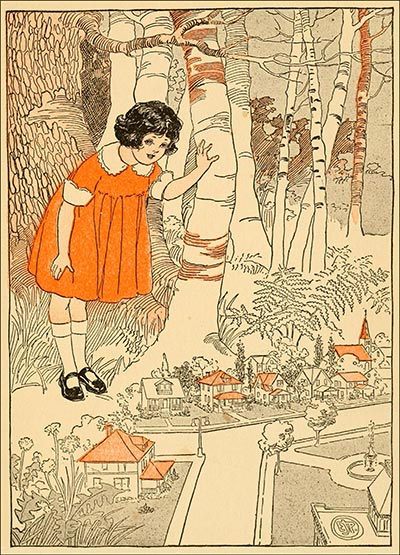
Just at Her Feet Lay the Tiniest Little Bit of a Town
“Strange!” thought Tiny, tiptoeing nearer and nearer. “Oh, no, it’s not strange at all. Why, it’s a flicker—a golden-winged woodpecker. Its wings are lined with yellow. Of course it looked like a yellow bird when flying overhead.”
“Wick—wick—wick—wick—follow—me.” The bird flew on a little farther.
“I will catch up soon, birdie!” Tiny called, and hurried to the branch where the bird was sitting.
“Wick—wick!” On and on it flew, Tiny following, when suddenly it disappeared entirely, and there was Tiny miles out in the forest, and not knowing the way back home at all. And not a single thing to eat, either.
“My, now I am scared!—but I won’t cry! I’m nine years old, and I won’t cry! I’ll look around and see if there isn’t something I can think to do,” but a big tear blinded her eye.
“Where’s my handkerchief? Where ever did I put my handkerchief?” She looked in her pocket. “But if I’m not going to cry, what do I need it for?” she asked herself, and brushed away a big drop with the back of her hand.
“Oh, oh, look!” Tiny laughed so that the woods echoed, and no wonder she did—for just at her feet lay the tiniest little bit of a town with real houses, no bigger than bird-houses; real people, too, not much taller than pins; real street-lamps no bigger than pencils; real carts no bigger than peanuts; real horses no bigger than katydids. In the center of the town was a lovely little fountain. From the fountain, walks led in four directions.
Houses and public buildings were along these walks; and scattered on the green lawns were pretty flower-beds.
“Oh, what a lovely cottage!” cried Tiny, spying a beautiful little house near the edge of the village.
“I’m going to pick it up! No, I’ll stoop down and look at it. People may be inside. If I picked it up they might be hurt and frightened.”
She leaned over and examined it closely, but was careful not to step into the town.
The walls were covered with vines, and geraniums bloomed at the windows. Charming white curtains hung on the sashes, showing off the brilliant color of the geraniums.
Smoke was coming out of the chimney.
“My, the people who live in that cottage must be getting supper!” The little girl spoke softly to herself. “It seems to me I can smell it cooking. What tiny little bits of dishes they must use—smaller than the littlest ones I own. Why, an acorn would be almost large enough for a bath tub for the house.”
Tiny laughed gayly at the idea.
“I’ll wait here for a minute or two to see if anybody comes out of the door,” she said, taking a seat on the twisted roots of a nearby tree; but, although she waited patiently for several minutes, no one appeared.
“How I wonder who lives in such a dear little home!” she thought. “It must be fun to live in such a beautiful little house. My, isn’t the whole town too sweet for anything! How I’d like to live there!”
She put her toe on the gravel walk which led across the tiny little town, and, in a second she was no longer a big girl; she was as little as a pin herself, only, of course, not so thin as a pin, but just the right size for the house.
Tiny is Put in the Lock-up
Tiny rubbed her tiny little eyes with her tiny little hand, and looked about her in amazement. She was very near the cottage she had so much admired. “I’d love to peep in the windows,” she thought, “but it would be so rude. I guess I’ll walk over toward the fountain.”
“Oh, here comes a hand-organ and a little monkey!” Tiny put her hand in her pocket to find a penny, but all she found there were three chestnuts, each no bigger than a period. “Poor little monkey!” said Tiny as he came up to her, lifting his hat, “you must be tired. I wonder if you’d like these nuts.”
The monkey smelled of the nuts, lifted his hat, looked at his master, and nodding his thanks, began to eat them.
“He no tired,” said the Italian organ-grinder. “He work only two hours a day.”
“Good!” said Tiny. “Does he play the rest of the day?”
“He play, play, play,” smiled the man, and passed down the street.
“My,” thought Tiny, as she walked along, “I wish I had taken some money with me this morning. If I had a nickel, I’d buy some bananas from that banana-man’s fruit-stand. I certainly am hungry.”
“Want banan’s?” inquired the man as she stood looking at his wares.
Tiny nodded. “I haven’t any money,” she said, trying to keep from crying.
“Never mind,” smiled the man, “I had little girl once. She gone. She die. I give banan’s you.” He handed her a half-dozen bananas no bigger than pencil points.
“Oh, thank you,” said Tiny. “I’ll never forget how kind you are.”
But the man was on his way down the street before she finished.
She felt much better after eating and stood for quite a while watching the little fountain play and splash.
Away in the distance she heard a dog bark, and at the edge of the village she saw a tiny newsboy and with him a tiny dog, no bigger than a capital letter. Under his arm he carried tiny newspapers no bigger than postage stamps.
“Not much news in such a tiny paper!” thought Tiny, watching the fountain splash. “Some day I’ll buy one to see what it says.”
Suddenly she realized it was getting dark; people passed by her and went into the houses. She felt very lonely and a little frightened. “Oh, dear,” she thought, “I do wonder where I’ll sleep to-night? I wonder if it’s against the law to sleep on the park benches?” She went over and sat down on one. “I guess I’ll try sleeping here, anyhow.”
She was just going to stretch out, when she saw a policeman coming toward her just as fast as he could walk.
“Come, come!” he said. “Who are you? I’ve never seen you around here before! What’s your name? Where do you live?”
“Please, Mr. Policeman”—Tiny tried to keep her voice from shaking—“my name is Tiny and I’m lost.”
“Tiny! Tiny! Tiny what? What’s your other name?”
“They call me ‘Tiny girl’,” said Tiny.
“Tiny Girl!” grunted the policeman. “Girl! I’ve never heard of a Mr. Girl or a Mrs. Girl around here! Oh, I know—I understand now—you’ve run away from home—that’s what you’ve done!”
“Oh, no, sir,” began Tiny, but the policeman took her hand, and walked toward the town hall.
“You’ll have to sleep over there to-night,” said he, pointing to the building, “in care of the police matron; and in the morning we’ll see what we can find out. Children that run away we always put in the lock-up.”
They were inside the door now, and the policeman rapped three times on the tiny table. Out came the police matron. Tiny thought she looked rather severe.
“Matron,” said the policeman, “I found this little girl on one of the park benches. She cannot tell me where she lives—she says she’s lost and that her last name is Girl—Tiny Girl. You know there is no family of the name of Girl in this whole town. Put her to sleep in a bed and if anything turns up to-night to show who she is, I’ll let you know. In the morning we’ll investigate. Good night.”
“Good night, Mr. Officer,” said the police matron.
“Come,” she said to Tiny, “let me wash you and comb your hair, and give you some bread and milk. I’m certainly sorry such a little girl should be a runaway. Your clothes show you have a careful mother.”
“I didn’t run away,” sobbed Tiny; “I tell you I didn’t!”
“How did you come here, then?” asked the matron, stopping combing her hair.
“I was a big, real girl,” said Tiny, “and—and I was walking in the woods, with my mother’s permission, when a bird flew ahead of me and he beckoned me to come on. I wandered and wandered and I came to this place. I stepped on the walk, and—and—and—I—melted into the tiny little thing I am—so there! How I wish I had my mother——”
“Oh, what a story! What an awful story!” cried the police matron. “Stop right away! We don’t allow children to tell lies here!”
“It’s not a story,” began Tiny, but the police matron dragged her to a tiny bedroom, and undressed her and put her to bed.
“You will have your supper in bed,” said she, “then I’ll be sure of where you are!” And she brought a bowl no bigger than a cherry-stone full of bread and milk for Tiny’s supper.
At first Tiny couldn’t eat a mouthful, but she was really very hungry, and finally she ate it all up.
“Mother will find me somehow,” she thought, as she slipped out of bed and knelt to say her prayers.
Tiny is Adopted
The next morning Tiny was awakened by a knock at her door.
“Good morning,” smiled the police matron. “I have a delightful surprise for you.”
“Good morning. What can it be?” cried Tiny. “Did my mother——?”
“You’ve nearly guessed,” nodded the police matron, helping her put on her shoes and stockings. “You’re going to have a mother, for a dear old lady—Mrs. Bountiful—wants to adopt you.”
“To adopt me? Why, I thought all adopted children lived in orphanages.”
“Oh, my, no!” exclaimed the police matron. “Children that run away are often——”
“I didn’t run away!” Tiny stamped her tiny foot. “I tell you I didn’t.”
“Come, come,” said the police matron, “you don’t want me to tell your new friend that you have a bad temper and tell stories.”
Tiny certainly did not, and as she was now washed and dressed she went down-stairs with the police matron.
“Here she is, madam,” said the police matron very politely as she led Tiny to where the dearest bit of an old lady was sitting.
“Oh, you dear child!” exclaimed the tiny lady. “You’ve had no breakfast, have you?”
“I just got up,” whispered Tiny, not liking to let her think that the matron had been neglectful.
“Well, well,” smiled the little old lady, “we’ll soon see to that. I have my automobile outside. Good-by, Mrs. Matron.” And taking Tiny by the hand she went out.
“This is my son,” said the little old lady, as they walked up to the car. “He can drive an automobile beautifully. Shake hands with Tiny, Martin.”
“How do you do?”
“Pleased to meet you,” said Martin, lifting his tiny cap.
“Let us drive right home,” said his mother. “This dear little girl hasn’t had any breakfast.” They climbed in, and away Martin drove, down the street through the village park, past the fountain, over to the edge of the village, up to—where do you think?—right up in front of the cottage which Tiny had first seen in the little village.
“Oh, isn’t it a beau-ti-ful home!” she cried.
“How glad we are that you like it,” said the little lady. “Welcome to Rose Cottage.”
“Walk—right—in—Welcome—to—Rose—Cottage,” cried a new voice as they entered. It was a shrill, nasal voice.
Tiny looked around, but saw no one. “Look! I’m—right—here,” cried the voice again.
The little lady laughed. “All right, Polly,” she called, and Tiny saw in one corner of the room a pretty green-and-red-and-yellow poll-parrot.
She wanted to go nearer and pet him, but his mistress hurried her to the breakfast table.
“Let—us—take—a drive,” called out Polly presently.
“Why, yes, let us. Shall we go now, Martin?” asked Mrs. Bountiful.
“Yes, Mother,” smiled the big boy.
“Take—us—all,” called Polly, “Take—us—all—don’t—forget—the—monk.”
“Why,” asked Tiny, who had been very quiet, “what does he mean?”
“He means,” laughed the little lady, “that we take Martin’s pet monkey and Polly for a drive quite often—and they are both very much spoiled.”
“Oh, how lovely!” cried Tiny. “Have you a monkey, too?”
Martin brought the monkey, and his mother took the parrot, and they all got into the automobile.
“Where do we go first, Mother?” asked Martin.
“Will you excuse me, dear,” the little lady asked, “if I whisper? I want to surprise you.”
Tiny nodded and smiled, as his mother leaned over to reach Martin’s ear.
They drove along the park and over into the business part of the village, up to the livery-stables and stopped.
“Good morning, ma’am,” the liveryman said.
“Bring him out,” nodded the little lady, and the man disappeared into the stables.
Soon he led out the dearest little brown-and-white Shetland pony—no bigger than a cricket.
“Oh, oh, oh!” cried Tiny. “I’d like to kiss him!”
The little old lady laughed delightedly.
“He’s yours,” she cried. “Get out and try to ride him.”
Martin helped her into the wee saddle, the liveryman gave her a tiny whip and the pony cantered all the way down the street and back again.
“Oh, I never thought I’d own a real live pony,” sighed Tiny, patting the little thing’s neck. “It seems too good to be true.”
“Let us go down to the candy shop,” said Tiny’s fairy godmother.
The candy shop wasn’t far away and when they drew up outside, Martin fastened the pony to the lamp-post. The little old lady took Tiny into the shop.
“Here, dear,” she said, opening her purse, “are two dollars. Spend them both. You can have all the candy and ice cream you want.”
So Tiny ate five plates of ice cream and three boxes of candy.
“It was splendid,” she said to the little lady when they’d gotten home. “I’d like to kiss you for all these lovely times.”
“I’m so glad, dear motherless child,” said the little lady with tears in her eyes.
“But I’m not motherless—” began Tiny.
“There, there, we’ll forget about that,” interrupted her new mother.
That night she tucked Tiny into bed quite early.
I must tell you about Tiny’s bedroom. All the woodwork and furniture were white. On the floor was a rose-colored carpet, with a border of pink and white roses and green leaves. At the windows were white curtains with pink roses along each edge. On the little white bureau was a tiny set of golden brushes and combs and boxes and bottles, and in a gold vase on the dressing-table was a very beautiful bouquet of tiny real roses.
Everything was so sweet that Tiny used up nearly every word of praise she knew, and she fell asleep before the little lady had finished tucking her in bed.
It must have been near midnight when Tiny was awakened very suddenly by an awful pain.
She cried out loudly for her mother.
The little lady hastened to her room.
“You poor dear!” she cried. “Martin shall go immediately for Doctor Curum.”
Martin was back with the doctor before Tiny realized he had started.
“Well, well,” said the doctor, looking Tiny over, “this young lady has been having too good a time—eh?”
“Oh, Doctor,” cried the little old lady, “will she die? It is my fault. I gave her too much candy.”
“Don’t worry,” smiled the doctor, quickly opening his case. “These medicines will cure her.”
“I will stay with you, dear,” said the little lady, after seeing the doctor to the door.
Tiny soon fell asleep and did not wake until early daylight.
“My, I feel all right,” she thought, stretching her little arms over her head. “How glad I am! But what smells so queer? I believe it’s smoke! Oh, it is! Something’s on fire!”
She sprang out of bed. The little lady had fallen asleep in the tiny white rocking-chair on the other side of Tiny’s bed. She looked so sweet in her rose kimono with a sweet smile on her lips, that Tiny hadn’t the heart to waken her.
“How tired she must be,” thought Tiny. “I’ll find out where the fire is first.”
She slipped into her clothes, and was soon out-of-doors. She saw immediately where the fire was—over on the next avenue, where smoke and flame were coming out of the roof of a building.
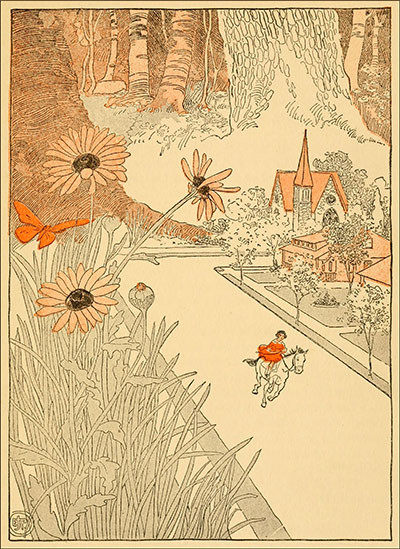
The Pony Cantered All the Way Down the Street
Tiny Discovers a Fire
“Oh, oh,” thought Tiny, “what shall I do? I know!” as she spied the pony in the stable where Martin had put him the night before. “I’ll ride over to the fire-house and tell them, and then I’ll ride to the house and warn the people.”
“Do your best, Love Trot,” she whispered to the dappled pony.
He pricked up his ears, and picked up his feet, and in no time to speak of Tiny was at the fire-house.
Just as she reached the door, a big dog (at least it seemed big to Tiny, for it was almost the size of Love Trot) came around the corner of the building. He raised up his head and barked as he ran toward her.
Tiny was so scared that she quickly jumped on the pony and was going to ride away, when a window of the fire-house opened and a man called out:
“Don’t be afraid, little girl, that’s Big Jim, the fire dog. He helps with all the fires. He won’t bite you. Lie down, Jim.”
Jim spread himself down at the pony’s side, wagged his tail, and looked up at Tiny with big brown eyes which seemed to say he was sorry he frightened her.
She soon explained her errand and was riding at full speed to the house that was on fire.
Down the street clanged the engine drawn by the beautiful little fire horses. Then came the hose-wagon, and then all the firemen with the ladders, and Big Jim, who was riding as though he were the most important member of the fire company.
Meanwhile, the little lady awoke. She sniffed the air and opened her eyes.
“Tiny,” she said, “how are you, dear? It seems to me I smell smoke. Doesn’t it to you?”
She looked at the bed.
“Where has the child gone?” she cried. “All her clothes are gone, too!”
“Martin! Martin!” she called. “Martin, get right up, and go to the police station in the town hall. Tiny has run away—has run away again!”
“All right, Mother,” answered Martin from his room. “I’m already dressed, I’ll ride the pony right over there.” But Trot was gone, and Martin ran all the way.
“Why, why didn’t you take your automobile and chase after her?” asked the policeman when Martin told him the story. “That’s the best thing to do now. I’d go help you—but I’m needed at the fire. You’d better start right away, you don’t want to lose any time.”
“Oh, yes,” answered Martin, “I know. I know. I’ll go right home and take out the car—but where do you think I had better chase to first?”
“Inquire of the first person you meet,” called out the policeman.
Martin and his mother were soon in the car, but there were few people on the street, as nearly all had gone to the fire.
“Drive on a way,” said the distracted little lady. “Drive anywhere. It’s better than sitting still.”
They hadn’t gone very far before they saw Tiny riding Trot toward them.
“Were you worried?” she called, hailing them from a distance. “I went to the fire-house to warn them of the fire.” She explained it all to them as she came up to the car; how she wakened, and smelled the smoke, and how she didn’t like to waken the little lady, and how she saw Trot fastened in the stable, and how she rode him to the fire-house.
“Dear, dear girlie,” said the little lady. “How brave you are! I’m so glad you didn’t run away again.”
“I never ran away,” answered Tiny. “I never, never ran away!”
“We know you did once, dear,” said the little lady; “but we’re trying to forget that.”
XIX TINY HAS MORE ADVENTURES
“IT seems to me,” said the little lady, a few days after the fire, “that it would be nice for you to start in school, Tiny dear. I met Miss Spectacles yesterday, and she asked me whether I was not going to send you soon. ‘I don’t want the truant officer to inquire into the case,’ she explained.”
“Oh, nothing could please me better!” exclaimed Tiny. “I love you dearly, but it would just be splendid to know some children.”
Martin and the little lady took Tiny in the automobile to the schoolhouse, which was the most delightful school building Tiny could imagine. It stood on the center of a green lawn. All kinds of swings and games were arranged in the playgrounds. The little lady introduced Tiny to her teacher.
“I’m glad to have so brave a child under my care,” smiled Miss Spectacles, “for I’ve heard all about Tiny and the fire.”
Tiny blushed and stood on one foot. “It didn’t seem very brave to me,” she said, “but I’m glad you think you’ll like me.”
After the little lady had gone, the teacher showed Tiny to a desk and gave her lesson-books. Tiny studied the lessons well, and when recess-time came was quite ready for play.
The children stared at her a good deal, for no doubt they too had heard about the fire, and many had seen her on her pony; but she was so friendly in her manner that the girls soon overcame their shyness and began to talk with her.
There was one particularly pretty girl who was especially nice to Tiny, and gave her half her apple to eat. There was another little girl whose mother combed her hair in one braid at the back of her head. Just as she started to talk with Tiny, one of the boys came along, and pulled the little girl’s hair.
“Hello, Piggy,” he said. “Hello, Piggy. Piggy-wiggy, Piggy-wiggy.”
“Oh, dear,” said the little girl, “I do wish they wouldn’t call me names.”
“For shame!” Tiny called to the boy. “It is dreadfully rude for you to call names. I won’t like you one bit if you call names.”
“Ha, ha!” laughed the boy. “I don’t care! Piggy-wiggy wears a pig-tail.”
“Never mind, dear,” said Tiny. “I believe I can make him stop.”
Then the bell rang.
After school Tiny went to the boy. “Listen,” she said, “what’ll you take to stop calling names?”
“What’ll I take?” repeated the boy.
“Yes,” said Tiny, “will you promise to stop if I give you ten cents?”
“Nope,” said the boy. “It’s too much fun.”
“Will you take a quarter?”
“Nope.”
“Well,” said Tiny, “that’s all I have. I spent all the rest of my money for ice cream and cake.”
“Say,” said the boy, “are you offering for honest?”
“Certainly,” said Tiny.
“Well, then, I’ll take a ride on your pony to stop. How about that?”
“Oh—” began Tiny, “I——”
“I’ll always call her Piggy if you don’t,” said the boy.
“How far?” asked Tiny.
“Far’s I want to go,” answered the boy.
“I’ll let you know to-morrow,” said Tiny, for that was the last thing she wanted to pay, and she was worried.
“I’m afraid school doesn’t agree with our Tiny,” said the little lady to Martin that evening, “she is so quiet.”
Tiny, who was playing the pretty white piano, turned.
“I was thinking, dear lady,” she said, and she told of Piggy-wiggy.
“Humph,” said Martin. “That’s easy. Let me know who that fellow is and I’ll stop him.”
“Can’t you manage better than that, son?” asked his mother. “Why not let the boy ride Trot when you and Tiny are nearby in the car, and can see that he is treated right?”
“That’s a splendid idea,” cried Tiny, kissing the little lady. “Will you, Martin? I know the boy is just crazy to ride the pony.”
So a plan was agreed upon, and the boy did have a ride on Love Trot, and he did stop calling the little girl names, and Tiny had the joy of knowing she had made two people happy.
Tiny Saves a Baby’s Life
“Tiny,” said the little lady after school the next day, “don’t you want to run over to the grocery shop and get some sugar for the pudding?”
“Indeed I do,” laughed Tiny; “there’s nothing I like better than pudding, you know.”
The grocerman was very pleasant and Tiny noticed he gave her extra good weight.
“Shall I send it home for you, Miss?” he asked as his grocery wagon drove up.
“No, thank you,” said Tiny, “I’ll carry it,” and the wagon drove on.
As Tiny reached the corner, she saw a baby toddling across the street.
“I wonder that baby’s mother lets it go out alone,” thought Tiny.
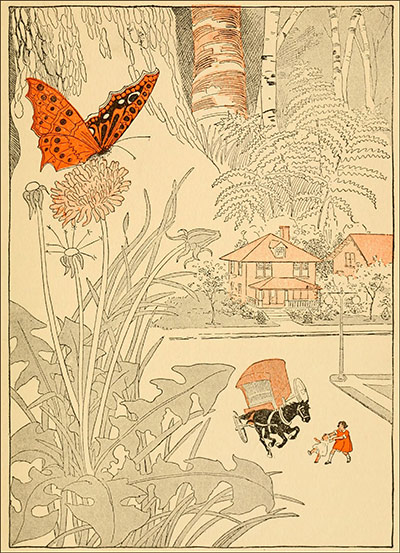
She Ran as Fast as She Could and was Just in Time to Drag the Baby Out of the Way of the Wagon
Just at that minute the grocer’s horse and wagon dashed around the corner. Tiny saw in a moment what would happen if somebody didn’t run to the baby, so dropping her bag of sugar, which burst open and spread all over the ground, she ran as fast as she could and was just in the nick of time to drag the baby out of the way of the wagon.
“Bless me! Bless me!” panted the policeman, running up. “I hurried as fast as I could. If it hadn’t been for this little girl,” he continued to the baby’s mother, who was now crying, “that baby would—— Why, it’s the little girl that ran away! How do you do?”
“I didn’t run away,” sobbed Tiny; “I didn’t.”
“Well, well,” said the policeman, “I guess we can begin to forget it by this time. After the fire warning and this——” But Tiny was hurrying away to the store to get more sugar.
“I do hope they won’t worry at home,” she thought.
“That’s the girl,” said the grocer’s boy as Tiny went into the store. “She was just in time.”
He had been telling about the near-accident.
The grocer couldn’t thank Tiny enough for saving the baby’s life, and he asked her to ride in the grocery wagon so that she would get home sooner.
“I was so afraid you would worry, dear lady,” she said as she told the story, “and I spilled all the sugar—every bit.”
“Oh, my dear, I’m so thankful you were not hurt,” said the little lady, “that I would give a hundred bags of sugar—you, dear brave little heroine,” as she took her on her lap.
“My mother,” began Tiny, “was something like you and——”
“Hush, dear,” said the little lady, smoothing her hair.
“You like to go to school, don’t you?” she asked to change the subject.
“My, I never enjoyed school so much in all my life,” said Tiny.
“Oh, you used to go, of course, didn’t you?”
“Always,” said Tiny, “my father was—” and her voice began to sound full of tears.
“Strange,” said the little lady to herself. “Very strange why she ran away. Maybe we’ll find out some day. I’ll inquire again if the police have found out anything more about her.”
Tiny Goes Shopping
The next morning Tiny took her pig-bank from the mantel and began to count her money.
“Wasn’t your mother dear to give me all this spending money, Martin?” said Tiny to Martin as he came into the room. “I do wonder how much there is; won’t you please help me count it?”
“Seven dollars and eighteen cents,” counted Martin, laying down the last coin. “My! that’s a lot of money, Tiny. What are you going to do with it?”
“Oh, Martin, don’t tell, please. Oh, it must be a secret! I do want it to be a surprise!”
“Wild horses couldn’t drag it out of me,” said Martin; “but what’s the secret?”
“Why, Saturday is your mother’s birthday, and I’m going to buy her a present.”
“Grand. What will you buy?” he asked.
“I really don’t know,” said Tiny, “but I’m going shopping this afternoon after school. I’ve had permission to get out early, because I told Miss Spectacles about the surprise.”
“Wasn’t that kind of her!” said Martin.
“People are often kinder than they seem,” said Tiny.
Just as she put the bank in its place on the mantel, Mrs. Bountiful came in. “Why, dear,” said she, “what a saving little girl you are; I haven’t given you any money in a long time; here is a dollar.”
“Oh, thank you,” said Tiny, “but you have been so good to me, I don’t like——”
“Never mind, dear,” said the little lady. “Come, it’s time to go to school.”
“I’ll be ready in a minute, as soon as I get my books.”
“Here is a banana for recess,” said Mrs. Bountiful, following her and kissing her good-by.
On her way out as Tiny passed the mantel, she quickly slipped her bank into her school-bag.
“Good-by, all,” said she.
She could scarcely wait for the time to come for her to go shopping, and it seemed almost a week until Miss Spectacles nodded her head that she might be dismissed.
On her way to the store, she would put her hand in her school-bag every once in a while to see if the bank was safe.
She had been to the Globe Department Store with Mrs. Bountiful more than once.
“What shall I buy?” she thought.
Just then she noticed a cute little china cat. She picked it up. “That’s certainly cute,” she thought, “but not very useful,” so she put it down and picked up a little stuffed dog. “Neither is that,” she concluded and put it down.
“Do you wish anything?” asked the saleslady politely.
“No, thank you,” replied Tiny.
She picked up several funny little images, and was so much interested that she did not notice that any one was near until she heard a voice, a man’s voice, speaking to the saleslady in an undertone: “I’ve been watching that child for some time, Miss Sellum; please keep an eye on her.”
“Oh, I don’t think she’d take anything, Mr. Knockem,” replied the girl.
Tiny looked around. No one was in sight except the pretty saleslady and a tall, haughty-looking man.
“I wonder who they mean?” thought Tiny. “Oh, they must mean me because I touched those things,” and she burst into tears.
“I never stole anything in my life—not a single—thing—ever,” she sobbed. “I’m Mrs. Bountiful’s—little—girl——”
“Mercy!” exclaimed Miss Sellum.
“Pardon me, Miss,” begged the floor-walker—for that was who Mr. Knockem was, and right scared he was, too, for Mrs. Bountiful was one of their best customers. “I didn’t mean any harm. Can I be of assistance to you?”
“Why, sir,” said Tiny, drying her eyes, “it’s all right—I shouldn’t have touched anything, I know, but—I’m trying to select a present for Mrs. Bountiful’s birthday. It comes Saturday, you see——”
“Oh, that’s it, that’s it, is it?” asked a new voice. It was so kind, and full of joy that Tiny knew she’d like its owner before she looked up at the kindly, bald-headed gentleman who had joined them.
“Leave the little miss to me, Mr. Knockem,” he said.
“Oh, certainly, Mr. Storem; certainly, sir,” said the floor-walker.
“Well, my dear,” said the stout gentleman, “I believe I can help you. I know Mrs. Bountiful quite well. The other day she was in the store inquiring for vanity hand-bags.”
“The kind all filled with golden powder boxes, and mirrors, and coin holders?” asked Tiny eagerly.
“Yes,” smiled Mr. Storem, “and here they are at this counter. Miss Prettyman, will you show those bags to Miss——”
“My name is Tiny, sir,” said the little girl, much pleased with the lady, who brought several bags for her to see.
“How much is this?” she asked, selecting a charming violet one, lined with dainty flowered silk.
“Five dollars,” said Miss Prettyman. “I’ve sold bags for years, but I never saw so lovely a one at that price.”
“I’ll take that, please,” said Tiny, reaching into her school-bag for her bank.
“Oh, dear,” she cried, “how am I going to get the money out of my pig?”
You should have heard Mr. Storem laugh. “Well, well,” he said, “I guess I’ll have to help you.”
So he helped Tiny “fish” out the five dollars.
Just then some one called him away.
“I’ll be back in a few minutes, Miss Tiny,” he said.
When the cash girl returned with the parcel, the saleslady handed it over to Tiny just as if she were grown up.
“Gee,” exclaimed the cash girl, “ain’t she swell, Miss Prettyman, with the owner of the store escorting her around!”
“Is he? Does he own this store?” asked Tiny, wide-eyed.
“Yes, Miss Tiny,” said Miss Prettyman.
Just at that moment Mr. Storem returned.
“Is there anything else, Miss Tiny?”
“Oh, I don’t like to trouble you, sir,” began Tiny.
“Tut! Tut! Don’t mention it, little one,” said he. “The gentleman who just called me told me you are the little girl who warned the people about the fire, and saved the baby’s life. It is an honor to do anything to help you.”
Tiny blushed. “Thank you. Well, if it isn’t too much trouble, please show me where I can get some beads to make a necklace for Mrs. Bountiful.”
“Certainly, certainly,” said Mr. Storem. “Right this way.”
Tiny selected some beautiful beads, and Mr. Storem helped her again in getting the money from her bank.
“Mrs. Bountiful will love the necklace if I make it,” she said. “She told me it is the kindness and the thought more than the costliness of a gift that counts. My own mother always——”
“Your own mother!” exclaimed Mr. Storem. “Your own! Isn’t Mrs. Bountiful your mother?”
“Why, no, sir,” exclaimed Tiny.
“I read it in the Tinytown News. I read about a little girl who ran away,” interrupted Mr. Storem.
“I didn’t,” said Tiny. “I didn’t run away, but nobody believes me.”
“I do, dear,” smiled the big man. “I do!” and Tiny loved him for it.
“Good-by!” she said, “and thank you! Thank you more than I can tell you.”
It was rather late when she reached Rose Cottage, but the little lady had been called out to see a sick neighbor, so she was able to hide her gifts away. Finally Saturday came. Tiny wrapped her gifts in tissue paper and tied them with blue ribbon, and laid them on the breakfast table at Mrs. Bountiful’s place.
The little lady was delighted. She opened the bag and took out the purse and powder box and examined them and looked at herself in the mirror.
“Oh, you made the necklace yourself? Isn’t it lovely, my dear?” she sighed. “You are just such a darling, loving, thoughtful little girl as I always dreamed of for my own daughter.”
“Put on your finery, Mother,” said Martin, handing her the bag and throwing the necklace over her head.
“My present,” exclaimed Martin, “is in my room,” and, excusing himself, he brought a pretty hand-carved tea-table.
“I made it for you myself, Mother.”
“Was there ever such a happy old lady as I!” cried Mrs. Bountiful, putting her arms around both the children.
“Was there ever one who gave other people so much happiness?” asked Tiny.
Tiny’s Mother Finds Her
“I wish I could tell mother about everything,” thought Tiny as she walked along the road to school. “My, what perfectly lovely times I have had, and how dear the little lady is; but I do miss mother. How frightened she must be!”
A tear dropped from her eye.
“I won’t cry, though,” she thought. “Mother surely will find me! I know she’s looking everywhere!”
Just then she noticed a tiny little bird in the branches of the tree overhead.
“Wick—wick!” he sang.
“Oh, you pretty little thing,” cried Tiny.
The bird flew to a low bush, Tiny following. On and on they went, until Tiny was surprised to find herself at the end of the town.
“Why, I’m almost lost again,” she thought, “I better turn back.”
“Wick—wick!” sang the bird, as he alighted on a tree just outside the town.
To Tiny’s amazement, he was no longer a little bird, but the same big golden-winged woodpecker that she had followed into the forest when she left home. She was just about to run after him when a shadow fell across the roadway and she looked up.
“Mother!” she cried. “Oh, Mother!”
For the shadow was that of her mother who had gone out into the woods to look for her.
She stretched out her tiny little arms, but she was so very small her mother didn’t see her.
“Oh, Mother, here I am,” she cried, running toward her.
She stepped off the edge of Tinytown, and in a second she was her own self again, as big as ever.
How she laughed and cried and hugged and kissed her mother. Then she told all about Tinytown—just as I’ve told you, and showed her the lovely little Rose Cottage, the town hall, the school house, the church, the fire-engine house and the shops.
“Mother, they were all so perfectly dear to me I hate to leave them,” she said.
“Why, Tiny, girl,” laughed her mother, “we can visit Tinytown again, now we know where it is—then you can always keep your friends.”
“Yes, and I can explain to them, Mother dear, how they were mistaken, and I didn’t run away.”
But when Tiny and her mother came to look for it a few days later, Tinytown was gone. The Story People had taken it for their own.
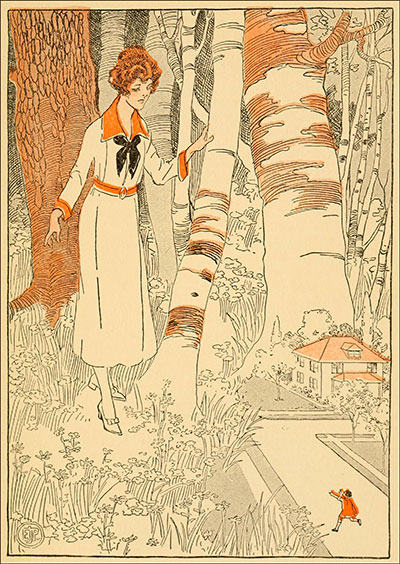
“Mother!” she Cried. “Oh, Mother!”
* * * * * *
“What a sweet story!” exclaimed Mary Frances, when the Story Lady finished.
“Yes, it is a sweet story,” she returned, “and we were so glad to get it, and the town, too. It shows our children how the children of other countries live.”
“Aren’t you tired after telling so many stories?” asked Mary Frances.
“Oh, no, I never grow tired of hearing and telling stories; but I like to hear you talk. Won’t you tell me something from your country?”
“Yes—let me see. All I can think of is a little poem about a robin and a buttercup.”
“Do let me hear it.”
So she recited—
The Robin and the Buttercup[B]
Down in the field, one day in June, The flowers all bloomed together, Save one, who tried to hide herself, And drooped that pleasant weather. A robin, who had flown too high, And felt a little lazy, Was resting near a buttercup, Who wished she were a daisy. For daisies grow so trig and tall! She always had a passion For wearing frills around her neck, In just the daisies’ fashion. And buttercups must always be The same old tiresome color; While daisies dress in gold and white, Although their gold is duller. “Dear Robin,” said the sad young flower, “Perhaps you’d not mind trying To find a nice white frill for me, Some day when you are flying?” “You silly thing!” the robin said, “I think you must be crazy; I’d rather be my honest self Than any made-up daisy. “You’re nicer in your own bright gown, The little children love you; Be the best buttercup you can, And think no flower above you. “Though swallows leave me out of sight, We’d better keep our places; Perhaps the world would go all wrong, With one too many daisies. “Look bravely up into the sky, And be content with knowing That God wished for a buttercup Just here, where you are growing.”
“Oh, thank you,” said the Story Lady, “I like that. You must write it down for me. To-morrow you shall have a lot of stories.”