THE LAST DAY ON STORY ISLAND
Reading edition
THE CRICKET ON THE HEARTH, A FAIRY TALE OF HOME.—CHIRP THE FIRST.—CHIRP THE SECOND.—CHIRP THE THIRD.—THE RETURN HOME.
THE LAST DAY ON STORY ISLAND The Cricket on the Hearth
XXXIV CHIRP THE FIRST
WHEN the Story People were all assembled, the Story Lady began:
“To-day we have only one story, ‘The Cricket on the Hearth,’ which was first told by one of our greatest story-tellers, Charles Dickens, who wrote ‘The Christmas Carol’ and many other stories that children love to hear.”
The Peerybingles
“Heyday! The cricket’s merrier than ever to-night, I think,” said John, stopping, in his slow way, to listen to its musical chirp, chirp, chirp!
“And it’s sure to bring us good fortune, John! It always has done so. To have a cricket on the hearth is the luckiest thing in the world!”
That is what John Peerybingle’s little wife Dot said one stormy night after John had come in from delivering packages and boxes, and she had given him his tea and had put the baby to sleep. For John Peerybingle was a local expressman; or, as they say in England, a carrier.
“The first time I heard its cheerful little note, John,” Dot continued, “was the night you brought me home—when you brought me to my new home here; its little mistress. Nearly a year ago. You recollect, John?”
Oh, yes. John remembered. I should think so!
“Its chirp was such a welcome to me. It seemed so full of promise and encouragement. It seemed to say you would be kind and gentle with me, and would not expect to find an old head on the shoulders of your foolish little wife. I had a fear of that, John, then.”
John thoughtfully patted one of the shoulders, and then the head of his little wife, as though to say, “No, no; he had no such expectation; he had been quite content to take them as they were.”
“The cricket spoke the truth, John, for you have been, I am sure, the most considerate, the most affectionate of husbands. This has been a happy home, John; and I love the cricket for its sake.”
“Why, so do I, then,” said the carrier, “so do I, Dot.”
“I love it for the many times I have heard it,” Dot went on musing, “and the many thoughts its harmless music has given me. Sometimes, in the twilight, when I have felt a little down-hearted, John—before the precious baby came to keep me company and make the house gay—when I have thought how lonely you would be if I should die, or I should be if you should die, its chirp, chirp, chirp, upon the hearth has filled me with new trust and confidence. For you see, John, I was afraid, being so much younger than you, that you might not find me at all suitable as a wife, and that you might find it hard to learn to love me as you would if I were older and had had more experience. I was thinking just before you came in to-night, dear, how the cricket has cheered me at such times; and I love it for their sake.”
“And so do I,” repeated John. “But, Dot! How you talk! I learn to love you? I had learned that long before I brought you here to be the cricket’s little mistress, Dot.”
She laid her hand, an instant, on his arm, and looked up at him as if she would have told him something. Next moment, she was down upon her knees before the basket of packages which John had brought in from his cart. Perhaps some of them would be called for; the others he would deliver in the morning.
“There are not many of them to-night, John. Why, what’s this round box? Heart alive, John, it’s a wedding-cake!”
“Leave a woman to find that out,” said John admiringly. “Now, a man would never have thought of it! But it’s my belief that if you packed a wedding cake in a tea-chest, or in a feather bed, or in salmon-keg, a woman would be sure to find it out directly. Yes, I called for it at the pastry-cook’s.”
“And it weighs, I don’t know what—whole hundred weights!” cried Dot, making a great show of trying to lift it. “Whose is it, John? Where is it going?”
“Read the writing on the other side,” said John.
“Why, John! My goodness, John!” exclaimed Dot.
“Ah! Who’d have thought it!” John returned.
“You never mean to say,” asked Dot, sitting on the floor and shaking her head at him, “that it’s for Gruff and Tackleton, the toy-maker!”
John nodded. Mrs. Peerybingle nodded also, fifty times at least—in dumb and pitying amazement.
And Tilly Slowboy, the nurse-maid, and helper of all work, began to talk in an undertone to the baby, who had awakened, as she walked to and fro with him in her arms: “Was it for Gruffs and Tackletons, then, and would it call at the pastry-cooks’ for wedding cakes, and did its mothers know the boxes when its fathers brought them home;” and so on.
“And that marriage is really to come about!” said Dot, after seeing that the baby was all right. “Why, she and I were girls at school together, John.”
John might have been thinking of how Dot looked then, but he made no answer.
“And he’s as old! As unlike May! Why, how many years older than you is Gruff and Tackleton, John?”
“How many more cups of tea shall I drink at one sitting than Gruff and Tackleton ever took in four sittings, I wonder!” replied John good-humoredly.
But even this brought no smile to the face of his little wife. The cricket, too, had stopped. Somehow the room was not so cheerful as it had been. Nothing like it.
The Strange Old Gentleman
“So these are all the parcels, are they, John?” she asked, after a little while; “so these are all the parcels, John?”
“That’s all,” said John. “Why—no—I—I declare—I’ve clean forgotten the old gentleman!”
“The old gentleman?”
“In the cart,” said John. “He was asleep, down in the straw, the last time I saw him. I’ve very nearly remembered him twice since I came in; but he went out of my head again.”
John hastily rose and lighting a candle went out the door. “Halloa! Yahip there! Rouse up! That’s my hearty!” he called as he made his way to the wagon-shed.
Soon the Stranger stood, bareheaded and motionless in the middle of the room. He had long white hair, good features, singularly bold and well-defined for an old man. His eyes were dark and bright and smiling. He saluted the carrier’s wife by gravely bowing.
His clothes were very quaint and old-fashioned, a long, long way behind the time. Their color was brown, all over. In his hand he carried a great brown club or walking-stick. He struck this upon the floor and it fell open and became a chair on which he sat down quite composedly.
“There!” said the carrier, turning to his wife. “That’s the way I found him, sitting by the roadside! Upright as a milestone, and almost as deaf as one!”
“Sitting in the open air, John!”
“In the open air,” replied the carrier, “just at dusk. ‘Will you take me along?’ he asked, and gave me eighteen pence. Then he got into the cart. And here he is.”
“He’s going, John, I think!”
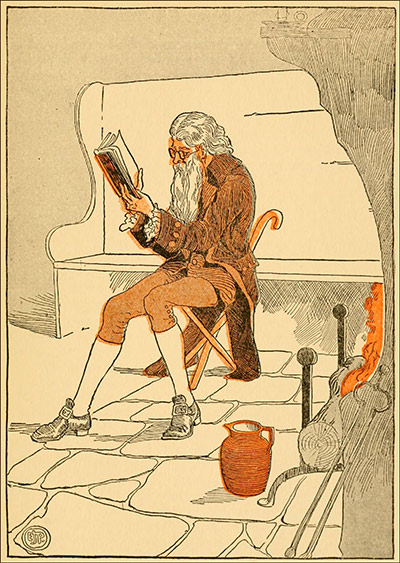
“If You Please, I was to be Left till Called For”
Not at all. He was only going to speak.
“If you please, I was to be left till called for,” said the Stranger, mildly. “Don’t mind me.”
With that he took a pair of spectacles from one of his large pockets, and a book from another, and leisurely began to read. Boxer, the carrier’s big dog, came sniffing at his legs, but he took no more notice of Boxer than if he had been a lamb.
The carrier and his wife glanced at each other in perplexity. The Stranger raised his head; and looking from Dot toward John, said:
“Your daughter, my good friend?”
“Wife,” said John.
“Niece?” asked the Stranger.
“Wife,” roared John.
“Indeed?” observed the Stranger. “Surely—very young!”
Dot took the baby from the couch where Tilly Slowboy had laid him. The Stranger quietly resumed his reading; but before he had read two lines, he interrupted his reading to say to John:
“Baby yours?”
John gave a gigantic nod, equal to an answer given through a speaking trumpet.
“Girl?” asked the Stranger.
“Bo-o-oy!” roared John.
“Also very young, eh?”
Mrs. Peerybingle instantly spoke. “Two months and three da-ays. Vaccinated just six weeks ago-o! Took very fine-ly! Considered by the doctors a remarkably beautiful chi-ild! Equal to the general run of children at five months o-ld! Takes notice of everything. May seem impossible to you, but true.”
Here the breathless little mother, who had been shrieking these short sentences into the old man’s ear until her face was crimson, held the baby up before him to prove her words, while Tilly Slowboy sprang around in cow-like gambols to amuse the infant, uttering words which sounded like “Ketcher! Ketcher!”
“Hark!” said John. “He’s called for, sure enough. There’s some one at the door. Open it, Tilly.”
Caleb Plummer
Before she could reach it, however, it was opened from the outside, for it was a primitive sort of door with a latch that any one could lift if he chose. In came a little, meager, thoughtful, dingy-faced man.
He seemed to have made himself a great-coat from the burlap covering of some old box; for, when he turned to shut the door, and keep the weather out, one could read upon the back of the garment the letters “G & T” in large black capitals; also the word “GLASS” in smaller capitals.
“Good-evening, John!” said the little man. “Good-evening, mum. Good-evening, Tilly! Good-evening, unbeknown! How’s baby, mum? Boxer’s pretty well, I hope?”
“All well and thriving, Caleb,” replied Dot. “I am sure you need only look at the dear child, for one, to know that.”
“And I’m sure I only need look at you for another,” said Caleb; “or at John for another; or Tilly, as far as that goes; or certainly at Boxer.”
“Busy just now, Caleb?” asked the carrier.
“Why, pretty busy, John,” he returned. “Pretty much so. There’s a lot of demand for Noah’s Arks at present. I’d like to be able to take more pains in making the families, but I can’t do it at the price. It would be a satisfaction, though, to one’s mind, to make it plain which was Shems and Hams, and which was wives. Ah, well! Have you got anything in the parcel line for me, John?”
The carrier put his hand into the pocket of the coat he had taken off, and brought out a tiny flower-pot, carefully wrapped in moss and tissue paper.
“There it is!” he said, adjusting it with great care. “Not so much as a leaf damaged. Full of buds!”
Caleb’s dull eye brightened as he took it, and thanked him.
“It was expensive, Caleb,” said the carrier. “Very dear at this season.”
“Never mind that. It would be cheap to me, whatever it cost,” returned the little man. “Anything else, John?”
“A small box,” replied the carrier. “Here you are!”
“‘For Caleb Plummer,’” read the old man, spelling out the directions. “‘With Cash!’ With cash, John? I don’t think it’s for me!”
“‘With Care,’” corrected the carrier, looking over his shoulder. “Where do you make out ‘cash’?”
“Oh! To be sure!” said Caleb. “It’s all right. ‘With Care!’ Yes, yes; that’s mine. It might have been ‘With Cash,’ if my dear boy in South America had lived, John. You loved him like a son; didn’t you? You needn’t say you did. I know, of course.”
He read again, “‘Caleb Plummer. With Care.’ Yes, yes; it’s all right. It’s a box of dolls’ eyes for my daughter’s work. I wish it was her own sight in a box, John!”
“I wish it was, or could be,” cried the carrier.
“Thankee,” said the little man. “You speak very hearty. To think that she should never see the dolls—and them a staring at her so bold, all day long! That’s where it cuts. What’s the cost, John,—what’s the damage?”
“I’ll damage you,” said John, “if you ask.”
“Well, it’s like you to say that,” observed the little man. “It’s your kind way. Let me see. I think that’s all.”
“I think not,” said the carrier. “Try again.”
“Something for our governor, eh?” asked Caleb after thinking a little while. “To be sure. That’s what I came for; but my head’s so full of them Noah’s Arks and things! He hasn’t been here, has he?”
“Not he,” returned the carrier. “He’s too busy, courting.”
“He’s coming, though,” said Caleb; “for he told me to keep on the near side of the road going home, and it was ten to one he’d take me up. I’d better go, by-the-way.”
He turned to Dot. “You couldn’t have the goodness to let me pinch Boxer’s tail, mum, for half a moment, could you?”
“Why, Caleb! What a question!”
“Oh, never mind, mum,” said the little man. “He mightn’t like it, perhaps. There’s a small order come in for toys—dogs that will bark; and I wish to go as close to nature as possible for a sixpence. That’s all. Never mind, mum.”
It happened that Boxer just at that moment began to bark with zeal. But, as this bark meant the approach of some new visitor, Caleb, postponing his study of dogs’ barks, shouldered the big round box of wedding cake and said good-by. He might have spared himself the trouble, however, for he met his employer upon the threshold.
Tackleton
“Oh! You are here, are you? Wait a bit. I’ll take you home!”
He turned to John. “John Peerybingle, my service to you. More of my service to your pretty wife. Handsomer every day—and younger!”
“I should be astonished at your paying compliments, Mr. Tackleton,” said Dot, not altogether pleasantly, “but for what I have just heard about you—being engaged to be married.”
“You know all about it, then?”
“I have gotten myself to believe it somehow,” said Dot.
“After a hard struggle, I suppose?”
“Very.”
Tackleton, the toy merchant, was well known in the neighborhood. Many people called him Gruff and Tackleton, the name of the firm when Gruff was Tackleton’s partner. Although Tackleton had bought out Gruff’s interest years before, the name still remained.
It was odd that such a man should have been a toy-maker, for he had no interest in toys whatever. He despised them, and wouldn’t have bought one for the world. The only toys in his shop which he could abide were the ugly ones. Hideous, red-eyed Jacks-in-Boxes, vampire kites, and fiery dragons really did give him some pleasure, for he saw that they scared little children. A very pleasant person, Tackleton! Not the kind of person you would think was going to be married, and to a young wife, too—a beautiful young wife.
He didn’t look much like a bridegroom as he stood in the carrier’s kitchen, with a twist in his dry face, and a screw in his body, and his hat jerked over the bridge of his nose, and his hands tucked down into the bottom of his pockets, and his whole sarcastic, ill-conditioned, self—peering out of one little corner of one little eye, like the concentrated essence of any number of ravens. But a bridegroom he was designed to be.
“In three days’ time—next Thursday—the last day of the first month of the year—is my wedding day,” said Tackleton.
Did I mention that he had always one eye wide open and one eye nearly shut; and the eye nearly shut was always the expressive eye? I don’t think I did.
“That’s my wedding-day!” said Tackleton, rattling his money in his pocket.
“Why, that’s the anniversary of our wedding, too!” exclaimed the carrier.
“Ha, ha!” laughed Tackleton. “Odd! You’re just such another couple as we will be! Just!”
At this speech, Dot was most indignant. What next would the man say? As though her John resembled Tackleton in any particular!
“I say! A word with you,” murmured Tackleton, nudging the carrier with his elbow, and taking him off a little way. “You’ll come to the wedding, won’t you? We’re in the same boat, you know.”
“How in the same boat?” asked John.
“Why, you’re not so youthful as your wife, yourself,” said Tackleton, with another nudge. “Come and spend an evening with us beforehand.”
“Why?” demanded John, astonished at this hospitality.
“Why?” returned the other. “That’s a new way to receive an invitation. Why—for pleasure—to be sociable, you know, and all that.”
“I thought you were never sociable,” said John, in his plain way.
“As you like; what does it matter? Your company will produce a favorable impression on Mrs. Tackleton that-will-be. You’ll say you’ll come?”
“We have arranged to keep our wedding day at home,” said John. “We think, you see, that home——”
“Bah! What’s home?” cried Tackleton. “Four walls and a ceiling! Why don’t you kill that cricket? I would! I always do! I hate their noise! You’ll say you’ll come, to-morrow evening?”
“You kill the crickets, eh?” said John.
“Scrunch ’em, sir,” returned the other, setting his heel heavily on the floor. “Then you won’t give us to-morrow evening? Well! Next day you go out visiting, I know. I’ll meet you there, and bring my wife that-is-to-be. It’ll do her good. You’re agreeable? Thankee. What’s that?”
Dot is Upset
It was a loud cry from the carrier’s wife; a loud, sharp, sudden cry, that made the room ring like a glass bell that was struck. She had risen from her seat and stood like one transfixed by terror and surprise. The Stranger had gone toward the fire to warm himself, but he was quite still.
“Dot!” cried the carrier, “Darling Dot! What’s the matter?”
They were all about her in a moment. Caleb, who had been dozing on the cake-box, in the first start, seized Tilly Slowboy by the hair, but immediately apologized.
“Mary!” exclaimed the carrier, for Dot’s real name was Mary, Dot being only a pet name of her husband’s. “Mary dear, are you ill? What is it? Tell me, dear.”
But at first she could not answer. She wept bitterly, and covered her face with her apron; then burst into a wild fit of laughter, and then started crying again. At length she let John lead her to the fire, where she sat down. The old man was standing there as before.
“I’m better, John,” she said. “I’m quite well. It was only a fancy, something coming before my eyes. It’s gone, quite gone now.”
“But why did she look at the old gentleman, as if addressing him?” thought John. “Was her mind wandering?”
“I’m glad it’s gone,” muttered Tackleton, turning the expressive eye around the room. “I wonder where it’s gone, and what it was. Humph, Caleb, come here! Who’s that man with the gray hair?”
“I don’t know, sir,” Caleb answered in a whisper. “Never saw him before in all my life. He’d make a beautiful figure for a nut-cracker; quite a new model.”
“Not ugly enough!” said Tackleton.
“Or a match-safe,” Caleb continued. “What a model! Unscrew his head to put the matches in. Let them fall down to his neck, and take out.”
“Not half ugly enough,” said Tackleton. “Nothing in him at all. Come! Bring that box! All right now, I hope, Mrs. Peerybingle?”
“Oh, quite right! Quite right!” said the little woman, waving him hurriedly away. “Good-night!”
“Good-night,” said Tackleton. “Good-night, John Peerybingle! Take care how you carry that box, Caleb. Let it fall and I’ll murder you! Dark as pitch, and weather worse than ever, eh? Good-night!”
So, with another sharp look round the room, he went out the door, followed by Caleb with the wedding cake on his head.
The carrier had been so much astonished by his little wife, and so busily trying to sooth her that he had scarcely been conscious of the Stranger’s presence until now, when he looked up and saw him standing there, their only guest!
“He don’t belong to them, you see,” said John. “I must give him a hint to go.”
Just at that moment the old gentleman came toward him, saying, “I beg your pardon, friend, but since my attendant has not come and the weather is so bad, can you, in your kindness, let me rent a bed here?”
“Yes, yes!” cried Dot. “Yes! Certainly!”
“Oh!” exclaimed the carrier, surprised by the quickness of her consent. “Well, I don’t object; still I’m not quite sure—”
“Hush!” she interrupted. “Dear John, please.”
“Why, he’s stone deaf,” urged John.
“I know, but—” She turned to the Stranger. “Yes, sir, certainly. Yes! Certainly!” Then to John. “I’ll make him up a bed directly, John.”
As she hurried off to do it, the fluttering way she did it was so strange that the carrier looked after her, quite dumfounded.
“Did its mothers make up a beds then?” cried Tilly Slowboy to the baby; “and did its hair grow brown and curly when its caps was lifted off, and frighten it, as precious pets, a-sitting by the fire?”
“What frightened Dot, I wonder?” thought the carrier, pacing to and fro, and half listening to Tilly’s silly chatter.
The bed was soon made ready, and the Stranger, who would not take anything but a cup of tea, retired.
After Dot put the baby to bed, she arranged the great comfortable fireside chair for the carrier, and filled his pipe for him. Then she brought her little stool and, placing it beside his knee, sat down for a cozy chat.
But the carrier fell to dreaming, and Boxer, who was stretched at his feet, I am quite ashamed to say, snored aloud. Just then the cricket began its song, and Dot, too, fell a-dreaming.
But what was that young figure of a man which remained there, singly and alone? Why did it linger still, so near her with its arm upon the chimney-piece, ever repeating in a whisper, “Married! and not to me!”
XXXV CHIRP THE SECOND
Bertha, the Blind Girl, and Her Father
CALEB PLUMMER, the toy-maker, and his blind daughter lived all alone by themselves, as the Story Books say, in a little cracked nutshell of a wooden house, close to the big establishment of Gruff and Tackleton, the toy merchants.
I have said that Caleb and his poor blind daughter lived here. I should have said that Caleb lived here, and his poor blind daughter lived somewhere else—in a sort of enchanted fairyland, where no shabbiness or poverty or trouble ever entered; for Caleb, in the magic of his devoted, deathless love for his daughter, played a little game of “Pretend” which made the blind girl think their home beautiful, her father rich and handsome, and that nothing was lacking which they needed.
The blind girl never knew that the ceilings were broken and the walls blotched, and bare of plaster here and there, the beams warped and bending because of age. The blind girl never knew that the woodwork was rotting and the paper peeling off the walls, and the little building withering away.
The blind girl never knew that the dishes were ugly and cracked, and the carpets threadbare; that sorrow and faint-heartedness were in the house; that Caleb’s scanty hairs were turning grayer, and more gray, before her sightless face.
The blind girl never knew that they had a master, cold, exacting, and not caring how they got along—never knew that Tackleton was Tackleton, in fact. For Caleb led her to think his rough words were meant for jokes; that he was very good to them, and had a peculiarity in that he could not bear to be thanked for any favor he had done.
You know why he did this. It was because he felt so sorry for poor blind Bertha that he deceived her into thinking everything lovely and fair in order that she might be happier. He, too, had had a cricket singing on the hearth when his motherless girl was very young, and when he listened to its music, he made up his mind to cheer the little one’s dark way by every means he could devise.
Caleb and his daughter were at work together in their usual working room, which served them for their ordinary living room as well; and a strange place it was.
There were houses in it, furnished and unfurnished, for dolls of all stations in life. Nice houses for dolls of moderate means; smaller houses for dolls not so well off; fine town residences for dolls of high estate. Some of the houses were already furnished with a view to the conveniences of dolls of limited income; others could be furnished on notice from the shelves nearby which were full of chairs and tables, sofas, bedsteads, and other articles of furniture.
Then there were many dolls themselves of all kinds and from all stations in life.
There were various other samples of his handicraft besides dolls and dolls’ houses in Caleb Plummer’s room. There were Noah’s Arks in which the birds and beasts were an uncommonly tight fit, I assure you. There were scores of little carts, which, when the wheels went round, performed most doleful music. There were small fiddles and drums, and no end of cannon, shields and spears.
There were little fellows in red breeches who would tumble down head first along a piece of tape. There were old gentlemen dolls who would fly over trapeze bars when pressed in the right place. There were beasts of all sorts; horses, in particular, of every breed, from the little spotted gray on four legs, to the thoroughbred rocked on his highest mettle.
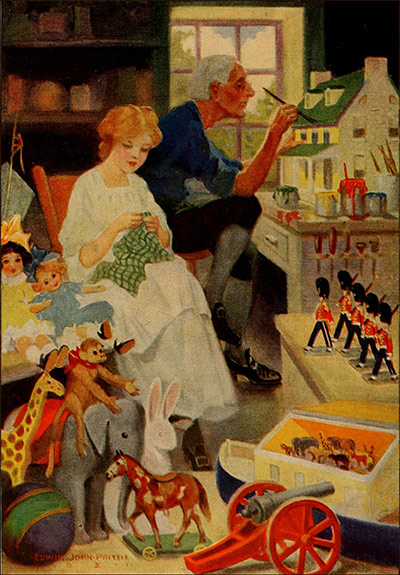
There were Houses in It, Furnished and Unfurnished, for Dolls of All Stations in Life
There were dozens and dozens of other little toys, but you already can imagine how the room looked.
In the midst of all these objects, Caleb and his daughter sat at work; the blind girl busy as a doll’s dressmaker; Caleb painting a desirable doll’s family mansion.
“So you were out in the rain last night, Father, in your beautiful new great-coat,” said Caleb’s daughter.
“In my beautiful new great-coat,” answered Caleb, glancing toward a clothes-rack in the room on which the burlap garment was carefully hung to dry.
“How glad I am you bought it, Father! And such a stylish tailor!”
“It’s too good for me,” said Caleb.
The blind girl rested from her work and laughed with delight. “Too good, Father! What can be too good for you?”
“I’m half ashamed to wear it, though,” said Caleb, watching the effect of what he said on her brightening face, “upon my word! When I hear the boys and people say behind me, ‘Hallo! Here’s a swell!’ I don’t know which way to look. And when the beggar wouldn’t go away last night; and when I said I am a very common man, said, ‘No, Your Honor! Bless Your Honor, don’t say that!’ I was quite ashamed. I really felt as if I hadn’t a right to wear it.”
Happy blind girl! How merry she was with the idea!
“I see you, Father,” she said, clasping her hands, “as plainly as if I had the eyes I never want when you are with me. A blue coat——”
“Bright blue,” said Caleb.
“Yes, yes! Bright blue!” exclaimed the girl, turning up her radiant face; “the color I can just remember in the blessed sky! You told me it was blue before. A bright blue coat——”
“Made loose to the figure,” suggested Caleb.
“Yes! loose to the figure!” cried the blind girl, laughing heartily; “and in it, you, dear Father, with your merry eye, your smiling face, your free step, and your dark hair—looking so young and handsome!”
“There! There!” said Caleb, “I shall be vain presently.”
“I think you are already!” cried the blind girl, pointing at him in her glee. “I know you, Father! Ha, ha, ha! I’ve found you out, you see!”
How different the picture in her mind from Caleb as he sat observing her. She had spoken of his free step. She was right in that. For years and years he had never once crossed their threshold with his own slow pace, but with a footfall free and sprightly, for her to hear; and never, even when his heart was heaviest, had he forgotten the light tread that was to render her own so cheerful and courageous.
“There we are,” said Caleb, falling back a step or two to better judge his work. “It’s a pity the whole front of this doll’s house opens at once! If there was only a staircase in it, now, and regular doors to go in at! But that’s the worst of my work, I’m always trying to make believe!”
“You are speaking quite softly. Are you tired, Father?”
“Tired?” echoed Caleb with a great burst of enthusiasm. “What should tire me, Bertha? I was never tired. What does it mean?”
To give greater force to his words, he checked himself in the middle of a yawn, and began to hum a song. He sang it with a pretended care-free manner that made his face look a thousand times more meagre and more thoughtful than before.
Tackleton Comes In
Just then Tackleton put his head in at the door. “What! You’re singing, are you?” he thundered. “Go it! I can’t sing!”
Nobody would have suspected that he could. He hadn’t a singing face by any means.
“I can’t afford to sing,” said Tackleton. “I’m glad you can. I hope you can afford to work, too. Hardly time for both, I should think.”
Caleb turned toward his daughter, and said in a low tone, “If you could only see him, Bertha, how he’s winking at me. Such a man to joke! You’d think, if you didn’t know him, he was in earnest—wouldn’t you now?”
The blind girl smiled and nodded.
“The bird that can sing and won’t sing, must be made to sing,” grumbled Tackleton. “What about the owl that can’t sing, and oughtn’t to sing, and will sing. Is there anything that he should be made to do?”
“The way he’s winking at me this moment!” whispered Caleb to his daughter. “Oh, my gracious!”
“Always merry and light-hearted with us!” cried the smiling Bertha.
“Oh, you’re there, are you?” answered Tackleton. “Poor idiot!”
He really did believe she was an idiot; and, strange to say, he thought her an idiot because she was fond of him.
“Well! being there, how are you?” said Tackleton, in his grudging way.
“Oh, well; quite well. And as happy as even you could wish me to be—as happy as you would make the whole world, if you could.”
“Poor idiot!” muttered Tackleton. “No gleam of reason! Not a gleam!”
The blind girl took his hand, and held it a moment in her own two hands, and laid her cheek against it tenderly, before releasing it. There was so much affectionate gratitude in the act, that Tackleton himself was moved to say, in a milder growl than usual:
“What’s the matter now?”
“I stood the little plant beside my pillow when I went to sleep last night, and remembered it in my dreams. When the day came, and the glorious red sun—the red sun, Father?”
“Red in the mornings and in the evenings, Bertha,” said poor Caleb, with a woeful glance at his employer.
“When it rose, and bright light came into the room, I turned the little tree towards it, and blessed Heaven for making such precious things, and blessed you for sending it to cheer me.”
“Whew!” said Tackleton under his breath, “we’re getting on! The next thing will be the padded cell.”
Meanwhile Caleb looked as if he were uncertain whether Tackleton had done anything deserving of praise or not. Yet he knew that with his own hands he had brought the little rose tree home for her so carefully, and that with his own lips he had made her believe that it was a gift from Tackleton, in order to keep her from suspecting how much he every day denied himself to save the money it cost—that she might be the happier.
“Bertha!” said Tackleton, with for once a show of cordiality, “Come here.”
“Oh, I can come straight to you. You needn’t guide me!”
“Shall I tell you a secret, Bertha?”
“If you will,” she answered eagerly.
How bright the darkened face looked! How anxious the listening head!
“This is the day on which that spoiled child, John Peerybingle’s wife, pays her regular visit to you—makes what she calls her ‘picnic’ here, ain’t it?” said Tackleton, with a look of distaste for the affair.
“Yes,” replied Bertha, “this is the day.”
“I thought so,” said Tackleton. “I should like to join the party.”
“Do you hear that, Father?” cried Bertha in delight.
“Yes, yes, I heard it,” murmured Caleb, with the look somewhat of a sleepwalker, “but I don’t believe it.”
“You see,” said Tackleton, “I—I want to bring the Peerybingles a little more into the company of May Fielding, for I am going to be married to May.”
“Married!” cried the blind girl, starting from him.
“Oh! She’s such a confounded idiot,” muttered Tackleton, “that I was afraid she’d never comprehend. Ah, yes, Bertha! Married! Church, parson, clerk, bells, satin, veils, and all the rest of the tomfoolery. A wedding, you know; a wedding. Don’t you know what a wedding is?”
“I know,” replied the blind girl gently. “I understand.”
“Do you?” muttered Tackleton. “It’s more than I expected.” Then aloud: “Well, on that account I want to join the party, and bring May and her mother. I’ll send in a little something or other before the afternoon—a cold leg of mutton, or some comfortable trifle of that sort. You’ll expect me?”
“Yes,” she answered, turning away.
“I don’t think you will,” muttered Tackleton, looking at her; “for you seem to have forgotten all about it already. Caleb!”
“I may venture to say I’m here, I suppose,” thought Caleb. “Sir?”
“Take care she don’t forget what I’ve been saying to her.”
“She never forgets,” returned Caleb; “it’s one of the few things she ain’t clever in.”
“‘Every man thinks his geese swans’,” observed the toy merchant, with a shrug of his shoulders. “Poor idiot!”
Having delivered this remark with much contempt, old Gruff and Tackleton went out.
Bertha’s Eyes
Bertha remained where he had left her, lost in thought. The gayety had vanished from her face, and it was very sad. Three or four times she shook her head as if bewailing some loss.
It was not until Caleb had been busy for some time in yoking a team of wooden horses to the tongue of a little wooden wagon by the simple means of nails, driven through the vital parts of their bodies, that she drew near his work-bench, and, sitting down beside him, said: “Father, I am lonely. I want to borrow your eyes.”
“Here they are,” said Caleb. “Always ready. They are more yours than mine, Bertha, any hour in the four-and-twenty. What shall your eyes do for you, dear?”
“My patient, willing eyes!” the blind girl said. “Will they look around the room, Father?”
“All right, no sooner said than done, Bertha.”
“Tell me about it.”
“It’s much the same as usual,” said Caleb. “Homely, but snug. The gay colors on the walls; the bright flowers on the plates and other dishes; the shining wood, where there are no panels; the general cheerfulness and neatness of the building; all make it very pretty.”
Cheerful and neat it was, wherever Bertha’s hands could busy themselves, but nowhere else were cheerfulness and neatness possible in the old crazy shed which Caleb’s fancy painted with such pleasant description.
“You have your working clothes on, and are not so gallant as when you wear the handsome coat?” said Bertha, touching him.
“Not quite so gallant,” answered Caleb. “Pretty lively, though.”
“Father,” said the blind girl, drawing close to his side, and putting one arm around his neck, “tell me something about May. Is she very pretty?”
“She is indeed,” said Caleb. And she was indeed. It was quite a rare thing for Caleb not to draw upon his imagination.
“I can imagine her,” said Bertha. “Her hair is dark, darker than mine. Her voice is sweet and musical, I know. I have often loved to hear it. Her form——”
“There’s not a doll in all the room can compare with her,” said Caleb. “And her eyes!”
He stopped; for Bertha’s arm around his neck had given a sudden pressure. He coughed a moment; hammered a moment; then began to sing the gay song about the sparkling bowl, a thing he always did when in such difficulties.
“Now, about your friend, our benefactor, Mr. Tackleton—I am never tired, you know, of hearing about him. Now, was I ever?” she said hastily.
“Of course not!” answered Caleb. “And with reason.”
“Ah, with much reason!” cried the blind girl so fervently that Caleb began to doubt if he had been wise in deceiving her.
“Tell me about him, dear father,” said Bertha. “Many times again! His face is kind and tender, honest and true, I am sure it is! The goodness in his heart shines out in his countenance.”
“And makes it noble,” added Caleb, who was rather desperate by now.
“And makes it noble!” cried the blind girl. “He is older than May, Father?”
“Yes, quite a little older; but that don’t signify,” said Caleb.
“Oh, no, Father! Just to think, she can do so much for him when he grows old and infirm, and can nurse him if he gets ill, and help him in every way. Will she do all this, Father?”
“No doubt of it,” said Caleb.
“I love her for that, Father. I love her with all my heart,” exclaimed the blind girl.
The Carrier’s Cart
In the meantime there had been a lively scene at John Peerybingle’s, for little Mrs. Peerybingle naturally couldn’t think of going anywhere without the baby; and to get the baby ready took time.
Not that there was so much of the baby, but there was so much to do about it, and it all had to be done by easy stages. For instance, when the baby was got, by hook or by crook, to a certain point in dressing, and you might have supposed that another touch or two would finish him off, and turn him out a tiptop baby, he was unexpectedly extinguished in a warm nightgown, and hustled off to bed; where he simmered, so to speak, between sheets and blankets, for the best part of an hour.
From this place of inaction, he was recalled, shining very much, and roaring violently, to partake of his luncheon. After which, he went to sleep again.
Then Mrs. Peerybingle took the opportunity to make herself look as fine as possible, and Miss Slowboy put on her best bib-and-tucker.
By this time, the baby, being all alive again, was dressed by the united efforts of Mrs. Peerybingle and Miss Slowboy, and put into his cream-colored coat and flannel cap; and so, in course of time, they all three got to the door, where John’s old horse stood tearing up the road with impatient autographs, and from where Boxer might be seen a little distance down the road, looking back, tempting the horse to come on without orders.
If you think that Mrs. Peerybingle needed a chair or anything of that kind to help her climb into the cart, you are mistaken, or you don’t know John Peerybingle, for before you could have seen him, he lifted her from the ground; and there she was in place, fresh and rosy, saying, “Oh, John, how can you!”
“All ready?” asked John, starting off, after Miss Slowboy and the baby were in place.
“John, you’ve got the basket with the veal-and-ham-pie and other things?” asked Dot. “If you haven’t, you must turn around again this very minute.”
“You’re a nice little article,” replied the carrier, “to be talking about turning round after keeping me a full quarter of an hour behind my time.”
“I am sorry for it, John,” said Dot, “but I really could not think of going to Bertha’s—I would not do it, John, on any account—without the veal-and-ham-pie and things. Whoa!” This last word was addressed to the horse, who didn’t mind at all.
“Oh, do turn round, John,” begged Mrs. Peerybingle. “Please!”
“It’ll be time enough to do that,” said John, “when I begin to leave things behind me. The basket’s here safe enough.”
“What a hard-hearted monster you must be, John, not to have said so at once, and saved me such a turn! I declare I wouldn’t go to Bertha’s without the veal-and-ham-pie and things for any money. Regularly, once a fortnight, ever since we have been married we have had our little picnic. If anything were to go wrong with it, I should almost think we were never to be lucky again.”
“It was a kind thought in the first place,” said the carrier, “and I honor you for it, little woman.”
“My dear John,” replied Dot, turning very red, “don’t talk about honoring me. Good gracious!”
“By-the-bye—” observed the carrier, “that old gentleman——”
Dot looked embarrassed.
“He’s an odd fish,” said the carrier. “I can’t make him out. I don’t believe there’s any harm in him, though.”
“None at all. I’m—I’m sure there’s none at all.”
“Yes?” said the carrier, with his eyes attracted to her face because she had spoken so earnestly. “Well, I am glad you feel so certain about it, because it makes me feel surer. It’s curious he should have taken it into his head to ask us for lodgings, ain’t it? Things come about so strangely.”
“So very strangely,” she rejoined in a low voice, scarcely audible.
“However, he’s a good-natured old gentleman,” said John, “and pays as a gentleman, and I think his word is to be relied upon, like a gentleman’s. I had quite a long talk with him this morning. He can hear me better already he says, as he gets more used to my voice. He told me a great deal about himself, and I told him a good deal about myself; and a rare lot of questions he asked me. I told him about having two routes, you know, in my business; one day going to the right from our house and back again, another day going left from our house and back again (for he’s a stranger, and don’t know the names of the places about here); and he seemed quite pleased. ‘Why,’ he says, ‘then I shall be returning your way to-night. I thought I’d be coming in exactly the opposite direction. That’s capital! I may trouble you for another lift, perhaps, but I’ll promise not to fall asleep again.’ He was sound asleep surely! Dot, what are you thinking of?”
“Thinking of, John? I—I was listening to you.”
“Oh! that’s all right!” said the carrier. “I was afraid, from the look of your face, that I had gone rambling on so long as to set you thinking of something else. I was very near it, I’ll be bound.”
Dot making no reply, they jogged on for some time in silence. But it was not very easy to remain silent long in John Peerybingle’s cart, for everybody on the road had something to say, though it might only be, “How are you?” and indeed it was very often nothing else. Sometimes passengers on foot or on horseback plodded on a little way beside the cart just for the pleasure of having a chat.
Then, too, everybody knew Boxer, all along the road—especially the fowls and pigs, who, when they saw him coming, running with his body all on one side and his ears pricked up inquisitively, would make tracks and not wait for any nearer acquaintance. Wherever he went, somebody or other might cry, “Hello! Here’s Boxer!” and with that, out came at least two or three other somebodies to bid John Peerybingle and his pretty wife good-day.
The packages and parcels to be delivered were as numerous as usual, and it required many stops to give them out. This was not the worst part of the journey by any means. Some people were so full of wonder about their parcels, and other people so full of directions about the parcels they were sending off by John, and John took so keen an interest in all the parcels, that it was as good as a play, and Dot thoroughly enjoyed it, as she looked on from her seat in the cart.
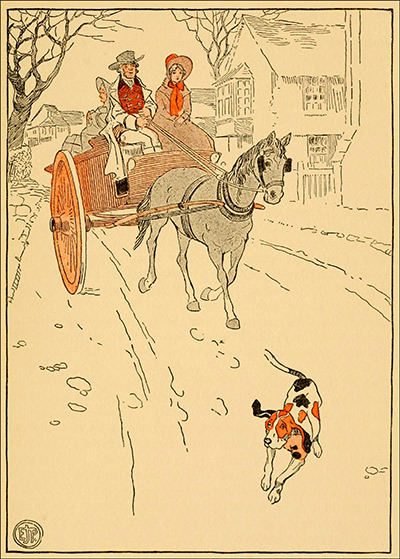
They Jogged on for Some Time in Silence
The trip was a little foggy, to be sure, in the January weather; and was raw and cold. But who cared for such trifles? Not Dot, decidedly. Not Tilly Slowboy, for she deemed sitting in a cart, on any terms, the highest point of human joys. Not the baby, I’ll be bound; for it’s not in baby nature to be warmer or more sound asleep than the blessed young Peerybingle was, all the way.
You couldn’t see very far in the fog, of course; but you could see a great deal! It’s astonishing how much you may see in a thicker fog than that, if you will only take the trouble to look for it. Why, even to sit looking for hazy fairy rings, and ghostly figures near the hedges and trees was a pleasant occupation, to make no mention of the unexpected shapes in which the trees themselves came out of the mists and glided in again.
In one place there was a great mound of weeds burning, and they watched the fire flaring through the fog, with here and there a dash of red in it, until, because of getting “smoke up her nose,” as she explained, Miss Slowboy choked and woke the baby, who wouldn’t go to sleep again. But Boxer, who was in advance a quarter of a mile or so, had passed the outskirts of the town, and gained the corner of the street where Caleb and his daughter lived; and long before they reached the door, he and the blind girl were on the pavement waiting to receive them.
The Party at Caleb’s
May Fielding was already there; and so was her mother, a little querulous chip of an old lady with a peevish face. Gruff and Tackleton was also there, pretending to be agreeable and perfectly at home, and really quite as much out of his element as a fish out of water.
“May! My dear old friend!” cried Dot, running up to meet her. “What happiness to see you!”
Her old friend was as glad as she, and it really was, if you’ll believe me, a pleasant sight to see them embrace each other. Tackleton had shown taste, beyond all question. May was very pretty. And so was Dot pretty. They simply set each other’s beauty off and, as John Peerybingle came near saying, they ought to have been born sisters—which was the only improvement you could have suggested.
Tackleton had brought his leg of mutton, and, wonderful to relate, a tart beside—but he could afford such generosity this time; one doesn’t get married every day. And in addition to these dainties, there were the veal-and-ham-pie and “things,” as Mrs. Peerybingle called them; which were chiefly nuts and oranges and cakes.
When the repast was set forth on the table, together with Caleb’s contribution, a bowl of smoking potatoes, which was all he was allowed to provide, Tackleton led his future mother-in-law to the post of honor. Why, she was gotten up for the occasion; even wearing gloves. Caleb sat next his daughter. Dot and her old school friend were side by side. The carrier took care of the bottom of the table. Miss Slowboy was seated a little distance away, far from every other article of furniture but the chair she sat on, that she might have nothing to knock the baby’s head against. She was delighted not only to take care of the baby, but to stare around at the toys.
“Ah, May,” said Dot. “Dear, dear, what changes! To talk of those merry school days makes one young again.”
“Why, you ain’t particularly old at any time, are you?” said Tackleton.
“Look at my sober, plodding husband there,” returned Dot. “He adds twenty years to my age at least. Don’t you, John?”
“Forty,” John replied.
“How many you’ll add to May’s I am sure I don’t know,” said Dot, laughing. “But she can’t be much less than a hundred years of age on her next birthday.”
“Ha, ha!” laughed Tackleton. Hollow as a drum was the laugh, though. And he looked as if he could have twisted Dot’s neck comfortably.
“Dear, dear,” said Dot. “Only think how we used to talk sometimes about the husbands we would choose. I don’t know how lively and gay mine was not to be! And as to May’s—ah, dear! I don’t know whether to laugh or cry when I think what silly girls we were.”
May seemed to know which to do, for the color flashed into her face and tears stood in her eyes.
“We little thought how things would come about,” said Dot. “I never fixed on John, I’m sure; I never so much as thought of him. And if I had told you you were ever to be married to Mr. Tackleton—why, you’d have slapped me, wouldn’t you, May?”
Though May didn’t say yes, she certainly didn’t say no, or express no, by any means.
Tackleton laughed—quite shouted, he laughed so loud. John Peerybingle laughed too, in his ordinary, good-natured and contented manner; but his was a mere whisper of a laugh compared to Tackleton’s.
“You couldn’t help yourselves for all that,” said Tackleton. “You couldn’t resist us, you see. Here we are! Here we are! Where are your gay young bridegrooms now?”
“Some of them are dead,” said Dot; “and some of them forgotten. Some of them, if they could stand among us at this moment, would not believe that we are the same creatures, because they would not believe we could forget them so. No! they would not believe one word of it!”
“Why, Dot!” exclaimed the carrier. “Little woman!” And Dot kept quiet, while Tackleton looked at her through his half-shut eye.
May uttered no word, good or bad, but sat quite still, with her eyes downcast, and made no sign of interest in what had passed. Her mother, however, observed that girls were girls, and bygones were bygones, and that so long as young people were young and thoughtless, they would probably conduct themselves like young and thoughtless persons. She then remarked that she thanked heaven that she had always found in May a dutiful and obedient child, for which she took no credit to herself, though she had every reason to believe it was owing to herself. With regard to Mr. Tackleton, she said that he was a son-in-law to be desired, as no one in their senses could doubt.
Now, the meal ended, John Peerybingle rose to go, for he only stopped to feed his horse, and to enjoy the social hour before finishing his route. He would call for Dot on his way back. This was always the program on picnic days.
“Good-by,” he said, pulling on his dreadnought coat. “I shall be back at the usual time. Good-by, all.”
Then he called Boxer, and soon the old horse and the cart were making lively music down the road.
Caleb and Bertha were talking together at one end of the room.
“So bring me the precious baby, Tilly,” said Dot, drawing a chair to the fire; “and while I have him in my lap, here’s Mrs. Fielding, Tilly, who will tell me all about the management of babies, and straighten me out in twenty points where I’m as wrong as can be. Won’t you, Mrs. Fielding?”
Here Tackleton walked out, and Mrs. Fielding, sitting bolt upright in front of Dot, gave her such a marvelous collection of receipts and rules that would, if Dot had carried them out, have utterly destroyed the young Peerybingle, even if he had been an infant Samson.
Now Dot brought her needlework out of her pocket, and had a whispering chat with May while the old lady dozed, and after a while Caleb and Bertha joined them, and all found it a very short afternoon.
Then as it grew dark, since it was the solemn rule that Bertha should do no household tasks on the days of the picnics, Dot trimmed the fire, and swept the hearth, and set the tea-tray out, and drew the curtains, and lighted a candle. Then she played an air or two on a rude kind of harp which Caleb had made for Bertha, and played them very well; for Nature had made her delicate little ear as choice a one for music as it would have been for jewels—if she had had them to wear.
By this time, it was the usual hour for tea, and Tackleton came back again, to share the meal and spend the evening.
When it was night, and tea was over, and Dot had nothing more to do after washing the cups and saucers—when the time drew near for the carrier’s return, Dot began to grow nervous. Every time she heard the sound of distant wheels, her color came and went, and she was restless. Not as good wives are when listening for their husbands. No, no, no. It was a different sort of restlessness from that.
Soon wheels were heard very near—horse’s feet—the barking of a dog—and then the scratching of Boxer’s paw.
“Whose step is that?” cried Bertha, starting up.
“‘Whose step’?” said the carrier, standing in the door, his brown face ruddy as a winter berry from the keen night air. “Why, mine.”
“The other step,” Bertha said. “The man’s tread behind you!”
“She’s not to be deceived,” observed the carrier, laughing. “Come along, sir. You’ll be welcome, never fear!”
The Shadow on the Hearth
He spoke in a loud tone; and as he spoke, the deaf old gentleman entered.
“He’s not so much a stranger that you haven’t seen him once, Caleb,” said the carrier. “You’ll give him house-room till we go?”
“Oh, surely, John, and take it as an honor.”
“He’s the best company on earth to talk secrets in,” said John. “I have reasonably good lungs, but he tried them, I’ll tell you.” Turning to the old gentleman, he spoke in a loud voice again, “Sit down, sir. All friends here, and glad to see you.”
Then he added in his natural tone, “A chair in the chimney-corner, and leave to sit silent and look pleasantly about him is all he cares for. He’s easily pleased.”
Bertha had been listening intently. She called Caleb to her side, and when he came, asked him, in a low voice, to describe their visitor. When he had done so, she moved away and showed no further interest in him.
The carrier was in high spirits, good fellow that he was, and fonder of his little wife than ever.
“Some folks may think it queer,” he said jokingly, putting his rough arm about her, as she stood apart from the others, “but I like this little lady somehow. Look yonder, Dot.”
He pointed to the old man. She looked down. I think she trembled.
“He’s—ha, ha, ha!—he is so fond of you that he talked of nothing else the whole way here. I like him for it.”
“I wish he had a better subject, John,” she said with an uneasy glance about the room—at Tackleton especially.
“A better subject!” cried the jovial John. “There’s no such thing. Come! Off with the great-coat, off with this thick shawl, off with the heavy wrappings! And now for a cozy half-hour by the fire. How would it please you, Mrs. Fielding, to have a game of cards, you and I? All right? Where are the cards, Dot—and will you let us have a cup of tea here if there’s any left, small wife?”
Soon the carrier and the old lady were deep within the game. At first the carrier looked about him sometimes with a smile, or now and then called Dot to peep over his shoulder to advise him on some knotty point. But soon he became so absorbed that he had neither eyes nor ears to spare, and his whole attention was upon the cards, and he thought of nothing else, until a hand was laid upon his shoulder.
“I am sorry to disturb you,” said Tackleton in a low voice, “but I want a word with you, please.”
“It’s my turn to deal,” returned the carrier. “Can you wait?”
“No,” said Tackleton. “Come on, man.”
There was an expression in his pale face which made John rise immediately, and ask him in a hurry what the matter was.
“Hush, John Peerybingle,” said Tackleton. “I am sorry for this. I am indeed. I have been afraid of it. I have suspected it from the first.”
“What is it?” asked the carrier in alarm.
“Hush! I’ll show you if you’ll come with me.”
The carrier accompanied him without another word. They went across the yard, where the stars were shining, and by a little side door they entered Tackleton’s own counting-house. There, through a window, they could look into a window of the wareroom where the boxes of toys were kept. The counting-house was closed for the night, and there was no light, but a dim light was burning in the wareroom, so they could easily see within.
“Wait a moment!” said Tackleton. “Can you bear to look through that window, do you think?”
“Why not?” asked the carrier.
“It will be a shock,” said Tackleton. “Promise not to do anything violent.”
And then John looked, and what do you think he saw?
He saw his dear young wife with the old man—old no longer, but straight and handsome, holding in his hands his soft white hair with which he had made every one think him old and treat him so kindly. He saw her listening to him as he bent his head to whisper in her ear, and then let him place his arm about her waist and lead her slowly to the door. He saw her, with her own hands, adjust the wig on his head, laughing as she did so!
John felt weak as an infant as Tackleton led him back to the house.
He was wrapped up to the chin and busy with his horse and parcels when she came into the room, ready for going home.
“Now, John, dear! Good-night, May! Good-night, Bertha,” she said.
How could she kiss them? How be so blithe and gay in her parting? Why didn’t she blush? Tackleton as well as John wondered.
Tilly was hushing the baby and as she walked to and fro, she was repeating drowsily: “Did they thought that it was to be its wives wring its heart almost to breaking? and did it weep all nights when nobody was there to see it?”
“Now, Tilly, give me the baby,” said little Mrs. Peerybingle. “Good-night, Mr. Tackleton. Where’s John, for goodness’ sake?”
“He’s going to walk beside the horse’s head,” said Tackleton, who helped her into the cart.
“My dear John! Walk?—to-night?”
The muffled figure of her husband made a hasty sign; and the Stranger and nurse being by this time in their places, the old horse moved off, Boxer running on before, running back, running round and round the cart, and barking merrily.
When Tackleton had gone off likewise, taking May and her mother, poor Caleb sat down by the fire beside his daughter. The toys that had been wound and set in motion for the baby had run down long ago. In the silence one might have imagined that they had been stricken motionless with wonder at Dot being false, or Tackleton beloved under any set of circumstances.
Presently Bertha spoke.
“After Mr. Tackleton is married, we shall not see so much of him, shall we, Father?”
“Well, we might—that is to say—” began Caleb.
“How I should love to be like May, Father, and have my eyes so that I might serve him, might show my love for him, who has been so good, so kind, so dear.”
Poor Caleb! How often he said to himself as he looked at her, in remorse, “Have I deceived her from her cradle, thinking to make her happier, but to break her heart at last?”
XXXVI CHIRP THE THIRD
John Listens to the Cricket

THE Dutch clock in the corner struck ten, when the carrier sat down at his fireside. So troubled was he that he scarcely heard the cuckoo as it counted off the strokes.
He could scarcely believe what his eyes had seen in the wareroom of Gruff and Tackleton. If any one had told him, he would not have believed his Dot could be a party to such dreadful deceit.
Yet, in his own heart, he did not blame her, but rather the old young man who had been so wickedly unfair, and he was planning to do him harm to pay him back. He hoped that Dot would be able to explain; but no—there really wasn’t any hope of that.
There, she was coming.
She had been upstairs with the baby, putting it to bed.
As he sat brooding near the hearth, she came close to him, and put her little stool at his feet. He then felt her hand upon his own, and knew she was looking up in his face.
He glanced at her. She looked as sweet as ever, until she caught the expression on his face. At first she seemed surprised, then her surprise changed in a wild recognition of his thoughts, and she simply bent her head and clasped her hands, but no words were said.
At length she rose and went away, and he felt glad, for the first time since he had known her, to have her gone.
There was a gun hanging on the wall. He took it down, and moved toward the Stranger’s room. He put his hand to the door—when suddenly the struggling fire burst into a glow of light, and the cricket on the hearth began to chirp.
No sound he could have heard, no human voice, not even hers, could so have moved and softened him. The very words in which she had told him of her love for this same cricket were as if just spoken in her sweet, pleasant voice, making household music; and they thrilled through and through his better nature, and awoke it into life and action.
He moved from the door like a man who had been walking in his sleep when awakening from a frightful dream. He put the gun aside. Clasping his hands before his face, he sat down again beside the fire.
The cricket on the hearth came out into the room and stood in fairy shape before him.
“‘I love it’,” said the fairy voice, “‘for the many times I have heard it, and the many thoughts its harmless music has given me’.”
“She said so!” cried the carrier. “True!” “‘This has been a happy home, John; and I love the cricket for its sake.’”
“She’s so sweet-tempered, so cheerful, busy, light-hearted. Otherwise I never could have loved her as I did.”
The voice, correcting him, said, “do.”
“You should trust her,” the fairy voice said.
All night long he listened to the voice. All night long the household fairies were busy with him, showing him how sweet and dear she was; how he had never found her untrue, or had reason to doubt her except this once.
He rose up when it was broad day, and washed and tidied himself.
He could not go on his usual rounds, for it was Tackleton’s wedding day. He had planned to go merrily to the church with Dot. But such plans were at an end. Ah! what a different wedding anniversary he had expected!
John Blames Himself
The carrier had thought that Tackleton would pay him an early visit, and he was right. He had just finished brushing his hair when he saw the merchant in his carriage coming along the road. As the carriage drew near he saw that Tackleton was dressed out sprucely for marriage, and that he had decorated his horse’s head with flowers and favors.
The horse looked much more like a bridegroom than Tackleton, whose half-closed eye was more disagreeably expressive than ever. But the carrier took little heed of this. His thoughts were elsewhere.
“John Peerybingle!” said Tackleton. “My good fellow, how do you find yourself this morning?”
“I have had but a poor night, Mr. Tackleton,” said the carrier, shaking his head, “for I have been a good deal disturbed in my mind. But it’s over now! Can you spare me half an hour or so, for some private talk?”
“I came on purpose,” returned Tackleton lightly. “Never mind the horse. He’ll stand quiet enough if you’ll give him a mouthful of hay.”
“You are not to be married before noon, I think?” said John.
“No,” answered Tackleton. “Plenty of time. Plenty of time.”
When they entered the kitchen, Tilly Slowboy was knocking at the Stranger’s door. One of her very red eyes was at the keyhole, for she had been crying because her mistress cried. She was knocking very loud, and seemed frightened.
“If you please, I can’t make nobody hear,” said Tilly, looking round. “I hope nobody ain’t gone and been and died, if you please.”
This hope Miss Slowboy made more emphatic by kicking on the door, but it led to no result.
“Shall I help?” asked Tackleton, turning to John.
The carrier nodded his head.
So Tackleton went to the door and he, too, kicked and knocked; and he, too, failed to get any reply. But he thought of trying the handle of the door, and as it opened easily, he peeped in, went in, and soon came running out again.
“He’s gone!” said Tackleton; “and the window’s open. I don’t see any marks—to be sure—or signs of a fight, but I thought perhaps you might have been so angry——”
He nearly shut up the expressive eye altogether, he looked at John so hard. And he gave his eye, and his face, and his whole body, a sharp twist, as if he would have screwed the truth out of John.
“Make yourself easy,” said the carrier. “He went into that room last night without harm in word or act from me, and no one has entered it since. He has gone away of his own free will.”
“Oh! Well, I think he has got off pretty easy,” said Tackleton, taking a chair.
The sneer was lost upon the carrier, who sat down, too, and shaded his face in his hand for some time before speaking.
“You showed me last night,” he said at length, “my wife, my dear wife that I love, deceiving me, and meeting a strange man who had deceived me. I think there’s no man in the world I wouldn’t rather have had show it to me.”
“I confess I know that I am not a favorite in your home, John, because I never believed wholly in your pretty little wife,” said Tackleton.
“And as you did show me, and as you saw her to such disadvantage, it is right you should know what my mind is on the subject. For it’s settled, and nothing can change it.”
Tackleton muttered a few words about its being necessary to decide, but he was overawed by the manner of his companion. Plain and unpolished as it was, there was something noble and dignified about it.
“I am a plain, rough man,” continued the carrier, “with very little to recommend me. I am not a clever man, as you very well know. I am not a young man. I loved my little Dot because I had seen her grow up from a child, in her father’s house; because I knew how precious she was; because she had been in my life for years and years.”
He paused a moment, then went on.
“I often thought that though I wasn’t good enough for her, I should make her a kind husband, and perhaps appreciate her better than another. And so it came about we were married.”
“Hah!” said Tackleton, with a shake of his head.
“I knew how much I loved her, and how happy I should be,” continued the carrier; “but I had not sufficiently considered her.”
“No,” said Tackleton. “No; you didn’t stop to think how giddy, frivolous, fickle, vain! Hah!”
“You’d better not interrupt me,” said the carrier, with some sternness, “till you understand me, which you seem far from doing.”
The toy merchant looked at him in surprise.
“I didn’t consider that I took her, at her age, with her beauty, away from her young companions and their many scenes of pleasure into my dull house and my tedious society. I didn’t consider how little suited I was to her fun and humor, and how wearisome I must be to one of her quick spirit. No! I took advantage of her hopeful nature, and I married her. I shouldn’t have done so!”
The toy merchant gazed at him without winking. Even the half-shut eye was now open.
“Heaven bless her!” said the carrier, “for the cheerful way she has tried not to let me see how it was! Heaven help me, that, in my slow mind I have not found it out before. Poor child! Poor Dot! Strange I did not realize when I have seen her eyes fill with tears on hearing of such a marriage as our own spoken of. How good and kind she has been! The thought will comfort me when I am here alone.”
“Here alone?” said Tackleton. “Then you do mean to take some notice of her deceit?”
“I mean,” answered the carrier, “to do her the greatest kindness in my power—to try to make it all up to her. She shall be free to go where she will.”
“Make it up to her!” exclaimed Tackleton, twisting and turning his great ears with his hands. “I must have heard wrong. You didn’t say that, of course.”
“Didn’t I speak plainly?” said the carrier, giving the toy merchant a shake.
“Very plainly indeed,” answered Tackleton.
“As if I meant it?”
“Very much as if you meant it.”
“Anger and distrust have left me,” said the carrier; “and nothing but my grief remains. In an unhappy moment some old lover, better suited to her years than I, returned. Last night she saw him in the interview we witnessed. It was wrong. But otherwise than this, she is innocent if there is truth on earth! I should not have taken her from her home. She shall return to it, and I will trouble her no more. Her father and mother will be here to-day, and they shall take her home. This is the end of what you showed me. Now, it’s over.”
“Oh, no, John, not over. Do not say it’s over yet. Not quite yet. I heard your noble words. I could not steal out again, letting you think me ignorant of what you said. Do not say it’s over—’till the clock has struck again!”
Dot had entered quietly while John and Tackleton were talking, and had heard every word.
“No hand can make the clock which will strike again for me the hours that are gone,” replied the carrier, with a faint smile. “But let it be so, if you will, my dear.”
“Well!” muttered Tackleton. “I must be off, for when it strikes again, I must be on my way to church. Good-by, John Peerybingle.”
The carrier saw him to the door, watched his horse until it disappeared in the distance, and then went out himself.
His little wife, being left alone, sobbed piteously, but often dried her tears to say how good and dear he was!—and once or twice she laughed through her tears so heartily and triumphantly that Tilly was quite horrified.
“Ow, if you please, don’t!” said Tilly. “It’s enough to dead and bury the baby; so it is, if you please.”
“Will you bring him to see me sometimes,” inquired her mistress, “when I don’t live here, and have gone to my old home?”
“Ow, if you please, don’t!” cried Tilly, throwing back her head. She looked a great deal like Boxer when he howled. “Ow, if you please, don’t! What has everybody gone and been and done with everybody, making everybody so miserable? Ow-w-w!”
Caleb Confesses His Deceit
And she might have kept on, if just at that moment Caleb Plummer had not come in, leading his daughter.
“Why, Mary” (which was Dot’s other name, you remember). “Why, Mary!” said Bertha. “Not at the wedding?”
“I told her you would not be there, mum,” whispered Caleb. “I heard as much last night. But bless you,” said the little man, “I don’t care what they say. I don’t believe them. There ain’t much of me, but what little there is would be torn to pieces sooner than I’d believe a word against you!”
He put his arms around her neck and hugged her very much as a child might have hugged one of the dolls he had made.
“Bertha wanted to come see you instead of going to the wedding,” said Caleb, “so we started in good time. I often wish I had not deceived her in regard to Tackleton, and I’ve come to the conclusion that I’d better tell her the truth. You’ll stay with us while I tell her, won’t you, mum?” he inquired, trembling from head to foot. “I don’t know what effect it may have upon her. I don’t know what she’ll think of me; I don’t know that she’ll ever care for her father afterwards. But it’s best she should be undeceived, and I must bear the consequences as I deserve.”
“Mary,” said Bertha, “where is your hand? I heard them speaking softly last night of some blame against you. They were wrong. I told them so. I scorned to hear a word! I know and trust you, Mary, so well that could my sight be restored at this instant, I could choose you from a crowd—my sister!”
Her father went on one side of her, while Dot remained on the other, holding her hand.
“Bertha, my dear,” said Caleb, “I have something on my mind I want to tell you while we three are alone. Listen kindly! I have a confession to make to you.”
“A confession, Father?”
“Yes, my child; I have wandered from the truth,” said Caleb, with a pitiable expression in his face. “I have wandered from the truth, intending to be kind to you; and have been cruel.”
She turned toward him, and repeated the word, “Cruel?”
“He accuses himself too strongly, Bertha,” said Dot. “You’ll say so, presently. You’ll be the first to tell him so.”
“He, cruel to me?” cried Bertha, with an unbelieving smile.
“Not meaning to be, my child,” said Caleb, “but I have been, although I never knew it until yesterday. My dear blind daughter, forgive me. The world, dear heart, is not as you imagine it. It is not as I have represented it. The eyes you have trusted in have been false to you.”
She turned her wondering face toward him still, but drew back, and clung closer to her friend.
“Your road in life was rough, my poor one,” said Caleb, “and I meant to smooth it for you. I have pictured things to you as different from what they are. I have even changed the characters of some people, to make you happier. I have surrounded you with fancies.”
“But living people are not fancies,” she said, turning very pale. “You can’t change them.”
“I have done so, Bertha,” Caleb told her. “There is one person you know——”
“Oh, Father, why do you say I know?” she said. “I who am so miserably blind.”
She stretched out her hands as if to feel her way.
“The marriage that takes place to-day,” Caleb continued, “is with a stern, sordid, grinding man. He has been a hard master to you and me, my dear, for many years. Ugly in his looks and in his nature. Cold and callous always. Unlike what I have painted him to you in everything, my child—in everything.”
“Oh, why,” cried the blind girl, “why did you ever do this? Teach me to love a person who really never existed? It is like death!”
Her poor father hung his head and offered no reply in his penitence and sorrow. Suddenly the cricket on the hearth, unheard by all but her, began to chirp, not merrily, but so mournfully that her tears began to flow; and when the fairy spirit which had been near the carrier all night, appeared behind her, pointing toward her father, she turned to Dot.
“Mary,” she said, “tell me what my home is like—what it is truly.”
“It is a poor place, Bertha; very poor and bare indeed. The house will scarcely keep out the wind and rain another winter. It is as roughly shielded from the weather, Bertha,” Dot continued in a low voice, “as your poor father in his sackcloth coat.”
The blind girl, greatly agitated, rose and led the carrier’s wife a little aside.
“Those presents that I treasured so much; that came almost at my wish,” she said, trembling; “where did they come from? Did you send them?”
“No.”
“Who, then?”
Dot saw she knew already, and was silent. The blind girl spread her hands before her face again, but in quite a different manner now.
“Dear Mary, a moment, please. Speak softly. Tell me truly. Look across the room to where we were sitting just now—to where my father is—my father, so kind and loving to me—and tell me what you see.”
“I see,” said Dot, who understood her well, “an old man sitting in a chair, and leaning over sorrowfully with his head resting in his hands. He looks as if his child should comfort him, Bertha.”
“Yes, yes. She will. Go on.”
“He is an old man, worn with care and work. He is a sad, thoughtful, gray-haired man, who seems to have lost the object he most loved in the world—his child for whom he lived.”
The blind girl broke away from her, and dropping on her knees before him, threw her arms around his neck.
“Oh, my Father! My dear, dear Father!” she cried. “I have been so blind! But now my eyes are open. I never knew you. To think, I might have died and never truly known the father who has been so loving to me!”
Caleb managed to say, “My Bertha!”
“And in my blindness, I believed him to be so different,” said the girl, still caressing him, “so young and gay!”
“The fresh, smart father in the blue coat—” said poor Caleb, “he’s gone!”
“Nothing is gone,” she answered. “Dearest Father, no! Everything is here—in you. But, Father——” She hesitated.
“Mary—Mary is just what you told me? There is no change in her? You never told me anything of her that was not true?”
“I should have done so, I’m afraid,” said Caleb, “if I could have made her better than she was. But I must have changed her for the worse, if I had changed her at all. Nothing could improve her, Bertha.”
The blind girl was delighted with this reply, even though she had felt so sure of what it must be, and her renewed embrace of Dot was charming to behold.
The Dead Returns to Life
Dot glanced at the clock, and saw that it was within a few minutes of striking, and immediately became very excited.
“More changes than you think for may happen, though,” said Dot; “changes for the better, I mean; changes for great joy to some of us. You mustn’t let them startle you too much when they come. But listen! You’ve a quick ear, Bertha. Do you hear wheels upon the road?”
“Yes—coming very fast.”
“I—I—I know you have a quick ear,” said Dot, holding her hand to her heart and talking as fast as she could, “because I have often noticed it, and because you were so quick to hear that strange step last night. Though why you should have taken such quick notice of it, and said, ‘Whose step is that?’ seems strange. But, as I said just now, there are great changes in this world; great changes, and we can’t do better than prepare ourselves to be surprised at hardly anything.”
Caleb wondered what she meant, for he saw that she was speaking to him as much as to his daughter. He saw with astonishment, that she was fluttered and distressed, and could scarcely breathe, as she held to a chair to save herself from falling.
“They are wheels indeed!” she panted. “Coming nearer! Nearer! Very close! And now you hear them stopping at the garden gate! And now you hear a step outside the door—the same step, Bertha—is it not?—and now!——”
She uttered a cry of delight; and running up to Caleb, put her hands over his eyes, as a young man rushed into the room, and flinging his hat into the air, came sweeping down upon them.
“Is it over?” cried Dot.
“Yes!”
“Happily over?”
“Yes!”
“Do you know the voice, dear Caleb? Did you ever hear one like it before?” cried Dot.
“If my boy who went to South America had not died—if he were alive—” said Caleb, trembling.
“He is alive!” shrieked Dot, taking her hands from his eyes, and clapping them in ecstasy. “Look at him! See, here he stands before you, healthy and strong! Your own dear son. Your own dear living brother, Bertha!”
She turned to meet the sunburned sailor half way, and let him kiss her heartily.
Just at this moment, the carrier entered. Upon seeing them thus, he started back.
“Look, John!” cried Caleb. “Look here! My own son! Him that you fitted out, and sent away yourself! Him you were always such a friend to!”
The carrier advanced to seize him by the hand, but stepped back as he noticed his resemblance to the deaf man in the cart.
“Edward! Was it you?”
“Now tell him all!” cried Dot. “Tell him all, Edward, and don’t spare me.”
“I was the man,” said Edward.
“And you stole, disguised, into the home of your old friend!” the carrier said. “I would never have believed it of you! There was a true and frank boy once—how many years is it, Caleb, since we heard that he was dead, and had it proved, we thought? He would never have done that!”
“There was a generous friend of mine, once, a friend, who was more a father than a friend; he never would have judged a man before he heard his case. You were he. So I am certain you will hear me now.”
The carrier, with a troubled glance at Dot, replied, “Well, that’s but fair. I will.”
“You must know, then, that when I left here, a boy, I was in love, and my love was returned, but the girl was very young, and couldn’t quite make up her mind. Still I felt quite certain that she loved me as dearly as I loved her.”
“You did!” exclaimed the carrier.
“Yes; and now I am sure she did. So all through the hardships and perils of my years away, I was constantly thinking of when I should come back to her. When I landed, twenty miles from here, I heard she had bestowed herself upon another and a richer man. I did not wish to find fault with her if she had preferred him. What I wanted to find out was whether she had done this of her own free will. I wanted to judge for myself just how she felt, so I disguised myself—you know how; and waited on the road—you know where. You had no suspicion of me; neither had she,” pointing to Dot, “until I whispered in her ear at the fireside, and so startled her that she nearly betrayed me.”
“Oh, Dot!” exclaimed the carrier.
“But when she knew that Edward was alive, and had come back,” sobbed Dot, now speaking for herself, as she had long wished to do, “and when he told her why he had disguised himself, she advised him to keep his secret close, by all means; for she knew that his old friend, John Peerybingle, was too open in his nature to keep such a secret, no matter how he tried. Then she—that’s me, John—told him all, how his sweetheart had thought him dead; and how she had, after all the years, been over-persuaded by her mother, because the silly, dear, old thing called the marriage advantageous; and when she—that’s me, John—told him they were not yet married (but soon would be) and that it would be nothing but a sacrifice if it went on, for there was no love on her side; and when he went nearly wild with joy to hear it; when she—that’s me again, John—said she would help him, and carry messages to his sweetheart, as she had so often done as a girl; and she would find out what his sweetheart thought was right——”
“Oh!” said John.
“And it was right, John,” Dot continued, catching her breath, “for they were married, John, an hour ago! And here’s the bride! And Gruff and Tackleton may die a bachelor! And I’m a happy little woman. May God bless you!”
As she drew May forward and lavished all kinds of good wishes and congratulations upon her, the carrier stood confounded. As he flew towards her, Dot stretched out her hand to stop him.
“John, dear John, forgive me! It was wrong to have a secret from you. I’m very sorry. I didn’t think it any harm until the night when I came and sat down by you on the little stool. But when I looked at your face, I knew you must have seen me walking in the wareroom with Edward, and were suspicious of me. But oh, John, how could—how could you think wrong of me?”
John Peerybingle would have caught her in his arms; but no, she wouldn’t let him.
“Wait a minute, please, John dear, until you let me hear you tell me that you believe me, and trust me, and that you know how much I love you—so much that I’ll never have another secret from you; and that you’ll never, never think of sending me from my home, and yours, John, and our cricket on the hearth.”
Then you would have been delighted to see Dot run into the carrier’s arms. You may be sure the carrier was in a state of perfect rapture; and you may be sure that everybody, especially Miss Slowboy, wept for joy, and she, wishing to include the baby, handed him around to everyone in succession as if he were something to eat or drink.
But now the sound of wheels was heard again outside the door, and somebody exclaimed that Gruff and Tackleton was coming back in. Soon he appeared, looking warm and flustered.
“My, what in nation’s this, John Peerybingle!” said Tackleton. “There’s some mistake. I had an appointment with Miss Fielding to meet me at the church, and—oh, here she is!” seeing her with Edward, to whom he then turned, saying:
“I beg your pardon, sir; I haven’t the pleasure of knowing you; but if you can do me the favor to spare this young lady—she has a rather particular engagement with me this morning.”
“But I can’t spare her,” said Edward. “I couldn’t think of it.”
“What do you mean, you vagabond?” exclaimed Tackleton.
“I mean—and I pardon you for being vexed—I mean that I am as deaf to your harsh words as I was last night.”
Such a startled look as Tackleton gave him!
“It is too bad, sir,” said Edward, holding out May’s left hand, especially the third finger, “that the young lady can’t accompany you to the church; but as she has been there once this morning, perhaps you’ll excuse her.”
Tackleton looked hard at the third finger, and took a ring out of his waistcoat pocket.
“Miss Slowboy,” said Tackleton, “will you have the kindness to throw that into the fire? Thank you.”
“It was a previous engagement, quite an old engagement, that prevented my wife from keeping her appointment with you, I assure you,” said Edward.
“Mr. Tackleton will do me the justice to say that I told him about this old engagement many times, and that I never could forget it,” said May, blushing.
“Oh, certainly,” said Tackleton. “Oh, to be sure! Oh, it’s all right, it’s quite correct. You are now Mrs. Edward Plummer, I infer?”
“That’s the name,” said the bridegroom.
“Ah, I shouldn’t have known you,” said Tackleton. “I give you joy, sir.”
With these words, he hurried away, merely stopping at the gate to take the flowers and favors off the horse’s head, and to kick the horse once, just to relieve his feelings.
Of course, the next thing in order was the wedding feast; and Dot set to work with all her might, even calling in some neighborly help, and everybody, as if on the point of life or death, ran against each other in all the doorways, and round all the corners, tumbling over Tilly Slowboy and the baby everywhere.
Then there was an expedition to find Mrs. Fielding, and to apologize to her, and to bring her back, happy and forgiving. At first, she would not listen at all, and wouldn’t say anything but, “Now carry me to my grave,” which seemed absurd, on account of her not being dead, or even ill.
After a while she settled down into a dreadful calm, and advantage was taken of this to get her into her coat and gloves, and carry her off to John Peerybingle’s.
When they reached the house, there were Dot’s father and mother; and May’s mother and Dot’s mother began to renew their acquaintance.
After a grand confusion of talk and action, they actually were seated at the table. To have missed that dinner would have been to have missed as good and as jolly a meal as man need eat.
After dinner, Caleb sang his song about the sparkling bowl; and, you may not believe it, but he sang it through.
And, by-the-bye, a most unexpected thing occurred just as he finished the last verse.
Tackleton Does the Unexpected
There was a tap at the door, and a man came staggering in with a big round box, which he set on the table in the center of the nuts and apples. He said:
“Mr. Tackleton’s compliments, and as he hasn’t got no use for the cake himself, perhaps you’ll eat it.”
And with these words, he walked off.
There was some surprise among the company, as you may imagine. Mrs. Fielding suggested that the cake might be poisoned, and told about a cake which she had heard of that had turned a seminary of young ladies blue. But, notwithstanding the story, the cake was cut by May with much ceremony and rejoicing.
I don’t think any one had tasted it, when there came another tap at the door, and the same man appeared again, having under his arm a big brown paper parcel.
“Mr. Tackleton’s compliments, and he’s sent a few toys for the baby. They ain’t ugly.”
The whole party would not have been able to find words to express their astonishment even if they had had plenty of time. But they had none, for the messenger had scarcely shut the door when there came another tap, and Tackleton himself walked in.
“Mrs. Peerybingle!” said the toy merchant, hat in hand, “I’m sorry. I’m sour by disposition, but I am going to try to do better. Caleb, I might have had you and your daughter for dear friends. As it is, my house is lonely to-night. I have not even a cricket on the hearth. I have scared them all away. Be kind to me, please; let me join this happy party!”
He was at home in five minutes. You never saw such a fellow. What had he been doing with himself all his life, never to have known before how much fun he had in him! Or what had the fairies been doing with him to change him so!
There was but one more living creature wanted to make the party complete, and in the twinkling of an eye, there he was, very thirsty—with hard running, for Boxer had gone all the way with the cart on its journey, and being disgusted at finding his master absent, and unable to induce the horse to come with him, had turned tail and trotted home.
There was a dance in the evening; but since the old people didn’t dance, and Dot said her dancing days were over because, I believe, she preferred to sit near the carrier really, Edward and May were the only dancers, and they got up amid great applause, to dance alone, while Bertha played her liveliest tune.
Well, if you’ll believe me, they had not been dancing five minutes, when the carrier suddenly jumps up, takes Dot round the waist, dashes out into the room, and starts off with her, toe and heel, quite wonderfully. Tackleton no sooner sees this than he skims across to Mrs. Fielding, and follows suit. Then Dot’s father and mother, and Caleb and Tilly Slowboy join in.
Hark! how the cricket joins the music with its chirp! chirp! chirp! and how the kettle hums!
THE RETURN HOME GOOD-BY, MARY FRANCES. COME AGAIN!