STORIES TOLD THE SECOND DAY
Reading edition
THE MAGIC MASK.—THE CLOSING DOOR.—TOM GOES DOWN THE WELL.—GLOOMY GUS AND THE CHRISTMAS CAT.—PATTY AND HER PITCHER.
STORIES TOLD THE SECOND DAY
XX THE MAGIC MASK

WHEN all the Story People were assembled, the Story King in his place, Mary Frances in the seat of honor beside the Story Queen, the Ready Writer at his table with pen in hand, the Story Lady began to tell one story after another. Even the clock ticked softly, as if listening, and no sound was heard except the sweet music of her voice as it ran from story to story, until five in all were told.
* * * * * *
Many years ago, a little prince was born in a rich country across the sea. He had long been wished for, and great was the rejoicing throughout the land when he came.
As you may suppose, he was given everything he wanted. Indeed, if he were denied anything for a moment, he would set up so great a cry that the servants would run in haste to bring him what he desired; and if he were opposed by any one he would frown and stamp his foot, and throw himself into such a rage that his whole face would become ugly and distorted, and the little children would run in fear from him.
When he grew up, he delighted to fight; and nothing pleased him better than to put on his armor and helmet and ride forth at the head of his army.
He won many, many victories, and his country grew richer and stronger than it had ever been before.
By and by the time came when his father, the king, died, and the prince took his place. Then he wished for a queen, and began to think of a beautiful princess he had met in one of the cities which he ruled over. And the more he thought about her, the more anxious he was that she should become his wife. No one else was half so fair and lovely to his eyes.
So one day, he made up his mind to go to see the princess. He bade his servants deck him out in regal splendor, and put on him his royal robes and his jeweled crown.
“How do I look?” he asked his valet. “Did I ever appear more handsome?”
“Oh, no, your majesty,” replied the valet. “If you will look in the long mirror, you will see that.”
When the king looked in the glass, he saw a wonderful reflection. His robe was of velvet and satin in royal purple and green, jeweled, trimmed, and embroidered—nothing was wanting in the costume. Then he saw his own face—all seamed with frowns and hard, cruel lines.
“Oh,” he thought, “such a face will frighten the lovely princess! What shall I do? She will never be willing to marry me!”
And he sent all his servants away, and sat down in a fit of melancholy; or, as some people say, “in a fit of the blues.”
For hours he just sat and glowered. Once a page approached him to say that his luncheon was served, but he told him to be gone before he ordered his head chopped off. You can imagine how fast the page ran away. When the page told the other servants, they said, “We must not go near him until he rings for us when he comes out of his angry mood.”
After a while the bell did ring, and in fear and trembling the valet went to see what the king wished.
“Tell the groom to saddle my best steed and have it at the palace steps within ten minutes, and do you undress me and put me in my riding suit.”
Quickly the change was made, quickly the horse was saddled, quickly the king was mounted and riding away.
“No!” he thundered, when the groom rode up to attend him on his journey. “No one comes with me! I ride alone!”
Through forest and dale, through valley, stream, and over stubble the king rode, on, and on, and on, until he came to the home of the enchanter, Herlo.
Thrice he knocked at the door, and a deep voice bade him enter.
“Good-day, Enchanter,” said the king, lifting the latch and entering; “I have come on a most important errand.”
“I know your errand,” replied Herlo; “you wish to gain the princess Viola for a wife, and you fear she will not love you enough to marry you.”
“How can she, when she sees my face?” said the king. “I have come to ask your help. Is there anything you can do for me?”
The enchanter stopped to think, then he raised his head and told the king, “Yes; I have a plan, but it needs your own help. I can change your features if you will do as I tell you.”
The king was very glad, and he promised to do everything the enchanter bade him do.
“Very well,” said Herlo. “I will make you a magic mask of thinnest wax. It will be exactly the shape of your face, and no one will know that you are wearing it except yourself. I will paint it with my magic paint so that your features will look kind and pleasant, instead of fierce and stern. I will fasten it upon your face so that you need never take it off.”
“Make it”—said the king, “as handsome and attractive as you possibly can, and I will pay you any price you ask.”
“This I can do only with your help,” Herlo explained; “only on this one condition—that you keep your own face in exactly the lines I shall paint. One angry frown or one cruel smile will crack the mask apart and ruin it, and I can never replace it.”
Now the king wanted the princess for his queen more than anything else he had ever wished for, so he said, “Yes, I promise. Tell me what I shall do to keep the mask from cracking.”
“You must not lose your temper,” the enchanter told him. “You must think kind thoughts. You must try to make your people happy. You must help them, not by fighting, but by building libraries and schools and hospitals. You must see that there are none of your subjects in want; you must try to relieve all suffering, even of animals. You must follow this rule:
Help the weak if you are strong; Love the old if you are young; Own a fault if you are wrong; When you’re angry, hold your tongue.
“Call here again within ten days, and the mask will be ready. Good-by.”
So the king rode away with happiness in his heart.
The ten days passed slowly enough, and he could scarcely wait for the last day to come. Early in the morning, he again rode alone to the home of the enchanter.
The magic mask was ready, and Herlo tried it on the king’s face. It fitted exactly, but it transformed his countenance. Gone was the ugly scowl; gone, the frown between his eyes; gone, the thin, straight, sullen lips. In their stead were pleasant smiles; and kind, tender eyes; and merciful, unselfish lips.
And again the king rode away with happiness in his heart, for Herlo had shown him his face in a glass.
The next day, he rode with his retinue of courtiers to the home of the lovely princess, and she thought him all that could be desired, and promised to be his wife.
And one wonderful day in the springtime they were married. Two years sped quickly away in great joy and happiness, for the princess found her husband to be even more kind and forbearing than she had thought he would be. The servants never could understand what had happened to change the king. Instead of being frightened by his presence, they were only too glad to serve him, and his royal household was the happiest in the world.
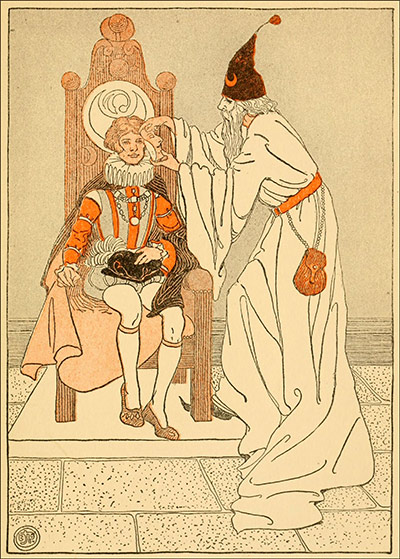
The Magic Mask was Ready, and Herlo Tried It on the King’s Face
You would think that the king would have then been satisfied, wouldn’t you? But he was not quite satisfied, for one thing troubled him.
When the queen would smile in approval of his kindness, and his self-control, he would think, “I wish I had not deceived my dear wife. I wish she knew my own self.”
At last he could bear it no longer, and so one day he rode for the third time to the home of the enchanter, Herlo. And again Herlo met him at the door. The king said:
“O Herlo, I have come to you to ask you to take back your magic mask. I cannot wear it any longer, because I cannot bear to deceive my dear wife who thinks me so kind and good. Better the truth than to deceive so true and kind a person as my queen.”
“I warn you,” replied Herlo, “that if I once take off the magic mask, you can never have it replaced. Think carefully before I remove it.”
“Yes,” said the king, “I know, and I have weighed the question carefully. It is better to be my own true self than to live behind a false face. Better that the queen should despise me than to live under false pretenses and have her love when unworthy.”
So the enchanter took off the mask, and bade the king good-speed.
You can imagine how the king felt as he rode home this time; how he dreaded looking into his glass, although he knew he must do so before he entered the presence of the queen; and how he feared that what he most prized in this world was about to be lost—his wife’s loving trust in him.
But can you imagine his joy when he looked into the glass and saw his own face—for his own face was handsomer than the mask! The ugly frown and the wicked, cruel lines were gone, for his face had been molded into the exact likeness of the mask; and when he came into the presence of his wife she saw no difference in him. He was the husband she had always so much honored and loved.
* * * * * *
“And they lived happily ever after,” finished the Story Lady. Then after a slight pause, she went on: “Now we will have a little goblin story.”
XXI THE CLOSING DOOR

THERE was once a little girl, who had a dear little room, all her own, which was full of treasures, and was as lovely as love could make it.
You never could imagine, no matter how you tried, a room more beautiful than hers; for it was white and shining from the snowy floor to the ceiling, which looked as if it might have been made of a fleecy cloud. The curtains at the windows were like the petals of a lily, and the little bed was like swan’s down.
There were white pansies, too, that bloomed in the windows, and a dove whose voice was sweet as music; and among her treasures she had a string of pearls which she was to wear about her neck when the king of the country sent for her, as he had promised to do some day.
This string of pearls grew longer and more beautiful as the little girl grew older, for a new pearl was given her as soon as she waked up each morning; and every one was a gift from this king, who bade her keep them fair.
Her mother helped her to take care of them and of all the other beautiful things in her room. Every morning, after the new pearl was slipped on the string, they would set the room in order; and every evening they would look over the treasures and enjoy them together, while they carefully wiped away any specks of dust that had gotten in during the day and made the room less lovely.
There were several doors and windows, which the little girl could open and shut just as she pleased, in this room; but there was one door which was always open, and that was the one which led into her mother’s room.
No matter what Little Daughter was doing, she was happier if her mother was near; and, although she sometimes ran away into her own room and played by herself, she always bounded out at her mother’s first call, and sprang into her mother’s arms, gladder than ever to be with her because she had been away.
Now one day when the little girl was playing alone, she had a visitor who came in without knocking and who seemed, at first, very much out of place in the shining white room, for he was a goblin and as black as a lump of coal. He had not been there more than a very few minutes, however, before nearly everything in the room began to look more like him and less like driven snow; and although the little girl thought that he was very strange and ugly when she first saw him, she soon grew used to him, and found him an entertaining playfellow.
She wanted to call her mother to see him; but he said:
“Oh! no; we are having such a nice time together, and she’s busy, you know.”
So the little girl did not call; and the mother, who was making a dress of fine lace for her darling, did not dream that a goblin was in the little white room.
The goblin did not make any noise, you know, for he tiptoed all the time, as if he were afraid; and if he heard a sound he would jump. But he was a merry goblin, and he amused the little girl so much that she did not notice the change in her dear room.
The curtains grew dingy, the floor dusty, and the ceiling looked as if it might have been made of a rain cloud; but the child played on, and got out all her treasures to show to her visitor.
The pansies drooped and faded, the white dove hid its head beneath its wing and moaned; and the last pearl on the precious string grew dark when the goblin touched it with his smutty fingers.
“Oh, dear me,” said the little girl when she saw this, “I must call my mother; for these are the pearls that I must wear to the king’s court when he sends for me.”
“Never mind,” said the goblin, “we can wash it, and if it isn’t just as white as before, what difference does it make about one pearl?”
“But mother says that they all must be as fair as the morning,” insisted the little girl, ready to cry. “And what will she say when she sees this one?”
“You shut the door, then,” said the goblin, pointing to the door that had never been closed, “and I’ll wash the pearl.”
So the little girl ran to close the door, and the goblin began to rub the pearl; but it only seemed to grow darker. Now the door had been open so long that it was hard to move, and it creaked on its hinges as the little girl tried to close it. When the mother heard this she looked up to see what was the matter. She had been thinking about the dress which she was making; but when she saw the closing door, her heart stood still with fear; for she knew that if it once closed tight she might never be able to open it again.
She dropped her fine laces and ran towards the door, calling, “Little Daughter! Little Daughter! Where are you?” and she reached out her hands to stop the door.
But as soon as the little girl heard that loving voice she answered:
“Mother! Oh, Mother! I need you so! My pearl is turning black and everything is wrong!” and, flinging the door wide open, she ran into her mother’s arms.
When the two went together into the little room, the goblin had gone. The pansies now bloomed again, and the white dove cooed in peace; but there was much work for the mother and daughter, and they rubbed and scrubbed and washed and swept and dusted, till the room was so beautiful that you would not have known that a goblin had been there—except for the one pearl which was a little blue always, even when the king was ready for Little Daughter to come to his court, although that was not until she was a very old woman.
As for the door, it was never closed again; for Little Daughter and her mother put two golden hearts against it and nothing in this world could have shut it then.
* * * * * *
As the story ended, the Story Lady paused while the clock ticked twice, and then said, “Next we will have a funny story about a silver teapot.”
XXII TOM GOES DOWN THE WELL

“I SEE it, I see it!” cried Tom eagerly, balancing himself perilously over the well-curb. “It’s down at the bottom!”
“Did you suppose it would float?” asked Bess, with a touch of scorn in her tones.
“Let me see,” cried Bob, pushing forward.
“You clear out,” said Archie; “you’re to blame for dropping it in; you’d better go before you tumble in yourself, you little goose.”
Archie’s broken arm felt very stiff to-day, and his temper was slightly damaged, too. All four children gathered around the well, at the bottom of which lay the silver teapot, like truth, bright and shining, but apparently not to be recovered by mortals.
Mr. Bradley had gone to the village, and the children were determined to get the silver teapot up before his return, for as yet they had not thought it necessary to mention its disappearance, and Mr. Bradley was not the man to notice its absence.
“Of course, if it was lost we should have to tell,” Bess had said to her brother; “but as long as we know where it is, and that it’s safe, there’s no need to say anything about it.”
“Well, what’s to be done?” asked Archie. “I can’t go after it, with my broken arm.”
“Now I suppose we will hear of nothing but your broken arm for a month, and you’ll shirk everything for it. ‘I can’t study ’cause my arm’s broken; I can’t go errands ’cause my arm’s broken; I can’t go to church ’cause my arm’s broken;’ that will be your whine, Archie; but don’t try your dodges on me, for I won’t stand it. If it really hurts you, I’m sorry, and I’ll lick any fellow that touches you till you get well again, but none of your humbug. Of course you can’t go down the well; you couldn’t if your arm wasn’t broken.” This was from Tom.
Meanwhile Bess had gone to the house for a long fishing-pole, and soon returned carrying it.
“We’ll fasten a hook to the end of it, and fish the teapot up,” said she.
“Ho, ho! Do you suppose it will bite like a fish?” laughed Tom.
“No, I do not, Tom Bradley. But I suppose if I tie a string to the pole, and fasten an iron hook to one end, with a stone to keep it down, that I can wiggle it round in the water till the hook catches in the handle, and then we can drag it up; that’s what I suppose,” answered Bess, preparing to carry out her design.
“There’s something in that, Bess; you’re not so stupid as you look. Give me the pole and let me try.”
“No, go and get one for yourself.”
“Where will I find the hook?”
“In the smoke-house, where I got mine.”
“Oh, get me one, too,” cried Bob.
“And me one, too,” cried Archie.
Before half an hour had passed, the four children, all armed with fishing-poles, were intently wiggling in the water, catching their hooks in the stones by the side of the well, entangling their lines, digging their elbows into each other’s sides, in their frantic attempts to pull their hooks loose; scolding, pushing, and getting generally excited.
Every few moments Tom would pull Bess back by her sun-bonnet, and save her from tumbling over in her eagerness; but so far from being grateful to her deliverer, Bess resented the treatment indignantly.
“Stop jerking my head so,” she cried.
“You’ll be in, in a minute; you’d have been in then if I hadn’t jerked you,” answered Tom.
“Well, what if I had! Let me alone. If I go in, that’s my own lookout.”
“Your own look in, you mean. My gracious, wouldn’t you astonish the toads down there! But you’d get your face clean.”
“Now, Tom, you let me be; I ’most had it that time!”
“So you’ve said forty times. This is all humbug; I’m going down on the rope for it.”
“Oh, no, Tom, please don’t. Indeed, you’ll be drowned; the rope will break; you’ll kill yourself; you’ll catch cold,” cried Bess, in alarm. She could fight Tom all day long, when in the mood for it; but to see him deliberately rush into danger, or to contemplate the fact that a hair of his precious head might be hurt, was more than our intrepid Bess could bear.
“Pooh! girl! coward!” retorted thankless Tom, pointing the finger of scorn at his sister. “Who’s afraid of what? Stand back, small boys, I’m going in,” and Tom began to divest himself of his jacket.
“You’ll poison the water,” suggested Archie.
“It will be so cold,” moaned Bob. But nobody took any notice of Bob; he was treated with great contempt, and much hustled, as the author of the mischief. All felt that if Tom came to grief, Bob would be answerable.
“I’ll scream for a hundred years without stopping, Tom,” cried Bess wildly. “You shan’t go down, you shan’t; I’ll call some one. Murray! Peter! Maggie! O-o-o-o-o-o-o-me! O-o-o-oh, o-o-o-o-o-me!”
“Stop screaming, and help,” said Tom, who had his shirt sleeves rolled up to the elbow, and his pantaloons to his knee—why, no one but Tom could tell. “Now do you three hold on tight to this bucket; don’t let go for a moment; pull away as hard as you can when I tell you to. Now for it!”
And without more ado, Tom clung to the other rope with his hands, and twisted his feet around the bucket handle.
“Hold on tight, and let me down easy,” said Tom, and the three children clung desperately to their rope, and lowered him little by little. Long experience in rescuing cats from a watery grave in the well had taught the children how to manage the ropes and buckets; but they had not calculated on the fact that Tom would be heavier than a cat; and it was with red faces and straining muscles that they dragged away on their rope. However, they were able to keep Tom steady, and he, clinging with one hand to his rope, and pushing himself away from the sides of the well with the other, made his dangerous descent as successfully as though his coadjutors had been gifted with Samson’s strength. A sudden splash and shiver told them he had reached the water, and a shout of triumph declared that the teapot was rescued.
As Tom shouted, all three children let go the rope and rushed to the side of the well to look at the victorious hero.
It was a most fortunate circumstance that the water in the well was low, and that Tom, plunged suddenly to the bottom by this unexpected movement, was able, after much scrambling, to stand upright with his head out of water; otherwise the earthly career of Thomas Bradley would have been brought to a sudden and untimely end.
As it was, he stood in the cold water up to his shoulders, clinging still to the rope, holding the teapot with one hand, and wildly vociferating to his admiring audience whose heads hung over the well-curb, and their faces, as seen in this position by Tom, looked like those of grinning fiends.
“What made you let go?” roared Tom, and his voice sounded hollow and unnatural as it resounded from the depths of his cool and shady retreat.
“Oh, Tom, have you got it? Have you really? Ain’t it cold? Are you hurt? Were you scared? Is the teapot broken?” were a few of the questions that came faintly to him from above and sounded very unlike angel whispers to the diver for teapots, who stood first on one leg, then on the other, to prevent equal cramp in both.
“Draw me up! You silly children! You goose of a Bess! Why don’t you draw me up?”
“We’re so tired?” called down Archie. “I helped to lower you with only one arm, but I can’t drag any more. My arm’s broken.”
“Bess! draw me up, I tell you!” screamed Tom from below.
“I will, Tom; I’m going to,” answered Bess, who now reached up and recovered the bucket, that had flown with a jerk to the top of the well-roof when it had been so suddenly abandoned.
But all the united efforts of Bess and Bob and Archie’s left arm could not raise Tom. After a desperate tug he was raised an inch, and suddenly lowered again. The result was a splash, a scramble below, and Tom’s voice sputtering incoherent invectives. Again and again the children tugged, and again and again Tom splashed, scrambled and sputtered.
At last a red, anxious face looked down to him, and Bessie’s voice, choked with tears, called out:
“Oh, Tom, do hold on till I call Maggie; we can’t get you up.”
Away ran Bess to call help, followed by Archie; but Bob, whose ideas on some points were as yet but feebly developed, seized one of the long poles, and began to poke at his brother with it, under the impression that some good would come of these unaided efforts.
“Bob, be done! You’ll put my eye out!” cried poor Tom, desperately, as the swinging iron hook circled around his head.
“Catch hold! Catch hold!” cried Bob, getting excited as he saw how near he came to grappling his brother.
“Just let me get up once, and I’ll catch hold,” muttered Tom, wrathfully; then, raising his voice, he yelled as loud as he could for help. “Pete! P-e-e-e-e-ter! P-e-e-e-e-e-e-ter!”
But Peter was a mile away, and consequently could not hear. Maggie had improved the occasion of her master’s absence to visit her friend and neighbor, Miss Flaherty, for half an hour; and Kate, summoned from her baking, came to the rescue, but only assisted by wringing her hands and wailing.
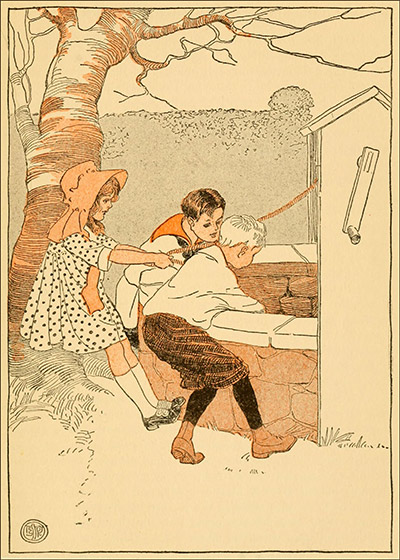
But All the United Efforts of Bess and Bob and Archie’s Left Arm could not Raise Tom
“Och, he’s lost wid the cold! Shure an’ he’ll get his death now! Arrah, what childer yez arre!”
“Take hold of the rope and pull,” cried Bess.
“I couldn’t rise him; shure an’ I’d only pull him up be snaps, and dhrop him again,” said Kate, who showed a lamentable want of confidence in her own abilities.
“Oh, do something!” cried Bess, now almost beside herself with fear; “do something, Kate. Oh, where is Murray?”
“Garn for a load o’ wood, and won’t be home till night,” answered Kate.
“Oh, Tom, can’t you shinny up the rope?” called down Bess.
“No. I’m too stiff now with cold; besides, I couldn’t do it anyway,” moaned the captive Tom, who looked like a Triton blowing on a conch-shell, as he stood with uplifted teapot. He seemed to think the teapot should be kept dry at all hazards, and wearied his arm to keep it above water.
“I’ll run next door and call Mr. Wilson,” said Bess, more hopefully, and started on this errand, while Kate, suddenly inspired, rushed to the kitchen sink, where stood the iron pump, connected by a pipe with the well, and began to pump vigorously, apparently with the anticipation of seeing Tom ooze through the spout, for which purpose, and to make the matter surer, she removed the filter.
As Bess ran she was suddenly stopped at the gate by the sight of a carriage which had just driven up, and out of which now stepped Aunt Maria and Aunt Maria’s husband, Uncle Daniel. These were the very grimmest and grandest of all the relations. When they came to see mamma, Bess had always to sit perfectly still on a chair, answer very politely, have her very best dress on, her hair parted directly in the middle and be intensely proper. As for the boys, they suffered the torture by soap and water, and endured their new jackets, could not whittle, nor whistle, nor wrestle, and were sustained under these tribulations only by the expectation of a very good dinner and a “bully” dessert!
The white-and-gold china always came out on these occasions, the best double-damask tablecloth and napkins, the heaviest silver forks and spoons, the silver salt-cellars, and—oh, agony of agonies!—the silver teapot!
For one awful moment Bess stood stunned. Then her anxiety for Tom overcame every other consideration, and before Aunt Maria could say, “How do you do, Elizabeth?” she had caught her uncle by his august coat-tail and in a piteous voice besought him to come and pull on the rope.
“Pull on a rope, Elizabeth!” said Uncle Daniel in mild astonishment. “Why should I pull on a rope, my dear?” and Aunt Maria murmured, “Very astonishing thing for a child to say.”
“Oh, come quick! Hurry faster! Tom’s down in the well!” cried Bess, with freely flowing tears.
“Tom down a well! And how did he get there?”
Uncle Daniel never hurried, and required a reason, always, for the hope that was in his friends.
“He went down for the teapot,” sobbed Bess, “the silver teapot, and we can’t pull him up again; and he’s all cramped with cold. Oh, do hurry!”
“The silver teapot down the well; my mother’s silver teapot! Daniel, didn’t I always say that Mary Bradley should never have had that teapot? This must be looked into.”
And with dignified strides Aunt Maria marched to the well.
Tom’s teeth by this time were chattering so that he fully expected they would all drop out, and the three fishers were so completely demoralized by their fears as to be speechless.
Uncle Daniel was a slow man. He leisurely looked down at Tom, then up at the wheel, then at the rope, and calmly remarked, “All new, I see.” Then he slowly took off his coat, and as slowly carried it into the house, stopped to give an order to his coachman, who had driven around to the stable, and came with measured pace to where the three frightened children stood listening to Aunt Maria, who was doing her duty by them strictly and fully.
Uncle Daniel then took hold of the rope, gave a long, strong, calm pull, and in an instant, Tom, “dripping with coolness, arose from the well.”
* * * * * *
As soon as they had stopped laughing, the story teller said:
“I will now tell you a Christmas story of the Great Northwest.”
XXIII GLOOMY GUS AND THE CHRISTMAS CAT
THE Canadian miner was the first of the men to finish “washing up,” on his return from the mine.
“Where’s Barbara?” he asked, tossing his towel at a peg.
“She has a little cold and I put her to bed,” replied Mrs. St. Clair.
The anxiety in the mother’s voice kept him from asking any more questions. He followed the other men in to supper.
“It seems lonesome without Barbara,” said McGill, the mining engineer.
The rough men had made a pet of the laughing, blue-eyed little girl, and they missed her. She had slipped into their lives so quietly that they did not realize how much they looked forward to seeing her at the end of the day. And Barbara returned their love. A mining camp is hardly the place for a child, but Barbara’s father was dead, and her mother became the cook at the Little Bear Mine.
After supper the men sat in a grave, silent circle before the great open fireplace. There seemed to be nothing to talk about. Other evenings these big, rough men had had Barbara to romp with, all except Gloomy Gus.
But then Gloomy Gus never showed any interest in anything. He was a big, gruff Swede, whose name appeared on the company’s books as Gustavus Schwarstun. To the men, however, he was “Gloomy Gus.”
“This will give me a chance to finish her snowshoes,” the Canadian finally said, with an assumed air of gayety. “Christmas is almost here.”
He went to the bunk room and returned with a pair of small snowshoes he was making.
Every one of the men was making Barbara a present—every one but Gloomy Gus. McGill eyed him sharply.
The big Swede did something which at another time would have met with a roar of laughter; but not a man smiled when he pulled a ball of red yarn and a half-knitted mitten out of his pocket.
“I learned how to do it in the old country,” he said as he busied his rough, calloused fingers with the crude pine knitting needles he had made. He had unraveled the sleeve of a new red sweater to get the yarn he needed.
The men found it hard to work that evening, and trooped off to their bunks earlier than usual.
McGill remained. He went down the hall to Mrs. St. Clair’s room, where a light was still burning, and tapped gently.
“I’m going to put a cot in the mess room and sleep in there to-night,” he told her. “You may need me.”
It was after midnight when she called him. McGill found the little patient’s fever high. He listened to Barbara’s labored breathing and counted her pulse.
When he looked up, he found Mrs. St. Clair watching him anxiously. He knew from her eyes that she shared his fear—the fear that Barbara might have pneumonia. McGill had helped the doctor fight several cases of the disease in those mountains. They had generally been losing fights, but he set to work.
The big, hobnailed boots of the men fell softly on the rough floors as their wearers slipped in for breakfast. They had prepared it themselves and ate it silently. During the meal McGill came in. He looked worried and did not eat. After they had finished the men waited for him to speak.
“It’s pneumonia,” he said briefly.
That was all. Soon the men slipped off quietly to the mine, and McGill went back to Barbara.
By night Barbara was delirious.
“It looks bad,” McGill admitted to the men. “She is fretting over that cat.”
When Barbara came to the Little Bear Mine, she had brought with her a small Maltese kitten, her dearest possession. The death of the little kitten a week before had been the greatest tragedy in her young life.
After supper the men tried to work on their presents, but somehow the work dragged. The hours passed, but the men did not leave the mess room. Toward midnight McGill came out to them. “Mrs. St. Clair says you had better come in now if you want to see her. She’s—she’s going!”
The whole crew, from mucker to foreman, tiptoed down the hall—all except Gus. He didn’t seem to notice that they went.
Into the sick room they filed and stood in a little embarrassed group by the door. Barbara tossed fretfully on the bed, her eyes glowing with unnatural brightness.
“I want a kitty, Santa Claus! I want my kitty!” she wailed feebly.
The Canadian miner, tears rolling down his cheeks, left the room. The others followed.
Gus was still in his place by the fire when they returned.
“I can’t stand it to see her begging for that kitten,” said the Canadian. “I would risk my life to get one for her. I’d try to get to Telluride, if I thought I could get back in time to do any good.”
A minute afterwards Gus got up slowly and went out to the bunk room.
But Gus did not stop there long. He drew on an extra sweater, rubber coat and furs, snatched his skis and pole, and slipped from the house.
It was after midnight. The thermometer registered way below zero. The wind swirled down from the mountain tops with the lash of a gale. But Gus did not mind the storm; a master of the ski, he swung down the trail with a speed that mocked the wind at his back.
Telluride, the nearest town, was thirteen miles away, the only route leading there being over a zigzag pack trail. From the mine this trail descends the crest of a ridge until it strikes the edge of the canyon, staggers back and forth down the steep face of the canyon, then for the rest of the way meekly follows the river.
It is only a pack trail, narrow and dangerous at best. During the summer a line of burros or donkeys winds along it, bringing down ore from the mine and carrying back provisions. But when winter sets in, the trail becomes very dangerous, and the zigzags have caused the death of many prospectors who have stayed too late in the mountains, or taken the trail too early in the spring.
Gus had little difficulty down the first part of the trail. In an hour he reached the zigzags. They were covered with hanging masses of snow that threatened with every blast to go grinding down the wall of the canyon.
By his pole Gus held himself on to the side of the canyon, moving cautiously across hanging drifts. He made his way only by grim, desperate effort.
At the end of thirty minutes of hard struggle he stood half-way down the trail. Then a savage blast tore a pile of clinging snow from the top and drove it at him. Gus saw it start, gathering speed and bulk as it came. The whole mountain side began to move. Tons of hard-packed snow were slipping, and he was directly in their path. There was no way of dodging the avalanche—he must outrace it.
There was no time to zigzag back and forth down the side of the canyon; he had to take as direct a route as the avalanche. He threw his pole from his grasp and shot ahead of the oncoming mass of snow. Death was behind him. Before him rocks jutted out to trip him, and jump-offs endangered his course.
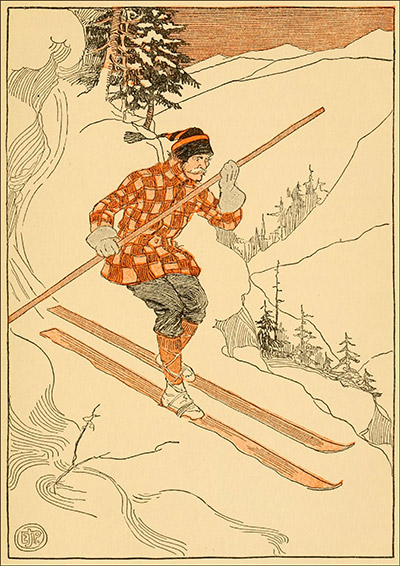
He Swung Down the Trail with a Speed that Mocked the Wind at His Back
But he rode his skis with reckless abandon, leaping, twisting, dodging down the slope. Behind him crashed the snow. He was veering to the left to escape its path.
A leap brought him to the bottom of the canyon. But before he could glide to safety, a mass of snow at the side of the slide caught and hurled him before it, bruised and half buried.
A desperate struggle freed him. His skis were broken, his muscles were bruised and twisted.
It was half-past three when he reached the outskirts of the town. Mounting the steps of the first house, he rained heavy blows upon the door. The owner stuck his head out of a window. “Who’s there?” he asked.
“Give me a cat!” Gus ordered in a rough voice.
“Are you crazy?” yelled the enraged man at the window.
“I’ve got to have a cat! I’m from the Little Bear! Cook’s little girl is sick—pneumonia! She’s goin’ to die if we don’t get her a cat!”
“From the Little Bear? Over the zigzags? Impossible!”
“Give me a cat or I’ll break your door in!”
Presently a light glimmered through the night and a hastily clad man joined Gus. A search of the neighborhood produced a cat and fresh skis. In half an hour Gus was on the trail back.
At the mine the men had not gone to their bunks that night. They huddled before the fireplace, awaiting the dreaded news. McGill slipped by now and then on some errand.
The night dragged through, and Christmas dawned.
Christmas! This was the first time they had planned a real Christmas since they left their homes years ago. But now the heart had been taken out of the day.
They sat down to a listless breakfast. McGill came in.
“She’s still fighting. She’s got to win or lose pretty soon,” he said.
They did not go to the mine that morning. It was the first Christmas the Little Bear Mine had not run.
At ten o’clock McGill came in to report.
“Boys, I can’t stand it any longer. She’s wearing her strength away fretting for that cat. I’m not sure that a cat would really quiet her, and I hardly believe any living man can make it to Telluride, but I’m going to try.”
“No, you’re not,” said the Canadian. “She needs you here. Besides, you’re worn out. I’ll get the cat.”
“We’ll draw for it,” said the men.
“No use. Gus and I are the only two good enough on skis to have a fighting chance.”
“Gus! That brute hasn’t got the heart of a mine mule! He wouldn’t go at the point of a gun! Where is he? I haven’t seen him since last night,” stormed the foreman.
Silently the men watched the Canadian prepare for the trail. They were rough men, who held life cheaply, but not one of them believed a man had a chance to make the trail and return safely.
Suddenly the door opened and Gus staggered in. He tried to cross the room, but his worn-out muscles refused to act, and he sank to the floor.
The men sprang to him, laid him on a cot, pulled off his furs, and unbuttoned his coat. Underneath the coat was an old sack. One of the men gave it a shake. Out on the floor rolled a half-frozen, half-smothered kitten. It told the story; it told them that Gus was a hero.
The next morning when consciousness returned to Gus, the men carried his cot into Barbara’s room. On the bed he could see a little figure, frail and worn, but sleeping the restful sleep of exhaustion. One little arm was outside the covers, hugging up closely a fluff of a kitten. Beside the bed, he saw the mother, smiling happily through her tears, for she knew that Barbara would get well.
XXIV PATTY AND HER PITCHER

AT the end of the story the Story Lady paused a moment, and then said: “We will now leave the cold and snowy world and come back to our warm and pleasant Fairyland and to the story of Patty and her Pitcher.”
“This is the delightful surprise I spoke of,” said the Story Queen to Mary Frances. “Just watch the magic circle.”
Mary Frances noticed a large circle drawn on the carpet, about which all the Story People were grouped.
“You are going to hear the story and see it acted at the same time. The Story Lady will control the action with her voice.”
In the Magic Circle
Mary Frances sat listening entranced to the voice of the Story Lady. It flowed on and on like sweet music, now rising, now falling, filling the ear with charming sound, and the imagination with a perfect picture of the story she was telling.
The story began:
“The most charming little girl in her native village was Patty—”
At the words a little girl, Patty, not much bigger than Tiny of Tinytown sprang up in the circle with her little home and the village all about her.
“The pigeons flew down—to coo around her—”
And they flew down and cooed.
“The chickens fed from her hand—”
And the chickens came running.
“The cat rolled over her feet and purred—”
And the cat did it.
“The steady old dog, Bluff, cut his liveliest capers—”
And Bluff did it.
As the story fell from the Story Lady’s lips there was instant obedience in the village of the magic circle. The characters obeyed the voice instantly, just as the feet of children dancing obey the music of the piano. So the story flowed on—the acting kept pace with the voice and did everything the words said.
Mary Frances sat spellbound, for she had never seen anything so beautiful as the way in which that wonderful voice brought every player and every action to her ears and eyes at the same time.
This is the story. If you keep your eyes on the magic circle you can see it as Mary Frances saw it—through the veil of words.
* * * * * *
The Wonderful Pitcher
The most charming little girl in her native village, was Patty; at least, so all the neighbors said, and what everybody says ought to have some truth in it.
Patty deserved their kind words, for she loved everybody and everything, and in return she was loved by all who knew her. The pigeons flew down from their little house to coo around her; the chickens fed from her hand; the cat rolled over her feet and purred with pleasure; and even the steady old dog, Bluff, put himself to the trouble of cutting his liveliest capers to attract her attention.
Patty was always busy, too, about something. When she was no higher than your knee, she used to bustle about and do little things in the handiest manner; and as for sewing, she was the pattern child at the dame’s school, where her sampler was hung upon the wall, as a guide to the other children.
She lived in a little cottage with her parents, who were now old and very poor, and depended upon their little daughter for many things which they were too feeble to do for themselves. One of her daily duties was to go to the spring for water.
She would dip her pitcher into the clear, bright liquid, and sing her sweet little songs, with a voice that made every one who passed that way stop to listen with delight.
Upon one of her journeys to the spring, occurred the great event of her life, of which I am now about to tell you.
Patty had filled her pitcher at the spring, and was carrying it home with some little difficulty, for it was quite heavy when filled. When almost in sight of her cottage, she saw a poor, old, travel-worn woman sitting by the wayside, as if overcome by the fatigue of a long journey.
She sat upon the trunk of a fallen tree; her face was as brown as a nut, and covered with a complete network of wrinkles, while her dim eyes looked dull and sunken. At her back was tied a bundle which seemed quite large enough for a strong man to carry.
She watched Patty as she came near, and cast eager eyes upon the water in the pitcher, which seemed so cool and tempting; and after looking at Patty’s rosy, good-natured face, she asked for some water.
“Dear little child,” said she in a feeble voice, “give me a drink from your pitcher, for I am very old, and faint, and weary.”
“To be sure, mother, and welcome,” said Patty, sweetly, as she raised up the pitcher so that the old woman could drink.
Long and eagerly did the poor creature drink of the delicious water; so long, indeed, that Patty was much surprised at her extreme thirst.
“Thank you, my darling. Heaven will reward you for your kindness,” said the old woman.
“Oh, you are quite welcome, mother,” said Patty again, shouldering her pitcher, and going cheerfully on her way, singing in the lightness of her heart, at the pleasure of having relieved the poor woman’s distress.
But she had not gone far before she was overtaken by a large dog, who seemed to be bound upon a long journey; for he was covered with dust, his eyes were bloodshot, and his parched tongue hung from his mouth to catch the cool air.
“Poor fellow,” said Patty, in a kind voice.
The dog turned around at the words, and stopped to look at her. She held out her hand, and he came nearer. She then set down her pitcher to caress him, but he strove eagerly to reach the pitcher which his instinct told him contained water. Patty understood his wants, and held the pitcher to the poor dog so that he could drink with comfort.
He lapped and lapped, until she began to think he would never leave off. At last, he looked up into her face, and licked her hand in gratitude; then, after bounding and gamboling about to show how refreshed he was, trotted on his way.
Patty now looked into her pitcher and found that it was more than half empty, so that she must take all her journey over again; for it was of no use going home with a pitcher but half full.
As she rose, she saw some hare-bells by the side of the road which appeared to be in a very drooping, dusty state, so she at once poured over them all the water that remained in the pitcher.
Then, with her pitcher once more upon her shoulder, she turned her steps again toward the spring, without a single regret at the double work she had to do. She traveled blithely on over the dusty road, cheering the way with her sweet songs, and soon arrived once more at the margin of the spring.
Resting for a few minutes in the shade, she gazed sleepily at the bubbling water, and all kinds of fanciful thoughts passed through her mind. She was just dropping off into a little nap, when she thought she heard some one call her by name. It was a sweet little voice, and Patty could hardly distinguish it from the tinkling of the spring.
She rose quickly to her feet, and looked in every direction for the owner of the voice, but in vain; till suddenly casting eyes upon the spring, she saw, to her amazement, a dear little face looking up at her from the water; and presently there stood before her one of the most beautiful little creatures Patty had ever seen.
She balanced lightly upon the surface of the rippling water, where she seemed to stand with the same ease as Patty did upon the land, and was really no higher than the pitcher.
“So, Patty,” said she, “so you have come back again, my dear?”
“Yes, Madam,” replied Patty, who, to say the truth, felt somewhat alarmed; “yes, Madam, because I——”
“I know all about it,” said the fairy, for it was a fairy, you know; “and it is because I do know, that you see me here, for I am now come to make you a useful present.”
“A present!” said Patty, with a pleased surprise.
“Yes, and such a one,” replied the fairy, “as will be a lasting reward for your goodness of heart toward others, and your little care for yourself. You blush because you do not remember the many kind things you have done, and I am the more pleased to see that you think I am giving you unmerited praise.
“That you think so little of all the kind actions which are the ornament of your life, assures me of the purity of your motives; for it is our duty to forget the good we do to others, and to remember only the good that others do to us. You have always done so, my dear Patty.
“To reward you, I will place a spell upon your pitcher, which will always be full of water or milk, as you may desire. It will also be able to move and work whenever you wish it, and will always prove your firm friend in any trouble.
“If it should, by any mishap, be parted from you, it will easily, by its magic powers, be able to find you; and in whatever position you may happen to be, you will always find it by your side, as adviser and friend; so put your pitcher on the ground, and look into it.”
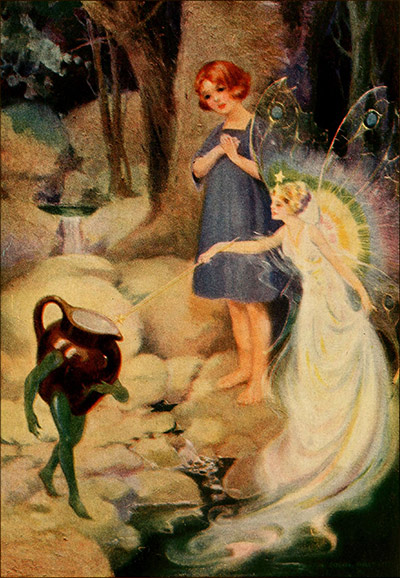
She then Touched the Pitcher with Her Wand
Patty did so, and to her surprise, saw the bright water gradually rising until the pitcher was full to the brim. When she saw it was full she tried to lift it, but found it too heavy for her strength.
“You need not trouble yourself to carry it,” said the fairy, smiling; “it will save you all further trouble on that score.”
She then touched the pitcher with her wand, when to Patty’s greater surprise, two very well-formed legs grew out of the bottom, and a pair of neat little arms appeared at the top of the vessel, which, as soon as it was firm on its legs, made a very polite bow to Patty as its future mistress.
“Now, Patty,” said the fairy, “follow your pitcher, and you cannot possibly go wrong;” and as she finished speaking, she gradually faded away, and at last broke into a thousand sparkling drops, which mingled with the bubbling stream, and were soon borne away on its bosom.
Patty rubbed her eyes as if to make sure that she was awake; for the whole thing seemed to her like a wonderful dream. She coughed aloud, and at last began to pinch herself until she found it painful, when she finally concluded that she must be really awake. But more convincing than all, there stood the saucy brown pitcher firmly upon its sturdy green legs, with its toes turned out in the politest manner of the day, and its little fists planted in its sides in a style that was very business-like indeed.
“Quite ready to start, mistress,” said a little voice that made Patty jump, for the fairy had not told her that the pitcher could speak; but screwing up courage, she said: “Come on, then, Pitcher,” and set the example by starting off into a run.
And didn’t the pitcher follow her in good earnest! Indeed, it ran so fast that it soon overtook her, and not only that, but it ran beyond her, long before she got half-way home.
But the most surprising thing was that, although it hopped along with the most wonderful strides and jumps over the rough places in its path, it did not spill one single drop of water in its progress. This puzzled Patty, who, with her utmost care, could never avoid wetting her dress whenever she had tried to run with the pitcher, even half full.
“What will people think when we get into the village?” thought Patty, as she looked at her strange companion; “I’m sure they will be frightened, and what will father and mother say when they see what I have brought home with me?”
“Do not trouble yourself about that,” said the pitcher, who seemed to know her thoughts; “your parents will soon get accustomed to me, and be much pleased when they see how handy I am, for you do not yet know half of my good qualities.”
As he was speaking, they came to a very high stile. “Shall I help you over?” said Patty, thinking of his short legs.
“Oh, dear, no,” said the pitcher; “see how little I need it.” And, so saying, he skipped over the stile in the most graceful manner. As he did so, a dog who was passing put his tail between his legs, and after two or three very weak barks, scurried off in evident fright and surprise.
A man was at the same time coming along the road with a slow and pompous walk—for he was the squire of the village—who, upon seeing the strange pitcher clear the stile, was rendered almost speechless with amazement; but as soon as he saw the little legs speeding toward him, he uttered one loud exclamation of terror, and fled!
His hat flew one way, his cane another, and his cloak mounted into the air like wings. Being very fat, however, he had not gone far before his legs failed him, and he lay kicking in a furze bush, roaring for help. Patty could not help laughing at the sight, but the pitcher, trotting on with the greatest unconcern, soon reached the cottage door to the astonishment of Patty’s parents.
The pitcher walked quietly into the cottage, and sat down in a corner, tucking its legs carefully under it, so that no one could see them. The neighbors, therefore, who had been alarmed at the squire’s account of his fright and disaster, and came to the cottage in crowds, only saw a pitcher, such as they all had at home, and put the old squire down as being a little bit out of his mind.
Patty was awakened next morning by hearing a noise below, as if someone was very busy with the furniture. She heard the chairs pushed about, and presently the handle of a pail klink down as plain as could be. So she put on her clothes and crept down stairs. She peeped cautiously through the red curtains at the bottom, and there, to her wondering surprise, she saw, what do you think?—not any thieves, but the astonishing pitcher; and what do you think it was doing? Why, it was mopping up the red tiles of the floor as handily as if it had never done anything else all the days of its life; and more wonderful still, the fire was made, and was burning brightly upon the hearth!
We can imagine a pitcher of water washing the floor, but we cannot imagine it doing anything else with a fire except putting it out. But, no! the fire was lighted, the kettle was on, and there it was, merrily singing a little song about breakfast being nearly ready.
“Good morning, dear mistress,” said the pitcher, cheerfully; “you need not trouble yourself to do anything but grow and improve your mind; for from henceforth you will have but little labor to do, as I am here to do it for you.”
You may suppose that Patty was well pleased to hear this, for she was now growing to be a tall girl, and felt a great desire to improve herself with books, which as yet she had had very little time to do, having been so much taken up with her household cares.
When Patty was left alone in the evening with the pitcher, she told him how much she was obliged to him for all he had done, and how much she wished to learn; but did not know what to do for books, as she had read the few she already possessed, many times over.
“Oh, I can soon help you there,” said the pitcher, “for you have only to wish, and I will yield you as much milk as you desire. You can then make butter and cheese, and go sell them at the market town; buy as many books as you like, and have something left for other purposes besides.”
No sooner said than done. Patty set out all the pans she had, and all she could borrow from her kind neighbors, and as fast as they came the pitcher ran about and filled them; so that she soon had plenty of cream for her butter and cheese.
She had only to ask, and a good neighbor lent her a churn, while the pitcher furnished a pair of arms to do the churning, and such butter was produced as had not been seen in the village for many a day. You may suppose that Patty was pleased; and as for her dear old parents, they hardly knew what to make of it all.
The same good neighbor lent her a gentle horse and some baskets; and early one lovely morning, she started for the market-town, to which the pleased pitcher pointed out the way. He did not go with her, as he said the people of the town were not accustomed to see brown pitchers with legs, so he should stay at home and see about making the cheese.
Patty rode cheerfully on her way, looking as happy and handsome as the best farmer’s daughter of them all—so everybody in the market said—and she soon sold all her butter at the very best prices of the day.
And so Patty went on thriving, and doing good to every one in need, until in course of time, she grew into a beautiful and lovable young woman, living in comfort with her old parents in one of the prettiest cottages in the village.
Every one said that she deserved her good fortune; no one envied her; she was loved by young and old; so, as you may well believe, she was happy as the day is long.
The Well-dressed Stranger
And now, a wonderful thing came to pass, which changed the whole course of Patty’s simple and contented life. One evening, she was standing in her garden, feeding her pigeons, when a well-dressed stranger approached the gate. After looking at her with admiration for a moment, he bowed gracefully, at the same time removing his plumed hat, and, in the politest manner, inquired the way to the next town.
Patty answered him pleasantly, and as she spoke, the music of her voice and the charming modesty of her manner seemed to strike the young man with surprise and pleasure.
He looked at her intently for a moment, which made Patty’s eyes seek the ground in blushing confusion; then bowing again with greater respect than before, he proceeded slowly on his way, often looking back for another glimpse of sweet Patty.
And now, as you probably guess, the handsome young stranger came again and again, although he knew his way very well indeed between the village and the neighboring town. At last she found that it was the way to her heart he was seeking. He told her parents that he was rich, and wished to have a wife of whom every one spoke well. He did not care how poor she might be, so that she loved him; since he had wealth enough for both, and could choose to marry when and where he pleased.
You must not suppose, however, that Patty fell into the arms of the young stranger at once. He coaxed her a great deal before she consented to be his wife; as she wanted to make sure that he was as upright in character as he was handsome in appearance.
The parents smiled as they looked upon the ardent and handsome lover, whom, however, they did not think a bit too good for their darling Patty; and so, in as short a time as was possible, they were happily married.
Now the stranger who had married Patty was a prince in disguise; and the pretty cottage-girl became a great princess, surrounded with all the splendor of her high station!
Did Patty now forget her early home and her old friend, the pitcher? No, she did not, for the pitcher went with her; but her parents wished to end their days in the peaceful village where they were born. In the splendid state in which she now lived, the pitcher was as useful to her as before, though in a different way. When the poor came to the palace gate, he gave them bread and nourishing soup for their families, for which they daily blessed the kind princess who relieved their wants. So you see the pitcher, although now not called upon to work, still continued, in the name of his mistress, to do good to all around.
Patty in Trouble
But, alas! the best of us cannot escape from envious hearts and wicked tongues, and so it befell with Patty. Her dream of happiness was short. Many of the wicked courtiers envied her the love of the people, to whom Patty was endeared by her gentle kindness; and they whispered slanders into the ears of the prince, her husband, who at last, I am sorry to say, was weak enough to listen to them; for they aroused his fears by telling him that she was trying to bribe the people by her charities to rebel against him.
They also said that she was served by evil spirits, and pointed to the good and innocent pitcher as a proof of their wicked tales. Alas for human weakness! The prince at last became convinced of her guilt; and although his heart ached, he had her put into one of the dungeons of the palace; and there poor Patty was left to mourn over the too easy belief of her husband in her guilt.
She did not, however, mourn long, for as night came on, the prison door gently opened, and there, to her great delight, she saw the faithful pitcher, with a bunch of keys in his hand.
“Come,” said he, “let us return to your peaceful home, and show your husband that it is his heart and not his riches that you covet. He will come back to reason and repentance when he finds he has lost you.”
Poor Patty followed him in deep grief; but they had not gone far in their flight, when she perceived with alarm, that they were followed by a band of soldiers. She screamed with fright.
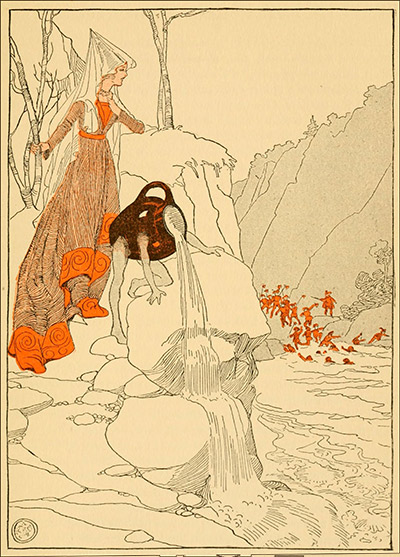
“Be not Alarmed, Dear Mistress,” said the Pitcher
The Pitcher to the Rescue
“Be not alarmed, dear mistress,” said the pitcher; “I will soon stop their pursuit.” So saying, he bent over the side of a rock and poured out a cataract of water through the valley in which the soldiers were marching.
Soon the water swelled into huge waves, which swept the soldiers from their path, and compelled them to save their lives by swimming to the nearest land, when, wet and dispirited, they soon returned to their master, the foolish prince.
That night Patty slept once more beneath the sheltering roof of her parents, who, as you may suppose, received their darling with open arms.
She once more found herself in her beloved garden, and the flowers, as you may believe, were often watered with her tears. It was but natural that her thoughts should wander to the home of her husband, and that she should grieve over his cruelty in return for her pure and ardent love. Hope, however, whispered to her, in the midst of her tears, that he would yet learn how false the stories were that had caused not only her unhappiness, but his also. The pitcher, too, was always at her side to give her comfort in her silent sorrow.
And thus days and weeks rolled on, but no news or messenger reached her from her husband. Had he entirely abandoned her? Or did he believe her to have been swept by the torrent that had so nearly drowned his soldiers, who were too busy looking out for their own safety to notice what had become of her?
She hoped that it was so, as that in a measure would excuse him; and even now, he might be mourning her as lost to him forever! For surely, she thought, long ere this the evil tongues must have appeared to him in their true light.
One morning, she rose earlier than usual. She was restless and could not sleep. The pure air was cool and refreshing to her fevered brow. Looking sadly around her, she saw the dear old pitcher trimming the flowers just like an experienced gardener.
“Good morning, dear mistress,” said he, rubbing his hands cheerfully; “you are up betimes to-day, for the sun has hardly yet peeped into the valley. I am glad you are so early afoot. As you see, I am taking extra care with the garden, for I expect visitors to-day!”
“Visitors?” said Patty with an inquiring look.
“Yes, visitors,” said the pitcher, from whose mouth issued a low, chuckling laugh; “I can distinctly hear footsteps in the distance, and they are coming this way. Listen! they are now near enough for mortal ears to hear!”
And so they were; nearer and nearer they came. Presently the figure of a traveler, with a hood over his face, came in sight. He stopped a moment, threw back his hood, and stood, struck with amazement; for it was the prince, her husband, who believed her to be dead—drowned in the valley, after she had escaped from prison!
“This,” said the pitcher, “is the visitor I expected. Believing you to be dead, he has wandered in many lands to cure his grief; and at last ventured to this quiet cottage to see once more the spot where he first had the good fortune to meet you. He has bitterly grieved over the sin he has committed in believing you guilty of coveting his riches, when he alone was all your riches and your delight.
“That you are still alive, is the reward for his sincere repentance. He finds you in your parents’ home where he saw you first, regretting nothing of your past life, except the loss of the husband you love so well.”
The faithful pitcher here ceased speaking. The prince rushed forward with a cry of delight, and knelt at Patty’s feet and begged her forgiveness.
The pitcher, like a discreet friend, placed her hand in his, and went into the cottage.
The prince now happy in his love, which had increased a hundred fold, wished at once to return to his palace; and desired to send forward a messenger, so that he might bring back his recovered wife in triumph. The pitcher, upon this, came out and joined them.
“Prince,” said he, “spare yourself this trouble. I am here to render a last service to my mistress. Since your sincere love now leaves nothing for her to desire, the fairy who appointed me to reward her for the greatest of human virtues—self-denial, now recalls me to her water-palace.”
Behold! As he ceased speaking, jets of sparkling water rose high in the air from his mouth, until the valley was filled by a lovely lake, upon which floated a gilded barge, manned by stout rowers in the prince’s livery, and gay with flags of all colors.
Patty then took an affectionate leave of her parents, and she and her husband stepped into the barge. Still the water flowed from the pitcher’s mouth, until the lake grew into a mighty river, down which they floated until they came in sight of their beautiful home, standing high upon the rocks which bordered the stream.
Hundreds of flags floated from the towers, and booming cannon sent forth a noisy welcome. Crowds of rejoicing people stood to receive their beloved mistress, whose kindness had long ago endeared her to their grateful hearts; and, when at length they landed, the people rushed forward—happy if they even succeeded in kissing the hem of her garment.
After that Patty lived many years in peace and prosperity; but the magic pitcher was seen no more, for Patty was happy, and its loving task was done.
* * * * * *
As the Story Lady ceased speaking, the actors vanished from the magic circle into thin air.
“Oh, I wish I could learn to tell stories like that!” exclaimed Mary Frances.
“You can,” said the Story King, heartily; “for you have come to the home of good story-tellers.”
“Yes, you can, my dear, because you love stories,” said the Story Queen.
“And for that reason you will always be young,” added the Story King; “for good story-tellers never grow old.”
“It seems too good to be true; the Story Lady is so wonderful,” returned Mary Frances.
This outspoken admiration pleased the Story People very much, for they were very proud of their Story Lady.
Now the Ready Writer folded the copies of the five stories; stepped up with a funny little bow and handed them to their guest as before; and that was the end of the Second Day.