TOURIST SECTION (continued 5)
Reading edition
It was on the 6th, when the 51st German Infantry Regiment arrived, that fires broke out in the whole of the village. The inhabitants fled before the flames, but the soldiers seized them and asked for information regarding the movements of the French troops, threatening at the same time to shoot them. Eight hostages were led as far as Brabant-le-Roi, where they were released after having been made to kneel, whilst their captors made a dumb show of firing at them.
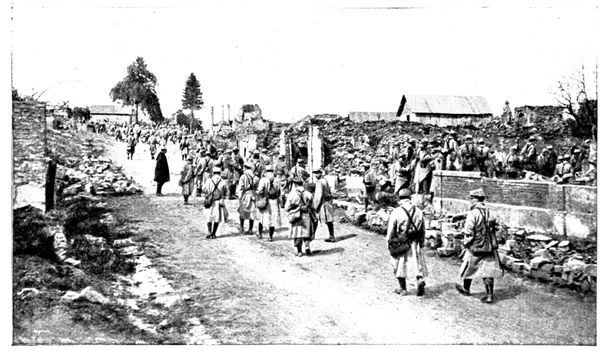
TROOPS VISITING THE RUINS OF SOMMEILLES
The Germans committed still more inexcusable crimes at Sommeilles. On September 12, when the Light Infantry entered the village, the officers and the doctor found in the cellar of the Adnot family's house, seven corpses. Death had taken place under particularly atrocious conditions. The Official Report gives the following details:
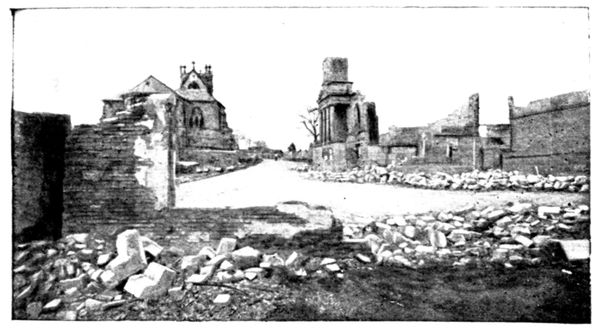
RUINS OF SOMMEILLES
"We discovered the body of a man of about sixty (M. Adnot) who had been shot, he had two wounds in his chest, and his eyes were still bandaged; that of a woman of about the same age (Mme. Adnot) with no visible wounds; another of a woman of about thirty-five years, whose right fore-arm, entirely severed from the rest of her body, had been thrown at some distance. Her clothing had been torn off (this woman appeared to have been violated). Then that of a little girl of about twelve years, who seemed to have met the same fate; those of three children of from five to ten years, two of whose heads had been cut off and thrown near the bodies."
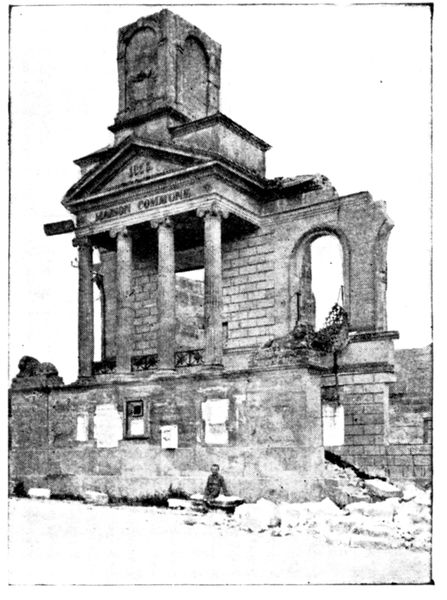
TOWN-HALL, SOMMEILLES
After visiting Sommeilles, we retrace our steps as far as the cross-roads, which we met on arriving at the village, and continue straight on towards Laheycourt by G. C. 35. In Laheycourt (39 km.), through which we pass, the monumental town-hall on the right, shown in the photo below, is worthy of note. It was burned by the Germans. The church opposite was turned into a hospital, and was spared for this reason. A certain number of houses were burned, or destroyed by shells.
On leaving Laheycourt, pass a level-crossing, then follow the railway for about 2 km. The railway then leaves the road and goes towards Villotte and Lisle-en-Barrois, while the road continues along the Valley of the Chée towards Louppy-le-Château.
The right wing of the Fifth Corps experienced violent fighting in this region on September 6. After having lost Sommeilles and Laheycourt, it turned to bay at Louppy-le-Château, as also at Villotte on the 8th.
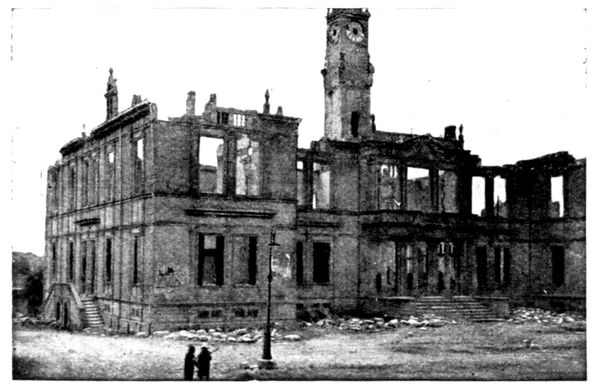
TOWN-HALL, LAHEYCOURT
Traversing Louppy-le-Château (44 km.), three-quarters destroyed by fire, the church will be noticed on the right, in a piteous condition from shelling, as shown in the photographs on p. 253. It dates from the thirteenth century and was restored in the nineteenth. The steeple was destroyed and the roof has fallen in. The bell, which was recovered from amidst the ruins, has been set up on the ground, and still summons the inhabitants to the services held in the roughly repaired choir.
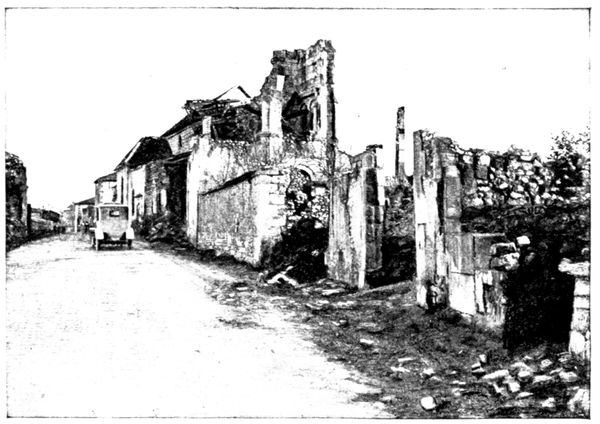
RUINS OF LOUPPY-LE-CHÂTEAU
The Germans committed revolting acts of brutality and immorality at Louppy-le-Château during the night of September 8-9, in a cellar where women and children had taken refuge from shell-fire. Two married women of 74 and 70 years, a spinster of 71 years, and a mother of 44 years and her children were odiously misused. The mother made the following declaration before the Commission of Enquiry:
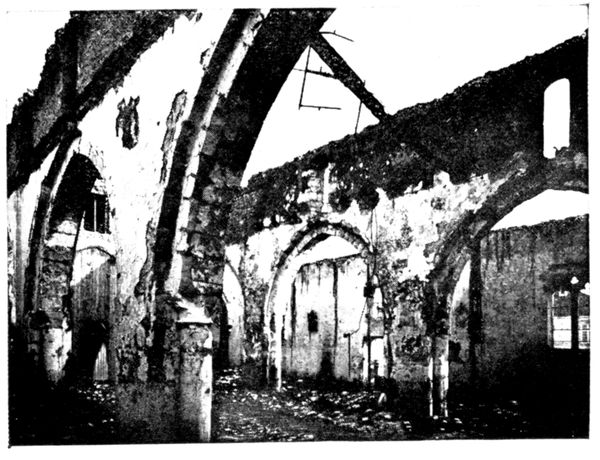
INTERIOR OF THE CHURCH
"I was in M. Raussin's cellar with my five children and other persons from the village, when three Germans, with revolvers in their hands, entered. One of them commanded me to lie down on the ground. I was obliged to obey.... Meanwhile, I received numerous blows. The Germans left the cellar, but two came back again. I made a dash for the stair and was not again mishandled, but I heard sounds of the scenes of violence to which the women who remained in the cellar were subjected. Among them were my two daughters aged thirteen years and eight years respectively. Both were violated, the latter, who was killed by a shell splinter on the following day, being unable to walk."
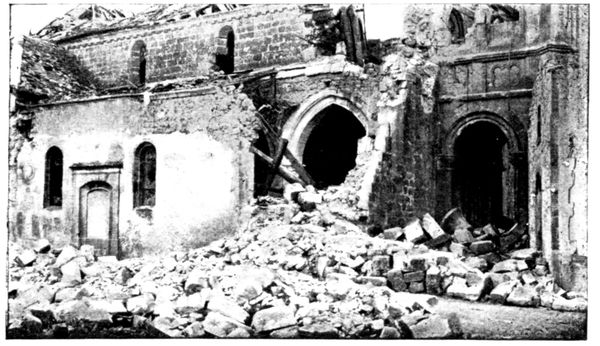
EXTERIOR OF THE CHURCH
The brother of the little victims, a boy aged eleven, made the following declaration: "I was sleeping in M. Raussin's cellar, when two Germans woke me, and tore my trousers. I cried out: 'I am a little boy.' They gave me a sound thrashing and struck my head with their fists."
On leaving Louppy-le-Château, turn to the left into I. C. 55 in the direction. of Louppy-le-Petit. Cross the Chée, then turn immediately to the right. 2½ km. further on cross a tributary of this river, and thus reach Louppy-le-Petit (49 km.). The defenders of Louppy-le-Château, subjected to a violent shell-fire, were obliged to abandon the village on September 8, and fall back on Louppy-le-Petit, which they were compelled to abandon likewise on the 9th. The line of defence was removed further east to Génicourt, which the tourist will pass after Louppy.
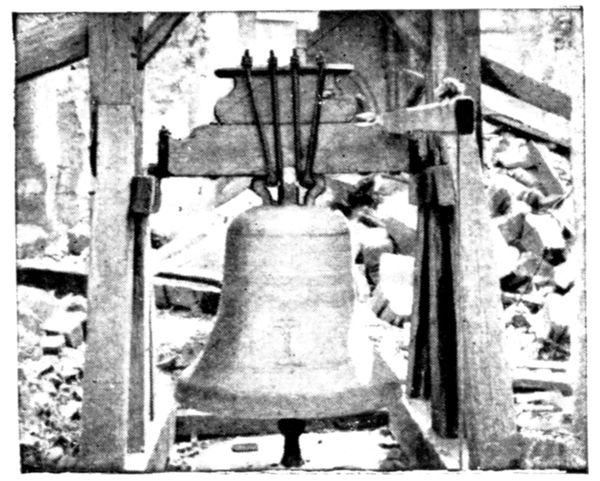
BELL OF CHURCH LOUPPY-LE-CHÂTEAU
In Louppy, turn to the right towards the church, where the bombardment has caused much havoc. Descend towards the Chée and, cross it. Immediately afterwards, I. C. 55 turns to the left in the direction of Génicourt-sous-Condé (51½ km.).
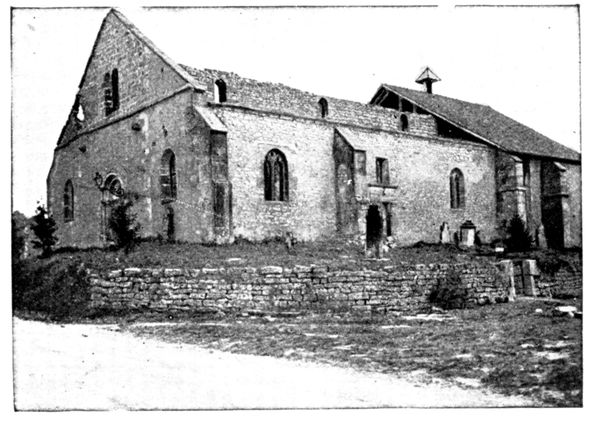
CHURCH, LOUPPY-LE-PETIT
Pass straight through Génicourt, go over a level-crossing, then over the river, and 200 yards beyond, at the entrance to Condé, turn to the right into G. C. 28 leading to Hargeville (54½ km.).
We are leaving the zone of the fighting of September. Turn to the right in Hargeville to cross the river, then to the left towards the church and continue straight on.
On leaving Hargeville, cross the railway twice by level-crossings. At Vavincourt (58 km.), turn to the right in order to pass the church, and go through the village to the far end. On leaving it, take the road on the right (I. C. 16), which branches off from G. C. 28. I. C. 16 goes through Behonne then descends into the valley of the Ornain and Bar-le-Duc. At the foot of the slope, cross the railway and the canal, then again the railway. Turn to the left immediately afterwards into the Rue des Romains; then take the Rue Couchot (3rd on right). Leave it to follow the Rue de l'Hospice on the left, which passes Notre-Dame. On arriving at the church, turn to the right towards Notre-Dame Bridge by Rue de Bar-la-Ville. After crossing the bridge take the Rue Notre-Dame which is a continuation, then Rue d'Entre-deux-Ponts on the left. On the left is the Boulevard de la Rochelle, where the hotel will be found (65 km.).
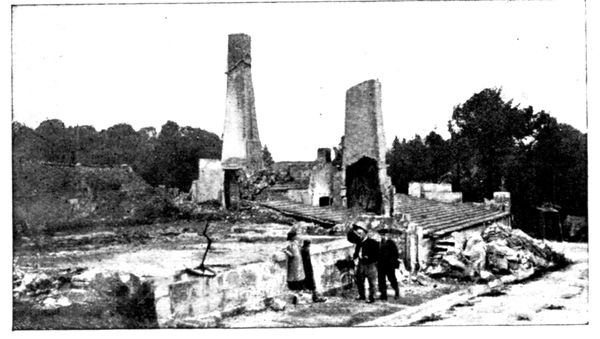
RUINS OF LOUPPY-LE-PETIT
FIELD OF OPERATIONS OF THE THIRD FRENCH ARMY
IV.—FROM BAR-LE-DUC TO VERDUN
(63 km.)
(See map inserted between pp. 212-213)
via Naives, Vavincourt, Marats, Rembercourt-aux-Pots, Vaux-Marie, Beauzée, Amblaincourt, Seraucourt, Issoncourt, Heippes, Souilly.
Leave Bar-le-Duc by the Boulevard de la Rochelle, at the east end of which, before St. John's Church, turn to the left and cross the Pont-Neuf. Then turn to the right into the Rue Ernest Bradfer; 300 yards further on, turn to the left into the Rue du Passage-Inférieur. After crossing the railway, turn to the left into the Rue de Popey. 250 yards farther on the Rue de Saint Mihiel will be found on the right, and this is continued by the G. C. S. 1 bis.
At Naives (5 km.), turn to the left and take G. C. 28, which climbs the plateau, at whose foot we have been travelling since leaving Bar-le-Duc. Pass straight through Vavincourt (8 km.) and take I. C. 16, a hilly road, leading to Marats-la-Grande (14½ km.). Descend into the village, turn to the left; and on leaving it by its western end, take, on the right, I. C. 48 leading to Rembercourt-aux-Pots (18½ km.).
We are entering the zone of action of the Sixth Corps. Rembercourt was attacked on September 7, but held out, thanks to the defences which had been strongly organised round it. It was abandoned on the 10th and retaken on the 12th.
The road passes in front of the church, which is classed as an historical monument (photo below). It is one of the most remarkable in the Department of the Meuse. It dates from the fifteenth century, but its beautiful front is Renaissance. The roof of the nave and that of the left aisle have been destroyed by German shells, but fortunately the front only suffered slightly. Take the street on the right on leaving the church; it leads out of Rembercourt by G. C. 35.
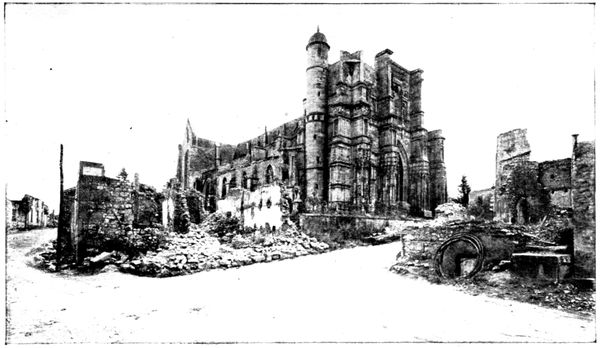
CHURCH, REMBERCOURT-AUX-POTS
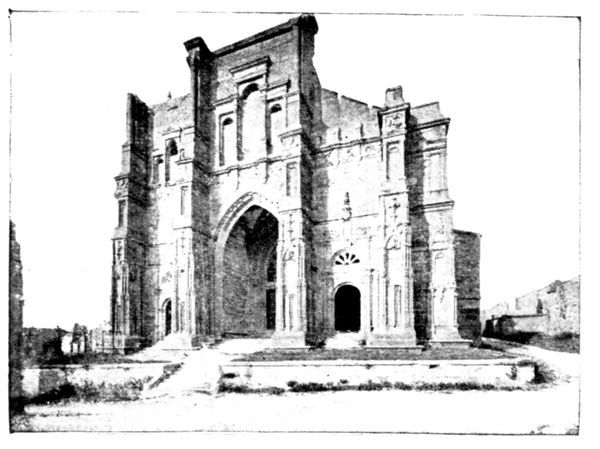
WEST FRONT OF CHURCH, REMBERCOURT
3 km. farther, turn to the left in order to pay a visit to Vaux-Marie Farm (22 km.), which was one of the most important centres of resistance in this part of the battlefield.
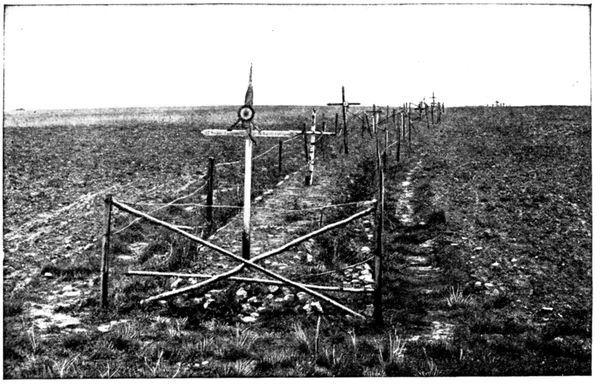
GRAVES NEAR VAUX-MARIE
A few yards from the cross-roads, on the right, is a large common grave, of which the photograph is given below. Soldiers belonging to the 132nd Line Regiment and the 26th Battalion Light Infantry are buried there. The farm stands at a distance of 1,500 yards from the cross-roads. As shown in the photos on pp 256-257, its buildings have suffered badly from the violent shell-fire to which they were subjected, particularly on September 8. The attacks were fierce, but the defences which the Light Infantry had established round the farm enabled them to hold out until the 10th. The farm was abandoned at the same time as Rembercourt, and retaken on the 12th with the latter village. The whole of the plateau extending from Rembercourt to Vaux-Marie was the scene of combats which were among the most violent of the Battle of the Marne.
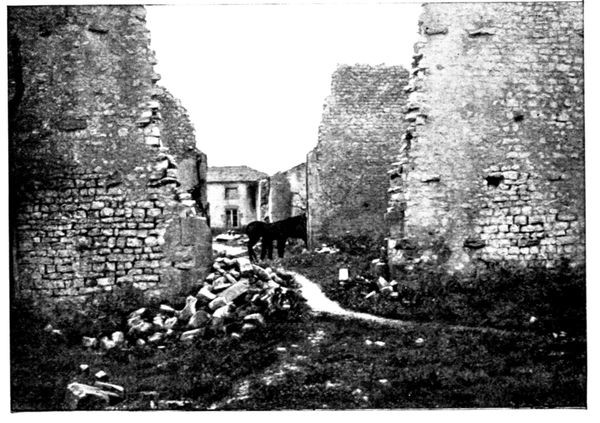
FARM, VAUX-MARIE
Continuing along the road, after leaving the farm, go over first one level-crossing, then another. The line runs between embankments, and was utilised as a line of defence. French and German graves (seen in centre of this page) were dug along the slope. On the right of the road is Hill 302, on the left Hill 293, which were comprised in the line of resistance of the Twelfth Division of the Sixth Corps on September 6, and of the 107th Brigade on September 7.
Before descending from the plateau into Beauzée, there is a very fine view. The photograph at the foot of this page shows the valley of Seraucourt, which the tourist will visit after Beauzée. It was there that the 40th Division of the Sixth Corps manœuvred. The photo at the top of p. 258 was taken looking towards Beauzée, whose steeple is visible. The numerous graves on either side of the road recall the violence of the struggle on September 6, when German pressure obliged the Twelfth Division to evacuate Beauzée and fall back on Hills 302 and 293, which the tourist has just passed.
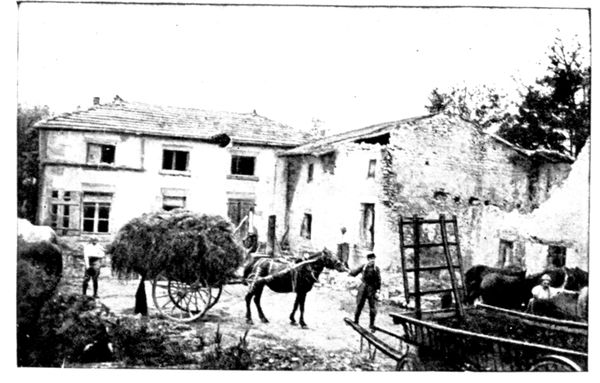
COURTYARD OF FARM VAUX-MARIE
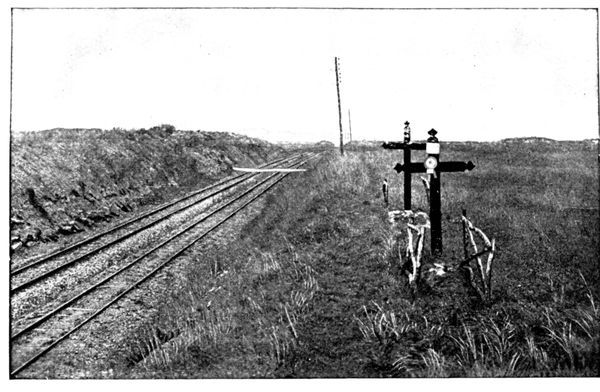
GRAVES NEAR VAUX-MARIE
Before entering Beauzée, go over two level-crossings. Follow the principal street, and turn to the right in order to arrive at the church (27 km.).
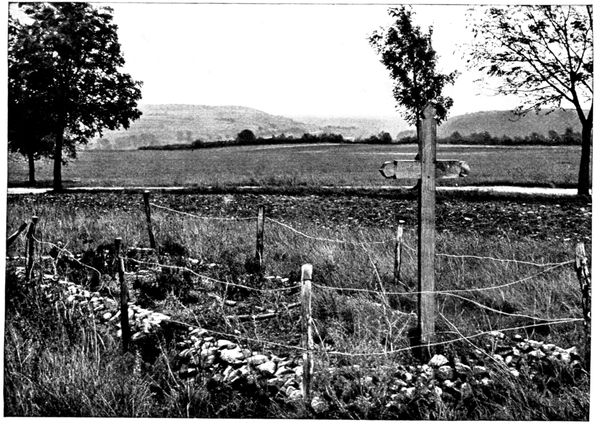
VIEW OF THE VALLEY OF SERAUCOURT
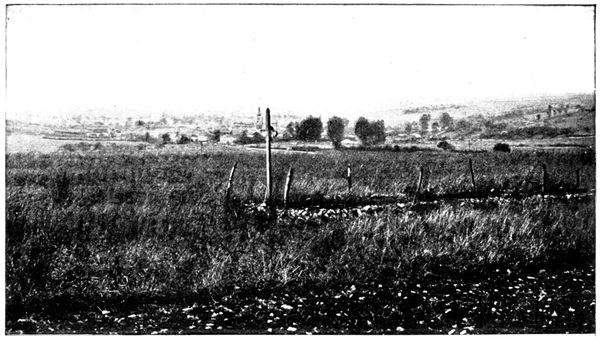
VIEW LOOKING TOWARDS BEAUZÉE
The photographs on pp. 258-259 give some idea of the state in which the German bombardment left this fine building. The church dates from the sixteenth century, as is shown by the rich ornamentation of the west front (see at the top of p. 259). This part of it received several shells, and in the photograph the shattered fragments resulting from this may be seen strewn on the ground. The nave, the apse, and the transept suffered most of all. The tower, restored in modern times and crowned by a spire, escaped destruction. It will, perhaps, be possible to save the panellings of the stalls and confessionals, which date from the eighteenth century.
A large number of houses in the village, and particularly around the church, were destroyed by shells.
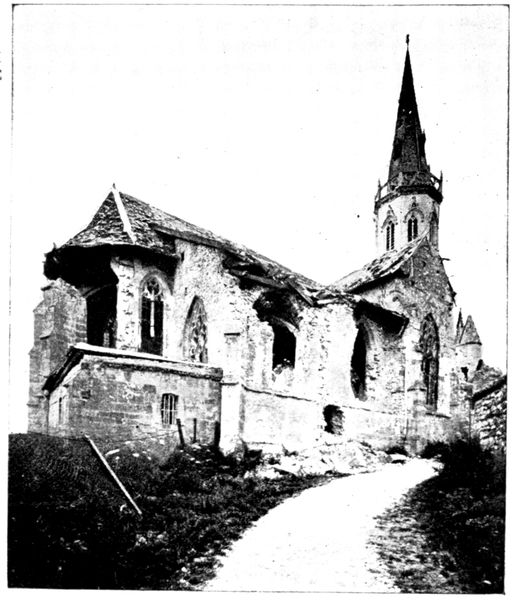
CHURCH BEAUZÉE
Turn to the right in front of the church, into the street shown in the photograph at the foot of p. 259. Then turn to the left towards the river and cross it. There is a very picturesque view of the village from this spot (photograph p. 260). Immediately after passing the Aire, turn to the right into I. C. 26, which goes up the valley towards Amblaincourt (29 km.).
This little village was destroyed. The view in the centre of p. 260 shows what remains of the town-hall, which was formerly a church. In Amblaincourt, turn first to the right and then to the left, without crossing the railway. I. C. 26 going to Seraucourt follows the valley which appears on the panorama on p. 257. A tributary of the Aire and the little railway from Bar-le-Duc to Verdun follow the windings of this valley.
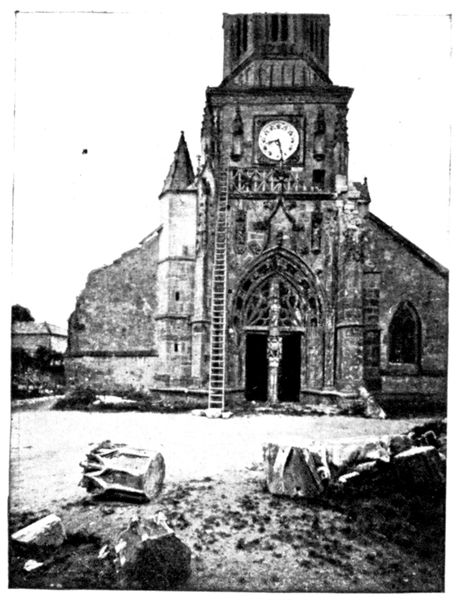
FRONT OF CHURCH
The 40th Division of the Sixth Corps fought on the two heights which command the valley to the north and to the south. The southern one (and especially Chanet Wood, which we can see on the right) served as a place of retreat when the attacks of September 6-10, which aimed at taking the northern crest, failed. On the 10th, in spite of an heroic resistance, the 40th Division was obliged to abandon Chanet Wood and to retire for several kilometres. On the night of the 12-13th the Germans, having been completely beaten on all other points of their front, evacuated their positions, which the French re-occupied the next day.
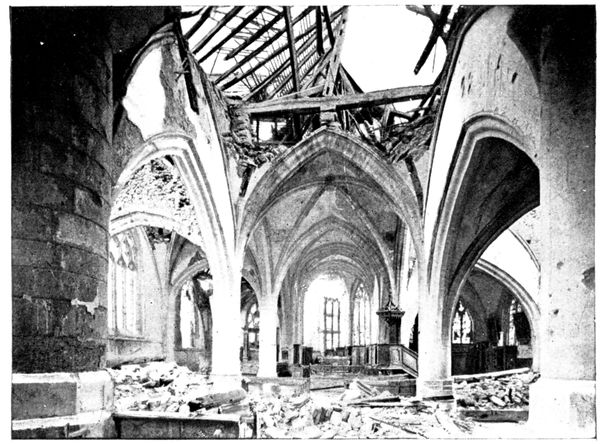
INTERIOR OF CHURCH
Pass straight through Seraucourt (31½ km.). Part of its houses were destroyed by shell-fire.
From Seraucourt to Lemmes we are going over the battlefield of the reserve divisions placed at the disposal of the Third Army, in order to strengthen and prolong its right wing, and to attempt to outflank the enemy's left.
Tn the neighbourhood of Seraucourt the 65th (reserve) Division linked up with the 40th Division of the Sixth Corps.
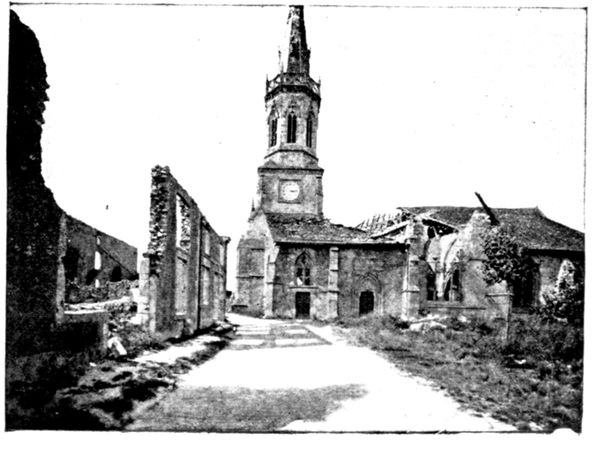
RUINS AROUND CHURCH
Still following the valley, we reach Rignaucourt (33½ km.). To the north of the village, on the plateau, is Blandin Wood, which was occupied until September 10 by the 65th (reserve) Division. From there it hurled its daily attacks to the west against the flank of the enemy. On the 10th it was thrown back violently to the south-east, beyond Landlut Wood, which crowns the plateau to the south, and lies to the right of the road. The German retreat took place on the night of the 12th.
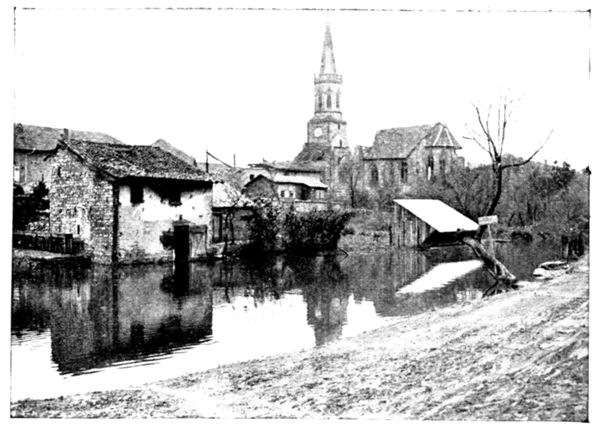
VIEW OF BEAUZÉE
In Rignaucourt, turn to the right in order to pass in front of the church; descend towards the railway, and beyond the level-crossing go over the river, and turn at once to the left towards Issoncourt (35½ km.). At the entrance to the village, turn to the left into G. C. D. 6, which is the main road from Bar-le-Duc to Verdun. After two railway-crossings we arrive at Heippes (39½ km.). The 65th and 75th (reserve) Divisions fought desperately to the west of this road in Ahaye Wood, until September 10, endeavouring to give relief to the Sixth Corps by an attack on the German flank.
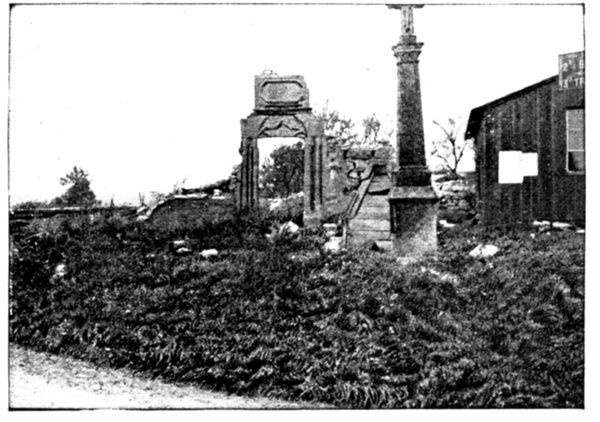
TOWN-HALL, AMBLAINCOURT
Leaving Heippes church behind, I. C. 24 leading to Saint-André comes into view on the left. This road formed the pivot of the attacks of the 75th Division, one part of which was operating to the south, with the 65th Division in Ahaye Woods; the other to the north in the Woods of Châtel and Moinville. After a fierce struggle the reserve divisions were forced to retire. Whilst the 65th Division clung for a time to Hill 342 or the Signal d'Heippes, which commands the village to the south-west beyond the railway, the 75th held out in Heippes, but on the 10th both were driven back to the east of G. C. D. 6.
After Heippes the road goes towards Souilly (43½ km.). On the heights to the left of the road the 75th (reserve) Division fought, Souilly was abandoned by it on September 10.
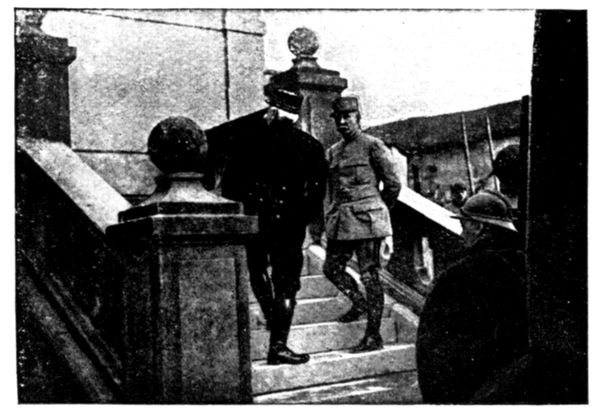
JOFFRE AND PÉTAIN AT SOUILLY
During the great battle of Verdun in 1916 General Pétain had his headquarters at Souilly Castle. The photograph opposite shows the victor of Verdun in company with General Joffre.
Go straight through Souilly to reach Lemmes (48 km.), after twice crossing the railway. To the west of the road is the battlefield of the 67th (reserve) Division and the mobile defences of the entrenched camp of Verdun which, during the Battle of the Marne, worried the German communications by frequent raids against their flank.
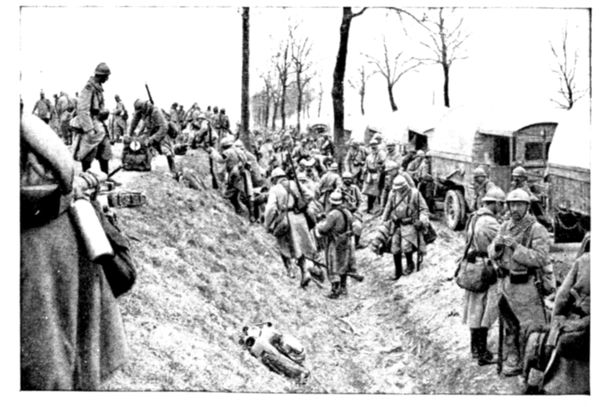
TROOPS DISMOUNTING FROM MOTOR-BUSES
G. C. D. 6 rejoins N. 3 beyond the hamlet of Moulin-Brûlé (54 km.). The railway is again traversed by two level-crossings.
This little line, which comes from Bar-le-Duc, and which we have followed from Beauzée, was at the beginning of the Battle of Verdun the only one possible for victualling the troops. The main line from Châlons to Verdun was under the fire of the German artillery, and that from Bar-le-Duc or from Toul to Verdun was occupied in its centre, at Saint-Mihiel, by the enemy. The capacity of this single branch was so small that all the heroism of the defenders would have been vain, and the Germans would have entered as conquerors into the old city, if, by a remarkable feat, motors had not been able to replace the feeble railway. The road which the tourist followed on leaving Bar-le-Duc, and which he rejoined at Issoncourt, has been known since that epoch as the "Voie Sacrée" (the Holy Way). An average of 1,700 motors transporting troops, ammunition and stores, went by each day in both directions, making one vehicle every twenty-five seconds. The view below gives an idea of this line of cars winding across the country.
At the junction with N. 3, shortly after passing the spot where the railway crosses the road, turn to the right in the direction of Verdun (63 km.). This town and its entrenched camp, whose renown has become worldwide, are the subject of a special volume.
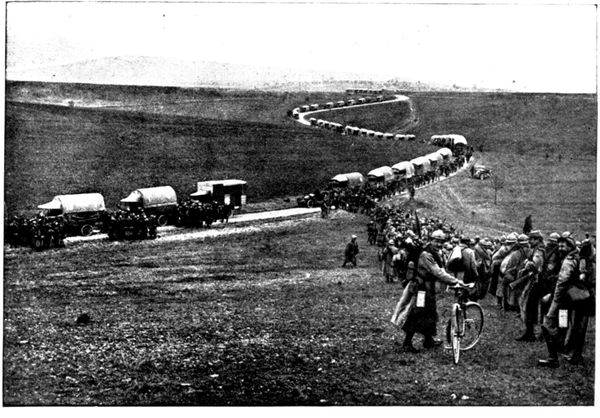
FLEET OF MOTOR-BUSES BRINGING TROOPS BACK FROM VERDUN