Front matter (continued 5)
Reading edition
"Pile out, everybody! Throw our company stores off the cars at once and stow them alongside the track. Get some lanterns working, men. On the jump, now!" and Captain Henderson strode along the embankment shining his flash-light and encouraging his men to do good work.
Lights flickered along the train. Stores were tossed off in quick order, camp sites selected, police parties immediately prepared latrines, and the guard was posted. Then, the immediate requirements being attended to, the men rolled up in their blankets on the hard earth to get such sleep as they could.
"Who were all those hombres[#] surrounding us before we crossed the big bridge, Sergeant?" asked Dick, pulling his knapsack into a more comfortable position beneath his head.
[#] Hombres--Men.
"They was the chief army of the rebels in these parts," replied Dorlan. "When we stopped back there we were right in the middle of the biggest town in Nicaragua, and the one where all the trouble starts. The people of Leon are always ready to revolute with the hope of makin' it the capital instead of Managua, and bein' on the only railroad from the capital city to the seaport, Corinto, they're in a foine place to control things. The nearest Federal troops are at a place called La Paz, about twenty-three kilometers from here."
"How long is a kilometer, Sergeant?" questioned one of the men.
"It's about five-eighths of a mile, so La Paz would be about fourteen miles south of here. From there on the Federal troops hold the railroad to the southern outskirts of Managua, and as this line goes on to Granada, I figure it's up to us to do considerable of work yet, for they say that we'll never get through the rebel lines beyond the capital without a fight. However, so far things seem to be goin' pretty slick."
"Do you know how many troops there are in Leon, Sergeant?"
"About two or three thousand, so they say, and they didn't want us to pass through there to-night, but finally consented. The Adjutant told me the leaders were pretty ugly about it, but as you see they finally gave in, and here we are."
"Now we are here what are we going to do?" inquired Dick.
"This battalion's goin' to camp right here and watch these fellers in Leon; the rest of them behind us will go on through when they come up and help the outfit that's ahead. All the telegraph and telephone lines are down between here and La Paz Centro. The rebs have cut 'em, and we can't get word of what's goin' on up ahead; but we'll know by to-morrow night. Now, quit yer askin' of questions. It's three o'clock in the mornin', and reveille's set for five A.M. Ye always want to get all the sleep ye can on campaign, for ye can't never tell what's a-goin' to be happenin' the next minute. Good-night, boys," and Sergeant Dorlan rolled over, his snores soon announcing he had followed his own excellent advice, but it was a long time before Dick's eyes closed in slumber, and it seemed as though the notes of reveille awakened him even before he had succeeded in getting the time-quoted "forty winks."
"I can't get 'em up! I can't get 'em up!
I can't get 'em up in the morning!
I can't get 'em up! I can't get 'em up!
I can't get 'em up at all!
The private's worse than the corporal,
The corporal's worse than the sergeant,
The sergeant's worse than the Captain,
And the Captain's worst of all."
* * * * * * * * *
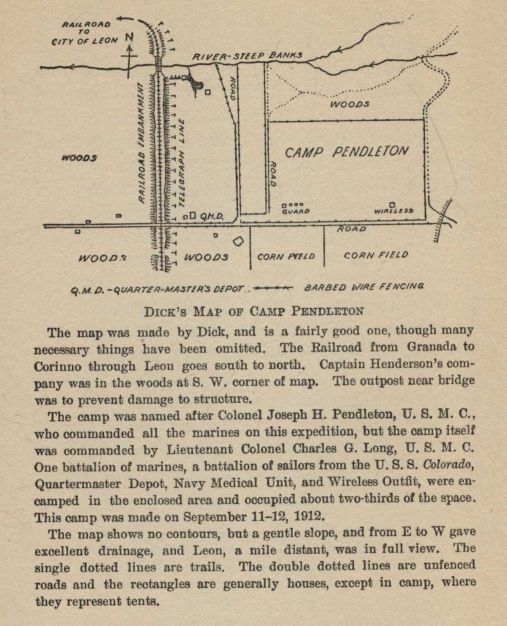
Dick's Map of Camp Pendleton
DICK'S MAP OF CAMP PENDLETON
The map was made by Dick, and is a fairly good one, though many necessary things have been omitted. The Railroad from Granada to Corinno through Leon goes south to north. Captain Henderson's company was in the woods at S.W. corner of map. The outpost near bridge was to prevent damage to structure.
The camp was named after Colonel Joseph H. Pendleton, U.S.M.C., who commanded all the marines on this expedition, but the camp itself was commanded by Lieutenant Colonel Charles G. Long, U.S.M.C. One battalion of marines, a battalion of sailors from the U.S.S. Colorado, Quartermaster Depot, Navy Medical Unit, and Wireless Outfit, were encamped in the enclosed area and occupied about two-thirds of the space. This camp was made on September 11-12, 1912.
The map shows no contours, but a gentle slope, and from E to W gave excellent drainage, and Leon, a mile distant, was in full view. The single dotted lines are trails. The double dotted lines are unfenced roads and the rectangles are generally houses, except in camp, where they represent tents.
* * * * * * * * *
"Come on, ye lazy bones, roll out of yer hammicks," called Dorlan cheerily, "and if ye foller that path down by the shack acrost the road ye'll reach the river and a good place to wash, only don't go too far down-stream, as there's a bunch o' buzzards cleanin' up some dead men, and the sight ain't extry fine on an empty stummick."
It was not long before Dick had finished his ablutions, and as he had avoided the buzzard's feast he felt quite capable of doing justice to the breakfast the mess cooks prepared.
The day was spent in fixing up the camp, preparing it for defense, reconnaissance work, and sorting stores. That the rebel general felt kindly towards the Americans might have been implied from the fact that he sent two beeves to the Colonel Commanding, with his compliments, but these were returned with expressions of thanks, as the Colonel did not feel he could accept the gift. Many parties of rebel soldiers passed the camp during the day and curiously watched the soldiers from the great Northern Republic at their varied occupations. Other days followed, some filled with flurries of excitement, some slow and monotonous. The rest of the regiment passed on towards the capital and a battalion of sailors came to augment the force, and for the time they were ashore, absorbed the Marine Corps spirit, "hook, line and dipsey."
One day a rebel "armored" train came puffing along from Leon, where they kept it carefully locked up in the station shed, and proceeded towards La Paz, with red flags streaming and a poor edition of Joan d'Arc astride the cow-catcher brandishing a big machete and cheering on the deluded soldiers.
"Viva Luis Mena! Viva Leon!"[#] they shouted to the marines, and waving their guns wildly, passed on.
[#] "Hurrah for Louis Mena! Hurrah for Leon!"--Mena was the rebel candidate for presidential honors and after the battle of Coyotepe he was taken under guard by the marines to Corinto and deported.
"They are off for a fight," hazarded the onlookers, but it was only a foraging party out for wood and fresh beef which they confiscated as they found it. One of the flat cars was arranged with sand bags, and over the parapet thus formed a Hotchkiss machine-gun menacingly stuck its baleful snout. This rebel train was an eye-sore to the American officers; for as long as General Rivas, who commanded at Leon, had this train and locomotive locked up in the station, so long it was sure to be a menace. The marines were in Nicaragua primarily to keep open the railroad, which was American-owned, and orders now came from the Admiral commanding the forces afloat and ashore to demand the surrender of the train. This Rivas refused, feeling confident that the few Yankees encamped across the river were neither strong enough nor brave enough to attempt to force him, and should they do so then it was quite certain they were no longer impartial. One Sunday morning in September, to his astonishment, three trains filled with marines and sailors pulled into the sidings at Leon. The attitude of the officers and men on this train was such that Rivas considered surrender the better part of valor, though at one time it looked as though his enraged men would precipitate a bloody struggle. Anyway, the train was taken out from its shed; the rebels were permitted to remove their gun, and amid the curses and execrations of the multitude gathered at the station, it was towed back to the American camp.
As for Richard Comstock, he found the life exciting and full of adventure. Following his application, he had had his rank changed to that of a private, and accompanied Sergeant Dorlan, who had been appointed special messenger to carry despatches, up and down the line. The situation was getting more critical every day. Then came orders to send all the field artillery from Leon to Managua, and on the train that took them went Dorlan and Dick, bearing special despatches to the Admiral who had gone on to the capital city for a conference. The rebels near the Leon camp looked gloomily upon this move. A few days before a train bearing marines, on passing through Masaya, a city south of Managua, had been fired upon, some men being killed and wounded on both sides.
Now it was apparent that the Yankees were going to assist the Federal troops. What would be the outcome? Would they attempt to attack the rebels at Barrancas and Coyotepe? If they did they could never take those positions. No troops had ever yet wrested those strongholds from the soldiers defending them. It had never been done in the history of the republic and its many wars. Secretly General Rivas despatched bodies of mounted men to augment the rebels in the vicinity of the threatened points.
When the artillery train stopped for watering the engine at La Paz, hundreds of Federal troops met it with a band at their head and cheering vociferously:
"Viva los Americanos! Viva los Federales!" they shouted till their throats were hoarse.
"Let's get off and buy some fruit, Sergeant," said Dick, who was riding on the engine with his companion.
"You go along, Dick, but hurry back, as I heard the engineer say we'll be pullin' out o' here in a jiffy."
Climbing down from his seat, Dick elbowed his way through the crowd till he came to a fruit stand at the far side of the station platform. After selecting some oranges and mangoes he was hurrying back when the broad shoulders, red neck and blond, bristly hair of a foreigner standing at the edge of the crowd drew his attention. Beside him was a tall man whose tanned face could not hide the fact that he too was a stranger from another land. Under the brim of the taller man's hat was a white spot of hair over and behind one ear, and the left hand, as he raised it, showed half the middle finger missing.
"The German and the Englishman!"
Dick almost said the words aloud in his excitement over the discovery. Both men were watching the crowd in front of them with great interest, and conversing in rather loud tones in order to make themselves heard above the din made by the enthusiastic soldiers cheering the train. Unobserved, Dick stopped directly behind them.
"Just our blooming bad luck to have them go through during daylight, after we have been waiting for this very move for several days," said the Englishman in a drawling voice.
"I never expected they would make the move by day, or I should have made better arrangements. If it were dark, as we expected it would be, we could pull off the same kind of game we worked in Masaya when Butler's Battalion went through there. I had to do that trick against General Zeladon's wishes. If he had consented to let me work it as I wished that train-load of marines never would have lived to get through as they did. I had to make it appear an unpremeditated affair, and as a result not half the people joined in the fight. A single defeat of these Yankees to the credit of the rebels, and the whole country would have joined us, Mena would have been president without a doubt, and our plans would be well under way towards consummation."
"You made a mistake, though, Mein Herr. You should never have made it appear that the rebels began the shooting. Our policy is to lead these Americans to believe that the Federal troops are against their interference."
"Bah! You don't know what you are talking about," said the German in the same arrogant way of speaking that Dick remembered so well.
"Well, don't let us get ratty over it; you know, old top, we have other things to think about. Now if we might delay this train in some way it would still be possible to work the game here."
"No chance at all! Not a chance!" exclaimed the big man impatiently, "but it would have been a fine opportunity to turn the tables had it only been dark. Our men here would have been enough to make them believe the whole outfit of Federals were shooting them up, and in the excitement the marines would have returned the fire, and the fight would have become general."
"Will the other trick work?" the Englishman now asked. "Will those papers implicating Chamorra come into the Americans' hands in a perfectly natural way?"
"Yes, and it is our last hope, outside of actual defeat of this Yankee rabble by the rebels, and I believe that is a possibility. These men are nothing but play soldiers. What do they know about war? And as for taking Coyotepe away from Zeladon and his men, bah! they can never do it! They will have to declare war first, and get down their miserable army. That will delay them long enough for us to defeat the Federals, and Mena and his men will be in supreme power. Hello, the train is off. Donder und Blitzen! How I wish it were night!" and the speaker stamped in wrath upon the gravel of the roadway.
So interested was Dick in the conversation of these two men which for a second time had been overheard by him that he had failed to note the train was moving away. To his consternation he saw now that he could not catch it because of the crowd between him and the last car, which was passing as he looked over the sea of heads. Running to the telegraph office where, owing to many previous visits with Dorlan, he was well known, he dictated a wire to be sent on to Nagarote, the next stopping place along the line, explaining briefly that he had missed the train. Then he turned to the operator, and before the man knew what was happening had divested that surprised individual of his coat.
"Quick, Frederico, loan me your coat and hat," he said. "Take charge of my canteen and haversack till I return. Oh, yes, I'll borrow your necktie too," he added, stripping it off the neck of the open-mouthed native, and after pulling off his leggins and putting on the things he had commandeered, he sped out through the doorway in pursuit of the two men whose rapid strides were even then carrying them towards the center of the town.
CHAPTER XXII
DICK IS LEFT BEHIND
As Dick ran from the telegraph office and looked about him in search of the two foreigners, he saw them disappearing around a street corner a few hundred yards away, but when he arrived at the same spot they were nowhere in sight. He dashed up the long street scouring each crossing for a sight of them, but in vain. The town was practically deserted. Most of the smaller houses were open and vacant. The stores and larger dwellings were closed and locked. The inhabitants had vacated when the Federal forces occupied the town some weeks before. La Paz was in too great a danger of changing hands again to make it comfortable as a place of habitation.
Small patrols of Federal soldiers sauntered about, but the majority had returned to the entrenchments which surrounded the town on all sides. Even women and children were noticeable by their absence, for the families of the Latin-American soldiers as a rule accompany their fighting men into the field, living with them on the firing line. Often the women themselves join in the fray, armed with machetes, and are most savage and blood-thirsty opponents.
Failing to discover the whereabouts of the German and the Englishman, Dick was at first at a loss as to his next step. Then he recalled having met at the station a few days before Colonel Solorzano Diaz, nephew to the president of Nicaragua,, and second officer in command at La Paz. Undoubtedly this officer could give him information of the two he sought, as it was improbable they could be inside the Federal lines and not be known to him.
"Is Colonel Diaz in La Paz?" asked Dick of a group of soldiers standing on a corner.
"Yes, Señor, he is at his headquarters."
"Take me to him at once! I have important news for him!" demanded Dick.
The young soldier who had answered his query now volunteered to act as guide, and after a ten minutes' walk they came to the Colonel's tent, erected near a battery of field guns. The smart, military-looking orderly on duty there halted them and after inquiring their business, he ushered them into the Colonel's presence.
"You say you are an American and have important news for me?" asked the handsome young Colonel, immaculately attired in a splendidly fitting uniform.
"I have, Colonel, and will be glad to tell you what I know if I may see you alone."
"First, explain how you come to be within our lines. Your arrival has never been reported to me, señor."
"I met the Colonel three days ago when I delivered a letter from the Commanding Officer at Camp Pendleton. I am a marine, Señor."
"Why are you dressed as you are, if such is the case?" and the officer looked Dick over with suspicion in his eyes.
Briefly Dick gave his explanation, but before Diaz would consent to hear the rest of his disclosures the orderly was directed to telephone Frederico at the station to verify the statements.
Colonel Diaz was a graduate of an excellent military school in the United States, and his command was remarkable for training and discipline, and though Dick fussed over the delay, he nevertheless admired the native officer for his caution.
Dick now saw that he had erred in not telegraphing to have the train held at Nagarote until he could explain by wire to the marine officer in command all the facts in order to permit that officer to govern his future movements to better advantage. While thinking of this, Colonel Diaz entered the tent, having gone out in order to talk to Frederico in person.
"You are Private Comstock, guard for Sergeant Dorlan, special messenger for the American forces?" he stated in a questioning manner.
"I am."
"I will hear what you have to say. Step outside, orderly, and take the guard who brought this man here with you." Then turning to Dick, he said in a most agreeable tone, "Be seated, Señor, and proceed."
Dick now told of his two meetings with the German and Englishman, and of the conversation he had so fortunately overheard on each occasion.
"Do you mean to say, Señor, that these two gentlemen, Señors Schumann and Heffingwell, are the men you heard engaged thus?" asked Diaz in amazement.
"If those are the names of the German and the Englishman I have described, yes," answered Dick positively.
The black eyes of the officer flashed ominously, and a deep flush mantled the smooth olive complexion.
"They will pay dearly for this, Señor. Those two men have had many concessions from my uncle, the president, in the past. They have been in Nicaragua for some years, and now I understand why they were ever busy in travelling about on various pleas. Sometimes it was to investigate the mines, at others to visit the coffee plantations of Diriamba or the rubber industry of the midlands. But this is not action! Orderly," and the clear voice rang with decision, "find out at once if Señors Schumann and Heffingwell have passed the outposts; if not they are to be brought here immediately."
During the time they waited for the report Colonel Diaz paced up and down the tent in deep thought, puffing great clouds of smoke from his cigarette.
"The Captain commanding the outposts, sir, states the two foreigners and escort of fifteen cavalrymen crossed the southern outpost fully ten minutes ago. Their passes were in due form and signed by yourself, sir."
"Yes, I gave them permission to leave at any time that suited their convenience, and provided an escort for their protection--the same men who accompanied them in here two days ago with a pass through our lines from General Pollito."
"Probably rebels in federal uniform," suggested Dick, "and the ones they depended upon to start the fracas at the station had the train arrived after nightfall."
"Yes, uniforms these days consist of little more than a ribbon to be changed as it suits the fancy or the convenience, but the question is, what should be done in the matter? It is evident they can do nothing to harm the train. The road, which nearly parallels the track from here to Managua, is in no shape for fast going. I inspected these men the day they arrived here. Their horses were worn out and poor at best. Even the lay-up they have enjoyed would not put them in condition. I will acknowledge there have been times a man on a good horse could leave here and arrive at the capital ahead of the train, but never unless it was held up by carelessness on the part of the native engineers. Nearing Managua the train has to descend some tortuous grades in the hills and the wagon road is more direct and gives the horseman the advantage during the last few kilometers."
"What do you propose to do, Colonel?" asked Dick. "Could you not send your men out after them and bring them back?"
"I cannot spare the men. We are too few here already, and at any moment we are expecting an attack. Also I have no absolute proof of their perfidy which would justify me in taking such drastic measures. They are under the protection of my superiors, and though I believe your story, unfortunately I am not the only one who would need to be convinced. The best that I can do is to telegraph my suspicions to all points and have them watched carefully from now on."
A scraping on the canvas at the front of the tent attracted Colonel Diaz's attention.
"Come in," he called, and then as his orderly appeared he added, "What is it you wish?"
"A telephone message from the station states that the telegraph wires between here and Nagarote have been cut, sir," reported the soldier, and at a nod from his superior he withdrew.
"They are at it again," said Diaz quietly; "no sooner do we send out and repair it than the line is cut at another point."
For a few seconds the officer and the young marine sat lost in thought. That some disaster threatened the train bearing the battery of field guns and the marines had become a conviction in Dick's mind. He could not forget the Englishman's question, "Will the trick work?" and the German's reply in the affirmative. Dick felt sure that this "trick" was to occur before Managua was reached, and this being so, what could be done to prevent it? Could it be prevented? It was certain that he could not count on help from Colonel Diaz, and now, adding to the difficulty, the wires were down.
Glancing through the tent opening Dick saw beneath a tree, held by a uniformed orderly, two spirited horses, saddled and bridled. The sight at once suggested action to the mind of the worried boy. Anything was better than this inactivity. Furthermore, Dick knew that if he stayed on here at La Paz he should never witness the stirring events which were bound to follow the arrival of the artillery at Managua. Here was a means of going forward and joining his companions. Possibly too he might learn something of advantage by following the route taken by Schumann and his band. It was worth trying.
"Colonel Diaz, may I borrow horses from you and a guide? I wish to proceed to Managua at once."
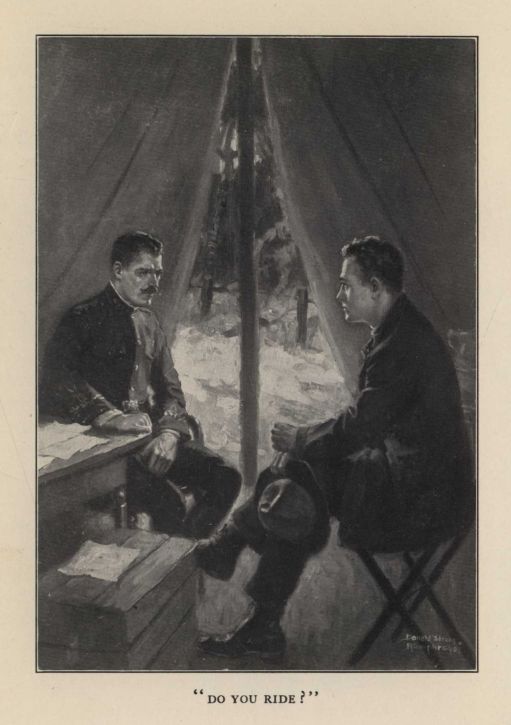
"Do you ride--ride well, I mean?"
"DO YOU RIDE?"
"Yes," replied Dick.
"It is sixty-three kilometers by rail, and about fifty-eight by road to Managua, señor. It is possible even to cut that distance with a man who is thoroughly acquainted with the country. A good horseman, well mounted, should reach there before dark."
"May I have the horses and a guide, Colonel?" and this time Dick looked enviously at the horses outside. Following the glance Diaz now espied the impatiently waiting animals.
"Ah! And did you mean my horses? Well, Señor, they are the only two horses in this camp capable of making the journey," and he said it with a pardonable touch of pride. "Those are not native ponies. They are thoroughbreds. I love them as a father would his sons, and----" he hesitated.
"I will give them good care," said Dick, who, to tell the truth, had no idea that the Colonel would entrust two such animals in his keeping when he had asked for horses, but now he thought possibly this would be the outcome of his request, and thought he understood why Diaz made his involuntary pause.
"That is not the only consideration, Señor Comstock. Those two horses are almost as well known as their master. You would be in constant danger of attack along the way, and seeing you, an American Marine, riding my horse, every rebel you encountered would do his best to stop you. They would not hesitate to shoot in case they could not capture you otherwise. Besides, those whom you seek are between you and your destination and they would surely hold you up. No, the chances are against you ten to one."
"Were they a thousand to one, Colonel, I would wish to make the attempt."
A smile of understanding lit the face of the officer and, rising, he gripped Dick's hand with warmth.
"I understand! It is the call of duty--of patriotism--and for you my heart holds naught but admiration, and my hand withholds nothing. You may take my horses, Señor, and may the good God who watches over brave men watch over you on your ride to the assistance of your fellow countrymen."
Colonel Diaz now called the orderly who brought the horses to the tent door, and turning again to Dick, he said:
"Tomas is an old servant in my household, Señor. He will accompany you and be under your orders. This paper will pass you through any of the Federal lines. Again, Señor, I wish you luck. Adios!"
Less than five minutes later Dick, mounted on the powerful black horse and followed by Tomas Casanave, a full-blooded Indian, was swinging along beside the railroad on a path which his guide informed him would save nearly a kilometer at the start.
At the first pond of water they came to, Dick ordered a halt. Dismounting and ordering Tomas to do likewise, he gathered up a quantity of mud and began smearing it over the velvety coat of the animal he rode, over his clothes and shoes, even putting some on his face.
"And why does the Señor do this?" asked Tomas, looking on in amazement at the proceeding.
"The Colonel told me his horses are known from here to Managua by every rebel along the line, but they are well known because they are always so well groomed, for one thing."
"I care for the Colonel's horses, Señor," said Tomas, simply, but with much pride in his voice.
"By spreading this mud over the horses," continued Dick, "it may help deceive persons whom we meet. Now, Tomas, turn those saddle cloths, smear mud on the trappings and harness, and tie your coat in a roll back of your saddle. Also hide your carbine and its boot where you will be able to find it on your return, and last, but by no means least, remove that blue band from your sombrero."
Tomas followed Dick's advice, and by the time he had finished no one would suspect either of them of belonging to any military organization. In fact the Tramps' Union, if there be one, would have disowned them.
"In case we are held up you are to answer all questions. I will tie this handkerchief about my neck, and you may state I am ill and we are hurrying to Managua to consult a doctor about my throat, which pains me and prevents me from speaking. Now, Tomas, we have lost time enough. You take the lead and I will follow. Save every minute, but also remember these horses must carry us to the end of the journey."
Springing into the saddle they instantly broke into the long lope which was to be their gait for the coming hours.
When told of the task before him by Colonel Diaz, Tomas had been anything but pleased at the prospect. He knew the danger of running the gauntlet of rebel bands infesting the country between La Paz and the capital city, and he was filled with apprehension. Dick's preparations won his admiration, and the boy's knowledge of Spanish was another agreeable surprise. He began to believe they might win through, rebels or not.
That the foreigners, who had a half hour's start, were following the same road, was soon discovered by the Indian. Accustomed to reading signs of the trail he interpreted them for Dick's benefit. Once he dismounted just before crossing a small stream which trailed across the road and carefully examined the ground on the far side near the water's edge.
"They passed here less than ten minutes ago, Señor," he said as he remounted and splashed across the brook. "I can tell this by the water which dripped from their horses, and the degree of moisture still remaining."
On they went to the accompaniment of the thud of the well-shod hoofs, the creak of leather, the jangle of bit and spur. Tomas was still watching the road, when without apparent reason he stopped.
"What is the trouble?" asked Dick, reining in the black charger on arriving abreast of his companion, but before answering the native looked about him cautiously.
"I have lost their trail, Señor. They have left the road."
"Which way did they turn, Tomas?"
"I cannot tell without going back, but I believe to the right."
"Is there any cross trail or road?"
"No, and there is no reason that I know for them to leave the road."
"Why do you suppose they have done so?"
"Quien sabe?"[#] answered Tomas, giving his shoulders a shrug which carried as much meaning as his words. "Possibly they are in hiding and watching us to ascertain if they are being followed. If so, it would not be wise to retrace our steps in case it is your desire to learn what became of them. But now that we are evidently beyond them, I think we are fortunate, and would suggest we proceed at once on our way. So far we have been unusually lucky, having met with no rebels."
[#] Quien sabe--Who knows?
That there was wisdom in the Indian's words could not be denied, but Dick felt a distinct sense of disappointment as he looked about him in the vain hope of seeing something of those they had been following so closely. About a half mile to the west an almost bare hill stuck its summit high into the glaring blue sky. Its slopes were cone shaped and fringed with a short stubby growth. In spite of disappointment, it was impossible to see the beautiful symmetry of the hill without admiring it, and as Dick watched, a cloud of smoke burst forth from its apex. Knowing the volcanic nature of the country he was nevertheless surprised at the sight, as Mount Momotombo, rising from the waters of Lake Managua, was the only active volcano in this immediate neighborhood.
"Is that small hill an active volcano, Tomas?" he asked.
The native looked long and searchingly at the smoking hilltop. At first his face expressed fear and amazement, followed in turn by a look of question, and then of understanding.
"No, no, Señor, it is not a volcano. It is a signal. Someone is sending smoke signals."
"Smoke signals? What do they mean?"
"They may mean anything. It is a method used by my people long ago and often resorted to by the natives of Nicaragua. If you notice the smoke is interrupted; sometimes long columns, sometimes short clouds or puffs."
"Are you able to read the message?"
"No! one has to know the code, Señor."
"If I had field glasses, it would be possible to see who is sending the message," said Dick, straining his eyes to discover if he could detect any movement on the hill.
"There are binoculars in the saddle-bags belonging to Colonel Diaz," exclaimed the native.
Dick placed his hand in the bag, which in the haste of departure from La Paz had not been removed, and brought forth a powerful pair of prismatic glasses. Adjusting them to his eyes, the cone-like hill appeared to be almost within reach of his hand. On the hilltop, more or less screened by the scrubby growth, were a number of men standing about a fire which gave forth a thick volume of smoke. Two of the men were moving a blanket back and forth over the fire, which caused the smoke to rise in irregular clouds. Half-way down the hill he saw about twenty horses with a few mounted men tending them.
Again he searched the hill. He was convinced these men made up the band whose trail they had followed from La Paz, and if he could discover the two foreigners his suspicions would be verified. As he watched he saw a man pointing to the southward. The others now turned their heads to look, and then from the shade of a boulder, he clearly saw both Schumann and Heffingwell arise and reaching for their binoculars, focus on the distant point.
"It is our party, Tomas," said Dick; "they are all looking to the south and evidently pleased at what they see there."
"That indicates their signal is answered," replied Tomas.
"It must be so, Tomas, for they are scattering their fire, and some are trailing down the hill. All have left now, except the two foreigners. They are apparently reading a paper between them, though I cannot quite make out what it is. Yes, it was a paper, for the German rolled it up and threw it on the ground near the rock on which they had been sitting."
"The message or the code, Señor," stated Tomas; "if we had it----"
"We shall have it, for I am going to get it. It is too good an opportunity to let pass, and even though it were nothing, I should not feel I had done my best if I left here without it."
"We are in plain view from the hill, Señor. If we remain here longer we may be detected."
"Never fear, they won't get us, but we must take to cover until they pass, and then secure the paper."
"As the Señor wishes; but having let them precede us again we may have difficulty in passing them in turn and reaching Managua in safety."
"We must take the chance," replied Dick, with no thought of wavering, and after replacing the glasses he led the way deep into a rough tangle of high trees and dense undergrowth at the roadside. Here they awaited impatiently the reappearance of the horsemen.
Soon the clatter of hoofs and the shouts of men greeted their ears, and they came galloping up the road.
"Seem to be in a big hurry, all of a sudden," mused Dick as he peeped through the green branches at their approach.
With the completion of his thought the blood in his veins seemed to congeal, for the black horse which he rode, hearing the oncoming troop, pricked his ears, and then before Dick had time to grab the quivering nostrils to prevent it a loud ear-splitting neigh filled the silent wood with its tell-tale message.
CHAPTER XXIII
DICK MAKES A FLYING LEAP
Too late the boy's firm fingers closed upon the nose of the black horse, and fearing a repetition of the alarm Dick pinched for dear life, meanwhile peering apprehensively through the surrounding mass of green foliage. To his mystification the road was clear of any living soul.
Turning anxiously to question the Indian, he caught him in the midst of choking back an amused chuckle. Not understanding the situation, and believing the guide was suffering from a stroke of apoplexy, Dick began to pound him vigorously on the back.
"Bastante, bastante![#] I am not choking," exclaimed Tomas as soon as he was able to stop his fit of laughter. "Pardon me, my friend; I expected your horse to send out his challenge, but I knew those in the road would never hear it. They were too noisy themselves. In consequence, I could not refrain from a little enjoyment at your expense."
[#] Bastante--Spanish for "enough."
"You mean to say they did not hear at all this black fog-horn-fourteen-inch-double-barreled-siren-and-brass-band all rolled into one? Why! It was enough to awaken the dead. Boy! but it sure made me sweat," and Dick wiped the beads of perspiration from his forehead.
"They heard nothing, Señor, and at the rate they were going they are well on their way by now."
"Then, Tomas, let us make haste to get that paper," and without further words they turned their horses' heads in the direction of the cone-like hill. On arriving at the point where those before them had left their horses Dick, dismounting and leaving Tomas in charge, climbed the remaining distance alone.
At the top of the hill he saw the dying remnants of the scattered fire, and then with a glad cry he sprang forward to pick up a crumpled ball of paper lying dangerously close to a glowing ember.
Seating himself he smoothed out the sheets. Upon one was a rude sketch in ink; the other was filled with writing in Spanish. Feverishly he translated it aloud.
"Señor: Everything is prepared, and when I see your smoke signals I will know the exact hour to spring my surprise. The rock is in position to roll on the track at the curve marked X, where the arrow points. Crushed beneath it, as if accidentally by his own carelessness, will be the body of a Federalista, a close friend of the President. In his pockets will be found the papers proving conclusively that the Federals planned to wreck the American train. Even the money paid for the work will be in the dead man's pocket, untouched. If the train arrives at the spot in the night, our scheme cannot fail. If by day, and it should be discovered in time to prevent a bad accident, the proof will be there anyway, and the northern meddlers must then believe Diaz and his adherents are implicated. Viva el Republic! Viva Mena!
"CANDIDO.
"P.S. My men have driven away those peons who fill the tender with fuel at the wood pile south of Mateare, and that will cause more delay."
Having finished the letter, Dick studied the map, but it was so inaccurate and he was so little acquainted with the country that he gleaned no real information from it. He believed that the curves depicted represented the tortuous stretch of rail a few kilometers north of Managua. There the road turned and twisted through a group of hills, and in many places the sides of the cuts were lined with rocks of great size and weight. Often these had been loosed in the past, either by natural causes or otherwise, and, falling into the right of way, caused many serious accidents. Perhaps Tomas would be able to recognize the spot, and Dick ran down the hill to question the waiting soldier.
"Here, Tomas, read this aloud to me," he demanded, thrusting the letter into the guide's hands. The reading proved that Dick's opportunities for learning the Spanish tongue had been used to good advantage.
* * * * * * * * *
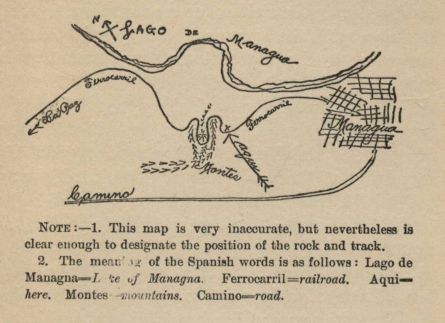
Map Showing Position of Rock and Track
NOTE:--1. This map is very inaccurate, but nevertheless is clear enough to designate the position of the rock and track.
2. The meaning of the Spanish words is as follows: Lago de Managua=*Lake of Managua*. Ferrocarril=*railroad*. Aqui--here. Montes=*mountains*. Camino=*road*.
* * * * * * * * *
"I know the exact place, Señor," said Tomas, and his features reflected Dick's own excitement. "It is one hour's hard riding from here, and Señor, look! There is the train pulling away from the filling station now. You may know it to be so because of the trail of black smoke. We can never reach the spot before the train. We are too late, and soon it will be dark and we cannot then ride as fast."
"We must make the trial," said Dick, mounting his restive steed. "Come, lead the way. Do not spare the horses now," and with the Indian in advance they were soon clattering down the hill at breakneck speed. On reaching the road the Indian, bending low in the saddle, for the first time touched his horse with the spur, and the splendid animal responded to the unaccustomed punishment as if shot from a catapult.
Side by side the two sped along the roadway towards their distant goal. Again the rails and track ran parallel and Tomas, taking advantage of his knowledge of short cuts, turned from the highway and led the chase along the narrow trail beside the tracks, never once stopping the fearful speed of his mount.
Suddenly from behind them came the long wailing whistle of a locomotive. Glancing over his shoulder Dick saw a few hundred yards behind a fast approaching train. This could not be the troop train, he was sure. Once more he heard the whistle warning him to get clear of the track.
"Tomas," he called, but the Indian gave no sign of having heard his cry.
Another look behind showed the train rushing on with no slackening of speed. Still Tomas continued in his mad flight. Dick tried to swerve his horse from the trail beside the track, fearing that when the train overtook them the animal might become frightened and dash against the side of the train; but now the black horse was infected with the fighting spirit, and so long as the bay horse in the lead was ahead just so long would he keep up the heart-breaking run. Dick could feel the powerful muscles beneath him working with the smoothness of well-oiled machinery, and in spite of the enormous strides with which they covered the ground, he hardly rose from his saddle, so perfect was the action.
Then to Dick came a new thought. Unless the train ahead was delayed he never could hope to reach the danger point in time to warn the troops. He knew his attempt was futile, so why continue! This train now thundering along so close behind might catch up with and stop the artillery train. But how could he let those on board know of the danger? To attempt to flag the train was useless now. Had he thought of it before it might have been possible, but it was not very likely, under the most favorable conditions, that they would stop on the signal of two lone and unrecognized horsemen alongside the track. Should he attempt to interfere with its progress, the chances were that the train guard--men from his own corps, possibly his own company, would shoot him as a suspiciously acting native: "shoot first and inquire after," was a fundamental principle in these treacherous revolutionists.
His mind, naturally active in summing up situations in their true light in times of stress, and quick to formulate his plans, saw only one way left open to him. He must board the moving train. He must make the leap from his saddle in some way, grasp hand-guard, brake, door, window or sash, and hang there until those on the train could pull him to safety.
Even as he made his resolve the engine, foot by foot, was gliding ahead of him. From the cab window the engineer, a sailor from one of the ships of the Navy, watched with deepest interest what he believed was a vain race between two "loco Spigs"[#] and the train, and turning to his grimy fireman he ordered him to keep up the steam pressure at all costs and "Durn the expense."
[#] Loco--Spanish for "foolish."
That the horses could keep up their terrific speed for any length of time was out of the question. The Indian's horse appeared to have taken matters in his own hands and was running away, though Tomas was now doing his best to hold in the excited brute.
Now the tender and the first car had passed Dick. Another quick glance from the corner of his eye and he saw there were but three more cars in the train, and when his eye returned to the narrow trail he saw it gradually drawing away from the rails. Unless it returned beside the track within the next few rods his last opportunity would be gone.
On the train every window was filled with excited faces watching this uneven race between God-made and man-made power, but they tried to encourage the riders with shouts and yells and much waving of hats and hands. Dick heard and saw the "rooters," but beneath his cap there was no change of expression; his face was white and stern with a bulldog tenacity of purpose.
Now the second car had drawn past him, and the middle of the third car drew opposite the straining horse. Would the trail never get nearer? Must he in a last desperate endeavor pull with all his might on the left rein and cross the rough ground in order to bring the laboring animal against the side of the cars? If he did it meant almost certain destruction.
Now the fourth car appeared, nosing forward on his flank, yet he dared not take his eye from the trail. Must he leave it and make the dash across the rough uneven space? He would wait just a few strides more. Then once again he found the narrow path converging towards the tracks. Already Tomas was racing beside the car, ten feet in advance. Would the black horse be equal to the effort? With a wild yell the boy dug the spurs into the flanks of the steed, and with a gasp of surprise the horse bounded forward as never before. For a second the painted side of the clattering coach was like a dull smear on Dick's blurred vision--then he leaned far out in his saddle to his left, his clutching fingers slid along the beveled edges of the car's wooden frame, they gripped the iron hand-rail at the rear end of the platform, the next moment he was pulled from his saddle, his feet struck the steps and with a last, final effort he fell breathless on the floor, held in safety by the strong hands of two astonished train guards.
"Well, I'll be jiggered, if it ain't Dick Comstock," exclaimed Private Jones, late of the Denver's guard. "I ain't seen you since we separated at Colon. Say, Dick, what in the dickens are you doing here, and where did you come from? I sure am some glad to see you."
"Wait a minute; let him get his breath before you take it all away again by making him answer your questions," said the other marine, assisting Dick to his feet, and looking at this sudden arrival with unfeigned admiration. "My word, Bo, but you beat any movie picture hero I ever seen. By the way, your friend back there doesn't seem to know what's become of you."
"I'm thinking he must believe the Angel Gabriel come along and took you up in his chariot," said Jones, whose knowledge of Biblical characters and their history was fragmentary.
Far down the track Tomas could be seen halted in the middle of the rails scratching his head while he gazed after the train in evident perplexity.
"I guess he'll figure it out. He's a wise old Indian," said Dick; then the reason for his being on the train struck him with its full significance, and, "Who's in charge of the train?" he asked.
"Why, Dick, our old friend, Sergeant Bruckner. He's up forward on the engine. Why? What's up?"
But Dick did not stop to answer. Roughly pushing his way through the crowd of natives gathered at the end of the car to see what manner of man it was who rode hair-breadth races with railroad trains, he ran through the remaining coaches to the front end of the train, climbed over the tender, now nearly empty of wood, and finding the sergeant, he told him what he had done and what there was still to do.
"You say the artillery train left the vood station about tventy minutes ago?" asked Bruckner, reverting to his v-habit in his excitement.
"Yes, and they will necessarily have to go slowly. It is getting dark, and I believe we can catch them before too late."
"But ve also have to stop and refill with vood, and as ve von't find any men there to do the vork for us, it's going to be a very slow business."
"Slow? Why, if necessary, we'll make every passenger on this train lend a hand, willingly or otherwise," said Dick.
"Well, here we are," called the engineer who, though keeping his eye on the rails ahead, was an eager listener. "Come, all hands, get everyone on the job, and I'll lend a hand myself."
Never was wood hustled into a tender of the Ferrocarril de Nicaragua so fast as it was that October evening, and when the fireman finally announced that he had sufficient, the ear-splitting whistle had barely died away before the old wood burner was surging on into the gathering darkness, her headlight streaming on the lines of shining rails ahead, making them appear like two bars of yellow gold stretching on into infinity.
"If there are any ties out, fishplates gone or spikes driven between the rails this night we're goners," said the fireman to Dick as the two worked, throwing log after log into the capacious maw of the engine, where the draft seemed quickly to turn them into a mass of dark red cinders which streamed out of the great stack and left a glowing trail as of a comet's tail following them through the night.
"I've been with old man Strong, the engineer, every trip he's made, and I never seen him light out like this. I almost believe we're making forty-five miles, and mebbe more than that, especially on the down grades. Wow! Man dear, but he took that curve on two wheels, and it's a wonder we stayed on the track when he struck the reverse. What's his idea of pullin' the whistle every two seconds, anyhow?"
"He's started sounding the 'S.O.S.' calls," said Dick, "hoping the train ahead will hear us and wait to see what's up."
"How many miles have we got left to catch 'em?"
"I don't know," answered Dick, as for a moment he ceased his labors, and holding to the rail at the side of the cab peered ahead along the parallel lines of light; "it can't be much more, for we are in the hills now, and on the down grade. If we are to do any good at all it must be soon."
The next moment there was a long weird shriek of the whistle, then the grinding of brake-shoes on the wheels as the signal for the train guards to man the wheel brakes followed in staccato blasts. Groaning, straining, shaking, screeching, bumping and thumping, the train slackened its speed, crawled for a few yards, and then with one last resounding rattle it stopped, and there, but a few short yards ahead, waiting to discover the reason for the wild signals for help they had picked up, stood the officers and men of the artillery train, safe and unharmed.
Owing to a "hot-box" they had been forced to stop and repair at a station called Brasiles. While there they discovered that the lines of wire either side of the station had been cut and later, hearing the wild whistling of the engine in their rear as they proceeded cautiously on their way, and believing rightly that the signal was meant for them, it was decided best to await the arrival of the news before going further.
It was Richard Comstock who, a little later from the seat above the cow-catcher of the leading train, gave a shout of satisfaction. Rounding the last abrupt curve in the hills before descending to the straight road-bed of the plain, he espied a great mass of rock thrown directly across the rails. Had the train been other than creeping along through the cuts and defiles a serious accident would have followed undoubtedly.
Slowly the train drew up to the dangerous obstacle, and then, true to the contents of the letter which Dick had delivered into the hands of the Marine Officer in charge, they found crushed beneath the mass of rock the body of a man in whose pockets was the letter and the money, which, if the truth had not been known, might have changed the pages of Nicaragua's history.
CHAPTER XXIV
THE SITUATION WELL IN HAND
Zoom! Whiz-z-z, and then a distant bursting cloud of cottony white smoke high in the blue sky over the hill called Coyotepe. Soon the waiting ear heard the sharp explosion of that seemingly soft fluffy cotton-ball, which in reality carried death in its wake, for with the bursting came hundreds of tiny bits of steel and bullets seeking out the enemy behind their entrenchments. And through the day and the night following the sound of the field guns prepared the way for the attacking marines, sailors and Federal troops the next morning.
At the first break of day two battalions of United States Marines began their advance. In reserve, a battalion of sailors, as yet untried in land warfare, fretted and fussed at their position behind the actual firing line, and some even rolled in the yellow mud till their white suits were the color of marine khaki and then, rifle in hand, sneaked away from their command and joined their brothers in arms. As for the Nicaraguans, supposed to attack but not relishing the job, they delayed and delayed, only too happy to let Colonel Pendleton and his command assume the task of attempting to drive Zeladon and his insurrectos from Coyotepe and Barrancas. Deep down in their hearts they felt that what no Nicaraguan army had yet accomplished could never be carried to a successful issue by these few pale-faced Americans from the North.
No! It seemed that those who held these two hills which commanded the road and railroad, north and south, could never be driven from them. Yet, little by little, step by step, up the rocky, slippery slopes, struggled the thin brown lines of marines. On through briar and bush; over jagged cliff or bullet-strewn open space; on and ever on. Through prepared traps of barbed wire; cutting, slashing, firing, sweating, swearing, always upward, till finally in one mad, glad, glorious, soul-stirring, blood-thrilling rush, they mounted the earthworks on the hilltop's crest, in spite of rocks, in spite of cannon, in spite of rifle, in spite of machine-gun fire, and there at bayonet's point engaged in hand-to-hand conflict with enraged men and wild Amazonian women who wielded bloody machetes with fanatical frenzy.
With those who shared in the glory of that conquest was Richard Comstock, his breath coming in short, labored gasps; the rifle he held, taken from a fallen comrade far down the slope, still burning hot, and the knife-like blade of the bayonet shining brightly in the early morning sunlight.
And the marines accomplished this supposedly impossible task in less than forty minutes from the beginning of their advance. Is it any wonder that the natives of the countries where the fighters visit and uphold the glory of the stars and stripes, honor and respect them, individually and collectively?
After the pursuit of the fleeing rebels the Federal troops, encouraged by the unbelievable success of their allies, attacked, took and sacked the town of Masaya in true native style, which always involves useless destruction and uncalled-for brutality.
The "handwriting on the wall" was now unmistakable and when later in the day some of the victorious troops and the battery of field guns were entrained and started for Leon, the rebels in that city gave up all hope of ever putting their candidate into office.
Carrying despatches on the first train north went Sergeant Dorlan and his guard, Dick Comstock, and in those despatches was a very complimentary letter to Dick's immediate commanding officer which told of his timely warning and the manner of its accomplishment.
Barrancas and Coyotepe were taken on October fourth, and on the sixth long lines of marines and sailors were seen leaving Camp Pendleton. That the rebels had agreed to surrender and lay down their arms without a fight was very much doubted, and Lieutenant Colonel Long, who had charge of the coming occupation, was going to enter the town in force and take no chances of a possible ambush.
Immediately after reveille the first troops had quietly reënforced the company already on duty at the railroad station. This was done without incident, and then on three sides of the city the forces began their advance. The rebel troops, knowing that their leaders, Generals Rivas and Osorio, had fled, had spent the night in drinking and debauchery. As the main column debauched into the principal street and the excited, inflamed wearers of the red cockades saw the stars and stripes of the United States flaunting in the breeze, they resorted to their usual street fighting tactics.
Street by street the marines advanced. Every inch of the way was disputed and the bullets whizzed and cracked, sang and stung; taking their tally of wounded and dead.
"Dick, me lad, I'd give me old pipe, I would, to be able to be on ahead with the advance instead of here with the colors, much as I love 'em," announced Dorlan as he stood in the shelter of an overhanging roof and watched the windows of a pretentious building on his right.
Reaching a street corner or alley a little later it was found that the natives had resorted to their brutal, inhuman tactics in dealing even with civilized troops. A sailor, stripped of his clothing and mutilated, was lying in the roadway. Perhaps he had lost his section and wandering here trying to locate it, was set upon by the cruel natives.
"Ah! a sight like that makes the very blood in me bile," said Mike, shaking his fist in the direction of the dodging opponents far up the street; "if I knew the feller what did that to the poor flatfoot,[#] I'd be a brute meself and tear him to pieces with me bare hands."
[#] "Flatfoot"--Marine Corps slang for a sailor.
"Look out, Dorlan," yelled Dick, and falling flat on the rough cobble stones in the middle of the street he emptied a clip of cartridges into a doorway which that moment was flung open, and from which a half dozen rifle barrels were pointing from behind a rough barricade. But he did not stop the volley of shots which followed, and the heavy leaden slugs splashed, pattered, and flattened all about the little color guard. They rained against the walls of the buildings on either hand, gouging out great chunks of mortar and plaster to a depth of several inches, and one bullet, partly spent, struck Dick in the shoulder, penetrated to the bone and lodged there.
"I guess I'm hit, old pal," he said weakly to Mike, after they had silenced the fighters behind the barricade and had gone on for a couple of blocks. "I thought it was only a scratch, but the blood's running down my back, and----" but just then it seemed as though a great thunder-storm was descending upon the city; the sky grew black and the darkness came so swiftly that he could not see where to step, and with a sob he fell into the arms of his faithful friend.
"After all, it is not much more than a scratch; it is lack of sleep and nourishment during the last few days," said the surgeon, handing Dick a piece of lead he had recently removed from the boy's wound, "but I have recommended that you be sent back to Corinto, where you can receive proper attention on board ship."
"But is the fighting all over?" asked Dick weakly.
"Surest thing you know, my boy, for 'the marines have landed and have the situation well in hand,' as the papers always say," answered the surgeon smiling.
"Thanks for the Navy's bringing us here," added Dick with a wan smile, and then he dropped off into a much needed peaceful sleep.
Two days later as he lay on his white bunk in the sick bay of the U.S.S. Buffalo, steaming southward to Panama, and the wonderful hospital at Ancon, a letter was handed him. On opening it he found a document appointing him a corporal in the United States Marine Corps. Also enclosed was a very complimentary letter from the Commanding Officer of Marines ashore, thanking him for his excellent work during the exciting days of the campaign, and at the end he read with satisfaction that, owing to his information, a certain German and his accomplice had been arrested by the Government authorities and were on their way to the coast, where they were to be deported, and forbidden ever to return.