Front matter (continued 3)
Reading edition
"Tell us some more, Dorlan," one of the bystanders pleaded.
"Ah, g'wan with ye. Sure I'm so dhry now from so much blabbin' I can drink the scuttle-butt[#] dhry, and that without half tryin'."
[#] A tank holding drinking water.
"Let us see the campaign medal the government gave you, will you, Mike?" asked Dick. One of his chief ambitions was to be able some day to wear some of those little bronze medals suspended from the bright colored silk ribbons on his own coat. Their intrinsic value was small but what an honor it would be to have the right to wear them.
Mike Dorlan opened his ditty-box, upon which he was sitting, and fumbling around in its interior brought forth two bronze medals; one considerably larger than the other.
"This one," said he, holding up the larger medal, "is the Sampson Medal, given for bein' on board of a ship of the U.S. Navy in some of the actions against the coastwise towns or with the Spanish Fleet. You all know that Admiral Sampson was in command of our naval forces that bottled up Cervera in the harbor of Santiago. That feller Cervera was a brave man indeed, and he fought like the gentleman he was, with no more chance of escapin' than I have o' bein' made the Commandant of the Corps, and you know how likely that is, bedad. This other little piece of bronze is the regular medal everyone got who was in Cuban waters or on Cuban soil durin' the war. It's the Spanish or West Indian Campaign Medal."
"Why don't you ever wear your ribbons and medal, Mike?" asked Dick. "Believe me, if I had 'em I'd be so proud I'd want to show 'em to everybody I met. I would like to see you with them all on some day at inspection."
"I'll tell ye why, me lad, and ye can belave it or not, as you please; there's one medal I want mor'n all of these combined and until I can wear that one, I'll not be wearin' of any."
* * * * * * * * *
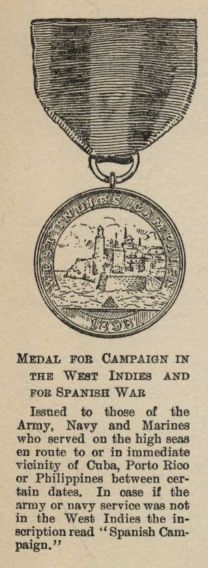
Medal for Campaign in the West Indies and for Spanish War
MEDAL FOR CAMPAIGN IN THE WEST INDIES AND FOR SPANISH WAR
Issued to those of the Army, Navy and Marines who served on the high seas en route to or in immediate vicinity of Cuba, Porto Rico or Philippines between certain dates. In case if the army or navy service was not in the West Indies the inscription read "Spanish Campaign."
* * * * * * * * *
"Which one is that, Dorlan?"
"It's one of them good-conduct medals the Top Sergeant was showin' of ye that first day ye come on this ship, and I'll git one yet! In three days more me present enlistment expires. I'm going to ship over right off, and I'll be makin' a bargain with ye right now!"
"What's the bargain?" asked Dick.
"Well, if I don't git one of them little bronzes at the end of my next enlistment, I'll be givin' all the rest o' me medals to ye, and ye can melt 'em up into copper pennies; but if I do git it, I'll string the hull lot of them across me chest at the first inspection what comes along."
And midst much laughter from the group surrounding them, Dorlan and Richard shook hands on the "bargain."
Ten days later the "galley yarns" came true, as they sometimes do, and the Denver steamed through the narrow entrance and into the wonderful, green bordered, blue waters of Guantanamo Bay, where she anchored for an indefinite stay.
Upon the first opportunity, Sergeant Douglass took the entire guard ashore for a view of the historic battlefields. Landing at Fisherman's Point, they climbed the steep slopes of McCalla Hill, where stands the monument erected in memory of the heroes who lost their lives in the memorable engagement. But it was Corporal Michael Dorlan who explained to the interested men every phase of the landing and the attack; who showed them the hill from which the intrepid Quick had signalled so calmly oblivious of personal danger, and finally he took them through the dusty cactus and chaparral to the old well, the destruction of which forced the Spanish troops to evacuate and leave the field to the sturdy soldiers of the sea.
At a later date, the boys in company with Dorlan and others made a week-end "liberty" to Santiago, where the winning battles of the war were fought on land and water. They saw the exact spot where Hobson and his brave crew blew up the Merrimac in the harbor entrance; they scaled the walls of Morro Castle, which withstood with hardly a scar the fierce bombardment of our fleet; and they rode out to San Juan Hill, where the gallant soldiers of Shafter's army fought so valiantly and successfully.
These little trips to old battlefields resulted in a great demand for books dealing with the wars of that period, and the crew's library of the Denver was more popular than it had been for months.
CHAPTER X
WINNING HIS FIRST MEDAL
Overhead the sun shone mercilessly from a cloudless sky. Hardly a breath of air stirred the stubby grass and scrubby bushes which covered abrupt little hillocks of piled-up coral lightly spread with clinging bits of sandy soil. From the floor-like level of the baked sand flats, covered with white streaks where the sun's rays had gathered up the water and left small deposits of salt, the heat-waves rose, bubbling and boiling, a snare to the unwary or unknowing riflemen, who, from various ranges and positions, were sending little pellets of lead encased in steel jackets at rows of paper targets surmounting the earth and concrete parapets, known as the "butts."
It was a busy and interesting scene of action. Marines in khaki and sailors in white were sprinkled over the vast plain, all intent on watching the bobbing rectangles of brownish paper with black, round, bull's eyes whereon was marked each shot-hole caused by the bullets in their flight.
For days the preliminary drill had been under way. To the men who never before had fired there seemed to be much useless labor and time wasted. Position and aiming drills are monotonous at best, and to stand at long intervals raising the rifle from the hip-position of "load" to a certain height, then bringing it to rest against the right shoulder, bending the head and squinting over the sights at small round black pasters an inch in diameter stuck to a bulkhead or wall and finally snapping the trigger, seemed the height of folly. When, however, the sighting drills progressed to their making tiny triangles by getting points on a piece of white paper twenty feet distant from the rifle sights and connecting these with straight lines, followed by explanations why certain triangles were good and if a bullet had actually travelled along the indicated path, excellent or poor scores would have resulted, then the drills held more interest for Richard and Henry.
Each day Sergeant Battiste, one of the famous shots of the Corps and attached to the Denver, gave lectures on rifle shooting. A celebrated coach, member of many winning teams in the National Rifle meets, holder of the coveted Distinguished Marksman Medal, and Military Rifle Champion of America for two consecutive years, he was well fitted for his task.
Marines are entitled to fire the regular record practise for qualification under the Small Arms Firing Manual of the United States Army once during each target year; but those men who made the grade of Expert Rifleman were not required to fire again during their current enlistment and for that time received each month the extra pay which is a reward for their merit. Naturally all hands were anxious to make the score necessary to acquire these benefits and Sergeant Battiste left no stone unturned to help them in their desires. Each step had been carefully rehearsed, instruction practise completed and to-day the record firing would decide their final merit.
"I've already told you," said Battiste, the men being gathered around him on arrival at the 200-yard firing point, "not to get excited and to take your time. Get your rear sight in perfect alignment with the front sight and the 'bull' sitting oh top; fill your lungs--then, the moment you are ready to fire hold your breath for that instant and squeeze the trigger--don't pull or jerk it, first take up the 'creep,' and by now every one of you should know just when that little additional pressure will be sufficient to release the firing-pin. We've a perfect day for shooting, and if you don't make good scores it's your own fault. As we go back to the longer ranges the wind will come up, but it will blow steadily from the left or nine o'clock,[#] if I know anything about this range and the action of the wind here, and I claim I do. We shall have to watch out for mirage. Your targets have been assigned. Each man knows the number he will fire at and there is no excuse for shooting on the wrong target. To do so would possibly spoil another fellow's score, and it means you will receive a 'goose egg'[#] for your own shot, and goose eggs mean low qualifications."
[#] When facing the target the range is supposed to represent the face of a clock. Twelve o'clock is at the target; six, at the firing point; three, to the right, and nine, to the left. The direction of the wind is easily designated by reference to any hour of the clock dial. A clock-face is also imagined on the target-face; twelve at the top and six at the bottom, facing the firer.
[#] A Zero on the score.
"Are we permitted to blacken our sights on record practise, Sergeant?" inquired Dick, as Battiste paused for a moment.
"Yes, you may blacken both front and rear sights. I'd suggest the use of camphor, and I should also smoke the barrel well, as this sun makes the blued metal glare badly. The red flag is up in the pits, so the 'sand rats'[#] are ready for us to begin. Get on the line, men, and begin firing when your target comes up. Each shot will be marked. If you fail to hit the target a red flag will be waved across its face, indicating a miss; the white disk placed over the shot hole means a bull's-eye, or five; the red disk, four; the black and white disk a three and the black a two. If any of you wish to challenge the marking, Mr. Gardiner, who is the Range Officer, will call up Mr. Thorp in the butts and have the target gone over carefully. Remember to keep your own score in your book and see that it corresponds with the marking and with the scorekeepers' records."
[#] Men who operate the targets and signal the hits from the butts.
"How many shots do we fire?" called out Private Jones, the most inattentive man of the guard, but also the one always spotlessly clean, which reputation had gained for him the position of one of Commander Bentley's cabin orderlies.
"This is slow fire at 200 yards," answered the coach, who seldom lost his temper and had the patience of Job. "Each man will fire two strings of five shots each from the standing position, then we shall move back to 300 yards, and fire the same number of shots from either the sitting or kneeling position. No sighting shots allowed at either of these ranges. The targets are up, men! Commence firing!"
Immediately following the command came the crack of rifles all along the line--the record practise was under way.
Neither Richard nor Henry, before this week on the range at Guantanamo Bay, knew anything of rifle shooting, though both, one in the New England woods, the other along the bayous of the Mississippi, had spent many happy hours with dog and shotgun. Practise with the high-powered military rifle was a decidedly different proposition, but they took to it as a duck does to water, and during instruction practise they agreeably surprised Sergeant Battiste with work that was excellent for beginners.
Dick, having more patience and being more cool-headed, strong and nerveless, was without doubt the better of the two. Henry's one failing was his impatience to "get the shot off." In case he failed to bring his sights in perfect alignment on the bull's eye with a steady hand, he would fall back on the quick "fly shot" so necessary to the hunter armed with a fowling piece, but disastrous to one who aspires to perfection with the military weapon.
"Five o'clock three for you, Cabell," sang out the coach; "must have pulled down on your gun at the last moment. Remember my caution--take your time and squeeze the trigger. Good work, Drummer Comstock; you've found the bull first shot. It's nipping in at twelve o'clock.[#] It pays to be calm and deliberate."
"I'm way off to the right, Sergeant," called out Jones irritably; "all three of my shots have gone in the same place--twos at three o'clock, and you said there wasn't any wind blowing."
[#] "Nipping in at twelve o'clock"--A rifleman's term for a bull's-eye just barely cutting the black at the top.
"Not a bit of wind, Jones, and if you would only remember to set your wind gauge properly those twos would have been bulls, every one. You have almost three points of right wind on, and you shouldn't have any. Apply your quarter-point rule. Each quarter-point on your wind gauge at 200 yards moves your shot how many inches on the target?"
"It moves it two inches, and three times two is six inches," said Jones smugly. "My shots are about two feet from the center of the bull, so there must be wind blowing from the left."
"Your arithmetic needs a little oiling, Jones. There are four quarters in every full point and that makes twelve quarters altogether for your three points. Each quarter point moves you two inches, making twenty-four inches in all. You see, that is the two feet that your shots are out, which is what I said in the beginning."
Jones sheepishly corrected his sight, and the next shot on his target was marked a "pinwheel."
Thus it was the coach went up and down the firing line, offering the advice of long and successful experience.
At the completion of the firing at 200 yards the line of riflemen moved back to the 300-yard point, and taking the sitting or kneeling position, began the next stage of the course. A "possible" or perfect score of ten shots would mean fifty points towards the three hundred points necessary to qualify the men as marksmen, and this they would have to get in order to be permitted to shoot the sharpshooter's course. The firing at 200 yards was the hardest in Dick's estimation, and though he had started off with a bull's-eye, or five, as already stated, he did not continue to see the little white marker or spotter in the black space as he hoped would be the case. His first and last shots were fives and the rest fours, making his total score forty-two. Henry was six points below centers, or thirty-four.
Three hundred yards was an easy range for Dick and he surprised himself with the high score at that stage--forty-seven points, all bulls but three, which fell close outside in the four-ring. Henry had made one over centers, or a score of forty-one.
"Now we will go back to five and six hundred yards," said Battiste. "Each man must fire two sighting shots at both those ranges before he can count his shots for record. The firing will be the same as it was in instruction--from the prone position. I expect every man to average up his score at the 500-yard range, for the bull looks as big as a barn-door, and you can't miss it. You know we change the size of the targets now and use the mid-range or B-target, and the bull's-eye is twenty inches in diameter. In the short-range or A-target it is but eight inches, and in the long-range or C-target it is thirty-six inches. For this reason B-target at 500 yards and C-target at 800 yards are what we call 'easy marks.'"
"Supposing we fire the twelve shots and the first ten are bulls but the last two goose eggs, would the latter count against you?" asked Henry, as he rearranged the leather sling on his rifle around his left arm before lying down.
"It's your last ten shots which count," replied the coach. "Firing regulations require you to take the two sighting shots, and you can't juggle them around to suit yourself; they've got to be the first two fired. The mirage is no longer boiling straight up,[#] but it's moving off to the right a bit, so I'd advise you all to take your sighting shots, make your own deductions and then wait for me to see how nearly correct you are."
[#] Mirage--Heat waves near the earth, visible on some days to the naked eye, but more clearly seen through a telescope. It is really the air travelling on the range, and the best guide for windage, as it is the actual air through which the bullet travels. When there is no movement to left or right the wind is either still for a moment or carrying the mirage directly towards or from the target. It appears to rise and is said to be "boiling."
The moment Dick's target appeared he lay flat on his stomach with his body at an angle of about forty-five degrees to the firing line, feet spread apart with the heels turned inwards. His leather sling was fastened tightly about the upper part of his left arm, and the left hand was well under the rifle, bearing against the lower swivel, which held one end of the sling. The butt of the rifle was placed, with the aid of his right hand, against the right shoulder, both elbows on the ground, the right hand grasping the small of the stock with the forefinger curling around the trigger. His cheek was against the left side of the stock and his right eye so near the rear of the cocking-piece that to one uninitiated it would appear dangerous. But it was the safest position he could assume, and the rifle in his grasp was steady as a rock.
Crack! Crack! The first shots sped on their way to the butts, as Dick and the man on his right fired almost simultaneously.
Nothing followed! Dick's target screen did not move. He was certain his position, his aim, his pull, were all perfect. The shot must have gone through the black paper in the center or one of the black annular rings and was not seen by the "sand rat" in charge.
"Mark number three target," shouted the sailor who was keeping Dick's score, and the man at the field-telephone relayed the message to the butts. A second or two later "number three" was "sashed," or pulled down; then up it popped with the fatal red flag waving back and forth across it as if in derision.
Dick was surprised at this, for he was positive his first shot must have been a bull's-eye. He looked at his sight critically. What was wrong? Perhaps the wind was blowing enough to throw him off the "bull," but never could that light breeze throw him off the target altogether. He had one more sighting shot, and unless he found the target with that one he would have no "dope" for his ten record shots that were to follow. Already he had a quarter-point of left wind on his gauge, which meant, at this range, if he took one-half a point windage that would move the shot one-half the width of the "bull"--enough to put him in the four-ring if his aim deviated the slightest and his "dope" happened to be wrong.
He was about to make the change, even though against his better judgment, when the man at the end of the telephone called out:
"Two shot holes in the bull on Number Four target!"
Dick drew a long breath of relief. He had fired his first shot not at his own but at his right-hand neighbor's target.
"Thank your lucky star, young man, for the sighting spots, or else your score would have been spoiled in the making," quietly remarked Sergeant Battiste, who was standing back, enjoying the lad's perplexity. "Let it be a lesson to you--always take a squint through your peep sight at the number below your target before you fire. One of those fives in Four Target was right in the center--a pin wheel! How much windage did you have?"
"A quarter-point of left wind," answered Dick.
"Just right--now, go ahead and make a possible."
And that is exactly what Drummer Comstock did--every one of his following shots hitting the bull's-eye for a perfect score, and to the present day he shows that page from his score book with great pride.
Dick's luck continued with him at 600 yards, which to many old and tried riflemen is one of the most interesting ranges. With forty-three points here and the fifty at 500 yards, Dick now had a total score of one hundred and eighty-two points.
"What's your total, Hank?" asked Dick while they rested during the noon hour.
"One hundred and sixty-three, so far; but do you know who has the highest total for the day?"
"No, I didn't get through at six hundred in time to look over the score-boards; why, who is it?"
"Oh, a fellow named Richard Comstock! Great Scott! If you keep this up they will be hailing you as the Military Champeen of the World, Dick. That was great shooting you did at 500 yards, old man."
* * * * * * * * *
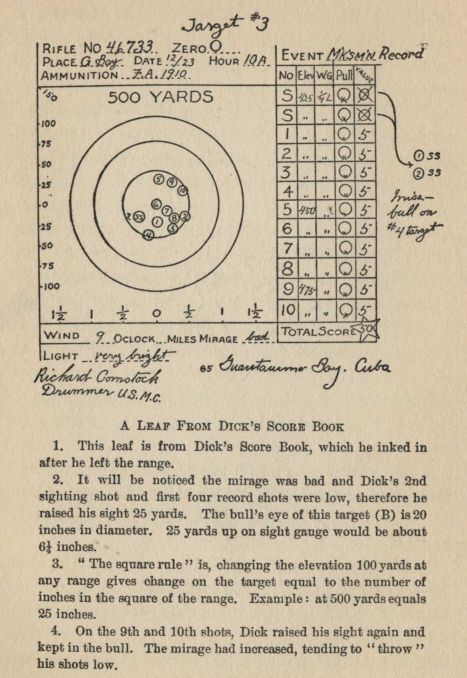
A Leaf From Dick's Score Book
A LEAF FROM DICK'S SCORE BOOK
1. This leaf is from Dick's Score Book, which he inked in after he left the range.
2. It will be noticed the mirage was bad and Dick's 2nd sighting shot and first four record shots were low, therefore he raised his sight 25 yards. The bull's eye of this target (B) is 20 inches in diameter. 25 yards up on sight gauge would be about 6-¼ inches.
3. "The square rule" is, changing the elevation 100 yards at any range gives change on the target equal to the number of inches in the square of the range. Example: at 500 yards equals 25 inches.
4. On the 9th and 10th shots, Dick raised his sight again and kept in the bull. The mirage had increased, tending to "throw" his shots low.
* * * * * * * * *
"I am proud of it, of course, but when you read how some of these crack shots make a string of bulls as long as your arm at that range then it loses some of its lustre as a star score."
"They didn't get those wonderful records, though, on the first real practise, as you have done, Dick; and Battiste says you have a natural gift for shooting which further practise will surely develop."
"Yes, I got along pretty well with the slow fire, Henry, but I'm rotten in rapid fire, especially at 200 yards. Somehow I can't get the knack of it."
"That is funny, for I am perfectly at home in rapid fire," said Henry.
"If I can get on my tummy and shoot 'em I am safe, therefore I don't fear the skirmish runs. How many more points can be made from now on? Let's figure it out!"
"We could make three hundred more. Each of the two skirmish runs counts one hundred, and the scores at rapid fire at 200 and 300 yards are fifty each, but I don't reckon we will get anything like that. Besides, you shouldn't worry, and I need but one-thirty-seven to qualify as marksman, and you a hundred and eighteen."
"You are wrong, Hank. It's true you require but three hundred points to make you a marksman, but you need as many points as you can get. I'm not satisfied just to scrape through in a matter of this kind, and because the thing appears easy is all the more reason we should try for the highest score we possibly can get. Then there is another reason; your marksman's score is added to what you make in the sharpshooter's course, and you've got to make a total of four hundred and fifteen points to get the qualification, which then gives you the right to shoot the expert test."
"You are right again, Dick, and thank you for the tip, or I might have missed my badge and the extra pay."

Marksman badge. This is the badge of the lowest qualification. Below this men are rated as "1st class," but receive no badge.
That night when the different divisions of the Denver's complement returned, tired and hungry, to their ship, Sergeant Battiste worked till late arranging the scores of those who had fired, and out of twenty aspirants for the honor all had qualified as marksmen and would shoot the following day. Of the twenty, the top notch shot was none other than Dick, and fighting for last place were Trumpeter Cabell and Private Jones, both with 323 points to their credit. Dick had made the excellent score of 449 out of a possible 500 points.
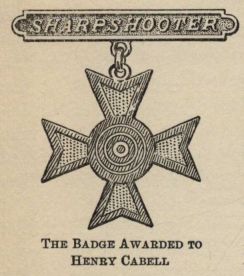
The Badge Awarded to Henry Cabell
The following evening when the shooting cohorts returned on board having finished the Sharpshooter's[#] Course, he was still leading the detachment with a total score of 586 points.
[#] This course consisted of ten shots slow fire at 800 yards, same at 1,000 yards, and ten shots rapid fire at 500 yards; a possible score being 150 points.
"The 1,000-yard range was my Waterloo to-day," he explained to First Sergeant Douglass, who did not have to fire, being already an expert rifleman; "a fellow needs a lot more practise than I've had to be able to find and hold the bull at that distance, especially if there is a 'fish tail'[#] wind blowing, as happened to-day. Anyway, I'm sure of my Maltese Cross; but I want to pull down that expert's badge to-morrow, for it's the finest of the lot."
[#] A wind coming from a direction nearly parallel with the flight of the bullet:--the course the bullet travels through the air is called its trajectory.
The expert rifleman's test consisted in first firing ten shots slow fire from 600 yards over an embankment at the silhouette of a kneeling figure of a man with his arm raised as in shooting. Then came five shots at 500 yards and five at 400 yards at the same figure, only in this shooting it bobbed up above the butts for five seconds and might show up at any point, with five-second intervals between appearances. Next, two strings of five shots each at the "ducks," or Target F, the silhouette of a man lying, are fired at 500 yards. These "ducks" are supposed to fall over when hit, and at 300 and 200 yards the target first fired at, Target E, is pulled across the range on a track fifty yards long, in thirty seconds, while ten shots are being fired. Every hit counts one point, and the firer must make twenty-five hits out of fifty shots to qualify.
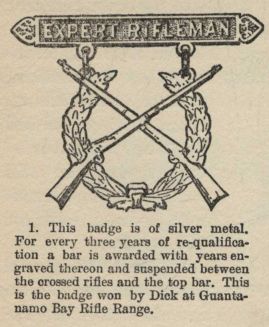
Expert Rifleman badge.
This badge is of silver metal. For every three years of re-qualification a bar is awarded with years engraved thereon and suspended between the crossed rifles and the top bar. This is the badge won by Dick at Guantanamo Bay Rifle Range.
It is a true test of the individual's ability, where steady hand, quick eye and excellent judgment are prime qualities for its successful accomplishment, yet, in spite of his fine showing on the two previous days, Dick barely scraped through with the exact number of hits to win out. But he had won, and two months later when the little silver emblems were received from Headquarters, it was with mingled pride and thankfulness he saw his own name neatly engraved on the reverse of the pin which Sergeant Douglass handed over to his keeping.
Five new experts, eleven sharpshooters and four marksmen was the final result of Sergeant Battiste's course of training.
"Well, I don't believe," Dick remarked as he strained his eyes to see the bright new badge he had pinned to his khaki coat preparatory to Saturday morning inspection, "that I'll ever have as much pleasure in winning anything as I had in winning this, my first real medal."
"You may be right, Dick," said Henry, looking a little regretfully at the new sharpshooter's badge he held in his hand, "but what appeals more to me is that extra pay these little silver gadgets bring in each month."
CHAPTER XI
A REPUBLIC IN DISTRESS
Christmas and the New Year's holidays passed by uneventfully, and the Denver still remained at anchor in Guantanamo Bay. Other vessels arrived and departed, but no orders came for the cruiser, much to the disappointment of all hands.
Rumors of trouble at various points often reached their ears, but the crew finally began to lose hope of moving. The Department must have forgotten them! The Secretary of the Navy was going to make her a station ship! The Admiral of the Fleet had it in for the Captain, and wouldn't let him move! All sorts and kinds of excuses and reasons were forthcoming, but they were as unsatisfactory as they were improbable.
Over six months of outdoor life, swimming, boating, fishing, riding horseback, taking a leading part in athletics, for which his days at Bankley High School and the healthy life in the New England seaport formed a splendid foundation, had developed Richard Comstock into a tall, broad-shouldered, small-waisted, powerful young man, one able to give an excellent account of himself, no matter what the situation. As bow oar of the winning marines' dinghy race-boat crew he had already given evidence of the strength and endurance of his well-knit muscles. He was nearly as brown as the Cubans who plied their bum-boat[#] trade at the port gangway during meal hours, and with his straight black hair and dark eyes he might easily have disguised himself as one of them.
[#] A shore boat which sells fruit, post-cards, curios, etc., to ships visiting the port.
The months had likewise worked a change in Henry Cabell, but his figure was much slighter and less robust than that of his boon companion. The boys were trying to master the Spanish language, and when ashore on visits to Caimanera and Guantanamo City, as frequently they were, it became a practise to carry on all their conversation in that tongue, much to the amusement of themselves and particularly the natives with whom they came in contact. However, the practise was good for them, and they were able to converse quite fluently, and to chatter glibly with the Phillipino cooks and mess attendants, of whom a number were attached to the ship.
Usually their evenings were spent ashore at the Marine Barracks on Fisherman's Point, where a nightly programme, consisting of the best moving-picture plays, were shown on the screen or boxing and wrestling matches, in both of which Dick occasionally took part, helped pass the hours.
In the meantime Joe Choiniski and "Slugger" Williams, having completed their term of punishment in solitary confinement, were released and restored to duty. The long enforced diet seemingly wrought a change in Williams' attitude towards the world in general; and the ship's athletic officer, Lieutenant Robling, hearing of the "Slugger's" reported prowess with the gloves, had interested him anew in boxing, and he had gone into training with a view of winning laurels when the Fleet should finally put in its appearance during the winter maneuvers and target practice. Choiniski belonged to the "black gang,"[#] and his living space was far removed from the marines' compartment, consequently the boys rarely came in contact with him, but if black looks could speak for anything it was certain that Joe's feeling for them was still full of animosity.
[#] A nickname for the Engineer Division on shipboard.
Altogether Captain Bentley's ship was having a peaceful, rather than a wildly exciting time.
Then like a bolt from the blue came a cable message--received at the little station near the lighthouse.
"Revolution in San Domingo. Proceed immediately to Monte Cristi and report to Senior Officer Present for further assignment on arrival."
Thus ran the order.
It was Saturday afternoon, and most of the crew were ashore. Immediately the "Cornet"[#] was hoisted at the foremast, which was a peremptory order for everybody to return on board at once regardless of length of leave. It told those on shore that the ship was under sailing orders and about to get under way.
[#] A signal flag used to recall all boats and liberty parties.
Conjectures were rife in the boats hurriedly returning from all the various places to which they had gone for the afternoon's outing. Swimming parties hardly waited to get into their clothes before shoving off for the cruiser; officers playing golf did not stop to look for the balls they had sent flying along the "fairway" or bouncing into the "rough"; the baseball game in progress halted as a batsman in the act of making a "home run" cut swiftly across the diamond from second base and, grabbing his sweater, made his final spurt for the boat landing.
"Back to the good old U.S.A. for us, boys!"
"Hooray! Broadway and the white lights, fellers!"
"Philly's good enough for me!" called out one enthusiast from the stern sheets of the loaded sailing launch.
These and many other such remarks filled the air.
"Whoop her up, boys, for ten days' leave in the old home town, no matter where it may be!" yelled one joyful youngster, and all who could lent a willing hand on the heavy oars.
Then came the disappointment!
Within an hour the gangways and boat booms were rigged in, awnings furled, cutters and steamers hoisted aboard, life-boats secured for sea, all the hundred and one things necessary to the departure of a man-of-war attended to.
Last of all the mail was sent ashore, for this might be the only opportunity for days,--possibly weeks; who could tell?
Now came the peeping of the boatswains' whistles and raucous voices bellowing throughout the ship.
"All hands, Up anchor!"
Silently the divisions fell in at their proper stations. Slowly the propellers began their revolutions, which would not cease until the arrival at that island of trouble, San Domingo--the Hispaniola of the Spanish Main.
Ashore the little garrison of marines lined the beach at Fisherman's Point. They had heard the news and when the Denver passed, clouds of smoke issuing from her funnels, her ensign snapping in the breeze, and her crew drawn up on deck, the envious men ashore gave her three rousing cheers to speed the parting guest. On past the lighthouse, out through the narrow entrance of the harbor into the deep indigo waters of the Caribbean, where, once the coral shoals were well astern, the course was changed to due east, and one by one, buildings, bay, and lighthouse were swallowed in the distance and the bluish haze which hovered over the terraced hills and shore of Cuba's southern slopes.
Captain Bentley, unlike most naval officers of his day, believed in informing his officers of all the reasons underlying his official actions and the movements of the vessel he commanded. The idea which so many officers held,--divulge nothing, keep officers and crew in ignorance of situations, destinations and intentions until the last possible moment, was not in accord with his conception of good management, executive ability and coördination, therefore, unless absolutely forbidden by his instructions, he made it a point to explain fully all orders which would sooner or later affect them, so that they might familiarize themselves with all the ramifications of the probable events.
Following out this policy he summoned the heads of all departments to his cabin after supper, and there being no officer in charge of the marines, he included First Sergeant Douglass among those present, and furnished them with a short résumé of all the messages he had received since the first one ordering him to sea so unexpectedly.
"Gentlemen, for some months the political situation in the Dominican Republic has been hovering on the brink of another revolution, and from these despatches received to-day, armed conflict has at last become a fact. Our government anticipated this state of affairs, but owing to various causes we have not sufficient ships in San Domingan waters adequately to guard the interests of American citizens nor protect the customs, which as you are aware, are under the supervision of the United States. The situation is so acute, in the belief of the Department, that already marines are embarking on board the Dixie at Philadelphia, and by morning will be on their way to Monte Cristi, where the greatest activity against the organized government seems centered. It will be five days at best before the marines will reach here. I have been ordered to proceed there also and report to the S.O.P. for assignment. Barring unforeseen accidents we should arrive at our destination on Monday morning. It is advisable for us under the circumstances to make ourselves acquainted with such facts as are available regarding the political, economical and geographical features of the unfortunate republic. Our duties may take us to any one of its ports; therefore a study of the charts and a glimpse at the island's history will be beneficial to all. I believe the day is not far distant when San Domingo will become a territory of ours, or at least a protectorate under us."
"If you have time and inclination, sir, I believe all present would appreciate a short talk along the lines you indicate," said Lieutenant Commander Ogden.
"Very gladly, and I will not waste time on preliminaries," said Captain Bentley. "Of course, you all know Christopher Columbus discovered Santo Domingo on his first voyage, and by his direction his brother Bartholomew founded the first European settlement in the New World on August 4, 1494, naming it New Isabella. From this time to the present the island has been the scene of more continual fighting, and strife, and dissension, than any other portion of the globe of equal size. The Spaniards were the first people to believe in the policy that 'a good Indian is a dead one,' and they proceeded to make them 'good.' English, French, and Spanish armies and navies have fought along and on its shores. Revolution has succeeded revolution. The French end of the island was declared a republic in 1801 after an uprising of the blacks under Toussant L'Ouverture, who incidentally was the son of a Royal African King. The French and Spanish long disputed certain portions of the island, and a treaty establishing the boundary was made January 3, 1777, but with the independence of Haiti the whole island came under the rule of the negroes. Soon the Spanish element revolted against the blacks and formed an independent republic, and the old boundary lines were reëstablished in 1844. In 1849 President Baez endeavored to lease Samana Bay to the United States, but our President, Mr. Pierce, did not succeed in putting the measure through. The countries of Europe were fearful of our securing a base in the West Indies of such prime importance, and a revolution against Baez, incited so it is claimed by the English, overthrew the government.
"Strife was again rampant, and finally Spain was invited to take over her former colony by the people in 1861.
"This lasted till 1865, when the Spanish yoke was again thrown off and another futile attempt made to interest us in Samana Bay. Hardly a year has passed since without dissension and bloodshed. In the interests of our own and foreign citizens, and to carry out the policy of the Monroe Doctrine, the United States has at all times endeavored to settle these sanguinary conflicts, and with some success; but never has a permanent peace resulted.
"About 1905 we agreed to manage their customs for San Domingo, and to assist them to liquidate many of the enormous financial claims against their government by various foreign and domestic concerns. Germany, ever on the alert to expand her power, was only too anxious to establish herself in the Western Hemisphere, and in order to continue our stated policy of protection against such invasion, some such act on our part was absolutely necessary. Deprived of the rich benefits of custom dues, revolutions did not prove profitable, and a period of comparative quiet ensued. But it seems that a Latin-American people cannot long remain stable, and now they are again on the rampage. European influence is undoubtedly behind it, but I do not feel free to divulge that phase of the matter. I hope I have not bored you."
"Are you able to give us the present situation regarding the contending forces?" asked Lieutenant Robling, the engineer officer.
"Only in a general way. The rebels seem to hold the interior towns and country, and with the exception of Monte Cristi the seaports are all in the hands of the government troops. A great amount of smuggling is being carried on between the rebels and Haitians, and the officials are powerless to prevent it."
"Do you believe we shall land?" inquired the Executive Officer.
"That I cannot say; however, we must be prepared for any emergency."
"I will make all arrangements for the landing force to be ready for instant service. To-morrow is Sunday, but with your permission I will 'turn to' in the morning, go over the details, and break out and stow on deck our equipment."
"Go ahead with the work as you see fit, Mr. Ogden, and be sure that the gunner gets his small-arms ammunition ready for issue. Turn over to First Sergeant Douglass enough rifle and pistol ammunition to equip the guard. The marines may be needed immediately on arrival for service ashore. If that is all, gentlemen, I will bid you good-evening."
No feeling of disappointment prevailed among the Denver's crew upon receipt of the news that they were en route to aid in putting down a full-fledged rebellion, and everybody was once again full of cheerfulness and smiles. This elation was particularly noticeable among the marines, for if there was "anything doing" ashore their participation was a foregone conclusion. The mere fact that a thousand of their fellows were already sailing from Philadelphia was indication enough that the situation was critical.
Time and again the marines had been rushed here and there and everywhere to police up this or that fractious republic; it was an old yet ever new story with them, and though the activities and general status of this fighting branch of Uncle Sam's armed forces were obscure to the majority of people at home, they were well known and greatly respected in those lands where they labored, fought and often died in their country's service.
Richard and Henry were greatly excited over the prospect and worked with a will the following day in getting out stores, munitions, clothing and otherwise preparing for the hoped-for duty ashore.
"It's lucky we went to Guantanamo, Dick, else we might not have had any experience with these big Colt's forty-fives we pack around on our hips," Henry remarked.
The two lads were at the time carefully oiling and cleaning their heavy revolvers, the weapons the "musics" of the Corps carried into conflict. Splendid shooting arms they were, too, and during the stay in Cuba they had received a certain amount of practise with them in connection with the Navy Small Arms Course, wherein scores with both rifle and revolver were required.
As he spoke, Henry whirled the open cylinder about, and with a clever twist of the wrist snapped it shut, then pointing the empty revolver at a passing man he snapped the hammer rapidly.
"Stop that!" came a curt command, and looking up Henry found Corporal Dorlan standing over him. The look in Dorlan's eye was not pleasant to see, and the usual good-natured smile was missing from the older man's face.
"Stop what?" asked Henry, flushing because of the harshness in Dorlan's voice and glance.
"Stop that foolishness! Ye ought to be gettin' sense in the noodle of ye after bein' these months in the marines."
"I reckon I've as much sense and maybe a little more than some marines around here, who've been in as many hitches[#] as I have months, and I don't need a trial by Summary Court to teach me lessons," and Henry glared hotly at the veteran soldier.
[#] "Hitches"--Enlisted man's term for enlistments.
"If that's the case, me lad, let's see ye use it, both in yer actions and yer manners," said Dorlan, and the twinkle was now returning to the gray-blue eyes; "but I'll tell ye one thing sure;--it won't be a 'summary' but a 'general' ye will be after gettin' if ye go around so careless like aimin' and shootin' yer gun at human bein's, and ye can put that in your pipe and shmoke it for the rest of yer life, and 'twill do ye a wurrld of good."
By this time Henry's better nature asserted itself and rising he put out his hand frankly and asked the elder man to excuse his unwisely chosen words.
Richard, witnessing the incident, was happy to see these two good friends of his settle so amicably what might have developed into a bitter animosity on the part of the young Southerner.
"Now that 'the battle is over, Mother Dear,'" quoted Dick, "suppose you sit down, Corporal Michael Dorlan, and tell us the causes of the Revolutionary War."
"And I could do that too, me lad," said Dorlan, smiling at Richard, whom he claimed as his own particular protégé, "but I'll sit me down and tell ye somethin' that may be of interest and profit to the two of yez."
Seating himself on a near-by sea-chest, Dorlan continued:
"Just a bit ago, young man, I saw ye pointin' a gun at one of yer shipmates and not only that, but pullin' of the trigger," and he looked severely at Henry.
"What of that? The revolver wasn't loaded--it couldn't harm anyone," stated Henry.
"That's where ye are wrong, lad, for it's the gun what ain't loaded which generally goes off and kills yer best friend. It's the kind of accident ye read about in almost any paper ye pick up in any part of the world, and I'd make a bet with ye that the weapon the other fellow 'didn't know was loaded' since the invention of gun-powder has caused more deaths and serious accidents than have the aimed shots in actual warfare."
"But, Corporal, I knew my pistol was empty," protested Henry; "I looked through the cylinder before I closed it. Besides, we've had no ammunition given us."
"Nevertheless, what I say is true, Henry, and here is a safe rule for ye to follow for the rest of your life: never point a gun, loaded or unloaded, at any human bein' unless ye mean to kill or wound him."
At the instant Dorlan finished speaking a half dozen laughing bluejackets came running around a corner into the marines' compartment. Following in close pursuit was a companion flourishing a noosed rope in one hand and a revolver in the other. As he appeared he called out:
"Catch the bandits!"
It was innocent horse play and the men in the vicinity turned to watch the chase. The "bandits" disappeared through a door on the port side of the deck, the pursuer aimed his revolver at them and pulled on the double-action trigger. There was a loud report and a leaden bullet flattened itself harmlessly against the iron bulkhead.
The young apprentice seaman who had fired the shot stopped short and, with a white face, looked in horror at the smoking weapon as it fell from his nerveless grasp to the deck.
"I never knew it was loaded!" he cried hoarsely.
Reaching for the heavy Colt's, Corporal Dorlan picked it up and broke open the cylinder,--every chamber but the one just discharged was filled with death.
"Come up to the Officer of the Deck, young feller," ordered Dorlan grimly, taking the trembling sailor by the arm, and as they turned to leave, he looked towards Dick and Henry, saying:
"As I said before--never point a gun unless ye mean to kill."
No more salutary lesson could have been given than old Mike's talk and its startling sequel.
Out into the windward passage; northward then eastward into the trade-wind-tossed, white-capped waters of the Atlantic; past the mountainous shores of Haiti and the famous or infamous island of Tortuga, whence came the buccaneers and their notorious chief, Sir Henry Morgan.
Then the character of the land changed from rugged mountains rising at the shore line to low, gray, misty ranges rearing their serrated ridges far inland. Finally from out the sea a lone peak reared its crest; growing ever higher and higher--the well-known Monte Granero, so called by the great discoverer when he first saw it, and from the summit of which can be seen the site where now are the ruins of New Isabella on the northern shore of San Domingo. On the low-lying plain a few miles southwestward from the base of the mountain was the straggling town of Monte Cristi, sweltering in the morning sunshine.
Since before dawn the spluttering snap of the wireless filled the air on board the Denver as the message sped through the intervening miles of space to the flagship lying in the open bay off Cabras Island.
Captain Bentley on the bridge read the aerograms with interest, and particularly the last one.
"Large force rebels reported operating vicinity Samana Bay. Proceed to Sanchez, investigate conditions, protect American and foreign lives and property. Guard customs. Report conditions."
"We will continue on our present bearing, Mr. Ogden," said the Captain; "read this, and send word to the Navigating Officer to report to me at once in my cabin."
Captain Bentley then went below, and soon was poring over the chart of Samana Bay, one of the finest harbors and most desirable bases in the whole of the West Indies.
CHAPTER XII
SEÑOR PEREZ ASKS FOR AID
Before the mud caused by the dropping anchor rose to the surface of the water, a shore boat containing two oarsmen and one passenger put out from the wharf and pulled for the Denver. That the passenger was in a hurry was evidenced by his gesticulating hands, and by the black cotton umbrella held by its bulging center which he waved in an attempt to make the clumsy boatmen pull together. From under the white cork helmet his dark face worked spasmodically as with a mixture of Spanish, English and German words he urged on his laggard crew.
Interested sailors and marines lined the ship's rail, watching the approach of the stout, excited little foreigner. His rapid speech was now quite audible though not intelligible.
"He is giving those peons what my mother would call 'gowdy,'" said Dick to Henry, "and that is her worst swear word."
"Meaning our excitable friend is rather strong in his choice of expletives?" inquired Henry.
"You've got it, Hank! His language is hot enough to make a bottle of Tobasco sauce weep tears of envy."
By this time the boat was within a few yards of the ship.
"Boat ahoy! What do you want?" hailed the Officer of the Deck.
"I want to see the Captain. I am the consul. I am Señor Perez. There is much trouble."
"Come alongside," ordered the Officer of the Deck, and walked to the gangway to meet the consul who, with surprising agility, sprang from his boat and waddled hurriedly on deck.
"Excuse the absence of honors, Señor, but we did not expect you. The Captain will see you at once, sir."
"I do not want the honors, I want the protection. I want----"
"Orderly, conduct Señor Perez to the Captain's cabin," said the officer, and still talking volubly the little man disappeared below, the marine orderly leading the way.
"It was a regular vaudeville show," said Private Jones later, hardly able to control his laughter while he related the interview to a group of friends accosting him for news after he came off watch. "The little Spig is our consul, all right enough, and after the Old Man had quieted him down a bit he appeared to be a pretty agreeable sort. But, say! He was going strong when he first opened up, and that's no idle jest."
"All right, Jonesie, cut that part and tell us what all the excitement's about."
"From what I gathered seeing the door to the cabin was open all the time," continued Jones, "he's all wrought up over the arrival of a bunch of rebels in the hills back of the town. He has just returned from a trip to the States; came on a Clyde Liner Saturday. His daughter was struck in the leg by a stray bullet during the revolution two years ago and has been in New York for treatment. He brought her back, also a new German governess for his four children, the oldest being this little girl--her name is Sol-la-de-da or something like that----"
"Guess you mean Soledad," volunteered Dick.
"That's it,--Soledad! Well, last night the rebs shot up the town, but no one was hurt. The little girl--he sort of worships her--was scared stiff, and so was everyone else. The government troops were afraid to leave the fort, but added their shots and shouts to the general uproar.
"Some of the bullets hit the consulate, and Perez believes, because he is the American Consul and Americans are unpopular with the rebs--also because he was active in electing the present president--that they are after him. He's a native of San Domingo, and I expect he ought to know what he's talking about."
"What did the Old Man tell him?" asked one of the men.
"The Captain told him he'd received orders not to send any forces ashore unless absolutely necessary; in other words, that we are not to get mixed up with any of the fighting at all if we can help it. He offered to take him and all his family on board for a while."
"What did the Spig say to that?"
"Oh, he went up in the air at first, but it was finally settled to arrange signals from his house to the ship, and if he was actually attacked he could send up a rocket or two and we'd land in a jiffy. You see, there are only about fifty insurrectos in the hills, so it's estimated, and there are two hundred government troops in the town, and the rebs are afraid to come in to attack, even though the federals are afraid of them. We are going to keep our search-lights on all night, and though we can't see the Spigs in the bosky they'll think we can, and that'll be enough to scare 'em. After that Mr. Consul went ashore with a bundle of rockets under one arm and his old bumbershoot under the other, mollified but not satisfied."
"Is that all you know?" inquired another inquisitive man.
"You can't expect me to remember everything; besides, I'm no evening paper," answered Jones.
"You ain't no yeller journal, that's sure," said Joe Choiniski, sneeringly, from the edge of Jones' audience. "I, for one, wouldn't give two cents to read all you've chawed about so far."
"Nobody asked you to butt in and listen," promptly answered Jones, looking at the speaker, who was none too popular, especially with the marines, "but I've got a dime thriller up my sleeve for the Sunday edition."
"Loosen up, Jonesie," said a big marine, tossing into the circle a quarter, which Jones deftly caught, "here's two bits; you can keep the change. What's the scandal?"
Rather proud at being the center of so much attraction, an honor not ordinarily accorded him, Jones continued:
"Well, the chief thing old Perez was excited over is a bunch of money he's got in his house. He's about the richest man in town, and is a kind of banker too, and he's got several thousands of dollars of government money in his keeping. He can't get rid of it, for the railroad is busted up. He's afraid to let the Commanding Officer of the government troops know about it, for the simple reason that a lot of pay is already due him and his men, and they'd be liable to confiscate it and his own coin too. He claims that the rebel chief is an enemy of his and wouldn't hesitate to kill him and his whole family if he heard about the money and could get it. He can't let the money out of his house for the reason he's received word a federal officer is expected at any old time to get it, and if he didn't have it ready for instant delivery, he'd always be in bad with the authorities, and----"
"You have done enough talking, young man," interrupted First Sergeant Douglass, who overheard the latter part of Jones' discourse, "and I want to tell you, if ever I hear you or any other orderly disclosing, without authority, official matters which you may happen to overhear while on duty in a position of trust, I'll see that you get well and properly punished. You may not have thought of it in that light, but it's a sneaking, unmanly trick, and marines are supposed to be men, not sneaks."
Private Jones was honest enough to feel the humiliation of this rebuke, but that did not stop the tales he told from being quickly carried to every member of the crew.
Soon after, "all hands" was called. Rifles and ammunition issued to the sailors and word passed that the landing force would sleep under arms until further notice, after which recall sounded and the routine drills were resumed.
Much to the disappointment of the crew, no one was allowed ashore, and though the town did not offer much in the way of diversion or entertainment, it was a new country and a new people for the majority, and all were naturally curious.
On the steep slopes of the hill, rising abruptly from the water's edge, nestled the little town, consisting of one principal street following generally a contour line, while from it on either hand were cobbled lanes and narrow paths with no general symmetry or direction. Back of the town on a spur of the mountain stood the red-walled fort, a winding road leading to its entrance. Barefooted soldiers in red caps and blue denim coats and trousers and armed with nearly every make of antique rifle lined the walls of the fort or marched along the road. At frequent intervals strange calls sounded on high pitched bugles to which no one seemed to pay the slightest attention.
Night fell! A glorious rising moon spread its effulgent rays over a peaceful scene. From the little village on the hillside came the tinkle of guitars, the shouts of playing children. The shore lights twinkled cheerfully, while in a large building a dance was in progress. Added to the moon's brilliancy were the beams of the ship's search-lights constantly moving over woods and town, making objects clear cut and distinct but casting massive black shadows where house or hillock intervened.
"This is the bloodiest war I've ever heard about," said Henry in disgust at the peaceful turn of affairs. "I do wish they'd start something, don't you, Dick?"
Dick glanced about at the sleeping men, their rifles by their sides, canteens and haversacks and bayonets within easy reach, ready for any emergency, but instead of answering he emitted an unintelligible grunt, turned over on his side and was soon asleep.
For two nights peace and quiet. The insurrectos had withdrawn from the near-by hills, so it was reported, but were guarding all the roads and keeping fresh supplies from reaching the inhabitants.
On Wednesday afternoon liberty was granted a limited number of officers and men. Henry, being on duty, was unable to go ashore, so Dick found himself alone soon after his arrival on the beach.
A small hotel attracted most of the men with its one decrepit pool table, tinny piano and refreshment café. The town was a little garden spot, each yard filled with a profusion of flowers. Dick turned to the left at the main street and strolled along in the direction of the consulate. Passing the house, easily the finest residence in sight, he noticed the bright colors of the American flag hanging from the white pole, and on the spacious piazza three children, olive-skinned and dark-eyed, waved their hands in friendly greeting to the young marine. He addressed them in his halting Spanish, but they hung back bashfully, making no reply.
Señor Perez's residence was at the end of the well-kept street on the outskirts of the town. Dick, not noticing where the winding road to the fort branched off, continued into the country before he became aware that the road was little more than a wide trail, which had turned and twisted away from the bay. Occupied with his thoughts, and the tropical vegetation and strange birds on every hand, he had gone much further than was his intention.
He was about to retrace his steps when a woman's scream from around the bend ahead arrested him. Though no words were uttered it was distinctly a call for help, and without a second thought Dick ran towards the spot. Arriving at the bend of the road he saw a young woman in the grasp of two disreputable looking natives, while a few yards beyond a half dozen others with rifles slung over their shoulders were turning off the trail into the dense underbrush.
The leading man of those in the distance carried a struggling child, a girl, in his arms. From where he stood Dick noticed her face was covered with a dirty cloth which stifled any outcry. The two men holding the woman were so occupied in keeping her from breaking away in pursuit of the men with the child, and attempting to gag her, that they were unaware of Dick's timely approach. The fact that the ruffians did not see him favored the attack which the boy delivered silently and swiftly. One of the men was holding the woman's arms while the other, bending, endeavored to bind them behind her with a piece of rope. She twisted her supple body and kicked vigorously with her stout walking shoes.
As Dick reached them he swung his right fist with all his strength on the jaw of the standing man, knocking him senseless to the road. Grabbing the other about the waist he fairly lifted him off the ground and threw him heavily.
Like a cat the native was on his feet. Rushing at Dick with a savage cry he drew back his right arm, in which was a dangerous looking knife. His assailant was within a few feet of him when Dick launched his one hundred and sixty-five pounds of brawn and muscle in a low tackle which did credit to his football training at Bankley. Unaccustomed to such a method of attack, the native had no chance at all, and again he fell to the path, his head striking against a rock; the knife flew from his hand into the bushes, and he lay there motionless.
In another moment Dick was up, and taking the pieces of rope he found near by, he quickly tied both men securely, nor did he do the task at all gently. The man whom Dick had first struck was now groaning, for the terrific blow had fractured his jaw; as for the other, it was not certain in Dick's mind whether he was dead or not, for he had not moved since his second fall.
For the first time Dick looked at the woman whose summons for help he had so effectually answered. To his surprise she was lying in the road, her eyes closed and face deathly pale. What should he do? Was she dead? Had her assailants dealt her some fatal blow? Had he arrived too late to save her?
Kneeling at her side Dick looked anxiously into her face; he felt incompetent to cope with this phase of the situation. She was a comely woman about thirty years of age, her fair complexion and light hair proclaiming her of a northern race. As he watched, the color began slowly returning to the white cheeks. He saw her lips move and bending he caught the one word they uttered:
"Soledad!"
He was still bending over her when the eyelids quiveringly opened and drawing a deep sigh the blue eyes of the woman looked straight up into the dark eyes of the brown-skinned boy, whose straight black hair and aquiline features, now covered in dirt and dust, brought to her mind but one thought--the horrible men who had attacked her. She started to scream, but the unspeakable terror again crept over her and again she fainted.
Dick's mind was working with lightning rapidity. The name "Soledad" must be that of Señor Perez's daughter; this woman must be the new governess! Her two assailants, securely bound, were no longer a menace, but the child was in a dangerous predicament. The German woman would soon regain consciousness and be able to secure help--but Soledad, the little girl already in mortal fear of rebels, who for two years had suffered from a former revolution, what of her? If he returned for help her abductors would be far away by that time. If he set out in pursuit at once he might overtake them and--and what?
He was unarmed! What could he accomplish against so many? Six men had disappeared in the tangle of woods,--there might be more, and those he had seen were armed with rifles. He remembered that point distinctly.
How fast his brain worked!--the pros and cons flashing before his mind's eye with kaleidoscopic clearness, in all their varying positions. Would those who had gone wait for their two comrades?
In that thought was a glimmer of hope, for it might be they were even now waiting not far off. Could he find them? The trail, the country,--all were new to him!
His roving eyes swept the two men lying at the roadside. Here were weapons. He at least would not go unarmed. Rising, he went to the trussed-up men and calmly took from them their revolvers, holsters and ammunition belts. The man with a broken jaw was suffering, but with the stoicism of a brute rather than of a man. From him Dick also removed a two-edged dagger in its sheath, while the fellow glared at him silently. A moment in adjusting his weapons, another to find his campaign hat, a final inspection of the bound legs and arms of the natives, a last look at the woman, who was showing signs of returning consciousness, and he was running off down the road. Not a mad dash such as he made in his attack, but the long swinging stride of the cross-country athlete.
It seemed to Dick as though hours had elapsed, when in reality the minutes had been but few. In the stress of action, when brain and mind, flesh and bone, nerve and muscle, are working in perfect coördination even Time in his flight appears to stop and wait. But Dick's mind was not engaged in thoughts of this character as he turned from the trail and disappeared into the tropical jungle on his precarious errand of mercy.
Fräulein Stauche opened her eyes slowly. She almost feared to do so, for the last thing she remembered were the black eyes of a dirty ferocious native glaring into her own, his face so close she could feel his breath fanning her cheek. This time she saw nothing but the blue sky overhead. The sun, low on the western ridge, would soon sink, bringing a premature twilight hour to the little town nestling at the base of the lofty mountain. The glare, however, hurt her eyes and she closed them. It was easier to collect her thoughts thus. Why was she lying here under the open sky, and who had been the man staring at her when she looked but a second or two ago? Where was Soledad?
Soledad!
The name brought back with such startling poignancy the fearful tragedy through which she had lived that she struggled to her feet and looked about her in fear and trembling. She recalled how, with Soledad holding her hand, they had strolled along this path, when without warning two men sprang at her from the bushes and attempted to gag her, while others, how many she could not remember, grabbed her dainty little charge and ran along the path and disappeared in the thicket, leaving her fighting and struggling. She looked down the trail and caught sight of a man just turning where the others had turned.
What had they done with the child? What should she do? Fear was tugging at her heart and her knees shook with weakness. A movement at the roadside attracted her. She looked. Lying there were two men. They were now still, but the eyes of one were fastened on her. With a scream of terror, Fräulein Stauche turned and ran as fast as she could for the town behind her.
At last the consulate--and from the pole flew the stars and stripes in the evening breeze! Thank the good God that the gray ship was in the harbor. Help would soon be forthcoming, and as she struggled on she prayed it would not come too late.
When the officers reported their divisions at evening quarters on board the Denver that night another of the ship's force was among those missing. For Drummer Comstock had already been reported as absent upon the return of the liberty party at five-thirty, but now the Engineer Officer stated that Joe Choiniski had jumped ship.
"How do you think Choiniski got ashore?" asked the Captain of Mr. Ogden.
"The only solution I can offer is that during the noon hour, while the men were buying fruit from the bum-boats, Choiniski secreted himself aboard one of them. He was seen hanging around the port gangway at that hour in dungarees and Chief Master-at-Arms Fitch ordered him below."
"Did he obey the order?"
"Fitch does not know, sir. The Officer of the Deck called him at that second to drive away some bum-boatmen trying to tie up to the starboard gangway, and when he returned Choiniski was gone."
"That coal passer is a bad man, and I hope, now that he's gone, that we have seen the last of him; but, isn't it a strange coincidence that Drummer Comstock did not return on time? Do you attach any significance to that?"
"Oh, no, Captain, Comstock and Choiniski are not in the least friendly. They would not hob-nob together."
"That is not what I mean. I have heard that Choiniski threatened to get even with Comstock on account of the affair in Culebra. I was thinking that he might have made his threat good. I believe him capable of almost any act. I don't like his face."
"Here is Sergeant Douglass, sir; he may give us some information," said Mr. Ogden, and the Captain turned to the old marine.
"Sergeant, what have you heard regarding the actions of Drummer Comstock while on shore?"
"From inquiries, sir, I find he did not stay with the others, but went around town by himself. Some sailors were talking with him in front of the hotel, and they state that he started off for the fort. After he had gone some distance they also decided to visit the fort and followed him, but when they came to the road that leads up the hill they saw him still going along the main road in an easterly direction. They thought he acted queerly in not asking them to accompany him, for they were discussing the matter between them, and when they saw he didn't go towards the fort at all, they decided he must have some reason for not wanting them along. That was the last seen of the boy."
"Thank you, Sergeant, that is all. Let me know if you hear anything further."
"Aye, aye, sir," and Sergeant Douglass saluted and turned away.
"It's after six o'clock, sir, and if that is all for the present I will get ready for mess."
Captain Bentley was about to reply when the Gunner came hurriedly up the ladder and, spying Lieutenant Commander Ogden, he approached and saluted.
"Mr. Ogden, the chief gunner's mate reports to me that two Colt's forty-fives, and a dozen boxes of ammunition have disappeared from the armory since morning quarters. He put the revolvers away himself and locked the door--it is a snap lock--which was still as he left it when he went in the armory a while ago."
"Who has access to the armory, Mr. Nelson?" asked the Captain, and a dark frown appeared on his face. Too many inexplicable things were happening on board his ship this day to suit him, and he was becoming decidedly annoyed.
"I have the only key, sir, and I never allow anyone in the armory except the chief gunner's mate. Whenever he gets through his work there he always brings the key to me. Of course, Mr. Ogden has duplicate keys, as you know, sir."
"Does the chief gunner's mate permit anyone in there?"
"No, sir, I believe he obeys my order to the letter. A few days ago he asked and received permission to allow Drummer Comstock of the marines in there. The boy wanted to familiarize himself with the mechanism of the Colt's machine-gun."
"Hm-m-m-m! What do you think now, Mr. Ogden?" and Captain Bentley gazed scowlingly at the darkening shadows on the mountainside, and the lights appearing, one by one, in the houses ashore.
Even while he looked there came distinctly to his ears the loud:
Sh-h-h-s-h-h! like escaping steam as from the vicinity of the consulate a streak of fire shot into the air. Then came the sound of an explosion, while directly over the ship three green balls of fire cast a ghostly glare on the upturned faces of officers and men.
Señor Perez had called for aid!
CHAPTER XIII
CIRCUMSTANTIAL EVIDENCE
The three green balls of fire floated past the ship and slowly faded away in the heavens. Absolute silence reigned, while those on the Denver's deck watched with fascination their weird progress.
From the shore came no sign nor sound of disturbance. No calls, shouts, nor firing of guns. What, then, was the meaning of the rocket?
"It was fired from the consulate," said Captain Bentley. "My agreement with the consul was to send up a rocket in case he absolutely needed assistance, but he is such an excitable individual and his nerves are in such state that he is quite capable of committing any error of judgment."
"The shore looks peaceable enough," remarked Mr. Ogden. "Shall I have the search-lights turned on, sir?"
"Yes, and then I wish you to go ashore and investigate. Take a squad of marines with you and a bugler. If in your estimation an immediate landing is required, he can sound 'call to arms' from the consulate. It will save time. I seriously doubt if there is need of such drastic action."
The search-light beams lighted up the shore while the Captain was speaking and those officers who had binoculars scanned the town for evidences of excitement. A few people strolled about the streets turning their faces from the glare as the travelling rays momentarily flooded them with daytime brilliancy.
"Call away the steamer, Mr. Gardiner, and send word to Sergeant Douglass to have a squad of men and a trumpeter ready to get aboard when she comes alongside. I will go ashore in the same boat," and having given his orders Mr. Ogden disappeared below to get his sidearms.
Ensign Gardiner, Officer of the Deck, issued his orders promptly. In the marine compartment Douglass was besieged with requests from eager marines to be among those landed, but his announcement that Corporal Dorlan's squad was detailed for the duty blasted the hopes of all but the fortunate ones included. Henry Cabell, being the only music left in the guard, was also detailed, and a few minutes later Mr. Ogden followed the last of his guard into the steamer.
"Shove off, coxswain. Take your orders from Mr. Ogden," ordered Mr. Gardiner, and the little steamer started on its way to the landing, full speed ahead.
A little after five o'clock that afternoon Señora Perez awaited the return of the governess and little Soledad. The rebel forces had withdrawn; the American sailors were ashore, and no thought of danger entered her mind. From the high ground of the garden in front of the house she could now see the boats returning to the ship laden down with the liberty party. It was high time for Fräulein to be back.
A sound as of someone trying to lift the latch of the gate came to Señora's ears.
"They have come home," she thought as she turned to watch the entrance, but the next moment, with a cry of apprehension she was running to support the faltering form of the German governess.
"Where is Soledad? Where is my child?" she demanded in a shrill, strange voice.
But Fräulein Stauche was unable to answer. She had reached the limit of her endurance, and she fell into Señora Perez's arms, overcome and speechless.
With the help of servants she was carried into the house and restoratives given. Messengers were sent for the consul and a physician. In the meantime the distracted mother listened to the disconnected words and sentences which told her of her child. Finally the consul arrived and in turn was given the sad news. But all this took time, and nearly three hours had elapsed since Soledad was snatched from the keeping of Fräulein. Unhesitatingly the consul fired the signal which would bring the most efficient aid he could command, and while he watched its gracefully curving arc shooting out over the darkening waters, and the three green balls of fire slowly drift across the bay, he lost all hope of ever seeing his child, for he knew the rebel chief Gonzales whose forces held the approaches to the town and he knew nothing but evil of the man. Waiting there in the darkness he heard the bugle on board ship calling away the boats, bringing aid to his door. He saw the search-lights illuminate the shore line and then he paced from door to gate, back and forth waiting--waiting! No longer a fussy, ridiculous figure, for the despair which gripped his heart lent him a new dignity.
Soon the tramp of men on the macadam road! No native soldiers ever walked with that long swinging stride. He watched them pass beneath a glimmering street light at the corner, "two, four, six, eight," he counted, as the rifle barrels flashed by. What! No more than eight men, when hundreds were needed if ever they hoped to catch Gonzales! Yes, more than hundreds!
Then he saw two more Americans pass the light, one a naval officer in his white uniform. Ah, perhaps this little body was merely an advance guard!
Rushing to the gate, he met Lieutenant Commander Ogden and in the fewest possible words, brokenly related his pitiful story. Meanwhile Dorlan and his men entered the grounds and stood at ease, silently attentive.
"May I see Fräulein Stauche?" asked Mr. Ogden. "Perhaps she may remember more incidents now that she has recovered a little. Does she speak English?"
"Si, Señor[#] Ogden, she speaks four languages fluently. Come this way," and the Consul led the officer to the hysterical governess, and while the questions he asked her were being answered Dorlan stood by listening.
[#] Yes, sir, or master, or mister. Señora is lady, madam, etc. Niña means little girl and niño, little boy.
"Yes, two men first attacked her. No, they were not soldiers. On second thoughts she was positive one with whom she fought was dressed like the American soldiers from the ship. He was the one she remembered bending over her when she recovered consciousness, and now she recalled seeing him run down the road after the others with the child. Yes, he was armed with two revolvers. No, she did not understand why two natives were lying near her on the road--she only remembered seeing the eyes of one of them fastened on her and, becoming terrified, she fled. Not a word had been spoken, but the last man looked like a Spaniard. He was good looking but very dirty."
Mr. Ogden was at a loss as to what action he should take. It was out of the question to send a searching party into the country; in the night they could accomplish nothing. Leaving Dorlan and his men in charge he returned to make his report to Captain Bentley. The Consul had sent word to the Commandant at the fort, but that official said he could not order his men out on such an errand without permission of higher authority. More than likely his men would refuse to go in any case.
"The evidence against Drummer Comstock and Choiniski seems to be growing," said the Captain when Mr. Ogden had ceased speaking as they sat in the cabin, after the Executive's return.
"Yes, it is, startlingly so, for to-night Corporal Dorlan told me that every man on the ship knows the Consul has a large sum of money in his house. I supposed that fact was known only to you, the Consul and myself."
"How did it leak out?"
"Your orderly, Jones, repeated what he had overheard the first day Señor Perez came on board. Both the absentees were present and Choiniski even questioned Jones later regarding the talk. As for the Drummer, Fräulein Stauche describes him very accurately, dark eyes, black hair, dark skin,--you know how tanned he is--and 'dressed like soldiers from the ship.' Comstock claimed he was bound for the fort, and apparently was anxious to be alone, but we know he did not go up there. He was last seen on that very road, and shortly before the attack happened. Dorlan swears that the boy is innocent, and believes he was hurt and possibly is lying on the road wounded or else he has gone in pursuit of the men who abducted the child."
"It is a serious matter," said the Captain. "I dislike to hold a suspicion of the kind against the young marine, but the circumstances are certainly damaging, and there are some points you have overlooked."
"Something derogatory to the marine?"
"Yes. If you recall, he was allowed in the armory as a favor, and to-day two revolvers are missing from there; also the governess says the last man who disappeared had on two revolvers."
"Well, sir, it looks black indeed. If it is true then the rebel leader Gonzales is not the guilty party. But what is the object in taking the child?"
"Having possession of the Consul's daughter and knowing the Consul has a large amount of cash, the object is altogether too plain to admit of error in arriving at a conclusion;--hostage and ransom money, Mr. Ogden! It is Choiniski's idea, and Comstock's help in the matter will make the venture a success. I was cruising in the Mediterranean when the missionary, Miss Stone, was abducted in Turkey. The bandits of the Balkans and of Turkey resort often to this method of procuring funds. Joe Choiniski was born in Krajik, a small village hidden away in the wildest part of the Albanian Mountains. To him this is no horrible thing, as it is to us."
For a while there was silence in the little cabin. Then the Captain continued:
"By morning I think we may have some news. I have no fears for the child's life. She is too valuable alive. Her abductors want money and will find a way to have a message reach her father demanding payment. But nothing can be done to-night."
"One more thing, Captain. I have stated these facts about the young marine, not because I am convinced of his guilt, but because every point having bearing on the case should be weighed. Now, if he is not guilty or implicated, what has become of him? Corporal Dorlan wanted permission to go up the road to where the attack took place and look over the ground. He feels that young Comstock may be lying there in the road and unable to return. He is staunch in his belief in the boy, and if you have no objection I would like to send him on the errand. It could do no harm."
"Is there anyone ashore who can read signals?"
"Almost all the marines are good signalmen, and Trumpeter Cabell is an expert. He can read any kind of a message not in code."
"Very well, send the order, and have Dorlan report by signal immediately upon his return. But he is not to go off the trail nor further than the point mentioned. You say he has a flash-light, and it should be easy to discover traces in the dirt of the roadway."
Trumpeter Cabell felt the importance of his position when, a little later, he began spelling out the message, from the string of red and white lights, sent by Ardois[#] from the Denver. Corporal Dorlan took down each letter carefully, for he wanted to make no mistake in his instructions.
[#] "Ardois" lights are used for night signalling in the Navy.
"It's about time they was doin' somethin' regardin' that lad," he mumbled as he wet the stubby pencil in order to write more legibly. "Now, young feller, ye wigwag to the ship, when they throw the light on this balcony and can see yer, that I want 'em to keep that fool search-light away from this place. Every time they shine it over here it puts the whole lot of us in plain view to git shot up by any Spig in the neighborhood. Tell 'em you will signal with a lantern, and we don't want their bloomin' old light around here."
With this parting word the corporal started out on his reconnaissance along the road where the Fräulein had met with her adventure.
There was no moon, and soon the trail turned back from the bay. Here the darkness of the tropical night hung heavily about the little party. The old soldier took no chances in his work, and formed his three-man patrol in accordance with the rules of warfare.
One man marched about fifty yards ahead, the other the same distance in rear of Dorlan. This formation lessened the danger of a surprise, and increased the chances of at least one member of the patrol's escape, if attacked. Dorlan had brought his small flash-light with which to search the ground for clues of any import.
"I know that lad ain't mixed up with that rascal Joe Choiniski," mused Dorlan as he walked, "no matter what the First Lieutenant believes. It's more'n likely he's the very one what knocked out them two fellers what tackled the Dootch girl, and--ah! Here we are!" he exclaimed.
With a low peculiar whistle he halted his men and began a systematic search of the tracks in the dusty path.
"Here's where the Dootch girl fainted, and here's where the shoe marks show the scrimmage took place. These tracks were made by government issue shoes and were worn by a marine. The imprint of the strap of the leggin' is plain as the nose on yer face. Them's Dick Comstock's tracks; and it's as I says,--he's gone after them greasers for sure. Hello, what's this? The grass and bushes all bendin'. Ah, ye dirty Dago ye. I've got ye. Come back here, Smithers, and help untie these two fellers. We'll take 'em back and see what they've got to say for themselves. And I guess that's about all I can do this night, accordin' to me orders."
And back over the trail to the consulate went the patrol to deliver their two prisoners and make their report. But if the natives knew anything, they refused to talk, and the whereabouts of little Soledad and Drummer Comstock still remained an unsolved mystery.
CHAPTER XIV
DICK MAKES THE ACQUAINTANCE OF COLUMBUS
Lieutenant Commander Ogden's surmise as to the manner in which Joe Choiniski jumped ship was correct, but as to the theft of the revolvers, which he was inclined to fasten on Drummer Comstock, was not.
Just before the noon hour Choiniski, happening by the armory and finding the door ajar, entered, confiscated the weapons and ammunition and with them tucked inside his dungaree jumper left the place, snapping the lock after him; he was unseen by any of his shipmates.
Since the Denver's arrival off Sanchez, he had been bargaining with the bum-boatmen to secrete him and take him ashore in one of their boats, but they would not risk the chance of discovery without payment, and having lost all his money by sentence of the court-martial, Choiniski was without funds, nor could he borrow any sum sufficient to tempt their cupidity. That noon, however, when he promised a Colt's forty-five together with cartridges in payment, the bargain was consummated.
Choiniski had visited the Samana Bay ports previously while attached to his former ship, and on one occasion he met the man Gonzales, a Spanish-negro stevedore in the employ of the German concern owning the one and only wharf. Gonzales was now in command of the rebel forces holding the roads leading into the town, and Joe felt sure his information regarding the large sum of money in the consulate would be a certain means of securing for him an established position with the rebel chief. His familiarity with the language and his experience, not only in the Navy but with the armed forces in the Balkans a few years before, was enough to make him at least second in command if he worked his wires properly in dealing with the rebels.
Within an hour after reaching the shore he was talking with Gonzales.
"And how much money do you say Señor Perez has in his house?" asked the general.
"Many thousands of dollars. I do not know the exact amount, but enough to keep us both comfortably for many years," answered Choiniski.
"How do you propose getting it?"
"It should be easy," said Joe. "To-night we will go to his house and demand it. The Consul will answer our summons. We shall prevent him from sending any message or signal to the ship. If he does not give us the money and if we cannot find it on searching the house, we will take his daughter as a hostage. It is said he loves her more than anything else. Having her in our possession he will pay up promptly."
"Your idea is good, Señor. Now I must get my brother, Alfredo, to assist us. I do not trust these men with me on such work. They would want too much for their share. My brother is in command of an outpost on the Camino Real not far from the consulate. I will go to him at once. In the meantime, Señor, await my return. Adios!"
And off went the chief to consult with his brother, commanding a half dozen picked men in hiding on the road along which Soledad and the Fräulein, who was a stranger and who did not understand the danger, were even then strolling.
Gonzales had no intention of permitting anyone but himself to reap the benefit of the news confided to him by the deserter from the Yankee ship. Least of all did he intend that Choiniski should be a gainer thereby. The plan was excellent, but the sailor would never see a peso of that wealth stored in the house of Señor Perez.
Before leaving camp Gonzales gave orders to disarm the sailor and hold him a prisoner.
"We do not need his help," said he, after having outlined the plan to his brother. "How do I know that it is not all a clever scheme to catch me! Perhaps it is a spy who has come among us."
"Hush! Hermano mio!" said Alfredo, and he gazed up the road intently. "Ah! We are indeed fortunate, for here comes the Señorita Soledad and her duenna, along the trail. Good luck is with us! You will take the niña, while Juan Mendoza and I secure the woman. We will carry her into the hills with us and at nightfall set her free. She will be unable to find her way back until morning. You and the rest of my men will carry the child to camp and leave her. To-night we will make our attempt to get the money after the Yankee sailors sleep. Then, before they can do anything, we have the money and are gone."
This was agreed to and it was with great satisfaction that Alfredo, a little later, saw his brother, Fernando, disappear in the bush carrying the child and followed by his erstwhile soldiers. But the duenna was putting up such a desperate struggle that he was glad indeed Juan was there to aid him.
As the rascal pinned Fräulein's arms behind her, his black eyes sparkled with happy anticipation of the prosperous days of joyous living about to be his. He grew careless in his efforts to hold the governess, and in the one instant her mouth was freed she had called loudly for help. But this made little difference. No one dared to leave the town these days with General Gonzales' band of insurrectos holding the roads, and----
Then came the crashing blow of a hard fist on his jaw and for a time he knew nothing more. As for Juan, though taken by surprise and thrown heavily to the path, he was quick to attack on his own account, but with the result that has been told.
When Juan recovered his senses darkness had fallen. His chief, Alfredo, was endeavoring to untie the cords which bound him, but to no avail. They turned on their sides, and back to back, worked at the knots, each trying to assist the other. Then their quick ears heard footfalls of someone approaching from the town, and fearful of discovery they rolled over and over in the grass and shrubs, away from the trail, only to be discovered eventually by Dorlan and his men and marched back to the consulate as prisoners.
Corporal Dorlan's request regarding the searchlight had been observed and the consulate was in darkness when the reconnoitering party returned. It was then decided to hold the prisoners until morning before turning them over to the military authorities and by the time the final message to that effect was exchanged with the ship, "taps" had sounded over the quiet waters, and the crew settled down to a night's rest. However, many discussions were being carried on in an undertone regarding the circumstances connected with Dick Comstock's absence and Joe Choiniski's "jumping ship." In spite of Sergeant Douglass' warning another orderly had violated his confidential position and the news was common property throughout the cruiser. Most of Dick's ultimate friends were indignant at hearing the story, but the majority were inclined to regard his actions as suspicious and proclaimed him guilty.