Front matter (continued 4)
Reading edition
How fortunate it was that the object of all this commotion was unaware of the nature of these rumors flying among his shipmates, for had he known of them his brain would not have been so free to grapple with the task he had set out to accomplish.
Soon after turning from the trail he was following at a discreet distance the six men carrying off little Soledad.
How should he go about getting the child? He must take no chances, because to do so might mean his own capture and but add to the child's troubles; so he carefully trailed along behind her abductors, waiting for some circumstance which would assist him in solving his problem.
That the men did not intend to wait for their two accomplices was evident, for they proceeded through the forest without a backward glance. All the time Dick was drawing nearer to them, but as he was forced to make his way warily, and often off the poor trail, he was seriously handicapped.
Finally the men with the child emerged from the woods into a clearing in which was situated the barrio[#] where Gonzales made his headquarters. A dozen or more houses and shacks along either side of the road afforded shelter for his troops, about one hundred in number. A few native women, and dirty, half-naked children could be seen, while the barking of several mangy canines filled the air.
[#] Barrio--Small collection of houses.
Beyond the houses on the far side of the road were a few scraggly bushes, and a thick grove of cocoanut trees filled the space to the shore of the Bay. Here some native boats were drawn up on the beach out of sight of the water, and in the grove small groups of rebel soldiers were engaged in various pursuits.
Perforce, Dick was obliged to stop on the edge of the woods and watch General Gonzales and his small band cross the clearing and enter the largest house on the far side of the road. Dick crouched down in a thick bed of ferns and studied the situation, keeping close tab on the incidents taking place before him and waiting for the darkness which would soon fall. That the rebels were carefully guarding the road was evidenced by the little groups of men, to be observed about one hundred yards from either end of the barrio, who halted all persons approaching.
Near Dick's refuge was a well which supplied the drinking water for the community, and frequent visits to this well were made by men, women and children.
It was nearly dusk when a small native boy came bounding out of the quarters of General Gonzales, and the General himself appeared in the dimly lighted doorway. That he had been chastising the urchin was evident from the way the boy rubbed his shoulders and from his loud lamentations as he stood at a safe distance and observed the rebel leader.
"Here you rascal, you! Be quiet, or I will beat you more. Go and bring me some fresh water at once, or you will be sorry your namesake ever discovered this island," and with the words Gonzales threw a battered pail at the boy.
"Come now, hurry, you imp of Satan;" with that the General entered the house and closed the door.
Painfully the boy picked up the pail and approached the well. Dick could hear his sobs as he drew near. Arriving at the well he made no attempt to draw the water but stood looking back in the direction of the house. Finally he shook his small hand in a gesture which Dick's knowledge of West Indian customs told him implied contempt and insult, and from the boy's rapid speech Dick heard enough to convince him that here was a possible ally, could he but win the native lad's confidence.
With a sibilant hiss Dick attracted the boy's attention, but though he looked about him in some fear he was unable to discover who called.
"Quien habla?"[#] he questioned, still looking about him.
[#] Who speaks?
"Un amigo: un Americano,"[#] answered Dick, and then before the boy had time to make an outcry he spoke again.
[#] A friend, an American.
"Do you want to make plenty of money, muchacho?"[#]
[#] Spanish for boy.
The boy had now located Dick's hiding-place and he approached warily.
"How can I make plenty of money?" he questioned in a dubious tone.
"If you will help me, I will see that you get it, and also I will see that the big man is punished for beating you."
The boy was by this time squatting down on his haunches within a few feet of Dick and even in the dusk, Dick could see the eyes flash with anger at the mention of the past incident.
"But what can you, an American, do against General Gonzales, and all his soldiers? Everyone here fears him! Even my father grovels at his feet, and my mother must do as he says. He will kill my father and my mother and me some day, I fear, when he becomes angered. He is a big chief. I am afraid to do aught against him."
"There will be no danger if you do as I will suggest and----"
At that moment the door of the General's house was thrown open, and again the figure of the chief was framed in the lighted doorway.
"Columbus! Columbus! Come here at once!" roared the harsh voice across the clearing.
"I must go, or he will send the soldiers for me. But I will return," said the lad, rising, and quickly filling the pail he ran back across the clearing.
CHAPTER XV
THE ESCAPE FROM THE BARRIO
In an incredibly short time Columbus was back, and this time he nursed a large bruise on the side of his head where the General's cane had fallen with no light force.
"If my father were able to fight he would kill that nigger," exclaimed the excited lad. "But my father was crippled in the last revolution. That general, he makes our house his own. He makes my mother to cook for him and to wash for him. We could not leave my father when the rebels occupied the barrio. We had to stay to look out for him. They eat our food and kill our pigs and chickens, and never pay. They----"
"Is your name Columbus?" inquired Dick in order to cut short the boy's tale of trials and tribulations.
"Si, Señor."
"Well, Columbus, here are two brand new Americano pesos for you, and there will be many more if you do as I tell you," and Dick passed over the silver coins.
"What must I do?"
"First of all tell me how many soldiers are in the barrio."
"Over one hundred, Señor."
"How far is it from here to Sanchez?"
"By the shore road it is nearly three kilometers. The shore road passes through the barrio," said the lad.
"Is the road guarded by more soldiers than the group of men I could see before dark on the outskirts of the town?"
"Oh, yes, Señor, they patrol the entire road every night. The big light from the ship does not frighten them."
"Can you see the ship from the beach back of your house, Columbus?"
"No, a point of land prevents that, but it is not far by boat,--a little over a kilometer."
"Who is in your house with the General?"
"The five soldiers who came with him this afternoon, my mother and father and a little girl the general stole from her people. I do not know her name. She weeps all the time, but makes no noise. He has told her he will kill her if she tries to run away."
"Columbus, I want to get the little girl out of that house and return her to her father and her mother. If you help me they will pay you well."
"It is impossible, Señor. I overheard the General making plans to go to Sanchez and attack the house of her father to-night, and he gave his men orders to guard the child carefully. There are to be men both inside and outside the house all the time."
"Would your father and mother help us?"
"No, Señor, they could not afford to. They would fear to go contrary to General Gonzales' orders."
"At what hour does the General start for the town?"
"Very soon, for he expects to be there by ten o'clock, Señor."
"Are there any small boats on the beach?"
"Oh, yes, and the best canoe there is my own."
"Providing I get the little girl out of the house, will you go in the canoe with me to the American ship?"
"No, Señor, I am afraid; but I will place paddles in my canoe and I will do what else I can to assist you. My canoe is the last one on the beach nearest the town."
"Describe your house, Columbus. Where are the windows and doors?"
"That reminds me, Señor--after all, I can help you. If you approach our casa from the rear you will find a little cocina[#] which opens into the middle room. My father and mother occupy the room on the right as you enter from the cocina. My room was on the left, but it is now the General's, and the little girl is lying in there now, weeping. Long ago I loosened a board at the side near the cocina so that it will slide back, and I used it to go out when my parents believed me asleep. I will tell the child about you and the hole and she can escape that way. First I will put my paddles in the canoe, and then you can take her in it to your ship. Keep close to the shore until you are around the point, then go direct to the vessel. There are no shoals to fear. The only thing to be careful about is passing through the cocoanut grove. Avoid the hut, for soldiers are guarding a prisoner there also."
[#] Cocina--Kitchen.
"Another prisoner? A native?" questioned Dick.
"No, he is a sailor who ran away from your ship and came here shortly after noon to-day, and he told the General about the money and the little girl. But the General had him imprisoned, for he distrusts him and he had the sailor's pistol and ammunition seized."
"Did you hear the name of the sailor, Columbus?"
"Yes, Señor, his name is José. He is a dark man and very dirty, and wears peculiar blue clothes."
"Joe Choiniski, or I miss my guess!" exclaimed Dick as he looked towards the lights flickering through the grove on the far side of the road.
"Can you get me some meat, Columbus?" Dick asked, after a brief pause.
"Has the Señor hunger?"
"No, I don't wish it for myself, but there are many dogs in the barrio, and when they discover me they will betray me to the soldiers if I come near the houses. With the meat I could quiet them."
"Never fear, amigo mio; all the meat in this village would not be enough to satisfy the appetite of the dogs in the barrio nor keep them quiet. They are ever barking and fighting at night, so the soldiers would not think it strange, especially in the early part of the evening. If that is all, Señor, I will go, for the General may miss me. What time shall I tell the niña to be ready for you?"
"Tell her to wait for three knocks on the wall of her room from the side of the cocina, after the General leaves the house. Then she must slide back the board and I will be waiting for her in the cocina. Make her understand I am her friend and will take her back to her people. And, Columbus, here is all the money I have with me, but I will see that you are rewarded later on, if you carry out our plan," and Dick pressed all his remaining currency into the hands of the boy crouching by his side.
"Thank you, Señor, but I cannot take this money. I am a common peon and my people are poor, but they would not wish me to accept money to help a little girl in distress," and Columbus bravely handed back the bills to Dick, though his fingers were itching to keep them.
He made his little speech with such an air of pride, however, that Dick did not insist and with a low whispered, "adios, amigo mio," the brown boy was swallowed up a moment later in the shadows and darkness.
Impatiently Dick waited in his refuge for the departure of General Gonzales on his proposed expedition. Finally becoming tired of such long inactivity he arose and boldly stepped out into and across the clearing. Dick reasoned that in the darkness of the night should he pass anyone inside the camp he would not be recognized nor suspected. He pulled his khaki shirt outside his trousers so as to appear more in keeping with the native soldiers' costume should he happen to meet anyone.
With rapid strides he was soon in the vicinity of the houses lining the near side of the road. The barking of a dog at his approach caused him a little nervousness, but he kept on, remembering what Columbus had told him. Another dog came sniffing and growling at his heels. He paused long enough to kick the canine and it scampered away with shrill yelps of pain and fright.
The following moments were the most thrilling of Dick's life. Turning, after delivering the kick which sent the cur scampering off in the darkness, he almost ran into a man.
"Get out of my way, you spawn," said a voice which he recognized as none other than that of General Gonzales. "Why are you on this side of the road, anyway, when I told you to guard my quarters? Go over there where you belong, and let the dogs bark as much as they please, but attend to your duties, or it will fare badly with you in the morning. Obey me, pronto!" and the rebel chief shoved Dick out into the wide street.
How grateful Dick was that no answers were required of him, otherwise he might have been discovered. He did not know now whether or not Gonzales was following after him, and he feared to turn and look. He could hear no footfalls. Now directly in front of him and not fifteen feet distant was the house where Soledad was held a prisoner. According to Columbus, and this was already verified by the remark of Gonzales, there was a sentry guarding the house, and somewhere in the shadows ahead that native soldier was walking. What if he was waiting to attack Dick on his nearer approach? Perhaps he had heard the chief talking to Dick on the opposite side of the road and was watching his movements with catlike eyes. Dick's ears detected no sound as he drew nearer the house. Now he was within a few feet of the walls. The next moment he dodged around the corner of the building, and just in the nick of time, for, as he did so, the front door was thrown open and the light from the interior streamed into the street. Flattening himself against the wall Dick peered around cautiously. Before the door stood Gonzales, while emerging from it were five men, presumably those who had accompanied their leader from the outpost on Camino Real.
"Everything is ready," announced the General. "Come, let us go. The others have already started, and we must not delay." The party moved off down the road in the direction of Sanchez, and once again quiet reigned in the immediate vicinity. Dick now knew the time for action had arrived. Forgetting for the moment that he had to deal with the sentinel who was supposed to be here on duty he was about to step out in the direction of the cocina when he observed the dim moving figure of a soldier coming from the rear of the house.
Slowly the soldier sauntered towards Dick until he arrived so near that the boy could have touched him. Here the man stopped. Dick's heart thumped so violently from the suspense that it almost seemed the soldier could not fail to hear it. The noise pounded in his own ears like the striking of a bass drum. It was so dark that he could not see what the sentry was doing. Perhaps the eyes of the native, more accustomed to darkness than Dick's own, were even then fastened on him and enjoying his discomfort, perhaps----
A rattling noise assailed Dick's ears. It was the sound made by safety matches shaken in a partially empty box. The sentry had seen him, but now was going to strike a light in order to discover his identity.
The match scraped along the box, but made no spark. At the second attempt the yellowish flame flared up. In its light the dark brown face of the soldier stood out boldly in the Stygian darkness. A white papered cigarette was between the fellow's lips and his dark eyes were bent solely on the flame, seeing nothing else. The flame wavered, then there was the sound of a dull blow, the light disappeared and the sentinel sank to the ground. Once again Dick Comstock's hard fist had found a victim, and once again he was binding and gagging a rebel soldier.
Dick used his own regulation belt to make fast his victim's arms, while the soldier's belt sufficed to secure his legs. Pulling the native's shirt over his head Dick stuffed part of it in his mouth and bound it there with a handkerchief. In the darkness it was difficult work, but he did the best he could, and after dragging the soldier to one side and under a bush, the drummer boy began to feel his way towards the cocina at the rear. A dim light, shining through the cracked walls of the center room, saved him from stumbling into a collection of pots and pans in the small lean-to, which Columbus had dignified by the name of kitchen. Creeping cautiously to the wall of the building under the lean-to, the lad rapped the boards three times, giving the signal agreed upon. Then he waited breathlessly for some response. Finally he heard the scraping of one board on another. The noise came from near the floor where he was waiting. Then he saw the white figure of little Soledad squirm through the opening. Quietly he assisted her to her feet and without a word, hand in hand, the two stole from the house and out into the grove in the direction of the bay.
They had gone about fifty feet when another figure suddenly confronted them, and again Dick's heart seemed to jump to his throat while his right hand sought the pistol hanging at his side.
"Silence, Señor, it is Columbus. I have come to help you find the canoe. Follow me, carefully, for we are near the house where the sailor is imprisoned," and on the little party went like flitting shadows through the grove.
Soon came the soft rustle of waves on the shore, and emerging from under the dense overhead foliage of the palms, objects were more distinguishable. They found the canoe, and in it the paddles which the faithful native boy had previously placed there. Dick took his place in the stern, the little girl tremblingly, but with no hesitation, sat in the bottom. Then with a whispered "buenas noches,"[#] Columbus shoved the frail craft from the sands out into the waters of the great bay, and with a happy heart Dick sent the canoe on its way with long powerful strokes.
[#] Buenas noches--Good-night.
CHAPTER XVI
THE ATTACK ON THE CONSULATE
Corporal Dorlan on making the rounds of his little force shortly after taps noticed the Ardois lights from the Denver were flashing regularly. Not being an adept signalman he sought Trumpeter Cabell, who was trying to snatch a little sleep on the back piazza of the consulate, and shook him into wakefulness.
"Come, me lad, shake a leg, for the ship is callin' of us, and I want ye to read the message."
"Be with you in a jiffy," said Henry, going to get the lantern, which he had already put to good use in the earlier part of the evening.
Soon he was acknowledging the call, and the message Corporal Dorlan noted down as Henry called off the letters caused the veteran many a chuckle of satisfaction. It was a long message, and immediately it was finished Dorlan and Henry shook hands over it in great glee.
"I knew that lad would turn the trick, and come out on top," remarked the older man as he entered the house in search of Señor Perez.
In the center of the building was a room, which, because of past revolutions, the Consul had prepared against the chance of stray bullets. It was but a makeshift affair, but it had served its purpose on many occasions, and during times of danger the family always occupied it. Around the walls of this compartment rows of iron-wood railroad ties were placed from the floor to ceiling and these tough native timbers could be counted upon to stop the leaden bullets used in the guns with which the opposing factions were generally armed. Corporal Dorlan's knock at the door of the "strong room," as it was called, was immediately answered by the Consul.
"'Tis the 'best of news I have for ye, sir," he said, and his face shone with delight. "Yer little daughter is safe and sound aboard the Denver. It seems that our drummer boy, Dick Comstock, followed them rascals what stole her, and he's just now got her away from 'em and is back on the ship. After ye give yer wife the good news I've got somethin' important to tell ye, and the quicker the sooner, sir." With that the thoughtful fellow closed the door and impatiently awaited the Consul's reappearance.
Soon the little man came out and, running up to Dorlan, he embraced the marine in true European fashion by kissing him on both cheeks, much to the old fellow's embarrassment.
"Your good tidings have made me the happiest man in the world, whereas, but a short time since, I was the most miserable," said the Consul, and he again threatened Dorlan with another exhibition of his enthusiasm, but this time the marine evaded it.
"That's all right, yer honor, but we can't be talkin' of that now. There's other doin's afoot this night, and with yer help we can do a neat stroke of work to cap the climax of this day's excitement."
Thereupon he outlined his plan, and an understanding having been reached Señor Perez returned to his wife, while Dorlan made mysterious visits to each member of his little force. He then distributed them to his satisfaction about the house and grounds. All the lights were extinguished except a low-burning lamp in the spacious hallway, and then he sat down to wait behind the closed front door, much as a cat sits before the mouse hole she knows will soon be the scene of some lively action.
Since the end of the message from the ship not a light other than the usual anchor lights could be discerned by the closest observer on the shore. Nor could activity of any kind be noted, but as a matter of fact khaki-clad marines were even then silently embarking in one of the cutters and under muffled oars were pulling towards the landing pier. And from the opposite side of the ship three boat-loads of bluejackets were as silently doing the same thing--but, pulling in the opposite direction, en route to a little barrio less than three kilometers down the coast.
General Fernando Gonzales at the head of his picket force of thirty men halted on the beach road and looked out over the waters at the ship. He heard the beautiful notes of the bugle sounding the soldiers and sailors good-night, and he saw the lights, which had been flickering at the masthead for so long, cease punctuating the darkness. With their cessation he felt reasonably certain that the crew had a feeling of security, and that they felt that everything ashore must be going well, for the big search-light was not shining as on previous nights. He did not understand the meaning of the red and white lights, nor know that they were just finishing a message regarding his whereabouts at that very moment. Such signals were unknown in the armies of San Domingo.
Already the people of Sanchez were closing their doors and windows; soon the streets would be deserted. Leaving his men concealed, General Gonzales ventured forth in the direction of the consulate for a little preliminary scouting. It was high time his brother and Juan Mendoza were at the rendezvous, but their non-arrival caused him no great uneasiness. The street before the Consul's home was also deserted, and he approached the place boldly. As he passed the gate the lights in the house were turned out,--the family of Señor Perez had retired. A few yards beyond the last few members of the Club were closing the door and leaving for their homes. He decided to wait no longer. Calling his men, he soon stationed them in the hedge and shrubbery surrounding the consulate, then with his chosen half dozen villains he approached the front entrance and mounting the broad piazza he knocked loudly. Finally the door opened a few inches and the face of Señor Perez appeared.
"Who are you, and what do you want at this hour of the night?" said the Consul in a voice he tried hard to control.
"I wish to talk with you, Señor, on a matter of great importance to us both. Let me in."
"Who are you?" again came in inquiry, though the father knew well that this was the man who had caused him so much heartache that day.
"I am General Fernando Gonzales, and if you do not admit me without further talk I will shoot you," and a long-barreled revolver was shoved ominously through the opening into the face of the consul, who fell back into the dimly lighted hall. In a moment the General and six followers rushed in, well pleased over the success of their operations thus far.
Was it a sudden draft of wind which closed the door so softly behind them? Gonzales never had time nor thought to inquire, for suddenly the large room became a blaze of light, and he found himself staring into the leveled muzzles of six gun barrels in the hands of Dorlan's men.
"Hands up, ye spalpeens!" called out the voice of the Corporal, and though not a man there understood his words they did understand the menace in the voice, and in a twinkling there were fourteen dirty brown and black hands held tremblingly aloft.
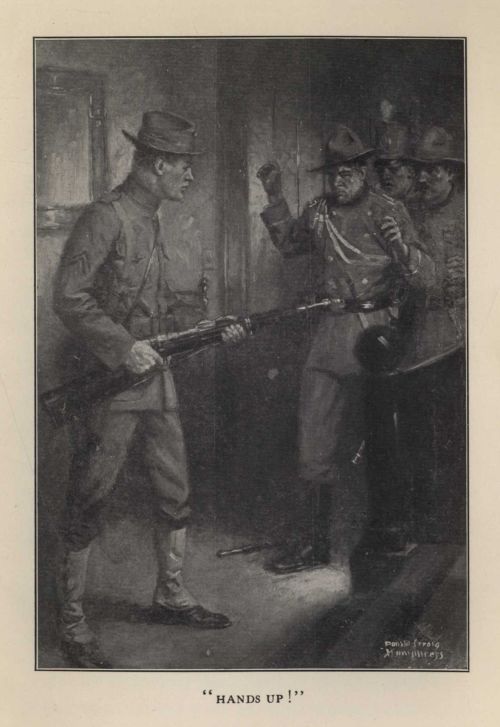
"HANDS UP!"
"Take them guns and knives, and throw them in the corner, me lad," now ordered Dorlan, and Henry began to disarm the rebels. It was then that the leader Gonzales, knowing what would be his fate if he were turned over to the government troops, made a break for liberty.
Although he put up his hands with the rest he still held in his right hand the revolver he had carried on entering. Now with a wild yell the negro half-breed fired one shot into the air, another in the general direction of the Consul, and as he dashed for a window near by he fired the remaining four shots at the marines lined up across the hall. On reaching the window he unhesitatingly jumped through the flimsy lattice work which guarded it, and was running across the lawn before the house.
The sudden attack of the negro so surprised most of the marines, who were not looking for any active resistance after the men had thrown up their hands, that there was an appreciable moment of inactivity which held back their fire. But not so with Henry, for with the first shot of the rebel chief, the trumpeter had pulled his automatic from the holster, and as Gonzales jumped through the window he fired two shots.
One of those bullets found a resting place in the fleshy part of the native's leg. The impetus of Gonzales' rush carried him on, but now he stumbled and called upon his followers hidden in the bushes to come to his assistance. Again he stumbled, this time falling headlong into a flower bed. As he attempted to rise, a figure in khaki rose in front of him; there was the flash of a clubbed rifle, then the weapon descended with crushing force on the general's skull, and he sank to the ground. The days of General Fernando Gonzales as a rebel chief were ended.
From all sides came a fusillade of shots. The bullets tore their way through wooden walls or spattered on the tin roof of the building, but harmed no one. From the fort on the hill came the sound of high pitched bugles sounding the alarm, while flashes of light and the sound of guns showed the government troops were as usual wasting ammunition by firing at nothing in particular and everything in general.
Then a red star shot up from the main road a little to the west of the consulate; there came a rush of heavy shoes on the macadam, a rattle of accoutrements, and First Sergeant Douglass at the head of the remainder of the Denver's guard charged down the road. Again the search-light of the ship flooded the shore and then, without waiting to see what had befallen their leader, the rebels took to their heels and fled.
It was daylight before the excitement in the town subsided, but by then it was known that the hold of the rebels over the inhabitants was effectually broken. The General was dead, his brother, his lieutenant, Juan Mendoza, and the six others were turned over to the custody of the Federal troops. As for those rebels in camp at the barrio, they too had been dispersed, for when the landing party of sailors, guided by Dick, reached the shore near the barrio and demanded the surrender of the deserter Choiniski they fled incontinently, fearing an attack from the Americanos, which they did not relish.
When a search of the barrio and the hut in the grove was made it was found that Joe had either taken the opportunity to escape or the rebels had taken him with them into the hills, for the place was deserted. The only persons remaining behind were the native boy Columbus, his crippled father and his mother. On learning how well the urchin had assisted Dick, and how the rebels had treated the poor peons, a very substantial purse was collected by the kind-hearted men and presented to the lad's mother, and the landing party was then towed back to the ship.
It was Dick Comstock's privilege to escort little Soledad ashore at an hour shortly after sunrise, and though Señor Perez was too much overcome to thank the rescuer of his favorite, Dick felt fully rewarded just to witness that joyful reunion.
Reports now began coming in from all points that the revolution was toppling, and soon those who were still under arms were pleading to be allowed to surrender and go to their homes and former occupations. Orders also came for the Denver to leave Sanchez and proceed on a surveying trip near the border line dividing San Domingo and Haiti, and incidentally to watch for some smuggling reported to be carried on extensively in that vicinity.
The day of departure arrived. In the afternoon a shore boat came alongside carrying Señor Perez, his wife, children and the governess. Captain Bentley met the party at the gangway, and after a few words he gave orders that the crew be assembled aft. When all had gathered there in the shade of the awnings, Captain Bentley stepped forward and called for Richard Comstock of the United States Marine Corps to come to the mast. Then in behalf of the Consul, his family and the governess, the Captain presented the drummer boy with a beautiful gold wrist watch, appropriately engraved, which the grateful donors had ordered by cable from New York City and which the Clyde Liner had but that morning delivered.
Dick felt that he should make some reply, but for the life of him he was unable to utter a single word. Suddenly there was a patter of light feet on the white deck and to his relief Soledad rushed forward. As he bent to take the child's hand, she threw her arms around his neck and kissed him squarely on the lips. The look of amazement now on Dick's face was so great that the entire assembly roared with laughter, and Chief Master-at-Arms Fitch, regulations to the contrary notwithstanding, called out:
"Three cheers for our Drummer Boy and the girls he rescued."
They were given with a will, for now there was no longer doubt as to the loyalty, faithfulness or bravery of Richard Comstock.
CHAPTER XVII
A MAP-MAKING EXPEDITION
"I consider that we are the two luckiest youngsters in the service, Dick. What do you think about it?"
Henry looked about him at the surrounding country, a combination of river scenery, swamp land, tropical jungle and lush savannahs, with an appraising eye.
The two boys stood on the rickety landing near the Captain of the Port's house at the mouth of the Estero Balsa, a branch body of water communicating with Manzanillo Bay, where the Denver was anchored, and where certain members of her officers and crew were engaged in making a chart of the coast line, river deltas and numerous lagoons.
It was interesting work for those so engaged, and each day the various boats of the ship started at an early hour taking lines of soundings from one point to another, measuring angles, plotting positions, sketching in prominent features, or locating reefs and shoals. At night they combined their data, and with compass and rule worked over the smooth copy of the chart which would be sent to the Department at Washington when complete and eventually supplied to each ship of the Navy cruising in these waters.
Having received permission from the Navigating Officer, Dick often accompanied the chart makers on their expeditions, and, always eager to learn, he proved himself a valuable helper with compass or sextant, in taking angles, both vertical and horizontal, and working them out.
Also at night the Denver's boats were engaged in other and more exciting work. Owing to various causes there was a systematic smuggling going on between the two island republics. Small sailing vessels and motor launches were suspected of carrying contraband merchandise back and forth across the Bay at night, and organized bands of smugglers made the passage of the Massacre River from its mouth up to and beyond the San Domingan town of Dajabon, on its eastern bank, and the Haitian village of Ouanaminthe, directly opposite. The customs officers were doing their best, but they were too few in number to cope with the situation. In consequence money was being lost to both governments. The United States was administering the customs affairs of San Domingo, and the Navy had to be called in at times to aid in putting a stop to this illegal traffic.
The presence of the Denver had its salutary effect, and the smuggling by day in the boats had practically ceased, but at night activity was resumed. Consequently the ship's boats, which during the day were engaged in the aforesaid work of surveying, became at night a fleet of armed patrols with certain definite sectors to cover. Many exciting chases resulted in the overhauling, arrest, and, occasionally, resistance and escape of the venturesome smugglers.
The marines were often detailed for this night work in the patrol boats, and they enjoyed it, for there was always a chance of a lively little "scrap," and that is what marines enlist for--scrapping.
All articles coming across the border were supposed to be entered at Dajabon, and after customs dues were adjusted the goods were sent to other points along the only really passable road which led through Copey, a town at the headwaters of the Estero Balsa, thence to Monte Cristi or towns and cities of La Vega Real.
Somewhere in the dense jungle between Dajabon and the office of the Captain of the Port, where the two boys were now engaged in conversation, were trails unknown to the general public, and these trails the smugglers used for their purposes. As charts made by naval officers usually show but little of the interior terrain it was not the intention of Captain Bentley to include any roads on the map his officers were engaged in compiling. However, if Dick and Henry succeeded in getting information of value it was decided that their work should be incorporated with the rest. Both boys had studied surveying while at school, and early on the cruise they had secured a volume on Military Topography and spent many hours in acquiring a thorough knowledge of what was needed in a military map. First Sergeant Douglass, seeing how they desired to get ahead and only too glad to give them something to keep them out of mischief (for musics are generally conceded by all hands to be mischievous), allowed them to have a cavalry sketching case from his storeroom, and with this they became quite expert in making position-sketches and road-maps.
In response to Henry's question, Dick finally replied:
"Yes, I think we are lucky, but it's not going to be an easy task, Hank."
"Right you are, Dickie. This country is all swamps and jungle, with few trails really leading anywhere. I believe it is going to be a difficult proposition to cover the entire area between this place, Copey and Dajabon, in time to be back and meet the steamer in three days."
"Let's not count up the obstacles, though, Hank. We will meet them as they come in the best way we can. We are handicapped by being obliged to do the work secretly. Captain Bentley impressed that upon me. You know, since we were so lucky in the Culebra and Sanchez affairs he has come to regard us as older than we are and capable of a man's work, and with a man's reasoning powers and discretion. I'm not so sure of it myself; but it certainly is up to us to make good now that the opportunity has come our way."
"Tell me just how we happened to get here, Dick. I've been so busy getting things together since you sprung the surprise this morning that I've not had time to question you."
"Well, it was this way! Last night I was out in the steamer on patrol work. Mr. Gardiner was in command. About midnight one of the lookouts thought he spotted a motor boat moving in from the west. We gave chase, but as often happens it was a false alarm and the lookout was conjuring things from being so anxious to see something.
"Well, after it quieted down, Mr. Gardiner began talking about the chart, and how it would aid the ships to be stationed here later on in searching out smugglers. Then he said it was too bad the trails between the coast line, Dajabon and Copey couldn't be sketched in on the map, particularly as one of the ship's boats was to get the data of the Massacre River the following day. With that, and all the trails in between, the map would be of much greater value, he thought. The trouble was, they didn't have enough officers to do the additional work and get through in time, for we are expecting orders to leave here most any day now."
"I reckon you didn't let that opening get by you, Dick," Henry remarked.
"You just bet I didn't. I said that I thought you and I could do it if the Captain would allow us, and told him how much we'd like to try it."
"What did he say?"
"Well, he said, 'Maybe you could,' and he mentioned that First Sergeant Douglass had shown him one of the road maps we made together, last winter while at Culebra, and then the subject was dropped. But this morning Top told me the skipper wished to see me in the cabin at once, and when I reported Mr. Gardiner was in there, and the Captain told me what was wanted, and that I might go ashore and try my luck. He said I should have to go on what was ostensibly a hunting trip, and that I should probably get into trouble with the authorities if they discovered what I was up to."
"Did you ask if I might come along?"
"Of course! I told him we had worked together on road sketches and showed him that one we made of the road from Playa Brava to the old naval station. He seemed satisfied with the work, but then he began to doubt if it were wise to let two kids such as we are go on such an errand."
"He surely put enough restrictions on us," said Henry.
"Oh, not so many, Hank, and they are all wise provisions."
"But why is it necessary that we should return each night to this place? Why can't we stay where we happen to be when night comes, then continue our work next day right where we left off?"
"The Old Man wants to be sure we are all right. Each night I will make up a report and send it in to him, and also all our data up to that time, by the boat making the trip here on the high tide. Then, too, they are nearly through their work anyway, and orders for us to move on are daily expected. The next reason is, that by making our headquarters here we won't have to move our camping outfit or our rations, and this place is centrally located, so that each day we can cover new territory."
"I hadn't thought about all those things," said Henry thoughtfully, "but I reckon the Old Man is right, after all."
"Well, now that you are satisfied, let's get our gear up to the palatial hut assigned for our use by Señor el Capitan del Puerto, fix things shipshape, and make our plans for to-morrow."
This was done, and in the vacant, earthen-floored shack they unstrapped their cots, arranged their bedding, hung mosquito bunk-nets, and after building a fire, cooked their evening meal. It seemed to the two boys as though fried hen-fruit, baked spuds, crisped bacon, ship's punk and steaming java,[#] never tasted so delicious. Nor did the coffee make any difference to such healthy bodies and minds, when a little later they crawled under their white nets and blue-gray blankets, and went to sleep.
[#] Sailor and marine slang for fried eggs, baked potatoes, crisped bacon, ship's bread and steaming coffee.
Though advised against doing so by the native owner, they left both doors to their domicile wide open to admit the night breezes. In most tropical countries, the natives, of the poorer classes especially, close every door and window at night, so as to prevent the slightest breath of fresh air from striking them, and it is for this reason, undoubtedly, that during times of epidemic, the fatality among the natives in semi-civilized places is so great.
Sometime before dawn the boys were awakened by the sound of agonizing cries and the rush of many feet across the hard-packed floor of their hut. Almost at the same instant they sat up, and reached for their automatics. Then they listened, but all was silent, except for the creaking of night insects or the gentle stirring of the palm leaves on their thatched roof. Inside the room was inky darkness, nor was the light outside much brighter.
"Did you hear that, Hank?" questioned Dick, softly, not quite daring to make any further move until he knew where his companion might be and until he understood a little more of the situation.
"I reckon I heard it right enough, Dick; but what was it?"
"I haven't any idea. I heard a yell and someone running and suddenly found myself awake and sitting up."
"Same here, Dick, but I thought it was you chasing something or someone. It looks a little funny, doesn't it?"
"Keep quiet a minute, Hank; I believe they are still in here. I hear someone moving."
Silence followed the caution while they listened intently. Then came a deep-drawn sigh from the center of the hut, and the sound as of a heavy body being dragged across the floor.
"Who's there?" challenged Dick. "If you move again I'll fire."
Once again absolute silence, which was finally broken by a series of sharp staccato taps. Dick immediately recognized the private call Henry and he used in their practise at telegraphy and sound signalling. His companion was rapping on a match-box with some kind of an instrument. If the person or persons in the room understood English then any conversation would inform them of the action to be taken against them. Dick grinned delightedly to himself at Henry's quick way to secret and safe coöperation. As the light sounds shuttled back and forth it was evident to what a state of expertness these two young marines had drilled themselves.
"Look out, I will turn on my flash-light. Be ready to shoot. Do you understand?" came Henry's message.
"It is dangerous. Let me do it, and you shoot," cautioned Dick.
"No! You are the better shot. I think he is near the door, and if I flash the light you can get him better than I can. Stand by right after I sound 'preparatory.' Stand by!"
The safety catch on Dick's automatic hardly made a sound as he pushed it down with his thumb and peered into the darkness near the door. The weapon was already loaded, so that but a slight pressure on the trigger would bring its deafening response. Breathlessly he waited. The next moment came the rattle of the match-box as once again Henry struck it with sharp emphasis:
One rap--two short raps--one rap--one rap!
Then the room was lit by the electric torch from Henry's side of the hut. There was a wild rush of many feet, loud squeals filled the air, and out of the open doorway raced and scrambled an enormous razor-back pig with a litter of squealing, frantic piggies at her heels.
The sudden transition from the serious to the comical was so great that both Dick and Henry burst into a roar of hysterical laughter, and both made a solemn pact never to relate this part of their adventures to a living soul. After this, sleep being out of the question and the gray dawn already lightening the eastern horizon, they prepared their morning meal and made ready for an early start.
From previous tests each of the boys knew the exact stretch of ground covered in one of his strides[#] and Dick's stride being sixty inches, even though he was a six-footer, and five feet being a most convenient multiple, it was to be his duty to keep account of the distances between observation points or stations. For this purpose he carried an instrument used in checking off the number of coal bags hoisted on board during coaling ship, and with each step taken with his left foot he recorded it by pressing on the lever with his thumb. The tally was so small it could be carried unobserved in the palm of the hand. Besides the tally Dick carried a small pocket note-book, conveniently ruled, in which he entered his data and from which, on their return, they would be able to make a very comprehensive sketch of their travels.
[#] A pace is the distance between footsteps; a stride the distance between the spot where one foot strikes the ground and the next succeeding fall of the same foot; a stride is therefore the equivalent of two paces.
Henry was provided with a small prismatic compass by means of which he read the angles from each selected point to the next station. With these simple instruments they could accomplish their work and arouse no suspicion, at least in the minds of any ordinary native with whom they were liable to come in contact.
There was but one trail for them to follow from their point of departure, and it led to the town of Copey. To follow this trail the first day and plot in the cross trails between it and the Massacre River on the following days was their intention, and as the sun rose in a soft pink cloud of color, with shotguns under their arms, game bags over their shoulders, and the heavy Colt's forty-fives strapped to their right thighs, the young surveyors started out on their quest with an eagerness born of youth and enthusiasm.
CHAPTER XVIII
MEXICAN PETE AGAIN
The method followed by the two marines was very simple. Having selected a landmark some distance ahead of them on the trail, Henry, with the sight-leaves of his compass raised, would look through them towards the point and read the azimuth or angular direction with respect to the north and south line, or meridian. This angle was called the bearing of the point or station.
Starting at the Captain of the Port's house they named their point of departure "A," and sighted upon a distant tree, calling it station "B." A line drawn from "A" to "B" would form an angle with another line passing through station "A" and the north pole. This angle was read off in degrees on the compass-card from north going around in the same direction as the hands of a clock, and there would be two methods of recording it. They could state the whole angle as read from the compass, which would then be the true azimuth of station "B," or they could note the true bearing of the line A-B. The true bearing of a line is that angle less than ninety degrees which the line makes with the true meridian. The boys decided to use the true azimuth in their data.
Dick, having made the entry in his book, started marching towards "B," pressing on his tally register with every fall of his left foot. Reaching "B," the number of his strides were entered, a new sight taken, and the march resumed.
Where trails crossed or joined the route, their bearing was jotted down. Features of the country to one hundred yards either side of the trail were kept under observation; houses, corrals, streams, bridges and their nature, cultivated fields, swampland, all were noted carefully.
It was several hours before they met a native, though there was every appearance of the way being well travelled. At noon they halted in the shade of a clump of bamboo and ate their luncheon. There was nothing about them to indicate they were members of a famous military organization, because they had been supplied before leaving the ship with some "cit" clothes. Their canteens of water were carried in the game-bags, for good soldiers never drink water found in strange countries until it has first been boiled, and there was no time for work of that nature while engaged in their present task.
Overhead the sky was a brilliant azure. The sparkling beams of the noonday sun danced gaily with the shadows cast by the leafy foliage and a soft breeze whispered through the feathery leaves and hanging moss. Little lizards darted about in quest of insects, butterflies floated by on downy wing and the hum of bees seeking honey-laden blossoms added a drowsy note to the lazy hour.
"When should we reach Copey, Dick?" asked Henry, with an undisguised yawn.
"In about an hour, I guess. We have been going slowly, but it won't take long on the return trip. From now on we must be extremely careful. The country in front of us is more populated, and the trails joining this one are more numerous."
"Hullo--here are some people coming along the road," said Henry, sitting up; "sounds like a goodly party."
Soon after a considerable company came riding by, consisting of about twenty mounted men and boys, driving before them a number of burros and horses. Most of the party passed without noticing the two marines, but at the rear of the cavalcade was one man who permitted nothing to escape his roving eyes. Spying Dick and Henry, he rode up and inquired in Spanish as to their business.
"Buenos dias, amigos! I see you are hunting! What luck have you had?"
"Very poor luck," Dick replied, looking up at his interrogator but without deigning to rise. "And what did you hope to shoot along this trail, my friend?" inquired the native, looking searchingly at Dick.
"'Most anything--we heard that the ground doves were plentiful, but it has not proven so to-day."
"Where do you come from, stranger?" the horseman now asked. "I know you are Americans, but I have never seen you around this part of the country before, and I know every foreigner from Monte Cristi to the border."
"We are just passing through," said Dick, evading a direct answer.
"Ah! Then, of course, you are bound for Copey. I regret I cannot be there to offer you the hospitality of my home, humble though it is. I am Señor Don Antonio Lugo y Suarrez, alcalde[#] of the town, and if you are to remain in this neighborhood for any length of time, it will----"
[#] Alcalde--Mayor.
"Thank you, Señor, but we are to be here but a short time, otherwise----" and Dick, now having risen, waved his hand in a gesture that was meant to indicate his regret.
"Nevertheless, I shall hope for the pleasure, Señors, and now I must hurry along to my friends. Adios, amigos!" and with a low bow, the alcalde put spurs to his steed and disappeared up the trail.
"That fellow is a slick one, Hank. He talks too much, and he's too suave to suit me. As for his expressions of regret and regard--it's all tommy-rot."
"He surely kept his eyes busy during his visit," drawled Henry.
"Well, there was nothing to satisfy his curiosity," said Dick, looking around to see if he was correct in his statement. "By jinks, Hank, if he put two and two together he might have cause to suspect. You know I didn't give him any satisfaction as to who we were, but as alcalde, he naturally would have heard of the Denver being busy around Manzanillo Bay, and so it's easy to connect us with the ship. But if he wanted proof of what we were doing, there is the evidence."
Henry immediately sat up to look where Dick pointed. On a small tree near by were hanging the two canteens of water with the black letters "U.S.M.C." stenciled on their sides, while on the ground beneath, the flap to one of the hunting-bags had fallen open, and there lay note-book, pencil, tally register, compass, and a rough sketch of the locality around the Bay, which Dick had brought along as a possible aid in their work.
"If Señor Don Antonio and-all-the-rest-of-his-name, was half as wise as he looked he knows pretty well, right now, what we are up to," added Dick grimly. "I wonder what his next move will be!"
The sound of a horse galloping along the trail came to them and then like a streak, horse and rider dashed by and along the way they were about to travel. The rider was spurring and beating his steed as he bent low in the saddle. If he saw the boys, he at least gave no sign.
"That fellow reminds me of something or someone," mused Dick, watching horse and rider disappear in a cloud of dust.
"The way he's beating his animal makes me think of the Mexican you horsewhipped in Culebra last winter," said Henry.
"By jinks, Hank, that's who he is, and no mistake. He was riding along with that outfit a while ago, and now the alcalde has sent him back on an errand. I'd bet an old hat that it won't help us any either; also I hope Mexican Pete doesn't see us, for we can hardly hope he won't remember us. And if he does, the jig is up."
"I've got an idea, too. If that is Mexican Pete, then he's in cahoots with the alcalde, and they are starting out on a smuggling expedition, and the alcalde is sending back word to prevent us from any possibility of getting information of it."
"That's more than likely correct, Hank, and we shall have an interesting report to send in to the Captain to-night. Well, we'd better be getting along, for I've a feeling the more we can accomplish to-day the better it will be in the end. If that outfit is a band of smugglers then it's up to us to discover their trail and see where it leads. It will be easy to find it, and we shall have accomplished our mission if we find even one of their routes."
"Let us go after them right now," suggested Henry.
"If we go back now, of course we can pick up their trail easily enough, but they have taken the precaution to send back word regarding us, and they surely have left some people to watch us if we attempt to follow them. On the other hand, we may never get another such favorable opportunity to finish up the road map to Copey, and as it will be a valuable addition to the chart for future reference, I guess we'd do well to complete it."
"Vamos,[#] then," said Henry, rising and starting off.
[#] Vamos--Let us go.
They worked more rapidly now, taking every precaution against arousing suspicion. The houses beside the road were more frequent, and often they had to guess at the azimuths from one station to another when curious natives were watching them. The pacing of the distances, though, was not interfered with, and they hoped to be able to check up questionable data on their return. Fortunately it was the siesta hour, and few men or women were abroad. Even the streets of the town, when they arrived, were fairly deserted.
The road on which they entered Copey continued through the town until it crossed the broad highway which lay between Dajabon and Monte Cristi. Arriving at this point and accosting a native lounger as to where they could procure refreshments, they found themselves surrounded with surprising rapidity, and the attitude of the men in the group was anything but friendly.
"There is a good cantina there on the corner, Señor," replied one of the men in answer to Dick's question.
"Thank you," said Dick, starting for the store; "and perhaps you will join us?" he added, believing it better to appear sociable even though he did not feel so.
The native accepted with alacrity. Inside the little building it was cool and dim and they ordered, at the proprietor's suggestion, "huevos fritos, pan tierno y mantequilla, y cafe con leche."[#]
[#] Eggs fried, fresh bread and butter, and coffee with milk.
During the preparation of the repast, Dick and Henry, taking their weapons with them, repaired to the yard in the rear of the cantina, where a small brown girl brought them fresh water, soap and towels. Dick, having finished his ablutions first, gave the diminutive maid a silver coin, over which her little fist closed greedily, and the next moment she was displaying it to her mother, who stood in the doorway of the cocina, and who smiled pleasantly at the donor.
"Your child is very pretty, Señora," said Dick.
"The Señor Americano is very kind to say so," replied the woman in her soft voice.
"And how do you know I am an American?" asked Dick.
"Hush!" almost whispered the woman, glancing cautiously back into the cantina. "Listen to me, Señor, your lives are in danger here. It is said you are spies sent here by the Americans, and everyone in the town knew of you before your arrival. You must never attempt to go to Dajabon. The alcalde here is very powerful, and his orders are law. The feeling is very bitter against all Americans. Some of your officers were stoned yesterday in Monte Cristi. Be careful! I can say no more!"
"And why do you tell us this, Señora?" asked Dick.
"Because I like the Americans. An American surgeon saved my child's life when she was ill last year. You, too, were kind to her. Hurry and finish your meal and leave at once. Watch out for trouble, as they will follow your movements. Do not let them suspect that you know anything. Be careful--here comes my husband," and the woman hurriedly occupied herself with some household duties.
"Everything is prepared, gentlemen, and awaiting your pleasure," announced the owner of the cantina, and the boys followed him to their places at the table where their guest still awaited them.
During the meal conversation was confined to the subject of hunting, and it was noticeable how their guest and host agreed that it was a bad season for doves, that the birds never were numerous in the locality, and discouraged any further attempts at enjoying sport of that nature anywhere except along the coast, where snipe of all kinds abounded.
Many times the proprietor left them for the purpose of supplying numerous thirsty individuals who seemed to flock to his little bar, and all his customers seemed mightily interested in scrutinizing the party seated at the marble-topped table. Finally, after paying their bill, the boys bid good-bye to their host and, still accompanied by the native who had partaken of their bounty, they began their return trip over the road by which they had entered the town.
On reaching the outskirts of the village their self-appointed escort volunteered the information that if his friends were returning to the Captain of the Port's house at Estero Balsa he would be glad to serve them by showing them a short cut which was very easy to travel, but with many expressions of good-will they declined and, with relief, they saw the native turn back over the trail to town.
"Phew! But I'm glad that Spig has gone! I've been nearly bursting to talk over what that woman told us," said Henry. "Do you believe they are up to anything?"
"Did you see any of those men coming into the cantina while we were eating?" asked Dick, as he loosened the flap covering his automatic in the holster, and turned it back so that he could easily draw the pistol in case of need.
"No; my back was towards the door, and I thought it best not to appear too curious."
"If you'd seen them you'd not feel very easy over the matter, Hank, for one of them was none other than Mexican Pete; and he recognized us, too. He came sauntering in, and I noticed him start when he saw me sitting there. He didn't know I was looking at him; and later he kept his back turned all the time, but was giving us the once-over in the looking-glass behind the bar. I saw him at the head of a detachment of mounted men leaving town about fifteen minutes before we left."
"Do you reckon they expected us to take the short route and hoped to catch us on some blind trail?" asked Henry.
"Possibly. You see the country along the road is fairly open on either side, and a considerable body of men would have some difficulty in surprising us. But they can easily pick us off if they are good shots."
"I see you've unlimbered, and I reckon I'll do the same," said Henry, looking at Dick's pistol; "also I'm going to change my load in this pump-gun from bird to buck shot."
"Mine has been loaded with buck since we started this morning," said Dick. "If ever I had taken a crack at a wild pigeon and one of those slugs hit, there wouldn't have been enough feathers or bird left to satisfy the appetite of an Argentine ant."
The boys kept up a pretty rapid pace, and it was not long before they had left behind their noonday resting place and now were keeping careful watch of the trail in order to discover where the alcalde and his troop had turned from it. The marks of the horses on the road had not been disturbed, and about five miles from Copey the tracks plainly turned off to the left up a trail through the dense woods. It was certain that here was at least one clue to their credit which would be of value to the customs officials.
"Why did you hurry on by, Dick? We might have gone up that trail for a way. We've plenty of time."
"Yes, and we might never have come down it and returned to the ship with our information, Hank. That is why I told you not to stop nor act as if you'd noticed anything unusual. I saw something I didn't like when I squinted up that beautiful sylvan dell, and I believe we'd better do some tall hustling from now on."
"What did you see?"
"Well, it looked like a full-sized native jumping behind a tree. I believe they thought we might turn up that way, and were waiting for us. As it is, I'll feel a whole lot better when I can get around that turn ahead of us. I've an idea there is a gun pointing between my shoulder-blades this minute, and it doesn't feel a bit comfortable."
Unconsciously Henry turned his head to look back over the road; then with a shout of caution he started forward on the run.
"Beat it, Dick; Mexican Pete and his gang are after us!"
With the words came a scattering volley, and the yells of the natives in their rear, the sound of the leaden bullets tearing through the leaves and shrubs, helped the boys onward in their flight.
CHAPTER XIX
A BRAVE ACT AND A CLEVER RUSE
As the two marines dashed around the bend in the road they found before them an open plain with small clumps of low-lying shrubs here and there on its sun-baked, level surface. Three hundred yards to their right a thatched hut of mud stood at the edge of the mangroves which bordered the plain. Apparently deserted, it offered the only real shelter in sight, and this was shelter from observation only, in all probability, for its walls would offer little resistance to the shots of their enemies.
"Make for the shack, Hank," called Dick, and together they dashed across the firm ground. Before they reached their haven the bullets were again zip-zipping about them. Dick, in the lead, was within a few yards of the hut when he was arrested by a cry of distress from Henry. Turning, he saw his chum on his hands and knees about twenty yards in the rear, while from the direction of the bend an exultant yelling told him the natives were aware that one of the party was injured. Instantly Dick doubled on his tracks and was soon at Henry's side.
"Did they get you, Hank?" he inquired anxiously.
"Yes, in the right leg," answered the plucky boy, with a smile. "It knocked me down. Doesn't hurt much, but I can't seem to use my leg."
"I'll fix you all right," said Dick cheerily, though he felt far from happy, and bending while Henry sat up, he easily picked up his companion in the way he had been taught to use in carrying wounded men off the field. He took Henry's left leg under his own left arm, and made the injured boy bend over his left shoulder. Then, grasping Henry's left wrist with his right hand, Dick was up and again running towards the hut. The shooting kept up while Dick was bending over his chum, but when the natives saw him carrying away the fallen boy they redoubled their fire and their yells increased in proportion. Fortunately they were poor marksmen, and Dick reached the shack without further mishap. Here he deposited Henry on the dirt floor and reaching in his hunting-bag he brought forth a first-aid package. The wound was bleeding freely, and without hesitation Dick ripped the right trousers' leg from the knee downward with his knife (the same one he had taken from Gonzales at Sanchez) and then with an expert hand he bound the wound up firmly.
"I feel O.K. now, old chap, and you'd better squint outside and see what those rapscallions are up to."
"They've quit shooting and there is no one in sight," said Dick, who crawled to the empty doorway and looked out across the flats towards the bend.
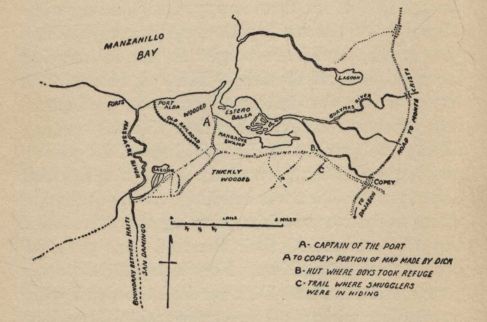
Map Showing Position of Hut in Which Boys Took Refuge
"Do you reckon they've decided to let us alone?"
"I don't know, Henry, but I'll know in a minute. I'm going out after our shotguns. We're pretty poor soldiers to leave our weapons lying all around the country," and Dick's grin was meant to convey the idea that the task he was about to undertake was not of much importance nor danger.
"Don't try it, Dick. Perhaps they are only waiting for us to show ourselves and then when we do they hope to pot us."
But Dick had rushed out of the doorway before Henry finished speaking. He zigzagged his way across the open space to about fifty yards, the point where he had rescued Henry, and with his reappearance another fusillade began. As Dick reached the spot he saw the two guns lying within a few feet of each other, and between them and the enemy was a small clump of green bush.
Back in the doorway Henry now sat watching with bated breath. He saw Dick stop in his mad rush, then he saw him throw up his hands in a wild gesture of despair and fall to the ground. That his brave friend was in great agony was evident to the helpless watcher. He saw Dick roll over and over, his arms and legs seeming to thresh the air. Finally the movements ceased and Dick lay stretched out like a log on the scorching hot plain. The tears rolled unheeded down Henry's cheeks, and then, hearing the loud victorious shouts of the natives as they streamed out from behind the shelter of the woods near the bend, and on across the plain, his lips pressed together and his eyes grew cold and stern, for the brain behind was dominated by but one thought, the desire to avenge his comrade.
With grim determination he placed all the spare magazines for his pistol within easy reach and drew his heavy Colt's from the holster. Not a man should ever reach Dick's body if the steady hand and cool nerve of Henry Cabell could prevent.
On came the natives, and Mexican Pete was leading them. Even as they came they continued firing at the hut and in the direction of the still body lying behind the little bush where it had rolled in the last struggles. Henry, unheeding the pain in his leg, rolled into the doorway on his stomach and, resting both elbows on the floor, he squinted over the sights and took careful aim at the Mexican. He meant to make every shot count, and so he waited until the leader should be within seventy-five yards of him. So intense was he on judging the precise moment to open fire that he saw nothing but this one man whom he covered with his pistol.
As he looked he saw the Mexican throw up his arms, whirl about and run back towards cover. What caused this? Henry lowered his pistol, and now saw the rest of the gang wildly scattering, leaving two of their number lying on the plain. The next moment Henry was rubbing his eyes to see if he were awake. The body lying in the shelter of the bush had come to life. Dick Comstock was working his shotguns with lightning rapidity, and clouds of dust flew up from the plain as the buckshot sprayed about among the fleeing men. As the last one was lost in the distant cover Dick ceased his fire and came running, with both guns in his hands, for the hut.
"Say, boy, but didn't I fool 'em?" he joyfully shouted as he sprang through the doorway. "Did you see me get 'em, Hank?"
"Old boy, I thought they had gotten you. I reckon I was pretty much all in too, Dick, when I saw you go down, and I was just about to open up when you began on them. It was sure a good trick you played, but, Dick, be careful to let me know about it the next time or I'll die of heart failure. Did they get you at all?"
"Not once; but one of their darn slugs took off my cap, right enough, and right then the thought flashed through my mind to play the trick. Whew! It's some hot out there, and, Hank, do you still see those two chaps that fell? I wonder if they're hurt, or--or---- Gee! I feel kind of squeamish, now that it's over," and Dick sat down rather suddenly with his back against the wall.
"No, they are not dead, Dick, for one of them jumped up and limped off when your fire stopped, and the other is yelling for help right now. Besides, they deserve no better fate, and our death would have meant nothing to them in the way of regret, at least."
"I feel better, after what you've said, but for a moment the thought of killing a man was making me sort of sick at my stomach. I didn't feel that way when I was shooting at 'em, though," and Dick took a deep breath of relief, then rising he looked out at the scene of recent conflict. Out in the middle of the plain the wounded native still called for help, but if his comrades were within hearing they made no attempt to render any assistance.
"I reckon those buckshot sort of stung a bit," snickered Henry; but his snicker ended in a little painful gasp that he tried in vain to control.
"I've got to get you out of here, Hank, and in a hurry. There is no telling what they'll do next, and they'll be back as soon as the first fright wears off. I believe that path back of the hut will take us to a creek which flows into the Estero Balsa and which the officers plotted in on the chart last week when I was with them. Anyhow, it's worth trying. If you feel well enough suppose you keep an eye out on the plain while I reconnoiter in the rear."
"Good; I feel fine, Dick, so go along, and I'll keep them off, don't worry."
In ten minutes Dick returned with the news that his surmise was correct, and as luck would have it, a small boat with two men was even then coming up the narrow creek. Taking Henry on his shoulder once more, Dick carried him to the bank of the creek, arriving there as the boatmen reached a point opposite. At his hail the boat was soon nosing the bank, and the natives inquired what was wanted.
"My comrade just met with an accident, and I wish to take him to the Captain of the Port's house; will you row us there?"
The two fishermen at first demurred, but Dick settled the matter by taking hold of the gunwale and at the same time drawing his pistol. It was no time to parley; in a moment they saw the force of his remarks. Henry was placed carefully in the bottom of the boat, and soon they were speeding down-stream.
Once during the passage the two boys looked at each other and winked knowingly, for from far upstream came the sound of numerous shots.
"Seems to be a lot of hunting in this country," said Dick aloud.
"Oh, yes, Señor, the doves are very plentiful this year," said one of the rowers.
Crossing the waters of the Estero, they drew up alongside the wharf, where they had landed less than twenty-four hours previously. One of the ship's boats was there, and the coxswain in charge hailed them.
"Hurry aboard, you leathernecks. I've all the stuff from your camp. The ship's under sailin' orders fer Nicaragua, where there's a hot little revolution goin' on. What's that, one of you hurt? Well, they shouldn't let boys carry guns anyway; they're all the time a-shootin' of themselves. Steady, lads! Handle him with care, and make a soft place fer him in the cockpit with them cushions. Shove off, for'rd! Full speed ahead! Say good-bye to this heck of an island, fellers; we're off this time, for sure!"
CHAPTER XX
"TO THE DITCH AT PANAMA"
"There goes the good old Denver, Mike. I guess she'll reach the fighting grounds before we do."
"Don't let that be for worryin' of ye, Dick, me lad," responded Corporal Dorlan. "We'll be havin' a bellyful of it, I'm thinkin', if all signs is correct. Nevertheless, she was one of the foinest little crafts I've ever served on, and they was a grand lot of Navy officers on her, too; but I'm glad to git back to the Corps again. I'm a marine, Dick, through and through, and though I get along with them Navy men well enough, I like to serve with me own kind best of all."
The old veteran and young drummer were standing on the wharf at Cristobal, at the Atlantic end of the ten-mile stretch of land across the Isthmus of Panama known as the Canal Zone, which by treaty with the Panamanian Government had come under perpetual control of the United States. Fading away in the dim distance was the ship which for many months had been Dick's official home. Diverted from her original orders, she had put in at Cristobal long enough to land all her marines, with the exception of Henry Cabell, who was still under the surgeon's care; and now she was bound for Bluefields, on the Mosquito Coast of Nicaragua. In order to fill existing vacancies in a regiment of marines hurrying to the scene of action on board the Naval Transport Dixie, which ship was just appearing above the distant horizon, the guard of the Denver had been unceremoniously "dumped on the beach," as the men put it.
There was no question that the revolution in progress, most active on the Pacific coast of Nicaragua, was a lively one. Marines were being assembled from all available points, even reducing the guard at Camp Elliott to a mere skeleton detachment. These men from the Zone were the first to leave for Nicaragua, and the army men stationed there had watched them depart with feelings of envy.
"Blame it all! Those marines are always getting into something. I'll bet I take on with that outfit the next time I sign up," more than one regular army "file" had been heard to say.
And that first lot of "soldiers of the sea" had already met with opposition. Even now they were somewhere between Corinto and the capital city, Managua. If they found the rails torn up, they repaired them; bridges burned, they built new ones temporarily. They were threatened with annihilation if they interfered, yet they continued with a dauntless, young and able leader at their head, relieving the fears of the foreigners in the interior and keeping the single line of railroad back to their base in fairly good order. Only this very audacity could assure the success of their undertaking, and also a possible misunderstanding on the part of Federals and Rebels as to which side "these interfering Yankees" were really there to help, though it was the bearers of the red rosettes who actively opposed their progress. American financial interests were jeopardized, and underlying all the fuss and furor were greater stakes than the general public realized.
Perhaps Drummer Richard Comstock and Trumpeter Cabell, in a talk before they separated that morning, were closer to the real reason for this strong force being despatched than were even the best informed officers of the expedition.
"I reckon a certain conversation you all overheard in Washington a year ago is bearing fruit," suggested Henry, looking up from his bunk in the sick bay where Dick had gone to visit him.
"It looks that way," Dick had replied.
"Well, if you run across a certain German and a three-fingered Limey,[#] Dick, you'll do well to keep an eye open. I sure wish I could go with you all, but we'll get together again before long; so good-bye, old boy, and good luck," and Henry turned to the wall to cover the emotion this separation caused him. Thus they had parted.
[#] "Limey"--British maritime regulations require the captain to issue regular rations of lime-juice as a preventative for scurvy. British ships and sailors are therefore known as "Lime-juicers," or in sailor slang, "Limeys."
Steadily the transport grew upon the vision of those awaiting her arrival. Finally, when she came alongside her berth, the place became a seething ant-hill of activity. Tons and tons of rations, tents, munitions, wireless outfits, buckets, clothing, field ranges, medical supplies, field artillery, and the thousand other things necessary for extensive operations were sent up out of the ship's holds and packed on freight cars, and soon trains of men and supplies were slowly creeping from under the railroad sheds, out past Monkey Hill, on and on, with ever-increasing speed, towards the Pacific terminus at Balboa.
Much to Dick's pleasure and Corporal Dorlan's satisfaction they found themselves detailed for duty with a company commanded by an old acquaintance, Captain Kenneth Henderson, formerly in charge of the Marine Detachment of the U.S.S. Nantucket.
"Well, Sergeant Dorlan, I'm glad to have you back under my command," said the Captain as he shook hands; "report to the First Sergeant at once, and tell him I said you are in charge of the working detail loading the cars." Then he turned to Dick. "Where have I seen you before, music? Your face looks familiar, but I can't place you."
"I met the Captain on the Nantucket, sir, if the Captain remembers the day we were upset by a motor boat and Dorlan rescued Tommy Turner."
"Now I know! You are Drummer Comstock. Your friend's uncle asked me to keep an eye on you in case I ran across you. How is it that you are a drummer? I understood you enlisted to get a commission."
"I hope to have my rank changed before long, sir, but at the time I enlisted they were taking only musics into the Corps."
"Does this young man know anything? Can we make a corporal out of him?" asked Captain Henderson, turning to Dorlan, who still stood at attention near by.
"Indeed he's a broth of a lad, sir, and knows more'n most of the corporals right now, but if the Captain will excuse me, I wanted to explain before goin' to the First Sergeant that I'm only a corporal meself, sir. Ye may disremember I was reduced in rank over a year ago."
"I remember it very well, Dorlan; but from to-day on you are again a sergeant. So get busy with that work of loading. As for you, music, I'll make you my orderly for the present. Go aboard, find my mess boy, Jackson, and get my luggage on that train. It is already packed. Then present my respects to the Colonel, and tell him my company is ready to move any time he sends me word."
Thus it was Dick found himself on board the first troop train to cross the Isthmus. He was well repaid now for the hours he had devoted to his graduation essay. At that time he had gone deeply into the subject and since then, while cruising in the West Indies, many times his previous reading and study had been of great help. The history of the Panama Canal was a favorite subject, and now he verified his book knowledge by actual experience. The sight of the vast area already flooded as a result of the nearly completed dam at Gatun, the names of Frijoles, Bas Obispo, Camp Elliott, Cucaracha, Pedro Miguel and Miraflores brought back to his mind afresh the disappointments of the French and the difficulties overcome by his country. At one place on the road a dirt train held them up for a short space of time, and from the car window he caught glimpses of the mighty Bucyrus steam shovels scooping up tons of earth and rock in their capacious maws with almost human intelligence. The new line they travelled passed to the east of Gold Hill, back of which was Culebra Cut, where the slipping, unstable earth caused so much delay, disappointment and expense by its dangerous slides. Every where were scenes of activity! Hundreds of cars and engines, empty trains, trains filled with excavated earth, trains of freight, passenger trains, workmen's trains, thousands of men, negroes from the South and the West Indies, Spaniards, Englishmen, Frenchmen, Chinese, Latin-Americans, full blooded Central American Indians, Hindoos from the Far East, all busy, all hustling, even in this tropic zone. They passed through little villages and settlements, each a reminder of the fabled "Spotless Town," with their excellent roads, splendid drainage, immaculate, screened buildings, stores, boarding-houses, hotels, public buildings and residences, all under the supervision of the Government. How proud the young drummer was to be a part of this big republic which did things on such a wonderful scale; that he served this country which flung to the breeze the Stars and Stripes: that he was even then on his way to help a misguided people, who, under the far-sighted provision of that Doctrine of President Monroe, now needed a helping hand to guide their ship of state over treacherous waters: that he was Richard Comstock, United States Marine.
All too soon the passage of that narrow neck of land was completed, and the train pulled in under the sheds of the Balboa wharves. Again the hustle and bustle, for close behind followed freight trains and more troops, and the work of unloading the cars and filling up waiting lighters was begun.
Men's hands, unaccustomed to the rough work, blistered and went raw, their backs ached, their muscles grew stiff and strained, the perspiration soaked their khaki clothing a dark brown color, but cheerfully they stuck to their task. And truly it was Herculean, for after being placed aboard the lighters the stores were towed alongside a great gray battleship lying far out in the harbor, where they again had to be transferred aboard and stored away.
The companies worked in two-hour shifts, one battalion being detailed at each of the transfer points. They arrived at Cristobal at noon, and a little after midnight the work ashore had been completed. Captain Henderson's company was one of those detailed for work on the Balboa wharves, and shortly before ten o'clock he started in a motor car for the city of Panama, taking his newly appointed orderly with him. About the time the relief shift was to go on they returned, laden down with sandwiches of all kinds and several big freezers of ice-cream with which to regale officers and men. The cooks in the meantime had made gallons of hot coffee, and when mess-call sounded, never was food and drink more welcome than to those dirty, grimy, sweat-laden marines, who, seated on box or barrel, gun carriage or packing case, in the glare of many cargo lights, munched and drank to repletion. Then "carry on" was sounded, and with cheerful shouts and renewed vigor they tackled their task.
By six o'clock the next morning the big ship slowly swung her bows out towards the ocean of Balboa, the mighty Pacific, and laid her course for Corinto, Nicaragua's principal seaport on the west coast.
Then it was that Dick Comstock realized he was tired--good and tired, but there could be no rest for the weary. Every man must first know to which boat he was assigned in case of "abandon ship," what he was supposed to do in case of fire, where he was to berth; then there were roll calls and cleaning ship and stowing away the stores on deck, and it was dark once more before the willing workers finally found the time and the place to catch a little sleep. But it was all worth while when the Colonel Commanding sent around to each company his official word of praise: "No body of men could better their record, and he doubted if any could equal it," so read the memorandum. And Dick, curled up in an unoccupied corner on deck, fell asleep, while ringing in his ears was that well-known stanza of the Marines' Hymn which a group of still energetic Leathernecks were softly singing somewhere up near the bridge:
"From the pest hole of Cavite
To the ditch at Panama,
They're always very needy
Of marines, that's what we are,
We're the watch dogs of a pile of coal
Or we build a magazine,
Though our duties are so numerous,
Who would not be a Marine?"
CHAPTER XXI
THE MARINES HAVE LANDED
"That's a fine-looking engine," said Dick, three days later, as he gazed, with a derisive laugh, at the locomotive backing onto the wharf at Corinto to couple up with a train of laden flat cars ready to start on the precarious journey to support the battalion of marines somewhere along the line, but just where no one rightly knew.
And indeed it was an engine of a type quite new to most of the marines perched on every available sticking-place amid the boxes, barrels and bales with which the train was laden. A care-free, jovial lot of huskies they were, taking this back-breaking work as a mere matter of course. They were marines, so it was their just due to be chased from one corner of the world to the other; and if it had not been so, they would have said disgustedly that they "might as well be in the Army." The world moved and the marines moved with it; they themselves were sometimes inclined to think they moved it.
"The only place I ever saw an engine of that type was on those blue three-cent stamps the United States put out for the centennial celebration many years ago," remarked a junior officer, seated near Dick on the floor of the car, with his feet swinging idly over the side.
"You are not much of a philatelist, Mr. Mercer," said Captain Henderson, who happened by, "or you would have known of other postage stamps with an engraving of the wood-burning type of engine on their face. This country we are now in uses a series of them over on the Mosquito Coast, and Honduras has another series. But I see we are about to start. Pass the word to fix bayonets: no rifles to be loaded without command. Each man must understand this affair is being handled with kid gloves, and they must not precipitate things by any hasty action on their part. Remember, too, that we are here to keep order, and unless interfered with we will go about our business quietly. To us, at the present time, all Nicaraguans are our friends until they prove otherwise. Treat both parties alike until you get orders to the contrary. Those men wearing red rosettes and ribbons are 'agin the government'; they are rebels; so be careful of your every act."
The engine with its enormous bell-topped stack by now had bumped into position and with a jerk and wrench and creaking of wheels the journey was begun.
All along the route could be seen small bands of men. Some carried rifles, but the majority were armed with long knives, called machetes. Many sported uniforms, but most were attired in ordinary clothing, the little red badges identifying them with the insurgent forces.
Hour after hour they clattered and bumped along the fearful road-bed. Forward! Bump, stop! Bump, ahead! Stop! Little by little, mile after mile, they progressed. Here the rails were slippery, and with shovel in hand the men jumped off the cars and covered them with dirt so that the wheezy engine could once more proceed. At a town named Quezalgaque, just as darkness fell, the engine ran out of water. A bucket line was formed down the steep river embankment at this spot and under the glare of flaming torches the men worked filling the boiler till the Navy Machinist in charge of the engine stated the gauge was "full up." Then forward once more with the cheers of the detachment of Uncle Sam's sailors, stationed here to guard the bridge, ringing in their ears.
The night was so black that it was difficult to see one's hand before one's face and when, after about five miles more of bumping and thumping had been covered, the train again halted, word passed from the head of the train for no one under any circumstances to leave the cars. There seemed to be a mysterious something in the air, as of a dense crowd of humanity pressing in from all sides, yet there was no sound, other than the puffing of the wood-burner at the head of the train.
"Wonder what makes this place so spooky like?" whispered Dick to Dorlan, who sat beside him filling his old corn-cob pipe preparatory to lighting up; "I have a feeling that if I put my hand out I'd touch some human being; and yet I can't see a thing in this blackness."
Dorlan did not reply, but the light from his match made a small glare in the surrounding night. Small as it was the men in his immediate vicinity were startled at what it disclosed. A sea of faces, a forest of armed men, crowded up to the very edge of the track on all sides.
"Whew! Did you see them?" whispered a man near Dick. "Every beggar in sight has a gun, and here we are right in the middle of 'em, and we didn't know it."
There was a restless movement on the part of the marines. Those who had been drowsing awakened, to grip more firmly the rifle which, since darkness, no longer held the knife-like bayonet. One man quietly opened the bolt of his rifle and nervously fingered a clip of cartridges in his belt.
"Easy, men!" came the caution down the length of the train, and the slight flutter of nerves calmed to steadiness. But the tension was there, and only the excellent discipline held them in check, for these rebels were too close for comfort. Then followed the slow ringing of the locomotive's bell, brakes were released and the train moved on, crossed a high trestle bridge, and again halted.